

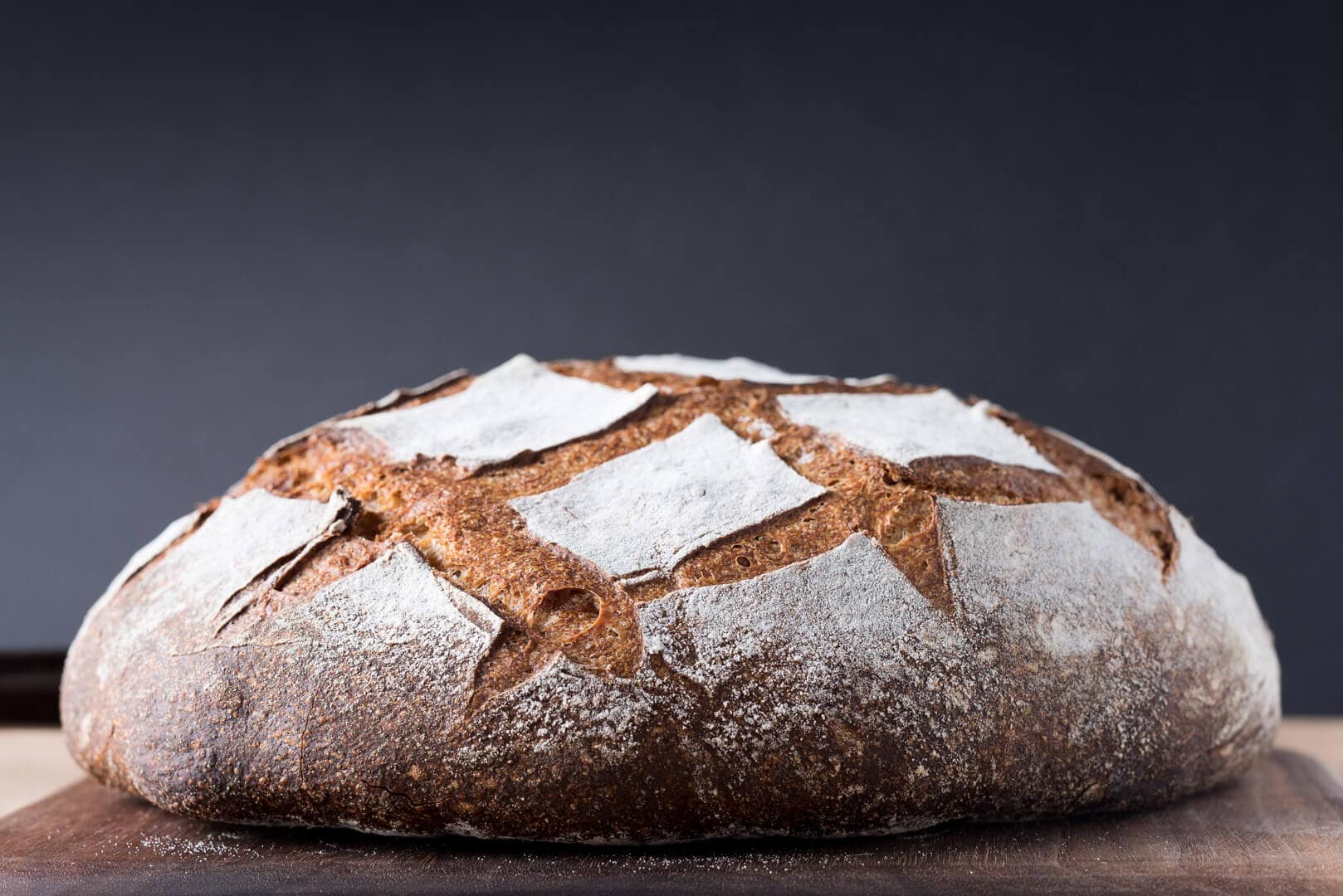
This hefty einkorn miche bread recipe embodies community. Substantial in size, it is the ideal centerpiece for breaking bread with others, and its hearty flavor and nourishing quality will hearten all who gather at the dinner table. The loaf is so heavy it requires two hands to lift— oh, what a statement it makes.
Miche are large, round country-style loaves. Traditionally, they were meant to sustain a family for the days between their turn baking in the communal oven (and with natural leavening and all the subtle acidity built up through lengthy fermentation, they certainly will stay good for a long time. As you know, sourdough bread keeps incredibly well due to the natural acids produced as a byproduct of lengthy fermentation.
If you think about it, a massive round loaf is probably the most efficient way to bake large quantities of dough: It takes up less space in the oven, has plenty of crust, can be divided and wrapped up, and if it’s meant to go to a single destination, a single loaf makes sense. A true daily bread.
Over time as the central community oven became increasingly scarce, these large loaves began to fall out of favor, and they were replaced by more ephemeral bread meant to be consumed entirely on a baking day. But there’s still a place for this beautiful and enticing loaf.
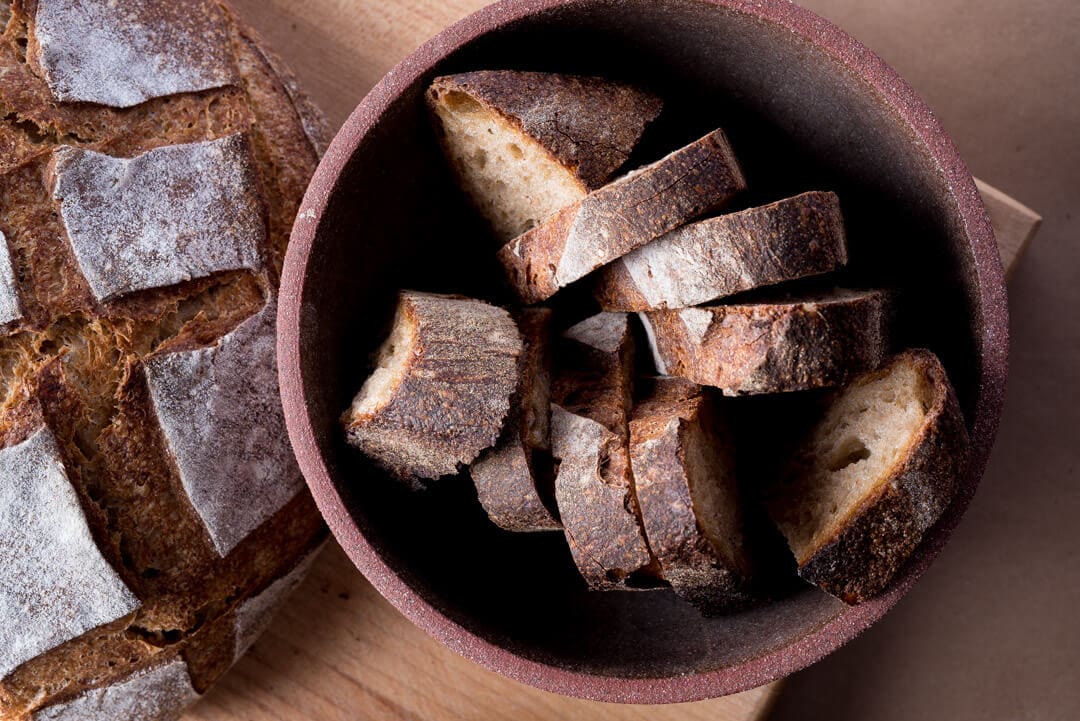
The high percentage of freshly milled einkorn and high extraction flour mean this is wholesome bread. Each bite feels good; it makes your body feel good; you know it’s healthy food. Real bread. I find the flavors in this loaf continue to develop and intensify one to two days after baking, and it’s the second day after baking when I find the flavor of einkorn at its paramount: nutty, sweet, and, dare I say, buttery.
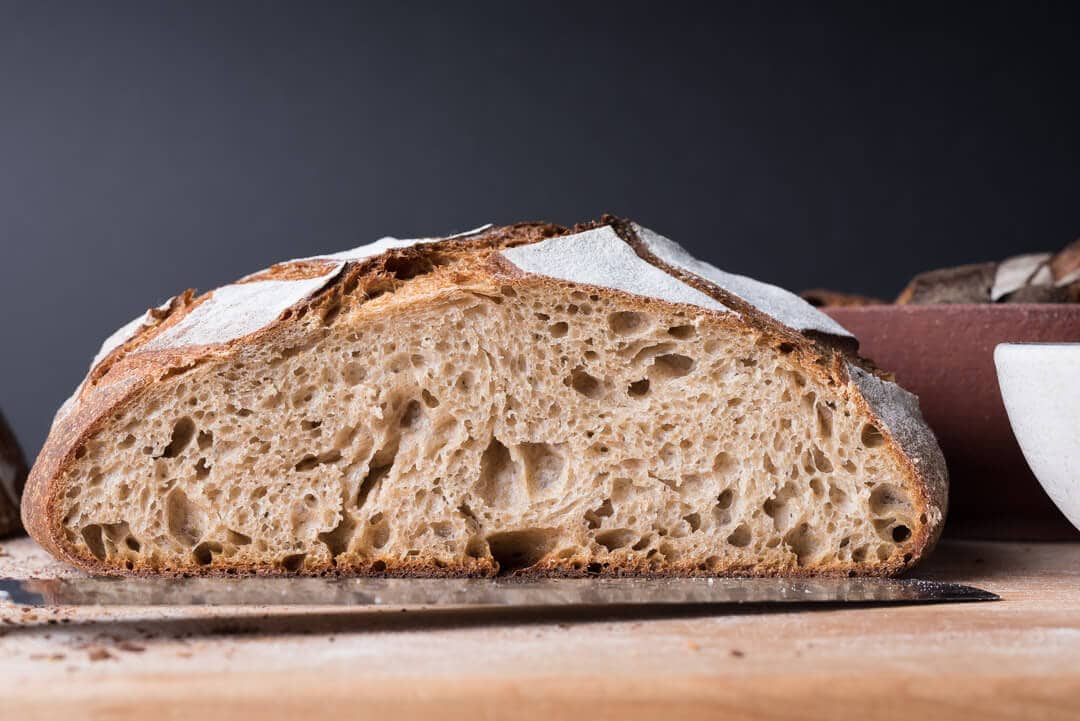
The texture of the crust in this miche is phenomenal.
The texture of the crust in this miche is phenomenal. It’s crisp and substantial but not overly husky or overbearing; it’s the perfect match to the supple interior. It carries a wide range of colors, from light tans to dark hazel, and each slice has its character.
While the nature of this bread is rustic, it isn’t devoid of sophistication. The spacious round invites the baker to exercise creativity with scoring, as the loaf’s vast top surface is a perfect canvas for intricate designs or, as I show below, symmetrical patterns. With a beautiful score, a miche never fails to rouse awe and even a surprised grin when you hand it over to the dinner host proclaiming, “Here’s just a little something for the table.”
Flour selection
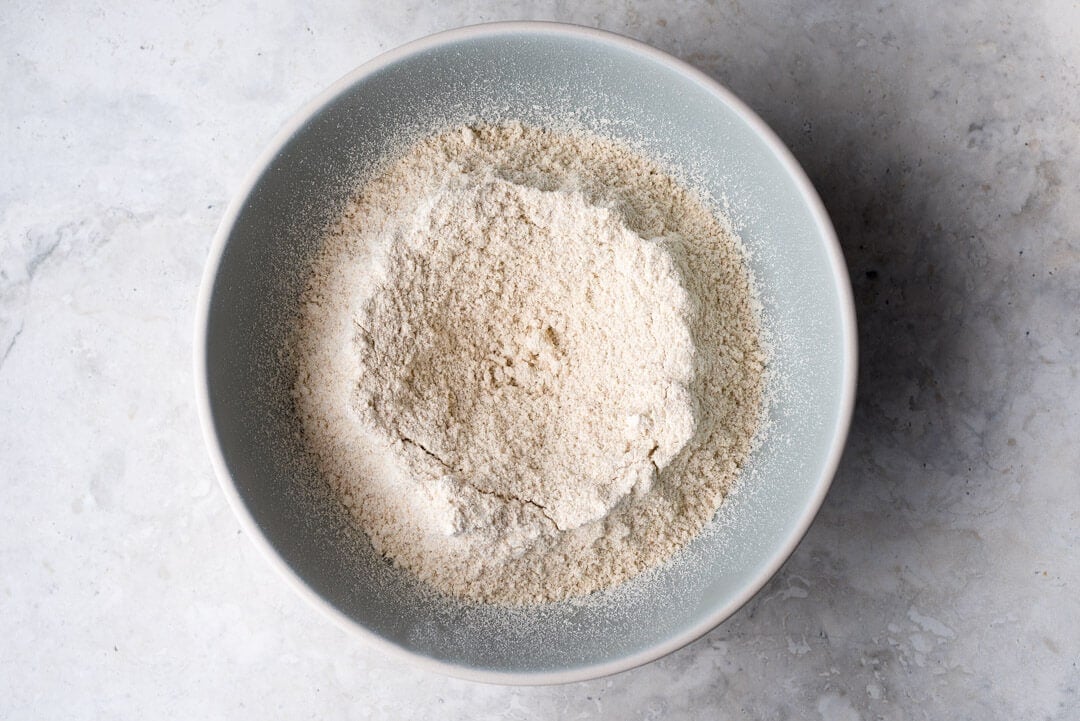
Einkorn grain and flour
I’ve been milling around (no pun intended) for far too long, trying to decide where first to use einkorn. I’ve read about its wonderful flavor, texture, and color. But I’ve also heard that it can be challenging at 100% extraction (whole grain) due to the nature of the grain’s protein: while the protein content is high for wheat (which is great, nutritionally), its delicate nature makes baking high-hydration hearth-style loaves more challenging. Therefore, in this recipe, I pair einkorn with a small percentage of high protein flour (“bread flour”) to achieve the balanced texture I’m after. But with a miche, we’re not looking for a dramatically open crumb or explosive oven spring; a miche is more about taste and texture—two things einkorn has in spades.
Right out of my grain mill, fresh einkorn flour has a silky feel and a buttery yellow complexion. The flour floats down in sheets and clumps readily when squeezed in hand—a good sign that the natural oils are preserved in the flour. It also has a remarkable aroma when the flour first touches water. All of these characteristics help produce a strikingly flavorful bread.
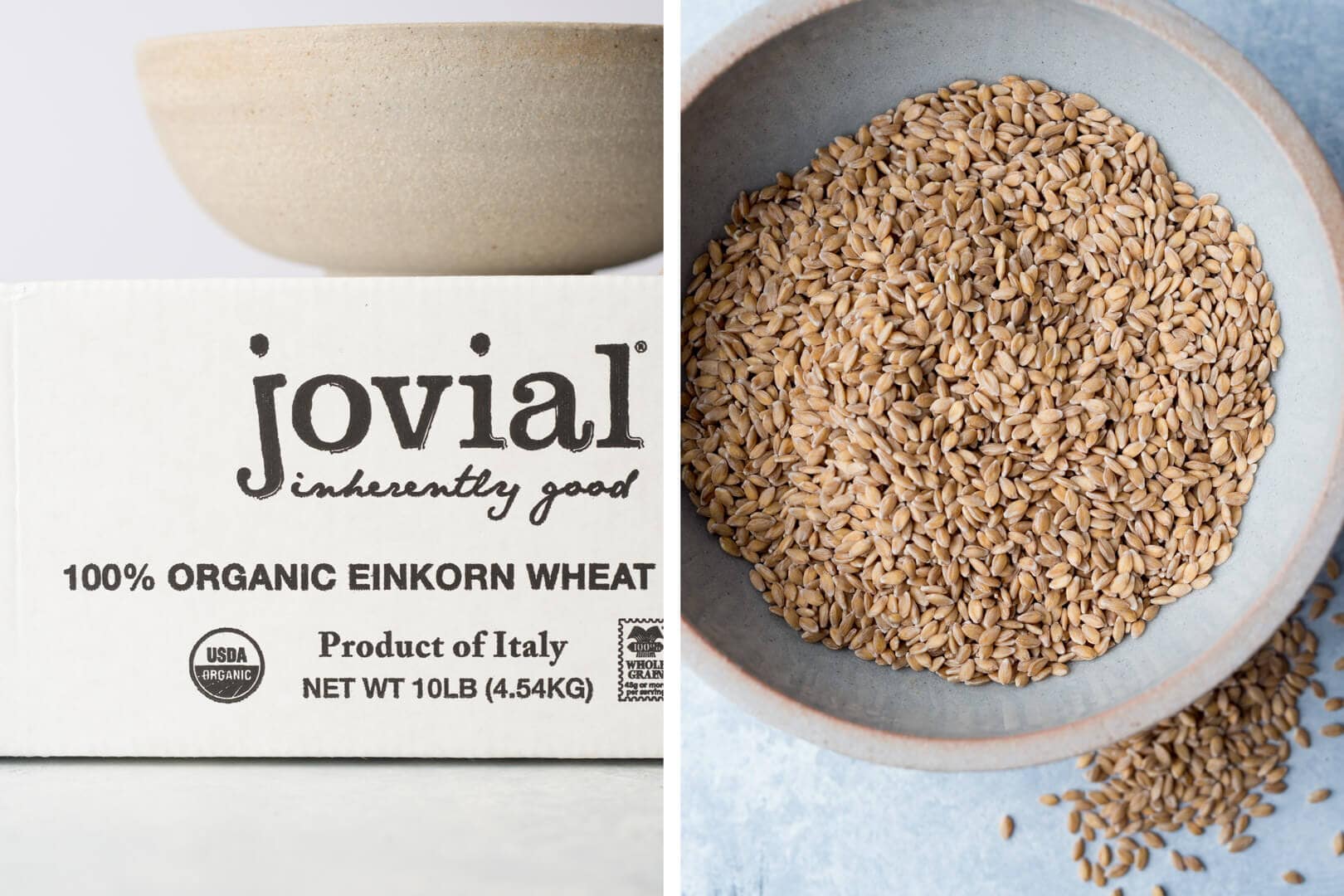
Jovial brand’s einkorn is entirely organic (and sourced from Italy!), and whole einkorn berries are available on their website. If you cannot mill your flour at home, Jovial sells whole grain einkorn flour, all-purpose flour, and even sprouted flour. (Many thanks to Jovial for sponsoring this post!) These options would be first-class substitutions for the freshly milled einkorn listed in my formula below, but know that choosing the all-purpose option will yield a milder flavored loaf, potentially with a more open interior too.
If you don’t have access to einkorn, I would experiment with freshly milled, or aged, whole red wheat in its place; the pronounced flavor of red wheat will add depth of flavor to the loaf. If you take this route, I would also add a small percentage of whole-grain rye flour (even just 5% will be noticeable) to round everything out.
Type 85 flour
I paired the einkorn flour with a high-extraction type 85 flour, which lands somewhere between whole wheat and white flour. The type 85 flour in the mix is appreciable and brings a nice wheaty backdrop, but it plays the second stage to the prominent einkorn flavor, which is the focus of this miche bread recipe.
If you don’t have high-extraction flour on hand, you can approximate this flour by blending about 70% white bread flour with 30% whole wheat flour. Another option is to bolt (sift) your own freshly milled flour.
Baking schedule
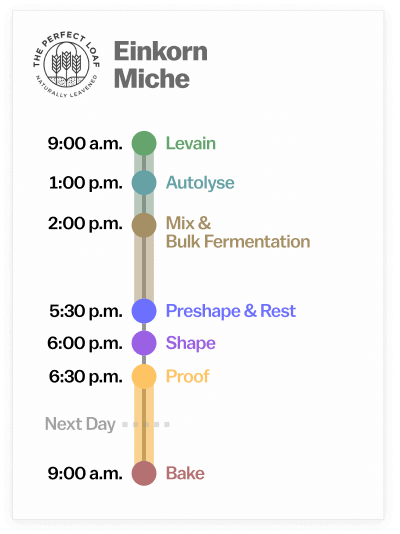
This miche bread recipe is made over two days, which gives the dough plenty of fermentation time for a deep and complex flavor.
It’s also possible to bake this loaf all in a single day by allowing the dough to proof on the counter, shaped and covered, until the dough is puffy, relaxed, and passes the dough poke test.
Einkorn miche bread recipe
For tips on calculating baker’s percentages or modifying this formula, see my post on baker’s percentages (baker’s math).
Vitals
| Total dough weight | 1,500 grams |
| Pre-fermented flour | 7.5% |
| Levain in final dough | 16.2% |
| Hydration | 85.0% |
| Yield | One large miche |
Total formula
Desired dough temperature: 78°F (25°C) (see my post on the importance of dough temperature).
| Weight | Ingredient | Baker’s Percentage |
|---|---|---|
| 393g | Type 85 flour (Cairnspring Trailblazer Type 85) | 50.0% |
| 236g | Whole grain einkorn flour, freshly milled | 30.0% |
| 157g | High-protein bread flour (~12.7% protein, King Arthur Bread Flour) | 20.0% |
| 629g | Water 1 (levain and autolyse) | 80.0% |
| 39g | Water 2 (mix) | 5.0% |
| 1g | Diastatic malt powder (optional) | 0.1% |
| 16g | Fine sea salt | 2.0% |
| 29g | Ripe sourdough starter, 100% hydration | 3.8% |
Einkorn miche bread method
1. Prepare the levain – 9:00 a.m.
| Weight | Ingredient | Baker’s percentage |
| 59g | Type 85 flour | 100.0% |
| 29g | Water 1 (levain) | 50.0% |
| 29g | Ripe sourdough starter, 100% hydration | 50.0% |
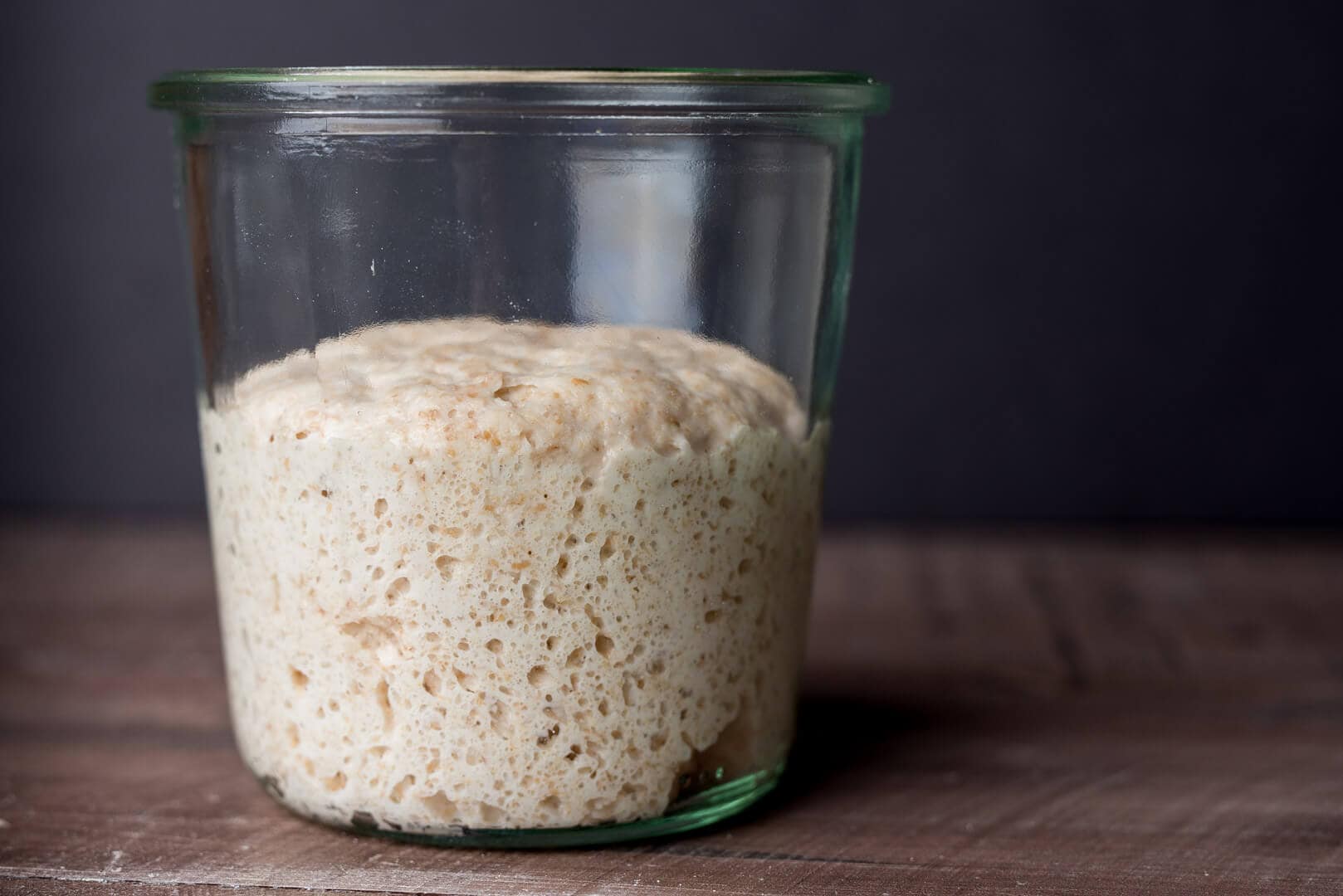
Mix the ingredients in the chart above in a jar and leave them covered at a warm temperature, 74-76°F (23-24°C), to ripen for 5 hours. This is a stiff levain, and if it is exceedingly hard to knead the ingredients together, use a little more water to make incorporation easier.
2. Autolyse – 1:00 p.m.
| Weight | Ingredient |
| 334g | Type 85 flour |
| 236g | Whole grain einkorn flour |
| 157g | High-protein bread flour |
| 599g | Water 1 (autolyse) |
| 1g | Diastatic malt powder |
I use the autolyse technique for this miche bread recipe to help reduce the total mixing time required.
Warm or cool the autolyse water so that the temperature of the mixed dough meets the FDT (final dough temperature) of 78°F (25°C) for this recipe. Place the flour, optional malt powder, and water 1 in a large bowl. Use wet hands to mix until no dry bits remain; the dough will be shaggy and loose. Use a bowl scraper to scrape down the sides of the bowl to keep all the dough in one area at the bottom. Cover the bowl and place it near your levain for 1 hour.
3. Mix – 2:00 p.m.
| Weight | Ingredient |
| 94g | Water 2 (mix) |
| 17g | Fine sea salt |
| 117g | Ripe levain (from Step 1) |
Add the salt and levain to the top of the dough in autolyse and use a splash of water 2 to moisten. With wet hands, mix thoroughly. Add the remaining water if the dough feels like it can handle it. Next, knead the dough for a few minutes using either the slap and fold technique or folds in the bowl. For this dough, I kneaded for about 5 minutes until the dough smoothed and became elastic.
Transfer the dough to a bulk fermentation container and cover.
4. Bulk fermentation – 2:30 a.m. to 5:30 p.m. (3 hours)
At a warm room temperature, 74-76°F (23-24°C), bulk fermentation should take about 3 hours.
This dough will require 3 sets of stretches and folds during bulk fermentation. After the first 30 minutes, wet your hands, grab the side of the dough farthest from you, and stretch it over to the other side. Rotate the bowl 180 degrees and repeat. Then rotate the bowl a quarter turn and stretch and fold that side. Rotate the bowl 180 degrees again and finish with a stretch and fold on the last side. The dough should be neatly folded up in the bowl. Cover and repeat these folds every 30 minutes for a total of 3 sets of stretches and folds. Then let the dough rest, covered, for the remainder of bulk fermentation.
5. Preshape – 5:30 p.m.
After 3 hours, the dough should be well-risen in the bulk fermentation container and puffy to the touch. The edge where the dough meets the container should be domed downward, showing strength and rise.
Fill a small bowl with water and place it next to your work surface. Scrape the dough onto a clean counter. With your free hand wet and bench knife in the other, preshape the single piece of dough into a loose round.
Let the dough rest, uncovered, for 30 minutes.
6. Shape – 6:00 p.m.
Flour the top of the preshaped round and your work surface. Using your bench knife, flip the round over onto the floured area. Using floured hands, shape the dough into a boule (round). Gently transfer the dough to a proofing basket at least 8 inches in diameter, seam-side up.
The 8-inch round baskets I’m using for this recipe can be found at SFBI.
7. Proof – 6:30 p.m. to 9:00 a.m.
Cover the basket with a large, reusable plastic bag and seal shut. Place the basket in the refrigerator to proof overnight.
8. Bake – 9:00 a.m.
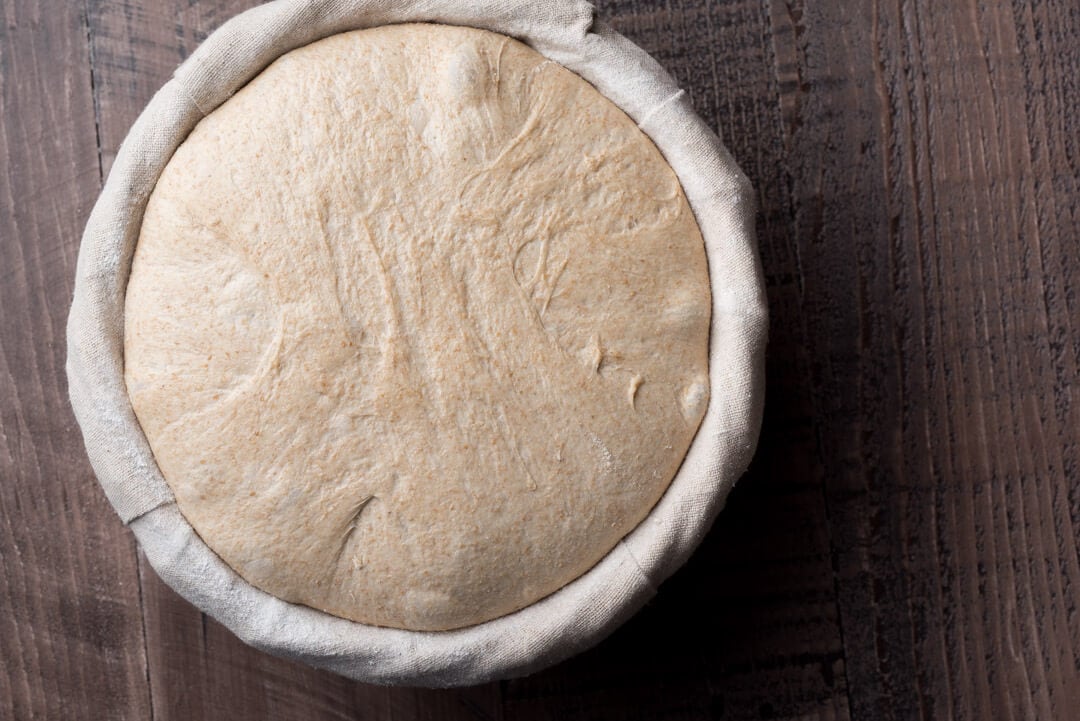
Place an oven rack in the bottom-third of the oven and preheat it to 450°F (230°C). Due to the large size of this loaf, a typical Dutch oven or Combo cooker may have trouble fitting the dough. I prefer to bake this miche directly on a baking surface and steam my oven. See my guide to steaming a home oven for bread baking for instructions.
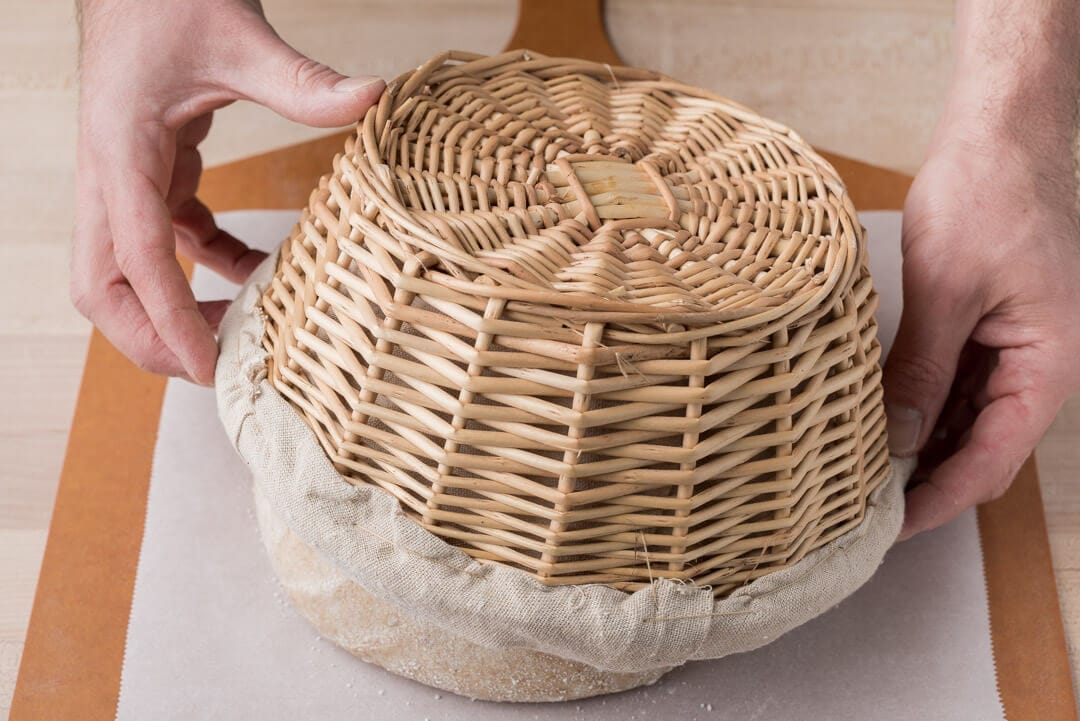
Take the proofing basket out of the fridge, uncover it, and put a piece of parchment paper over the basket. Place a pizza peel or inverted baking sheet on top of the parchment and, using both hands, flip everything over. Gently remove the basket and score the dough.
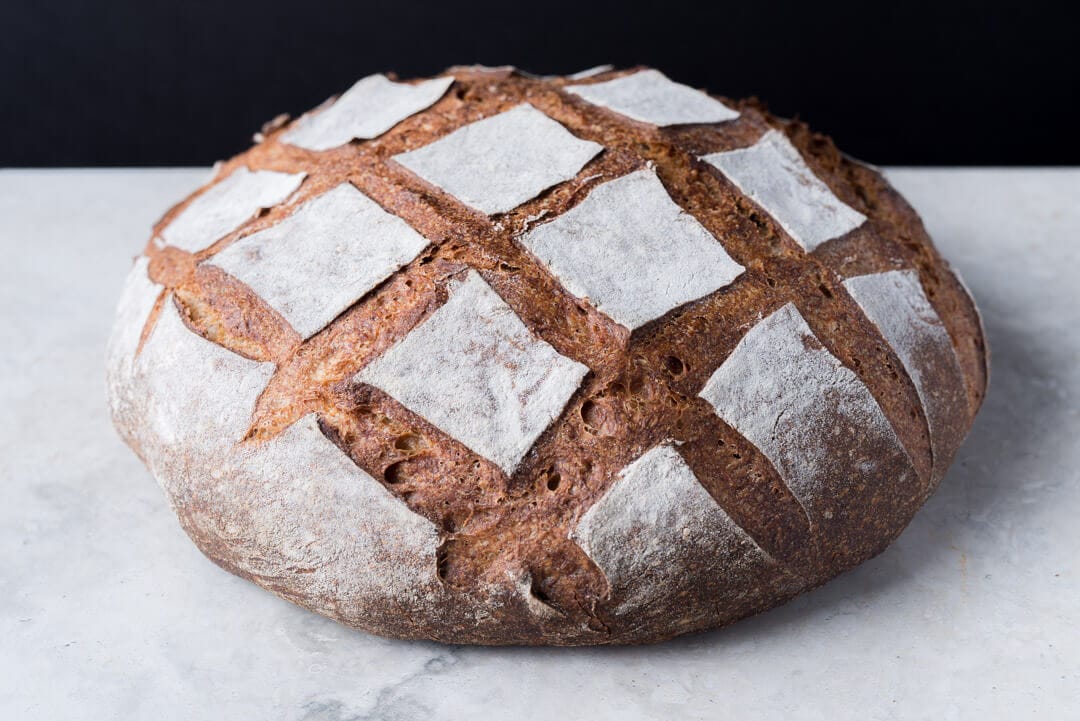
I like to score this miche bread recipe dough with a cross-hatch design on top, but any scoring pattern for a boule will work well. See some more bread scoring ideas in my video, below:
Slide the dough into the oven. Steam the oven by pouring ice into the preheated pan at the bottom of the oven. Bake for 30 minutes. Vent the oven of steam by removing the steaming pans. Continue to bake for 35 minutes more. When done, the loaf should have an internal temperature of around 204°F (95°C), and the crust should be deeply colored. Let the loaf cool on a wire rack for at least 3 to 4 hours before slicing.
The final baked miche bread recipe will keep well for at least a week if the bread is stored properly.
Print
Einkorn Miche Bread Recipe
- Prep Time: 25 hours
- Cook Time: 1 hour, 5 minutes
- Total Time: 26 hours 5 minutes
- Yield: 1 loaf
- Category: Dinner, Main course
- Method: Baked
- Cuisine: French
Description
A large loaf with a complex and lingering flavor. This miche is perfect for large gatherings or as a single bread to sustain a family for an entire week.
Ingredients
Levain
- 59g Type 85 flour
- 29g Water
- 29g Ripe sourdough starter, 100% hydration
Autolyse
- 334g Type 85 flour
- 236g Whole grain einkorn flour, freshly milled
- 157g High-protein bread flour
- 599g water
- 1g diastatic malt powder
Main dough
- 94g Water
- 17g Fine sea salt
- 117g Ripe levain
Instructions
- Levain (9:00 a.m.)
In a small bowl or jar, mix the Levain ingredients. Cover the jar and keep it at a warm temperature for 5 hours. - Autolyse (1:00 p.m)
In a mixing bowl, add the autolyse ingredients until no dry bits remain. Cover the bowl and let rest for 1-hour. - Mix (2:00 p.m.)
Add the about half the water 2, salt, and levain to the top of the dough that was just in autolyse. With wet hands, mix thoroughly. Next, knead the dough for a few minutes (I used the slap and fold technique) until elastic and slightly smooth. If it feels like the dough can handle it, add the remaining water 2. Mix by pinching and folding until the ingredients are thoroughly incorporated and the dough is cohesive. Transfer the dough back to the bowl or to a container for bulk fermentation and cover. - Bulk Fermentation (2:30 p.m. to 5:30 p.m.)
This dough will require 3 sets of stretches and folds during bulk fermentation. After the first 30 minutes, wet your hands, grab the side of the dough farthest from you, and stretch it over to the other side. Rotate the bowl 180 degrees and repeat. Then rotate the bowl a quarter turn and stretch and fold that side. Rotate the bowl 180 degrees again and finish with a stretch and fold on the last side. The dough should be neatly folded up in the bowl. Cover and repeat these folds every 30 minutes for a total of 3 sets of stretches and folds. Then let the dough rest, covered, for the remainder of bulk fermentation. - Preshape (5:30 p.m.)
Fill a small bowl with water and place it next to your work surface. Scrape the dough onto a clean counter. With your free hand wet and bench knife in the other, preshape the single piece of dough into a loose round. - Shape (6:00 p.m.)
Lightly flour the top of your preshaped round and using floured hands, shape the dough into an round (boule) shape, then place the dough in its proofing basket, seam side up. - Proof (6:30 p.m. to 9:00 a.m. the next day)
Cover the proofing basket with reusable plastic and seal. Then, place it into the refrigerator and proof overnight. - Bake (The next day, 9:00 a.m.)
Place an oven rack in the bottom-third of the oven and preheat it to 450°F (230°C). I bake this miche directly on a baking surface and steam my oven. See my guide to steaming a home oven for bread baking for instructions. Take the proofing basket out of the fridge, uncover it, and put a piece of parchment paper over the basket. Place a pizza peel or inverted baking sheet on top of the parchment and, using both hands, flip everything over. Gently remove the basket and score the dough. Slide the dough into the oven. Steam the oven by pouring ice into the preheated pan at the bottom of the oven. Bake for 30 minutes. Vent the oven of steam by removing the steaming pans. Continue to bake for 35 minutes more. When done, the loaf should have an internal temperature of around 204°F (95°C), and the crust should be deeply colored. Let the loaf cool on a wire rack for 3 to 4 hours before slicing.
Notes
If you don’t have diastatic malt powder, it can be omitted.
If you don’t have type 85 flour, substitute it out for a mix of 70% bread flour and 30% whole wheat flour.
What’s next?
While a large, deeply flavorful miche is a really wonderful thing, the other side of the spectrum can be delightful, too. Check out my recipe for sourdough baguettes: ultra-crunchy, very mildly flavored, and light in hand—perfect for a delicate sandwich or simply sliced and topped with butter.
If you use this recipe, tag @maurizio on Instagram so I can take a look!


74 Comments
Hello Maurizio, I am trying to divide this process into 3 days. Can the Levain be mixed and then used 12 hours later? Can they still proof overnight in the refrigerator?
What flour could be used in place of type 85?
Hi! Can I use your Hayden Mills TPL flour in lieu of Type 85?
Yes, will work really well there, Jennifer!
Will this boule fit in the Brod and Taylor Boule Baking Shell?
Yes, it will!
Could a Central Mills T110 be a substitute for Type 85?
Yup, absolutely. Especially in this bread.
Hi! First, thank you for this. Second, I am apparently highly sensitive to wheat and gluten (Docs suspected celiac, but I never went far enough to find out for sure. I just avoided gluten completely for nearly 14 years.). A few months ago I started developing a home-milled whole-grain Einkhorn starter. It has been a somewhat frustrating process. I am able, after close to 10 weeks of 2x daily feeds on the counter, to make less-dense/less-sour batter loaves. It's still early, but I seem to be able to tolerate bread made entirely of Einkhorn. My question here is this: Could I use a gluten-free all-purpose flour in lieu of the Type 85 flour and high-protein bread flour in this recipe once my starter is fully functional? I have loads more questions, but I didn't want to even attempt this if there's no possibility of this combination working out at all. I checked out your book, but I saw in one of the comments that there aren't any Einkhorn recipes in it and, I really need to use Einkhorn apparently. Thanks so much for your help! :o) I'm thoroughly enjoying reading through all of your suggestions.
I think this is possible, yes. I would start with an all einkorn or mix of gf + einkorn pan loaf instead of a free-form loaf like this. Check out my high-fiber loaf as an example, and swap out the wheat or einkorn and gf:
https://www.theperfectloaf.com/high-fiber-sourdough-bread-recipe/
Of all the recipes I’ve tried, this was the biggest failure. My dough was so sluggish that even though it had risen quite a bit, after 3 hours it was still like pudding (and I didn’t even add water #2). I had to add 150g of flour and do slap and folds for 10 minutes to make it look like a dough, and even then it’s still super slacky…
Einkorn is difficult to work with, to be sure. It sounds like maybe your starter wasn't ripe or your dough might have needed a bit more. BUT! Be careful because a dough with a lot of einkorn will be sticky and wont rise the same as a modern wheat dough, it'll have less overall.
Wow! What a fantastic bread! This is such a flavorful loaf with richer and deeper flavors peaking after 2-3 days. It’s now my family’s favorite bread.
Following your message of caution I ended up scaling the water back by nearly 100g in total but otherwise followed your recipe exactly. My first bake using Einkorn….where have I been ? lol! This recipe is highly recommended and not to be missed. Thank you.
So glad you liked this MG!
I didn’t think sourdough could get any better until I tried this. Crust, crumb, texture, aroma are all so over the top. In my first attempt, I used all the water indicated and it was challenging to shape but still a delight to eat. I have scaled that back some and the outcome is divine. The size of the loaf makes it imperative to share with friends and family and aren’t they lucky. Thank you so much for this recipe.
Fantastic, happy you liked this recipe, Phyllis!
I recently received your bread book and it’s amazing! I have attempted to make the Eikorn Miche bread twice two days apart and have thrown out the sourdough batch both times during bulk fermentation after S&F’s because it turns out to be a big sticky glob. The 1st time I knew something was wrong with the Levain amount to add to Autolyse even though I printed the recipe from the website. I then looked at the recipe again online and compared with what I had printed out and saw the error and that it had been corrected on your end. This was just this past week. So this morning I attempted to start over with the corrected recipe. But once again the texture of the dough is so soft, it seems to do well after a set of S&F, feels right but then just relaxes to a sticky mess and the the same repeat. I didn’t add all of the water 2 during the Mix. But I can’t figure out what I’m doing wrong. I have the 85 flour from Central Milling and the Eikorn flour, malt powder. Would love to make this bread so will look forward to hearing back from you! Thank you, Patti
So glad you’re enjoying my cookbook, Patti! Thanks so much for getting it. So strange, I do not have these issues with this bread, in fact, I could even add in more water than I list here. I would say try reducing the hydration a bit further to see if that helps. You could also try leaving out the einkorn and just do 100% CM T85 for a test batch. The “sticky” parts of this recipe might be the hydration and the einkorn… Try that and please let me knw how it’s going!
I scaled this to a 900 gram loaf pan and added 70 grams of soaked seeds (flax, chia, pumpkin, sunflower). It was delicious! It’s the first time I used type 85 flour. Delicious combination of flavors!
Sorry about that, Cindy! It should be 177g levain and bake at 450F. I’ve updated the post. So glad this turned out great for you, I love the idea of adding seeds to this one!
Thank you!
Hi Maurizio. Please confirm amount of levain. Mixing instructions say 180g but the quantity for the levain ingredients only add up to 117g. I ended up using the smaller quantity. But would love to know what it should be. Thanks!
It’s now fixed!
Hi Maurizio, I’m really loving your new book!!! It’s amazing and slowly getting filled with small notes and bits of flour. I want to make my first miche and bought einkorn flour but was a little disappointed your book recipe doesn’t include the einkorn. Can I just replace the amount of whole wheat called for in the book with whole wheat einkorn or is there more to it? I can also just follow this recipe, was just enjoying being off of a screen. Thank you!
So glad you’re enjoying my book, Daphne! Yes, it was a hard call not including einkorn in my book… Sorry about that. I wouldn’t say whole wheat in the book is a 1-to-1 sub for einkorn, but it can be done. Just know that einkorn results in a tighter and more closed crumb—but that’s okay! It has incredible flavor and soft texture (plus nutrition). I would start at 10-20% einkorn in any recipe in the book, then work your way up/down through testing. Hope this helps!
(Also, you can print this recipe, scroll to the top and there’s a print button, too 🙂).
Happy baking!
Maurizio do you have a rye Miche recipe. While living in Germany, wile I occasionally enjoyed Roggen Brot, my daily was Graubrot. So far using German recipes has not yielded what I remember?
Hey, Darryl. I don’t have a rye Miche here, but I do talk about this in my cookbook. I don’t use a high percentage of rye, though!
Hi Maurizio, should I just cut the ingredients in half if I want to make half a recipe?
Yes, exactly. Check out my post on baker’s percentages for a detailed explanation 🙂
Thank you Maurizio. Your post on baker’s percentage is super helpful!!
How would you adjust this recipe if using 100% Einkorn for friends who are gluten sensitive?
I would probably drop the hydration at least 10%!
Hey, Rob! So glad to hear you liked this Einkorn recipe. Yes, that’s generally my finding as well: freshly milled whole grain flour can typically take on more water than aged, bagged flour. Great job with the adjustment “in the field.”
Happy to help and thanks so much for the kind words and feedback—happy baking!
I got a really nice result with this recipe! I divided the dough into two loaves and baked each with steam for 20 minutes and then 25 more minutes without – this gave a really nice interior and the perfect amount of color/crunch in the crust. For the type 85 flour I mixed 50% KA All Purpose and 50% KA stone ground wheat. I didn’t have any diastatic malt powder, but for the high gluten flour I used Bob’s Red Mill Artisan Bread flour (13.8% protein), which has malt in it. YUM! I’ll definitely make this recipe again.
That’s awesome to hear, Mary! Your modifications sound great, and I’d say a close approximation for the Type 85. Your’e right the Bobs should have malt, so that should be plenty! Thanks so much for reporting back Mary and enjoy!
Excellent presentation!!!!!
Thank you 🙂
I tried this approach today (still in bulk fermentation) as I loved the history behind this miche bread. Since in Greece, we do not have access to these type of flours, I used wholewheat stonemilled, whole rye and whole Zea flour..and of course bread flour in a higher percentage than yours.I’m anxious to see the result in the taste tomorrow that I’ll be baking this bread…Thank you for your excellent posts!!!!!
I hope it turned out well, Niki!
Oh yes it did!! Thank you!!!!
This is a wonderful recipe, I’m in the middle of trying it right now. How would you bake this in a wide dutch oven?
Thank you. Same as shown on my guide to baking in a Dutch oven but be sure it’s large enough to hold this rather large dough. Additionally, you’ll have to bake longer and you might consider removing the dough from the DO after about 2/3 of the bake time to finish baking directly on the rack (to avoid burning as cast iron can — not always — do this). Enjoy!
Have you tried converting the recipe to, say, a 900g loaf and make a sandwich bread using a tin? Do you think this would work?
I think it’d be great as a smaller loaf!
Can I just say that this is indeed “The Perfect Loaf!” Thanks Maurizio!
Thank you, Alex!
Hello there,
this is the recipe I am baking most at the moment. But it requires quite a bit of time at home and sometimes not easy to fit into a schedule.
Do you have a recipe I can bake for during the week being able to be at home after 17h each evening. So either mix & bake the same evening or proofing longer than 10h all the way to the next evening?
Thx! Phillip
Hey, Phillip! I’m already working on a recipe/process/schedule for exactly that. Keep an eye out for the post (if you’re subscribed to my mailing list you’ll get an email when it’s posted)!
Great, look forward to reading it!
Hey Maurizio – you mention that if a 1500g loaf is too large, “you can split this mass up in half and make two 750g rounds or batards.” What happens to baking temp and time in the oven if I decide to split the mass in half? I assume I’d have to either lower the former, or shorten the latter, no? I’ll be trying this latter this week, baking the smaller rounds in a dutch oven.
That’s right, but you might be able to simply just reduce the baking time (which is what I almost always do). Keep an eye on them and reduce the temp if needed, but usually it’s just a reduced time. It’s hard to say how much, you’ll have to eyeball it! Let me know how it goes, I actually haven’t split this one up to test. Have fun!
Hey Maurizio, I really like the chequerboard style of scoring you use for this miche. I’ve tried to recreate it for my bread when I shape boules however I haven’t been fully satisfied with results so far. My loaves tend to burst open a bit too much, especially on the cuts that make the traditional square shape cut. Leaving the other lines to not fully break open. I was wondering if you had any tips on getting the even pattern that you achieve? Is it purely how I score the loaf? Or maybe leaving it to proof a bit longer?
Hopefully my description my makes sense and isn’t too confusing. Any advice would be greatly appreciated. Thanks!
A checker score like this can be difficult, a few pieces have to be in line for the dough to not expand erratically. Yes, the level of proof of your dough will impact the final score — if your dough is on the under proofed side it’ll tend to rise too dramatically in the oven without any control. But in addition, a sufficiently tight, even shape and deep, but not too deep, score are also necessary.
In the end it comes down to practice with decorative scores like this. If you find your loaf is rising too much in the oven try to push the proof a bit more. When you go to score, score in just deep enough to get below the thicker skin on the dough (you can sort of see this when you do a cut, it’ll look like a hard layer on top). If your dough is overly proofed and you score too deep it’ll slightly collapse, and conversely, if it’s under proofed and you don’t score deep enough the score will sort of just fuse back together. So many things in baking come down to a balance between all things, and this is a good example of just that.
I hope this advice helps in some way!
Hi Maurizio,
Curious about your use of the high extraction malted flour in combination with the bread flour to accompany the einkorn. What was your aim in including the percentage of the high extraction that you did? Wondering about the reasoning for your ratio. I looked into it and the protein content as well as the ash (more significantly so) in the high extraction is higher than in the bread flour. Was your intent mainly health focused? Just curious about substituting the high extraction in place for bread flour or using it along side. Do you have any comments or pointers for working with the high extraction flour.
Thanks,
Allie
Hey, Allison. Through using it, I’ve come to really love the flavor, strength, and added nutrition from high extraction flour. I feel the flour adds quite a bit of flavor to the end result without compromising the height of the final baked loaf — it feels like a good middle ground between strong flour and whole grain flour. Type 85 is pretty much a staple in my pantry these days!
Hope that answers all your questions.
Dear Maurizio, I am working my way though your ideas 🙂 I would like to try this and the spent grain recipes. Do you really take the dough straight from the fridge and place into the oven? Or am I missunderstanding something?
Doesn’t the dough dry out with the basket in the fridge?
Normally I would bake directly after the 4hrs fermentation and get good results. What does the proofing add to the process? I will give it a try next time. Thanks! Phillip
How much space do you think this takes up on the pizza steel when baking? I’m wondering because I have a rather large dutch oven that it could maybe fit into, but I’m not sure. Seems like a big loaf! Looks awesome. I usually bake in dutch ovens over a pizza steel. If there wasn’t steam in the oven, do you think it would not work? I guess I could divide, but the idea of making one large loaf is pretty cool.
This is definitely a big loaf! It takes up enough space on the Baking Steel that you can’t really fit any other loaves to bake at the same time. I haven’t taken a final measurement of it’s diameter, though, so I can’t say whether it’ll fit in your DO or not. Let me know how it goes!
Hi Maurizio, thanks for recipe! I got my grains from Jovial on Cyber Monday and received them the next day. I baked the loaf this morning and it is amazing. The flavor is phenomenal, and the crust is just perfect, I might have overdone it on the darkness of the crust so I know to bake 5 minutes less next time. I stayed conservative on the hydration so I’ll add a little more water next time. Thanks again!
That’s fantastic, Thibaut! I saw their sale and was tempted to pick up another couple bags… I still have some to bake with, though. Thanks for the feedback, glad the loaf turned out awesome ????
Made this! I bought the all-purpose flour from Jovial since I was curious. And used Bob’s bread flour for the other parts of the dough. Skipped the malt powder since I don’t have that now.
Got to admit that I was skeptical putting the dough together since it seemed a bit heavy. But it baked into a beautiful loaf! I tagged you on Instgram so you can see. Also: my family loved it! We only have half a loaf left. We were not able to wait a day or two to sample it. 🙂
Thanks!
Super happy to hear that — I saw your photo of your baked loaf on Instagram, and as I said there, such a nice bake! Thanks for the comments and enjoy!
Thanks for another great recipe to try, Maurizio! Question: you say this bread is best 2 days after baking–how do you store it (and bread in general)? I keep mine in a paper bag cut side down, but I’ve never been sure what the best way to store bread is.
Thanks, Dan! I get this question a lot — I really should do a FAQ entry for this ????
For this bread I like to actually just leave it as-is, no cutting, until the next day. Once I cut it, I do as you do: leave it cut side down for that first day it’s cut. After that, I either store it in my bread box (which I love) or I’ll keep it wrapped up in a paper bag.
If I bake more bread than I can eat, I’ll likely freeze an entire loaf by wrapping it several times in plastic wrap, then into a freezer bag and in the freezer.
Hope this helps and happy baking!
hello maurizio!
perfect timing with this latest post as i have einkorn that needs to be used and i trust you! quick question does this go straight from overnight fridge proof to oven? no room temp rest for a couple minutes? i don’t think i missed that in the post but if i did apologies in advance…thank you!
Excellent, Tina! Yes, straight from fridge to oven (I’ll update the post to reflect this). The dough should be pretty well fermented by the morning, it’ll be puffy and well risen (see my photo in the ‘Bake’ section, above).
If, however, you see the dough is sluggish in the basket, a few minutes (even up to 30 if necessary) on the counter before baking would help out quite a bit.
Happy baking, Tina!
Can I bake this the same day? Just keep it proof for 1.5 hours?
Absolutely, a same day bake would work very well with this and would yield an even more mild flavored bread. 1.5 hours sounds about right, but it depends on how the dough is fermenting (especially important is the ambient temperature). Keep an eye on the dough and give it a poke occasionally to see when it’s ready for the oven.
That is absolutely beautiful! I actually just ordered a bunch more flour from them because the grain I have will only last me so long and I am having a bread making class for 2 friends, one of whom will get a baby from Myrtle (the Einkorn only wild yeast). I’m going to give her one of the 10 pound bags I ordered. I also am fortunate to have an Amish farm a few hours drive away that grows organic Einkorn, Spelt and Corn. I’ll probably make a trip up that way soon too! Making this for Thanksgiving is a great idea!
And I sure hope I win that trip! Too bad I didn’t think to add your email to the contacts I sent the link so I could have more entries!
Thanks, Gina! I knew you’d be happy about this einkorn post ???? I sure enjoy the flavor of this loaf, and the size and heft of it is sure to impress. What fortune to have farmers so close to you, I’d be taking advantage of that for sure.
Sounds like you’re all set now and have plenty of grain for baking — perfect with the upcoming holidays. Fingers crossed on the trip!
Thanks for the link to Jovial!! Amongst other things. I learned to bake bread from your blog a few years ago, and had progressed to milling flour and loving Einkorn, but Azure Standard has had it out of stock for a few months and I was missing it. Some of my favorite loaves have been 30% einkorn, and look pretty similar to yours. Thanks again! Great blog!
You’re very welcome, Matthew! I tried various percentages of einkorn and 30% was my favorite. I do plan to increase in the future, likely for a pan bread — and I’m pretty sure it’s going to taste fantastic. Thanks for the kind words and happy baking!