

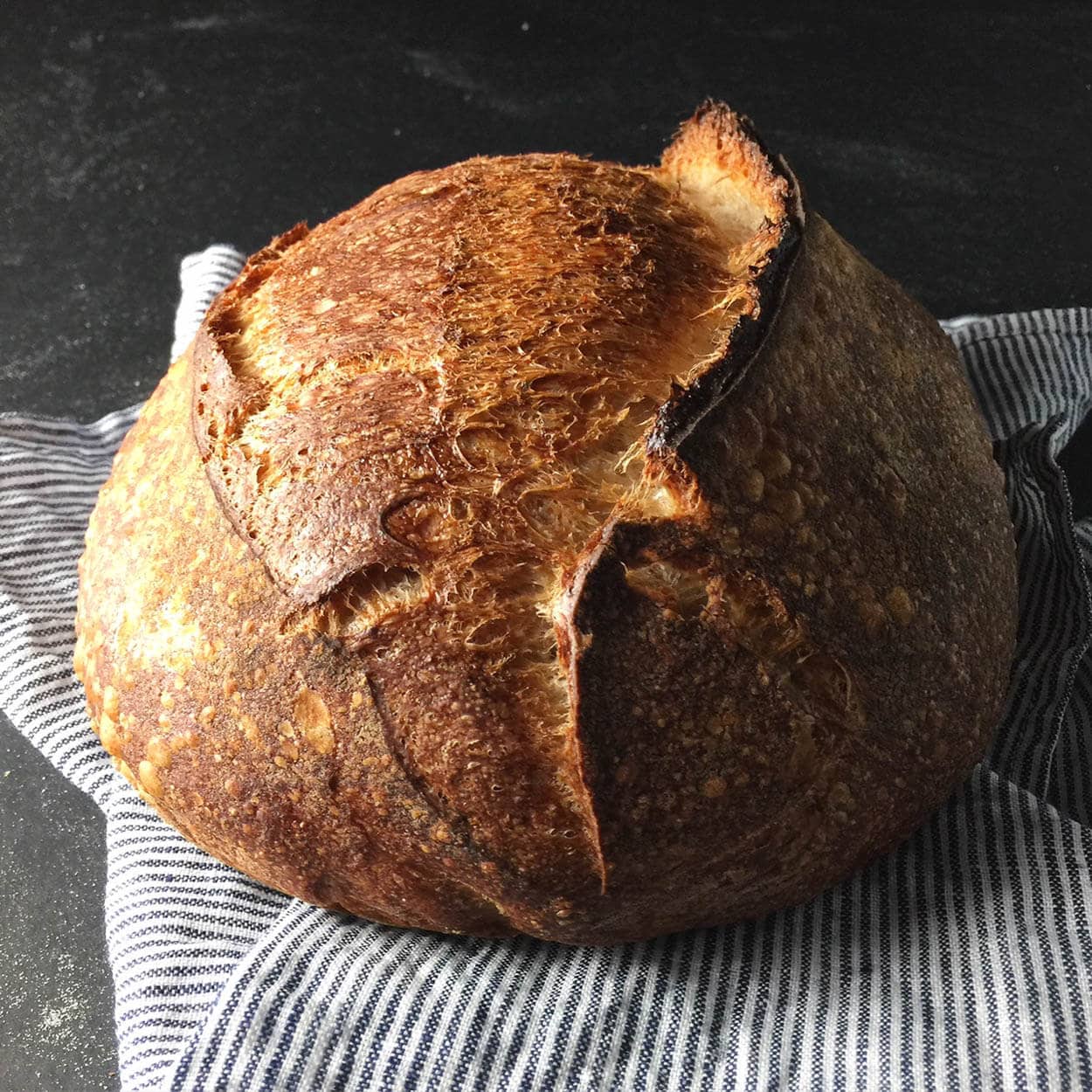
Steam burns hurt. Like, really hurt. The small mark on my left forearm begs the question daily: Maurizio, was it worth it? But before we talk about my new baking badge of honor, let’s concentrate on overcoming the challenges of baking good bread at home. While many of these challenges show up early in the two-day process (fermentation, flour selection, mixing, shaping, and so on), one crucial component comes at the end of this ordered procession: how to bake bread with steam in your home oven.
For your bread to rise to its potential, that outer, taut skin on your loaf needs to be able to expand and stretch before hardening off. Steam in the oven, and subsequently on the surface of your loaves, helps keep the skin pliable and stretchy during baking. If your dough dries and bakes too quickly on the exterior, it can harden off before it rises to its full potential (and you may not see a satisfying grigne, either).
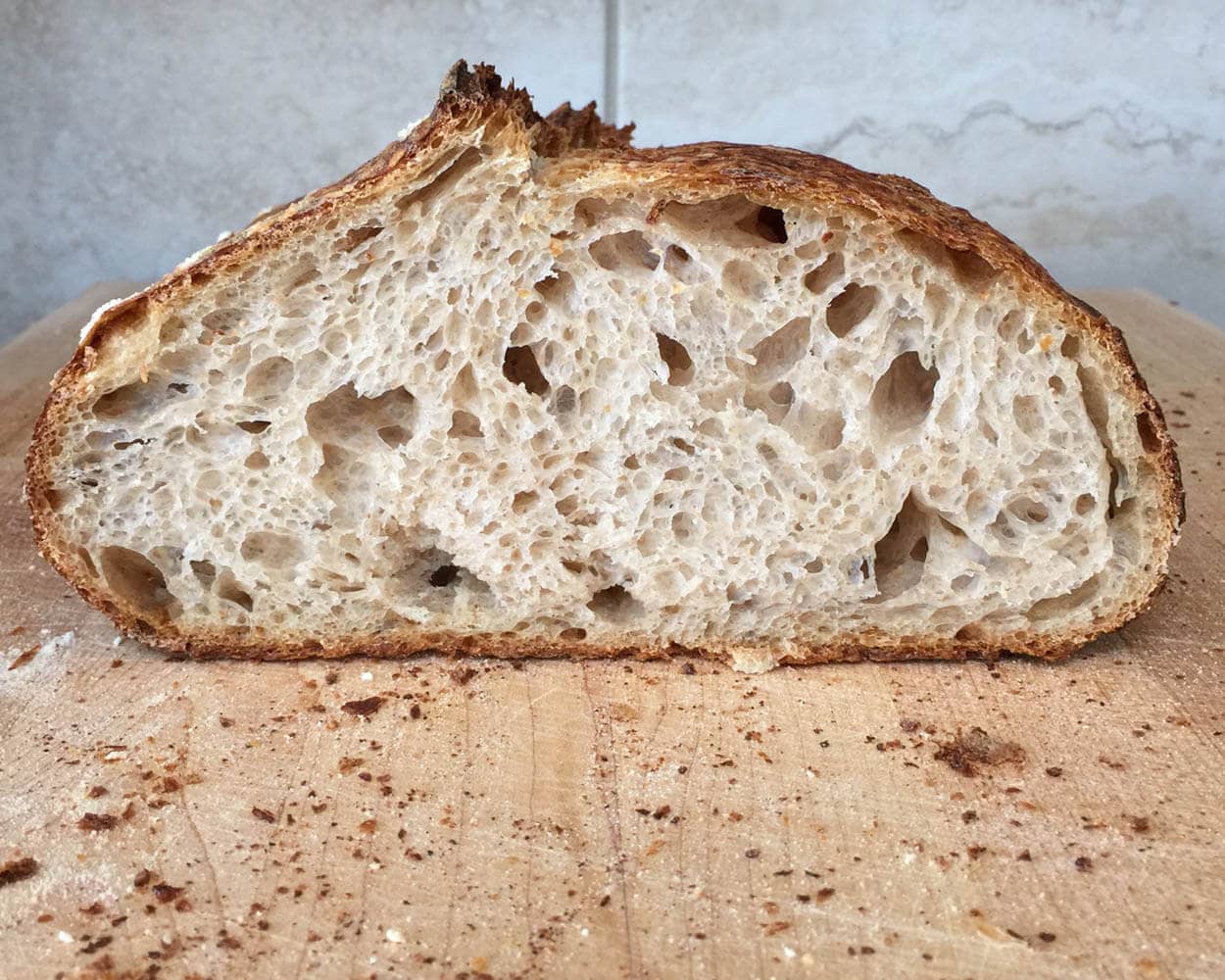
So how can we get enough steam in the oven to keep those loaves rising? There are indeed methods abound, and each person has a different approach, but arguably the most popular choice at the moment, and the one I started with, is baking bread in a Dutch oven (see my guide on how to bake bread in a Dutch oven if you’re not familiar). However, there comes a time when you might want to bake two (or more) loaves at a time, or perhaps your loaves are scaled more substantial than your Dutch oven can comfortably hold. An alternative is to bake directly on stones and generate sufficient steam in your home oven by some other clever means.
Professional baking ovens have steam on tap. Press a button, and a wave of steam sprays over the decks of newly loaded dough. Now there are home ovens that are “steam ovens,” but the ones I’ve looked at are incredibly small. You might be able to fit two loaves, but I could also fit two Dutch ovens in my current home oven; no advantage there. Some other alternatives can’t inject steam at a button press, but they are sealed to trap steam and have a method for generating steam. These look very promising but are on the expensive side.
Since most of us bakers out there do not have a fancy oven (if you do, I’m jealous!), read on to learn how to bake bread with steam in your home oven.
What You’ll Need: Tools for Steaming Home Oven
Five things, and my guess is you probably already own most of them:
- A cast iron or stainless steel roasting pan filled with lava rocks or ceramic briquettes. The extra surface area helps because with more hot surface, you get more instant steam. Or, if you want, trade complexity for ease and just leave the pan empty for a little less steam (but still enough!).
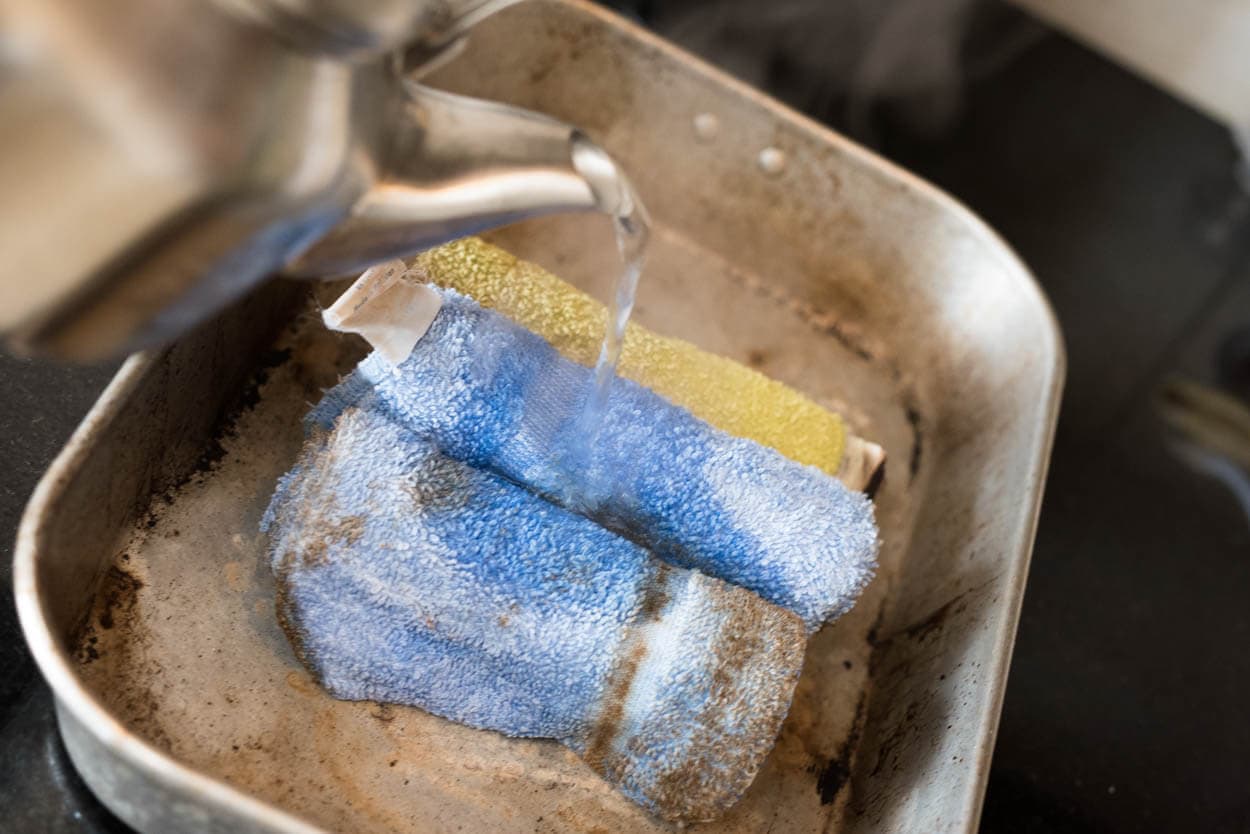
- A rectangular roasting pan with three dish towels rolled tight inside to provide continuous steam during baking. Use 100% cotton kitchen towels that are undyed or white. They tend to look beat up eventually, so cheap towels are best.
- A pizza or bread peel and parchment for loading.
- Optional: a stainless hand spritzer for one last shot of steam before the door shuts. (If I want an extra shiny crust, I’ll re-steam 5–10 minutes in.)
So, how do we use all these tools?
How to Steam Your Oven For Bread, Step by Step
This takes a bit of practice. First, gather your tools and keep them within reach; this is a hectic process, and you want to do it almost without thinking—muscle memory. The longer your oven door stays open, the more heat escapes. Your thick baking stones or a baking steel (also awesome for sourdough pizza!) will help offset some of the loss, but you still want to act quickly.
Below is a quick visual showing where I have my pans, where the loaded dough goes, and where my baking stones are.
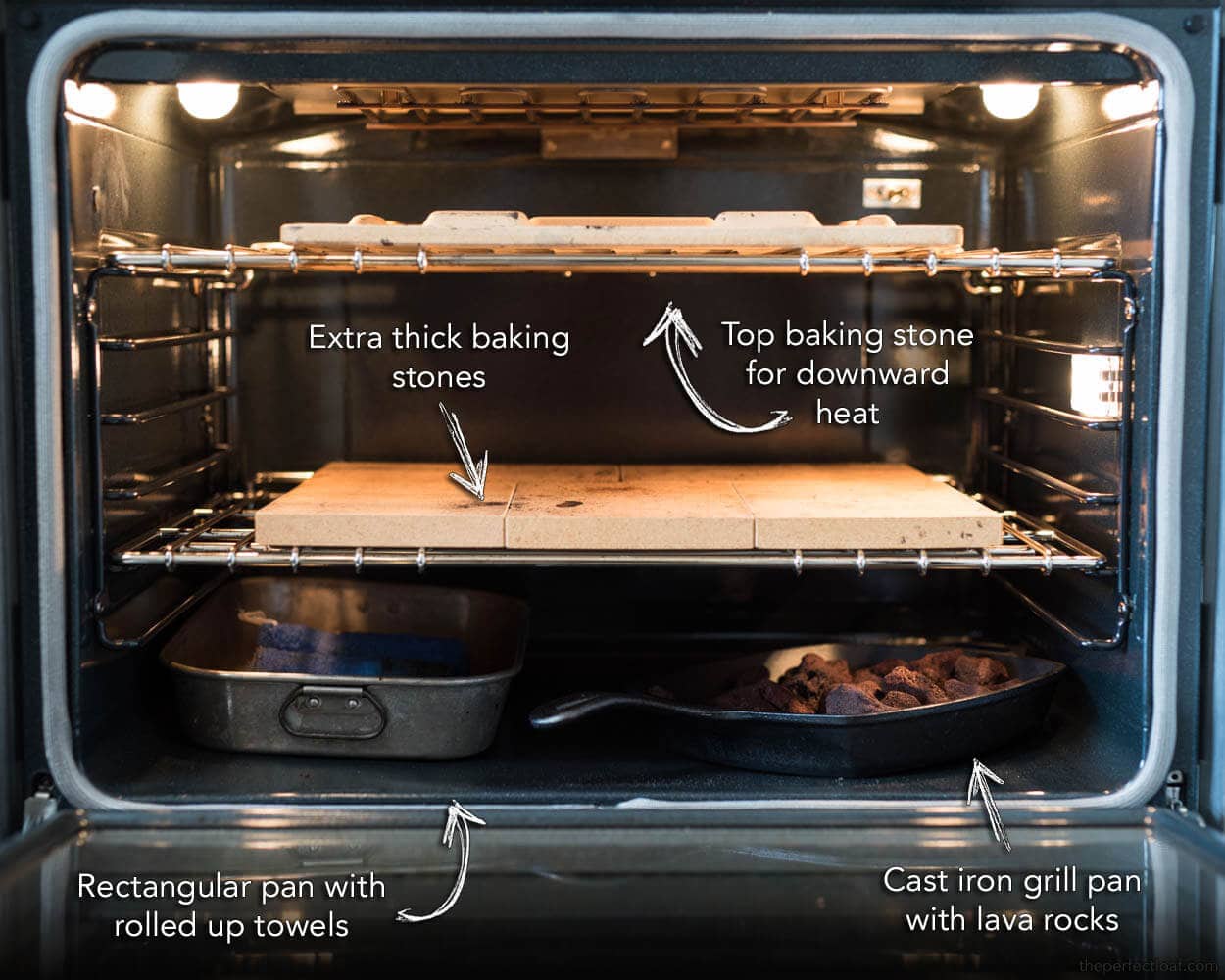
Home Oven Steaming Method
- An hour before baking, turn on your oven (preheat)
- 10-20 minutes before loading your bread, boil water, pour it over the towels in your rectangular baking pan, fully saturate them, and place them in the back corner of your oven
- 10-20 minutes after loading the pan, put each mass of dough on a separate piece of parchment paper
- Place the dough and parchment underneath on a pizza peel
- Score dough
- Open the oven and slide the dough (with parchment) onto baking stones
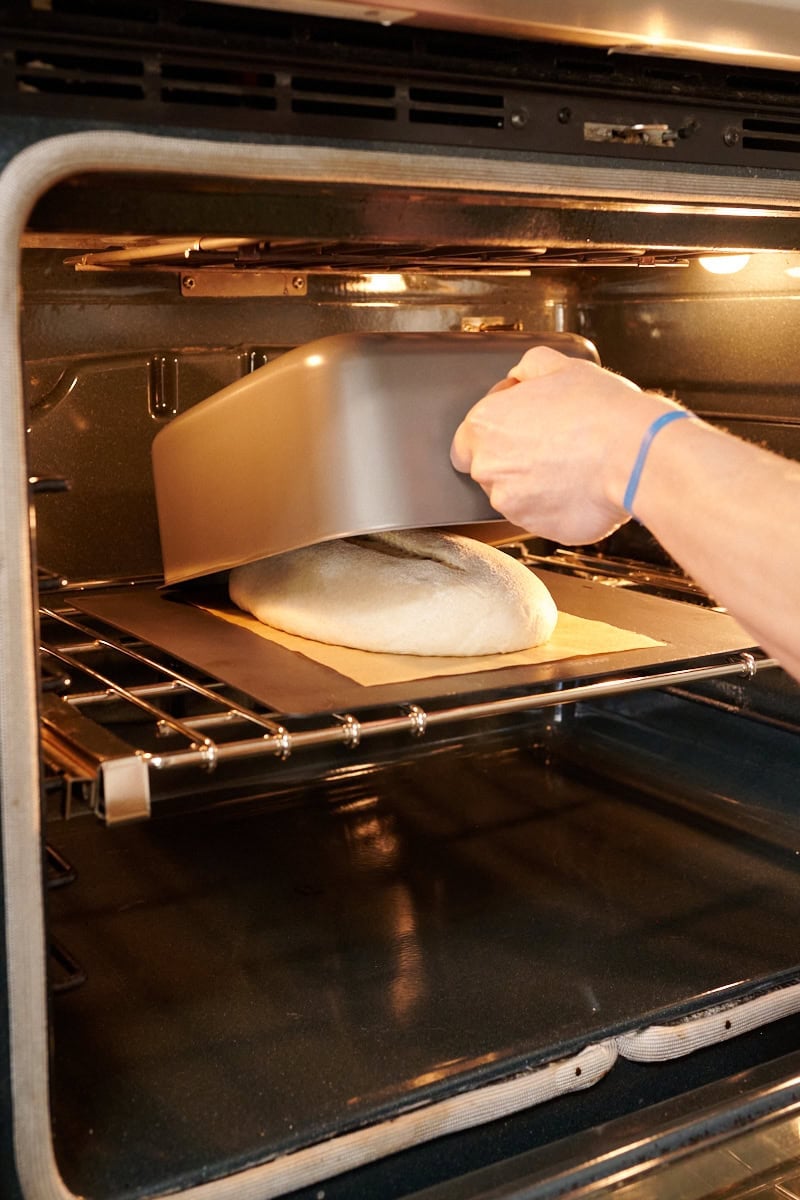
- Quickly lay a towel on the oven door glass (optional; you can see me doing this below). I’ve read that cold water dropped onto a hot oven glass door will shatter the glass, thus the towel. I have dropped some water on the oven door without any ill effect, but I do this to be safe.
- Carefully toss 1 cup of ice into your cast iron pan with lava rocks
- Quickly spray loaves a bit with a hand spritzer (optional)
- Close the oven door and watch your dough rise
- 20 minutes later, remove both steaming pans (careful, these are extremely hot) to stop steaming
- Bake until the loaf is well colored and crusty
Video: Baking Bread With Steam
In my video below, you’ll see me baking bread with steam from start to finish.
Why do we use two sheets of parchment paper for our dough? Using two sheets lets you adjust the space between the loaves as they bake, if needed. One of the worst things that can happen is when the dough expands and joins another loaf; this reduces the overall rise of both loaves. If you notice the loaves start to get a bit close as they rise, slide them apart quickly.
After 20 minutes of baking, we remove the cast-iron and rectangular baking pans so no more steam is generated, allowing your loaves to crisp up and harden off.
Caution: Please be careful with this method: if you drop too much cold water on your oven door, you might crack the glass. I have never had this happen to me, but I know of at least one baker who has. Be sure to keep the water off the glass.
When to Vent: Pulling the Steam for a Crisp Crust
Bread dough benefits from steam early in the process, then a dry oven to finish for the best crust.
Twenty minutes is my rule. By then, the loaf has done its expanding; the oven spring is over, and leaving the pans in any longer only keeps the crust soft when you want it hardening and coloring. So I pull both steaming pans at the twenty-minute mark and let the dry heat finish it off, usually another twenty to twenty-five minutes, depending on loaf size and how dark I want the crust.
If your crust comes out pale and a little leathery no matter how long you leave it in, you’re almost certainly steaming too long. Pull the pans earlier next time.
Why Steam Matters When You Bake Bread
You already know that steam keeps the loaf’s skin pliable long enough for it to rise. But here’s what’s actually happening during that first part of the bake when steam is in the oven.
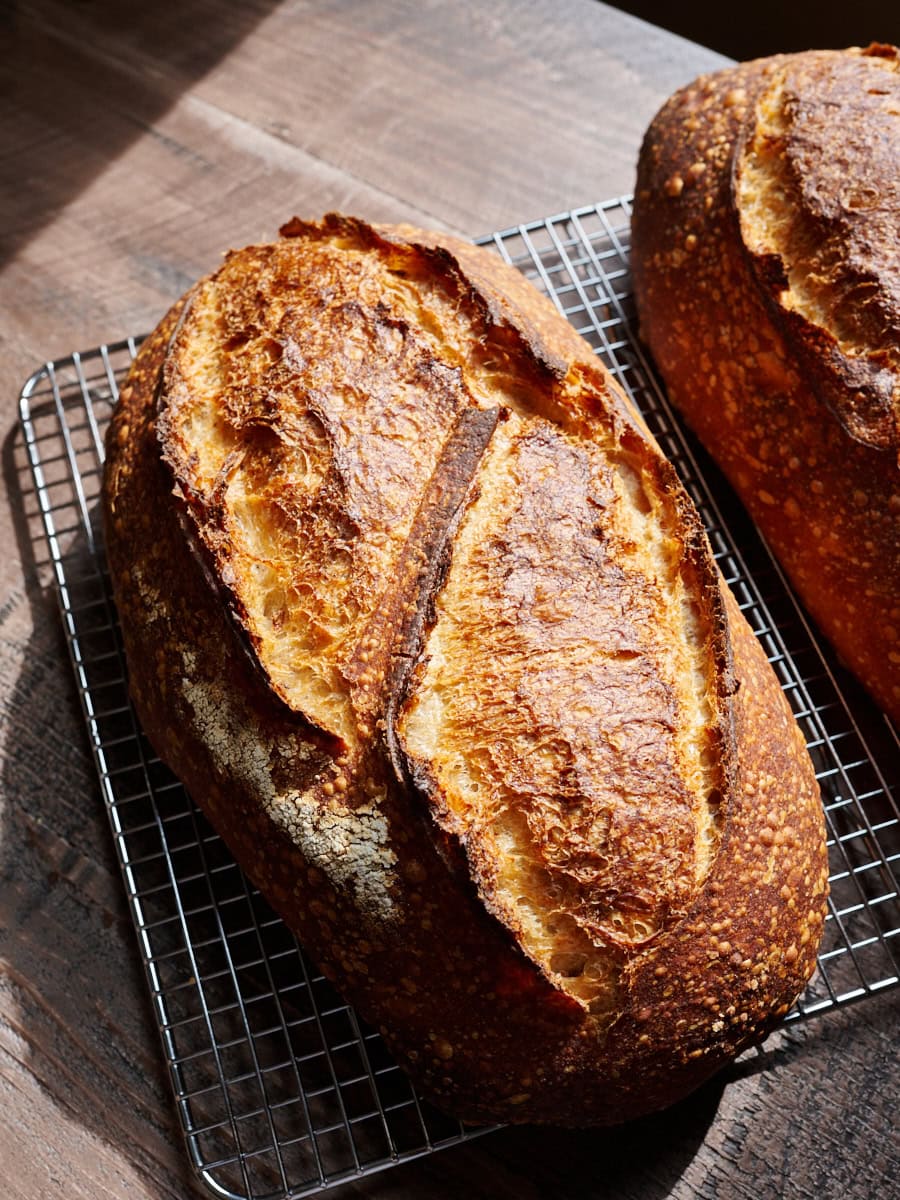
A loaf does most of its rising in a short window at the start of the bake, while the dough is still soft and the gases are still pushing out. Steam is what helps keep that window open long enough to reach maximum volume. It settles on the dough’s cool surface, keeps the crust from forming prematurely, and lets the loaf reach its full volume before it sets. Skip steaming, and the exterior stiffens early, reducing rise and leaving you with a tighter crumb and a blunt, torn ear (or a crust that sort of fuses together) instead of a clean opening and tall rise.
There’s also a second payoff: shine. The moisture gelatinizes the starches on the surface, and once the steam clears and the dry heat takes over, those starches set into a thin, glossy, almost lacquered crust. A dry oven gives you a duller, flatter brown. Steaming gives you blisters, gloss, and that varnished look you’re after.
Why Your Home Oven Fights You
Professional ovens (or even smaller-scale home ovens like the RackMaster) are sealed and built to hold steam. Your home oven is built to lose it.
A home oven vents steam by design, pulling humidity out about as fast as it’s made. That’s a feature when you’re roasting a chicken and want a crispy skin. It’s not great for bread, though, which benefits from humidity. Gas ovens are worse, too, since the burner needs to breathe, so they vent even more.
The other half of the problem is thermal mass. Home ovens are light with only bare racks inside. Open the door to load your loaves, and the temperature drops significantly, then slowly creeps back up. Baking stones or a baking steel fix that by providing thermal mass, which stores heat.
Other Ways to Steam Your Oven ( and When I Use Them)
There’s no shortage of ways to get steam into a home oven when baking, and I’ve tried most of them. A few of the following are worth trying, but most aren’t.
Spraying alone. Mist the oven walls as the bread goes in, then again a few minutes later. Easy, and better than nothing. But the steam vanishes about as fast as you make it, and every spritz is an open door bleeding heat. You can skip all the pans and just use the spritzer, but you won’t get quite as shiny of a crust (but admittedly, it’s much easier).
Boiling water in a pan. Skip the lava rocks, preheat an empty cast iron pan, pour in a cup of boiling water as you load. This is the workhorse most bakers start with, and it works fine. Lava rocks just push it a little further for better results.
An inverted pan or shell over the dough. A Baking Shell, cheap aluminum roasting pan, or a big metal bowl flipped over a single loaf traps the dough’s own moisture against its skin, Dutch-oven style, minus the Dutch oven. It works very well, actually, and is a lot easier than a Dutch oven.
A cloche. Same idea as the inverted pan, prettier and heavier and pricier. Round loaves only, one at a time.
The Dutch oven. Still the most forgiving way to bake bread with steam at home: you place your dough in a preheated pot, close the lid, and put it in your oven. The drawback is you’re limited to round loaves, since you’re limited to round pots. For a single round loaf, or a dough slack enough to need the walls to hold its shape, I still reach for the pot for simplicity (if you go this route, see my post on how to avoid burning your loaves).
Common Bread Steaming Mistakes
Most steam problems show up as a crust gone wrong (too pale, too thick, too dull). Here are a few reasons why it might have happened:
Leaving the fan (convection) on. Convection blows your steam away before the loaf can rise. If your oven defaults to fan-assist, turn it off.
Steaming too long. Past the oven-spring window (around 20 minutes), the crust never dries enough to crisp and color. Pale, leathery, soft, and no shine. Pull the pans at twenty minutes and let the dry heat finish the crust.
Too little steam, or venting too early. The reverse: a blunt, thick crust and a torn ear instead of a bloomed one. Usually too little surface area in the pan, or a door that didn’t seal fast enough. Work quicker, add more towels.
Drenching the oven door. Cold water on hot glass can crack it. Place a towel over the glass, and aim the water at the pans.
Letting the loaves touch. Two doughs that grow into each other both lose their rise at the seam, which will also fail to color, leaving a pale spot. The two-parchment trick is the fix. Slide them apart as soon as they get a little too friendly.
Baking Bread in a Home Oven FAQs
Can I bake bread in a home gas oven?
Unfortunately, this method doesn’t work super well with a gas oven given the venting requirements. Instead, I’d bake using a sealed Dutch oven.
When baking bread in a home oven, do you use convection/fan assist?
No, you do not want to use convection (fan assist) when baking bread in a home oven with steam. The fan will blow steam around, creating a hard crust on the outside of the dough before it has a chance to fully expand in the oven.
Do you really need steam to bake bread at home?
For a lean, crusty hearth loaf, yes. Steam holds the crust off long enough for the loaf to reach full volume, and it’s what gives you the gloss, the blistering, and the deep color. Soft sandwich loaves in a pan don’t need it. A crackly sourdough boule does.
How long should you steam your oven for bread dough?
About twenty minutes, long enough to carry the loaf through oven spring. After that you want a dry oven so the crust can set and color, so pull your steaming pans and let the dry heat finish the bake.
Can you over-steam bread dough when baking?
You can. Steam past the oven-spring window and the crust stays soft instead of crisping and browning, leaving you a pale, leathery finish. If that’s what you’re getting, pull the pans earlier.
Can I steam bread dough without a Dutch oven?
Yes, and that’s exactly what this method is for. Baking stones (or a steel) plus a cast iron pan of lava rocks and a towel-filled pan let you steam the whole oven and bake two to four loaves at once, no Dutch oven required.
Conclusion
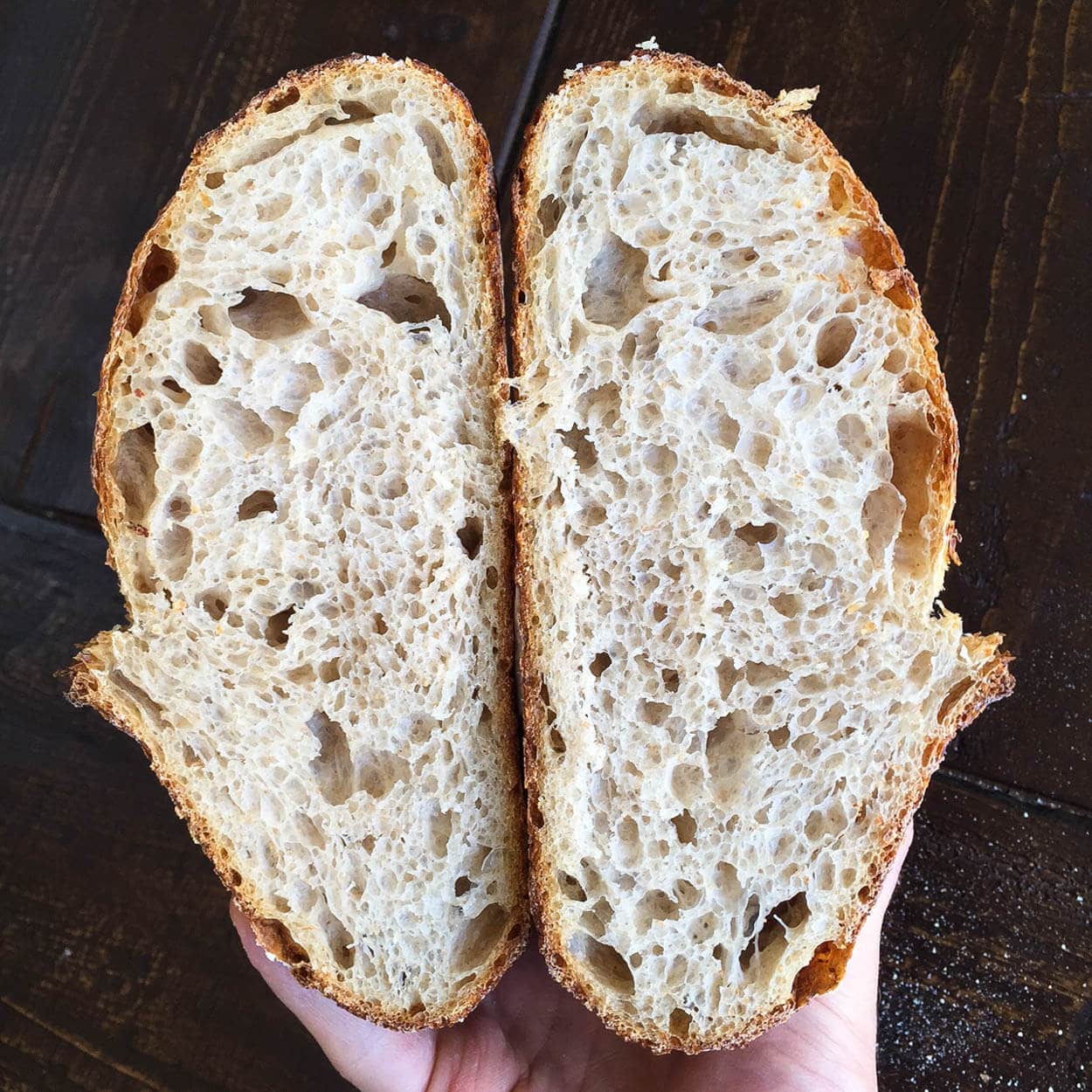
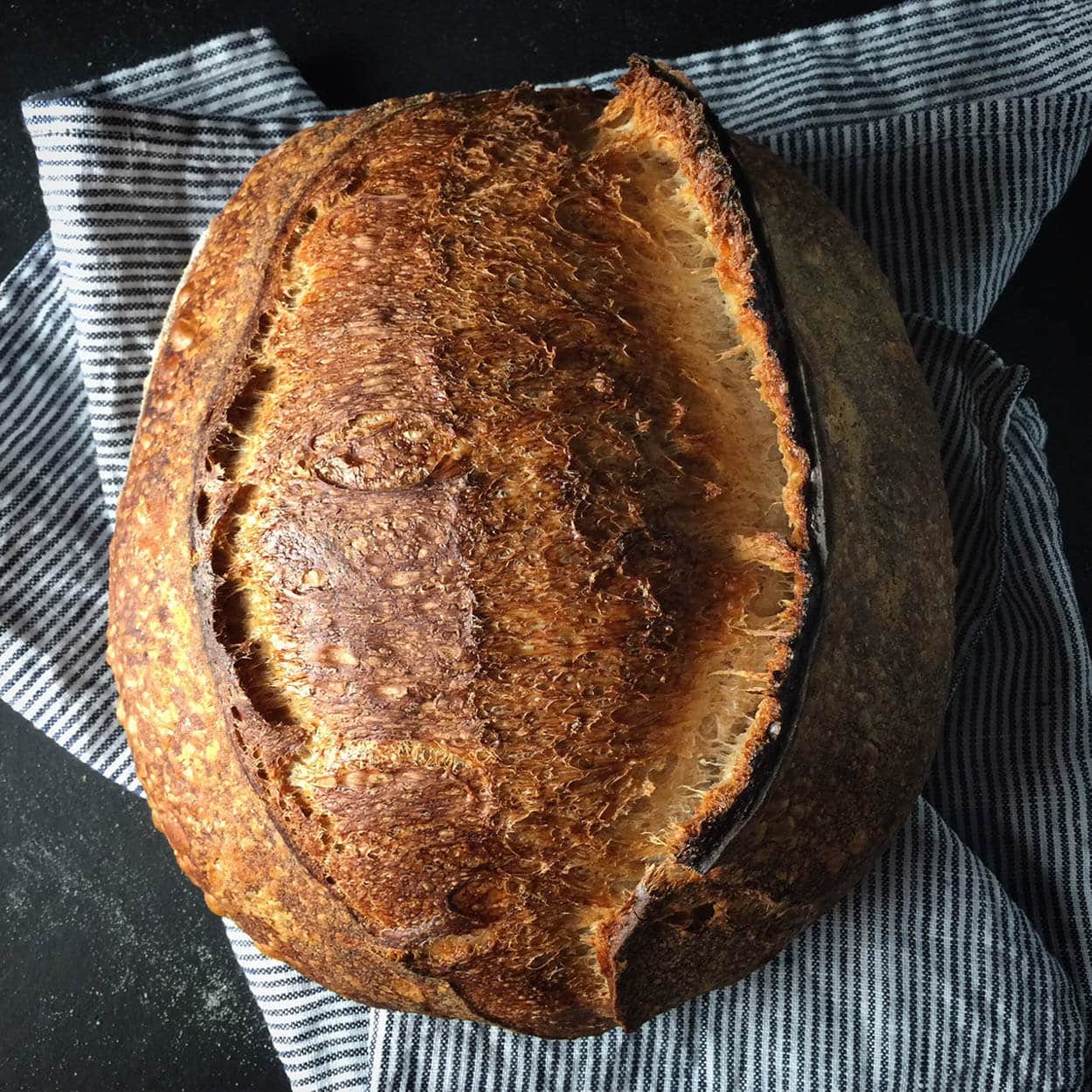
I like this method for baking bread in my home oven because it lets me bake two large loaves at a time. I plan to bake four loaves at a time, and this will let me do that with no problem. Baking with a Dutch oven (or combo cooker) works exceptionally well, and I might still use that method if doing only a single loaf or a highly hydrated one (the pan will help keep the dough together). Still, I find myself using this new method more and more. The results have come out smashingly.
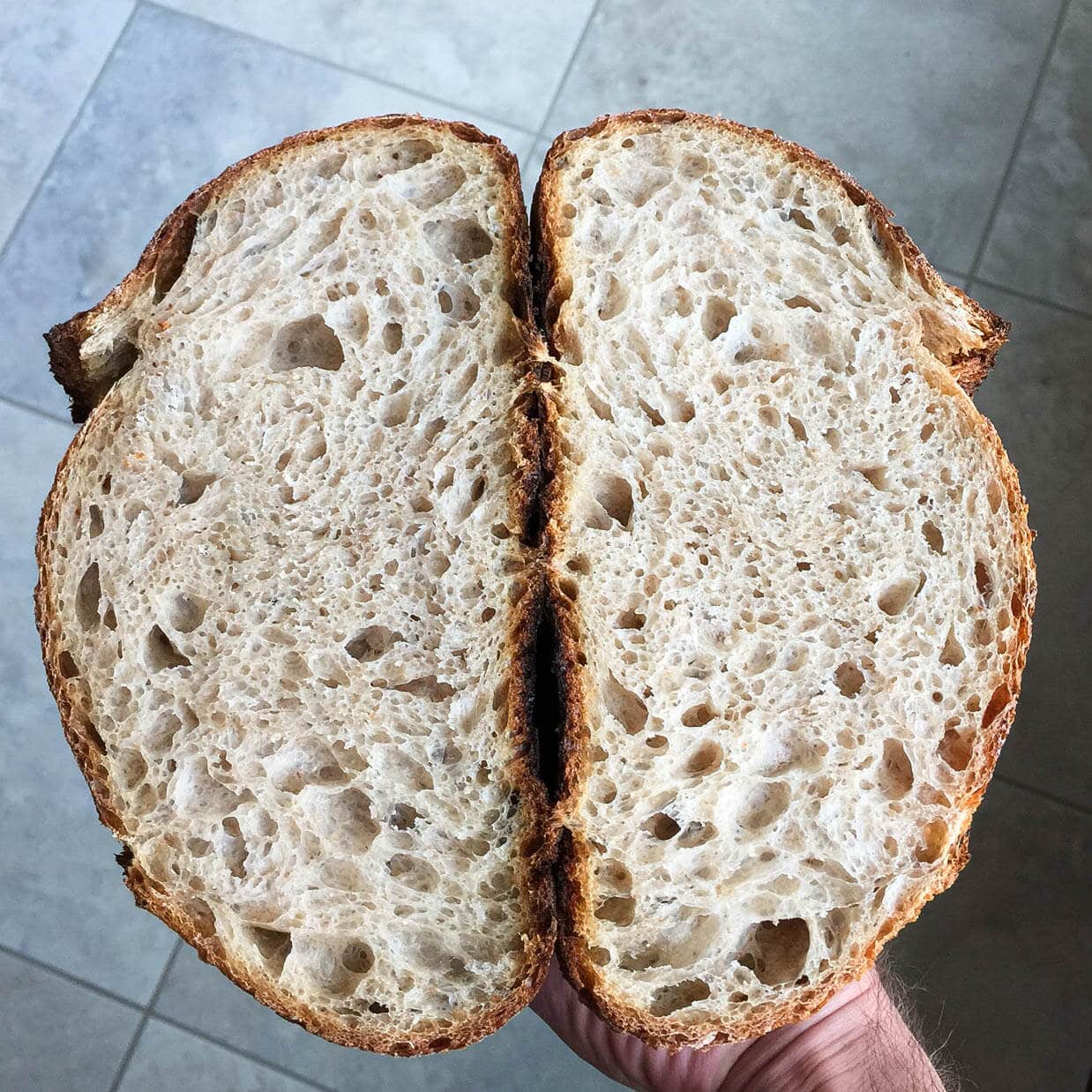
Small steam burns: worth it (as you can see below).
What’s Next?
Be sure to check out my full guide to baking bread at home for more details on this important step!


430 Comments
I am wondering if you have any suggestions for adding steam to a convection oven (commercial) in which the fan cannot be turned off? I’m baking for a small restaurant and this is our only oven.
Ahh, that’s a tough one. If it were me, I might consider baking in pots (Dutch oven, etc.) if the fan and venting couldn’t be subverted…
Thank you so much for this great article! 🙏 I’m a home baker and been doing it for a while using DO, but now more people are asking/ordering my bread, so it’s seems like I’m moving towards a bigger operation here rather than just few loaves for family, so I’m really hoping your method will do wonders and I’ll be able to bake more than 2 loaves at a time 🤗
However, I have a question before I purchase all the components required. I have a GE gas oven which is with vents at the bottom of the oven and expels large amount of air (I learned that hard way – some butter from the cake dripped to the bottom and the amount of smoke coming through the vents was unbelievable! 😱).
So do you think this method be sufficient this type of oven or would I need to cover these vents somehow?
Hey there! You’re very welcome. Hmmm. If your oven has those vents than yes, it’s likely too much steam will leave the chamber. It’s possible my method might still be enough to get some good rise, but a sealed oven is definitely best, although I know that’s typically not the case for home ovens (mine is not).
You might be better off baking in a DO or something similar!
Laima-I have 3 ovens (a gas and a double electric) that have the vents. I add enough water using just the cast iron skillet and boiling water immediately after putting the loaves in and the oven still holds a lot of the steam despite what I see escape it. When I open it 12-15 min later I’m hit in the face with that wet heat so be careful. Good luck!
Hallo Maurizio,
I have a question regarding the lava stones- is there any kind of danger using them in the stone? i read somewhere that the oven glass can get cracked.
my second question- is this method is better than just putting a tray with boiled water on the bottom? whenever i shape a Batard it comes out stiff and nice from the fridge, but than in the steam baking method (only tray with water) in turns flat like pita.
Cracking in the oven is usually if too much cold/cool water gets on the hot glass of the oven door. Be sure to avoid that!
I’ve found a single tray with ice cubes to work really well also, but adding in the towels does seem to take it one step farther. I wouldn’t say it’s mandatory, but it does add more sustained steam through the bake.
Hi Maurizio,
What stone do you use on top? Or it could be any baking stone?Thanks,
Arthur
These days, I actually bake without that top stone. I’ve found my oven does a good enough job with top heat as it is. If you want to use one, any baking stone (or baking steel) will work fine there.
Hello! First of all, thank you soooooo much for making our baking lives so much easier! I recently started a home-based bakery and I’ve been selling my loaves to a very loyal group of customers and I am somehow happy with what I have achieved. However, these past few weeks I noticed inconsistency in the end result, some of my loaves were not rising enough, the scoring was not coming out as aesthetic as before, etc. So I decided to do some research and I came across your blog. Let – me – tell – you, oh boy have you changed my baking perspective! I have just tried the steaming home-oven technique and this is by far the best technique I’ve ever tried. Thank you sooooo much!!!
You’re very welcome, Roman! Congrats on the new baking venture, something I’d love to do myself in the future as well 🙂 Hope my site helps you on your journey and happy baking!
Wow. Everytime I visit your site I learn something new and feel like I’m refining my skills! I would like to move on to batard shapes but without buying much more equipment. I have several cook top cast iron griddles. Can I bake my batard on those (under parchment paper) or do I use those as a heat retention tool?
Those should work!
Hello! Thanks for all the info here! More than helpfu!…Just a question: What should the oven temperature be for baking with steam? Before and after removing the steam sources (stones and towels)?
You’re very welcome! I typically stick to 450°F at all times for most bread.
Thanks for this information! I have a question about your steam oven setup vs a dutch oven. Is the only benefit to the steam oven setup the capability to bake more than on loaf at a time? Or should this setup produce a better oven spring? I’m getting a decent crumb on my sourdough loaves using a dutch oven, but not quite as open as I’d like. Would this method be likely to improve the open crumb?
Mostly it’s to bake more than one loaf t a time, but also to bake different shapes (e.g., batard, baguette, ciabatta, etc.). It does result in really nice spring, but you can get that with a DO also!
Ciao Maurizio, I am very eager to use steam in my oven and branch out from my sweet antique Dutch oven, but my oven has elements in the bottom. I bought the lava rocks and a wonderful baking steel and am excited about using my batard banneton and trying a number of other recipes, but am stuck trying to figure out where to put the lava rocks and towels… Any suggestions? Thanks! Can’t wait to try your Bomboloni once I have a little more time. 🙂
Hey, Kiki! If you have a heating element exposed on the bottom, place an oven rack at the lowest rung just above that. Then, place another a rung or two up from that so you can slide in the pan 🙂
Hi Maurizio!
I’m a little late in the discussion here but I have a question. I, like many others, am waiting for my Rofco B40 to arrive. I have in my possession, however, the 3 steam pods that go with it. I was thinking of trying to incorporate them into this method of adding steam to my home oven. Have you or anyone else tried this? If so, would they replace both pans or just one? Which one? How much water should I pour into them?
Also, I am stuck with a gas oven, which I usually love, but it has an extra-large chimney opening in the top, like 5″X5″. It seems like the steam just goes right up and out of it. Any thoughts on restricting it in some way, like with foil perhaps?
Thanks in advance, and thank you for all you do. You are my main man!
I have not used them in my home oven but have wanted to, it should work really well. I’d probably start with one on the side, but a second could be great, too. It’s hard to say how much water to pour in. Ideally, you want to pour in just enough so it stops steaming after about 20m, but even if it kept going it’s ok, just open the oven door to vent and it should all dissipate.
I’m not sure on blocking that pipe. I’d be a little skeptical to do so… I don’t know!
Given the fact that your Rofco is coming, I might just try with one or two steam pods and see how it goes. If it were me, I’d probably stick to using a Dutch oven or large roaster instead of modding my oven, since the Rofco will be here at some point!
Hope that helps 🙂
Thanks Maurizio!
Hi!
I’ve been making your sourdough bread with a young levain the past year. Since I wanted to make a larger batard rather than a round, I had to use something other than my round dutch oven. In the far corner of my kitchen cabinet was a rarely used, large graniteware roaster with a deep, handle-free lid. This is what I almost exclusively use now, carefully placing my scored batard inside using parchment paper, putting the lid on and placing the whole thing in a 500F oven. The enameled tin is thin, so it doesn’t need preheating like my dutch oven. After 25 mins I turn heat down to 450F and remove the lid, and since both pan and lid are very deep I never had issues with the lid lifting, but have had beautiful rise and ears and perfect crispy crust (but not too thick as I sometimes think is the case in the cast iron Dutch oven). I also make sure to use corn meal on the bottom of the batard so the bottom doesn’t burn from the 500F heat. Since I don’t have an oval banneton and the lid has ridges and no top handle, I often put the shaped dough in the lid (with towels supporting the sides) for the overnight fridge proof, using the pan as a cover.
Best of all, I didn’t have to spend money, but if you don’t have a roaster like this it could cost you as little as $20.
That’s something I wish I had when I first started baking. In fact, I tried many roasters over the years and they all weren’t large enough. That’s a great option if you have one big enough!
Hello (again), Maurizio! I decided to treat myself to a baking steel, so am now trying to figure out the best way to set up my steam. I’ve got a cast iron pan, and typically in the past have just put water directly in there. I was wondering if you have ever heard of using leca (expanded clay balls for hydroponics) instead of the lava rocks? I think it should work, and have a ton of those…
I haven’t heard of using those! As long as their oven-safe and won’t impact the bread baking in any way (smoke, etc.), should be fine!
Hi Pam,
DId you manage getting enough steam from LECA (clay balls)? I have a bunch of them in a cast iron pan in the oven right now pre-heating with some water and I find they’re not generating much steam. Now I’m having second thoughts loading my loaf 🙁
I haven’t done it the right way, so I don’t have anything to compare them to… but I threw water on them after loading the loaf and it seemed to work?
Hey Maurizio, excellent information. I have a steam cleaner that I use for my tile floors. It has different attachments and I could use one of them to inject steam into the oven. I would of course have to open the oven door to accomplish this. I’m just wondering if one injection of steam from this device would be enough steam for the entire bake since. The steam does shoot out at about 60 psig when the steamer is fully charged so I could get a fair bit of steam in there. I see recommended about 1 cup of water added to a pan with lava rocks, so one good inject from the steam cleaner would no amount to 1 cup of water, but it would be a lot of steam. This is the steam cleaner that I have https://www.myvaporclean.com/products/vapor-clean-ii-298-single-boiler-65-psi-4-5-bar-made-in-italy/?gclid=Cj0KCQiA_qD_BRDiARIsANjZ2LCAQNTSY7P5or1ZnbpE_4zAQfHDqWkiinsGxlqycZ8DqvrC-A2RAjQaAjVOEALw_wcB
Thanks! That looks like a great way to steam the oven. I’ve thought about picking one of these up to test, a few others have reported using similar steamers to bake with great success. I’d imagine if you’re getting good rise and a nicely colored crust, that’s doing the job just fine!
Hey Maurizio, thanks for all your info. I was wondering how you steam in your Rofco. I have the smaller version of the B40 and the steaming pans use a lot of space. Thanks.
Hey there! You’re very welcome. Check out my guide to using a Rofco oven for all the details on how I use it!
Thank you so much. Really helpfull
I have not used it but have heard of that function. If I could, I’d probably get it! The key would be to be able to steam however much you’d like—if you could steam at the press of a button that would be great.
Greetings from the Land of Entrapment! I just got a baking steel and am worried that the steaming will cause rust (especially underneath) Have you found this to be an issue or am I worrying for nothing? TIA!
Hey! I have used my same baking steel for almost 5 years now with no rust and constant oven steaming sessions. I treat my steel like cast iron: don’t let water or liquid sit on it, and every once in a while rub a thin layer of veg oil on it to season. It looks brand new!
Thanks so much! I appreciate your guidance on this and all things bread!
Hi, do you reduce the oven temp with the steel ?
Mine got black on the bottom otherwise came out great and took a lot less time
Yes, that will work. Another option is to reduce the preheat duration. I typically drop the temperature.
Much appreciate the content on this site. I’ve been tinkering with how to add steam in my oven for baguettes and found the following method to work best. I saw it on a FB post called the Mun method. It was a simple, direct, no-fuss way to add steam to your baguette baking. You need a perforated baguette pan, a baking sheet that is larger than the baguette pan (1/2” deep or more), and an alum roasting tray (recyclable 3-4” deep works, no handles) that is bigger than the baguette pan but smaller than the baking sheet. When preheating your oven make sure the wire racks are moved to allow for the height of the roasting tray and baguette pan. Start your preheat with the baking sheet in the oven. Get 1-2 cups of hot water ready. When you get to your oven temp, place the baguette pan on the baking sheet and then use the alum roasting tray as a dome to cover the baguette tray, but fitting inside the edges of the baking sheet. Now pour the hot water onto the baking sheet. Be careful, the water will immediately steam. A good quality baking sheet shouldn’t warp, but be careful. Close the oven door quickly. If you’ve set this up correctly, the steam will rise directly into the alum roasting tray dome and keep the volume of air around the dough at a higher humidity level. Remember to close the door quickly. After the 15-20 min steam bake, feel free to remove the roasting tray. That’s it. Works for all oven sizes. As long as you have the setup right, you basically add the hot water, close the door, the steam is trapped around the dough, and you get beautifully risen baguettes. No fuss with multiple trays, spraying incessantly, etc. Thanks and happy baking.
Yes, that’s a great method! I’ve tried this with loaves of bread, using a large roasting pan over my dough to trap steam. It works well, the only catch is you need to be sure the roasting pan is taller than the loaves will rise! Great suggestions.
Hi – I have a goofy question. I like your scoring. I also read your contribution on the KAF site; the loaves look beautiful. in your gif above I see that you spray your bread after inserting it into oven. Do you also use this method, specifically spraying the top of the loaves, when scoring your design with the 50/50 rice flour/apf? I’m wondering if spraying the top diminishes the design, or perhaps cakes the flour? Thanks.
Hey, Erick! Spraying is totally optional, it just adds a little more steam in an already steamy oven. If you do spray, yes, it tends to spray off some of the pattern on top. If I’m doing an intricate design with a pattern (with scoring or flour) I won’t spray inside the oven, or if I do, not anywhere near the top of the loaf.
Maurizio, I find that when using this method, my crust ends up very very thick and hard. I also find that as soon as I put the steam in, the temperature drops and stays down for the whole time it’s steaming. Last time, it dropped from 450 all the way to 365-385 degrees! Really ruins the bake. What do you suggest? If I crank up the temperature, my baking steel / dutch oven gets too hot. Could I opt for a different method of steam? Or a longer steam?
Yes, that’s a typical issue with a home oven: opening that door really expunges quite a bit of the heat stored up in the oven. This is why a baking stone or steel is so important, it helps hang on to the heat and transfer it right to your dough once it’s loaded. It’s best to act as fast as possible when loading your dough to avoid losing too much heat. If you find the baking steel is baking your loaves a bit too much on the bottom, try preheating at a lower temp or for shorter time. You could preheat your oven to 450 or 500F, then load the baking steel to get hot for 15-20 minutes (shorter than usual so it’s not quite so hot).
Thanks Maurizio! Really appreciate the feedback, I want to try that. And yes, I’m sure my baking steel helps but definitely too hot to bake on if I preheat it for an hour.
The oven temps discussed are they for fan forced or regular oven
No fan (not convection).
Hello Maurizio, I love your site. I’ve been having loads of fun making my own sourdough and bread of course. I must mention I also love your sourdough discard recipes. I am ready to transition from my baking vessels, I have an Emile Henry cloche and a Le Creuset. They do the job but I’m curious about investing in good quality steel and/or ceramic stones. You mention you like your steel and get fabulous results for pizza. Yeah, nice extra. You also mention the extra thick baking stones are no longer available. Well I found some. I might still order the steel you recommend just to compare. Can you please comment on the baking stone on the top rack? You don’t say anything about it. Do you no longer recommend it? It shows both in your picture and video. Should I give it a go?
I don’t use the stone on the top rack any longer (I mention that in the post). I used to use it for additional top heat but have found it not necessary!
Hey Maurizio. I’ve given this method a try for my past few bakes after >1yr of doing 2 dutch ovens. Decided it was time to trade steam burns for hot steel burns (from placing the loaf in the tall ductch oven) :P.
I’m using my most common recipe, flour (80% T70, 15% high pro WW, 5% josey rye), shaping method (your youtube video), etc which I’ve mastered pretty well and get highly consistent results with the dutch oven but the loaves are coming out relatively poor using this method so I’m curious your thoughts.
The rise and crust are not turning out. The loaf is rising a bit but probably only ~2/3 what I get in the dutch oven & absoloutely no ear develops. The crust is thick and super dull (vs. nice crisp shine), has none of the little crackly bubbles, and ends up being quite soft. I’m thinking I’m not creating enough steam and/or my oven may be venting the steam faster than I’m generating it (it’s a ~1yr old oven but it still spills out a lot of heat from the top/back).
My steam setup is identical to your suggestions above with only one difference: I filled the entire pan with rolled up towels. Next bake might try fewer so the towel to no-towel ratio is similar to yours. I’m also wondering if I don’t pre-steam w/ the towels in there long enough. I’ve been doing 15-20 minutes but when I open the oven after that to load I don’t really feel any steam come out. Finally, I’m just using tap-temp water for the lava rocks, should it be colder? Probably about half the steam from the lava rock splash billows out before I can push the cast iron back in and close the door. Not sure if that’s a big deal or not.
Here’s a couple tips:
1. Check to see if your oven has a fan running or is releasing lots of steam from a vent. Many modern ovens have a convection fan on (even though they are not in convection mode) that helps prevent hot spots. If there is a vent, try to block it up with some wet towels.
2. Try using a pie tin with holes poked through the bottom. Place ice in and slide on top of your lava rocks before loading your bread. This will release a shot of steam after closing your oven.
Hope that helps!
Hi, as I don’t have a Dutch oven I tried to use a pizza stone and a roasting tray full of boiling water, however my loaves burnt. Should I reduce the temperature or the time they spend in the oven? Would using a Pyrex glass dish and it’s lid work better? Thank you for the brilliant tips!
Yes, I’d say drop that oven temp!
Just a question: why do wet towels create more steam than just adding water to the tray? Maybe it creates a larger surface?
The towels slowly release steam through the bake whereas adding ice or water will quickly disappear and do more of a blast of steam. They’re optional, but do help!
Hi Maurizio! I have an electric oven with coils on the top and bottom – how do you recommend this method for an oven like that? I’m trying to do 2 loaves at once if possible, but I’m not sure I’ll have enough room for the lava rocks/steaming tray with the bottom coils.
I’d place a rack in the oven at the very bottom rung to hold the pans, then another rack up above that to hold the baking surface!
Do you take out the bottom oven heating coils or put the pans directly on top?
My bottom coils are not exposed.
As a newbie, I’ve been working to improve my bread, with generally better loaves each of the last six weeks. I’ve been doing the bulk ferment on one day with the scheduled folding, then putting it in a basket with dishtowels for 12 hours, then into a 500-degree preheated Staub dutch oven. When I uncovered the dutch oven after 20 minutes this week, the loaf had finally given my a fantastic oven spring and I thought I had finally pulled it off. But after another 20 minutes baking uncovered at 450, the loaf had actually gone down almost an inch. The bread still had a fairly open texture and tastes great, but still isn’t quite what all the photos show or what I saw happening initially. So why did it actually come back down after such great initial spring? Is this normal? Should I have left the lid on longer? Am I baking it too hot?
Yes, that works!
Hi Maurizio!
Have you ever tried baking your bread first in a steam oven (in around 100C) for first few minutes and then move it to standard oven set up to really high temperature?
I am thinking about buying extra steam oven as I bake a lot (it would make my life easier). But because it’s expensive I want to check this approach first 🙂
Thanks for any piece of advice!
Piotr
I’ve not tried this, no. You’d have to be careful transferring the dough at that point, it would still be quite pliable. Theoretically, should work!
You may cover your loaf with a large stainless steel mixing bowl for about 20 minutes create steam. I also have a roasting pan at the bottom of my oven to which I added boiling water at the beginning of the bake.
Yes, that’s a fantastic method as well!
Is it possible to do this method with two pans of towels if I don’t have lava rocks?
Yes, that will work also! You could also just omit the towels and rocks in the other pan and throw ice in the empty, preheated pan.
What baking stones would you recommend for a beginner? I’ve been using a dutch oven but would like to start trying your steaming method using the stones. Thank you for such amazing information! You have inspired me to try all the recipes in your website. My sister and I have been each trying your recipes from different states and sharing our own experiences. Thank you for allowing us a way to connect even more, even if long distance.
Check out my baking tools page, I have options listed there!
Hi Maurizio! I love your site! I’m wondering if/how you adjust your temperatures when baking on a baking steel? I can get pretty great rise and color, but the bottoms often brown a bit too much. Thank you!
Brian, I had similar issues with mine as well! The only solution I have found so far is, after you remove the steaming trays, let the bread bake for half of the remaining time (if 20 min more without steam, bake for 10 min) and then remove the bread from the steel and bake directly on the oven rack for the remainder of the bake. Instead of removing the stone completely to do this, just quickly put your other oven rack (I keep mine outside of the oven during baking) at the notch just above the stone and place the bread on there. You still get a hard crust but it isn’t burnt or indestructibly hard.
You could try preheating at a lower temperature, or preheat for a little less time to offset all that stored heat in the steel.
Hi Maurizio!
Okay so – I’ve had great success with your recipes and methods, I just have one question/problem. I’m finding that the bottoms of my loafs don’t get as hard/dark as I’d like them. I’m baking on a 3/4” pizza stone with my temps at the same of yours. (I’m currently in Denver at your same altitude). Any reason you can think of?
THANK YOU
You could try heating your oven at a higher temp, perhaps 500F or higher. Also a baking steel is an amazing thing for sure! Be sure to preheat it an hour or so until super hot.
Well until this morning I wasn’t using lava rocks in my cast iron. But I got my hands on some yesterday and used them this morning and it worked great! Is it possible that the steam created helped the bottoms of the loafs? Bread can be so magical sometimes…at this point I believe anything is a possibility.
I find those rocks really do produce a lot of steam — lots of surface area there. It should help with the bake overall!
What size square baking stones do you use? Thanks
Unfortunately the stones I have aren’t available any longer, but this pizza stone should work quite well (just be sure the size is good for your oven). I have some other options on my baking tools page as well!