

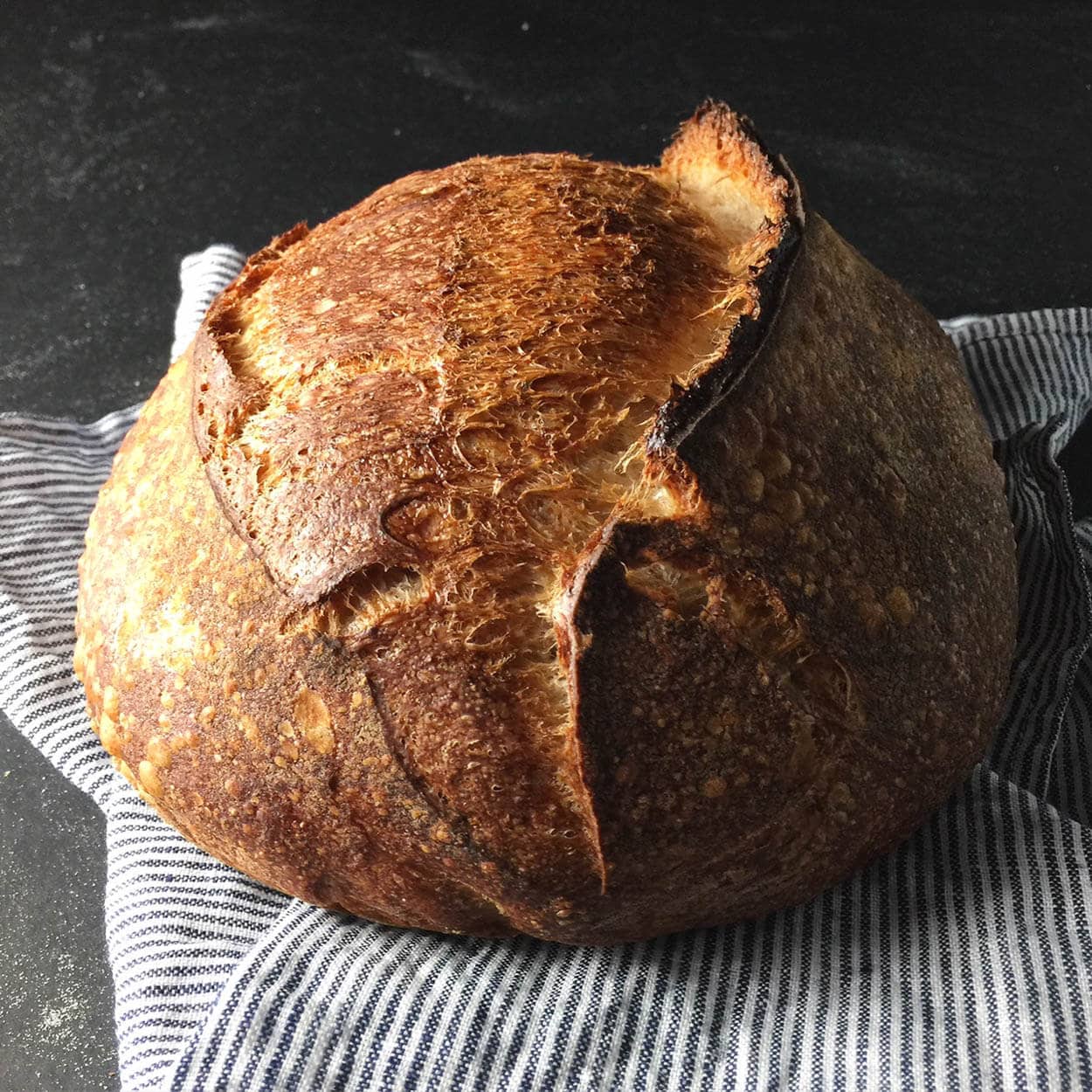
Steam burns hurt. Like, really hurt. The small mark on my left forearm begs the question daily: Maurizio, was it worth it? But before we talk about my new baking badge of honor, let’s concentrate on overcoming the challenges of baking good bread at home. While many of these challenges show up early in the two-day process (fermentation, flour selection, mixing, shaping, and so on), one crucial component comes at the end of this ordered procession: how to bake bread with steam in your home oven.
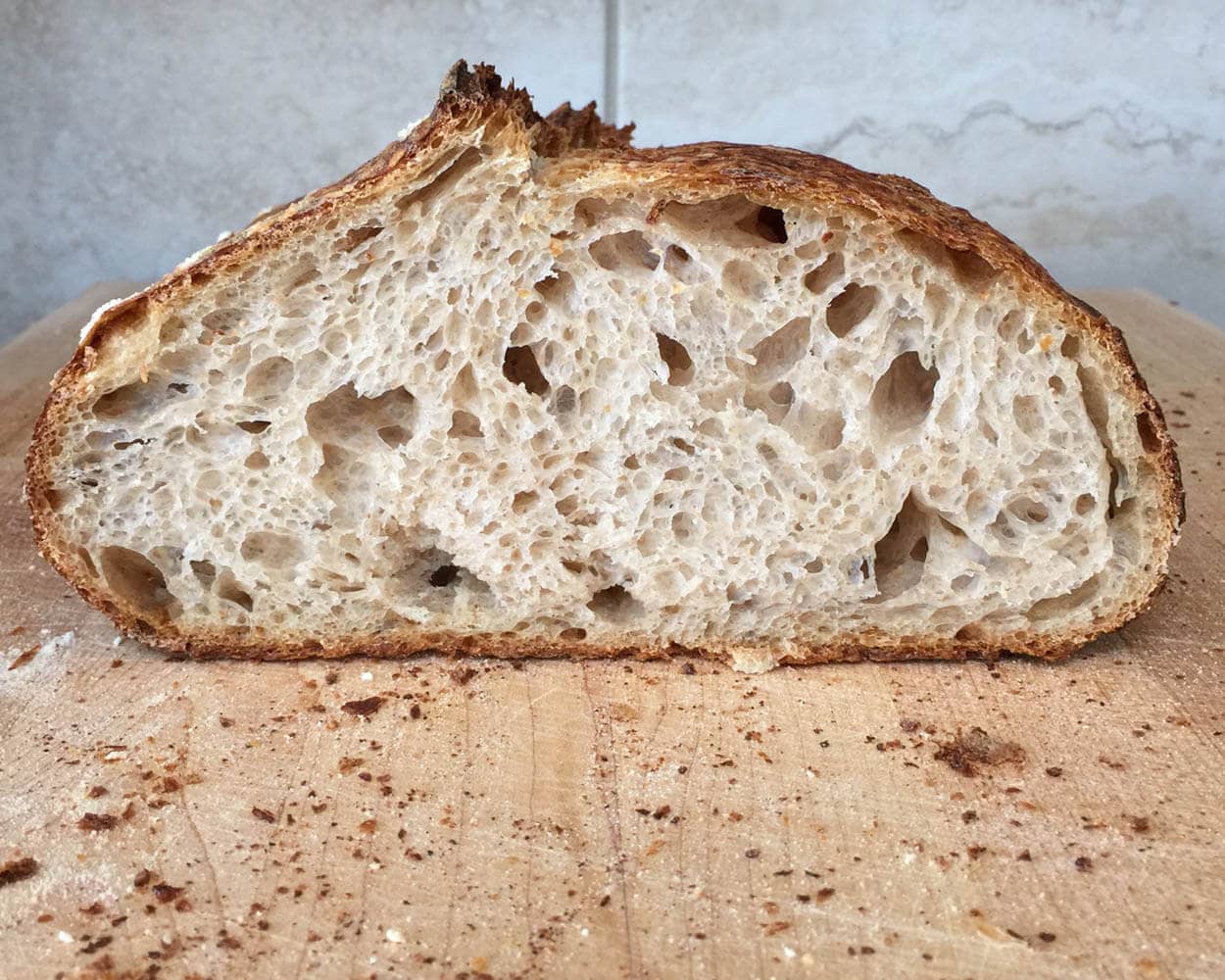
For your bread to rise to its potential, that outer, taut skin on your loaf needs to be able to expand and stretch before hardening off. Steam in the oven, and subsequently on the surface of your loaves, helps keep the skin pliable and stretchy during baking. If your dough dries and bakes too quickly on the exterior, it can harden off before it rises to its full potential (and you may not see a satisfying grigne, either).
So how can we get enough steam in the oven to keep those loaves rising? There are indeed methods abound, and each person has a different approach, but arguably the most popular choice at the moment, and the one I started with, is baking bread in a Dutch oven (see my guide on how to bake bread in a Dutch oven if you’re not familiar). However, there comes a time when you might want to bake two (or more) loaves at a time, or perhaps your loaves are scaled more substantial than your Dutch oven can comfortably hold. An alternative is to bake directly on stones and generate sufficient steam in your home oven by some other clever means.
Professional baking ovens have steam on tap. Press a button, and a wave of steam sprays over the decks of newly loaded dough. Now there are home ovens that are “steam ovens,” but the ones I’ve looked at are incredibly small. You might be able to fit two loaves, but I could also fit two Dutch ovens in my current home oven; no advantage there. Some other alternatives can’t inject steam at a button press, but they are sealed to trap steam and have a method for generating steam. These look very promising but are on the expensive side.
Since most of us bakers out there do not have a fancy oven (if you do, I’m jealous!), read on to learn how to bake bread with steam in your home oven.
What You’ll Need: Tools for Steaming Home Oven
Five things, and my guess is you probably already own most of them:
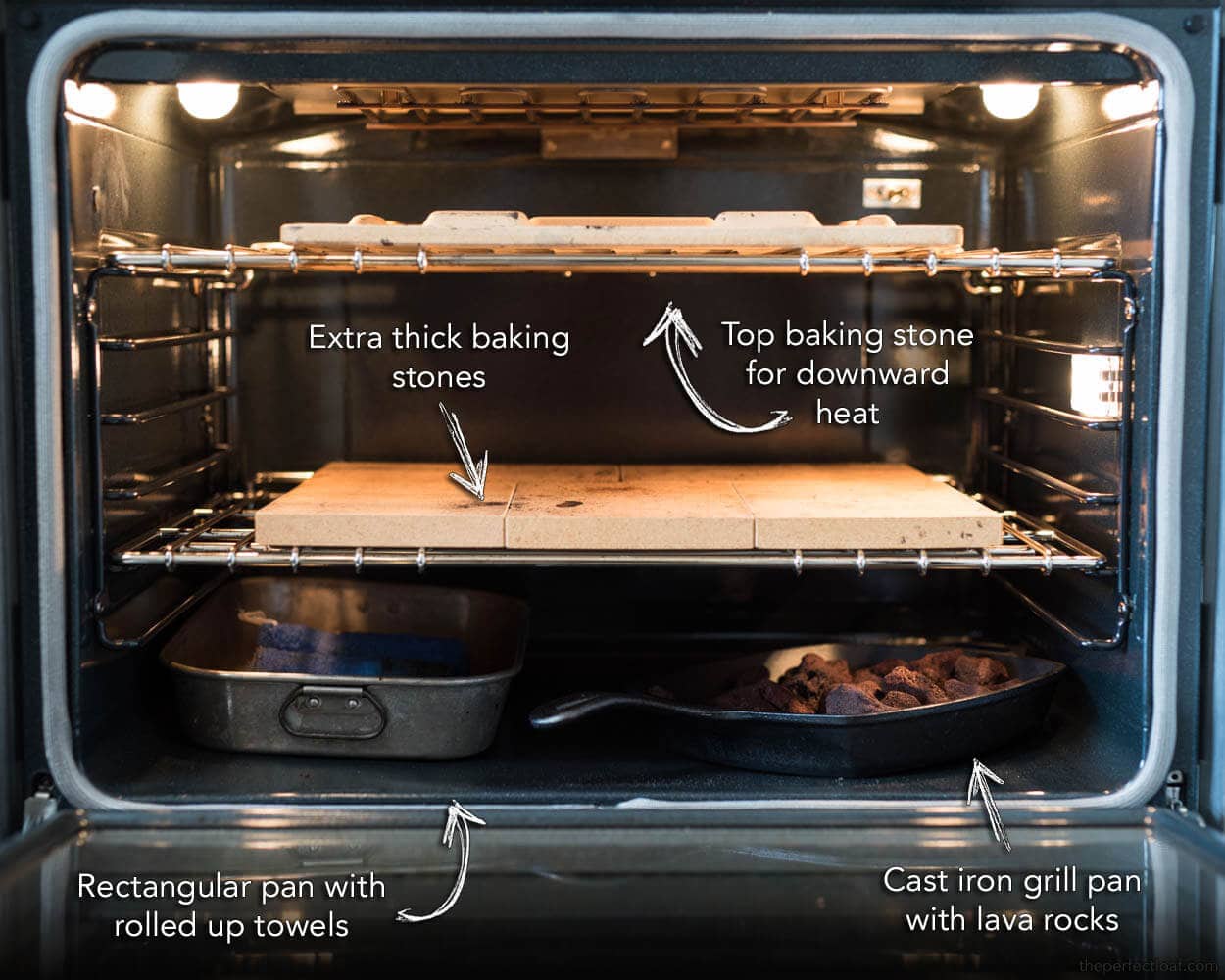
- A cast iron or stainless steel roasting pan filled with lava rocks or ceramic briquettes. The extra surface area helps because with more hot surface, you get more instant steam. Or, if you want, trade complexity for ease and just leave the pan empty for a little less steam (but still enough!).
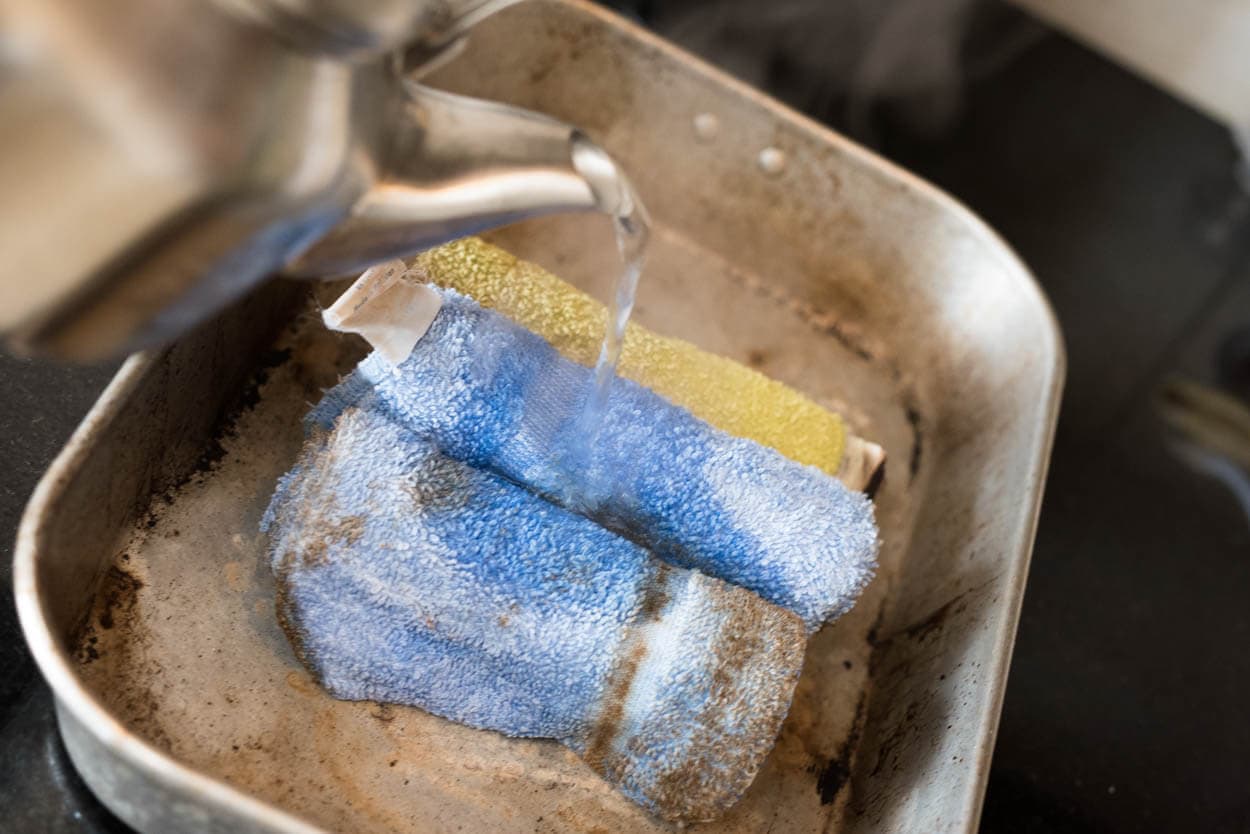
- A rectangular roasting pan with three dish towels rolled tight inside to provide continuous steam during baking. Use 100% cotton kitchen towels that are undyed or white. They tend to look beat up eventually, so cheap towels are best.
- A pizza or bread peel and parchment for loading.
- Optional: a stainless hand spritzer for one last shot of steam before the door shuts. (If I want an extra shiny crust, I’ll re-steam 5–10 minutes in.)
So, how do we use all these tools?
How to Steam Your Oven For Bread, Step by Step
This takes a bit of practice. First, gather your tools and keep them within reach; this is a hectic process, and you want to do it almost without thinking—muscle memory. The longer your oven door stays open, the more heat escapes. Your thick baking stones or a baking steel (also awesome for sourdough pizza!) will help offset some of the loss, but you still want to act quickly.
Below is a quick visual showing where I have my pans, where the loaded dough goes, and where my baking stones are.
Home Oven Steaming Method
- An hour before baking, turn on your oven (preheat)
- 10-20 minutes before loading your bread, boil water, pour it over the towels in your rectangular baking pan, fully saturate them, and place them in the back corner of your oven
- 10-20 minutes after loading the pan, put each mass of dough on a separate piece of parchment paper
- Place the dough and parchment underneath on a pizza peel
- Score dough
- Open the oven and slide the dough (with parchment) onto baking stones
- Quickly lay a towel on the oven door glass (optional; you can see me doing this below). I’ve read that cold water dropped onto a hot oven glass door will shatter the glass, thus the towel. I have dropped some water on the oven door without any ill effect, but I do this to be safe.
- Carefully toss 1 cup of ice into your cast iron pan with lava rocks
- Quickly spray loaves a bit with a hand spritzer (optional)
- Close the oven door and watch your dough rise
- 20 minutes later, remove both steaming pans (careful, these are extremely hot) to stop steaming
- Bake until the loaf is well colored and crusty
Video: Baking Bread With Steam
In my video below, you’ll see me baking bread with steam from start to finish.
Why do we use two sheets of parchment paper for our dough? Using two sheets lets you adjust the space between the loaves as they bake, if needed. One of the worst things that can happen is when the dough expands and joins another loaf; this reduces the overall rise of both loaves. If you notice the loaves start to get a bit close as they rise, slide them apart quickly.
After 20 minutes of baking, we remove the cast-iron and rectangular baking pans so no more steam is generated, allowing your loaves to crisp up and harden off.
Caution: Please be careful with this method: if you drop too much cold water on your oven door, you might crack the glass. I have never had this happen to me, but I know of at least one baker who has. Be sure to keep the water off the glass.
When to Vent: Pulling the Steam for a Crisp Crust
Bread dough benefits from steam early in the process, then a dry oven to finish for the best crust.
Twenty minutes is my rule. By then, the loaf has done its expanding; the oven spring is over, and leaving the pans in any longer only keeps the crust soft when you want it hardening and coloring. So I pull both steaming pans at the twenty-minute mark and let the dry heat finish it off, usually another twenty to twenty-five minutes, depending on loaf size and how dark I want the crust.
If your crust comes out pale and a little leathery no matter how long you leave it in, you’re almost certainly steaming too long. Pull the pans earlier next time.
Why Steam Matters When You Bake Bread
You already know that steam keeps the loaf’s skin pliable long enough for it to rise. But here’s what’s actually happening during that first part of the bake when steam is in the oven.
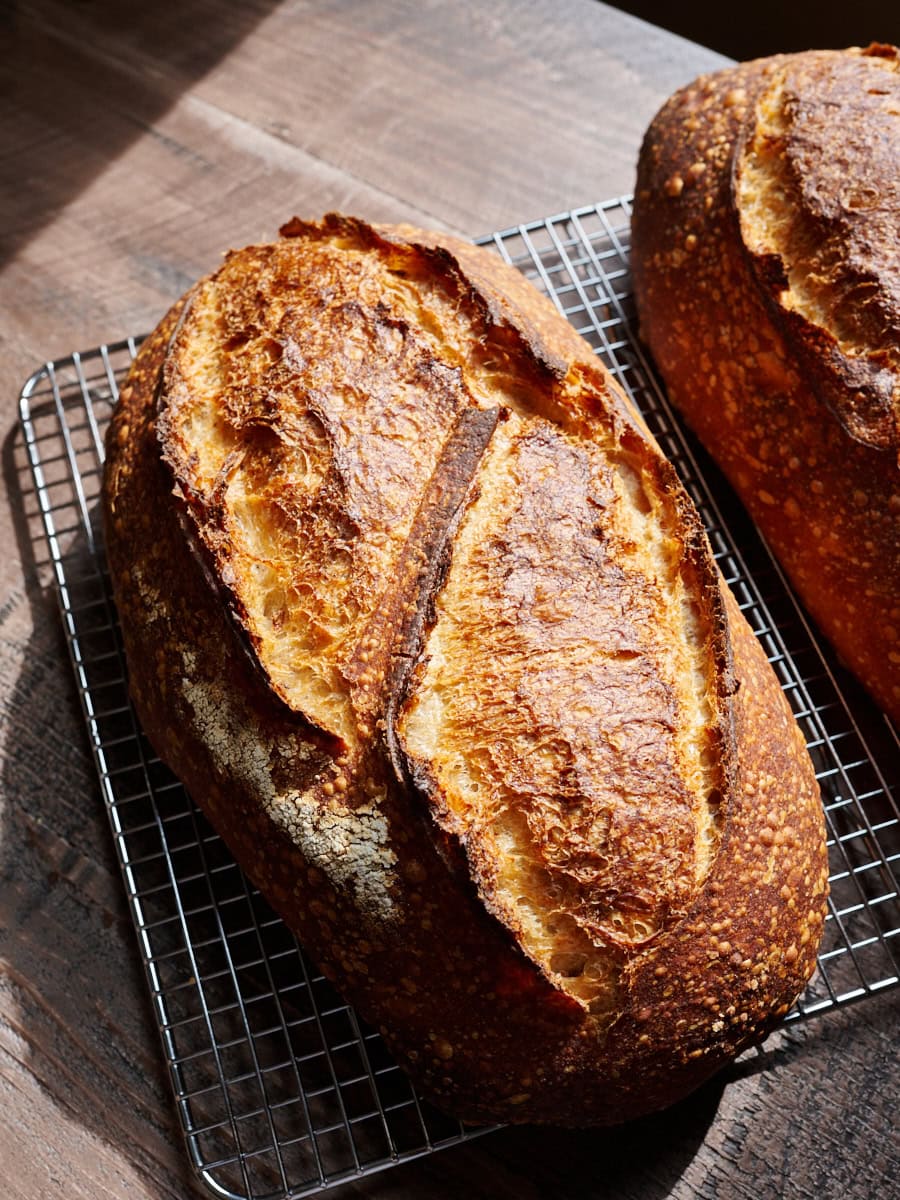
A loaf does most of its rising in a short window at the start of the bake, while the dough is still soft and the gases are still pushing out. Steam is what helps keep that window open long enough to reach maximum volume. It settles on the dough’s cool surface, keeps the crust from forming prematurely, and lets the loaf reach its full volume before it sets. Skip steaming, and the exterior stiffens early, reducing rise and leaving you with a tighter crumb and a blunt, torn ear (or a crust that sort of fuses together) instead of a clean opening and tall rise.
There’s also a second payoff: shine. The moisture gelatinizes the starches on the surface, and once the steam clears and the dry heat takes over, those starches set into a thin, glossy, almost lacquered crust. A dry oven gives you a duller, flatter brown. Steaming gives you blisters, gloss, and that varnished look you’re after.
Why Your Home Oven Fights You
Professional ovens (or even smaller-scale home ovens like the RackMaster) are sealed and built to hold steam. Your home oven is built to lose it.
A home oven vents steam by design, pulling humidity out about as fast as it’s made. That’s a feature when you’re roasting a chicken and want a crispy skin. It’s not great for bread, though, which benefits from humidity. Gas ovens are worse, too, since the burner needs to breathe, so they vent even more.
The other half of the problem is thermal mass. Home ovens are light with only bare racks inside. Open the door to load your loaves, and the temperature drops significantly, then slowly creeps back up. Baking stones or a baking steel fix that by providing thermal mass, which stores heat.
Other Ways to Steam Your Oven ( and When I Use Them)
There’s no shortage of ways to get steam into a home oven when baking, and I’ve tried most of them. A few of the following are worth trying, but most aren’t.
Spraying alone. Mist the oven walls as the bread goes in, then again a few minutes later. Easy, and better than nothing. But the steam vanishes about as fast as you make it, and every spritz is an open door bleeding heat. You can skip all the pans and just use the spritzer, but you won’t get quite as shiny of a crust (but admittedly, it’s much easier).
Boiling water in a pan. Skip the lava rocks, preheat an empty cast iron pan, pour in a cup of boiling water as you load. This is the workhorse most bakers start with, and it works fine. Lava rocks just push it a little further for better results.
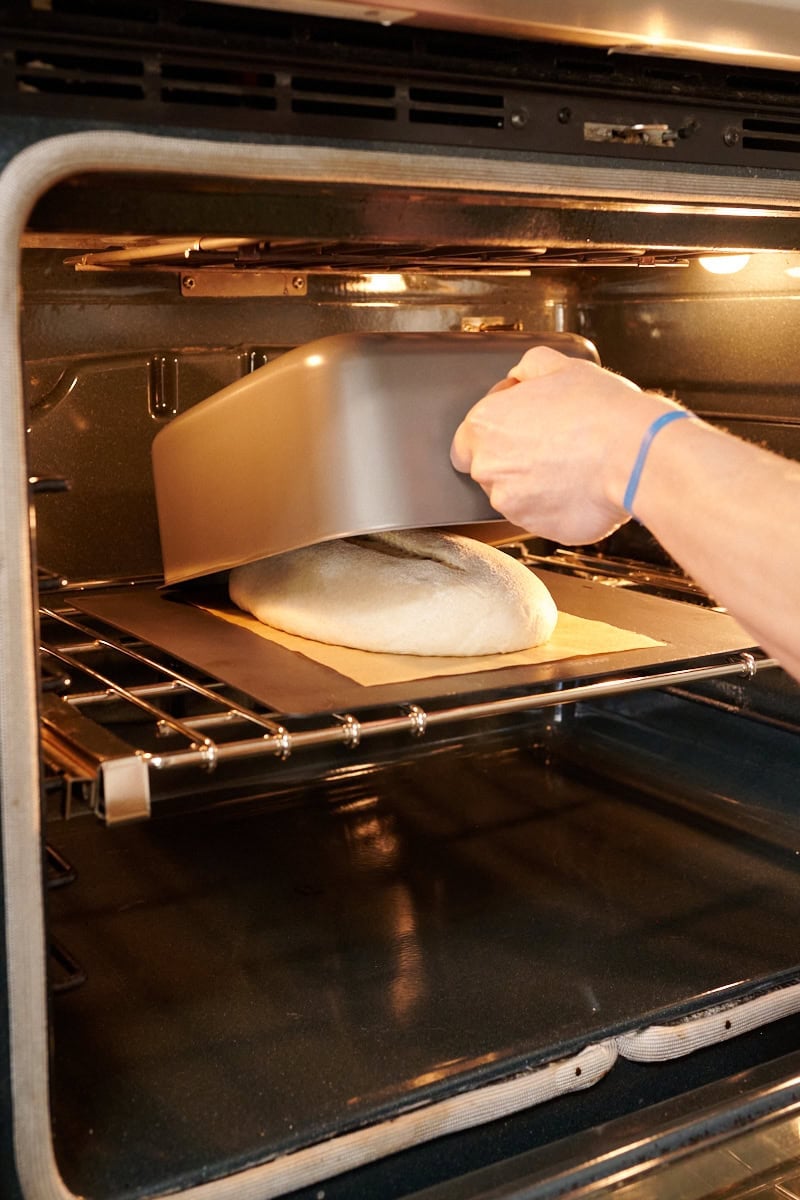
An inverted pan or shell over the dough. A Baking Shell, cheap aluminum roasting pan, or a big metal bowl flipped over a single loaf traps the dough’s own moisture against its skin, Dutch-oven style, minus the Dutch oven. It works very well, actually, and is a lot easier than a Dutch oven.
A cloche. Same idea as the inverted pan, prettier and heavier and pricier. Round loaves only, one at a time.
The Dutch oven. Still the most forgiving way to bake bread with steam at home: you place your dough in a preheated pot, close the lid, and put it in your oven. The drawback is you’re limited to round loaves, since you’re limited to round pots. For a single round loaf, or a dough slack enough to need the walls to hold its shape, I still reach for the pot for simplicity (if you go this route, see my post on how to avoid burning your loaves).
Common Bread Steaming Mistakes
Most steam problems show up as a crust gone wrong (too pale, too thick, too dull). Here are a few reasons why it might have happened:
Leaving the fan (convection) on. Convection blows your steam away before the loaf can rise. If your oven defaults to fan-assist, turn it off.
Steaming too long. Past the oven-spring window (around 20 minutes), the crust never dries enough to crisp and color. Pale, leathery, soft, and no shine. Pull the pans at twenty minutes and let the dry heat finish the crust.
Too little steam, or venting too early. The reverse: a blunt, thick crust and a torn ear instead of a bloomed one. Usually too little surface area in the pan, or a door that didn’t seal fast enough. Work quicker, add more towels.
Drenching the oven door. Cold water on hot glass can crack it. Place a towel over the glass, and aim the water at the pans.
Letting the loaves touch. Two doughs that grow into each other both lose their rise at the seam, which will also fail to color, leaving a pale spot. The two-parchment trick is the fix. Slide them apart as soon as they get a little too friendly.
Baking Bread in a Home Oven FAQs
Can I bake bread in a home gas oven?
Unfortunately, this method doesn’t work super well with a gas oven given the venting requirements. Instead, I’d bake using a sealed Dutch oven.
When baking bread in a home oven, do you use convection/fan assist?
No, you do not want to use convection (fan assist) when baking bread in a home oven with steam. The fan will blow steam around, creating a hard crust on the outside of the dough before it has a chance to fully expand in the oven.
Do you really need steam to bake bread at home?
For a lean, crusty hearth loaf, yes. Steam holds the crust off long enough for the loaf to reach full volume, and it’s what gives you the gloss, the blistering, and the deep color. Soft sandwich loaves in a pan don’t need it. A crackly sourdough boule does.
How long should you steam your oven for bread dough?
About twenty minutes, long enough to carry the loaf through oven spring. After that you want a dry oven so the crust can set and color, so pull your steaming pans and let the dry heat finish the bake.
Can you over-steam bread dough when baking?
You can. Steam past the oven-spring window and the crust stays soft instead of crisping and browning, leaving you a pale, leathery finish. If that’s what you’re getting, pull the pans earlier.
Can I steam bread dough without a Dutch oven?
Yes, and that’s exactly what this method is for. Baking stones (or a steel) plus a cast iron pan of lava rocks and a towel-filled pan let you steam the whole oven and bake two to four loaves at once, no Dutch oven required.
Conclusion
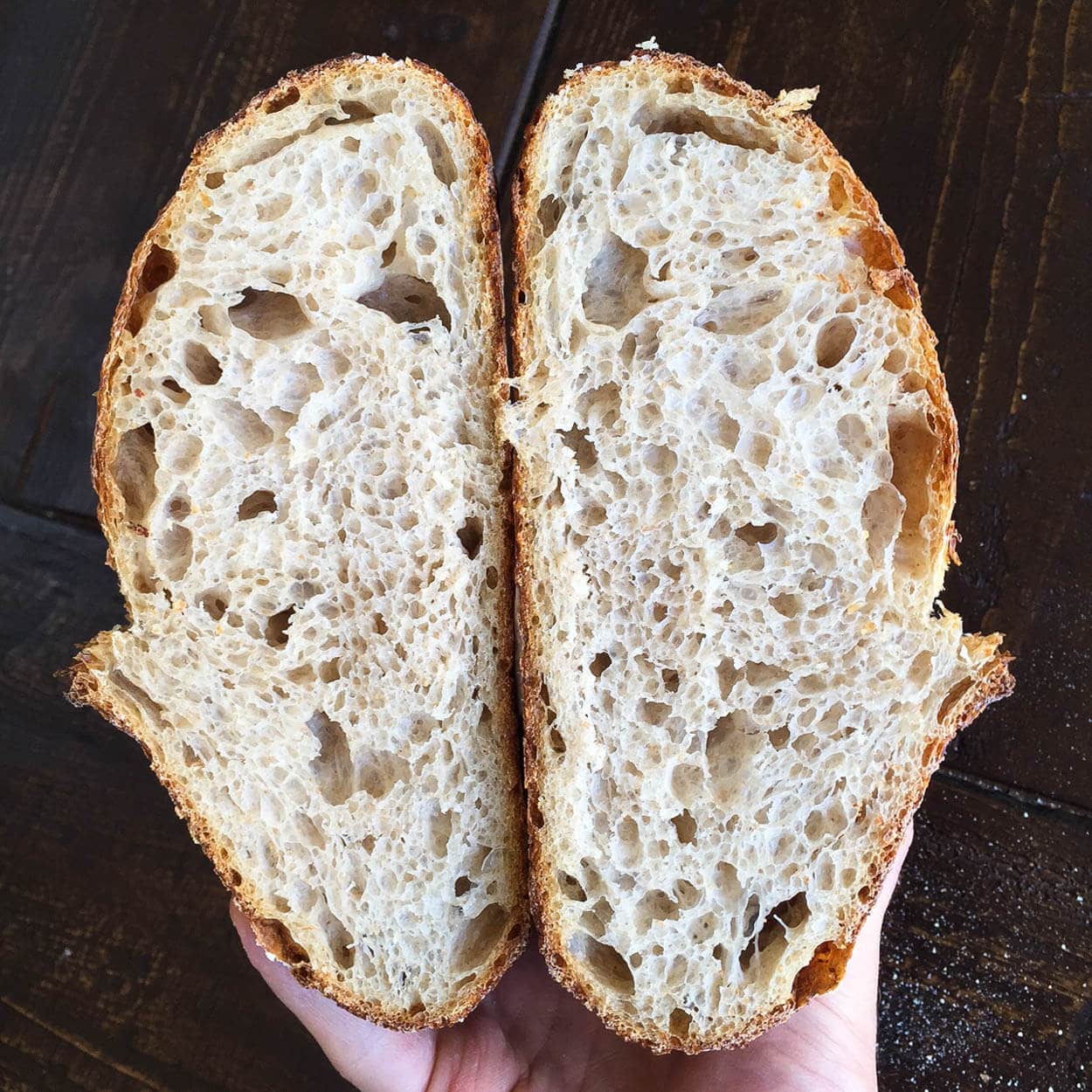
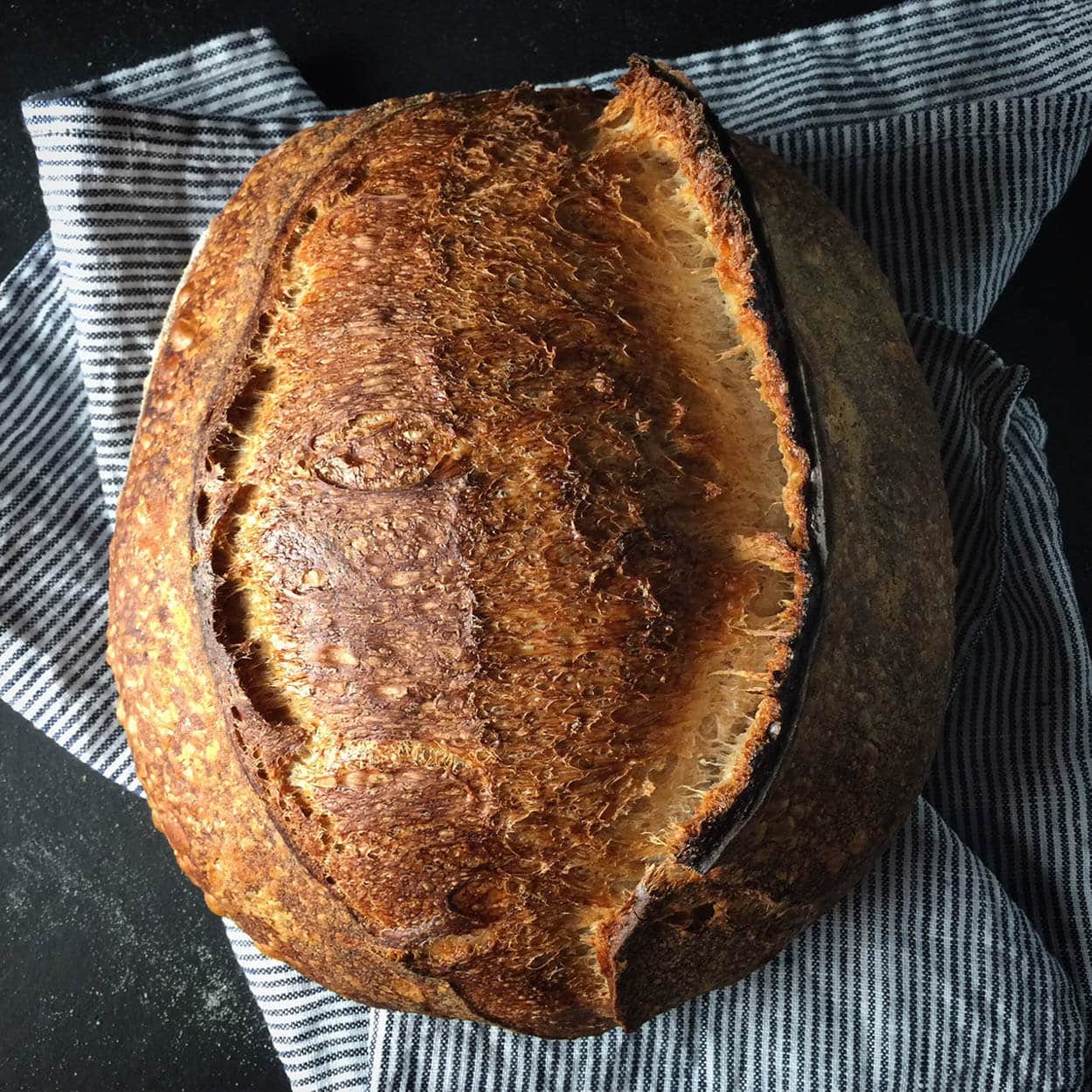
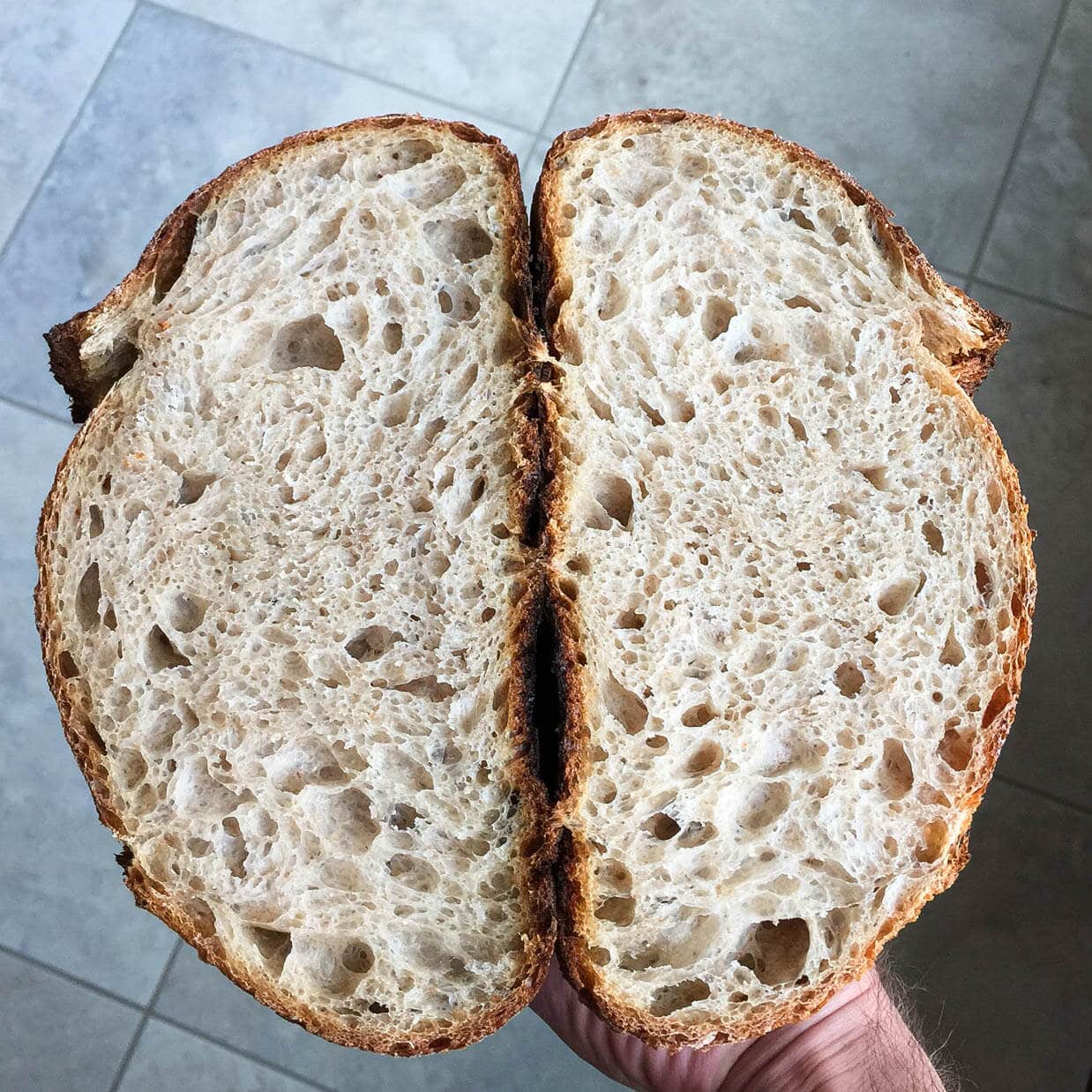
I like this method for baking bread in my home oven because it lets me bake two large loaves at a time. I plan to bake four loaves at a time, and this will let me do that with no problem. Baking with a Dutch oven (or combo cooker) works exceptionally well, and I might still use that method if doing only a single loaf or a highly hydrated one (the pan will help keep the dough together). Still, I find myself using this new method more and more. The results have come out smashingly.
Small steam burns: worth it (as you can see below).
What’s Next?
Be sure to check out my full guide to baking bread at home for more details on this important step!


430 Comments
Sounds good. That is definitely interesting. Keep me posted!
Recently I bought a FibraMent stone. (Before this I used a Dutch oven or a cloche.) My plan was to bake with a big stainless bowl over the dough to create steam. I’ve baked twice this way. The first was the biggest flop I’ve ever had – no oven spring; the crust was smooth and shiny and the inside was a cavern! Thinking the stone had not gotten hot enough, I tried again. It still had a cavern inside although not as big. Clearly oven spring did not happen but I don’t know why. Today I used the same recipe and went back to the Dutch oven and it came out beautifully. I have no idea what’s going on with the stone/bowl method but would appreciate any feedback.
That’s very interesting. Are you preheating the stone sufficiently? Depending on the thickness and the material it may just take much longer to preheat — perhaps up to 2 hours. If you have a cheap IR thermometer you could check the temp of the stone to ensure it’s fully saturated with heat each time. Other than that, the bowl method should work really well — I’ve done this myself several times and many readers have reported success as well!
I did use an IR thermometer. The stone got up to 450 but would not go higher. My gas oven takes a long time to preheat and even longer with the stone. This in itself is a problem not only because it’s wasteful but it’s hard to time the proofing when I need such a long time to preheat, plus I like to proof in the oven with the light on which I obviously can’t do during the preheat. But if I was getting decent bread it would be worth it! Until I get up the courage to try again, I’ll stick with the Dutch oven!
Wondering…why not just leave some water in a tray below? At that temperature it will convert to steam in the oven. Will this work?
It will, but I think the bowl works better.
I think I get a higher density of steam with the bowl in closer contact with the dough. And its a pretty large oven, so it takes a lot of water.
The bowl is an excellent method as well! @vijayapushkarna:disqus
I’m not entirely sure it makes a difference. Its been a long time since I baked in a dutch oven, and I’ve gotten a bit better at the whole process.
If you have to buy one, the bowl is cheaper!
You can probably control the bake temp better in the bowl, as the dutch oven retains a lot more heat. I usually reduce the temp after I remove the bowl, so the bread doesn’t get too brown and I can cook more of the water out of it.
Others might see heat retention of the dutch oven as a positive. If your oven temp swings wildly, the dutch oven can mitigate that.
Remember that I am cooking on a pizza stone too. I wonder how a cookie sheet would work…
I already have not just one but two dutch ovens ~, but I am thinking of getting a pizza stone because with my dutch ovens right now, they tend to burn the bottom crust of my bread a bit — I like to bake my bread to a pretty deep brown color, but by the time the top crust becomes deep brown, the bottom gets burned.
But I do love the oven spring that my bread gets in the dutch ovens. Some people complain about not getting as much oven spring when baking on a baking stone. I obviously could create a water bath setup as described in this post, but it seems like too much of a hassle. If a bowl works, I’d just use a bowl since I already have a big stainless steel mixing bowl that I can use as a lid.
Do you use parchment paper under your bread in the dutch oven? You could put something under the bread to slow down heat transfer. A couple of layers of parchment paper, or a sandwich with parchment paper and aluminum foil might just work.
I usually bake in a 7 inch springform pan without the bottom to get a good shape – the springform and the bread both rest on the parchment. Sometimes, I slip the bottom under both the parchment paper and the bread during late baking to keep the bottom from getting too brown.
Thinking about it, a springform pan bottom in the bottom of your dutch oven right from the start might work to slow down heat transfer a little.
I do use parchment paper under my bread — I sometimes put put multiple layers of parchment paper, which didn’t seem all that helpful. But yesterday, I experimented with lowering the initial baking temperature (I typically do 500F for 20 minutes during the lid on phase, based on some of the recipes I use), but instead, I did 475 for 20 minutes with the lid on, and 450 for 25 with the lid removed. The bottom definitely wasn’t burned this time!
Have you baked bread in a dutch oven? If you have, how does the bowl on a pizza stone method compare to a dutch oven?
That’s a really good method that is very effective at trapping steam! Experimentation is half the fun with baking, isn’t it? Have fun!
Now I just need to find something long enough trap steam to bake baguettes!
I’ve taken to using a stainless steel bowl on top of my pizza stone. I do the final rise on parchment paper, spritz the bread and the inside of the bowl, plop the dough on the parchment down on the stone, and cover it with the wet bowl.
I usually leave the bowl on for 20 minutes, but today I’m experimenting…
I think its some kind of black magic.
I can’t set anything on the floor of my oven as some of my heat comes from under that base. I actually melted the enamel and burned out the oven in the past. Will putting the towels and stones on a bottom rack be sufficient?
Yes, that will work just fine!
I’m not very experienced with those types of ovens. Typically in a professional bread oven you’d just hit the steam injection button a few times right after you load your dough. Since the oven chamber is completely sealed the steam will stay inside until you vent. If you have control like this over the oven I’d do the same thing! Just a few sprays in the beginning and then vent it out (carefully) after 20 minutes.
I’m sure it’s going to take some experimentation but what a joy to have that oven at home!
I am very new to sourdough bread, and recently upgraded my oven to a model that has a water reservoir for steam baking. Previously, I’ve only used my Dutch oven but I’d like to try the steam option. Would I just use a baking stone and steam for the first 20-30 mins when switching to my oven’s steam setting?
HI! I’ve been following you and using your methods for the past 8 months and I have loved getting into baking and refining my process with each bake! I recently switched to your home steaming method to increase the possibilities of shape and size of my bakes, and it’s been going ok. One thing I’ve run into is that I am not getting a good crust on the bottom of my loaves by the time they are crispy and golden on top. Do you have any tips for this? I bake in a gas oven on a thick stone using the lava stones and tray for steam in the first 20 minutes @ 475 and then come down to 450 for the rest of the bake. Typically i go for 25 minutes in the second part if using the dutch oven, but find I have to pull loaves out closer to 15-20 mins with this new method and have even resorted to flipping the loaves for another 5 minutes of oven time to crisp up the bottom some more.
It might be that you’re not preheating your oven sufficiently. I preheat for at least an hour, sometimes 1.5 hours, to ensure my Baking Steel (or even my baking stones) are 100% saturated with heat. If you have a cheap IR thermometer you could quickly test the surface temperature of your bricks to ensure they’re hot enough!
Loved the lava stone option. One wuestion: Do I place the cast iron pan with the stones into the oven as its heating up ?
Yes, I preheat those as well. You want them super hot so they help instantly generate steam as the ice hits them!
Hi there mauri! Why you use a top baking stone when you have an oven with already heat from above?? great site bro!
Hey, thanks! The top stone is not 100% mandatory. I kept it up there to help insulate and regulate downward temperature but if your oven has consistent heat from the top it’s not something you need. Happy baking!
Hi Maurizio,
I’m a big follower of yours but I gotta ask: why pour the water over the towels 10-20 minutes before putting the dough in the oven, and not at the same time? I learned from one of Peter Reinhart’s books that’s how you do it, but it seems to work for you so I’m really looking forward to what your comments are on this.
Thanks and regards.
Hey, Daniel! I usually pour the water over the towels and get them very saturated, then put them in the oven 15-20 minutes before loading the dough. Why? Because that helps pre-steam the environment before loading your dough, then once you do you add even more to fully saturate. It might be a superfluous step but I find the towels hold on to so much water they don’t completely dry out even by the end of my steaming period. So it might be optional but it doesn’t hurt! Hope that helps, happy baking.
I see what you’re saying. You’re right… it doesn’t hurt (in fact, seeing your point, I see how it would create a more humid environment). Thanks for your reply.
@maurizioleo:disqus , do you bake only pizza on Baking Steel or bread as well? How do you avoid bottom of the loaf to be burnt? Mine came out black. Baking stone at the same oven with the same temperature gives better results.
I do use the Baking Steel for bread also. It can be hard to avoid a slightly more baked bottom than top, and it requires quickly turning down the oven to avoid this. A few sheets of parchment paper below the loaf help as does other insulating material like cornmeal and/or wheat bran. A baking stone works extremely well, use whatever works best for you and your oven!
@maurizioleo:disqus , may you recommend any particular oven for home bakers? May be the one worked best for you. I am not going to use your answer as an advise what to buy, but as one of the most valuable opinions 🙂 I would really appreciate your answer. Thank you.
I’m not very up to date on the oven offerings out there but my home oven is a double oven made by Thermador — it works well. There are steam ovens out there but I haven’t looked into them much. That might be another option to look at!
@maurizioleo:disqus thank you so much, I looked at Thermador as well, but hesitated to make a choice toward that brand due to the small oven capacity compared to fancy Samsung and other ovens 🙂 Thank you
Hmm if I turn the heating element on the top on my electric oven, the bread gets a thick crust after I remove the top of my Duch oven and the bread does stops growing… so I was thinking I better not use the top element at all. Am I wrong?
Sounds right to me, you shouldn’t need that top heating element as long as you have a bottom one continuing to provide heat to the oven.
Just received my lava rocks. Do I need to clean them before first use? Do you have a preferred way to prep these?
I didn’t clean them in any way, since they were prepared for culinary use. If you see lots of dust you could rinse them off the night before you use them!
I bake in my Bosch steam oven. Your ideas are great and gives everyone a chance to make their bread great! I have plenty of room to make two side by side loaves like yours in one of those perforated bread baking pans. My bread has been turning out reliably well.
Thanks! I’d sure love to have a steam oven like that. I looked for one a while back when I redesigned my kitchen but I couldn’t find anything just like I had wanted. Sounds like you’re set!
Hey, I’m thinking about buying an oven with a steam function, which can be used with either the fan forced setting, or bake using the top and bottom elements and fan assist. Steam can’t be used without a fan setting. Which fan setting do you use when baking with steam and how have the results been, or are they different if using different settings? Thanks! Also, do you know what percentage steam/fan you use?
I don’t use a fan in my oven because I’m afraid it’ll reduce the effectiveness of my steaming. If your oven is made to use a fan with steam I would assume it would work well (as it’s being sold to do so)!
Good points Maurizio! The steam function isn’t specifically for baking though, so it’s hard to know whether it’ll be effective for that purpose. I read about someone who bought one to bake and said it was terrible using the steam function with fan forced setting as it made her bread pale and soft! Hence my concern. But it does seem like a good oven regardless of the steam function. I’m curious to read about how commercial ovens work as it seems that in order to have the oven at 250 degrees on the ones I’m looking at you can only use 25% steam, 75% fan heat, which I imagine is roughly what you want.
Yes that’s what originally steered me away from purchasing one of those ovens when I remodeled my kitchen. It seems rather limited and was mostly geared for steaming vegetables and other food, not for baking. The other issue was, at least back then, the oven cavity for those were rather small!
Steam injected ovens in a bakery simply have a button you press, and when you do, the oven chamber is flooded with steam (usually for a few seconds or however long you hold the button).
Good luck on the search!
Yeah, the full steam ovens are mostly tiny. There do seem to be a lot more on the market now and some are normal size and there are more combination ovens, though no one seems to know much about them!
I think I’m going to take the risk, fingers crossed!
Maurizio, nothing could be farther from the truth. My pies are gorgeous and baking is plain awesome in my steam oven.
That’s awesome! I probably should have revisited those ovens after I had looked at the small one I had access to back in the day. I know if they worked like you’re saying I’d be in heaven!
my loaves are golden dark brown and shiny fyi
I bake my bread at 375 on the steam convection setting and it’s perfect. I do an overnight rise in the refrigerator (my recipe for my home weekly loaf is 2 cups spelt and kamut that I soak for 2 hours, I throw in the sourdough starter and top is off with bread flour-overnight in fridge on second rise and it does most of the fluffy rise in the steam oven! I always use steam convection because the results are so nice, the fan is perfect.
Amazing, thanks for letting me know. I’m happy to hear that it works well using steam and the convection fan as it seems that’s how most of the combination ovens work. It’s so tricky to get information about how the steam function works, even the company that makes them can’t tell me!
I have the Bosch steam oven, I’ve never used the straight steam setting for bread and I have made bread in the dutch oven however we like a normal sandwich loaf with lots of tooth and flavor. The round loaves are great for a special meal but nothing beats a great loaf of bread with a dusting of cardamon. It’s a reliable recipe and everyone raves about the flavor of spelt and kamut incorporated into the recipe. I would love to try a sprouted grain bread, that’s next on my list.
Sounds delicious!
Hey! What baking stone do you use for downward heat? What do you consider a thick stone? I’m hoping to transition from DO baking to baking on a baking stone (need to buy one first). Scared to make the wrong investment, would love some advice! I bought some lava rocks from Home Depot recently, need to get some bath towels (the ones in your picture don’t look like kitchen towels).
I see that your pans are on the very bottom of your oven, can I do that in a gas oven? My pilot light is right underneath along with the broiler, I see some splash back in your short video, that might possibly turn off my pilot light…which has happened when I accidently missed the pan completely~
Hey! I use this baking stone for the top, it works really well. My oven is an electric oven and there’s no heating element on the bottom, it’s just a flat base. You can put the the pans on anything, really, even a rack at the bottom most set of rungs. You could buy a very large metal baking sheet and place everything on top of that, this way it would catch any water dripping as well. Just an idea!
No heating element on the bottom? So the upper element alone can heat both stones enough to bake?
I meant there’s no exposed heating element on the bottom. I do get radiating heat from the top and bottom when my oven is on.
Maurizio,
Thanks for providing such a helpful blog. I’m new to bread baking. I’ve tried a few different methods, and yours is by far my favorite, however every recipe I have tried my crumb comes out very gummy. My crust is good, and i get plenty of good air bubbles, but the crumb is shinny, gummy, and chewy. I have followed your method as best as I can from starter to steam bake. Any thoughts on what I might be doing wrong?
I find that this happens when I underproof my loaf. Maybe try giving the final proofing another hour. Also, a few extra minutes in the oven is good insurance against underbaking, just as long as the crust isn’t getting too dark.
Hey, Joshua! Glad to hear things have been going well for the most part. As @erikmidtskogen:disqus suggested below, it’s possible the loaf is underproofed. Make sure the dough gets sufficient time at room temp and proofs fully — you could leave your dough out (covered) 30 minutes or so after you shape it before placing it in the fridge.
Also, ensure your loaves are fully baked out. If you find the crust coloring too fast and the interior is under cooked (the interior temp of the loaf should be around 210°F or so) reduce the temperature of your oven for that second half of the bake so you can bake it longer but at a lower temperature.
Hope that helps!
Thanks Erik & Maurizio I’ll definitely try that on the next bake. I live just south of Atlanta Georgia so I’m still trying to figure out the proofing times. Most recipes I have found are from drastically different reigons.
Hi Maurizio! me again 🙂 Thanks for sharing the knowledge.
I’ve just finished baking two loaves with stones ans lava rock, not bad but no full ovenspring. But i suspect overproofing.
Quick check on baking temperatures your using? I did
1- 500 preheat 1 hour
2- 500 1st phase 23 mn
3- 450 2nd phase 30 mn
Is that correct? It’s what i do usually with dutch oven (with succes).
Do i really need heat from the oven after preheating the baking stones, aren’t they hot enough alone for the rest of the bake?
Cheers
Hakim.
Hey! Yes, those times and temps look correct (for the second step you have listed, the step with steam, for me it’s typically just 20 minutes). I have to continue to keep my oven on and going at the temps listed above even after preheating — opening the oven door to load the dough, vent the steam, and everything else drastically reduces the temperature of the inside cavity, especially in a home oven with a large oven door.
Hope that helps!
Hi,
When you say you can bake more than two loaves, i assume that you mean not in the same batch?
Cause i am preparing to bake on stones of the same size and i could not imagine fitting 3 loaves on them.
Hey, Hakim. That’s correct, when baking more than two loaves I have to separate it out into multiple bakes. Usually when the dough is kept cold enough (as in a home fridge), that delay is not an issue.
I would caution against the idea of spraying a second time a few minutes into the bake. I used to do this, but I noticed that it seemed to affect the oven spring. So I watched closely one time after spraying (my oven has a glass window to look through). After closing the door after the second spraying, I saw the loaf deflate fairly dramatically. I’m not sure why, but it might simply be that I’m lowering the temperature of the loaf itself by spraying it with water, and I’m losing a fair amount of heat and steam from inside the oven while I have the door open.
On a separate note, I recently had an interesting experience. I entirely forgot to prep my oven in any way, and by the time I noticed this, my loaf was already almost over-proofed and getting ready to fall. So, I just grabbed an old cookie sheet, threw the loaf on it, threw it into the oven, and turned on the heat, not expecting anything very good to result from it. This was a rye loaf, and I have a gas oven, BTW. So the loaf turned out just fine. I actually had the best shape of any loaf I’ve baked (nice and round, without the “flying saucer” shape I so often end up with because of premature hardening of the crust). The crumb was also just as good as I usually get. The only disappointment was the crust, with looked a bit funny, with uneven browning and a weird, lumpy surface, and not very much crispness.
So that was interesting.
Thanks for the comments, Erik! Yes, that second spray could potentially drop the internal temps quite a bit — it really depends on your oven and how fast you are 🙂 Really though, I do notice a temp drop but I can usually do it fast enough so there’s minimal loss.
Very interesting about the non-preheated oven! I’ve actually never seen this done before, now i have to give it a try myself.
Happy baking!
From the photos of your results, I can see that the second spraying is working very well for you. My oven is not really the best. Maybe that’s why it’s not working so well for me.
Just a thought, since his oven is gas, I wonder if the moisture produced from burning the gas prepped the oven with steam from the start?
That’s very possible. I’m not too familiar with gas ovens!
Amaing information Maurizio, thanks!
I am new to your blog and I am loving the content.
Would your method of baking with steam work when baking gluten free sourdough bread?
Also, do you have a post written about how to bake with a dutch oven? I just got one.
Thanks very much!!
Thanks, Maite! Glad to hear that. I’m sure it’d work with gluten free bread as well, although I’ve never tried it. Principles are still the same.
I have a few posts on how to work with a Dutch oven, check out my Beginner’s Sourdough Bread post!
Hi Maurizio,
Thanks for the amazing content on this website!
I was wondering why you use the two separate methods (towels and rocks) for steaming your oven rather than just using more of only towels or only rocks. Do you find they operate in a complementary way? I was planning on using only lava rocks in my home oven and was wondering whether I’d not achieve successful results using only the one method!
Hey Leigh! You can definitely just use the lava rocks, I just find the combination of the two to work very well for me in my home oven. The rolled up and soaked towels provide constant steam throughout the bake as they retain, and release, a lot of water. This release happens slowly whereas the lava rocks with ice or water creates an initial blast of steam that dissipates much quicker.
The thought here is the lava rocks will provide that blast of steam to get the interior of the oven saturated as well as the top of the dough, and then the towels continue to steam the chamber all the way through the bake.
You could try just using the lava rocks and see the results. It’s possible your oven can trap much more steam than mine and the towels might not be necessary.
Hope that helps!
Thanks for all the help!
When baking Baguettes, I am bursting each baguette on any side adjacent to anther baguette. (If I have three on my stone, the front one burst on the inside, the middle burst on both sides, and the far one again burst on the inside. I do not think it is technique issue or a proofing concern. I typically dump ice water into a cast iron pan, where there is water throughout the entire process. Can there be too much steam? Also, I preheat to 550 and drop to 420, could the initial temp be to high causing a premature crust?
Hmm, that’s very interesting. Usually when I see excessive bursting like this it’s either because I’ve under proofed my dough slightly or I did not sufficiently score the dough in that area, or another area, to allow for smooth expansion. could either of these be a possible cause?
I don’t think it’s from over steaming, usually this causes the crust to remain too soft and pliable and will even cause a crust to not ever really harden off at the end of baking.
I have been using the Dutch oven method with no problems. I have tried to bake twice now with the lava rocks method and have no success. Bad oven spring, and the skin where I scored it has toghent back up and hasn’t cracked. What am I doing wrong. I suspect I’m not generating enough steam
Ah, bummer to hear this! I’ve used this method for quite a while now with excellent results (all my bakes are done this way), I wonder what part of the process is off in your home oven. Be sure you’re preheating your baking stones / baking steel for a full hour at least — this high heat stored up in the baking surface is crucial to this method, especially since we don’t have the retained heat from the Dutch oven. From there, make sure your lava rocks are preheated with the oven, they need to have enough stored heat to melt the ice almost immediately on contact. Finally, make sure to really drench those rolled up towels until you see they don’t hold any more water and water starts to leak out to the pan. These towels should be placed in the oven either right before you load your dough, or a few minutes beforehand.
You could also try adding in another cup of ice 5-10 minutes into the bake into your pan with lava rocks — you might need another kick of steam after the first has most likely leaked out of your oven.
Hope this helps — keep me posted!
I didn’t know I had to do both the towels and the lava rocks. I thought it was one or the other. Maybe that’s why?
It all depends on your oven. If using just one provides enough steam than that’s great, but for me, and my oven, I find I need both to really generate the steam required.
I am finding that my lava rock has an odor when hot and is leaving a residue in the pan . I am thinking of switching to glass rocks as used as ballast in vases or fish bowls. Does anyone have experience along these lines? Before lava I had used the glass fragments that the city gives away for landscaping as part of their glass recycling program. They worked fine but my wife objected to having these around the kitchen. I’m going to find something other than a cast iron skillet to hold this.
I’d be cautious using glass as it can crack when it’s exposed to temperature shock (super hot to super cold). That said, they could still work for you as I’ve never tried it — I’d just be cautious.
Another option here are small river rocks or even small pebbles/sand. I’ve talked to a few people who use these to great success as they hold quite a bit of heat and don’t cause any issues to the pan.
As for the cast iron, using a stainless steel pan will work just as well! Another option would be to pickup those cheap, disposable metal baking pans (Reynolds or the like) and cycle them out periodically.
Hope that helps!
Another item that people have used is large industrial iron chains.
Quick question — do the rectangular baking pan and cast iron pan w lava rocks go in the oven for the entire 1 hr preheat? If so, I’m assuming you only add the towels 10-20 min before baking, yes? I just ordered some lava rocks and am looking forward to trying this method for steaming. My electric oven has a vent just above the cooktop (below the controls) and anytime I’ve tried steaming with hot water, soaked towels, etc, I see a plume of smoke leaving the oven and filling my kitchen. 🙁 I’m hoping that the lava rocks will make a difference! And maybe I’ll try blocking the vent with a kitchen towel. Love your blog, thanks for sharing your expertise!
Hey, Nicole! Sorry for the late reply. The pan with the lava rocks does get preheated but the pan with the towels does not.
It’s important the towels never get dried out otherwise they can smoke up and even burn a bit. Always keep the towels out of the oven and only put them in, after soaking them, when you load your bread (a few minutes before).
Thanks and I hope that helps!
Thanks! I use the parchment simply to help me slide the bread into the oven after I score it. I’ve often thought about the point you’re bringing up, though: does the parchment insulate the dough from the surface cause less heat transfer? Honestly I don’t think that to be the case, in all my time baking I’ve used parchment (when not using a Dutch oven) and I haven’t really seen any lack of baking on the bottom of the loaves or sluggish spring. I’ve even seen some pro bakers use parchment in their deck ovens.
Further, if I weren’t to use parchment I’d have to use something else to help me ease the dough into place, such as flour, bran or cornmeal. These items would insulate in a similar fashion.
I do constantly move my dough around in the oven as there are hot and cool spots. I’ll move them around when I notice things are cooking to fast on one side or not enough on the other. In my oven the right side tends to get a little hotter than the left so halfway through the bake I’ll switch the loaves around.
Thanks for the input and insight!
These are some very good thoughts I hadn’t considered, thanks for bringing them up! I’ll have to think of some way to test this out myself and see the results…
What about the temp limit for parchment paper? I’ve been tempted to use it for my breads that include figs, cherries, etc. that tend to caramelize & make a sticky bottom. But the highest rated parchment paper I found is 450, and I bake @ at least 500…and didn’t want to start a fire. 🙁 ! do you have a higher rated parchment paper? or lower baking temp? or it just isn’t an issue?
Great write up (and website), thanks!
I have never had an issue with parchment paper in any of my bakes and I always use it. Sometimes the parchment paper does turn quite black at the edges and corners but I’ve never had an issue with a fire breaking out.
That said, be careful when using it until you’re confident you won’t have issues!
Interesting…thanks!
I have a cast iron pan so I will probably use your lava rocks method. Do you ever have a problem with rust on your pan with all that water? I also have a baking steel do you ever have a problem with that rusting?
Yes, I do notice rust will accumulate on the steel/iron parts that are exposed to water. One thing I’ve been experimenting with lately is using a regular, hardened steel baking tray to hold the lava rocks instead of a cast iron pan. This way I can toss that baking tray in the dishwasher occasionally and wash it. This has been working well!
I’ve been experimenting with the steam jet of my espresso/cappuccino maker. I unscrew the outer cover of the steam jet, leaving only the straight tube. Over that I fit a length of poly pipe from the hardware store, which has at the other end a length of small-diameter copper tubing that I have flattened slightly and bent into an “S’ so it fits past the profile of the oven door. Just before loading the bread, I turn on the steam, aim the copper at the kitchen sink and wait until all the condensate has spluttered out; then open the oven door, pop the copper tube into place, and close the door. There is of course a gap so the door is not tightly closed, but it is small enough that not much heat escapes. After steaming the oven for 30 seconds or so, I load the bread, and continue steaming for another 30 seconds to a minute. Results vary, and I’ve never been sure how long to inject the steam. After reading some of the other comments here and on other blogs, I think I may repeat the injection at intervals for the first 10 minutes of baking and see how that works out.
Note that I am wearing heavy oven mitts the whole time (if you think steam is hot, try that copper!). The espresso machine is by Breville.
This is such a great idea! And an even better idea with the heavy duty gloves 🙂
I’ve seen people rig up their oven with a pressure cooker as well. They fill it part way with water and set it on the stove. From the top of the pressure cooker (where the outlet valve is) they run a tube from there into the vent of their oven and it will pump steam into the oven for as long as the cooker is over a flame. I’ve been tempted to do this but not bold enough to follow through 🙂 Seems risky to me and I wouldn’t recommend it.
Anyways, love this idea! I might have to try that out myself. Considering you probably have a much more effective steaming of the oven you probably don’t need to steam for the entire 20 minutes as I do here. I know that in a professional bakery they might only press the steam injection button a few times the first few minutes of baking. You’re going to have to experiment some more — which is what it’s all about, anyways.
Happy baking and thanks for the idea!
Hi Maurizio! Great blog! I have a question on whether it’s better to use convectional bake or regular bake. On one hand c. bake is faster and spread the heat evenly, on the other hand it may dry the bread and be better to be used only after the first 20 minutes bake (post oven spring). I’ll be happy to hear your opinion on that.
Another question, when you mention lava rocks – are these the very same ones used for gardening?
Thanks,
Eyal
Thanks, I appreciate that! Your comments on convection vs. traditional are spot on: with convection you’ll have better heat regulation and distribution throughout the oven but a potential for reduced steam in the oven cavity. I choose to not use convection, all of the bakes shown here are with a traditional oven. My guess is that convection would be good for the second half of the bake but in the beginning it would dry out the loaf and cause it to not rise as high as it could.
The lava rocks I use are culinary grade and not the same as those used outdoors. You can find the lava rocks I use in my oven here.
Hope that helps and thanks for the comments!
I tried this method, although I didn’t have baking stones on top, and the baking stone that the bread was on was not very thick. I was pretty happy with the results, but the bottoms of my bread didn’t brown as well as the top of the bread. In fact, the top surface was almost burnt, and the bottoms were barley cooked. Do you have any idea why that would happen? Do you think it has to do with the pan in the bottom having too much water in it?
Did you preheat the oven for at least an hour to ensure the bottom baking stones were fully heated? It sounds like maybe they weren’t quite as hot as they could be and radiated less heat than the interior of the oven. It’s possible the pan had too much cold water but I wouldn’t guess that would cause this issue. If you preheated for an hour you could try 1.5 hours next time and see if that helps, if not reduce the amount of water in the pan and see if that solves the issue. The stones should be smokin’ hot!
Thanks for the reply! I did preheat for an hour, but tomorrow I will try for 1.5 preheat and less water. I’ll tag you on Instagram if they turn out better 🙂
Ciao Maurizio e complimenti per il blog.Io utilizzo la vaporetta per immettere vapore nel forno e trovo questo metodo molto comodo ed efficiente.
Grazie mille, apprezzo molto che! Trovo che questo sia il modo migliore per cuocere a vapore il forno a casa, anche se richiede un po ‘di lavoro extra. Felice cottura!