

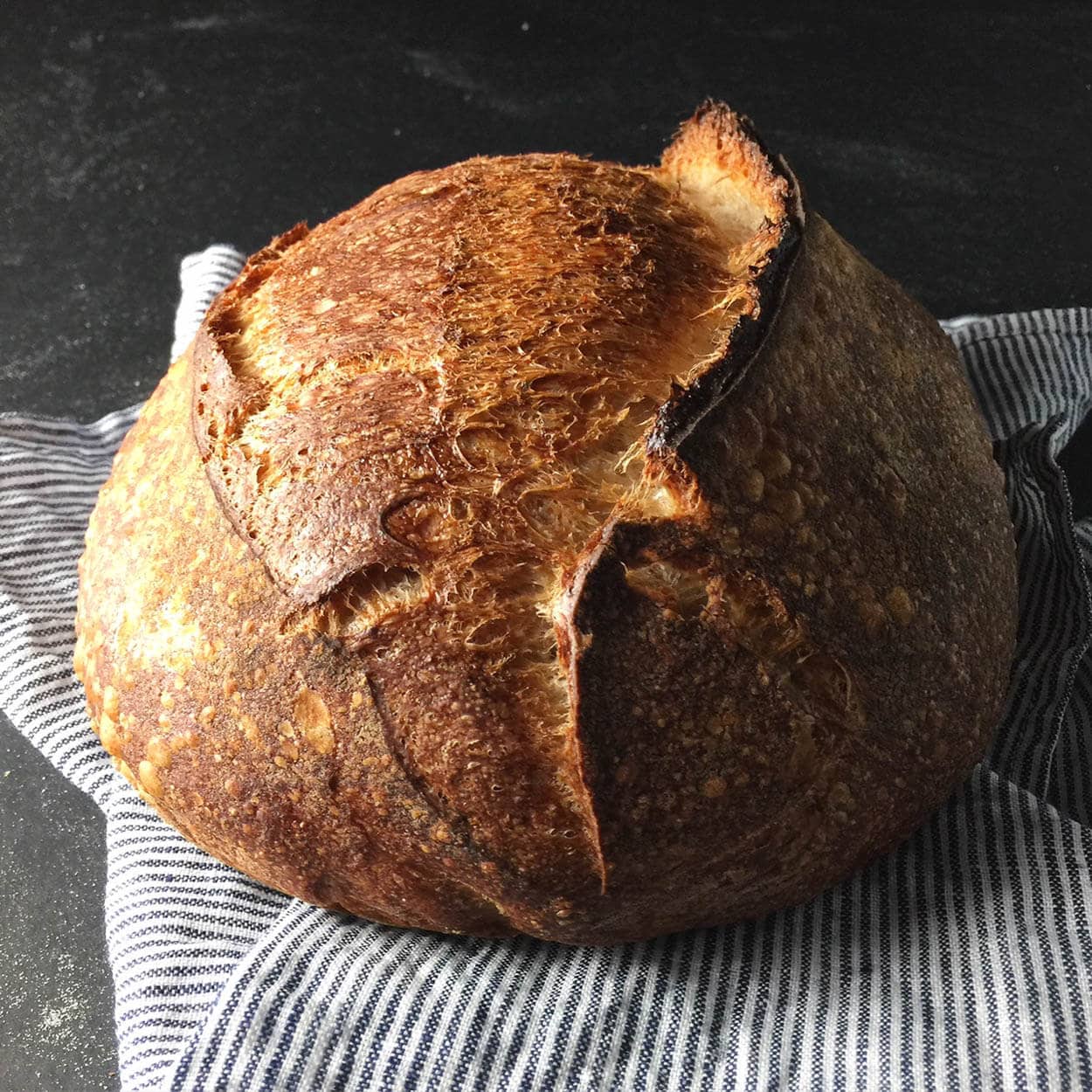
Steam burns hurt. Like, really hurt. The small mark on my left forearm begs the question daily: Maurizio, was it worth it? But before we talk about my new baking badge of honor, let’s concentrate on overcoming the challenges of baking good bread at home. While many of these challenges show up early in the two-day process (fermentation, flour selection, mixing, shaping, and so on), one crucial component comes at the end of this ordered procession: how to bake bread with steam in your home oven.
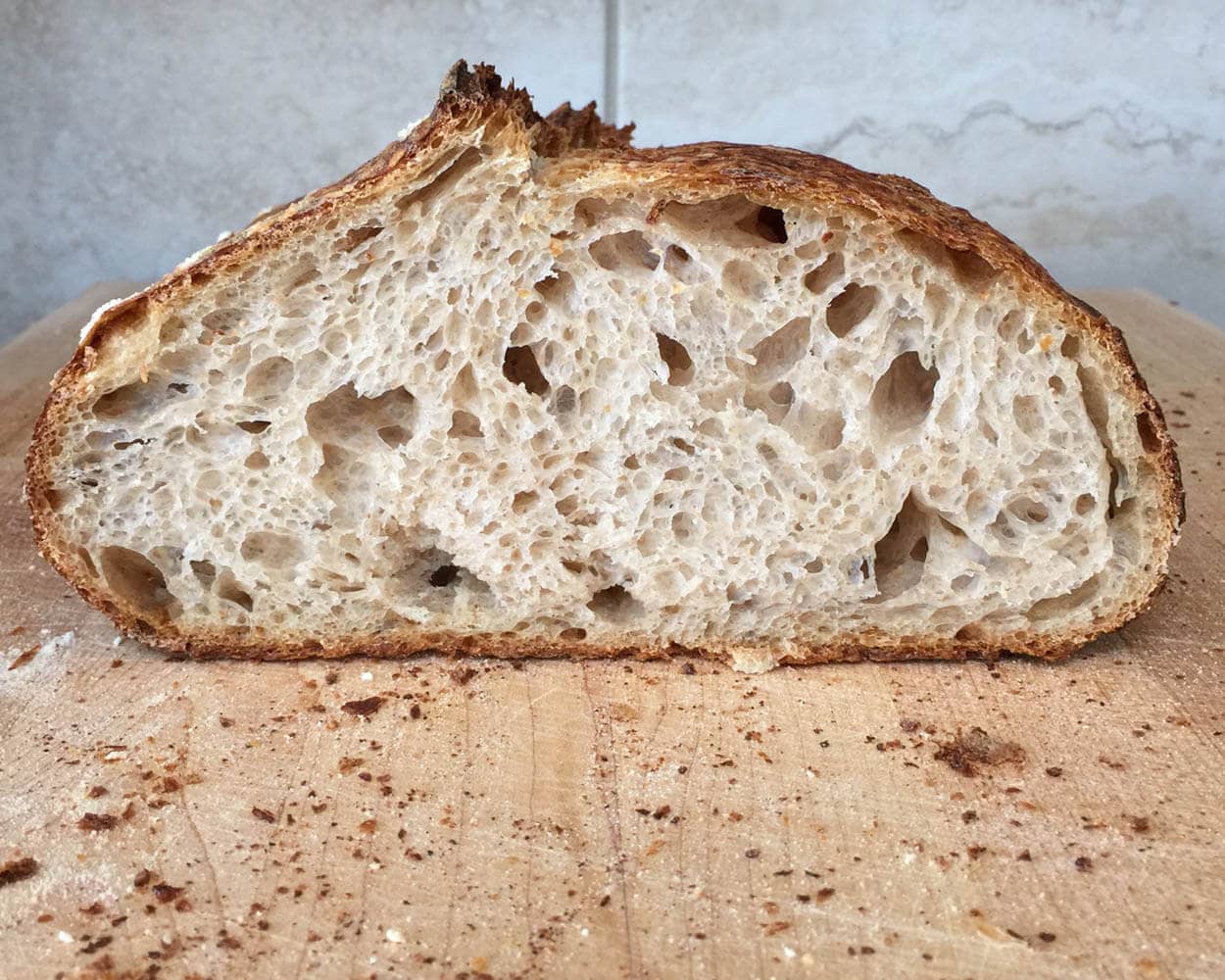
For your bread to rise to its potential, that outer, taut skin on your loaf needs to be able to expand and stretch before hardening off. Steam in the oven, and subsequently on the surface of your loaves, helps keep the skin pliable and stretchy during baking. If your dough dries and bakes too quickly on the exterior, it can harden off before it rises to its full potential (and you may not see a satisfying grigne, either).
So how can we get enough steam in the oven to keep those loaves rising? There are indeed methods abound, and each person has a different approach, but arguably the most popular choice at the moment, and the one I started with, is baking bread in a Dutch oven (see my guide on how to bake bread in a Dutch oven if you’re not familiar). However, there comes a time when you might want to bake two (or more) loaves at a time, or perhaps your loaves are scaled more substantial than your Dutch oven can comfortably hold. An alternative is to bake directly on stones and generate sufficient steam in your home oven by some other clever means.
Professional baking ovens have steam on tap. Press a button, and a wave of steam sprays over the decks of newly loaded dough. Now there are home ovens that are “steam ovens,” but the ones I’ve looked at are incredibly small. You might be able to fit two loaves, but I could also fit two Dutch ovens in my current home oven; no advantage there. Some other alternatives can’t inject steam at a button press, but they are sealed to trap steam and have a method for generating steam. These look very promising but are on the expensive side.
Since most of us bakers out there do not have a fancy oven (if you do, I’m jealous!), read on to learn how to bake bread with steam in your home oven.
What You’ll Need: Tools for Steaming Home Oven
Five things, and my guess is you probably already own most of them:
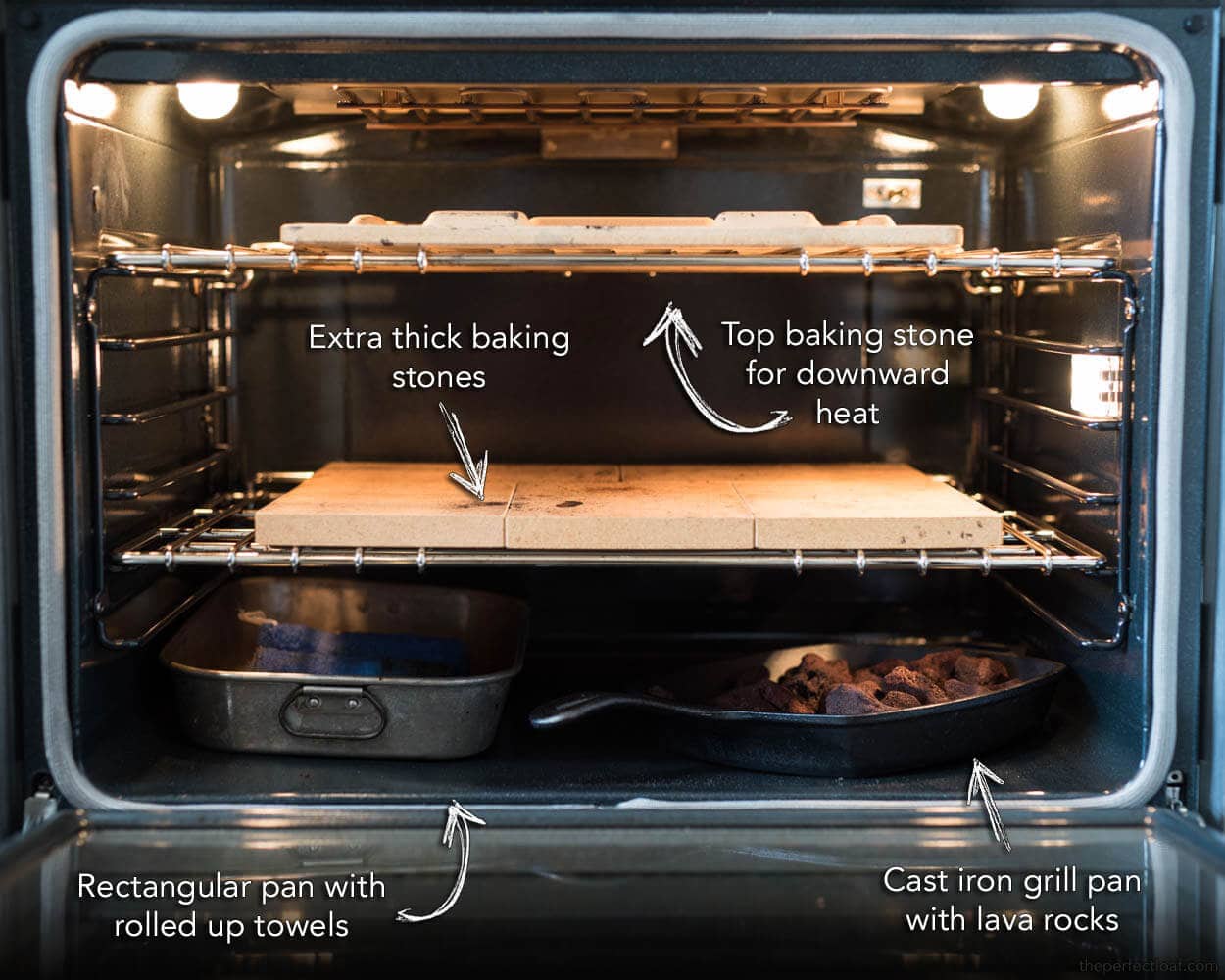
- A cast iron or stainless steel roasting pan filled with lava rocks or ceramic briquettes. The extra surface area helps because with more hot surface, you get more instant steam. Or, if you want, trade complexity for ease and just leave the pan empty for a little less steam (but still enough!).
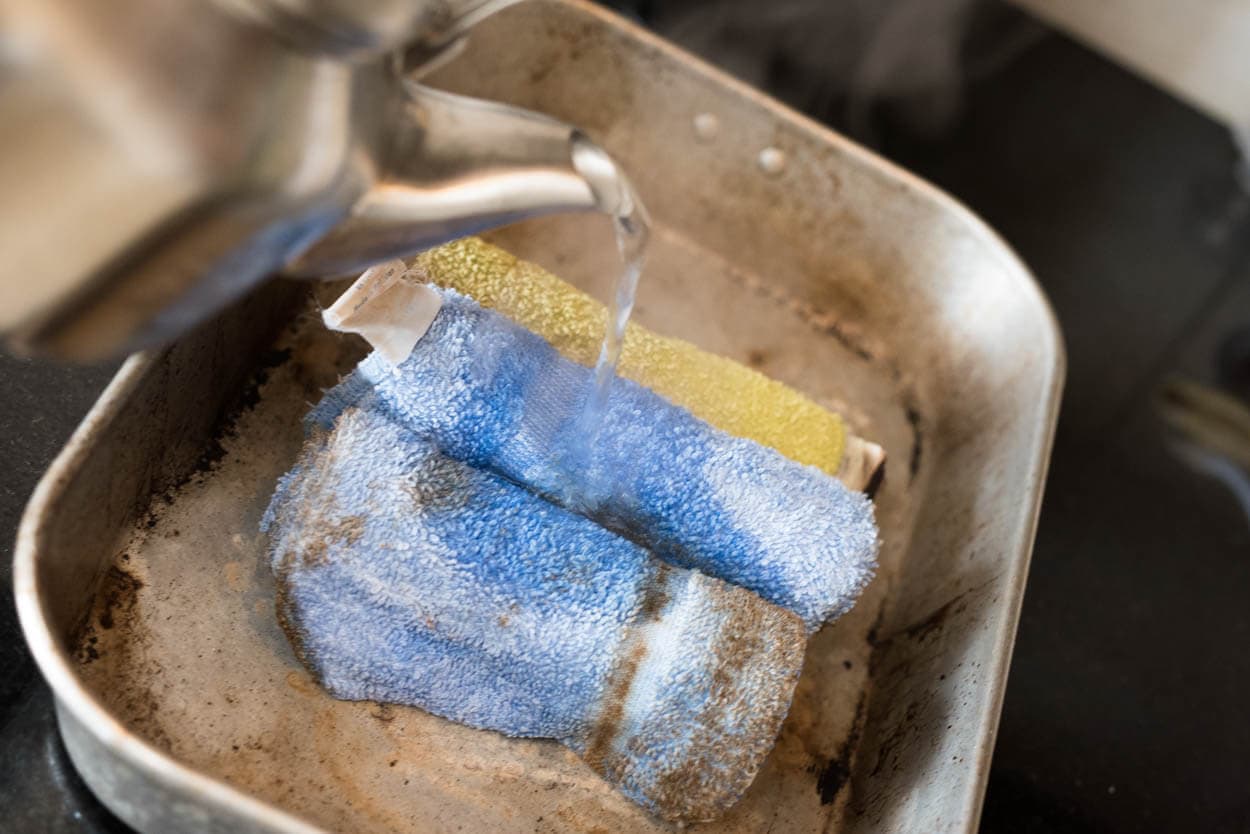
- A rectangular roasting pan with three dish towels rolled tight inside to provide continuous steam during baking. Use 100% cotton kitchen towels that are undyed or white. They tend to look beat up eventually, so cheap towels are best.
- A pizza or bread peel and parchment for loading.
- Optional: a stainless hand spritzer for one last shot of steam before the door shuts. (If I want an extra shiny crust, I’ll re-steam 5–10 minutes in.)
So, how do we use all these tools?
How to Steam Your Oven For Bread, Step by Step
This takes a bit of practice. First, gather your tools and keep them within reach; this is a hectic process, and you want to do it almost without thinking—muscle memory. The longer your oven door stays open, the more heat escapes. Your thick baking stones or a baking steel (also awesome for sourdough pizza!) will help offset some of the loss, but you still want to act quickly.
Below is a quick visual showing where I have my pans, where the loaded dough goes, and where my baking stones are.
Home Oven Steaming Method
- An hour before baking, turn on your oven (preheat)
- 10-20 minutes before loading your bread, boil water, pour it over the towels in your rectangular baking pan, fully saturate them, and place them in the back corner of your oven
- 10-20 minutes after loading the pan, put each mass of dough on a separate piece of parchment paper
- Place the dough and parchment underneath on a pizza peel
- Score dough
- Open the oven and slide the dough (with parchment) onto baking stones
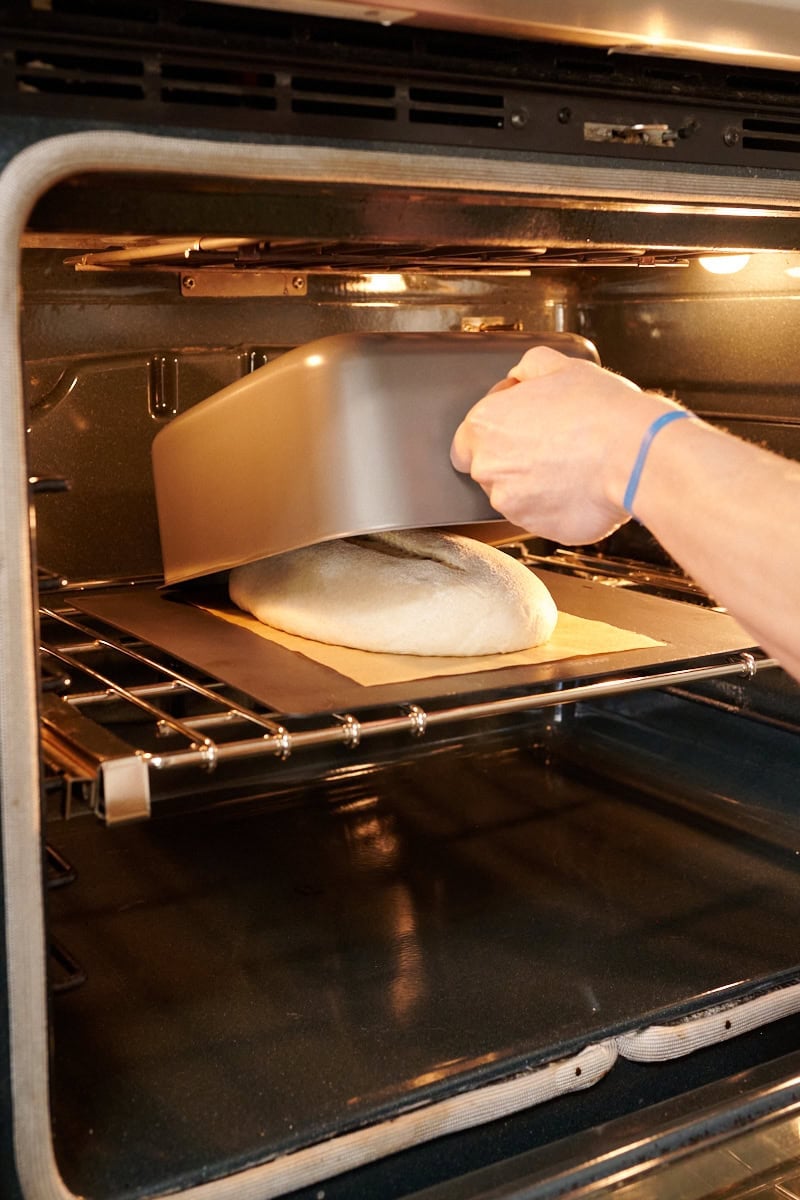
- Quickly lay a towel on the oven door glass (optional; you can see me doing this below). I’ve read that cold water dropped onto a hot oven glass door will shatter the glass, thus the towel. I have dropped some water on the oven door without any ill effect, but I do this to be safe.
- Carefully toss 1 cup of ice into your cast iron pan with lava rocks
- Quickly spray loaves a bit with a hand spritzer (optional)
- Close the oven door and watch your dough rise
- 20 minutes later, remove both steaming pans (careful, these are extremely hot) to stop steaming
- Bake until the loaf is well colored and crusty
Video: Baking Bread With Steam
In my video below, you’ll see me baking bread with steam from start to finish.
Why do we use two sheets of parchment paper for our dough? Using two sheets lets you adjust the space between the loaves as they bake, if needed. One of the worst things that can happen is when the dough expands and joins another loaf; this reduces the overall rise of both loaves. If you notice the loaves start to get a bit close as they rise, slide them apart quickly.
After 20 minutes of baking, we remove the cast-iron and rectangular baking pans so no more steam is generated, allowing your loaves to crisp up and harden off.
Caution: Please be careful with this method: if you drop too much cold water on your oven door, you might crack the glass. I have never had this happen to me, but I know of at least one baker who has. Be sure to keep the water off the glass.
When to Vent: Pulling the Steam for a Crisp Crust
Bread dough benefits from steam early in the process, then a dry oven to finish for the best crust.
Twenty minutes is my rule. By then, the loaf has done its expanding; the oven spring is over, and leaving the pans in any longer only keeps the crust soft when you want it hardening and coloring. So I pull both steaming pans at the twenty-minute mark and let the dry heat finish it off, usually another twenty to twenty-five minutes, depending on loaf size and how dark I want the crust.
If your crust comes out pale and a little leathery no matter how long you leave it in, you’re almost certainly steaming too long. Pull the pans earlier next time.
Why Steam Matters When You Bake Bread
You already know that steam keeps the loaf’s skin pliable long enough for it to rise. But here’s what’s actually happening during that first part of the bake when steam is in the oven.
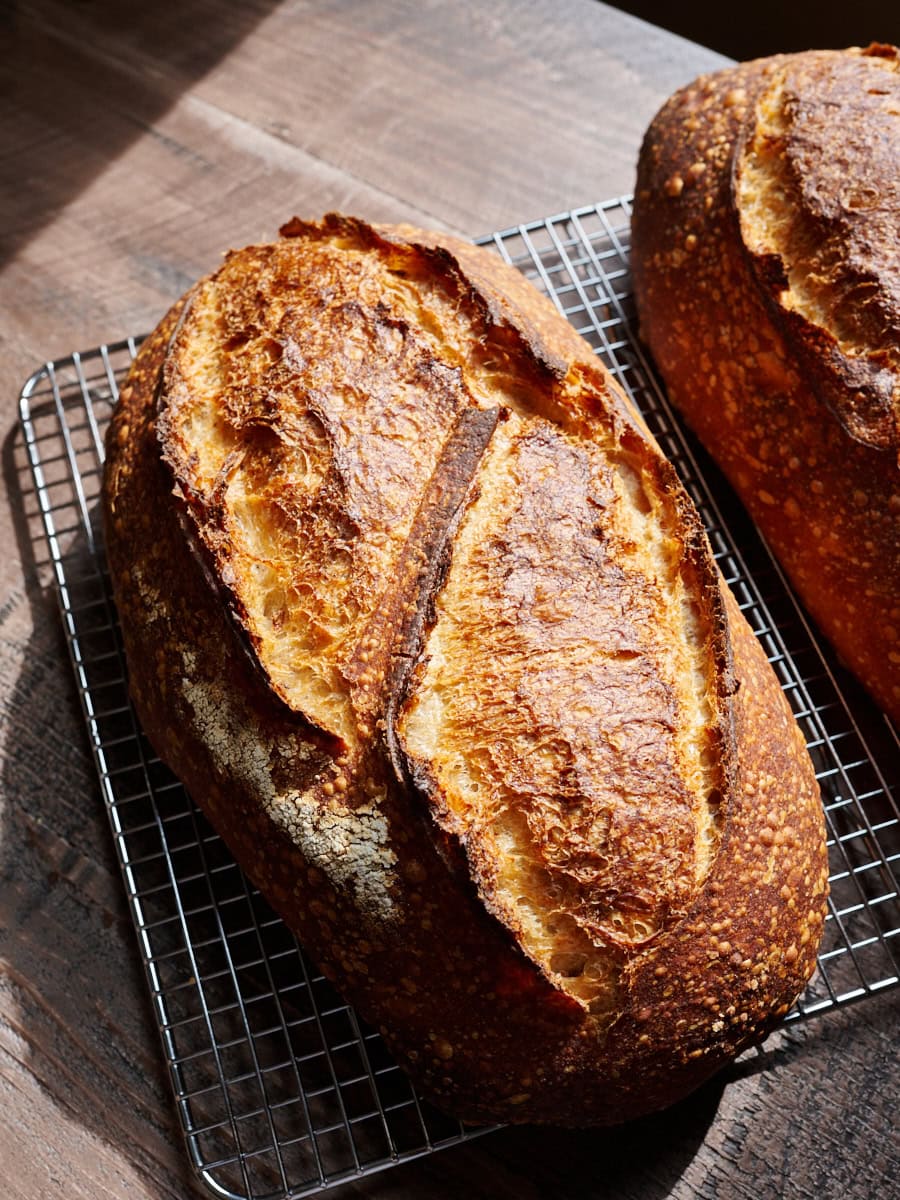
A loaf does most of its rising in a short window at the start of the bake, while the dough is still soft and the gases are still pushing out. Steam is what helps keep that window open long enough to reach maximum volume. It settles on the dough’s cool surface, keeps the crust from forming prematurely, and lets the loaf reach its full volume before it sets. Skip steaming, and the exterior stiffens early, reducing rise and leaving you with a tighter crumb and a blunt, torn ear (or a crust that sort of fuses together) instead of a clean opening and tall rise.
There’s also a second payoff: shine. The moisture gelatinizes the starches on the surface, and once the steam clears and the dry heat takes over, those starches set into a thin, glossy, almost lacquered crust. A dry oven gives you a duller, flatter brown. Steaming gives you blisters, gloss, and that varnished look you’re after.
Why Your Home Oven Fights You
Professional ovens (or even smaller-scale home ovens like the RackMaster) are sealed and built to hold steam. Your home oven is built to lose it.
A home oven vents steam by design, pulling humidity out about as fast as it’s made. That’s a feature when you’re roasting a chicken and want a crispy skin. It’s not great for bread, though, which benefits from humidity. Gas ovens are worse, too, since the burner needs to breathe, so they vent even more.
The other half of the problem is thermal mass. Home ovens are light with only bare racks inside. Open the door to load your loaves, and the temperature drops significantly, then slowly creeps back up. Baking stones or a baking steel fix that by providing thermal mass, which stores heat.
Other Ways to Steam Your Oven ( and When I Use Them)
There’s no shortage of ways to get steam into a home oven when baking, and I’ve tried most of them. A few of the following are worth trying, but most aren’t.
Spraying alone. Mist the oven walls as the bread goes in, then again a few minutes later. Easy, and better than nothing. But the steam vanishes about as fast as you make it, and every spritz is an open door bleeding heat. You can skip all the pans and just use the spritzer, but you won’t get quite as shiny of a crust (but admittedly, it’s much easier).
Boiling water in a pan. Skip the lava rocks, preheat an empty cast iron pan, pour in a cup of boiling water as you load. This is the workhorse most bakers start with, and it works fine. Lava rocks just push it a little further for better results.
An inverted pan or shell over the dough. A Baking Shell, cheap aluminum roasting pan, or a big metal bowl flipped over a single loaf traps the dough’s own moisture against its skin, Dutch-oven style, minus the Dutch oven. It works very well, actually, and is a lot easier than a Dutch oven.
A cloche. Same idea as the inverted pan, prettier and heavier and pricier. Round loaves only, one at a time.
The Dutch oven. Still the most forgiving way to bake bread with steam at home: you place your dough in a preheated pot, close the lid, and put it in your oven. The drawback is you’re limited to round loaves, since you’re limited to round pots. For a single round loaf, or a dough slack enough to need the walls to hold its shape, I still reach for the pot for simplicity (if you go this route, see my post on how to avoid burning your loaves).
Common Bread Steaming Mistakes
Most steam problems show up as a crust gone wrong (too pale, too thick, too dull). Here are a few reasons why it might have happened:
Leaving the fan (convection) on. Convection blows your steam away before the loaf can rise. If your oven defaults to fan-assist, turn it off.
Steaming too long. Past the oven-spring window (around 20 minutes), the crust never dries enough to crisp and color. Pale, leathery, soft, and no shine. Pull the pans at twenty minutes and let the dry heat finish the crust.
Too little steam, or venting too early. The reverse: a blunt, thick crust and a torn ear instead of a bloomed one. Usually too little surface area in the pan, or a door that didn’t seal fast enough. Work quicker, add more towels.
Drenching the oven door. Cold water on hot glass can crack it. Place a towel over the glass, and aim the water at the pans.
Letting the loaves touch. Two doughs that grow into each other both lose their rise at the seam, which will also fail to color, leaving a pale spot. The two-parchment trick is the fix. Slide them apart as soon as they get a little too friendly.
Baking Bread in a Home Oven FAQs
Can I bake bread in a home gas oven?
Unfortunately, this method doesn’t work super well with a gas oven given the venting requirements. Instead, I’d bake using a sealed Dutch oven.
When baking bread in a home oven, do you use convection/fan assist?
No, you do not want to use convection (fan assist) when baking bread in a home oven with steam. The fan will blow steam around, creating a hard crust on the outside of the dough before it has a chance to fully expand in the oven.
Do you really need steam to bake bread at home?
For a lean, crusty hearth loaf, yes. Steam holds the crust off long enough for the loaf to reach full volume, and it’s what gives you the gloss, the blistering, and the deep color. Soft sandwich loaves in a pan don’t need it. A crackly sourdough boule does.
How long should you steam your oven for bread dough?
About twenty minutes, long enough to carry the loaf through oven spring. After that you want a dry oven so the crust can set and color, so pull your steaming pans and let the dry heat finish the bake.
Can you over-steam bread dough when baking?
You can. Steam past the oven-spring window and the crust stays soft instead of crisping and browning, leaving you a pale, leathery finish. If that’s what you’re getting, pull the pans earlier.
Can I steam bread dough without a Dutch oven?
Yes, and that’s exactly what this method is for. Baking stones (or a steel) plus a cast iron pan of lava rocks and a towel-filled pan let you steam the whole oven and bake two to four loaves at once, no Dutch oven required.
Conclusion
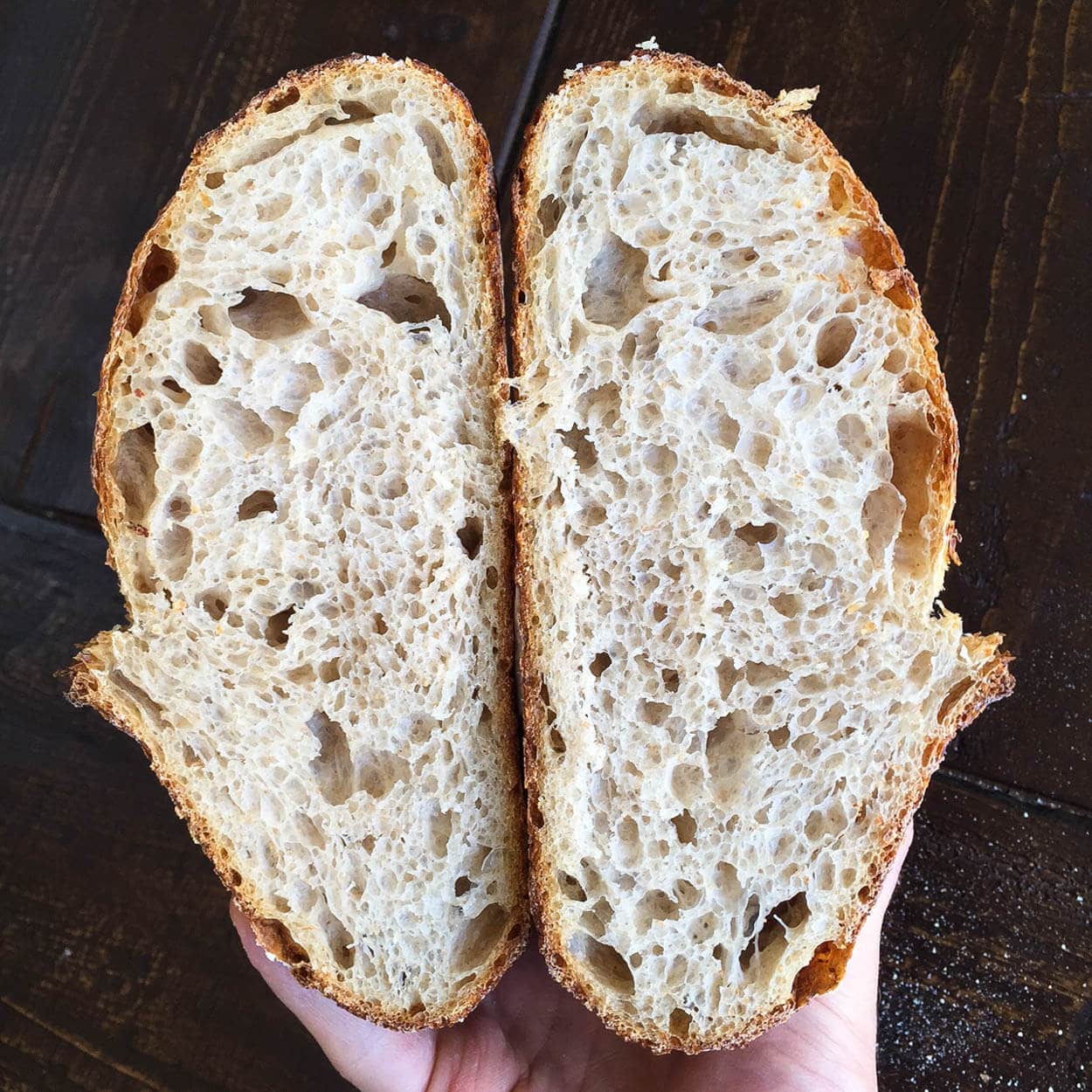
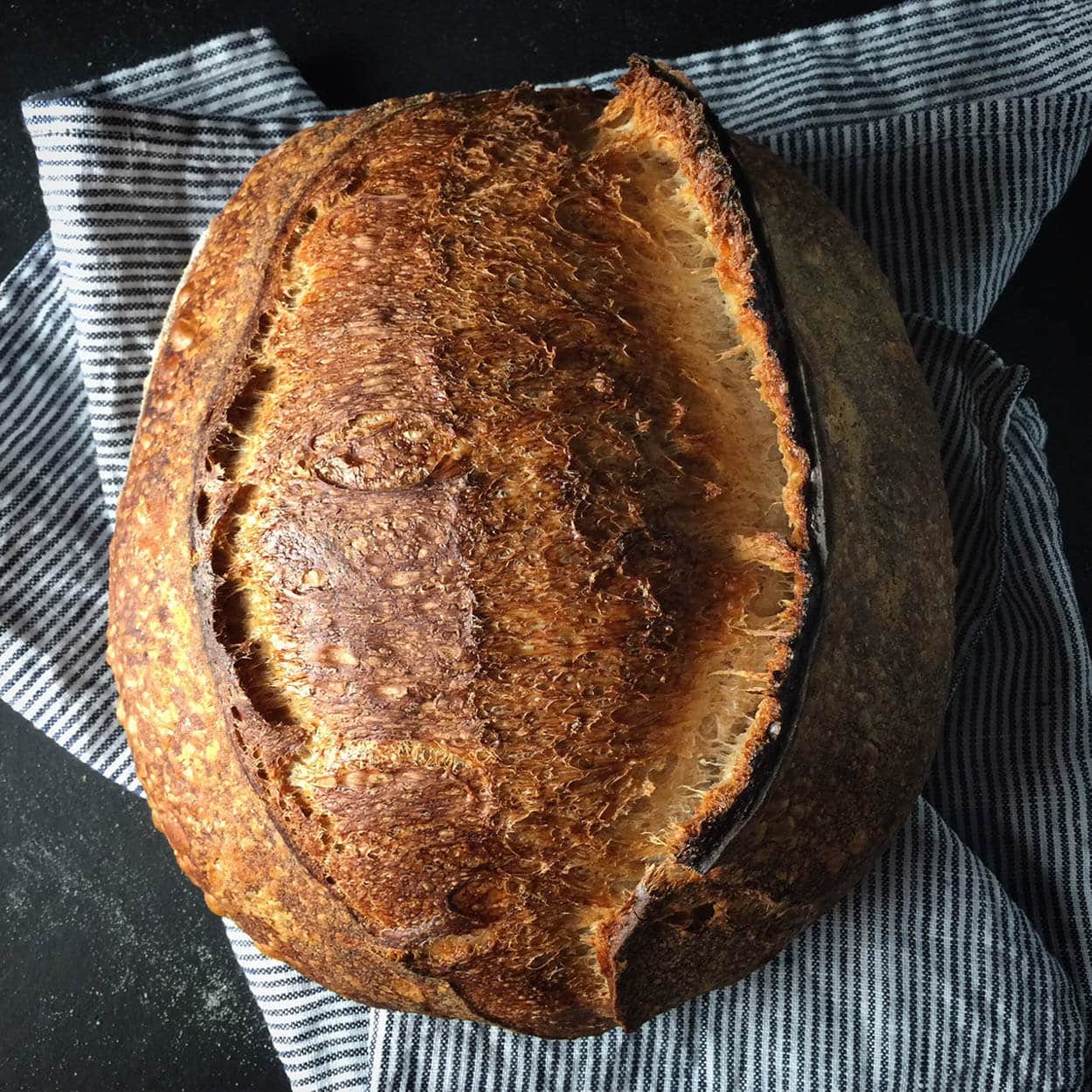
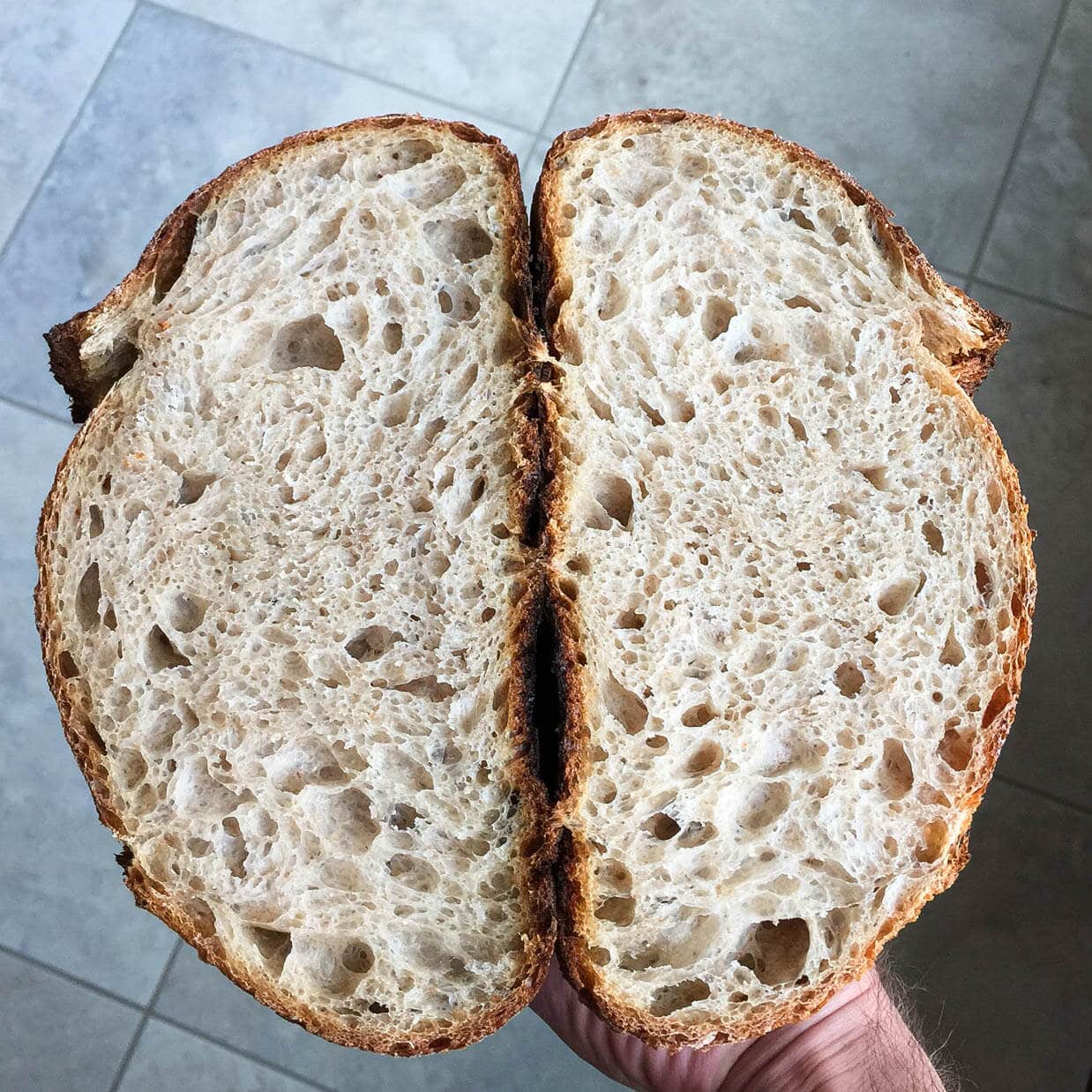
I like this method for baking bread in my home oven because it lets me bake two large loaves at a time. I plan to bake four loaves at a time, and this will let me do that with no problem. Baking with a Dutch oven (or combo cooker) works exceptionally well, and I might still use that method if doing only a single loaf or a highly hydrated one (the pan will help keep the dough together). Still, I find myself using this new method more and more. The results have come out smashingly.
Small steam burns: worth it (as you can see below).
What’s Next?
Be sure to check out my full guide to baking bread at home for more details on this important step!


430 Comments
In Emmanuel Hadjiandreou’s How to Make Bread, he suggests preheating the oven with your baking stone inside and a sheet pan below it. When it’s time to bake, you add water to the sheet pan to create steam. It’s very, very simple, and thus far it’s worked beautifully for me when making sourdough. I’m about to get a new oven, though, so we’ll see how it works in that one!
That’ll work just fine as well!
Hey Maurizio, awesome blog! You’ve provided every amatuer baker out there a great service 🙂 Quick question, is there any benefit to adding some boiling water to the dutch oven (under parchment paper) to add extra steam? Doing a bake in about 2 hours and I’m really itching to try it.
Thank you! I would not add water below the parchment paper, it will just create a soupy mess there on the bottom. If you have a handheld spray bottle mist the top of your dough when you load it into the DO and then spray more in right as you’re covering the loaf to trap more steam in — I do this all the time and works well!
That’s a great suggestion! Just did the bake and it had the best oven spring I’ve ever had with pouring about 1/3 cup of hot water under the PP. However the bread tastes a little too sour and yeasty (or floury). Is it possible that this is because of the extra water? This was also the first time I proofed my dough at ~85 degree ambient temp. Thanks so much for the info. Here are some pics (not happy with the crumb 🙁 )
Top View: https://i.stack.imgur.com/fnnUe.jpg
Side View: https://i.stack.imgur.com/jMJun.jpg
Crumb: https://i.stack.imgur.com/thZ0J.jpg
Really nice rise and crust color to that! It looks like you may have proofed the dough just a little too long (and that might be an explanation for the slightly sour bread). I’d pull back on the proof time a few hours and see if that helps open the interior up a little bit and reduce the sourness!
Maurizio, I am on my second attempt for doing batards with no dutch oven and it isn’t working out so well. I have a baking steel, two loaf pans with steaming towels and no rise. I put in the loaf pans 5 minutes before and also put in hot water after I load in the loaves. I barely get any rise. I am wondering if it is that the oven is venting all to well or if my loaves are too hydrated. My two batards did though start touching each other after 5 minutes. What would you suggest to debug this issue? I am pre-heating at 475.
It sounds to me like your dough is either over hydrated or there’s not enough strength to the dough. It’s also possible your dough is over proofed. All three of these things can lead to excessive spreading in the oven. I’d first start by reducing hydration in your mix to see if that helps. Even if your oven doesn’t have any steam at all your dough will still rise up some, just not to its full potential.
Try reducing hydration some, if that doesnt help then I’d try pulling back on your proof time a bit to ensure the dough isn’t going over!
Thanks! I will try that next. I went back to 78% and using a DO just to get a win and bread to eat for the week. I might just do that with one of the loaves for next bake. This last one was insipred by Kamut 60% and at 85% hydration.
Sounds good!
Maurizio,
Is the second baking stone absolutely necessary?
I’ve seen other places use a similar method to you with good results but without the top baking stone…. Also I assume a baking steel should work in place of the thick baking stones?
Best,
Scott
Scott — no the top stone is NOT necessary. I find it helps some people who have heating elements on top and bottom with regulation of that top heat but it’s not mandatory at all. The baking steel would replace the baking stones on the bottom altogether.
Maurizio,
I ended up getting a loaf that I think got too much heat on top…. I had got some weird black burn bubbles after just 20 minutes with steam and it did not look like the loaf rose correctly…. What’s weird is I don’t think my top heating element even turns on as far as I can tell but I guess I should look into that…. Is the only solution to this to try and add that top baking stone to regulate the heat?
Best,
Scott
I’ve never seen black scorching like this unless I’m making pizza and I place my dough close to the top broiler element. I suppose it’s possible your top element is getting a tad higher. A top baking stone would help regulate this, yes. If you move your oven rack down though, perhaps that would help? Move it away from the top some if that’s the issue.
Usually ovens are pretty even in terms of top and bottom heat so I’m surprised you’re having this issue!
For example could a slightly lower temperature and slower preheat solve this problem?
Sorry one last question….
Could a lack of regulated top heat contribute to poor oven spring? I noticed the loaves did not hardly develop any open crumb and when I’ve baked in a close cast iron I haven’t had too much issue with that. I assume it’s either that or lack of steam but I followed your method for steam closely.
Best,
Scott
I’ve heard that you are really not supposed to let your baking stone get wet. Would the steam not possibly damage the stone? I just purchased my stone and I am getting ready to use it for the first time!
Thank You
I have not personally had this happen to me, but I could see really cold water splashed onto the stone causing issue (anytime really cold liquid touches anything really hot there is a possibility of a crack). I think since I’m not pouring water directly on the stone I haven’t had any issues — use caution, though!
This was very helpful! I just bought the book by Ken Forkish and I do not have a dutch oven and was wondering what a good alternative method would be. Now I will try this instead… Thank you!
Right on, glad to hear it! I still use this method almost every day when I bake and it works very well 🙂
Baked my first loaf today (60% white wheat, 20% rye, 20% spelt, added pumpkin seeds). I let it got a little too dark in color and didn’t think to score the bâtard… so it was a little dark and funky shaped… but hey, not bad for a start! I will keep trying! Thanks again!
Cool! Well, each loaf does have its own style and character 🙂 Keep at it, happy baking!
So I tried this technique and it worked pretty well but I just had one or two questions: is there a particular amount of boiling water the report over the rags in the roasting pan they need to be completely saturated or just enough to cover all the rags? Also I use your sourdough recipe that I took my load out of the fridge about an hour before baking, but it seemed to flatten out a little bit initially in the oven. Would it be beneficial to leave the loaf in the fridge until right before scoring and baking?
I boil enough water to completely soak the towels in my pan. I’m not sure exactly how much water as I just fill my kettle, boil the water, and pour until I notice the towels are totally drenched.
I do like to leave my dough in the fridge until right before baking: take the dough out, score it and load it directly into the hot oven with towels already steaming (be careful).
Hope this help!
Hi! Love your blog. I bought a Baking Steel (the thick one) and I’m going to use it for the first time tomorrow morning – will be the first time I’ve ever not used a Dutch oven.
Do you now use a Baking Steel in place of refractory bricks? Either way it would be a good subject for a blog post!
Could you put the lava rocks and the rolled up dish towels in the same baking tray? Or would the rocks scorch the towels?
PS. I bought a KoMo after reading your post but sadly the grains I bought to mill (organic, UK grown) have very little strength and result in a close textured loaf. Going to search elsewhere – do you have any tips about what to look for? Protein percentage etc?
Thanks so much!
Sorry for the late reply! Yes, I use the steel instead of the bricks, they are removed altogether. I agree, a blog post on how I use the steel and any updates to my method is due! Not too much has changed, though, just the swap for the steel instead of the bricks. They both work well, though!
I would not put the towels in with the rocks, it would defeat the purpose of the rocks. They were there to store additional heat so when the ice is thrown on them massive steam is created. The towels provide a consistent steaming throughout.
Congrats on the KoMo! Fantastic mills. Hard to say on what to look for exactly with grain, it depends on what you’re after. In general look for grain that claims a protein from 11% – 13% (you could go higher but any lower and it’s more like pastry flour).
Hope that helps — happy baking Rachel!
Since the thick stones covered enough area to handle multiple loaves I’m wondering if you found a steel that covers the same area? I looked for one since i use one for making pizza with great success but only found a large area one that was too thin. I’m curious what you use for a steel and its thickness and dimensions.
This is the baking steel I use, the dimensions are listed there at the webpage. It is a bit smaller than when I had baking stones but I can easily fit 2 x 1kg batards — it is a bit challenging to fit two boules, though. I usually will do one boule and one batard if I want to change things up. I almost always do batards, though 🙂
Is there a reason you wouldn’t go for a thicker steel like the big by Baking Steel? Would this not theoretically improve oven spring?
I actually did not see The Big by Baking Steel when I first ordered my Modernist Cuisine one, that’s quite a bit thicker and pretty heavy! Up to you on that, theoretically it should retain and radiate more heat…
Yeah, I only ask because I’d imagine it’d lose less heat when opening the oven door due to retention. It is a bit of a monster though… Ha!
Have you had any trouble with scorching on the bottom of the loaves using a steel? I baked on my steel (without parchment, may make a difference) and the bottom of my loaf was black.
I do get a little more of a cooked crust with the steel than I do with baking stones. I’ve found that I do have to turn the heat down on my oven during the preheat as the steel seems to get a bit more hot than traditional stones.
Thanks very much for your work on this site! My girlfriend and i have been having a blast learning how to care for our starter (practice child?), getting used to the quirks of our oven, and baking some fantastic bread.
I’d like to try to bake wood-fired loaves on my Weber Kettle. I have the Dough Joe stones, a Lodge pan that I already use as a drip/water pan when I smoke or slow roast meats, lava rocks to put in the Lodge, and a spritz bottle. I’m good at controlling the temp using the top and bottom dampers on the grill. I figure I can spritz through the holes in the top damper to compensate for the steam that will escape through them.
Do you think I’m missing or overlooking anything?
Thanks for any suggestions you can offer!
Right on, so glad to hear you guys are enjoying my site! Your sourdough starter is totally a child of love 🙂
I think that would be an awesome thing to try! I’d say just be careful with spritzing in the holes as some steam might come back at ya there, but I’m sure you’ve thought of that. As long as you can maintain a somewhat closed oven and get steam in there during the first part things should go very well!
Another thing is you could just use your Dutch oven inside the kettle, both bottom and top to enclose the dough during the first part of the bake for steam and then remove the lid for the last part. You won’t get quite as much “wood fired” taste I’d guess but if you find you’re not able to generate enough steam this might help.
Let me know how it goes! Jealous of that Kettle, been meaning to get one just haven’t made the leap 🙂
This is great info! I’ve been having issues getting my bread to have thick, dark crusts. I use a cast iron pan on the lowest shelf and the baking stone right above it. I’m wondering if I should either raise my stone up (it seems like the steam just hits the bottom of my stone and has no where to go) or, put my steam pan above the baking stone? My stone is also quite large and takes up most of the rack space. There is 1-2 inches of space on either side, and I can see steam escaping the oven so I know it’s in there. I’m curious to see if the steam would distribute more evenly. Any thoughts on the best place to put the steam pot, or if people have had success with it above the bread? I also have an electric oven…would that play a role in how it affects my bread?
I also use an electric oven and in fact I think they are better than gas because gas ovens usually have an internal vent of some kind, which will cause steam loss.
I put my steaming pans to the sides of my baking stone (or baking steel) so the steam can kind of get funneled up around and to the top of the oven. As long as your bread is rising well in the oven then I’d say you have plenty of steam in there to allow it to expand at the beginning of the bake. If you’re more concerned with the color and cook level of the crust there might be other issues at play here instead of the steam. To get more color on your crust make sure you’re preheating your oven at a very high temp (like 525F or 550F) for a full hour to get your baking stones nice and hot. When you load your dough try to act as quick as possible to prevent too much heat loss. Bake your dough hot for the first 20 minutes — you could wait to turn the oven heat down to 450ºF until even 30 to 40 minutes into the bake to try and really bake that crust. Keep an eye on it, though, as it can quickly scorch.
Finally one thing you could play with is purchasing another baking stone to place above your loaves as I’ve done in this post. That might help retain some top heat in your oven and radiate it downwards as you bake. I’d only do this as a last resort if you don’t already own a second baking stone (I hate buying excess equipment!).
Let me know how it goes or if you’ve made any progress! Happy baking 🙂
Great post. Thanks for the info. The reason I found it… I’m considering buying my wife a Roller Grill and am debating between models with or without humidity injection. Is bread the only baking use for humidity? She’s more into muffins, cakes, etc but with proper tools I’d love some sourdough! 😉 Is it worth the upgrade?
Also, we don’t have any other oven in our house. Baking would be the primary function and an occasional steak or roasted veggies.
Any advice? Thanks!
JB
You’re welcome, thanks for the kind words! I’ve never used my oven, steamed, for anything other than baking bread but I do know some of these “steaming ovens” can be used to cook vegetables with steam to keep them moist. I’m not too familiar with this, but if I were to buy an oven that had steam injection I’d want to make sure I have control over when, and how long, steam is injected into the oven. You want to steam your baking dough for some time in the beginning but then stop after a while. The other benefit I could see to buying an oven that has steam injection is it would most likely be completely sealed, meaning no steam would escape the cavity — this would be fantastic.
In the end I’d say it’s up to you! Personally I would have bought a steam oven for my house if there was a model that was large enough and let me precisely control the amount and duration of steam injected — I wasn’t able to find an oven like this at a reasonable price.
Hope that helps!
Okay, so I’ve tried a bunch of things recently since I decided to stop baking in the dutch oven, but I still can’t figure out how to get the entire crust (top and bottom) evenly cooked. My oven has an element on the top and bottom, and it seems like one always wins. My first attempt was on a round pizza stone with nothing above my bread. I removed the loaves when the top looked nice, but noticed the bottom didn’t cook nearly as much.. My second attempt was making a pan loaf with the top covered (as this post recommends) but nothing between the pan and the element. The bread that was touching the pan burned by the time the top was dark enough. Then I upgraded my stone to a baking steel (the normal one, not the thicker modernist cuisine one like you have). This time, I covered the top element and cooked until the top of the loaves looked nice, but the bottom burned! Any advice on how I can make sure the outside of my loaves cook evenly?
It’s always a constant battle to get loaves to cook completely evenly in a home oven. Usually mine will have a slightly more cooked bottom than top, but I’m ok with that. The baking stone on the top should help dissipate some of the heat generated by your top elements so they don’t overheat the top too fast. To prevent the bottom from cooking too fast you can reduce your preheat time so the Baking Steel doesn’t have quite the same amount of stored up heat. Additionally, you could raise up the bottom Baking Steel so it’s not so close to the heating element. And one more idea: you could coat the bottom of your dough with something to help burning, like coarse cornmeal or bran/germ.
So in the end it’s going to be a juggle for you to find just the right sequence of events to get things to bake evenly. I’d recommend raising the Baking Steel one rung, lower the preheat by say 15 mins (or whatever is best) and then keep that top baking stone to help dissipate the direct heat from the top element.
Keep in mind that when your oven is actively heating (trying to reach the temperature you’ve input) the elements will be on and red hot, so you might have to turn the oven down in temperature once the internal cavity reaches the desired temperature. This way they won’t activate but you will still have plenty of heat stored in your steel and stones.
Sorry I don’t have a 100% definitive answer to get your bread to bake evenly! I am constantly turning, moving and juggling things in my oven to keep things as consistent as possible — it’s not easy sometimes 🙂
I hope these ideas help!
Use a baking cloche. Cover the bread with a bowel for the first 25 minutes at as hot as your oven will go 230 degrees Centigrade for my oven . Then for the last 25 minutes turn heat down to 190 degress Centigrade and remove the cloche/cover. Saves all this messing about. I actually use stainless steel dog bowls as the cloche/cover (Unused by dogs of course). Bake straight on a thick baking Stone. I also prove the dough on non stick baking parchment and transfer the dough into the oven on the parchment saves a lot of messing about.
Yes, cloches work very, very well and have been around for quite a while. Much easier also! The reason I steam my oven this was is I’m baking 2 (and up to 4) loaves at a time, and the loaves are usually in batard shape so they won’t fit easily in my Dutch oven or even a large cloche. All depends on the bread you’re baking, I suppose. I’d say this method I have here works just as well as a cloche / Dutch oven.
Thanks for the comments!
Can you do this in a gas oven?
Hello! I’ve never baked my bread in a gas oven, but I do know because they have vents inside it is harder to keep the steam generated inside the oven cavity. I would say this would work but perhaps not quite as effective as it is in an electric oven. Give it a shot and see if the rise of your bread is comparable to something like baking in a Dutch oven (a sealed pot). Hope that helps!
Thanks Kim, appreciate the kind words and the comments!
Yes this method may be overkill for some people, for me it produces ample steam to get my loaves up — it could be that my oven vents more than usual, or the interior is larger than most home ovens and thus the need for a bit more steam. I’ve played with just the towels and it works, but the pan with rocks helps out quite a bit for me.
Happy baking!
Speaking of steam, when you set up your oven with all that steam, be careful opening the door for the first time! I got the most painful facial of my life one morning. It gives whole new meaning to the word: facial peel! Just sayin’.
Absolutely true statement there! Steam burns hurt, as I said in the post 🙂
Thanks you very much for all the tips and share your experiences.
Same Day please make tutorial videos.
Best Regards from Santiago, Chile.
You’re very welcome! I’m definitely working on videos!
I’ve had great success with everything in Tartine Bread, including the sourdough croissant recipe. To achieve steam I use a Dutch oven technique with various shapes of covered cast iron or stoneware pots. I recently decided to order a Wolf combi steam oven. Because the bread baking mode settings are proprietary, there is no way to know the temperature and % humidity. The oven instructions also say not to preheat(!!) – which makes me think the process is nothing like a commercial steam injected oven. Has anyone tried baking Tartine sourdough bread in a Wolf combi steam oven? Gaggenau or any other brand? Have the results been as good as in a Dutch oven?
That oven sounds awesome, but no preheat? That’s very, very odd! I don’t have any experience with any of those ovens (although I’d love to have any of them :)) so I can’t comment, sorry! Hopefully someone else chimes in…
I use (unused by dogs ) stainless Steel dog bowls as cloches to keep the steam around the baking dough for the first part of the bake as per the Tartine method. Bread cloches were around long before Tartine published his book.
If you don’t have rocks can you still use your skillet as a steam pan? Or will this ruin the seasoning of your skillet?
Sure, you can definitely just use your pan without the rocks. Over time you’ll want to oil or season your skillet because, yes, the water will eventually cause your pan to rust. I will oil mine periodically to keep that nice seasoned layer on top.
I have done all that but you still end up getting a thick crust. Do you think there is a way to make the crust thinner? Yet a lot of maillard.
Are you baking your bread at a high enough temperature, for the times listed in my post above? If you bake a higher temperature, for a shorter period, and your oven has sufficient steam you should get a nice thin crust.
I really like the lava rock method. I’ve been using it now for quite a while to great success. Yes, the Dutch oven is a very good tool to have around! Not only do I use it for certain round shaped loaves I like to use it for all sorts of things in the kitchen — a very versatile pan.
I actually plan to do some traditional Italian breads soon! I recently stumbled on a really, really old cookbook my Dad had that has some really interesting recipes (including Altamura style bread). Stay tuned 🙂 Sounds like you did Puglia the right way!
Glad you’re enjoying my site, thanks so much for the comments!
I’ve tried each of these methods except for the lava rocks, but will give these a go with your instructions! The Dutch Oven was a real revelation for me, and just that tip made the Tartine book totally worth it. I was lucky enough to do a bread course at the Cordon Bleu in Mexico and got to use a steam oven for three months- it was really hard to go back to my crappy Mexican oven. 🙁
On another note, would you consider doing a few posts on traditional Italian breads since that’s where your family is from? I lived in Puglia for a while and really loved the differences in bread from town to town. I have a lot of fond memories of the weekly fresh loaf with just a little olio before lunch!
I just discovered this blog and LOVE IT!
You could spray the loaves first and then pour the water over the rocks in order to trap more steam.
I’ve used lava rocks for 2 years but I recently switched to small (river ?) rocks, 0.5-1 inch diameter (or even smaller – one of the commenter suggested sand – that could work too). I figured the water will heat up and evaporate more efficiently due to larger contact area: it did.
Coincidentally I’ve just started doing this! I now spray the loaves quickly first, and then pour in the water, you’re right it’s a better order of operations.
Very good reiteration, I think river rocks (yes those are the small round ones you can buy) are a great idea and worth a test for me, thanks! I’ll add them to the list of things to pick up, and then washed thoroughly of course 🙂
Thanks for the comments, really great suggestions — happy baking!
Maurizio,
I just found your site and REALLY like it. I’ve used a variety of steam generation methods over the years and lately have reverted to a Dutch oven for simplicity 🙂 However, I’ve started researching newer steaming methods for non-boule loaves.
Here is one from Bouchon Bakery that I haven’t seen discussed. It appears to generate a TON of steam:
Hotel Pan: 13x21x3 inches
River rocks: 9-10 pounds, golf ball size or smaller
Metal Chain link: 10 feet (links appear to be 1/4″ thick) threaded among the rocks
Super Soaker water gun: Needs to deliver about 350g/1-1/2 cups of water from far enough away that the steam doesn’t burn you. (Wear long protective gloves if you are concerned about burns).
They say that there is tremendous thermal mass (I’ll say!) and it produces a lot of steam.
Any comments on this?
BTW – you might want to reemphasize putting a HEAVY towel over the oven door’s glass. I used a thin one once and a small amount of water cracked the glass! The manufacturer’s replacement part was ridiculously expensive. I replaced it with borosilicate glass I sourced from a local glass company at a fraction of the cost – and I don’t have to worry about breaking it.
Thank you! That is a fantastic idea, especially the pan with river rocks — might even be better than lava. I think, though, that method might even generate too much steam, if that’s possible. My method here, which I still use, works so well that even with other things I’ve tried I still come back to this. That said, changing the pan to river rocks might be a really great modification. Either way!
Sorry to hear about your glass! Yes I’ve always been very worried about this and it is a concern. The glass on my oven seems to be extremely strong because I have seen some water accidentally splash on there with no ill effect — thankfully. I’ll definitely be switching to a thick towel, though!
Thanks so much for the comments and these recommendations!
HI Maurizio!
I’ve been into home bread baking now for 3 months… I have 2 sourdoughs, one white flour and whole wheat flour.. Your website information is really helping me to learn and getting better with time. So big thanks for that!
I purchased the thick baking stone 3 months ago (a working friend suggested it as i even didn’t know about it). We bake everything with it – bread, pizza, cakes and even grilled food.
My question is about increasing the heat with my home oven (bloomberg)… i know that a baking stone gives it approx. 30 (celcius) degrees more then without it. I am considering now purchasing another thick baking stone…. would it give more heat especialy for pizzas?
Thanks,
Emanuel
You’re very welcome Emanuel, glad you’re finding my site useful! I would imagine adding more stones would help your oven retain more heat, but I’m not sure it would make it “hotter” overall, if that makes sense.
Have you used your broiler when making pizza in your home oven? What I do is move my rack up a little higher like if you were to broil. Preheat your stones on your rack as hot as normal (I do 525ºF for 1 hour), then when you are just about to load your pizza turn your broiler on high heat. Your thick baking stones should retain quite a bit of heat (mine get over 500ºF, I use an IR thermometer to test temperature) and then the broiler blasts the pizza from the top with a lot of heat. Works extremely well. Be careful with the broiler though, it can quickly burn your pizza (I’m taking 3-5 minutes bake time) and there might be some splattering depending on what ingredients you’ve topped with.
Hope that helps!
You should try using sand, spread in a half inch layer in a baking dish, in the bottom of the oven. Sand is going to slowly and steadily releases moisture
Chris,
Thanks for the suggestion, I’ve actually never thought of that. I could see it as a good medium given how dense it would be. Of course I’d have to find clean and sterile sand… I’ll look into that!
hello Maurizio, wonderful recipes and tempting photographs..im going through your photographs again and again from last week..cant resist it.. i have an OTG oven of 16 liters capacity. can i use it to bake breads with steam?..or should i just bake it without steam?,this oven is very compact..and can i halve the recipe for levain and dough?..if it should be changed how can i do that without changing the texture?
Thanks so much, I appreciate that!
You should bake with steam, bread requires some at the start to ensure a nice and lofty rise. I’m not familiar with your oven but you should be able to generate enough steam in there as long as it is relatively sealed. My oven doesn’t have a full seal but using the method above I’m able to generate plenty to get a nice rise.
Yes, you can halve the recipe with no problem. Just take everything and literally reduce it by 50% and you will attain the same results.
Let me know if you have any other issues and happy baking Anilitty!
thanks for your replay..by the way im from India and OTG(oven toaster grill) ovens are quite popular here…i just bought an another otg with convection mode of 33 liters capacity and it is perfect for your kind of baking..no one here in India makes sourdough breads from my knowledge..too bad for people like me..:(.. i had been searching for recipes like yours for a very long time..thanks again for the inspiration..keep baking
Ahh yes, I know what oven you are using. It should work! You’re very welcome, keep me posted on how it’s going!
Maurizio, I have ordered the extra thick baking stones, the lava rocks arrived today. I will work up to doing two loaves at once as you demonstrate, but how do you plan to get 4 in at once? Maybe two running north to south and two east to west? What shape loaves and would these be full sized?
As others have mentioned, this is a fantastic write up. By the way, I’m in Portland, OR. If you want a loaf of Ken’s (Ken Forkish’s bread is a life changing experience for those who don’t know him) just say the word and it’s done.
Thanks for everything,
Matt
Matt, excellent! I plan on doing 4 loaves by actually adding in a second shelf in my oven. I will have to remove the top stone, or rather flip it around. It will be very, very tight in there, but I should be able to get it to work.
I envy you out there in PDX! My brother lives up there and he really, really enjoys it. I’ve had Ken’s bread (and pizza) and it’s superb. Thanks for the shipping offer, I appreciate that. My brother acts as a “mule” when he comes to visit with his back stuffed full of bread and other items from out there 🙂
You’re welcome, thanks for the comments!
Great write up Maurizio!
I’ve used this technique to great effect my last two bakes, but I noticed something peculiar happens on some loaves, sometimes. The loaves in question will appear to rise just fine, but when I remove the steam I they continue to rise and “crack.” That is, they will no longer release the strain of the oven spring through the score like the loaf right next to it, but instead just burst. Any idea why this might happen? I’d never seen it before I started cooking on stones.
My theories are 1) (the simplest) they aren’t finished rising yet. I, of course, have no way of knowing this. It’s strange that that loaf right next to it will be fine. My oven is kinda crappy so maybe the distribution of heat is just complete crap as well, thus causing one loaf to rise faster than the other. I could always give them more time, and in theory as long as there is a proper amount of steam it shouldn’t really matter, right?
2) My shaping job on one isn’t as great as the other. (this is extremely possible as well)
Maybe it’s both! It’s probably both. Either way, I really love the crust this method produces. Super thin and crackly. I find it’s an immense improvement over the dutch oven (which I now suspect doesn’t have a great seal).
Thanks!
Mike
Thanks, Mike! Glad this method is working out well for you. I’ve used it many, many times now with great results. Even better if you can find all those vent holes in your oven and cover them 🙂
I sometimes get a “crack” as well. My theory on these is that you have great rise in the loaf but perhaps your scoring isn’t sufficient enough to allow the bread to bloom to its max potential. It pushes hard against areas that have no release, the outer crust is hardening as the bake progress and then eventually a crack emerges. I don’t think a crack is a bad thing at all and I’ll typically get one near the top or bottom of my batard.
Shaping could also play a role, as you suggested. No one is perfect at this 🙂
I agree, I get such a nice and thin crust it’s incredible. I too have suspected for a long while the Dutch oven does not get a full seal! I almost always bake this way at this point, but I still dream of a proper baker’s oven at home…
Cheers!
Maurizio-
Check this out – perhaps a serious way to go beyond the Lodge Combo Cooker.
https://www.kickstarter.com/projects/stranddesign/the-fourneau-bread-oven/description
Scott Schmidt
London
Scott, thanks for the link that product looks very interesting. Essentially it’s kind of a larger combo cooker if you think about it, but it might make loading bread easier. Unfortunately the size is rather small so it looks like you can only fit one loaf of bread (one of my loaves at least) at a time. I’m not sure they could make it much bigger, though, I bet that thing is heavy!
Thanks for the link, I’m definitely going to follow these guys and their product!
Thanks for sharing your alternate method, Martin. Sounds like a good approach, and a bit more straightforward than my method above. I will have to give it a shot. I don’t typically steam more through the bake as that rectangular pan I have in there continues to put off steam, however, I don’t know if it’s even possible to over-steam in a home oven (mine isn’t sealed particularly well). I’ll have to try that as well!
And yes, protective gear is a good idea! 🙂
Thank you for this post! My one attempt at steaming my oven for baguettes was not successful, and I look forward to giving it another try with your method.
You’re very welcome — good luck and let me know how this method works out for you! I have not tried it on baguettes yet, but I’m sure it will work very well.
Nice post. I use a simpler steaming technique. I preheat an old boiling drip pan in the oven along with the stone. After I load the bread, i throw boiling hot water into the drip pan. The first time it is about 1 cup. I repeat it at 3 min intervals until 10 minutes, then I carefully remove the pan. It seems to work for me, I get good spring, crust and crumb on my baguettes. I also wear some clear protective goggles, and long welding gloves to keep burns down.
Great Post. Your bread looks GREAT. I thought you would be the right person to ask a question. I have been baking yeast bread and pizza for many years. ( When baking bread I would throw ice cubes in a tray every 3-4 minutes for the first ten minutes. ). How things change.
I recently joined your newsletter and find it entertaining and informative. Well done. I came across your site in my research for making a starter for sourdough bread. I read Tartine Bread and tried the starter from the book. Not much luck. I now have a 100% hydration rye starter going for about a month. I have been using the technique from Tartine Bread.
Using a 75% hydration dough, recipe for one loaf, 20g of starter for leaven mix, 100g of leaven, ( my leaven passes the float test and it doubles in about 5-6hrs) I have let it go as long as 8-12hrs and then tried it with similar results, 60-70 minute autolyse, add salt, fold 6 times or so, pre-shape, then shape, put dough in a floured basket and refrigerate for 12hrs or less, use the cast iron skillet for baking. Thing is my bread does not rise much in the basket in the fridge and does not have much oven spring. (only about 2-1/2″ ht ) I do get some large holes in the crumb and a gelatin like look but the crumb is heavy. The exterior color is good and the scoring is not bad ( ears ) My thought is that my starter is too weak to leaven the dough. Also, the dough does not seem to have the extensibility or smoothness that I have seen on a video with Chad Robertson showing him shape his dough. I would appreciate any advice if possible. Many Thanks. Your trip to Italy looked like fun.
Thanks! I’m glad your starter is up and running, once it’s established it’s a very forgiving thing, so long as it gets regular food!
I would guess either your starter is not strong enough, as you suggested, but the fact that it passes the float test indicates there is some strength there and it should leavened your bread. My main concern is that you might not be allowing your bread sufficient time during bulk fermentation. How long do you perform your bulk fermentation for? Do you know what the ambient temperature is during this time? Or what temperature your dough is after you mix (stick a thermometer in your mass of dough)?
My bulk fermentation is typically around 4 hours at 78-80ºF. By the end of bulk fermentation my dough has risen at least 30%, but the main indicator is that the dough looks like it’s alive and holding some shape. The edges of your dough, where it meets the bowl wall, should be slightly domed down towards the wall. If you wet your hand a bit and feel the dough it should not feel extremely stretchy (extensible), and it should feel airy, light, gassy.
Your dough will become stronger (less elastic) during bulk fermentation, start to look “smoother” and have more of a shine to it. A full and strong bulk fermentation is key to producing light and airy bread!
Your comments about Chad Robertson, his dough is typically probably upwards of 90% hydration, despite what he says in Tartine Bread! That’s my guess at least. I know some of his bakers will sometimes comment on their hydration levels and they are definitely over 85%.
I hope that helps, let me know if you have any more Q’s!
Hi Maurizio,
Thanks for the tips. I have since made a new starter using your method and I ‘m pleased with the results. Big difference. I used your recipe for the bread, the only change that I made was that I used 50g of starter to make the leaven for one loaf. I’m going to try 25g of starter next time and see what happens. Thanks!
Glad to hear it, thanks for the update! I agree, slowly back off the amount of levain you use in your mix until you get sufficient leavening of your dough. Once your starter is strong enough (it probably already is) you can even get it all the way down to 20%, or like me, 15% in your mix.
Happy baking!
Yet again you’ve delivered a ripper and really informative post! What a great idea the lava rocks are and the look of that loaf is smashing, what an ear! Doubt I could fit doing this into my ‘Toy Oven’ but once (hopefully within 12 months) I get a real oven I’ll definitely give it a go. Thanks 🙂 PS, what brand of oven is that?
Thank you Maree! The lava rocks work extremely well in this case, and are pretty cheap to boot. My oven is a Thermador double oven. I don’t use convection for these bakes even though it has the option. Pretty much a standard home oven!
Nice write up, thanks Maurizio! But, the bread is outstanding!!! Tell us more 🙂
Thanks, Margie! These loaves were done while testing mixing techniques and flour combinations. For each of them I did ~8 minutes slap/fold up front, they used my stiff whole wheat levain (still working on a post about this), are around 80% hydration and I extended proof times in the fridge, up to 24 hours in one case. They really came out great, the one at the very top is one of my best loaves I’ve baked — now to nail down that consistency 🙂