

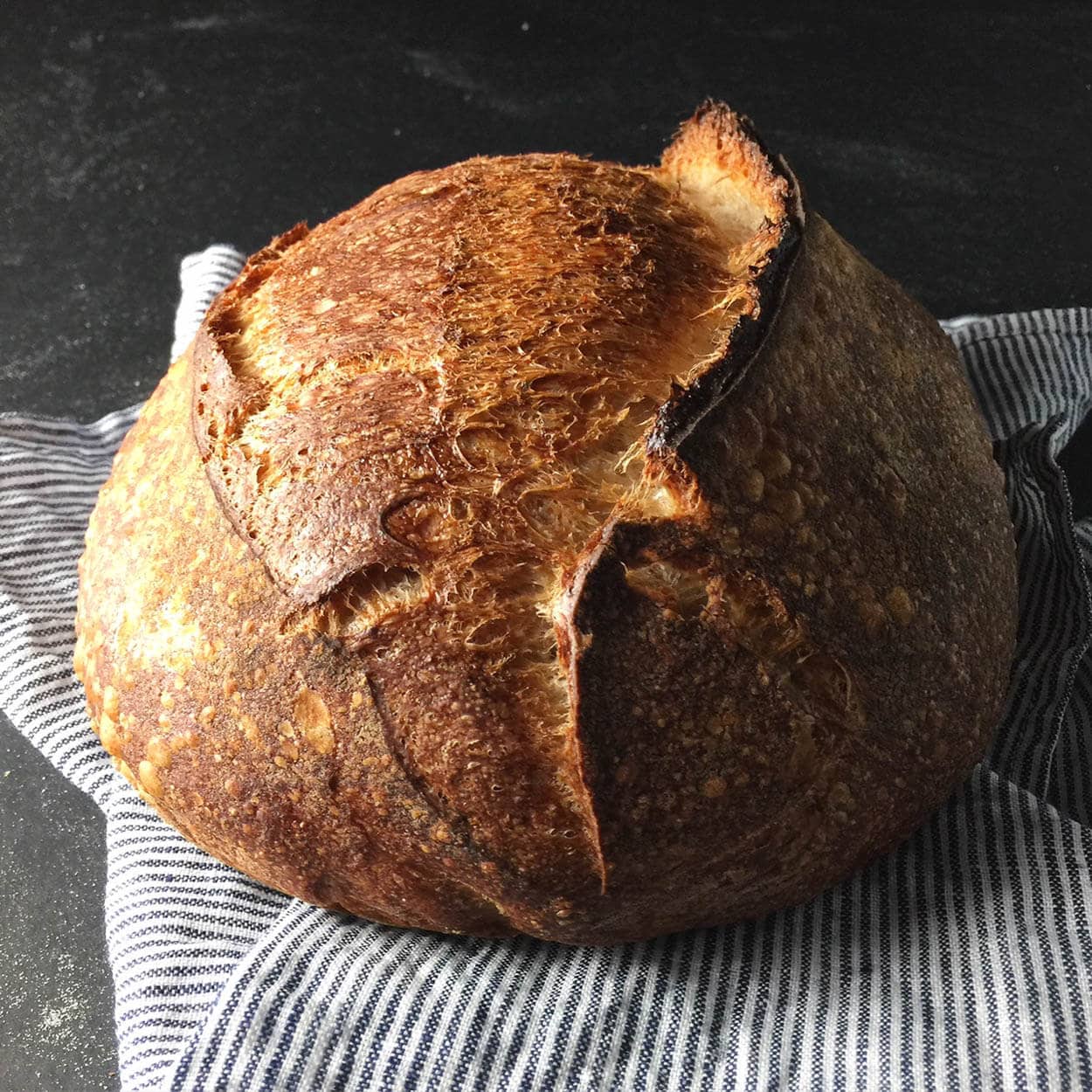
Steam burns hurt. Like, really hurt. The small mark on my left forearm begs the question daily: Maurizio, was it worth it? But before we talk about my new baking badge of honor, let’s concentrate on overcoming the challenges of baking good bread at home. While many of these challenges show up early in the two-day process (fermentation, flour selection, mixing, shaping, and so on), one crucial component comes at the end of this ordered procession: how to bake bread with steam in your home oven.
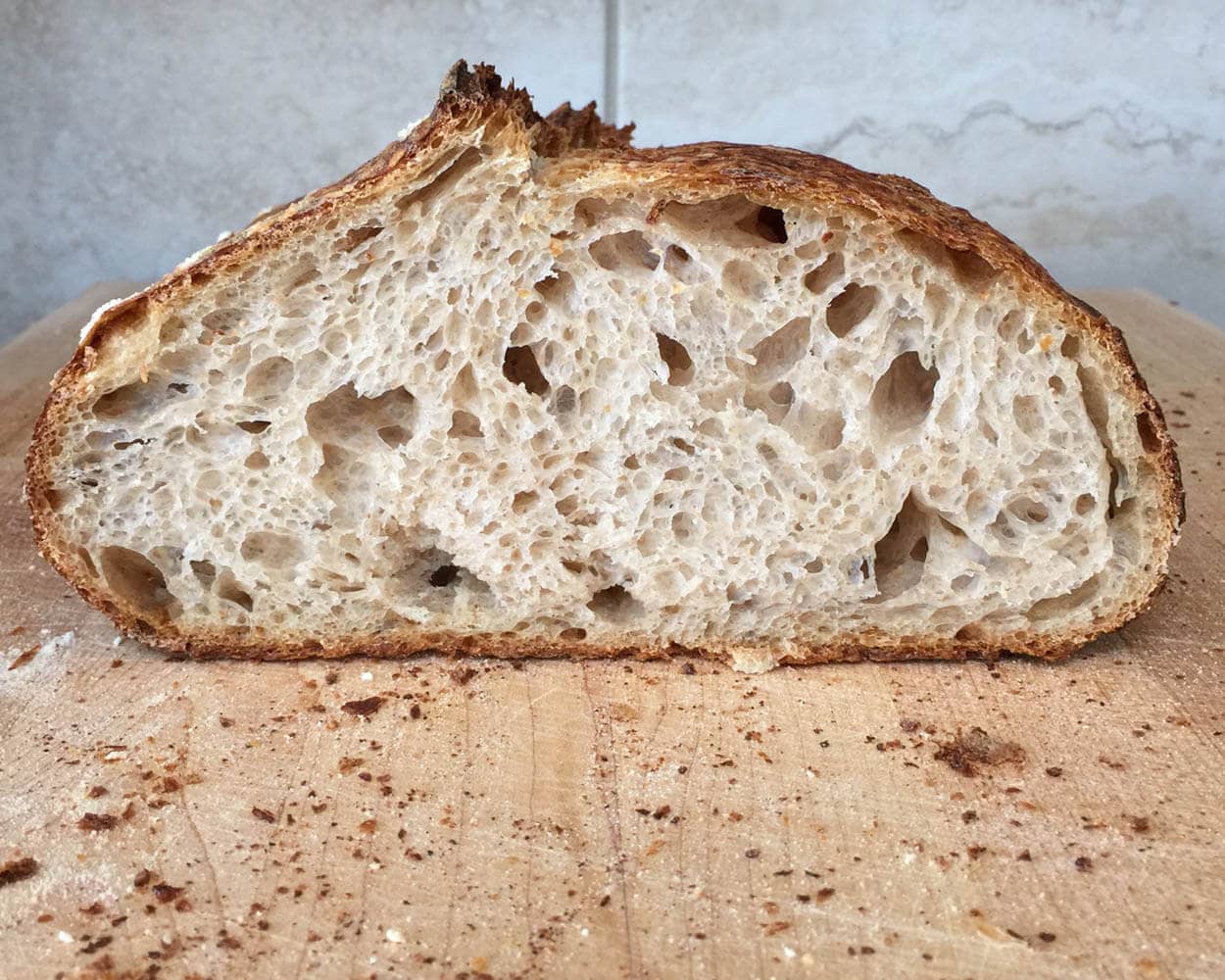
For your bread to rise to its potential, that outer, taut skin on your loaf needs to be able to expand and stretch before hardening off. Steam in the oven, and subsequently on the surface of your loaves, helps keep the skin pliable and stretchy during baking. If your dough dries and bakes too quickly on the exterior, it can harden off before it rises to its full potential (and you may not see a satisfying grigne, either).
So how can we get enough steam in the oven to keep those loaves rising? There are indeed methods abound, and each person has a different approach, but arguably the most popular choice at the moment, and the one I started with, is baking bread in a Dutch oven (see my guide on how to bake bread in a Dutch oven if you’re not familiar). However, there comes a time when you might want to bake two (or more) loaves at a time, or perhaps your loaves are scaled more substantial than your Dutch oven can comfortably hold. An alternative is to bake directly on stones and generate sufficient steam in your home oven by some other clever means.
Professional baking ovens have steam on tap. Press a button, and a wave of steam sprays over the decks of newly loaded dough. Now there are home ovens that are “steam ovens,” but the ones I’ve looked at are incredibly small. You might be able to fit two loaves, but I could also fit two Dutch ovens in my current home oven; no advantage there. Some other alternatives can’t inject steam at a button press, but they are sealed to trap steam and have a method for generating steam. These look very promising but are on the expensive side.
Since most of us bakers out there do not have a fancy oven (if you do, I’m jealous!), read on to learn how to bake bread with steam in your home oven.
What You’ll Need: Tools for Steaming Home Oven
Five things, and my guess is you probably already own most of them:
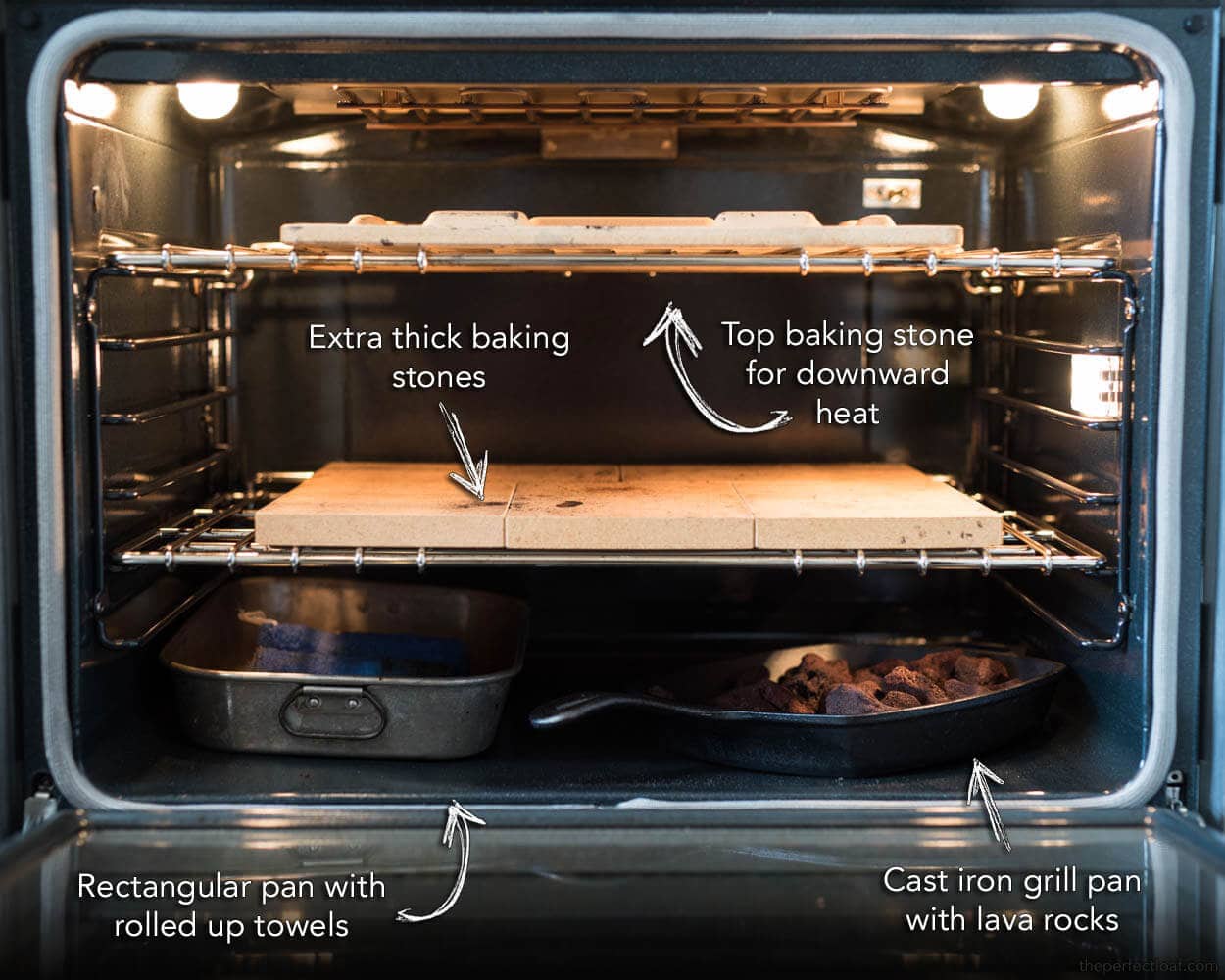
- A cast iron or stainless steel roasting pan filled with lava rocks or ceramic briquettes. The extra surface area helps because with more hot surface, you get more instant steam. Or, if you want, trade complexity for ease and just leave the pan empty for a little less steam (but still enough!).
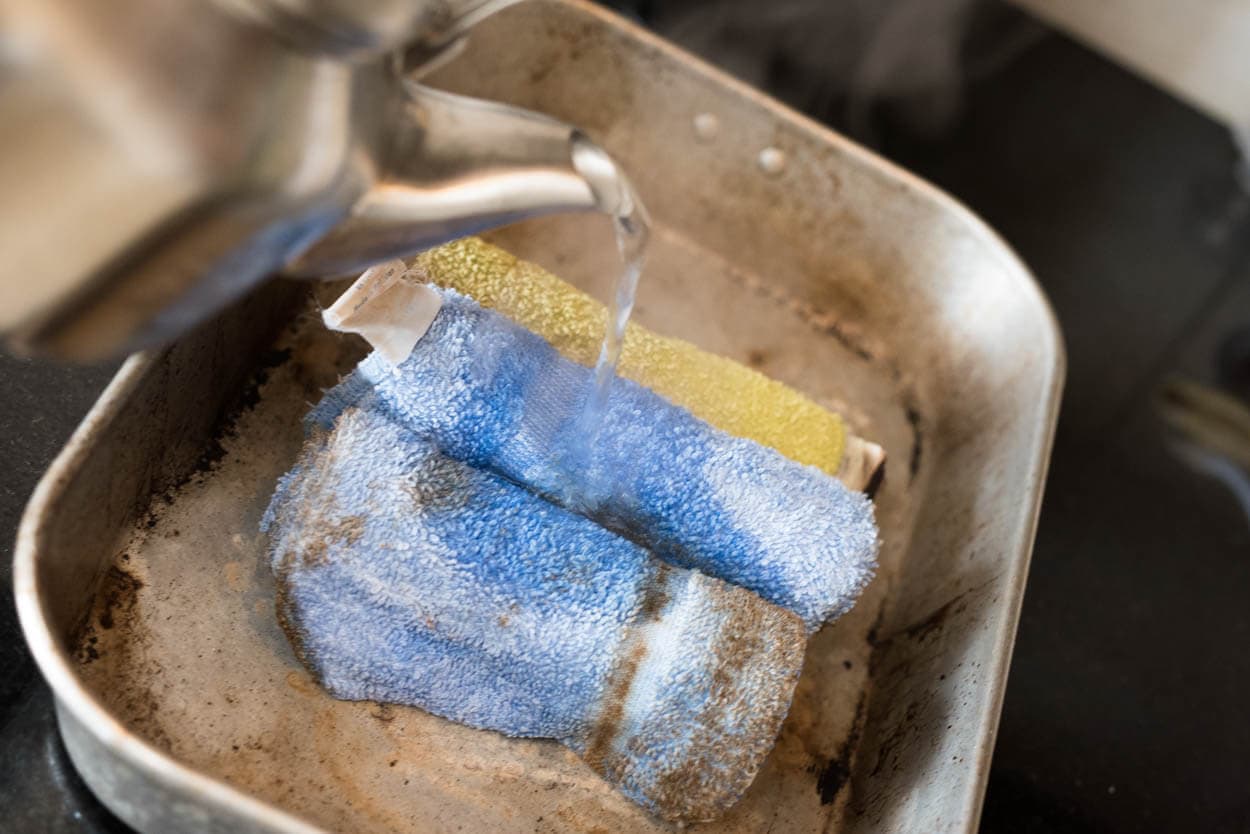
- A rectangular roasting pan with three dish towels rolled tight inside to provide continuous steam during baking. Use 100% cotton kitchen towels that are undyed or white. They tend to look beat up eventually, so cheap towels are best.
- A pizza or bread peel and parchment for loading.
- Optional: a stainless hand spritzer for one last shot of steam before the door shuts. (If I want an extra shiny crust, I’ll re-steam 5–10 minutes in.)
So, how do we use all these tools?
How to Steam Your Oven For Bread, Step by Step
This takes a bit of practice. First, gather your tools and keep them within reach; this is a hectic process, and you want to do it almost without thinking—muscle memory. The longer your oven door stays open, the more heat escapes. Your thick baking stones or a baking steel (also awesome for sourdough pizza!) will help offset some of the loss, but you still want to act quickly.
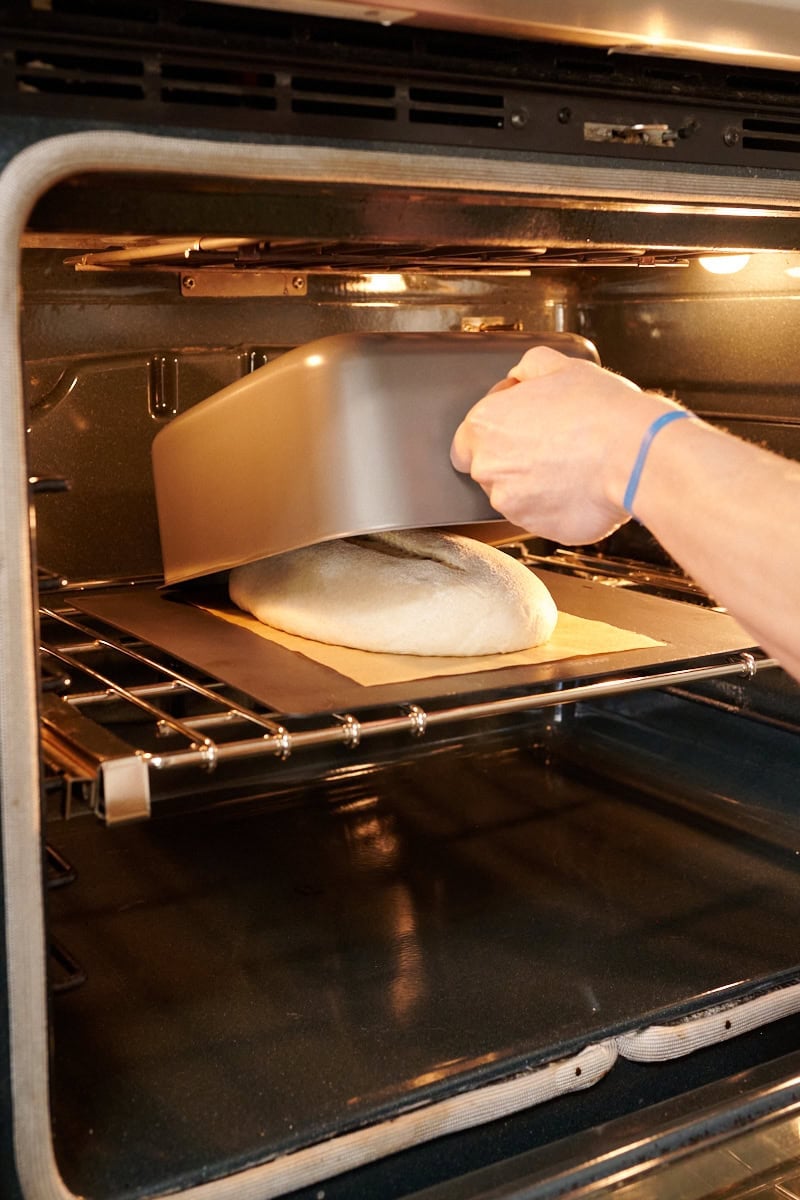
Below is a quick visual showing where I have my pans, where the loaded dough goes, and where my baking stones are.
Home Oven Steaming Method
- An hour before baking, turn on your oven (preheat)
- 10-20 minutes before loading your bread, boil water, pour it over the towels in your rectangular baking pan, fully saturate them, and place them in the back corner of your oven
- 10-20 minutes after loading the pan, put each mass of dough on a separate piece of parchment paper
- Place the dough and parchment underneath on a pizza peel
- Score dough
- Open the oven and slide the dough (with parchment) onto baking stones
- Quickly lay a towel on the oven door glass (optional; you can see me doing this below). I’ve read that cold water dropped onto a hot oven glass door will shatter the glass, thus the towel. I have dropped some water on the oven door without any ill effect, but I do this to be safe.
- Carefully toss 1 cup of ice into your cast iron pan with lava rocks
- Quickly spray loaves a bit with a hand spritzer (optional)
- Close the oven door and watch your dough rise
- 20 minutes later, remove both steaming pans (careful, these are extremely hot) to stop steaming
- Bake until the loaf is well colored and crusty
Video: Baking Bread With Steam
In my video below, you’ll see me baking bread with steam from start to finish.
Why do we use two sheets of parchment paper for our dough? Using two sheets lets you adjust the space between the loaves as they bake, if needed. One of the worst things that can happen is when the dough expands and joins another loaf; this reduces the overall rise of both loaves. If you notice the loaves start to get a bit close as they rise, slide them apart quickly.
After 20 minutes of baking, we remove the cast-iron and rectangular baking pans so no more steam is generated, allowing your loaves to crisp up and harden off.
Caution: Please be careful with this method: if you drop too much cold water on your oven door, you might crack the glass. I have never had this happen to me, but I know of at least one baker who has. Be sure to keep the water off the glass.
When to Vent: Pulling the Steam for a Crisp Crust
Bread dough benefits from steam early in the process, then a dry oven to finish for the best crust.
Twenty minutes is my rule. By then, the loaf has done its expanding; the oven spring is over, and leaving the pans in any longer only keeps the crust soft when you want it hardening and coloring. So I pull both steaming pans at the twenty-minute mark and let the dry heat finish it off, usually another twenty to twenty-five minutes, depending on loaf size and how dark I want the crust.
If your crust comes out pale and a little leathery no matter how long you leave it in, you’re almost certainly steaming too long. Pull the pans earlier next time.
Why Steam Matters When You Bake Bread
You already know that steam keeps the loaf’s skin pliable long enough for it to rise. But here’s what’s actually happening during that first part of the bake when steam is in the oven.
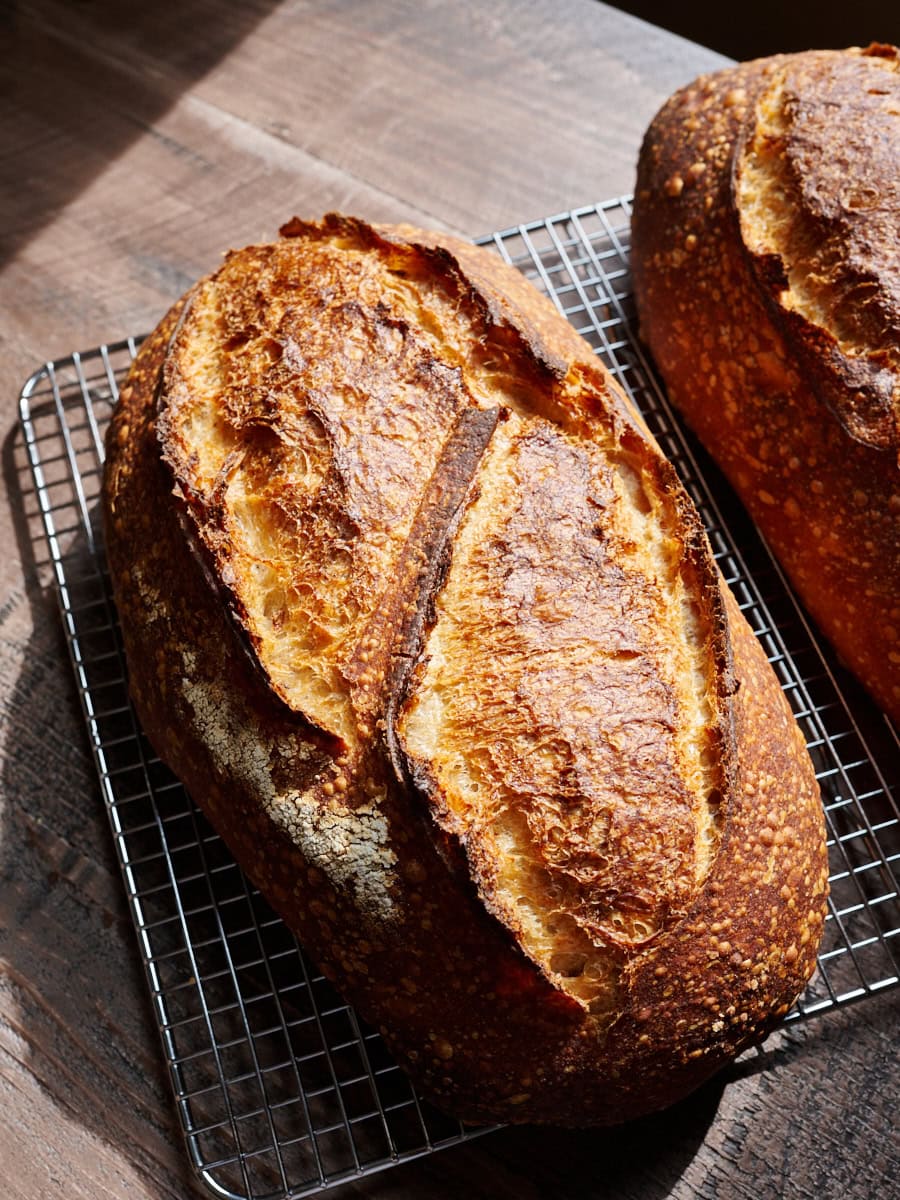
A loaf does most of its rising in a short window at the start of the bake, while the dough is still soft and the gases are still pushing out. Steam is what helps keep that window open long enough to reach maximum volume. It settles on the dough’s cool surface, keeps the crust from forming prematurely, and lets the loaf reach its full volume before it sets. Skip steaming, and the exterior stiffens early, reducing rise and leaving you with a tighter crumb and a blunt, torn ear (or a crust that sort of fuses together) instead of a clean opening and tall rise.
There’s also a second payoff: shine. The moisture gelatinizes the starches on the surface, and once the steam clears and the dry heat takes over, those starches set into a thin, glossy, almost lacquered crust. A dry oven gives you a duller, flatter brown. Steaming gives you blisters, gloss, and that varnished look you’re after.
Why Your Home Oven Fights You
Professional ovens (or even smaller-scale home ovens like the RackMaster) are sealed and built to hold steam. Your home oven is built to lose it.
A home oven vents steam by design, pulling humidity out about as fast as it’s made. That’s a feature when you’re roasting a chicken and want a crispy skin. It’s not great for bread, though, which benefits from humidity. Gas ovens are worse, too, since the burner needs to breathe, so they vent even more.
The other half of the problem is thermal mass. Home ovens are light with only bare racks inside. Open the door to load your loaves, and the temperature drops significantly, then slowly creeps back up. Baking stones or a baking steel fix that by providing thermal mass, which stores heat.
Other Ways to Steam Your Oven ( and When I Use Them)
There’s no shortage of ways to get steam into a home oven when baking, and I’ve tried most of them. A few of the following are worth trying, but most aren’t.
Spraying alone. Mist the oven walls as the bread goes in, then again a few minutes later. Easy, and better than nothing. But the steam vanishes about as fast as you make it, and every spritz is an open door bleeding heat. You can skip all the pans and just use the spritzer, but you won’t get quite as shiny of a crust (but admittedly, it’s much easier).
Boiling water in a pan. Skip the lava rocks, preheat an empty cast iron pan, pour in a cup of boiling water as you load. This is the workhorse most bakers start with, and it works fine. Lava rocks just push it a little further for better results.
An inverted pan or shell over the dough. A Baking Shell, cheap aluminum roasting pan, or a big metal bowl flipped over a single loaf traps the dough’s own moisture against its skin, Dutch-oven style, minus the Dutch oven. It works very well, actually, and is a lot easier than a Dutch oven.
A cloche. Same idea as the inverted pan, prettier and heavier and pricier. Round loaves only, one at a time.
The Dutch oven. Still the most forgiving way to bake bread with steam at home: you place your dough in a preheated pot, close the lid, and put it in your oven. The drawback is you’re limited to round loaves, since you’re limited to round pots. For a single round loaf, or a dough slack enough to need the walls to hold its shape, I still reach for the pot for simplicity (if you go this route, see my post on how to avoid burning your loaves).
Common Bread Steaming Mistakes
Most steam problems show up as a crust gone wrong (too pale, too thick, too dull). Here are a few reasons why it might have happened:
Leaving the fan (convection) on. Convection blows your steam away before the loaf can rise. If your oven defaults to fan-assist, turn it off.
Steaming too long. Past the oven-spring window (around 20 minutes), the crust never dries enough to crisp and color. Pale, leathery, soft, and no shine. Pull the pans at twenty minutes and let the dry heat finish the crust.
Too little steam, or venting too early. The reverse: a blunt, thick crust and a torn ear instead of a bloomed one. Usually too little surface area in the pan, or a door that didn’t seal fast enough. Work quicker, add more towels.
Drenching the oven door. Cold water on hot glass can crack it. Place a towel over the glass, and aim the water at the pans.
Letting the loaves touch. Two doughs that grow into each other both lose their rise at the seam, which will also fail to color, leaving a pale spot. The two-parchment trick is the fix. Slide them apart as soon as they get a little too friendly.
Baking Bread in a Home Oven FAQs
Can I bake bread in a home gas oven?
Unfortunately, this method doesn’t work super well with a gas oven given the venting requirements. Instead, I’d bake using a sealed Dutch oven.
When baking bread in a home oven, do you use convection/fan assist?
No, you do not want to use convection (fan assist) when baking bread in a home oven with steam. The fan will blow steam around, creating a hard crust on the outside of the dough before it has a chance to fully expand in the oven.
Do you really need steam to bake bread at home?
For a lean, crusty hearth loaf, yes. Steam holds the crust off long enough for the loaf to reach full volume, and it’s what gives you the gloss, the blistering, and the deep color. Soft sandwich loaves in a pan don’t need it. A crackly sourdough boule does.
How long should you steam your oven for bread dough?
About twenty minutes, long enough to carry the loaf through oven spring. After that you want a dry oven so the crust can set and color, so pull your steaming pans and let the dry heat finish the bake.
Can you over-steam bread dough when baking?
You can. Steam past the oven-spring window and the crust stays soft instead of crisping and browning, leaving you a pale, leathery finish. If that’s what you’re getting, pull the pans earlier.
Can I steam bread dough without a Dutch oven?
Yes, and that’s exactly what this method is for. Baking stones (or a steel) plus a cast iron pan of lava rocks and a towel-filled pan let you steam the whole oven and bake two to four loaves at once, no Dutch oven required.
Conclusion
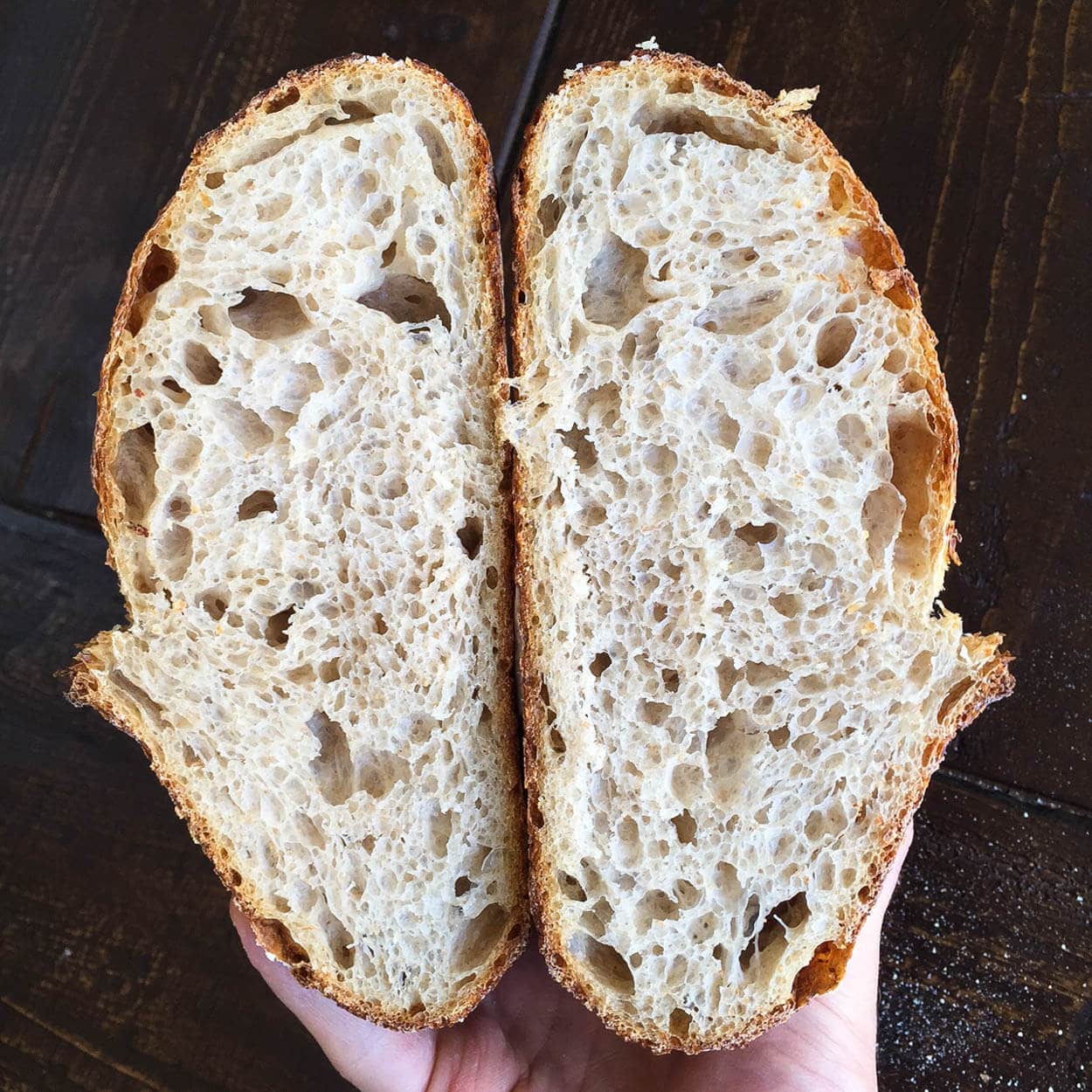
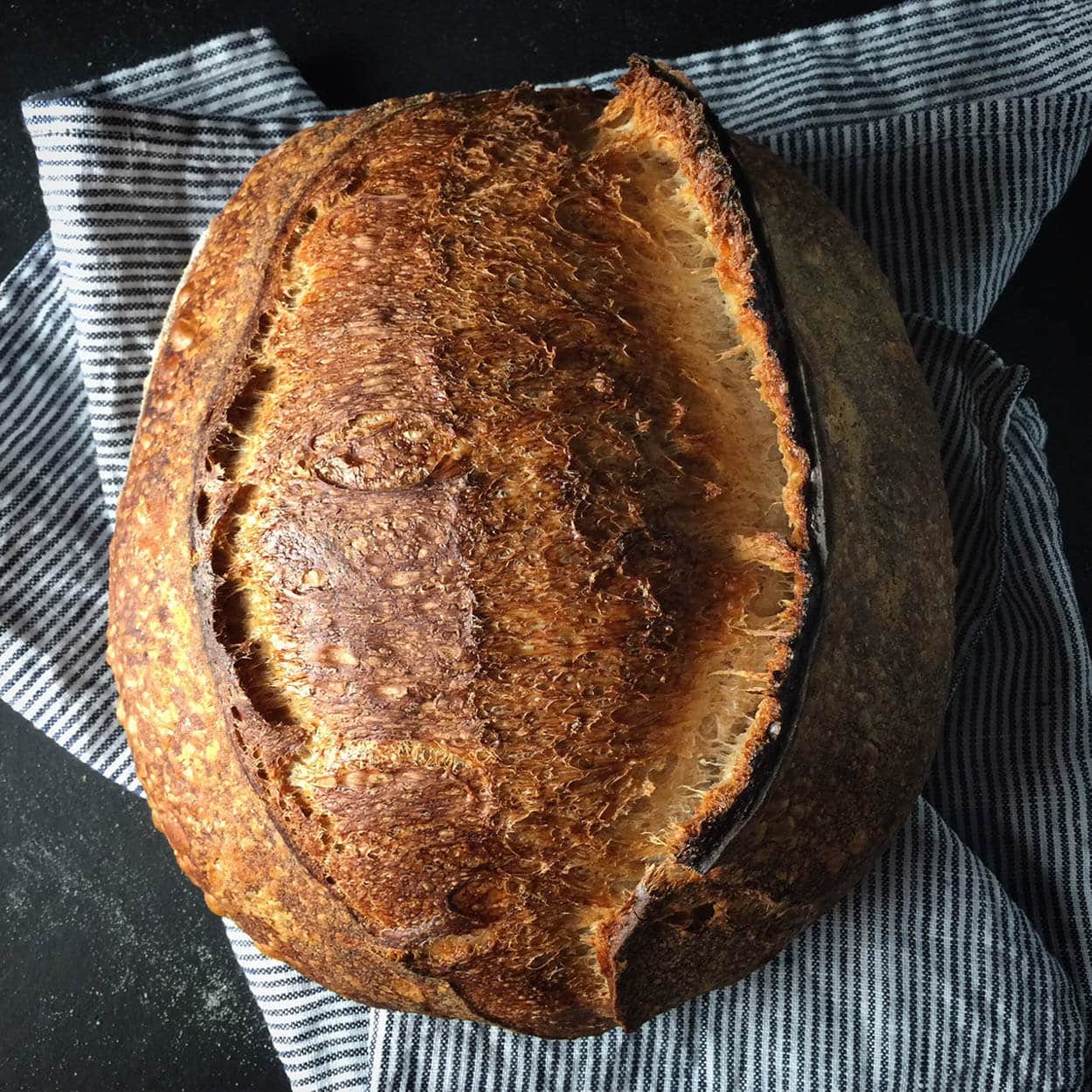
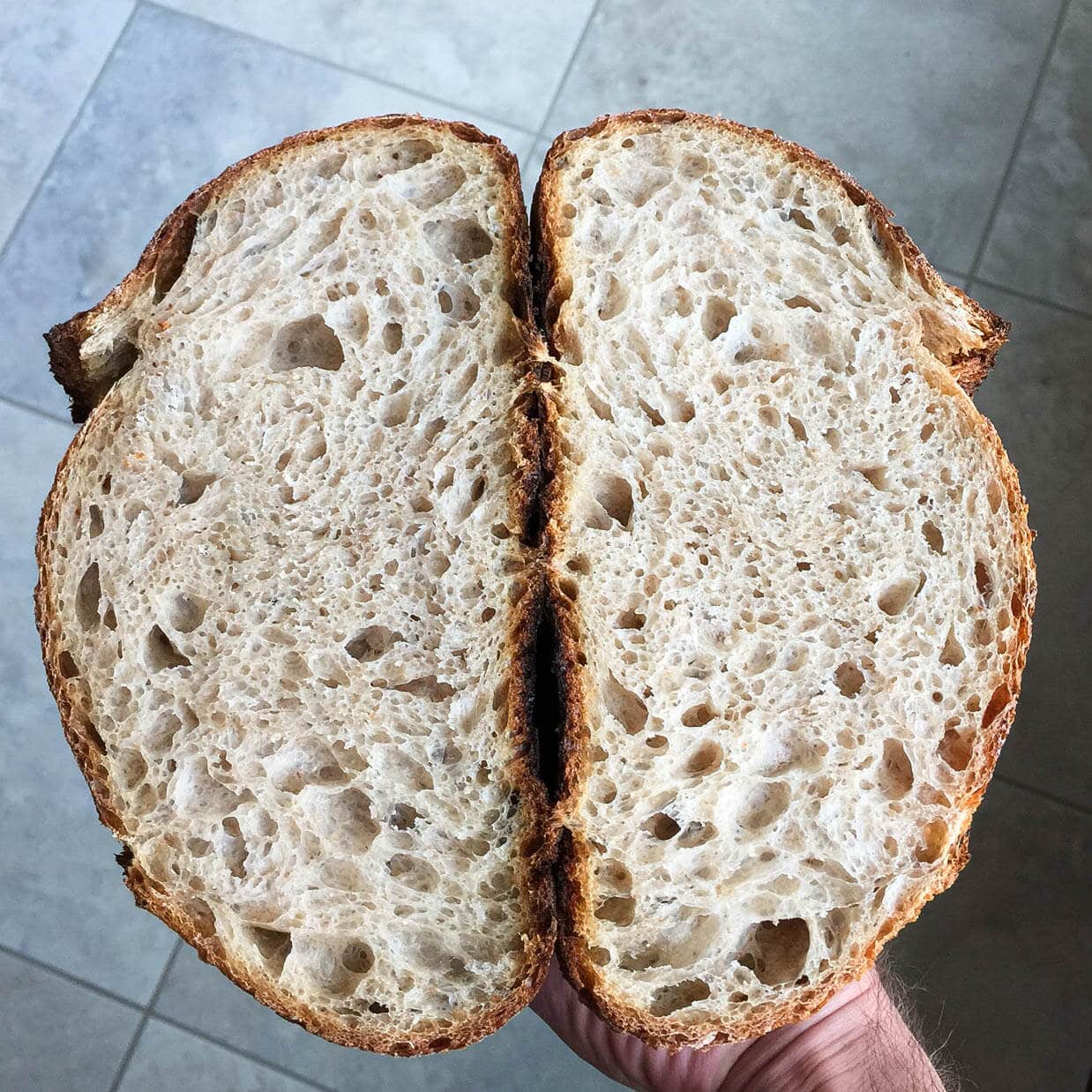
I like this method for baking bread in my home oven because it lets me bake two large loaves at a time. I plan to bake four loaves at a time, and this will let me do that with no problem. Baking with a Dutch oven (or combo cooker) works exceptionally well, and I might still use that method if doing only a single loaf or a highly hydrated one (the pan will help keep the dough together). Still, I find myself using this new method more and more. The results have come out smashingly.
Small steam burns: worth it (as you can see below).
What’s Next?
Be sure to check out my full guide to baking bread at home for more details on this important step!


432 Comments
I put a roasting pan like yours filled with lava rocks and water in the bottom of my oven for steam. I’m wondering why you use two pans and why one is towels and the other is lava rocks. I have enough lava rocks for two pans but do I need two when my roasting pan is pretty large?
The two pans do different jobs. The towels give you a slow, steady release of steam that lasts the whole steaming period, while the lava rocks give an instant burst the moment you add water (or ice). The burst gets the loaf’s surface pliable right as it goes in, and the towels keep the oven humid while it springs. Two pans of lava rocks would give you two bursts but nothing sustained. If you only want one pan, keep the lava rocks (or leave it empty, too), but adding the towel pan is worth it if you can fit it. But again, it’s optional!
Hi Maurizio, does the material/dye of the dish towel matter? I tried using black hand towels from hall closet (not kitchen) and it smelled toxic and the dye bled into the steel roasting pan. I tossed the perfect first baguettes.
Oh no, sorry about those first baguettes, Tiffany! Yes, the towel material matters. Use only 100% cotton kitchen towels, undyed or white. Towels with synthetic fibers or heavy dyes might release fumes and bleed exactly like you experienced, and it’s not worth risking it.
Plain cotton towels hold steam beautifully and stay inert at oven temperatures. Your instinct to toss those baguettes was right. Next bake will be the one!
How to bake Soughdough in a Miele Combination Steam Oven using steam component and not Dutch oven.
If you have a Miele, just use the steam function on the oven as described. I would just do steam in the beginning part, maybe the first minute or two. The reason is those ovens are built to trap steam, so you only need to add (inject) steam once at the start, then let it stay inside the oven chamber. You’ll still want to vent the oven after 20m (either with a button press, or just opening the oven door—be careful though, it will be hot).
Help, I cannot anywhere find direction about which oven settings are being used. Are you using top and bottom heat? Or purely fan bake? My oven has lots of option, from fan bake only, to grill (US=broil), bottom heat only or either of those options with fan assist. I need to adjust the temperature down by 20C if converting from conventional bake (top and bottom heat) to fan bake, so knowing which setting is being recommended/used is really important. I never see this detail on US baking sites, confused as to why. This variety of settings is standard on ovens where I live.
Hey Rachel. When I steam in this way, I’m NOT using convection/fan and NOT broil. You dont want the steam blowing around and exiting the oven. As for the elements, my oven has both top and bottom I think (they’re actually not exposed but inside the oven walls), and they’re both on with normal operation.
Hi, what’s the purpose of using cast iron skillet for lava rocks? Can I just use two metal pans?
Not necessary to be cast iron, two metal pans works well!
De ce nu putem pune in cuptor o simpla tava cu apa clocotita? Nu genereaza suficient abur?
Do you have a gas or electric oven? Can you use this method with a gas oven?
Electric. Unfortunately, this method doesn’t work super well with a gas oven given the venting requirements. Instead, I’d bake using a Dutch oven:
https://www.theperfectloaf.com/how-to-bake-bread-in-a-dutch-oven/
I did an open bake but the bread is gummy. It's got a beautiful crumb but it's just gummy.
i set my gas oven to 500° and heated everything up for an hour, followed all the steps. I took the lava rocks out after 20 minutes and the internal temperature was 210° after another 15 minutes of baking.
Buuuut it's gummy. It's got a great flavor but gummy, lol.
I may need to invest in a real baking steel. I used an upside cookie sheet, could that have made the crumb gummy?
If the hydration is too high for your dough it can lead to an overly wet or gummy interior. If the dough feels "soupy" or very "slack" then try pulling back the water percentage by 5% and see if that helps.
Make sure to bake your loaves completely. The interior should register around 204-206°F (95-96°C) or higher.
If your loaf is under proofed then this will typically lead to a gummy or "wet" textured interior. Make sure your starter and levain are very vigorous and strong when you use them. This is very important! From there, make sure to bulk ferment your dough fully (use the images you see in my posts to guide you on what the dough should look/feel like). You want the dough to be alive and aerated before you divide and shape.
From there, a full and complete proof is also very important.
A few ideas there for you, let me know how the next attempt goes!
Since I have 2 ovens (bottom is now my dedicated steam oven), I don’t need to remove the steam baths – I can simply transfer my loaves to my top, preheated oven to finish their bake. Then I can add more loaves back to my bottom steam oven.
I’m a lazy baker and prefer to make multiple loaves at a time. I freeze, and give away (trade) my extra loves!
Hey that's not a bad idea, Kathy!
Hiya! I take the simple way out of this dilemma. I place my cast iron pot on the baking stone and preheat heat it and the lid. When at temperature i place the bread on a couple sheets of parchment paper and put it into the heated baking pan. I immediately place 3-4 ice cubes between the sheets of paper around the edges and the pan itself and put the on the lid and bake as usual. I have had success with this and now it is standard procedure! Try it and let me know!! Cheers!!! Mary
Yup, that's a fantastic way as well, Mary! I talk about this in my new guide to the baking step: https://www.theperfectloaf.com/guides/the-ultimate-guide-to-baking-bread-dough/
Hi there – have been experiencing issues with getting any type of oven spring with my electric oven that ONLY has a top element (european modern oven). There is no heat being generated from the bottom and all loafs are coming out well browned on the top, and quite doughy below. I’ve been preheating the oven on convection setting and turning off the fan once I load my loaves. Any suggestions?
I recommend using a baking steel on the bottom of your oven, by preheating it you will get more heat coming form the bottom than you have without it.
Like Kenneth said below, a baking surface will help store some of that heat for the bottom of the loaf!
I’m trying to source the extra thick baking stones under the bread- the link is to the top baking sheet, but how thick are the bottom stones , and I would like to buy 2 or so smaller ones so i can lift them easily as I am a little old lady. 🙂
Thick refractory brick or stones will also work very well!
I’m thrilled that I found such an informative article. I was watching a Julia Child episode earlier today where she used quarry tiles to increase the temperature of her oven. I’ve also read how her husband, Paul, used to place asbestos bricks in a pan of water to create steam. I’d prefer to avoid both asbestos and any potentially improperly made tiles, and wondered if Fire Bricks might work? They appear to be able to be “fitted” together. I just do not know if they are the right sort of tile/bricks for bread making, and if they are able to withstand steam?
Ha ha, definitely avoid the asbestos. Fire or refractory bricks will also work very well!
I’ve been banking great loaves for 5 years and all one has to do is to put a roasting pan under your stone (no towels or lava rocks needed) Drop your dough ball onto the stone and pour a cup of water into the pan. Close the oven door as far as you can and you’re done.
I, too, use a roasting pan. Only difference: I boil the water (2 cups) ahead of time, and pour it into the room temp pan in the preheated oven. Starts to boil again within seconds.
That works well, for sure!
Hi Maurizio! I have attempted the open bake method once and am now experimenting with a few things to achieve a nice loaf. I use a baking steel and create steam underneath. What does the baking stone on the top rack do? Does it prevent the crust from forming too soon?
That one isn't needed, these days, I don't use it!
Hi Maurizio! I love your book and so grateful for all the content you give out. I noticed you have 3 extra thick baking stones in the oven that you place the loaves on to bake. Could you give the link to those stones or the thickness and size of them as you did for the one you use on the top? I tried looking up extra thick baking stones but nothing comes up that looks like yours. Thanks in advance!
Siera
I put a garage sale cast iron pint size kettle in the oven when heating up. When I put the dough in, I put a cup of ice cubes in the cast iron and it steams about 20 min. This way I finish up dry. So far it’s working. I have a Miele electric oven. If anyone ever needs a new oven, I highly recommend a Miele. I never realized how awful my Whirlpool, GE and Kitchenaid 9vens were until I bought this Miele. The roll out racks were an added bonus.
I’m new to sourdough baking. I use a Dutch oven and spritz the loaf just before baking. I start at 500 and reduce the heat to 450. I found just opening the door will lower the temp quite a lot. I put baking pans on the lowest rack to prevent burning the loaf’s bottom. Spraying the loaf with water seems to work well, but I may be missing something?
My towels are cotton / polyester… but polyester melts around 500F or so… should I be using towels with no plastic? Ie 100% cotton etc? About to try this method (though I LOVE the results with the Challenger Bread Pan) in preparation for an attempt at baguettes. Great book by the way.
I only have a Propane oven which by necessity is continually ventilated to the room. Viola, no steam!
Any suggestions about how I can bake other than in a closed pot would be much appreciated.
Thanks.
Barrett
In that case, you’d really have to kind of over steam the oven to ensure it’s steamy enough in there. That’s a challenge!
Damn so I’ve been trying this setup for the past few bakes and I just can’t get enough steam to stay in the oven compared to when I’m using my Dutch oven. Last week I baked two loaves on the same day, from the same dough – one in my DO and one on a baking steel with the towels and rocks. After 15mins the Dutch oven loaf was still super pliable on the outside which after fishing baking it with the lid off gave it the super thin bubbly crispy crust I’m used to, while the ”naked” loaf visibly started to harden up after only like 8 minutes making that crust much more thick…
I’m wondering if my oven (it’s a small 2/3 size oven btw) is just not holding onto the steam as well as it should… the whole time the oven is on / preheating, the cooling fan CRANKS so I wonder if it’s just blowing out all that steam the moment I add the loaves. I’m going to try again tomorrow with two more loaves – might try to cover the vent a bit with a towel to hopefully trap that steam in there for the first half of the bake. Hopefully I don’t blow the house up lol
Yes, sounds like it’s venting too much! I have a few more solutions coming here soon, stay tuned Nicholas!
Yeah so I basically gave up on the lava rocks for the time being – however I did fashion something crazy instead! I bought a handheld steamer (for like cleaning couches and stuff) from amazon, as well as a 500F heatproof silicon tube to go over the nozzle! After launching the loaf I just hold down the lever on that puppy and let it go till it runs out (usually lasts like 10 minutes). It’s not ideal but it certainly works the best compared to anything else I’ve tried, as the steam is being replenished at the same rate as the vent. I’m gonna try it with the lava rocks in there as well for just a little extra initial steam, but I can send pics of the setup if you’d like!
I’ve wanted to do this for so long as well! I’ve heard other bakers use this tool and I looked for one a while ago, but couldn’t find the right one.
Also, here’s my YouTube video on steaming the home oven, as promised!
Yes, would love to see photos of the setup. Are you a TPL Member? If so, please drop the photo in the Discord chat!
I have been using this very method successfully now for over a year. I don’t remove the cast iron with lava rocks though, it’s just so heavy! However would my crust be a bit more crustier 🤣if I did? Stay tuned. Thank you, you rockstar you M!
Totally works to leave it in there! But yes, it’s best to finish baking your bread in a dry oven to fully harden off the crust. My guess is, though, that all the water you’ve put in that pan is gone by midway through anyway, so no harm done!
My oven is gas how do I place Rectangular pan and cast-iron pan with lava rocks on bottom without ruining my oven bottom
You can place an oven rack at the lowest level in your oven (the last rung). Then, place the pans on that. One rung up, place another oven rack with your baking surface.
I have been using the open baking methodjust like yours, for years with much success. I pour boiling water into either an old cake pan in one oven, or a beat up cast iron skillet in my other. After 20 min. all the water has steamed off so I don’t have to remove the pans and risk a burn. Recently I have been experimenting with turning the oven OFF after first steaming, to further reduce hardening off of the crust and increasing oven spring. I think it improves oven spring.. Oven back on after 10 min. Have you tried this? Your opinion welcomed.
That’s a great idea and something to try, Sandy. In my larger bread oven I kind of do the same thing, I turn the heating elements essentially off to prevent the outer crust from forming prematurely… would make sense to try this in the home oven as well!
I use a large metal mixing bowl over my dough to capture steam, and a roasting pan filled w boiling water underneath to generate the steam. After about 30 minutes I remove both and finish the bake. Seems to work great–I get a great crust.
Yes, this is a great approach!
Are you using an electric oven or a gas oven?
I have trouble keeping steam in my gas oven using steam pans under my baking stones. Using dish towels and lava rocks sounds like it could extend the steam generation for my vented gas oven.
I have an electric oven. My method here would definitely help generate more steam!
I would try using the oven if it works well! Yes, I’d go 20m with steam in there, too.
Jealous of that proof option!
Hello Maurizio! I usualy bake in a dutch ove , but decided to try this method today! I preheated the oven to 240, and baked 20′ with steam and a little hand spritzer, and then 20′ without! The crust turned out to be very thick and a bit hard! Any suggestions? Should there be more steam or the temperature was high?! Thanks
Hey, Michael! You likely need a bit more steam in the oven than you were doing, which will help keep it thinner!
How do you care for the cast iron pan that holds the lava rocks? Mine is rusting something fierce and from what I can find, that’s just the result of boiling the water; it strips the finish every time.
Sadly, yes, this is an issue with cast iron. Lately, I’ve actually switched to a stainless steel pan instead of the cast iron. It, too, get’s a little ruined over the long haul, but much less so than the cast iron!
Good grief, you can buy a bamboo steam cooker for $40
Not sure this would bake a great loaf of bread, though 🙂
Hi Mauricio! Love your website, great resources and instructions! I baked my first ever loaf of sourdough using your easy recipe for sourdough in the start here section of your website. It came out pretty good looking, however it was dense and had a slight sour aroma. How can I improve my technique? Thanks and congrats!
So glad to hear that, Sandra! Happy to have helped. It’s hard to say, it might have been that your loaf was over proofed if it was very sour and didn’t have much rise. Try to follow the pictures and guidance regarding temperatures in the post—especially temperature!
I’m a bit concerned with the lava rocks. My bag says the rocks give off carbon monoxide which is a gas that can kill you. What are your thoughts please.
The ones I use (listed above) state that they’re safe for use in a grill or other culinary applications. The bag I have didn’t have this warning!
You’re welcome, Mark! And yea, the top stone can help, but it really depends on your oven!
Hi Maurizio,
Thanks for all the information on your great blog! As it comes to steam I use the Desh Stoom in my home oven. It’s invented by a Dutch baker and is easy to use and works very well.
Greetings from Holland, Wendy
https://stoom.store/nl/
You’re very welcome, Wendy! That looks very interesting, I’ll have to pick one up. Happy baking!
Desh Stoom doesn’t seem to ship to USA locations. If you were successful would love to know how/where you purchased. And your impressions of the product? Thank you!
The Desh Stoom is so cool! Wish we could get them shipped to the US.
Dear Maurizio,
First of all THANK YOU VERY MUCH for your great blog. I love everything here and your recipes enriched my life in so many ways. I read through this part only yesterday because I rather spontaneously decided to bake two loafs at once. So you can imagine I don‘t have all the equipment handy you described up there. Therefore – and I don’t want to undermine your for sure very good technique – I just simply used my tarte-pan filled with water underneath the backing tray. No baking stones, no lava stones, no Hand-Spritzer. I removed the pan filled with water after 20 minutes (like you recommended). Everything worked just perfectly. To clarify I made your potato bread (which might just have the perfect hydration grade) and also I live in the middle of Europe and the climate is for sure very different here. Maybe all that helped to get a good result with very simple equipment.
Again thank you and please continue your wonderful webpage.
You’re welcome, Stefanie! Glad to hear my site has helped. And you’re absolutely right, steaming the oven can be done with a much more streamlined approach without the need for many pans or other items. I find my approach gives the dough a little more shine and crispness, but it’s not 100% necessary. A pan with some water or ice cubes is all that’s needed. Thanks for the comments and happy baking!
Hi Maurizio! I love your site and the generous amount of information you share. i’m transitioning to steam bakes on a steel. Yesterday was my first bake using your method except I used the lowest rung for the base of a combo cooker filled with lava rocks, worked perfectly. I would like to put the cast iron on the oven floor and steel above it on the sliding rack. Will placing the steam vessel directly on the floor damage it? It would be easier to pour the water onto them with a lower chance of splashing on the glass door. Thank you
Super glad to hear that, Susan! In my oven, I put the pan directly on the floor, but my oven does not have exposed heating elements on the bottom as some ovens do. So I can say if you don’t have coils on the bottom, it’ll work just as well!
I have wall, double ovens with the elements on the top. Super excited to experiment again because the last loaf was a perfect loaf, from the exterior and the crumb. I will tag you on IG. Thank you for your quick response and all that you do!!
Ok, great! Happy to help, Susan 🙂