

Baking sourdough bread in the winter, even with a stiff starter, always presents problems here at my house: it’s cold! Probably not quite the cold you get in other parts of the world, but it sure is cold to me, and my starter. Kitchen temperatures are consistently hovering around 70°F (21°C) which slows fermentation activity. I’ll typically offset this by changing the percentage of mature starter carryover or by heating the water used in my feedings (a dough proofer is another great option), but I like to try to keep my starter around 76-78°F (24-25°C). Keeping my starter at that temperature is not easy to do when winter is bombarding your area! You have to make do with the warmest spot you can find in your kitchen, for me this is next to my whiskey collection. Almost poetic.

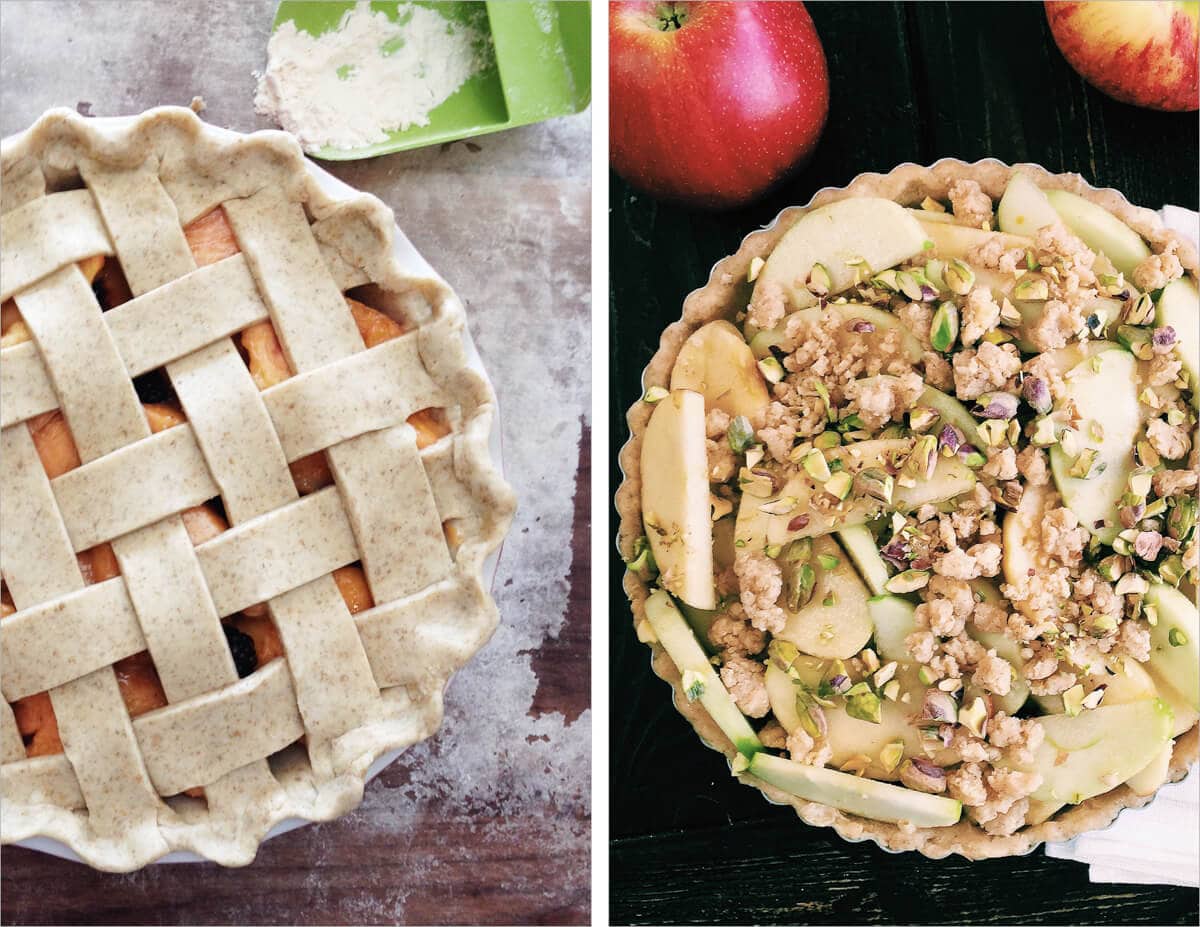
A short aside… In the winter with all the holiday events and cold weather, I find myself baking pies and cakes more and more. I recently baked an excellent lattice pie, an apple/pistachio tart, and the famous Cook’s Illustrated pecan pie, each received with equal high praise. Making a pie crust by hand becomes more accessible the more you do it (like most things), but even when it doesn’t turn out great, it’s always delicious. Butter makes life worth living, as they say. Anyway, here’s a couple of shots of two of these beauties, lots of fun to take a break from bread baking and bake something sweet.
Ok back on task here… During this challenging baking season, I’ve been experimenting with a much more stiff starter than my typical “liquid” one I’ve described thus far (outlined by Chad Robertson at Tartine Bakery). It seems many bakers argue over the differences between stiff and liquid starters, their benefits, differences, and similarities. I’ll first give a few high-level characteristics of each and then go into some things I’ve noticed after a month or more from a more personal perspective.
Frequent starter refreshments will generally lead to lower acidity, whether you’re working with a stiff or liquid starter.
Let’s first look at a very brief overview of some chemistry and biology happening inside our sourdough starters. A mature and healthy starter, and the beneficial bacteria contained within, will break down the complex carbohydrates in flour into sugars. These sugars are consumed by the yeast and bacteria, creating carbon dioxide and two types of acids as metabolic byproducts: lactic (adds a mild yogurt-like taste) and acetic (adds a more sour, vinegar taste). This symbiotic relationship between bacteria and yeast is what gives our dough leavening power in the form of CO2, and complex and layered flavors in the form of a mixture of lactic and acetic acids. You can control the production of each by the method in which you maintain your starter (frequency of feedings, water temperature, ambient temperature, etc.), the temperature it’s kept at, and the flour used when feeding. Liquid starters maintained at warmer temperature will produce more lactic acid, whereas stiff starters held at slightly cooler temperatures will make more acetic acid.
However, does this mean you’ll end up with a super sour loaf when using a stiff starter? No, not at all. Whether you’re using a stiff or liquid starter the final taste in your bread is up to you and how you decide to manage fermentation. It’s just as possible to make a sour-tasting loaf using a liquid levain (by increasing fermentation time or using a higher percentage of levain) as it is to produce a very mellow, sweet-tasting loaf using a stiff starter (which is what I prefer and always strive for).
Now let’s take a high-level look at the differences (and similarities) between a liquid and stiff starter.

Liquid Starter
Characteristics:
- hydration at, or higher than, 65% water-to-flour
- typically “sweet” or “milky” smelling if refreshed frequently as I do
- incorporating in dough mix is very easy due to its liquid nature
- refreshing is similar to stirring a thick milkshake
My liquid starter, originally started by following the guidelines set out in Tartine Bread, is a “sweet” and “milky” starter that is very loose and amorphous. I’ve maintained this high hydration starter for numerous years, and it creates bread that is very creamy tasting with a subtle sour tang to it. Many references suggest that a liquid starter will produce a final loaf that has more of a sour tang to it, but of course that all depends on how you manage other aspects of your starter (timing, temperature, etc.). More on this below.
Stiff Starter
Characteristics:
- hydration at, or less than, 65% water-to-flour
- incorporating into dough mix is a little more difficult due to the thick, tough nature
- refreshing is similar to kneading a dough
- produces a more subdued acidic taste in final loaves if maintained correctly
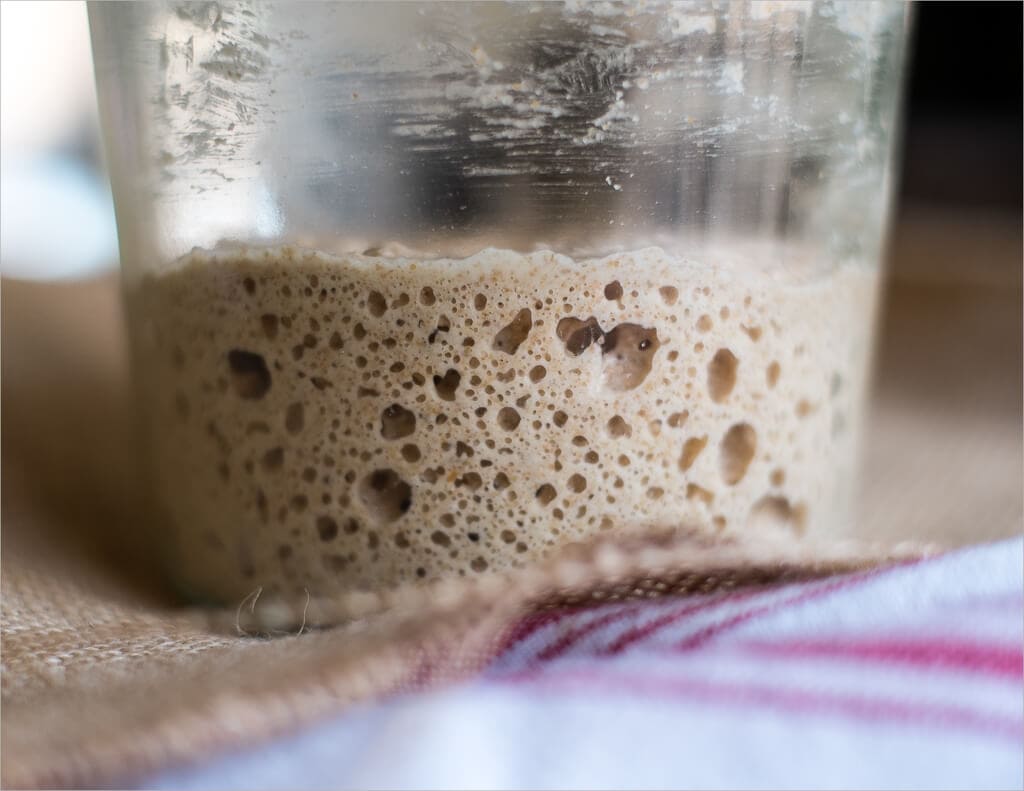
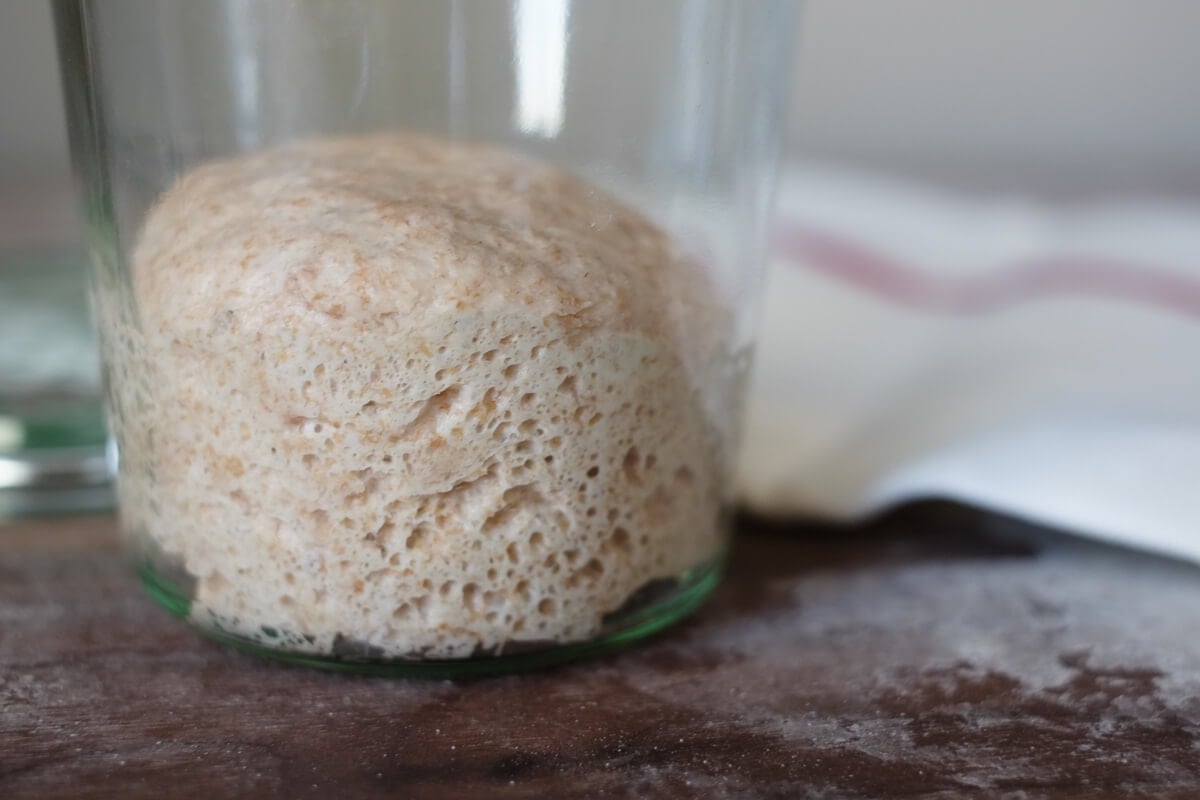
A stiff starter is a little more forgiving when it comes to refreshment (feeding) due to the delayed “falling” (when compared to a liquid starter which falls when food is exhausted) of the dome on top when rising. Think of it as a rising balloon in a jar that eventually runs out of helium and then suddenly the top caves in and the entire top begins to fall. There have been a few instances where I wasn’t able to attend to my starter until many hours after my regular refreshment time, and the starter was just fine — no deep vinegar smell and it was well before the total acidic breakdown of the flour.
Starter Conclusions
Experimenting with a stiff starter has been a very worthwhile endeavor for me, I’ve learned about the different feel, fermentation behavior and taste between using the two types of starters and levain types. Honestly, in the end, I think the choice between the two mostly comes down to your personal preference: do you like to stir your levain like a milkshake when refreshing or do you want to scoop it out and quickly knead & mix by hand? I find myself preferring the latter, surprisingly. It’s quick and easy for me to drop in some flour, water, and knead out the dough on my work surface, then drop the dry ball back into its rising jar. No messy soup to deal with. Additionally, when mixing up a high hydration recipe (like below) the stiff starter does seem to impart more strength to the final dough, giving the bread a bit more rise and making shaping a little easier. Maybe because in the end there is a little less hydration in the levain, and because of the increased acidity in the stiff starter which helps to strengthen and condition gluten.
Update:
After baking with my stiff starter for a while now, I can safely say the misconception that a stiff starter/levain produces a more sour bread is unfounded. I’ve now baked some of the most incredible tasting bread that only has a small hint of sour, probably even less than my liquid version. A stiff starter, if also fed with 100% whole wheat flour, will produce significant acidity (both lactic and acetic) but the actual transfer of these acids to your final dough is very minimal as the amount of levain used in a recipe is usually rather small
For more information, see my next post on how I maintain my sourdough starter for information on feeding (refreshment) times, flour types, and much more.
See my guide to the differences between a sourdough starter and a levain for information on how these two differ.
Prepare the stiff levain – 8:00 a.m.
Note that the quantities and temperatures in this entry have been adjusted to compensate for the cold environment in my house (around 70°F/21°C).
| Weight | Ingredient |
|---|---|
| 50g | Ripe starter |
| 50g | Giusto’s whole wheat flour |
| 50g | Central Milling Organic Artisan Bakers Craft (malted) |
| 65g | Water |
I keep the levain in the oven with the light on until the interior temperature reaches 78-80°F (25-26°C). Leave this to build acidity and strength for 4 or 5 hours. With a stiff levain, you’ll know it’s ready when the domed area on top begins to cave in, but after 5 hours it should be good to go.
Autolyse & Mix – 12:00 p.m.
Ingredients:
Gather the following:
| Weight | Ingredient | Baker’s Percentage |
|---|---|---|
| 100g | Giusto’s whole wheat flour | 10% |
| 50g | Whole rye flour (Bob’s Red Mill Dark Rye Flour) | 5% |
| 850g | Central Milling Organic Artisan Bakers Craft (malted) | 85% |
| 875g | Water | 87.5% |
| 20g | Fine sea salt | 2% |
| 200g | Ripe, stiff levain (amount increased 5% from last entry due to cold weather) | 20% |
Perform the following for your autolyse:
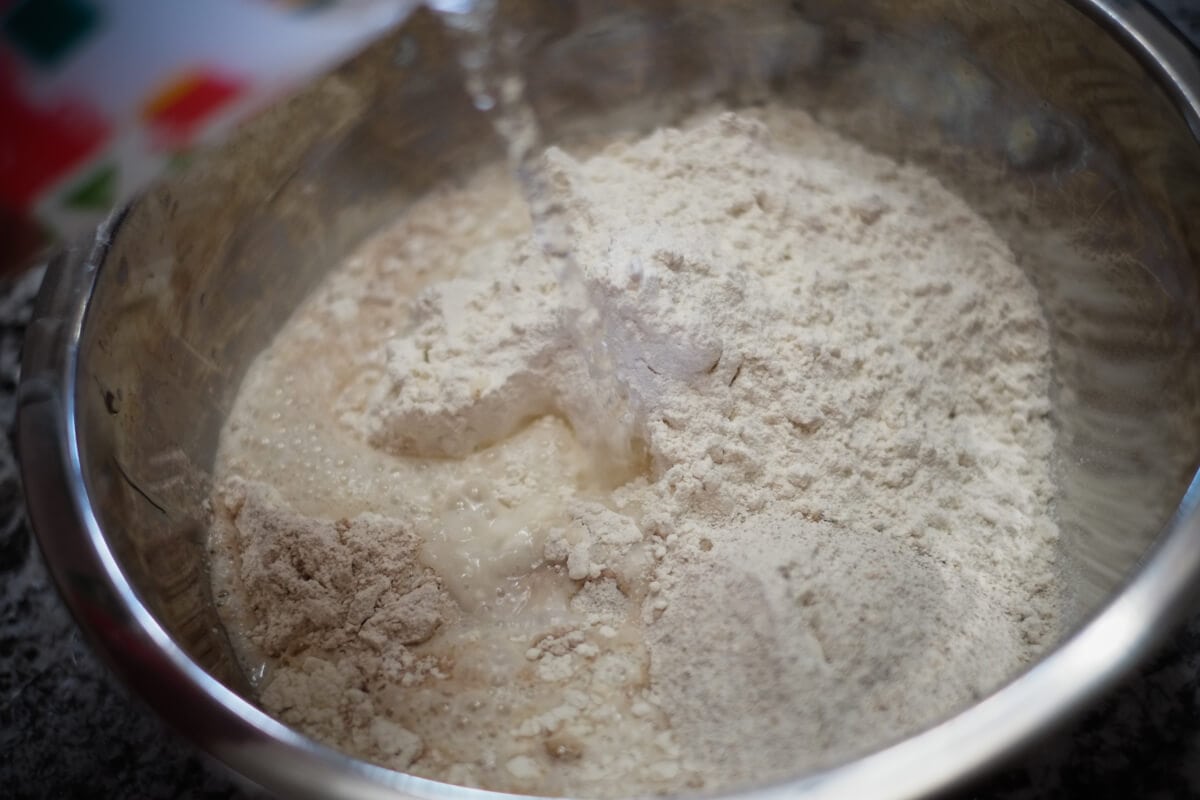
- In a thick bowl add the flour
- Add 750g of your heated water (the rest is reserved until later when we add in the levain & salt after the autolyse)
- Mix these ingredients by hand until incorporated. Remember at this stage we are not looking for any gluten development, make sure all the dry bits of flour are incorporated
- Cover with wrap and keep near your levain for 1 hour (in my case in the oven to keep warm)
Slap & Fold Mix After Autolyse – 1:00 p.m.
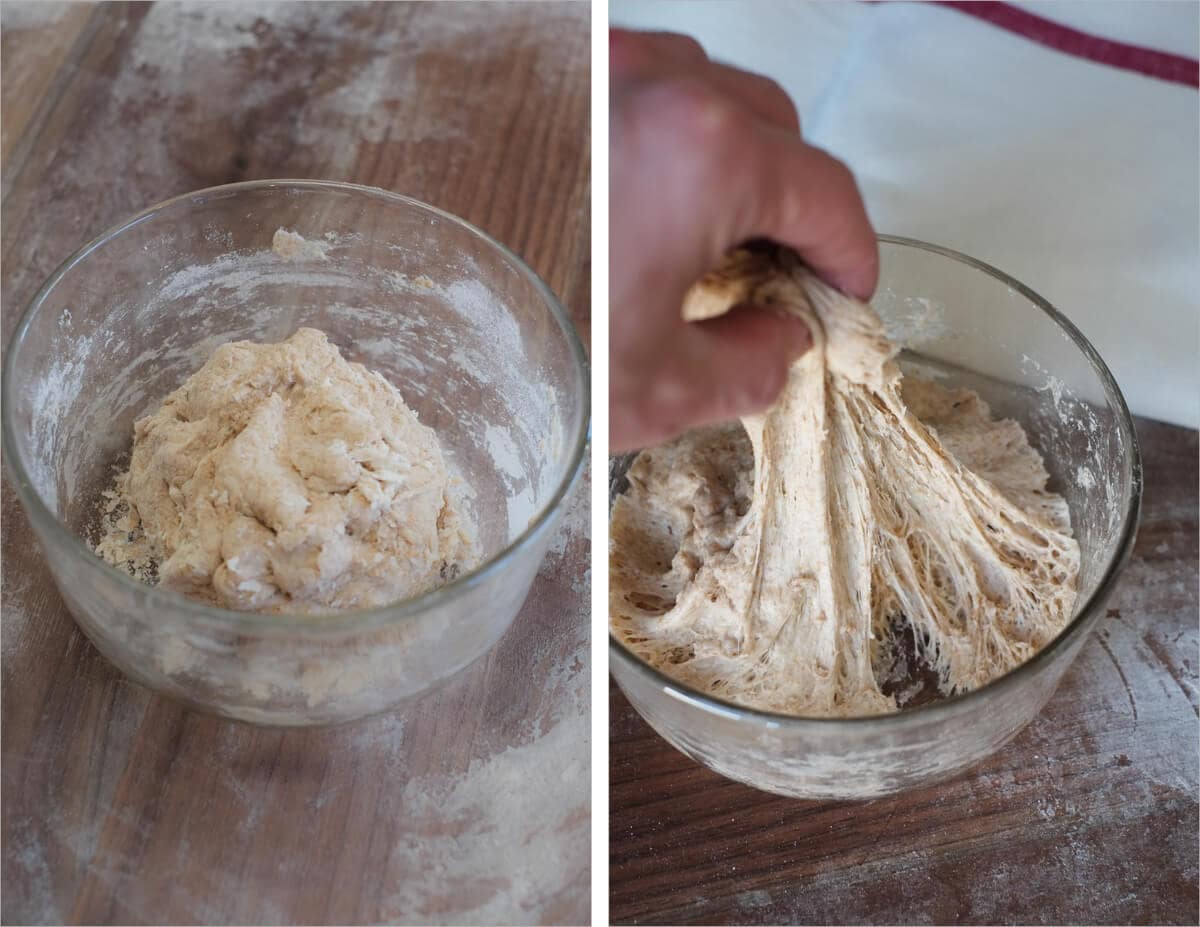
After your one hour or so autolyse, take your dough in the bowl, break up the stiff levain on top, pour on about half the remaining water (warm water if it has cooled) and slap and fold for about 5-8 minutes until the dough looks smooth and doesn’t stick to the counter.
Return dough to the bowl and let rest for just a minute, then pour on top the salt and remaining water and do another slap and fold session for about 5 minutes until the dough again looks smooth and has some strength to it. “Strength to it” is a loaded term and this is an intuitive judgement call. After a few tries if you remain observant, you’ll start to build up a feel for “strong enough” and know when to stop your slapping & folding.
At this point, the dough should look smoother, feel elastic and strong.
| Final dough temperature: | 71°F (21°C) |
My final dough temperature was VERY cold at 71°F (21°C) (typical would be 78°F/25°C). Even with the extremely warm water having the dough exposed to air during the two slap and fold sessions cooled things off considerably. I was a bit worried at this point but performing bulk fermentation in my oven with the light on (around 80°F/26°C) let the dough proceed with fermentation, although a bit slower.
Bulk Fermentation – 1:10 p.m.
Transfer your dough to a clear container to be used during bulk fermentation and let rest for the first 30 minutes. After the first 30 minutes have passed, at 1:40 p.m., do your first set of stretch and folds. Then do two more sets, each 30 minutes after the last.
I stopped at three sets but you will need to make the call based on how your dough looks and feels. If it’s holding shape in the container, turns become a little harder to perform because the dough bundles up and it pulls easily from the sides it’s most likely strong enough and you can let rest for the remainder of the bulk fermentation.
Pre-shape – 5:10 p.m.
Take the dough out of the container onto your work surface. Divide into two halves and lightly spin the dough in little circles across your work surface with your bench knife in one hand and your other empty hand—kind of like turning a car’s steering wheel. No need to overwork the dough here! You want to gently form them into two boules, just enough to hold their shape for a 30 minddute rest, uncovered.
Shape + Proof – In Fridge at 8:40 p.m.
Shape each resting dough to your liking and place them into their flour-dusted bannetons. See my guides page for tips on shaping boules and batards. Now place these into plastic bags and let rest on the counter for 2 hours at room temperature to start proofing.
I found this rest to be necessary based on how my dough was developing and how cold it was in my kitchen—70°F (21°C)—but if it’s warmer in yours, you might want to shorten this proof period to compensate.
After this initial proof on the counter, you should have noticed your dough rise just a bit, place your bannetons with wrap into the fridge to proof overnight.
Score + Bake – around 6:00 p.m. (Next Evening)
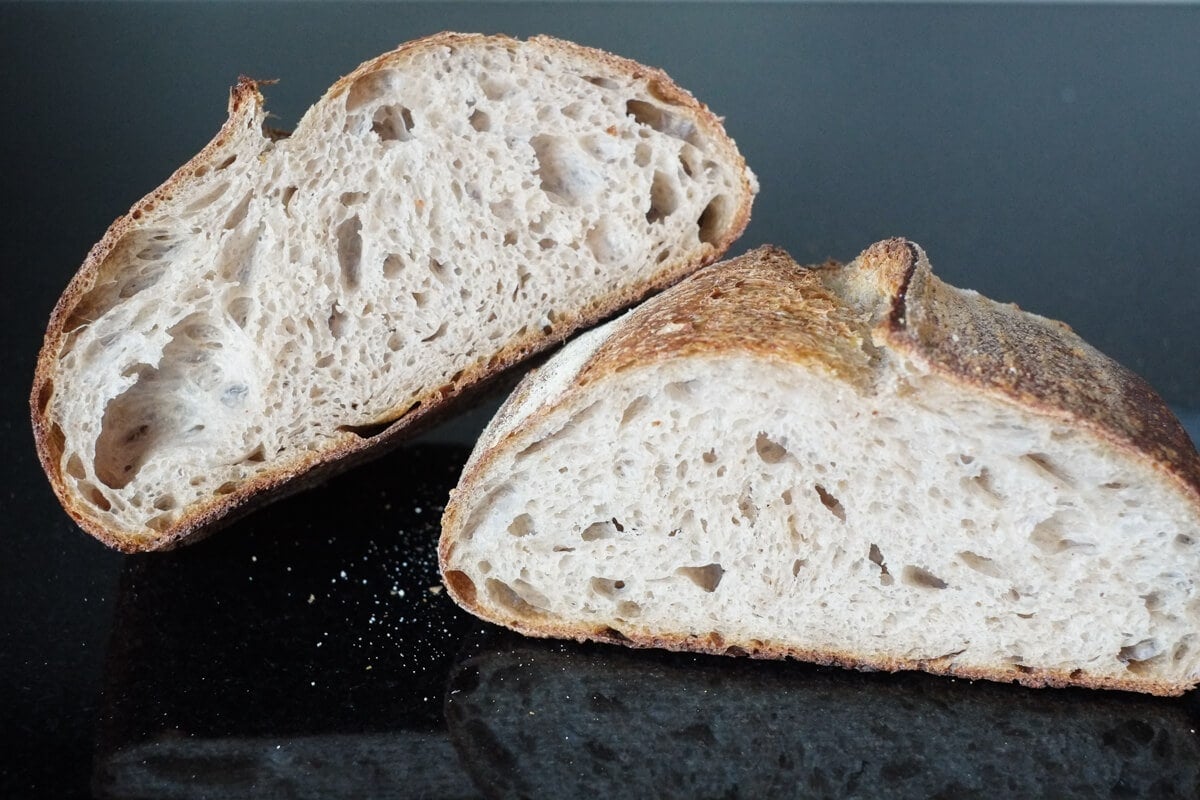
I went for a long proof this time: about 22 hours! My theory on my fridge being too cold at 39°F (4°C) is spot-on, and you can see in the results here as there was a much more open crumb than usual due in part to the long proof. Next bake I’m going to leave the dough out even longer, perhaps 3 hours, before placing into the fridge.
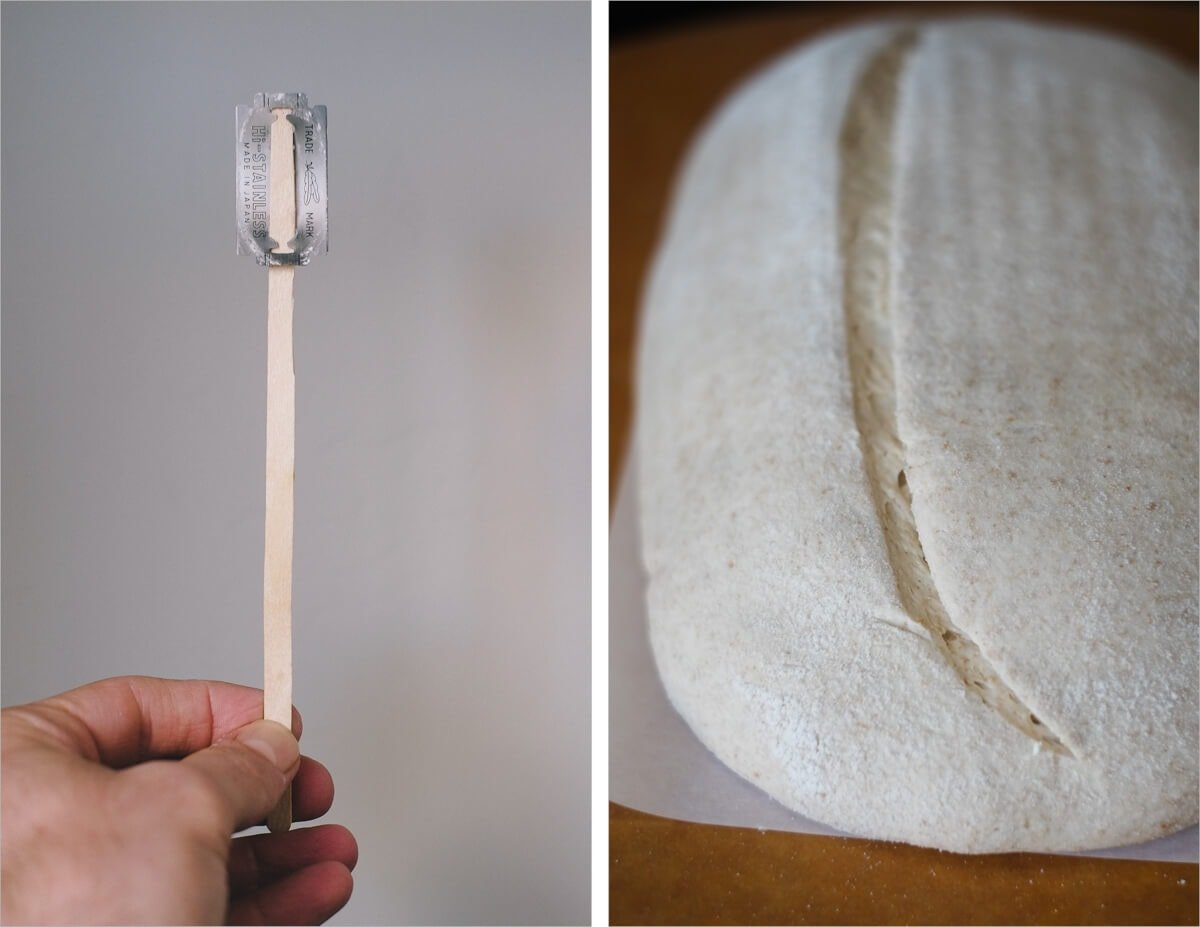
Preheat your oven with a Dutch oven (or combo cooker) inside to 450°F (230°C). Once preheated, take one of your bannetons out of the fridge and cut a piece of parchment paper to place on top. Take your peel and then put it on top of those two and quickly invert it, so the dough is now resting on the parchment paper which is resting on the peel. Score the top of the dough with your desired pattern. Take out the shallow side of your Dutch oven and drag in your dough. Quickly place the pan back in the oven, cover with the deep side, and bake for 20 minutes. After 20 minutes, open the oven and take off the deep lid of the Dutch oven (set it next to the other half inside the oven), then bake for an additional 35 minutes or so, until the bread is to your desired doneness.
For more tips with baking, have a look at my guide to baking with a Dutch oven.
Conclusion
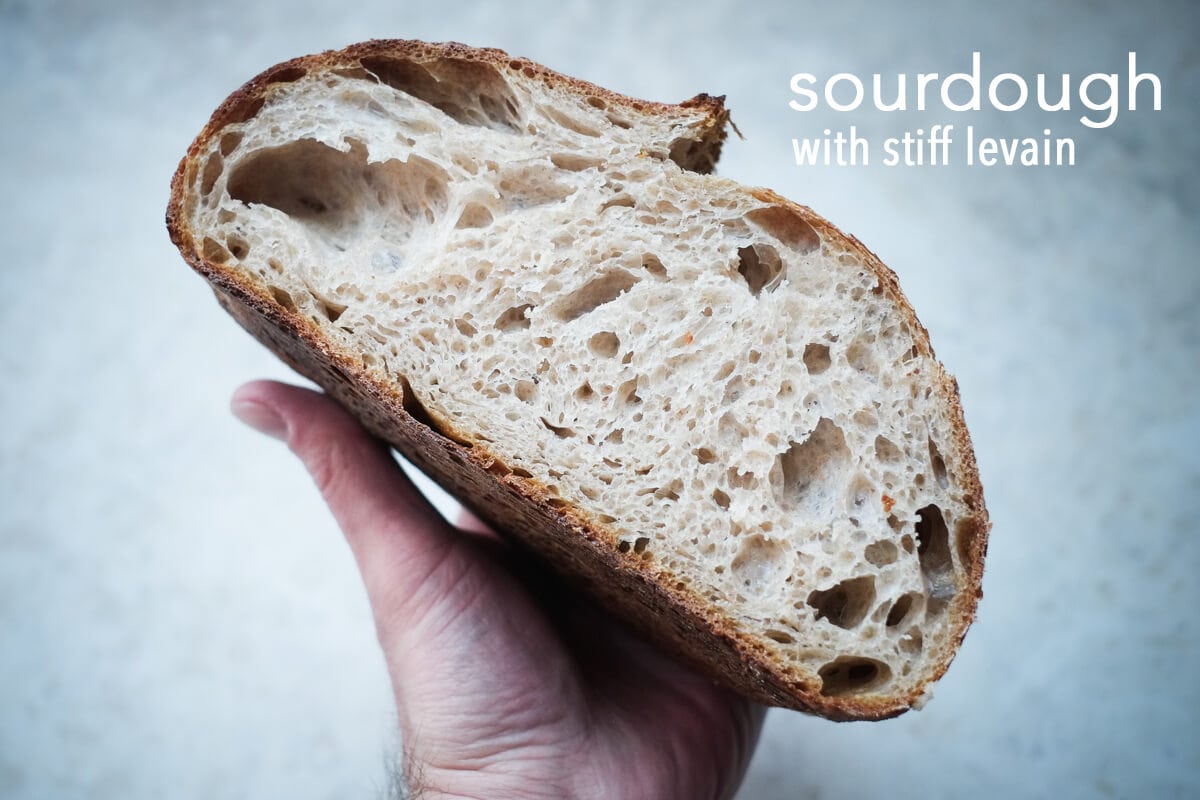
What a beautiful bake! I was happy when I sliced into these. I was pleasantly surprised by the beautiful open crumb inside, and I’m confident I can open things up a bit more next time. I’m slowly inching closer to my ideal loaf for each experiment and each trial. Sure, there are bakes that fall short, but the general progression for my bakes has been in the right direction. I’m still looking for that loaf that looks like a spider web inside with large holes and dynamic movement, almost like an explosion went off surrounded by sticky, gooey, custard.
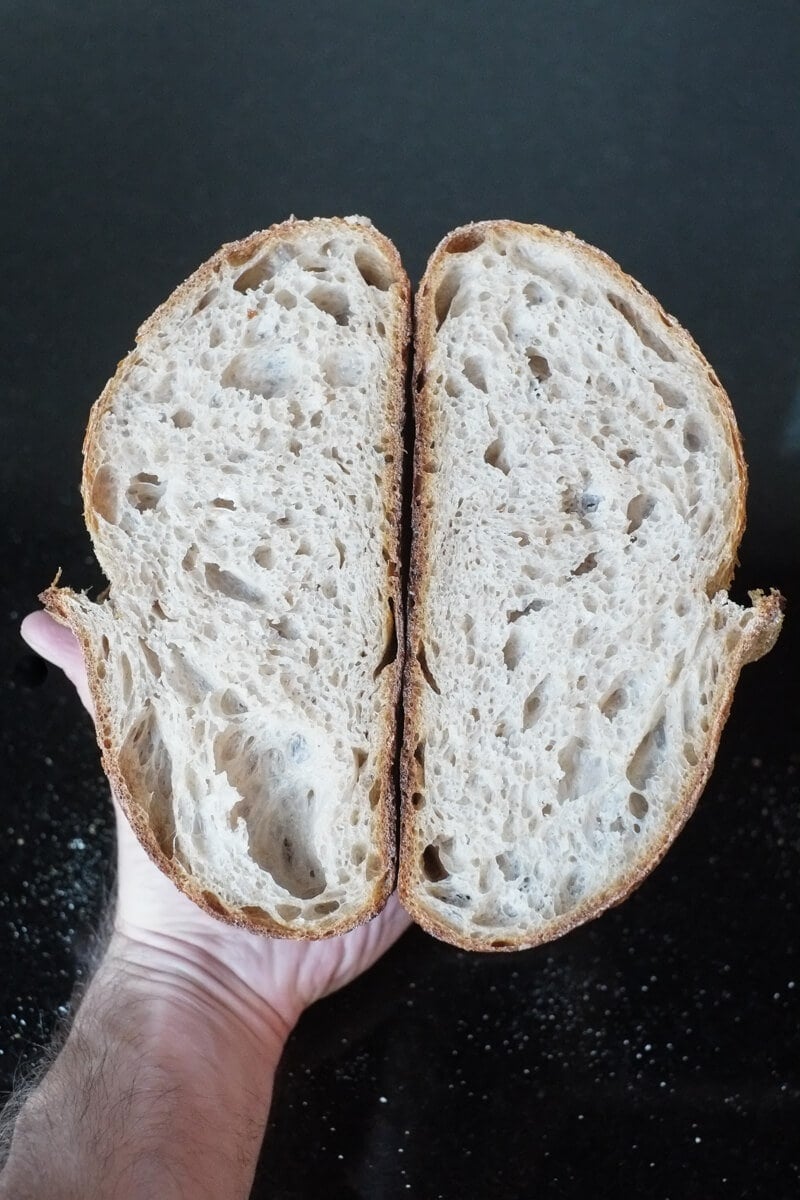
My next attempt will be using the same procedure almost precisely as outlined above but I’ll take half and attempt a longer proof on the counter before retarding. It’s hard to say just how long will open things up more, and you don’t want to overproof, but it is an experiment after all. I’m sure it will still make excellent toast.
Crust
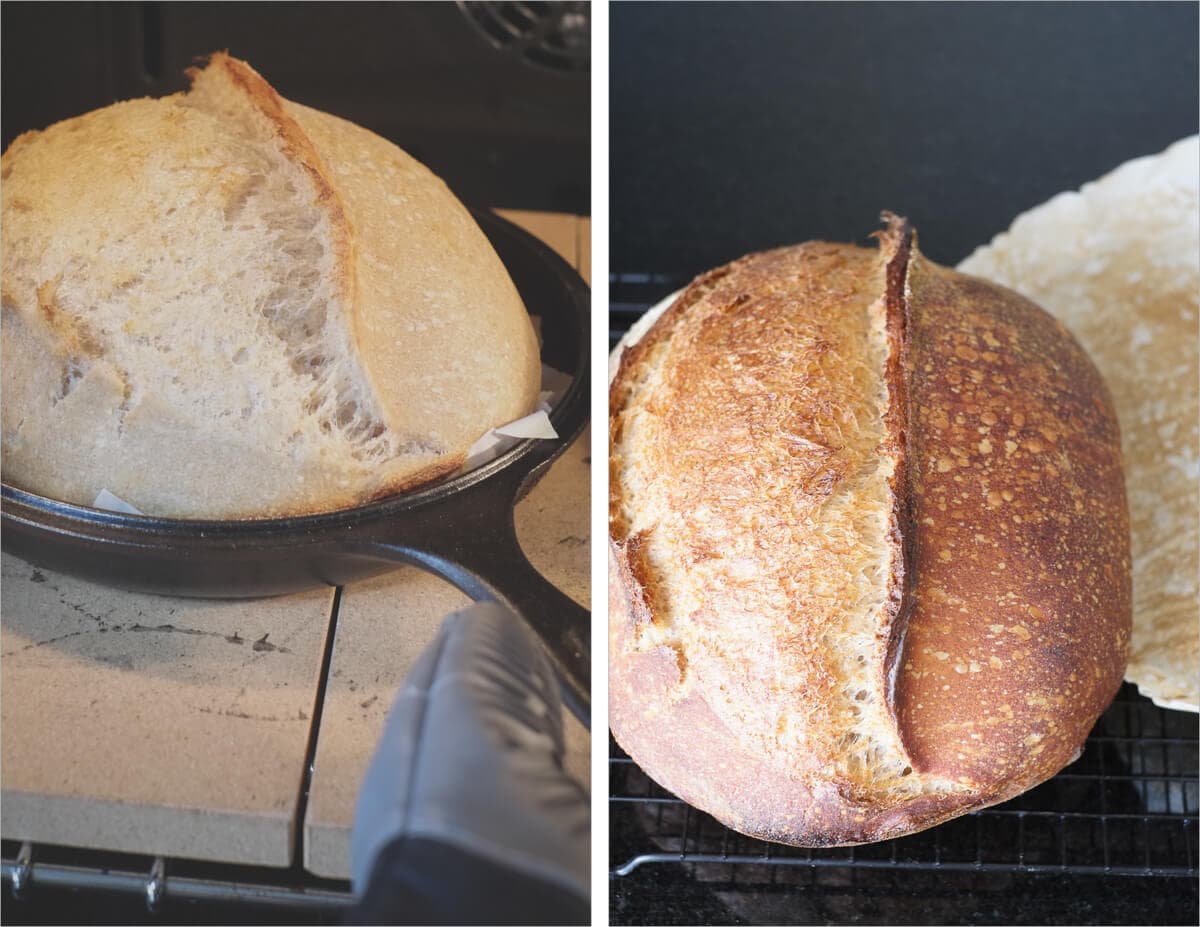
Thin, brittle, snaps under the lightest of pressure. Beautiful coloring throughout and excellent oven spring on these. I was a little afraid spring would suffer due to the high hydration, but the strengthening of the dough through using a stiff starter/levain and the slap and folds helped to keep things in check. Sublime coloring on the outside ranging from light brown to dark brown and signs of caramelization on the exterior. Cracks, small bubbles, tears, and rips.
Crumb
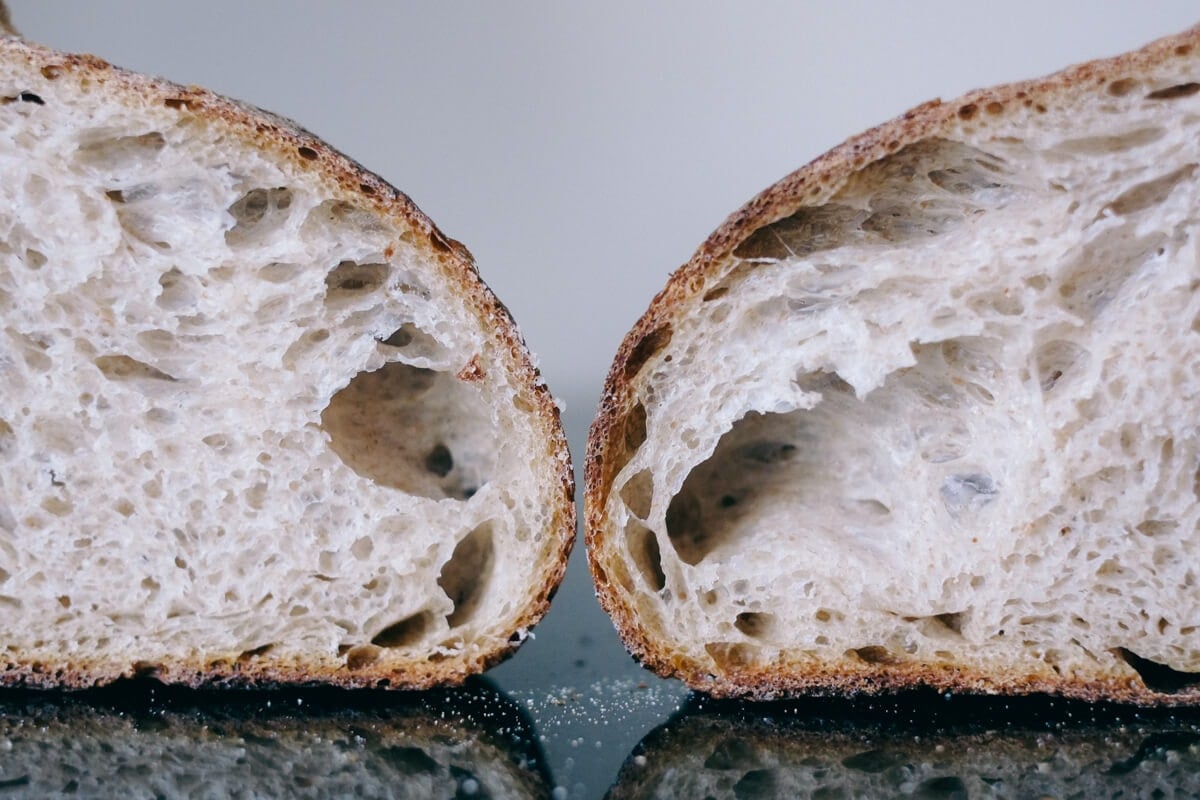
Super open, but still a little room for improvement (mostly in the bottom middle area). Tender and moist with a slightly nutty flavor likely from the whole wheat and tiny bit of rye. This bread is my current favorite sandwich bread. You can see in the image below that ghosting or shiny look to some areas where it looks like a thin sheet is being stretched wide — this is the look I want throughout.
Taste
Startling taste! My ritualistic late afternoon sandwich. With freshly baked bread shined, I couldn’t even take a minute to snap a picture to post here — it was gone. The stiff starter and managed proof did not impart an overly sour flavor to this bread; it was a mild taste that slightly lingered after finishing a bite. I like it this way, as you may know by now.
Happy New Year everyone, I hope you enjoyed this look into baking sourdough bread with a stiff starter, and I hope you join me through next year where I hope to bake and write even more—happy baking!
If you use this recipe, tag @maurizio on Instagram so I can take a look!


130 Comments
Hello Maruzrio., I am not sure about the stiff levain, after mixing the ingredients to make a stiff levain do I need to feed it again or just make the stiff levain and use it..🙏🤔
Just mix and you’re good to go when it’s mature!
Late to the stiff starter party, but the difference in rise has been so significant that I’m pretty close to giving up on the more traditional wet starter. Is there anything I would need to differently if I wanted to use a stiff starter (1:1:2 ratio) with your cinnamon roll or pizza recipes?
I’d say just account for the hydration difference: less water in the levain means you might need to add more liquid to the dough mix to get the same consistency as you’re used to.
Bulk ferment says 1:30 pm but your first s&f is at 1:05 pm. What am I missing? Is BF supposed to start at 1:05?
Sorry about that typo, Mary! I’ve fixed the post above (there were a few areas that needed some touch ups after all these years). Happy baking and thanks for reporting that!
Glad to assist. 😊. Several of your formulas have, over time, become favorite foundation recipes for me. Planning to experiment with stiff levain.
Super glad to hear that! I sometimes use a stiff levain, and almost always when doing 100% whole grain doughs, and just love the results. I plan to post more on this soon!
I am keeping a 50% whole wheat starter as well. When is the best time to use it? Currently feeding it 2x a day as it is young at 2 weeks. It can double and dome within 8 hours, house ambient temp is at 78-80F. Can’t wait to make bread with it but I don’t want a very sour flavor. How do I manage?
I typically use a stiff starter/levain when the dome up top just starts to level off. If you peel back with wet fingers it’ll feel very soft and you’ll see lots of bubbles and activity inside. Usually quite a pungent smell as well (in a good way). So yes, for me it’s right when that rounded dome recedes just a bit and levels off.
Hey Maurizio, now that is summer, I’m noticing my bread is fermenting so much fast. I used to be able to leave my bread in the fridge overnight. Now, I can only leave it in there a maximum of 8. I wanted to know — does making a stiffer starter help it not not ferment so quickly. Also, if I do notice that fermentation is happening quite rapidly because of summer. Is it a good idea to add less starter no matter what the consistency is? What aspects of the bread does the starter effect if you add more or less? Thank you!
When warmer months come around I typically double down and focus on my Final Dough Temperature (see my guide on the importance of dough temperature in baking) with each batch I mix up. Sometimes without noticing our FDT sometimes climbs up and up as the season grows warmer. A warmer FDT that usual will require adjustments down the line in your baking process; it might require a shorter bulk, less levain used, higher salt, shorter proof, etc.
I find a stiff levain does help temper fermentation activity but I wouldn’t usually change that to overcome temperature issues. If your dough is mixing up warmer than usual, try cooling your water to hit your desired FDT.
You could add less levain to your mix, yes, that will help slow the timeline as well (assuming all other things are kept constant).
For me in the summer, it’s all about cooling the water and ensuring the dough temperature is where I want it to be, the entire span of the process.
I hope that helps!
I always use a stiff starter which I refresh in the ratio 1:1.1:2 (starter:water:flour). This reproduces exactly the original stiffness, meaning I can refresh and replace in the same operation, ie some goes into the dough and some goes into the fridge.
A 1kg loaf will contain about 300gm of this refreshed starter.
Apart from these advantages, I have found that the starter survives my (mis-)treatment of it quite stoically. I can leave it in the fridge for a month or so without paying it any attention at all. It will stink like nail varnish remover. Yet if I just follow my routine, whilst it will take a good while longer to refresh (maybe 24 hours instead of 8), yet it still produces an absolutely normal loaf, open textured, sweet flavoured, great crust, little acid.
I tried a liquid starter years ago for just a few weeks, and it simply could not survive my routine. So for me, stiff is the way to go.
Really enjoyed this post Maurizio. I’ve been baking with a liquid starter but would like to begin experimenting with a stiff starter. I like that stiff starters are bit more forgiving, which is a plus for me since I never get home when I think I will. Looking forward to reading your upcoming post on creating/maintaining a stiff starter. Is it still in the works?
Great post. Im curious what you can advise for those who want extremely sour taste? I was researching and most say a stiff low hydration stare fed with whole grain Like whole wheat- rye or Spelt is a good choice, any experience creating a very sour bread? thanks. Any knowledge is appreciated.
Ciao Maurizio, I’m new to sourdough and still working on building a mature starter. I’m using einkorn (gluten intolerant) and had no luck until I saw the newly posted video on the Jovial website. Carla’s approach calls for a very still starter beginning on day 5. My starter had been acting dead for a week, and I switched to her approach (100F water and 2:1 ratio of einkorn to water by weight, and bam, instant results. And consistently good results for about a week now. She also only feeds every 24 hrs, so that’s what I’m doing. I’m using my warming drawer set on low as a proofer. So after just one day my starter was as her day 5 stage, and thus I’ve been making a stiff fed starter each day for several days with bubbles to the bottom, doubling in volume within 5 or so hours and doming. pretty exciting. I appreciate your post here because I had not seen such a stiff starter discussed anywhere until watching that video, but I was still skeptical about it working long term. Your post gives me a little more confidence about its viability. I think that a slightly more liquid starter is a little more exciting and traditional (as far as I can tell). I’m still worried about not getting enough lift in my dough with straight einkorn, so if you have any suggestions, I’m all ears. Since I’d like to let my starter mature a bit more, I am making a yeast bread with straight einkorn and yeast and some discarded starter. I’m letting it rise for 24 hrs to let the sourdough do it’s job, and it had doubled within a few hours. But at 12 and 24 it fell back to about half its size. So I’m worried that it won’t produce a nice risen bread. I am going to use the USA loaf pans that you recommended. I only used 1/2 tsp yeast for 300g einkorn flour, plus 1/2c discarded einkorn starter, so maybe that wasn’t enough yeast.
BTW, I live in the SF Bay Area, and both Tartine and Josey Baker (and Acme, of course) are TDF! We have hundreds of incredible professional sourdough bakers here, so it seems!
Sorry, third sentence should have read: “…a very stiff (not still!) starter…”
Hey! Glad to hear your starter is doing well. I’ve had very good results with both a stiff and liquid starter/levain — they both work very, very well! There are differences between the two (acidity, strength they impart on the dough, and more) but they both leaven and add plenty of flavor. Use what works best for you! As far as einkorn, if you’re doing a pan loaf you won’t have any issues. The pan will give structure to the dough and your bread will be really nice. Just make sure to proof it fully, you want a nice and fermented loaf!
Yes, Tartine and Josey Baker as fantastic places. There are so, so many places out there for you… jealous! Happy baking 🙂
Hei Maurizio. I have a recipe that calls for 90 grams stiff levain 50% hydration. The levain has to be refresh 3 times in an interval of 4-5 hours after the last refreshment. Could you help me how to manage this. Thanks.
Just mix up the levain with half water to flour (not sure what the inoculation is, the amount of mature starter to feed it) and refresh it every 4-5 hours (feed again with the same ratio of ingredients as they specify).
Hi There – thanks again for a very interesting post. Just started experimenting with a stiff starter…
A quick question about feedings / refreshments. I keep my stiff starter in the fridge and feed to build a levain before baking. At what point of the levain status it’s recommended to restore some back in the fridge as a starter for future baking? right after feeding? when the levain is mature? does it matter at all? Thanks in advance!
I usually will do a refreshment then let my starter sit out for 30 minutes to 2 hours (whatever is convenient) before placing it in the fridge. Works really well!
Hi Maurizio!
I want to prepare the dough in the afternoon (start the autolyse around 13:00). Is it possible to prepare the levain the night before (around 23:00-00:00) and let it ferment overnight (around 12 hours) by converting a liquid starter to a stiff starter by tweaking the water-flour proportion? Or is it better to just reduce the amount of mature starter in the levain and still use a liquid starter?
Also, is it possible to transform a liquid starter to a stiff starter and vice a versa depending on the weather/time strains?
Hi, Nandita! You can do any of the above, all will work and it really depends on what you’re after in the end. You could also follow this recipe with a liquid starter/levain as well. You can convert between liquid and stiff starter at any time, really, just adjust the hydration to your end goal and continue feedings with the new hydration numbers. For example, if I had a 65% hydration starter (stiff) and I wanted to go to a liquid one (100% hydration), I could simply add much more water the next feed and continue with 100% water to flour from there on out.
I hope this helps!
I have two questions related to using a stiff starter: first, why do you choose to add your starter after the autolyse? I know some people add it at the same time as the autolyse, and add the salt afterward, which has the advantage of saving an hour on bulk rise. It also has what I think is an advantage in allowing me to dissolve my ripe stiff starter in the water before adding the flour, especially because I maintain it with 55% water. So my second question is whether you think there would be an advantage in soaking/dissolving the starter in part of the water, separate from the flour/water autolyse, for the hour-ish time before adding it along with the salt. If you see what I mean. Thanks for you input!
Once you add your starter into the dough fermentation begins — always keep this in mind. When I’m doing a short autolyse (around 30 min or less) sometimes I’ll add my starter in the dough at the beginning but I usually only do this when I’m using a stiff starter. If I’m using a liquid starter (100% hydration) I’ll wait to add it into the dough until the “true” autolyse is finished. One of the points of performing an autolyse is to help bring extensibility into the dough. A liquid starter, in my experience, already brings lots of extensibility into the dough and adding it into the mix at the start of the autolyse will typically bring too much extensibility for my liking. However, a stiff starter doesn’t usually bring added extensibility to a dough, I’ve found it brings elasticity (“strength”).
I’ve actually never noticed a different between the bakes when I dissolve my stiff starter and when I just break it up and place it in the dough at various spots. These days I just break it up and spread it about when mixing and it works just fine — just make sure it’s thoroughly mixed throughout.
I hope this helps!
I was so pleased to read such good information about a stiff culture as that us the one I grew on my own and have maintained for over 3 years, after reading Bread, by Jeffrey Hamelman.
I have a problem with mine. I was away over the summer and froze my culture. I took it out last week, let it thaw and warm up (68-70F kitchen) and resumed a regular 2x day feeding schedule. However, it is not behaving and puffing up like normal. I changed to feeds 1x day and it seems to be doing a tiny bit better.
I have read about restarting by taking out just 2TB and kind of feeding it like I did at the beginning when I was growing it (so not discarding any). I could do that with some of the starter and keep going as I have been doing if you think that is a good idea.
Any help and suggestions appreciated.
Sarah — it’s been a long, long time since I’ve frozen any part of my starter and revived it. If you haven’t already, I’d say try feeding like you suggested when starting a new culture. I would also say feed it with some portion of whole rye flour (perhaps 25-50%) for a week or so and see if that helps perk things back up. Treat it like a sick child! Pay attention to its needs and nurse it back to health.
Next time you go away for an extended period I recommend drying out some portion of your culture completely and storing it that way. Take your firm starter and mix it with a large portion of dry flour until the entire mixture feels like coarse sand. Then place it in a tightly sealed jar in your pantry out of the light. It’s important there is no moisture in the mixture. Then when you return, use water to moisten it back up and get it back on track. I’ll be writing a post on this process here sometime soon!
Hey, Maurizio! I was looking at your percentages, trying to determine my percentages for my pan loaf this weekend, and noticed that you indicate you levain constitutes 20%. However, the total weight for the recipe was 2095 grams. Did you mean to say that you used 400 grams of levain, or just under 10% (or 200 grams) of levain?
Nevermind! Pardon my ignorance. I was confused because I forgot that flour represents 100%!
Not a problem — happy baking!
Hi. I came across your blog while searching for a recipe for whiskey sourdough The combination of words in your blog triggered the search engine, just no recipe for it – lol. Never mind. We do however, share a similar problem. The temperature in my kitchen over winter tends to hover between 2C and 8C (we use Celsius over here, that would equate to 35.6 to 46.4 F). I can’t afford the $600 a month firewood cost, or even the $400 a month power cost for heating, so I learned ways to get around it. Some of them may be of use to you.
1. Many ovens have a ‘low’ setting – with my oven I turn it on until it just clicks on, then no more. This keeps the oven at a nice toasty temp for the rising period for bread.
2. If you do any distilling or cider making, etc (I do cider), or start seed for garden plants early, chances are you will have a heating pad This also works great.
3. Use a bowl with a top rim circumference slightly bigger than a good sized cooking or preserving pot (the deeper the better), Put hot water in the pot, and set the bowl with the dough in it over it (the bottom of the bowl should not be touching the water). Wrap a towel around the pan to help retain the heat longer.
4. Set the bowl with the dough in it on one or two hot water bottles, and put a large towel over the whole lot, to help retain the heat longer. If you don’t have any hot water bottles, use plastic (or glass) screw top bottles (I use old 1 litre soda bottles) laid on their sides.
Hope some of that helps. Cheers.
Ahh the internet, how wonderful (and strange) it can be 🙂
These are such good ideas! One more I’d add to your list: since writing this post I’ve picked up a small home bread proofer that’s so, so good. I keep this on 24/7 in my pantry and keep my sourdough starter in there. When I make bread, and it’s overly cold, I’ll keep my bulk dough in there as well. It’s a wonderful little device!
Thanks so much for the ideas and happy baking!
I just started playing with Jeffrey Hamelman’s “Bread” and I thought I’d ask you about Pain au Levain here since it uses a stiff starter. My question is more about the way he uses bakers’ math: he says the Pain au Levain uses 15.5% preferment, but I keep doing the math and coming out to ~30%. Do you understand how he’s doing that calculation? I know it’s a bit off topic here but I appreciate the help!
Thanks for all the wonderful tips.
I have 3 questions please.
1- When refreshing a stiff starter, I find it difficult to dissolve the starter in water before adding the flour. I noticed that you said:
“It’s quick and easy for me to just drop in some flour, water, and knead out the dough on my work surface, then drop the dry ball back into its rising jar.”
Does that mean that we don’t have to dissolve the seed in water first? we can just mix it with flour and water all together?
2- What are the visual signs tha a stiff starter has reached its peaks, when its time to feed or use? Is it when the dome just begins to go down, or it is when the dome is completely flat?
3- You said “I’ll be outlining my maintenance schedule and some tips/pointers on creating and maintaining a stiff starter in an upcoming post.”
Did you make that post yet? because I cannot find it. It would be great to see your pictures of stiff starter at different stages.
You bet! Answers:
1) You can dissolve it if that works for you, or what I do is just place the stiff bit in a bowl, top it with the required flour and then pour on the water. I mix it well by hand, sometimes in a bowl to make it easier, and then kind of mix and knead it out until it’s well mixed.
2) I usually look for when the dome isn’t so curved, more flat. Once you start to see it flatten out then it’s starting to get close to the time when you should use it. Usually you can also tell by the smell, which should start to get a little more sour, and also the bubbles on the side and top should be more prominent. If you pull back the top of the dome it’ll be a little soft and show signs of significant fermentation below (bubbles, “stretched” flour, etc.).
3) I have not finished this post, yet. I’m working on it!!
Hope this helps 🙂
Hi thank you for a simple comparison between the two types of starter. Though I’ve been making sourdough for years I’ve always used my own starter (liquid). I’ve just bought a book which uses both types, and it’s not been obvious how to tell the two apart. ie to technical about hydration levels etc. Talk about blinding you with science!
Yes, it can get all very complicated. When you boil it down, though, it really just comes to the hydration level and that’s about it. There are biological effects of changing water in your culture but I’ve been able to safely ignore most of that and my bread still turns out delicious — that’s what it’s all about, right? Happy baking!
Hi,
Just found your web on the net. When you say that your bread isnot sour with stiff starter, Im looking for a typical french baguette no sour at all taste, is that what you get ? thanx
I don’t like overly sour bread. I maintain my starter in such a way as to keep acidity low with frequent feedings when needed. I also have not noticed a significant sour taste when using a stiff or liquid levain — there are a lot of factors that go into overly sour bread (including the amount of whole grains in the recipe, the amount of levain used, the maturity & acidity of the levain, the length of proof, etc.).
Hi so I came across your blog while searching for more info on stiff levain vs liquid levain and your blog had some great info. I have a stiff levain that I started a few weeks ago and found a bread I want to make that uses both stiff and liquid levain starters. Can you use a mature stiff levain to start a liquid levain or is it best to start from scratch? Any advice or insight would be great!
Hi there! You can definitely use either a stiff starter/lev or liquid starter/lev to create the other. I just adjust the hydration at the next feed and, ideally, give it a few feeds at that hydration over the course of a day or two to adjust. Hope that helps!
There is a website where you can convert from stiff to liquid and the other way.
http://www.lievitonaturale.org/calcoli_menu.php#start
li.co.li is the liquid and pasta madre is stiff.
Hello Maurizio,
I have spent wonderfull time reading your blog. I am just exploring the world of baking, but every day I’m getting more and more obsesed with it. It’s really challenging and fun, and with blogs like this, it gets more interesting.
I just baked a very nice loaf following this recipe, as my starter is of the stiff kind.
Love the result! Very nice crust and a even nicer crumb. The only thing I can’t handle yet is the scoring in order to get a decent “gringe”.
Any advice???
Thanks for the comments Lucho, really appreciate that and happy to hear about your growing interest in baking bread at home!
To get a nice gringe on your loaf first make sure you shape things tight enough so there’s a taut skin on the outside of your loaf after shaping. From there you want to find that right proof point so your loaf isn’t overproofed (a sign of this will be a loaf that kind of spreads instead of springs up in the oven) and also not underproofed (a sign of this will be overly dramatic oven spring with ruptures all over). And finally, you want to score your bread at a slightly shallow angle between the dough and the blade, perhaps 15º to 25ºF. Score shallow like this and deep enough to be below that tight skin you formed on your dough.
Hope this helps!
I can’t tell you how much I value reading all of your fine writing on the art of baking. I did find another typo under the “Slap & Fold Mix After Autolyse – 1:00pm”; last line of the second paragraph where “slaping” should read “slapping”.
Isn’t slapping out of vogue now, August of 2016, with the popularity of the “stretch and fold” technique? I used to really enjoy the slapping but would occasionally find where especially hydrated bits had been projected to some distant surface to desiccate.
Your pieces have been very enlightening and I understand the feeling you have over the years that your product is improving with each nuanced change. What I wish clarification on is your progression through your various flour sources. Perhaps you could do a short piece on your subjective feelings toward the various miller’s products you have used over the years. Living in Tampa I am totally without a local mill and at the mercy of what the markets carry or what I am willing to pay for shipping or Amazon Prime. I say pay for the latter as often items are available slightly cheaper without “free” Prime shipping and there is the $100 annual fee, although it is worth it in my opinion.
Super glad to hear that, thanks Hugh! I really appreciate the typo-spotting — it’s been fixed!
I think the whole world of kneading has been out of vogue for a little while, most turning to stretch and folds during bulk. However, with a very wet dough I still find some upfront strengthening very necessary, unless you want to add in more sets of stretch and folds during bulk (which is totally fine, too). It’s messy, for sure, but after a while you get the hang of it and those projectile dough bits don’t go flying around quite so much.
I really like the idea of a post on the flour choices I’ve made over the years. A little while ago thanks to a reader’s suggestions (thanks Margie!) I started including a “Flour Selection” section to explain a little on why I choose the flour types I do for each recipe. I think a full blown post is a great idea, though, I’ll work on that!
Shipping for grain can be quite pricey, I find if I order in large quantities it’s not quite so bad, though. I’ll typically order my favorite flour types in 50 pound sacks and be set for several months.
I hope that helps and I’m adding your post idea to my queue! Thanks again.
Oh, Prime is definitely worth it 🙂
The 50g of mature starter referred above, is that your normal “liquid” starter from which you made the stiff levain? Or was that 50g of a stiff, mature starter?
In this case I was maintaining a stiff starter only, but really either would work just as well!
I just tried stiff starter a few days ago and I must say the difference is significant. Indeed, stiff starter is ‘stronger’ and I no longer have to make overly hydrated dough. I can finally make dryer load that’s easier to shape. It’s bit harder to feed it tough.
Thanks for the feedback! I’ve kind of settled into using a stiff starter for certain bread types (fresh milled flour loves, and whole wheat loaves), and my trusty liquid starter for others (mostly white loaves). I love both and I think each of them brings different characteristics to the resulting bread.
It’s funny you say that, I find the stiff starter easier to feed! I use a separate bowl to place the starter in and then mix in there with my hand and roll it around.
Hi Maurizio,
Does your stiff starter pass the float test?
Mine does not, yet it smells wonderfully yeasty 3-5 hours after feeding and grows about 2-2.5x.
Any tips for how to improve activity in a stiff starter? Up the feeding schedule (I’ve been feeding about once every 12 hours)? Change the flour and/or water-to-flour ratio?
Thanks!
Honestly I’ve not tried the float test with my stiff starter. I would guess that it might *not* pass the float test. You can tell when your stiff starter is ready by inspecting the bubbles around the sides, and pull back a little, does the mass feel soft and broken down? You said it smells yeasty, that’s a good sign! To me it sounds like you’re using it at the right time. I find a stiff starter/levain to be much, much more forgiving in terms of that window when you can use it for baking. Unlike a liquid levain you can let it ferment much farther and still be safe (I’ve left mine up to 10 hours!).
Using rye flour is a good idea to help increase activity. Consistent feedings definitely helps as well. If you want to “speed” it up you could use slightly warmer water or put it in a warmer area in your kitchen.
My starter is at 65% but may look more stiff depending on your location. I’m essentially living in a desert, it’s very very dry here.
I’m still working on my feeding schedule post for my stiff starter, it’s taking way too long! I’m hoping to have it wrapped up here this month… Sorry about the delay 🙂
Thanks for the comments, let me know if you have more Q’s!
Awesome, thank you for the advice!
I’m trying the 2:3:5 starter:water:flour ratio today to see how it reacts. I have no problem raising a loaf with the stiff starter so I probably shouldn’t worry.
Now I just need to tackle not letting it over proof and getting the right hydration. I just can’t seem to get the right consistency, slap and fold never seems to bring it together in a cohesive dough. I’m in Washington D.C. so I’m sure the humidity is a factor, maybe my flour is much wetter? Not sure how I should systematically adjust a recipe for that.
For example I’m following the recipe from this “stiff starter” post and this is how my dough looks while trying to do the first set of folds (after a slap and fold even!):
https://vid.me/UTAT
Crazy wet, pretty much a batter rather than a dough!
I will admit though that I let it autolyze for a LONG time.
Any way to save this batch?
Wow, that is extremely wet. How long was your autolyse? You could salvage it by adding flour until it reaches a bit more cohesive structure. I’d say you should cut back perhaps 15-20% water in your mix next time and try that. After your autolyse the dough should be really extensible (you can pull and stretch it pretty high) but it shouldn’t look like your video! Cut back the water and give it a shot.
Almost embarrassing but I let it autolyze overnight WITH the levain. My levain wasn’t showing as much activity as I’d like so I mixed it up with that long overnight autolyze/rise.
Oh, I didn’t know you had added your levain to your “autolyse”. If you add in your levain that isn’t really considered an autolyse, you are undergoing full on fermentation at that point! An autolyse is only with flour and water. The reason your dough looked so gooey is that it has undergone fermentation for a full night and by the time you got to it in the morning the gluten has completely broken down and your starter has consumed (most likely) all the food available to it. Essentially you’ve made your entire dough mass one big starter. Does that make sense?
You won’t have to add any extra flour next time if you don’t add that levain in with your autolyse 🙂
Shoot me an email and let me know if you have any more questions! My email is up top through the “Connect” link.
Thanks, I just did that! Sorry, I don’t think the spacing was preserved so it might come through as a wall of text.
Thanks again for the input, very much appreciated!!
Based on your recc. of cutting water back 20% I added just over 20% of the water weight in bread flour, which comes out to about 100g (doing a half recipe).
This is what it looks like after adding the 100g bread flour, waiting 25 minutes, and doing about 10 mins of slap and fold:
https://vid.me/h9ey
Still a bit too wet right? I would expect the dough needs to come together more than that after slap and fold, your thoughts?
After two sets of stretch and fold it was still unbelievably wet so I just tried adding another 50g of flour.
I think the super long autolyze with levain really messed up the consistency, I don’t think I’ll need to add this much extra flour in the future.
Maurizio what a great post, I agree with all your points and I also never came back to using a liquid starter.
One thing that is worth mentioning and helped me a lot with my stiff starter is its lifetime in the fridge. I can reactivate mine even after weeks without use. Liquid starters don´t keep that much in the fridge…
Happy baking!
Thanks for the comments! You’re right, you can leave a stiff starter in the fridge for a whole lot longer than a liquid version. I love this added flexibility. Great to hear from ya, happy baking!
Alex, it’s funny you just mentioned that book to me, I was suggested it by another baker and had it in my Amazon cart ready for purchase — you pushed me into pulling the trigger. It’ll be here next week, can’t wait to read through it. I’ve devoured the “scientific” sections in Hamelman’s Bread and have been looking for more ever since, I hope there’s more of that in this book.
Thanks for the suggestion!
Karen, thanks so much, I really appreciate that! The stiff starter is a bit of a revelation for me, very little maintenance and quite strong. You’re right, it can be left unattended in the fridge for days and perk right back up.
Thanks and yes, exactly. I see a bit more strength from this stiff starter, most likely due to the acids produced by bacteria that favor this type of environment. I am still on the fence between the two (liquid vs stiff) as the flavor profile has changed since I’ve begun using this stiff starter. It could be the flour and/or seasonal changes thus I’m not swapping back right away but I’ll need to do a comparison bake to see the differences. I still prefer a bit of rye in my starter mix as well.
Thanks for the comment!
Oh, hey Alex! I didn’t know that was you. Interesting idea, a hybrid almost. I’m going to start maintaining two starters again also: 1) 100% ww stiff, and 2) my “trusty” 50/50 rye/white 90% hydration. They each have their uses I’m starting to learn, and they each impart a slightly different taste profile.
I’m getting two new 50# bags of flour in this week so the baking will be on again soon!
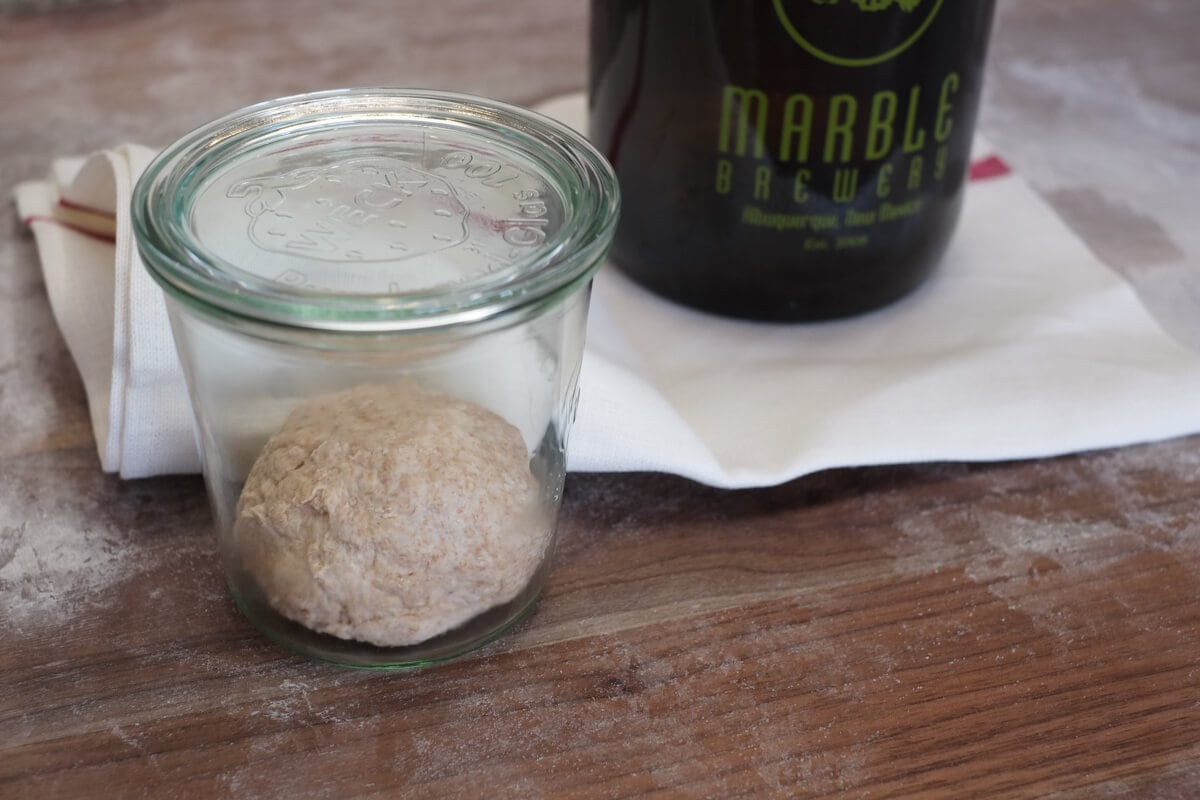
I use these .5 L Weck jars with tapered top to store my starter, they are perfect for stirring and watching your starter rise & fall.
My starter jar isn’t always that clean, but having a stiff starter means no soupy mess!
This is really amazing. I was hoping if you were able to give me some advice.
I’ve been following the Tartine Recipe at 75% hydration with a ratio of 9:1 white and rye flour. My starter is strong and rises and falls as you outlined. My bulk rise time is 4 hours (6 turns, 4 in the first two hours).
I’ve not been able to get the same oven spring, and so I’ve found that my loaves look awfully flat and short as opposed to tall and dome-shaped like yours. The crumb however is open and gelatinised. Scoring the loaves has been hard since the dough tend to sticks to my lame causing drag, and hence has not developed ‘ears’ and opened up in quite the same way as yours. Shaping is hard as well because of the stickiness.
Any advice? Drop to a lower hydration level, turn more in the bulk rise stage? Thanks for your help!
Thanks for the comments!
I’d say try reducing hydration to 67% or 70% and see if that helps with shaping. You really want to concentrate when shaping to get a nice taut skin on the outside before you place into your proofing baskets. This taut skin will help your dough rise high in the oven and will also make scoring a lot more manageable. The more you handle your dough, though, the more gasses you knock out — a balancing act between achieving a strong outer skin in as few movements as possible.
Because you have a nice open crumb I wouldn’t say you’d need to do any further turns, but that will have to come with some experimentation. If your dough is “strong” at the end of bulk and the pre-shape you should be good to go. I look for the dough holding its shape in the bulk container, defined smooth ridges on the dough, and a smoothness in general.
I hope that helps, let me know how it goes and if you have any more questions!
I wouldn’t say that an autolyse would fix the issue you’re having, but I do recommend around a 40 minute autolyse to increase extensibility (this does help rise but I’m not sure it’s related to your issue) and create some nice coloring on the crust.
I’d recommend lowering hydration and giving that a go!
Also… no Bourbon!?
I’m on the lookout for a solid bourbon to add to my collection there, it’s in the works 🙂
Have the same issue in my cold apartment. Sits around 72-73 ambient.
What’s the highest temp water you would mix in? That is, is there such a thing as killing the starter with too much heat?
My faucet gets to 130+, which seems way too hot….
Winter baking can be tough! I try not to go over 100ºF if possible but you definitely don’t want to get to 130ºF as that is the death point for yeast.
Thanks! You can start a rye starter very easily, just take some of your mature starter at your next feeding that you’d normally discard and set aside to feed with 100% rye flour or a mixture of white/rye. That will start up with no problems.
I’ve read the Pineapple article a long time ago and it definitely makes sense (high acidity, etc.), but honestly you don’t really need to use anything but flour and water to get a culture starter. Now that you mention it though it’s worth a re-read for me!
Hamelman’s Bread is my most trusted authority on sourdough and I just knew someone was going to ask why it’s not in my bookshelf there. Well the simple reason is that it’s always sitting here next to me on my desk! I reference it quite a bit and so I need it always within reach.
Tartine 3 is a great book but I’d say it’s a more “advanced” look at baking. Aside from the complexity going up just a bit it is a wonderful look at baking with whole grains and ancient grains. If that interests you I’d highly recommend it.
Josey Baker’s book is a great baking book geared more for the beginner, it would make a great gift for someone who is just starting out. He has some really interesting recipes in there (including his rye bread which I’ve made a few times now) but if you’re a more experienced baker it would only make sense to pick it up if you’re interested in the recipes.
Hi Maurizio,
Congrats on all your bakes, they look fantastic!
For the pineapple juice solution, I found this website once that showed a side-by-side: http://yumarama.com/968/starter-from-scratch-intro/
I did both ways myself, and really, it’s just a difference of a few days, the end result will be the same.
David — thank you, I appreciate that. Thanks also for the link to the pineapple solution, it definitely look interesting. For me, my rye approach is the most straightforward, and like you said, they both end up with the same result. I’ve recreated starters many, many times over the years with just rye flour and it is very reliable. I think most people have issues when they are using simply white flour, or white flour that has a very high protein amount. Thanks again for sharing!
Thanks to you Maurizio, you’re the one doing all the hard work and sharing it with us, it’s really appreciated. I have just received my order of rye flour and will definitely try your way for the starter (although I wonder about something: you say in your post that the composition of the feedings should always be the same, as the starter gets used to it and therefore gets stronger. However, at the most important stage (making bread), we are feeding it with a total different mix (for the rustique, it’s 90% white, 10% whole). Sorry just wondering out loud!)
Lately I have been doing the high-extraction miche (Poilane) of Peter Reinhart’s “whole grain breads”, have you tried it? It’s basically doing a long (12h) autolyse with some of the flour & water (and a bit of salt to slow the bacterial growth), and separately the levain, then mixing them the next day. I increased a bit the hydration and added your “slap-and-fold at the beginning” idea (and no turns afterwards), and the result was amazing.
So thanks for this idea 🙂
You’re very welcome, it’s why I created the site! I was completely lost when I started baking so I thought I’d share what I’ve learned over the years.
That is a very good point about the starter and flour usage. Using rye and whole wheat due spur high activity due to the increased nutrition in these flours, and I think it helps to build up a large yeast/bacteria population in your starter through successive feedings — and keep that population around until you bake. It could be argued whether we “lose” some of that potency when we switch flours abruptly to make a levain, but I’d say having that potent starter built up can only be beneficial. Just my two cents! I’ll have to do a bit more research on this, if it exists.
I haven’t tried Reinhart’s recipes at all, although I do have his book in my cart for purchase. When I bake whole wheat I will typically do a really long autolyse to increase extensibility in the dough but I have not yet tried using slap and fold — that will have to happen this week! Thanks for the reminder.
Thanks for the comments and questions & happy baking!