

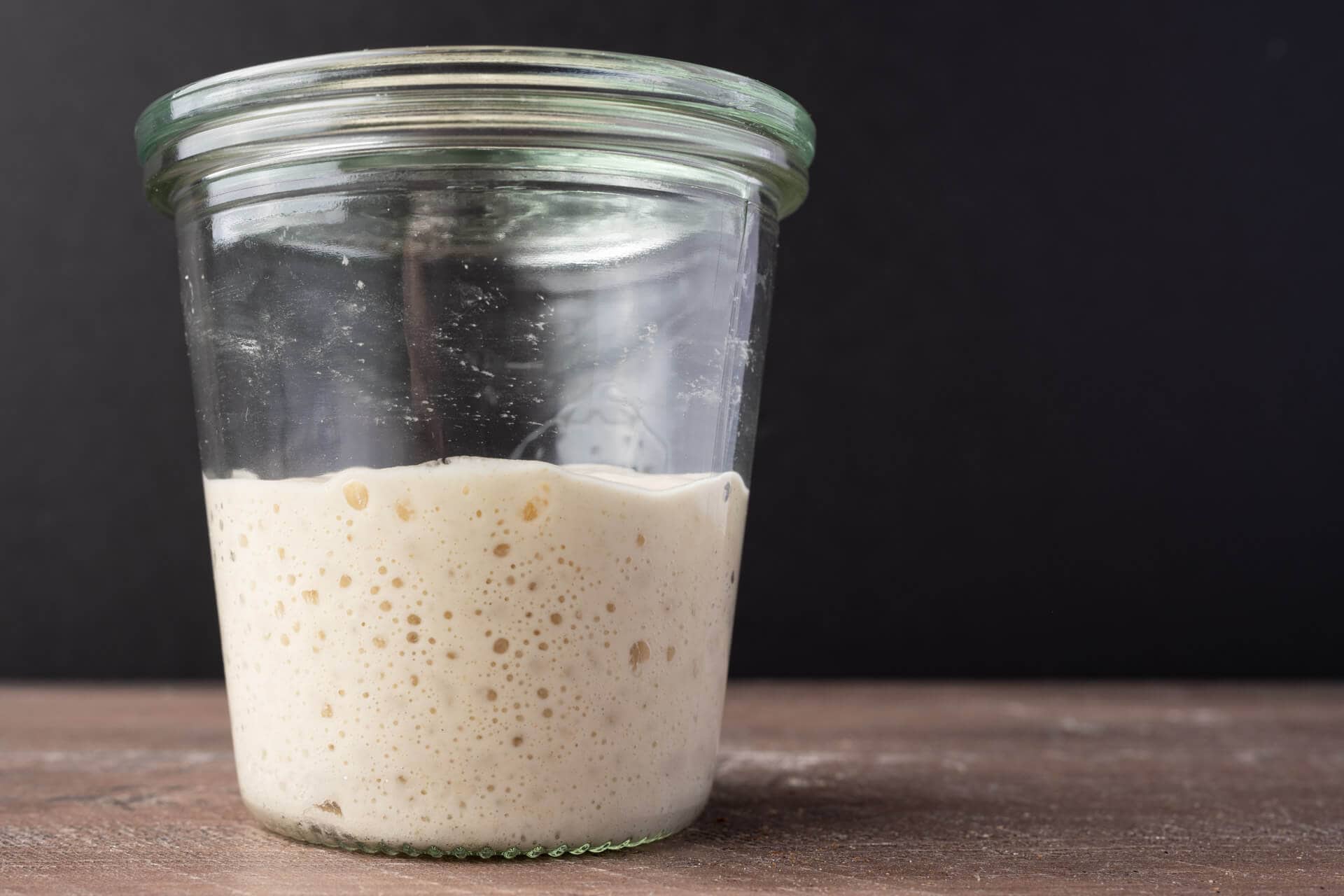
I’ve maintained the same sourdough starter for years, refreshing it with 20g ripe starter, 100g flour (usually a mix of 50% white flour and 50% whole rye or 50% freshly milled whole wheat), and 100g water (the amount of ripe starter carried over may fluctuate based on the season) twice a day, every day.
While this maintenance routine means I have a strong and lively starter with enough to fuel my larger bakes here at home, keeping a smaller sourdough starter to reduce waste can make sense for those baking in smaller quantities or during times of conservation. This smaller sourdough starter doesn’t imply it’s any less vigorous or powerful; it’s scaled down and uses only one flour variety: all-purpose white flour.
Before we begin, I’m assuming you already have a strong sourdough starter that’s ripening properly each day. If you don’t have one, head over to my guide to creating a sourdough starter from scratch to get this going first.
This post is full of sourdough starter maintenance advice and I try to keep it practical and approachable. If you need more help with creating, maintaining, or you find yourself scratching your head, my sourdough starter frequently asked questions post is replete with information. Or, check out my list of the top 21 sourdough starter problems (with solutions).
Let’s first look at what container I like to use to keep this mini-starter alive and healthy.
The best jar to hold a sourdough starter
Finding the right container to hold this small starter had me turn to my favorite jar: Weck. If you’re a regular reader here, you’ll find them scattered on just about every page, and for good reason. They make jars of all sizes and even some much smaller than the 1/2 liter or 3/4 liter I use for my usual starter.
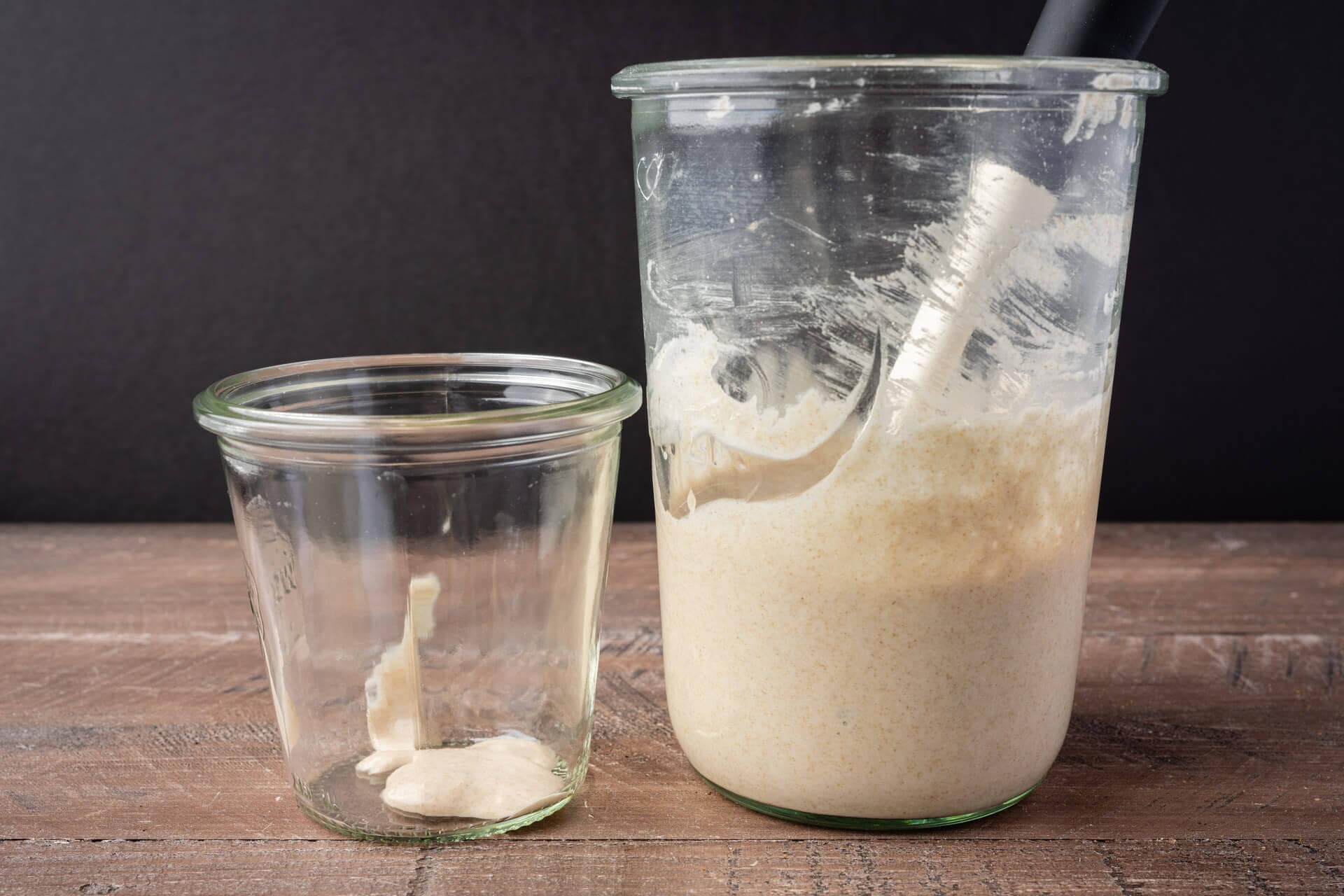
The Weck 900 Tall Mold Jar – 1/5 Liter jars are perfect for holding this small starter. You can see above how much smaller these jars are smaller than my usual 3/4 liter jars holding my bigger sourdough starter. Inside the jar on the left, you’ll see the small amount of ripe starter I use to keep my culture going—just 5g (more on this below).
I like these jars because they have relatively straight sides, few nooks and crannies for the dough to get stuck into, and the glass lid can rest lightly on top without sealing clamps. Resting the lid in this way lets any gasses escape but keeps unwanted air and other debris from falling inside the jar. Additionally, they’re incredibly strong and easy to clean in the dishwasher.
Read more about why I think Weck jars are the best jars for a sourdough starter →
Smaller Sourdough Starter Refreshment Recipe
I’ve been testing various quantities for this for a while, and the following smaller sourdough starter has been my preferred ratio of ingredients. To scale down your current starter find a small vessel and add the following to it:
| Weight | Ingredient | Baker’s Percentage |
|---|---|---|
| 5g | Ripe sourdough starter | 20% |
| 25g | Water | 100% |
| 25g | All-purpose white flour | 100% |
I keep this smaller starter on my counter at room temperature, around 70-72°F (21-22°C), and it ripens—meaning, it needs another refreshment of fresh flour and water—in about 12 hours.
Smaller Sourdough Starter Ripening
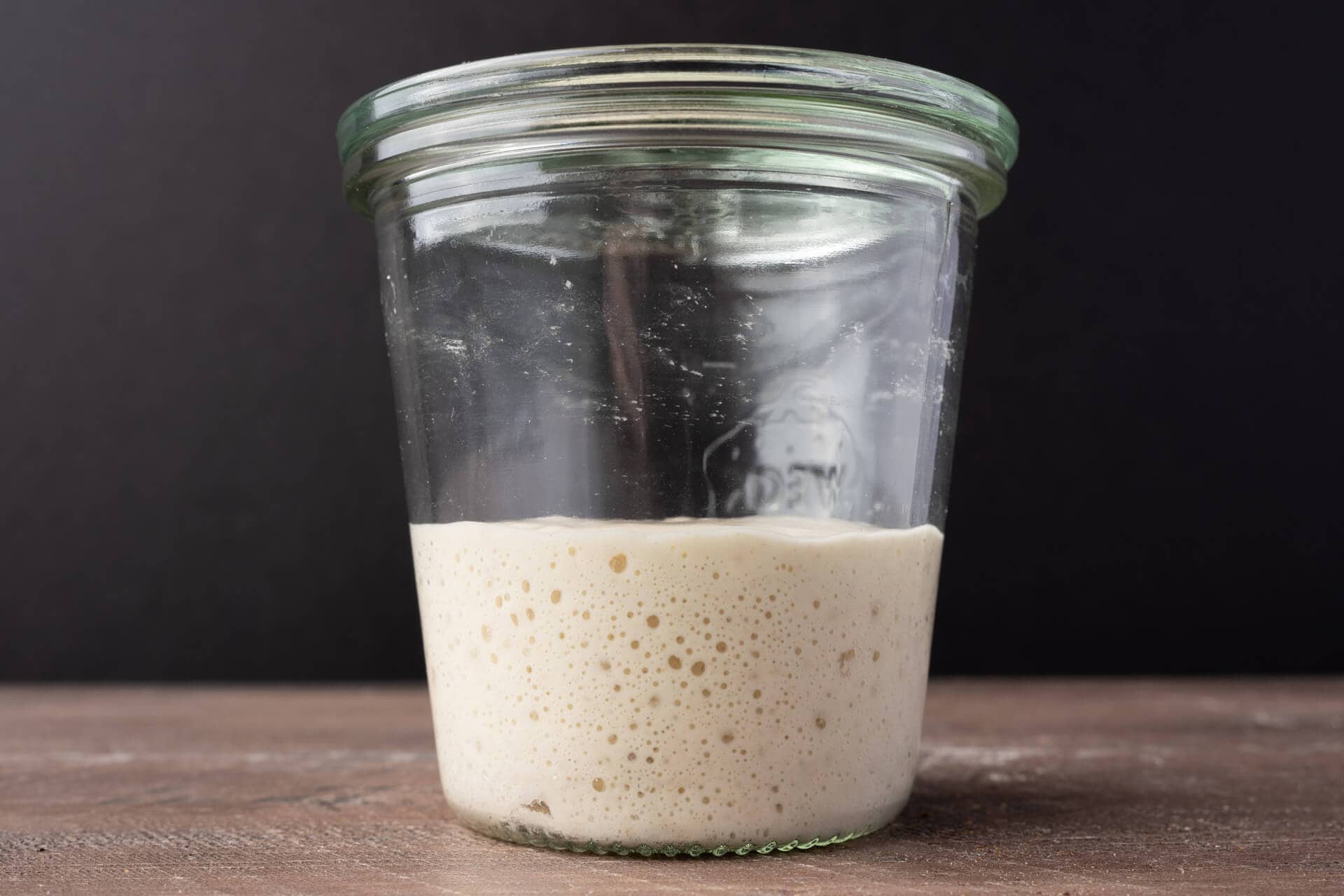
The following images show the progress of my smaller sourdough starter over the course of 12 hours (my normal refreshment interval) at about 72°F (22°C). Click on the gallery to see larger images.
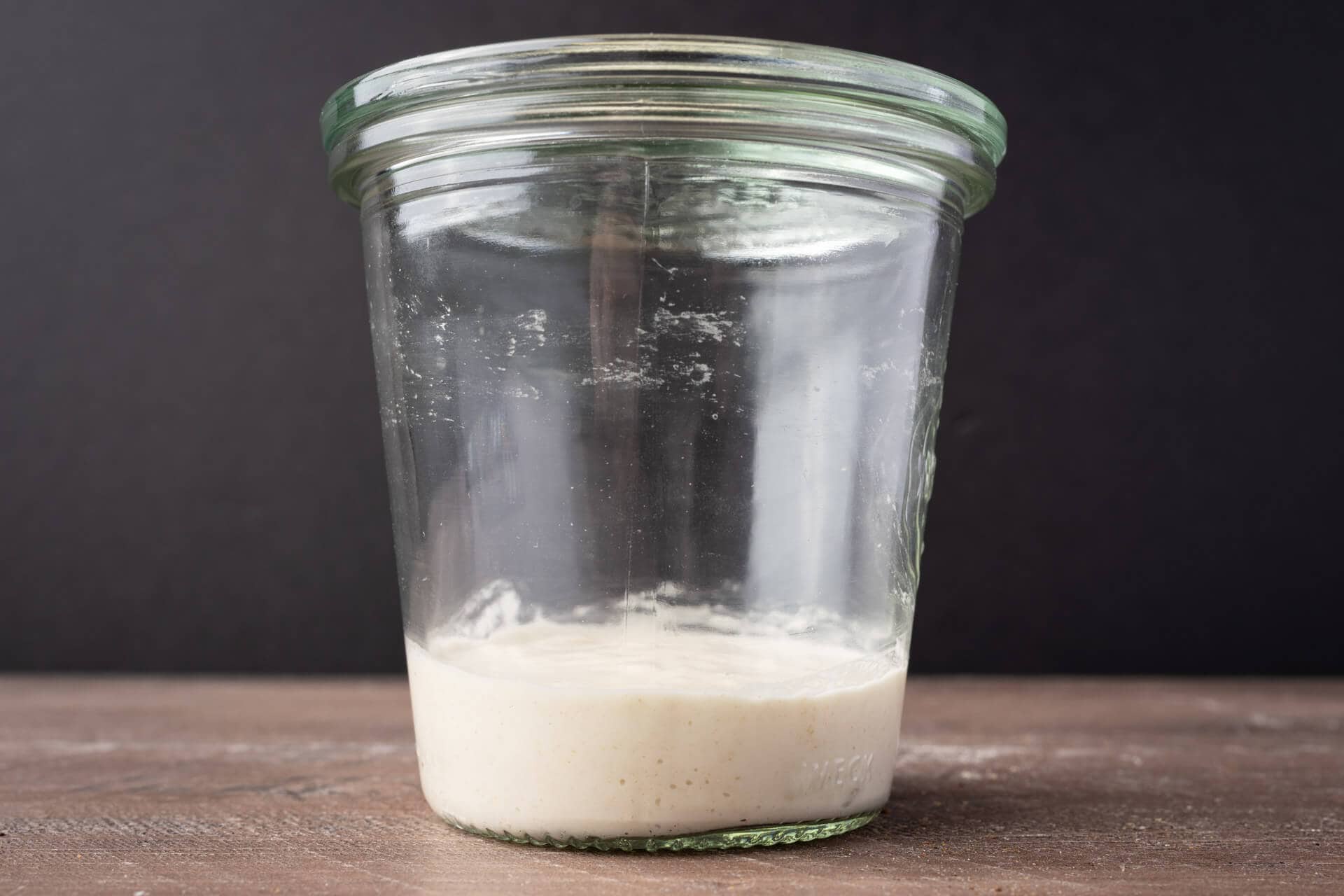
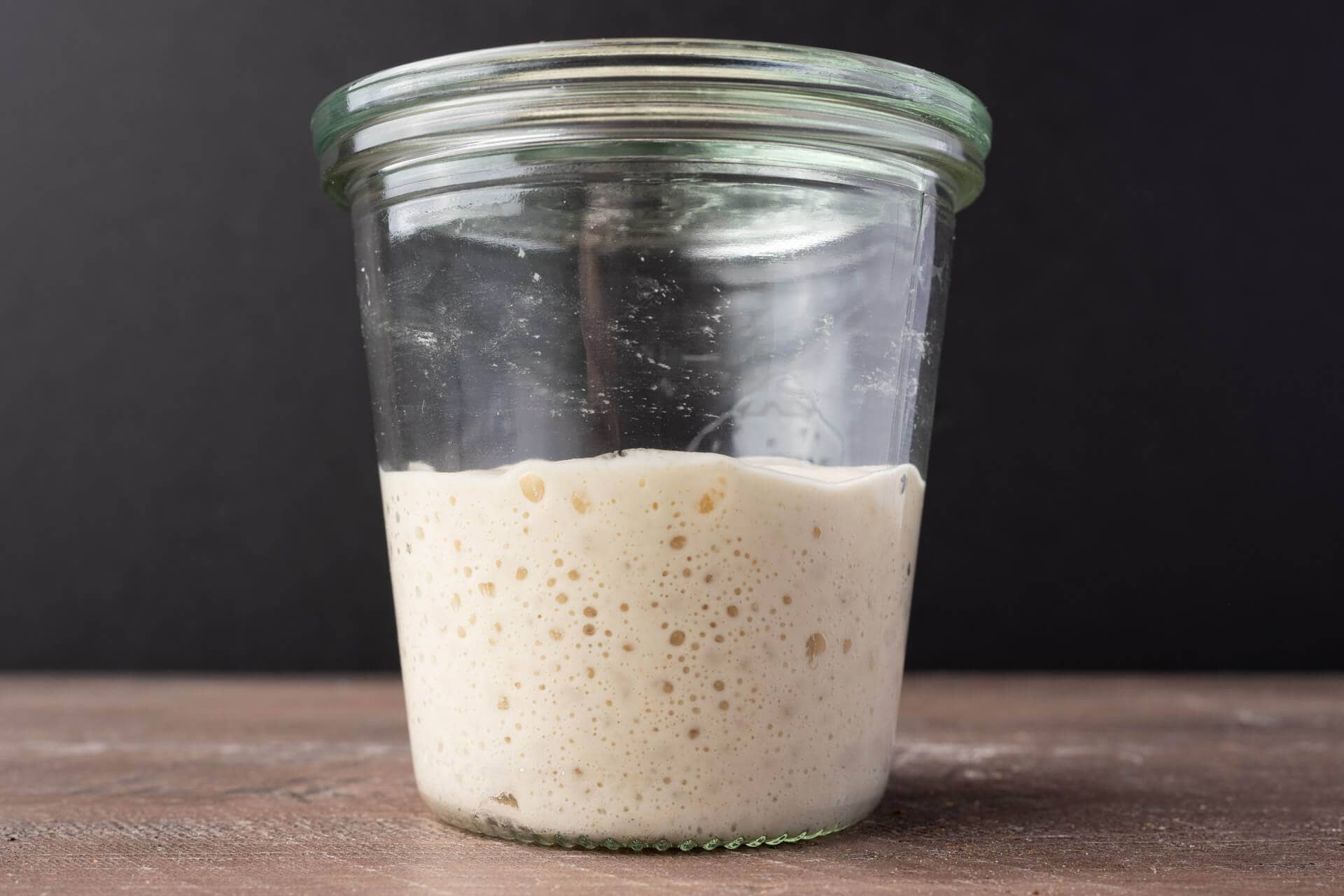
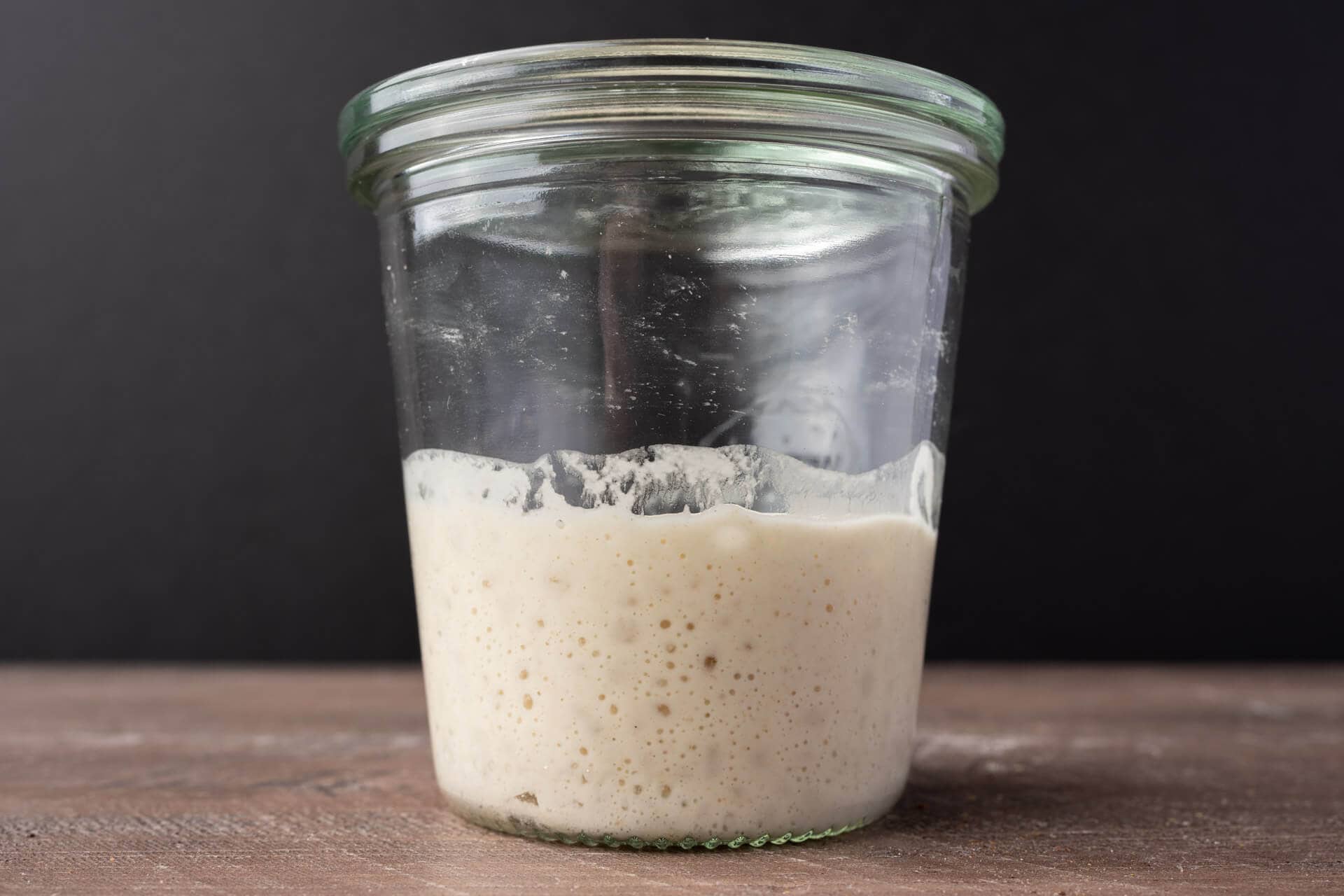
Beginning: At the far left you see the beginning 5g of ripe starter, 25g flour, and 25g water mixed together—there’s not a lot in the jar! But as you see it progress through the day there’s plenty of activity with sensorial cues for when it’s ready to be used and when it needs a refreshment.
Just Before Peak Ripeness: In the third image from the left my starter is at, or very close to, its peak readiness. This was taken around 10 hours after feeding. This peak is when the starter has ample yeast and bacteria growth and is my preferred time to use some of the starter to create a levain or mix it straight into a dough (like focaccia).
Ready for Refreshment: In the last image, the starter has begun to smell very sour, has a very loose consistency, and has started to breakdown further. If you were to stir it, you’d feel the loose consistency and see signs of significant aeration. If you still wanted to bake with your starter at this point it’s still very possible, but know your result might be a bit more on the sour side, and you might see increased fermentation activity.
Be flexible: adjust the amount of ripe starter carried over to lengthen or shorten the refreshment interval (time between refreshments).
The time it takes for your starter to go from just-refreshed to very ripe will vary with the flour used, temperature, and other conditions—adjust as necessary. If it’s ripening too fast, reduce the 5g left in the jar to even less. Conversely, if it’s taking much longer than 12 hours, leave more than 5g until it ripens right when you want it.
Stretching the Refreshment Interval Even Longer
Reducing a starter down quite low helps conserve flour and reduce waste, but using 100% all-purpose flour also helps reduce activity and keep that lengthy interval. If you’re looking to stretch things even farther, reduce the amount of ripe starter left in the jar at each refreshment, all the way down to 1-2g if necessary. If you find your starter is still ripening too fast, keep it in a cooler spot in your kitchen to reduce activity further.
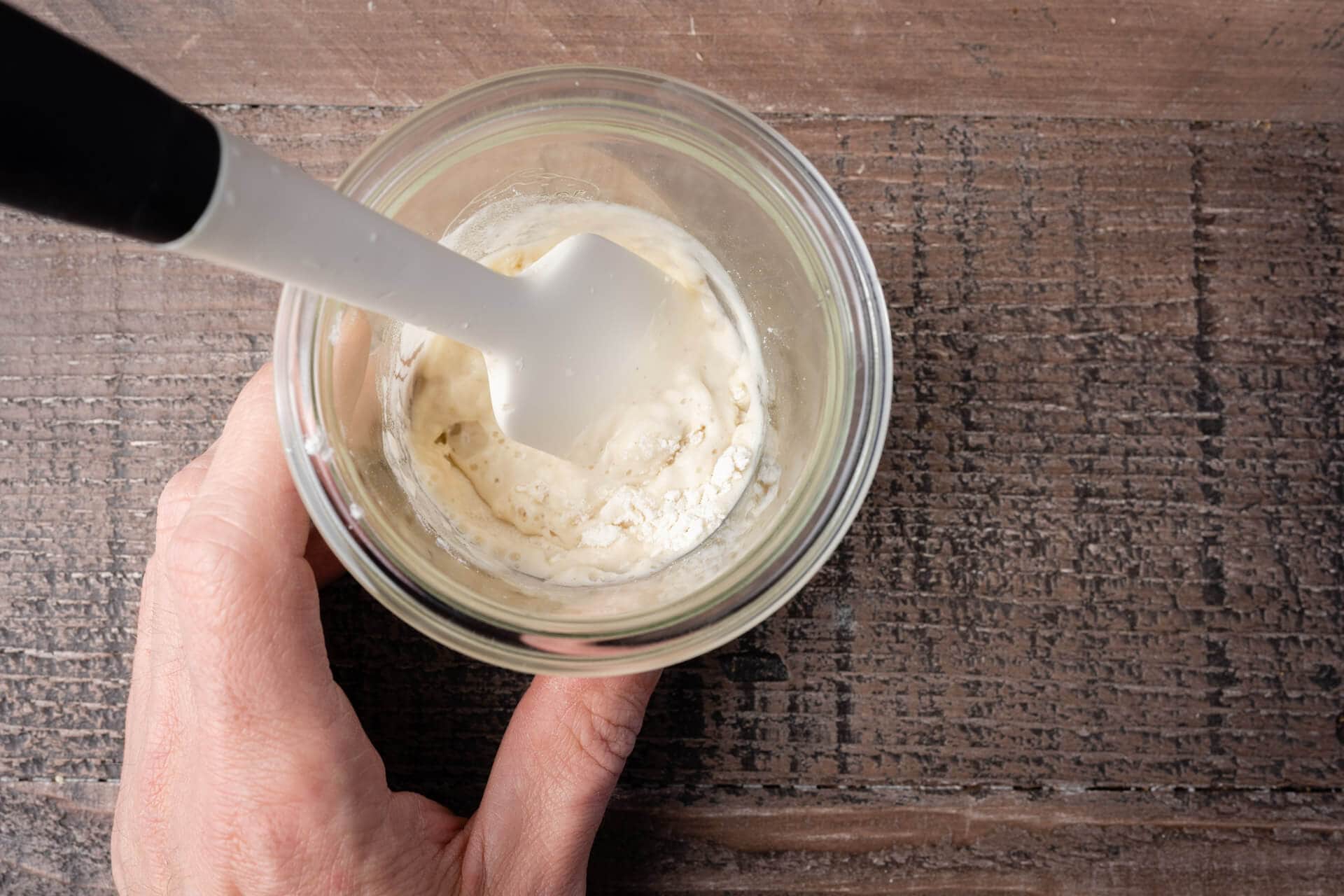
Scaling up: Preparing for Baking
Due to the small quantity of this starter, if the recipe you’re going to bake requires more starter to create a levain or mix directly into a dough, you’ll have to scale up your starter to cover the requirement. Many of the recipes here at my site require very little starter because I typically create a levain (which essentially scales up the pre-ferment, see more on what a levain is here). But in the case where you need a large pre-ferment, let’s look at an example to see how this is done.
Let’s say you wanted to make my sourdough fougasse, which calls for 173g of ripe sourdough starter. When your smaller sourdough starter is ripe it will produce about 55g of starter. You need to scale up your starter at the next refreshment to cover, let’s say, 190g (this way you have a little leftover starter to keep in the jar to keep your culture going with a little buffer).
Add the following to your starter jar (making sure it will hold 190g without overflowing!):
| Weight | Ingredient | Baker’s Percentage |
|---|---|---|
| 17g | Ripe sourdough starter (carryover) | 20% |
| 85g | Water | 100% |
| 85g | All-purpose white flour | 100% |
The above will yield around 187g of ripe starter after 12 hours kept at room temperature.
The key is to keep the same ratio of ingredients in baker’s percentages: 20% starter, 100% water, and as always, 100% flour. In this way, you should expect the same level of activity, time to ripe, and signs for when it’s ready (assuming you’re using the same flour and it’s kept at the same temperature as before), all the while attempting to keep the same balance of bacteria and wild yeast.
Why Not Use the Refrigerator?
A refrigerator is a great tool for slowing your starter’s activity, and it’s sometimes an approach I’ll take for a week or less, but I don’t like to keep my starter in the fridge longer than a week if I’m not traveling. When I take my starter out of the fridge, it takes a day or two to get back up to full strength, and generally, the health of my starter starts to suffer if left unattended for more than a week.
The benefit of maintaining a smaller sourdough starter is the discard at each refreshment is minimal, and my starter is ready—and at full strength—to make bread every day.
When I turn to the fridge, I use my weekend baking schedule to keep feedings to a minimum during the week, but then take it out a few days before baking to ramp it back up and prepare for baking.
The benefit of maintaining a smaller sourdough starter is the discard at each refreshment is minimal, and my starter is ready—and at full strength—to make bread every day.
Why Maintain a Larger Starter?
So with all this, why would one ever maintain a larger sourdough starter instead of just keeping a smaller one to reduce waste?
Over the years, I’ve found keeping around 200g of starter ready to go at any time ideal for the amount of baking I do here at home. In addition, I regularly make sourdough pancakes, sourdough waffles (see the next section), and even a sourdough galette from time-to-time. Having that excess starter almost always gets used in some way, and if it doesn’t directly go into a baked good, the excess sourdough starter goes in my compost pile.
My typical feeding schedule means my starter is at full power and ready to go when I need it for the amount of baking I typically do—but sometimes scaling things back to “maintenance mode” is the right option to ensure I can still bake but in a reduced capacity.
What to do With Starter Discard?

Maintaining this small sourdough starter means much less discard than maintaining a larger starter, but there will always be some discard. One approach is to save up all this discard in one container in the fridge in what I like to call a sourdough starter cache. Then, use all this at once in a starter discard recipe or my sourdough waffles, pancakes, or banana bread at the end of the week.
What’s Next?
If you haven’t tried my simple weekday sourdough bread that’s the next place to turn; with this starter, you can make two loaves of sourdough during the busy work week without having to scale up the starter refreshments. This smaller sourdough starter maintenance routine and that weekday recipe are an effective team: minimal waste, minimal fuss, and healthy sourdough bread any day of the week.
Happy baking!
If you try this smaller sourdough starter, I’d love to see how you use it! Tag @maurizio on Instagram and hashtag your photo #theperfectloaf so I can take a look.


189 Comments
I would like to be able to feed my starter once a day for less discard and less flour usage. Should I bump it up to twice a day a day or two before planning to bake? Thanks so much!
I bake once a week so I keep the starter in the fridge until Thursday after work, let it warm up then feed at night and Friday morning. Friday night levain for Saturday making, Sunday baking. My question is, after refreshing my starter, at what point do I put it back in the fridge for the next week? Right after feeding? After it has matured a little? After it’s matured a lot?
I am retired and it is just my husband and myself home. I love sourdough bread and am just going to start making it myself. I have read this starter a few times now and wondering if I could cut the amounts in half and follow your same directions as above as I only need a couple of loaves per week and can make other recipes with the discard and have it turn out correctly.
I am in a similar situation and find that maintaining a smaller starter works well. I refresh it daily and when I don't have time, I put it in the refridgerator. I just need to remember to bring it out a few hours before feeding it again.
I just got a Sourdough Starter from King Arthur Flour and started feeding it using this (small batch) starter method. I am feeding all-purpose flour it every 12 hours.. By any chance, do you have a clue how long I should feeding the starter to make it strong enough so I can start baking with it? After 12 hours of sitting on the room temperature, my starter rises to about twice the volume but not much bubbles like the photos of your starter. There are many bubbles on top but very little on the side… Thanks!
Could you feed the 20G starter (or the smaller 5 G starter) once a day rather than twice?
Yes, as long as it's not too warm in your kitchen. The colder the better (or use cooler water when feeding).
I live in a country where the kitchen is typically very warm (25-27 degrees) and doesn't cool down too much in the evening. What suggestions do you have for maintaining a small starter?
I have a question about the instructions for feeding frequency in your "The Perfect Loaf Sourdough Starter and Levain Quicksheet":
The feeding instruction for a stiff starter is to feed it once daily. However in the starter description, a starter is ripe in 10 to 14 hours, and overripe at 24 hours. I understand I would want to use the starter when it is ripe, but would I not want to feed it at ripeness (twice a day), rather than letting it get overripe before being fed? Or is feeding a stiff starter when it is "overripe" okay for keeping it strong?
You always want to feed and use your starter when it's ripe. There's no exact moment, but the times and schedules I have in the sheet are my go-to trusted routines there.
A stiff starter is a little more resilient and can handle being overripe for longer, in my experience.
I hope that answers your Qs, let me know if something is still unclear!
Hi Maurizio, newbie here 👋! I am super excited to bake my first loaf, but I am confused about one thing, when it says to "maintain" a certain amount of starter, that means the amount of starter you have AFTER feeding, right? So if I wanted to maintain 100 grams of starter, I would discard until I only have 20 grams of starter left, then add 40 grams of flour and 40 grams of water daily, right? I'm sorry if that question makes no sense or if the answer is incredibly obvious 😅. Thanks!
Yup, you got it right there Natalie!
I’m so confused! What to do if the recipe calls for a 1:1:1 starter?! Can I keep a small starter 1:1:1 or is the levain process where you make your 1:1:1 starter for the recipe. Yes I am a newbie.
I would not keep a 1:1:1 starter, it would ripen very quickly each day (around 3-4 hours!). I would make a 1:1:1 levain just to bake with that day, and use my ratios above to keep a more mild starter.
here's more info about starter vs levain and how to make one:
https://www.theperfectloaf.com/what-is-a-levain-and-how-is-it-different-from-a-starter/
Hi Maurizio, I’m trying your small starter and I like to keep mine in the fridge because I don’t bake every week. With my previous larger starter I refreshed once per week. Should I do the same with the smaller starter as I see you say below the starter can be left in the fridge for up to 3 weeks. Do you leave it without refreshing?
Loving your site and all the incredible info! Thanks!
Before placing my starter in the fridge:
Using a ripe starter, discard down to 20g
Refresh the starter with the ingredients listed in the table below
Let sit on the counter for 30 minutes to 1 hour
Place in fridge for up to 3 weeks
Yup you can do up to 2-3 weeks in the fridge. If doing so, I would add a little more flour, though. I see it as giving the starter a “runway” to ferment before it runs out of food.
Hope that helps!
Hi Maurizio,
I created a full size starter using your original recipe, then scaled it down to this size outlined in this recipe . However I’ve noticed since then my starter does not seem to rise as or bubble as much despite the same environment . Perhaps it’s possibly my original starter wasn’t as mature as I thought. Will a starter of this size eventually able to get more mature or is it better to upsize back? Thank you !
It should be just fine at this size…
I love my tiny weck jar also for this purpose ( best preserving jars too) and when refreshing and stir the starter I use a wet chopstick- no waste, minimal cleaning. and KN ( below)- if planning to use starter after it’s been stored for a long time, I like to give it min 2 or max 3 quick refreshes to get it really happening. Use small amount of starter to larger proportion of flour, and I like to include about 1/5ths whole rye flour in the refresher flour as well.
Those jars are fantastic, Amanda! I use them often, too (as you can see in this post :)).
Hi! First time baker here and finally got a sourdough starter that will rise and fall consistently thanks to your guides!
– Is it possible to keep this smaller sourdough in the fridge to extend the refresh time as well?
Hey there! Yes, it can work, but I prefer giving it a room-temp feeding at least every two weeks or so.
I am a little confused about the ratio of starter to feeds, for the amount of time needed to make a mature starter. Here you mention that with a ratio of 1:5:5 the starter is ready for the next feed in 12 hours. However when you make a levain over 12 hrs, you use a ratio of 1:10:10 for the levain to be mixed in the dough 12 hrs later. What ratio should I use, if I want the starter/levain to be ripe for making the dough?
It also depends on the flour you’re using and the temperature it’s kept at… Good Q! I use 1:5:5 here to ensure the starter is plenty ripe by morning time.
I apologize if someone has already asked this, but is it best to use organic flours to feed your starter or does it matter? Also, do you feel that using different types of flour to feed negatively affects its strength? I generally use organic bread & rye or build a 100% organic rye. Btw, I had great results with your stiff starter bread recipe. Thanks, Maurizio, for your time and sharing your knowledge.
It doesn’t have to be organic, no. You can really use any flour you’d like! (Sorry for the late reply 🙂)
I never have discard. I keep 40-50g in a Bonne Maman jam jar in the fridge. The day before I bake I take the starter out of the fridge, add 55g flour and 55g water, stir it, and leave on the counter for 4-6 hours.
When the levain has doubled, I mix my dough (375g water, 10g salt, 100g levain, 500g flour). I let it rise with 4 folds at 30 minute intervals. After the last fold I let it rise in the bowl for 3-5 hours. Then I shape and put in a banneton in the fridge to rise overnight. The next morning I bake it at 450F in a Dutch oven, 20 minutes covered, 20 minutes uncovered.
After mixing the dough, I put the jam jar back in the fridge. Some of the levain sticks to the utensils so there is about 40g left in the jar for next time.
Thanks for the comments, Phillip! Really interesting process and it sounds like it’s working quite well for you. I’ve never been able to use my starter so close to taking it out of the fridge, but I do know other bakers who have. I always say, do what works for you (and your starter) 🙂 Happy baking!
Maurizio! You are awesome! Everything you share is detailed, well-explained, makes total sense! I just bought your book and it is, let me just say – NOT A DISAPPOINTMENT! Thank you for all things delicious bread.
Thanks so much Jay, I really appreciate that!!