

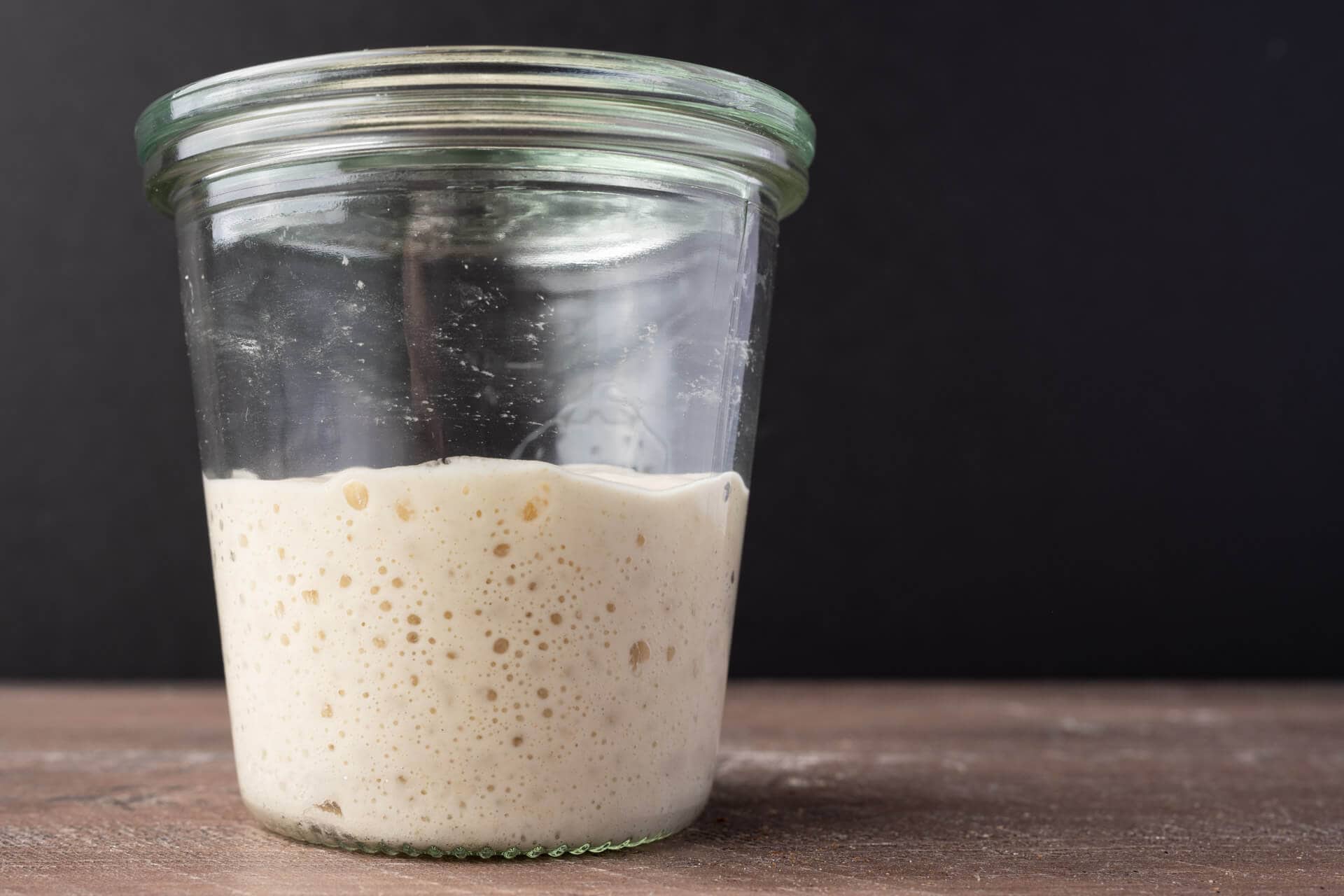
I’ve maintained the same sourdough starter for years, refreshing it with 20g ripe starter, 100g flour (usually a mix of 50% white flour and 50% whole rye or 50% freshly milled whole wheat), and 100g water (the amount of ripe starter carried over may fluctuate based on the season) twice a day, every day.
While this maintenance routine means I have a strong and lively starter with enough to fuel my larger bakes here at home, keeping a smaller sourdough starter to reduce waste can make sense for those baking in smaller quantities or during times of conservation. This smaller sourdough starter doesn’t imply it’s any less vigorous or powerful; it’s scaled down and uses only one flour variety: all-purpose white flour.
Before we begin, I’m assuming you already have a strong sourdough starter that’s ripening properly each day. If you don’t have one, head over to my guide to creating a sourdough starter from scratch to get this going first.
This post is full of sourdough starter maintenance advice and I try to keep it practical and approachable. If you need more help with creating, maintaining, or you find yourself scratching your head, my sourdough starter frequently asked questions post is replete with information. Or, check out my list of the top 21 sourdough starter problems (with solutions).
Let’s first look at what container I like to use to keep this mini-starter alive and healthy.
The best jar to hold a sourdough starter
Finding the right container to hold this small starter had me turn to my favorite jar: Weck. If you’re a regular reader here, you’ll find them scattered on just about every page, and for good reason. They make jars of all sizes and even some much smaller than the 1/2 liter or 3/4 liter I use for my usual starter.
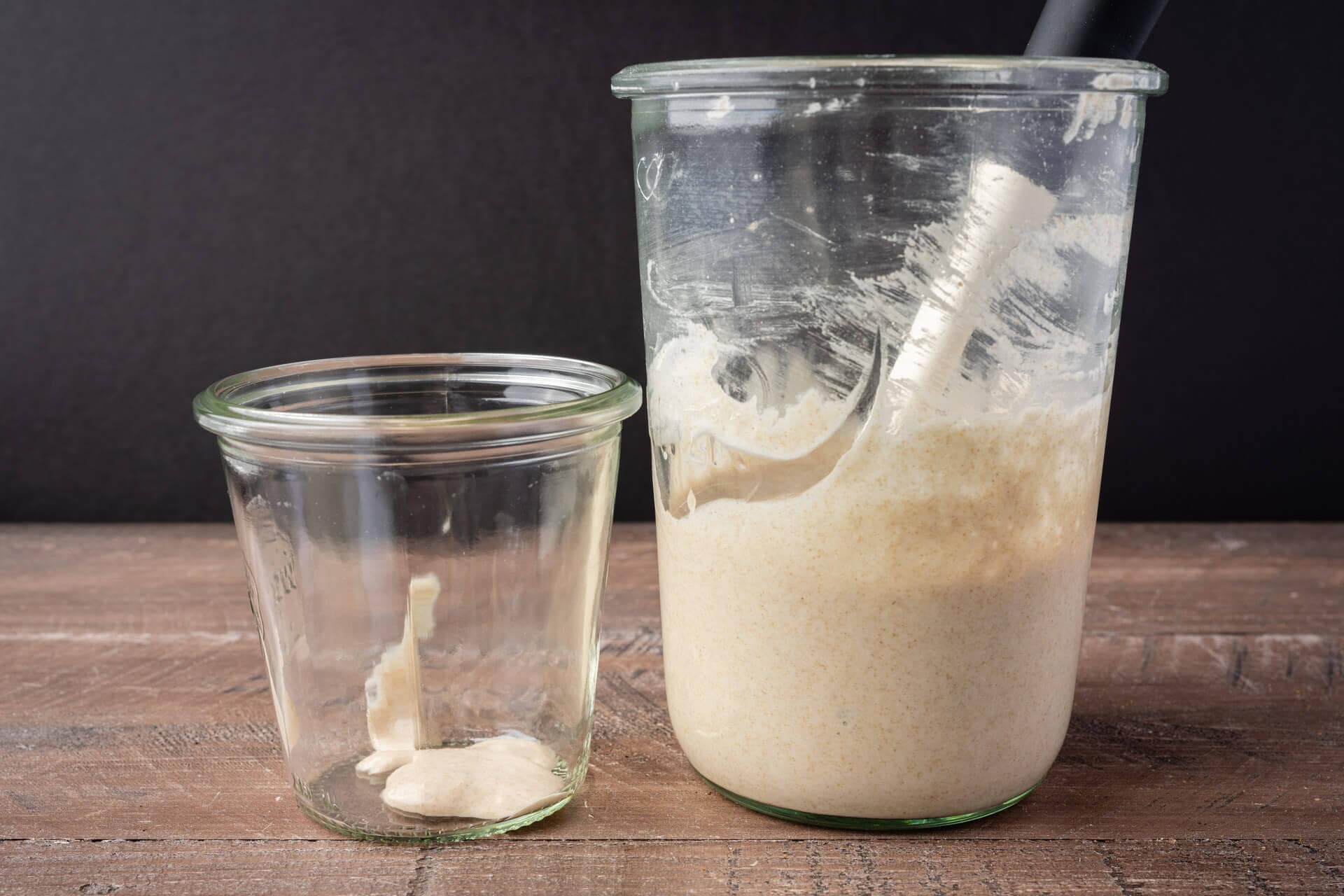
The Weck 900 Tall Mold Jar – 1/5 Liter jars are perfect for holding this small starter. You can see above how much smaller these jars are smaller than my usual 3/4 liter jars holding my bigger sourdough starter. Inside the jar on the left, you’ll see the small amount of ripe starter I use to keep my culture going—just 5g (more on this below).
I like these jars because they have relatively straight sides, few nooks and crannies for the dough to get stuck into, and the glass lid can rest lightly on top without sealing clamps. Resting the lid in this way lets any gasses escape but keeps unwanted air and other debris from falling inside the jar. Additionally, they’re incredibly strong and easy to clean in the dishwasher.
Read more about why I think Weck jars are the best jars for a sourdough starter →
Smaller Sourdough Starter Refreshment Recipe
I’ve been testing various quantities for this for a while, and the following smaller sourdough starter has been my preferred ratio of ingredients. To scale down your current starter find a small vessel and add the following to it:
| Weight | Ingredient | Baker’s Percentage |
|---|---|---|
| 5g | Ripe sourdough starter | 20% |
| 25g | Water | 100% |
| 25g | All-purpose white flour | 100% |
I keep this smaller starter on my counter at room temperature, around 70-72°F (21-22°C), and it ripens—meaning, it needs another refreshment of fresh flour and water—in about 12 hours.
Smaller Sourdough Starter Ripening
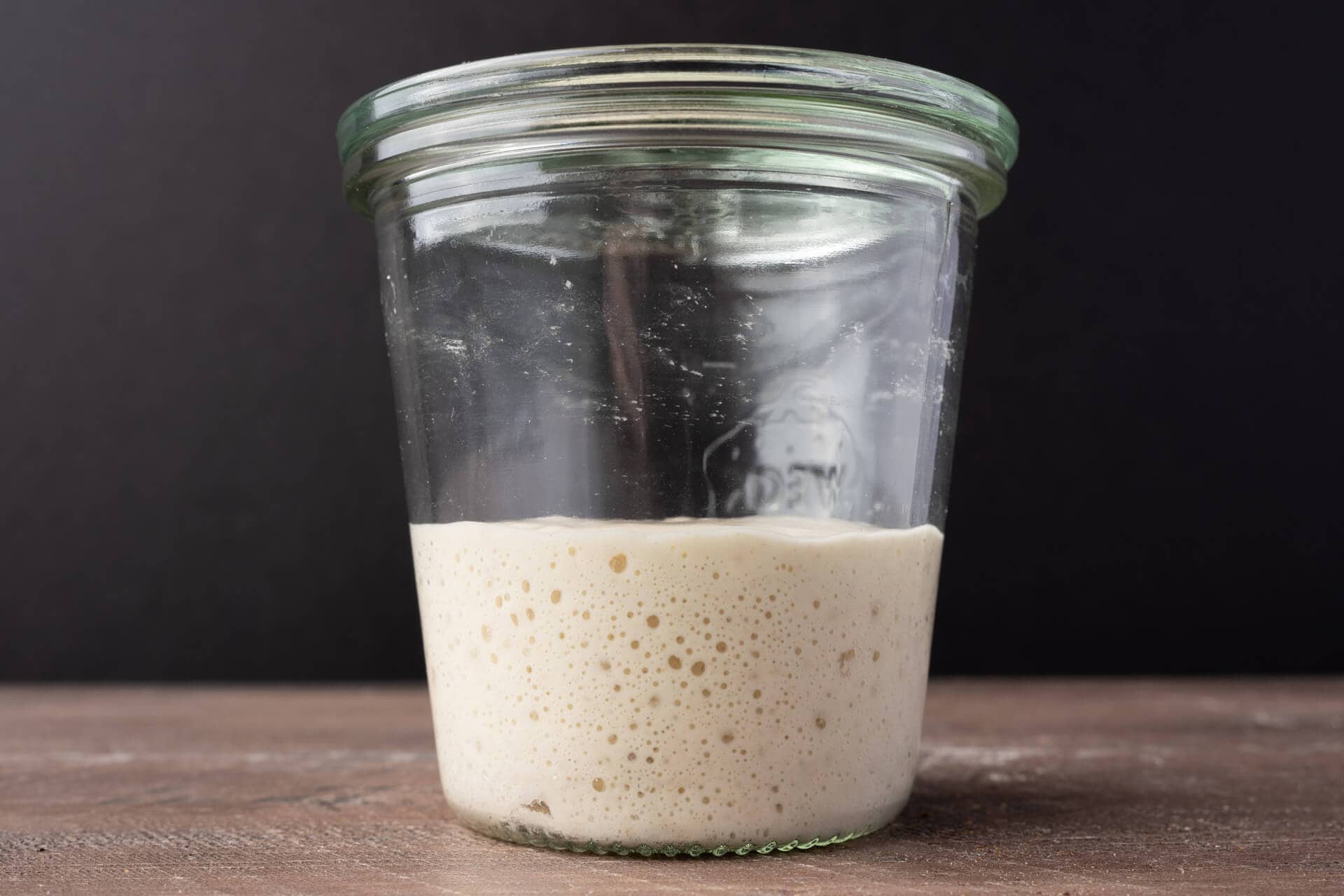
The following images show the progress of my smaller sourdough starter over the course of 12 hours (my normal refreshment interval) at about 72°F (22°C). Click on the gallery to see larger images.
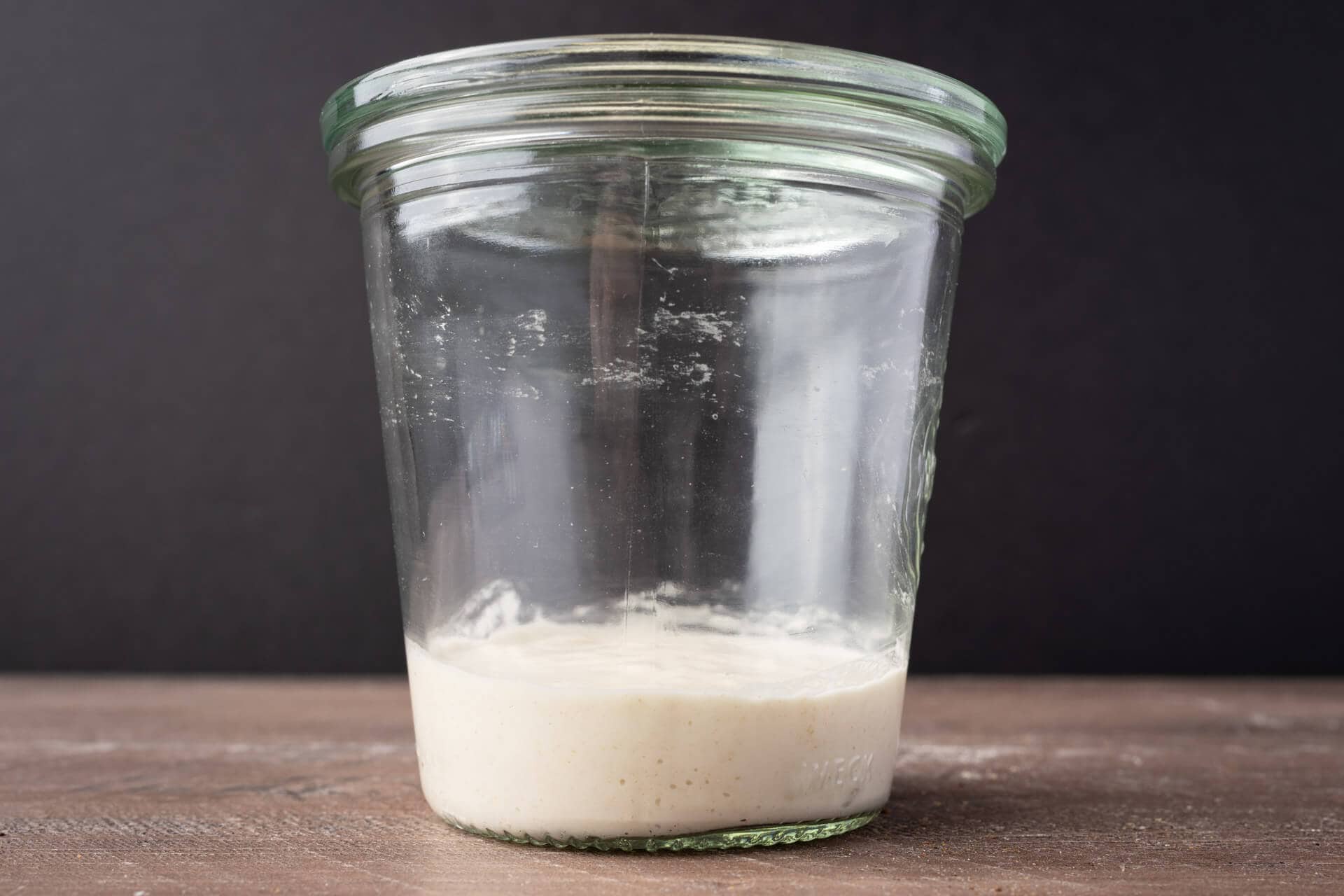
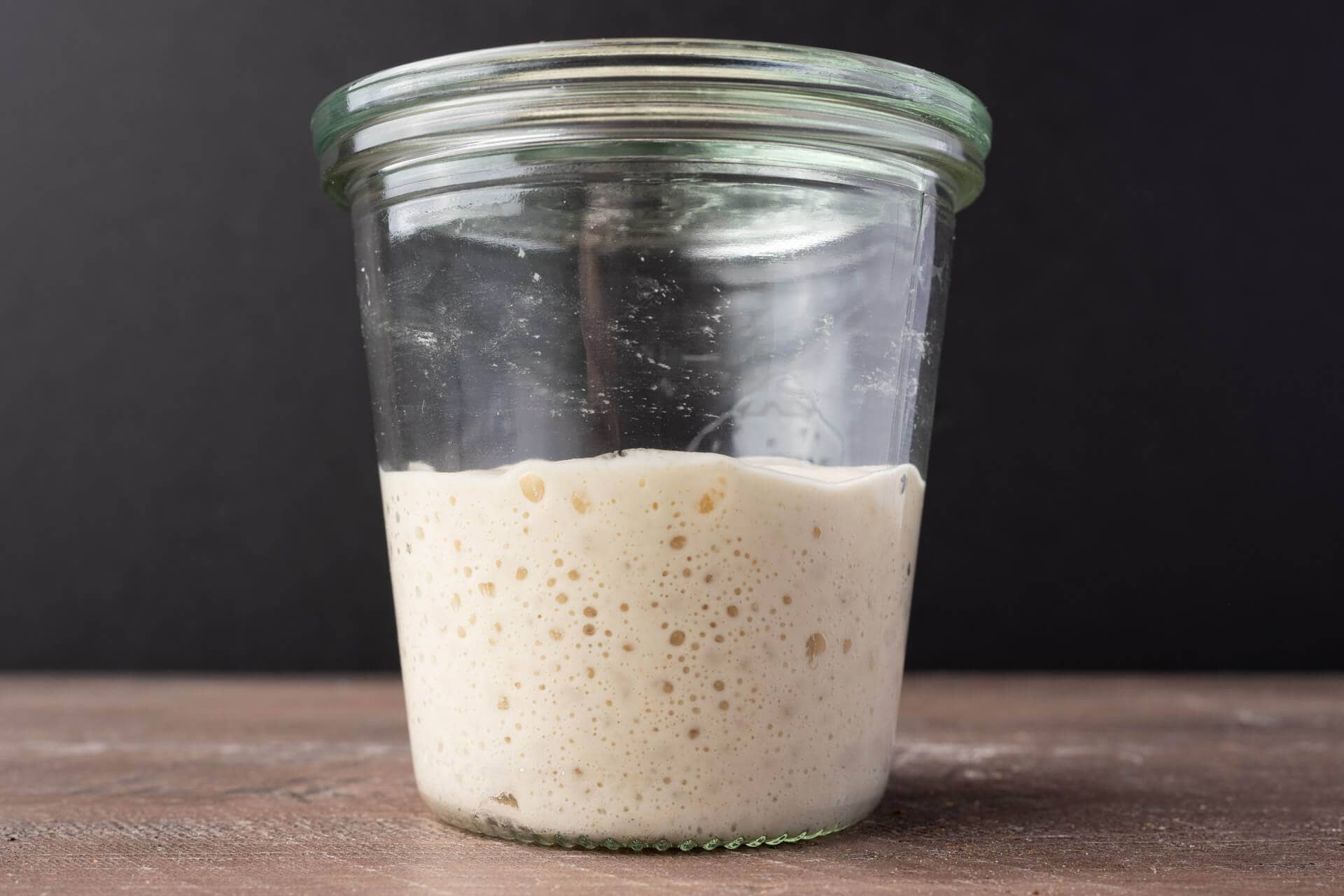
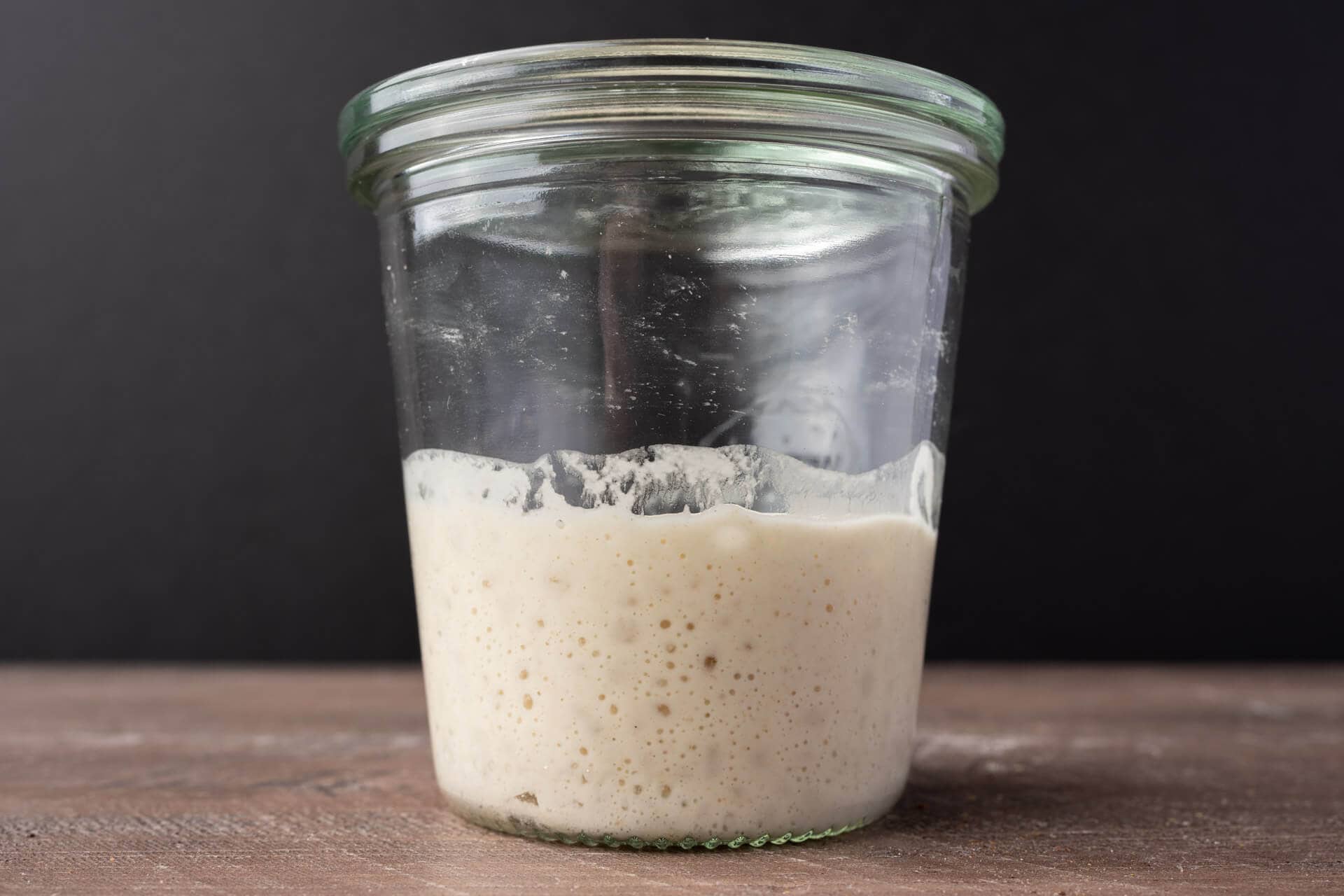
Beginning: At the far left you see the beginning 5g of ripe starter, 25g flour, and 25g water mixed together—there’s not a lot in the jar! But as you see it progress through the day there’s plenty of activity with sensorial cues for when it’s ready to be used and when it needs a refreshment.
Just Before Peak Ripeness: In the third image from the left my starter is at, or very close to, its peak readiness. This was taken around 10 hours after feeding. This peak is when the starter has ample yeast and bacteria growth and is my preferred time to use some of the starter to create a levain or mix it straight into a dough (like focaccia).
Ready for Refreshment: In the last image, the starter has begun to smell very sour, has a very loose consistency, and has started to breakdown further. If you were to stir it, you’d feel the loose consistency and see signs of significant aeration. If you still wanted to bake with your starter at this point it’s still very possible, but know your result might be a bit more on the sour side, and you might see increased fermentation activity.
Be flexible: adjust the amount of ripe starter carried over to lengthen or shorten the refreshment interval (time between refreshments).
The time it takes for your starter to go from just-refreshed to very ripe will vary with the flour used, temperature, and other conditions—adjust as necessary. If it’s ripening too fast, reduce the 5g left in the jar to even less. Conversely, if it’s taking much longer than 12 hours, leave more than 5g until it ripens right when you want it.
Stretching the Refreshment Interval Even Longer
Reducing a starter down quite low helps conserve flour and reduce waste, but using 100% all-purpose flour also helps reduce activity and keep that lengthy interval. If you’re looking to stretch things even farther, reduce the amount of ripe starter left in the jar at each refreshment, all the way down to 1-2g if necessary. If you find your starter is still ripening too fast, keep it in a cooler spot in your kitchen to reduce activity further.
Scaling up: Preparing for Baking
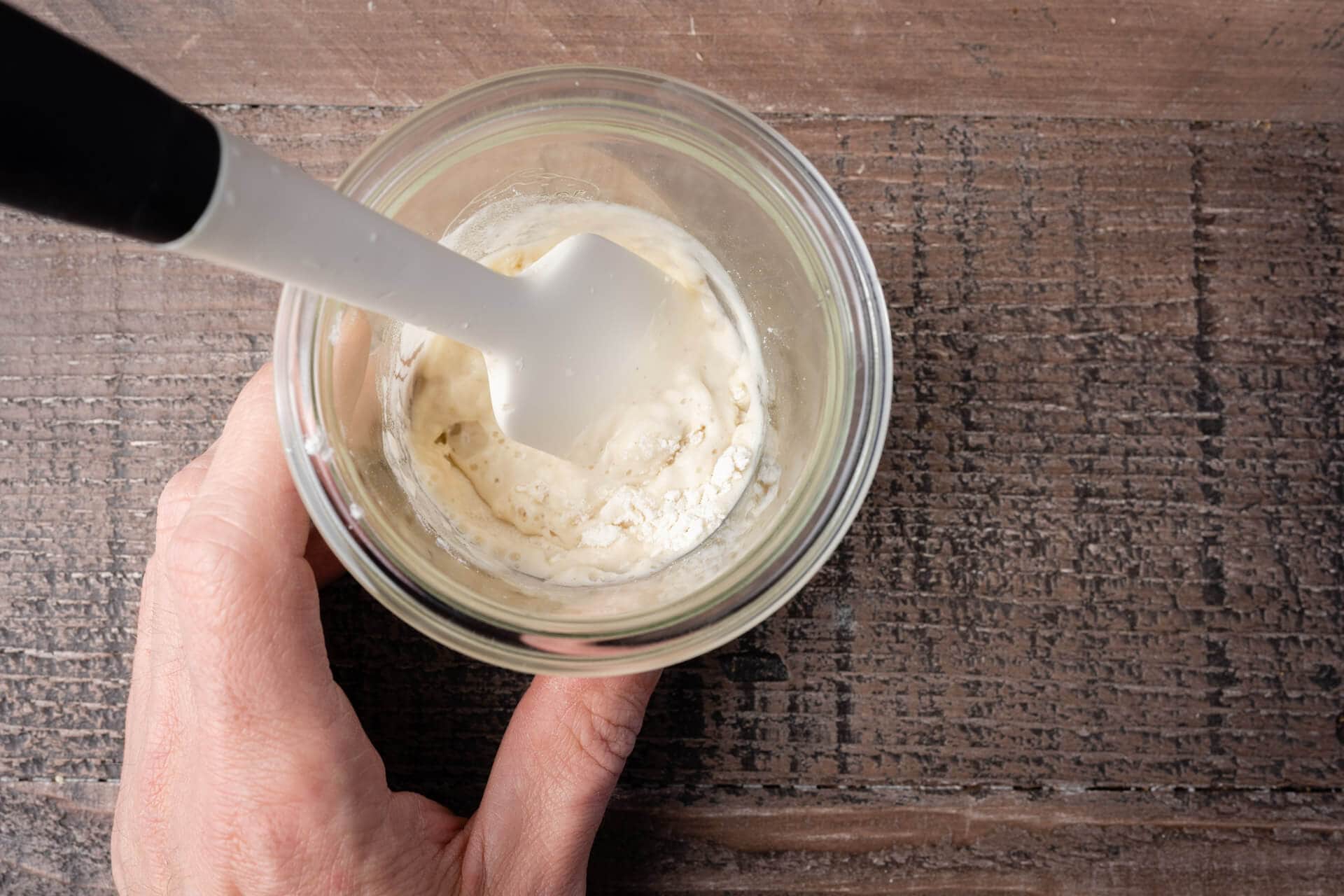
Due to the small quantity of this starter, if the recipe you’re going to bake requires more starter to create a levain or mix directly into a dough, you’ll have to scale up your starter to cover the requirement. Many of the recipes here at my site require very little starter because I typically create a levain (which essentially scales up the pre-ferment, see more on what a levain is here). But in the case where you need a large pre-ferment, let’s look at an example to see how this is done.
Let’s say you wanted to make my sourdough fougasse, which calls for 173g of ripe sourdough starter. When your smaller sourdough starter is ripe it will produce about 55g of starter. You need to scale up your starter at the next refreshment to cover, let’s say, 190g (this way you have a little leftover starter to keep in the jar to keep your culture going with a little buffer).
Add the following to your starter jar (making sure it will hold 190g without overflowing!):
| Weight | Ingredient | Baker’s Percentage |
|---|---|---|
| 17g | Ripe sourdough starter (carryover) | 20% |
| 85g | Water | 100% |
| 85g | All-purpose white flour | 100% |
The above will yield around 187g of ripe starter after 12 hours kept at room temperature.
The key is to keep the same ratio of ingredients in baker’s percentages: 20% starter, 100% water, and as always, 100% flour. In this way, you should expect the same level of activity, time to ripe, and signs for when it’s ready (assuming you’re using the same flour and it’s kept at the same temperature as before), all the while attempting to keep the same balance of bacteria and wild yeast.
Why Not Use the Refrigerator?
A refrigerator is a great tool for slowing your starter’s activity, and it’s sometimes an approach I’ll take for a week or less, but I don’t like to keep my starter in the fridge longer than a week if I’m not traveling. When I take my starter out of the fridge, it takes a day or two to get back up to full strength, and generally, the health of my starter starts to suffer if left unattended for more than a week.
The benefit of maintaining a smaller sourdough starter is the discard at each refreshment is minimal, and my starter is ready—and at full strength—to make bread every day.
When I turn to the fridge, I use my weekend baking schedule to keep feedings to a minimum during the week, but then take it out a few days before baking to ramp it back up and prepare for baking.
The benefit of maintaining a smaller sourdough starter is the discard at each refreshment is minimal, and my starter is ready—and at full strength—to make bread every day.
Why Maintain a Larger Starter?
So with all this, why would one ever maintain a larger sourdough starter instead of just keeping a smaller one to reduce waste?
Over the years, I’ve found keeping around 200g of starter ready to go at any time ideal for the amount of baking I do here at home. In addition, I regularly make sourdough pancakes, sourdough waffles (see the next section), and even a sourdough galette from time-to-time. Having that excess starter almost always gets used in some way, and if it doesn’t directly go into a baked good, the excess sourdough starter goes in my compost pile.
My typical feeding schedule means my starter is at full power and ready to go when I need it for the amount of baking I typically do—but sometimes scaling things back to “maintenance mode” is the right option to ensure I can still bake but in a reduced capacity.
What to do With Starter Discard?

Maintaining this small sourdough starter means much less discard than maintaining a larger starter, but there will always be some discard. One approach is to save up all this discard in one container in the fridge in what I like to call a sourdough starter cache. Then, use all this at once in a starter discard recipe or my sourdough waffles, pancakes, or banana bread at the end of the week.
What’s Next?
If you haven’t tried my simple weekday sourdough bread that’s the next place to turn; with this starter, you can make two loaves of sourdough during the busy work week without having to scale up the starter refreshments. This smaller sourdough starter maintenance routine and that weekday recipe are an effective team: minimal waste, minimal fuss, and healthy sourdough bread any day of the week.
Happy baking!
If you try this smaller sourdough starter, I’d love to see how you use it! Tag @maurizio on Instagram and hashtag your photo #theperfectloaf so I can take a look.


189 Comments
Hey, Erin! You can switch to whatever flour you’d like, really. You can do it over the course of a few feedings or do it all in one go, as I likely would. If you want to feed less, keep less of the starter in the jar each time you feed, this will lengthen the timeline. Hope that helps!
Is it OK to use a jar that seals completely, air tight?
Hi Dave,
I’d strongly suggest that you do not tighten the lid, as the bacterial process gives off a number of natural gasses, and if the jar is sealed it would slow down the fermentation (which makes the whole exercise pointless of course!), and build up a pressure in the jar, creating a very slight risk of breakage.
What you could do if the jar is one you wish to use, is simply lay the lid loosely on the top, or instead, cover the jar with a piece of light cloth (such as muslin or cotton) held on with an elastic band
As @John said below, I wouldn’t suggest closing tightly. Just lay the lid on top so air (and other stuff) cant get in, but gasses generated through fermentation can still escape.
Is it better to keep the same jar for the starter or to carry over to a new jar each time? I find that weighing, say, 20g is easier if I just carry this to a new jar, but I suspect that there’s more residual bacteria that would make for an overall stronger starter if I keep the same jar going and leave the right amount in it, rather than take the right amount from it. Are my suspicions right or no difference?
I actually have the same question. I’ve always used a clean bowl to mix and then a clean jar to incubate for each and every feed, but I just read that for the first time in Maurizio’s FAQ. But it does make perfect sense to use the same container to take advantage of the wild yeasts in the jar. I’m even thinking that at least keeping the same lid (when the jar gets too messy and needs to be changed) would help. I’m going to try using the same jar and lid for awhile. But I need to use a bowl to mix, so I’m thinking that the process is: take from the jar the amount of starter needed, put in a bowl and mix the refreshed starter; remove the remaining starter from the jar (except for a little residue? he refers to refers to residual starter, so not sure if the intent is to leave some residue behind) and either use remainder for bread or discard; put the newly mixed refreshed starter in the original jar; and scrape down any residue left to meet up with the refreshed starter. Hopefully I understand this process correctly? (Note: The reason that I need to mix in a separate bowl is that I made a dough-like (vs wet) starter using 60g einkorn and 30g water.)
What did you read in the FAQ? The practice of using a clean bowl or vessel each time? For me, at some point the inevitable residual starter on the sides higher up in the jar (either from scooping out or stirring) may be more of an detriment as it may not be a positive contribution. I don’t know. For me it’s also the additional washing up of using extra vessels. But if I take the starter jar and remove the weight required to leave, say 20g, I don’t have enough in one place that can be easily incorporated into the refreshment with new flour and water as well as if i start it in a whole new jar. But maybe there is bacteria enough in that residue and “air” of the jar that renders it more beneficial than to start in a brand new jar each time. I must say, I haven’t noticed a major difference, but then I don’t know what’s really going on behind the scenes. I suspect the same jar and lid method creates a more robust starter over time, but I’d be interest to see what the more experienced bakers think! Thanks, Ginger.
I just read the FAQ so ignore that bit!
Hi Maurizio! I’m only on day 5 of my sourdough starter and I’m about to refresh it. I’d like to use the discarded starter today as an addition to a 100% einkorn whole grain bread made with yeast that I’m about to make. The yeast bread recipe is a Jovial recipe where you start with 236g water, 1 cup of einkorn flour (about 90g), 1 3/4 t yeast and 2 T honey, blend and then rest for 15 mins. Then you add all of the remaining flour and butter and let it rise, then shape and bake. I have 2 questions: 1) Do I need to reduce the amount of water in my yeast mixture to compensate for the wetness of the discarded starter? 2) When do I add the starter — I’m assuming when I make the wet yeast mixture right, just like I would do for a levain (except that this is like a fast track levain at only 15 mins). 3) How much discarded starter can i use in it — all of it, hopefully? (The starter is the recommended 60g flour/30g water, less about 14g of starter that I’ll use for refreshing and also less the grey layer on top.)
When you bake a bread, do you use the sour dough right after feeding or before feeding?
Also, if I wanted to start my sour dough from scratch and make a small one could i just cut all the ingredients by 1/3 from your original sour dough starter recipe?
Hi Maurizio!
This quarantine (& your website!) have been great for my Sourdough education! I wanted to ask about the scale up side of this post – if hypotethically you need to scale up by more starter than you have available, would you just repeat this process with the relevant amounts over 2 days, maintaining the right ratios each time?
Hello Maurizio-
I have been feeding my sourdough one time daily with the formula of 100 g of flour (75 g AP, 25 g whole wheat), 100 g of water, 50 g starter. Do you think I would get a better results if I went to the smaller feeding that you described above and fed it twice a day? Normally twice a day would be too much of a commitment for me, but I am working from home these days. Thanks for any guidance you can provide!
Good call, will do this!
Exactly the info I need! One question, though. Are the proportions you list above good for any mature starter, or are they specific to the starter you have on this website? Thanks in advance!
They’re just fine for any starter, really! The important thing will be the flour you’re using for refreshments, though. If you’re using more whole grains you’ll likely have to adjust things because it’ll need a refreshment sooner.
As a newbie, curious about the ratios to maintain an active starter. I have been using the ratio of 1:1:1 – 20g starter, 20g flour mix (1/2 bread flour, 1/4 wheat flour and 1/4 rye), and 20g room temp water. I usually refresh 2-3 times a day. Is there any reason to move to a different ratio if I just want to bake 2-4 loaves a week?
Hi Judy – Like you, I bake about 4 loaves per week, I also use the same ratio of 1:1:1 (x.g of each starter, flours, water)
I also refresh my starter 3 times per 24 hours, and this way I maintain a wonderfully active starter.
It does mean, of course, that every time I refresh – I discard 2/3rds of ‘old’ starter). (until I start building a levain of course)
I actually work with 15gm weights in my ratio – (I have found that less than this is just too fiddly!) – I’ve also worked with 50gm portion weights, and found the resulting starter no more effective.
I can see no benefit of working to a different ratio, for the importance of the requirement of fresh ‘food’ (flour) for the starter does not diminish because of the number of loaves you intend to bake.
You could keep your starter in a refrigerator, and thus slow the fermentation, but I have found that it takes two days at room temperature at least to bring the starter back to a reasonable activity – and as I bake at least twice per week, there’s absolutely no advantage for me to do so.
Does that answer your question?
Yes! Thank you so much!
Good advice from @disqus_FPNWkRuGEf:disqus , below!
I bake 4 loaves daily Tuesday thru Saturday, and make dough Monday thru Friday. In my 4 loaves I use 400 grams of starter. So, in the morning I feed my starter 200 grams of water and 200 grams of flour. It takes about 5 hours to double in size. After removing the stater for todays dough making, I leave the jar alone on the counter until tomorrow morning when again I add 200 grams flour and 200 grams of water. Each day after removing 400 grams of starter, about 50 – 100 grams of starter remain in the jar.
Hey Ronnie, I can’t help but ask – what do you do with four loaves of bread a day? Also, how do you bake 4…one at a time or more than one? I’m fascinated!
I give the loaves to neighbors. I bake two at a time. I have two lodge dutch ovens. I bake the bread with lid on for 30 minutes at 450′, and 8 minutes at 400′ with lid off. The bread comes out between 200′ – 205′, and slightly deep golden brown.
That’s awesome! They must really love it. Thank you for the degrees and times! I am excited about my next loaves and the tinkering (#3 & 4, haha just starting here). The last two were a bit damp. Dialing back the water this time.
Hi! When you say ” If it’s falling too fast, reduce the 5g left in the jar to even less.”, do you mean reduce and keep the same ratio (for example 1:5:5) or reduce the starter and keep the flour and water for example 25,25gr? Hope I explained it. Thanks!!
The idea is to reduce the ratio of transferred starter to flour and water. That is, less starter but same flour, same water. Introducing a smaller quantity of microbes to begin the new culture will increase the time until it reaches its peak maturity.
Exactly as @disqus_gMABLO00CG:disqus said below.
Good Morning ( and Happy Easter!), I am a newbie and just got some starter from a friend and had a successful rise after feeding yesterday. My question is around timing of feeding to have a mature starter ready in the morning to build a levain. If I feed in the morning at 7, it peaks in the late afternoon and by 7a the next morning it does not pass the float test. Do you always feed in the evening to have a mature starter in the morning?
Also, I just did a feeding and may have used too much starter (200g starter, 100g flour/100g water) for my am feed this morning. Will this be a problem?
Many thanks for your inspiring posts!
You can adjust the timeline of your starter by keeping less or more of that in the jar each time you feed it. If you keep less in there the time between feedings will be lengthened. Conversely, if you keep more in the jar the timeline will be lengthened.
Yes, I usually feed 2x a day, once in the morning and once in the evening before bed.
Not a problem if you fed more than needed!
Thank for your contribution. I got levain from a friend, and baked two pairs to date. I’ll keep experimenting. Your website is my new bible!
You’re welcome, Tommy! Happy baking 😊
Hi Maurizio, I usually keep my starter in the fridge and feed it once a week as I only bake once a month or so. But now that I’m working from home I wanted to keep it nice and strong and ready to use at any time so I tried your tips here and it was working really well. 5/25/25 using a cheap plain flour. Refreshed it around lunchtime and then again around midnight before I went to bed.
The other day the weather dropped off a bit and it’s been a couple of degrees cooler and I noticed the starter didn’t get as bubbly or doubled in size as before. I refreshed it all the same and it still isn’t peaking within 12 hours.
I tried putting it in the microwave with the light on or on the counter but wrapped in a tea towel. Also tried 10-15g of starter to 25g of water and flour. Still not a lot of activity.
I want to get it back to the 12 hour feeding schedule so I can plan my baking on a specific schedule. What’s the best way forward to get it back on track? I won’t be leaving the microwave on all night so do I need to change my ratios around to compensate for the cooler weather ?
Thanks in advance
Frank
I’ve created a sourdough starter two weeks ago. It feels like I’m having zero success when it comes to getting my starter to rise. I didn’t start with your recipe when it comes to creating a starter (I used King Arthur Flour). I stumbled upon your website and I love the informations you (Maurizio) and other community members.
As of now, my sourdough starter isn’t rising but I see bubbles.
My current feeding: (Based on your suggestion)
4g previous starter
25g water (about 75F)
25g 1:1 ratio whole wheat and White all purpose flour.
The temperature that I am holding the starter in is around 75F-80F (inside an off oven with the light turned on).
After 12 hours, some days the starter has the “hooch” (a thin liquid on top of the starter), and it smells sour.
Not sure what is going on and changes to make to my feeding. Any recommendations?
Andy – hey there! I might suggest, if you have the flour, to scale up your feeds for a few days (or a week if possible). You could go up to 100g water, 100g flour, and 16-20g starter and keep it out on your counter where you can check in on it during the day. See how it transforms after just feeding, to midday, to end of day. You should see some rise, even if it’s not excessive. Adding more ingredients to the jar, just for a little while, should help make all of this evident.
Another thing to consider: your starter might be very high hydration for the flour you’re using. If you drop the hydration a bit, below 100%, perhaps to 80% hydration you might see more evidence of fermentation. When you go to feed it, stir it very well for a few mins to help strengthen it.
It sounds like you have proper fermentation going on, but my guess is it’s hard to see this given the size and perhaps the hydration. Let me know if this helps!
Hello again!
Ironically, when I finished writing this post. My sourdough starter decided to rise and triple in size, I will continue with the same feeding until it is consistent.
At the beginning, I started the starter with a larger batch but there were a lot of waste. I started to lower the amount of feed and starter since I don’t bake a lot of bread, but I still kept the same ratio.
I really appreciate your website! It’s amazing information.
Thank you so much.
PS: I was very close to giving up on my starter.
im pretty lazy, so as my starter matured and my understanding of all the whys and how’s of the sd process evolved, i realized that super exact measures for maintaining a starter not terribly important. instead of weighing for each feed, i found a volumetric measure that came real close… 1/3 cup flour (~60g) + 1/4 cup water (~60g) + a smear from the bottom of the jar was adequate for my needs and yielded a strong and active starter. i still weigh everything for levain and dough. now that i’ve done that amount for a few months and always have plenty, i’ll take your lead and halve that. i’m thinking a scant 1/4 cup flour and maybe a coffee scoop (2tb) of water will be close enough.
That’s the way to go, really. I don’t always measure my jar, I know by sight how much to leave in there (with a small margin of error) each refreshment, but then I do measure how much flour and water I add. If the next morning it’s fallen early, I’ll adjust next time by leaving less. I usually check in once a week or so to assess my eyeballs 🙂
Hi there! I just started with my starter this week. I was warming water to 80 degrees and feeding it based on your guide. It’s very active and moving almost too fast. I fed it at 10:30am and it peaked by 2pm and now is dropping. When is it time to feed or should I let it slow down at this point ? Help! Maybe less carryover starter on the next feeding?
Hey there! It’s great to hear your starter is so active. Yes, leave less starter in your jar when you do a refreshment, this will slow things down. You can also reduce the temperature of the water if you’d like as well, but I do like to keep my starter warm and ready to go. In general: warmer = faster and more left in the jar = faster.
Hope that helps and happy baking!
Hi Maurizio! What’s the reason for discarding the rest of the starter? Thanks a lot for your time to explain.
Hey there! Take a look at my frequently asked sourdough starter questions post, I have an answer there for your question (as well as many more!). Happy baking!
Hi, I have a good, active sourdough starter going that, in advance of a bake, I feed three times/day with a schedule I got from Full Proof Baking. Her first two daily feed ratios are 1:1:1 (starter/flour/water) with a ratio of 90% white flour/10% rye and the last feed of the day is 1:4:4 (same flour ratio). I’d like to understand more about the interplay of different types of flours in the starter and their effects on various starter attributes (activity, acidity, fermentation, etc.). In this post, you say your daily feeding schedule is twice daily at 1:5:5 with 50% white/50% rye or whole wheat flour, but in your advice to reduce the size of the starter you say to use 100% white/all purpose flour to “…reduce activity and keep that lengthy interval.”
I’ve read that rye/whole wheat flours can create more activity and acidity, but can you expound more on their attributes vis-à-vis the starter? Also, are there any pros and cons to using a starter for a levain build that’s been fed once daily vs two or three times daily, or is the only thing that matters is to have an active starter? How might the flour composition of the starter influence the levain and therefore bake outcome? Thanks, as always!
Hey there! All great questions with potentially extremely long answers 🙂I find that many bakers have different preferences when it comes to all of this, so what you find here is what I’ve found, empirically, to work the best for the type of bread I bake in my kitchen. And the best part: it’s always changing and evolving. I discover new facets of baking all the time, and those discoveries get folded back into my process and understanding. I put all this first because with baking bread I don’t think there’s any right answer or any right way to do things, it’s all about what works best for you.
In general, increased whole grain percentages in a starter do lead to more activity, faster fermentation rates, and with potentially increased acidity build up over time (the same as when using them in a dough). The reason for increased acidity is due to the increased buffering capacity of whole grain flour vs. white flour (since the bran and germ are removed) — this means as a dough with increased whole grains ferments, there will eventually be more total acidity (measured via TTA) because bacteria will not be “deactivated” earlier by low pH as the flour is buffering this acidity. This is more related to the dough itself, but also presents in the starter.
Regarding feedings, I have found that 2x a day feedings for my starter keeps it stronger and more active when I use it to make a levain. The reason for this is mostly scheduling: if I feed just once a day, even if I leave the smallest amount in the jar, it will have risen and fallen for some time in its jar before I can get to it to make a levain. This means it will be overly ripe, acidic, and not where I want it. Many bakers will push to 3x feedings a day but that’s a lot of maintenance and in my testing I haven’t found that to be necessary. I maintained a starter with 3x feedings for a long while and upon switching back to 2x I didn’t noticed any discernible difference between the two schedules. My feeling there is bakers might do that in a bakery situation because they need a ripe starter at multiple points in the day from which to create a levain for their production schedule.
The only idea I have here that might challenge this is the fact that yeast growth is faster than bacteria growth, which means a starter that’s fed in rapid succession might be more yeast-dominant, meaning more gas production vs. acid production via bacteria.
Regardless of the feeding frequency, I find it’s always best to use a starter when it’s mature/active. This is both for flavor and performance.
Regarding your question about flour composition and how it effects the levain and final outcome: this is something I’ve been testing for years with no definite answer 🙂 I’ve fed my starter all manner of flour varieties, both freshly milled and aged, and always come back to 50% rye flour with %50 white flour. I’m not saying this is the best, there are many bakers who feed 100% white flour and bake incredible bread, but for me it settles into the performance and flavor I have found to enjoy. To further complicate things, how much does this starter, which ultimately is a pretty small percentage in the final outcome, effect the flavor of the bread? My feeling is perhaps very little, it’s the levain itself that has the biggest impact on the final dough as it’s in larger quantity. BUT, you still want to be sure your starter is strong, active, and has maximal populations of bacteria and yeast to inoculate your levain.
I could go on (with info and speculation). I hope this answers your questions — and doesn’t raise too many others! — but there are so many interconnected parts to baking sourdough bread I’ve found it to be one of the most complex of topics with no single answer for any of it. Which is a beautiful thing, because you can get into all of this as far and as deep as you want to go. You can always make amazing bread with just mixing a few things in your bowl, tossing in your starter, and giving it time. 🙂
Thank you so much for this wealth of very helpful info! As you said, it of course raises even more questions but I’ll give those pause for now. You’ve given me lots of food for thought, including a term which I hadn’t heard of before: buffering capacity of flour! I’ll give doing 2 feedings/day a shot in my kitchen. If one can regulate the temperature of the environment that the starter is in (I can), is there an ideal temperature to keep it at for feedings? I’ve been doing 78 F when I’ve done 3 feedings/day but I suspect something around 74-75 for 2 feedings/day?
Actually, one more small question if that’s ok—in your recipe for 50/50 white/whole wheat sourdough bread your schedule involves starting the levain build at 12:30 pm. How can one adjust the activity of their starter to hit a desired peak time (say, for use in your recipe)? For instance, when I was feeding my starter 3x/day I would do a feed at 8 am, 3 pm, and 10 pm. How could I adjust the peak of my starter so it could be ready at 12:30 if it were on the feeding routine I described, and if I was feeding it at 7 or 8 am? You’d probably want to speed up starter fermentation?
Hi Maurizio!
I’ve been using your recipes as sendoffs for ingredients I have on hand for years now. Thank you so much!
Probably somewhere near 2000 loaves at this point. I’ve taught a few classes on doing it simply at home, have baked large batches for parties and catering and restaurants just out of our 40’s Chambers gas oven.
I was texting about how I would tweak a recipe my buddy sent me; in the end I think it was more process than ingredients, but I told him to check out your site.
Then I clicked on this article when I pulled it up and I was like, “Sweet! more science from Maurizio!” I truly love it. It’s repeatable science that I can take back to my own lab and my own methods. I’m in Denver, so things work a bit differently.
That said…
I also really want to encourage people to take it easy with themselves and realize just how really forgiving sourdough is.
For all of the rules Maurizio has I’m sure he’ll tell you himself that someone else will tell you differently, and… I would be willing to bet that almost every ‘rule’ he has… he has seen culture behave funny.
I do actually keep my starter in the fridge. I “caught” it 7 or 8 years ago and got more and more neglectful until it just got really resilient. It does take a day or two to refresh to full Pow, but I am still using a version of that same start even after 2 months cold. If you have an old starter in the fridge, don’t give up on it. Just use a smaller amount to start a smaller amount of levain and build it up over a couple of graduated batches . All good, take it easy. If you forget to build up the next batch at just the right time, no worries. You have to get a feel for how it behaves and what missing out on getting your levain into the autolyse at precisely x hours does. You get to learn something every time you don’t follow the recipe exactly with sourdough. It gives you the leeway to make mistakes and forget about the batch in the fridge outside for 2 days because the kid broke his arm, but you decided to bake it off anyway. Deliciously sour!
Until you’re at least a dozen batches in I’d be surprised if you pulled anything out of the oven which rose like you’d hoped. Don’t quit! Take your time and observe. Small differences in time and temp can make a difference, but really the biggest thing is getting in hands on and playing with the dough. Watch the videos, read all the recipes you want, but until you start to feel the dough and what 70% vs 80% FEELS like, all the changes you try in a recipe won’t matter.
My basic recipe was perfected over at least 100 loaves, but is still also very simple and is based on a recipe very close to, but maybe not as precise, as the beginner’s recipe on this site.
Thanks again for writing it all down!!
Sincerely, Eric
Just love your comments, Eric! Thanks so much for writing them — and you’re so right about all of it. There’s no right or wrong way to do any of this, I just write here about what I’ve found to work and am hoping others do too. Our cultures are incredibly resilient and will undergo so much stress and keep on ticking — it’s pretty hard to “mess” anything up, just get in there and get mixing, things will be just fine 🙂
Over the years I’ve experimented with many ways to do all of this, sometimes things work and sometimes they don’t. I take the stuff that works and add it to my toolset, which is ever expanding and evolving with every bake.
Cheers and happy baking, Eric!
My buddy who was texting for help just sent me a pic yesterday of his most recent loaf – he labeled it “perserverance!”
He has brewed beer for years and therefore understands the vagaries of yeast. I put it into terms he could understand with regard to time and temp and paying attention to process – getting a “feel” for how things behave given all the variables. A dozen or so loaves in and he got it – this time, at least.
Again, for all those just beginning: Have fun! Play with the dough! Get the feel, and don’t give up.
Use this site to help you understand the relationships with time, temp, ingredients, process, but don’t be discouraged if you don’t pull a Perfect Loaf out this time. You will. If you spend the time doing it, you will.
Much Love, Gratitude, and Appreciation Maurizio!!
-Eric
Discard overload over here. Been baking lots of fun things but definitely looking to scale back since flour is such a precious commodity right now. Just to be sure I’m clear, is the idea here that you use this same ratio daily? So each day you start with 5g starter, 25g flour, and 25g water and get rid of what’s leftover from the previous day? Thank you in advance!
The discarded starter in the fridge really should only be used for things like waffles, pancakes, banana bread — I don’t feel it will be the best for bread where it’s critical to have your starter or levain in the right condition to achieve proper rise and flavor. The “ripe” or “mature” starter is right when it’s at its peak height in the jar, when you’d normally give your starter a refreshment — that’s when you’d use some to mix into a dough or make a levain.
It’s probably fine to keep it longer than a week, but I try to use it all up in one week.
Hope that helps!
Ahh, I see, sorry for the confusion. You can use the saved up discard or your normal discard from your ripe starter — either works. You don’t need to do anything to the discard saved in the fridge, it’s already ripe 🙂 Just mix directly into the recipe.
Weekend pancakes are the best. Enjoy!
Maurizio, fabulous and timely, as usual. Question (with background): I make 100% Jovial Einkorn starter (and need to start one from scratch again after a long-hiatus after killing mine by accidentally leaving it in my warming drawer while traveling for 3 weeks). I make both the all-purpose and whole-grain starters (though is that wasteful, unnecessary and duplicative? probably!). But my question is…once mine gets going again and has a good rise and bubbly by 6+ hours or so…do you think that I can just cut her recipe down proportionately to keep it going? Or does it really need to be fed with as much flour as she recommends each time I refresh. For the first starter she uses 45g water:60g flour (either AP or WG). For refreshing she uses 30g water: 60g flour. It’s just my husband and me, and even refreshing at 1x per week, a fair amount goes to waste. Thoughts and recommendations on the barest minimum that would work best and still give good rise?
Ginger — you’re very welcome! I think I answered your question previously but I’ll reiterate: you can certainly scale things down if you’d like. In fact, I’m not sure there’s a real minimum, but the quantities I show here in this post are super small, it’s probably the smallest I’d go! After a while, it gets hard to see the signs for when it’s ready 🙂 Hope that helps and happy baking!
Sorry! I reposted accidentally!
I’ve been using a smaller starter for a while now. I have a tablespoon measure that holds exactly 15 grams of water. I pre-measure out 30 grams of bread flour in enough 4 oz jelly jars to last a week. To refresh, I just reserve a dab of starter (the rest goes into discard jar in my fridge), add 2 Tbs of water, then add flour from one jar. So much easier to refresh when I don’t need to get out the scale!
The discards from the week are just enough to make a batch of sourdough crepes. I use discard, 3 eggs, and enough milk to loosen batter to correct consistency. Best of all, batter doesn’t need to rest as in typical recipes, since it’s been in the fridge all week!
Wow Laurie, I’m impressed with your method here! Talk about pre-planning — can’t beat that. I think that’s important, too: we all find our rhythm and what works for us in the kitchen. I have my little “starter station” in my kitchen and when I step up to work it’s autonomous for me and I’m done in just a few minutes. Thanks for sharing your process and happy baking!
Why do you recommended all purpose flower?
I would think I could use the same mix as for the larger starter.
You certainly could. I recommended ap flour here just because it seems to give the most runway before needing a refreshment, but also because it’s everywhere and easy to come by.
Hi Maurizio! I was going to ask the same question. Good to know that AP isn’t used because it’s necessarily better with a lower quantity starter. I am working towards keeping a smaller starter at room temperature rather than keeping some dormant in the fridge. I am baking a loaf every 2-3 days, and I feel better about keeping it more “alive” more of the time.
But I do have a few questions that I would love some guidance with… hopefully they’ll be short answers:
1. Am I right to think that the smaller starter will be better off if started once the original starter is as mature as possible? i.e. I should keep it well fed for as long as possible. I am currently feeding 1:4:4 with 20g starter carryover.
2. I started my starter without a decent supply flour. Probably unwise! I had a bit of this, bit of that. But this pandemic has caused a run on flour in the UK! I will be sorted soon with a delivery, but, here’s the question: does the starter gain quality and strength when using a consistent flour profile to feed or does it not matter so much regarding the bacteria formation? Mine seems fine, but I wonder what’s happening the general quality of it if one day I feed something like 1:1 bread flour:wholemeal then the next day 1:2:2 rye:BF:WM, etc.
3. At the moment I don’t plan to vary the recipe for the bread I’m making At the moment I plan to just bake using the starter at its peak instead of building a separate levain. Therefore, at the same time as I feed the starter I’m also using the carryover for the bread. As long as I have enough starter for this, nothing wrong with this, right?
4. Last question! Plenty of US recipes called for all purpose flour. In the UK what we might call all purpose is otherwise called plain flour. This is not very ‘strong’ and not considered prime for bread baking. “White Bread Flour” (often not styled as ‘strong’) seems to be the most sensible switch for AP. Do you know if this is right? I’m worried that substituting “bread flour” for AP in recipes is too strong and gummy, but maybe I’m wrong.
Thanks so much. Great site! I didn’t realise you were so attentive on responding to comments and questions 🙂
Thanks for this great guide Maurizio! I have passed it along to several friends who are still struggling with how to maintain their starters and also what to do about waste.
You’re welcome, Tracy! Thanks for sending it around, much appreciated. I hope all is well and happy baking!
I’m in need of some advice. I live in a country with very slow flours (bad flours) and I read a more dry starter for this kind of flours is good. I keep my starter in the fridge and I take it out the night before feeding it 15gr ss, 30gr flour and 30 gr water, and in the morning 3 hour before baking I feed it 75 gr ss, 45 gr flour and 25 gr water. Do you think is OK or which ratio you’d recommend. Thanks in advance.
Sure, that would work well. I also agree, if you keep a stiff starter (or make a stiff levain), this might help you bake with flour that’s very low protein, it should give a little more strength to the dough.
I keep my starter in the fridge and feed it once a week, when I bake. I’ve been doing this for years and it works fine for my purposes.
Right on Brigid! I know many bakers who take this approach and it works very well. Thanks for sharing that and happy baking!
Can you explain your methode in more detail?
It’s easy. I just add equal amounts of water and AP flour. I do the water first, on my scale, without measuring (about 90g) then an equal amount of flour—it’s easy to remove excess flour if you add too much. Since I use it when it’s ready I rarely have discard.
What I would like to know what you do when you have feed it. Do you put it ight back the fridge or keep it at room temp for a certain time?
After you refresh it I like to keep it out for an hour, then place it in the fridge if that’s your plan.
It depends. If I’m baking, I use it. If not, I stick it back in the fridge. I usually let it “eat” a while first, but I have just fed it and stuck it back in and it was fine.
Thanks Brigid. Ok now I get it. I am not sure yet how I gone do it. Keep the bigger batch, go for smaller or use your fridge methode.
I just start making my starter 7 days ago and baked the first bread with it today. For a first it looks fine and I can’t wait to taste it but it need to cool down some more. Great site Maurizio.
Hi from Australia! Thank you for this. It is very timely as I just added 200g of flour to my new starter and was worried about waste. Not only have you shown me how to reduce waste, I also now have some great recipes to use my excess starter – thank you 🙏 😊. Sending virtual hugs and best wishes for good health to you and your readers.💖💪
Hey there, Judy! Glad this post can be of help, I figured at this time (and always, really!) it’s best for us to conserve and make use of everything we have. Plus, it’s a chance for us to stretch and learn to make some new delicious food in the kitchen. Likewise, wishing you and your family the best! Happy baking 🙂
This is so helpful – Thank you! I’ve been using commercial yeast and am excited to move to a starter. Can I create a starter for these 1/5 Liter containers with smaller quantities using the same ratios as in your 3/4 Liter tutorial?
Using those quantities it won’t fit in these jars, but ratios, yes that will work. I do recommend when creating your starter you might want to start with a bit more flour than what’s used here — but if you’re worried about running out of flour, give it a try and see how it goes. Keep me posted!
Was just now re-reading your post about shelf stable sourdough starter wafers…also apropos for these times!
Maurizio, fabulous and timely, as usual. Question (with background): I make 100% Jovial Einkorn starter (and need to start one from scratch again after a long-hiatus after killing mine by accidentally leaving it in my warming drawer while traveling for 3 weeks). I make both the all-purpose and whole-grain starters (though is that wasteful, unnecessary and duplicative? probably!). But my question is…once mine gets going again and has a good rise and bubbly by 6+ hours or so…do you think that I can just cut her recipe down proportionately to keep it going? Or does it really need to be fed with as much flour as she recommends each time I refresh. For the first starter she uses 45g water:60g flour (either AP or WG). For refreshing she uses 30g water: 60g flour. It’s just my husband and me, and even refreshing at 1x per week, a fair amount goes to waste. Thoughts and recommendations on the barest minimum that would work best and still give good rise?
You’re welcome, Ginger! I like to only keep one starter here and then make a levain with different flours if a single bake requires this. And to your other question: yes you should be able to scale the starter down without any problem, just be sure to keep enough so you can see the signs of fermentation each day and take a little extra care with it, smaller quantities are less resilient and can be prone to temperature fluctuations much more rapidly than a larger mass would. I probably wouldn’t go much less than the quantities shown here in my post, but you could if you wanted to. All in all, you shouldn’t have any issues!
Hi Ginger and Maurizio,
I began this whole adventure with Einkorn. We were ordering 25-50lbs of berries from Jovial to grind on demand.
I was making amazing crusty loaves a decade ago when my wife realized she wasn’t digesting our western wheat so well.
We met while working at a natural foods store and therefore had an inclination toward and knowledge of alternatives. I started out with einkorn as an alternative just with regular yeasted breads and learned a lot about physical manipulation of dough and what I call a gentle firmness or being firmly gentle. There’s a fine line between enough and too much when working with your dough and Einkorn really emphasized that for me.
Once my wife realized she had gluten issues we switched to Einkorn; when she found she could digest real sourdough, I thus began my quest with sourdough.
I agree 100% here with those recommendations:
– don’t worry about keeping a separate starter – I’ve had great luck kicking one into action with all sorts of fun variations. (Mine is 50/50 AP and fresh gound wheat at 100% saturation.)
– totally OK to keep just a small amount to keep it going and boost it up when you need; as stated above, you may need to pay closer attention if you want to scale down to ensure you have good activity, but as long as fermentation is happening you can bring it back
-Eric
Thank you Eric and Maurizio!
I’ve been keeping two separate starters succesfully going in the fridge generally on a 30ish gram total for a while now… I’ve never understood why guides push for such generous refreshes
Probably advice from people who bake a lot and always need a large amount of starter on hand.
For me it’s because I bake in larger quantities, but there are other reasons also. Another good one is a larger starter is a little more robust: it’s less affected by temperature changes (because of the larger mass), there’s more room for error if you accidentally spill some, and sometimes (it’s happened to me!) I pour out too much starter into the compost bin only to realize I poured too much and now can’t cover my levain requirements. But yes, some books in the past call for HUGE starter quantities which I never really understood for a home baker 🙂
Do you have a recommendation if I only want to feed 1x/day. Smaller? Larger? Does it make a difference?
After my weekend bake, I’ve typically used most or all of my starter (it doesn’t seem to matter how much is left- even just a bit stuck to the sides of the jar is enough to get a new batch going). I put 1 tablespoon AP and 1 WW back into my starter jar with an equal amount of water and put it back in the fridge. It generally surprises me with how rapidly it reactivates the following weekend. I usually feed 2-3 times before using, but this weekend it almost tripled on the 1st feeding after removing from the fridge.
That’s awesome, Dan — perhaps an even more economical method. I think in the end there are so many ways to keep your culture going and it’s such a resilient thing in the end, I’ve yet to abuse/neglect it so bad that it never came back for me 🙂 Thanks for the comments and happy baking!
Dan, what’s 1 WW? Whole wheat flour?
Yes, that’s right.
I have always done this. And it has always worked for me.
Right on, Susan. I’ve been keeping this one for a few weeks now specifically for this post and it’s been going quite well. In the past I’ve also kept smaller starters from time to time and it’s no issue at all. Thanks for the comments and happy baking!