

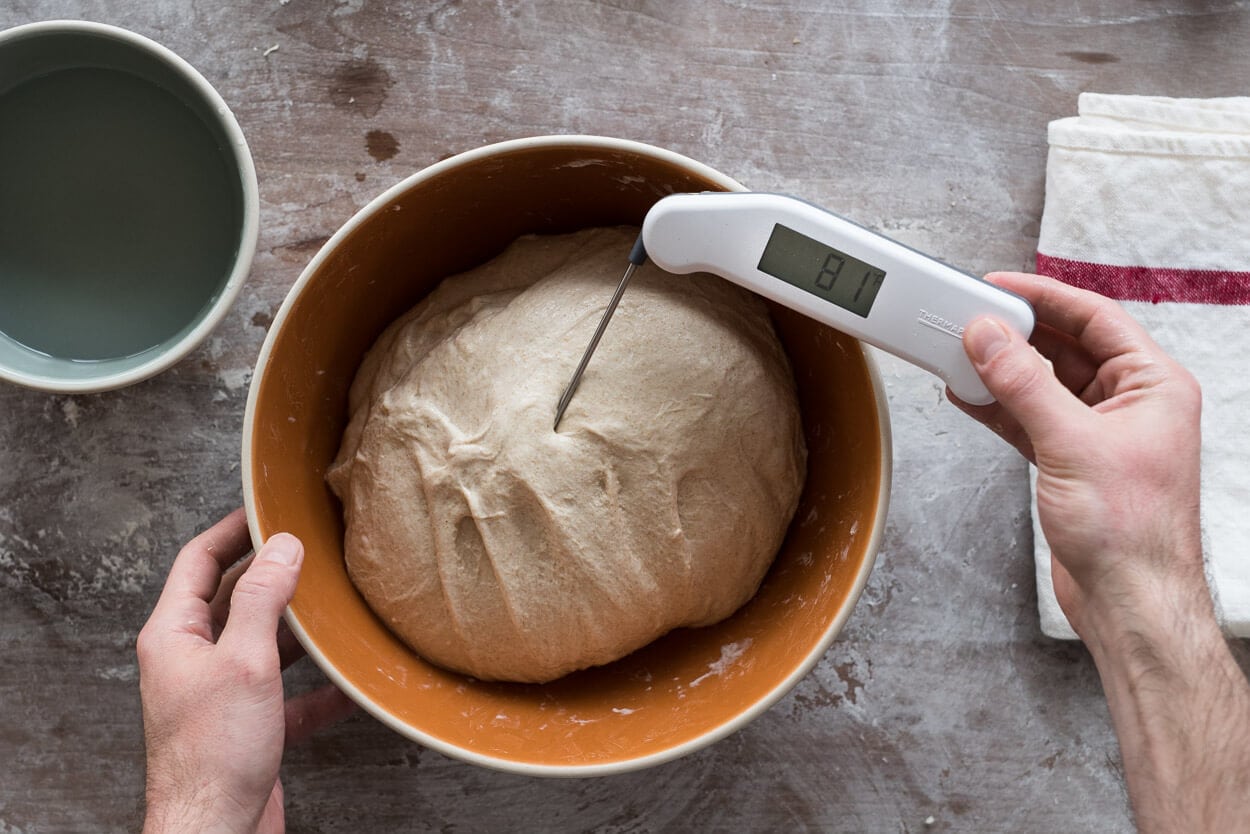
Baking sourdough bread at home certainly comes with challenges (or, as my enigmatic calculus professor used to tell me, opportunities for continuous growth). Baking bread at home with a consistent outcome has even more, ahem, opportunities. But one of the most critical facets of successful sourdough bread baking is learning to consistently monitor and adjust the dough’s temperature to keep it within an optimal range for vigorous fermentation. This will help produce consistent loaves of bread with a tall rise and the most flavor.
I’d argue that temperature is the most important aspect of the bread-making process because it greatly impacts fermentation, which is the backbone of sourdough bread. And, of course, maintaining a consistent and sufficiently high dough temperature becomes even more difficult when ambient temperatures begin to drop (hey, winter!) or when they’re in flux (as they often are in a typical home kitchen). Like a frog in a pot, sometimes we don’t even realize temperature change is happening.
Often, we blame our sourdough starter if the dough is slow to rise or if the final loaf has a lackluster flavor: it just wasn’t as lively as usual, we say, or maybe we forgot to feed it last night, we confess. While sticking to a dependable starter maintenance routine is essential, sometimes the dough’s temperature (too low or too high) is at fault. We must make simple adjustments to ensure the dough is at the right temperature for optimal fermentation activity.
Let’s first look at why temperature is so important when baking sourdough bread in the first place.
Real Quick: What’s My Favorite Dough Thermometer?
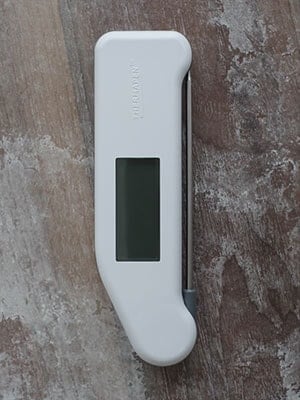
Without question, my Thermoworks Thermapen. It can read the temperature within a second or two and is extremely accurate. If you’ve ever taken a workshop or baking tour with me, you’ll recognize it: I always (always!) have it in my shirt pocket ready to test a dough’s temperature.
Why is Dough Temperature Important?
Temperature is the driving force in fermentation, and fermentation impacts sourdough bread volume, flavor, and texture. Warmer bread dough will ferment faster than colder dough, and strong fermentation will result in better bread. The longer the dough can ferment, the greater the opportunity yeast and bacteria (primarily) have to flavor it. But there’s a limit. If a dough ferments too long or is too warm, it can quickly overproof and degrade its structure, resulting in poor rise.
It’s also important to keep the dough temperature consistent throughout the bread-making process. If we can ensure temperature consistency, we know the dough will be in the same fermentation condition throughout the lengthy process. And further, if we maintain the same temperatures each time we bake, we make delicious bread.
In other words, we cannot expect consistent results every time we bake if our dough temperature varies widely.
I measure and log two dough temperatures every time I bake: the desired dough temperature (DDT) and the final dough temperature (FDT). And yes, I keep an extensive written record of my dough temperatures to refer to them for future bakes–all to produce consistently delicious loaves!
(Psst! If you don’t want to do any math, scroll for a temperature cheat sheet and calculator.)
What is the Desired Dough Temperature?
The desired dough temperature (DDT) is the ideal dough temperature at the end of mixing, just before bulk fermentation begins. Each of my recipes includes a DDT as a guide.
What is the Final Dough Temperature?
The final dough temperature (FDT) is similar to the desired dough temperature, except it’s the actual measured temperature of the dough right after mixing all the ingredients.
How Temperature Affects Flavor (Not Just Timing)
Temperature doesn’t just control how fast your dough ferments; it influences how it ferments, and that shows up directly in flavor.
At warmer temperatures (around 78-82°F / 25-28°C), both yeast and bacteria are highly active. Fermentation is efficient and relatively fast, which tends to produce a milder, more lactic sourness that’s smooth and yogurt-like.
At cooler temperatures, yeasts remain relatively active while lactic acid bacteria slow down more significantly. This shifts the balance of acid production toward acetic acid (the sharper, vinegar-like tang that defines more assertive sourdough). Cooler, slower fermentation—whether during a long bulk at 70°F or an extended cold proof (retard) in the refrigerator—generally produces more complex, developed flavor.
This is why bread baked in a cool kitchen, or left for a longer overnight cold proof, often has more depth of flavor than bread rushed through a warm fermentation. The tradeoff is time, but for many bakers it’s worth it.
How Warm Should Dough Be to Rise?
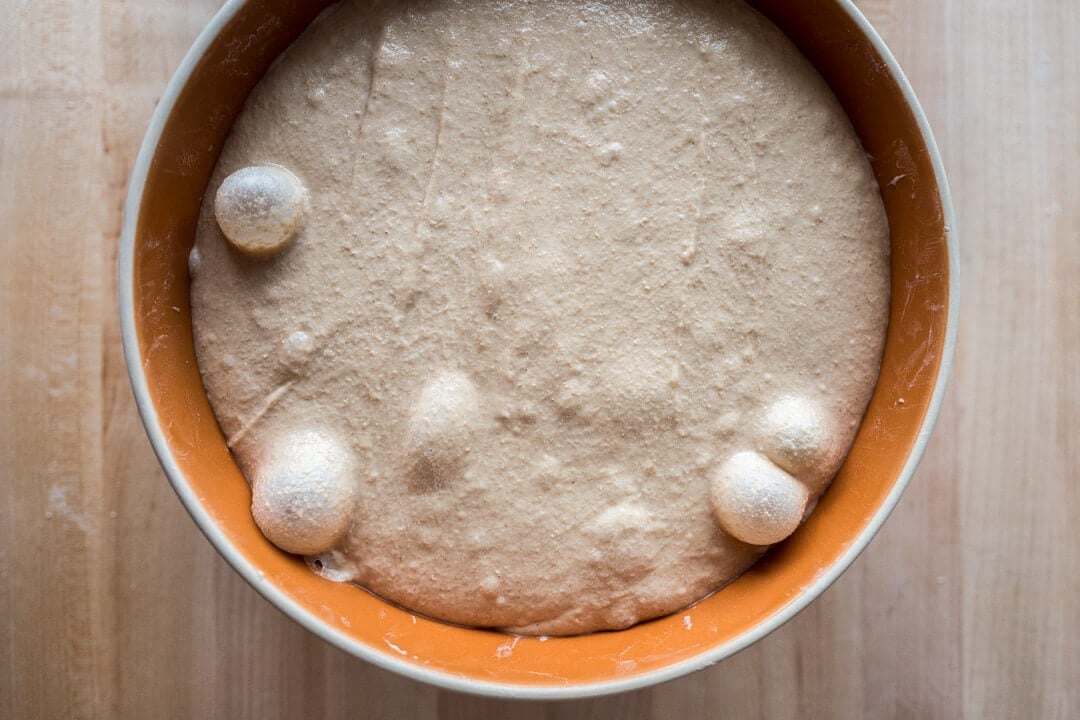
The warmer the sourdough bread dough, the faster it will ferment and rise. Dough should be warm enough to encourage lively fermentation and flavor development, but not so warm that it overproofs quickly. For most recipes here, I target a final dough temperature between 75°F and 78°F (24-25°C).
Bacteria and yeasts function optimally at different temperatures: 89°F (32°C) and 80°F (27°C), respectively. However, these temperatures are relatively high, so finding a happy medium at around 78°F (25°C) results in a dough that’s warm enough to have ample bacteria and yeast fermentation activity but not so warm that you end up with a dough that ferments too quickly and becomes sticky, hard to handle, and overproofs.
For doughs with a high whole-grain content, I typically reduce the desired dough temperature (DDT) to around 75°F (23°C) to avoid overproofing. Whole-grain doughs contain more bran and germ particles in the flour, which enhance fermentation activity.
| Type of dough | Approximate DDT |
|---|---|
| Mostly white flour | 75°F to 78°F (24 to 25°C) |
| Mostly whole-grain flour (including freshly milled whole grains) | 75°F (23°C) |
What Happens if My Bread Dough is Too Warm?
Most bakers know that cold dough means a longer bulk fermentation, but the reverse is equally important to understand. If your dough comes out warmer than the DDT, fermentation will move faster than the recipe anticipates.
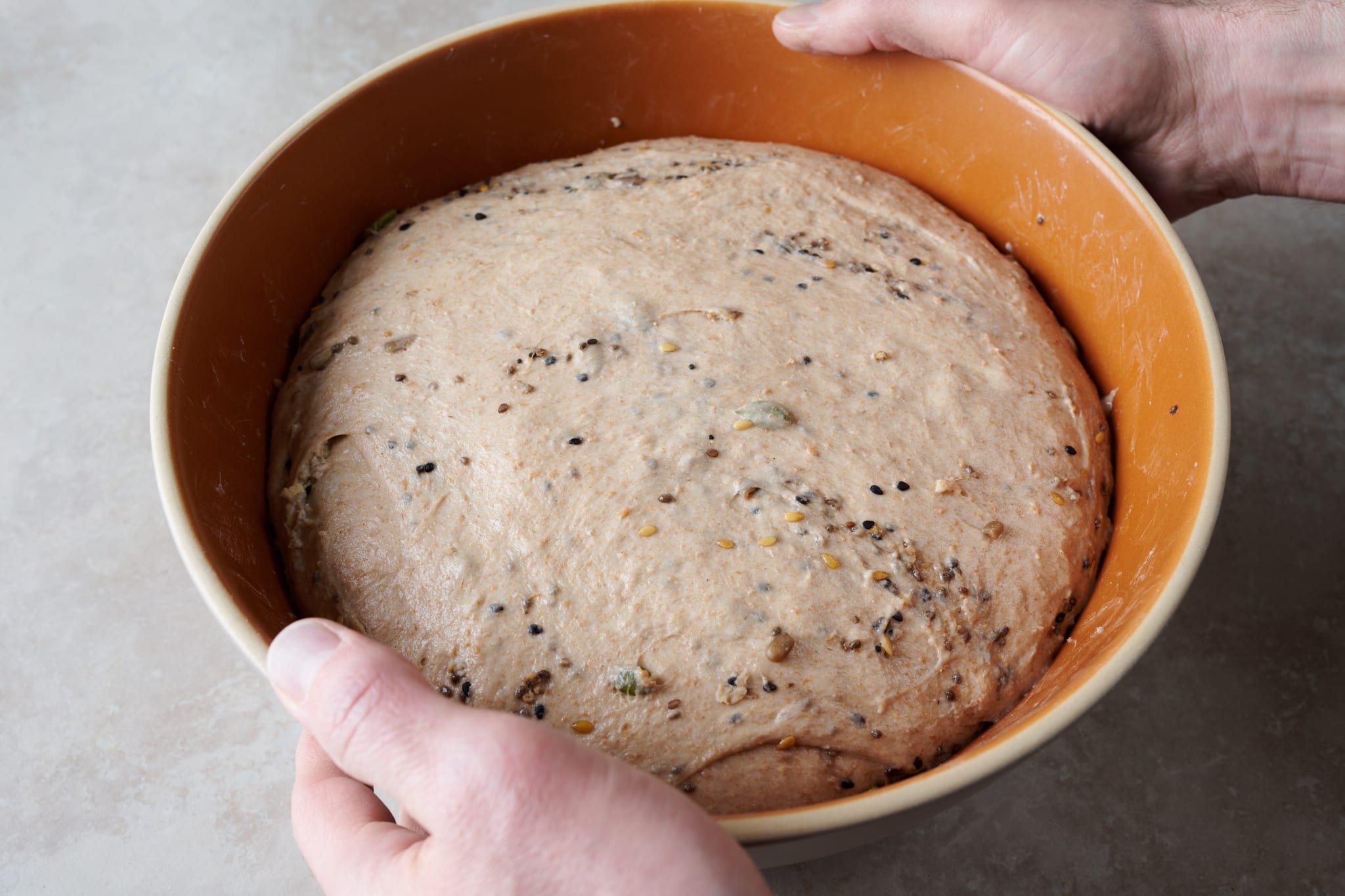
Watch for rapid bubble formation early in bulk, a dough that feels very alive and active during folds, and a faster-than-expected volume increase. You may need to divide and shape 30-60 minutes earlier than the recipe suggests.
The risk with warm dough is overproofing. Dough that gets away from you becomes slack, loses structure, and bakes up flat with poor oven spring. When I’m in this situation, I usually err on the side of dividing earlier—it’s much better to slightly underproof going into the fridge than to let the dough go too far.
To remedy a dough that’s too warm: place the bulk fermentation container, covered, in the refrigerator for 15 to 30 minutes at the start of bulk fermentation to help bring the temperature down.
What Happens if My Bread Dough is Too Cold?
If the bread dough is cold, even by just a few degrees below the desired dough temperature, it might result in a much longer bulk fermentation and/or proof time. In this case, be flexible and wait to divide or bake the dough until it displays the signs it’s ready to move on to the next step in the bread-making process.
To remedy a dough that’s too cold, put the container with the dough, covered, in a warmer spot in the kitchen (or a home dough proofer; more on this below) until the dough reaches the desired temperature.
Next, let’s look at measuring and monitoring dough temperature because, well, without the ability to measure, it’s hard to ensure the temperature is where we want it to be.
Seasonal Sourdough Bread Baking
Temperature management looks quite different depending on the time of year. I’ve written two dedicated guides that go deep on the specific adjustments for each season:
- How to Bake Sourdough Bread in Summer — Keeping fermentation under control when your kitchen is hot, including reducing pre-fermented flour, using ice water, and watching your dough more closely.
- How to Bake Sourdough Bread in Winter — Combating slow fermentation in a cold kitchen and avoiding the most common winter mistake: underproofed dough.
How to Monitor Dough Temperature
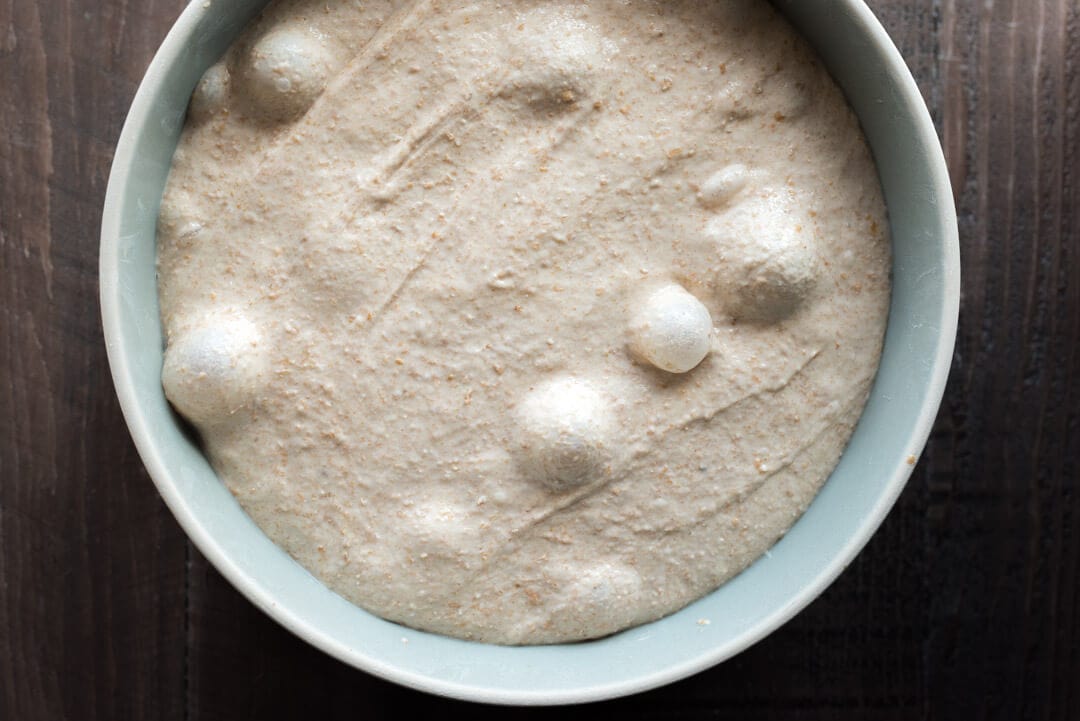
Monitoring a dough’s temperature is simple: stick an instant-read thermometer into the center of the dough and record the temperature.
I like to take the dough’s temperature at the end of mixing to record the final dough temperature in my baking notebook. I also record the dough’s temperature a few more times during bulk fermentation, when I stretch and fold it—this is a great time to check in and see how fermentation is progressing.
Some bakers will say you don’t need a thermometer and don’t need to monitor dough temperature—strictly speaking, this is true! People have been baking bread for centuries—way before the thermometer was even invented. However, I find investing in a few simple tools, with corresponding processes, helps me remove the guesswork and take steps to improve my bread-making consistency. A good quality thermometer (like my Thermapen) is one such tool.
Over time, as your baking intuition builds, reliance on these tools does subside, but to this day, I always take a minute (if that) to measure the dough temperature right at the onset of bulk fermentation. Why? It provides me with an intuitive sense of how bulk fermentation will progress. Is my dough temperature a few degrees lower than I expected after mixing? If so, I’ll either warm up my dough a little at the beginning of bulk, or I’ll plan for bulk fermentation to go a little longer than planned. Conversely, if I overshot my DDT, I know bulk fermentation will likely take less time, and I’ll keep an eye on the dough to divide it earlier.
Now, let’s look at how to use temperatures to ensure our dough is on target.
How to Calculate the Mixing Water Temperature for Bread Dough
Water is often the largest ingredient in a dough, so it has the largest impact on the final dough temperature (FDT). This is an opportunity for us bakers because the water’s temperature is easily adjustable, allowing us to dial in the final dough temperature.
If we measure the temperature of other factors—flour, the levain or preferment, the room temperature, and take into account heat generated when mixing—we can do a simple calculation to figure out to what temperature we should heat (or cool) the water to reach a recipe’s desired dough temperature (DDT).
Example: Calculating the Mixing Water Temperature for my Beginner’s Sourdough Bread
In the following example, which is from my Beginner’s Sourdough Bread. The recipe has a DDT of 78°F (25°C). First, look at the temperatures needed for the calculation:
- Levain or preferment temperature (this might be your sourdough starter, if you’re using that directly)
- Flour temperature (usually the same as your room temperature)
- Room temperature (use your Thermapen to measure this!)
- Friction factor (see below)
What is Friction Factor?
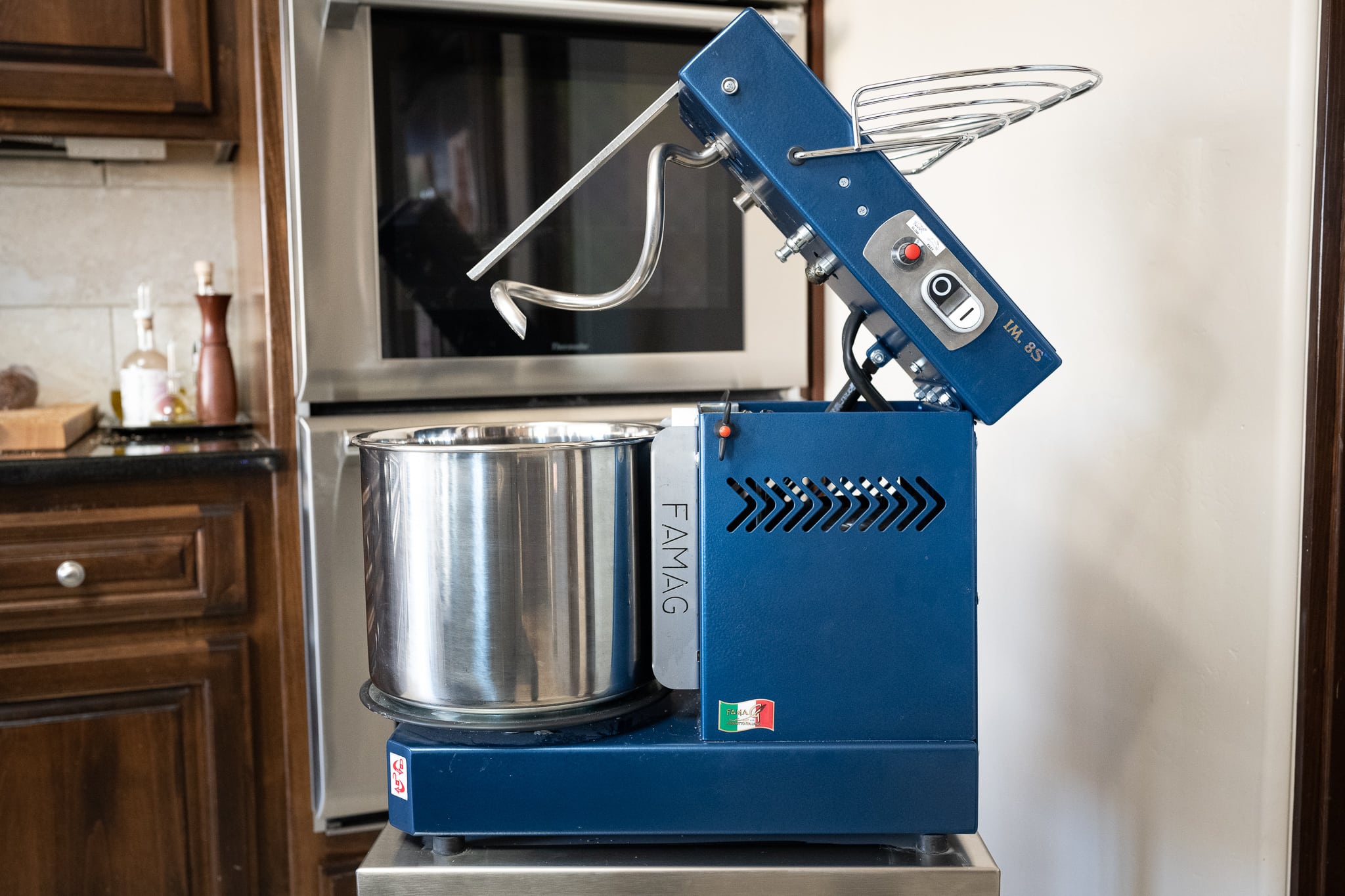
One variable in the water temperature formula that often causes confusion is the friction factor—the heat generated by mechanical mixing. When a stand mixer is running, the motor and mixing action warm the dough, sometimes significantly, depending on the mixer, speed, and mixing time.
When mixing by hand, I set the friction factor to 0. Hand mixing simply isn’t vigorous enough to heat the dough in any meaningful way (and in a cold winter kitchen, it might actually cool it slightly).
If you use a stand mixer, you’ll need to determine your friction factor by experimenting: mix a dough, note the dough temperature before and after mixing, and calculate the difference. Once you know your mixer’s friction factor, it stays fairly consistent as long as your speed and mix times don’t change.
So, back to our example, here are the temperatures I measured:
| Temperature Variable | Measured Temperature |
| Levain | 78°F (25°C) |
| Flour | 74°F (23°C) |
| Room Temperature | 74°F (23°C) |
| Friction Factor | 0 (since I’m mixing by hand) |
Mixing Water Temp = (DDT x 4) - (Levain Temp + Flour Temp + Ambient Temp + Friction Factor)
Mixing Water Temp = (78 x 4) - (78 + 74 + 74 + 0)
Required Mixing Water Temp = 86°F
We need to warm our water to 86°F (30°C) so that, at the end of our mix, our FDT will be 78°F (25°C).
Water Temperature Calculator
Use the interactive dough water temperature calculator to quickly determine how much to warm or cool your water so that, at the end of mixing, your dough reaches the desired dough temperature. Head to the water temperature calculator page to bookmark it and use it each time you mix.

Water Temperature Calculator
Don’t Like Math? Use This Water Temperature Cheat Sheet
I have a cheat sheet for temperatures like this in my cookbook, but here’s a quick reference chart. On the left, it shows what your kitchen temperature might be, and on the right, what you should warm your mixing water to so you get close to a final dough temperature of 78°F (25°C), the common goal for recipes at The Perfect Loaf.
| If your kitchen temperature is | Warm or cool the mixing water to |
| 68°F (20°C) | 98°F (37°C) |
| 70°F (21°C) | 94°F (34°C) |
| 72°F (22°C) | 90°F (32°C) |
| 74°F (23°C) | 86°F (30°C) |
| 76°F (24°C) | 82°F (28°C) |
| 78°F (25°C) | 78°F (26°C) |
| 80°F (26°C) | 74°F (23°C) |
How to Heat or Cool the Mixing Water
The easiest way to warm the mixing water is to heat it in the microwave (my choice for convenience), on the stove, or to draw warm water from the tap. To cool the water, use cold water from the fridge (I keep a container inside just for this) or drop a few ice cubes inside your water pitcher.
Where is The Best Place For My Dough to Rise?
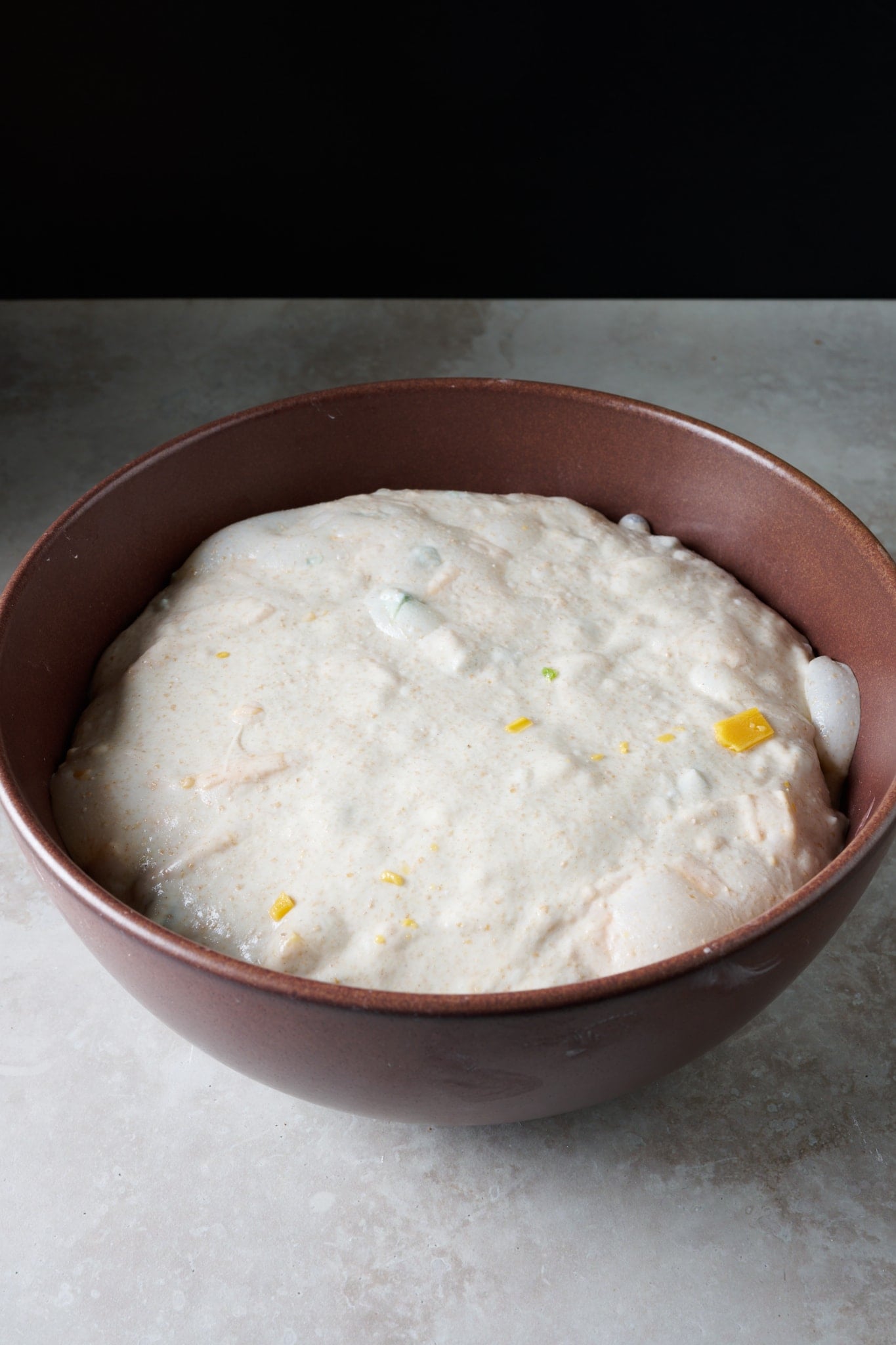
Now that we know how to monitor our dough temperature and hit that all-important DDT each time, how do we ensure our dough maintains a sufficient temperature throughout bulk fermentation and proofing? As home bakers, this can be challenging because our doughs are usually smaller batches, which are more easily affected by temperature changes. Additionally, the home kitchen can also have drastic temperature changes due to heating and cooling. So, the trick is finding the optimal place to proof dough.
These are my favorite places to let my sourdough bread dough rise:
- Inside a small home dough proofer
- Inside the home oven, closed and with the light on
- Inside the microwave
- In a warm spot in the kitchen, for me, this is on top of my refrigerator
Let’s look at each option in more detail.
Using a Home Dough Proofer to Maintain Dough Temperature
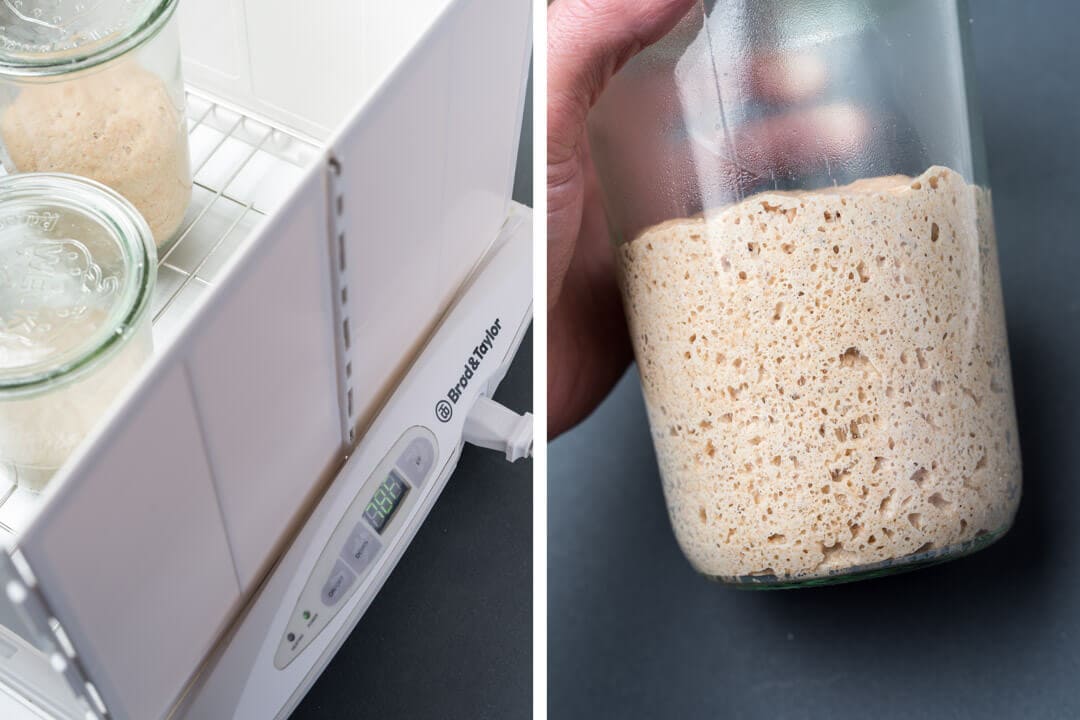
I’ve been using a Brød & Taylor dough proofer for years. The electric proofing box sits in my pantry and runs 24/7, keeping my sourdough starter (and a levain before a bake) at a comfortable 76°F (24°C) for optimal fermentation. Since purchasing this proofer, I have noticed a significant increase in the consistency of my bread, thanks to its steady temperature.
There’s enough room in the proofer to fit my starter (and even another levain) in a corner and my proofing bowl with 2kg of dough (see the picture below). This means I can have multiple bakes that are nice and warm at the same time.
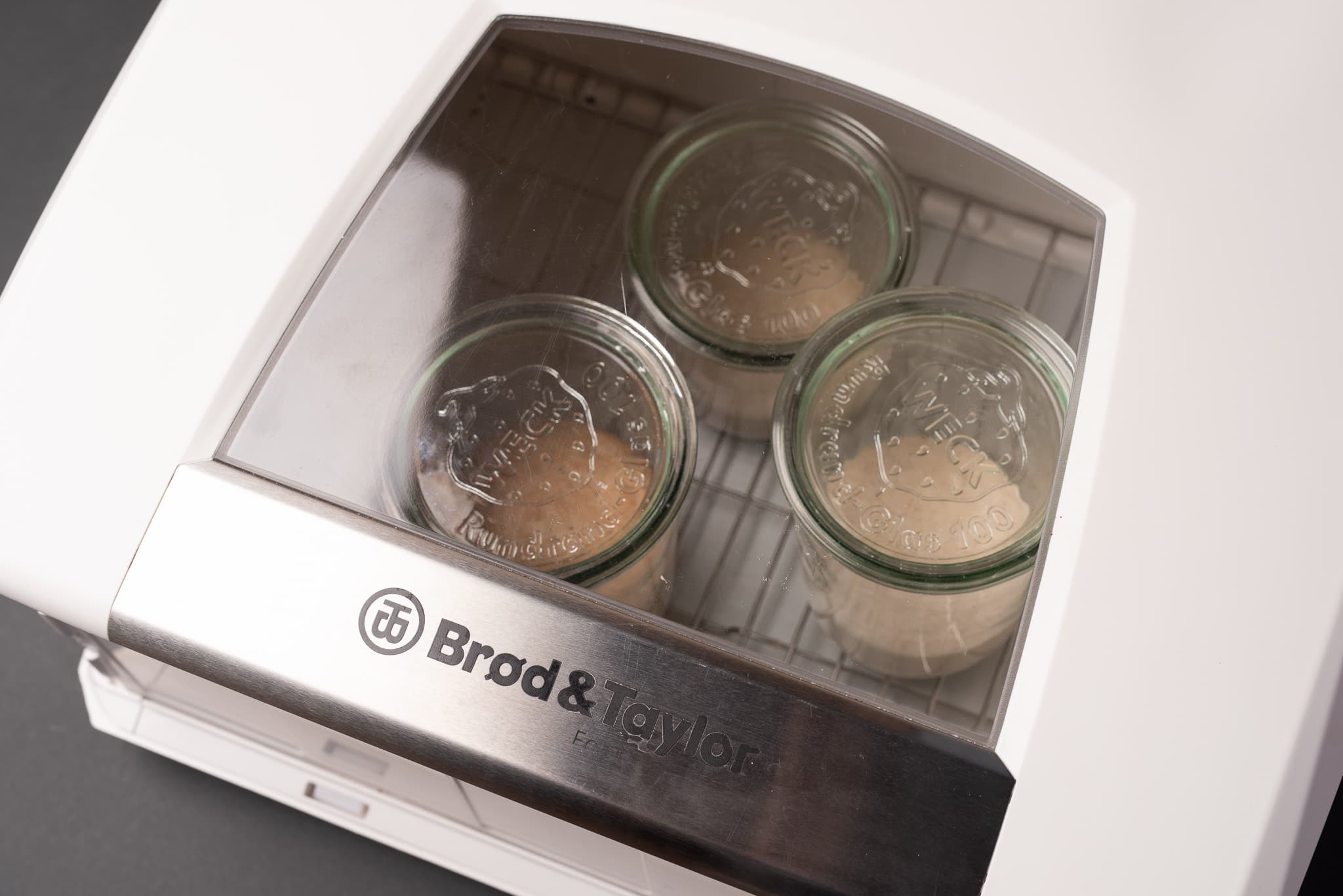
What you see above is typical of a morning in my kitchen: two levain and my starter (on the left) in my favorite Weck jars. The proofer is plenty spacious, and I can even fit my bulk fermentation container with these three jars.
The proofer is dead simple to use. Use the up and down buttons to enter the desired temperature until it is displayed. The entire bottom of the unit is a gentle heating element that runs continuously to maintain the set temperature. They even make a shelf you can insert halfway down the length to hold shallow bowls or trays.
In the beginning, I mentioned that adjustments could be made in bulk if we miss our DDT by a small margin (1 to 2 degrees). If my measured FDT is a little low, I’ll turn up the proofer by 5 degrees so the dough mass heats up at the start of bulk. Then, at each set of stretches and folds (30 minutes apart), I remove my dough from the proofer and measure its internal temperature. If the temperature is close enough to my initial target, I’ll set the proofer back to my DDT for the remainder of bulk.
When I have dough in bulk fermentation inside the proofer, I set it exactly to the formula’s DDT (typically 78°F/25°C).
Because the proofing can be adjusted quickly, we can speed up or slow down fermentation (within reason). There are so many handy features of a home proofer, and I recommend reading my guide to using the Brod and Taylor Proofer for an in-depth discussion.
Using a Home Oven to Maintain Dough Temperature
A home oven is another great, convenient option for maintaining dough temperature. Place your starter or bulk fermentation container in the oven (turned off), insert an ambient-temperature thermometer inside, and turn on the interior light. Usually, this light will generate enough heat to raise the internal temperature quite a bit—just keep an eye on that thermometer to ensure it doesn’t go too high. (Additionally, put a sticky note on the outside of the oven that says “Do Not Turn On!” so someone doesn’t accidentally bake your starter.)
Using a Microwave to Maintain Dough Temperature
A microwave is a small, sealed chamber that is rather convenient for holding a starter, levain, or a bowl of rising bread dough. I typically cover my bulk fermentation container or proofing dough, then place it in the microwave to help insulate the dough and keep it warm. If you want to warm up the dough, boil a small cup or bowl of water and place it inside the microwave alongside the dough.
Using a Warm Spot in Your Kitchen to Maintain Dough Temperature
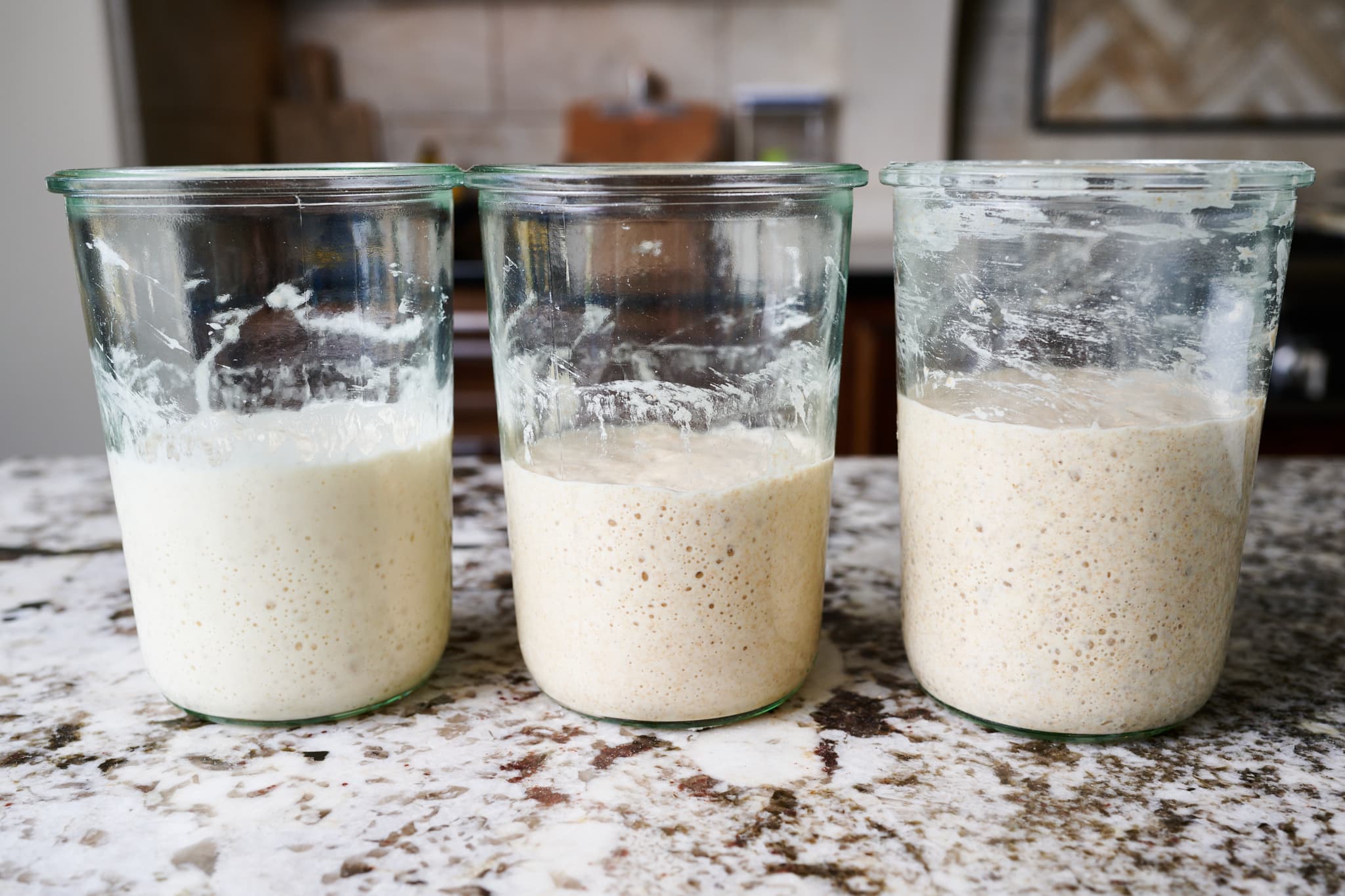
Every kitchen has warm and cool spots. As bakers, we seek these out over time and learn to place our dough (and our sourdough starter) in various locations depending on its temperature needs. The top of my refrigerator is always a few degrees warmer than the rest of the kitchen. In your kitchen, the warmest spot might also be next to a coffee machine, a home oven, or another secret spot. Find yours!
Note: For my sourdough starter, I like to keep it in my Sourdough Home, a specially designed little unit that maintains the perfect temperature.
How does Dough Temperature Affect Bulk Fermentation Time?
While it’s challenging (if not impossible) to assign a hard number for how long bulk fermentation should last for a particular dough, the following table shows how a range of final dough temperatures could impact this duration.
Note that this table is for illustrative purposes only and provides a snapshot of how the bulk fermentation duration may vary with temperature. The table assumes all other factors are equal, bake-to-bake (which is hard to ensure!), and is most accurate for the recipes and processes here at The Perfect Loaf.
| Final Dough Temperature (FDT) | Typical Bulk Fermentation Duration |
| 75°F (24°C) | 4 to 4.5 hours |
| 78°F (25°C) | 3.5 to 4 hours |
| 80°F (26°C) | 3 to 3.5 hours |
In the chart below, you can see this idea depicted roughly in a diagram: as dough temperature increases the bulk fermentation duration decreases.

Dough Temperature FAQs
When is the dough temperature for bakers calculated?
The final dough temperature (FDT) is calculated right at the end of mixing, before the start of bulk fermentation.
Where is the best place to put the dough to rise?
A warm spot in your kitchen is the best place for bread dough to rise. Try to find a place that’s between 75°F and 78°F (24°C and 25°C) to encourage strong sourdough fermentation.
What happens if the dough is too warm?
If the dough is too warm, it can become sticky, hard to handle, and eventually overproof.
Will dough rise at room temperature?
Yes, absolutely. Room temperature can vary widely and differs from room to room, but as long as it’s around 68 to 76°F (20 to 24°C), you’ll see your sourdough dough rise. The cooler the temperature, the longer it will take for your dough to rise.
How long can you let the dough rise at room temperature?
The time you let the dough rise at warm room temperature depends on the dough formula and the exact temperature. For most sourdough bread doughs, a final rise (proof) time of 1 to 4 hours at room temperature is appropriate.
My kitchen runs very hot—between 82-90°F (28-32°C). How do I adjust my timing?
At these temperatures, fermentation can move twice as fast as a recipe anticipates. For instance, a 4-5-hour bulk might be done in 2 to 2.5 hours. Use ice water for mixing, watch the dough rather than the clock, and consider reducing your levain percentage to 10-12% pre-fermented flour to buy yourself more working time.
What’s the ideal refrigerator temperature for cold proofing? My dough always comes out underproofed from the fridge.
Aim for 38-40°F (3-4°C) and verify with a thermometer, as home fridges often run colder than the dial suggests; below 35°F (2°C), fermentation can nearly stall. Also, check that the bulk has gone far enough before shaping: a 50% rise alone isn’t always sufficient. Look for a dough that feels aerated and jiggly, and give shaped loaves a 20-30 minute rest at room temperature before refrigerating.
During bulk fermentation, the rise doesn’t seem significant. Is this because of low kitchen temperatures?
Most likely yes. In a cool kitchen (around 68°F / 20°C), bulk can easily take 6-8 hours, and the dough often feels sluggish for the first half before picking up. Don’t rely on volume alone. Look for bubbles on the sides, a lighter feel, and a jiggle when you shake the container. Use warmer mixing water to hit your DDT and find a warm spot to maintain it throughout bulk.
Is there a maximum water temperature I should use to avoid killing the yeast in my levain (or starter)?
Yeast starts to weaken around 120°F (49°C) and dies above 130°F (54°C). As a practical limit, stay below 110°F (43°C) for mixing water, especially since you’re often adding water near the levain before it’s diluted by flour. In practice the formula rarely calls for water that hot anyway, but it’s a good ceiling to keep in mind.
What’s Next?
As bakers, I’ve talked about how we need to be acutely aware of our environment and treat temperature as importantly as our ingredients—and it is that critical: temperature is the driving force behind fermentation. To see how temperature plays a role in the final rise of sourdough bread dough, read through my guide to proofing bread dough.
Happy baking!


208 Comments
I’ve been using my sous vide appliance to control the temp. Fill a tub with water, put my dough (in a cambro container) in the water with the souvide appliance at the desired temp. Wait until it gets to the height I want. A sort of proofing box.
That's a fantastic idea, David!
Hello, Maurizio. I live in Ireland, and the ambient temperature in my kitchen, just about all year, is 69 to 70 F. I use a Brod & Taylor proofer, and have found that adding water at about 97F I end up with a dough temp at the end of autolyse somewhere between 78 – 80F (pretty much in line with the chart you provide in your book). After a 2 stage mix (levain, salt, and 1/2 water 2) it might be holding around 75F, but by the end of working the dough the temperature has dropped right down to 72F. So, if I were to take that as FDT, I’d be way off. Nevertheless, bulk is clocking in at about 4 hours, and I’m getting excellent spring and a nicely fermented loaf (most recently, your Sunflower and Sesame). After the first 30 minutes of bulk the temp might have come up to about 74F. So, basically, I can’t hit your target of 78 ‘after mix and working the dough’ and just wondered if you had any comments.
How about using a dehydrator for proofing?
That’ll work if the temp is right!
What would I set the friction level to on the calculator if I’m using my Kitchen Aid mixer?
I’d say around 20°F or so!
Is there a max temp your water can be to prevent it from killing the yeast in the levain?
I don’t like to go too high over 110°F
Maurizio, you said somewhere you’re an engineer, so I’m guessing you’ll have thought about this: Why is it that the temp calculation does not include amounts of the different ingredients? Giving the same weighting in the equation to a small amount of levain as a large amount of flour, for example, doesn’t seem to make sense. How does this work?
Thanks again for all the great info, recipes, and more!
Yup, you’re absolutely right, Even! Mass isn’t taken into account, so there’s quite a bit of error inherent in these calculations. BUT! The calcs are just to get a ballpark, not a very precise number. Empirically, in the kitchen you might run this calc once or twice but once you get a good number, you’ll find it mostly stays around there and slowly shifts as the seasons come and go. So it’s an easy way to quickly get a water temp number, but it’s by no means super accurate!
Thanks for the quick reply! Treating this as ballpark totally makes sense–today I’m making your Seeded Whole Wheat Sourdough for the second time (fantastic recipe!), and the formula got me to an actual FDT of 75 rather than 79–so this teaches me how to adjust to real-world. And FYI, I do notice that every source online uses this approach, so a formula with mass must be just too complicated to work out. Anyway, thanks again!!
Hi there! I have tried twice this recipe for seeded whole wheat sourdough and both times it’s been a disaster. I followed the recipe to the point btw. Do you live in a cold place? I do, and that may be the reason. Thanks for your insight on this. I just think it’s interesting that someone was successful on that what I failed so bad. Thanks!
Hi just wondering, If my bulk fermentation for sourdough is above 24-26C like its 30-31C, when I do final shaping, the dough is harder to do final shaping, its collapsing. May I ask why? Because of the temperature?
Yes, it sounds like the dough is likely going too far in fermentation due to the warmer temperature! Try to keep it cool and/or use cool water for mixing to offset.
I cleared by cache and is not showing up at all on the page (calculator). I am on my laptop rather than phone.
Just an FYI. Thanks.
Thank you for checking back in with this, Robin. I’m still looking into the issue here—I’m perplexed as to what’s going on. Sorry for the delay with this!
Darn your calculator is not showing up.
I just did some cleaning up over here, I’m hopping that fixed the issue (I see the calculator over here without any problems). Do you still see an issue? If so, can you try cleaning your browser cache and try again? I’d like to get this fixed for you (and others)!
Still no luck with IOS or IPAD. I will try laptop next. I just figured it the old fashioned way pencil and paper. I will let you know when I try laptop later. Thanks!
My 1st two loaves the outside is nice and crisp. But the inside is doughy. Very heavy and kind of wet and not springy and lots of bubbles. What did I do wrong??
Did you check internal temp prior to removing from oven? Did you preheat your cast iron pan if using one or baking stone? Sometimes appears outside is too done but is not and if removed too soon without checking internal temp you have an undercooked loaf. I am sure Maurio will add or correct me if wrong 🙃
I’ve read this now a few times and also looked at various blogs about summer sourdough baking. I’m really struggling to get my dough cooled down enough that I can develop the gluten and allow it to go through bulk fermentation. So far, I’ve reduced my water temp and reduced the amount of starter to slow the fermentation. The dough isn’t doubling as fast but it’s sticky and slack when it comes time to shape (as if it is still over proofed) and I end up with most of the dough stuck to my fingers. My house is hot right now (no AC) as we live in the Rockies. I can’t seem to find the happy medium needed to successfully shape…it seems like my dough is doubled within 2-3 hours but has no substance…it’s just pillowy. And, when I am successful at shaping, the end result is a fairly dense crumb without much oven spring. I am using the basic Tartine Country White which usually is consistent in cooler months when I use my proofer. Any advice for baking sourdough during heat waves?
Hey, Perri! I’m just about to post a dedicated article to baking bread in the summer, it should address all your concerns and have some practical advice for you. It’s hot here (it was 105F the other day…) as well and I struggle to keep my dough in check—hopefully some of my tips here will help. Keep an eye out this week for the article (hoping to post by Friday). If you’re subscribed to my newsletter you’ll get an email when it goes up end of this month as well.
Stay tuned!
Hi Maurizio,
Regarding the broad and taylor, do you use it all year round, including during the Summer season, I know it gets quite hot where you are
Hey! It does get super hot here in the middle of summer. When it’s very warm I turn the unit off, but it has a permanent place in my pantry. I always put my starter in there even in the summer (it’s just turned off) because it’s a convenient place for me to keep it out of reach of others. The key is just to keep it at the temperature you want–if it’s very warm in the kitchen, it doesn’t need to be on, if it’s cold, then yes so it warms your starter.
Hello Mauricio, I saw you talking about your high temperature… where do you live? I live in Palm Springs where the summers are brutal…Making bread can be a challenge.
Hi Maurizio,
I built my own proofing box out of an old cooler and a temperature controller with a 25 watt light bulb. The controller can be set to +/- 1 degree. I’m sticking all of my materials in the cooler overnight before mixing, so they are all at 78 degrees when I throw them in the mixer. What do you think? Seems to me like this is pretty good process control.
Yes, that sounds like a fantastic approach, Fred!
Hi Maurizio,
I live in a warm climate, around 28-30C. I hit the FDT around 24-25C using cool water. I get a good feel of the dough while folding. What confuses me is the recommended bulk fermentation time should be shorter in my climate, around 3 hours using 20% levain, However, I don’t see the my dough doubling at the end of bulk fermentation. My question is, how much longer can I extend the bulk fermentation without over fermenting my dough or it ending to be too sour (i’m also aiming for a less sour loaf). Should I wait for the signs of a well fermented dough no matter how long?
Thank you so much for all you do in the bread community!
Yes, it’s all about the dough and how it’s progressing–you can pretty much ignore the clock. That said, the time does give you a general indicator for about when it should be ready, but there are so many factors that go into this (temperature, starter/levain ripeness, flour, levain %, etc.), this is why I like to give more description and/or show photos of the dough when it’s ready to be divided. If your dough is moving slowly, definitely give it more time!
Since I already have an instapot with a yogurt setting, could I use instead of purchasing the proofer? I’ve read several articles on line, which instructed to set it for yogurt, on low, and assume it might double in half the time. Would the flavor develop as well? I’d be eager to hear any thoughts you might have on this.
I haven’t tried this! As long as it doesn’t get too warm, it should work just fine. I would avoid trying to heat the dough excessively to speed up the process. You can do this to some degree, but going warmer than say 85F will likely result in a dough that’s hard to control 🙂
Hello, Mauricio,
I, too, keep a cool house about 66 degrees. I found a source of heat in the kitchen, though.
Our old SubZero refrigerator and freezer have fan blowers at the bottom for the condenser air, gently blowing forward. Warm air! If I put the starter or levain jar there, it gets to about 78. That’s where I now put my dough for bulk fermentation, etc. Dough gets to about 76 degrees. No need to look to anything else.
Wow, now isn’t that handy!? Nice find, David 🙂
Hello Mauricio, how many hours of first bulk fermentation, with the dough in 25/26 Celsius, and in the AMBIENT is 28, 29 , 30 Celsius?
It really depends on the dough. Temperature is one part of the equation, but so is the flour used, the amount of levain in the dough, and the final dough temp. If the FDT comes in around 26-27F, for my typical doughs which are around 15% levain to total flour, I go 3.5-4 hours.
Hi! One thing I’m not sure of, after overnight rest in fridge, do we bring temperature of dough up again before baking? I don’t see that instruction so I’m a little confused if we’re supposed to bake straight from fridge. Thanks!
Nope, bake straight from the fridge!
I’ve been working with whole grain and high-extraction flours ordered from mills. I use flour straight from the freezer, room temperature water and set the Brod & Taylor at 74, but the dough sometimes feels “ready” after 1.5 or 2 hours – puffy, domed, jiggly and with a few bubbles. But I want to do more stretch and folds, so I keep going to 3 or 4 hours sometimes turning the proofer down to 72. But while I do start to see small bubbles later, it never feels as good as it did at the early stage – it’s a bit more dense. My loaves have been pretty good and I get decent oven spring but I wonder if I should be doing something else to slow down the fermentation from the start – or whether I should let it go for six hours at 72 degrees and maybe it would get more active again.
If you’re using freshly milled flour, you’ll almost always see an increase in fermentation activity. To offset, you can reduce the levain percentage, the temperature, or the percentage of whole grains (and especially freshly milled). In your case, I’d try dropping the levain percentage since you want to keep the other two constant. That should help!
Thanks so much, Maurizio, I’m currently using 160g leaven for 1000g flour. I’ll try dropping to 120.
Actually, I’ll cut the levain in half, to 80. And go down from there as needed. I have also been reading about the method of using only a half teaspoon of unfed starter, with a very long fermentation time, which is intriguing.
I can’t find a calculator on the page indicated above. Do I need to use a computer rather than mobile to access the feature I can do the math but just wanted to check out the calculator. Thanks.
It seems to not be showing up on mobile—working on a fix for this. It displays fine on a desktop computer!
Robin—this should be working now on mobile!
Hi Maurizio, want to bake Pain De Mie been trying figure out how to calculate this with so many addition milk from fridge, honey, butter? Any advice? TY
Hey, Max. Because of the milk from the fridge in that recipe, usually the dough temp works out if you use a mixer. If you’re worried it will come in under, you can always warm the milk to 78F or so to help. It becomes hard to calculate the FDT requirements when, like you said, there are so many inputs into a formula. Typically, I’ll use my best judgement (experience!) to try and even things out, then see what the results are. If the dough wildly overshoots—over or under—I’ll note this for the next time and compensate by heating or cooling a liquid in the recipe.
I made my first sourdough bread ever. I used your Beginner recipe for Sourdough Bread w/All Purpose Flour. Unfortunately I didn’t have all purpose flour. Instead I used what I had. Probably not the smartest thing for a begginer to do. I used 25% whole wheat flour and 75% white bread flour. We live in CT, The weather last weekend turned. It was very cool. We keep our house on the cooler side as well. I didn’t realize how big of an impact temperature would really have. My house is or is usually at 65 degrees.Thats the norm. When I was making the bread, I noticed I was having issues with it rising. During that time I had something running in the dehydrator. So I put the dough in the same room as the dehydrator. It helped it rise, but not as much. I wanted to bake the bread, so I just put it in the oven. It came out quite delicious. The crust was crispy, the inside was nice and fluffy, with a very strong wheat flavor. So if it is this cool in the house. What can we do to adjust the temperature? Any suggestions for beginners likes us? Or who live in colder climates?
Thank You
Even though you didn’t get significant rise, you were keen to the correct modifications needed to keep the dough on track—that’s important! What you can do is warm the mixing water for the dough to reach the final dough temp listed in the recipe, that will help quite a bit. From there, try to keep your bulk container warm, you can place it in a turned off oven to retain heat (and turn the light on/off occasionally to warm the chamber). Finally, just give the dough more time! At 65F you’d likely need to bulk for quite a long while, I’d imagine around 6 hours or so (maybe more), until the dough had sufficient fermentation to divide. I’d say, do a mix: warm the water and try to keep the container warm, then just extend bulk as needed until the dough looks and feels as I describe in my posts. This should get you there. Happy baking!
I’ve been using a simple and economical method for keeping my levain and dough at the desired temperature during fermentation – a method that I find more accurate, and easier to control than using an unheated oven with the light on, or with a bowl of steaming water.
I have a pot with an opening nearly the same size as the rim of my mixing bowl. I fill the pot about one 3rd full with water that is the DDT, or a couple of degrees warmer, then place my bowl with the fermenting dough over the pot. The pot’s opening, and that of my bowl are close to the same size, so I can use the pot’s lid as a cover for the dough bowl. I then wrap a folded bath towel around the pot to help insulate the water in the pot, and place another folded towel on top of the dough bowl. This method holds the dough very accurately at the desired temperature. I check the water temperature periodically with a thermometer – usually at each stretch and fold – and adjust it as necessary by replacing a small portion of the cooled water with warmer water as necessary until the desired temperature is again achieved. For the levain, I use a similar method, setting the levain jar into a deeper bowl or pot partially filled with water at the desired temperature, and cover and insulate the containers as for the dough. I’m getting consistent results with this easy, inexpensive alternative to a proofing box.
This system can also be useful when the ambient air temperature is WARMER than the desired FDT, (when a proofing box may not be useful). Just put an ice cube or two in the water to bring it DOWN to the desired temperature, or a degree or two lower.
Love this idea, Julian! You’re making a little insulated dough chamber with a large mass of water as the heating/cooling element—that’s great! Definitely a cheaper alternative to a proofer, we all have these items in our kitchen. Thanks for sharing that, I should give it a try and update this post.
Exactly. And thanks again for putting together this very informative website, with a lot of useful information, links to equipment, and thoroughly vetted recipes. I’ve found it very helpful. And although I can’t always use the exact flours you specify in the recipes, I try to find something with similar properties, and have generally had excellent results.
Hi Maurizio,
Thank you for the great post! I have been struggling for half a year to get this right…
You’re very welcome!
Do you need to cover the bowl while proofing in the proofing box? I’m looking into getting one of these so I don’t have to cover the loaves…
Great site and a lot of great info!!! Really well done
Thanks, Mark. Yes, I usually do still cover the bowl. However, the B&T proofer also comes with a little water tray to put on the bottom that keeps the interior humidity high, in which case you wouldn’t need a cover.
Hi Maurizio!
Great texts I’ve found here in your website.
Thanks for sharing your knowledge.
Eder Nunes, from Sao Paulo, Brazil.
Thanks, Eder! Happy to help. Happy baking!
Hi Maurizio,
You define the FDT as the temperature of the dough right after mixing all ingredients together. Using your Best Sourdough recipe as an example, would this temperature be taken after the autolyse, after mixing in the levain, or after mixing in the salt?
Btw, the “common bread baking calculators page” link on this page is broken; just fyi. Thanks again for all the amazing info you provide!
Link is now fixed, sorry about that!
You take the temperature right at the beginning of bulk fermentation (end of mixing).
Hello, Maurizio!
In this time of quarantine I’m back to my sourdough adventures.
This time I’ve done more research and I’m monitoring the temperature of my starter and my dough.
The problem is: I live in Brazil and in a very warm region. We are at 32°C all year.
I’ve always noticed that my starter grows and collapses very quickly, it achieves around 120% growth in 3 hours and starts to collapse. And now I’m beginning to manage the temperature a little better. Can you check my schedule and see if anything is wrong?
What I’ve changed is to always use cold water (8C) in both starter and dough. Then I check the temperature and if it’s above 26C, I put it in the refrigerator for 10min and give a little mix, is enough to lower it to 25-26C. Then I check the temp every 30 min to keep it bellow 27C. If it goes too warm, 10 more minutes in the refrigerator. I usually only correct the temperature after the first correction with the dough in the bulk fermentation. The starter I let it warm up until 31C, which will happen after around 3 hours. This is giving me a rise time of the starter to around 6 hours.
Thank you for all the lessons and recipes! Keep doing this great job!
Best regards from Brazil!
Fellipe, that sounds like a good approach. Yes, if your dough/starter/levain is too warm, even after cooling the water, do what’s needed to bring the temperature down! Usually for me that means mixing with ice water.
Hey Fellipe,
I’m also living in similar temperatures. How do you handle your dough and bulk ferment time?
FYI the content of this page is not being displayed.
Andrew — thanks for reporting this. I’m looking into it. If you don’t mind, have you seen this on any other pages here at my website? Sorry for the trouble, I’m hoping to track this down soon.
Ok, found the issue — all should be working now!
Hi Maurizio,
Thank you for the great post.
I have kept the temperature for my last baked. And the FDT was 21C, but since I saw the structure was already quite built up. i actually did only 2x S&F, 30mins apart ( after lamination). So I am bit confused, if FDT is dependent on the starter and/ or flour and/or autolyse time? Because I didnt need to have that long of bulk fermentation as you suggested on this post.
Kawai.
You’re welcome, Kawai! FDT is simply the temperature measure of the dough right at the end of mixing and beginning of bulk fermentation. It does take into account the temperatures of all the things going into the dough, as that will determine the final temperature. Working with autolyse can be tricky, though, because if you have a long autolyse the dough might cool (or warm) during this time and throw off the FDT. This is why having the reserved water is handy, it’s kind of a last chance to try and hit the desired dough temp (DDT) for a particular recipe.
I hope that helps!
Hi, Maurizio! I’ve built a dough retarder in order to do final proof overnight at 50 degrees instead of frig’s 38 degrees. Problem is that my dough is overproofed following a 12 hour overnight stint in the dough retarder. My go-to sourdough formulas typically have 125-180 grams of 100% starter…is there a rule of thumb for decreasing starter amounts when using a dough retarder so to avoid overproofing? Any other tips for using a dough retarder?
There’s no rule of thumb, unfortunately, as there are so many other parts of the process that contribute to this (final dough temp, flour selection, hydration, levain maturity, etc.). I’d say if you want to push the final proof temp to 50F, you’ll likely have to shorten that time quite a bit to avoid over proofing. I run into the same issue when I increase my overnight proof temp as well, that’s just how it goes!
Hello Maurizio, I have been looking at the methods used for calculating the required water temp to achieve a specific FDT. The method used by Hammelman and also on your site and many others using a multiplication factor of 3 or 4 then deducting the known temperatures of ingredients is, i believe, flawed as it does not take into account the mass of each item and therefore its contribution to the final temperature of the dough. That it works reasonably well is I think because it uses an extraneous crib factor in room temperature which in reality has no immediate affect on the dough temp (You could mix your dough in a 35f coolroom for instance with ingredients from outside the coolroom where the temp is 75f). What should really be considered is the mass temperature of ingredients as determined by their weight and temperature prior to mixing. The rather formidable formula for this calculation is
t = (m1 c1 t1 + m2 c2 t2 + … + mn cn tn) / (m1 c1 + m2 c2 + … + mn cn) (2)
where
t = final temperature (oC, oF)
c1..n = specific heat of substances (kJ/kgoC, Btu/lboF)
t1..n = temperatures of substances (oC, oF)
Using this fomula and the following specific heat
Flour 1.6
H2O 4.2
Will give a far more accurate result for calculation of RWT to achieve the required FDT. In its simple form it can just be used with the flour and water as salt and yeast are minimal in their impact on the FDT. With a preferment however that will add a third part to the equation complicating the maths a bit.
If anyone reading this is interested there is a very good site at https://www.engineeringtoolbox.com/mixing-fluids-temperature-mass-d_1785.html where a “Mixing Fluids Calculator” is included ( flour is treated as a fluid same as water but with different specific heat factor).
All of this is of course a bit pedantic but it is accurate and does take in to account and allow for items like flour or preferment that could be far colder or hotter and of vastly different masses and therefore far greater contributors to the FDT depending on their mass – as you would expect really.
Interestingly the water temp calculaor contained on the Weekend Bakers site https://www.weekendbakery.com/ appears to use a javascript calculator that does actually take in to account the mass of the flour and water (in both the dough and preferment) used but only if you disregard the “Room Temp” title and use instead the Flour Temp in that field. Most other calculators I have seen use the Hammelman method of 4xFDT minus known temps including room temp = desired water temp approach. As said above however this does give a reasonably good results so you well might ask who cares?? 🙂 I just needed to get a formula that made sense and was science based instead of tradiion based.
Couple of assumptions I have made:
FDT is temp at completion of mixing and before ferment
Room temp is probably used in some instances as the flour is often stored in the mixing room
I have disregarded friction factor for my KA mixer as I only mix for max 2 mins at speed 2 as recommended by KA and have not been able to measure any discernable temp increase
Hope others find this interesting also and sorry for the very long post
Leslie — thanks for all that information, and of course, you’re completely correct. The formula I present above (and learned from Hamelman in his class, and many other books) is very simplified and sort of meant to be a quick calculation to be done “in the field” while you’re baking. It’s not an end all formula as the mass of each ingredient should be taken into account (what if we were using 20kg dough sizes? Then it would surely matter!).
The formula I use is sort of a starting point for a dough, to help bakers get in the ballpark for temperatures to reach a certain FDT. After they bake, it’s time to adjust as necessary. Doing the same dough day after day helps you home in on a temperature for the water to reach your FDT — the temperatures of the ingredients rarely drastically change and so each day we can slowly get closer and closer to our DDT by adjusting water temperature. In fact, these days I rarely take temperatures here in my kitchen because I’m slowly adjusting water temperature as the seasons (slowly) change, heating as necessary in winter and cooling as necessary in the summer. My large mixer will certainly heat up my dough if placed in second speed, so I intuitively add cold water to offset that.
Thanks again for sending all this info, I should get into the code of my calculator and make it more robust!
Thanks very much for posting this! After using Maurizio’s formula a few times and observing that my FDT didn’t seem to track to his formula, I wondered about the mass of materials having an effect on the outcome. I had a question or two and a comment on your post:
– In the denominator position of your formula you have
(m1 c1 + m2 c2 + ... + mn cn) (2). So, are we to multiply(m1 c1 + m2 c2 + ... + mn cn)by2and, if so, why?– Have you had any luck with arriving at a generalized specific heat for the levain?
– I couldn’t seem to find the calculator you mention at Weekend Bakers, but they link to an Excel spreadsheet at http://www.wildyeastblog.com/water/; is this what you were referring to?
I think that “(2)” at the end of @leslievalmadre:disqus line there is from the original post designating that’s the second equation — a typo (I could be wrong). I’ve been playing with this ever since her post and I haven’t arrived on a specific heat for levain, perhaps using water would be sufficient for this? I’d love to hear if you guys have made any progress here — like you’ve both said, taking mass into account will certainly get you closer to the result.
In the end, I think taking notes in the kitchen is really the best way to adjust mixing water temperature from day-to-day, assuming ambient/flour/levain temperatures aren’t wildly different each day.
I think that for our purposes you’re probably correct about following the heuristic of taking notes and adjusting water temp from day-to-day to narrow down a rough formula. If you’re working with relatively the same amounts of flour, water, salt, and levain each time, it would seem something like this would work. However, the geek in me would love to calculate the specific heat of the levain!
I looked up a general formula and found
Cp = Q/mΔT, where the specific heat is equal to the added heat in Joules divided by the product of multiplying the mass by the change in temperature. I’m getting hung up on obtainingQ, though, as it doesn’t seem like an easy thing to do. I’ve found a few old research papers that talk about specific heat of various flours but nothing that seems to address this.Hi Mario. Like others I have spent several mornings reading and studying your articles and the comments. I am on a mission. Really appreciate all your information and the replies you give which are most instructive. I have been baking breads using sour dough starters for years but have not paid much attention to many of the things you do such as dough temp. I have used several books- Many of Peter Reinharts and Chad Robertson. Have learned a lot but trying to get better. I use a 100% hydration starter, KA all purpose flour 50% and whole wheat flour. Sometimes I will add in other flours such as rye. But my starter and levains ripen much faster than what yours do. My kitchen temps are warmer, 81 degrees. So I use cold water. So timing gets really rushed sometimes. Also, I like a more sour flavor such as PR’s San Franciso Sour Dough. But like the more open crumb and darker crust of higher hydration doughs. So looking for ways to retard both bulk fermentation and the final proof. Any suggestions. Also I am baking in DO. And do not get the flamboyant ears on my loafs. Any advice would be most appreciated. Thanks.
You’re very welcome, Victoria. I’d say the most important thing is to always try to hit the desired dough temperature in the recipe, this really helps set the stage for bulk fermentation. If your FDT (final dough temp) is higher than a recipe states, expect that your bulk might need to get cut a little earlier, which is ok! Just adjust as your dough develops.
If you find your dough is always progressing too fast for your liking, you can always reduce the levain percentage in the formula to adjust. For example, if I call for 15% levain in a recipe and you find it bulks or proofs too fast, even at the DDT, try dropping the levain to 10-12% to slow things down.
I hope that helps and happy baking!
Dear Maurizio, how about baking sourdough in summertime? I am living in Turkey, Istanbul and it is hot here during summer, average 30 Celsius. Rather than warm up the water I should make it colder to have an optimum dough temperature.
Should I use cold water -at a certain temperature which I will calculate on the basis of your formula- or ice cube maybe, at the beginning of the autolyse? Another alternative is to use cold flour, kept in the refrigerator?
When the ambient temperature is 30 Celsius the bulk fermentation is also effected: should I keep the bulk shorter (on the basis dough observation) or should I put an ice cube/gel ice pack next to the dough to impede it to get warmer?
That’s right: when conditions are warm, you might have to cool the water to drop the temperature of everything when mixed, in order to reach your target final dough temperature. You can use ice cubes, or if you have a fridge, fill a large container and stick it in there a few hours before you’re planning to mix.
You can certainly try to cool the dough somehow to slow things down, but ultimately you’ll have to adjust the bulk timeline based on how the dough is progressing. If it’s very warm, bulk might be quite short (but it’s best to not shorten this or allow the dough to get too warm!).
Hope that helps!
Is the temperature formulation for the water thats going into the autolyse?
Yes, that’s right. Note that if you’re doing a long autolyse the water may cool, or heat up, depending on your ambient temperature. In that case it’s best to try and keep your dough at the temperature you’re shooting for (desired dough temperature) during this period.