

As a bread baker, you might find yourself in the same situation as I am: scattered bags of flour in the pantry, some with just little bits of this and that, all waiting their turn for the next bake. While some of these flours—notably, the white variety—are fine to wait around a bit, the whole-grain ones need their turn sooner rather than later. But what’s the best way to store flour if you don’t think you’ll get to use it soon? In this post, let’s tackle that question head-on.
The following is most important when thinking about the best way to store flour:
- Degradation of the lipids (oils) in flour is the main cause of flour spoilage
- Moisture, oxygen, and light will reduce the shelf life of your flour
- Store your flour (or whole berries!) well-wrapped and in the freezer
Now, let’s look into more detail on what happens when flour goes bad and the best way to store flour long-term to make sure you use it for optimal baking performance and taste.
Why does flour go bad?
When whole grain berries are milled, the protective outer bran layer is broken open, exposing the interior components (germ, endosperm, etc.) to oxygen and likely increased moisture. In addition to these components, the grain also contains a small but significant lipid (oil) content which is unstable and is the first to spoil. Degradation of the lipids in the flour is the main cause of poor flour performance and a lack of favorable flavor and aroma.
The science behind flour spoilage
Flour spoilage is primarily due to two causes: hydrolytic rancidity (water-related rancidity) and oxidative rancidity (oxygen-related rancidity), where hydrolytic rancidity typically is the first to take place, followed by oxidative.
Hydrolytic rancidity is due to lipase enzyme activity, which increases when sufficient moisture is available. Lipase hydrolyzes triacylglycerols to non-esterified fatty acids, resulting in flour with reduced baking performance, a bitter flavor, and off aromas.
Oxidative rancidity occurs enzymatically as lipoxygenase works to rapidly oxidize the non-esterified fatty acids present from the work of lipase enzyme activity and also through non-enzymatic oxidation as the flour is exposed to the atmosphere. Both forms result in reduced baking performance, nutrition (because of a loss of fatty acids), flavor, and an off aroma.
How long can you store your flour?
How long does flour last? A question I get asked so often! Generally, the more whole grain the flour, the shorter its shelf life (for reasons discussed above) if kept in the same conditions. Regardless of the flour type, it’s always best to keep it wrapped in an airtight container in the freezer.
White flour, such as all-purpose or high-protein bread flour, typically has a use-by date between 9 to 15 months. I like to use my white flour within 12 months of the milling date (if it’s listed). If you buy your flour at the market, it should have a best-by date printed on the sack.
Whole grain flour such as whole wheat or white whole wheat flour typically has a use-by date between 3 to 9 months of the milling date. I like to use my whole wheat flour as soon as possible if kept out on the counter, 6 months if kept in the refrigerator, or longer if in the freezer.
High-extraction flours, like Type-85, have a higher percentage of the bran and germ present in the flour. As such, I tend to treat these flours like whole grain flour and use them as soon as possible. In my experience, their shelf life is typically somewhere between 6 and 12 months (earlier is better!).
| Flour type | Shelf life (from milling date) |
|---|---|
| White flour (e.g., all-purpose or bread flour) | Around 12 months |
| Whole grain flour (e.g., whole wheat, whole spelt) | Around 6 months |
| High extraction (e.g., type-85) | Around 6 to 12 months (earlier is better) |
Keep in mind that in some locations worldwide, especially those with very high humidity, flour stored in the pantry will likely spoil much faster than in drier locations. In these locations, it might be advisable to always store your flour in the fridge/freezer, if possible.
How can you tell if your flour has gone bad?
The primary means for determining if your baking flour has gone bad is the smell. Flour that’s gone bad typically has an off smell to it, sometimes described as “musty,” rubber-like, or waxy. In my experience, it’s a smell that’s hard to quantify, but you know it when you smell it—to me, it’s a cross between sour and waxy crayons.
In terms of baking performance, flour that has gone bad tends to present in a loaf of bread with reduced volume and a pale, weakly colored crust. The flavor will also be off, usually taking on bitter notes, which are especially pronounced with whole grain flour (and there reason many think whole wheat flour is bitter by nature).
Now that we’ve looked at why a flour spoils, let’s look at the best way to store flour to keep it fresh for longer.
The best way to store white flour
White flour has a large portion of the bran and germ removed during milling. Because the bran and germ are where the highest concentration of lipids (oils) reside, which are the primary cause for spoilage, white flour has a much longer shelf-life, usually up to 12 months from the milling date.
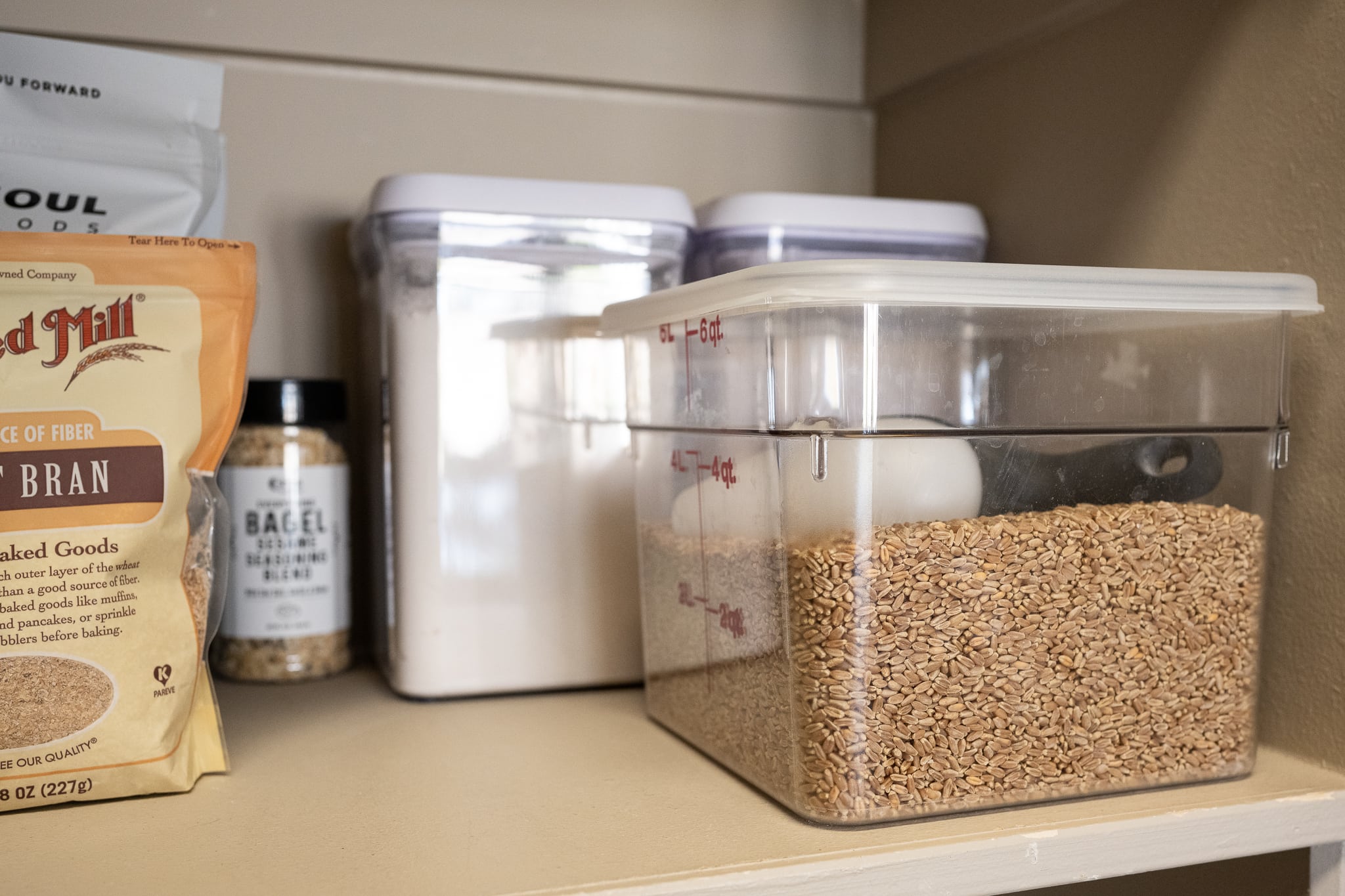
When I buy 5-pound sacks of white flour, I transfer the flour to air-tight containers (with a label) that can hold the entire 5-pound sack (see more container recommendations at the end of this post). This way, I can neatly stack the containers in my pantry, and accessing the flour is clean and easy with a pop-top and wide opening.
If you want to prolong the life of your white flour, place the original sack in a plastic bag, press as much air out as possible, then stick the wrapped bag into the refrigerator or freezer.
The best way to store white flour for the longest shelf life
Room temperature is fine for up to 12 months. If you have a large sack of white flour and don’t expect to use it all within 12 months, transfer some to a smaller container for the pantry, and place the rest into the refrigerator or freezer.
The best way to store whole grain flour
To store whole grain flour, I use a medium-sized Cambro container that’s air-tight to hold the grain, and then I stack the containers in my freezer. If I don’t have room, I’ll place the containers in my refrigerator (or my dough retarder). Keeping the grain out of sunlight, dry, air-tight, and at a cool temperature will significantly lengthen the shelf-life.
The best way to store whole grain flour for the longest shelf life
Room temperature is fine for up to 6 months, but the best option would be the freezer, where it will keep up to a year or longer.
Recommended reading: 100% whole wheat sourdough bread recipe
The best way to store whole grain berries
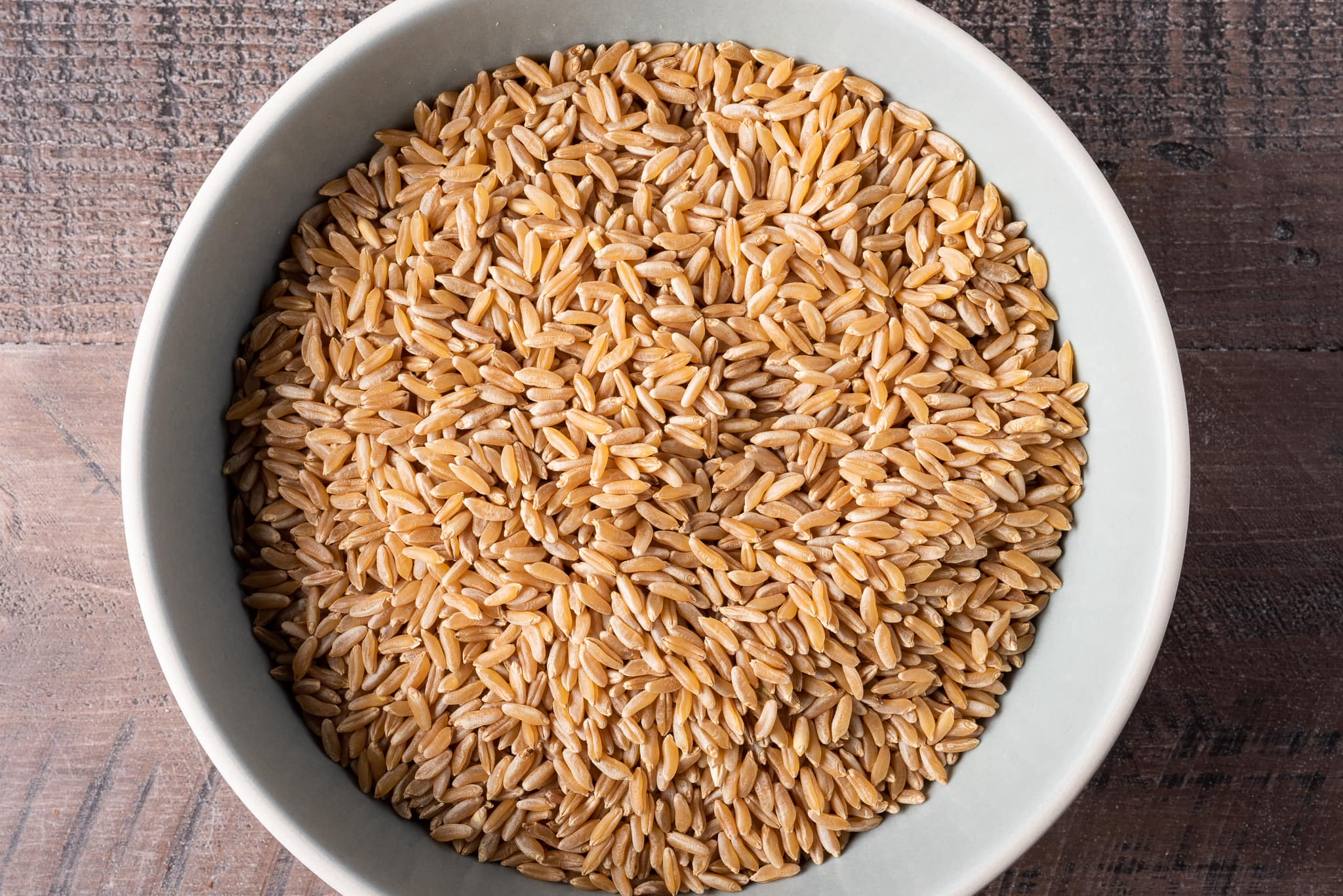
Whole grain berries last significantly longer than flour since the outer, protective bran layer is still intact. This bran layer is meant to protect the berry—a seed, after all—until it finds moisture that will begin seed germination if the conditions are right.
Because one of the enemies of whole berries is moisture—it’s best to keep them as dry as possible. My climate here in the Southwest USA is arid, so I have little worry about excessive moisture. And even though I live in a low moisture environment, I still inspect my grain if it’s been a while since I’ve used it to ensure the grain is still dry and no pests move in unnoticed.
Further, keeping the berries dry and cool (or cold) will prolong their shelf-life even further. I typically buy whole grain berries in large sacks that I split, placing some in an air-tight 6-quart container and then the rest wrapped in plastic and into the freezer.
The best way to store whole grain berries for the longest shelf life
Cold temperatures are best, but whole grain berries will have a long shelf life (I like to use them within 1-2 years) if kept dry and at room temperature.
When is it best to use freshly milled flour?
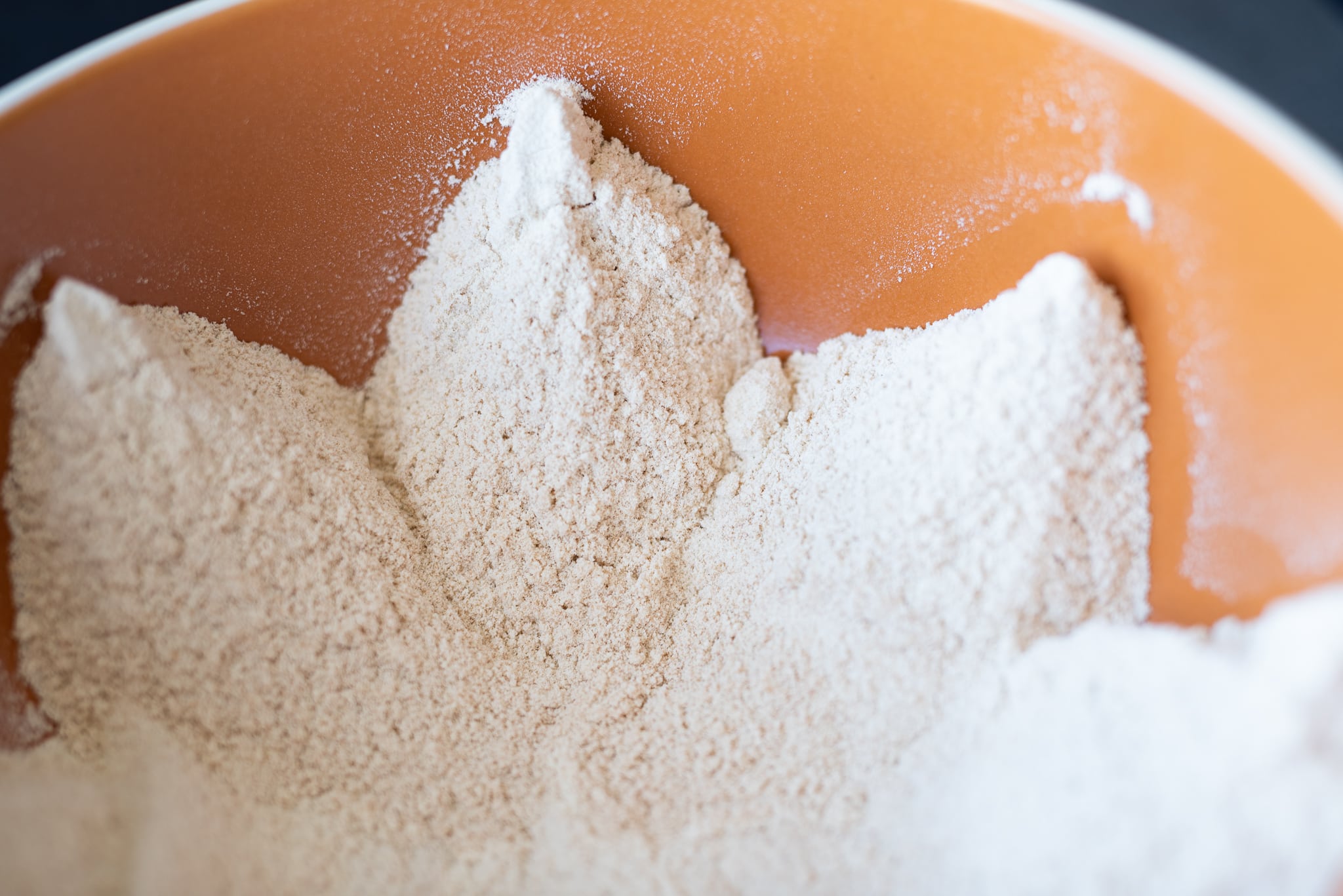
When I mill flour fresh for bread baking, I like to use it that day or the day after. Related to my discussion above on lipids, using flour soon after milling ensures it will have the best flavor, aroma, and nutrition.
There have been plenty of times where I’ve milled flour in the morning only for something to come up, preventing me from using the flour that day or even the next. In this case, I’ll cover the flour in a container and place it in the refrigerator. The day I want to bake, I’ll take it out and let it come to room temperature before mixing it into my dough (or warm the mixing water to make sure I hit the desired dough temperature for the dough mix).
For more information, see my guide to working with freshly milled flour at home.
What containers are best to store flour (and grain)?
I typically use three different containers to store flour and grain, each a different size. This is what I look for with these containers (and I’ve tried a lot of containers over the years):
- they’re square-sided (which takes up less room when set side-by-side)
- they have an air-tight seal
- they’re extremely sturdy
The following containers have these three characteristics and, in the case of some, have been in my kitchen for almost 10 years now.
Small containers (for 5 pounds of flour)
My favorite containers for storing flour for immediate use are Oxo 4-quart (3.8 L) Pop Containers. I’ve been using these for more than a decade in my kitchen, and they’re durable, air-tight, and the perfect size to hold 5-pound bags of flour (what you’d find at the market). The lid has a small circle on the top that, when pressed, pushes down into the container to form an air-tight seal.
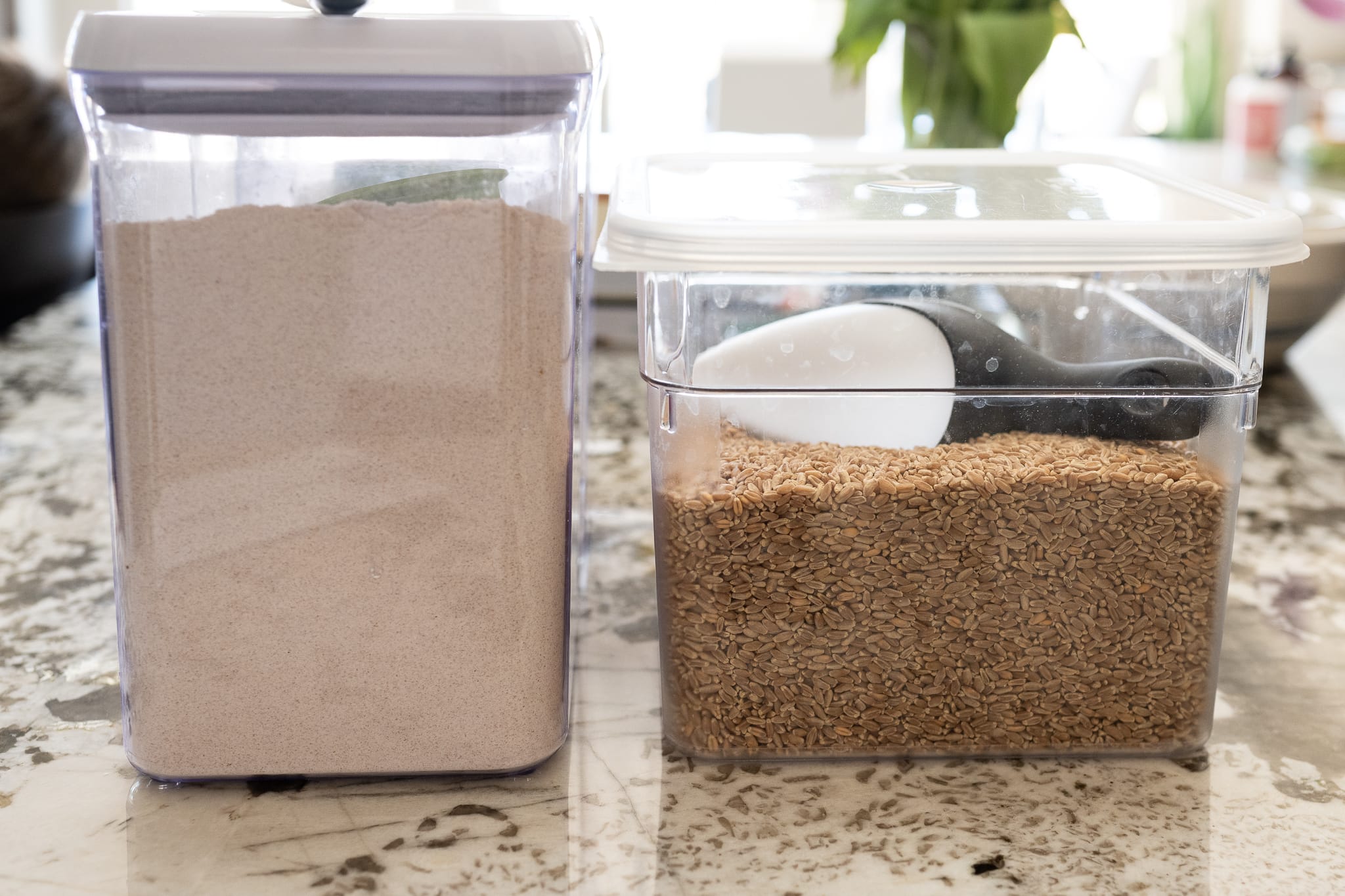
When I buy new sacks of flour, I transfer them directly to one of these containers because they’re effortless to open and close with an air-tight seal. Additionally, the wide opening up top makes for effortless scooping.
Medium containers (for a bit more than 5 pounds of flour)
For storing flour or grain a little over 5 pounds, I like these 6-quart Cambro food containers. These are about as robust a container as you want; they’re very sturdy and I’ve had the same ones for going on 10 years now. The lid snaps on tight and they stack compactly, perfect for a large freezer or the refrigerator.
Large containers for significantly more flour or gain
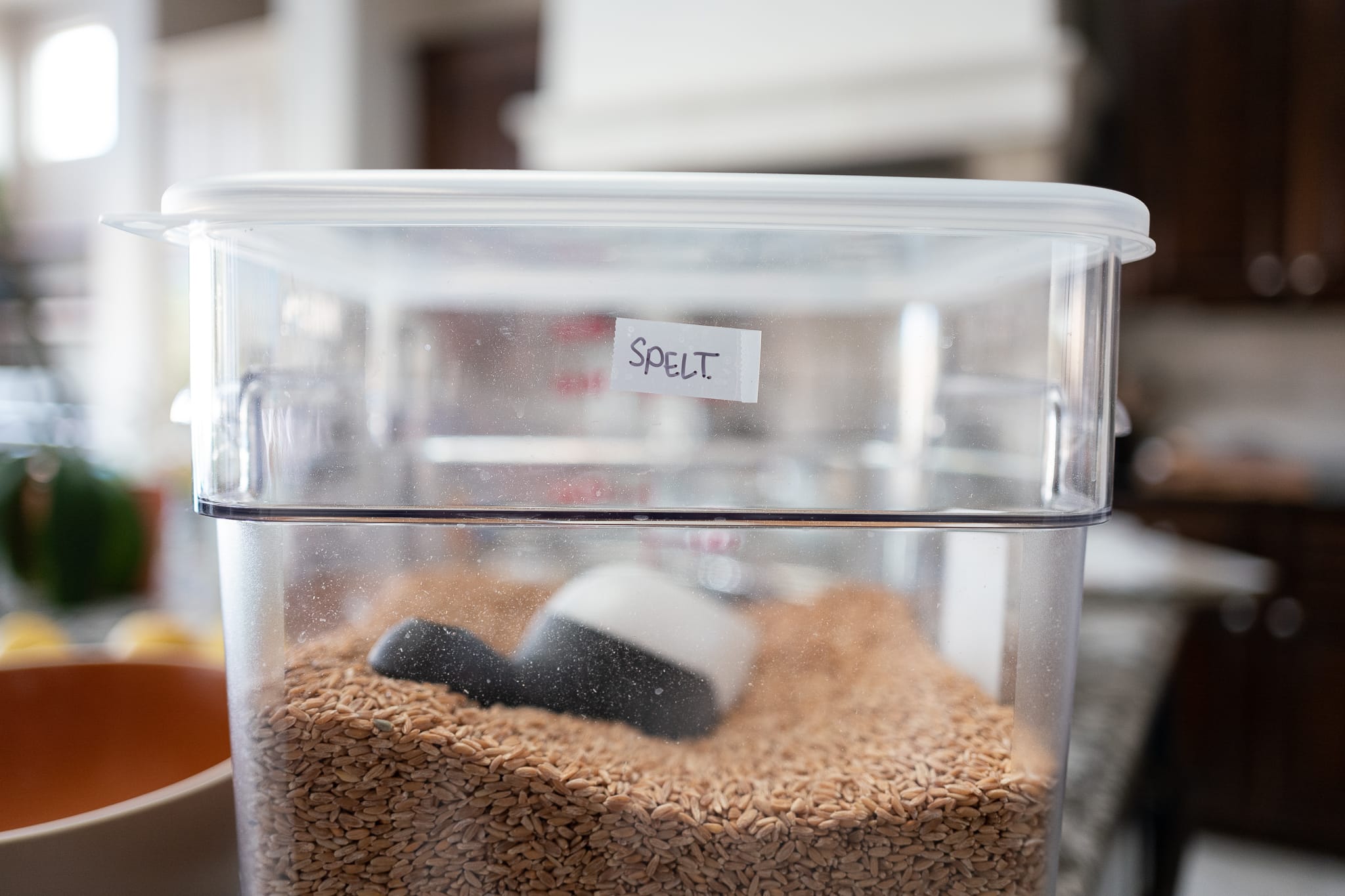
These are about shin-level containers meant to hold significantly more flour or grain. When I order 25 or 50-pound sacks, I like to transfer a large amount of flour to these to keep in my pantry and place the rest of the bag directly into a freezer. Again, I turn to Cambro for these 18-quart polycarbonate containers for holding large quantities of flour or grain (and I like these Oxo scoops for easy distribution).
Additional baking items to store in the refrigerator or freezer
In addition to storing flour in the freezer (or refrigerator), I also like to store the following to keep them as fresh as possible.
| Item | Why store in the refrigerator or freezer? |
|---|---|
| Wheat bran or wheat germ | These are the parts of the wheat berry that contain the most oils and nutrients |
| Cracked buckwheat | Once the buckwheat groat is cracked open, it can spoil more readily |
| Polenta, corn grits, cornmeal | To prolong the shelf-life of these corn products |
What’s Next?
Looking for ways to store other baking-related things? Have a look at these guides for more practical baking guides:
- how to store your sourdough starter for short, medium, and long baking bread (or to backup your starter!)
- how to store bread to keep it fresh for longer
- how to freshly mill flour at home for baking
Happy baking!


23 Comments
Being that oxygen is the number one destroyer on almost everything, removing the big O makes a great difference.
I buy my King Arthur flour in 50# bags. When I get it home I portion it into vacuum sealer bags and vac away.
I found how well it works when I purchased some 5# bags at the start of covid. I opened one in mid ’24 and there was no detectable difference in just purchased and the stored one, either smell , or performance.
I love the Starter and Levain calculator – I alter my hydration ratios quite often this makes figuring that out a very easy process. Thank you.
Bill
How do you feel about Polycarbonate used in the Cambros?
Hi I am completely new to bread baking, just found an unopened organic wheatflour that had expired 2 months! Is it still good for baking? Look forward to some advice, thank you
Generally, I don't use expired flour. Much better to buy fresh flour and use that, especially since you'll be going through two days of fermentation to make sourdough bread happen 🙂
I’ve read that freezing whole grain wheat berries when you buy them for a minimum of ten days will kill anything living in your container, then they can be stored in a cool location without worry. Can you please confirm this is true? It is not possible to keep large quantities in my freezer long term.
I've not read this anywhere, Clara! But it definitely won't be a bad thing to do anyway. The cooler temps definitely prolongs the berries life, anyway 🙂
Our house became infested by pantry moths from cornmeal purchased from a small ethnic grocery. It took about a year to get rid of them. Since then we freeze all the grain products we get for ten days to kill any moth eggs.
Wow, I've never heard of this!
It is a great idea for all grains and beans, but mostly for insect eggs, producing moths and wevils. The fats in the grains and flour will still degrade. Oxygen is the culprit.
Since one of the purposes of storing flour in the fridge is to prolong its life, how long will it keep on the counter at room temp AFTER it’s been in the fridge for a while unopened? I just took an unopened bag of flour out of the fridge and I’m wondering how long it will last on the counter if its life has been “prolonged.” Today is 1-25-24 and the expiration date on the unopened bag says 8-23-24. Does the 12-month storage time frame begin today?
Really great question Stella and I don't have an answer for you, unfortunately. Usually what I do is go by the expiration date and try to use the grain by then even if I keep it in the fridge (I'll use "expiring" grain first). If it's in the fridge and goes past the date, I know it's still okay to use.
This may be a question for a different post, but it has to do with flour. In your book you recommend flouring your banneton, banneton lining and your towels. When finished, shake out flour and store in a cool place. I bake twice a week, so my equipment has just enough flour and are put away in a sealed plastic container to prevent bugs. Recently I found black worms that roll up like a snake in my towels and bannetons. They were on the equipment and dead on the storage container. I washed the cabinets, towels and storage containers in hot bleach water and washed the bannetons in hot dish soap water. I started using as directed, after about 3 weeks the worms were back. I had changed flour so it wasn’t the same bag or brand. When I lived where it was humid, we would get weevils, never worms. Google doesn’t identify these black 3/4 inch worms, anyone else get them? I have since gone back to washing after every use. Worms are not acceptable.
It could be millipedes. We have them all over the house here in South Africa. Tiny baby ones, very cute but harmless.
I haven't had this issue here nor have I seen these, sorry I cant pinpoint the issue for you! I like to put my baking baskets in or on top of the oven (TURNED OFF) to have them dry after baking. This helps remove any moisture. Just be sure you don't close the oven door and it's turned off.
It’s great that you have covered this. Thank you.
I would add that in the U.K. climate whole grains, or wheat berries will keep a good two years in a dry environment. My miller tells me it’s longer, but two years is safe.
This seems a lot until you realise that the grain is still viable and will grow a and after 8-12 years non chilled storage. And, if it will grow it’s sure as blink good to eat.
So the test is: Sprout a little seed now and then and as soon as your getting less than 100% sprouting – its time to bake like hell.
Wishing you he very best and grateful for all of your input.
Cheers
You’re welcome, Kevin! Hah, great comments there. Yes, 2 yrs seems to be about the longest I keep grain (I usually use it much sooner, though!), though I’ve heard it kept much, much longer than that in dry, cool conditions. Happy baking!
This was very helpful. I buy my grains in bulk and store them at room temperature in 5 gallon buckets with gamma seal lids. I think this works well but I was doing quite a few other things wrong and after reading this will remedy them. For example: I was grinding too much flour at a time so the leftover has just been sitting at room temp, also, I have been storing my bran at room temp as well.
I was also glad to read Mike’s comment below on grinding your berries cold because the Mockmill heats up.
Learning a lot. Thanks for the post!
Super glad to hear the post has helped, Mandy! And yes, keeping those berries cold definitely helps offset the increase in temp when milling. I’ll often measure out my grain for the next day, stick it in the freezer overnight, then mill in the AM (that is, if they’re not already being stored in there!). Happy baking 🙂
hello, long time fan — sounds like you’re baking a lot of bread! how do you consume it all? can you maybe write a post on bread and health? there is so much out there about avoiding carbs and stuff. i want to get into this hobby but people are like “well if you bake bread all the time that’s not a very healthy thing to consume”. would love to hear your thoughts on this.
Hey there! I eat a balanced amount of sourdough bread (only what I bake, really!) compared to the rest of the food in my diet, and I get a good measure of exercise. In my opinion, bread is one of the healthiest foods out there as long as it’s consumed in a balanced way with the rest of your food. I’m not a dietician or health food professional, but I can say I eat at least 2-3 slices of bread most days and have no problems here 🙂 Any bread we don’t eat I freeze and keep for later, and any extra loaves I bake I gift to friends or family in the city—keeping everyone fed! I think a post on this topic is a great idea, I’ll add it to my list.
Another great reason to store whole berries in the freezer: milling temperature. When fine-milling hard white wheat stored at room temp, my Mockmill climbed as high as 130 deg F, which can destroy starches an enzymes. Milling right from the freezer however, and the temp barely exceeded 100 deg.
Yes, 💯 spot on there!