

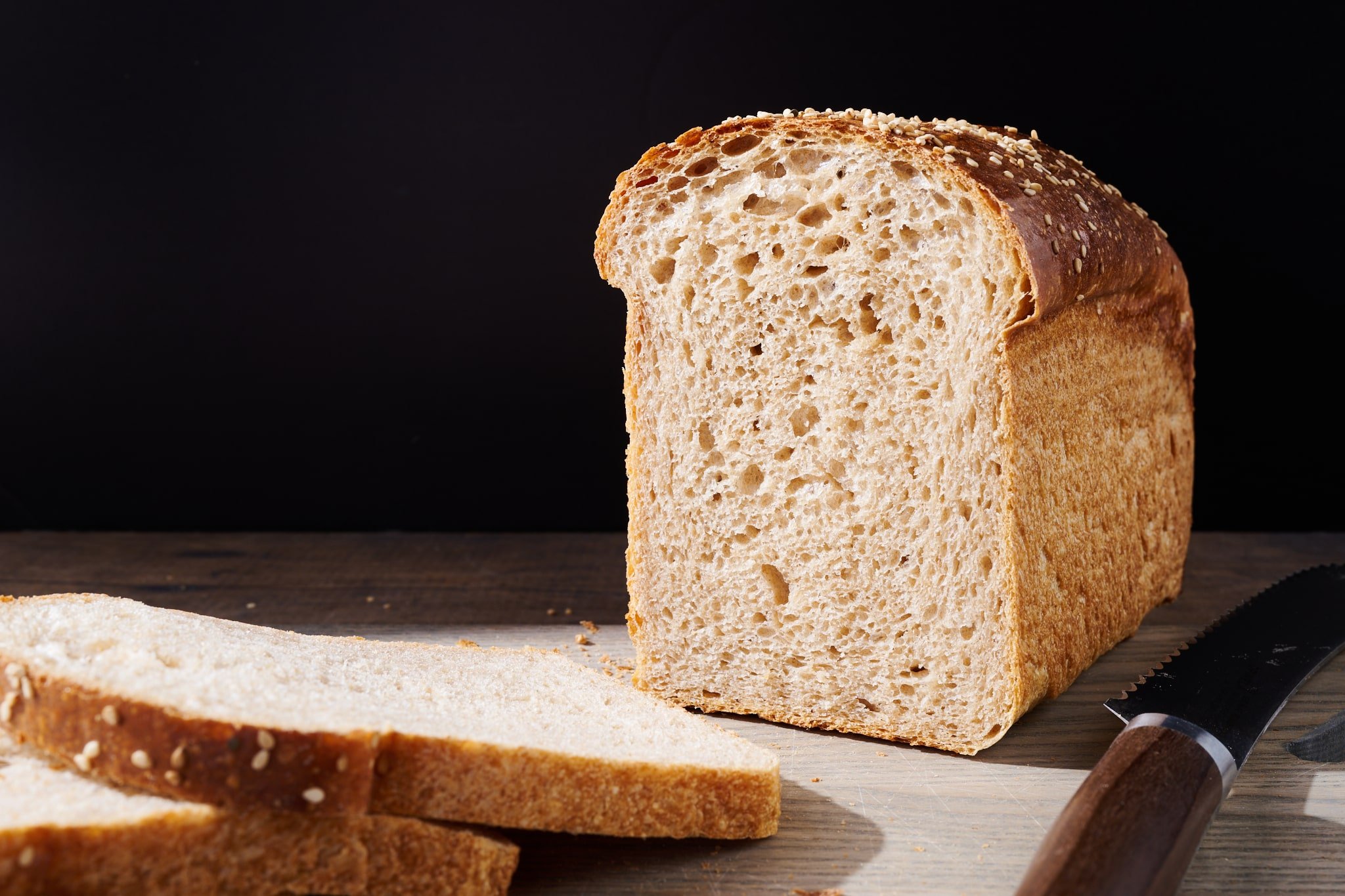
This half-whole-grain sourdough pan loaf ranks as one of the softest and tastiest I’ve concocted. I might sound a bit highfalutin, and generally, I’m not a fan of unnecessary superlatives. But there comes a time when you finally nail something you’ve been working on for a long while, and all the adjectives are earned. I think the title of “the best honey whole wheat bread recipe” could do with a few more adjectives thrown in–it’s that good–but I’ll keep it right there.
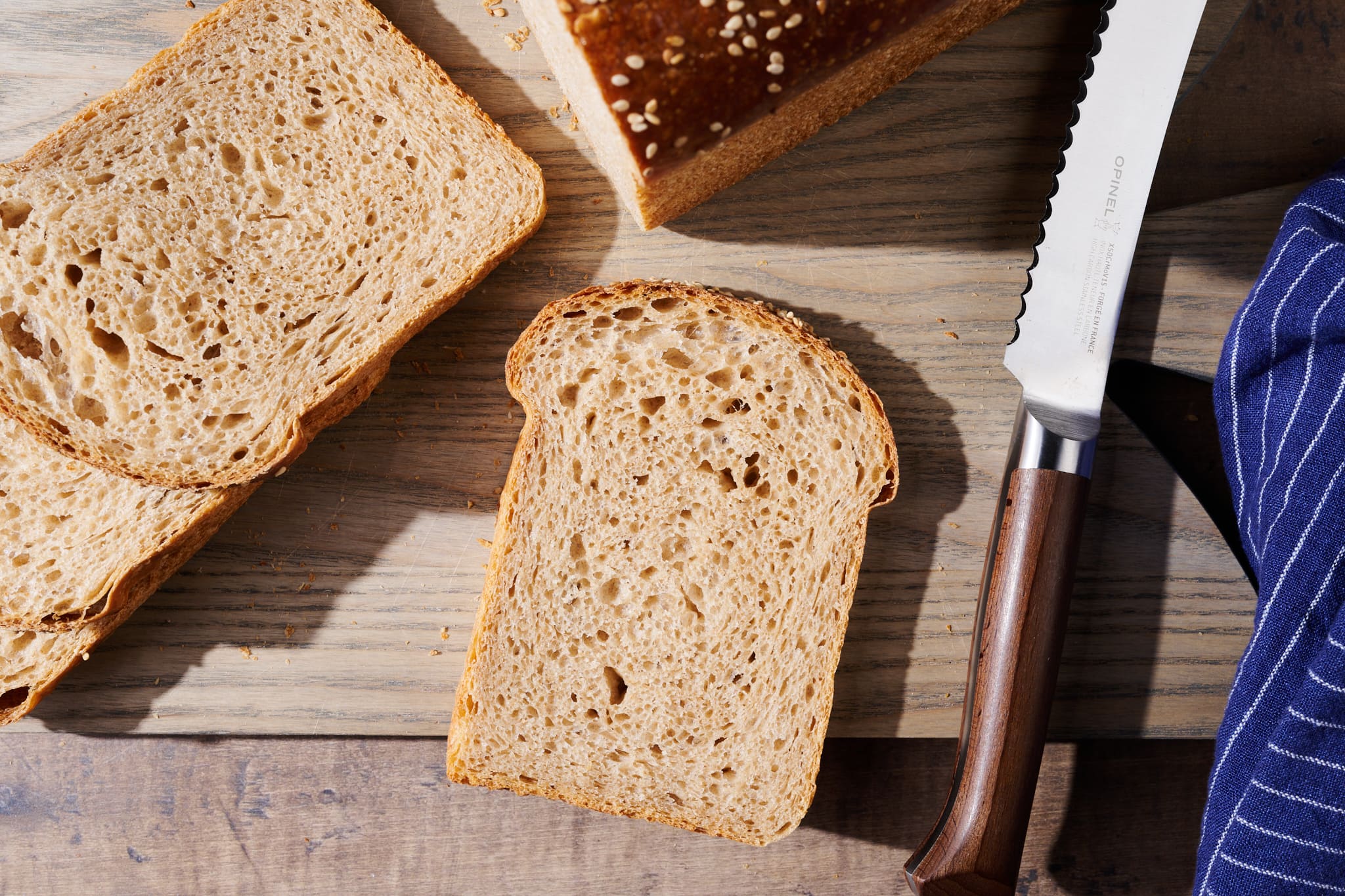
This pan loaf has an appropriately tight texture for hanging on to all those toast or sandwich ingredients, but it’s also light, soft, and squishy—a sometimes elusive dichotomy that you want in a pan loaf. And with this bread, I sort of pull all the technical levers—in a reserved way, mind you, to keep it healthy—to get softness despite the high whole-grain percentage: fats and pre-cooked flour.
On the flavor front, it’s mild with subtle sweetness from the honey, and it has just a kiss of buttery savoriness—a magical combination that fills the kitchen with a wonderful aroma when toasted.
To sum it all up, why is this honey whole wheat sourdough sandwich bread special?
- It’s 50% whole grain
- It has a flexible baking schedule
- The texture, flavor, and nutritional value are hard to beat
- It uses the yudane technique, which is simpler than tangzhong (more on this below)
- It makes the best toast
- There’s no refined white sugar
Flour and ingredient selection
This bread was inspired by my recent work on my sourdough shokupan, but unlike that super-soft bread made with all white flour, this one is sturdier and has a notable percentage of whole grains. But similarly, it incorporates pre-cooked flour; for this recipe, I use the yudane technique (similar to tangzhong). This technique couldn’t be any simpler: boil some of the water in the recipe and pour it over some of the flour–in this case, 10% of the total flour, all of which is whole wheat. Pre-cooking the whole wheat flour in this way almost feels like cheating. It softens the flour and helps make the dough stronger, more open, and softer.
Read more about the yudane (and tangzhong) technique →
Pre-cooking the whole wheat flour makes the dough easier to handle and results in bread that’s softer and more open.

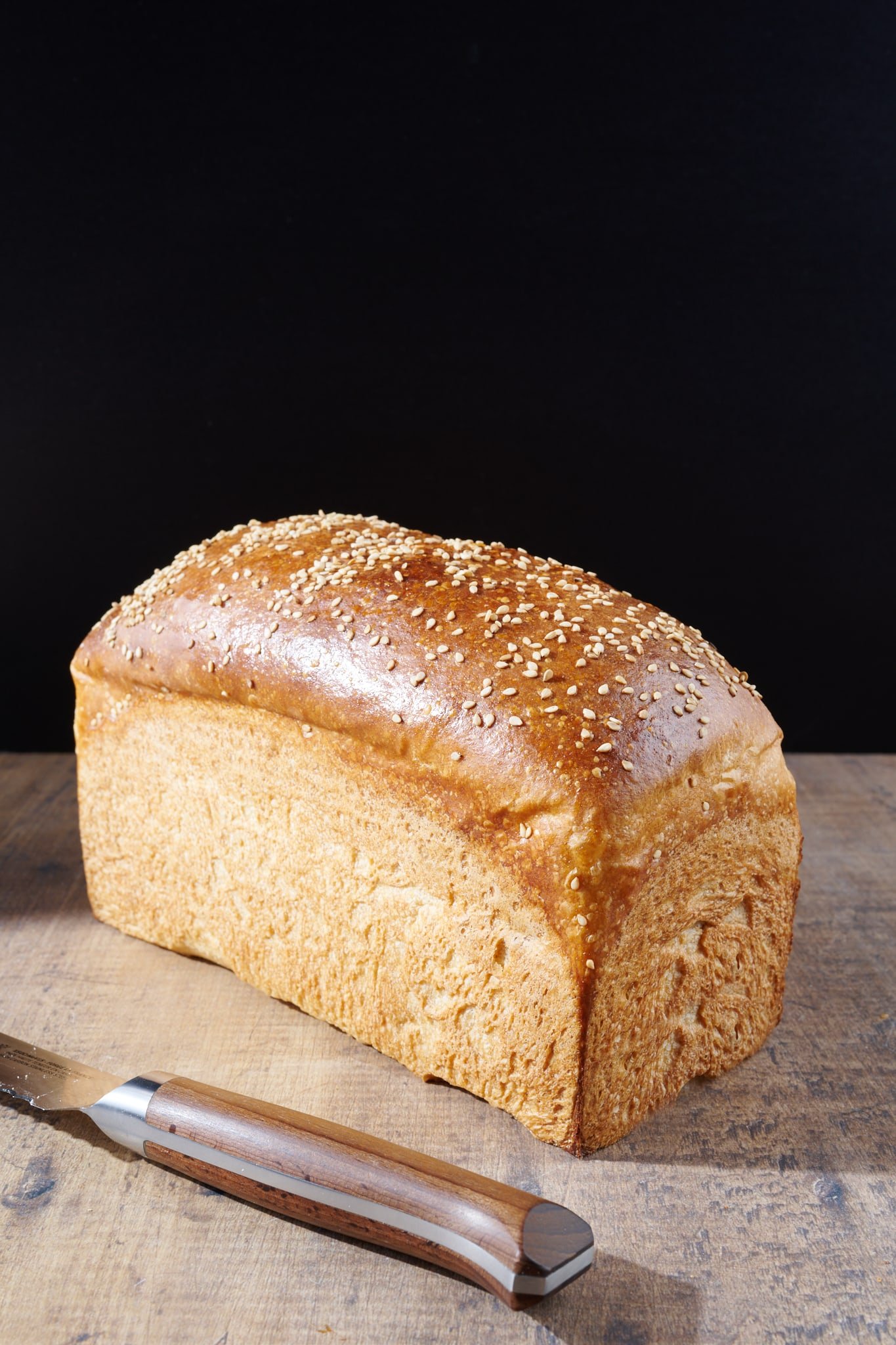
You’ll see that I have topped this bread with benne seeds, giving it a toasty flavor and extra crunchy crust. I also like to top these loaves with sesame seeds and oats, though you can also choose not to use a topping (but I’d still recommend using an egg wash if you want to skip steaming your oven).
Baking schedule
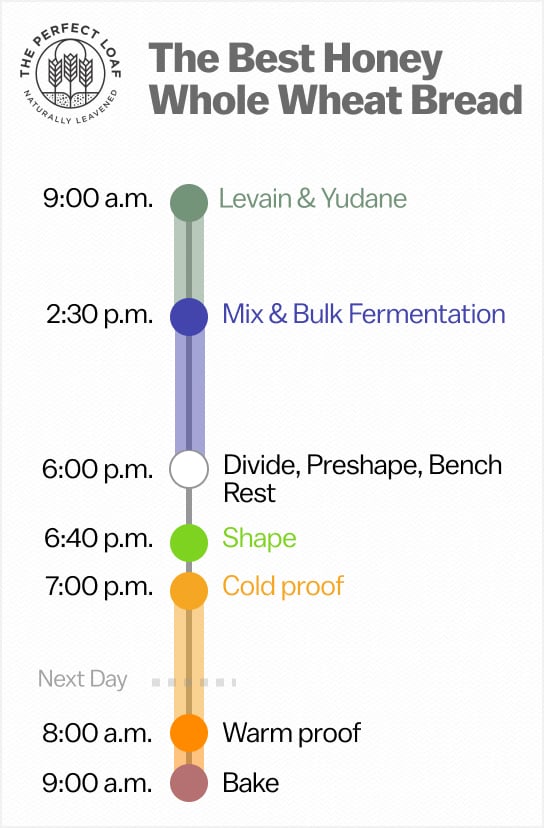
This wouldn’t be the best honey whole wheat bread recipe if it didn’t also have a flexible baking schedule. I like to make it over two days, retarding the dough in shape overnight. You can also bake it same-day if you want fresh bread the day you start the baking process: After shaping and placing the dough in the pans, cover the pans and let proof at room temperature until the dough rises to the rim of the pans and a gentle poke very slowly springs back, 1 ½ to 3 hours.
The best honey whole wheat bread formula
Note: See the FAQ at the end of this post to convert this recipe to a vegan honey whole wheat bread recipe.
Vitals
| Total dough weight | 1,800 grams |
| Pre-fermented flour | 10.0% |
| Hydration | 57.0% (water) |
| Levain in the final dough | 27.8% |
| Yield | Two loaves each in a 9 x 4 x 4-inch Pullman pan |
Total formula
Desired dough temperature: 78°F (25°C) (see my post on the importance of dough temperature).
| Weight | Ingredient | Baker’s percentage |
| 450g | White flour (about 11.5% protein; Central Milling Artisan Baker’s Craft) | 50.0% |
| 360g | Whole wheat flour (Central Milling Hi-Pro Whole Wheat) | 40.0% |
| 90g | Yudane: Whole wheat flour (Central Milling Hi-Pro Whole Wheat) | 10.0% |
| 135g | Yudane: Water, boiling | 15.0% |
| 54g | Egg, beaten (about 1 large) | 6.0% |
| 54g | Unsalted butter | 6.0% |
| 36g | Extra-virgin olive oil | 4.0% |
| 45g | Honey | 5.0% |
| 513g | Water | 57.0% |
| 17g | Fine sea salt | 1.9% |
| 45g | Ripe sourdough starter, 100% hydration | 5.0% |
Additional ingredients:
Benne seeds, sesame seeds, or oats, for topping (optional)
Egg wash: 1 large egg, 1 tablespoon whole milk, and a pinch of fine sea salt, for brushing
The best honey whole wheat bread method
1. Prepare the levain – 9:00 a.m.
Mix the following ingredients in a jar and leave them covered at a warm temperature, 74-76°F (23-24°C), to ripen for 5 hours.
| Weight | Ingredient | Baker’s percentage |
| 90g | White flour (about 11.5% protein) | 100.0% |
| 90g | Water | 100.0% |
| 45g | Ripe sourdough starter, 100% hydration | 50.0% |
2. Prepare the yudane – 9:10 a.m.
Put the 90g whole wheat flour in a medium heat-proof bowl. Pour the 135g boiling yudane water over the flour and mix with a small spatula until a paste forms. If the mixture is very dry, add a splash of water to help moisten the flour. Cover and set aside.
Read my guide to the yudane and tangzhong method for more on this technique →
4. Mix – 2:00 p.m.
I mixed and strengthened this dough in my KitchenAid stand mixer, but you could also mix it by hand using the slap and fold technique (make sure to hold back the butter until the end of mixing).
| Weight | Ingredient |
| 360g | White flour (about 11.5% protein; Central Milling Artisan Baker’s Craft) |
| 360g | Whole wheat flour (Central Milling Hi-Pro Whole Wheat) |
| 54g | Egg, beaten (about 1 large) |
| 54g | Unsalted butter |
| 36g | Extra-virgin olive oil |
| 45g | Honey |
| 423g | Water |
| 17g | Fine sea salt |
| 225g | Ripe levain (from Step 1) |
| All | Yudane (from Step 2) |
First, cut the butter into ½-inch pats. Set them on a plate to warm to room temperature.
To the bowl of a stand mixer fitted with the dough hook attachment, add the flour, water, egg, olive oil, honey, salt, ripe levain, and yudane. Mix on low speed (STIR on a KitchenAid) for 1 to 2 minutes until the ingredients come together and no dry bits remain. Increase the speed to medium (2 to 3 on a KitchenAid) and mix for 5 to 7 minutes until the dough smooths and begins to cling to the hook. If the dough is too dry, add a splash of water to soften, but be conservative.
Let the dough rest in the bowl for 10 minutes.
Even though there are several stretches and folds during bulk fermentation, it is important to mix this dough until it’s smooth, elastic, and clinging to the dough hook.
Turn the mixer on low speed (STIR on a KitchenAid) and mix for 2 to 4 minutes until the dough gains more strength and clings again to the dough hook. Next, with the mixer running, add the room temperature butter, one pat at a time, waiting to add each pat until the previous one is fully absorbed. Adding all the butter will take 4 to 6 minutes. In the end, the dough will be soft and mostly clinging to the dough hook. Transfer the dough to a bulk fermentation container and cover.
3. Bulk fermentation – 2:30 p.m. to 6:00 p.m. (3 ½ hours)
At a warm room temperature, 74-76°F (23-24°C), bulk fermentation should take about 3 ½ hours. The dough is ready when it is smooth, puffy, and well-risen.
This dough requires 2 sets of stretches and folds during bulk fermentation. After the first 30 minutes of bulk fermentation, wet your hands, grab the side of the dough farthest from you, and stretch it over it to the other side. Rotate the bowl 180-degrees and perform another stretch and fold. Rotate the bowl 90-degrees, and do another stretch and fold. Finally, turn the bowl 180-degrees, do one last stretch and fold. The dough should be neatly folded up in the bulk fermentation container.
Perform one more set of stretches and folds 30-minutes later. Then let the dough rest, covered, for the remainder of bulk fermentation.
4. Divide and preshape – 6:00 p.m.
After 3 ½ hours, the dough should be well-risen in the bulk fermentation container and be puffy to the touch. Thanks to the yudane addition, this is a relatively strong dough and doesn’t need a heavy hand when preshaping.
Fill a small bowl with water and place it next to your work surface. Scrape the dough onto a clean counter. Divide the dough into 2 equal pieces. Then, preshape each piece into a loose round.
Let the dough rest, uncovered, for 35 minutes.
5. Shape – 6:40 p.m.
Grease a 9 x 4 x 4-inch Pullman pan with a neutral-flavored oil.
I shaped this dough like I typically do for a pan loaf: I fold the sides in and roll down from top to bottom (see the video below). For information on baking in different pans, shaping pan loaves, and more, see my guide to pan loaves.
6. Cold proof – 7:00 p.m. to 8:00 a.m. (overnight)
Put the pans in a large, reusable plastic bag and seal it shut. Place the pans in the refrigerator to proof overnight.
7. Warm proof – 8:00 a.m. to 9:00 a.m., the next day
Remove the covered pans from the refrigerator and let them proof, at room temperature, for about 1 hour, depending on the temperature in your kitchen. The dough is ready to bake when it is puffy to the touch and about 1-inch below the rim of the pan.
If you see any large bubbles form on the surface, gently pat them down to disperse.
8. Bake – 9:00 a.m.
Place an oven rack in the middle of the oven. Preheat the oven to 400°F (200°C).
In a small bowl, whisk together the egg, milk, and salt.
Uncover the pans and brush an even layer of the egg wash on the top of each. Next, sprinkle on any desired toppings: oats, sesame seeds, or benne seeds. (See my guide to topping bread dough for more information on egg washes and other toppings.)
Slide the pans into the oven. Bake for 20 minutes. Then, reduce the oven temperature to 350°F (175°C), rotate the pans back to front, and continue to bake for 25 to 30 minutes more. When done, the loaves should have an internal temperature of around 204°F (95°C), and the crust should be deeply colored and shiny.
Remove the pans from the oven. Gently remove the loaves from the pans and put them on a wire rack. Let the loaves cool for 1 to 2 hours before slicing. See my post on the best way to store bread to keep it fresh for a week or longer.
Print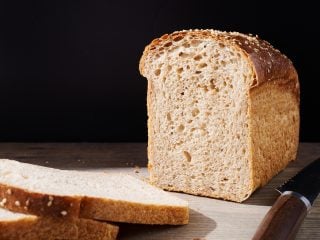
The Best Honey Whole Wheat Bread Recipe
- Prep Time: 24 hours
- Cook Time: 55 minutes
- Total Time: 24 hours 55 minutes
- Yield: 2 loaves
- Category: Sourdough, Bread
- Cuisine: American
Description
My recipe for a slightly sweet pan loaf (thanks to the added honey) with a large whole grain percentage yet a soft crumb and crust—it’s perfect for toast and sandwiches.
Ingredients
Levain
- 90g white flour
- 90g water
- 45g ripe sourdough starter, 100% hydration
Yudane
- 90g whole wheat flour
- 135g boiling water
Main Dough
- 360g white flour
- 360g whole wheat flour
- 54g egg, beaten (About 1 large)
- 54g unsalted butter
- 36g extra-virgin olive oil
- 45g honey
- 423g water
- 17g fine sea salt
- 225g ripe levain
- all of the yudane
Topping
Benne seeds, sesame seeds, or oats.
Egg wash: 1 large egg, 1 tablespoon whole milk, and a pinch of fine sea salt.
Instructions
- Levain – 9:00 a.m.
Mix the levain ingredients in a jar and leave them covered at a warm temperature, 74-76°F (23-24°C), to ripen for 5 hours. - Yudane – 9:10 a.m.
Mix the yudane ingredients in a small heat-proof bowl until a paste forms. Cover and set aside. - Mix – 2:00 p.m.
Cut the butter into ½-inch pats and let warm to room temperature. To the bowl of a stand mixer with the dough hook attachment, add the flour, water, egg, olive oil, honey, salt, ripe levain, and yudane. Mix on low speed for 1 to 2 minutes until the ingredients come together. Increase the speed to medium and mix for 5 to 7 minutes until the dough smooths and begins to cling to the hook. If the dough is too dry, add a splash of water to soften, but be conservative. Let the dough rest in the bowl for 10 minutes. Turn the mixer on low speed and mix for 2 to 4 minutes until the dough gains more strength and begins to cling once again to the dough hook. Next, with the mixer running, add the room temperature butter, one pat at a time. Adding all the butter will take 4 to 6 minutes. Transfer the dough to a bulk fermentation container and cover. - Bulk fermentation – 2:30 p.m. to 6:00 p.m. (3 1/2 hours)
Give the dough 2 sets of stretches and folds during this time, in 30 minute intervals. After the second set, let the dough rest, covered, for the remainder of bulk fermentation. The dough is ready when it is smooth, puffy, and well-risen. - Divide and preshape – 6:00 p.m.
Fill a small bowl with water and place it next to your work surface. Scrape the dough onto a clean counter and divide the dough into 2 equal pieces. Then, preshape each piece into a loose round. Let the dough rest, uncovered, for 35 minutes. - Shape – 6:40 p.m.
Grease a 9 x 4 x 4-inch Pullman pan with a neutral-flavored oil. Shape into a long tube and place in the pan. - Cold proof – 7:00 p.m. to 8:00 a.m. (overnight)
Put the pans in a large, reusable plastic bag and seal shut. Place the pans in the refrigerator to proof overnight. - Warm proof – 8:00 a.m. to 9:00 a.m., the next day
Remove the covered pans from the refrigerator and let them proof, at room temperature, for about 1 hour, depending on the temperature in your kitchen. The dough is ready to bake when it is puffy to the touch and about 1-inch below the rim of the pan. If you see any large bubbles form on the surface, gently pat them down to disperse. - Bake – 9:00 a.m., the next day
Preheat the oven to 400°F (200°C). In a small bowl, whisk together the egg, milk, and salt. Uncover the dough and brush on the egg wash. Next, sprinkle on any desired toppings: oats, sesame seeds, or benne seeds. Slide the pans into the oven and bake for 20 minutes. Then, reduce the oven temperature to 350°F (175°C), rotate the pans back to front, and continue to bake for 25 to 30 minutes more. When done, the loaves should have an internal temperature of around 204°F (95°C), and the crust should be deeply colored and shiny.
Notes
- To bake only a single loaf, divide all the ingredients in half (even the levain and yudane).
The Best Honey Whole Wheat Bread FAQ
The top part of my loaf separated from the crust!

You likely over-proofed the dough, especially if you see this coupled with a dense interior crumb (see the image at the right of an early test!). Next attempt, reduce the time the dough is left on the counter before baking.
What is a good egg substitute for this bread?
A flax egg is a good substitute for the whole egg in this bread recipe: Mix one tablespoon of ground flaxseed meal and three tablespoons of water in a small bowl. Allow the mixture to rest for 5 minutes before using. Instead of using an egg wash on the top of the dough, simply omit it and steam your oven instead.
How can I make this bread recipe vegan?
Swap out the egg for a flax egg, and substitute the butter with a vegan butter alternative.
Can I use the lid of the Pullman pan to bake this sandwich bread?
No. The dough weight is too high to use the lid for the 9 x 4 x 4-inch Pullman pan; the dough would leak out of the pan during baking.
Can I make one loaf instead of two?
Yes: Halve all ingredients in the recipe to bake only a single loaf in a 9 x 4 x 4-inch Pullman pan.
Can I use tangzhong instead of yudane?
Yes, absolutely. Instead of simply covering the whole wheat flour with boiling water, cook the flour and water mixture over medium heat until the mixture thickens. Let the tangzhong cool to room temperature before adding it to the dough mix.
What’s next?
One of the keys to making my best honey whole wheat bread is to have a strong and healthy sourdough starter. If you’re having trouble, review my top questions and answers on sourdough starter health to ensure yours is as strong as possible.
Next, if you want to make another healthy loaf with even more fiber and many seeds, check out my high-fiber seeded sourdough bread. My sourdough shokupan (Japanese milk bread) is the ticket if you’re in the mood for something even softer!
Buon appetito 🙂


160 Comments
Can you make the whole thing in a 13 x 4 pullman?