

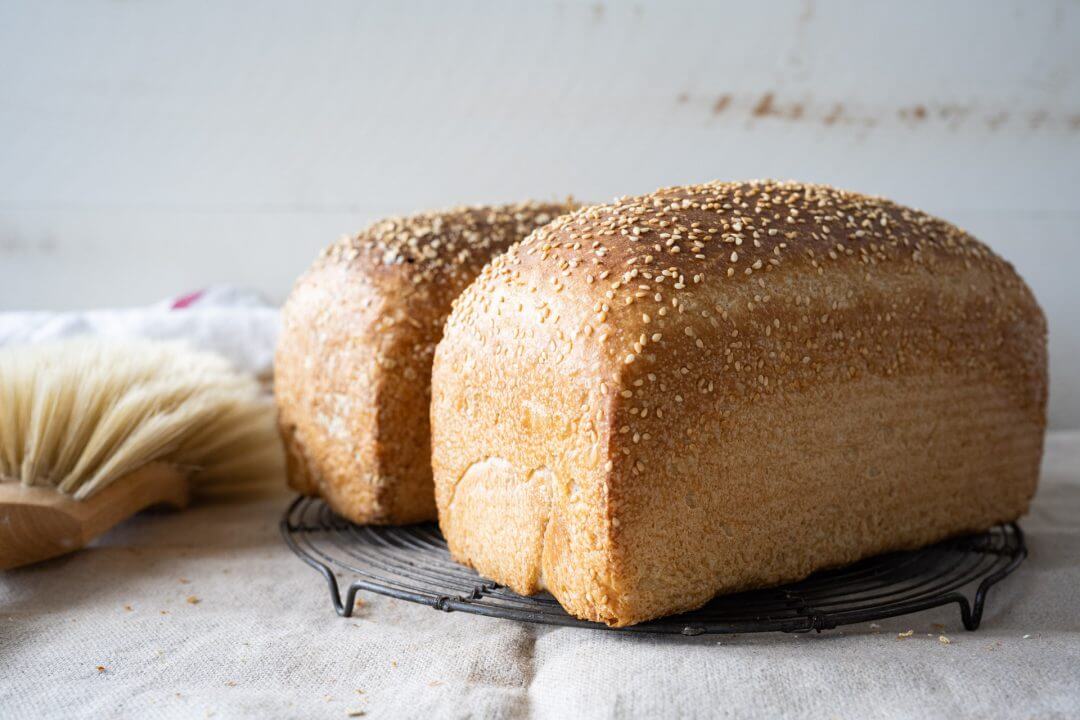
It’s back to school for most, and planning for speedy and healthy lunches is imperative whether your kiddos are physically attending school or staying home. And if you’re like us here, easy lunches are the best lunches. Enter the mighty sandwich. Sandwiches slathered with crunchy peanut butter—you’re not eating smooth peanut butter, are you?—and homemade jelly, a mozzarella, tomato, and basil layer-cake-sandwich, or a classic tuna salad sandwich are always on rotation here.
But taking the humble sandwich to the next level requires the ideal bread. It helps the mundane transcend the standard measure. And while this site has pan bread recipes abound (I guess I do love good pan bread), this tangzhong sandwich bread is so delightful it’s quickly floated to the top choice for, as my kids call it, “square bread.”
That’s not to say my classic pain de mie or whole-grain pan loaf isn’t a treat, but this bread brings a certain softness to the crumb that’s hard to achieve without high hydration or added enrichments. And yet, in pre-cooking a portion of the total flour used in this recipe, you’ll do just that.
This pre-cooking technique, commonly called tangzhong, is classic for enriched bread such as Japanese-style shokupan (milk bread), and it’s a handy technique for bringing a level of softness to a loaf without excessive fat or oil addition. A healthier version, if you will.
What is Tangzhong (Pre-cooked Flour)?
The tangzhong technique (also known as water roux or simply pre-gelatinized flour) is cooking raw flour and a liquid to approximately 150°F (65°C). At this temperature, the starches in the flour will gelatinize, similar to how the exterior of a bagel gelatinizes when you boil the dough. This process turns the mixture into a sticky starch paste added to the dough during mixing and brings incredible softness to the final baked bread.
This upfront cooking is a small step at the beginning of this recipe, but one that results in more tender and fluffy bread without the need for other enrichments such as butter, oil, or eggs.
A quick roundup of the benefits of incorporating pre-cooked flour (or tangzhong) in your bread dough:
- Adds tenderness and an open interior without the use of eggs, butter, or sugar
- The dough can have lower hydration but still achieve a soft texture
- Prolongs the shelf life of the bread (and coupled with natural fermentation, which already preserves, this might be the best sandwich bread yet)
Check out my guide to making tangzhong for more information on this technique.
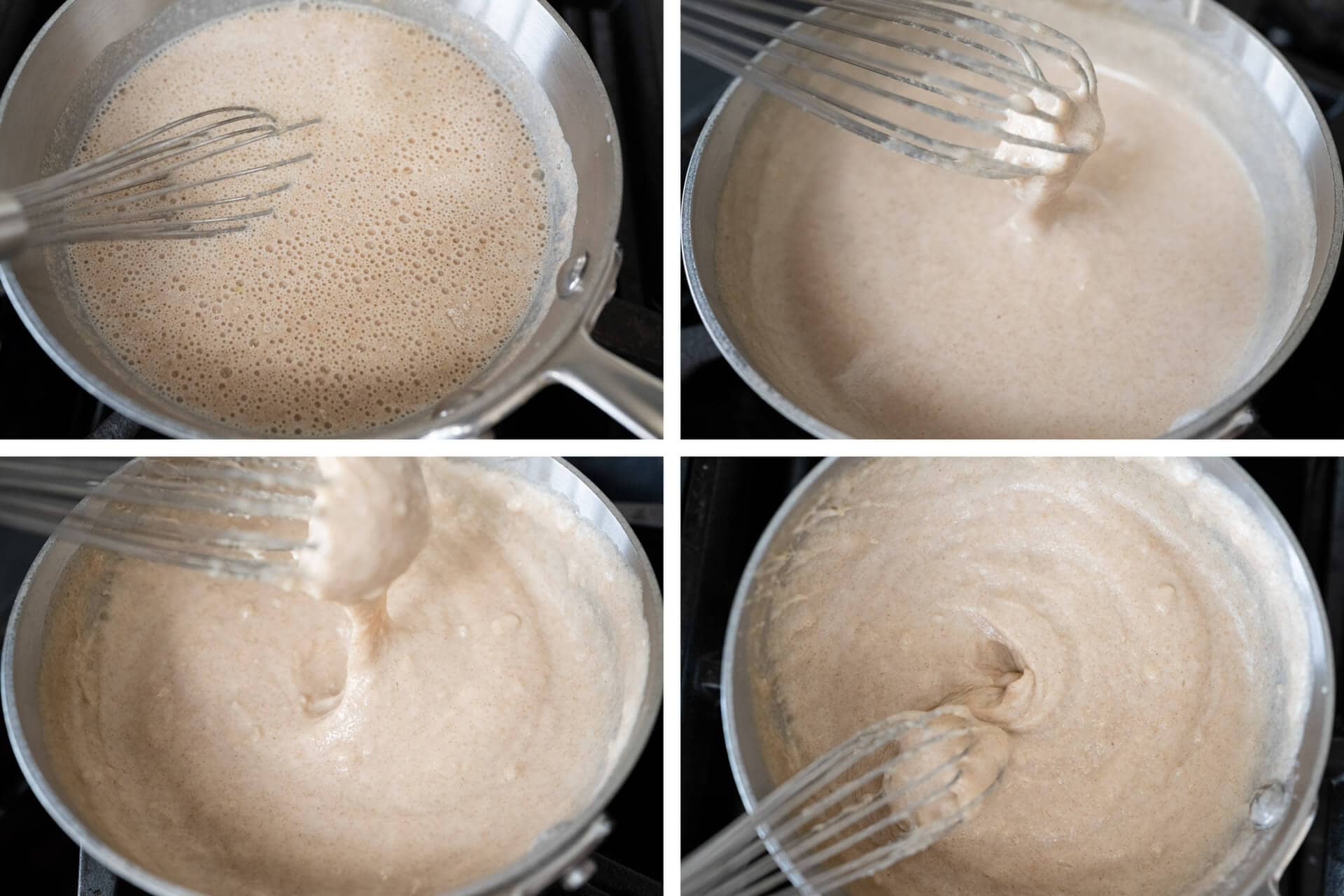
In the top left, the flour and milk are combined and whisked vigorously over medium-low heat. After a few minutes, the top-right shows the mixture starts to thicken. Continue to whisk, and don’t worry if you find small clumps here and there. The bottom-right shows the mixture sufficiently thickened and ready to remove from the flame. It will feel similar to a cooked porridge and be hard to whisk any further. Then, let the tangzhong mixture cool and add it as any other ingredient during mixing.
Flour Selection
Any medium-protein bread flour (around 11% protein) or all-purpose flour will work well in this recipe. I’ve made this with King Arthur Baking All-purpose with excellent results. And similarly, for the whole wheat portion, any whole wheat flour will work well.
Baking Schedule
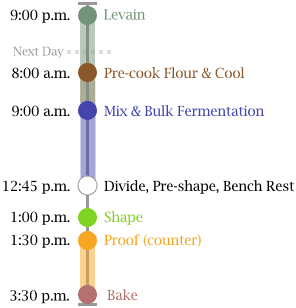
This tangzhong pan bread is a direct bake, meaning it’s baked the same day you mix (except for the levain, which is created the night before).
Overnight proof option: while I don’t call for this dough to be retarded (cold proof overnight), this can be done if it’s better for your schedule. Simply place it in the fridge after it’s shaped and in the Pullman pan, then bake first thing in the morning.
Tangzhong Sandwich Bread Formula
For tips on how to calculate baker’s percentages or how to modify this formula, see my post on baker’s percentages (baker’s math).
| Total Dough Weight | 1,800 grams |
| Pre-fermented Flour | 11.00% |
| Levain in final dough | 25.96% |
| Yield | 2 x 900g pan loaves |
I love using my 9x4x4″ USA Pan Pullman pan (without the lid) for sandwich bread. Not only does the nonstick liner mean the loaves always remove cleanly, its straight sides mean neat slices perfect for sandwiches or toast.
But if you’re looking for how to make this recipe work in a different pan, see my post on shaping a sandwich loaf.
Total Formula
Desired dough temperature: 77°F (25°C). See my post on the importance of dough temperature for more information on dough temperatures.
The rows marked tangzhong below are the two ingredients cooked ahead of time, but they are still counted toward the formula’s overall percentages. In other words, the 8% whole wheat flour is still counted toward the total flour in the formula and is not an “extra” addition.
| Weight | Ingredient | Baker’s Percentage |
|---|---|---|
| 74g | Tangzhong: Whole wheat flour (Giusto’s Whole Wheat Flour) | 8.0% |
| 296g | Tangzhong: Whole milk | 32.0% |
| 693g | Medium-protein bread flour or All-purpose flour (~11% protein, Central Milling Artisan Baker’s Craft or King Arthur Baking All-Purpose) | 75.0% |
| 157g | Whole wheat flour (Giusto’s Whole Wheat) | 17.0% |
| 65g | Olive oil | 7.0% |
| 37g | Honey | 4.0% |
| 453g | Water | 49.0% |
| 17g | Salt | 1.8% |
| 10g | Sourdough starter | 1.1% |
Tangzhong Sandwich Bread Method
1. Prepare Levain – Night before mixing, 9:00 p.m. (Day one)
| Weight | Ingredient | Baker’s Percentage |
|---|---|---|
| 101g | Medium protein bread flour or all-purpose flour | 100.0% |
| 101g | Water | 100.0% |
| 10g | Ripe sourdough starter | 10.0% |
Mix the following ingredients in a container and leave covered to ripen at about 78°F (25°C) for 12 hours overnight.
2. Prepare the tangzhong (pre-cook flour) – 8:00 a.m. (Day two)
| Weight | Ingredient |
|---|---|
| 74g | Whole wheat flour |
| 296g | Whole milk |
Be sure to do this ahead of time to give the pre-cooked flour time to cool before mixing.
Milk alternative: If you want to avoid using milk in this recipe, substitute out the dairy milk in the roux, below, for water (or something like oat milk).
To a medium saucepan, add the flour and milk listed above. Turn the heat to medium-low and cook, whisking continuously, until the mixture thickens and becomes like a paste, about 5-8 minutes. In the beginning, whisk vigorously to break up any flour clumps, and be diligent about this near the end to avoid burning. The mixture won’t seem to do anything until it reaches a critical heat point, be patient; it will thicken.
Once it transforms into a viscous paste (something like oatmeal porridge), remove the pan from the heat and spread it out on a small plate to expedite cooling. Set the tangzhong aside until called for when mixing.
3. Mix – 9:00 a.m.
I used my KitchenAid stand mixer to mix this dough, but it’s possible to make this bread without a stand mixer by mixing everything together by hand in a mixing bowl. To do this, you’ll need to mix for around 10-15 minutes, depending on your technique (slap and fold will work really well!).
| Weight | Ingredient |
|---|---|
| All | Tangzhong (see Tangzhong above) |
| 591g | Medium-protein bread flour |
| 157g | Whole wheat flour |
| 65g | Olive oil |
| 37g | Honey |
| 351g | Water |
| 17g | Salt |
| 213g | Levain (see Prepare Levain, above) |
Mixing water temperature note: I used cold water from the fridge to mix this dough, mostly because my pre-cooked flour was not fully cool by the time I needed to mix. Be sure to take the temperature of the pre-cooked flour and other ingredients into account to get close to the final dough temperature listed for this recipe.
Use my mixing water temperature calculator to quickly help you determine what to heat or cool your water to so it meets the desired dough temperature for this recipe.
To the bowl of a stand mixer fitted with the dough hook attachment, add the pre-cooked flour, flour, water, ripe levain, honey, olive oil, and salt. Mix on low speed for approximately 2 minutes until the ingredients come together, and no dry bits remain. Increase the mixer speed to medium (2 on a KitchenAid) and mix for 8-10 minutes until the dough starts to clump up around the dough hook. It won’t completely remove from the bottom of the bowl, and it will still be shaggy. See the image of my dough right after transferring to its bulk fermentation container.
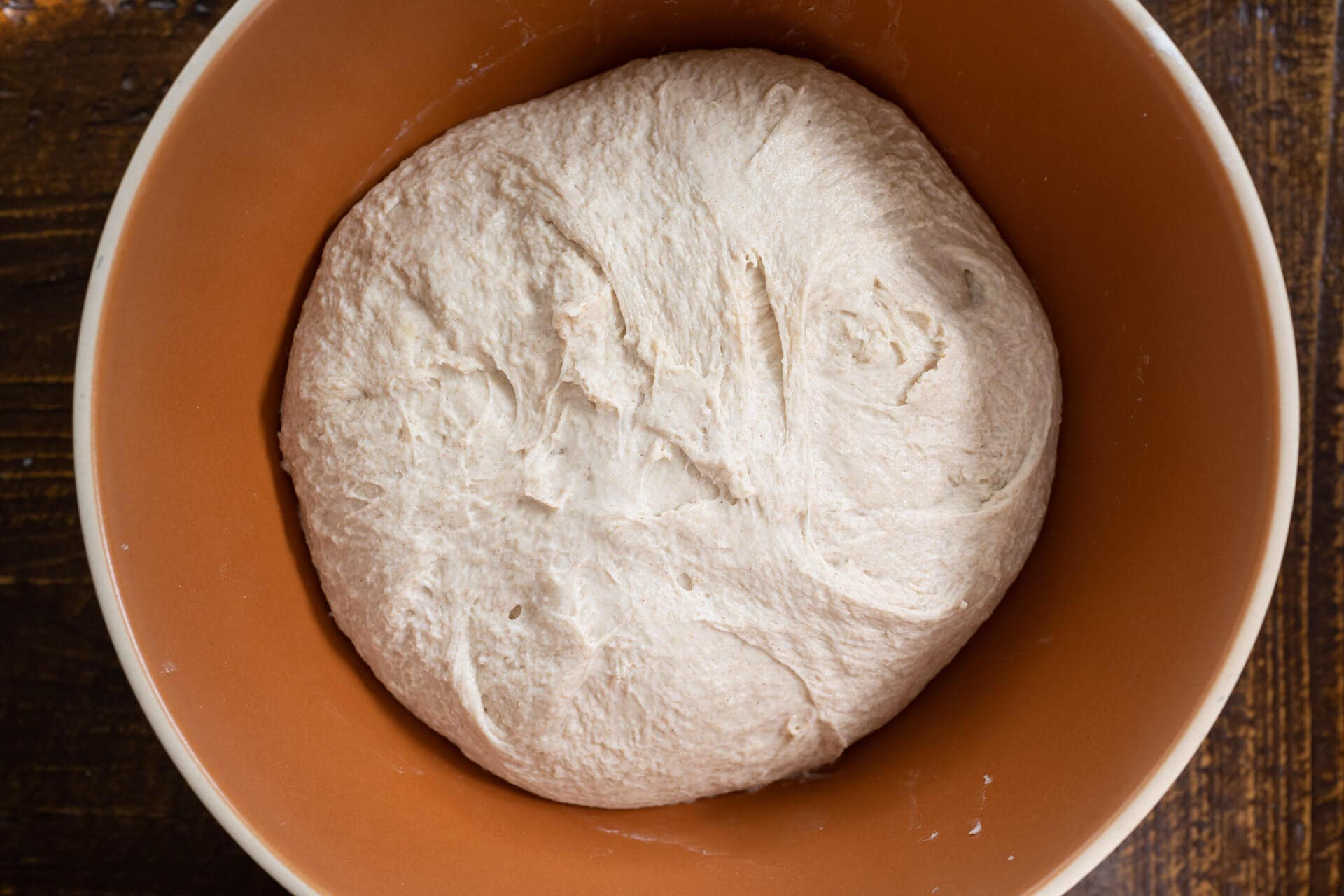
Transfer your dough to a bulk fermentation container and cover.
4. Bulk Fermentation – 9:15 a.m. to 12:45 p.m.
At room temperature, around 72-74°F (22-23°C), bulk should take about 3 1/2 hours. Give this dough three sets of stretch and folds during bulk fermentation (first rise) at 30-minute intervals, where the first set starts after 30 minutes from the start of bulk fermentation. For each set, wet your hands, grab one side and stretch it up and over the dough to the other side. Rotate the bowl 180° and perform another stretch and fold (this forms a long rectangle in the bowl). Then, rotate the bowl 90° and do another stretch and fold. Finally, turn the bowl 180° and do one last stretch and fold. You should have the dough neatly folded up in the bowl.
After the third set, let the dough rest for the remainder of bulk fermentation.
5. Divide and Pre-shape – 12:45 p.m.
Uncover your bulk fermentation container and gently scrape the dough out of the bowl onto a clean work surface. Using a bench knife, divide the dough directly in half and pre-shape each piece into a loose round. Let the rounds relax uncovered for 30 minutes.
6. Shape – 1:15 p.m.
First, lightly oil your Pullman pans with olive oil or another neutral oil. While this isn’t strictly necessary when using a USA Pan Pullman pan, it’s a little insurance just in case.
I shaped this dough in my typical method for shaping a pan loaf. Check out my guide to shaping pan loaves for detailed instruction.
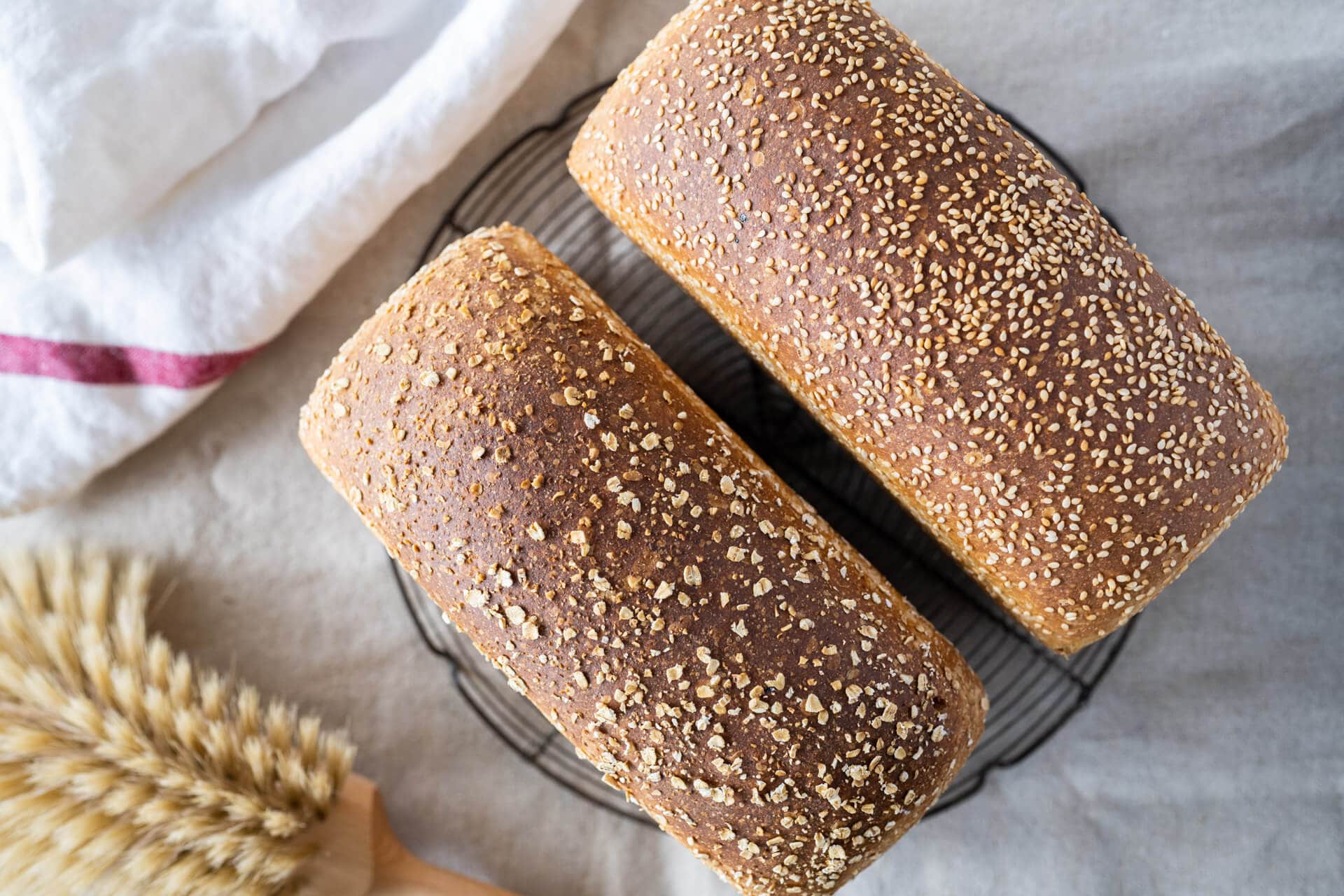
Once the dough is shaped into a long tube, transfer each to their pan, seam-side-down. At this point, you can sprinkle on any toppings you’d like, I added white sesame seeds to one loaf, and instant oats to the other.
7. Proof – 1:30 p.m. to 3:30 p.m. (2 hours room temperature)
Cover the pans with a large, reusable plastic bag and seal shut. Let the dough proof at room temperature, around 72-74°F (22-23°C), for 2 hours.
Overnight proof option: before the 2 hour counter proof, cover the pans with bags and place them in your home refrigerator to proof overnight. Bake them the next morning as indicated below. Expect a slightly more sour flavor.
8. Bake – 3:30 p.m. (pre-heat oven at 3:00 p.m.)
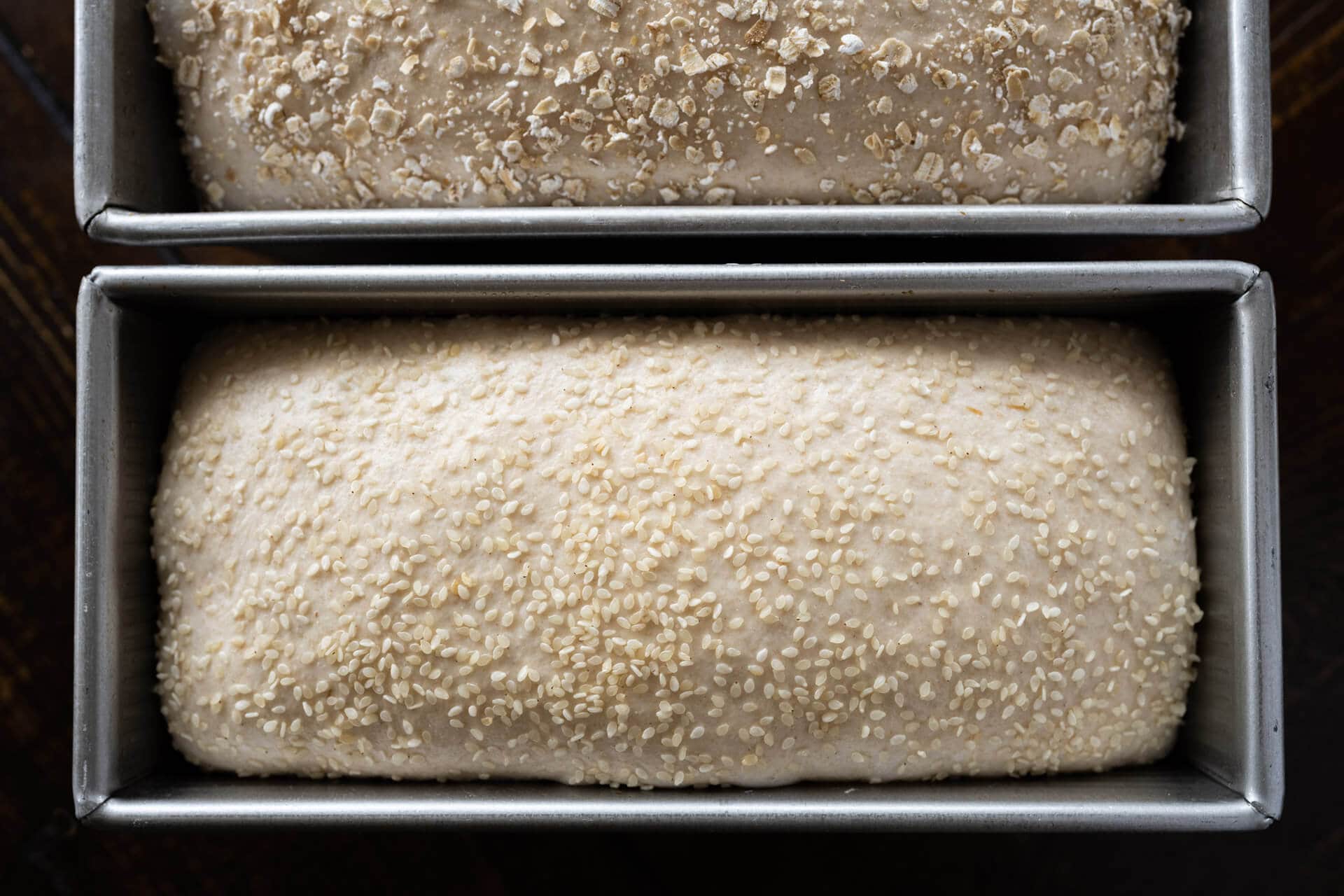
Check on your dough: it should have risen just below the top of the Pullman pan and be very light and airy to the touch (see above). If it’s not quite there, give it another 15 minutes and check again.
I steamed the oven for this bake as described on my post on baking with steam in a home oven.
Preheat your oven, with rack at the bottom third run and a pan with lava rocks on the bottom, to 400°F (205°C).
Once your oven is preheated, remove your proofed loaves from their bags and slide them into the oven. Carefully pour a cup of ice into the pan with lava rocks at the bottom of the oven and quickly close the oven door.
Bake at 400°F (205°C) for 20 minutes with steam. After this time, vent the oven, remove the steaming pan(s), and close the oven door. Bake for an additional 30-35 minutes until the top is well-colored and the internal temp is around 205°F (96°C). Remove the pans and gently knock out the loaves onto a wire rack. Return the loaves to the oven to bake for an additional 5 minutes without their pans to add extra color to the bottom and sides.
Let the loaves cool for 2 hours before slicing to ensure the interior is fully set. These will store incredibly well as described in my post on how to store bread.
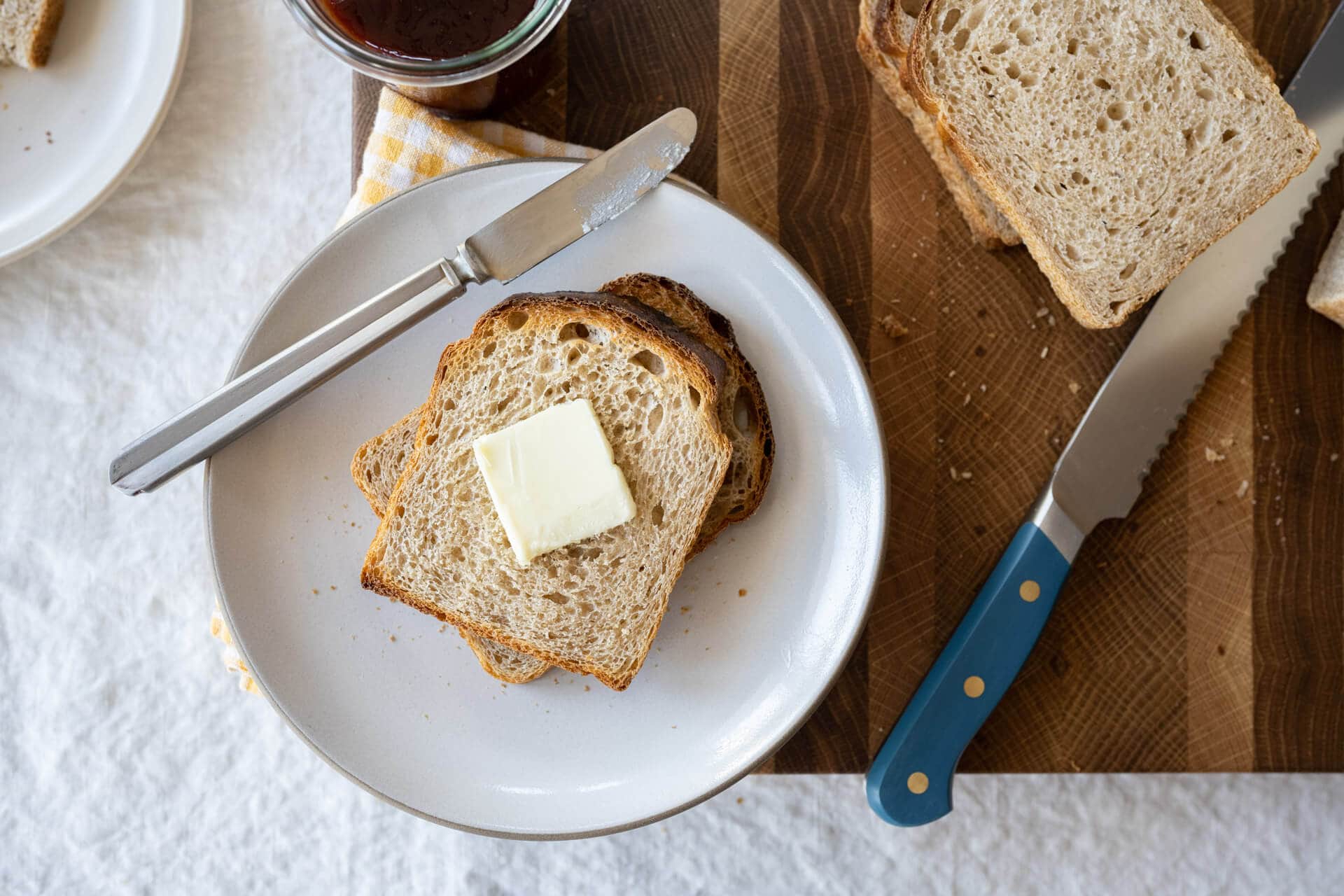
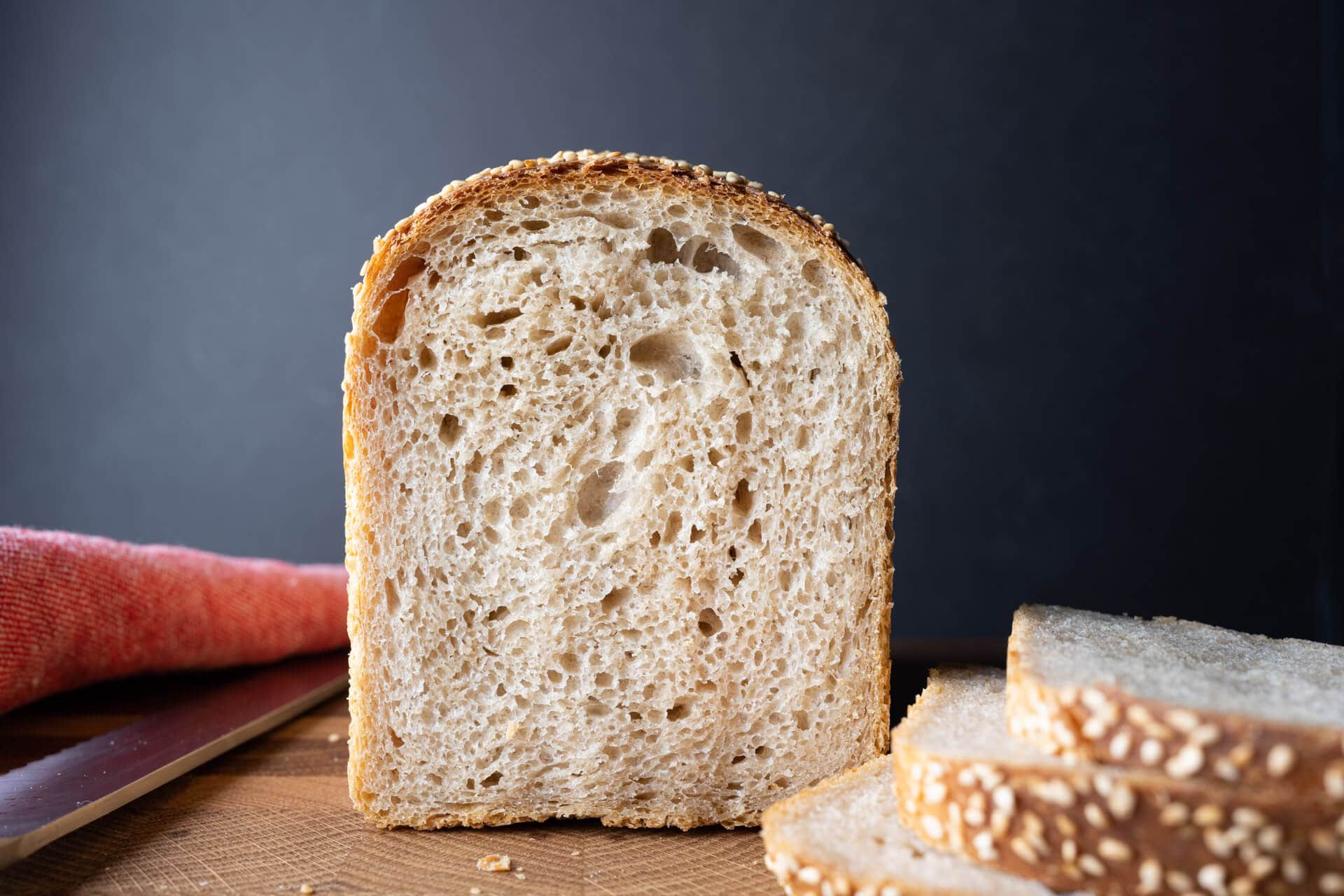
This bread has a delightful flavor that has little sourness. The overnight, mild levain with all white flour helped to this end as did the direct bake (no overnight cold-proof). The sourness that does slyly peek through comes at you at the very end of each bite, a gentle, but welcome, pop of flavor.
What I love about this bread—besides the tender interior, flavors created through natural fermentation, and flavorful, wheaty abundance, of course—is the shatteringly thin crust that forms when a slice is toasted (see above). We have the Pullman pan to thank here, and while a mouth-melting slice of bread is delightful, the added crunch in each slice is downright satisfying. And I think this might be the secret success of this bread: it’s soft, without excessive oil, eggs, or butter, for kiddos to love it, but still shores up enough strength to carry any ingredient you throw at it.
As I finish typing up these final words, I still can’t get the idea of crunchy peanut butter out of my mind. Shall we confess it’s time, yet again, for another amped-up PB&J? Buon appetito!
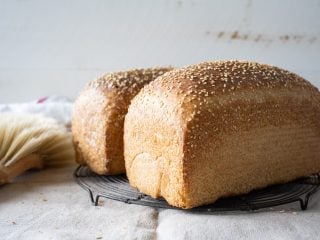
Tangzhong Sourdough Sandwich Bread
- Prep Time: 19 hours
- Cook Time: 55 minutes
- Total Time: 19 hours 55 minutes
- Yield: 2 loaves
- Category: Sourdough, Sandwich Bread
- Cuisine: American
Description
This bread has a delightful flavor that has little sourness. The overnight, mild levain with all white flour helped to this end as did the direct bake (no overnight cold-proof). The sourness that does slyly peek through comes at you at the very end of each bite, a gentle, but welcome, pop of flavor.
What I love about this bread—besides the tender interior, flavors created through natural fermentation, and flavorful wheaty abundance, of course—is the shatteringly thin crust that forms when a slice is toasted (see above). We have the Pullman pan to thank here, and while a mouth-melting slice of bread is delightful, the added crunch in each slice is downright satisfying. And I think this might be the secret success of this bread: it’s soft, without excessive oil, eggs, or butter, for kiddos to love it, but still shores up enough strength to carry any ingredient you throw at it.
Ingredients
Levain
- 101g medium-protein bread flour
- 101g water
- 10g ripe sourdough starter
Tangzhong
- 74g whole wheat flour
- 296g whole milk
Main Dough
- all the tangzhong
- 591g medium-protein bread flour or all-purpose flour
- 157g whole wheat flour
- 65g extra virgin olive oil
- 37g honey
- 351g water
- 17g salt
- all the levain
Instructions
- Prepare levain (Day one, the night before mixing, 9:00 p.m.)
In a small container, mix together the levain ingredients and keep at 78°F (26°C) for 12 hours. - Prepare the Tangzhong (Day two, 8:00 a.m.)
Add the tangzhong ingredients to a medium-size saucepan. Turn the heat to medium-low and cook, whisking continuously, until the mixture thickens and becomes like a paste, about 5-8 minutes. - Mix (9:00 a.m.)
To the bowl of a stand mixer fitted with the dough hook attachment add the Main Dough ingredients. Mix on low speed for approximately 2 minutes until the ingredients come together, and no dry bits remain. Increase the mixer speed to medium (2 on a KitchenAid) and mix for 8-10 minutes until the dough starts to clump up around the dough hook. It won’t completely remove from the bottom of the bowl, and it will still be shaggy. Transfer your dough to a bulk fermentation container and cover. - Bulk Fermentation (9:15 a.m. to 12:45 p.m.)
Give the dough 3 sets of stretch and folds at 30-minute intervals, where the first set starts 30 minutes after the start of bulk fermentation. - Divide and Preshape (12:45 p.m.)
Scrape out the dough, divide it in half, and preshape each half into a loose round. Let rest for 30 minutes, uncovered. - Shape (1:15 p.m.)
Lightly oil two 9x4x4-inch Pullman pans with olive oil or neutral oil. Shape each piece of dough into a tube shape and transfer it to the pan. Top with sesame seeds, rolled oats, etc. - Proof (1:30 p.m. to 3:30 p.m. at room temperature)
Cover the pans with reusable plastic and seal shut. Let the dough proof for 2 hours at 72-74°F (22-23°C). - Bake (3:30 p.m.)
Preheat your oven, with a rack at the bottom third run and a pan with lava rocks on the bottom, to 400°F (205°C). Bake at 400°F (205°C) for 20 minutes with steam. After this time, vent the oven, remove the steaming pan(s), and close the oven door. Bake for an additional 30-35 minutes until the top is well-colored and the internal temp is around 205°F (96°C). Remove the pans and gently knock out the loaves onto a wire rack. Return the loaves to the oven to bake for an additional 5 minutes without their pans to add extra color to the bottom and sides. Let the loaves cool for 2 hours on a wire rack before slicing.
Notes
This bread can also be proofed overnight to bake the next day. At the proof step (#7), instead of proofing on the counter, retard the dough to the fridge (covered). Any time the next day, remove the dough from the fridge and bake straight away.
A full-fat nut or oat milk or water can be used to make the tangzhong.
What’s Next?
For another tangzhong recipe, check out our ultra-soft and delectable sourdough cardamom rolls.


506 Comments
I adapted this recipe to a cinnamon raisin bread. I wanted to recreate the vegan Challah recipe in the Baker Bleu sourdough cookbook by Mike Russell. That’s makes a wonderful bread but uses old dough to build flavour and strength – something I don’t always have around. I followed the recipe using oat milk in place of water, sunflower oil in place of olive oil, and adding 220g of raisins (soaked in hot water and drained) and 10g cinnamon. I also did a cold ferment overnight but that was because it was 10pm by the time the bulk ferment had finished. Baked from bannetons in hot oven. Delicious!
Hi,
I followed your instructions twice, but it has never risen to the top. I have the feeling that it hasn’t risen after the first fermentation 😔. So, it is good, but it is more dense than fluffy. The second time, I was more tedious with the temperature.
Any ideas?
can this have same day baking directions?
Are you guys scoring these sandwich loaves? I have made the honey wholewheat and maple spelt from the cookbook and both times the loaves split on the top. The recipes don’t call for scoring. Can anyone comment on why the split occurs and if I should score or do something different?
If it split, then it needs scoring.
If it split, it needed more time proofing after shaoing, or needed to be scored.
Could this be made as focaccia instead of loaves?
focaccia is a simple dough, this is an enriched dough.
Thanks for the recipe! Is it possible to substitute a non-dairy milk?
Yes, you can use a full fat nut or oat milk in place of it.
Hello, I plan to make this loaf soon, as it is highly recommended. I like my breads to be at least 50% FMF. What do I need to do to allow for this change in recipe?
Just baked this for the first time. Came out pretty good, but the texture is a bit “gummy” and dense/heavy. Any thoughts on what to tweak for the next bake?
Maurizio,
First, I love your recipes, thank you for sharing!
Second, I've had a hard time baking sandwich loaves evenly in the pullman pans. The top always gets way too dark before the sides get any color. Even with steam it seems to make no difference. Wondering if you have any tips on what could be going on?
Thanks!
I've had this problem as well. One solution that's helped: try covering the tops of your loaves with foil about halfway through the bake…it helps prevent the tops from getting too dark.
Hello. Thank you for the wonderful detailed recipe. I am about to make my first sourdough sandwich loaf and excited to try your recipe. I had a question about the temperature. So once I remove the steaming pans, do I drop the oven temperature to 205 f and continue baking for addtional 30 min or keep the temp at 400 f without steaming pans? Thank you.
I love love love this bread! Next time I want to add eggs. I have a surplus of them.
Heya Maurizio,
Is there anyway to get around this recipe without steaming the oven with the lava rocks and tea towels? My oven doesn't hold steam too well; do you think that placing the loaf pans into Dutch ovens would work? Or is there something else that you would suggest?
Thank you in advance!
I don’t do the steam but I mist the top of the loaves with water. You could also brush top with milk. The idea is to prevent a crust from forming before the oven spring has maxed out. I love this recipe and always have this bread on hand for sandwiches.
I've done that for years rather than steam, what should be a quick and easy recipe, instead: When the proof is getting close, use a very soft pastry brush to 'paint' the tops of the loaves with room-temperature water … wait 10 and repeat, then bake. If the proof took longer than expected, then a light quick brushing of water right before baking is okay. Note that this method precludes using rolled-on toppings (sesame, oats etc) but you can still sprinkle them on right after the last brushing with water. And obviously, there is no interruption to the baking to remove 'steaming pans'.
I've had good results using a turkey roaster to bake loaf bread in. I picked up a large chicken roaster at Goodwill for under $10. 13" fits a loaf pan. Two of them fit on one rack in the oven.
This dough seems to never ferment to the ‘not sticky’ stage. It seems to just stay sticky.
Clear back at the Mixing phase, more slap and folds or more in-bowl folding. I find that developing structure early really helps out in the end in terms of the final dough characteristics and stickiness.
Can I still make this if I don’t have lava rocks?
Yup absolutely, Kathy. Just leave the pan empty!
Hi there!
I have a few questions about the temp. and the amount of time given for proofing. All of my loaves generally take several hours longer than the recommended time. I keep the dough within the correct temp window as well and I usually refer to the Sourdough Journey temp. and proofing chart to make sure I'm proofing enough. So, for example this recipe in total only proofs for about 6/6.5 hours but at 72-74 degrees it should be proofing closer to 8-10 hrs total. Id love to know your thoughts!!
Also, one last question about the cold proof on this white sandwich bread. If I put it in the fridge instead of a final counter proof, will it be proofed enough overnight? If it hasn't risen in the refrigerator should I wait until it just about reaches the rim of the pan before i bake?
And also, should I be expecting it to rise in the refrigerator overnight?
Thanks so much! Love these recipes!
Cristina, I'm glad you're enjoying the recipes! Proofing time variations are completely normal – the timings in recipes are always just guidelines. Your starter's unique behavior, your specific flour, and even humidity can all affect fermentation rates. Always trust the visual cues over strict timing.
For the cold proof question with the white sandwich bread – yes, you can absolutely do an overnight cold proof instead of the final counter proof. The dough will rise some in the refrigerator, but not as much as it would at room temperature. The result will be a slightly more sour flavor but not bad by any means.
Let me know if that helps with your baking schedule!
Hi, how can I use stiff starter, fed the night before, instead of levain? Also, if I start all the mixing process in 8 AM, is it possible to finish bake at 3 PM or so, in time for lunch? Which part of the process to shorten? The temperature in my kitchen is around 22 to 23 C. My starter is still young and I am trying to reduce the acidity in bread, so I am interested in this recipe, afraid that overnight proofing would increase acidity. Thanks
You can definitely use your stiff starter in place of the levain as long as it's ripe and active. Just use the same weight of ripe stiff starter as the recipe calls for levain. Since there's less water in your stiff lev, you might need/want to add a little more water to the dough. Might not be necessary, though.
For the timeline question, starting at 8 AM and finishing by 3 PM is tight but possible at your kitchen temperature (22-23°C). To make this work, you'll need to:
– Make sure your starter is very active when you begin
– Keep your dough in the warmest part of your kitchen
– Consider using a slightly higher percentage of starter in your dough (increase by about 20%)
Bulk fermentation will be the hardest part to compress. Watch for the visual cues of proper fermentation rather than strictly following time guidelines – look for about 30-50% volume increase and a puffy texture.
Let me know how it turns out!
Thank you for your reply. I have tried short timeline, with 20% starter. It is very difficult to achieve my goal. I will try again, as the summer is coming so temperatures will be higher. I also have issue with sourness of the dough. May starter is very young, but active. If I follow proper procedure, bulk and cold fermentation, I get bread with sourness that I don’t like. I tried also only bulk, without cold fermentation and the result is much better, but I don’t always have such schedule, except for a weekend. Sorry for my long reply, but you are person with experience and I thing I will get the best advice from you. Thanks!
Managed to get to the DDT and even though I live in the tropics, the bulk fermentation and proofing times were the same as outlined in Maurizio’s recipe! The only change I made was to swap out 20% of the King Arthur All Prpose for higher protein bread flour. Otherwise, the dough turns into a sticky mess in this humidity. Overall, a fantastic recipe as usual! Thank you, Maurizio
Great to hear about your success, Maggie! That flour adjustment is exactly the kind of intuitive adaptation that makes for better bread in different environments. The tropics certainly present unique challenges with humidity, and that swap to higher protein bread flour was a smart move to maintain dough structure.
Thanks for sharing your experience and adaptation on this one!
Can I use just a high protein all purpose flour instead of the wheat in this?
Yes, you can. I would consider increasing the hydration depending on how the dough is feeling during mixing!
thank you for the recipes, I have a 12inch pullman tin could I make the 1 loaf with this recipe instead of dividing into 2 tins? Thanks.
Yes, that will work Belinda.
I only have one USA Pullman Pan. Can the recipe for the Tangzhong Sourdough Sandwich Bread be divided – instead of two loaves make just one? I am assuming I would just divide the ingredients in half – correct?
Right, to make a single loaf, just divide all the ingredients in half!
Can i bake it in combi oven? And if yes on which settings. Thanks
Absolutely, I don't see why not. I'd use the same temps I list here, but if there is a fan inside, you'll bake for less time. Alternatively drop the temp by 25°.
Will it fit if I bake it with a lid on? Also can I add a pinch of yeast to speed up the process (I don’t bake so often with my sourdough..) Thanks
If you put the lid on you'll end up with a perfectly square loaf, which is great, too. It should fit with this recipe…
Hi, I'm sorry if this question has been asked before, but I went through about 100 of the comments before I gave up! I'd like to make this as buns/rolls (separated on a cookie sheet). At what temperature would you suggest I bake it and for how long? Thank you!
You could definitely do that. I would bake them like I do my other rolls, here: https://www.theperfectloaf.com/super-soft-sourdough-rolls/
Thank you for responding! I'm surprised they would need forty minutes of bake time, but maybe it's more when they're close together in a pan. I'll see how it goes!
Yes, usually a longer bake time with pans. But do keep an eye on them in the last 10 min until you get a feel for your oven!
Hi Mauricio – just wondering if I can make the tanzhong the night before, like the levain, and let it sit on the counter? Or would it need to be refrigerated? Trying to eliminate that step in the morning.
Yes, you can definitely make it the night before. I usually let it cool a bit, then cover it and keep it in the fridge.
Hi Maurizio! Avid beginner here. Your blog is so reliable for its precision, reasons behind, and room to experiment. Really appreciate it. So far, I’ve made: Pain de mie, Beginner’s SD bread, No-knead SD bread, Babka (truly gem!), Simple SD Focaccia, Ciambella, Banana bread, SD discard pancake, Tortillas, Fudgy SD brownies (favorites among sweet teeth). The latest one: Tangzhong SD sandwich bread. I have to report that it is my new favorite, with the potential it can be enjoyed by everyone, toothless or not 😉 I live in the tropic (28-34 C, around 70% humidity). Starter and levain rise more quickly. So in the tangzhong bread making, I replaced 70% honey with fine brown sugar, expecting the dough would be more pliable. Yet, after bulk fermentation it could not have smooth surface as yours. Any thoughts on this?
Method wise, I mixed the dough with hand as I don’t have mixer. Relied on lots of short stretch-and- fold in a mixing container (25 cm), as I didn’t have large surface to do slap-and-fold. I used home oven (33×23 cm) with folded towels + a lot of water 20 minutes before baking + 1 cup ice cubes just before sliding in two loaf pans. Some ingredients adjustment: I used cooking coconut oil, UHT wholemilk, ‘artisan’ milled whole wheat flour, volcanic salt, white sesame and wheat bran sprinkled on top (as I couldn’t roll the less firm dough).
The loaves rose fantastic! Slicing it after 2 hours: no gummy interior (as what I experienced in traditional SD bread), rather strong tang yet enjoyable, and easy to cut through (it’s important 😊). Thanks a lot for creating these recipes and sharing them with us! <3
So happy to hear you liked this one (and all the others), Agnes! Usually a lack of smoothness is a sign of under-strengthened or over-hydrated dough (or a combination of both, as they are related). If you find you’re still getting significant spreading, try first to add in another set or two of stretch and folds during bulk fermentation (or you can knead the dough a bit before bulk begins, check out my guide to the slap and fold kneading technique). If that doesn’t help, reduce the hydration of the dough by 2-5% to bring more strength.
Finally, it’s also possible your dough is over proofing, leading to a breakdown and excessive spread in the oven. If your dough felt strong and you shaped it tightly, try pulling back that final proof time a few hours (if you’re cold-proofing) to see if that helps. If it does, continue to dial in that proof time until you have a strong dough when baking.
I hope this helps!
Hello again! Yesterday I reduced hydration to total 78% and fermented + proofed in 24C air-conditioned room (normally, in my 30-34C kitchen). I forgot to take FDT, but average temp of iced water, flour, tangzhong, levain was 27DC. I did French fold before bulk fermentation (in the hot kitchen). Yes, it was pliable, smooth, but didn't rise much in the fridge (9 hours proofing though). Baked in the morning with towel + ice cubes in home oven. Crust was crispy and hard. Interior was soft with less alveoli. I tag you on my insta story :-D. What was possibly wrong?
Next time i will make adjustment in other areas.
Thanks Maurizio!
That's all sounding good so far. I'm wondering if it was slightly underproofed, which can present as a thick and hard crust. Especially since the interior had less alveoli, as you mentioned.
I'd give the dough 30m more in bulk fermentation.