

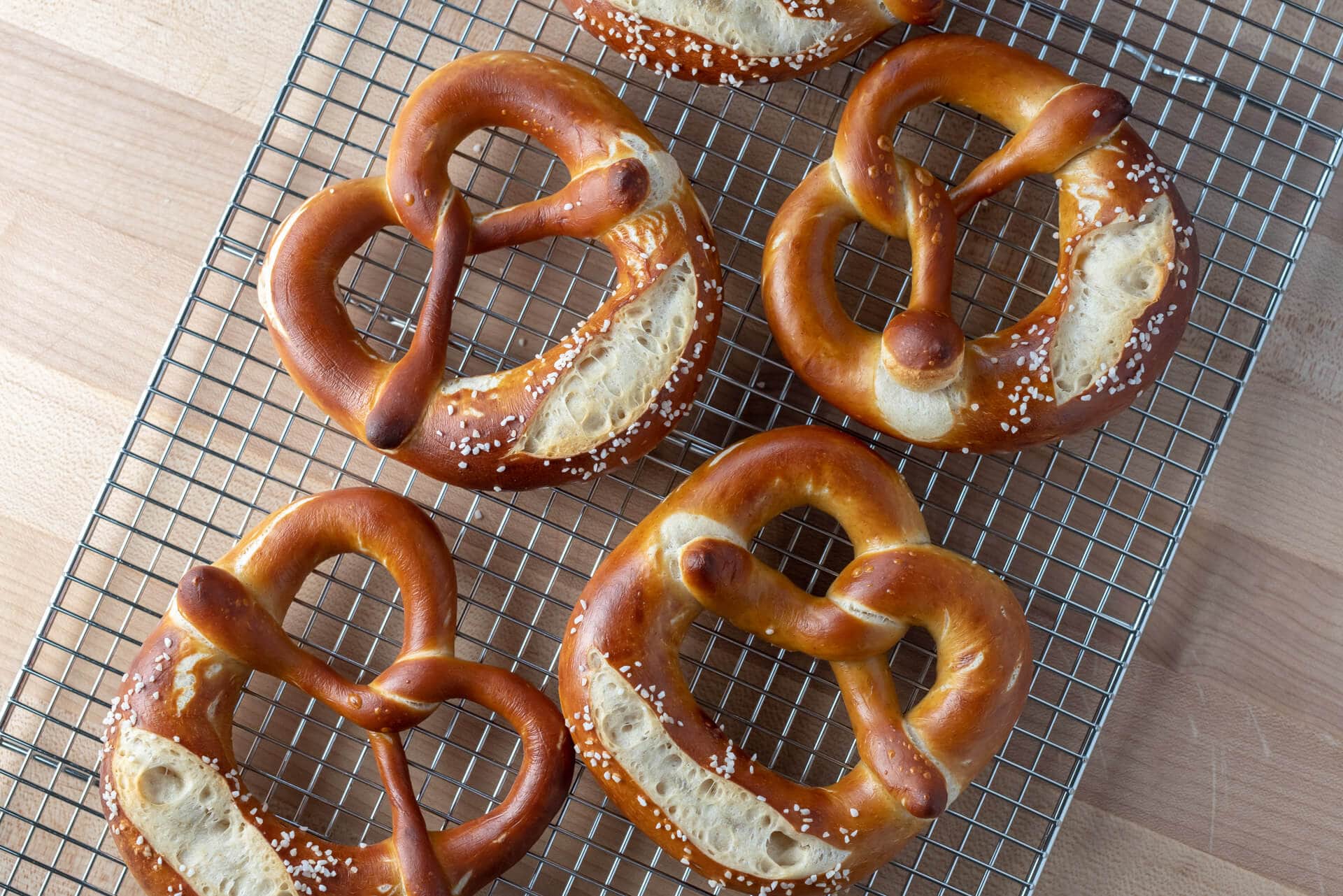
As I walked through the two enormous wooden doors of the German beer hall, each host to a gold-emblazoned crown, my senses were first assaulted by the aromas of beer, mustard, and sauerkraut. It was the beginning of an awakening. An unknown, or perhaps forgotten, craving began to bubble to the surface as I scanned for an empty bench. People were packed tight with broad grins, large mugs of beer, and that happy demeanor that only comes when the world outside is forgotten. My natural urge to raise my voice and tell a few stories was matched only by my desire for a seriously soft (sourdough) pretzel.
In recalling my travels through Germany a few years back, my memories of these beer halls are still fresh. We’d duck the incessant rain by dropping into a beer hall for sausage with sauerkraut, a laugenbrezel (pretzel), and a maß (1 liter) of beer. It seemed our entire time in Germany consisted of a series of strung-together visits to these fine establishments. I can confidently say I ate more pretzels during that week-long trip than in all the previous years of my life combined.
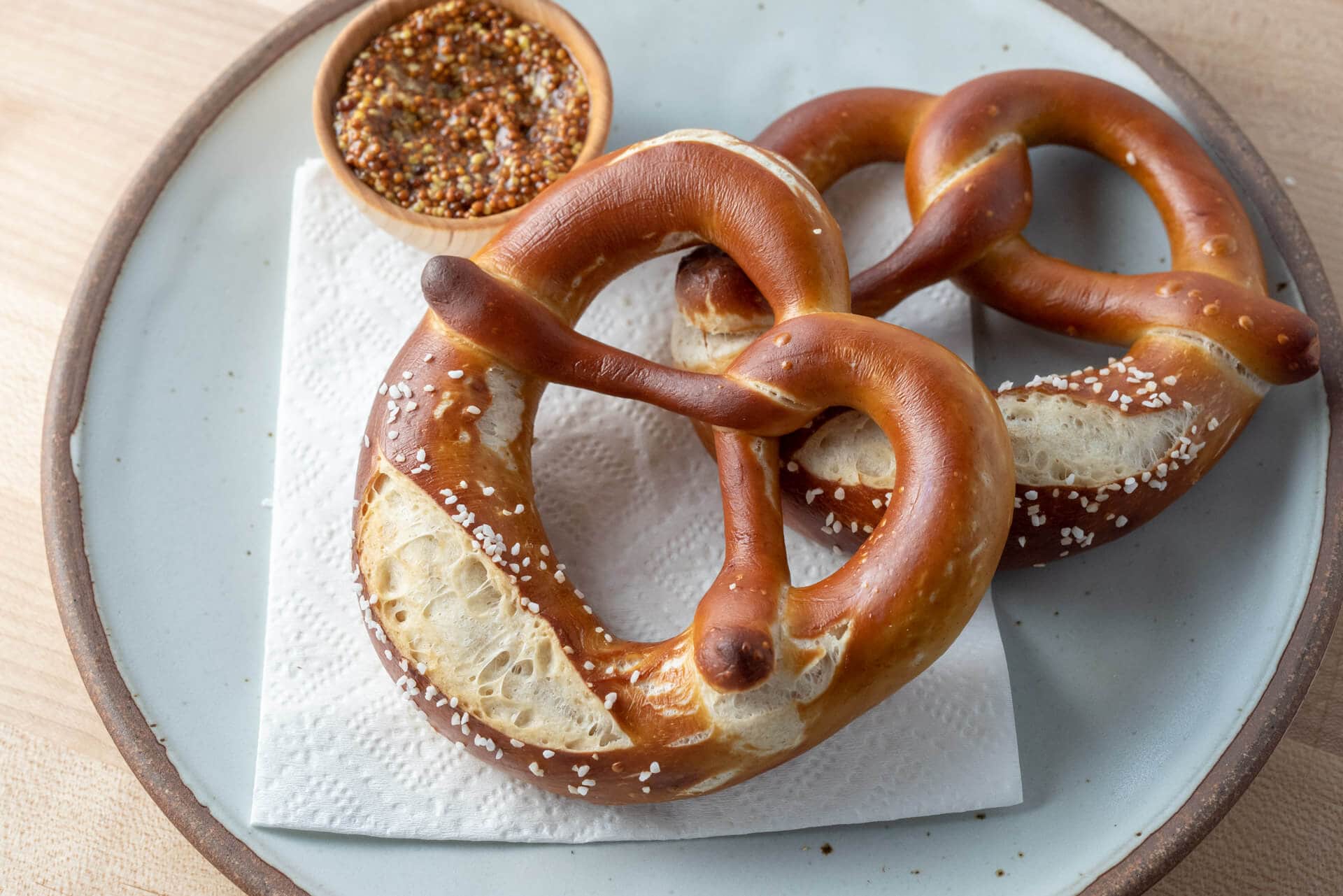
And there are so many ways to enjoy pretzels. There are countless variations not only in the final shape, but also in the toppings and accompanying condiments. I’ve also found that these topics spark pretty heated discussions among pretzel aficionados! It’s safe to say one could spend a fair amount of time traveling around and still fail to encounter all the variants. Laugenbrezel, brezel, brezen, butterbrezel… So many names, varieties, and options–so little time.
Admittedly, I should have started my attempts at a soft sourdough pretzel long ago. To make up for my lack of appropriate focus on this wonderful food, I’ve been working on this recipe relentlessly over the past few months. I’ve made them almost every day (as you might have seen on my Instagram feed), and I’ve really come to expect a fresh pretzel for lunch. Now, days without a fresh pretzel have become a day of deprivation.
The beauty of this pretzel recipe is that you can make it in a single day using your already-ripe starter or an overnight levain. However, you can also split the work over two days, forcing you to choose between fresh, warm pretzels in the morning or in the late afternoon. Also, the dough is easy to mix and bulk—the only slightly involved part is the lye bath.
Watch a Video of Me Making These Sourdough Pretzels
The Lye (Sodium Hydroxide) Bath
What Does Lye Do to Pretzel Dough?
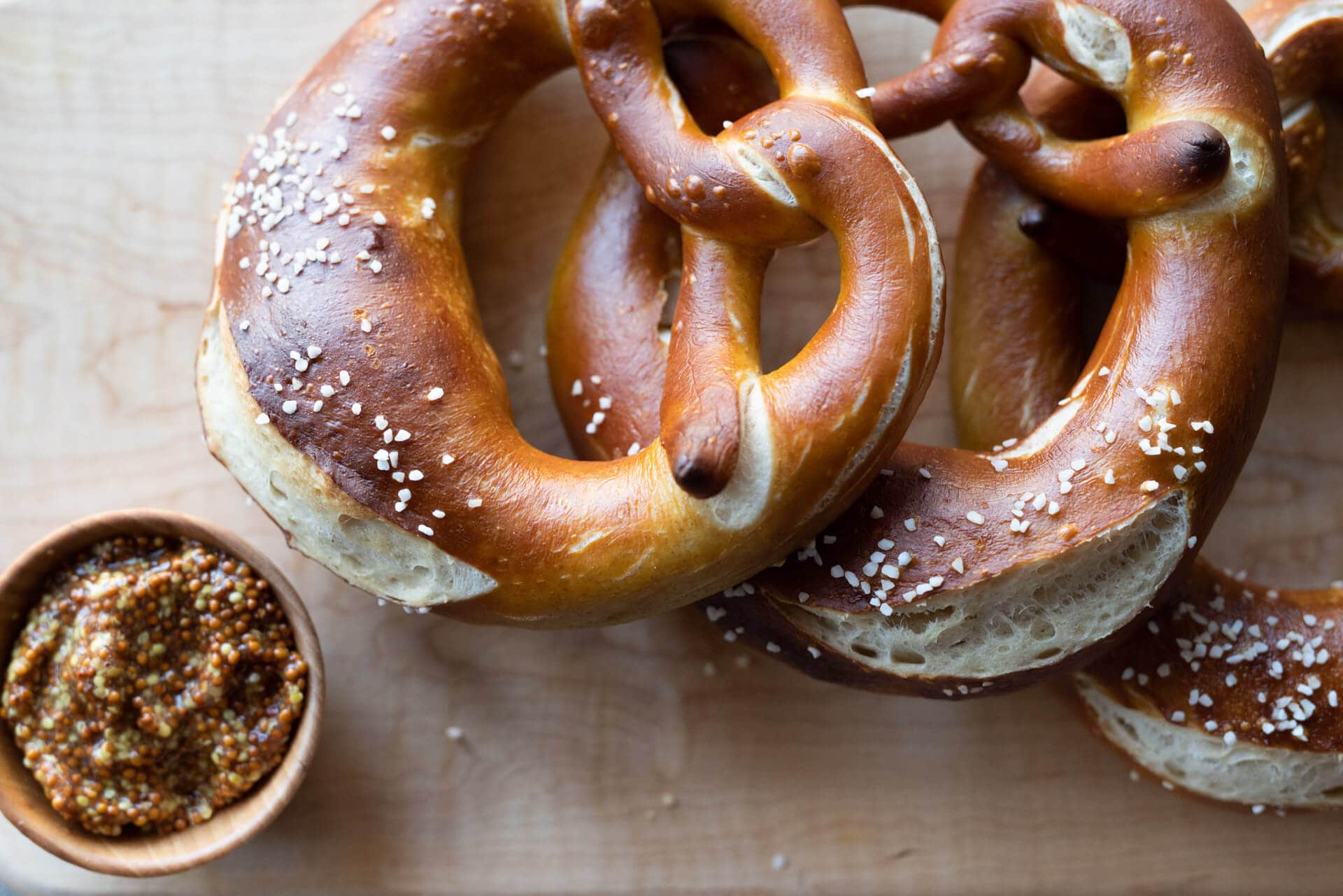
Traditional pretzels are made by dipping (not boiling) proofed, chilled pretzel dough in a 3 to 4% lye solution before baking. Lye is a corrosive alkali that amplifies the Maillard reaction on the outside of pretzel dough when briefly dipped in a lye bath. This lye bath will give the German-style pretzel a deep brown color, shine, a chewy crust, and a typical “pretzel” flavor.
When baked in the oven, the lye dissipates and becomes harmless while imparting that signature pretzel flavor and a beautiful brown crust (thanks again to the Maillard reaction).
What Lye Should I Use to Make Pretzels?
I use 100% food-grade lye and have used the same brand for all of my tests. It comes in a coarse powder form, and you mix it in a stainless steel bowl already filled with water, stirring until completely dissolved.
I use a 4% lye solution for these sourdough pretzels:
| Cool water (the cold water helps keep the chilled pretzel dough firm) | 940g (1 quart) |
| 100% food-grade lye (sodium hydroxide) | 38g |
Lye is caustic (corrosive) and can be dangerous if used incorrectly. Always wear long rubber gloves (and eye protection, if desired) and handle it with care. It’s best to keep children and pets out of the kitchen as well. If some of the lye solution does get on your skin, don’t panic; wash it off in the sink as quickly as possible. As with all household chemicals, keep them up and out of curious reach.
After testing this recipe countless times, I’ve found that lye isn’t quite the big deal many make it out to be. If you are careful and take proper precautions when handling the solution, the whole process is safe and takes minutes.
What Can I Substitute For Lye?
If you don’t want to use lye, another option is a baking soda solution. Baking soda isn’t as caustic as lye, but it should have a similar, less potent effect. I haven’t yet tested the substitution myself, but I’ve read it won’t garner you quite the same result. However, it might be preferable to those who choose not to bring lye into their kitchen.
Finally, another substitute for lye was made famous by Harold McGee, and it was to use baked baking soda. Baked soda (also called jian in Chinese kitchens) is a more powerful alkali than traditional baking soda, which helps add more flavor and color to a baked pretzel.
Can I Freeze and Store Pretzels?
After baking, these pretzels will keep well for a few days stored in a bread box on the counter. Alternatively, once they are completely cool, you can place them in a freezer bag and keep them frozen for months. To thaw, place them in the refrigerator overnight, and then warm them thoroughly in a low 350°F (175°C) oven.
How Do I Reheat Sourdough Pretzels?
If kept at room temperature, these sourdough pretzels reheat nicely in a 350°F (175°C) oven for a few minutes, until soft.
Seriously Soft Sourdough Pretzel Recipe
Through testing, reading, researching, and discussing with other bakers, I’ve found there are a few key points to making these pretzels.
While some of these are seemingly insignificant, they are small steps that add up to achieving that spectacular result:
- Degas heavily when dividing
- Don’t cover your baking trays when chilling the shaped pretzel in the fridge (this helps to develop a skin on the pretzel)
- Bake in a very hot oven, 450°F (230°C)
- Using lye for the pre-bake bath imparts that classic pretzel color, flavor, and texture
Vitals
| Total Dough Weight | 1,420 grams |
| Pre-fermented Flour | 12.0% |
| Hydration | 55.0% |
| Levain in the final dough | 28.6% |
| Yield | Twelve pretzels |
Total Formula
Desired dough temperature: 76°F (24°C) (see my post on the importance of dough temperature). I typically make these in the cooler months of the year; if you do, be sure to review my guide to baking in the winter.
This table shows the entire quantity and baker’s percentages for each ingredient. If you’d like to make fewer or more pretzels, scale up the quantities using baker’s math.
| Weight | Ingredient | Baker’s Percentage |
|---|---|---|
| 635g | High protein bread flour (12-13% protein; King Arthur Bread Flour) | 74.0% |
| 171g | All-purpose flour (11.5% protein; King Arthur All-purpose Flour) | 20.0% |
| 51g | Whole wheat flour (King Arthur Whole Wheat Flour) | 6.0% |
| 60g | Unsalted butter at room temperature | 7.0% |
| 471g | Water | 55.0% |
| 3g | Diastatic malt powder | 0.4% |
| 17g | Fine sea salt | 2.0% |
| 10g | Ripe sourdough starter, 100% hydration | 1.2% |
Sourdough Pretzel Method
1. Prepare the levain – 9:00 p.m., the night before mixing
To make the levain, mix the following ingredients in a jar and cover, then leave at a warm temperature (74-76°F/ 23-24°C) to ripen overnight.
| Weight | Ingredient | Baker’s Percentage |
|---|---|---|
| 10g | Ripe sourdough starter, 100% hydration | 10.0% |
| 51g | All-purpose flour | 50.0% |
| 51g | Whole wheat flour | 50.0% |
| 102g | Water | 100.0% |
2. Mix – 9:00 a.m.
Note: This sourdough pretzel dough is extremely stiff. If you’re using a KitchenAid mixer, it could cause your machine harm in the long run. You could mix for a few minutes in the mixer to incorporate, then turn the dough out onto the counter and finish kneading by hand (similar to a firm pasta dough). I used my Haussler Alpha dough mixer with a dough hook for this recipe because it excels at working with stiff doughs.
| Weight | Ingredient |
|---|---|
| 635g | High-protein bread flour |
| 120g | All-purpose flour |
| 60g | Unsalted butter at room temperature |
| 369g | Water |
| 3g | Diastatic malt powder |
| 17g | Fine sea salt |
| 214g | Ripe levain (from step 1) |
Cut the butter into 1/2-inch pats. Set them on a plate to warm to room temperature.
To the bowl of a stand mixer fitted with the dough hook attachment, add the flour, water, salt, butter, diastatic malt powder, and levain. Mix on speed 1 for 2 to 3 minutes, until all ingredients are incorporated. Let the dough rest for 5 minutes.
Continue mixing on speed 2 for 4 to 6 minutes, until the dough becomes smooth and cohesive. I’ve found the stronger the mix, the better the result.
Transfer the dough to a container for bulk fermentation and cover it with reusable plastic.
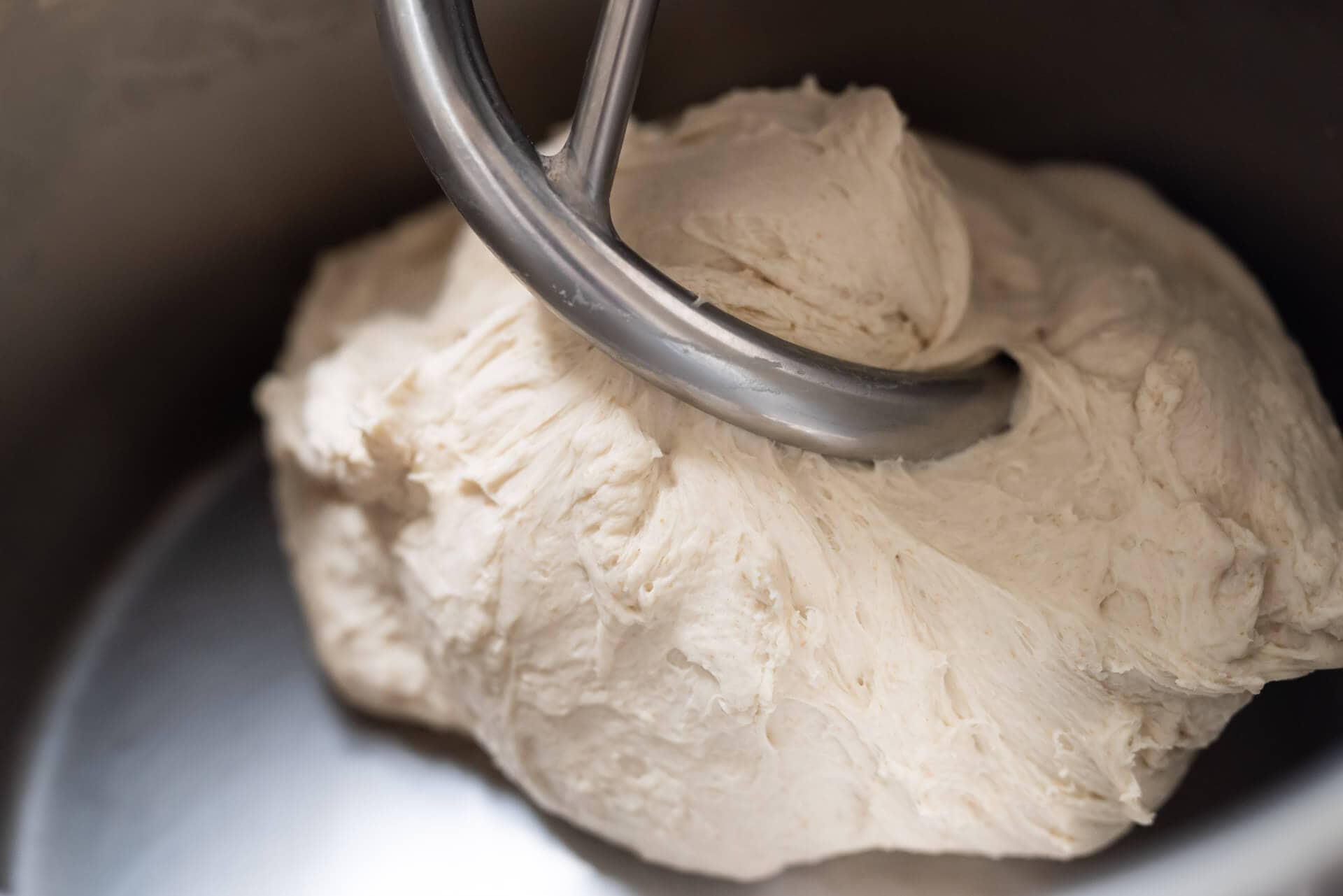
3. Bulk fermentation – 9:15 a.m. to 12:45 p.m.
At a warm room temperature, 74-76°F (23-24°C), bulk fermentation should take about 3 1/2 hours. The dough is ready when it is risen and is slightly puffy.
This dough requires one set of stretch and folds during bulk fermentation. After the first hour of bulk fermentation, turn the dough out onto a clean counter surface, and using two hands, stretch each side of the dough out and over to the middle.
Return the dough to the bulk container and let rest for the remainder of bulk fermentation.
4. Divide and preshape – 12:45 p.m.
When I’m not handling this dough, I like to keep it covered with plastic at all times. Because the dough is low hydration, it can quickly dry out and form a skin on the outside. To cover, I’ll drape one large proofing bag over the mass of dough yet to be divided and one bag over the “cigars” as I finish preshaping each one.
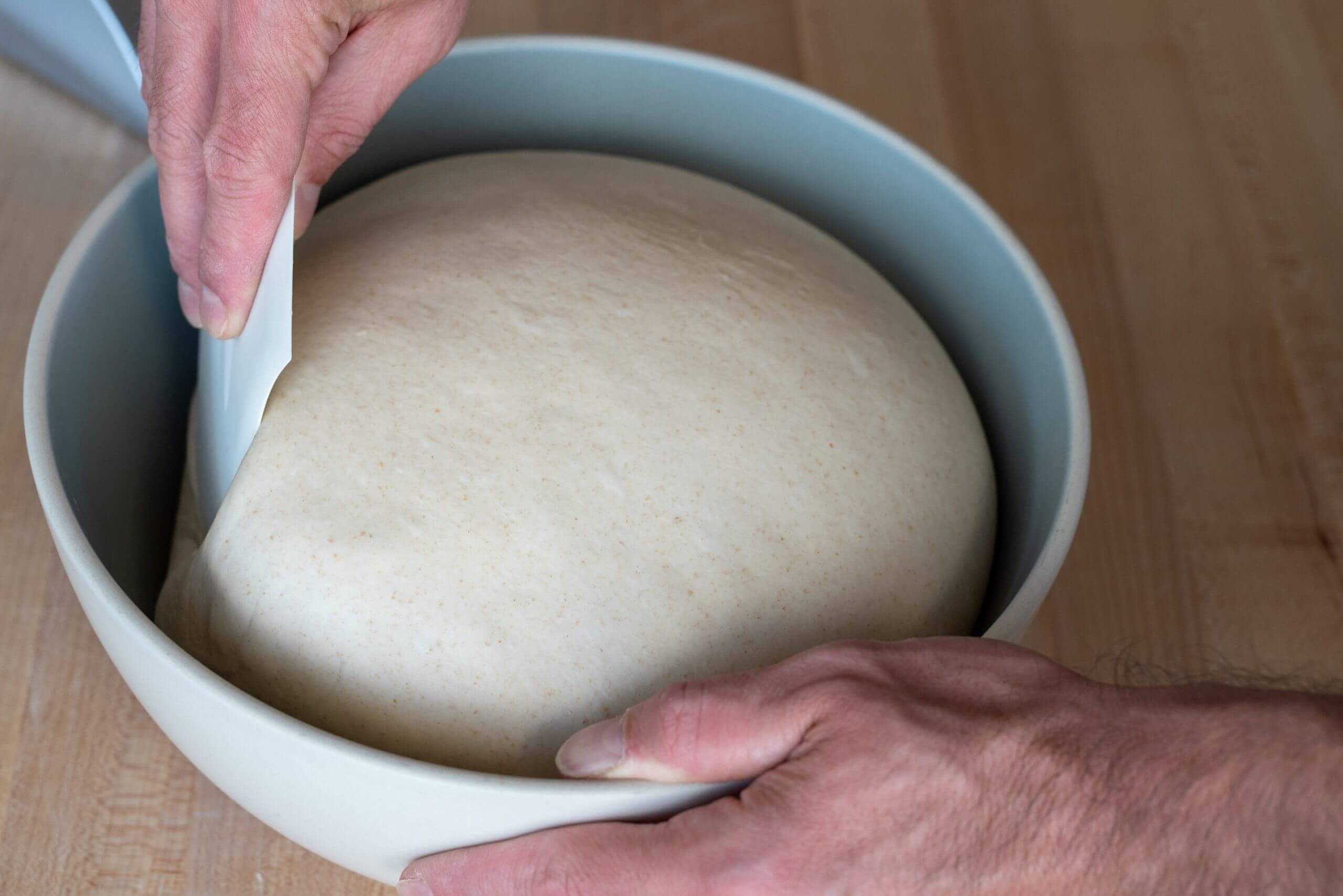
Scrape the dough onto a clean counter surface. Divide the dough into twelve 115g rectangular pieces. For each piece, degas heavily with a flat hand (really be assertive with the dough) and gently stretch it into a small rectangle. The fewer the seams, pits, and uneven sides, the cleaner and more uniform the resulting pretzel will be.
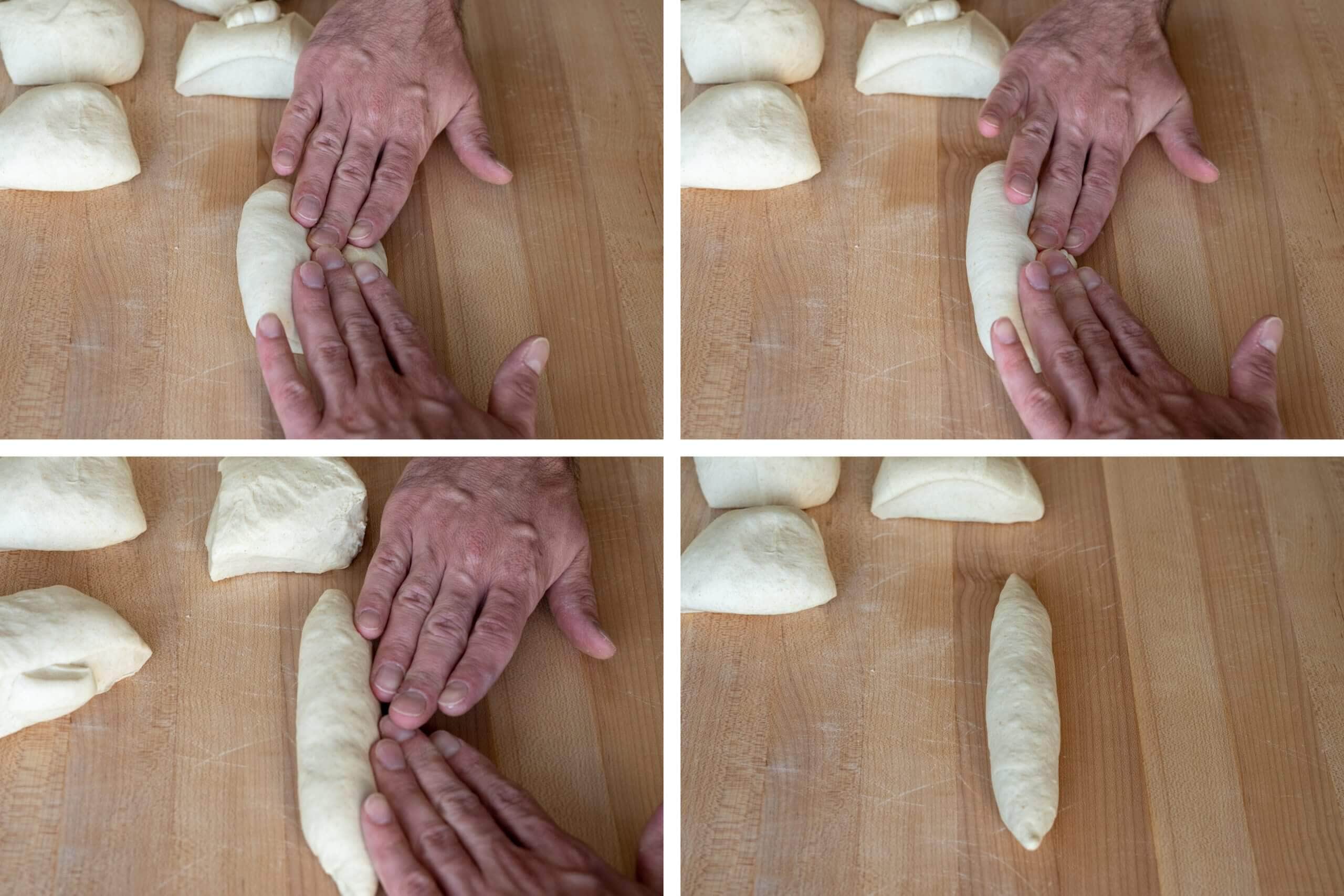
Working with one rectangular piece at a time, use your fingertips to fold down the long top side of the rectangle, then gently press into the dough to begin rolling a cylinder (upper-left image, above). Continue rolling the dough down, gently sealing each revolution, until it is rolled up. Seal the seam with your fingers or the palm of your hand.
Transfer the cylinder to the side of your work surface and cover with plastic.
Let the cylinders rest for 15 minutes.
5. Shape – 1:00 p.m.
Prepare two large sheet pans by lining them with parchment paper or a silicone baking mat. Depending on how large you roll out and shape your pretzels, you should be able to fit six per 13 x 18-inch sheet pan.
First, a few tips when shaping:
- If the dough becomes extraordinarily elastic and resists rolling outward, let it rest for a few minutes before continuing.
- The dough should be moist enough to stick to the work surface when rolling. If the dough dries out excessively, use a handheld spray bottle to lightly mist the dough, your hands, and the work surface to encourage a little friction.
Starting with the piece you preshaped first, place the cylinder in front of you so the tips are at your sides. Begin with your hands slightly overlapping in the middle; press down and roll the dough back and forth, away and then toward your body. As you roll, move your hands outward to encourage the cylinder to elongate and taper as you move from the center to the ends. You want to keep an exaggerated bulge in the very center of this rope–this will be the large part of the pretzel you score to encourage rise in the oven.
Finally, classic technique suggests leaving small little bulbs at the extremes of the rope, but that is up to your preference.

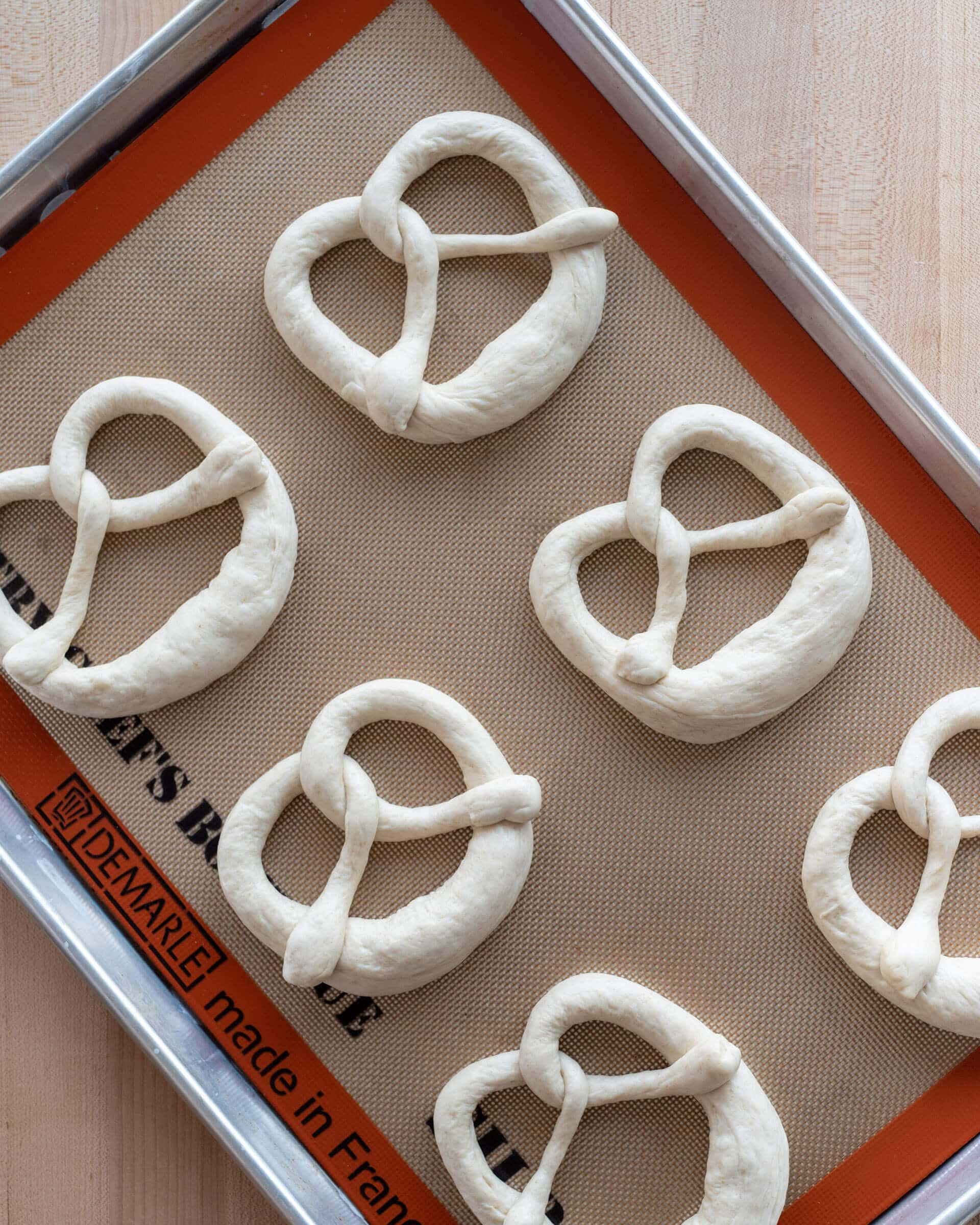
Grab the ends of the dough and arrange it so it loops away from you (upper-left image above). Take one end and fold it over the other side (upper-right image above). Switch your hands so your right hand is holding the new right end, and your left is holding the new left end. Fold the same side over the other as previously done (you’ll now have performed two twists). Grab the two ends, fold them up over the knot in the middle, and place each end on its corresponding side inside the loop. It looks nice to have a little overlap with each tip. Then, gently press it down into the side to seal (lower-right image, above).
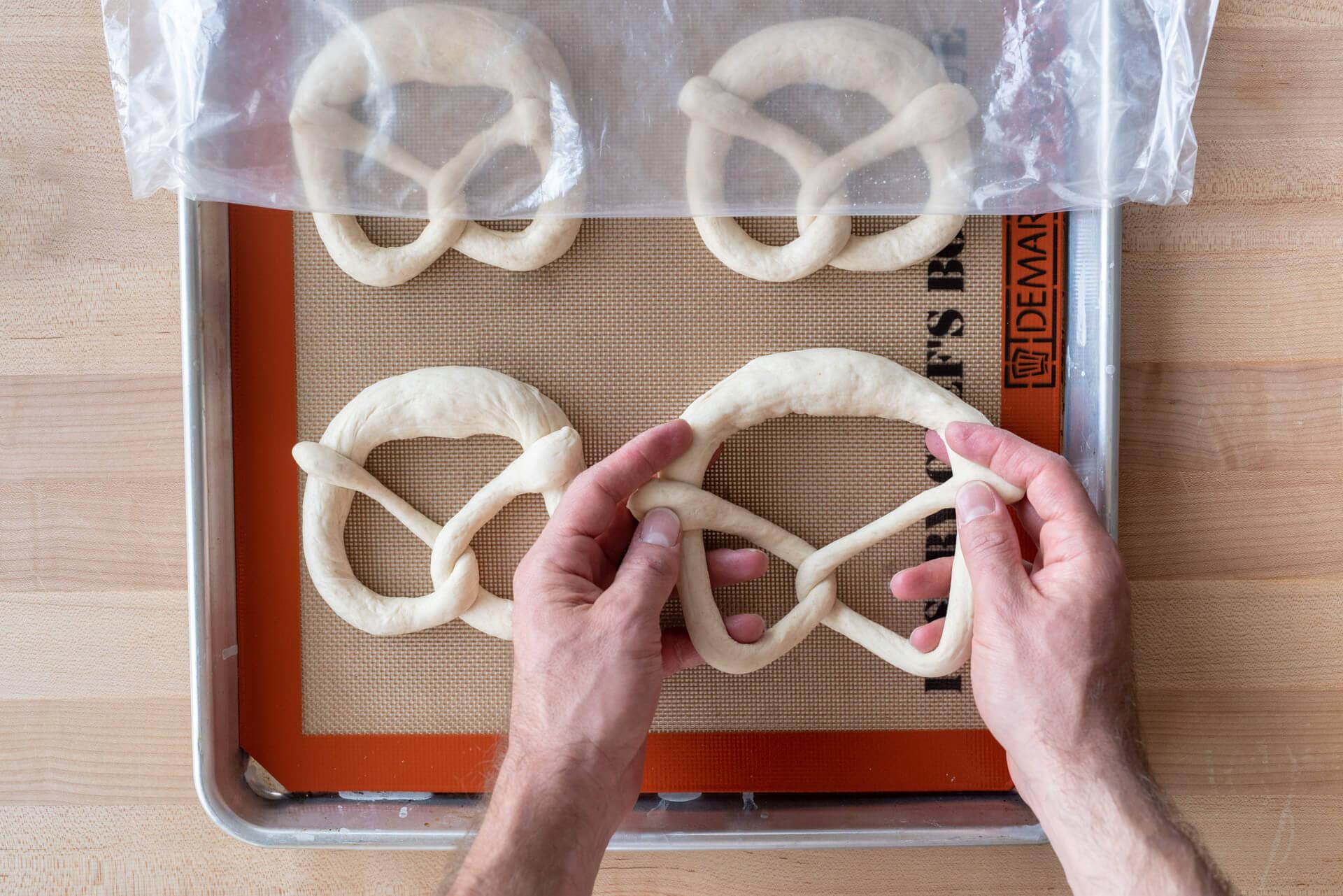
Transfer the shaped dough to the prepared baking sheet. I like to keep the sheet loosely covered while I’m shaping the remaining pretzels.
6. Proof – 1:15 p.m. to 1:45 p.m.
Let the sourdough pretzel dough proof on the counter at room temperature for 30 minutes, covered.
OVERNIGHT OPTION: At this point, you could also retard the shaped pretzels in the fridge overnight to make them the next day. Instead of leaving them out for 30 minutes to proof, leave them for 15 minutes, cover the sheet pans with plastic, and refrigerate. The next day, uncover the sheet pans, return them to the fridge, and chill for 20 minutes (to develop a skin, as mentioned previously). Then continue with the rest of the process.
Transfer the uncovered sheet pans holding your pretzels to the fridge for 45 minutes to 1 hour. Let the dough chill thoroughly and develop a dry skin on the outside. Not only will this make handling the dough easier, but it also helps the pretzels keep their shape when dipping them in the lye bath.
7. Lye bath – 2:45 p.m.
After the one-hour rest in the fridge, place an oven rack in the bottom third of the oven and another in the top third. Preheat the oven to 450°F (230°C).
Set up your station. Take out the sheet pans with fully proofed pretzel dough and gather the following:
- pretzel salt
- razor blade
- half sheet pan lined with parchment paper or a silicone sheet and a stainless steel wire rack inside,
- stainless steel bowl and rubber gloves for the lye bath. Be sure the bowl is not aluminum, which will react with the lye.
The goal is to set up an assembly line where you can work quickly. While wearing long latex or rubber gloves, add 940g cool water to the stainless steel bowl. Add 38g food-grade lye, stirring gently with a stainless steel whisk or large spoon. The mixture will initially be cloudy; keep stirring until all powder or pellets dissolve.
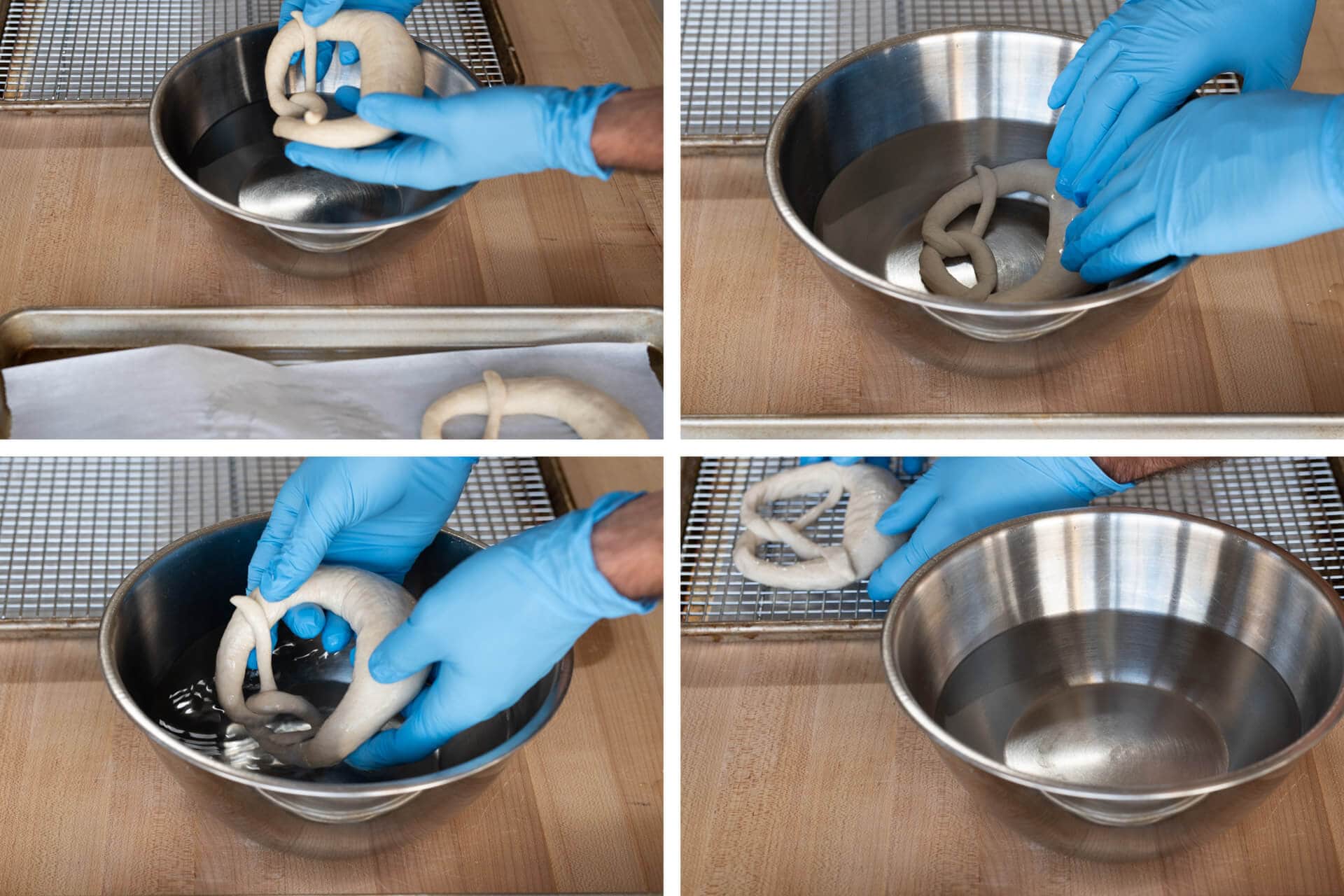
While still wearing gloves, pick up one shaped pretzel and transfer it to the lye bath (upper-left image, above). Let it sit in the bath for 15 to 20 seconds (upper-right image, above) and then transfer it to the wire rack (bottom-left and right image, above). Repeat with 5 more pretzels. Then, transfer the pretzels back to the original sheet pan (it should still have parchment paper or a silicone sheet on top) and set aside. Repeat with the remaining dough.
Carefully flush the remaining lye solution down the toilet or sink, then flush with water.
8. Bake – 3:00 p.m.
Carefully score each pretzel using a razor blade to make a single straight cut across the top of the bulge. Sprinkle the bottom area with pretzel salt. Transfer the sheet pans to the oven.
Bake at 450°F convection for 10 minutes. Rotate the sheet pans (bottom to top, back to front) and reduce the oven temperature to 425°F (220°C) convection. Bake for 8 to 12 minutes more, until done to your liking.
Watch the pretzels in the oven; they color quickly. If the temperature is too high, open the oven door to let it cool slightly and turn it down by 25°. Each oven is different, and my altitude of 5,280 feet might mean I require a hotter oven and longer duration—adjust as necessary.
Remove the sheet pans from the oven and let cool. The pretzels are best the day they are baked—and sublime still warm from the oven—but will keep quite well for up to 2 days. Enjoy warm with butter, mustard, and beer, of course.
Conclusion
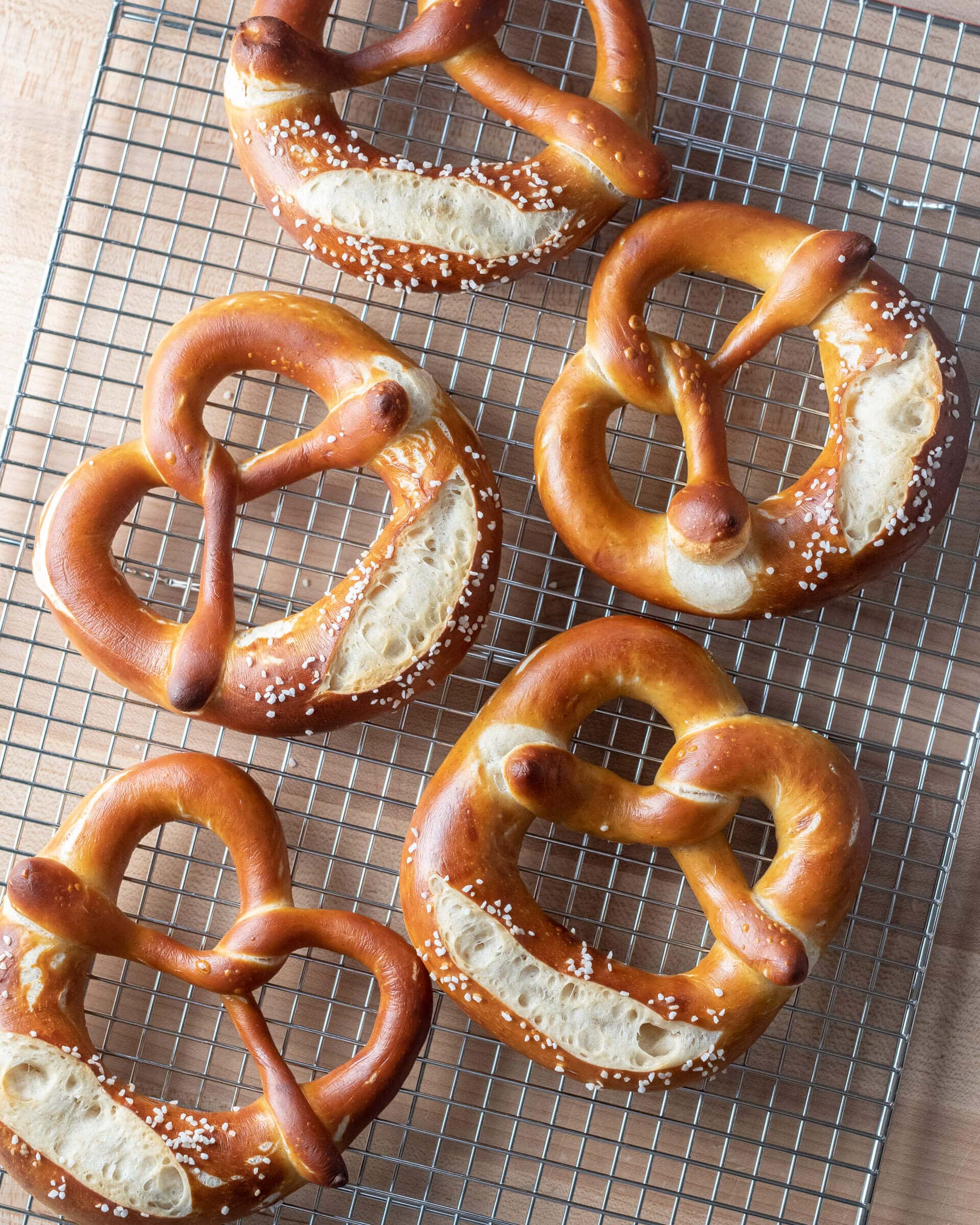
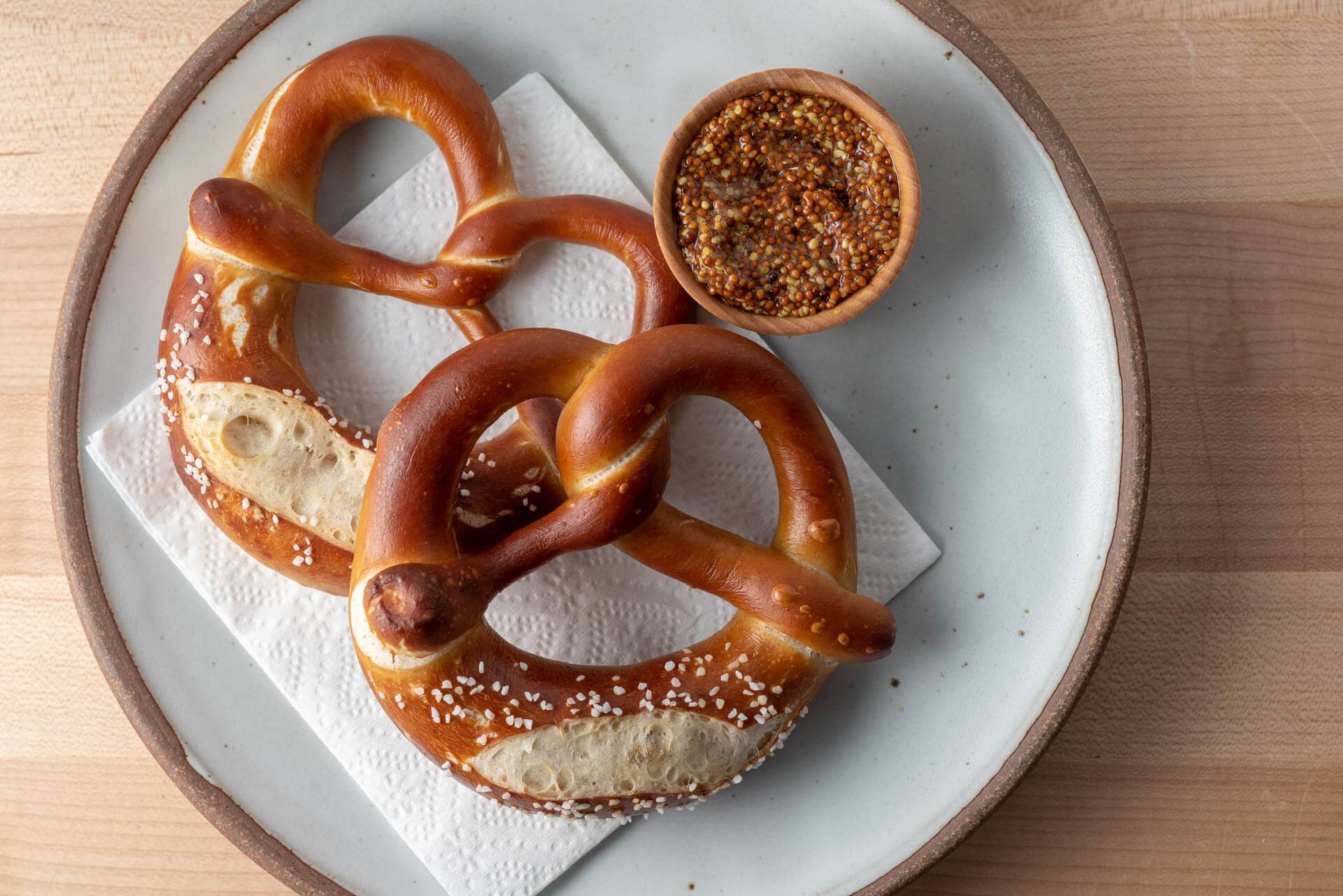
These pretzels check all the right boxes: a beautiful dark color, the thinnest of crusts, that traditional pretzel flavor, and a chewy, soft interior that’s dense but well-fermented.
If you want, you can exaggerate the textural contrast between the “arms” up top and the bulge at the bottom by rolling the arms very thin. This way, they’ll bake through completely and become crunchy, which nicely contrasts with the soft bottom.
Print
Seriously Soft Sourdough Pretzel
- Prep Time: 18 hours
- Cook Time: 25 minutes
- Total Time: 18 hours 25 minutes
- Yield: 12 pretzels
- Category: Sourdough, Pretzel
- Cuisine: German
Description
Chewy and soft, these sourdough pretzels are the real deal. Equally delicious with mustard, cheese, and beer, they have that unmistakable pretzel flavor and deep color.
Ingredients
Levain
- 10g ripe sourdough starter, 100% hydration
- 51g all-purpose flour
- 51g whole wheat flour
- 102g water
Main dough
- 635g high-protein flour (“bread” flour)
- 120g all-purpose flour
- 369g water
- 17g fine sea salt
- 60g unsalted butter, softened to room temperature
- 3g diastatic malt powder
Lye bath
- 940g cool water
- 38g food-grade lye
Topping
- coarse pretzel salt
Instructions
- Levain (9:00 p.m.)
In a small bowl or jar, mix the Levain ingredients. Cover the jar and keep it at a warm temperature for 12 hours. - Mix (9:00 a.m., next day)
Add the flour, water, salt, softened butter, diastatic malt powder, and levain to the bowl of a mixer fitted with a dough hook. Mix on speed 1 for 2 to 3 minutes until all of the ingredients are incorporated. Let the dough rest for 5 minutes. Continue to mix on speed 2 for 4-6 additional minutes until the dough becomes smooth and cohesive—an improved mix. - Bulk fermentation (9:15 a.m. to 12:45 p.m.)
Give the dough one set of stretch and folds after the first hour of bulk fermentation. Return the dough to the bulk container and let rest until time to divide. - Divide and preshape (12:45 p.m.)
Because the dough is low hydration, keep it covered at all times. Divide the dough into twelve 115 gram rectangular pieces. Preshape each rectangle into a tapered cigar shape. Let the pieces rest 15 minutes covered with plastic. - Shape (1:00 p.m.)
Line two half-sheet pans with parchment paper. Starting with the piece preshaped first, place the cigar in front of you so the tips are at your sides. Begin with your hands slightly overlapping in the middle, press down and roll the dough back and forth away from and then toward your body. As you are rolling, start to move your hands outward to encourage the tube to spread out and become increasingly thin as you move from the center out to the tips. You want to keep an exaggerated bulge in the very center of this rope, this will be the part you later score to open in the oven. Grab the two tips and arrange the dough so it loops away from you. Take one tip and fold it over the other side . Switch your hands so your right hand is holding the new right tip and your left is holding the new left tip. Fold the same side over the other as previously. Grab the two tips and fold them up over the knot in the middle and place each tip on its corresponding side inside the loop. It looks nice to have a little overlap with each tip — gently press it down into the side to seal. - Proof (1:15 p.m. to 1:45 p.m.)
Let the dough proof on the counter at room temperature for 30 minutes, covered. Then, uncover the pans and transfer to the fridge for 45 minutes to 1 hour. - Lye bath (2:45 p.m.)
Place two racks in your oven, one at the bottom and one in the top third. Preheat your oven to 450°F (230°C) convection (475°F (245°C) without convection). While wearing long latex or rubber gloves, add 940g cool water to a stainless steel bowl. To the water, add 38g food-grade lye while mixing with a stainless steel whisk or large spoon. The mixture will initially be cloudy, keep stirring until all the powder/pellets are dissolved. With gloves, pick up one shaped pretzel and transfer it to the lye bath and let sit for 15-20 seconds. Transfer to the cooling rack on top of the parchment paper inside a baking sheet. Repeat with remaining dough pieces. Once all the pretzel have been dipped, carefully flush the remaining lye solution down the toilet. - Bake (3:00 p.m.)
Score each pretzel with the razor blade and sprinkle on pretzel salt. Bake at 450°F (230°C) for 10 minutes. Rotate the pans back to front and top to bottom, turn the oven down to 425°F (220°C) and bake for 8-12 minutes longer until a deep brown color. Remove from the oven and let cool. Enjoy warm from the oven.
Notes
- For the lye bath, you will need a stainless steel bowl, stainless steel cooling rack, and pair of rubber gloves.
Sourdough Pretzel FAQs
Is pretzel dough the same as bagel dough?
No, they are quite different. Bagel dough typically has barley malt syrup added (and sometimes sugar, too, as I do in my sourdough bagels), whereas pretzel dough does not. Additionally, pretzel dough typically includes lard or butter, whereas bagel dough does not.
What is different about pretzel dough?
Pretzel dough typically has butter added for enrichment, whereas most typical bread recipes do not. Additionally, pretzels are dipped in either lye or a baking soda solution before baking for increased browning and that signature flavor (especially true with lye).
Does pretzel dough need diastatic malt?
I like to add diastatic malt powder to increase the coloring in the pretzels, add a little more chew, and ultimately, more flavor. However, you can omit the malt powder if you don’t have any on hand.
What’s Next?
There’s no question I’ll be making these soft sourdough pretzels often. When I’m in the mood for something sweet, my sourdough bomboloni will do, but these are their savory opposite. They’re slightly salty and the perfect snack for any sporting event, when friends come over for a beer or two, or even just for a tasty weekend treat.
With so many Oktoberfest festivities in my area, I’m sure I’ll have these on repeat for the next few weeks. The only real question is whether I’ll accompany them with mustard, cheese, or butter… Don’t judge.
If you’re in the mood for another recipe that’s in the same vein as these sourdough pretzels, check out my sourdough bagels: a similarly stiff dough but a completely different end product.
Guten appetite!
If you use this recipe, tag @maurizio on Instagram so I can take a look!


209 Comments
What is the best way to store these to preserve the salt? Should they be reheated before eating?
If you plan to eat them later, don’t add the salt before baking (which tends to go bad quickly). But they’ll keep in a bread box or a bag with a few paper towels underneath (to absorb moisture).
These pretzels come out great. I’ve been comparing your recipe for bagels to this recipe for pretzels to try and figure out how to make pretzel bagels or pretzel buns. I tried using this pretzel recipe to make bagels by just shaping them like bagels, but it didn’t quite come out how I expected. How would you change or alter this recipe to make bagels or buns?
I would instead use my sourdough bagel recipe 🙂 Glad you liked these pretzel, Matt!
Maurizio, I loved reading your experience of German beer halls. Takes me back to when I was an exchange student there. I’ve made these a few times and they’re great as-is! But then I got curious and experimented some with the wet ingredients. Use chicken stock or broth instead of water (cut the salt out, there is enough salt in the broth). You get a nicely subtle flavor of chicken soup in the pretzel. Try pineapple juice; you get a pretzel that tastes and feels like Hawaiian sweet bread but still with the pretzel skin; leave out the sugar and malt, the natural sugar in the juice will do the trick. Use a light colored beer, like a Pilsner or Hefeweizen; it is utterly delicious. If you shape them into hot dog buns, they work great to make a bratwurst pretzel sandwich!
Then for an Oktoberfest experience, make a cheese dip called “Obatzda.” You can find recipes online, but it’s simple. Mash together 8 oz of Brie, 6 oz softened cream cheese, 4 TBs soft butter into a gloppy mess. Stir in 1 or 2 TBs of beer, a splash of apple cider vinegar, a few shakes of paprika, a dash or two of sugar, and mix until well combined. Let sit in the fridge for an hour or so until it firms up a bit. When ready to serve with the pretzels, finely chop up one shallot or a handful of chives and mix into the spread. Serve with a hot bratwurst and a beer. Awesome! “Schmeckt’s gut!” (Tastes great!)
Wow incredible modifications there, David! Furiously taking notes over here to try some of these out 🙂
Maurizio, definitely make the Obatzda cheese spread. I can’t recommend that enough. There are plenty of videos online for how to do it. It will change your life…! 🙂
Hi Maurizio thanks for all your amazing recipes. Please can you let us know what length you roll the final rope to? Thanks!
It’s variable. You can roll it out however long you’d like, to make a more open pretzel, or a stubby, fat one. Up to you!
I tried to skim all the comments and I haven’t seen it asked, is it ok to wait a bit between lye bath and baking? I’m thinking of doing everything short of baking, take them to a friends house and bake there, would that work? Obviously accounting for fermentation. Thanks!
Yes, it’s okay to wait a bit, but I prefer to do it asap when they are still “wet.”
Sorry if its already been mentioned, but if you get lye on your skin, use vinegar to neutralize. Water is ok to rinse but won’t neutralize. Could you bake these without salt, freeze, and then wet pretzel and apply salt on the reheat?
That would definitely work. I’ve frozen batches and they reheat nicely in the oven on low!
Should I use malt syrup instead of dry one?
That works!
Hi Maurizio, long time listener, first time caller. Big fan! The link you have listed here for Lye is sending me to a link for Magnesium Citrate, is this a safer form of Lye/ has similar effects or should I be using Sodium Hydroxide (Caustic soda/lye)? All the best,
Alex
Hey, Alex! Sorry for the delay, so glad my site has helped. I updated the link above in the post!
I was not prepared for the lye fumes :|… that’s a bit painful to breathe! Be careful everyone!
Hey, Delphine! Strange, I never have intense fumes! I just keep my head away from the bowl and I’m good to go.
Hi Maurizio! If I don’t have a sourdough starter, is there a way to do the levain with just yeast?
You’d have to convert this to a yeasted recipe! It would take some R&D.
Hi Mario, where can i find the print frienly version of this recipe?
I have not added the print function to this recipe, will add it this week!
Hi Maurizio, how would you go about making these pretzel bites instead? Trying to make them party appetizer friendly 🙂
That’s a great idea! You could roll them out into long tubes and then chop them every inch or two, then proceed with the lye bath, sprinkle with salt, and bake 🙂
Thank you for the recipe. I made a mistake and halved the recipe. Now I don’t have enough pretzels. 🤷🏻♀️ These turned out delicious. Satisfying crunch on the crust and chewy interior. I didn’t do the lye, I have chinese kansui that I brushed on the cold pretzels and it worked! They didn’t come out shiny, so I was forced to brush them with butter. Oh, well. I will have to make a full batch and freeze some with the suggestions in the comments.
Even when I make the full recipe I find I didn’t make enough 🙂 Glad you liked the pretzels! I’ll have to look into kansui, I’ve never heard of this!
Hey Eric. Can you give more detail on what that is. I am not a subscribing to the New York Times so I cannot read what it says. Thanks!
Hi Maurizio I wanted to give you an update, the pretzels I froze have been so great. I froze the dough and then lay them out before baking them. I did recently just try 2 tablespoon of sugar and 1 teaspoon of cinnamon (covers about 2 pretzels) and sprinkled this mixture over melted butter on top of the pretzel dough and then baked and oh my my family and I are obsessed. A nice yummy sweet twist.
Thanks so much for that update, Michelle! Glad to hear the freezing went well. Oooh, a sweet pretzel, you know, all the times I’ve made these I haven’t tried that yet (although I have eaten them in the past). I’m going to give that a go! Thanks again and enjoy 🙂
I freeze mine as well following a simmering water bath (using “baked” baking soda…I don’t use lye). Once all have had the bath and drained on a baking rack, I lay out on parchment lined sheets to flash freeze until solid. Yes, as each one come out of the bath, I score the bottom and sprinkle with coarse salt. Then I individually wrap in Saran before transferring to gallon size Zip Lock freezer bags. They always bake up beautifully! I love that I can take out as many as wanted. I bake up straight from frozen.
Finished making these today and they were fabulous! Thank you Maurizio for yet another fabulous recipe!
I did use baking soda instead of lye. I did 1/3 of baking soda and baked for 45 min on 350 and then diluted it in a cup of water and soaked the pretzels for about 3 min each then dipped the pretzels off of any excess in a bowl of water. Then added the salt and scored it. I had so many that I froze them after soaking them so I do hope they freeze well. I read other comments that they do. We can’t wait to eat more! Thank you for blessing so many of us with your work Maurizio!
So glad to hear that, Michelle! They do freeze well! I thaw them in the fridge, then reheat them under the broiler until warm and soft. So good. Enjoy!
HI Maurizio,
During the backing my brezel developed a lot of little bubbles on the surface, and they came out obviously not so nice to see as yours. 🙁 I know that somebody already mentioned the same problem, but how do you think that it can be avoided?
Thanks a lot in advance!
Marina
Hey, Marina! I’ve not found a way to eliminate the bubbles, in fact, I kind of like them. I find they add a small bit of crunch and visual interest. I find I get fermentation bubbles like this when using the refrigerator.
Hi Maurizio, could I do this recipe with a young leaven (say 3-4 hours old)?
If you go the young route, the dough might need longer in bulk fermentation to reach the right stage. But otherwise, should work!
Hey Maurizio! I’m waiting for my lye to be delivered. However, I was wondering if I could follow this recipe as normal, but changing the shape to be rolls or even as laugenstange. It would be more practical for my family to eat them (as sandwiches).
Yes, you can!
Hi Maurizio, this looks like a really great recipe – thank you. I grew up with my father making real Pretzel, but using yeast and I’ve been keen to try these with sourdough. My question is, how important is the diastatic malt and what role does it play? I haven’t been able to find it where I am (in South Africa) and wondered if there is a more common substitute, or can it be left out altogether. How will that affect the final taste/texture?
Hey, Binta! You could leave it out, but I do find the malt brings added color, a little flavor, and a little chew to the bagels. But if you can’t find any, it’s totally find, go without!
You can make your own. It’s pretty simple to do.
Hello!! I would love to make this recipe, is there an easy way to print this off? I do better with recipe instructions printed off and in front of me rather than reading on a screen. Thanks in advance!
Hey there! I’m currently upgrading my recipe print options here and this recipe is due for update soon. Sorry about that!
If you have a laptop, you might want to try the CopymeThat app….it is a recipe keeper and only copies the instructions minus the pictures, etc., as well as link to the original recipe page. I find it much easier to be able to view just instructions and no “fluff”. The app also allows you to put your own notes in the note section that can be edited at any time you wish. It’s an awesome tool!
Hi Maurizio! These look amazing and I would really like to try it. Is there a print option to make this easier to follow while baking? Also, how many pretzels does one recipe make?
Hey, Maddie! Thank you. The recipe makes about 12 pretzels. I am almost there with the print function for this recipe, it’s not quite done yet. You can always print the page as usual, but no, no recipe print just yet (like my other recipes). Almost there!
found a good article talking about it after lots of digging! https://www.theguardian.com/lifeandstyle/wordofmouth/2017/may/18/how-to-bake-the-perfect-pretzels
sooooo… the water as it comes appears to be needed in pure form, no diluting. i’ll give it a try on just one pretzel to start! keep the rest in the fridge…
That looks promising! Please let me know how it works out 🙂
Hey there Dewi! So sorry for the late reply. In short, I really don’t know. I’ve only ever used the lye linked up in the post and diluted it with water to make the solution. I would say if that lye is food-grade, then it won’t hurt to run a test and try it out. If you find it imparts too much color, dilute the liquid to reduce its potency.
Thank you Maurizio. Perhaps, I will try. So for the lye using your link no longer available. Any other brand you would recommend?
This food grade lye is the one I use, just in a new package.
Thank you so much Maurizio!
Glad to see my same question here – living in Malaysia, all I could find was a small bottle of lye water – plastic bottle, too, which leads me to believe it’s pretty diluted based on the comments below! it’s a very small bottle… maybe i’ll do half in the bath and half in baking soda and see what I think!
Hey, Emma! See my reply to Dewi, above for some more ideas! 🙂
I love these pretzels. I have made them several times and am going to try freezing them after lye this time. I have made a half batch, full batch using the original recipe and then added a twist. I added beer to the water a 50/50 ratio. I heat the water to 105 and then add cold beer to the water. WOW WOW WOW!
Whoa, that’s a really good idea Samantha! Adding beer to my water next go!
I’m adding beer next time too!
Why do you think little tiny bubbles are on the surface of this pretzels when I make them???
My guess is it’s from the cold temps from the fridge coupled with the gaseous byproducts of fermentation on that thin, outer layer!
I lived in Philly, and had to have my pretzel when I moved. I have tried lye, but found a better solution.
Lye pH 12
Baking Soda pH 8
Sodium carbonate pH 11
You can very easily make sodium carbonate from sodium bicarbonate (baking soda). All you need to do is bake the sodium bicarbonate. I will sprinkle it on a pan as my oven is preheating, maybe a little more. It chemically dehydrates the soda to a whole new chemical. The reduction ability is greatly improved. I usually do a hot bath, and have done multiple single blind taste tests and the sodium carbonate wins over the lye every time. It is close, but it wins (and there is no contest with the sodium bicarbonate).
It is somewhat safer than the lye, easier to get, better flavor, all around a win. I do warn do not use an aluminum pot, esp with boiling water, big chemical reaction there! (just ask my wife about one of her favorite pots!)
Happy baking!
Thanks so much for that info, Tre! Yes, I’ve heard of this technique and have been meaning to try it out (once I run out of lye, but boy did I buy a lot…). Hopefully I’ll get to this soon!
Would you be willing to provide a little more detail on your process? What percent of sodium carbonate you mix with the water? How long you soak the pretzels? Etc. I tried using sodium carbonate today but the results weren’t perfect. Thanks!
I really don’t measure much.
I will take a pan and sprinkle a decent
amount of baking soda on it…. 1/4 cup or so I guess. Put that in the oven on what whatever I am going to be baking at…. 350, 450… whatever. I just stick it in there while it is preheating. I think I once read that at 200 it will take an hour, but at 350 it’s like 20 min, and 450 only 10…. something like that.
I then put that into a pot, spaghetti cooking pot…. make sure it’s steel, NOT Aluminum!!!
I then bring this to a gentle boil, and plop a few pretzels in. 1-2 min at a gentle boil.
From there on a new pan, salt, and in the oven.
Hope that helps.
This worked awesome! Thank you! And thanks Maurizio for the killer recipe!!! It’s perfect – although I am going to try the beer in the water next time too.
Hi Tre how much water would you say you put in to bring to a gentle boil?
The instructions I've found say redice by one third using weight.
I do this as well and I make enough to store in the pantry for when I need it for pretzels or bagels. I line a baking sheet with foil and spread out as much as I can in an even layer. Bake at 300F for 1 hour. I use about 1/3 c per 2 quarts water. Since I don’t use the diastatic powder I add about 1/4 cup to 1/2 cup dark brown sugar to the water and keep at a low gentle simmer to bath the pretzels for about 1 minutes each side than drain on rack, scoring each one and topping with salt as they come out. Oh and in the dough I replace the diastatic powder for equal amount of brown sugar. They have a great crispy light exterior and awesome color with this method for me.
Right on! I’ve made rolls a few times and they’re extremely delicious, they make the best sandwiches. Enjoy!
Hi Maurizio! I could only find Hydrogen Peroxide in liquid form, 3% over 500g. I used 30g for a litre of water anyways but it didn’t come out as it should be. Do you know how to adjust the formula with this type of lye? Thanks 🙂
Hey, Deborah! Yes, it’s been hard to source lye lately, I’m not sure why. What we want for this recipe, though, is sodium hydroxide, not hydrogen peroxide. I’ve been keeping an eye out for a source but haven’t found a good one yet!
Deborah, have a look at this food grade sodium hydroxide, that’s one option!
I am German…. to be precise: Bavarian. I have been living overseas for 11 years now and Brezen is what I am craving. I must say they are just PERFECT! We are amazed how well they turned out and how authentic the taste is. I have now made 3 batches in one week! Well done.
Wow that’s huge praise Cornelia, thank you so much!
I do a pretzel very similar to this one, and enjoyed seeing that we’re pretty much on the same page. Curious if you’ve done these in your Rofco B40. If so how’d you bake them. Thanks a million for all you do for the bread community.
That’s great to hear, Steve! I haven’t tried these in the Rofco, but it’s on my list to do soon! Happy to help and happy baking 🙂
What’s the name of the brand you use for 100% food grade lye? Trying to purchase some online to make your pretzel recipe but the link is broken.
Andi, this is the brand of food grade lye I’ve been using!
Mauricio, I made these a couple of weeks ago and my grandkids loved them. That’s all they want to eat now! My question: can I retard the formed pretzels not just overnight but over two nights?
Hey you’re in Denver like me!
Close, Albuquerque!