This multigrain spelt sourdough is one of the many spelt recipes I’ve posted here, but possibly one of my most favorite. I am completely transfixed with the flavor of spelt, and I developed this formula not only because I wanted to use the wonderful grain again, but also for a short article I wrote that would appear in the Bread Baker’s Guild of America Bread Lines magazine early next year. The article has some background information on me, my process, and my motivation for baking sourdough—most of which, if you’ve read my entries for a while, you already know. I went into how I started baking, how both the scientific and artisanal processes captivate me every bake, and how baking not only reminds me of my childhood growing up in an Italian restaurant but also because good, healthy food requires time.
So why another spelt recipe? When thinking about the article, I went back and forth on what method to include, swaying between a few sourdough recipes I’ve been experimenting with and some of my old tried-and-true favorites. I knew I wanted to use one that had freshly milled flour, and without a doubt, my previous spelt sourdough recipe is among my most favorite, but I wanted to take it a bit further. I began to think about what things I’d change if I were looking to improve it. I decided to start with that formula as a base and rove from there to explore and find something that struck my palette as different or produced a substantial structural difference—or perhaps both.
When exploring different grains to include in a formula, there are plenty of options; many you can sort of sneak in without their flavor showing up too much, or if they do, they are so subtle that they are hardly noticeable. I’ve found that rye is one of those grains that, even at a small overall percentage, brings an unexpected depth of flavor to the overall taste profile. There’s a reason why, suddenly, you’ll see rye at every turn: rye cookies, rye cakes, rye brownies, rye bundt cakes, and so on. However, due to the inherent nature of rye, as the percentage of it in the final mix increases, the result will become denser, more compact, and less open. To help avoid a dense interior, I paired the rye flour with a blend of wheat flour to alleviate the issue (more later).
In addition to flour modifications, I changed my method for each stretch and fold set during bulk fermentation. During the typical bulk rise, I’ve always started the sets with powerful North, South, East, and West folds that gradually get more gentle as bulk progresses. Still, for this bake, I placed more emphasis on this, and even though the folds were vigorous for the first set, they were not overly rough in any way. There was no tearing, squeezing, or slapping as I performed them quickly and efficiently. The last set of stretch and folds was incredibly gentle. It was mostly performed to redistribute the dough for temperature equality reasons, perhaps with a small amount of additional strengthening imparted.
The main reason for the gentle hands at the end of bulk fermentation is to avoid pressing out any of the gasses trapped in your dough. Each interaction you have with the dough at that point will disturb these little pockets, whether it be smashing them or merely creating connections within them, reducing the overall size of the pocket. Because pre-shaping and shaping are usually enough to even out the size of these pockets, I found it best to be gentle with each stretch and fold set but even more so with the last. You can read about how bakers recommend gentleness at the end of bulk in many books, but sometimes something doesn’t really stick until you realize and (re)experience it for yourself.
So to sum up, the basis for change and improvement with this formula over my last spelt sourdough (and also just my baking in general) were:
The flour blend for this formula was changed to promote a lighter and more open loaf without chewiness
The fresh flour was milled at a very fine coarseness (more on this in the next section)
Stretches during bulk fermentation were effective yet much more gentle
Final shaping was as gentle as possible
Let’s talk about flour.
Flour Selection
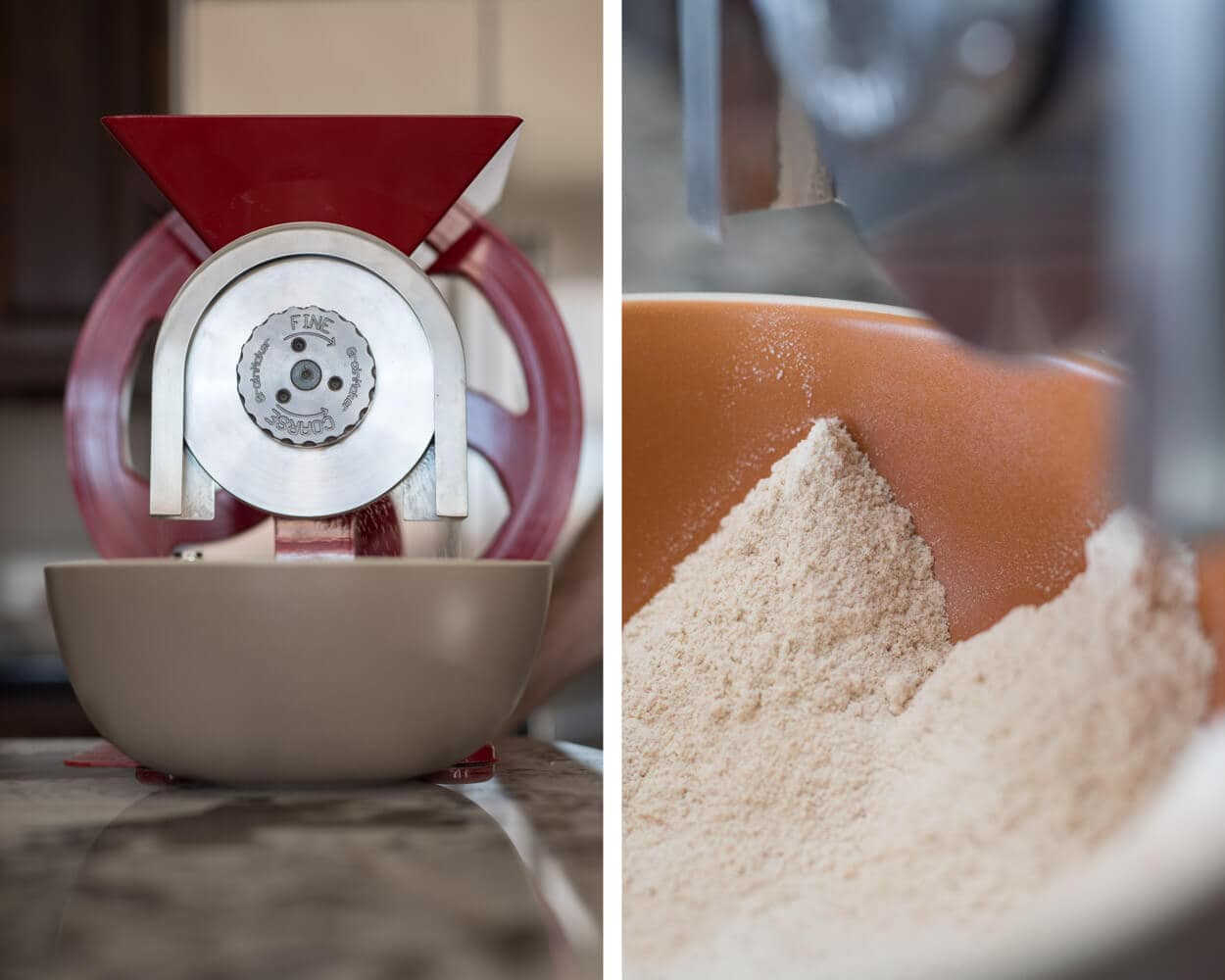
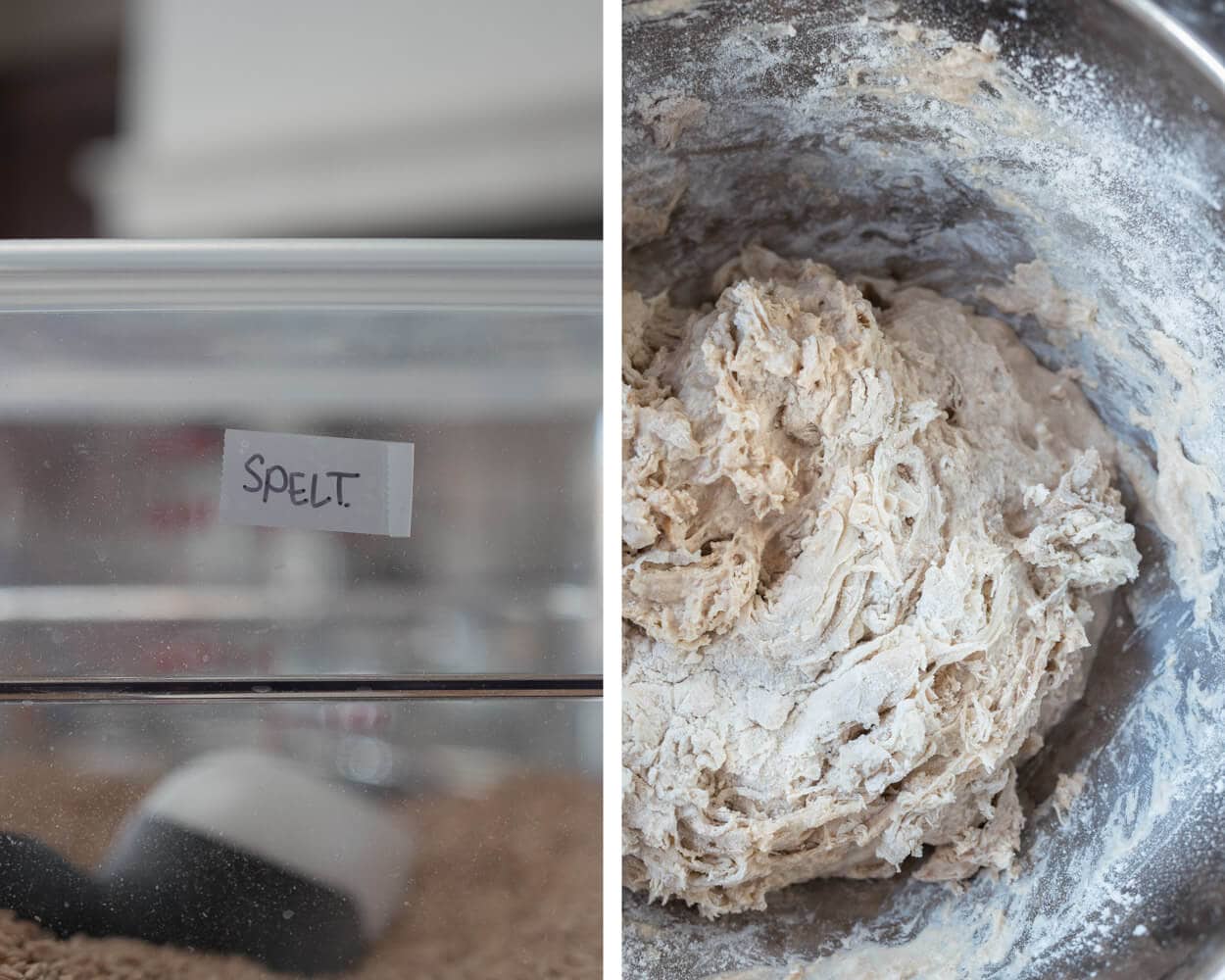
I milled the spelt fresh in the morning, first thing. I set my GrainMaker manual mill to the most refined setting it will go. From there, I got cranking as everyone else was still sleeping, dreaming of who knows what while I was watching the spelt float down into my mixing bowl. I’ve said it before but milling my grain is such a satisfying process—I value these solitary moments, time to think about and prepare for the day’s mixing, folding, and shaping.
Good music helps, too.
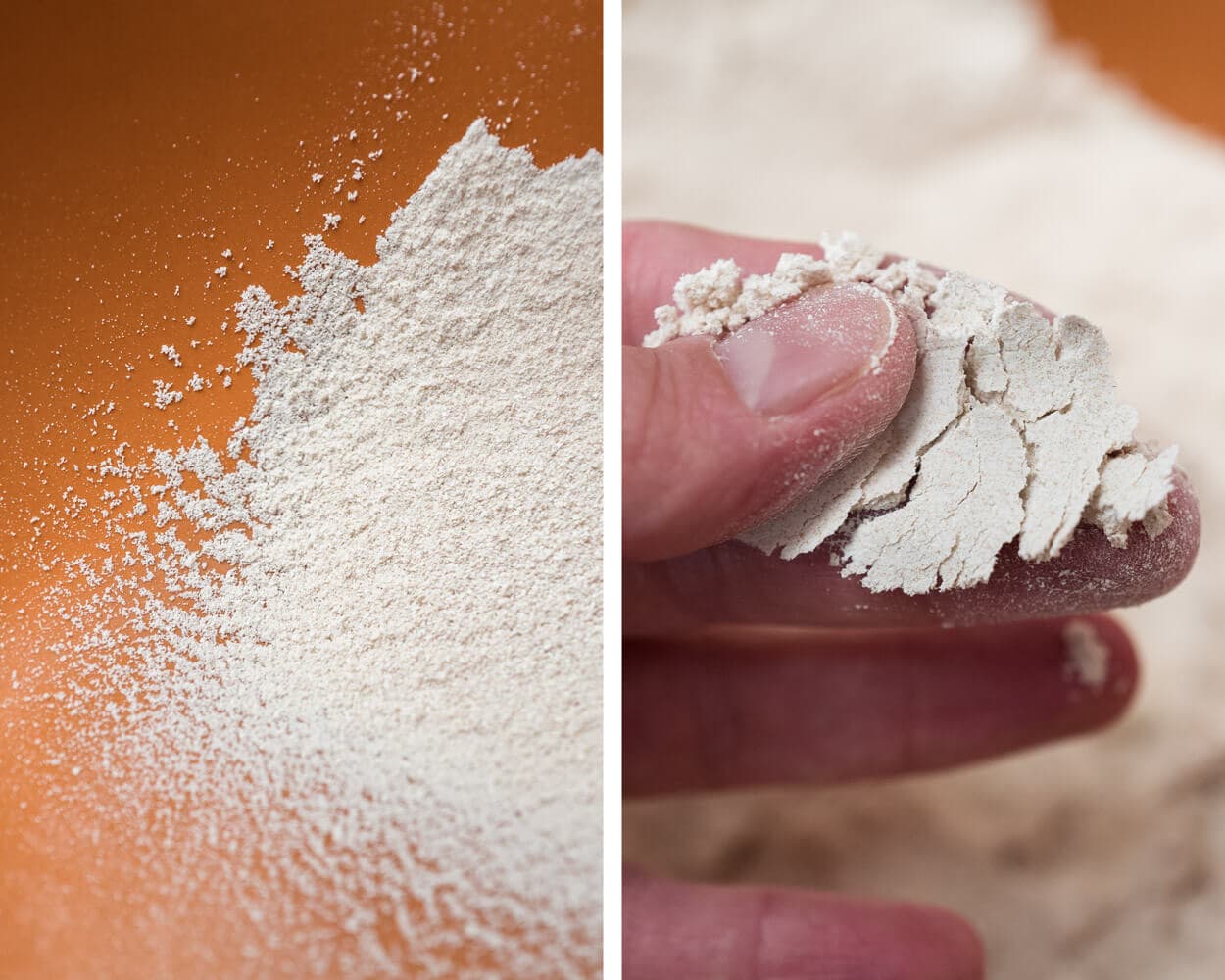
I’ve been experimenting and honing in on the right grind level with my manual mill, testing how the flour performs at varying coarseness. I’ve had my mill for a while now; perhaps my ability to correlate a particular flour coarseness to its result is finally getting more attuned. It seems, at least with my recent findings, that milling the flour increasingly fine helps attain a more open crumb (assuming everything else is in place), especially at this percentage of fresh milled whole grains.
With the burrs on my mill set very close, it takes me 20-30% longer to mill the required flour for this formula. As I placed the burrs closer and closer together, I had to follow suit and reduce the grain feed rate on my GrainMaker. Reducing the rate lessens the number of berries fed between the burrs at any one time—turning the crank gets more and more difficult. At this level, it is a bonafide gym substitute.
In the photos below you can see how fine I was able to mill, and keep in mind the flour used here is 100% whole grain spelt—I didn’t perform any sifting after milling.
I used a combination of flours to compliment the spelt to maintain a light and airy loaf despite the relatively high percentage of fresh-milled whole-grain spelt. In my last spelt adventure, I didn’t use quite the mélange of flours I’m using here, but I’ve found this blend to be the sweet spot that avoids a chewy crumb (from too much high protein flour) but still has enough strength to rise high with an open interior.
A touch of Central Milling High Mountain and its high protein percentage can be substituted with any “bread flour” with a protein percentage of around 13% (King Arthur Bread Flour in the blue bag will work well here). As I’ve mentioned, you can come somewhat close to Central Milling’s Type 85 by mixing 65% bread flour and 35% whole wheat flour.
Medium rye is not 100% whole-grain dark rye. It’s lighter in color and doesn’t have quite the hearty flavor of its darker sibling. Dark rye would do exceptionally well if medium rye is unavailable.
Multigrain Spelt Sourdough Formula
This bread, having a good portion of whole grains and freshly milled spelt, has a wonderfully sweet and nutty flavor. The spelt was milled extremely fine, and at a low temperature the morning it was used in the mix, preserving as much flavor, oils, and nutrients as possible.
Hydration note: Depending on your spelt flour, you must likely adjust your hydration. Typically, I reduce the dough’s hydration when using spelt, but because I milled the flour fresh, this fresh flour can take on quite a bit of water. During mixing, I kept adding till it felt right and ended up at the hydration listed below.
Please keep an eye on how the dough feels at the beginning stages of mixing, and if the dough feels overly wet and soupy, avoid adding in all the reserved water. The dough should be “wet,” no doubt, but it should not feel like it’s falling apart easily or like soup.
Vitals
Total dough weight: 1900g Pre-fermented flour: 3.50% Hydration: 88% Yield: 2 x 950g loaves
Using diastatic malt is optional, and I use it in this formula because a good chunk of the flour is not malted. I love the way malt adds color to the crust, and as long as it’s not overused, it will not have any adverse effect on flavor and only helps to boost enzymatic activity.
Build the liquid levain (everything listed in the Levain Build section above) in the morning or afternoon and store somewhere around 78°F (25°C) ambient for 5 hours to ripen. It should be well fermented, expanded, and have a smell that’s slightly sour, perhaps with a hint of sweetness.
2. Autolyse – 4:00 p.m.
Mix flour and water (reserve 100g water for the mix, later) in a bowl until all dry bits are hydrated. Cover the bowl and store somewhere nice and warm for 1 hour. Somewhere near your levain is convenient.
3. Mix – 5:00 p.m.
Add the called for ripe levain and diastatic malt powder to the autolysed dough and using about half of the reserved 100g of water mix thoroughly by hand. The levain should be well mixed through the dough and the added water wholly absorbed.
I chose to slap and fold for about 5 minutes, just until the dough started to show signs of a smooth surface and it was catching some air. If you aren’t comfortable with slap/fold method or don’t like it, you can do stretch and folds in the bowl until your dough tightens up and becomes slightly hard to stretch out and fold over.
Let the dough rest for 20 minutes before adding salt.
When finished mixing and resting, sprinkle the salt on top of the dough and the remaining water to help dissolve. Pinch through the dough thoroughly and fold the dough over itself to help incorporate and absorb the remaining water. Keep pinching and folding until all the water is absorbed and the dough comes back together.
When finished transfer the dough to a tub or thick-walled bowl for the first rise: bulk fermentation.
4. Bulk Fermentation – 5:30 p.m. to 9:30 p.m.
At 78°F (25°C) ambient temperature, bulk fermentation should go for about 4 hours. Perform three sets of gentle stretch and folds during bulk, spaced out by 30 minutes. After the third set of stretch and folds let the dough rest for the remainder of bulk.
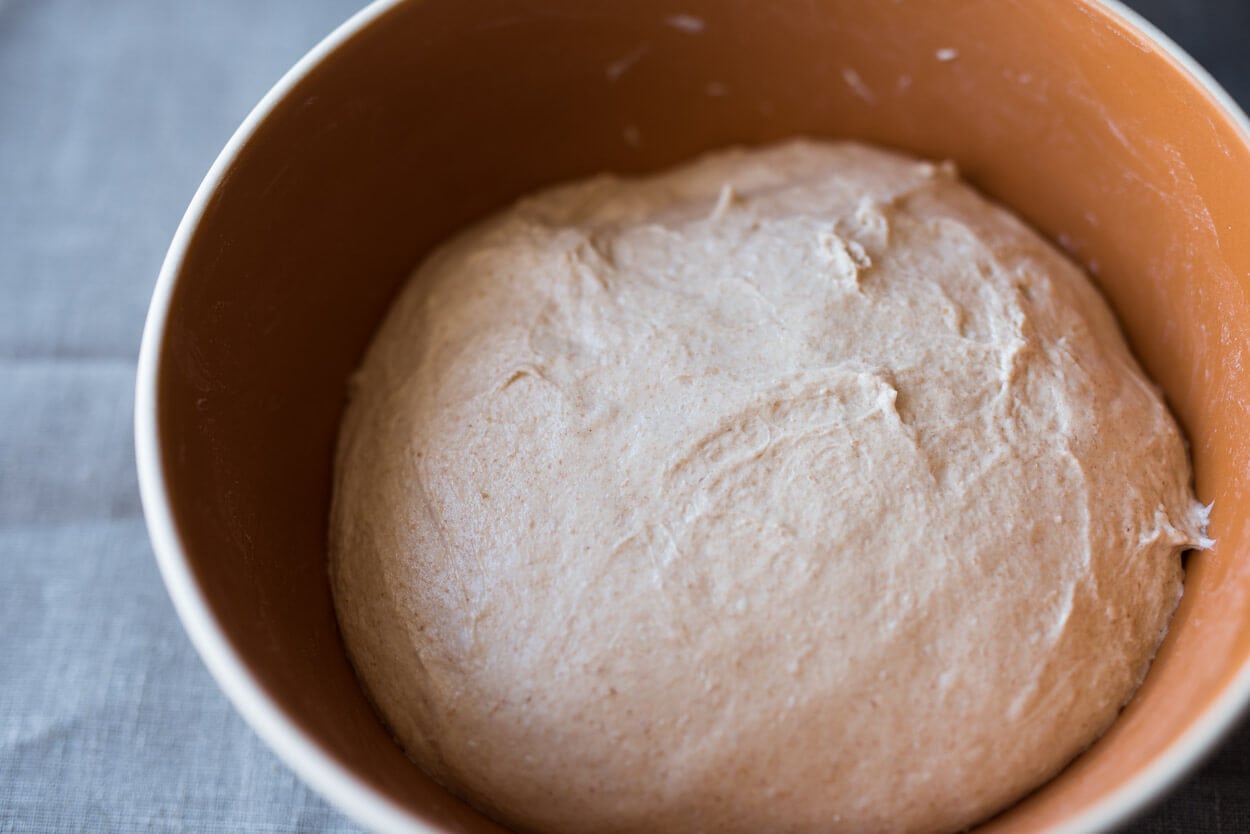
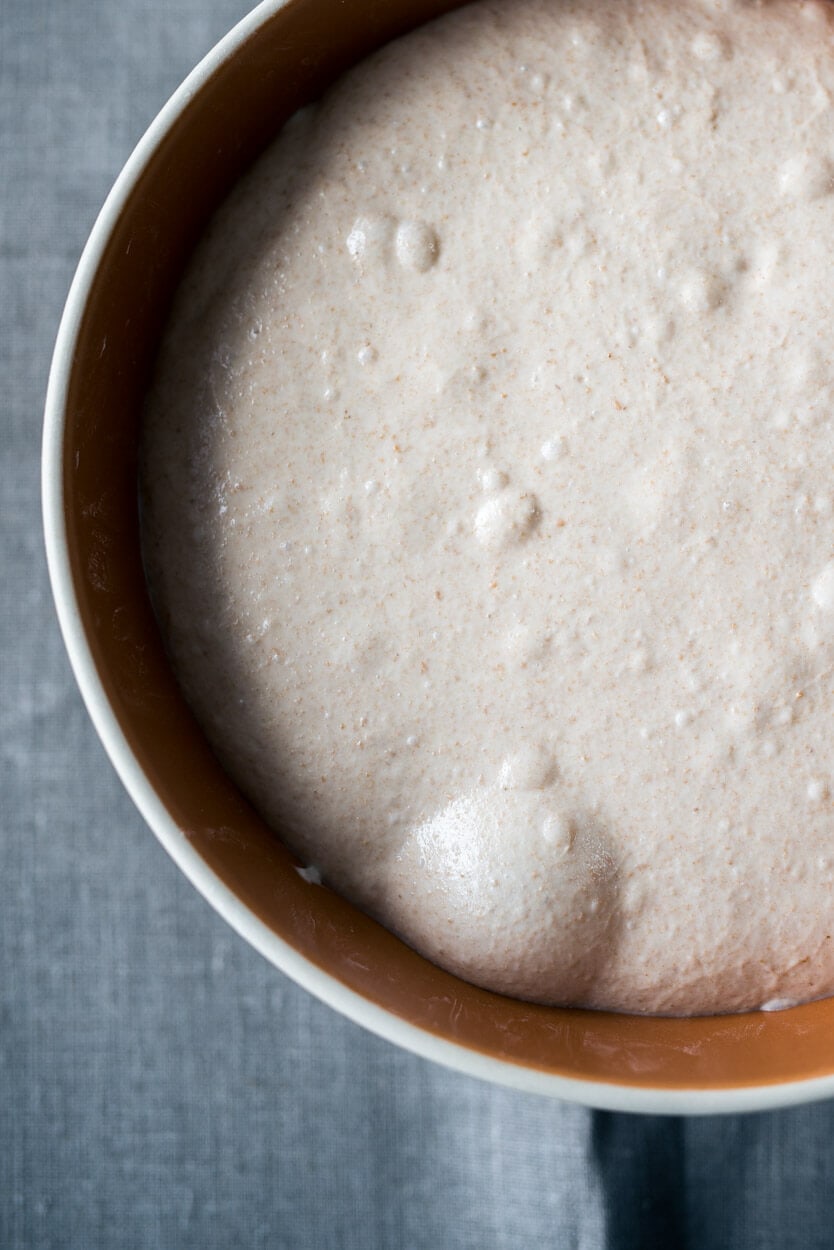
You can see my dough below, almost at the end of bulk fermentation—the photo shows it around 3.5 hours with half an hour left. Notice the bubbles on top, and the shadow at the edge of the bowl, indicating the dough is starting to dome at the sides (convex). These are signs I look for to ensure bulk fermentation has gone long enough.
After four hours get ready to divide the mass and pre-shape.
5. Divide & Pre-shape – 9:30 p.m.
Gently dump out the dough from your bulk container onto an un-floured work surface. Divide in half and pre-shape the dough into two round boules, let the rounds rest 20 minutes uncovered.
When pre-shaping this dough try to get each mass into a round with as little movements as possible, just enough to create tension in the dough, so it holds its shape but not overly tight which could cause inadvertent degassing of the dough.
6. Shape – 9:50 p.m.
Prepare two baskets that will hold your dough during its cold-proof in the refrigerator overnight. This dough works well shaped as a boule or batard, whatever your preference may be. I always tend to shape as a batard and this bake was no different.
To gently shape as a batard, first moderately flour the top of the dough and flour the work surface. Flip one resting round over, so the floured side is down on the work surface. Fold the top of the dough up and over to the middle and repeat for the bottom (you’ll now have a long slender rectangle in front of you). Pick up the rectangle and rotate it 90°, so it’s now lengthwise facing you. Grab the dough at the very top and fold over partway, press to seal with the central mass of the dough. Now grab this rolled over the top and gently continue to roll it down towards the bottom, tucking in the dough as you go (imagine rolling down a beach towel). At the end of this, you’ll have a tube that has mostly been rolled downward. Once shaped, transfer each to their floured shaping basket with the seam side facing up.
Cover your baskets with plastic and then place it in the refrigerator at 38°F (3°C) for about 10 hours. Even at such cold temperatures this dough can quickly overproof so keep an eye on it in the fridge in the morning.
8. Bake – Next Morning: Preheat oven at 6:45 a.m., Bake at 7:50 a.m.
Place your Baking Steel or baking stones in your oven and preheat for one hour at 450°F (230°C). Once preheated, take out both of the baskets from the fridge and remove the plastic wrap.
Bake for 20 minutes, then remove the steaming pans from inside the oven. Then, bake for an additional 30 minutes until the internal temp is between 206-210°F (96-98°C). Keep an eye on these loaves in the last 10 minutes of baking; they color very quickly. Remove from the oven and cool on a wire rack for at least 1-2 hours.
Conclusion
Spelt is flat out one of my favorite grains. Flavor, performance, incredible health benefits, and versatility—all part of its repertoire. When I find myself planning a spelt sourdough bake (which has been custom lately), I’ll usually mill some extra spelt flour to use in other pastry or breakfast items and let me say spelt pancakes, waffles, and tea cakes are to die for. My initial 25-pound order of organic spelt berries is dangerously low, but there’s no question I’ll be reordering soon.
I’ve baked this bread many, many times now. I’ve tested and tweaked times, percentages, and techniques and this formula has consistently produced my best loaves thus far—each has had a beautifully colored crust, high rise, and wonderfully open interior. This is darn close to being a perfect loaf for me (I said close 😉). There is so much flavor and there are so many health benefits locked away in this loaf of bread. It’s wicked.
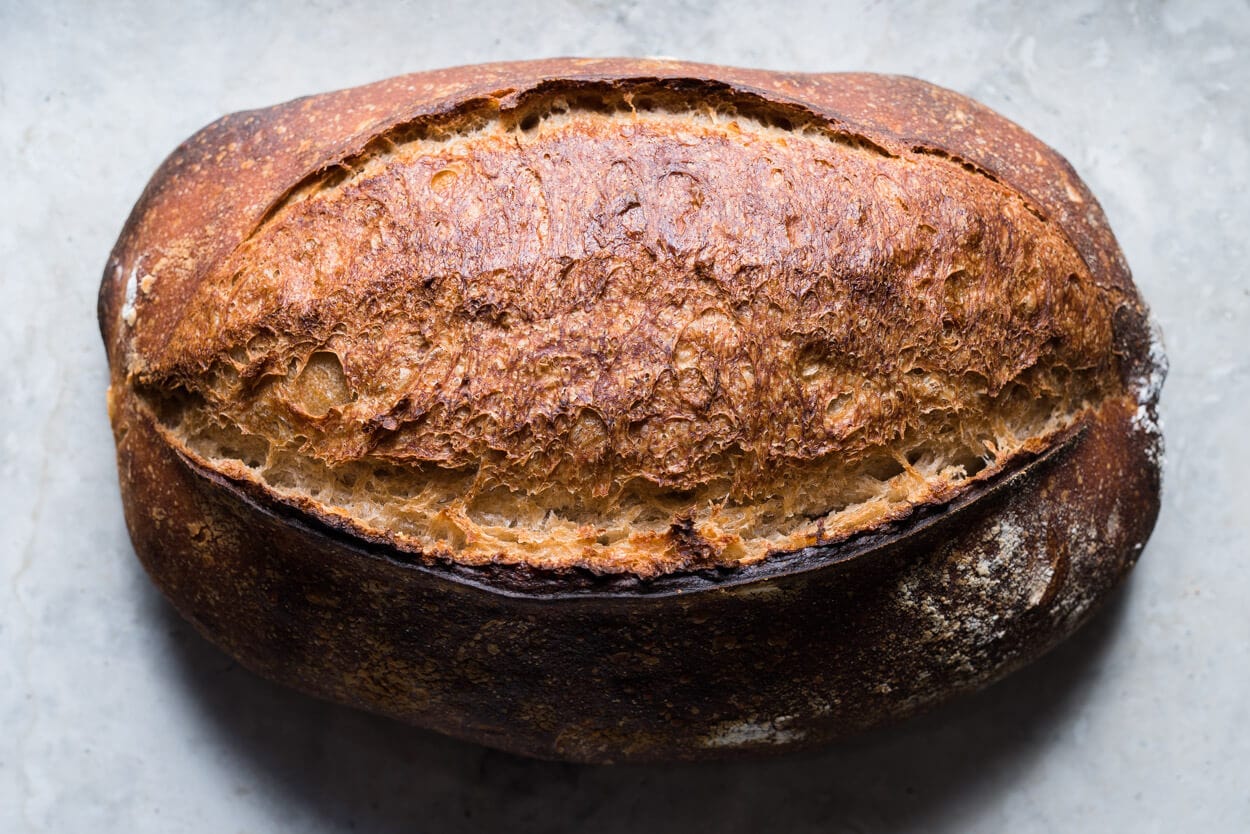
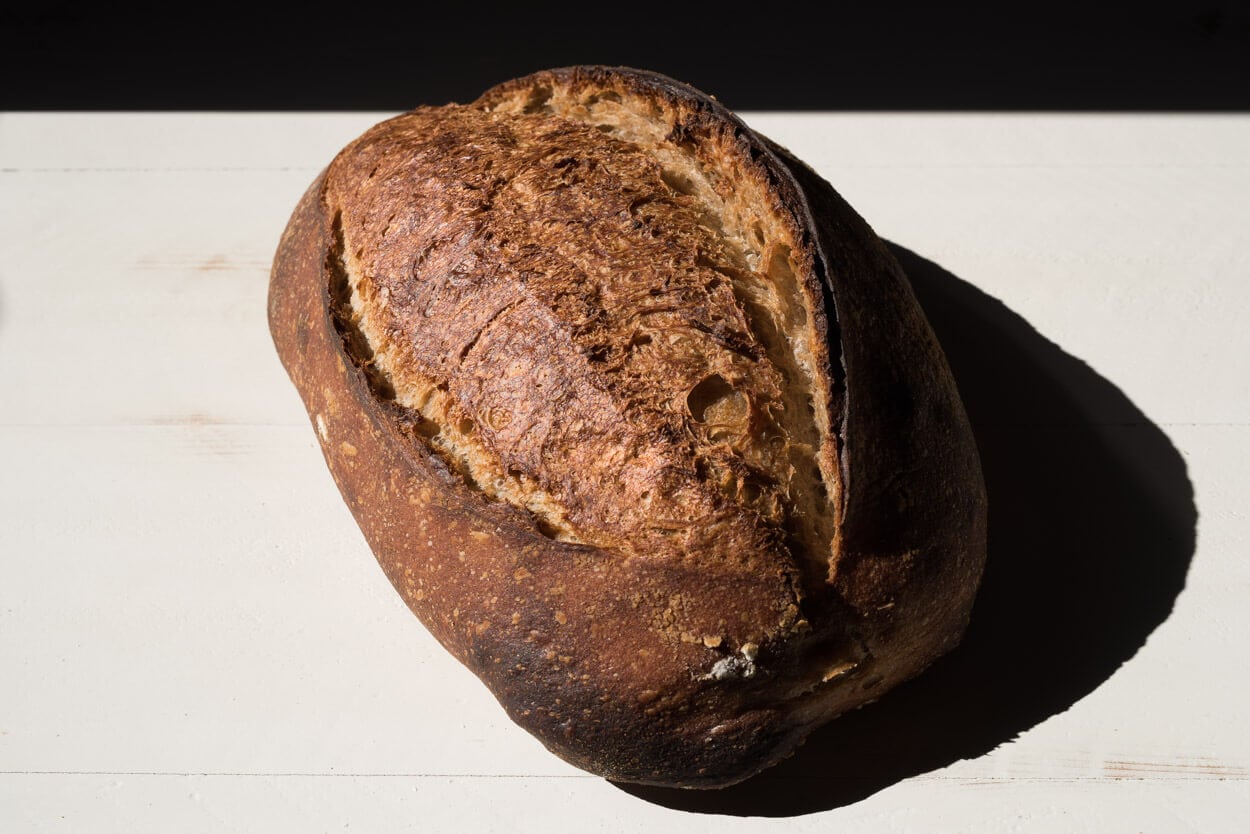
Crust
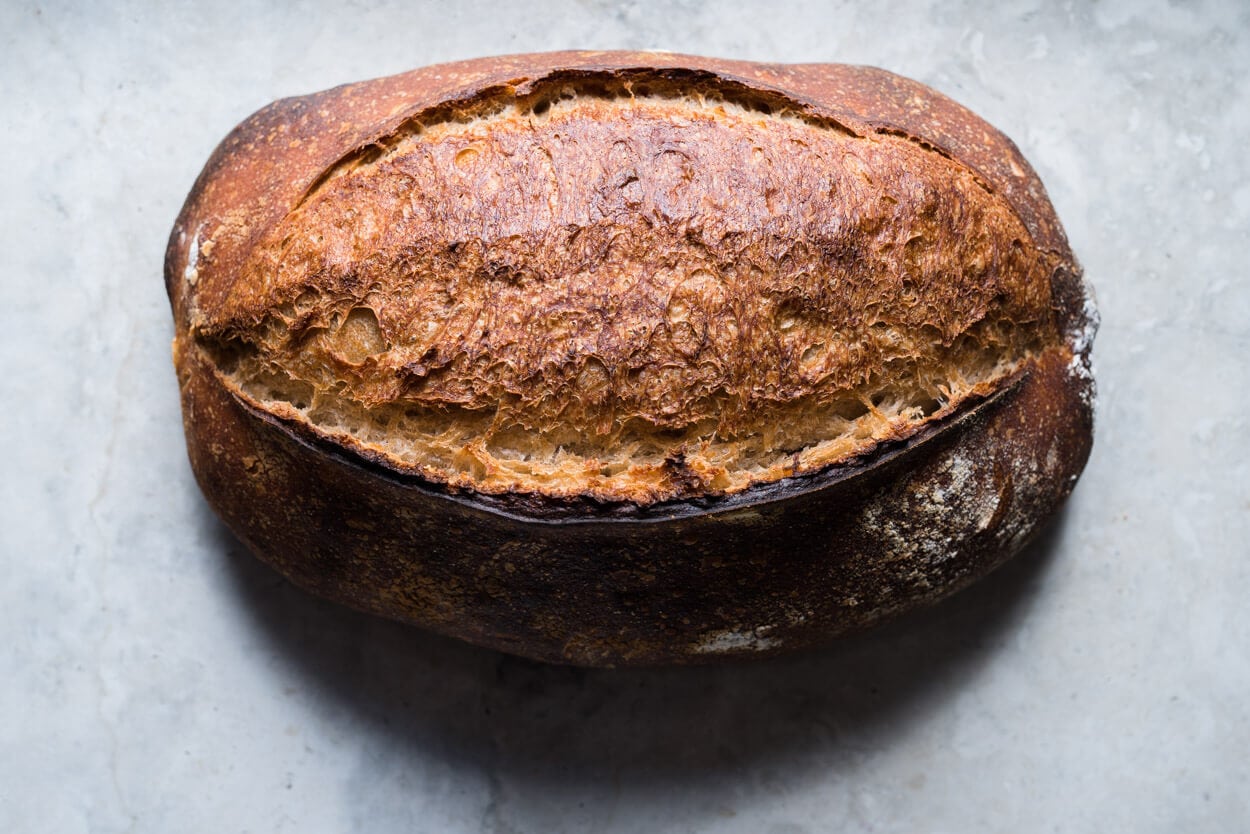
Dramatic. Sharp. Moody. Volcanic.
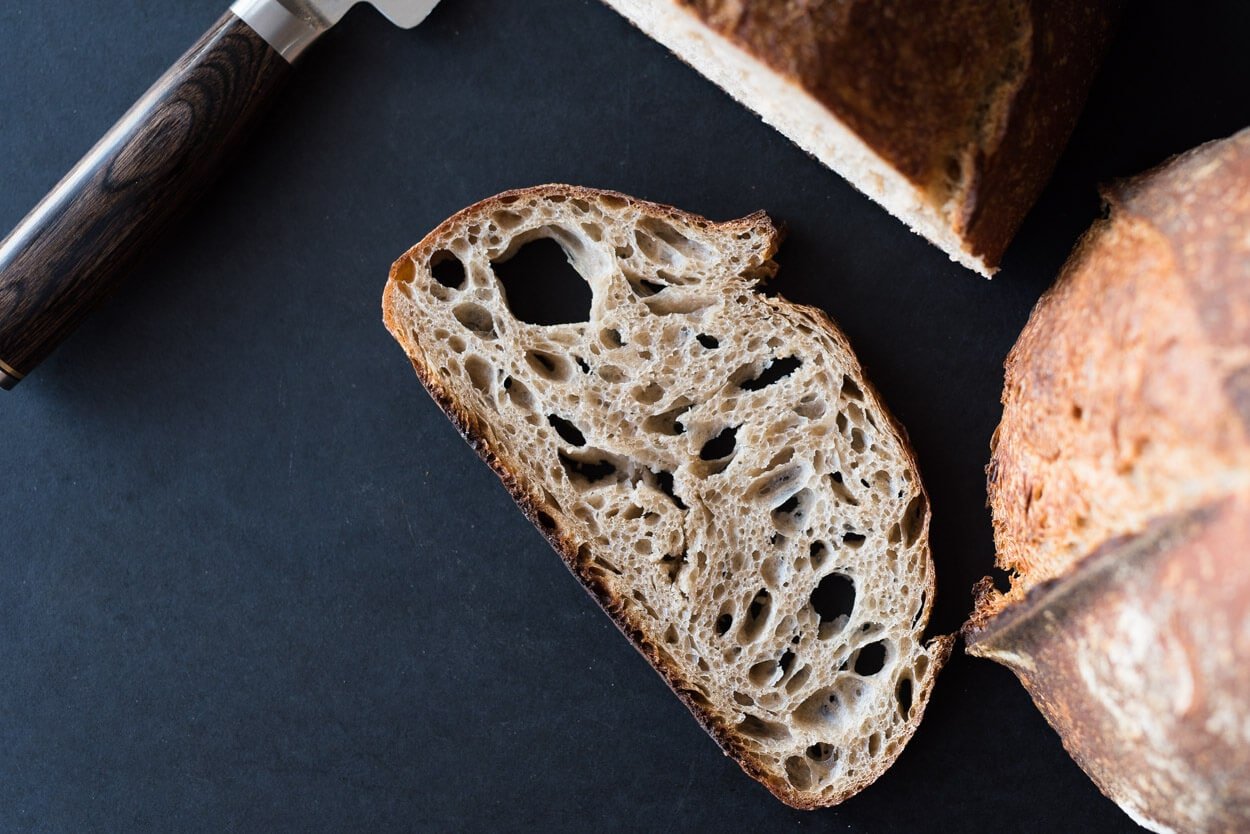
All adjectives I’d use to sum up this beauty. It’s hard to put words to this sensational crust, and the picture kind of tells it all, really, but the flavor and texture are left to the imagination. Because the crust is so, so important to me I strive to hit that mark, the high score on the wall I’m always reaching for—I think this one nailed it. Even though the crust looks intense, it was very thin (see the crumb shot below) and shattered when cut. Exactly how I like it.
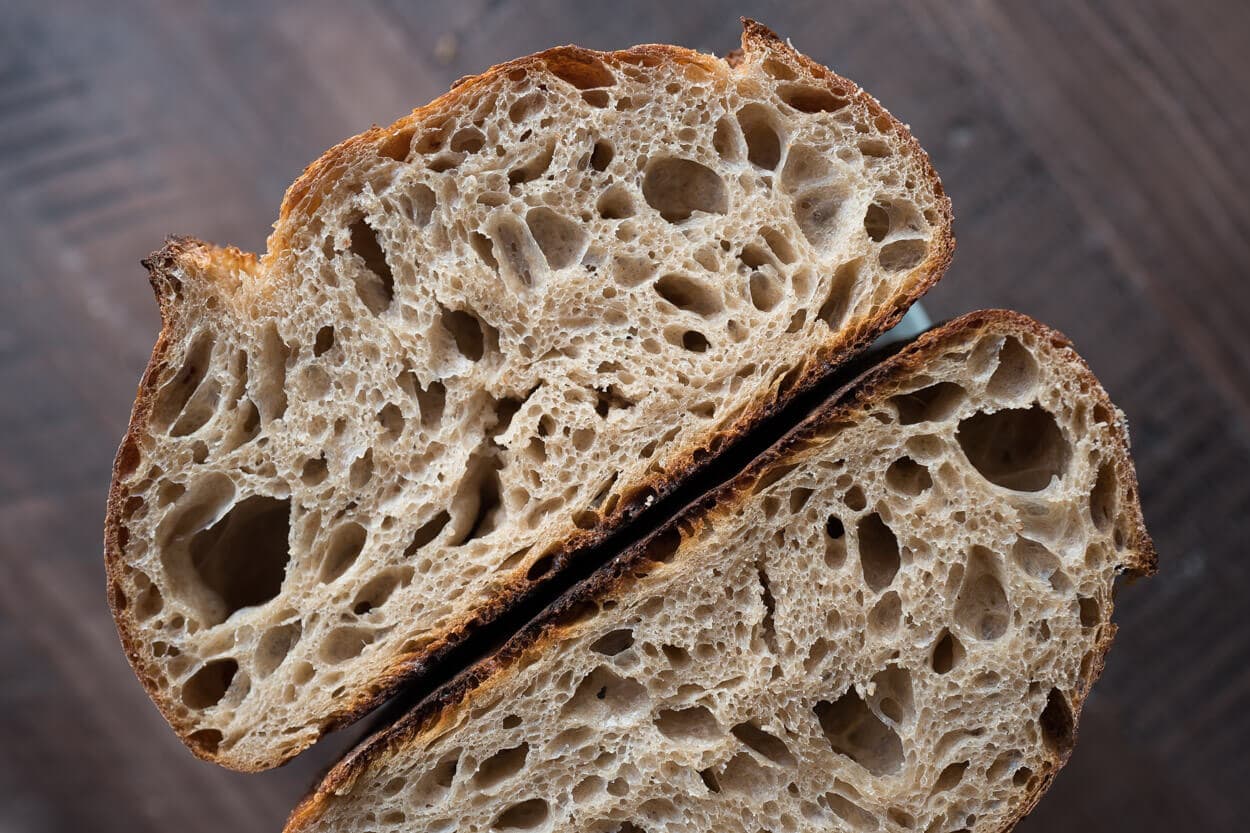
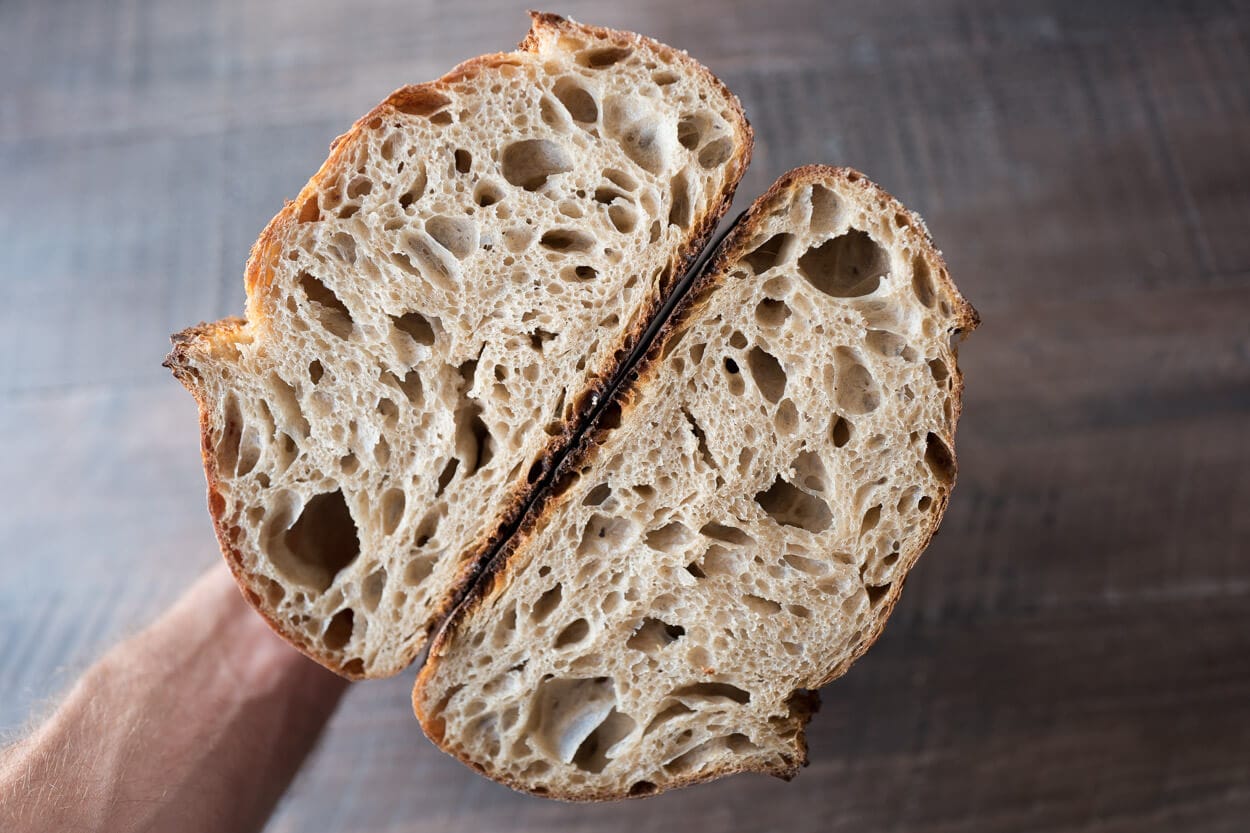
Crumb
This formula has a high percentage of whole grains, and yet the interior stayed quite moist and tender, creamy even. I pushed fermentation with this loaf, and that helped, but also the higher hydration kept things on the moist side.
When I push the proof time I find the interior to be much more flavorful and of a softer, creamy texture. Even with the high percentage of whole grains the interior was as open as I’d want it to be. Light, airy, and relatively uniform—just what I’m looking for. The gentle handling during bulk and final shaping also avoided excessively knocking out any of the gasses built up during the entire process.
Taste
The freshly milled spelt brought its classic slightly-nutty flavor profile to this bread, and when paired up with the rye flour it had quite a deep overall flavor profile. Between the whole grain spelt, the rye, and the type 85 flour this bread has the deep flavors of a whole grain loaf but the open and airy nature of a white loaf—a nice balance between the two.
I love the addition of rye flour in this recipe, even at such a small percentage. One thing you could play with is changing this grain out entirely: use Kamut, einkorn, white whole wheat or even buckwheat. It would also be interesting to try increasing from 5% to 10% (or potentially higher) to see if the flavor of the chosen grain compliments spelt even more so. As I said, it’s a very versatile grain.
In the end I love the changes I’ve made with this multigrain spelt sourdough formula and I feel I’ve achieved exactly what I was after in the first place: a fresh new flavor profile and a substantial structural improvement. The flour blend changes, extremely fine fresh spelt flour, gentle strengthening during bulk and light handling during final shape all contributed to the wonderful final result.
Maurizio Leo is the creator of The Perfect Loaf, the leading independent resource for baking sourdough bread and pizza at home, and the James Beard Award-winning, New York Times bestselling author of The Perfect Loaf and The Perfect Pizza. He lives in Albuquerque, NM, with his wife and two sons, and he's been labeled "Bob Ross but for bread." Read his full story →
Do sourdough posts like this help you in your baking? Join The Baker’s Corner for only $60 a year, and get:
Come chat with me and other bakers and get baking help
Remove all ads on website
Get my bakers tools & discounts
Get the full recipe archive in editable spreadsheets
Awesome, Rob! I love toasted pumpkin seeds in (and even on top) of a loaf—nutritious and healthy. I really think spelt is the best of the best, so flavorful! Thanks for the feedback and happy baking!
Hi Maurizio – thanks for this recipe! I modified the flours based on what I had available – 40% KA BF, 25% KA AP, 25% local spelt, 5% local rye, 5% KA WW, and I lowered the hydration by 5%. I initially did 5 min of slap and folds as suggested and it didn’t feel overly wet at that point. After focusing on being gentle for the stretch and folds, preshape, and shape, the result had a nice crumb but spread out laterally more than I’d have liked during the bake (it also relaxed considerably during the post-preshape rest). Any tips on how to best counter this with a higher hydration dough while not being heavy-handed?
I have made this several times and loved it, though with spelt flour from Bob’s vs fresh milled. I now have a mockmill and I’m just starting to experiment. Is there any reason I shouldn’t also use fresh milled for the rye and for an approximation of the type 85 with sifted fresh milled hard red winter? Or does it too difficult to get a light texture with that much home milled flour? Am I better off just milling the spelt until I get more experience working with fresh milled? Thanks!
I’d say go for it! You might see a need to increase the hydration depending on the freshly milled grain, and you might also see increased fermentation activity so be ready for those two.
so central milling doesn’t have any malted flour right now but I have diastatic malt from King arthur. What should the ratio be if you add the malt to the T85 instead?
In these older recipes I used to make extra levain to cover any bits left in the jar, hands, and spatula. I should come back and update that — sorry for the confusion!
Hi Maurizio, thanks for the great website and for kindly helping us with your expertise and advise. I have a question: do you suggest to increase the levain percentage up to 15% and to decrease the hydration a little bit, if aged flour is used, like you did in your Spelt bread recipe? Thank you.
You’re very welcome, Narine! Yes, that sounds like a good adjustment but I would still be cautious with adding water to this recipe: spelt is notorious for how finicky it is with too much water. Add it in slowly through mixing. Hope this helps and sorry for the delayed reply.
Hi Maurizio! I purchased a 40 mesh sifter from Breadtopia. I also have a Whisper Mill I purchased 35 years ago. If I milled hard spring white wheat berries (or hard winter red wheat berries) and then used the sifter for 85% extraction, could this be used as a substitute for CM type 85? The percentage protein would be higher so would it be a problem? I purchased a sifter based on your equipment list but I am not sure when to use this sifter in your recipes except in one recipe, the bran is sifted out to add as a topping. In what recipes would the sifter be beneficial? Thanks for having a wonderful website. I have learned so much. You are a great teacher! Your love for bread making is contagious!
Yes, that would likely get you close. After much experimentation I’ve found it’s very hard to approximate CM Type 85 at home — even with sifting it’s hard to match their fantastically fine T85 flour. That doesn’t mean we shouldn’t mill and sift ourselves, however! I usually like to refer to flour I mill + sift as “high extraction” and use it as that. In my kitchen I’d use this flour in place of CM T85 without any reservations because it’s the closest we can get.
I mill all my flour, so I've made a very similar bread using about half hard white wheat grain then Spelt and Kamut and the smaller bit of Rye. I let autolyse 2 hours to soften the bran (less bran in white wheat over red, but spelt has a lot)(no sifting – I did that in my beginning of fresh ground grains and soaked the bran, adding in later, but figure 2 hour autolyze is doing about the same thing.)
This may be my last bread bake for the season. Only our bedrooms are air conditioned and cranking the oven up to five hundred degrees when it’s 90 and 70-80% humidity doesn’t seem very appealing to me or my house mates. The day of milling and fermentation it was 100% humidity, yes a rainy day. As I was milling the flour you could literally see the flour soak up the moisture as it instantly made small clumps. I ended up using all the water in the recipe despite the weather, just going by instinct when I added the salt and the dough was sticky but workable. I did have to go an additional half hour for the bulk fermentation, until I saw some bubble activity like in your picture. Here’s some pics: https://imgur.com/x88zvjY and https://imgur.com/9Xh13nc. The flavor is fantastic, this makes a great sandwich bread and I know this one will go into heavy rotation. Now that the warmer weather is on it’s way I’ll be switching to sourdough pizza crusts on the grill. I already have some Central Milling 00 normal and everyone is looking forward to some great pizzas this summer.
Just tried this recipe yesterday and the result turned out fantastic! I used the finest setting on my Komo mill for the spelt and subbed the type 85 with finely milled, 100% red spring wheat. With such a high ratio of whole grains, I was stunned how open, moist, soft and creamy the interior was. And yet the whole grains added so much to the flavor. I was trying to be extra gentle during handling so it didn’t end up as a perfectly round boule but whatever, it is a rustic loaf after all. Thanks for the great write up and recipe!
Hi Maurizio. I’m fairly new to sourdough bread baking and I made your beginner sourdough recipe. Delicious. I’m making a honey spelt and oat bread at the moment. This recipe of yours looks fantastic, and I’m thinking of making it but half because I’m not confident about handling that high of a hydration with that much dough. That being said, you are using several flour types. I have an organic rye and spelt and whole wheat but it’s the other two that concerns me. Am I able to just use a bread flour for the Artisan bread flour and the Central Millng flour? For the malted flour I understand that I can combine whole wheat and bread flour. Just trying to simplify because living in Montreal, I am not sure where I can find the equivalent of what you are using.
Thanks, love your website!
Sharon
Hey, Sharon, really glad to hear those turned out well for you! You could (and it might be a good idea for the first go) reduce the hydration of this recipe by 5% and see if that feels more comfortable. I always suggest holding back water through mixing so you don’t get into the situation where too much has been added — but holding back 5% from the start might give you a better feel for the dough, then you can add it in the next time you bake this.
You could lump all the white flour used in this recipe together and just use “bread” flour. If you have access to an “all purpose” (around 11-12% protein) flour I might be more inclined to say go with that for the entire white flour component — especially if you’ll be reducing the hydration. If you only have bread flour on hand, then go with that.
I just finished baking this one and I’ve got to say, my very favorite so far! My kitchen smells wonderful and the bread is so delicious! You say to wait 1 to 2 hours, but I just could not wait! So good! Thank you.
That’s great to hear, Cindy! This is a super bread, to be sure. I still make it quite often and every time I do I get asked for another loaf 🙂 Thanks for the feedback and happy baking!
Maurizio, love the info on your site about milling, but was wondering why you aren’t using freshly milled rye in your recipe? I just recently ordered a komo mill and i’m trying to learn as much as possible before it arrives. It seems like a lot of recipes I’m reading have only some of the flour freshly milled, why is that? Cheers!
Thanks! I didn’t use fresh rye simply because I didn’t have any rye berries when I wrote up this recipe, otherwise I probably would have! You don’t have to use a mix of aged and fresh flour, by all means go full on 100% fresh flour (it’ll taste incredible). It can be more challenging to work with, though, and I sometimes use a base of aged flour for stability and strength. That said, there’s something incredible about a loaf of bread made with 100% fresh flour, the taste is out of this world. I actually just recently baked a 100% fresh milled loaf, have a look.
Happy baking and enjoy your KoMo, it’s an awesome mill!
It depends on the bread I’m trying to make. Almost always I use all of the resulting milled flour (100% extraction). If I wanted to make a lighter loaf with more “white” flour then I’d sift, but usually when I mill I’m interested in using the entire berry (and all of the nutrition!).
If I were to sift I’d sift right after milling. You can save the sifted out material (larger bran & germ pieces) to use in coating the loaf or another bake in the future.
Maurizio, will you make one with Kamut? I love Kamut and would love to see your take on it as well. I have tried the Kamut 60% from Tartine and it is a little bit wheaty. I like how you “lighten” these recipes to make it more palatable. Thanks!
Absolutely! I have some Kamut sitting in my pantry right now 🙂 It’s whole grain raw Kamut berries so it’ll most likely be a fresh milled recipe, but I’ll be getting there very soon!
So, you know how I told you I’m a bit ‘unscientific?’ Translation: I fly by the seat of my pants most of the time with the wild yeast and this new method. I made this bread yesterday morning after being sick all week and before leaving for Cleveland for the night to celebrate my brother’s 50th birthday. I had messed up the schedule for feeding due to not feeling well and then made my leaven way bigger than you suggest because of it. So, I figured that I needed to adjust water and flour in the final dough. My bucket of rye grain is buried under a bunch of other stuff in the basement with the move-prep atmosphere. I have also been starting a new exclusively Einkorn wild yeast (day 6 and VERY bubbly) for my friends with gluten issues, so I substituted the white flour for the white einkorn and the rye with sprouted wheat. I was also unsure how much to adjust the amount of water, but decided to err on the side of more, knowing wetter would be better than too dry. It was very wet, but seemed to get less so with the stretch and folds. It was still super sticky when it came time for the rounding and for shaping, I just added a bunch of flour on the outside so i could handle it well enough to get it into the proofing containers (a small mesh colander lined with a well-floured cotton towel and a bowl with a mouth the same circumference as my cute little le Crueset pot it was going to be baked in). The final loaves look beautiful with a single leaf pattern, great ears but a little burnt on the bottoms. I cut into one this morning and the crumb is not so pretty. Very small, tight and a little gummy. The taste was good, but we’ll see how it tastes as toast tomorrow. Some day my loaves will be as pretty as yours….more later!
Flavor is very good…mix of earthy, sweet and creamy. It was especially good tonight with butter and the sauce from Poute Chasseur recipe from Mimi Thorisson’s latest book French Country Cooking (my other fbtsomp adventure). A butter based, chicken stock and wine with carmelized onion and pan drippings from the chicken mixture. Yum!
Gina — thanks for the update! It sounds like maybe there was a bit too much water in the dough, especially if it was gummy, but the flavor of the Einkorn seems like it came through! I’ve read it has a very earthy and creamy flavor, sounds delicious. I’ve been meaning to try Einkorn myself but haven’t yet made it there (so many things to bake, I need more time!).
I just ate dinner but now you’re making me hungry again… I’ve seen Mimi’s book and have in my queue of books to purchase, sounds like it’s a winner. Thanks again for the update and I hope the next go at this one turns out a little less gummy! I’d say definitely reduce the hydration if you’re going to go with Einkorn as the majority of the flour.
First: the book. OH WOW! I had borrowed it from the library and, after cooking just 2 dishes from it and 1 from her blog, my husband demanded that I purchase it no matter the cost. It also has made me want to visit her there. My dream vacation would include a quick run over to Medoc for a few days (and a few bottles of wine) while I’m in Italy for 3-6 months. Lol about making you hungry 🙂
Second: the bread. It was primarily spelt flour and I just supplemented with a little Einkorn and even less of the sprouted wheat. I think the earthy, sweet and creamy flavor came from the spelt. I’m trying to save most of the Einkorn flour I have at this point for the gf peeps in my life. The einkorn-only wild yeast is bubbling away right next to my whole wheat-only yeast right now. (The sweet yeasty smell is settled over my kitchen in such a lovely way!) I am going to make its (einkorn) first levain tonight when I get home from work and its first loaves of bread tomorrow. Then tomorrow I’m going to make a levain from the wheat one and try the method Dave did (the restaurant owner in Tartine book 1) and see if it works better without steam.
FYI, the einkorn is VERY sticky. According to the book I have, it takes longer to soak up water, so will dough will appear very wet at first. I made the yeast from all white einkorn, but am going to use whole wheat for the bulk of the final dough. I’m going to follow the recipe to the letter and not try to do any of my own substitutions and such that usually get me into so much trouble lol. I’ll keep you posted on how this batch goes.
It’s so hard to type in between calls here at work…just to clarify…NOT going to Italy any time soon…that’s all part of the dream. And I have both whole wheat Einkorn as well as ‘regular’ whole wheat (hard white and hard red). The einkorn only will stay as such in bread as well as the starter to see if my friends and family who’ve gone gf can tolerate it. The book I have is from the folks who own Jovial Foods whose daughter had a sever reaction to gluten and does great with Einkorn. Again, will keep you in the loop. Wish I could take pictures to send to you too!!
Now I’m going to have to add that cookbook to my ever growing collection 🙂 I am not huge on French cooking (gasp) but of course I do love Italian cooking! I’ve been to France once and sadly it was a short trip but I do dream of heading back there one day soon to drive the country and explore. Now that would be a proper France trip.
I’ve seen Jovial’s einkorn at the market, that’s probably the first source I’ll try. I’ll probably have to pick some up soon after chatting with you now!
Sounds like you have your hands full with bread experiments, how fun. Never gets old I tell ya… Have fun!
Maurizio,
I wrote to you about a year ago, and I have been baking since then. I’ve been baking one-handed almost 11 years ago when a stroke left me
with one working hand. I started bread about 8 years ago with a bread
baker. Eventually I moved to the mixer, then with my hand. 2 years ago
it was time to make sourdough, and last year at this time I bough a
bread mill, so I mill about 1/2 of the flour I use. In Paris, the test
of a true Bread baker is weather he could ride the public
transportation, holding the loaf by the lip caused by scoring it, and I
can do it! I did it with this remarkable recipe, and I really wanted to say thanks! -Bruce Cadenhead
Bruce! Great to hear from you, yes I do remember talking to you a while back. Really glad to hear you’ve picked up a grain mill! Fresh flour is pretty incredible, isn’t it? Thanks so much for the feedback on this recipe, I’ve made it countless times now and it’s always a favorite 🙂 It’s also awesome to hear it passes the Paris public transit test! Although, like you said, a huge part of it (if not all) goes to the baker himself/herself — great job with it Bruce! Thanks again and happy baking!
Like your formula. I am also an avid spelt baker; often 50:50 with Khorasan (Kamut). My current favourite also has a little Rye — but included as a Rye sour. Your formula uses a higher percent of diastatic malt than mine — I will be giving that a try. Maybe I have been a bit too cautious there.
I haven’t yet tried khorasan but I have the berries to do so — haven’t had the time yet to dig into them! Can’t wait. I’m so taken with spelt at the moment I can’t seem to switch 🙂
I think overall 2% malt is around where I like to be. Try it out and see if the taste/texture is still acceptable, there is a danger when the malt gets too high for the texture to become a little “gummy”.
As an update I baked another couple following your instructions almost to the letter but this time cutting the hydration by 10% and increasing the time in the oven to 25 minutes at 482degrees f,if my oven is accurate, on a pizza stone with lots of steam then a further 25 minutes without steam at a cooler 430 degrees f according to my oven. I even checked the internal temperature at 220 degrees before removingbut might have not penetrated the lower uncooked dough.The rise in the oven was the best to date they both looked incredible from the outside. However the loaves,baked separately,were both inedible due to the lower 50% of the loaf being vastly undercooked and almost like hot raw dough . I have not experienced this with your beginners loaf. What am I doing wrong? Do you think it is an oven heating problem ?
I was just going to recommend each of those steps you performed, glad you did all that. Did you preheat your oven? Was your baking stone hot? It sounds like perhaps the baking stone wasn’t hot compared to the top of the oven, or maybe your bottom heating element wasn’t functioning properly? When I hear things like this it’s almost always a heating issue and the oven is not working properly. It’s strange that my other recipe worked so well but this one didn’t fully cook.
Maurizio what what an amazingly informed site , you really ought to write a book and publish !! Having just made this loaf in the south of the uk everything was fine even my first slap and turn attempt as the dough was incredibly moist am using locally grown organic flours. Spelt rye and unbleached white
I obtained the best rise in my over ever however after 40 mins in the oven at your recommended temperatures the colour was perfect as per your photos, however the internal crumb was too moist / sticky when I came to cut a few hours later. Would you suggest less hydration to start with ?
Hi Maurizio
I need to bake this beauty in two days and I don’t have time to proof for 10h in the fridge. My calculations says that I only have 6h30. Will it be enough if I let the dough on the counter? My kitchen temperature is around 73F right now (10pm), maybe less during the night.
What do you suggest?
Hello! It’s really, really hard to say yes or no to this… It depends on how the dough develops in your environment (starter strength, flour, kitchen temperatures, FDT, etc.). When I do a counter proof I typically need around 3-4 hours at 75ºF for the dough to be developed sufficiently (with a mostly white flour loaf). You could always try to speed things up slightly by using warmer water for the mix or using more levain.
Hello Maurizio,
For baking in your home oven are you using the convection or the induction function? As I use only one thick baking stone, on which I place the dough, I use the convection function, thus I wonder would I get better results baking with the induction function.
Thanks,
Hai Tsabar
Hai,
No, I am not using convection or induction. I bake my bread in an oven that does not have either of those functions, it’s just a straight regular home oven. I do believe there are heating elements at the top and bottom but they are not inside the oven but rather outside. Hope that helps!
Thank you Maurizio for your inspiration and recipe! My multi-grain spelt loaves baked this morning are beautiful and singing. They will be the hit of our Canadian Thanksgiving dinner on Monday! I truly appreciate all your hard work, tips and recipes. I can’t wait to try your Apricot, Lavender & Walnut recipe next.
You’re very welcome Kris, thank you for the kind words! Happy Thanksgiving and I know your bread will be the star of the meal! Let me know what you think of that lavender loaf — it was a hit over here! Happy baking 🙂
Hi Maurizio! I have a question for you. When it’s time to gently dump the dough from its bulk rise container onto the countertop for shaping, is there a way to make it come out a bit more easily without it? I get good results from my sourdough baking, but I feel like this is one place that I’m damaging the dough. It sticks and stretches a lot as it ever-so-slowly comes out of the bowl, and I almost always have to pull it from the bowl in some spots, surely damaging air bubbles I just spent half a day creating. I’m tempted to lightly oil the bowl before starting the bulk rise, but I don’t know that it would be a great idea.
Hey, Nicole! This is a really great question (I swear, it’s the seemingly small details that are always a challenge with bread!). You can certainly lightly oil the bowl with a neutral oil, many bakers do this with their plastic tubs (I don’t). I use a ceramic bowl for my bulk container so my dough always comes out fairly easy, but here is what I do:
I will pickup the bowl with my left hand and hold it in the air by the rim and start to pour the dough out onto the counter. With my other hand, and plastic dough scraper in it, scrape the dough from the bowl as I slowly pour. This helps remove the dough as it’s starting to pull down and fall gently to the bench. It takes some practice but all my bread you see here is done this way.
Sometimes when I use a rectangular bin I will just tilt the bin on its side, let the dough ooze down onto the bench and then scrape with my scraper to help release.
hi maurizio i really like read your lovely blog
have 2 questions for this recipe: in the final dough we need to use 86 gw of mature levain- is it part of the 150 g levain we build earlier (and we discard the rest) or it’s in addition to it? and how water you suggest to use if i din;t use frsh spelt like you?
wait for your answer thanks
Thank you so much, glad to hear that! The 86g mature levain is all you need in the final dough mix, the rest of the levain build is discarded (compost it or you can use it in other baking things around the kitchen, like pancakes).
If you don’t use fresh spelt I would recommend reducing the overall water 5% to 10% for the first try to see how the dough feels. I find fresh milled spelt can take on a lot more water than aged spelt, so add the water in slowly and stop when it starts to feel overly wet.
Ana — sure thing! Wow, I’d love access to a communal wood fired oven, how awesome. I think you could definitely travel with your dough to the oven, just keep it as protected as you can in transit. If you’re bringing it there in its proofing basket maybe use an insulated cooler if you have one. It should make it just fine, though! Try it out and see how the dough is when you get there — if it’s too warm maybe you can get an ice pack and put it under the proofing basket for transit.
Unfortunately I have zero experience with baking in a wood fired oven so I can’t really comment on what changes you’ll need. I do know you’ll still have to try and get some steam in that oven, but really even that isn’t 100% necessary. The bread will bake up differently for sure, it will have a more pale crust and perhaps not as high of a rise, but I bet the flavor will be totally awesome.
Sorry for the late reply, let me know how it goes!
I would use a cast iron pan if you are not able to provide steam in the oven chamber. Steam isn’t 100% necessary but it does give you a bit more rise, a thinner crust and sometimes a nice shiny exterior.
If you use the pan be careful, it will probably be incredibly hot in that oven!
I don’t understand your scheduling. Are you still on 2 daily feedings for your starter? If so, how do you build your levain at 12pm? I feed my starter at 7pm and 7am. How would I make this schedule work with my starter? I tried feeding my starter half so that it would be “fully fermented” at 1pm, but that’s turned out underfermented bread and seems to weaken my starter over the next few days. What can I do for these recipes (this one and the 50/50 whole wheat loaf) that call for building the levain later in the day, right in between my normal daily feedings.
So sorry for the late reply, I’ve been out traveling! Yes, I’m still on 2 feedings per day for my starter (mostly because I bake so often, but also because it’s been incredibly warm here). The time I start building my levain, the bake, and the entire process is adjusted for the day before. I leave a little flexibility in my schedule so I can kind of watch my starter when it gets near time to feed it and use it right when I think it’s ready to be included in a levain build. For this recipe I fed my starter a little later the day before so it would “last” until 12pm the next day, which is about when I wanted to start my levain. I say a “little” less here because, as you mentioned, you want to really just change the percentages a little here and there, nothing too drastic.
You can adjust this timetable to whatever you need for your own personal schedule. You can shift everything 2 hours earlier, 2 hours later, etc., just keep the relative timing the same. For example, I state this dough needs about a 4 hour bulk (which may be a little less or a little more for you, depending on how the dough is developing), just keep the bulk around that duration but when it actually happens during the day is up to you.
The schedule for this post (and the 50/50) is in the middle of the day, but this doesn’t mean you have to follow that specific time exactly. Just shift everything X number of hours earlier so building the levain coincides with when you’d normally feed your starter and adjust the rest of the times to follow. The specific time of day isn’t important, just the durations.
I hope this makes sense! Let me know if you need any more help.
It does make sense. Thanks for the reply! One more question, if I adjust this time frame back a few hours and start at 7 instead of 12, would retarding it longer in the fridge be acceptable? I certainly don’t think I’ll be baking in the middle of the night. Haha. The retard stage is something I don’t quite understand.
That is a good question and that’s correct: the longer the retard in the fridge the longer fermentation will continue. I would say a few hours plus or minus is usually ok (assuming your fridge is around 37F), but you’d have to see how the dough is developing to make that call. You could cut bulk fermentation a little short, say 15-25 minutes and get the dough into the fridge sooner. This way it should be able to last a little longer in the fridge.
Try that out and see how it turns out. If you notice the rise on your dough is very sluggish and it’s overly sour tasting you will have to reduce the final proof time (or change a few other factors).
Could you please comment for us you recent move towards building your levain with a greater proportion of starter compared to previous formulations?
In connection to this, the proportion of levain in the dough is also slightly decreasing. Is it all aiming at influencing the acidic component of the finished loaf, or is it simply meant to speed up levain maturation?
Whatever, did it work?
And finally, if you can, how do your results compare to Robertson’s levain formulation you are certainly familiar with?
Thank you, Bartolo! I sometimes build my levain with a larger “seed” percentage depending on my schedule. If I want my levain to ripe sooner I can start out with a 100% seed percentage (instead of my typical 50%) so my levain is ready in a shorter time period. This can have side effects, though, in that your levain can potentially impart a more acidic flavor to your bread, but when I do this I typically use such a low percentage of levain in my final mix (and I never use it past it’s peak where it becomes even more acidic) I don’t taste an overly sour bread, which I do not prefer.
My levain percentage has been decreasing for a few reasons. First, it’s very warm here right now as it’s summer time — it’s necessary for me to lower the levain percentage or risk over proofing. The next reason is when using a high percentage of fresh milled flour I must also reduce levain percentage as the dough is incredibly active and will quickly over proof. If you are using aged flour you will likely need to increase your levain percentage.
Robertson’s levain is different than what I typically use, his is a much “younger” levain with a very sweet smell/taste. He instructs using your levain right when it’s able to pass the float test whereas mine is used at a much more mature, expanded state. In my experience using a younger levain can help when your bread is undergoing fermentation temperatures that are high or if the total fermentation time is much longer.
I hope all that helps! Do keep in mind this is what I’ve experienced myself, here in my kitchen. Things may be a little different for you!
Maurizio:
tus recetas son un verdadero placer pro lo explícitas que son en todos los detalles, especialmente para los principiantes como yo. En Uruguay no disponemos de harina de espelta. Recién ahora, me enteré el otro día que hay unos quinteros que están plantando variedades de trigos ecológicos. Estoy esperando respuesta para ir a ver qué es lo que producen y tal vez haya algún grano de trigo duro para ensayar las recetas que nos envías.
Gracias por todo. Felicitaciones y adelante!!!
Desde Uruguay, un abrazo
Jaime,
¡De nada! Me alegro de que está disfrutando de mi página web. Está bien si usted no tiene harina de espelta, trigo orgánico funcionaría muy bien. Es incluso mejor que se puede obtener de una fuente local!
Gracias de nuevo por las amables palabras y me alegro de tenerte siguiendo a lo largo!
Great recipe! Trying it today, levain is already in progress. Unfortunately, I don’t have miller so no fresh milled flour for me, but I believe it’ll be tasty and at least as half as visually nice as yours.
However, you have a typo in levain formula. For starter percentage and weight don’t match. I work by percentage always, but there might be someone who can get confused.
Hi Maurizio – Sounds interesting but could you please check the formula. You talk about adding rye but there is no rye in the formula. Also the flours add up to 108%. Cheers, Mark




91 Comments
Awesome, Rob! I love toasted pumpkin seeds in (and even on top) of a loaf—nutritious and healthy. I really think spelt is the best of the best, so flavorful! Thanks for the feedback and happy baking!
Hi Maurizio – thanks for this recipe! I modified the flours based on what I had available – 40% KA BF, 25% KA AP, 25% local spelt, 5% local rye, 5% KA WW, and I lowered the hydration by 5%. I initially did 5 min of slap and folds as suggested and it didn’t feel overly wet at that point. After focusing on being gentle for the stretch and folds, preshape, and shape, the result had a nice crumb but spread out laterally more than I’d have liked during the bake (it also relaxed considerably during the post-preshape rest). Any tips on how to best counter this with a higher hydration dough while not being heavy-handed?
I have made this several times and loved it, though with spelt flour from Bob’s vs fresh milled. I now have a mockmill and I’m just starting to experiment. Is there any reason I shouldn’t also use fresh milled for the rye and for an approximation of the type 85 with sifted fresh milled hard red winter? Or does it too difficult to get a light texture with that much home milled flour? Am I better off just milling the spelt until I get more experience working with fresh milled? Thanks!
I’d say go for it! You might see a need to increase the hydration depending on the freshly milled grain, and you might also see increased fermentation activity so be ready for those two.
so central milling doesn’t have any malted flour right now but I have diastatic malt from King arthur. What should the ratio be if you add the malt to the T85 instead?
Because this recipe already calls for diastatic malt, I would skip adding any additional.
In these older recipes I used to make extra levain to cover any bits left in the jar, hands, and spatula. I should come back and update that — sorry for the confusion!
Hi Maurizio, thanks for the great website and for kindly helping us with your expertise and advise. I have a question: do you suggest to increase the levain percentage up to 15% and to decrease the hydration a little bit, if aged flour is used, like you did in your Spelt bread recipe? Thank you.
You’re very welcome, Narine! Yes, that sounds like a good adjustment but I would still be cautious with adding water to this recipe: spelt is notorious for how finicky it is with too much water. Add it in slowly through mixing. Hope this helps and sorry for the delayed reply.
Hi Maurizio! I purchased a 40 mesh sifter from Breadtopia. I also have a Whisper Mill I purchased 35 years ago. If I milled hard spring white wheat berries (or hard winter red wheat berries) and then used the sifter for 85% extraction, could this be used as a substitute for CM type 85? The percentage protein would be higher so would it be a problem? I purchased a sifter based on your equipment list but I am not sure when to use this sifter in your recipes except in one recipe, the bran is sifted out to add as a topping. In what recipes would the sifter be beneficial? Thanks for having a wonderful website. I have learned so much. You are a great teacher! Your love for bread making is contagious!
Correction: I got 90% extraction using the 40 mesh sifter.
Yes, that would likely get you close. After much experimentation I’ve found it’s very hard to approximate CM Type 85 at home — even with sifting it’s hard to match their fantastically fine T85 flour. That doesn’t mean we shouldn’t mill and sift ourselves, however! I usually like to refer to flour I mill + sift as “high extraction” and use it as that. In my kitchen I’d use this flour in place of CM T85 without any reservations because it’s the closest we can get.
Hope this helps!
I mill all my flour, so I've made a very similar bread using about half hard white wheat grain then Spelt and Kamut and the smaller bit of Rye. I let autolyse 2 hours to soften the bran (less bran in white wheat over red, but spelt has a lot)(no sifting – I did that in my beginning of fresh ground grains and soaked the bran, adding in later, but figure 2 hour autolyze is doing about the same thing.)
This may be my last bread bake for the season. Only our bedrooms are air conditioned and cranking the oven up to five hundred degrees when it’s 90 and 70-80% humidity doesn’t seem very appealing to me or my house mates. The day of milling and fermentation it was 100% humidity, yes a rainy day. As I was milling the flour you could literally see the flour soak up the moisture as it instantly made small clumps. I ended up using all the water in the recipe despite the weather, just going by instinct when I added the salt and the dough was sticky but workable. I did have to go an additional half hour for the bulk fermentation, until I saw some bubble activity like in your picture. Here’s some pics: https://imgur.com/x88zvjY and https://imgur.com/9Xh13nc. The flavor is fantastic, this makes a great sandwich bread and I know this one will go into heavy rotation. Now that the warmer weather is on it’s way I’ll be switching to sourdough pizza crusts on the grill. I already have some Central Milling 00 normal and everyone is looking forward to some great pizzas this summer.
Just tried this recipe yesterday and the result turned out fantastic! I used the finest setting on my Komo mill for the spelt and subbed the type 85 with finely milled, 100% red spring wheat. With such a high ratio of whole grains, I was stunned how open, moist, soft and creamy the interior was. And yet the whole grains added so much to the flavor. I was trying to be extra gentle during handling so it didn’t end up as a perfectly round boule but whatever, it is a rustic loaf after all. Thanks for the great write up and recipe!
Hi Maurizio. I’m fairly new to sourdough bread baking and I made your beginner sourdough recipe. Delicious. I’m making a honey spelt and oat bread at the moment. This recipe of yours looks fantastic, and I’m thinking of making it but half because I’m not confident about handling that high of a hydration with that much dough. That being said, you are using several flour types. I have an organic rye and spelt and whole wheat but it’s the other two that concerns me. Am I able to just use a bread flour for the Artisan bread flour and the Central Millng flour? For the malted flour I understand that I can combine whole wheat and bread flour. Just trying to simplify because living in Montreal, I am not sure where I can find the equivalent of what you are using.
Thanks, love your website!
Sharon
Hey, Sharon, really glad to hear those turned out well for you! You could (and it might be a good idea for the first go) reduce the hydration of this recipe by 5% and see if that feels more comfortable. I always suggest holding back water through mixing so you don’t get into the situation where too much has been added — but holding back 5% from the start might give you a better feel for the dough, then you can add it in the next time you bake this.
You could lump all the white flour used in this recipe together and just use “bread” flour. If you have access to an “all purpose” (around 11-12% protein) flour I might be more inclined to say go with that for the entire white flour component — especially if you’ll be reducing the hydration. If you only have bread flour on hand, then go with that.
Hope that helps and happy baking!
I just finished baking this one and I’ve got to say, my very favorite so far! My kitchen smells wonderful and the bread is so delicious! You say to wait 1 to 2 hours, but I just could not wait! So good! Thank you.
That’s great to hear, Cindy! This is a super bread, to be sure. I still make it quite often and every time I do I get asked for another loaf 🙂 Thanks for the feedback and happy baking!
Maurizio, love the info on your site about milling, but was wondering why you aren’t using freshly milled rye in your recipe? I just recently ordered a komo mill and i’m trying to learn as much as possible before it arrives. It seems like a lot of recipes I’m reading have only some of the flour freshly milled, why is that? Cheers!
Thanks! I didn’t use fresh rye simply because I didn’t have any rye berries when I wrote up this recipe, otherwise I probably would have! You don’t have to use a mix of aged and fresh flour, by all means go full on 100% fresh flour (it’ll taste incredible). It can be more challenging to work with, though, and I sometimes use a base of aged flour for stability and strength. That said, there’s something incredible about a loaf of bread made with 100% fresh flour, the taste is out of this world. I actually just recently baked a 100% fresh milled loaf, have a look.
Happy baking and enjoy your KoMo, it’s an awesome mill!
When you grind your own flour, is there ever a time when you sift out bran, and when and why do you do it?
It depends on the bread I’m trying to make. Almost always I use all of the resulting milled flour (100% extraction). If I wanted to make a lighter loaf with more “white” flour then I’d sift, but usually when I mill I’m interested in using the entire berry (and all of the nutrition!).
If I were to sift I’d sift right after milling. You can save the sifted out material (larger bran & germ pieces) to use in coating the loaf or another bake in the future.
Hope that helps and happy baking!
Maurizio, will you make one with Kamut? I love Kamut and would love to see your take on it as well. I have tried the Kamut 60% from Tartine and it is a little bit wheaty. I like how you “lighten” these recipes to make it more palatable. Thanks!
Absolutely! I have some Kamut sitting in my pantry right now 🙂 It’s whole grain raw Kamut berries so it’ll most likely be a fresh milled recipe, but I’ll be getting there very soon!
Perfect! I just baked mine today and waiting to cut into it later tonight. I will post to IG.
Is the Type 85 flour you use, do yo get the malted or non malted type 85?
I use malted Type 85.
So, you know how I told you I’m a bit ‘unscientific?’ Translation: I fly by the seat of my pants most of the time with the wild yeast and this new method. I made this bread yesterday morning after being sick all week and before leaving for Cleveland for the night to celebrate my brother’s 50th birthday. I had messed up the schedule for feeding due to not feeling well and then made my leaven way bigger than you suggest because of it. So, I figured that I needed to adjust water and flour in the final dough. My bucket of rye grain is buried under a bunch of other stuff in the basement with the move-prep atmosphere. I have also been starting a new exclusively Einkorn wild yeast (day 6 and VERY bubbly) for my friends with gluten issues, so I substituted the white flour for the white einkorn and the rye with sprouted wheat. I was also unsure how much to adjust the amount of water, but decided to err on the side of more, knowing wetter would be better than too dry. It was very wet, but seemed to get less so with the stretch and folds. It was still super sticky when it came time for the rounding and for shaping, I just added a bunch of flour on the outside so i could handle it well enough to get it into the proofing containers (a small mesh colander lined with a well-floured cotton towel and a bowl with a mouth the same circumference as my cute little le Crueset pot it was going to be baked in). The final loaves look beautiful with a single leaf pattern, great ears but a little burnt on the bottoms. I cut into one this morning and the crumb is not so pretty. Very small, tight and a little gummy. The taste was good, but we’ll see how it tastes as toast tomorrow. Some day my loaves will be as pretty as yours….more later!
Flavor is very good…mix of earthy, sweet and creamy. It was especially good tonight with butter and the sauce from Poute Chasseur recipe from Mimi Thorisson’s latest book French Country Cooking (my other fbtsomp adventure). A butter based, chicken stock and wine with carmelized onion and pan drippings from the chicken mixture. Yum!
Gina — thanks for the update! It sounds like maybe there was a bit too much water in the dough, especially if it was gummy, but the flavor of the Einkorn seems like it came through! I’ve read it has a very earthy and creamy flavor, sounds delicious. I’ve been meaning to try Einkorn myself but haven’t yet made it there (so many things to bake, I need more time!).
I just ate dinner but now you’re making me hungry again… I’ve seen Mimi’s book and have in my queue of books to purchase, sounds like it’s a winner. Thanks again for the update and I hope the next go at this one turns out a little less gummy! I’d say definitely reduce the hydration if you’re going to go with Einkorn as the majority of the flour.
Happy baking!
First: the book. OH WOW! I had borrowed it from the library and, after cooking just 2 dishes from it and 1 from her blog, my husband demanded that I purchase it no matter the cost. It also has made me want to visit her there. My dream vacation would include a quick run over to Medoc for a few days (and a few bottles of wine) while I’m in Italy for 3-6 months. Lol about making you hungry 🙂
Second: the bread. It was primarily spelt flour and I just supplemented with a little Einkorn and even less of the sprouted wheat. I think the earthy, sweet and creamy flavor came from the spelt. I’m trying to save most of the Einkorn flour I have at this point for the gf peeps in my life. The einkorn-only wild yeast is bubbling away right next to my whole wheat-only yeast right now. (The sweet yeasty smell is settled over my kitchen in such a lovely way!) I am going to make its (einkorn) first levain tonight when I get home from work and its first loaves of bread tomorrow. Then tomorrow I’m going to make a levain from the wheat one and try the method Dave did (the restaurant owner in Tartine book 1) and see if it works better without steam.
FYI, the einkorn is VERY sticky. According to the book I have, it takes longer to soak up water, so will dough will appear very wet at first. I made the yeast from all white einkorn, but am going to use whole wheat for the bulk of the final dough. I’m going to follow the recipe to the letter and not try to do any of my own substitutions and such that usually get me into so much trouble lol. I’ll keep you posted on how this batch goes.
It’s so hard to type in between calls here at work…just to clarify…NOT going to Italy any time soon…that’s all part of the dream. And I have both whole wheat Einkorn as well as ‘regular’ whole wheat (hard white and hard red). The einkorn only will stay as such in bread as well as the starter to see if my friends and family who’ve gone gf can tolerate it. The book I have is from the folks who own Jovial Foods whose daughter had a sever reaction to gluten and does great with Einkorn. Again, will keep you in the loop. Wish I could take pictures to send to you too!!
Now I’m going to have to add that cookbook to my ever growing collection 🙂 I am not huge on French cooking (gasp) but of course I do love Italian cooking! I’ve been to France once and sadly it was a short trip but I do dream of heading back there one day soon to drive the country and explore. Now that would be a proper France trip.
I’ve seen Jovial’s einkorn at the market, that’s probably the first source I’ll try. I’ll probably have to pick some up soon after chatting with you now!
Sounds like you have your hands full with bread experiments, how fun. Never gets old I tell ya… Have fun!
Maurizio,
I wrote to you about a year ago, and I have been baking since then. I’ve been baking one-handed almost 11 years ago when a stroke left me
with one working hand. I started bread about 8 years ago with a bread
baker. Eventually I moved to the mixer, then with my hand. 2 years ago
it was time to make sourdough, and last year at this time I bough a
bread mill, so I mill about 1/2 of the flour I use. In Paris, the test
of a true Bread baker is weather he could ride the public
transportation, holding the loaf by the lip caused by scoring it, and I
can do it! I did it with this remarkable recipe, and I really wanted to say thanks! -Bruce Cadenhead
Bruce! Great to hear from you, yes I do remember talking to you a while back. Really glad to hear you’ve picked up a grain mill! Fresh flour is pretty incredible, isn’t it? Thanks so much for the feedback on this recipe, I’ve made it countless times now and it’s always a favorite 🙂 It’s also awesome to hear it passes the Paris public transit test! Although, like you said, a huge part of it (if not all) goes to the baker himself/herself — great job with it Bruce! Thanks again and happy baking!
Like your formula. I am also an avid spelt baker; often 50:50 with Khorasan (Kamut). My current favourite also has a little Rye — but included as a Rye sour. Your formula uses a higher percent of diastatic malt than mine — I will be giving that a try. Maybe I have been a bit too cautious there.
I haven’t yet tried khorasan but I have the berries to do so — haven’t had the time yet to dig into them! Can’t wait. I’m so taken with spelt at the moment I can’t seem to switch 🙂
I think overall 2% malt is around where I like to be. Try it out and see if the taste/texture is still acceptable, there is a danger when the malt gets too high for the texture to become a little “gummy”.
Happy baking!
As an update I baked another couple following your instructions almost to the letter but this time cutting the hydration by 10% and increasing the time in the oven to 25 minutes at 482degrees f,if my oven is accurate, on a pizza stone with lots of steam then a further 25 minutes without steam at a cooler 430 degrees f according to my oven. I even checked the internal temperature at 220 degrees before removingbut might have not penetrated the lower uncooked dough.The rise in the oven was the best to date they both looked incredible from the outside. However the loaves,baked separately,were both inedible due to the lower 50% of the loaf being vastly undercooked and almost like hot raw dough . I have not experienced this with your beginners loaf. What am I doing wrong? Do you think it is an oven heating problem ?
Chris Winchester uk
I was just going to recommend each of those steps you performed, glad you did all that. Did you preheat your oven? Was your baking stone hot? It sounds like perhaps the baking stone wasn’t hot compared to the top of the oven, or maybe your bottom heating element wasn’t functioning properly? When I hear things like this it’s almost always a heating issue and the oven is not working properly. It’s strange that my other recipe worked so well but this one didn’t fully cook.
I’m guessing an oven issue here…
Maurizio what what an amazingly informed site , you really ought to write a book and publish !! Having just made this loaf in the south of the uk everything was fine even my first slap and turn attempt as the dough was incredibly moist am using locally grown organic flours. Spelt rye and unbleached white
I obtained the best rise in my over ever however after 40 mins in the oven at your recommended temperatures the colour was perfect as per your photos, however the internal crumb was too moist / sticky when I came to cut a few hours later. Would you suggest less hydration to start with ?
Chris Winchester Uk
Chris — sorry for the late reply and thanks so much for the kind words! I’ll reply to your other comment.
Hi Maurizio
I need to bake this beauty in two days and I don’t have time to proof for 10h in the fridge. My calculations says that I only have 6h30. Will it be enough if I let the dough on the counter? My kitchen temperature is around 73F right now (10pm), maybe less during the night.
What do you suggest?
Hello! It’s really, really hard to say yes or no to this… It depends on how the dough develops in your environment (starter strength, flour, kitchen temperatures, FDT, etc.). When I do a counter proof I typically need around 3-4 hours at 75ºF for the dough to be developed sufficiently (with a mostly white flour loaf). You could always try to speed things up slightly by using warmer water for the mix or using more levain.
Hope that helps!
Hello Maurizio,
For baking in your home oven are you using the convection or the induction function? As I use only one thick baking stone, on which I place the dough, I use the convection function, thus I wonder would I get better results baking with the induction function.
Thanks,
Hai Tsabar
Hai,
No, I am not using convection or induction. I bake my bread in an oven that does not have either of those functions, it’s just a straight regular home oven. I do believe there are heating elements at the top and bottom but they are not inside the oven but rather outside. Hope that helps!
Thank you Maurizio for your inspiration and recipe! My multi-grain spelt loaves baked this morning are beautiful and singing. They will be the hit of our Canadian Thanksgiving dinner on Monday! I truly appreciate all your hard work, tips and recipes. I can’t wait to try your Apricot, Lavender & Walnut recipe next.
You’re very welcome Kris, thank you for the kind words! Happy Thanksgiving and I know your bread will be the star of the meal! Let me know what you think of that lavender loaf — it was a hit over here! Happy baking 🙂
Holy crap..things I would do to get a taste for this. You are so talented.
Ha ha, thank you so much Soe!!
Hi Maurizio! I have a question for you. When it’s time to gently dump the dough from its bulk rise container onto the countertop for shaping, is there a way to make it come out a bit more easily without it? I get good results from my sourdough baking, but I feel like this is one place that I’m damaging the dough. It sticks and stretches a lot as it ever-so-slowly comes out of the bowl, and I almost always have to pull it from the bowl in some spots, surely damaging air bubbles I just spent half a day creating. I’m tempted to lightly oil the bowl before starting the bulk rise, but I don’t know that it would be a great idea.
Hey, Nicole! This is a really great question (I swear, it’s the seemingly small details that are always a challenge with bread!). You can certainly lightly oil the bowl with a neutral oil, many bakers do this with their plastic tubs (I don’t). I use a ceramic bowl for my bulk container so my dough always comes out fairly easy, but here is what I do:
I will pickup the bowl with my left hand and hold it in the air by the rim and start to pour the dough out onto the counter. With my other hand, and plastic dough scraper in it, scrape the dough from the bowl as I slowly pour. This helps remove the dough as it’s starting to pull down and fall gently to the bench. It takes some practice but all my bread you see here is done this way.
Sometimes when I use a rectangular bin I will just tilt the bin on its side, let the dough ooze down onto the bench and then scrape with my scraper to help release.
I hope that helps!
It does! Thank you so much!
hi maurizio i really like read your lovely blog
have 2 questions for this recipe: in the final dough we need to use 86 gw of mature levain- is it part of the 150 g levain we build earlier (and we discard the rest) or it’s in addition to it? and how water you suggest to use if i din;t use frsh spelt like you?
wait for your answer thanks
Thank you so much, glad to hear that! The 86g mature levain is all you need in the final dough mix, the rest of the levain build is discarded (compost it or you can use it in other baking things around the kitchen, like pancakes).
If you don’t use fresh spelt I would recommend reducing the overall water 5% to 10% for the first try to see how the dough feels. I find fresh milled spelt can take on a lot more water than aged spelt, so add the water in slowly and stop when it starts to feel overly wet.
Hope that helps, happy baking!
mauricio hi the bread was great . big success . thank you. how can i share the pictures?
Fantastic! You can shoot me over an email: maurizio (at) theperfectloaf.com 🙂
Hi Maurizio. I need some advice from you as usual 🙂 What about baking this beauty in a wooden oven?
Ana — sure thing! Wow, I’d love access to a communal wood fired oven, how awesome. I think you could definitely travel with your dough to the oven, just keep it as protected as you can in transit. If you’re bringing it there in its proofing basket maybe use an insulated cooler if you have one. It should make it just fine, though! Try it out and see how the dough is when you get there — if it’s too warm maybe you can get an ice pack and put it under the proofing basket for transit.
Unfortunately I have zero experience with baking in a wood fired oven so I can’t really comment on what changes you’ll need. I do know you’ll still have to try and get some steam in that oven, but really even that isn’t 100% necessary. The bread will bake up differently for sure, it will have a more pale crust and perhaps not as high of a rise, but I bet the flavor will be totally awesome.
Sorry for the late reply, let me know how it goes!
Do you suggest to use the cast iron pan the same way? Or it is not necessary?
I am almost ready to begin this adventure… 🙂
I would use a cast iron pan if you are not able to provide steam in the oven chamber. Steam isn’t 100% necessary but it does give you a bit more rise, a thinner crust and sometimes a nice shiny exterior.
If you use the pan be careful, it will probably be incredibly hot in that oven!
I don’t understand your scheduling. Are you still on 2 daily feedings for your starter? If so, how do you build your levain at 12pm? I feed my starter at 7pm and 7am. How would I make this schedule work with my starter? I tried feeding my starter half so that it would be “fully fermented” at 1pm, but that’s turned out underfermented bread and seems to weaken my starter over the next few days. What can I do for these recipes (this one and the 50/50 whole wheat loaf) that call for building the levain later in the day, right in between my normal daily feedings.
Thank you!
So sorry for the late reply, I’ve been out traveling! Yes, I’m still on 2 feedings per day for my starter (mostly because I bake so often, but also because it’s been incredibly warm here). The time I start building my levain, the bake, and the entire process is adjusted for the day before. I leave a little flexibility in my schedule so I can kind of watch my starter when it gets near time to feed it and use it right when I think it’s ready to be included in a levain build. For this recipe I fed my starter a little later the day before so it would “last” until 12pm the next day, which is about when I wanted to start my levain. I say a “little” less here because, as you mentioned, you want to really just change the percentages a little here and there, nothing too drastic.
You can adjust this timetable to whatever you need for your own personal schedule. You can shift everything 2 hours earlier, 2 hours later, etc., just keep the relative timing the same. For example, I state this dough needs about a 4 hour bulk (which may be a little less or a little more for you, depending on how the dough is developing), just keep the bulk around that duration but when it actually happens during the day is up to you.
The schedule for this post (and the 50/50) is in the middle of the day, but this doesn’t mean you have to follow that specific time exactly. Just shift everything X number of hours earlier so building the levain coincides with when you’d normally feed your starter and adjust the rest of the times to follow. The specific time of day isn’t important, just the durations.
I hope this makes sense! Let me know if you need any more help.
It does make sense. Thanks for the reply! One more question, if I adjust this time frame back a few hours and start at 7 instead of 12, would retarding it longer in the fridge be acceptable? I certainly don’t think I’ll be baking in the middle of the night. Haha. The retard stage is something I don’t quite understand.
That is a good question and that’s correct: the longer the retard in the fridge the longer fermentation will continue. I would say a few hours plus or minus is usually ok (assuming your fridge is around 37F), but you’d have to see how the dough is developing to make that call. You could cut bulk fermentation a little short, say 15-25 minutes and get the dough into the fridge sooner. This way it should be able to last a little longer in the fridge.
Try that out and see how it turns out. If you notice the rise on your dough is very sluggish and it’s overly sour tasting you will have to reduce the final proof time (or change a few other factors).
If the levain ripens for 5 hours, it would start at 12:00 pm not 11:00 am, no?
Correct, 12:00pm! Thanks for that 🙂
Hi Maurizio, great as usual!
Could you please comment for us you recent move towards building your levain with a greater proportion of starter compared to previous formulations?
In connection to this, the proportion of levain in the dough is also slightly decreasing. Is it all aiming at influencing the acidic component of the finished loaf, or is it simply meant to speed up levain maturation?
Whatever, did it work?
And finally, if you can, how do your results compare to Robertson’s levain formulation you are certainly familiar with?
Thanks a lot
Thank you, Bartolo! I sometimes build my levain with a larger “seed” percentage depending on my schedule. If I want my levain to ripe sooner I can start out with a 100% seed percentage (instead of my typical 50%) so my levain is ready in a shorter time period. This can have side effects, though, in that your levain can potentially impart a more acidic flavor to your bread, but when I do this I typically use such a low percentage of levain in my final mix (and I never use it past it’s peak where it becomes even more acidic) I don’t taste an overly sour bread, which I do not prefer.
My levain percentage has been decreasing for a few reasons. First, it’s very warm here right now as it’s summer time — it’s necessary for me to lower the levain percentage or risk over proofing. The next reason is when using a high percentage of fresh milled flour I must also reduce levain percentage as the dough is incredibly active and will quickly over proof. If you are using aged flour you will likely need to increase your levain percentage.
Robertson’s levain is different than what I typically use, his is a much “younger” levain with a very sweet smell/taste. He instructs using your levain right when it’s able to pass the float test whereas mine is used at a much more mature, expanded state. In my experience using a younger levain can help when your bread is undergoing fermentation temperatures that are high or if the total fermentation time is much longer.
I hope all that helps! Do keep in mind this is what I’ve experienced myself, here in my kitchen. Things may be a little different for you!
Maurizio:
tus recetas son un verdadero placer pro lo explícitas que son en todos los detalles, especialmente para los principiantes como yo. En Uruguay no disponemos de harina de espelta. Recién ahora, me enteré el otro día que hay unos quinteros que están plantando variedades de trigos ecológicos. Estoy esperando respuesta para ir a ver qué es lo que producen y tal vez haya algún grano de trigo duro para ensayar las recetas que nos envías.
Gracias por todo. Felicitaciones y adelante!!!
Desde Uruguay, un abrazo
Jaime
Jaime,
¡De nada! Me alegro de que está disfrutando de mi página web. Está bien si usted no tiene harina de espelta, trigo orgánico funcionaría muy bien. Es incluso mejor que se puede obtener de una fuente local!
Gracias de nuevo por las amables palabras y me alegro de tenerte siguiendo a lo largo!
Hornear feliz!
Great recipe! Trying it today, levain is already in progress. Unfortunately, I don’t have miller so no fresh milled flour for me, but I believe it’ll be tasty and at least as half as visually nice as yours.
However, you have a typo in levain formula. For starter percentage and weight don’t match. I work by percentage always, but there might be someone who can get confused.
Thanks, Ivan! It’s going to taste fantastic, even without fresh milled flour.
Thanks for the tip on the levain formula, I’ve fixed it!
Happy baking 🙂
You discuss rye at the beginning of the recipe yet I don’t see it in the list of ingredients. Am I missing something?
I had an error in the first upload of the formula but rye should now be there, try reloading the page!
Hi Maurizio, awesome! Another one to add to the ‘to do’ list!
Thanks! You’re going to love this one 🙂
Hi Maurizio – Sounds interesting but could you please check the formula. You talk about adding rye but there is no rye in the formula. Also the flours add up to 108%. Cheers, Mark
Mark — thanks so much for catching that, I pulled in the wrong table of ingredients. All fixed now!