

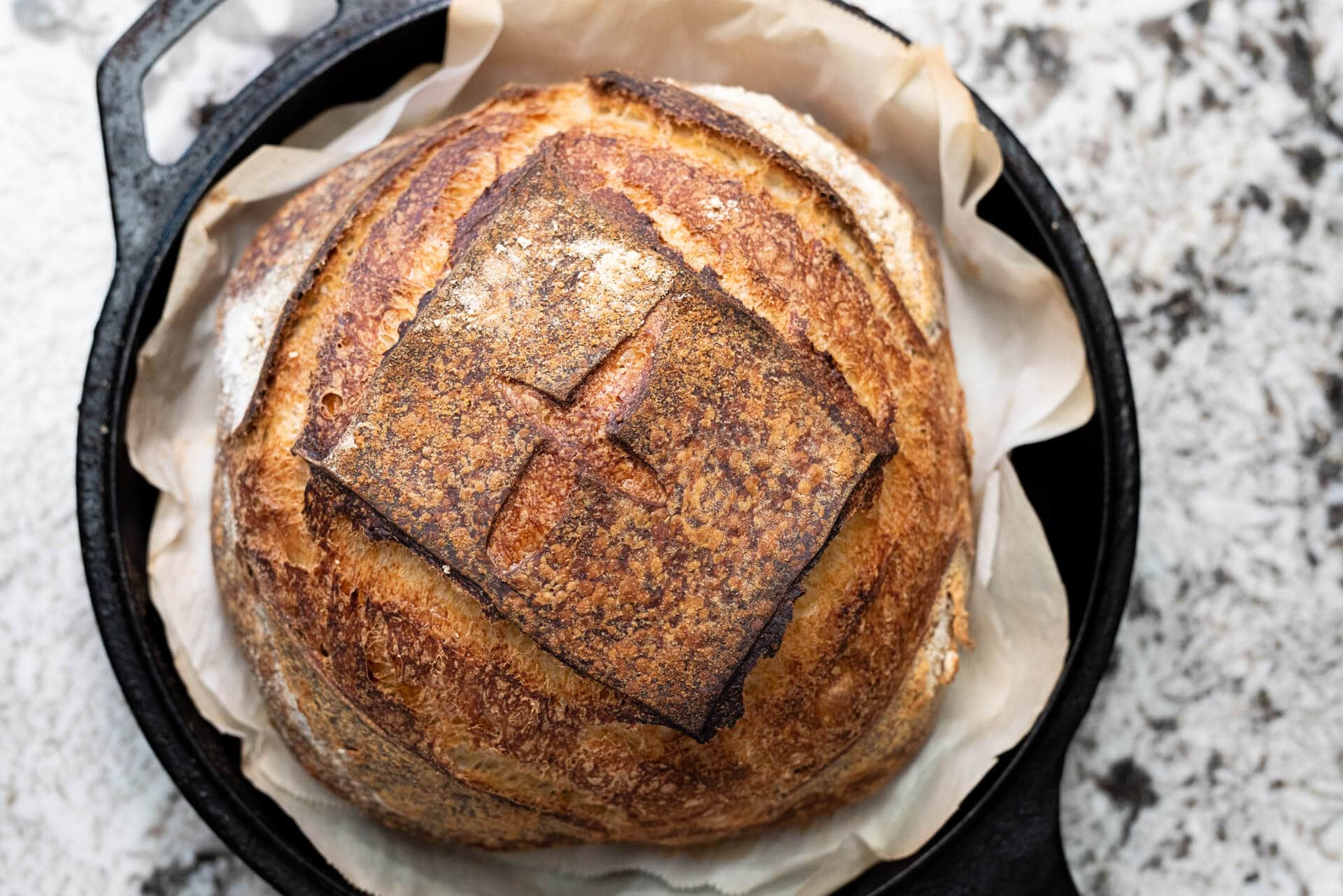
Learning how to bake bread in a Dutch oven is the first task many undertake when embarking on their bread-baking journey at home—myself included. Introducing steam in the home oven—a beneficial component in bread baking—can be a challenge, and a sealed pot makes this process simple and unassuming. During the initial stages of baking, steam is released from the dough into the sealed pot, where it is trapped and keeps the dough moist. This humid environment allows the bread to rise high and promotes a crispy and shiny crust.
In this comprehensive guide to baking bread in a Dutch oven, we’ll look at:
- Why using a Dutch oven (like this one, which is my favorite) to bake bread is a good idea (and what it does for your bread dough)
- The baking time and temperature necessary for baking in a Dutch oven
- How to avoid burning the bottom of your bread dough
- Links to my favorite (and high-quality) Dutch ovens
Real Quick: Why Bake Bread in a Dutch Oven?
A Dutch oven helps mimic the environment many professional bakers have in a bakery: a moisture-sealed chamber with intense, (mostly) even radiant heat. The Dutch oven’s thick cast-iron walls provide ample thermal mass, ensuring a temperature-stable baking environment. Additionally, the sealed interior traps steam, a beneficial component of baking bread. Moisture in the oven during the early part of baking allows your bread to rise fully, deepens the crust color, and finally adds a level of shine to the exterior.
Video: Watch Me Bake Bread in a Dutch Oven
Here’s a quick video showing how I use a Dutch oven in my kitchen to bake sourdough bread:
How To Bake Bread in a Dutch Oven, Step by Step
My method for baking bread dough in a Dutch oven:
- Preheat your home oven to 450°F (230°C) with a Dutch oven inside for 30 to 45 minutes
- Line a pizza peel, inverted baking sheet, or cutting board with parchment paper
- Turn out your proofed bread dough onto the parchment paper (trim the paper to fit, if necessary)
- Score your dough
- Slide the parchment paper with the dough into your preheated Dutch oven and return it to the oven
- Cover with the lid and bake for 20 minutes, covered
- After 20 minutes, remove the lid from the oven and continue baking per the recipe (typically 25 to 35 minutes)

When finished, a free-form loaf should have an internal temperature of around 206° to 208°F (96° to 97°C) when fully baked.
As with most things in baking, you might have to adjust the baking duration and oven temperature to suit your environment. See my guide to baking bread at high altitude if you’re a high altitude baker.
Should I Preheat a Dutch Oven When Baking Bread?
Yes, I always preheat my Dutch oven before baking bread dough inside. I’ve tested using a cold Dutch oven, and I don’t get the same oven spring or final loaf volume as when I bake bread dough in a preheated Dutch oven.
How To Remove Your Baked Loaf From a Dutch Oven
When your loaf is finished baking, use a pair of oven-safe gloves to carefully reach down into the pot to remove the bread. The crust will be fully hardened off by this time, so there’s no worry of collapse.
Additionally, if you baked your bread dough in the Dutch oven on a piece of parchment paper as I recommend here, you can lift the corners of the parchment to remove the baked loaf.
Why Bake Bread in a Dutch Oven (Or Any Sealed Pot)
A Dutch oven helps increase loaf volume
Without steam in the oven during the first part of baking (when oven spring occurs), the rapidly expanding dough quickly forms a hard crust on the exterior. This early crust formation limits optimal oven spring and reduces overall loaf volume, resulting in a squat, dense loaf.
Conversely, when you provide adequate steam, the exterior of the dough remains moist and supple, allowing it to expand and stretch further before starches gel and the crust hardens and sets.
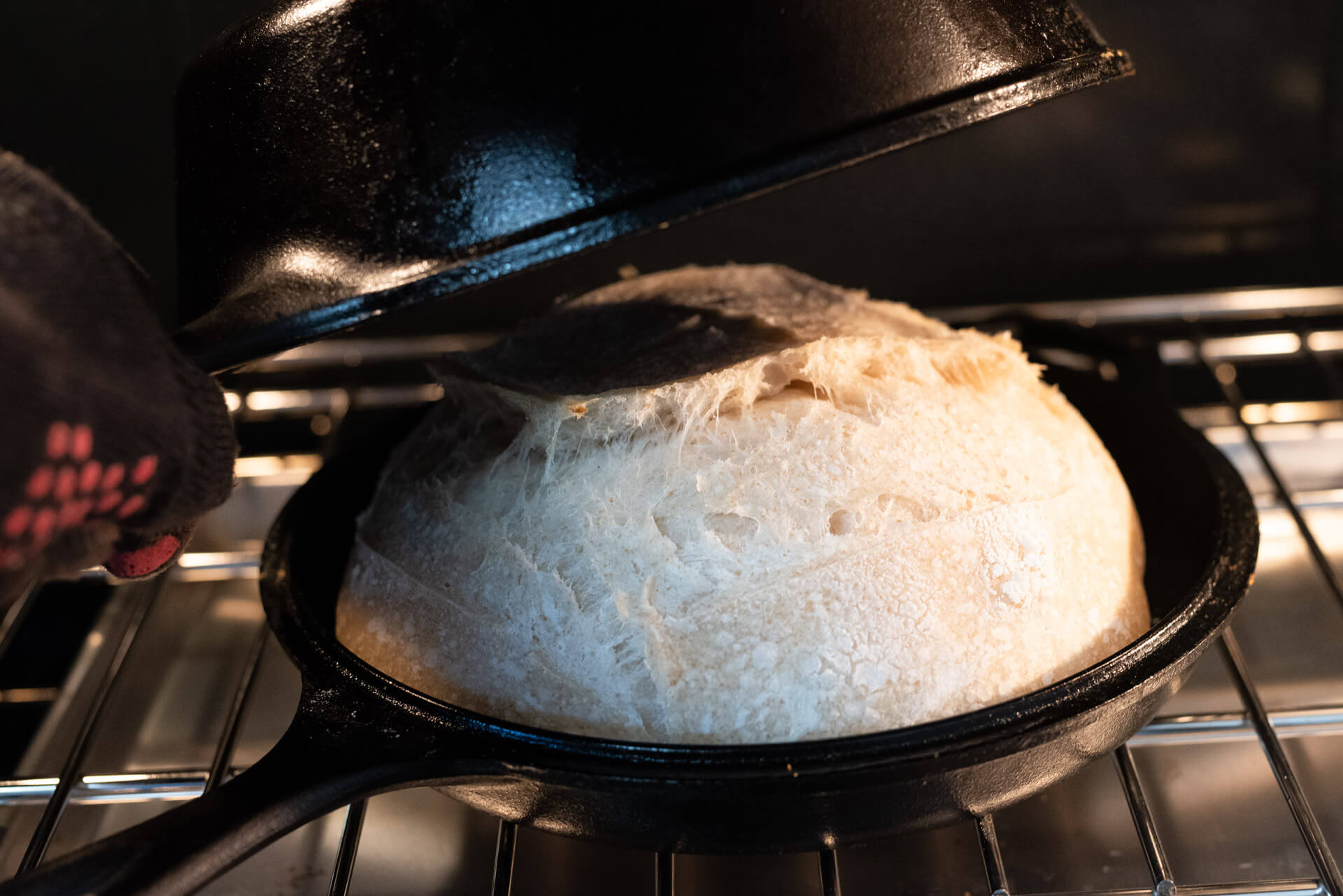
It doesn’t require much steam to provide benefit. When the pot is sealed during the first 20 minutes of baking, the moisture escaping from the dough provides the right environment to encourage optimal loaf volume.
Use a Dutch oven for a deeply colored and shiny bread crust
There’s little as elegant as a crust that’s well-colored with a gradient from almost-white to a deep mahogany—the contrast is striking. Add to this a subtle catch of light and shininess: your mouth starts watering even before the intoxicating aroma surrounds you.
As Jeffrey Hamelman states in his book BREAD, the reduced temperature on the exterior of the loaf allows the enzymatic activity to continue for longer. This activity, which has been happening throughout the entire fermentation process, continues to “unlock” sugars that contribute to crust color during baking.
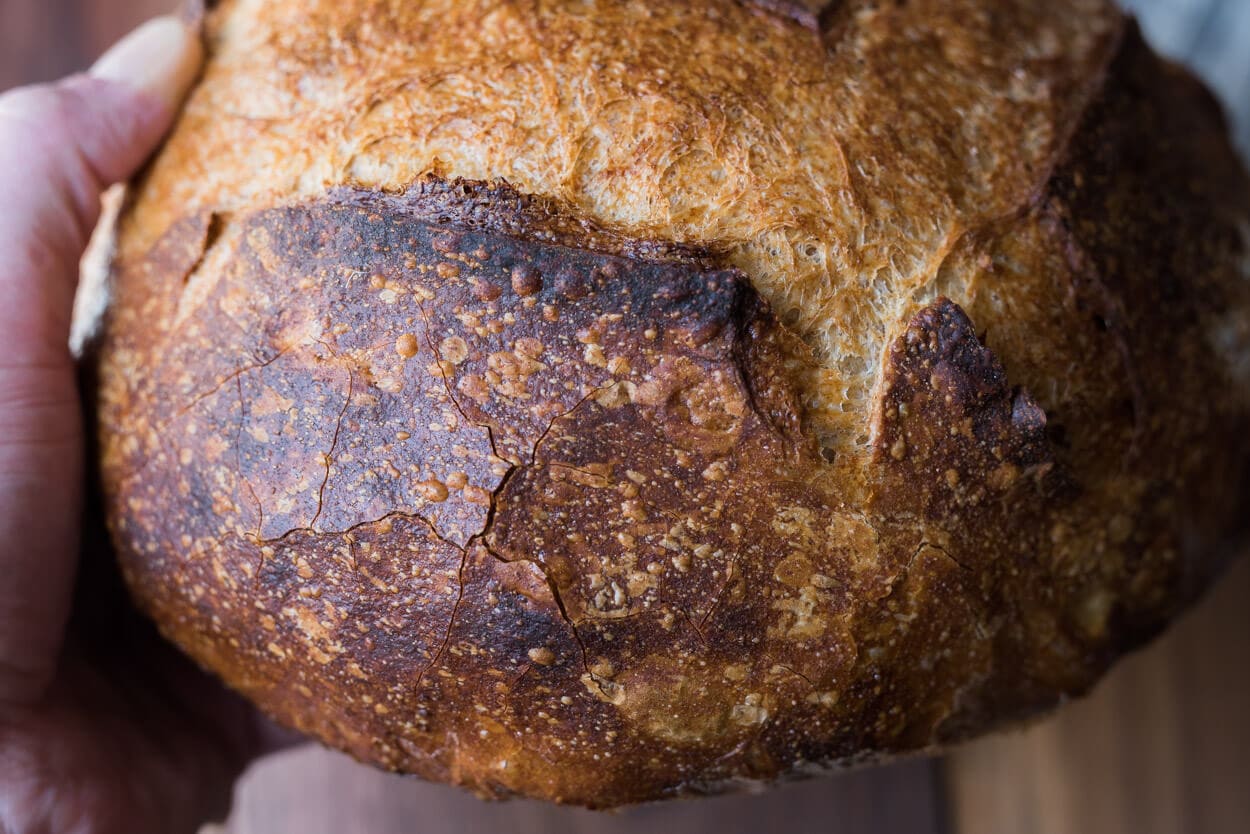
A well-steamed oven also promotes starch gelatinization: in the presence of heat, starch molecules on the exterior of the dough begin to absorb available moisture (hello, steam), start to swell, and eventually pop to form a thin liquid layer (starch gel). This layer finally bakes hard, forming a thin, crispy exterior with a subtle shine.
As we discussed earlier, steam in the Dutch oven’s closed environment settles on the outside of the dough, forming a thin layer that prevents the temperature from rising too quickly. This helps ensure the exterior of your loaf doesn’t darken before you finish baking the interior.
With all these benefits, baking in a sealed pot is a good idea. However, there are some issues with the method, the biggest being a thicker and possibly burned bottom crust. Let’s take a look at a few ways to help mitigate this issue.
How To Keep The Bottom of Your Bread From Burning
In my experience, baking in a Dutch oven typically produces a slightly darker bottom, even with the suggestions below. However, using one or more of these will significantly reduce this darkening.
My methods for ensuring the bottom of my loaf doesn’t burn when baking in a Dutch oven:
- Do not bake bread dough inside a Dutch oven on top of a baking stone
- Reduce the oven temperature during preheating
- Insulate the bottom of the Dutch oven with a baking sheet, baking stone, or even a single sheet of aluminum foil
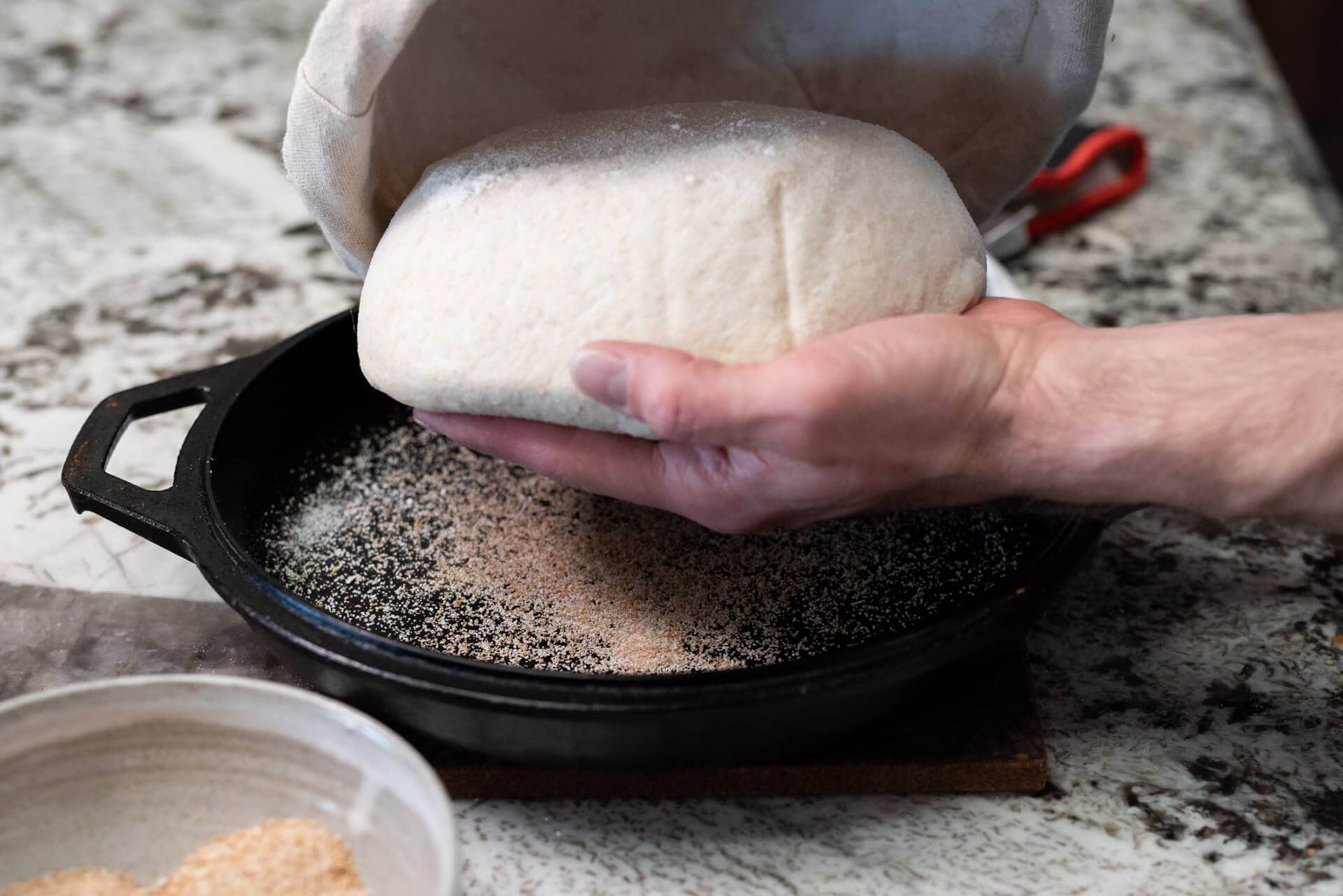
- Add coarse cornmeal or wheat bran to the Dutch oven before adding your dough
- Use two pieces of parchment paper below the dough
- Remove the dough from the Dutch oven when it’s almost finished baking
Let’s look at each method to help prevent bread dough from burning.
1. Do not bake bread dough inside a Dutch oven on top of a baking stone
The first important thing is to ensure you are not baking with your Dutch oven on a baking stone, or even better, a Baking Steel. When the oven has finished preheating, the stone and the cast-iron pot will be far too hot, resulting in scorched or burned bread.
2. Reduce the oven temperature during preheating
The first approach is to modify your baking temperatures. If you find the bottom crust is burning or becoming too thick, reduce the preheat temperature. For example, some of my recipes here call for a 45-minute preheat at 450°F (230°C); you could reduce it to 425°F (218°C).
3. Insulate the Dutch oven with a baking sheet or stone
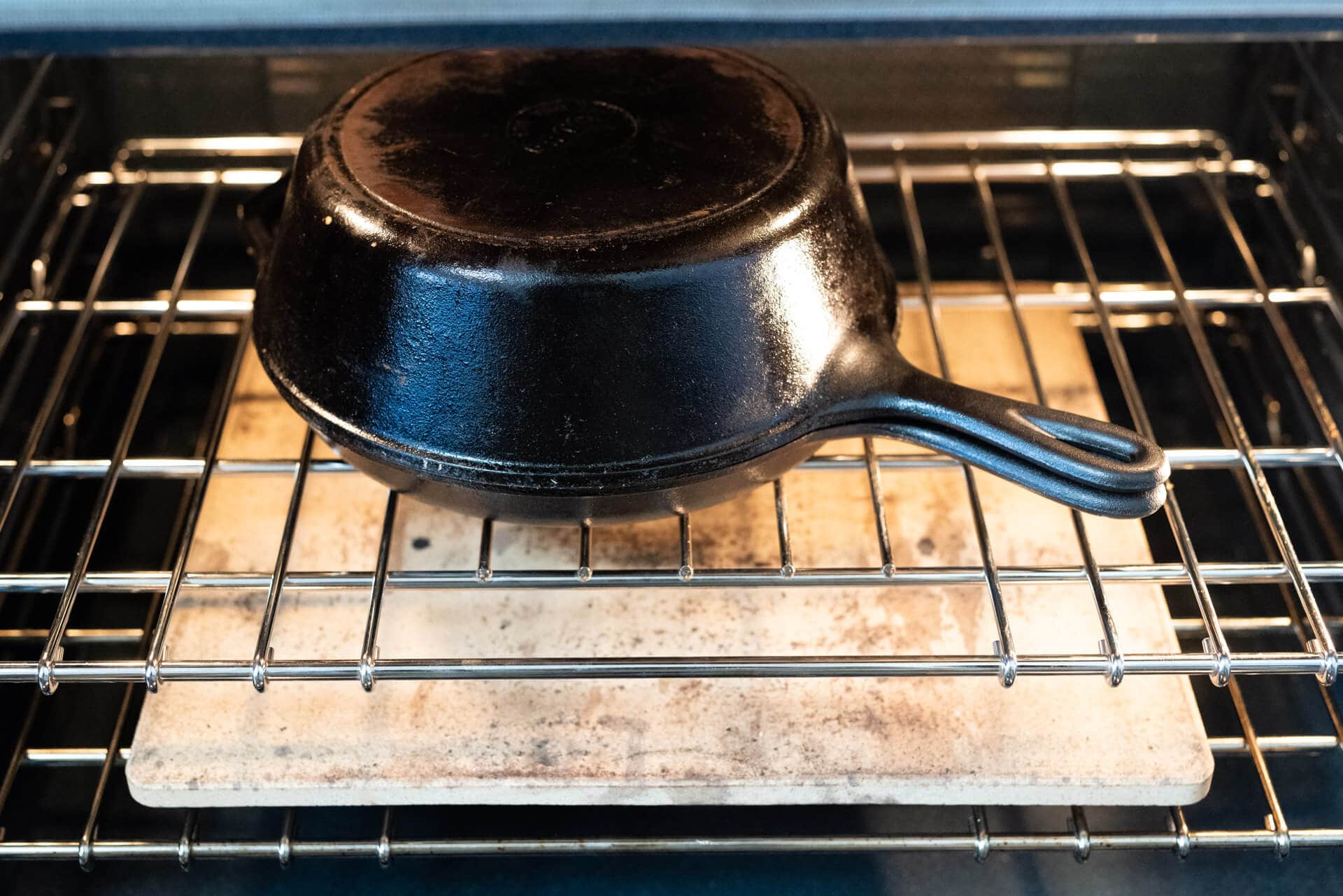
Most ovens have a bottom heating element that can provide far too much heat on the bottom of your dough, especially if you place the rack too close. An insulator, such as a baking sheet or stone, can provide enough thermal mass between the heating element and your dough. This will help insulate your dough when the heating element kicks on, which happens often.
Place a rack on the bottom of your oven, and then place another one or two rungs above that. Place your baking surface on the bottom rack. Then, use the rack above to hold your Dutch oven when baking.
Additionally, a thin aluminum baking sheet, or even a single layer of aluminum foil, placed underneath the Dutch oven will help reflect most of the infrared heat from the bottom of your home oven.
4. Use coarse cornmeal or wheat bran
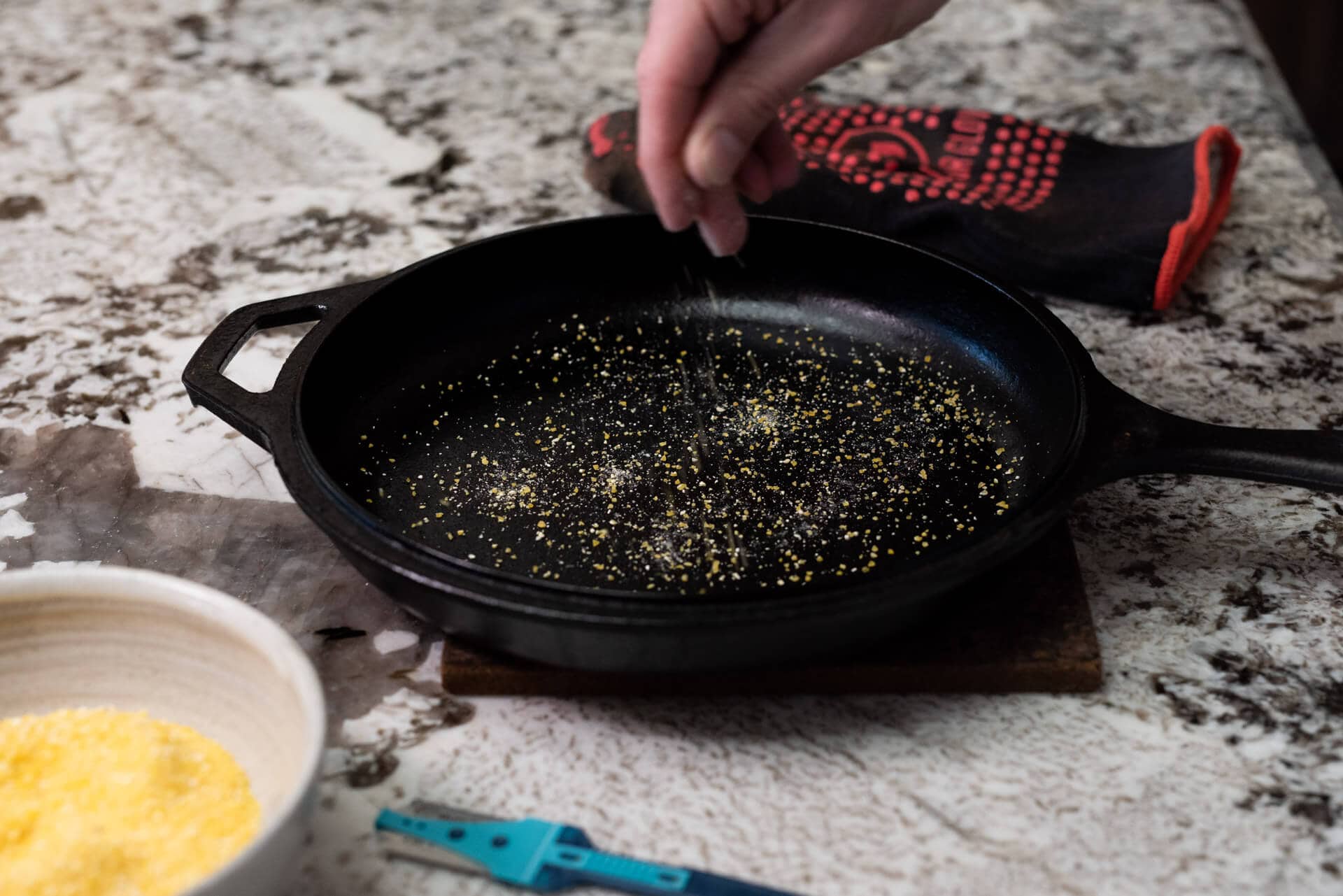
Coarsely ground corn (polenta or corn grits) works exceptionally well to provide a thin layer of insulation between your dough and the Dutch oven. This layer helps keep the dough from sticking to the cast iron while also lifting it to prevent burning.
Sprinkle a generous amount of coarse corn onto the preheated pan just before turning your dough onto it to score. Cover the pot with the deep end and center it over your baking stone insulator, as shown above.
If you frequently mill your own flour and have a sifting screen, save the wheat germ or bran you sift out. These coarse particles (which you can always add to the dough later) perform a similar function to the corn.
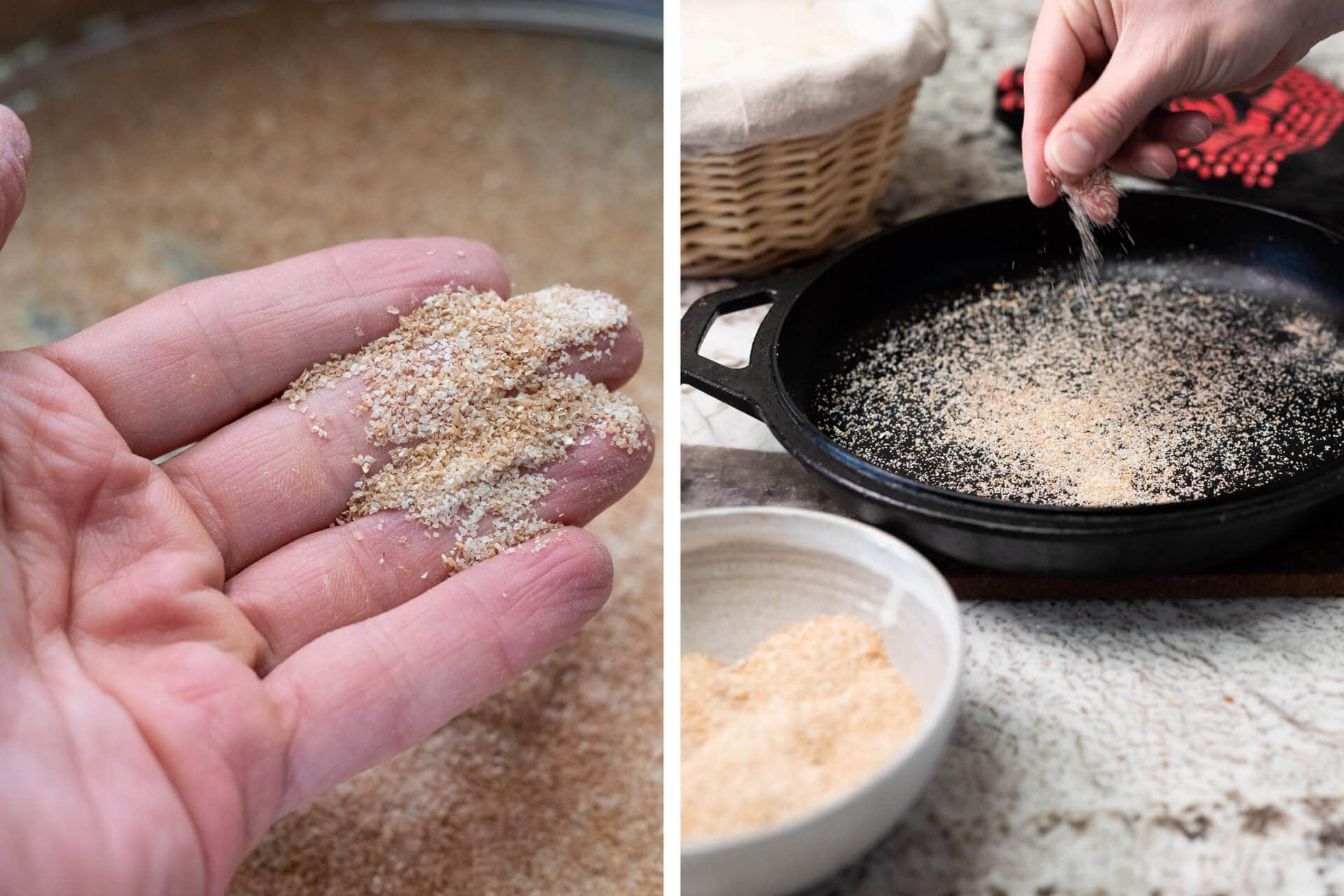
The image above shows the large germ/bran particles I’ve sifted out with my sifting screen. The fine, high-extraction flour falls through my screen into a bowl that I can add when mixing my bread dough. Then, I collect these larger bits to either add to the dough as porridge or use to coat the bottom as insulation.
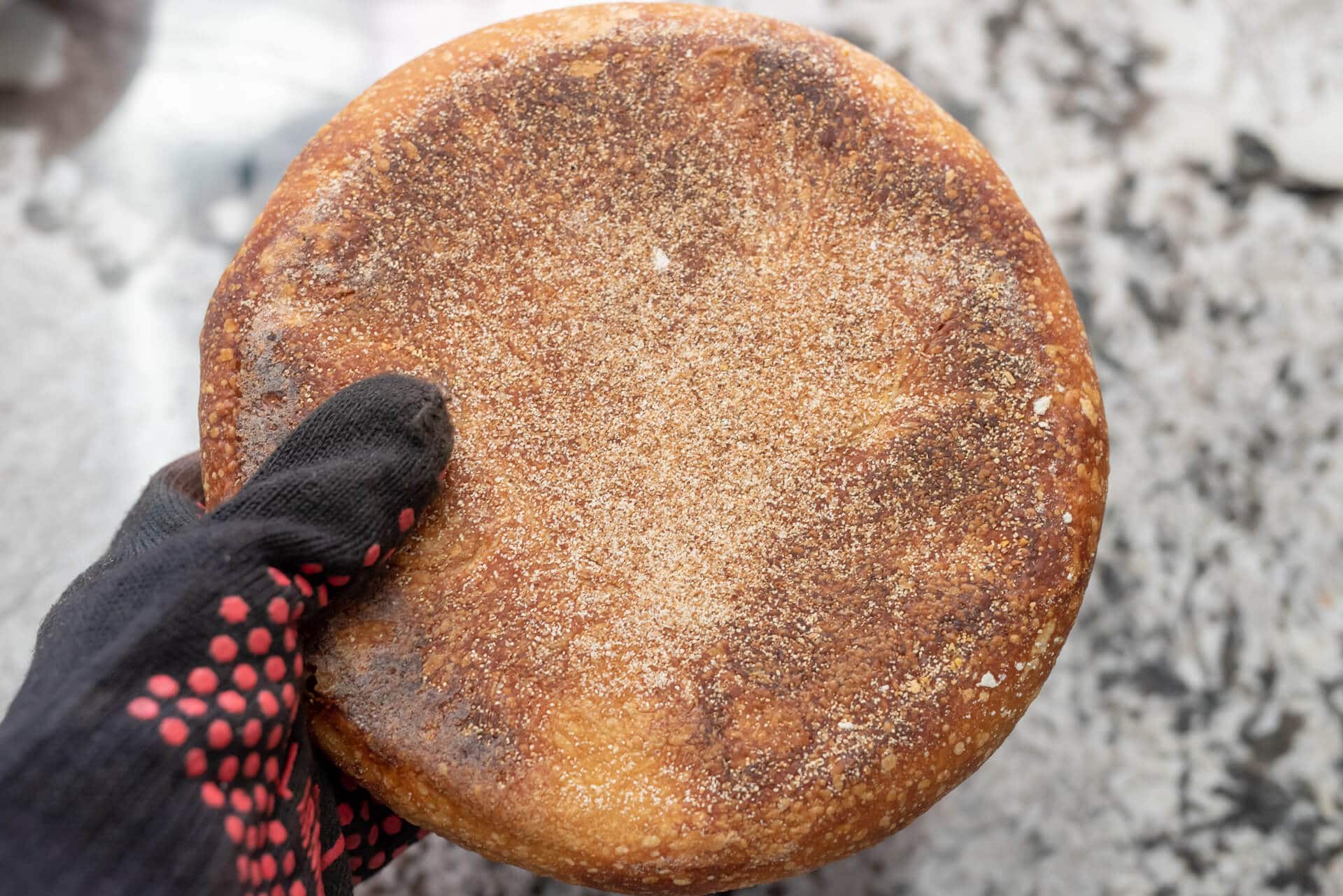
Bake on two pieces of parchment paper to help prevent burning
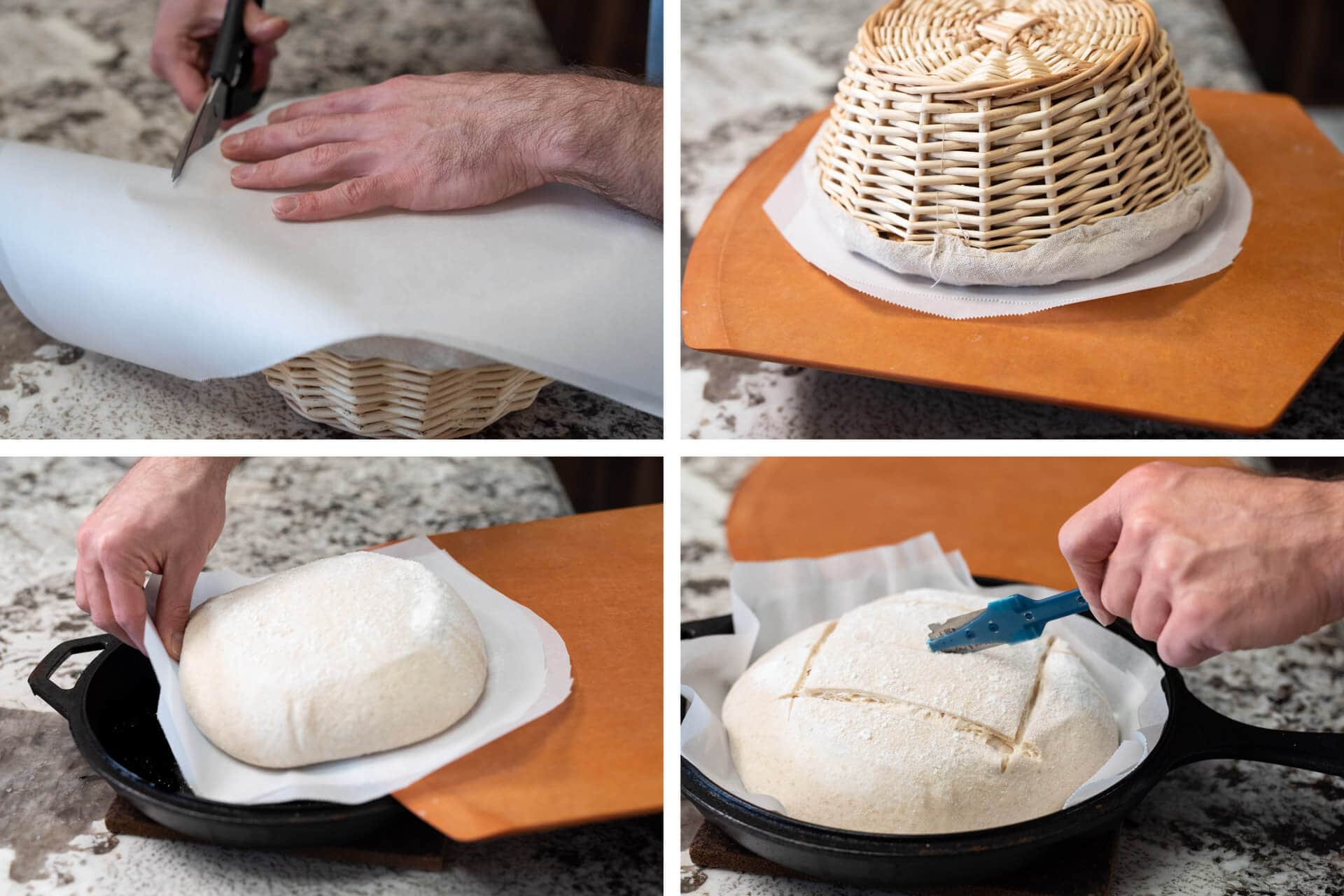
As you might have noticed in my Beginner’s Sourdough recipe, I typically use parchment paper (I love this natural, non-stick option) to help drag dough into the blisteringly hot Dutch oven. As I describe in that recipe post, lay a sheet of parchment paper over your proofing basket containing the dough, and cut it to fit. Invert the basket on a pizza peel, slide the parchment into the preheated Dutch oven, score the dough, and bake.
In this approach, you will follow the same process as before, except you’ll layer two pieces of parchment on top of each other to help further insulate the dough.
Additionally, you can sprinkle coarse corn (as discussed above) into the pan before you drag it into the parchment holding your dough. The corn will not stick to the dough, but it will help further insulate it and prevent burning.
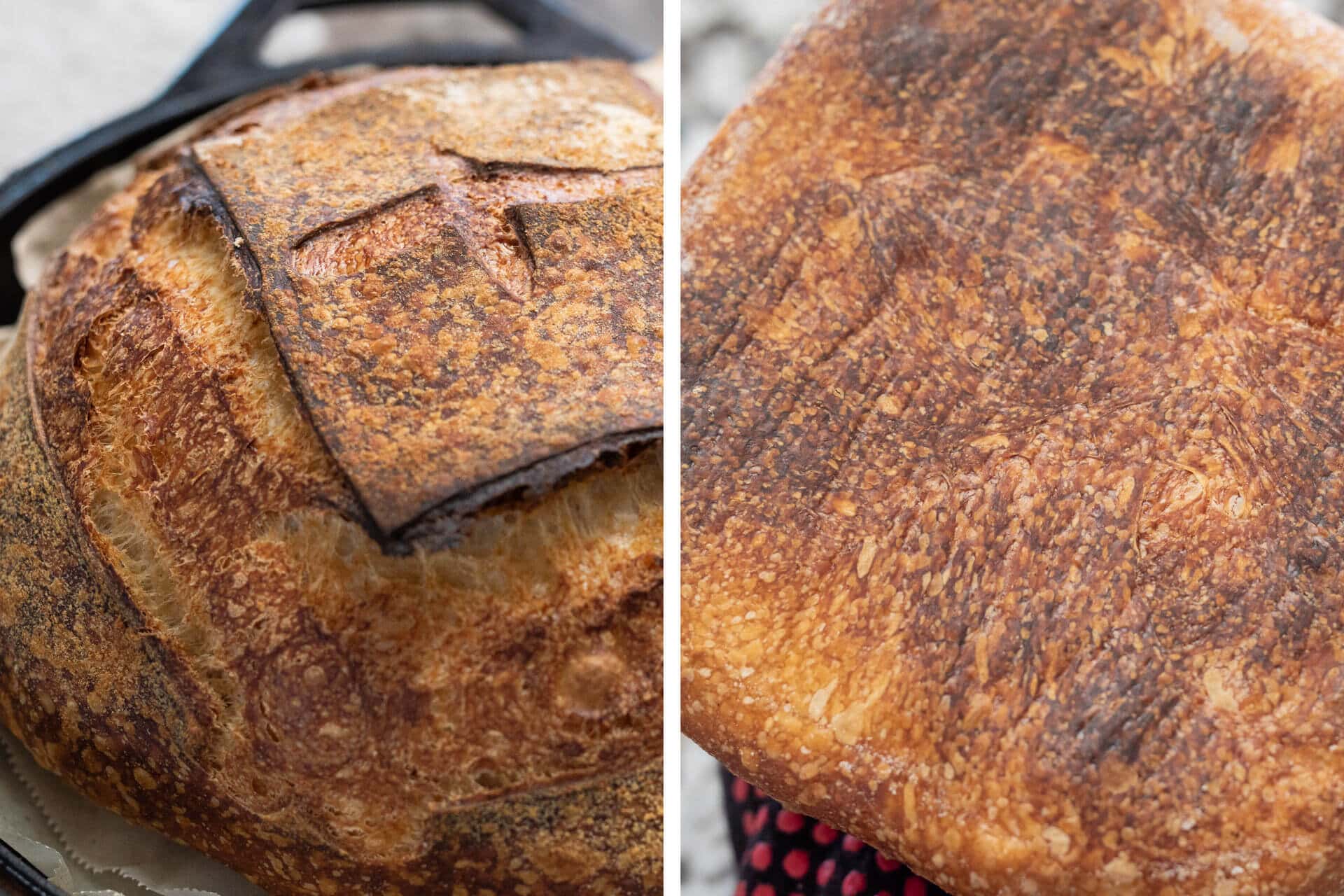
To prevent burning, remove the dough from the Dutch oven when it’s almost done
Another method to help prevent burning your bread dough in a Dutch oven is to remove it once the crust has set, about 30 minutes into baking. This means the dough has baked for 20 minutes with the lid on (and with steam), then uncovered and baked for another 10 minutes.
By this time, the crust should be a pale golden brown and sturdy enough to gently lift the dough from the Dutch oven to finish baking on the oven rack.
Additionally, remove both sides of the Dutch oven and the parchment paper at this time and continue baking until done.
Recommended Dutch Ovens and Combo Cookers
There are many types of Dutch ovens (lidded pots) and combo cookers out there, made from a range of materials, shapes, and sizes, and at varying quality levels. Any Dutch oven or combo cooker will work for baking bread if it’s oven-safe up to 450°F (230°C) and has a tight-fitting lid.
The following is a list of my favorite Dutch ovens for baking bread. I’ve used the following pots for years, and they’ve helped me make countless loaves of sourdough bread.
Note that some pots cannot be preheated empty, so check with the manufacturer if you are unsure.
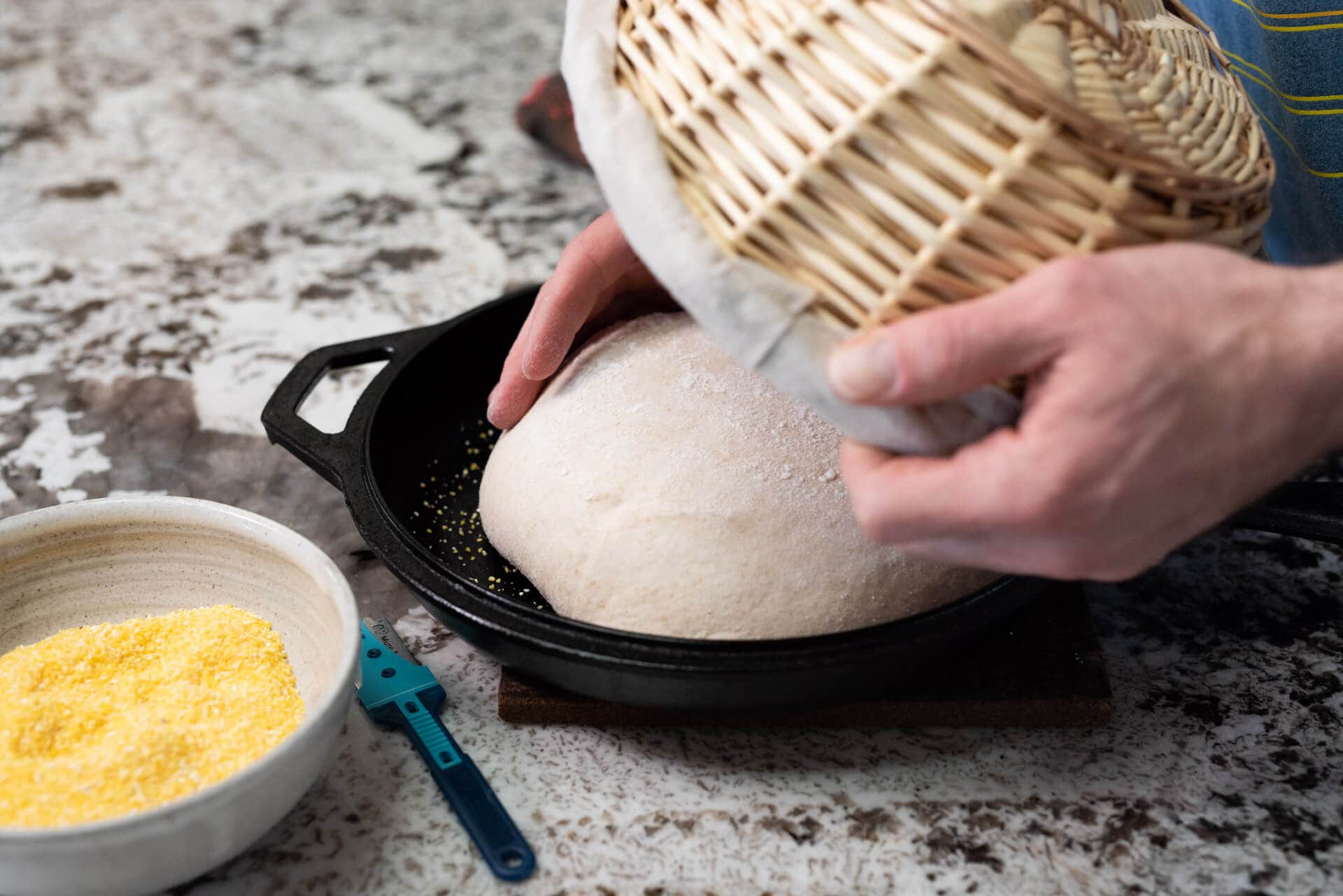
3.2 Quart Lodge Combo Cooker
| Maximum dough weight | 900g |
| Material | Cast iron |
My favorite Dutch oven (or combo cooker, as Lodge calls it) is the Lodge 3.2-quart cast-iron combo cooker. I’ve been using the same combo cooker since I started baking bread many years ago, and it still looks new. It’ll likely last a lifetime.
This pot is extremely versatile, and I use it for a myriad of other kitchen tasks besides baking bread. I frequently use it to make the wonderful Tartine French toast and crispy-bottomed sourdough cinnamon rolls, and the deep end makes a mean roast chicken.
I’ve comfortably fit bread dough sizes from 500g to 900g in the pot. As with all cast iron, keep it seasoned.
The Dutch Oven Is Heavy. Is There A Lightweight Option?
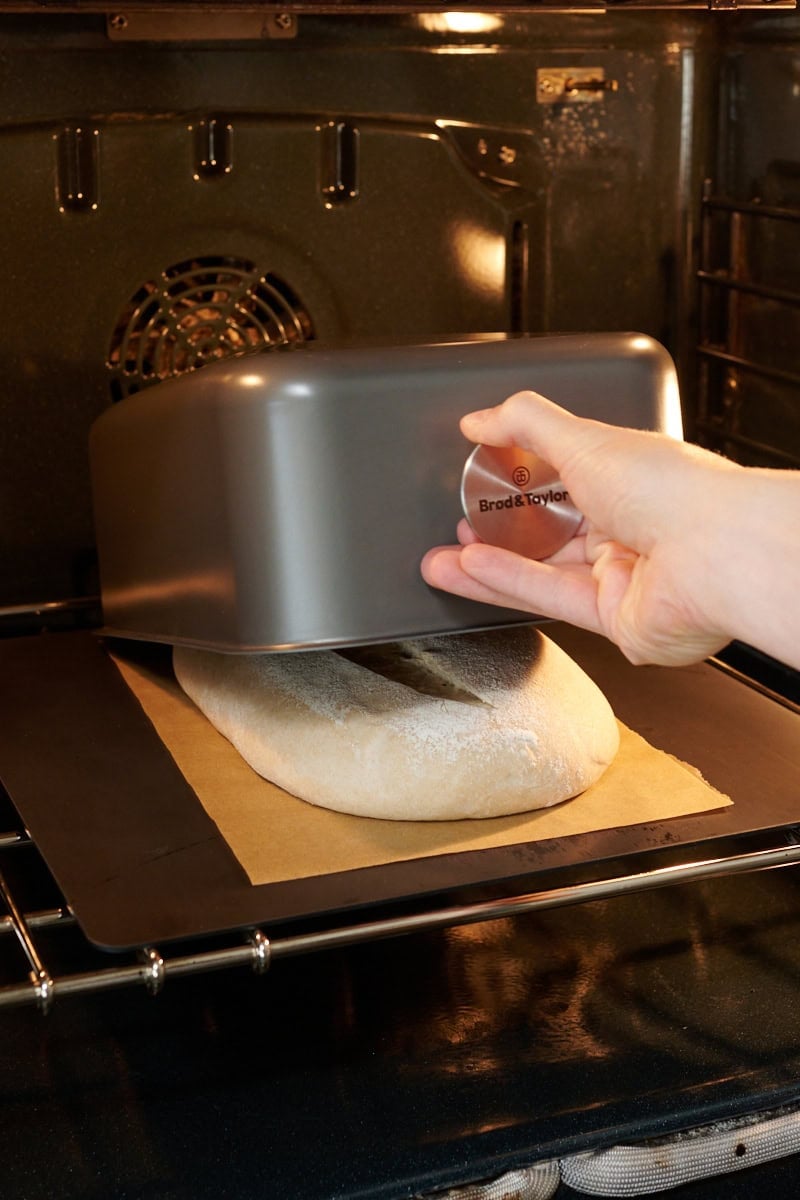
Instead of using a heavy pot to bake your sourdough bread, the new Baking Shell is a metal cover that traps steam and weighs just over 1 pound! If you struggle to move your Dutch oven in and out of the oven, the Baking Shell is perfect for you.
How Do You Bake Bread Without a Dutch Oven?
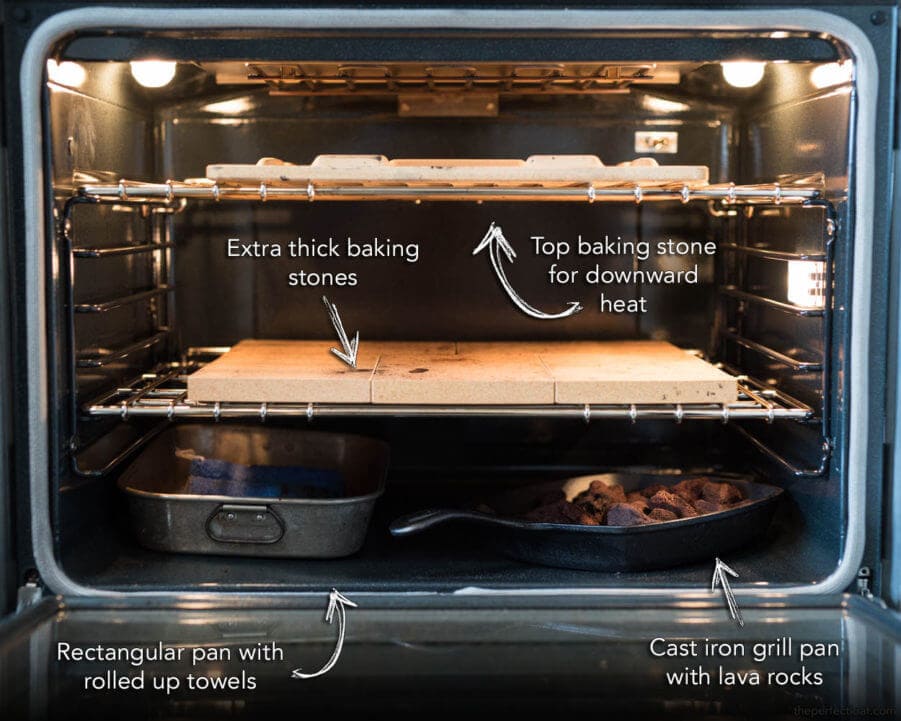
While using a Dutch oven to bake bread is straightforward, I still enjoy steaming my home oven and baking my sourdough bread directly on a baking surface. With this alternate method, it’s easy to bake two long bâtards (even up to 1.2 kg if your surface is large enough).
Ultimately, use whatever method is most comfortable for you and that you use often for the bread you bake. And if you’re like me, you might often switch between methods.
Baking Bread in a Dutch Oven FAQs
Do you oil a Dutch oven when baking bread?
No, no oil is necessary to bake bread in a Dutch oven.
What is the best size Dutch oven for bread?
I like to use a 4 or 5-quart Dutch oven or a 3.2-quart combo cooker for baking bread. These sizes are large enough to accommodate most bread recipes. If you have a larger Dutch oven, that will work just fine, too.
Should I preheat a Dutch oven when baking bread?
Yes, I always like to preheat the Dutch oven inside my home oven before baking bread. I find a preheated Dutch oven helps encourage maximum oven spring (the amount the dough rises in the oven) at the start of baking.
Can I reuse the parchment paper used to bake bread?
Yes, absolutely! I typically use the same square of parchment paper two to three times before needing a new one.
Why did my sourdough bread burn on the bottom?
It likely was baked for too long at too high a temperature. Reduce the bake time and temperature until it no longer burns. Use the suggestions in this guide post to help reduce burning on the bottom of your bread dough.
Do I have to season my Dutch oven?
Yes, I periodically season the Dutch oven I use to bake my bread—it is cast iron after all. I simply apply a thin layer of vegetable oil to the entire pot.
What’s Next?
And now that you’ve baked a loaf (or two), be sure to read my guide on how to store baked bread to ensure it stays fresh for as long as possible!
If you still have questions about the baking process or are looking for tips on scoring your dough before baking, see my full guide to baking sourdough bread.


353 Comments
Hi Maurizio, I really enjoy reading and learning from your posts.
Not sure if it was already discussed, but I have doubt about Oven types. How different is to bake using Gas and Electric oven? Also if the oven is Conventional or Convection.
Thanks for your attention!
Besides the typical differences in these types of ovens, I find electric to be much more consistent in terms of heat delivery — but I know many bakers who use both successfully (I bake in all electric ovens). When baking bread, I also do not use convection because I don’t want the fan pushing steam around the oven, potentially drying out the crust of the bread as it’s baking. I prefer to bake bread without convection, and all other things with convection.
I hope that helps!
thanks for the quick reply!
The Staub oval cocotte is over $300.00 on Amazon! Can you recommend any less expensive item? Thank-you!
Expensive, indeed. It’s an heirloom piece to be sure, and I use it throughout my kitchen for so many different foods, but yes, pricey! Check out the Challenger Breadware pan, a cast iron pan that’s built incredibly well and can accommodate a batard easily.
Hi Maurizio,
I really got into baking about 18 months ago. I plunged straight in to using sourdough almost entirely, after reading
The Perfect Loaf. With a domestic electric oven the dutch oven method you describe is pretty near foolproof. I have a cheap dutch oven that is kind of thin, so I use two pieces of foil cut to fit the bottom and about an inch up the sides and a round of parchment over the foil.
I haven’t mastered transferring the ready-to-bake loaf into the hot dutch oven by hand. So far, even with refrigeration my dough has been very slack out of the banneton. I don’t have a peel yet, and I’ve seen various techniques that for me would likely end in dropping the loaf, so I “cheat” your method of dragging the loaf by using a roughly 14 inch square of parchment so the corners of the parchment will stick up near the top of the dutch oven. I cover the banneton with the parchment and set a cooling rack atop the parchment and with one hand on the tray and the other on the bottom of the banneton I can safely flip the banneton and dough over. I slash the loaf before lifting the parchment by two diagonal corners and easing it into the dutch oven. The extra parchment really does keep the bottom from burning and can be used to pull the bread out to set it on the cooling rack once it’s done.
For my own starter, my best results have come from rye flour almost exclusively. I tried stoneground whole wheat, unbleached organic AP flour and stoneground rye and the one that uniformly succeeds is the rye. I wonder if it’s the local wild yeasts’ favorite?
It is so relaxing on a Thursday night before bed to get the starter “primed” then on Friday evening slowly put together what will be a beautiful and delicious loaf of bread, particularly after a busy week at work. Your site is lovely and filled with gorgeous photos and instruction and I’m a fan, absolutely. Thank you for what you do to inspire bakers!
Thanks so much for the kind words, I really appreciate that! I think there’s a beauty in caring for your starter, preparing a levain, and ultimately spending a day or two making bread, only to have delicious and healthy food for you and your family and friends. What’s better than that!?
Your method for dragging your dough into the Dutch oven sounds good to me — really whatever works for you and whatever you’re comfortable with, go with that.
Rye is a pretty incredible grain. It might just be that you’re noticing more activity with rye because of its high nutrient content (which our starters definitely love). It’s likely whole wheat will produce the same result but you’d likely need a higher percentage. Use whatever you prefer!
Thanks again and happy baking!
I use a dutch oven and solved the over browning of the loaf with a way I did not see mentioned. Aluminum is a great heat conductor but a terrible heat radiator. That means if you put aluminum between the heating element and the pizza stone, the heating will only happen from the hot air and not from the heating element directly. You can verify this by putting some aluminum foil on a rack below the one you bake cookies on if you want to ruin a batch of cookies. Anyway, I use a large aluminum cookie sheet that has bent up edges that is the same size as the pizza stone and set the stone on the edges of the cookie sheet so there is about 3/4 inch gap between the cookie sheet and the pizza stone. I then put the dutch oven on the pizza stone. I like having the dutch oven low in the oven as it helps keep the back of my hand from getting burned on the top of the oven.
Allen — thanks for contributing that method, it sounds like a super logical approach. I’m going to add to to my list of things to text next time I bake with my DO! I don’t typically use my baking stone when I use my DO these days, but it might be interesting to test sliding that aluminum sheet under the DO after the first half of the bake, to see if that helps deflect some of the intense heat coming from the oven.
Thanks again and happy baking!
You probably need the baking stone for the aluminum to work. Aluminum is a poor radiator of heat but it is an excellent conductor of heat so if the dutch oven touches the aluminum it won’t help. That said, if the aluminum is on a lower shelf in the oven, that works as well. My wife found that out by accident when she left a sheet of foil on the shelf under some cookies and the cookies didn’t cook right.
Right on, yes I was thinking keeping it down a bit below the DO to help deflect direct heat. I might give it a shot both ways!
Just to be clear, the aluminum does not deflect or reflect the heat. It gets hot. But it basically only conducts the heat like when used to bake cookies. And being a good conductor, it will spread the heat evenly. The trick is that it is a poor radiator so you can’t feel the heat unless you touch it. I think the technical term is that it has a low emissivity coefficient.
Wow, I totally misunderstood what you meant. Ok, got it now. In that case, yes, it would make most sense if it was touching the stone or the DO. Got it!
You need an air gap between the aluminum and the stone. I use a baking sheet and set the stone on the edges that are raised to that the stone only touches on the edges. I sincerely apologize for not being more clear in my initial post.
Hello Maurizio! I’m a newbie baker. I really like your blog since you explain a lot of things in details which help me not only reach results, but understand the process to be able to steer it if needed. I have an issue with my oven: the temperature is really hard to control there: controller is, probably broken, and when I lower the temperature it drops way too fast and often below the needed value. I wonder if I use baking stone can it fix the issue? The temperature will still drop, but maybe not that fast, so I have more time to react or even I may have enough time till it gets lower than needed. Thanks in advance!
Hey, Anastasia! Yes, baking stones could help with this by giving the oven more masonry mass to help regulate temperature. If you’re also using a Dutch oven, though, I’d recommend placing the stones on a rack below the Dutch oven so it doesn’t sit directly on the stones. In my experience placing a Dutch oven on top of very hot baking stones contributes to an over-baked bottom of the loaf. I hope that helps and let me know how it goes!
I have the Lodge combo cooker which works very well, but the Romertopf clay baker works just as well. No need to soak in water. Just place in oven when preheating. I use them when I don’t want a round loaf.
I’ve heard the Romertopf mentioned before but haven’t had the chance to use one. Lots of great options out there!
I just made no-knead sourdough bread using a Le Creuset enamel pot, pre-heated the oven to 500, put the dough onto a piece of parchment and into the Le Creuset (did not pre-heat the pot), reduced the oven temp to 450 and baked it 45 minutes covered and 15 minutes uncovered. The parchment was a 10” pre-cut round (not Reynolds or name-brand). The bread turned out beautifully, but the parchment baked into the bottom crust. Can you tell me if this was due to poor quality parchment, not pre-heating the pot, or ???
Hey, Sarah. My feeling is it’s likely the parchment paper as I’ve never seen this happen here (I use Kirkland brand from Costco or Reynolds). You could try dusting the parchment with a bit of coarse cornmeal or wheat bran to help keep it off the parchment. Alternatively, you could dust those into the pot directly and just bake the loaf without parchment. In a LC the dough likely won’t stick to the pot at all because of the enamel. Those are a few ideas!
Thanks, Maurizio. I will try the same recipe and procedure this week and will use a better-quality parchment paper—and the cornmeal dusting. Thanks for your blog! I’ve learned so much from you!
I posted on my instagram account a couple loaves I made using the Cold Pot method described in an America’s Test Kitchen book, Bread Illustrated. I’ve tried the rocks in the oven method, squirting the loaves, ice cubes…I haven’t tried the old towels you describe here. I like the cold pot method because I don’t burn myself or break the glass on my oven door (which I’ve done…sigh). I’m going to get one of those Lodge bakers you mention, seems perfect!! I’m glad I found this blog. I really like it!
Yes, I’ve heard a few bakers discuss this method as well. I’ll have to give it a try soon. Thanks for reporting that so we can all give it a try and thanks for the kind words — happy baking, Mona!
Are you going to do a similar post on the benefits and tips/tricks on baking on a steel, i.e. not in the dutch oven? I have always used the dutch oven for ease but am wondering if I should try without and what could be better that way? Thanks
Alex: I do have a post like this! Check out my post on how to bake bread in a home oven without a Dutch oven. Let me know if that doesn’t have the answers you’re looking for and I’ll try to update the post or even work on a new one. Happy baking!
I think it is possible to use an oven safe glass pyrex casserole dish (they come with a lid). Not tried it myself but seeing as I use one as a dough mixing bowl I’m very tempted to try it. I may even try loading the dough into it when the dish is warm (rather than hot) and transferring that onto a hot pizza stone in the oven. It should prevent the over cooked base but then again it could result in the opposite, an under-cooked base. I guess it’s worth a try. I’ll lose a bit of dough if it fails!
I’ve now tried the pyrex dish. It worked extremely well with excellent oven spring and excellent crust. However the issue was the base of the bread being a little undercooked. The only way to improve matters is to get the pyrex lid very hot and transfer the risen dough on to it via baking paper and a pizza peel. Even then it’s best to place the pyrex directly onto a hot oven stone. Later on in the bake I removed the bread and placed that directly in to the stone. It made for an acceptable base but perhaps not as thick as some would like it. I couldn’t fault the rest of the bread or crust. Well impressed.
Of course that’s my experience with my oven. A different oven may give superior results.
Sorry about the delay, Michael — really glad to hear the dish worked out well! I’ve never tried using a glass dish, mostly because I’ve been afraid of it cracking in the oven (especially with water/steam in the chamber…). Really anything should work as long as it can take the desired heat and can withstand the elements — my preferred vessel is definitely cast iron because of it’s incredible thermal properties and ability to take all manner of a beating in the oven 🙂 Thanks for the update and happy baking, mate!
The pyrex does work very well and of course they are designed to withstand very hot oven temperatures. I’m still not happy with the base of the bread. I think part of the problem is that the underside of the dish isn’t exactly flat but a little concave. That means a bit of an air gap between the dish and the oven stone. I’m going to try sand in a metal roasting tray and place the dish directly on the sand. That should negate the air gap. If it doesn’t work and I’m giving up and buying a cast iron pot!
Hello,
I have been following your recipes and they are fantastic! thank you!
I have a question regarding dutch ovens. I have quite a large one, not sure what size it is, but definitely a lot bigger than the combi cooker you suggest in your “my baking tools” section. I know my dough will flatten out if I place it in it, because it won’t touch the sides. So my question is whether this is a problem? I foresee that it might flatten out too much before the crust hardens enough to keep it intact. Would it be advisable to make one big dough instead of splitting them, becaus of the size of the dutch oven? Or is there a method to keeping the shape of the dough in the too big Dutch oven?
Sorry if this question has been asked before, thank you so much again! keep up the good work. 🙂
Liam
Glad to hear that, Liam! I replied to your comment on my other post 🙂
Hello, Maurizio. I’m starting to experiment with sour dough and I was directed to your amazing site by a fellow baker and wonder what you think about using a Miele steam oven and a Le Creuset dutch oven would do. I know the Le Creuset can handle the heat up to 500 degrees. Should I leave the top off and use the steam function or simply burst it early and put thetop on and finish the bake as you direct? Thanks.
Jacques in Encinitas.
Hey, Jacques! Sorry for the delay. If you’re using an oven with steam injection you don’t really need to use a pot at all, you can bake directly on a baking stone with steam injected at the beginning of the bake. The Dutch oven helps create a steamy environment with the bottom pot and top lid sealed shut, this keeps the dough inside moist as if the baker had a steam injected oven (as professional bakers have).
Since you have a steam injected oven you don’t need the pot at all!
How about the “5 Quart Cast Iron Double Dutch Oven” from Lodge? Looks very good indeed. I am a bit lost why it is called the “Double” Dutch oven?
“Double Dutch” is just ‘marketing-speak’ for the way the two handles are arranged on the cover. A traditional Dutch oven cover would have a single handle in the center, rather than two skillet-like handles on either side of the cover. I use a 5 qt Dutch oven for most all my round-loaf bread baking.
Yes, that will work!
Hey Maurizio, question about the baking stone underneath the combo cooker. At what point do you put it in the oven? At the same time as the combo cooker? At the same time you put the dough in? When you remove the lid? In the past, I think I’ve tried all 3 but my loaves usually turn out a little darker on the bottom than I want. Thanks!
Josh — I actually do not use a baking stone on the bottom when baking with a Dutch oven. I find the stone gets too hot, and in combination with the already hot cast iron, it’ll end up over-baking the bottom. I do preheat the empty DO the full time the oven is preheating, though. Hope that helps!
Thanks for the response, but let me clarify in that I was talking about putting the baking stone underneath the dutch oven on a lower rack (I’m referring to the section titled “Insulate with a Baking Sheet or Baking Stone”), not directly underneath the DO in which case it is resting on top of the baking stone. Unless the answer is the same for both haha!
Ah! Ok, gotcha. I would put that in as soon as you’re preheating the oven. You want it to still be saturated with heat, it’s acting as a thermal regulator of sorts, insulating the sometimes drastic temperature swings when the oven heating elements turn off and on to keep the oven warm. Happy baking, Josh!
Can I use part buckwheat flour
You can certainly use some buckwheat, but I wouldn’t go too high. The higher percentage you have, the more dense the result (buckwheat doesn’t have the same gluten properties as traditional wheat). I’d say start at 10% and work up or down to suit your taste.
Dear Maurizio, I love your blog; thank you for the useful and well-presented information! I’ve been doing my boules in a thrifted 5 qt Lodge Dutch oven with happy results. I ferment my shaped loaves in a parchment-lined bowl or colander in the fridge overnight, then simply lift and drop into the preheated DO. After the initial steaming, I lift the loaf (still in parchment) out of the DO and place directly on the oven rack to color for another 15-20 mins. This has solved the issue of an over-baked bottom for me.
I love this idea: much less handling and you can just lift it out of the proofing basket and right into the pot — great! It seems like many take the approach of pulling the bread right out of the DO and onto the baking stone. I’m trying this next time. Thanks for the suggestions and happy baking, Emily!
Hi Maurizio, thanks for your post. I have a silicone trivet that I place in the Dutch oven right before I add the dough. It is in the shape of a blossom and adds a cool design to the underside of the loaf, and lifts the loaf enough in the Dutch oven so that the bottom doesn’t burn. Have a look at #lisajsourdough where I tagged a few of my Instagram pictures where I used this trivet.
Great idea, Lisa! There was another reader who recommended a silicone sushi mat. I need to give this a try with my Le Cruset trivet. Thanks for the comment!
Hi Maurizio,
With respect to preventing burning on the bottom while using the combo cooker, I found one post on the Internet that recommended fitting the shallow side on top of the deep side when the time comes to remove the top. One word of caution mentioned was to ensure you have enough vertical space in your oven to support this new configuration.
Yes! This is another approach I’ve tried in the past. It does seem to also work well to insulate the bottom of the pot from direct heat. Thanks for reminding me, Robert!
I have a modification of this technique that I’ve not seen elsewhere so will share. I use Lodge combo cookers and 8″ round banneton proofing baskets. I proof the loaf directly in the basket — without a towel — which has been dusted with rice flour. I place a disk of parchment paper over the top of the loaf — same size as the basket — when I start the proofing. When the baskets were new I had difficulty with the dough sticking at points in the basket, but this is rare now that the baskets have aged and I improved my dusting technique.
The basket is too large for me to grip securely in my palm so I have added three small eye-screws in an equilateral triangle pattern around and about halfway down the side of the basket and then placed a loop of twine through the eyes with enough slack that I can get my palm within the twine and over the dome of the basket. This aids me with maintaining a secure grip on the basket when it is inverted.
To load the shallow part of the combo cooker I hold the handle of the cooker in my mitted left hand and the proofing basket in my right. I invert the cooker over the proofing basket, then with a single motion I rotate the pair so the basket is to the top and bring the pair down onto a block of wood on the counter with a distinct rap. I lift off the basket, score the loaf, cover and place in the oven. I can do this all within a minute so my cookware cools very little and my knuckles are well away from the hot surfaces so I reduce my risk of burns.
I have some concern that I am damaged the internal structure of the dough when I make the rap but I do this to better assure a clean separation of the dough from the basket. I rationalize that any damage is offset by minimizing the handling in getting the proofed loaf from the basket to the cooker.
I really like this method, Dwight. I tend to recommend people not hold the hot pan for too long to avoid any issues, but it sounds like you’ve got a really good process going here. I especially like the modifications to the banneton — I’ve never thought of augmenting it to make things easier. Great idea.
Regarding the rap/tap: as long as it’s not too aggressive it should be just fine. I’m very careful when I tip out my dough into the pan, but I’ve seen many bakers do a single, gentle knock of the basket on a dough loader, pizza peel, or directly onto a baking stone. Sometimes a little force here is necessary to cajole the dough out.
Thanks so much for the suggestions, really great ideas!
Definitely going to check that post out, I have not tried baking in a cold DO. Thanks for sharing that, Dave!
I have the 13inch 8 quart Le Creuset. I have been baking one large batard in that (1800g) for the same recommended time as your smaller loaves in a combo cooker. The final dough temperature though does NOT get up to 208°F. I’ve been leaving it in for an extra 5 minutes & the bread tastes great, EXCEPT for the bottom crust which tastes like burnt cardboard. (Will be trying these new recommendations this morning. Thanks!) What is the cooking time for a larger loaf? How do I determine the maximum amount of dough to put in an 8qt Le Creuset? Thanks again. GREAT website!
That’s a huge loaf! I’d say close to a miche-style loaf (which I love). Typically when baking a larger loaf you have to increase the baking time as the dough mass increases. It might be that, because your loaf is so large, the bottom is baking too fast before the interior, top, and sides can fully bake. I’d say you might have to utilize a few of the ideas in my post in conjunction to hopefully eliminate this issue. You could also try removing the loaf near the end of the bake from the pot entirely and finish baking it on the oven rack until the interior is done. This way the loaf wont be exposed to the high heat of the iron for too long. Just an idea!
Thanks. How much longer should I bake it?
It’s very hard to say, lots of factors involved. I’d say follow the same baking times/temps outlined in the recipe, then just give it the extra time at the end it needs to be well colored. Check the internal temp as well, if you find it’s coloring too fast on the outside before the interior temp has reached a high enough point, lower the baking temperature and let it bake until it’s fully baked through.
Hi, Maurizio! Sorry for reviving this old thread, but I’d like to ask your opinion about baking times/temps for smaller loaves. I’m planning to make your beginner’s sourdough for one 500-gram loaf. My initial plan is to reduce the on-lid time you recommended from 20 to 15 minutes and then determine the necessary off-lid time by paying attention to visuals and internal temperature. Do you think this sounds OK or should I leave the on-lid time unchanged on 20 minutes? Thanks, David.
That sounds totally fine. I almost always keep that first 20 minutes with steam, but reducing 5 mins would likely be just fine. Let me know how it goes!
One recommendation I haven’t seen anywhere online is to combine a Baking Steel with a thin enamel roaster, such as https://www.amazon.com/Granite-Ware-Covered-Oval-Roaster/dp/B000QRAMMS/. The oval shape works perfectly for batards, the metal transfers heat very quickly from the steel, and it’s so much cheaper & easier to work with than a dutch oven. There are larger, rectangular versions which can fit multiple demi-baugettes. I haven’t tried it with a baking stone, but when combined with a Baking Steel this is the most consistent and hassle-free approach I’ve found.
Super great idea, John. I need to buy one of these and try it out. Back in the day when I was testing I tried using a disposable aluminum roaster — it was a disaster. My loaf lifted the roaster up and I ended up with bread shaped like a Utah plateau… Hah! Your link looks to be quite a bit taller and I like the material choice as well. Thanks for that suggestion!
Outstanding piece. Thanks! Similar to Larry’s comment below, I have had *excellent* results with Breadtopia’s clay baker. A question though… Most ovens have a convection setting, and I have had really good success lowering any recipe by 25 degrees F when using the convection setting. Any thoughts about adding guidance when using a convection setting? I think the moving air helps during the uncovered stage, but I have not conducted any scientific test here. (Elevation where I am is 26 feet so I use long pre-heat at 475F (convection), then 475F (convection) covered for 30 minutes. Then 425 (convection) uncovered for 20 minutes.)
Thanks, Gary! When I use convection I regularly drop the temp by 25°F to compensate (in fact, many ovens will automatically drop the temperature by this amount when you switch from Bake -> Convection Bake). I’d imagine baking that uncovered time with convection would help color the loaf more evenly due to the circulating air. I personally haven’t used convection but I need to, many ask about it’s efficacy!
Maurizio,
I use a Lodge Combo either with or without parchment and have never had dark, thick, or burned bottoms on my boules. Like in your photo, I have a baking stone place on the lowest shelf between the heat coils and the rack for baking the bread. My bread bakes beautifully in about 40-45 minutes (20 covered) at 450F after heating the oven with cast iron pan/cover to 500F then reducing. I do not heat my pan for an hour but just until the oven reaches 500F and the pan is plenty hot. My only caveat is that occasionally I wish to do decorative scoring patterns on the bread and can do so by placing on parchment first then sliding onto lid of combo, although the parchment sometimes wrinkles the bread edges a bit. Unfortunately I don’t have two combos so, when I am baking two loaves at a time, I also use a cast iron casserole where I do not have enough reach to score intricately due to high pot sides. On another note, I have a small issue with scoring. My dough is 75% hydration and should allow good, smooth scoring with a sharp blade but mine seems wetter and the blade often drags, leaving a rougher albeit pleasant design. Any suggestions here? In your opinion, could the wet dough be due to insufficent bulk rise or proofing. I usually do 3 to 4 hours bulk (in semi-controlled environment like my slightly heated and cooled oven in winter) and 2 to 3 hours proofing in basket (I don’t like sour bread so follow Tartine style proofing). I look forward to your comments and more of your wonderful bread posts!!
Deborah Dal Fovo
Chef and amateur sourdough baker
Thanks for all that information, Deborah! If you’re having issues with the parchment paper, try cutting it to fit even closer with the dough. You just need enough so the dough stays on the paper and there’s a little handle on one side to drag it in.
I find that room temperature proofed doughs can be harder to score intricately because the dough is soft and supple. An overnight proof in a cold fridge helps to firm up the dough, making scoring much easier. Have you tried refrigerating the dough before baking it? Perform your usual room temp proof, then place the dough in the fridge for 20-30 minutes before you bake it to firm up the dough. Make sure the dough is almost fully proofed to your normal level before placing it in the fridge (you’ll have to play with this time a bit, remember the dough will continue to proof as it cools in the fridge, eventually slowing/stopping when it drops to 38-40°F). Then, take it out, score it with your desired design — it should be much easier and hold shape — and bake straightaway.
Hope this helps and thanks so much for the comments!
Thank you Maurizio, I never thought of refrigerating briefly but that is a great idea that I definitely will try! I’ll also use your suggestion for the parchment. Also, do you have tips somewhere on your site for creating steam in a static oven if I want to give open baking on my stone a go?
I’ve been using Breadtopia’s clay baker with great success. I use it the same as the Lodge I had once used, but I find the clay baker easier to handle and get the same results. I like the idea of doubling the parchment because the bottom of my loaves are a little tough sometimes.
Right on, Larry. I need to check this out!
Did you try out Clay in the end? How did it work. Also I remember reading or hearing if put empty in the oven they should be wet that they down crack?
Ooooh, love this. Wonder if my Rumertopf natural glazed clay chicken baker will work. How high of a temperature to you preheat the oven?
I preheat to 500F then after a few minutes in, I reduce the heat to 475F. When I remove the lid I reduce once more to 460F to finish.
Thank you Larry. Will try!
Thanks M! This is SO helpful! I’ll be trying the cornmeal as well as another baking stone next bake! I’ve been using my cast iron pizza pan with a metal bowl over it after watching Lionel Bertinet on you tube do that.
Ed and Vic….where do you put the ice cube?
You’re very welcome, Gina! Yes, Bertinet’s method also works super well. I feel like I might need to add a post on various steaming methods after so many great suggestions here.
Place the cube next to, but not on top of, the dough underneath the cover so the escaping steam is trapped inside with the dough.
i have the emile henry potato bread pot and it really has changed how lovely my bread turns out and it gets a lot more height and beautiful browning! I’m a fan!
I’ve seen those, they do look great! Are you able to preheat them empty? If not, do you notice a difference in the result with these vs. a preheated Dutch oven? Thanks for sharing, Janet!
yes, it’s made to heat up without anything inside it. It’s why I purchased it. the bread bakes beautifully and I’m really loving your recipes and instructions for autolyse — I was not familiar with this. My bread is turning out great! and I’m learning more about my starter….. so much to know! I have not used a regular dutch oven (as I do not have one). but I assume it works great. I guess my only thing that is super good about the potato pot is it is light and at 62 I’m finding it more difficult to lift all these beautiful cast iron pots out of the cabinet and I’m afraid I will drop them at some point. so the EH works for me!
Ok, that’s great then. I need to invest in one for testing.
Glad you’re finding my approach to baking so helpful! Well, regardless I think a lighter pot helps, there’s a lot of maneuvering going on in the oven and it can be a stressful time to be sure.
Thanks for the comments, Janet!
Many thanks for this excellent information! For baking batard-shaped loaves, the 6qt Bayou Classic 6qt oval fryer with griddle lid a great alternative to the Staub Oval Cocotte. The Bayou Classic is non-enameled, solid cast iron so it can withstand as much heat as you care to throw at it. Much like the Lodge Combo Cooker, it has a flat, griddle-style lid that can be inverted for use as baking surface that gets covered with the deep, heavy bottom once the loaf is in place. Dimensions are 21¼ inches long x 10 inches wide x 6½ inches high so it can easily accommodate 1000 – 1500g loaves. The only drawback is its weight – at 21⅓ pounds it’s not for the faint of heart – but for me at least, the weight issue is more than offset by the price: around $60 for the Bayou Classic as opposed to $250 for the Staub.
The Bayou is a really nice cast iron pot. I’ve seen a few other bakers use them and they look great, although they are quite huge. Great price, too!
If anyone is interested, the Bayou Classic 6-qt Oval Fryer is on sale on Groupon for $48.99 as of Jan. 15, 2019
https://www.groupon.com/deals/gg-cm-bayou-classic-6-qt-oval-fryer-with-reversible-griddle-lid
This looks like a great pan to own! Thanks for the suggestion.
I purchased the Forneau Oven about 6 months ago and love it for my oval loaves which I prefer. What I love about it is the ease of getting the loaves onto the baking tray and into the oven. After the first 20 minutes I move the loaf into the main oven and insert the next loaf into the Forneau. I bake everything at 475 which works well.
The best advantage is no more chance of burns.
I love these ovens, too. I just wish they made one a bit bigger.
These are very, very nice ovens! I haven’t had a chance to try one out yet, but I’ve heard great things indeed.
I’m surprised you don’t mention the limitations of the Staub (being that it’s enameled, and not supposed to go above 450°F or so) or cold-starting the bread. Perhaps the Staub has a higher heat threshold than Le Creuset?
Hey, Emily! I did mention that caveat with the Staub, but only after I realized I forgot to add it in — you should see the two important notes there where I talk about the pot and preheating. In addition, I’ve also emailed Staub for clarification on a few items regarding preheating and care of the enamel. I’ll amend the post further when I hear from their input. Thanks!
Hi Maurizio. I’m very interested about the Staub response to your email. I have it too and the doubts about the preheating are the same 🙂
Danilo and @emkrar:disqus, I received word from Staub: they said it’s okay to preheat the pots empty! I still think preheating at a temperature lower than 500°F is a good idea, though, especially since their pots are so good at retaining and radiating heat. I’ve been doing 450°F and it’s been working well.
I’ve been using my Lodge Combo cooker and only preheating the lid so I have a nice cool base to work with and handle without fear of burning myself. Also helps not burn the bottom of the loaf.
This is such a great idea, Ben. I’m going to have to start compiling all of these and adding them to the post. Thank you for sharing!
Great article Maurizio, thanks. Maybe an additional topic would be premature crust forming on the top when the heat element is too close to the Combo cooker, halting oven rise and expansion/ear formation.
Thanks, Carlos. Great idea — I think all the comments here have sparked many additions to this post (or perhaps a second post in this series?). Thanks for the suggestion!
Hi Maurizio, thanks for this post! My oven only goes to 465f, so I bake at that temp throughout – 25 mins with the lid then 19 minutes with the lid off. One thing I have been experimenting with is adding MORE steam into the pan. Initially I was misting a little spray inside the hot lid as I was closing it but this morning I had the idea to drop a small chunk of an ice cube in. I also use parchment to lower the dough in, so I just used a fork to pull the edge of the parchment up slightly and dropped it to the side. We are talking like one 5th of a standard ice cube. I feel like I saw some positive results, both on spring and also blistering/caramelisation, but not a eureka moment. I wondered if this was a worthwhile idea or if you think the steam escaping from the dough itself is enough? One other thing – it’s very hard to lower the dough without it twisting or bending, which makes me worry about degassing or distorting those lovely bubbles inside. Any tips for this? Ideally I will at some point replace it with an ‘upside down’ model like yours.
I think adding an ice cube is a great idea, just be sure to keep it off the dough itself. Many bakers use a single cube like this to add quite a bit of steam into the hot pan.
As for dropping the dough in, if it’s hard to get into your pan create a little “sling” with parchment paper. Cut it to fit your Dutch oven and leave thin little handles at the side so you can lower it in easily.
Hope this all helps and happy baking!
Thanks for the great post, Maurizio! I’ve been really getting into sourdough and bread baking in the last several months, and it’s all thanks to you and your comprehensive guides. A question: I, too, have the 5.75 quart Staub oval cocotte (love it so much!), but I am loathe to pre-heat it empty as I thought the manufacturer’s directions said not to do so, and I am absolutely terrified of cracking the enamel; do you pre-heat it empty without any issues?
You’re very welcome, Grace! Glad to hear my website has helped. I do preheat my Staub empty even though they say not to, I just reduce the temperature down to 450°F when I do this (I’ll update my post to make this clear). If you’re worried about cracking the pot, you can try to bake without preheating. It sounds counterintuitive but I know bakers who have had success with this. Just preheat the oven until it’s nice and hot, load the bread into the cold pot (you could warm it some in the oven when it’s coming up to temp perhaps, and remove it early), cover and bake.
When I first got my Staub I preheated it empty at 525°F and the outside of the pot did color some — this scared me, I thought I had ruined the pot. However, after searching online I used a mixture of baking soda and water to scrub the enable and every single mark came off the pot. It still looks brand new!
Hi Maurizio – I’ve recently received an Emile Henry cloche. I was using my dutch ovens with great success. In the cloche, the bake is fine, but I get a lot of spread for a flatter loaf. Do you have any experience with this? I get some spread in the larger dutch oven as well. My mother-in-law does not have this problem, but she uses much lower hydration formulas. Is that the issue? I try to make a relatively tight boule and do retard overnight in the fridge. Interestingly, I don’t get much spread when I bake a batard on a heated tile (with steam pans).
It might be that your dough is under strengthened and therefor spreads during baking. High hydration formulas would indicate this as well because as the water percentage goes up, the more strengthening you need to do for the dough to hold shape sufficiently during baking. I’d suggest you try and reduce the hydration a bit to see if that helps, and if so, work it back up with more sets of stretch and fold adding during bulk to help compensate.
I’m also wondering if this might be an issue with the cloche — if the heat is not high enough at the beginning (I don’t think those can be preheated?) your dough might spread before it has a chance to spring up. A fix there would be, again, added strength to help prevent the spreading before sufficient heat is imparted on the dough.
Those are a few of my ideas!
The people at at Emile Henry seem to be ok with preheating at least the base of the cloche.
One thing I’ve done is to use a dutch oven without the lid and just invert it over the loaf which is sitting on a baking stone. It can be a little tricky to remove it but I don’t get burned bottoms that way.
This is an absolutely brilliant idea, why haven’t I thought of that! I’m going to try that lid + stone method forthwith — thanks for sharing that!
Before I had a dutch oven I did this but with one of my metal mixing bowls over the top, with an ice cube popped inside. But the bowls are quite thin. I might try this again now I have the dutch oven, thanks!
I do the ice cube thing also. Love the end result.
Yes, this works really well also!
Thanks so much! I’m thinking it could be the strengthening in some cases. I’m still trying to get a good feel for when the dough is ready and how many turns it needs. I can and do heat the cloche, so that shouldn’t be the issue.
On another note, I also have the Emile Henry baguette baker and it has been a game changer for baguettes. They bake beautifully.