

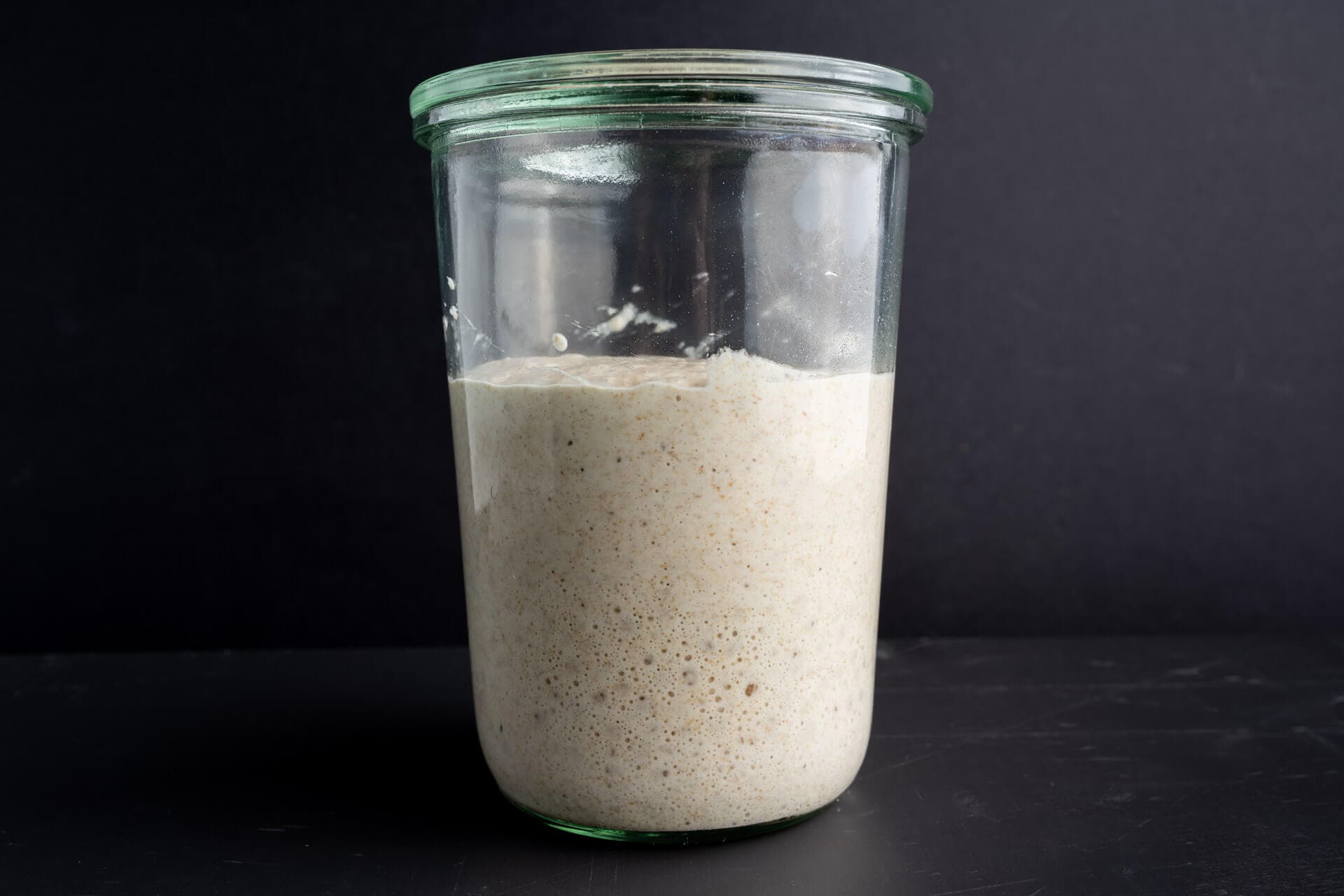

A sourdough starter, levain, chef, lievito madre, mother dough, mum, and so many more names—it can get a bit confusing. What is it, and when is it used? This post focuses on two foundational blocks in baking sourdough bread: a sourdough starter and a levain. And while there are many names for these two and other preferments, let’s dig in and look at what a levain is and how it differs from a starter.
The world of preferments is vast, with each having different flour-to-water ratios and names. A preferment is essentially a mixture of flour, water, and a leavening agent (in our case, a sourdough starter) that is left to ferment before mixing it into the final dough. Preferments help bring flavor, aroma, and keeping qualities to your bread. The extra fermentation time contributes additional byproducts of fermentation to your dough in the form of organic acids and alcohols—flavor. You can also use a preferment to skew the populations of lactic acid bacteria (LAB) and wild yeast, which affects the taste and texture of the final dough as it ferments.
At their core, though, both a starter and a levain fall under the same category as a preferment. They are mixed ahead of time, left to ferment, and then either used directly in the dough (levain and sometimes starter) or refreshed to keep the culture alive (starter).
And if you’re wondering, yes, the prefermented flour percentage you often see in recipes is the portion of the total flour that’s fermented ahead of time. This percentage gives you an idea of how much preferment there is relative to the rest of the recipe’s flour. Ultimately, this has implications for flavor, the recipe timetable, and more.
Let’s start at the beginning.
What is a Sourdough Starter?
A sourdough starter is a combination of wild yeasts and suitable bacteria that can live indefinitely if properly maintained. This starter can be used to seed fermentation in new bread dough, used to make a levain, or refreshed (discarded and new flour and water added) to continue its life.
You will never use your starter up entirely in a single bake. You might take part of your starter to mix directly into the dough, but you will always set aside some to keep the culture going. And if you don’t use a starter to mix directly into a dough, you can create a small offshoot to scale up the preferment, change its flour makeup, or adjust its hydration. This offshoot is called a levain.
An exception to this is the pâte fermentée, or “old bread” method. In this approach, no starter is maintained separately; a small piece of dough is taken from a batch of dough and kept until the next day to continue the culture. While bakers have used this method throughout history, I prefer to keep a separate jar for my starter. This approach helps avoid the unfortunate situation of forgetting to save a bit of dough and having to create a new starter from scratch.
Check out my 21 most common starter problems (with solutions) →
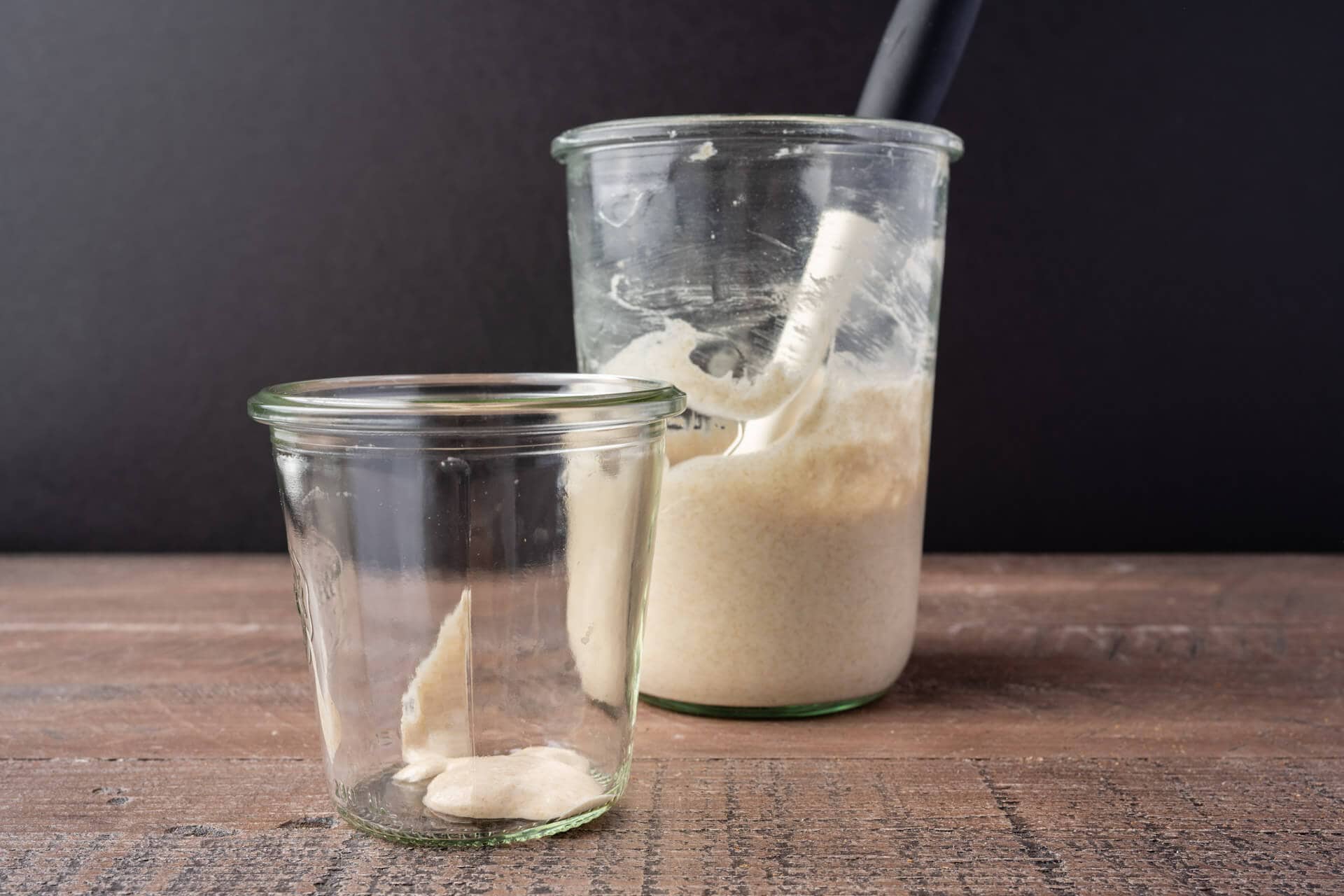
What is a Levain?
A levain, also called a leaven or levain starter, is an offshoot of your sourdough starter, and it’s a mixture of fresh flour, water, and some ripe starter. This mixture will be used entirely in a batch of dough and has the same fate as the bread dough you’re mixing: you will bake it in the oven. But before that, it’s your preferment for the day’s dough, meaning it will leaven your dough (make it rise) and contribute to the flavor produced by fermentation byproducts.
A levain is an off-shoot of your sourdough starter with a limited life.
You might also see the term “levain bread” or “pain au levain,” which are other names for sourdough bread. Because the term levain is French for leaven, which is almost always taken to mean naturally fermented bread, the term levain is often used synonymously with sourdough.
What is the point of making a levain?
Now that we know what a levain is (and isn’t), what purpose does it serve, and why not just use your sourdough starter? To me, there are two main uses for a levain:
- You can use a levain to scale up the pre-ferment to satisfy a recipe that requires more pre-ferment than your starter can cover
- It’s a chance for you to alter the flavor and performance characteristics of the pre-ferment for a single bake
And remember, you can always use your sourdough starter instead of your levain, especially in a pinch (more on this later).
Let’s look at the above benefits of making a levain in more detail.
1. A levain lets you scale up your preferment
I maintain a relatively large sourdough starter that I refresh twice daily. At each refreshment time, once in the morning and once in the evening, I have about 150-200g of ripe starter ready. This starter can be added to a dough mix, or I can use it to make a new levain. And while this amount of starter can cover just about all the recipes here at my site, a levain lets you scale up your preferment. And this can be essential if you maintain a smaller sourdough starter or your recipe requires a large preferment.
Further, using a levain lets me maintain a smaller sourdough starter, reducing flour use, and, in one step, build up my preferment to cover larger recipes or make multiple recipes.
2. A levain lets you change the flavor profile
You can use a levain to skew the flavor profile of the bread toward a more sour sourdough bread, or one that’s less sour. And the power of using a levain means you don’t have to modify your starter: you change the makeup of the levain.
Adjusting the flavor profile is an in-depth topic (one which I tackle in great detail here). But in general, assuming other factors (temperature, seed percentage, etc.) are held constant, I find that a levain made with a higher percentage of whole-grain flour yields a more sour final bread. Therefore, for many of the sweet or delicately flavored recipes here, I make a levain with 100% white flour.
For example, let’s look at that babka levain in detail to assess why it yields a milder result. Using white flour reduces the mixture’s buffering capacity. This reduced buffering capacity means the pH will drop faster as fermentation byproducts—namely, acids—are produced, acidifying the levain. Bacterial (lactobacilli) activity is reduced at low pH, which helps limit acid (sourness) production in the eventual dough.
Remember that the flour makeup of the levain is not the only factor affecting the eventual flavor profile. You must also account for fermentation time, temperature, starter seed percentage, and the time of use. All of these contribute to adjusting the end flavor balance. But this is just one of the levers we can pull to change the flavor and texture.
As sourdough bakers, part of the fun in natural leavening is managing wild yeast and bacteria to produce bread with our desired flavor profile.
Can a levain be multiple builds?
Yes. Many bakers use multiple levain builds to further adjust the yeast-to-bacteria balance or for scheduling purposes. Some rye bread methods, such as 3-stage Detmolder rye, use multiple builds to favor either lactic acid bacteria or yeast (or both in succession). Another example is panettone, which uses a series of short “refreshment” builds with a bit of lievito madre or pasta madre (sourdough starter) before it’s mixed into the primo impasto, or first dough.
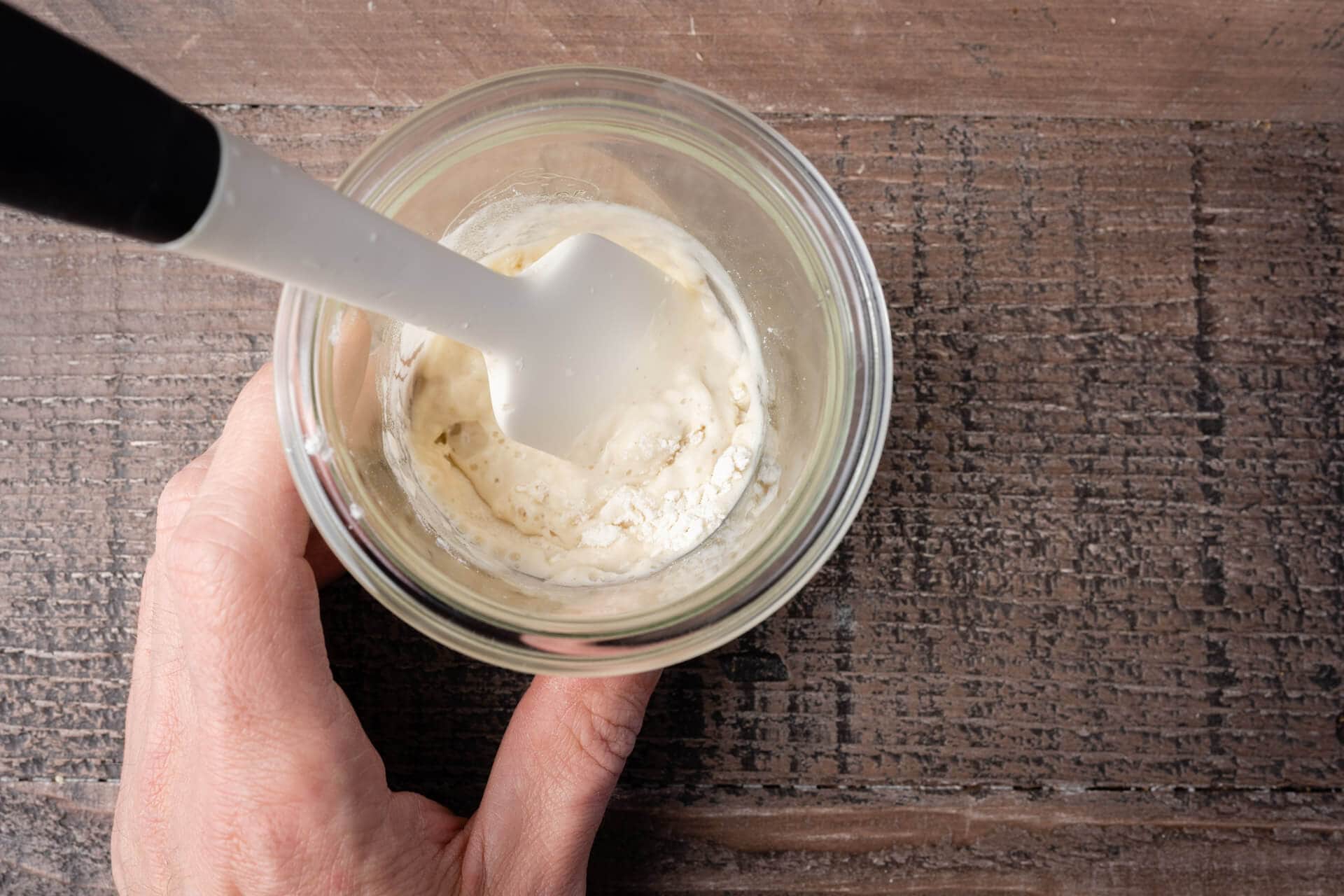
What if I forgot to make my levain?
In a pinch, just use your ripe sourdough starter! It might not have the same intended flavor profile in the end, but it’s better than not baking at all, right?
Alternatively, you could make an intermediate, fast levain build. In this case, I’ll often make a 100% flour, 100% water, 100% ripe starter (1:1:1 ratio). This levain is equal parts flour, water, and ripe sourdough starter and will ripen in 3-4 hours at 78-80°F/25-26°C. Again, this might adjust the final, intended flavor profile, but it’s a handy option.
How much levain is in sourdough bread?
The percentage of levain to total flour can change from recipe to recipe. A typical levain percentage for my formulas ranges from 6% to 30% levain in my final dough. But you can undoubtedly have values outside this range. The amount I use depends on the overall formula and its ingredients.
Note that the levain percentage in a bread formula differs from the prefermented flour percentage. See my post on baker’s percentages for more.
Is there a single levain recipe?
There’s no single levain recipe for every sourdough bread. And for the reasons discussed above, I often adjust my levain builds to change the flavor profile, flour mix, dough hydration, and timetable. There are many ways to make a levain, depending on the bread you’re baking.
What is a Levain and How is it Different From a Sourdough Starter?
To sum up, here’s what’s different, and the same, between a levain and a sourdough starter:
| Sourdough Starter | Levain |
|---|---|
| A preferment | A preferment |
| On-going culture, refreshed regularly | Used once for a single bake |
| Ongoing culture, refreshed regularly | Can be any flour combination |
| Because it’s maintained consistently, it should have consistent flavor characteristics | Can be used to change the flavor and texture of a single batch of dough |
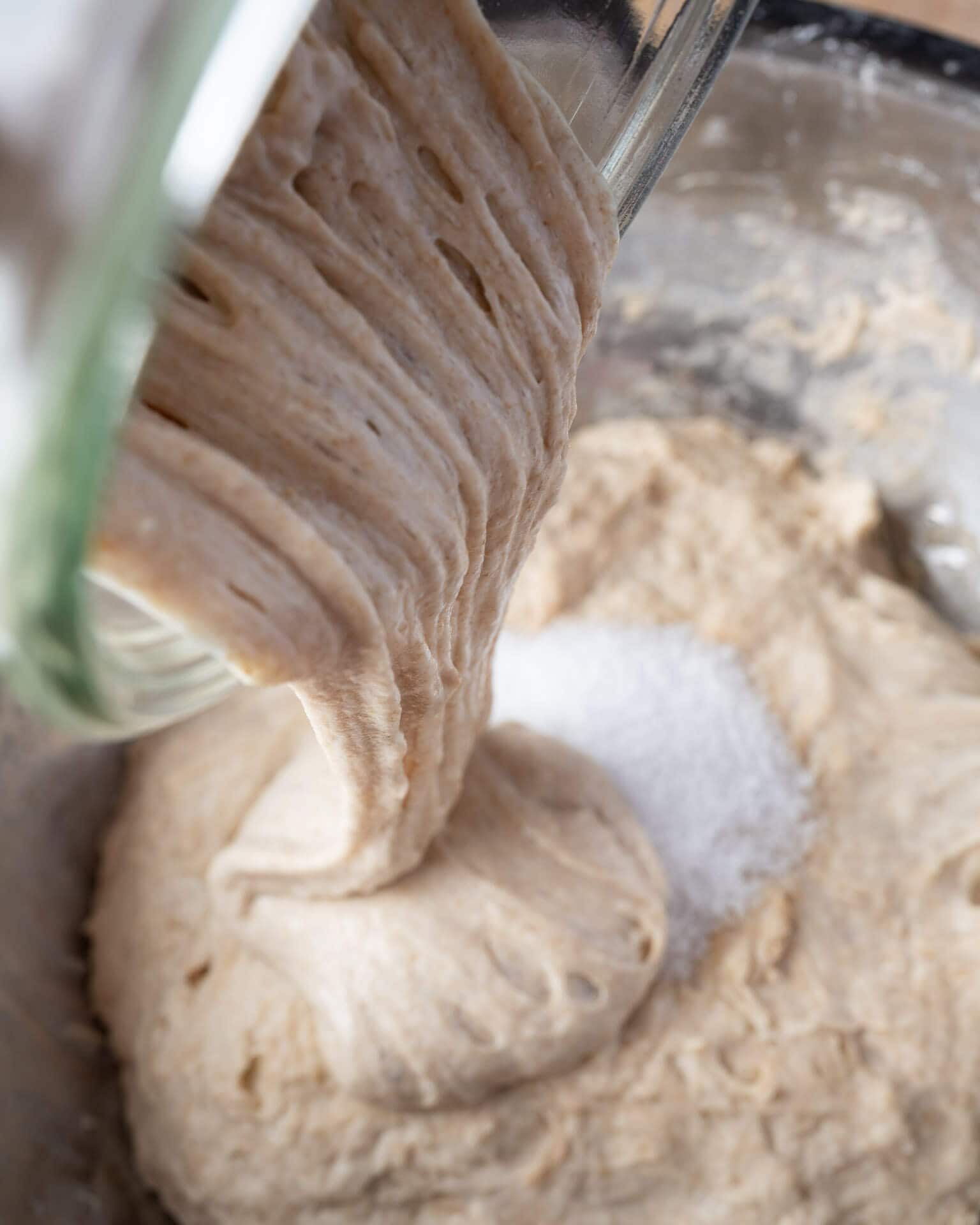
Ultimately, what you call your sourdough starter, mother dough, chef, levain, etc., is up to you. Much of this is cultural; each culture seems to have its own terminology, but it’s also a matter of preference.
They’re all preferments, and they all help bring flavor, aroma, and keeping qualities to your bread. I use levain to represent a single offshoot of my sourdough starter. And I use the term starter to represent my continually maintained sourdough culture.
How Can I Calculate My Starter or Levain Ingredients?
If you’re looking to make a specific starter or levain, use my calculator to quickly figure out how much water, flour, and seed (starter carryover) you need.
For example, if you have a recipe that calls for a 50% hydration (stiff) levain weighing 200g, the calculator will tell you exactly what you need to mix to achieve it.
What’s Next?
Head back and see how to make sourdough bread in the Beginner’s Guide to Sourdough Bread.


201 Comments
Hi Maurizio
So often in recipes I read the starter should either be young, ripe or mature. Can you elaborate what on
whether a ripe and mature starter are one and the same thing and can one say that these are starters that have passed their peak, beginning to recede, but have not collapsed. A young starter being one that has peaked and at least doubled but still rising. I’m just looking for some clarity, different people use different terminology and often some are inter changeable, but one does want to get the full understanding so as to find the correct final application.
Sorry for the confusion, there are a lot of conflicting terms! These days I simply say “ripe,” meaning it’s fermented for some number of hours (usually overnight for me) and either needs a feeding (refreshment) or it can be used to make a levain or mixed into a dough directly.
Some bakers use the term “mature” to refer to what I call ripe.
Hey, Liz! Sounds like a good method, and as I replied to you on F52: it’s all about our own process and preferences in the end! I personally find a lot of value in building a dedicated levain for each bake, but not all of them, sometimes I just use my ripe starter. The levain does help set everything to start with a common base, if you will, but if your starter is well-maintained it’ll work just the same (they are both preferments, after all). Thanks as always for the comments and happy baking!
In some cases, water is the majority ingredient in bread, too! It definitely plays a role, especially with fermentation.
Liz
Hi I was intrigued by your post. I am new to sourdough baking and would love your recipe. I plan on using my mixer as well with the dough hook. 65 years old, so understand sore arms and shoulders, lol. Also how do you maintain your starter? So many confusing directions.
Thanks
Laura
NC
Hi! I have been baking sourdough bread for over 20 years. I still find it difficult to regulate how sour the final bread becomes. To put my questions simple: how do I bake a really sour bread?
Niklas, Sweden
Hey, Niklas! I’ll reply to your email soon 🙂
Hello, did you ever explain how we can get a really sour bread?
Working a comprehensive post on this topic!
Hi Maurizio, I’ve done search and can’t find a post relating to it. Did you share this? Also great work on the book. I have my wife securing a copy for a belated Xmas present!
Maurizio,
I went through the comments for this very question. You stated that with the levain, we can change the profile of our flavor, but not affect our starter. I love very sour flavor, but have yet to understand how to achieve it. I have been told if I "abuse" my starter I could/would get that. It has not occurred. I have abused my starter and thanks to your website I have salvaged it (as well as started a whole new one, just to see if I could!) Could you please further elaborate on how I would create a very sour flavor with the levain–assuming this is the process? And do you have the recipe for the rye that required three/multiple feedings? Detmolyer or something.
Hi Niklas, I have been going through the comments for this very question! Did you get a reply?
Hey Maurizio thanks for all of your great sourdough explainers. I’m also a burqueno so it’s great to have someone so knowledgeable baking in the same environment!
What are the best types of flour to use in starter? I do a 50/50 white/whole wheat mix. I’ve used all purpose, bread, and hi gluten flour as my white flour and each seems to have its own consistency but I can’t tell how it’s affecting the starter itself, including the flavor profile. Any pointers on what tends to produce the strongest/most flavorful starter? Thanks again for all the helpful tips!
Glad to hear from you, Colin! In my experience, they all work just fine, it’s up to your preference. I like a mix of either white flour (all purpose) and whole what, or AP and whole rye (usually 50/50 or 70/30 with 30% rye). I like the addition of whole grains to give it a little more strength and flavoring.
is a poolish or a biga a reasonable alternative to either the sourdough or levain?
A biga has commercial yeast so it’s not strictly sourdough. But, I see a biga as kind of a hybrid: you still get much of the flavor benefit from the long running preferment, but still leavening power from the commercial yeast.
Can I refresh the levain if it is ready, but I want to use it later?
Yes, you can do a fast refresh. I’d do like 100% carryover, 100% flour, 100% water. That would ripen in 3-4 hours.
Hi Mauricio,
I’m not sure I’m following your distinction between starter and levain. Currently I keep a “starter” created from a 25gm/25gm blend of organic white flour and fine organic wheat flour. 100% hydration (50gm water) ratio. The night before I’m going to bake a single loaf I increase the refresh to 80gm mix of white and wheat with 100% hydration (80gm water) which gives me enough (160gm) in the morning to use 100gm of starter in the loaf while leaving enough leftover to feed and refresh the starter again. Are you suggesting that I should consider separating out my starter before I mix the “levain” for the morning break and keep adding the same 50/50 mix at 50gms? I hope this question makes sense!
Thanks,
Evan
Hey, Evan! What you’re doing is absolutely fine—there’s no right or wrong way! Your approach might actually be closer to what many bakers do in a bakery. I like to separate out a little build (levain) that I use 100% in a single bake, as I describe in the post. This way, I can alter the flour blend if I need to or change the temperature without modifying my starter. BUT! It’s not necessary, it’s all about how you’re doing things, and if you’re getting great bread by scaling up your stater a bit, that works, too!
Hi Maurizio!
First, let me say thank you for all of the wonderful content that you share – about your experience and knowledge of bread making. It has been tremendously helpful – as I only started with sourdough last April!
I totally understand your reply. In fact, instinctively I’ve used your approach when I was experimenting with using 100% whole wheat flour for my starter, I wasn’t sure what the effect would be. I tried 100% whole wheat, then settled on the 50/50 blend – but I used your approach of keeping back some of my original starter – just in case. 🙂
Now I search for the most open crumb I can create. I’ve been using roughly an 80% hydration and following a traditional stretch and fold fermentation. The crumb is nice, but I think I might need to adjust my timing as I’ve been using my starter ~ 12 hours after the last refresh. Crumb is “good”, but I’m striving for “great” :). Any suggestions on where I can experiment so as to open the crumb further would be appreciated.
All the best,
Evan
Happy to help! Unfortunately there isn’t a single thing that leads to a more open interior in a baked loaf of bread. First, the flour used is very important, it needs to be strong enough (protein) and have the proper gluten properties to trap the gasses produced during fermentation. For example, no matter how hard you try with rye flour, the gluten properties in the grain just won’t lead to an open interior.
From there, a very strong and well-fed starter is important — it all begins there. Fermentation in general is so critical, it’s worth spending some time really stepping back to look at how your starter is performing and how well-fermented your dough is during bulk fermentation and the final proof. Without strong fermentation your loaf will never rise to its full potential.
Sufficient dough strength through mixing, and also organically through fermentation, is also important. Think of your dough as a balloon: you want it strong enough to trap gasses and expand in the oven, but not so strong that it won’t relax and expand out. Finding this sweet spot takes some practice.
A full and complete bulk is also very important. Cutting bulk fermentation short before the dough is sufficiently fermented will hinder the development in final proof.
I also find that, and this depends on the dough you’re working with, a very gentle preshape and shape are key to maintaining an open interior. If you’re rough with the dough during these times the delicate interior will quickly break down and become more dense. That said, the dough does still need enough strength through shaping to hold its shape during baking.
Sorry for the long winded answer but really all of these things are important! Each part plays into the next and overall what we’re searching for as bakers is balance. Balance between the extremes in each phase of the process.
Thanks for the great information! One question I have is when making the levain, should your starter be freshly fed or “hungry”?
You should make your levain from a starter that’s ripe and usually when you’d give it a refreshment (feeding).
Thanks for answering! I actually started an experiment in my kitchen with hungry and fed starter to see how each levain behaves. I did 35g starter, 70g AP unbleached flour and 70g filtered water. I will update with my findings 🙂
After a few hours, they were exactly the same! Too bad I can’t post a picture (or I can’t figure out how to…)
I’d be interested to see how bread baked from each would turn out, though! Likely the “hungry” one will need much more time in bulk and possibly proof. The ripe levain will have higher populations of bacteria and yeast for fermentation and should speed things along.
Hi Maurizio,
Thank you for all the great information! Could you please elaborate on different levain builds? I’ve seen some recipes call for 3 hour levains while others use an overnight 12 hour build. Is it mostly due to the ratio of starter use in the levain that speeds things up? What would be a general ratio for 3 hour and 12 hour builds?
Usually for 3 hours I do 100% inoculation (seed, the amount of starter going into the mix). For 5 hours, 50% inoculation, and for 12 hours, around 10% inoculation. This is highly dependent on the flour used and the temperature the levain is maintained at, but those are my go-to builds 🙂
Thanks for the reply, really appreciate it! I’m assuming by the type of flour you mean whole wheat/grain flours compared to white flours? Whole wheat/grain starters or levains typically rise quicker, correct?
For those, usually a mix of 50% whole grain and 50% white, or 100% type 85 flour.
Hi Maurizio. Thanks for commenting on this. Can you perhaps elaborate a bit more on your apricot lavender – walnut bread? I noticed that you build your levain for >6 hours in that recipe while you use a 100% inoculation with a 1:1:1 ratio.
Hey! Yes, that’s not a typical build for me these days. However, the CM T85 used in that levain tends to be able to handle longer than usual fermentation times, plus, the recipe itself uses a large percentage of white flour that, for me at least, can handle those extended times without issue. If I were to update that recipe, I’d probably dial back that levain build to 3-4 hours to suit most people better!
Thanks for this. When making a levain, should you use a starter at its peak? I’m struggling to find an answer as to whether this matters or you can use a starter at any point in its rising and deflating cycle.
Great question. It’s very counterintuitive at first. White flour has less buffering capacity, which means, yes, the pH will drop quicker, which results in reduced bacterial metabolite activity. However, there is a distinct difference between the pH and the total acidity (total titratable acidity, TTA). While the pH drops quickly, the accumulation of acidity (which is the sour flavor we end up with) takes time to reach high levels. If bacterial activity is suppressed faster when using white flour (because the pH drops faster), this means they have less time to contribute to the aggregate levels of acidity in the mixture. In the end, this results in less sourness.
It’s an easy one to verify in your own kitchen as well: mix up a starter with 100% white flour to run 12 hours overnight. Next to it, mix up a 100% whole wheat starter. Taste the two after 12 hours.
Great question!
Hi, woow its really great explanation, thank you. I want to ask, someone i know called biga is semi sourdough, is it right or wrong?thx
Thanks! A biga typically has commercial yeast and is somewhat of a hybrid but that is not always the case, sometimes they are 100% naturally leavened (sourdough). So it depends on the baker!
I’ve had no luck with building a levain whatsoever. Regardless of the recipe, I never get passed the bubble phase. Essentially it does not double or triple in size. It bubbled up and looked active but not enough to pass the float test. Everything I’ve read said to be patient and give it more time. I assume that meant no feedings. So I’ve let it sit on the counter of my 60 degree house a couple days, then I put it in my oven with the light on overnight and it is now inactive. Nothing I’ve read tells me to feed the levain, but it seems like it either needs to be fed or tossed out . Any suggestions would be greatly appreciated.
Hey, Shellie! 60F is really, really cold, you won’t see too much activity at that temperature unless your levain was left for a long while. Warm the water to 85F then mix up your levain. Try to keep it warm, 76-78F is idea, and I bet you’ll see a big difference!
Hi! In your sourdough starter maintenance guide you said that you prepare your levain when you starter is at its peak ripeness (i.e. mature). Can the levain be made from a starter that is way past its peak ripeness? I reckon it could be done, after all it would be just like feeding a starter except separated from the main culture. It’s just that all recipes say to build a levain with a mature starter and I wonder what difference there would be if it were built with one past maturity.
The thing is, as I do not bake everyday, and in the interest of using as little resources as possible, I only feed my starter once a day—in the evening, before bed. Where I live, temperature rarely, if ever, goes below 24C, and I feed my starter with a 1:2:2 ratio. So you can imagine that the starter does mature quite quickly, volume increasing to about 125% its original in about 4 hours, maintaining a dome in the next 2, flattening out within the next 2, and by the time 12 hours have elapsed the volume has decreased to just a bit above its original. And then it stays in that state for the next 12 hours until the next feeding. So if, say, I wanted to bake the next morning and leave a levain to ferment overnight, by the time I have to feed my starter in the evening I will get a portion of the way-past-mature starter, use that to build my levain, feed the remaining starter, and by tomorrow after 8 hours of sleep I will have a levain just about mature and a starter that is approximately just past peak ripeness. (Note that my levain builds are usually 1:5:5). Would that be ok to do? Would that make a leavening that is still strong enough to leaven my bread? Or would its leavening power be weaker compared to if I had used a mature starter for the levain? Right now the only differences I can deduce are that of maturing times and flavor: a mature starter would make a levain that matures quicker (all things else the same), and a way-past mature starter could make a levain that is tangier (all things else the same). My major uncertainty is on leavening power and I have yet to experiment on this.
Of course this’ll cease to be a problem by feeding my starter twice a day, with a lower ratio of carry over to fresh flour and water, colder temp water, and refreshing as soon as peak ripeness so that by the time I’d want to make a levain in the evening the starter is mature and ready for its own feeding. But I want to see if carrying on with my current routine is ok anyway. Thanks!!
Yes, you can certainly do this, but I would recommend you try to avoid it being too acidic. However, the levain build should help even things out if you use it at the right time, even if the starter was used after it was ripe.
Can I save the unused portion of the levain and use it later in the week? If so, do I need to re-constitute or feed it?
Yes and yes. You may save a portion of the levain and use it for a later bake. If you do plan to do that, you’ll have to refresh it because just as your main starter it will die if you do not feed it (assuming of course that you will leave the levain until the following week and won’t be storing it in your refrigerator).
Although personally I do not understand why you would keep a portion of your levain in the first place. In my case, every levain I make is exactly measured out for a single bake such that it is all used up and nothing is left. That is after all what it was created for. Leaving out a portion of levain and refreshing it until use for next week is almost the same thing as keeping and feeding two sourdough starters at the same time.
Thank you for your response. The levain I made was from Ken Forkish’s Flour, Water, Salt, Yeast book. It resulted in 1,000 grams. Only 360 grams were needed for the bread recipe. I was stuck with a huge amount (650 grams) of “extra” yummy, active levain. I did not have the time to make an additional sourdough bread recipe at that time. That is why I asked if I could wait a few days and still use the remainder of the levain in something else other than discard recipes. I kept it in the fridge. Yesterday, I used 100 grams of it and reconstituted it for a different recipe. It looks good so far! Thank you.
You can, but like Avery said below, I’d rather just keep my starter going and use that in the future. You could save some of the leftover levain in the fridge, then use it in any of the starter discard recipes (like waffles, pancakes, banana bread, etc.), though!
I have been using my leftover leaven as my new starter. Is that incorrect? I am new to all of this.
I’m completely confused.
Can you give a specific levain recipe with measurements and times?
I assume the levain can be used in place of — rather than along with — starter. Correct?
Thanks for helping this overly bewildered newbie.
Almost every recipe on this site includes answers to your questions. Look around, there’s tons of info! As an example, 50g flour, 50g water, 15g ripe starter would constitute a levain, at 100% hydration.
And yes, you’d generally use only a levain as the leavening for a dough. Not the starter (this is more the mothership that houses all the good bacteria).
Thank you.
That’s right, Todd. Your levain is a little offshoot of your starter (which is fed and discarded regularly), it’s used only for a single bake. Almost every recipe here includes a levain build! Hope this helps.
Hello Maurizio,
I’m tried different of your recipes are great! Now I’m focus in flatbread but I’m not happy with results. I’m curious if you have any nice recipes can try at home? Thanks
Glad to hear that, Salvatore! While not strictly a flatbread, check out my sourdough focaccia, it’s wonderful. Happy baking!
Hi. What would results be if I put more levain in dough than recipe calls for…is it detrimental to the loaf? Does the loaf proof faster so i wouldn’t bulk proof in fridge overnight .
Increasing the levain will speed up the timetable, yes. You don’t have to proof the dough in the fridge overnight if you’d rather bake all in a single day! Instead of placing the shaped dough in the fridge, continue to proof it at room temperature. Depending on the recipe and temperature in your kitchen, it might just need 1-3 hours of proof time on the counter to finish and be ready for baking. Hope this helps!
Ok great will try that. Here in Perth Australia it is rather hot atm 35deg c days so will probably proof in 1hr in my kitchen. Will also make a loaf with less levain and refrigerate it and see how the flavour is, as longer proofs have a deeper flavour than that of the faster room temp proofs correct? Thank you so much for sharing your knowledge
In my experience, yes. That additional fermentation time at cold temperature brings more flavor in the end loaf. Happy to help!
How long may I leave a levain before using it?
It depends on how it’s made! If you make a levain with a high percentage of ripe sourdough starter it will be ready sooner. Conversely, a lower amount of sourdough starter means a long time until it’s ready to use.
Hi, Maurizio,
rookie mistake. I only added around 25% of the levain and completed the shaping and now dough is in the fridge. Anyway to salvage? Can I proof the dough longer out of the fridge before baking?
Hey there! Yes, just give it a lot more time at room temp to bulk or proof. It’ll still get there, it just might take quite a bit more time!
Thank you! It worked out great. Not the prettiest, but very tasty.
Finally I find a good answer to the benefits of making a levain! Thank you. Very easy to understand.
Glad to hear it helped, Rochelle!
Hello I am fairly new to sourdough baking. I am reading the comments below and people mention starter feeding of 1:2:2. can you please explain what this means. I feed my starter by weight, equal flour and water weights
That syntax is a way to show the ratio of starter ingredients. So 1:2:2 would mean one part ripe starter TO two parts flour TO two parts water. For an equal starter, flour, and water weight, it would be 1:1:1.
A few examples:
1:1:1 is the same as 50g starter, 50g flour, 50g water.
1:2:2 is the same as 50g starter, 100g flour, 100g water.
Hi Maurizio! I want to run an experiment by you. My starter lives in the fridge four days/week and I feed it 1:2:2 with a lot of whole grain to refresh. As a result, I think its acid load has increased over time, affecting both crumb (denser than I’d like) and flavor (sour, which I love!). To see if I can open the crumb back up while keeping the sour flavor, I created an off-shoot that I am keeping at low volume on the counter and feeding 1:5:5 instead. This weekend, I’m comparing by building a levain from each and letting both go past peak to see if the new off-shoot has an open crumb while retaining sourness. But this leads to my question. To do this comparison well, do you think I should still feed my fridge starter 1:2:2 as I refresh it, or should I feed it 1:5:5 as I’ve been doing with my counter off-shoot?
Great experiment! I’ve been playing with something similar over here in prep for a new post coming up. I would keep the 1:2:2 as-is, then you’ll have two separate starters—with their own feeding regiment—to compare.
Thanks Maurizio! That was my gut feeling. I’ll let you know how it goes!
The results are in! Well, sort of. Basically, the off-shoot breads looked decent if small – but were completely under-fermented, resulting in a dense crumb with huge mouse-holes and an almost inedible, unfermented flavor. The standard loaves, prepared exactly the same, were some of my best yet – not as sour as I like, but by far the best crumb. So there was something about the 1:5:5 starter, which was the only difference. I may retry the experiment in a few weeks, but for now I’ve tossed it and am going to continue to work on fine-tuning my timing to get the crumb and the sour flavor into the same bake. Thanks for your help!
Thanks for reporting back, Hank! It sounds like that 1:5:5 starter needed more time to ripen before using it to mix into a dough (or make a levain). I maintain my starter on the counter at this ratio and it works well for me, provided I use it when ripe!
You must be right – so in the end, experimental error. My next one will be about young, mature, and *very* mature levain. Do you have a post on the expected differences between these stages of incorporation?
Check out my sourdough starter maintenance routine post, it has a bunch of pictures and explanations on what I look for at each step of my starter’s lifecycle!
You might try using weight loss as a metric on the ripeness of your levain. My rule is that when a levain has lost 2% of the weight of the added flour, then it is ripe enough to use. So a levain mixed with 25g starter: 100g water: 100g flour would need to lose 2g before it is ready. This also works irrespective of the temperature you use to ferment your levain. Cooler takes longer. It can also tell you when you need to refresh your refrigerated starter because the rate of weight loss declines as the sugars are consumed. General rule is 2 weeks at 38°F is will use ~2%, and another 2 weeks will use another 2%, and another 2 weeks will not quite use 2% so it is time to do a couple of refresh cycles before you put it back into the refrigerator.
I’ve never heard of this method, Doc! Really interesting. I’ll have to give it a try and see how it compares to my usual organoleptic method!
It should be very close. Here is a link to a plot of weight loss vs time for three starters after being refreshed (but not given any time to mature before being refrigerated).
http://bit.ly/2RbDVOF
At this quantity (30g) you need a milligram scale, but for more typical levain builds that use at least 100g of flour, any scale with a 1g resolution and 1g accuracy is adequate.
This technique was developed when I was experimenting with TTA of levains that were built at hydrations of ~250% so they were all water and there was no foam and no rise and fall to track. You can calculate the expected loss based on sugars in flour, sugar to CO2 conversion by yeast and assume that after saturating the levain, all of the CO2 is lost without any evaporation of water (which turns out to be true if you cover it).
That’s fascinating, Doc. I’m curious, if you were testing TTA did you also compare the TTA to weight loss?
I don’t remember running a parallel track from which to pull starter and measure TTA. If you are tracking sample weight vs time at the mg level, you can’t be removing 10g aliquots for TTA titration and somehow subtract the weight while you continue to accurately keep tabs on CO2 production. It would have to be done by sampling from a much larger batch and assuming that the CO2 loss from one was also replicated in the batch from which you remove aliquots for TTA measurement. I probably have data from sequential testing but the focus of the TTA measurements was to see how long it continued to increase and maximum final values in a very high hydration levain vs 100% hydration levain.
The result was to verify that a high hydration levain produces more total acid than the same amount of flour in a lower hydration levain. The extreme application of this observation suggests that you put all of the water into the levain, let it run until it loses 4% of the weight of the added flour (this assures that there is still a healthy numerical density of both yeast and LAB to initiate the batch of bread). At that level, I expect a longer lag phase and a more sour loaf. If you are still seeking more TTA in the loaf, you can add some fructose at mix time (up to 2% and in conjunction with the bulk of the flour) which will independently boost TTA.
Thank you, Lana! You could do either: keep a larger starter to cover whatever requirement you have in the morning for mixing, or mix up a small levain to run overnight. I’d probably take the latter approach. You can slow the ripening of your levain by reducing the percentage of ripe starter you add to the jar. For an overnight levain, I typically do something like 10% starter, 100% flour, 100% water.
I am new to sourdough bread baking and I have been struggling to understand the difference between the starter and levain. You have explained it so well and it finally makes pefect sense to me! Thank you for this wonderful post.
Thanks for the feedback, Cindy! I’m glad my post has helped—it’s a source of confusion for many!
I now am using Organic Artisan Bakers Craft flour and I really like it. My second 25lb bag just arrived. It’s a little pricey due to the freight charges but worth it. Thanks for the tips you give. This article is very interesting. thanks for writing it. I have a question, in all the bread I have made over the 4 years of baking the size of the holes is not large like some of the pictures I see. They are not tiny but they are not large. About the size of a thumb nail is max. ???
Sounds totally find to me! As long my bread is light in hand, airy, tender, and delicious, I’m happy. The size of holes depends quite a bit on the flour you’re using, and generally, higher protein flour makes it easier to achieve an interior that’s much more open. But the tradeoff, in my experience, is using a high percentage of high protein flour can lead to a less-than-tender interior. A balance in all things, I like to say!
Is a Poolish the same as a Levain, or a souped up starter, or a totally different animal? The Poolish starts out with approximately half of the total flour and water plus an amount of starter(50g or 60g). Then it sits out covered overnight. It looks like a super starter feed job but all is used in the bread. Then there’s that thing called a Biga. All these different things are making me just a little crazy. Thanks for your help
A poolish and biga are also types of preferments, those usually include some commercial yeast in their makeup. A biga is Italian style and usually a more firm preferment, whereas a poolish is French style typically more on the loose and liquid side.
Wonderful article! No matter how long I’ve been doing this I always learn things from reading your posts! My starter has been regularly maintained with a 50/50 combo of BF and Rye. I recently created a Levain 100% BF for a Brioche recipe. I have been so impressed with it and using it for my breads. It was very interesting to learn BF starters have lower PH levels and make the dough less sour. I have noticed this change in my breads. I am gluten sensitive and my gut is happiest with a more sour bread which I assume is the Lactobacillius increase. What would be your recommendation for feeds? I feel like the rye combo ls not strong enough and doesn’t perform as well.
Thank you, Susan! Using a majority of white flour should lead to a faster drop in pH as fermentation progresses, so it makes sense an all BF would quickly reach a lower pH (this would be true with any flour with a low ash content). I typically maintain my starter at 30% whole grain and 50% white flour in the warmer months, and 50/50 in the winter. But this can change if I’m testing something 🙂
My feeling is a bread that’s more well-fermented should yield a healthy and very digestible bread. I tend to push fermentation rather far in my dough, I prefer a bread that’s over proofed than under!
For feeds, I typically like to discard a significant portion of my starter and feed with fresh flour and water 2x a day (once in the morning and once in the evening). If you’re doing white flour only, just be sure you leave enough of the starter in your jar at each feeding so it’s very well fermented by the time you feed it again—the amount you leave will depend on the temperature it’s maintained at (warmer = leave less, colder = leave more). Hope this helps!
Great article. I got a bit lost in the middle, but that final chart on the differences clarified it beautifully.
I have been sourdough baking for a few years now with the help of a ‘sourdough mentor’ who has had endless patience even through all my failures. I had at one point recently thought of abandoning sourdough and sticking to Poolish and Biga’s. However, with help I have gone right back to basics and started again.
There has been one common theme with my failures which I have determined is down to water. The majority of my sourdough loaves turn out on the ‘damp’ side in texture; even when not cutting straight away. The only way around this I have found is by putting in at least 30g less water than the recipe stated; sometimes as much as 50g. This issue can’t be down to the flour as I have used all kinds of flour and still had this problem. I thought maybe the humidity was a problem (I am in north west England); but why this last year and never before? It has been very frustrating especially if I have bought good expensive flours.
Any thoughts on this appreciated.
Thanks, Pauline! It’s likely that your flour has changed and requires less water to mix up to the same feel/strength. There’s always an adjustment to be made, there! Our wheat grows in different conditions each year, has different specifications (even if the mill is great at keeping things consistent), and just needs an adjustment. It sounds like your grain needs a little less water for a while—and that’s ok!
I had this happen to me recently. My latest shipment of flour from Giusto’s (one of my fav mills in California) seems to be more sensitive to water and I’ve had to cut back my hydration levels to adjust.
Hope that helps and happy baking!
Hi Maurizio. Thank you for such a quick reply. I should have been a little more clear and added this happens on whatever flour I use in any recipe. Be it white, Wholemeal, Spelt, Khorasan, Rimicanata etc. It is strange as it can be as much as 50g less.
Two ideas: perhaps you’re under baking (has your oven changed or baking process?) or perhaps your dough is under proofed. Both of those could lead to what feels like a damp/wet/gummy interior!
Thank you again for replying Maurizio. Apologies in advance for this being a long reply; I just want to give you a bit more background.
Nothing has changed with the oven or baking process; I normally use a Panasonic SD250 bread maker; or the Sage Smart Oven Pro which I believe is called a Breville in America. I have tried both using a Pullman tin and also direct onto a circular pizza metal sheet after proofing in a banetton or Lekue. While I have never in my eyes had the ‘perfect’ loaf, this last year has been dreadful for results with the same common theme of gumminess or very wet dough for the type of bread. I have been and still are very close to giving up on sourdough/poolish/biga loaves and going back to just doing normal bread maker recipes from the book. I have quite a lot of different flours to use up still; I had been looking forward to having some successes but it seems it is not meant to be as I just can’t afford to keep wasting expensive flours.
The under proofing is a possibility. I have had an excellent patient “mentor” who has now totally lost patience and doesn’t want to know. I can’t blame them when I do exactly the same thing as they do, yet mine still comes out like this. I thought maybe it was the general room temperature as I did notice my starters never seemed to rise and be as ‘frothy’ as all the ones I see online. Similar with the bulk proofing. However, I was told my starter looked fine which I believed (and still do) as my mentor is brilliant and very experienced in sourdough baking. Sometimes they have noticed that the rise hasn’t always been like it should be, but often it has got to the point where it hasn’t rose any more, so it is a case of bake and see, which in most cases turns out to be another fail. The sourdough starter has been much better when putting in the airing cupboard before taking any off for a bake, so I am wondering if maybe I should do the same when bulk and final proofing the dough? The average temperature of our home is between 60-70 degrees. I have allowed for the fact that this is lower than recommended, but as it can work the other way and dough can go in the fridge for quite a long time, I would have thought that eventually an initial bulk proofing would double as it is supposed to do, even if it takes some hours longer?
Finally: out of curiosity and because it was getting near the use by date; I baked a standard white bread mix in the bread maker with the recommenced amount of water. Now remember with the Panasonic bread makers they have sensors that make it so it starts kneading and rising etc at the optimum temperature. This loaf turned out fairly well. I would say there was just the tiniest bit of gumminess, but so small nobody else would notice (just me being ultra-fussy). I have checked the weighing scales, and as you know, tried many different flours. The weird thing is though that other than the Sage oven, everything is the same as when baking at the start a few years ago now. So surely if it was the temperature at fault say too low; I would have had this problem before?
Any further help to stop me from giving up completely which deep down I don’t want to do (would have been different if I hadn’t been so successful when first baking bread); would be brilliant. My only concern is that my bread issues may send you looking for a pistol ha ha.
Hey, Pauline. After reading your comments I almost want to say it sounds like your dough is possibly under proofed. At those cold temperatures, you’ll likely have to extend bulk fermentation quite far to get to the proper point in bulk fermentation. I would suggest warming the mixing water so your final dough temp reaches 80°F (26°C). Then, try to keep it in a warm vessel and around that temperature if you can. You should see significant rise and activity during bulk fermentation at those temperatures, and a bulk that should go around 3-4 hours.
Give that a try if you haven’t already. Then, please take some photos of the interior and exterior of your loaf and shoot them over to me in an email (or link to them here in these comments). I’d like to take a look and see if we can diagnose further!
Thank you again Maurizio. I will certainly give your suggestions a try. I do use warm water but I must admit, I haven’t checked the temperature of the dough. I am currently using up ‘bits’ of loaves from the freezer that are eatable; and hope to bake again at weekend (if not tempted to give in before then. I will post photos in due course here; purely because it may help others now or in the future who have had the same problem. I appreciate very much your help and suggestions. My ‘bread mentor’ will be sending me another recipe to try with a slightly different process of doing things; so hopefully it will go better. Watch this space.
Awesome summary! Your articles have been my sourdough bible since I started.
One issue I’ve been trying to grapple with is that when I do use 100% white flour to create a levain, it begins to smell acidic or vinegary after a few hours rather than the usual sweet, fermented, banana-like smell with my usual starter.
For perspective, I keep a 100% hydration starter, flour is 50% bread flour and 50% dark rye.
My levain is usually 1:1:1 but with the flour switched to all white. Would you have any insight you can share on why this happens?
Thank you! Glad to hear they’ve helped.
That’s strange. I’d expect increased fermentation with the rye, which should smell sourer earlier than an all-white variety. But, I too notice this vinegar-type smell when using all white flour after it’s fermented for a long while and has started showing signs of needing a refreshment. If you’re keen on trying something, try refreshing your starter halfway through your normal schedule if doing 1:1:1:. Then, at your next refreshment, see how it smells—it should be on the sweeter, more mellow side with the extra refreshment.
Hello Maurizio,
Firstly, I absolutely love your resources and your recipes have been amazing.
Do you recommend using the same flour in your levain that you will end up using to make the bread?
I usually use a stoneground flour to feed my starter. If i add that to a dough that is made up of white flour and wholemeal spelt flour is there any drawback to that?
Would it be better if my levain was a combination of white and wholewheat spelt?
There will obviously be slight flavour differences, but in terms of fermentation and “leavening strength” would there be differences?
Thank you
Thanks, Marc! No, I’ve found it’s not necessary to have the same flour in the levain as the final dough, it’s totally up to you. Your sourdough starter/levain will be just fine whether you’re using wheat, kamut, spelt, or einkorn—it’s all good. Happy baking!
Thanks for the well written and easy to understand article.
Most of my bread is 80% whole wheat, 20% rye. When building a levain will adding rye flour (at a similar %) produce a different flavor profile from using all whole wheat? My guess is yes, but I wonder about how.
Thanks again!
You’re welcome! There’s a lot of factors to weigh in there to give a definitive answer (how much rye? what temperature will they be kept at? hydration? starter seed percentage? etc.). Assuming everything was kept the same with just a sub out for whole grain rye, I’d expect perhaps a touch less sourness (if I recall, rye flour has less buffering capacity than wheat) and more yeast activity (more gassing power). I make my levain using rye flour very often, usually between 30-50% of the total flour, and love the results. For me, it’s a toss up between the two! I’d love to hear your experience.
Brilliant round up and a clear explanation. Thank you!
You’re very welcome, thanks for the comments!
What do I call mine? My starter’s name is Audrey II. Every time I walk by her, she screams, “FEED ME!”
Little Shop of Horrors reference 😉
Ha ha, love that!!
Great explanation of starter vs levain. Thank you for sharing expertise and helping us become better bread bakers, an arduous but delicious journey.
You bet, thanks for the comments and happy baking!
Thank you for such useful information! It clarifies a lots! Just curious – have you tried to use a mix of starters (e.g., rye and einkorn starters) to build a levain with the hypothesis that it may create a more complex favour of the sourdough? Thank you for any insights!
You’re welcome, Nicole! I’ve done this in the past when I used to maintain multiple starters. If I was a baker doing specialty breads more predominately, e.g. 100% rye, I might go back to maintaining several starters, one for each style. But these days, I only keep one starter and use a levain to adjust the flavor/performance/texture of the final loaf though levain builds. I’ve not found a reason to keep multiple starters—it’s a lot of work!—and I find the flavor is wonderful when I keep things simple (which is also effective!). Hope that answers your question 🙂
Many thanks for the great insights, Maurizio! I have been keeping 3 starters (rye, ekinkorn and spelt) and it takes a lots of commitment and resources too! Great to know that the flour choice of the starter doesn’t make a significant impact on the final flavour of the dough. Thanks again for sharing your valuable knowledge with us. Have a wonderful day!
That’s my experience! Happy to help, have a great weekend.