

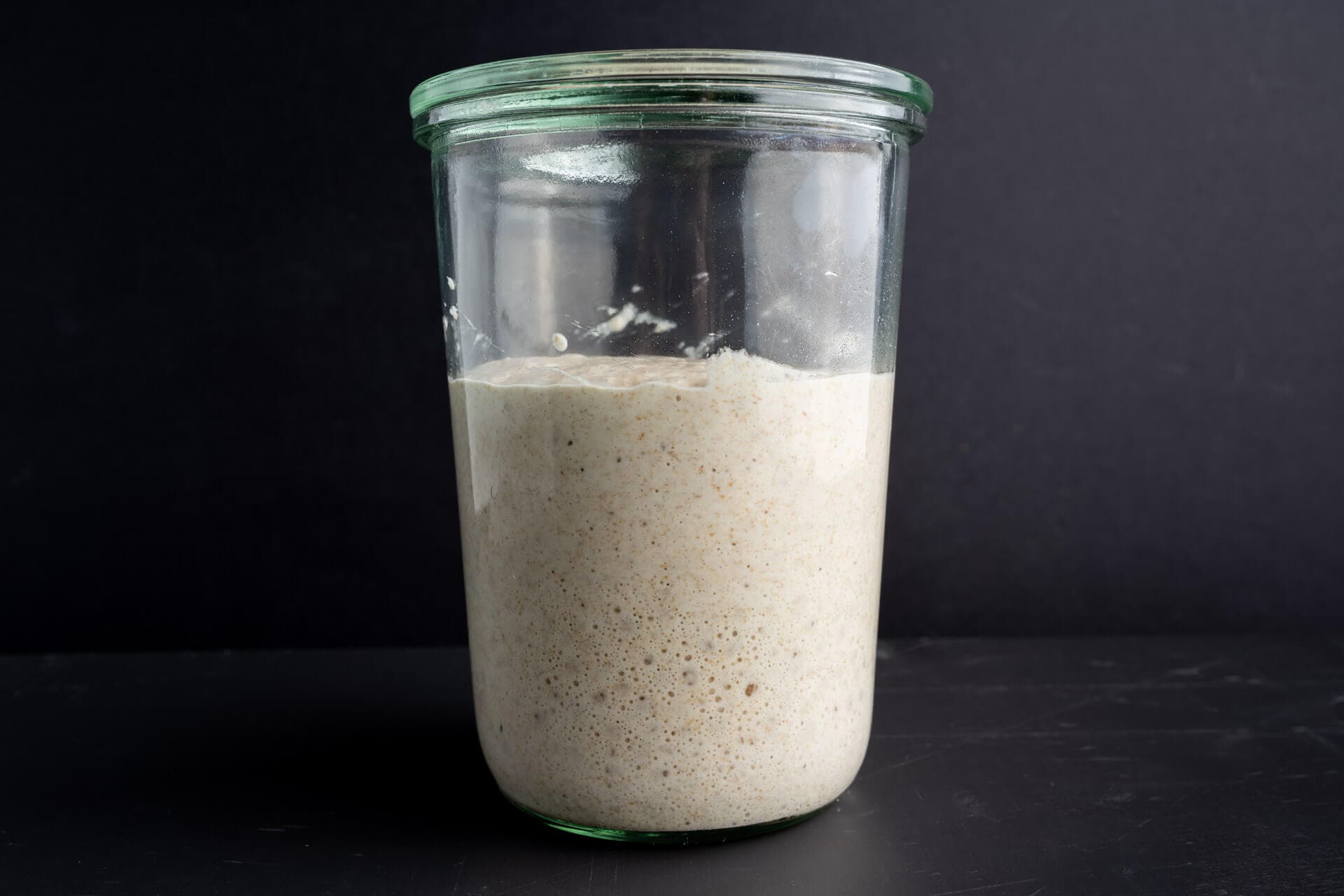

A sourdough starter, levain, chef, lievito madre, mother dough, mum, and so many more names—it can get a bit confusing. What is it, and when is it used? This post focuses on two foundational blocks in baking sourdough bread: a sourdough starter and a levain. And while there are many names for these two and other preferments, let’s dig in and look at what a levain is and how it differs from a starter.
The world of preferments is vast, with each having different flour-to-water ratios and names. A preferment is essentially a mixture of flour, water, and a leavening agent (in our case, a sourdough starter) that is left to ferment before mixing it into the final dough. Preferments help bring flavor, aroma, and keeping qualities to your bread. The extra fermentation time contributes additional byproducts of fermentation to your dough in the form of organic acids and alcohols—flavor. You can also use a preferment to skew the populations of lactic acid bacteria (LAB) and wild yeast, which affects the taste and texture of the final dough as it ferments.
At their core, though, both a starter and a levain fall under the same category as a preferment. They are mixed ahead of time, left to ferment, and then either used directly in the dough (levain and sometimes starter) or refreshed to keep the culture alive (starter).
And if you’re wondering, yes, the prefermented flour percentage you often see in recipes is the portion of the total flour that’s fermented ahead of time. This percentage gives you an idea of how much preferment there is relative to the rest of the recipe’s flour. Ultimately, this has implications for flavor, the recipe timetable, and more.
Let’s start at the beginning.
What is a Sourdough Starter?
A sourdough starter is a combination of wild yeasts and suitable bacteria that can live indefinitely if properly maintained. This starter can be used to seed fermentation in new bread dough, used to make a levain, or refreshed (discarded and new flour and water added) to continue its life.
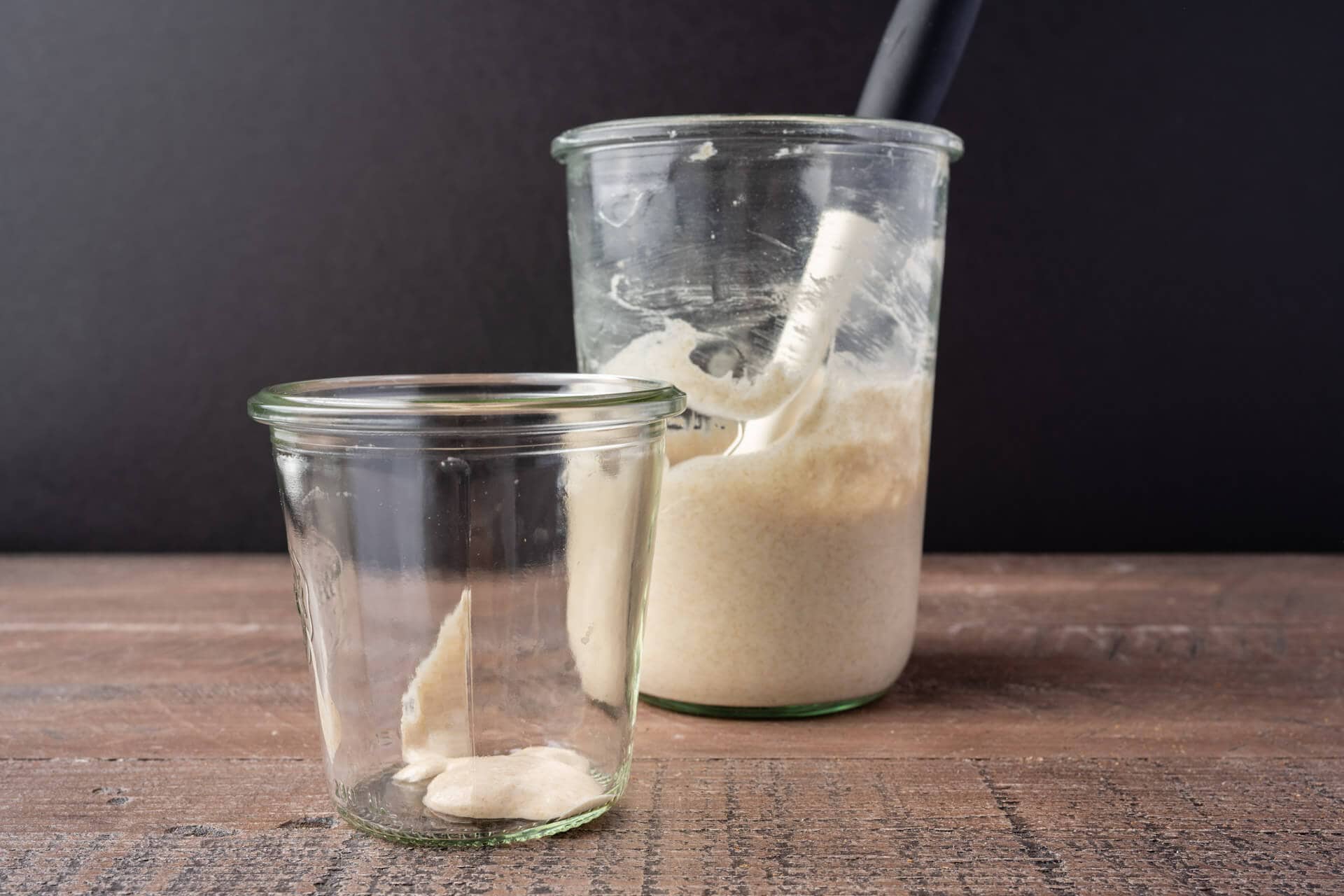
You will never use your starter up entirely in a single bake. You might take part of your starter to mix directly into the dough, but you will always set aside some to keep the culture going. And if you don’t use a starter to mix directly into a dough, you can create a small offshoot to scale up the preferment, change its flour makeup, or adjust its hydration. This offshoot is called a levain.
An exception to this is the pâte fermentée, or “old bread” method. In this approach, no starter is maintained separately; a small piece of dough is taken from a batch of dough and kept until the next day to continue the culture. While bakers have used this method throughout history, I prefer to keep a separate jar for my starter. This approach helps avoid the unfortunate situation of forgetting to save a bit of dough and having to create a new starter from scratch.
Check out my 21 most common starter problems (with solutions) →
What is a Levain?
A levain, also called a leaven or levain starter, is an offshoot of your sourdough starter, and it’s a mixture of fresh flour, water, and some ripe starter. This mixture will be used entirely in a batch of dough and has the same fate as the bread dough you’re mixing: you will bake it in the oven. But before that, it’s your preferment for the day’s dough, meaning it will leaven your dough (make it rise) and contribute to the flavor produced by fermentation byproducts.
A levain is an off-shoot of your sourdough starter with a limited life.
You might also see the term “levain bread” or “pain au levain,” which are other names for sourdough bread. Because the term levain is French for leaven, which is almost always taken to mean naturally fermented bread, the term levain is often used synonymously with sourdough.
What is the point of making a levain?
Now that we know what a levain is (and isn’t), what purpose does it serve, and why not just use your sourdough starter? To me, there are two main uses for a levain:
- You can use a levain to scale up the pre-ferment to satisfy a recipe that requires more pre-ferment than your starter can cover
- It’s a chance for you to alter the flavor and performance characteristics of the pre-ferment for a single bake
And remember, you can always use your sourdough starter instead of your levain, especially in a pinch (more on this later).
Let’s look at the above benefits of making a levain in more detail.
1. A levain lets you scale up your preferment
I maintain a relatively large sourdough starter that I refresh twice daily. At each refreshment time, once in the morning and once in the evening, I have about 150-200g of ripe starter ready. This starter can be added to a dough mix, or I can use it to make a new levain. And while this amount of starter can cover just about all the recipes here at my site, a levain lets you scale up your preferment. And this can be essential if you maintain a smaller sourdough starter or your recipe requires a large preferment.
Further, using a levain lets me maintain a smaller sourdough starter, reducing flour use, and, in one step, build up my preferment to cover larger recipes or make multiple recipes.
2. A levain lets you change the flavor profile
You can use a levain to skew the flavor profile of the bread toward a more sour sourdough bread, or one that’s less sour. And the power of using a levain means you don’t have to modify your starter: you change the makeup of the levain.
Adjusting the flavor profile is an in-depth topic (one which I tackle in great detail here). But in general, assuming other factors (temperature, seed percentage, etc.) are held constant, I find that a levain made with a higher percentage of whole-grain flour yields a more sour final bread. Therefore, for many of the sweet or delicately flavored recipes here, I make a levain with 100% white flour.
For example, let’s look at that babka levain in detail to assess why it yields a milder result. Using white flour reduces the mixture’s buffering capacity. This reduced buffering capacity means the pH will drop faster as fermentation byproducts—namely, acids—are produced, acidifying the levain. Bacterial (lactobacilli) activity is reduced at low pH, which helps limit acid (sourness) production in the eventual dough.
Remember that the flour makeup of the levain is not the only factor affecting the eventual flavor profile. You must also account for fermentation time, temperature, starter seed percentage, and the time of use. All of these contribute to adjusting the end flavor balance. But this is just one of the levers we can pull to change the flavor and texture.
As sourdough bakers, part of the fun in natural leavening is managing wild yeast and bacteria to produce bread with our desired flavor profile.
Can a levain be multiple builds?
Yes. Many bakers use multiple levain builds to further adjust the yeast-to-bacteria balance or for scheduling purposes. Some rye bread methods, such as 3-stage Detmolder rye, use multiple builds to favor either lactic acid bacteria or yeast (or both in succession). Another example is panettone, which uses a series of short “refreshment” builds with a bit of lievito madre or pasta madre (sourdough starter) before it’s mixed into the primo impasto, or first dough.
What if I forgot to make my levain?
In a pinch, just use your ripe sourdough starter! It might not have the same intended flavor profile in the end, but it’s better than not baking at all, right?
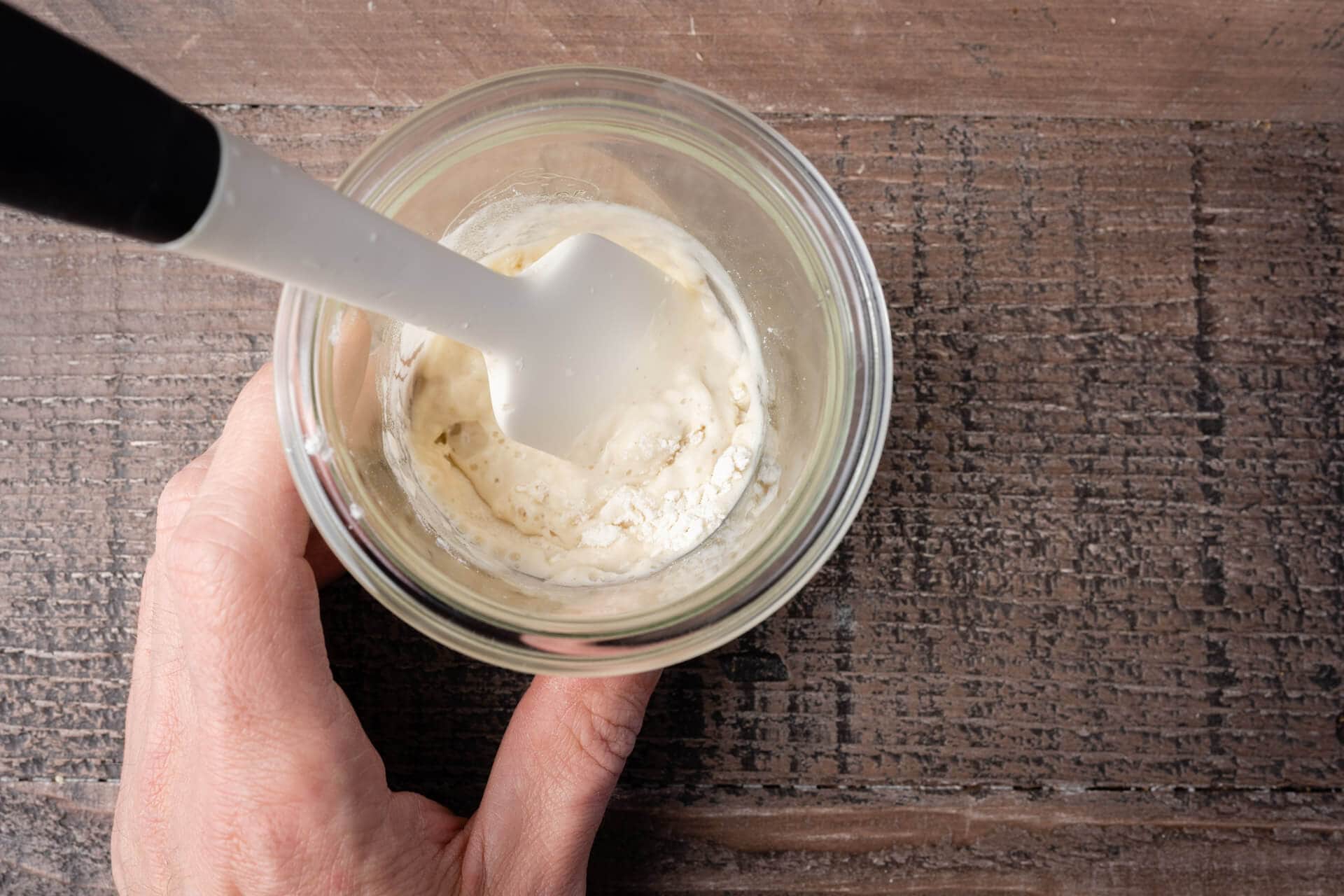
Alternatively, you could make an intermediate, fast levain build. In this case, I’ll often make a 100% flour, 100% water, 100% ripe starter (1:1:1 ratio). This levain is equal parts flour, water, and ripe sourdough starter and will ripen in 3-4 hours at 78-80°F/25-26°C. Again, this might adjust the final, intended flavor profile, but it’s a handy option.
How much levain is in sourdough bread?
The percentage of levain to total flour can change from recipe to recipe. A typical levain percentage for my formulas ranges from 6% to 30% levain in my final dough. But you can undoubtedly have values outside this range. The amount I use depends on the overall formula and its ingredients.
Note that the levain percentage in a bread formula differs from the prefermented flour percentage. See my post on baker’s percentages for more.
Is there a single levain recipe?
There’s no single levain recipe for every sourdough bread. And for the reasons discussed above, I often adjust my levain builds to change the flavor profile, flour mix, dough hydration, and timetable. There are many ways to make a levain, depending on the bread you’re baking.
What is a Levain and How is it Different From a Sourdough Starter?
To sum up, here’s what’s different, and the same, between a levain and a sourdough starter:
| Sourdough Starter | Levain |
|---|---|
| A preferment | A preferment |
| On-going culture, refreshed regularly | Used once for a single bake |
| Ongoing culture, refreshed regularly | Can be any flour combination |
| Because it’s maintained consistently, it should have consistent flavor characteristics | Can be used to change the flavor and texture of a single batch of dough |
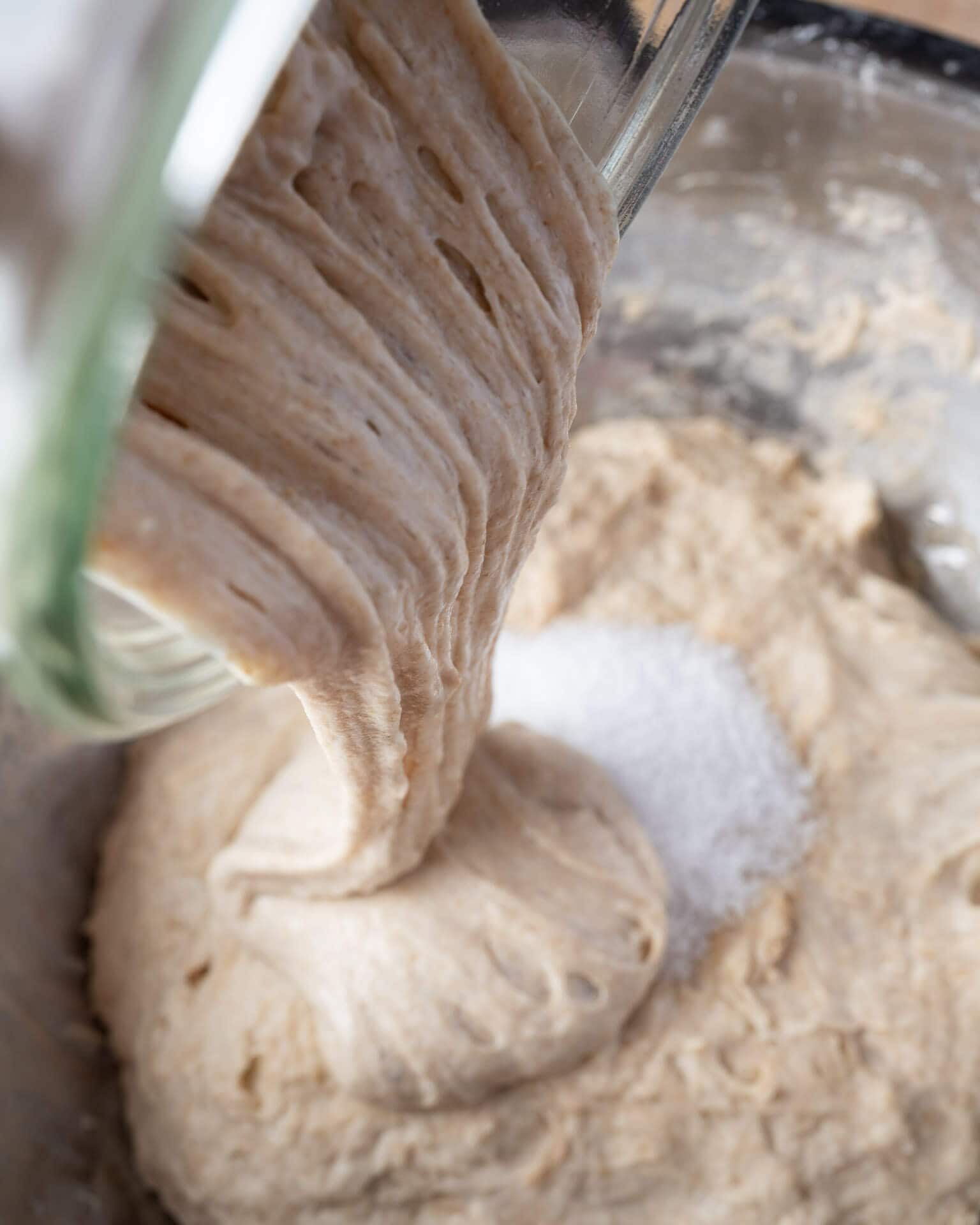
Ultimately, what you call your sourdough starter, mother dough, chef, levain, etc., is up to you. Much of this is cultural; each culture seems to have its own terminology, but it’s also a matter of preference.
They’re all preferments, and they all help bring flavor, aroma, and keeping qualities to your bread. I use levain to represent a single offshoot of my sourdough starter. And I use the term starter to represent my continually maintained sourdough culture.
How Can I Calculate My Starter or Levain Ingredients?
If you’re looking to make a specific starter or levain, use my calculator to quickly figure out how much water, flour, and seed (starter carryover) you need.
For example, if you have a recipe that calls for a 50% hydration (stiff) levain weighing 200g, the calculator will tell you exactly what you need to mix to achieve it.
What’s Next?
Head back and see how to make sourdough bread in the Beginner’s Guide to Sourdough Bread.


202 Comments
Can you correct my method? I know I am doing something wrong but I am not sure what. I keep my starter in the fridge to bake weekly or so. It is 450 g 1:1:1 ratio. When I want to bake I take it out, remove 85 g for my levain. I add 25 g flour and 25 g water to the 85 g starter. Let this rise until peaked or fallen a bit. then use it. Meanwhile, from the starter (now minus 85 g) I remove 150 g to retain and the remainder goes into discard container. The 150 g I retained I add 150 flour and 150 g water and let sit at room temp until 50 – 75 % rise and then I put it back in fridge until next bake. I get good results but I am positive I am missing a step and it annoys me!
That sounds okay to me, Elisha, but the ratios do seem a little off. I usually do 1:5:5 for 12 hours, but that’s a strong starter that’s feed 2x daily so it might ripen faster than yours. I’d say just avoid using a starter that’s overly loose and sour smelling, if you do get that, feed it earlier to bring it back into balance with less acidity.
How old can the starter be from the refrigerator to make a strong leaven? I always feed my starter weekly at least.
I usually like to give it a feeding for 2 days out of the fridge before making a levain.
I bake once or twice a week, so I maintain a small amount of my starter in the fridge and refresh it as soon as it peaks (or almost peaks). This is how I normally feed my starter: 1:5:5 ratio, 100% hydration, 80% white flour, 20% whole wheat. It normally takes around 3 days to peak in the fridge.
When I want to bake, I'll take an offshoot of the peaked starter and make levain with it, normally at a 1:2:2 ratio. If I follow the same flour combination, 100% hydration (as I feed the starter), the levain will peak after 3-4 hours at 26-27 degrees Celsius.
The problem happens when I try to tweak the flavor profile by changing the flour combination or hydration %. For example, if I try to have a sweeter levain, I'll use 100% white flour, or reduce the hydration to 85% (stiff levain), feeding ratio (1:2:2), and temperature remain the same. However, the levain performance reduces significantly; it will take longer (5 hours or more) to rise and only rise a little, or sometimes will show very little activity (tiny bubbles at the side), or some other times it won't rise at all.
My hypothesis is that the bacteria and yeast need a few more feedings to adjust to the new flour combination or hydration % before it can stabilize. I tested this hypothesis with more feedings, but the levain got worse, and the activities reduced to almost nothing and I had to discard the entire thing.
Would you be able to tell me your hypotheses behind this? Thank you!
Your hypothesis about needing adjustment time is actually going in the wrong direction. The microbial community in your starter can work with different flours immediately without a transition period (think about it, this is what we do when we make a levain!). What's happening is more straightforward: you're removing a significant nutrient source without compensating elsewhere.
That 20% whole wheat in your regular feeding is doing heavy lifting. The bran and germ provide minerals, enzymes, and additional wild yeast that your culture has come to rely on. When you switch to 100% white flour at the same 1:2:2 ratio, you're essentially putting your levain on a restricted diet while expecting the same performance.
Here's what I'd try: when building a levain with 100% white flour, increase your ratio to 1:4:4 or even 1:5:5. The extra flour compensates for the reduced nutrient density. You should see activity return to a more normal cadence.
For the stiff levain at 85% hydration, slower fermentation is expected and actually desirable (that's partly why people use stiff starters, more resilience, and different flavor development). But if you're seeing almost no activity, the combination of lower hydration AND reduced nutrients from white flour is likely the culprit. Try the stiff levain with your regular 80/20 flour mix first to isolate the variable.
One more thing: keep your main starter on its consistent routine. Only change the flour/hydration when you build your levain for a specific bake. That way, your starter stays strong and predictable, and you can experiment freely with the offshoot.
Hi, can i have a starter that uses 1:2:2 10g,20,20g with 30% wholemeal and 70% white flour? Or is best to use wholemeal in my levain?
Thanks
That works just fine!
I have been searching for anybody that has the same problem as me and I finally found it in this comment! But your answer is really confusing to me. My starter is slightly different from Joy’s, It’s 50% white bread flour, 30% whole rye and 30% whole wheat. It works great when I use it exactly as a 100% hydration starter or levain in a recipe. It works great when I use it to make any other levain that is Even higher in whole grain than my starter such as a 100% whole wheat slightly sweet stiff leaven for my sandwich bread recipe. But when I try to use it in many of your recipes and other people’s recipes that call for a 100% white levain, then I have problems. If there’s no sugar in the white levain, it will grow but very slowly. If there’s any amount of sugar, it grows even more slowly, the more sugar the slower it grows. I finally decided that maybe I need to make an all white second starter to keep on hand that will be already used to all white flower conditions, and will hopefully perform better in all white leavens, whether sweet or not. But it seems like you’re saying that this is the wrong thing to do. And I’m not sure why because it sure as heck isn’t working the way you say it should or the way other recipes say it should. I’m just not sure what’s going on.
I use my starter when it is ripe, to make Levain. However, after 5 hours at 25 degrees Celsius, there is no activity with my Levain. Do I wait longer? (I am using 1:5:5 ratio for my starter and I am following the seeded loaf recipe). Thx
Hey! Yes, wait longer if needed until your starter/levain has risen, has bubbles, and a gentle sour aroma.
My kitchen tends to run hot, @80-82°F.
After making the levain, when should I use it to yield the best results? At the max pick or when it starts to deflate?
I usually look for bubbles on top and at the sides, a sour aroma, and the starter will start to feel loose and may collapse, yes.
Maurizio, I've tried using levain many times to bake a traditional white (San Francisco style) sourdough loaf. But despite many different adjustments I haven't been able to even come close to the desired level of tangy sourness. Honestly, it's been pretty hard to detect any sourness at all. My only success has been using a generous portion of depleted starter (discard), which I feel is cheating the system. That is, it hands off its own sourness without really letting the loaf develop its own. Any suggestions on how I can adjust a levain to get that terrific pungent SF sour quality? THANKS!
For a sourer flavor profile in your sourdough bread, try these ideas:
– Use more whole grains in your dough mix (whole wheat and whole rye)
– Use your starter when it’s very ripe (it should have a pungent sour aroma), perhaps let it ferment longer than you might otherwise
– Keep your dough warm, 78°F (25°C) or warmer
– Cold fermentation really helps, you can do a cold bulk fermentation (like I do here in this recipe), and then also do a cold proof (retard)
– Use less levain in your dough. It’s counterintuitive, but using less levain (which many of the recipes at my site actually do!) will allow for more total acidity to build up in the dough
– One or a combination of the above will help get you there! Let me know how it goes.
Hello! Please, how do I create my first starter from scratch if I do not have an existing starter already? Also, how long do I have to keep my first starter before I can use it? Thank you.
Found the link to the page for making sourdough starter from scratch. Many thanks! I'm still a novice in baking and I've never baked a sourdough bread before but look forward to attempting it.
PS: Just a feedback. I'm new to your website and got your welcome email. Clicked on the "…8 steps to making amazing bread" at the end of the mail and thought that the first step would be about how to make a sourdough starter from scratch but it was about making one with an existing starter. I later found information about making the starter from scratch after I had posted my comment above. Then scrolled back to the top of the page and realized the highlighted words "sourdough starter" links to the information I needed, but I had missed this at the beginning. Perhaps you could edit the writeup on the first step to include the highlighted statement, "…learn how to make a sourdough starter from scratch…" instead. This way, someone who had never made a sourdough starter before can quickly learn about this before getting on with making a levain and so on. Thanks again!
This is super great advice, Thank you Grace. Will modify! Welcome 🙂
Hello! I haven't feed my starter for a month and two days ago, I took it out from the fridge, put some to new jar and feed it. It has doubled in size, but I'm not sure. Is it levain or starter?
Starter is the part u keep and continue to feed. What you take to mix into a recipe to bake is the levain, even if u feed it once more to enlarge it before baking.
Sounds like your starter, it also sounds like it's doing fine!
Thank you so much, Maurizio! I have asked this very question on sourdough chat groups and never received an adequate answer. Thank you for making sense of it all for me. I will start experimenting with some other flours in my levain (which I use often for my recipes) and see how the flavors change. Can't wait! Thanks also for helping me understand what 100% hydration means. We never buy bread anymore and my neighbors benefit from my experiments often. Great way to make friends in our new community! 😉 Thank you.
Super happy to help, Courtney 🙂
If I don’t have the time to make a levain and I just want to use straight starter…how many grams of starter should I use to replace the levain in a recipe?
The same amount of starter as levain!
Hi Maurizio! I’ve been making simple sourdough bread for about 2 years now without a levain, just active starter. I’m trying your “My Best Sourdough” today, and when I measured in the levain it was about 10g shy of 151g. Is that common? I read that 2% can be lost in fermentation, but 10 grams is way more! I doubled check my ingredients and temperature when measuring as well. I ended up adding 10g of my starter to compensate. Is this going to screw up my bread? ;0) BTW… LOVE your book!!!!
It turned out great!!! Still uncertain why the levain lost 10g during fermentation. Would love your input! Thanks
Hey Maria! I mention this a bit in my book, but it's common for the levain to come in just a bit under. If you're worried about this, add 5g more of each (Water, flour, starter) when you make it next time to build it up just a bit bitter.
Thank you so much for getting my cookbook!
Maurizio, I've not seen a consistant recipe for a starter or even the actual sourdough recipe. Is there a tried a true recipe or method that might ensure a better, more successful starter and then a loaf of bread?
Hey Andy. Yes, my recipe and method is here: https://www.theperfectloaf.com/7-easy-steps-making-incredible-sourdough-starter-scratch/
Hello!
I'm having difficulty combining the levain and autolyse. They do not like to combine. Any suggestions?
Yes, this is one of the "hassles" of doing the autolyse (I talk about this on my autolyse guide ). I just pour the levain or spread it as best I can, then pinch it through with a splash of water. It takes a min to get it incorporated, but I'm usually doing more mixing/strengthening anyway. It's totally okay for the dough to break apart during this time, do not be alarmed at that.
hello maurizio, i have your book and i lookk al over to see the difference in between a levain 1:2:2 5hr and 1:5:5 12 hour and idk if make some difference in the flavor or something because some recipe are mede in 5hr levain and anothers in 12hrs levain so i am curious about the diference in between those.
I explain that a bit in my cookbook in the levain section (why I use the different times and flour blends). Generally, the longer something ferments the more potential flavor you can build up in the mixture (levain, or even the dough). It gives time for the bacteria to function, which primarily creates acids (sourness and complexity).
Hello Maurizio!
If I made a Levain but didnt use it for 24 hours, would that cause less rise after shaping? The last 2 times I have made the Pain De Mie its been with 24 hour Levain and my loaves rise only about a 1/3 of what they should in the pan and only about 1/2 of what they should in the oven. They cook fully and have a nice tight crumb. They are not over proofed, unproofed maybe. They sit out for like 6hrs in a 72 degree kitchen for the final rise. Should I let them rise longer?
Thank you for your time!
Cheers!!
I would definitely try to time the levain to use it when the recipe says it should be ripe. Ultimately, though, go by your intuition and senses. For instance, if my recipe says the levain will ripen in 5 hours but it's cold in your kitchen, you might not see (and smell!) the signs of ripeness until later.
Is it ok to use levain if left over night ?
As long as it's not too sour/acidic, it should be fine to use. If it smells sharp like vinegar or fingernail polish, I'd make a new levain.
Hello, so could levain help 100% whole wheat or whole wheat/rye mixture be less dense and/or rise more?
Not necessarily, many factors involved there!
Hi Maurizio. To help clarify a term which is leaading to my confusion, does the word “discard” mean the starter left in the starter jar that was not used?, or does it mean the starter amount being pulled out to make the levain? Ultimately my question is does the term “discard” mean to thow it out and not use it anymore because it is ultimately going to be less and less active and useful?
Discard is the bit of starter you're removing from the jar (to compost or throw).
Hi there
Why do you throw it out? Can't you make another starter with the bit you take out?
Mine is very cold, and doesn't seem to be bubbling a lot but is definitely fermented, it smells like beer. Can I use it as is?
I've been feeding it daily for about 2 weeks, and today I fed it 3x. Hoping to use it tomorrow. I fed it white flour only for 2 weeks and today I fed it brown bread flour. Still not very bubbly, quite soft.
Thank you for your amazing informative website!
Hi Joanne, I have found several amazing recipes that use sourdough discard. Some of our favorites are waffles, pancakes, biscuits, zucchini bread, and cookies. The options are pretty much limitless. Try searching the web for ideas.
Being the child of parents who went through the depression (yes, I'm OLD! LOL) it is hard for me to throw away food of any kind. Good luck and happy baking. <3
I hear you on that one, I don't like wasting either! I have a growing collection of discard recipes, here: https://www.theperfectloaf.com/collections/sourdough-starter-discard-recipes/
Lots of great discard recipes here, Joanne!
https://www.theperfectloaf.com/collections/sourdough-starter-discard-recipes/
Hi Maurizio, thanks for your article, I now know the difference between a levain and a starter. However, I have two questions. I maintain two 50g AP flour based starters fed weekly in my refrigerator. 1) If I start feeding one of them with 100% whole wheat flour, how many feedings do you estimate it would take for the AP flour effects to be completely gone? And 2) What do think the new flavor profile would be like, would it yield a tangier bread?
Hey Jim, happy to help. I would say just a few feedings to convert it over, though it's really hard to say. Though I would not be so concerned with it—it'll work fine even if there's still a bit of AP floating around in there somewhere. Yes, with whole grain flour expect more sourness ("complexity", aka flavor!).
I think it’s too early in the morning for my head to comprehend this article. I am so thoroughly confused. 🙈
Let me know how I can help!!
Hi Maurizio,
I have a question – do I need to feed my starter and wait for it to be rip before I pull some of it out to make my levain?
Thanks!
Yes, feed it and let it ferment for some number of hours until ripe (bubbly, sour smelling, loose), then take some to make the levain.
I am curious about this. I keep my starter at room temp, and feed 1:5:5 once per day in the evening. It peaks/falls before 24 hours is up— ideally, I should be doing this ratio 2x/day but I can’t with work/life balance
The vast majority of the time I build my levain at night, 24 hours since the last feed, so it is not at peak/ripe, then mix my dough in the morning (when levain is at peak). My breads seem to turn out well. As I am never sticking the starter in the fridge or waiting long between feeds, I am curious as to why it would be better in my situation to build the levain using a ripe starter (to do this I would need to add an extra feed at the 12-hr mark). I guess I would need to do a side by side comparison but I have a hard time believing this extra step is necessary. What do you think?
If my levain has not double in size after the 5 hours but I started the autolyse what should I do? I moved it to a heat pad do I need to start a new autolyse?
Let the autolyse run until your levain is ready, it’ll be just fine.
One issue I’m unclear on and maybe I have just missed it…you never seem to indicate what percentage of your levain should be starter. You mention the 1:1:1 ratio if you’re in a pinch, but what would a “normal” bake look like percentage-wise? Thanks
Usually, it’s 20% to total flour in the levain!
Hi Maurizio,
I always feed my sourdough starter (I maintain two jars) and use it when ripe instead of making a levain. That’s because in many of your recipes the levain must be made the night before baking and I think this way it will rise and has gone all the way down by the time of dough making. So I would use a non ripe preferment. Isn’t it odd???
Thanks, Eloisa
No, it’s totally find to just use your starter directly, Eloisa! They are the same thing, after all 🙂
I’m new to the sourdough starter family. I am a bit confused on the Levain, so sorry!!! So that small amount you have in the jar is that after you have fed the starter? And if so you are leaving it out to add to your dough recipe. So I am still using the starter and the other ingredients and just adding in the levain as well? I know the starter is my “mothership” just lost on the levain. And one more question, I bought the Brod and Taylor home. So if I keep it at 50 then I only feed it once a week? But when I need it before the feeding then do I feed it beforehand as you would the fridge method to wake it up? Thank you so very much for ALL your help.
Yes, each time you feed your starter you leave just a bit in the jar, and to that, give it fresh flour and water.
Hello! Does my levain need to double in order to be useable in the recipe? Or should I just go by hour? In other words, should I use it in 5-6 hours no matter what it looks like, or should I wait till it’s doubled? Also, if it’s peaked and seems to have dropped a bit, can I still use that?
Thanks!
I don’t like to go by “doubling” or rise height. See here for my answer!
https://www.theperfectloaf.com/frequently-asked-sourdough-starter-questions/
i am also looking for an answer to this. How do i know that my levain is ready to use?
Hi. Thanks for the great levain discussion. I use your perfect loaf book religiously!
Some of your recipes call for a 5 hour levain and others a 12 hour. Could you discuss why?
Thanks so very much.
So glad you’re enjoying my cookbook! The answer to your question is in my book, in the levain section 🙂
Dear Maurizio – thank you so much for all the content you have put out on the internet and for your lovely book! I’ve been eagerly reading the techniques sections for the last several weeks and am just now trying to make my first sourdough breads!!
I am hoping to ask for your insight on an issue I’m experiencing which I haven’t seen described on your blog, the book, or the internet more broadly: all of my levain builds (and subsequent bulk ferments) have very weak fermentation activity despite having a very active sourdough starter.
Parameters:
Starter – classic TPL recipe (20g carryover, 30g rye, 70g AP, 100g water), water at 85*F at mixing, final mixing temp 82*F, cools to 76*F over a 12 hour time period. Starter doubles in height at around 8-10 hours, tons of large bubbles, smells wonderfully fruity sour with notes of malic acidity , tastes like sour cream.
Levains – build recipes as per your book (I have tried both the beginner sourdough and the 100% WW loaf). Both are started with water at 80-82*F —> final internal temp of 78*F after mixing, held at consistent 76*F for fermentation period. Levains tend to be super slow to take, usually need to add 2-3 hours of extra time as compared to book recommendations
Final bread – even slower fermentation than levains, not enough time in a day to finish a full bulk ferment sometimes. Internal dough temp held consistent at either 76*F or 78*F depending on recipe. Zero oven spring and not edible (sadly have to compost).
Before beginning with my starter, I used the techniques in your book for mixing, bulk, preshape, shape, score, bake, etc. with instant yeast to make bread and had really good success so I don’t think it’s an issue with technique at the other stages…it’s something fermentation related that I can’t pin down. Any and all help is really appreciate—even a link to a YouTube video, Reddit post, etc.
Thanks so much!
Can I save leftover Levain and use it after it’s been refrigerated in making more bread?
I would use it in a discard recipe, instead. If it’s been too long in the fridge it may not function very well to leaven dough!
I am just starting out. I have a mature starter and a jar of discard. Are you saying my jar of discard is levain? If so then do I feed it before I use it? Sorry I am confused.
Your discard is discard, not levain. Your discard is starter that isn’t quite ready. So it wouldn’t be right for levain. Levain needs starter that’s ready. Usually a spoon full in a glass will float, then you know it’s ready and nice and bubbly, at its peak. Sometimes I use a mock floater tho as I also go of the smell and if it has a a good meter on of bubbles. I’m quite new too. I’d forget discard and levain right now and build
Up some rhythm and experience of your starter. Then when comfortable with that look at using discard for flat breads and pancakes etc and levain for different flavour profiles.
"Your discard is starter that isn’t quite ready." That really is not what discard is. Discard is the amount of starter that is left in the container after you have removed the amount you're going to use to refresh/re-feed your starter. Using what ever ratio that is needed or desired. I personally use a new clean container whenever I am refreshing/re-feeding my starter. Some people save the discard for other things. Some people throw it away.
A levain is simply a small amount of ripe starter that’s been mixed with fresh flour and water and left to ferment. That’s it! It’s like an off shoot of your starter that’s used up entirely in a single bake.
“Discard” can have different connotations, because it can be overripe or under, too.
Hello, Where can I purchase this container?
Thank you!
You can find these sourdough starter containers here!
If i missed peak to make my leavin, May I still use the starter?
Yes, absolutely!
Hi Maurizio – Any chance of having a post focused on the Italian Pasta Madre / Lievito Madre approach with its water or bound storage periods, washing, and refreshment cycle and tight pH window w/ high expectation for leavening power (>3x in 3 hr)? I’m toying with this myself and not seeing success as quickly as I’d like. Would love to have another reference point to learn from. Much of the resources are in Italian and the few in English are ‘translated’ from Italian by machine or something. 🙂
Yes, I am absolutely going to have this, but please bear with me! I need more time to fully develop my process here for a home baker 🙂 I’ll get there soon!
Good to hear. It is really a fascinating sub-topic of sourdough baking. But I’m finding it is really challenging as a home baker to practice it because it is so time and flour intensive (each test I do is down to 50g) and STILL I just accmulated and used 1400g of discard from the past few weeks! :-0
Hi Maurizio,
I was wondering, if you create a levain with a different flour than the starter, do you prefer building it with multiple feedings or is a single feeding sufficient? I see that you mentioned that multiple feedings can be used to further adjust the balance of yeast to bacteria, but does it make a big difference compared to a single feeding?
Cheers!
A single feeding is sufficient, I haven’t found this to cause any issues!
Hi Maurizio!
I’ve been having a little trouble getting my levain ready for baking after resting 5-6 hours. My SDS is very active, I’ve been feeding it whole wheat only twice a day. I’ve noticed when I add AP flour it gets very sluggish, and the same has been happening with my levain, it often does not pass the float test after 5-6 hours. My question is: is there a problem if in your Beginner’s Sourdough Bread Recipe I substitute the flour in the levain for Whole wheat only?
Regards.
That’ll work just fine! Also, if your starter needs to go 6 or 8 hours to be ripe, give it that time. Keeping it warm will also help.