


The goal of this weekend bread baking schedule is to help you get into a routine for baking fresh, healthy bread more often without having to worry about refreshing your sourdough starter during the week. Ok, I know it’s hard to bake a sourdough recipe every weekend, but I believe this post outlines a manageable schedule for fresh bread most weekends. It can be challenging to carve out time from our busy work schedule day after day to devote to sourdough starter maintenance—with two kids at home, believe me; I get it.
Help! I don’t have time for anything bread during the week, how can I ignore my starter most of the time and just bake on the weekends?
I get the above question a handful of times during the week, thus motivating me to put together this entire post. The key to reducing the maintenance required for a sourdough starter, of course, relies on using the home refrigerator. I’ve mentioned many times in the past that a starter can be placed into the fridge and taken out when needed, but given the number of questions, I think this sample schedule might give some concrete ideas and instructions for how it can be done and still make great bread—and even sourdough pancakes.
A high-level timeline goes something like this (click the link on each day to jump down to that day’s schedule):
| Day of Week | Action |
|---|---|
| Monday | The starter is in the fridge, resting. |
| Tuesday | The starter is in the fridge, resting. |
| Wednesday | The starter is in the fridge resting. |
| Thursday | Take the starter out of the fridge after work, let ferment for a few hours, and refresh at night. |
| Friday | Refresh starter in the morning before work. Feed again at night before bed. |
| Saturday | Build the levain early in the morning. Refresh the starter and let ferment all day until night. Mix the dough in the afternoon and bulk ferment in the afternoon/ evening. Shape the dough and place proofing baskets in the fridge overnight. At night make my sourdough starter discard pancake or waffle batter. Then, refresh the starter before placing it into the fridge. |
| Sunday | The starter is in the fridge resting. |
Most people are turned off by sourdough baking at home, primarily because of the overhead in dealing with a sourdough starter. It does indeed take a few minutes each day to care for but believe me, this is a weekend baking schedule that’s manageable and one that you can work right into life’s hustle.
First, let’s talk about what I refresh my starter with when I keep it in the fridge.
Starter Maintenance Refreshment Before Refrigeration
I like to slightly reduce the hydration at the refreshment right before placing my starter in the fridge. The lower hydration helps to reduce the fermentation activity slightly, and I prefer it a little on the stiff side, so it’s not quite so gooey when I take it out the following week.
Refreshment Process
Before placing my starter in the fridge (you might also want to label your Weck jar “Sourdough Starter” to avoid someone inadvertently throwing it out!):
- Using a ripe sourdough starter, discard down to 20g
- Refresh the starter with the ingredients listed in the table below
- Let sit on the counter for 30 minutes to 1 hour
- Place in fridge for up to 3 weeks (I’ve done up to 3 weeks using this method, but it might be possible to keep it in there even longer. In this case, I’d reduce the hydration even further.)
Refreshment Ingredients
| Weight | Ingredient | Baker’s Percentage |
|---|---|---|
| 20g | Ripe sourdough starter (100% hydration) | 20% |
| 100g | 30g whole rye or whole wheat flour, 70g white flour | 100% |
| 100g | Water, warm room temperature | 100% |
For more, see my in-depth look at how I feed my sourdough starter daily.
Dough Proofer
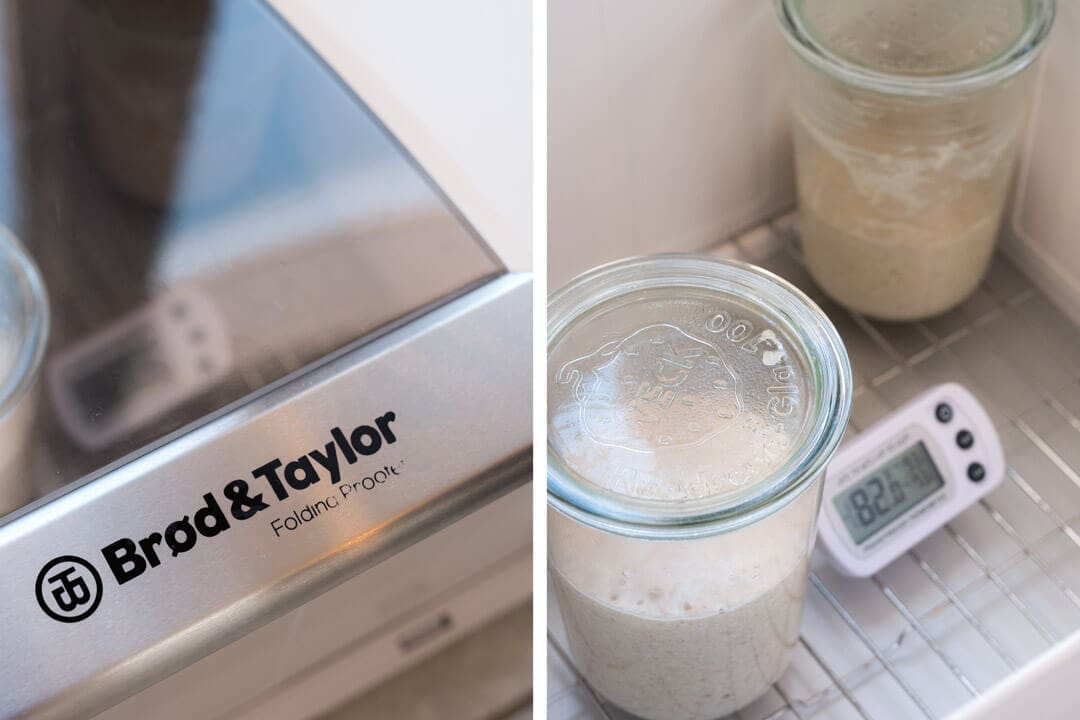
One tool I mention occasionally (and have been frequently asked about) is my proof box. In the past, I’ve considered building one of these on my own with a digital controller and ice chest, but in the end, I bought this Brød and Taylor dough proofer. It’s been plugged in and turned on ever since. I keep my starter in the box all day, every day, at just the right temperature—for me, that’s around 74-76°F (23-24°C).
Additionally, when making a levain for a single bake, I’ll place that in the center alongside my starter (also seen above). After I mix my dough, I can also easily fit my standard 2kg dough in the box, which is then also maintained at the right temperature during the entirety of bulk fermentation (the dough’s first rise).
The nice thing about this temperature-controlled box is that I can quickly get my starter back up to a warm temperature after taking it out of the fridge. Once I take it out, I place it into the proofer set to 76°F (24°C), and it will return to full activity in short order.
This proofer is one of those tools that help me achieve more consistency with each bake. If someone asks, I also keep a small thermometer next to my starter that tells me the current temperature at that spot and the highest and lowest temps recorded (handy to know if there were any spikes up or down).
See my post on using the Brød and Taylor proofer for more information. If it’s cold in your kitchen, refer to my guide on baking bread in the winter. Conversely, if it’s warm, my guide on how to bake bread in the summer will have tips for keeping your dough cool and under control.
Weekend Bread Baking Schedule: How do you schedule sourdough?
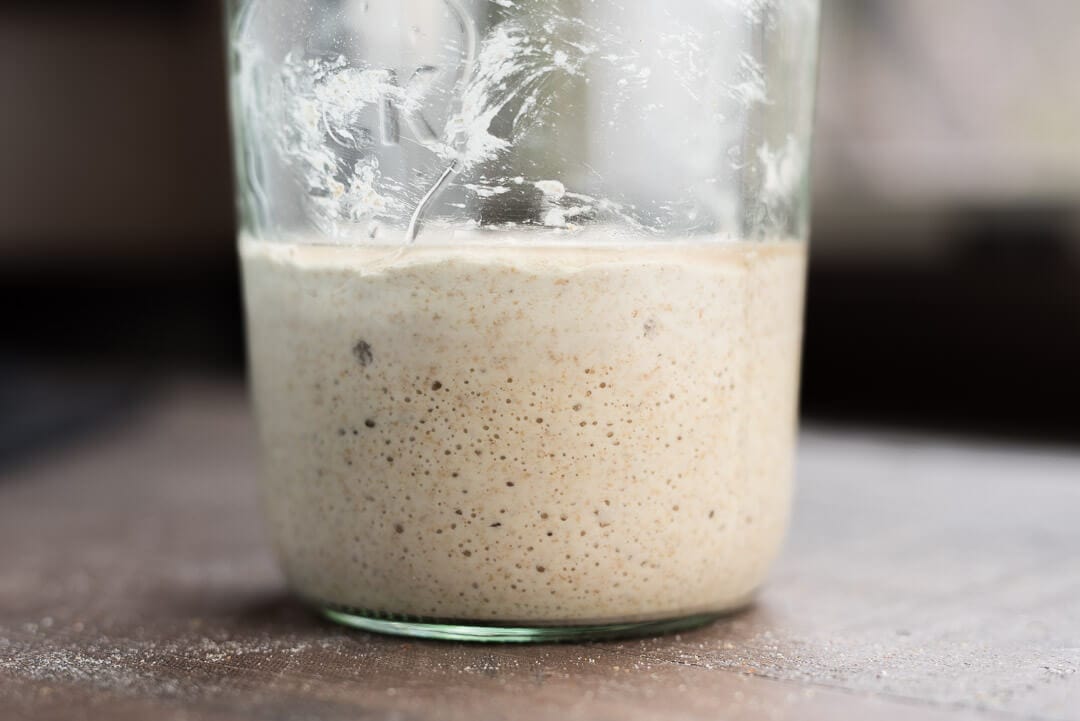
Before we begin, I want to show a picture of what my starter typically looks like when it’s at full strength, regularly receives refreshments, and I keep it at a warm temperature in my proofer:

Above, you can see the signs for vigorous fermentation: bubbles at the top and the sides, some rise height (it’s “peak,” as some bakers call it), and a loose and frothy consistency. My starter usually takes about 11-12 hours to get there using my typical refreshment (20g ripe starter, 100g flour, 100g water at room temperature) when it’s kept in my proofer at around 76ºF (24°C).
I followed the exact process I’m about to outline with my starter for a week, and I took photos of each step to illustrate the method better. In addition, I baked two loaves of Beginner’s Sourdough Bread and made sourdough pancakes to illustrate the effectiveness of my resuscitated starter. As a result, you’ll see my starter transition from states of high activity, reduced activity, “rest,” and the reverse when taken back out of the fridge. This progression will help me explain the cues and what to expect as your starter changes.
My stater performs best when given at least 2-3 refreshments after it’s taken out of the fridge but before being used to create a levain for baking.
Thursday
Our starter has been in the fridge for several days at this point (since last Saturday). Fermentation has continued, but it’s slowed due to the cold temperatures. Nonetheless, there will still be signs of fermentation (as seen above): some scattered bubbles and potentially a layer of thin liquid on the top that’s gathered. This liquid, sometimes called “hooch,” is a byproduct of fermentation and consists of alcohol. It’s not harmful, and I usually stir this down into the mixture during the first refreshment (you could also pour it off if you’d like).
Evening: Remove Starter from Fridge
When you get home from work, take your chilled starter out of the fridge and let it come to room temperature (or place it in a proofer set to warm temperature) for a couple of hours. I give mine enough time to warm up, become easier to stir, and potentially finish fermenting a bit longer.
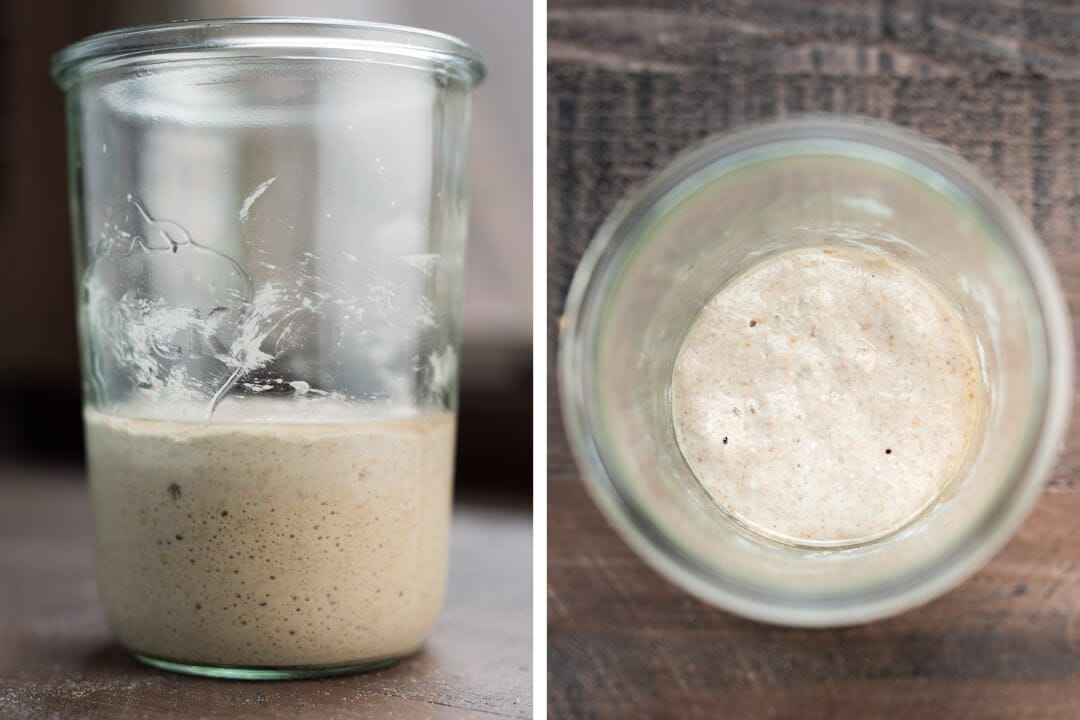
You can see the transparent layer of liquid on top, some bubbles in the interior and on top, but overall nowhere near the vigor you’ll see in my starter when kept in my proofer.
Before going to bed, discard the contents of your jar down to 20g ripe starter and add 100g room temperature water and 100g flour (or your standard refreshment flour mixture). Place your starter in a warm location or a proofer, and let ferment until the morning.
Friday
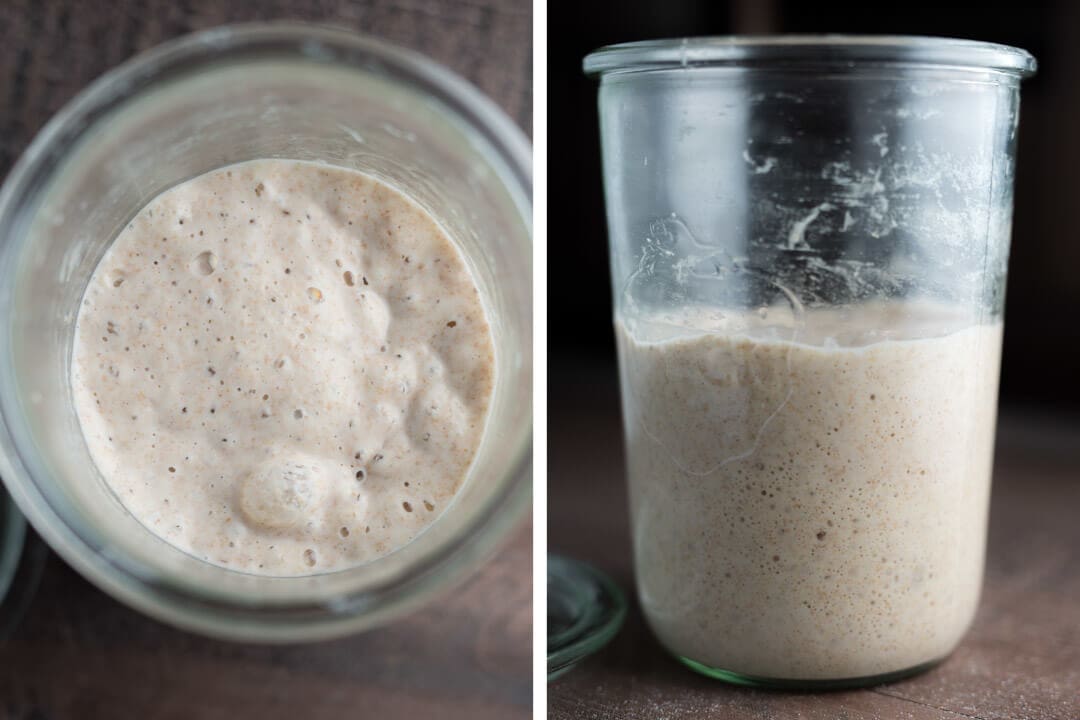
In the morning, you can see above that my starter is still a bit sluggish to rise and overall still not up to total activity (compare the above picture to the one at the beginning of the schedule). However, it has only had a single refreshment since you pulled it from the fridge, and with 24 more hours to ferment after this refreshment, we’ll see the activity pick up quite a bit by Saturday morning.
Morning: Refresh Starter
Before heading off to work, refresh your starter with whatever ratios you typically use to have your starter last for 12 hours before needing another refreshment. For me, I discard the contents of my starter container to 20g ripe starter and refresh with 100g flour and 100g water at room temperature. Then, stir, place the loose-fitting lid back on, and put the jar into your proofer or on the counter. Let ferment until later in the evening.

Evening: Refresh Starter
You’ll see that by the evening, your starter will display signs of even more vigorous fermentation—things are starting to pick back up to normal. So, in the evening, before bed (or when your starter needs refreshment), do a regular refreshment. I made the same refreshment as the morning.
In the morning, we’ll finally build a levain to mix the dough on Saturday.
Saturday
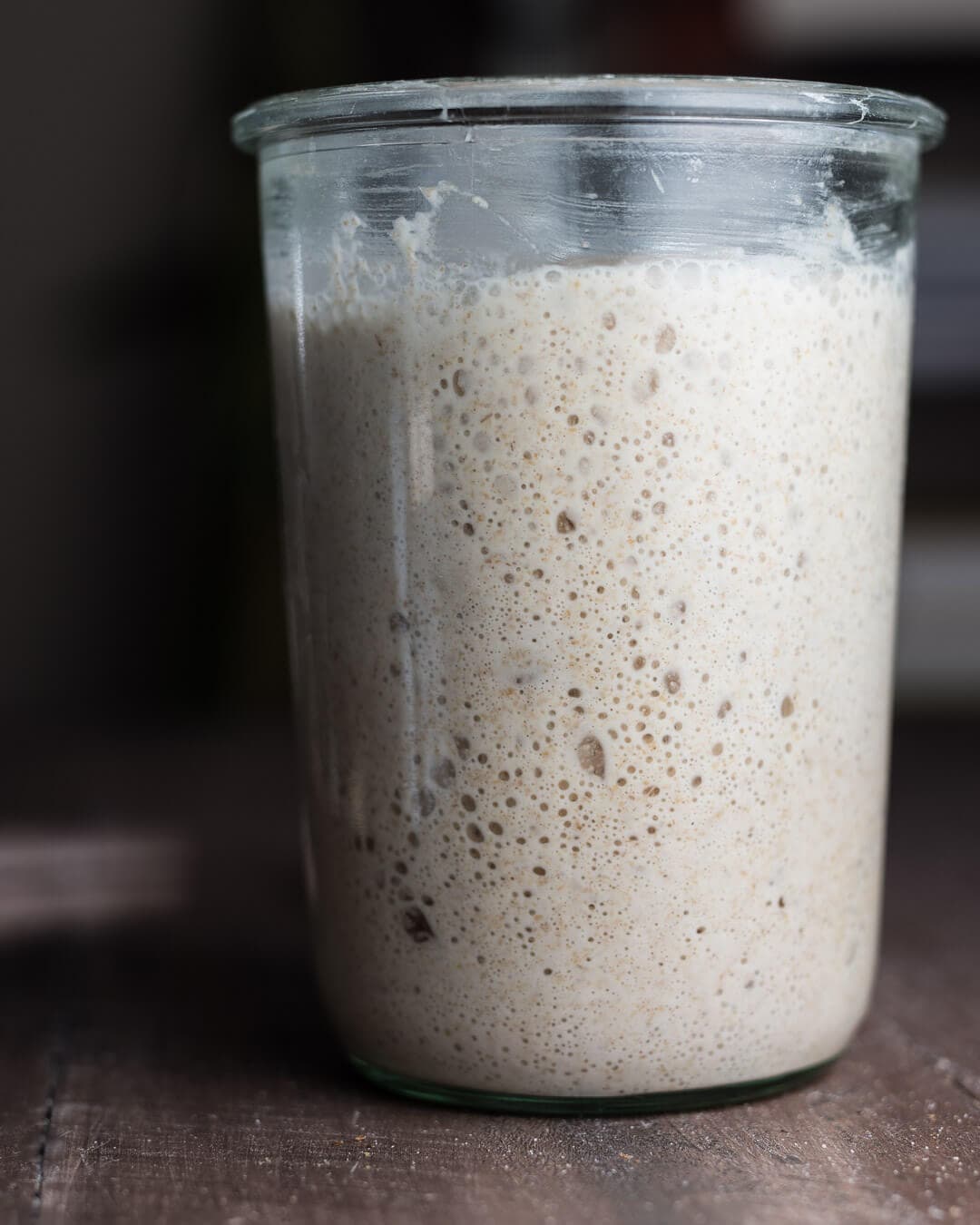
As seen above, my starter is back at full strength by Saturday morning. Super strong signs of fermentation occurred overnight with lots of bubbles, nearly the same height as usual, and a smell that’s ever so slightly sour and yet relatively mild—pleasantly reminiscent of creamy yogurt.
Morning: Build Levain
First thing in the morning, make a levain that will be used in a dough mix later that day. The recipe I decided to use here is based on my Beginner’s Sourdough Bread formula, but you could make a levain from any of the recipes here at my site.
After mixing a levain, place it in the proof box or somewhere warm in your kitchen, and let it ferment until it’s ready to be used later in the day. From there, autolyse (or not), mix, and continue to follow whatever bread recipe you’re baking.
Morning: Refresh Starter
After making a levain, refresh your starter and place it in the proofer or the counter until the evening. Why do we bother refreshing the starter? I do this to give my starter enough food to get through the day to nighttime, where I will prepare sourdough pancake batter for Sunday morning. If you want to skip making pancakes (why would you?), refresh your starter (as outlined Sunday morning, below) to prepare it for cold storage until next week.
Afternoon: Mix, Bulk, Pre-shape, Shape and Retard Dough
Proceed to follow whatever sourdough bread recipe you started this morning, then place the dough in the refrigerator for an overnight retard for increased flavor (you will bake the bread Sunday morning).
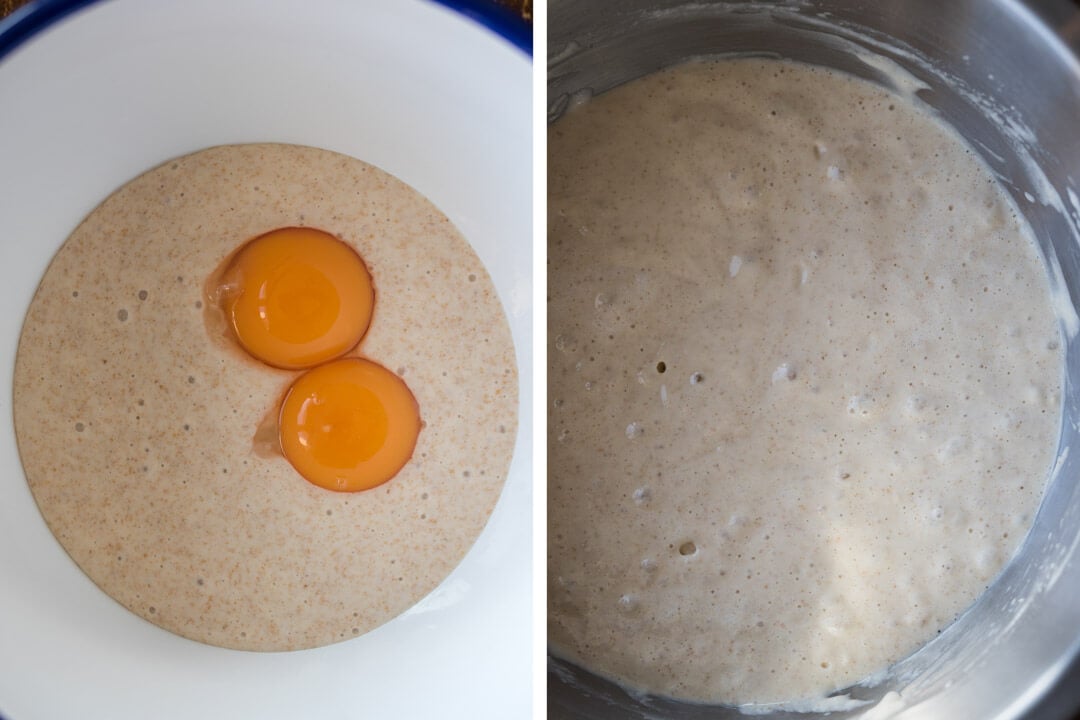
Evening: Make Pancake or Waffle Batter
If you feel like light and fluffy pancakes, use my overnight sourdough starter discard pancake recipe to make the pancake batter at night and let ferment until the morning. Alternatively, if you feel like something crunchier, make my overnight sourdough waffles.
Evening: Refresh Starter with Maintenance Ratios and Refrigerate
After making the pancake batter, refresh your starter using the maintenance ratios I described at the beginning of this post. Let sit out 30 minutes to 1 hour and then finally place back into the refrigerator until next week (or whenever you want to bake again).
Sunday

The past few days have built up to this final day, the day we get to enjoy not only fresh sourdough pancakes but also fresh sourdough bread later in the afternoon. Remember, at this point, your starter is in the fridge and resting until next week. So there’s no need for refreshment this morning.
Morning: Make Pancakes, Preheat Oven
In the morning, preheat the oven to prepare bread after breakfast. Additionally, get that smoking hot griddle (or 12″ steel skillet like I use) going and get ready to make some pancakes. Finish making the pancake batter, cut up some fresh fruit, and whip some heavy cream. Finally, make the sourdough pancakes and enjoy while the oven preheats.
Afternoon: Bake Bread
Continue to follow whatever bread recipe you started and bake the sourdough bread once the oven is preheated. Let cool and enjoy just in time for lunch. Again, your starter is still resting in the fridge, waiting until you want to bake again.
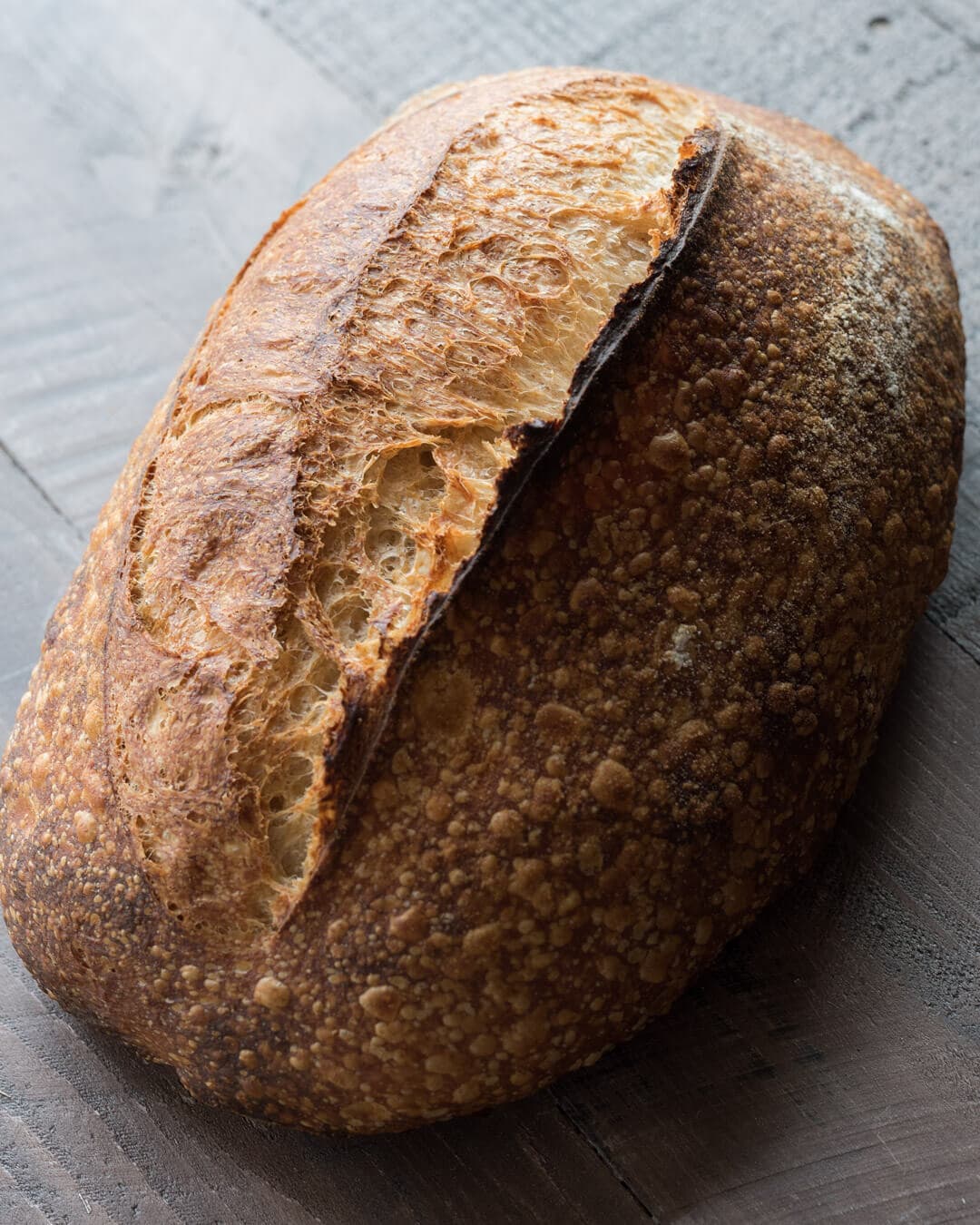
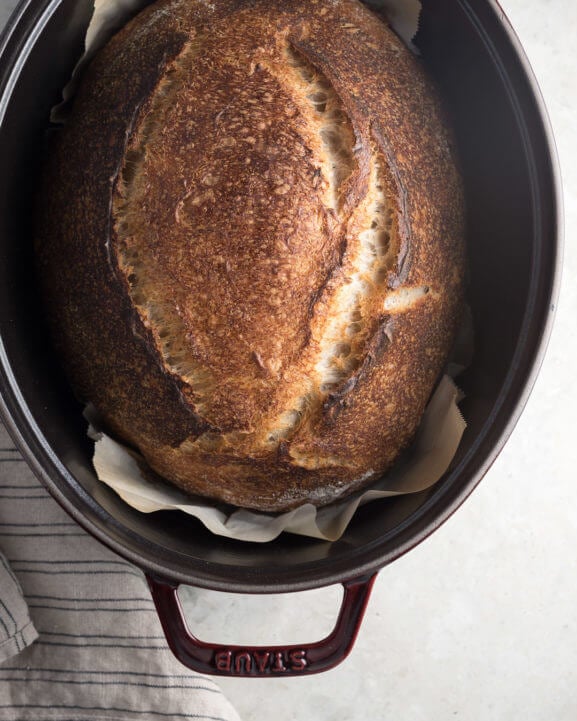
Lately, I’ve also been experimenting with baking my usual 900-950g batard shape (instead of being forced to make a boule in a combo cooker) in a 5.75 qt Staub Cocotte and, as seen above, the resulting bakes have been fantastic. The steam trapped inside is sufficient to blister the crust and the radiating heat from the cast iron colors the crust beautifully. I will continue using this, especially for single loaf bakes (it’s also pretty amazing in the kitchen for roast chicken!) when steaming the entire oven isn’t necessary.
Alternatively, you could use your typical Dutch oven or even the Challenger Bread Pan for long, oval loaves.

The various bread shots used my refrigerated starter throughout this post—all fantastic bakes! I’ve found using a schedule like this to help offset workload during busy weeks while still ensuring I enjoy fresh bread on the weekend and into the following week.
At first glance, this weekend baking schedule post might come across as packed with many steps, but the fridge does most of the work. This way, our starter only needs attention a few days at the end of the week, removing many maintenance refreshments while still allowing us to make great bread. The key is using the cold temperature of the fridge to slow fermentation Saturday through Thursday and then only three refreshments before baking. And while our starter is out for bread, we might as well make some sourdough pancakes that make the weekend go from great to excellent. Buon appetite!
Weekend bread baking schedule FAQ
How do you schedule sourdough?
In most cases, your starter can be kept in the fridge, taken out a day or two before you need to use it, given two to three feedings, then used to make a levain or mixed directly in the dough.
How can I increase my sourdough activity?
To increase sourdough starter activity, keep it at a warm temperature and give it timely feedings. I like to feed it every 12 hours and kept around 74-76°F (23-24°C).
How do I make my sourdough schedule fit?
In the end, this is a personal thing! Your starter can go 12 to 24 hours between feedings when kept at warm room temperature, and at each point when you feed it, it can be used to mix into bread dough. This gives you multiple opportunities throughout the day to make fresh sourdough bread.
What’s Next?
Now that you have a go-to method for a weekend bread baking schedule check out my weekday sourdough bread for when you want to try and squeeze a loaf of fresh sourdough in during the busy workweek.
If you use the tips in this post, tag @maurizio on Instagram and use the hashtag #theperfectloaf so I can take a look!


234 Comments
Hi! I made the beginner’s loaf the other weekend but had no whole wheat flour, so I used rye for the levain and all purpose in the dough… however it didn’t rise as much as I’d like or as much as your photos show. I still don’t have whole wheat but I do have all-purpose, bread, and rye (+some crazy ones like quinoa and coconut :)). Any ideas for substitutions for whole wheat?
If you wanted you could leave out the whole wheat altogether, just use a mix of the bread flour (or all purpose) and the small amount of rye called for. It will be a wonderful bread!
Thanks so much for the response! I’ll try that next time. Hope you’re doing well!
Since I didn’t understand the 10g and than the 20g, I just went ahead and used 20g to start. Today is Thursday and I see that I should take the starter out tonight. When looking at it, I see a lot of bubbles but I also see a very thick crust on top. Is this normal and do I take the crust off? Why did this happen?
That’s the correct approach, I’d leave 20g in the jar. You can take the crust off if you’d like (it’ll be hard to mix it back in anyway). A crust like that will form if the lid is not on tight enough — too much air getting into the jar! It’s ok though, not a huge deal, but I do prefer to keep mine covered.
When I am only baking one loaf (ran out of enough bread flour for two!) do I use the same amount of levain or half as much? Seems on your website or in one of your videos you indicated to use the full amount of levain as for two loaves. Thank you.
Karen — if you’re making just one loaf and halving a recipe, then also use half of the levain. Happy baking! Hopefully more flour comes to the shelves soon…
In the instructions for the weekend baking schedule, you say to reduce the mature starter down to 10g than replenish following the schedule. The list says to use 20g of starter?…. so does this mean I will actually have 30g of starter?…
Can you explain this section a little better? Don’t understand the 10g and then the 20g. Thanks
Refreshment Process
Here is the general refreshment process prior to placing my starter in the fridge:
Using a mature starter (at its peak, ripe), discard down to 10g
Refresh starter with ingredients listed in the table below
Let sit on counter for 30 minutes to 1 hour
Place in fridge for up to 3 weeks
Refreshment Ingredients:
Weight Ingredient Baker’s Percentage
20g Mature liquid starter (100% hydration) 20%
100g Malted Type 85 Flour (Central Milling T-85 Malted, but you could also use a mix of 50% whole wheat and 50% white flour) 100%
80g H2O @ room temperature 80
Please, please, please can you explain this???
Barbara, that is a typo (I’ve fixed it now). Discard down to 20g mature starter, then add 100g flour and 80g flour. Let this sit out for an hour or two, then place it into the fridge. Sorry about the confusion!
Thanks for the update! Moving forward!
I have the same question!
It was a typo, Dianne! The post is now fixed (to say discard down to 20g).
Thank you for all these great resources Maurizio!! I’m trying to maintain the smaller starter, but with this weekend schedule. How do you recommend doing that? How would that affect what flour I feed the starter and when? Thank you for the help!
You’re welcome, Caitlin! You can certainly do that. I’d follow the smaller starter post and then use this guide on when to put it in, and take it out of, the fridge. When putting a starter in the fridge I do like to make it a bit more stiff by going below 100% hydration, so that’s why I call for 80g water and 100g flour (80% hydration). For the smaller starter I’d likely do the same — 5g mature starter, 20g water, 25g flour.
Hi Maurizio! What a time to be a baker. So much demand! Hey, I noticed Central Milling is struggling to fulfill orders on the popular Baker’s Craft Plus…have you ever tried the “Organic Type 70 Malted?” Seems they have that in 5lb bags right now. Trying to be flexible. Have changed up the starter food since I couldn’t find rye but I just threw together some of the best I had in my pantry and the starter is pretty happy. Thanks and hope all is well in your house!
So true, Nancy! Yes, I love Type 70 malted, really, really good flour. I get a bag from time to time and always enjoy it — it’s close to white flour but just a bit more whole grain in there (small amount). Hope all is well and happy baking!
Lodge Bread sold me 10Lbs last week! Right from their makeshift sidewalk counter. Lifesavers!
I follow them on Instagram — true practitioners of the craft. Fantastic work.
Hi Maurizio – this is my second time trying my own sourdough starter and I love how thorough your website is – super helpful!
My starter never seems to pick up enough though. Every time I try to make bread it never proofs enough and I end up with pancakes. It’s winter and my kitchen is quite cold, but I’ve been using a heating pad to try to remedy this (still hasn’t helped though!). Any tips? Both for picking up my starter and then making bread?
Thanks so much!
Glad to hear that, Hannah! Keeping it warm goes a long, long way. You could also try feeding with some portion of rye flour for a while, perhaps 25%, to see if you can increase the vigor. Do this while keeping it warm with timely feedings, I like to do 2x a day. I hope all is well and sorry for the late reply!
Maurizio, I have been baking for 2 months now and your blog was a huge inspiration, I hope my bread come nearly as good as yours one day 🙂 I don’t remember seeing a site as complete as yours. Congratulations.
I live in Brazil, now the temperature is about 27 C (80 F) and after some bakes and lot of study I found out that I was extending the bulk fermentation for far too long, my dough was tripling in size (in bulk).
That’s because I have a tight schedule, I must go to sleep at 10PM so I can wake up at 5AM and go to work. I usually start the mix at 8 PM, so I can do the foldings until 10 PM, and leave in bulk fermentation at ambient temperature (80 F) until 5 AM (9 hours of bulk), then I shape and leave to proof in the refrigerator until I arrive from work.
I tryed to reduce the leaven to 10%, but that was not enough, my dough still tripling (or doubling) in size.
Can you help me figure it out about how to fit that long bulk fermentation in my schedule?
Thank you.
Maurizio, I have been baking for 2 months now and your blog was a huge inspiration, I hope my bread come nearly as good as yours one day 🙂 I don’t remember seeing a site as complete as yours. Congratulations.
I live in Brazil, now the temperature is about 27 C (80 F) and after some bakes and lot of study I found out that I was extending the bulk fermentation for far too long, my dough was tripling in size (in bulk).
That’s because I have a tight schedule, I must go to sleep at 10PM so I can wake up at 5AM and go to work. I usually start the mix at 8 PM, so I can do the foldings until 10 PM, and leave in bulk fermentation at ambient temperature (80 F) until 5 AM (9 hours of bulk), then I shape and leave to proof in the refrigerator until I arrive from work.
I tryed to reduce the leaven to 10%, but that was not enough, my dough still tripling (or doubling) in size.
Can you help me figure it out about how to fit that long bulk fermentation in my schedule?
Thank you!
Thanks Gulherme! That’s a very long time at 27C, I fear your dough will over proof with that temperature. My suggestion would be to do a “cold bulk.” Essentially do as you’ve done with a warm bulk (27C) for 2 hours, then place your dough in the bulk container, covered, into the fridge overnight. When you get home from work the next day, take it out, divide and let it rest for about 30 minutes to come up to room temperature and relax. Then shape the preshaped rounds into their final shape and finish proofing the dough in their proofing baskets on the counter. Depending on the temp in your kitchen, the dough should be ready anywhere from 1-3 hours (use the “poke test” to determine when they’re ready).
This process is very similar to how I cold bulk my sourdough baguettes.
Let me know how it goes!
Hi Maurizio, I finally had the time to test bulk proofing in the fridge, but I did slightly different than you suggested, I mixed and fold after work and did a overnight proof in the fridge. I think that it wasnt enough time, I should have left in the fridge until I arrived from work as you suggested.
I am still learning how to “feel” the dough, but I think that now I undestand how the process works. I will keep trying.
One doubt that I still have is: should I expect that my dough will have the same increase in volume when I proof in the counter or in the fridge? I know that proofing in the fridge will take a looonger timer, but will I get the same volume? I am thinking about that 30% increase to know when I can shape my dough.
Thanks again 🙂
Thanks for reporting back, Guilherme. Regards to final volume: it’s hard to say they’ll be exactly the same, but yes I believe they should be at the same overall level of fermentation if you expect them to bake similarly. I’d shoot for the same volume.
I originally came to your web page to review a recipe. I have now devoured the entire web site and have thrown out all of my previous methods of making sourdough bread. My previous bread was “usually” good but not great. It was always what I considered too dense, and seldom had the big air pockets I would see on other websites. Now I’m fairly confident that a good portion of my failure is how I fed/kept my starter. I suspect I seldom hit the peak of the starter. Usually I used the starter straight out of my main jar. I now have great hopes for a far better experience.
Thank you!
Right on, Jeffrey, I’m really glad to hear you’re enjoying my website. Keeping your starter strong and fermenting consistently is definitely the backbone to baking sourdough. Let me know if you ever have any questions and happy baking!
I love your site, Maurizio! I’ve learned a great deal and, judging from the bread coming out of the oven these days, I am very excited about my new passion! I have a question about your feeding ratios. In this article, for the Friday morning refresh, you mention your ‘everyday’ refresh is *15g* mature starter, 100g flour and 100g water. Yet in your article 7 Easy Steps to Making an Incredible Sourdough Starter your refresh (from day seven and onward) is *50g* mature starter, 100g flour, 100g water. Why are the amounts of mature starter that you use different in these two situations?
Here’s my very simple schedule. I wonder if it’s too simple and gives a less than optimal result (I don’t think so but I don’t have a good point of comparison).
Monday: Starter in fridge resting.
Tuesday: Starter in fridge resting.
Wednesday: Starter in fridge resting.
Thursday: Starter in fridge resting.
Friday: Feed starter in the evening (100g flour & water). Leave out overnight.
Saturday: Starter has more than doubled in size. Bake, using half of the starter (no separate leaven), in the morning and proof in fridge until Sunday morning. Use the basic sourdough recipe. Starter back in fridge.
Sunday: Bake loaves in the morning. Starter in fridge resting.
So the starter is only fed once a week and spends all the time in the fridge, except for the night between Friday and Saturday. Since I mix on Saturday morning the proof in fridge is about 17 hours.
That could certainly work very well for you and your starter! Personally mine benefits from some room temperature time before using it for baking, to get it back up to full strength and maximal yeast/bacteria numbers (and in the right ratio). The only suggestion I’d have is to perhaps try a side-by-side test bake: keep your starter out on the counter for a week and feed it regularly. Use that to bake with and see how it turns out. Then, do the same with your starter schedule as you’ve listed above. Compare the results and see if that countertop starter performed better.
Keep in mind doing comparisons like this require you to keep as many things consistent between the tests as possible (times, temps, flour, hydration, etc.).
Wow! Thanks so much for all the useful amazing info on your site. I think I have figured out (thanks to your posts) that my starter will not work to make a healthy levain straight from the fridge only feeding it once a week. I have now baked 6 loaves that have failed to rise properly and I have tried all kinds of fixes and they haven’t worked. Is it possible to have a levain that floats, but is still not active enough to properly raise the dough?
The “float test” is definitely not a definitive test, but it’s a good general compass for when it’s ready to be used. First, I’m not quite sure what you mean by “fail to rise properly” — this is a very dough-specific thing and it could be many other factors causing issues with the end result! It sounds like your starter and levain are strong and showing signs of fermentation (rise, bubbles, smell, floating, etc.) so that’s a good beginning. From there, make sure the hydration of your dough is suited for your flour mix. If you try to push the water too high in your dough, you’ll end up with a soupy mess that’ll never really come together. From there, make sure your dough temperature hits the temps I specify in my posts here — this is very important! If the dough temp is too low you’ll have to adjust by extending bulk fermentation significantly to compensate (low temp means reduced fermentation activity). If you have all of these things in line, it’s possible you’re going the other direction as well: over proofed dough. If you find when you bake your dough it kind of pancakes out with lots of small holes in the interior try pulling back your proof time a few hours (if in the fridge) and see if you get more spring in your dough.
Send me an email (Contact link above) if this happens again with a few pictures of the dough and final result if you can and I can help you further!
I sort of wonder… You write somewhere that if the starter goes into the fridge, it is a stresfull thing for him. I can agree. What about a method when a starter is always stored in the fridge and only a needed portion is extracted for building a new room-temperature-starter and subsequently a levain. Then you would not stress the starter at all but of course it would be always in that hibernation mode and never gets realy active. I have no idea how that would effect the strength of the starter in the long term. So you think it is better for the starter to take it out of the fridge once a week and make it active? Thanks!
That’s a good thought but in my experience the best thing for a starter is to be kept at room temp (or warmer) for maximum activity. I’ve seen some starters work just fine in cooler temps, but for me and my particular starter, it loves warmer temperatures. The fridge does slow activity and “stress” it — only when I take it out and feed it for a few days does it spring back to normal strength and fermentation activity.
Hello –
Thanks for the posts, these are great. I’m disheartened by how much flour it takes to prepare for a single loaf of bread. If I’m reading correctly, and it seems I might be off, you recommend feeding/refreshing your starter five times from the point you take it out of the fridge.
1. Thursday night (refresh)
2. Friday morning (refresh)
3. Friday night (feed)
4. Saturday morning (refresh)
5. Saturday night (refresh)
I’m not sure if there’s a difference between feeding and refreshing, but it looks like it would take 500g of flour to support the start for a single loaf of bread? I can’t argue that you get results – I aspire to make the bread you carefully explain on your site (thank you), but would love to know if there’s a way to minimize waste.
Thanks!
Hi Maurizio,
I’ve been baking since Feb 2018. I still have my original Starter (I’m proud to say). you and I have communicated a couple of times since then and I have always appreciated your answers and knowledge.
My reason for writing this time is: I broke my stove, the beginning of may so bread making came to a sudden halt until I could resource a new stove. I fed my Starter and put it in the fridge, and basically forgot about it…there was slow activity (100% dark rye). I discarded 50% and refreshed it a week later and then did nothing with it. I subsequently started a new job which took me out of town for better part of two weeks. My starter was in the fridge the whole time…I figured it had died.
Anyway when I got home I took about 50g out and added 100gr each of water and whole wheat flour. It was alive!! I made great bread! I have since then always kept my started in the fridge diminishing it between 20 – 50 gr per bake (3 times a week) and when it gets down to approximately 75 gr I simply add 150 gr. each of dark rye ad water. Bread tastes great. Starter looks healthy. Is this okay to do? I replenish my starter probably once every 2 weeks and only take from it in-between.
I kinda figure if it aint broke don’t fix it…what are your thoughts.
Thank Steve!
Hi Maurizio! I want to bake in my Staub cocotte but am worried about ruining the enamel by pre-heating empty. Any tips?
Hey, Robin! When I preheat my Staub I do get some discoloration on it — I was heartbroken! I’m not sure what causes this because I don’t always see it, just sometimes. Regardless, I’ve been able to remove 100% of the discoloration by scrubbing the outside of the pot with a mixture of baking soda and water. It comes off like magic. Do use caution when baking in your Staub. What worked for mine may not work for yours… Also, make sure the handle can take the heat (no plastic) and you could try a lower temp.
Robin — another idea is you could even try baking with your Staub without preheating it, check out this article on this topic over at King Arthur Flour.
Hey Maurizio. Love the site! One question. Isn’t using 15g of starter too little? Can I use 100g starter 100g flour and 100g water to refresh my starter? I read somewhere that you should use the same amount of starter, water and flour to refresh hungry starters. Is this true?
Can you please explain why there is a ned to refresh the starter twice, once one Thursday & once on Friday & then after you make the levain on Saturday?
Hi Maurizio, I notice most of your recipes include leaving overnight in the fridge. What temperature do you keep your fridge at? I’ve been having a mixed experience following your recipes, when they come out good, they come out so goooood, but sometimes I think they get overproofed in the fridge, and so I think that it’s my fridge temperature that might be causing that. I live houston, a pretty humid place, but my kitchen is usually around 78-80 degrees. I usually get to the end of bulk and shaping pretty well and looking real good, and it’s just sometimes I never know about what’s coming out of the fridge. Usually it’s awesome, but every few I get it overproofed. Ideas? Fridge temp? Thanks! Yr the best, your loaves get me all the instagram likes :))))
Hi Maurizio, thank you for your generosity, it is so encouraging and I am looking forward to lots of good bread.
What do I do with the starter when I go on extended holidays?
hey maurizio, it’s necessary to build levain from the ready starter or, if i have enough ready starter i can use him into the dough ?
thank you.
Hi Maurizio love your website, information and pictures. I’ve been trying to bake the last few weeks and I’m having issues with my loaf rising. I’ve ensured the starter and levain are active before proceeding the the bulk fermentation and proofing. In this last loaf I checked temperatures as well. I’ve uploaded a photo not sure if you can help out and let me know what you think might be going wrong with my bakes. https://www.dropbox.com/s/6al1ornaeff227x/bread.jpg?dl=0
Any help would be appreciated.
Thanks.
Hi Maurizio, I made my sourdough starter completely using whole wheat. Its around 18 days old now. I fed it once for every 24 hours for first 6 to 8 days and then I have been feeding it twice a day (every 12 hours) with 100% whole wheat in 1:1:1 ratio for last 10 days and it gets 2.5 times in size every time in 4 hours and maintain the peak for next 4 to 5 hours before slowly falling down. Now I am thinking about dividing my starter in two parts. One would go in fridge with the ratio you mentioned (20g + 100g + 80g) and I shall keep feeding it weekly basis. The second portion shall remain on my counter and I shall keep feeding it every 12 hours (some times I feed after 15 to 16 hours due to busy schedule) and use it for regular baking. I want to divide the starter maintenance because I have kids in home and there is always risk of the starter at the counter to be thrown at floor 🙂 I have following questions in this regard:
1) Will the strength of over the counter starter with every 12 to 15 hours feeding be more than the starter in fridge that shall be fed on weekly basis?
2) My room temperature is currently 30C (86F). I expect it to rise to 34 C (93F) during the summer. Will this affect the quality, taste and strength of my over the counter starter being fed every 12 to 15 hours?
3) Does starter behaves the same in fridge? I mean does it rises as it rises over the counter and then slowly falls down? If yes, can we feed the starter in the fridge after every 3 days instead of one week?
I shall greatly appreciate your response.
I know this sounds like blasphemy, but if I don’t plan on baking every week, how would you feed a refrigerated starter? Do you still recommend feeding it multiple times, or can I just feed it 1/week to maintain?
Hello again,
Can I refrigerate the dough mixture before adding salt to control my timing? Can you mention all the times during the whole process where dough can be refrigerated? I find it difficult to control timing!
Thank you Maurizio for great information on weekend bake! Is it possible to create a printable timetable that we could follow? I will frame it and hang it on the kitchen wall!!!!!!
Hi Maurizio,
Thank you for your amazing blog! I have learned so much. What sized oval brotform basket do you use in your 5.75q oval staub? Do you have a link where I can buy it? thank you in advance
Hi,
Thank you for your blog, I have started the starter few days ago, can’t wait till weekend to bake! But I have one point I would like to clarify with you. The refreshment section you have mentioned at the beginning of this post, is it the one I shall follow if I am not planning to bake soon, which you have mentioned could last for 3 weeks? And the starter you have taken out on ‘Thursday’, is it the same thing? And the feeding will be the same even if the starter have been hibernating not just from ‘last Saturday’?
Thank you
Yes, that refreshment is what you’d do prior to placing your starter in the fridge. When I take my starter out of the fridge and plan to use it I’ll resume whatever refreshment ratios I’d normally do when it’s not in the fridge. For example, I’d typically discard what’s in the jar down to 15g starter and then feed that 100g type 85 flour and 100g water at room temperature — use whatever ratios and flours you’d normally use at this point.
Essentially I reduce the hydration of the starter when I place it in the fridge to slow things down a little more. When I take it out I feed it whatever I normally would (100% hydration, for me).
I hope that helps!
Hi,
I have tried your “best sourdough” recipe today. I was so excited and I am glad that it turned out very nice, Thank you! Though I am not sure if it is because of the cold environment in general ( I live in Stockholm), the fermentation takes way longer than expected ( both in bulk fermentation and the levain step). So I actually left the dough for autolysing way longer than written in the recipe, will it be the reason my dough is pretty wet and doesnt look as stable as the one in your photo? Or I didnt stretch and fold enough?
This is a dram coming true, exactly the information and help I needed. Clear and detailed. Wonderful, thank you!! Just one question. Refreshing and feeding the started is the same thing?
Glad to hear that! Yes, refreshing is the same thing as feeding. Happy baking!
Hello. I just did this weekend bake. The bread was “only” my 3rd attempt at your beginner sourdough loaf. My 3rd attempt at any sourdough bread. It was the best yet. I am very excited at how it turned out. Wish I could post a picture. Still a little tweaking like figuring out how not to have a nearly burnt bottom that is almost impossible to cut. It did not slow down the 4 teenagers who spent the night and finished both loaves. (Need to make more now.)
I also did the waffles/pancakes. I did both because I wanted to try both though I had my batter a little too watery. Stilll, very delicious!!
Thank you for these awesome recipes!
So, so awesome to hear all this! It’s so fantastic to have fresh (and super healthy) bread at home 🙂 Enjoy!
If you are getting the bottom of your bread too done, try placing a baking sheet on the bottom rack of your oven. That will reflect the heat from the bottom element in your oven, and the bottom of your bread will not get done before the top. HTH!
Super suggestion, Warn, thank you!
Just wanted to clarify something.
Under the heading Evening: Remove Starter from Fridge you mention “Before going to bed, discard the contents of your jar down to 30g mature starter and add 100g room temperature water and 100g flour” while earlier you say “My starter usually takes about 11-12 hours to get to there using my
typical refreshment (15g mature starter, 100g Type 85 flour, 100g water
at room temperature) when it’s kept in my proofer at around 76ºF.”
My question: what is your feeding formula for the (first) Thursday night feeding? Do you start with 30 grams or 15 gram starter?
Thank you!
Great question, and somewhat conflicting information presented there. When I take my starter out of the fridge for the first time I usually leave a bit more than the 15g in the jar to ensure the process starts up in a timely fashion. The mixture will be cold and a little extra mature starter left in the jar helps with this.
I hope that makes sense — great catch.
Hi Maurizio, first I’d like to say thank you for your site and sharing great information! I’m a new home baker and your posts have really helped me out… I have a question for you, at what point should I be putting my sourdough starter in the fridge? Is it when it is doubling in size?
Glad my site has helped! You want to put it in the fridge 30 minutes to 2 hours after a feeding (refreshment). So discard a portion of your starter, feed it new flour and water, let it sit on the counter for a bit, then place it in the fridge. If you place it in there too soon after feeding it might be too far along metabolizing the new food. Hope that helps!
Thanks for the response! This is very good to know. And to be more specific about my question… (This is a new starter and it’s been about 2 weeks now, feeding it twice a day)… How do I know when the starter is at its optimum use and be able to store it in the fridge to bake with it once a week? I don’t want to put it in the fridge if its not ready… Its pretty cold where I am at, maybe thats why…
Thank you so much for your help!
That’s a valid concern: you want to wait till your starter is strong enough before placing it into the fridge. I’d say once your starter is ready to leaven bread, it should be fine to store in the fridge for a week or so at a time. You can tell when it’s ready if it’s reliably rising and falling each day at around the same time when in the same conditions. You should see signs of solid fermentation that happen each day — bubbles, smell changes, a rise and fall (the amount isn’t super important, just that it does).
Hello Maurizio!!! I’ve got more thanks to you! 🙂 I keep on reading your articles, and I decided to try the schedule for weekend baking which you offered and keeping the starter in the fridge. I put my 10 days old started into the fridge (later I read in some comments that you recommend to wait till the starter is strong enough before putting it into the fridge, but I didn’t know that before)
So, I put it into the fridge, and took it off in 3 days and refreshed 5 times before baking (two refreshments a day, in the morning and in the evening). The first day it was weak – you predicted that in your article, then it became strong again, and I baked one more wonderful loaf of bread with it! I am so grateful for your precious articles!
Happy holidays to you dear Maurizio and to your family and close friends and people in your life!
Love!
Hey again, Elena! Glad you’re still reading through all my posts! Yes, I always like to wait until a starter is very strong before placing it into the fridge (which weakens it somewhat). Sounds like yours is doing just fine, though! Glad to hear your bakes are going so well.
Happy holidays to you and your family as well!
thanks!!!
I cooked my starter. I put in oven with light on thinking it would be like proofing to be ready for Saturday Levain mixing. I’m very sad..
Ahhh so sorry to hear about that! I just posted about how I deal with the winter weather in my post on the importance of dough temperature, too. Bummer!