“This is really good but you should try to make sourdough potato bread sometime, it’s delicious.” I’ve probably heard my Dad utter a version of that fifty times to date, usually just after eating a slice of my fresh sourdough bread.
I love how eating good food tugs at an invisible, interconnected web of food-memories we’ve constructed over the course of our lifetimes. This complex web, with scattered connections between foods, smells, experiences, and memories, is gradually filled in and ever-evolving: it shapes the corpus of foods we enjoy, giving them significance in place and time. Perhaps the construction of this web is instilled at a primal level, maybe it’s a way we’ve evolutionarily progressed to favor foods that provide proper nourishment by exciting our senses, pushing out hollow foods that provide nothing or are uninteresting. I believe it’s one of the many reasons we’ve stayed alive for so long, eating the things we need instead of those we don’t.
But this web might not be as invisible and hidden as it might first seem. We see evidence of the intermingled connections each time we sit down to eat: “this cake reminds me of that one you made 2 years ago when…,” or “this salad reminds me of that time we were traveling through Italy and stopped in at…” In fact, I’d go out on a limb and say just about every meal I eat with my family we talk about other meals eaten, or other dishes enjoyed in the past — and it’s through that traversal of the food-memory web where we are instantly, and clearly, transported to a significant time and place in our otherwise blurred history.
In any case, my Dad must have many connections back to a distant potato bread. He often mentions his Mother and the bread she would make them as a kid: 100% potato to flour by weight, small bits of potato throughout, creamy, soft and of course, starchy.
I set out to pay homage to that bread but modify it slightly (as I do) until I found just the right flavor and texture. I do hesitate to call this potato bread (or pane alle patate) because that might define a bread that has much more potato than my formula. And, as my Dad indicated, most of his memories of this bread from Italy usually have equal ratio potato to flour. While I know that would be delicious, this formula produces a lighter loaf that still pairs very well with other foods (aged cheese comes to mind immediately). If this bread was intended to be eaten on its own, and with 100% potato it surely could be a meal-in-a-slice, I’d continue to push the potato percentage even higher, perhaps to 75% or even up to 100% per tradition. Let’s save this for a future experiment.
I should note that through my development of this recipe I provided my Dad with ample test loaves and gathered his input. My final version here scored the highest marks, even if I did receive a final comment indicating I should push the potato percentage higher one day…
But for now, on to roasting some potatoes.
Sourdough Potato Bread
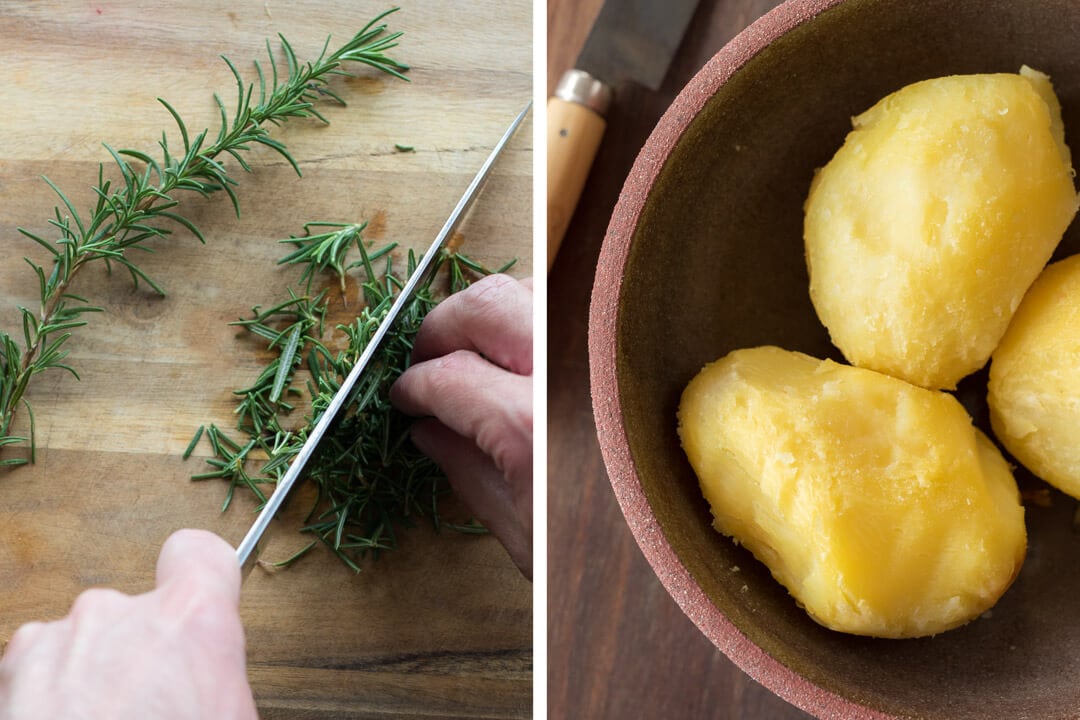
My version of potato bread is a spin on an Italian bread laden with mashed/pureed potatoes. In taking cues from my approach to making gnocchi, I like to roast the potatoes instead of boiling them. I find this gives the potatoes a nice color and texture; plus, it helps dry the flesh out, preventing unwanted water absorption that could later be released into the dough.
Roast the potatoes instead of boiling to avoid excessive water absorption.
Potato and rosemary are a classic pairing but you could substitute the rosemary for another spice such as thyme (which is what I tried for my first few attempts seen below), or omit it entirely for a cleaner, more potato forward flavor. Speaking of rosemary, I find not all rosemary plants produce the same level of potency in their leaves. Some plants, like mine, are quite pungent and strong while others are simply not. Start with the recommended 1% rosemary and scale up/down to suit your taste after you try the first bake. As with my previous polenta sourdough with rosemary, I like to keep the spice light so it doesn’t obscure the other flavors throughout.
I chose to puree the potatoes in my blender for a smooth consistency (and a few chunks) but you could also dice the potatoes if you’d like to have bits of potato very evident in the crumb. Additionally, you could wash the potatoes and leave the skin on for added texture and interest.
Early trials of this recipe using thyme instead of rosemary
Build the liquid levain (everything listed in the Levain Build section above) in the morning and store somewhere around 78-82°F (25-27°C) ambient.
2. Roast Potatoes & Prepare Rosemary – 9:35 a.m.
After building the levain, preheat the oven to 425°F (218°C). Prepare a small baking sheet lined with parchment, wash the potatoes and using a fork to perform a few shallow pokes around the potato.
Once the oven is preheated, roast the potatoes on the baking sheet for 45 minutes to 1 hour, rotating and flipping them halfway. Test the potatoes at 45 minutes to see if they are done by inserting a knife into the center. The knife should slide easily and not encounter any tough spots.
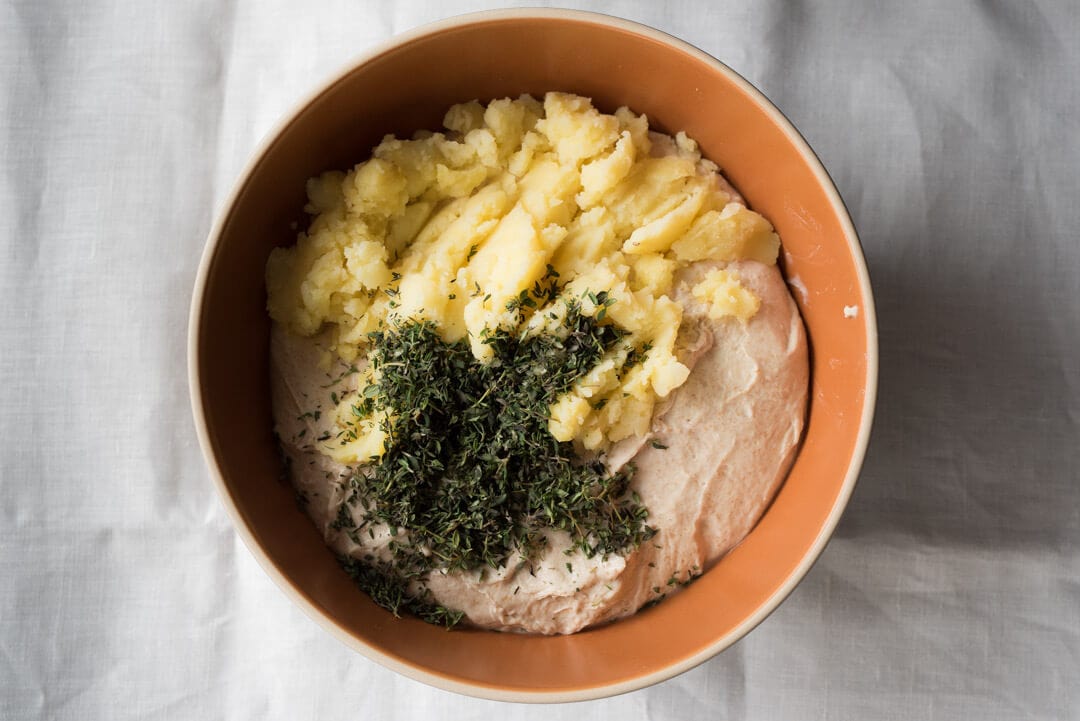
Let the potatoes cool until you can handle them, then peel and puree in a blender (or mash them with a potato masher) until smooth and just a few large chunks remain. Let cool until called for during mixing.
Pick, wash and coarsely chop the rosemary called for in the formula. Set aside until mixing, later.
3. Autolyse – 11:30 a.m.
Mix flour and water (reserve 100g water for the mix, later) in a bowl until all dry bits are hydrated. Cover the bowl and store it somewhere warm near the levain for 1 hour.
4. Mix – 12:30 p.m.
Add the called for levain and about half of the reserved water to the mixing bowl. Mix until well combined.
Dump the dough onto the counter and slap and fold the dough (French fold) for about 3-4 minutes, just until the dough starts to show signs of a smooth surface. The dough should be fairly strong.
Let the dough rest 15 minutes.
Sprinkle the salt, rosemary and pureed potato on top of the dough and pour on the remaining water. Pinch the ingredients through the dough and fold it over until everything is incorporated very well. Perform a series of stretch and folds in the bowl until the dough comes back together into a cohesive mass and the ingredients look well distributed throughout. If you encounter any unwanted large chunks of potato, just smash them with your fingers and smear it onto the dough.
Transfer dough to a tub or thick-walled bowl for bulk fermentation.
4. Bulk Fermentation – 1:00 p.m. to 4:00 p.m.
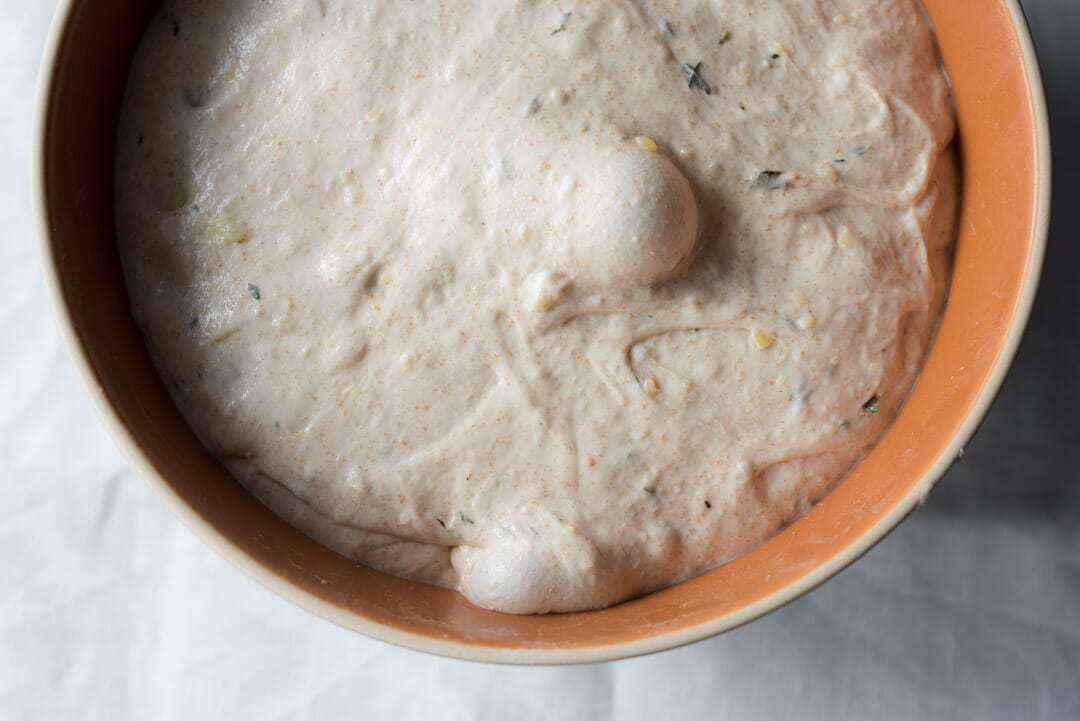
At 78-82°F (25-27°C) ambient temperature, bulk fermentation should go for about 3 hours. Perform a total of 2 sets of stretch and folds during bulk, spaced out by 30 minutes.
This dough felt very strong due to the low hydration (relative to the flour I’m using) but the pureed potato will give it a sticky, tacky feel to it at the end of bulk. Keep an eye on the dough during bulk!
5. Divide & Preshape – 4:00 p.m.
Dump the dough from the bulk container to a un-floured work surface. Divide the dough roughly in half and preshape each half into a round. The dough will feel strong but sticky.
Let the two rounds rest, uncovered, for 30 minutes until relaxed.
6. Shape – 4:30 p.m.
Flour the work surface and the top of each rested dough.
To shape as a batard: flip the resting round over onto the floured surface and fold the top half up and over to the middle and the bottom half up and over the recently folded top. You’ll have a long horizontal rectangle sitting in front of you. Turn the rectangle 90º and grab a small portion of the top, pull up and fold over a little bit, pressing down to seal. Take the rolled top and continue to gently roll it down toward your body with two hands working together. As you do each roll and work your way down the vertical rectangle, use your thumbs to gently press the dough into itself.
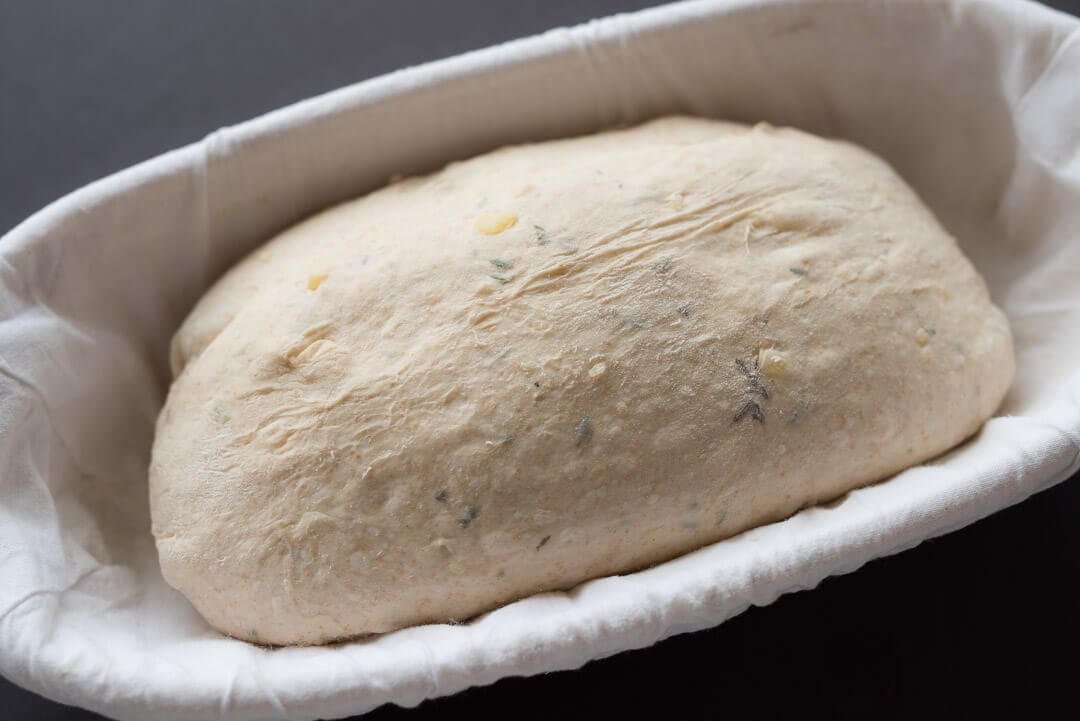
Once shaped, transfer each to a basket lined with a cotton towel (I like to use these towels for this potentially sticky and messy dough — much easier to clean) that has been lightly dusted with white rice flour, seam side up.
7. Rest & Proof – 4:50 p.m.
Cover each basket with plastic and then place it in the refrigerator at 38°F (3°C) for 13-14 hours.
8. Bake – Next Morning: Preheat oven at 6:00 a.m., Bake at 7:00 a.m.
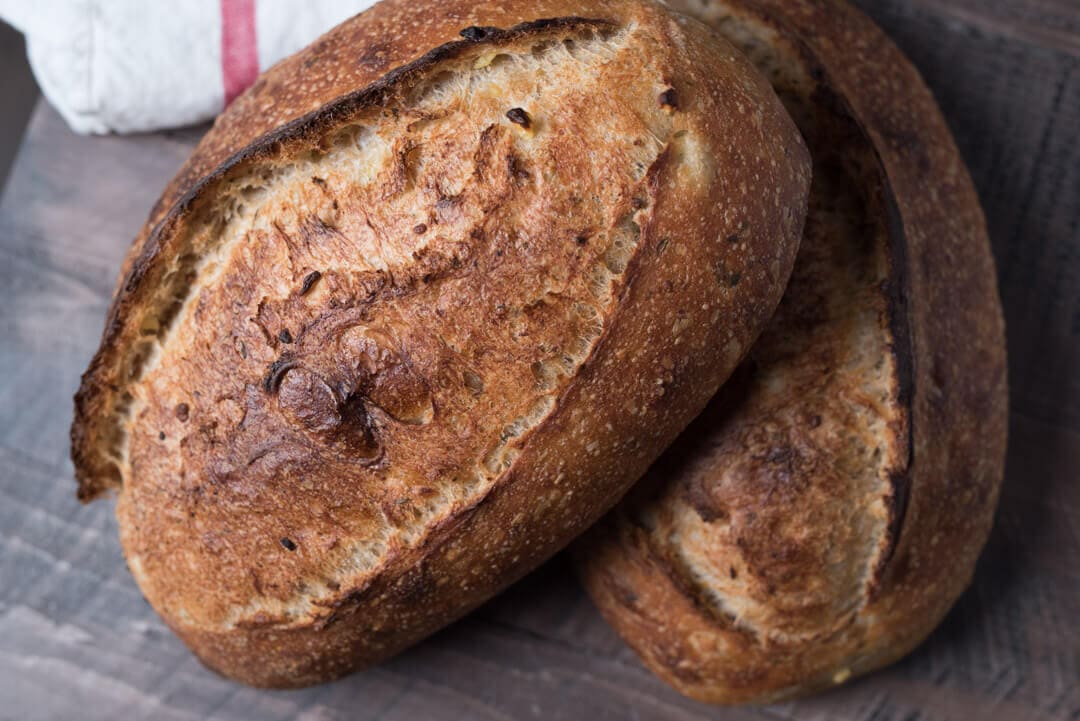
Take out both of the baskets from the fridge and cut a piece of parchment paper to fit over the top, quickly invert each basket onto each piece of parchment. Using a sharp razor blade fastened to a stick (or a lame) score the top of each at a shallow angle to the dough and just deep enough to cut below the top skin of the dough. Start at the top of the oblong loaf and with a single decisive stroke cut from top to bottom with a slight outward bend.
Bake the loaves at 450°F (232°C) for 20 minutes with steam, then remove the steaming pans from inside the oven. Then, bake for an additional 30-35 minutes or until done.
The taste, texture, and wholesomeness of this bread are evident from the first bite: it’s filling and solid, but somehow also delightfully light and soft. Sometimes there’s a loaf of sourdough that compels you to temporarily forgo any notion of restraint, a bread that threatens to take hold of and subdue, your willpower. You might find yourself in a deep trance with your hands on autopilot, cutting this bread slice after slice as they quickly disappear from the cutting board to your mouth. If you have brie or a similar cheese within arms reach, you might want to call for help.
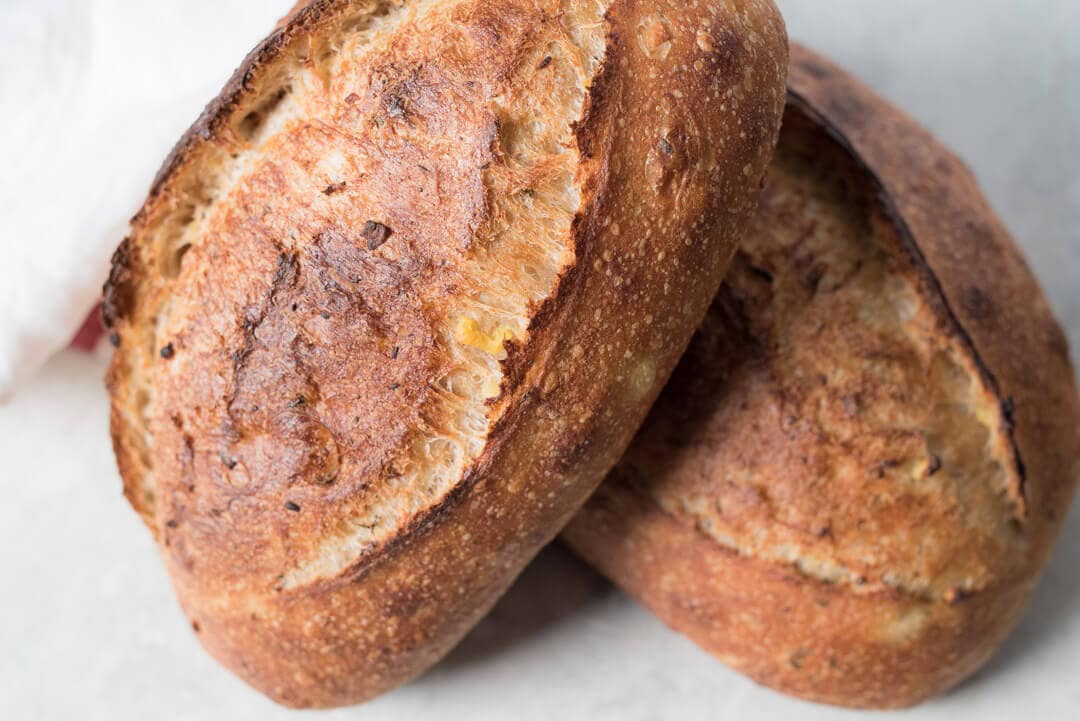
Crust
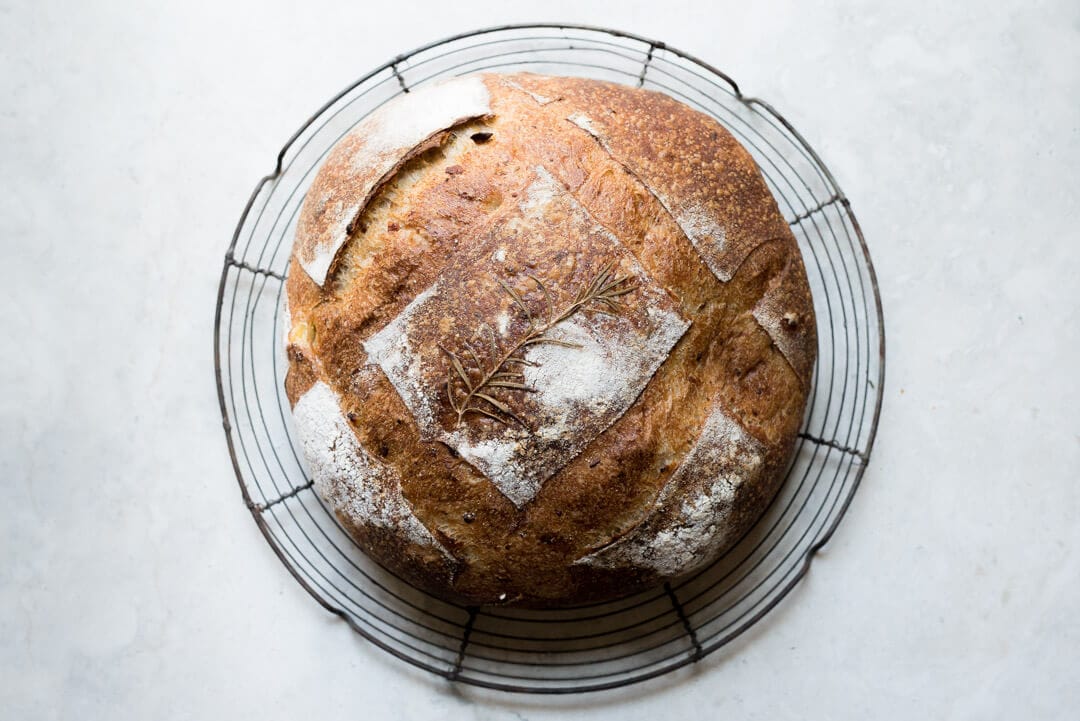
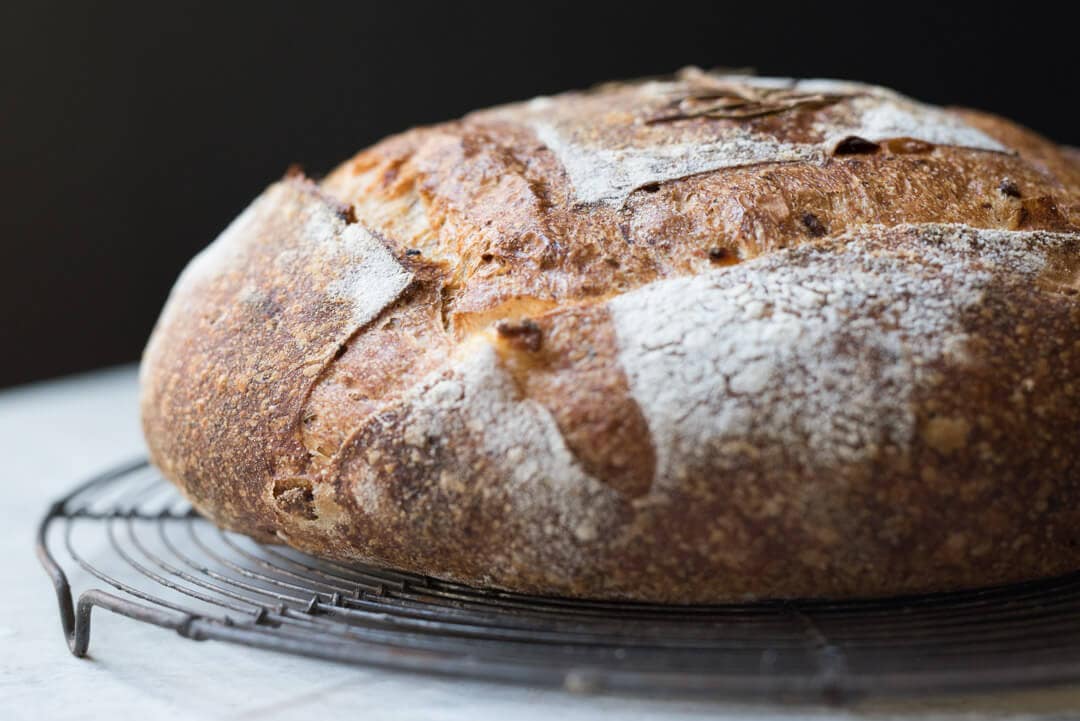
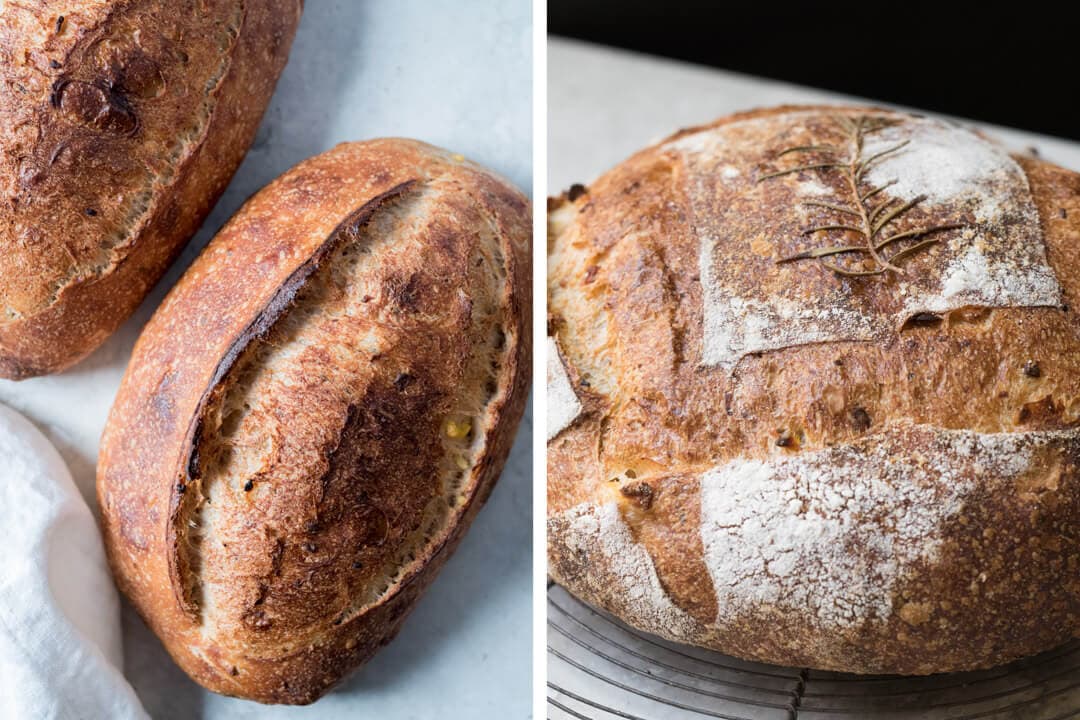
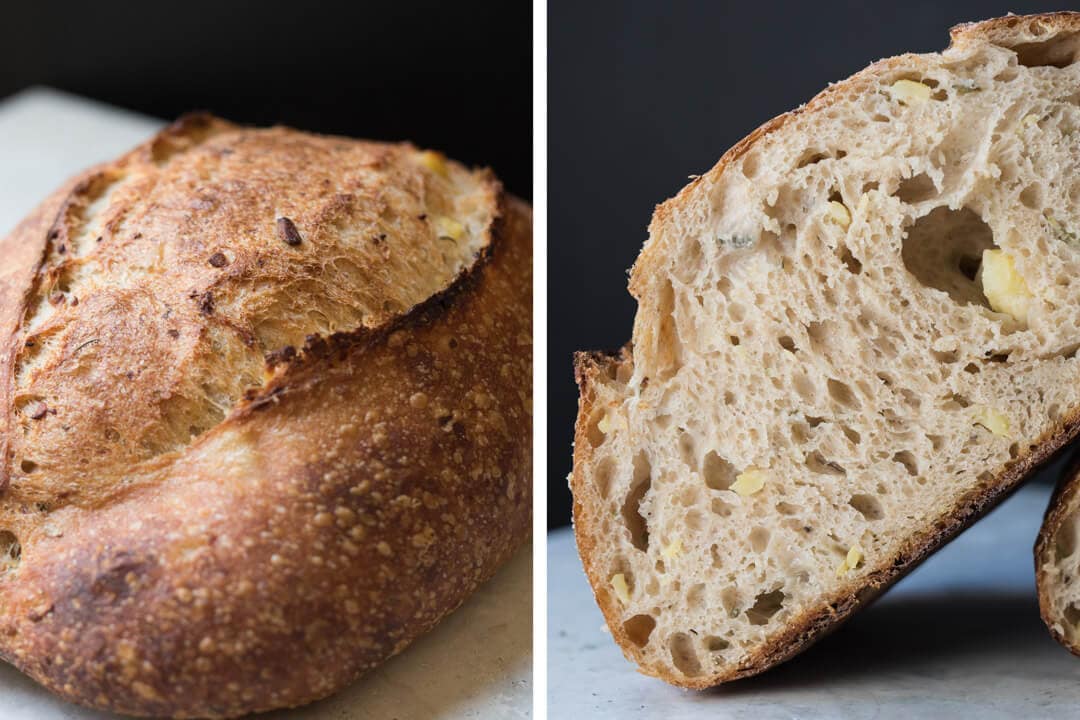
This crust runs the most striking gamut of colors from dark mahogany to light yellow. There’s no doubt the extra sugars in the potato helped this crust color nicely in the oven. While it may look craggy and hard, it’s actually quite soft and when toasted, it becomes super svelte and crunchy.
The bits of potato and rosemary that found their way to the surface colored deeply, in a good way. If you don’t like well-toasted pieces like this, poke them back into the mass of dough right before you transfer them to their proofing baskets.
Crumb
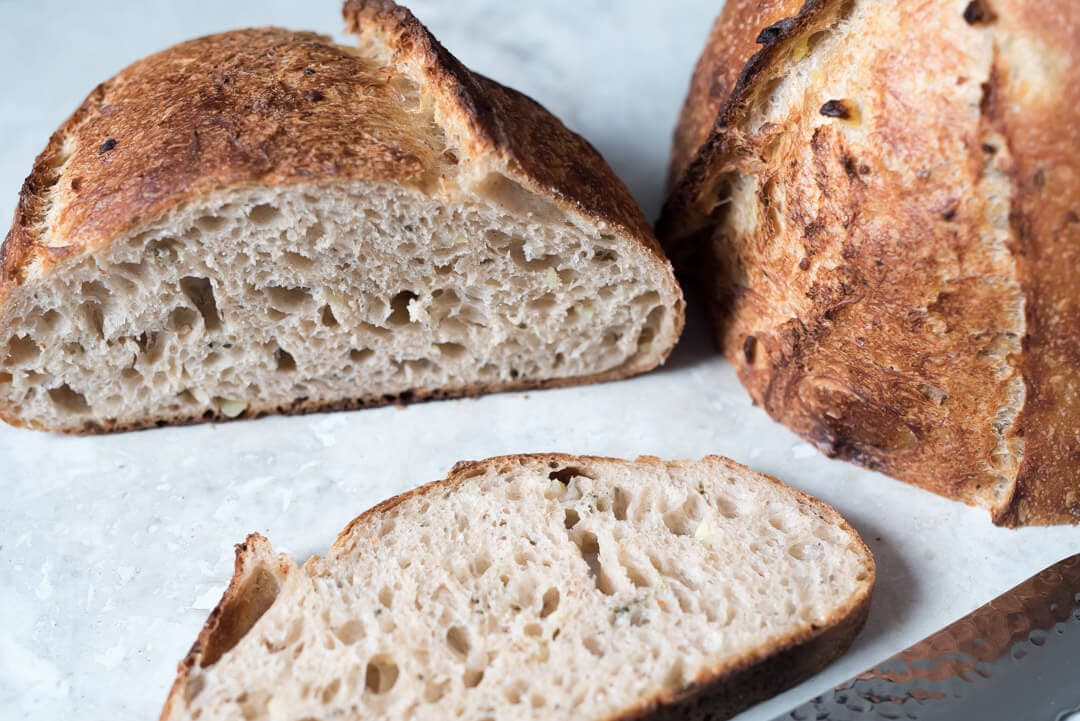
The interior of this bread stays superbly moist and tender for days after baking. I enjoy this type of bread heavily toasted as the entire interior becomes crispy in a way that you’ll only find in highly hydrated loaves or porridge bread—fantastic. The crumb does become softer, creamier, and slightly tighter as the percentage of potato increases, but thanks to this starchy addition, the tender texture of the crumb is what makes this bread stand out.
Taste
Depending on how well the potatoes were pureed (if even), you’ll encounter bits and pieces of potato throughout as you make your way through the loaf. These little explosions of flavor are boosted by the rosemary, the fusion of the two flavors and textures play so well together. The interior is rich with potato but balanced nicely by the rosemary and soft crumb. As I mentioned above, the taste compels you to eat your way through each loaf much quicker than you anticipated.
This is a bread I’ll definitely be making for our next family gathering. Cut into thick, hearty slices its one that will ensure your guests to remember the meal and the time spent together at the table.
I hope this sourdough bread with roasted potato and rosemary, with its deep, rich flavor and surprisingly light texture, helps you form new food-memory connections for you and whomever you share your loaves with. Perhaps now my Dad’s desire for potato bread is satiated, at least until I develop my next recipe.
Maurizio Leo is the creator of The Perfect Loaf, the leading independent resource for baking sourdough bread and pizza at home, and the James Beard Award-winning, New York Times bestselling author of The Perfect Loaf and The Perfect Pizza. He lives in Albuquerque, NM, with his wife and two sons, and he's been labeled "Bob Ross but for bread." Read his full story →
Do sourdough posts like this help you in your baking? Join The Baker’s Corner for only $60 a year, and get:
Come chat with me and other bakers and get baking help
Remove all ads on website
Get my bakers tools & discounts
Get the full recipe archive in editable spreadsheets
Hello! My sourdough bread, the Weekday Sourdough bread very beautiful, but always gets burned a little on bottom. I put it on the lowest rack, bake as recipes says 450F,parchment paper( 2ply)in DutchOven. How can I avoid the black ish bottom?
moving up should do the trick, may be the middle rack. In my experience bottom rack is good when you make pizza, for leoparding the bottom and then move to the top rack with broiler for outer crust. when baking bread I always use the middle rack with baking stone with cast iron pot upside down
Hi Maurizio!
I don’t have high gluten bread flour, just regular bread flour, and was wondering if I could sub the high gluten bread flour with semolina flour? Thank you!
Love your introduction to this post so much, Maurizio!
You’re so right about the interconnected web of food-memories. In fact, I think there is no one here for baking bread, but for creating and bringing back food-memories…
All the best and happy baking 🙂
After autolyzing and combining the ingredients, I ended up with firm clumps in the dough. I had to go through and thoroughly fish out about 20 hard clumps that would not have incorporated into the dough properly. Any advice for the future?
Try mashing the potato more into a smooth paste next time you work it into the dough, this should help. But a few clumps of potato in the end is not a bad thing, I think!
Hi Maurizio,
I’ve been wanting to try a sweet potato sourdough for some time now. Do you think that this recipe would translate well substituting sweet potato for Yukon? Any modifications you’d recommend? Thank you so much!
Yes, I do think this would work well with sweet potato! As with any potato, watch the hydration of the dough because some potatoes have more water than others. I’d likely try to mix the dough a little drier just in case, perhaps a reduction of 5%. Then see how the dough is developing during bulk fermentation, if it feels very slack and wet, give it more folds as necessary.
Hi Maurizio, Trying this bread Will bake tomorrow. So far the dough is holding together great. I don’t have a steam setup so will be making boules in the pan.
Same temperatures? Thanks, John
Hi Maurizio – In this recipe you don’t dust the dough with flour during the preshape as you do in other recipes. Why not? When I made this recipe I found it very hard to preshape the dough due to how slack and sticky it was, and I think dusting the top might help tighten up the preshape. Curious as to your thinking.
– update – I made this recipe again yesterday and flouring and flipping the dough pieces before preshape did make the process a lot easier for me.
Thanks!
Sorry for the confusion there, Rich, I almost always dust with flour when preshaping and shaping, this way the dough is easier to handle. Another approach is to use wet hands when preshaping and then use flour when shaping — I’ve been doing this a lot more lately with great results. Happy baking and thanks for the update!
Sorry but these do not seem to be baker’s percentages. For that all FLOURS would equal 100% (you can list them as percentages of that 100%. Then all other ingredients are a direct percentage of the 100% Flour.
This means that 1/2 the weight of the starter used will be flour and 1/2 water in the final hydration.
What I am trying to say is that the purpose of baker’s percentage is to allow the baker to use the percent scale once the flour is in the mixer.
At least let us know what you are trying to say. I am really confused as there is no 100% to start with and the total ingredient are more than 100%…
What I showed in this post was the levain build table and the final dough mix table, so I didn’t include my typical “total formula” which shows the overview of the formula (essentially combining those two together in a rollup). I just updated the post with this table, scroll up to see the Total Formula table which now will show everything for this recipe together in one table.
Hi Maurizio,
As someone new to the world of sourdough baking (or any kind of bread baking), your website is an absolute treasure trove of valuable information, so thank you and well done! I’m trying out this potato and rosemary recipe today and only just realised that the temps you mention (other than the DDT) refers to the ambient temp and not the dough temp itself! I’ve been maintaining the dough temp through BF at approx. 81F. In such circumstances, which other variables could I adjust to accommodate this?
Thank you, Anita! Glad you’re finding my website valuable — baking at home is incredible, isn’t it? No worries, the real important thing is you meet the FDT of the recipe and that your dough stays relatively warm through bulk fermentation (it’s ok even if it cools a bit during this time). Really, the FDT sets the stage for bulk fermentation, it gives you a clue how long it might take to complete bulk (assuming you don’t have wild temperature fluctuations during this time). If your FDT is a little higher than what the recipe indicates, keep it in a cooler spot and know that bulk might finish a little early. Conversely, if FDT is a little high, bulk might need to be cut short to avoid over proofing your dough.
I am going to take a loaf of the Sourdough Rosemary Potato bread to a gathering on Saturday evening along with a cheese board. Any recommendations as to which cheeses go best with this bread? Thanks for this beautiful recipe!
You’re very welcome, Linda! I could totally see this going well with fontina, provolone, and maybe even a gruyere cheese. That’s what I’d pick 🙂 Enjoy!
Happy Saturday, Maurizio! I currently have your Tartine Olive Sourdough proofing in the fridge, and am going to make this recipe for a Memorial Day bake. Does it matter if I make the levain tonight (as is mentioned in many of your other recipes, including the olive sourdough) vs. in the morning, as stated in this recipe? I kind of like having it taken care of at night, and ready to go in the morning.
Hey, Mark! An overnight levain build will also work. In this case don’t use 100% inoculation (the amount of mature starter added to your levain build) as that ripens in usually 3 hours at room temp. Instead, I’d do more like 15%: 6g mature liquid starter, 19g whole wheat flour, 19g white bread flour, and 38g water. Check on it in the morning when you wake to see how it’s progressing. If it’s moving fast and has already started falling in the jar get mixing right away and adjust next time (use less than 6g to slow it down a bit). Hope that helps and happy baking!
Hey Maurizio! Tried the recipe today and I had a similar issue as Itai down below – the dough was almost soupy and it was almost impossible to build some strength into it. I took half of it and baked it in a tin – delicious, (albeit relatively dense). The other half I tried to work into loaves with a ton of dusting in between. Worked out ok, but they did turn quite pancaky as the loaves held no real strength. Will try to get some of that high-gluten flour you mentioned in the recipe (as I used 550 “strong” flour, it’s impossible to get bread flour here in German super markets, it seems). Will report back as I do want to turn this into a success!
Hello, great recipe – thanks so much. If you fancy playing further with the recipe one day, I suggest throwing in nigella seeds. Also a couple of glugs of olive oil (I don’t bother with extra virgin as my taste buds can’t taste the difference in my finished loaves but possibly others can so will want to use it) and use sea salt instead of regular salt.
Making dinner for my daughter’s boyfriend’s parents tmw night. Pulled out the French cook book because they’re Italian and I thought everything I would make would be something they’d compare to their own experience….maybe when I know them better I’ll pull out gnocchi or something else I love or we can make it together! Anyway, I’m thinking of making a batch of this dough, but half as rolls to be eaten with said dinner. I plan to have the levain ready in the morning so I can bake in the afternoon. My very cold basement will hopefully help with keeping the levain slow to grow so it still is ‘young.’ I’ll let you know how it all goes!
Yesterday I made some Jacques Pepin-style potatoes, which are simmered in chicken broth and then browned. Soooo good. I had a sizeable portion left over, and decided to use them for this bread recipe. The loaves came out tasty but very heavy, moist and gummy – I guess there was a lot of liquid absorbed into the potatoes. Still very good if I toast it, especially when buttered and paired with butternut squash soup (today’s lunch), but next time I will roast the potatoes, like your instructions indicate. Lesson learned.
I love, love, love potatoes cooked that way — they’re incredible. Yes, I would imagine they would absorb a serious amount of liquid, this is why I choose to bake the potatoes used in this recipe. I’m sure the bread was still extremely delicious, though! Thanks for sharing and happy baking 🙂
Maurizio, I have made this recipe before and loved it. Yesterday I went to make it again, and since I had leftover sweet potatoes in the fridge, decided to give it a try. It makes a fantastic bread! The crust is darker, and the sweetness of the potatoes shines through, with an aftertaste of rosemary. What a special bread!
Really glad to hear this recipe has worked so well for ya! I have not thought of using sweet potatoes — what a great idea! I’m going to give that a try next go. Thanks for that!
I made the dough yesterday and baked it this morning. It was very brown and crusty but the inside of the loaf is damp and gluey and more sour than I usually get when I bake plain sourdough bread. Perhaps the potatoes were too starchy to begin with? Any ideas as to what would cause this? I weighed them after peeling them then pureed them. Next time I will add more rosemary as the sourness of the loaf seems to be masking the flavor.
It’s possible fermentation went on for too long in the dough, causing more sourness in the result. You could try reducing the amount of potato in the dough and see if that helps reduce the soft interior — we might be looking at a difference between potatoes here. It’s also possible the loaf needed more time to bake in your oven. You could try reducing the temperature 25°F near the end of the bake but allowing it to go longer. This way we can avoid burning the outside while we let the loaves bake a bit longer to ensure everything is fully baked out.
Also, be sure to keep your starter fed regularly and right when it needs a feeding! I find this helps reduce the acidity in the starter and using a starter that’s overly ripe can transfer over additional sour flavor to the dough.
Hope that helps. Let me know how it goes the next try!
I like your idea of roasting the potatoes instead of boiling them. My last batch of potato bread was good, but this one has been deemed “Just like store-bought bread!” by my husband. It is so soft I can squeeze it! I skipped the rosemary this week since it was in last week’s batch. SO GOOD!
I am probably naive here, but are white bread flour and all purpose flour synonymous? I am well acquainted with the higher protein bread flour like King Arthur’s; however, i have not seen a recipe call for both a white bread flour and a high protein bread flour before. Maybe the white bread flour is the same as a good quality all purpose flour??
“Bread flour” typically has higher protein percentages (12-13+%) than “all purpose” or just white flour. I do a blend because I didn’t want overly excessive strength in the dough, but just a little more than all purpose to help support that potato addition. If you didn’t want to use both types you could definitely get away with using 100% of bread or 100% all purpose, just keep in mind the dough would be stronger or a little bit weaker, respectively.
Thanks! I am anxious to try this recipe. I will probably replace the white bread flour with an addition of more King Arthur bread flour unless i can find some white bread flour locally. I’ve seriously enjoyed your recipe for seeded sourdough as of recent; i can’t stop making it.
Thank for another great recipe, I baked it yesterday and the taste of this bread is superb.
The problem I had with the dough is that it was super wet, it was very difficult to shape it before putting in the baskets.
I had to use a lot of rice flour and then before baking the dough went quit flat because it was so wet, although I used only 50g of the remaining water and not all the 100g that was kept aside. (the potatoes was very dry after bake I don’t think i was an issue)
What do you think I can do for next time? reduce water? maybe the type of flours I used is the problem?
You’re very welcome, super happy to hear that! Yes, I’d suggest reducing water for sure, it sounds like it was just over hydrated. I’d try again with the same flour but reduce the water by 10% and see if that helps. You were wise to hold back some of the water, just hold back some more and see if that works out better with your flour.
Made this today (served with butter and brie). The dough didn’t rise much overnight, but the oven spring was good. The fam loved it! Thanks for posting another great recipe (I posted my results on Breadit as well).
(ignore the beginning portion where I fold the sides and top down, only the entire top needs to be folded down and sealed at first).
I don’t get this part where you say ignore the first part. The bread sounds YUMMY.
Oh yeah. I watched the video. But you don’t do the little shoelace thing anymore? Is that what you were talking about? I am still looking for a good final shaping method. Also—thanks for mentioning that fresh milled flour ferments faster. That solves a puzzle I am having with my loaves! You’re the best.
You can see after I fold the two halves of the dough and turn it, I kind of lace the top (just one set). I don’t do that anymore, I just fold in half, rotate and roll down. This is my preferred method of shaping these days but the dough does have to be strong enough.
I see I accidentally got off the blog. Sorry.
I never understand what “strong enough” means. My dough starts to hold it’s shape very soon after the first couple of stretch and folds. Is that what you are talking about?
It takes time and experience to determine just when the dough has enough strength, but yes, it should hold it’s shape after your first few sets of stretch and folds — that’s a good sign!
I think I have been baking for about 5 years now.
Yet I still don’t have it down. I am not getting a lot of oven spring. Less than I did when I started. I think I am over proofing my loaves, as when I back off, I get a better result. But is it possible to get the dough too strong?
It’s challenging for sure, and it takes quite a bit of repetition. The best way to really nail dough strength is to pick a single recipe, use the same flour and just do it over and over and over. You’ll really develop that intuition for dough strength. Yes, it’s totally possible to over-strengthen the dough. If you do so it won’t relax properly in the oven and it will resist rising to its full potential (since it’s not extensible enough to stretch out and fill with gases)!
This is super helpful. Thank you so much, Maurizio.
I will keep you posted. Baking tomorrow.
Maurizio, you are such an inspiration! This is on my must try list, I have been wanting to do some potato breads, my mom loves them, but she is not a rosemary fan, so I need to think of another great marriage like rosemary and potato, but not.
My latest bake walnut / fig sourdough was a big hit last night, it was just cobbled together in the rare moments that I’ve had since Tuesday and was baked in time for dinner last night. Rave reviews from the crowd including, the how did you make purple bread from my other half! Ha, use some black mission figs.
Thanks so much, Sivia! As I mentioned at the beginning I originally used thyme instead of rosemary and it really did taste great! Thyme and potato is also another “classic” pairing but you’ll usually see this on things like focaccia.
Ooh, walnut + fig sounds superb, what a combo. Glad it turns out so well! Happy baking 🙂
Maurizio,
I just took the second of the two loaves out of the oven; looks good and smells wonderful! Can you tell be if this bread freezes well?
Thank you for your blog and generous advice. I have made several of your recipes and they they all turned out great!
Fantastic! I’m not sure if these loaves will freeze well. I’m always a bit apprehensive about freezing potatoes, for some reason they just never thaw very well. It might be fine with this bread, though, one would have to try it and see.
Thanks so much I really appreciate that — happy baking Robert!
This recipe looks great Maurizio Leo! I’d like to try and use home ground wheat for this. Would the following plan work closely?
529g White Bread Flour (King Arthur Bread Flour)
150g Stoneground Whole Wheat (Fresh milled hard red wheat)
127g High Gluten Bread Flour (Fresh milled hard red wheat – high extraction)
I have lot of hard red and hard white wheat that I mill with a Mockmill attachment. I usually use some of it straight and then run some of it through a tight screen to take out some of the bran and create a high extraction flour. The problem is I don’t always know how to map it to recipes. Have you made this recipe with your home milled flours?
Thanks, Ed! I haven’t used fresh milled flour with this recipe but I plan to very soon. Your mix sounds really great, there! I’d say go for it, you should have enough strength from the Bread Flour to hold up the potato and the rest of the flour will add quite a bit of flavor. Keep an eye on the dough as it’s fermenting, it can quickly go over with fresh milled flour (as you probably know).
Hi @maurizio, l’m asking the same question, it says on your recipe when you’re doing the stretching Folds, you are saying to do two sets, but then it says a total of 3 hours is there an hour of resting. There can you please let me know as soon as you can Mario I really appreciate it????.
Thanks for sharing this Maurizio! It looks amazing and I’ll be tackling this one tomorrow. Can you clarify this step though: At 78-82ºF ambient temperature bulk fermentation should go for about 3 hours. Perform a total of 2 sets of stretch and folds during bulk, spaced out by 30 minutes – this seems to stray from the simpler recipes of yours that I’ve tried and seems like not very many “stretch and folds”. These are the four turns and stretches right? How do I time this within the 3 hours?
Thank you! For this recipe I do some strengthening of the dough upfront in the “Mix” step (slap and fold), and thus the need for fewer sets of stretch and folds during bulk. For this recipe I only did two sets of stretch and folds, the first after the initial 30 minutes of bulk, then the second set 30 minutes after that. After the second set, the dough will rest for the remainder of bulk until it’s time to preshape.
If you’d rather not knead/mix the dough in the beginning with slap/fold, you can just add more sets of stretch and folds during bulk until the dough feels strong enough. Perhaps 3-4 sets, spaced out every 20-30 minutes.
Hope that helps, let me know if anything is unclear!
That’s a huge help – thanks! The slap and fold was a bust for me, I punctured my thumb piercing the spuds and gloves and sticky dough was not a fun combination. Don’t think I got enough proper slaps in, so I’m adding a few extra turns and folds 🙂
Maurizio, I recently join your mailing list and I don’t know why I didn’t find you before. I love the way you write and tell the story of the food and the connection with your family. Amazing!!
Thank you Maurizio ????, for these absolutely wonderful new delicious recipe with potato and Rosemary ????????????????. Can’t wait, P.S. you got a winner again Maurizio .
Thank you. I made the dough and it’s at the bulk fermentation stage. With the low hydration, it does feel firmer than your best sourdough recipe. And the dough looks and smells so good that my kids wanted me to bake it now! We’re going to be patient, though, and wait until tomorrow am to bake it.
Wow this looks amazing Maurizio! The rosemary on top of the boule looks beautiful and artistic. I am so excited to give this a try! Thank you for sharing this!




108 Comments
Hello! My sourdough bread, the Weekday Sourdough bread very beautiful, but always gets burned a little on bottom. I put it on the lowest rack, bake as recipes says 450F,parchment paper( 2ply)in DutchOven. How can I avoid the black ish bottom?
moving up should do the trick, may be the middle rack. In my experience bottom rack is good when you make pizza, for leoparding the bottom and then move to the top rack with broiler for outer crust. when baking bread I always use the middle rack with baking stone with cast iron pot upside down
Hi Maurizio!
I don’t have high gluten bread flour, just regular bread flour, and was wondering if I could sub the high gluten bread flour with semolina flour? Thank you!
“Bread flour” from the store will work just fine!
Love your introduction to this post so much, Maurizio!
You’re so right about the interconnected web of food-memories. In fact, I think there is no one here for baking bread, but for creating and bringing back food-memories…
All the best and happy baking 🙂
Thank you, Klaas! Agreed and right back at you, happy baking!
After autolyzing and combining the ingredients, I ended up with firm clumps in the dough. I had to go through and thoroughly fish out about 20 hard clumps that would not have incorporated into the dough properly. Any advice for the future?
Try mashing the potato more into a smooth paste next time you work it into the dough, this should help. But a few clumps of potato in the end is not a bad thing, I think!
Hi Maurizio,
I’ve been wanting to try a sweet potato sourdough for some time now. Do you think that this recipe would translate well substituting sweet potato for Yukon? Any modifications you’d recommend? Thank you so much!
Yes, I do think this would work well with sweet potato! As with any potato, watch the hydration of the dough because some potatoes have more water than others. I’d likely try to mix the dough a little drier just in case, perhaps a reduction of 5%. Then see how the dough is developing during bulk fermentation, if it feels very slack and wet, give it more folds as necessary.
Hi Maurizio, Trying this bread Will bake tomorrow. So far the dough is holding together great. I don’t have a steam setup so will be making boules in the pan.
Same temperatures? Thanks, John
Hey, John! Yes, I’d go with same temperatures. I hope it turns out well — enjoy!
I did and it did! Looked really slack at the end of bulk, but looks and tastes great. Very moist but not gummy.
Excellent! Thanks for reporting back and enjoy 🙂
Hi Maurizio – In this recipe you don’t dust the dough with flour during the preshape as you do in other recipes. Why not? When I made this recipe I found it very hard to preshape the dough due to how slack and sticky it was, and I think dusting the top might help tighten up the preshape. Curious as to your thinking.
– update – I made this recipe again yesterday and flouring and flipping the dough pieces before preshape did make the process a lot easier for me.
Thanks!
Sorry for the confusion there, Rich, I almost always dust with flour when preshaping and shaping, this way the dough is easier to handle. Another approach is to use wet hands when preshaping and then use flour when shaping — I’ve been doing this a lot more lately with great results. Happy baking and thanks for the update!
Sorry but these do not seem to be baker’s percentages. For that all FLOURS would equal 100% (you can list them as percentages of that 100%. Then all other ingredients are a direct percentage of the 100% Flour.
This means that 1/2 the weight of the starter used will be flour and 1/2 water in the final hydration.
What I am trying to say is that the purpose of baker’s percentage is to allow the baker to use the percent scale once the flour is in the mixer.
At least let us know what you are trying to say. I am really confused as there is no 100% to start with and the total ingredient are more than 100%…
What I showed in this post was the levain build table and the final dough mix table, so I didn’t include my typical “total formula” which shows the overview of the formula (essentially combining those two together in a rollup). I just updated the post with this table, scroll up to see the Total Formula table which now will show everything for this recipe together in one table.
Hi Maurizio,
As someone new to the world of sourdough baking (or any kind of bread baking), your website is an absolute treasure trove of valuable information, so thank you and well done! I’m trying out this potato and rosemary recipe today and only just realised that the temps you mention (other than the DDT) refers to the ambient temp and not the dough temp itself! I’ve been maintaining the dough temp through BF at approx. 81F. In such circumstances, which other variables could I adjust to accommodate this?
Thank you, Anita! Glad you’re finding my website valuable — baking at home is incredible, isn’t it? No worries, the real important thing is you meet the FDT of the recipe and that your dough stays relatively warm through bulk fermentation (it’s ok even if it cools a bit during this time). Really, the FDT sets the stage for bulk fermentation, it gives you a clue how long it might take to complete bulk (assuming you don’t have wild temperature fluctuations during this time). If your FDT is a little higher than what the recipe indicates, keep it in a cooler spot and know that bulk might finish a little early. Conversely, if FDT is a little high, bulk might need to be cut short to avoid over proofing your dough.
For a deep dive on dough temperature, check out my post on the importance of dough temperature in baking — lots of info in there!
I hope that helps and happy baking, Anita!
I am going to take a loaf of the Sourdough Rosemary Potato bread to a gathering on Saturday evening along with a cheese board. Any recommendations as to which cheeses go best with this bread? Thanks for this beautiful recipe!
You’re very welcome, Linda! I could totally see this going well with fontina, provolone, and maybe even a gruyere cheese. That’s what I’d pick 🙂 Enjoy!
Happy Saturday, Maurizio! I currently have your Tartine Olive Sourdough proofing in the fridge, and am going to make this recipe for a Memorial Day bake. Does it matter if I make the levain tonight (as is mentioned in many of your other recipes, including the olive sourdough) vs. in the morning, as stated in this recipe? I kind of like having it taken care of at night, and ready to go in the morning.
Hey, Mark! An overnight levain build will also work. In this case don’t use 100% inoculation (the amount of mature starter added to your levain build) as that ripens in usually 3 hours at room temp. Instead, I’d do more like 15%: 6g mature liquid starter, 19g whole wheat flour, 19g white bread flour, and 38g water. Check on it in the morning when you wake to see how it’s progressing. If it’s moving fast and has already started falling in the jar get mixing right away and adjust next time (use less than 6g to slow it down a bit). Hope that helps and happy baking!
Thanks so much, Maurizio! I’ll give it a try right now!
Hey Maurizio! Tried the recipe today and I had a similar issue as Itai down below – the dough was almost soupy and it was almost impossible to build some strength into it. I took half of it and baked it in a tin – delicious, (albeit relatively dense). The other half I tried to work into loaves with a ton of dusting in between. Worked out ok, but they did turn quite pancaky as the loaves held no real strength. Will try to get some of that high-gluten flour you mentioned in the recipe (as I used 550 “strong” flour, it’s impossible to get bread flour here in German super markets, it seems). Will report back as I do want to turn this into a success!
Hello, great recipe – thanks so much. If you fancy playing further with the recipe one day, I suggest throwing in nigella seeds. Also a couple of glugs of olive oil (I don’t bother with extra virgin as my taste buds can’t taste the difference in my finished loaves but possibly others can so will want to use it) and use sea salt instead of regular salt.
Making dinner for my daughter’s boyfriend’s parents tmw night. Pulled out the French cook book because they’re Italian and I thought everything I would make would be something they’d compare to their own experience….maybe when I know them better I’ll pull out gnocchi or something else I love or we can make it together! Anyway, I’m thinking of making a batch of this dough, but half as rolls to be eaten with said dinner. I plan to have the levain ready in the morning so I can bake in the afternoon. My very cold basement will hopefully help with keeping the levain slow to grow so it still is ‘young.’ I’ll let you know how it all goes!
I think this recipe would make excellent rolls, what a great idea. Have fun and let me know how it goes!
Cassoulet was magnificent and the rolls were a hit too! We had a great time with them! Getting ready to reheat both now for tonight’s dinner!
Yesterday I made some Jacques Pepin-style potatoes, which are simmered in chicken broth and then browned. Soooo good. I had a sizeable portion left over, and decided to use them for this bread recipe. The loaves came out tasty but very heavy, moist and gummy – I guess there was a lot of liquid absorbed into the potatoes. Still very good if I toast it, especially when buttered and paired with butternut squash soup (today’s lunch), but next time I will roast the potatoes, like your instructions indicate. Lesson learned.
I love, love, love potatoes cooked that way — they’re incredible. Yes, I would imagine they would absorb a serious amount of liquid, this is why I choose to bake the potatoes used in this recipe. I’m sure the bread was still extremely delicious, though! Thanks for sharing and happy baking 🙂
Maurizio, I have made this recipe before and loved it. Yesterday I went to make it again, and since I had leftover sweet potatoes in the fridge, decided to give it a try. It makes a fantastic bread! The crust is darker, and the sweetness of the potatoes shines through, with an aftertaste of rosemary. What a special bread!
Really glad to hear this recipe has worked so well for ya! I have not thought of using sweet potatoes — what a great idea! I’m going to give that a try next go. Thanks for that!
I made the dough yesterday and baked it this morning. It was very brown and crusty but the inside of the loaf is damp and gluey and more sour than I usually get when I bake plain sourdough bread. Perhaps the potatoes were too starchy to begin with? Any ideas as to what would cause this? I weighed them after peeling them then pureed them. Next time I will add more rosemary as the sourness of the loaf seems to be masking the flavor.
It’s possible fermentation went on for too long in the dough, causing more sourness in the result. You could try reducing the amount of potato in the dough and see if that helps reduce the soft interior — we might be looking at a difference between potatoes here. It’s also possible the loaf needed more time to bake in your oven. You could try reducing the temperature 25°F near the end of the bake but allowing it to go longer. This way we can avoid burning the outside while we let the loaves bake a bit longer to ensure everything is fully baked out.
Also, be sure to keep your starter fed regularly and right when it needs a feeding! I find this helps reduce the acidity in the starter and using a starter that’s overly ripe can transfer over additional sour flavor to the dough.
Hope that helps. Let me know how it goes the next try!
I like your idea of roasting the potatoes instead of boiling them. My last batch of potato bread was good, but this one has been deemed “Just like store-bought bread!” by my husband. It is so soft I can squeeze it! I skipped the rosemary this week since it was in last week’s batch. SO GOOD!
Thanks, Gina! Glad to hear all that 🙂
I am probably naive here, but are white bread flour and all purpose flour synonymous? I am well acquainted with the higher protein bread flour like King Arthur’s; however, i have not seen a recipe call for both a white bread flour and a high protein bread flour before. Maybe the white bread flour is the same as a good quality all purpose flour??
“Bread flour” typically has higher protein percentages (12-13+%) than “all purpose” or just white flour. I do a blend because I didn’t want overly excessive strength in the dough, but just a little more than all purpose to help support that potato addition. If you didn’t want to use both types you could definitely get away with using 100% of bread or 100% all purpose, just keep in mind the dough would be stronger or a little bit weaker, respectively.
Hope that helps!
Thanks! I am anxious to try this recipe. I will probably replace the white bread flour with an addition of more King Arthur bread flour unless i can find some white bread flour locally. I’ve seriously enjoyed your recipe for seeded sourdough as of recent; i can’t stop making it.
Right on, that sounds great. Glad you liked the seeded one so much, it is tasty!!
Hi Maurizio,
Thank for another great recipe, I baked it yesterday and the taste of this bread is superb.
The problem I had with the dough is that it was super wet, it was very difficult to shape it before putting in the baskets.
I had to use a lot of rice flour and then before baking the dough went quit flat because it was so wet, although I used only 50g of the remaining water and not all the 100g that was kept aside. (the potatoes was very dry after bake I don’t think i was an issue)
What do you think I can do for next time? reduce water? maybe the type of flours I used is the problem?
But again- very good flavor and I loved it.
Itai
You’re very welcome, super happy to hear that! Yes, I’d suggest reducing water for sure, it sounds like it was just over hydrated. I’d try again with the same flour but reduce the water by 10% and see if that helps. You were wise to hold back some of the water, just hold back some more and see if that works out better with your flour.
Glad it tasted great, though! Happy baking 🙂
Made this today (served with butter and brie). The dough didn’t rise much overnight, but the oven spring was good. The fam loved it! Thanks for posting another great recipe (I posted my results on Breadit as well).
You’re very welcome and thanks for sharing it on Breadit! Butter + brie + this bread = winner every time.
Glad it baked up so well for ya!
(ignore the beginning portion where I fold the sides and top down, only the entire top needs to be folded down and sealed at first).
I don’t get this part where you say ignore the first part. The bread sounds YUMMY.
I was referring to the video I posted on Instagram: I used to kind of stitch the top of the dough before rolling down but now I just roll it down 🙂
Thanks, I hope you enjoy it — I’m making it again today!
Oh yeah. I watched the video. But you don’t do the little shoelace thing anymore? Is that what you were talking about? I am still looking for a good final shaping method. Also—thanks for mentioning that fresh milled flour ferments faster. That solves a puzzle I am having with my loaves! You’re the best.
You can see after I fold the two halves of the dough and turn it, I kind of lace the top (just one set). I don’t do that anymore, I just fold in half, rotate and roll down. This is my preferred method of shaping these days but the dough does have to be strong enough.
Glad I could help!
I see I accidentally got off the blog. Sorry.
I never understand what “strong enough” means. My dough starts to hold it’s shape very soon after the first couple of stretch and folds. Is that what you are talking about?
It takes time and experience to determine just when the dough has enough strength, but yes, it should hold it’s shape after your first few sets of stretch and folds — that’s a good sign!
I think I have been baking for about 5 years now.
Yet I still don’t have it down. I am not getting a lot of oven spring. Less than I did when I started. I think I am over proofing my loaves, as when I back off, I get a better result. But is it possible to get the dough too strong?
It’s challenging for sure, and it takes quite a bit of repetition. The best way to really nail dough strength is to pick a single recipe, use the same flour and just do it over and over and over. You’ll really develop that intuition for dough strength. Yes, it’s totally possible to over-strengthen the dough. If you do so it won’t relax properly in the oven and it will resist rising to its full potential (since it’s not extensible enough to stretch out and fill with gases)!
This is super helpful. Thank you so much, Maurizio.
I will keep you posted. Baking tomorrow.
Maurizio, you are such an inspiration! This is on my must try list, I have been wanting to do some potato breads, my mom loves them, but she is not a rosemary fan, so I need to think of another great marriage like rosemary and potato, but not.
My latest bake walnut / fig sourdough was a big hit last night, it was just cobbled together in the rare moments that I’ve had since Tuesday and was baked in time for dinner last night. Rave reviews from the crowd including, the how did you make purple bread from my other half! Ha, use some black mission figs.
keep baking! Sivia
Thanks so much, Sivia! As I mentioned at the beginning I originally used thyme instead of rosemary and it really did taste great! Thyme and potato is also another “classic” pairing but you’ll usually see this on things like focaccia.
Ooh, walnut + fig sounds superb, what a combo. Glad it turns out so well! Happy baking 🙂
Maurizio,
I just took the second of the two loaves out of the oven; looks good and smells wonderful! Can you tell be if this bread freezes well?
Thank you for your blog and generous advice. I have made several of your recipes and they they all turned out great!
Fantastic! I’m not sure if these loaves will freeze well. I’m always a bit apprehensive about freezing potatoes, for some reason they just never thaw very well. It might be fine with this bread, though, one would have to try it and see.
Thanks so much I really appreciate that — happy baking Robert!
This recipe looks great Maurizio Leo! I’d like to try and use home ground wheat for this. Would the following plan work closely?
529g White Bread Flour (King Arthur Bread Flour)
150g Stoneground Whole Wheat (Fresh milled hard red wheat)
127g High Gluten Bread Flour (Fresh milled hard red wheat – high extraction)
I have lot of hard red and hard white wheat that I mill with a Mockmill attachment. I usually use some of it straight and then run some of it through a tight screen to take out some of the bran and create a high extraction flour. The problem is I don’t always know how to map it to recipes. Have you made this recipe with your home milled flours?
Thanks again!
Thanks, Ed! I haven’t used fresh milled flour with this recipe but I plan to very soon. Your mix sounds really great, there! I’d say go for it, you should have enough strength from the Bread Flour to hold up the potato and the rest of the flour will add quite a bit of flavor. Keep an eye on the dough as it’s fermenting, it can quickly go over with fresh milled flour (as you probably know).
Happy baking!
Hi @maurizio, l’m asking the same question, it says on your recipe when you’re doing the stretching Folds, you are saying to do two sets, but then it says a total of 3 hours is there an hour of resting. There can you please let me know as soon as you can Mario I really appreciate it????.
Correct: only two sets of stretch and folds during the first hour, the dough will rest in the bulk container the remainder of the time.
Thank you Maurizio for getting back soon ????????????
Thanks for sharing this Maurizio! It looks amazing and I’ll be tackling this one tomorrow. Can you clarify this step though: At 78-82ºF ambient temperature bulk fermentation should go for about 3 hours. Perform a total of 2 sets of stretch and folds during bulk, spaced out by 30 minutes – this seems to stray from the simpler recipes of yours that I’ve tried and seems like not very many “stretch and folds”. These are the four turns and stretches right? How do I time this within the 3 hours?
Thank you! For this recipe I do some strengthening of the dough upfront in the “Mix” step (slap and fold), and thus the need for fewer sets of stretch and folds during bulk. For this recipe I only did two sets of stretch and folds, the first after the initial 30 minutes of bulk, then the second set 30 minutes after that. After the second set, the dough will rest for the remainder of bulk until it’s time to preshape.
If you’d rather not knead/mix the dough in the beginning with slap/fold, you can just add more sets of stretch and folds during bulk until the dough feels strong enough. Perhaps 3-4 sets, spaced out every 20-30 minutes.
Hope that helps, let me know if anything is unclear!
That’s a huge help – thanks! The slap and fold was a bust for me, I punctured my thumb piercing the spuds and gloves and sticky dough was not a fun combination. Don’t think I got enough proper slaps in, so I’m adding a few extra turns and folds 🙂
That’ll work!
Maurizio, I recently join your mailing list and I don’t know why I didn’t find you before. I love the way you write and tell the story of the food and the connection with your family. Amazing!!
I really appreciate that, thanks so much!
Oh wow! This looks wonderful, thank you so much!
Thanks, Laura! Enjoy 🙂
Thanks so much Marisa! You’ll get that starter going, it’s a pretty resilient thing. Good luck, let me know how it goes!
Glad to hear that, Ruth! Enjoy 🙂
Thank you Maurizio ????, for these absolutely wonderful new delicious recipe with potato and Rosemary ????????????????. Can’t wait, P.S. you got a winner again Maurizio .
You bet, Rosa! Thanks 🙂
Looks delicious. Might just try making this tomorrow…
Awesome! It’s seriously good bread — I’m hooked.
Thank you. I made the dough and it’s at the bulk fermentation stage. With the low hydration, it does feel firmer than your best sourdough recipe. And the dough looks and smells so good that my kids wanted me to bake it now! We’re going to be patient, though, and wait until tomorrow am to bake it.
Made it…delicious and beautiful! Put a few photos on Instagram. You’ve got another winner…thanks!
This one should be absolutely delicious!! Very different from that one I ate in Italy last summer… I would say, much better ????
Hah! Thanks, I appreciate that 🙂
Wow this looks amazing Maurizio! The rosemary on top of the boule looks beautiful and artistic. I am so excited to give this a try! Thank you for sharing this!
Thanks so much Diana! I hope you like it, such a good bread. Let me know how it goes and happy baking!