

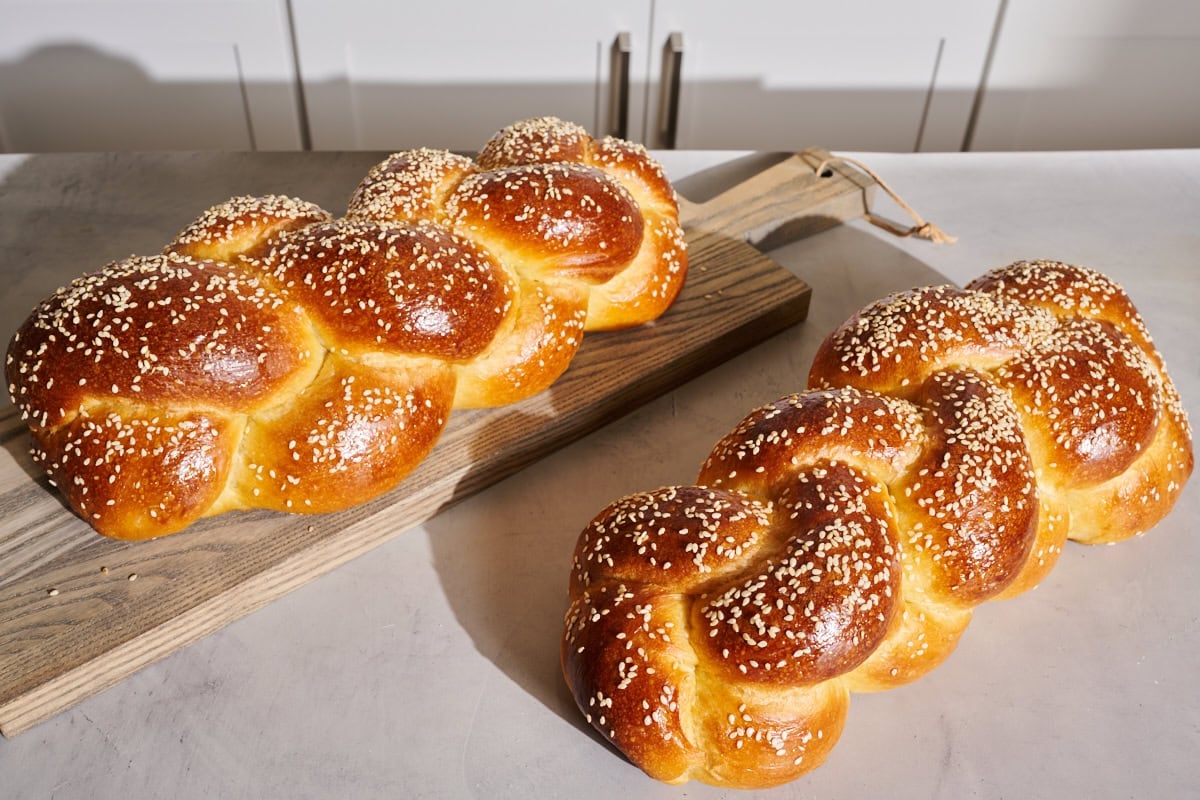
Oh, sourdough challah, you’re a challenging one, aren’t you? To create this recipe, I went through more than ten iterations, each one a little better than the previous, with the end goal of a challah that clearly shows the braids, while also being as flavorful and soft as can be. After much testing, this latest version hit top marks with my taste testers (my kids, neighbors, the mailman, any unsuspecting visitor…). And it is challah like you’ve never eaten before: deeply flavorful thanks to the long fermentation time, rich, and yet still slightly sweet, all with a soft and light texture.
If I’m completely honest, though, this was not an easy recipe to develop. Let’s walk through it step by step (and watch a video).
This post is a little different from my others. I want to walk you through the development of this sourdough challah recipe step by step. It might be helpful to see the behind-the-scenes of how I developed this recipe, building and tweaking it throughout many iterations. I started with a general idea for what I was after, and then I pulled all the fermentation and dough modification levers I have at my disposal through each test as I honed in on the final result.
If I’m completely honest, though, this was not an easy recipe to develop. Let’s walk through it step by step (and watch a video).
Along the way, I’ll talk about the decision I made and point out the signs (dough strength, fermentation, etc.) for when to proceed with each step of the bread-making process. The key with this recipe is to have really strong fermentation at each of the critical stages: levain, bulk fermentation, and final proof.
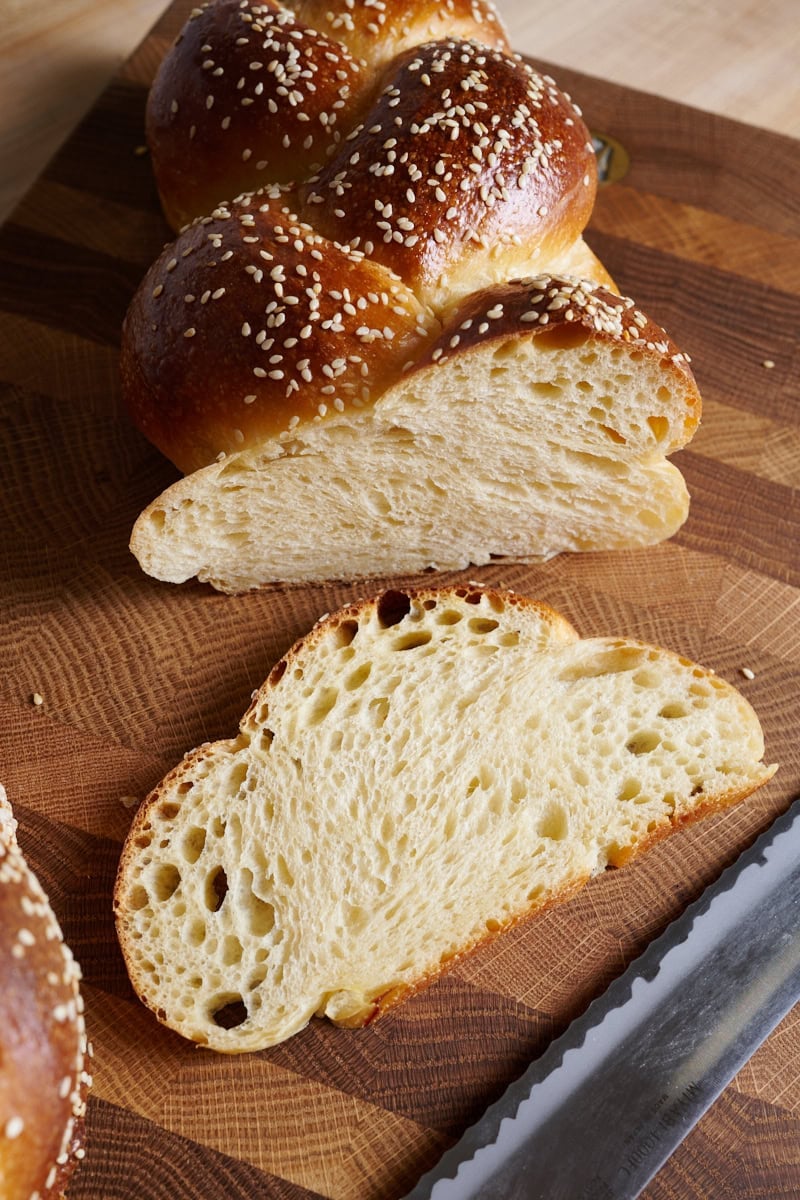
But before we dive into all that, for those who aren’t in the know, let’s talk about what challah is, then read on for details about how I developed this delicious recipe.
What is Challah?
Challah (often pronounced “haa · luh”) is traditionally a yeasted bread that’s braided before baking, and it is an important food in Jewish culture. Though enriched with eggs, oil, and sugar, it is made without dairy so it can be served at any kosher meal. Often, you’ll find challah brushed with an egg wash (for color) and topped with sesame or poppy seeds for added flavor and texture. Challah is typically eaten on Shabbat (the Jewish Sabbath) and holidays.
I developed this sourdough challah in tandem with Eric Pallant’s excellent article here at The Perfect Loaf on what challah is, how it’s typically eaten, and its historical, cultural, and religious significance.
I am not Jewish and have only had this bread on a few occasions (though we did make it in France!), but regardless, I think everyone will find this dairy-free bread wonderfully delicious.
Video: Watch Me Make This Sourdough Challah
Before we get into the nitty-gritty of developing this recipe, watch me make this sourdough challah from start to finish, below (here’s a direct link to YouTube, too).
The video also includes how I like to braid a 4-strand challah based on instructions from Jeffrey Hamelman’s BREAD.
Next, let’s examine some of my decisions as I developed this sourdough challah.
How I Created This Sourdough Challah
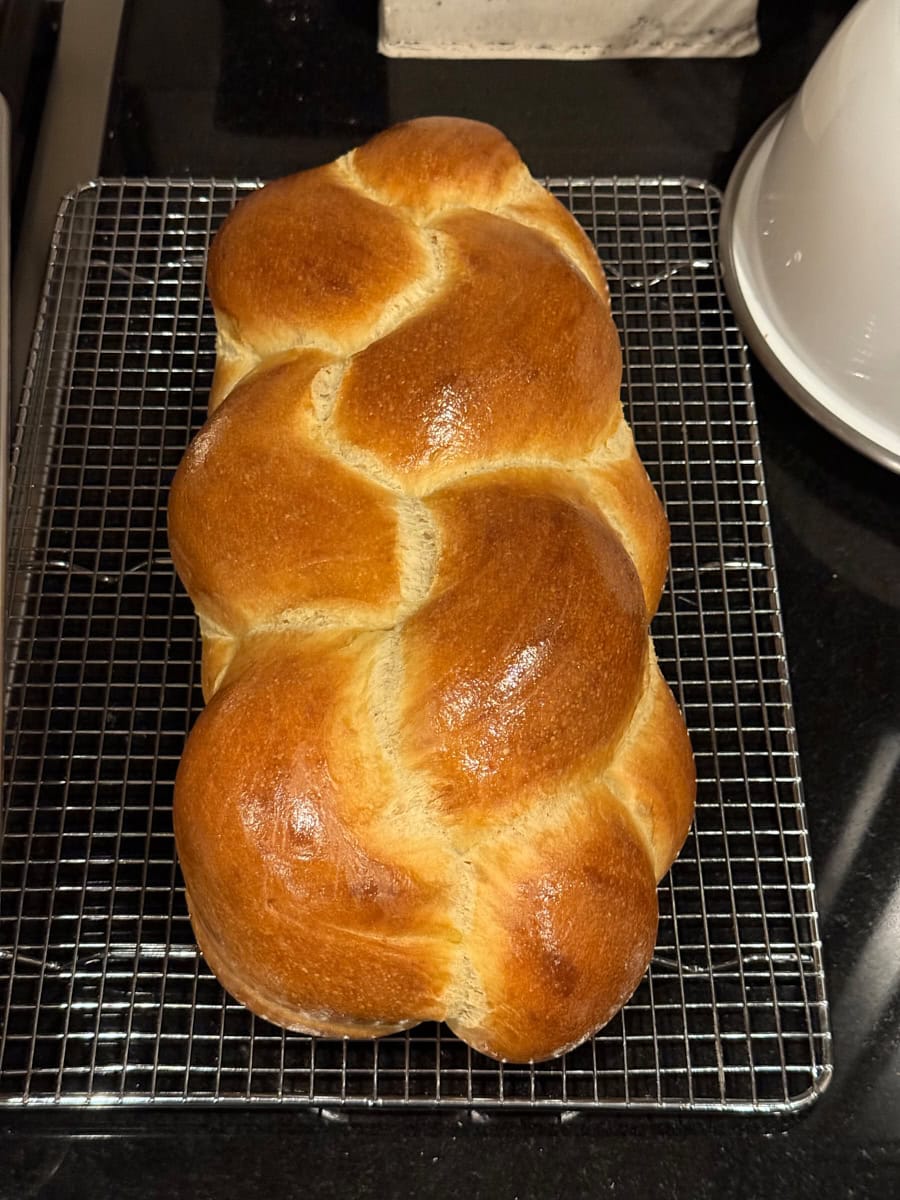
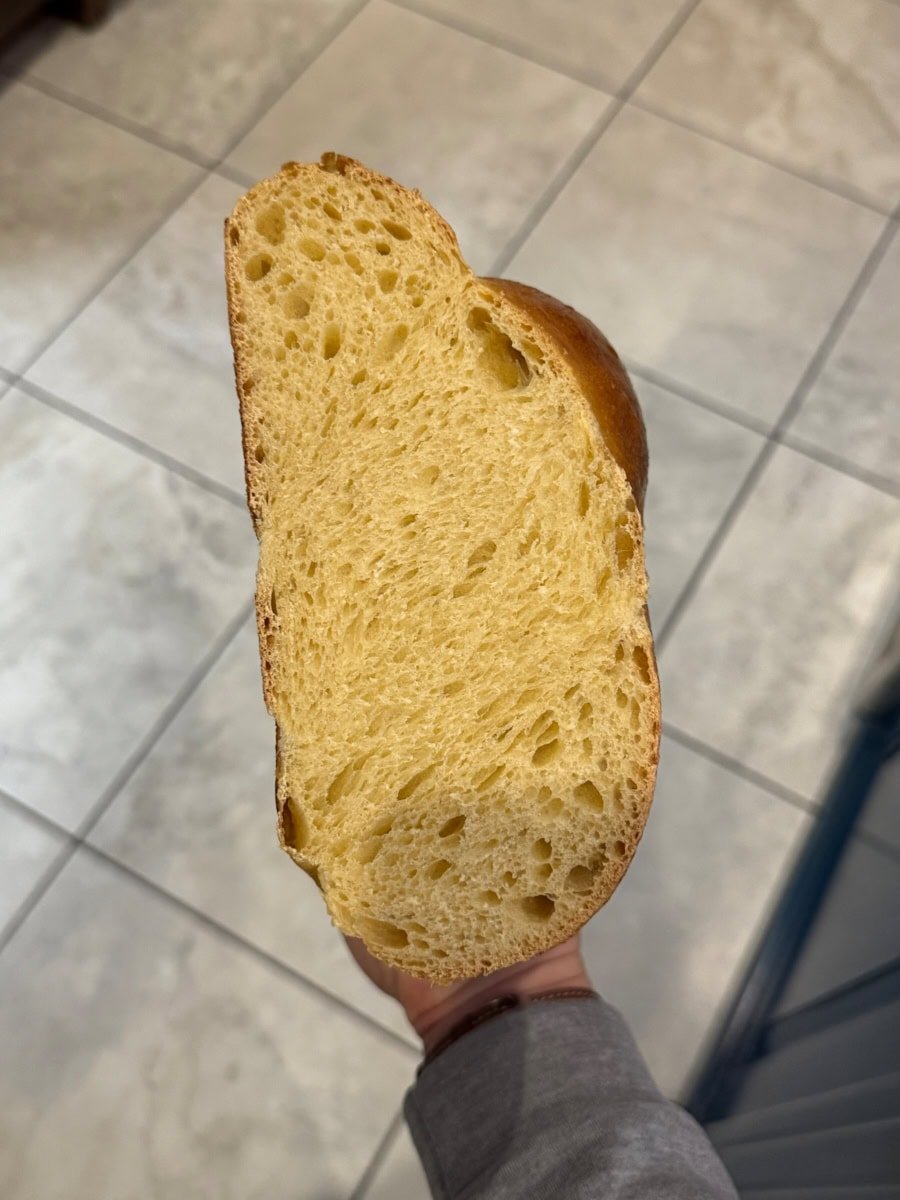
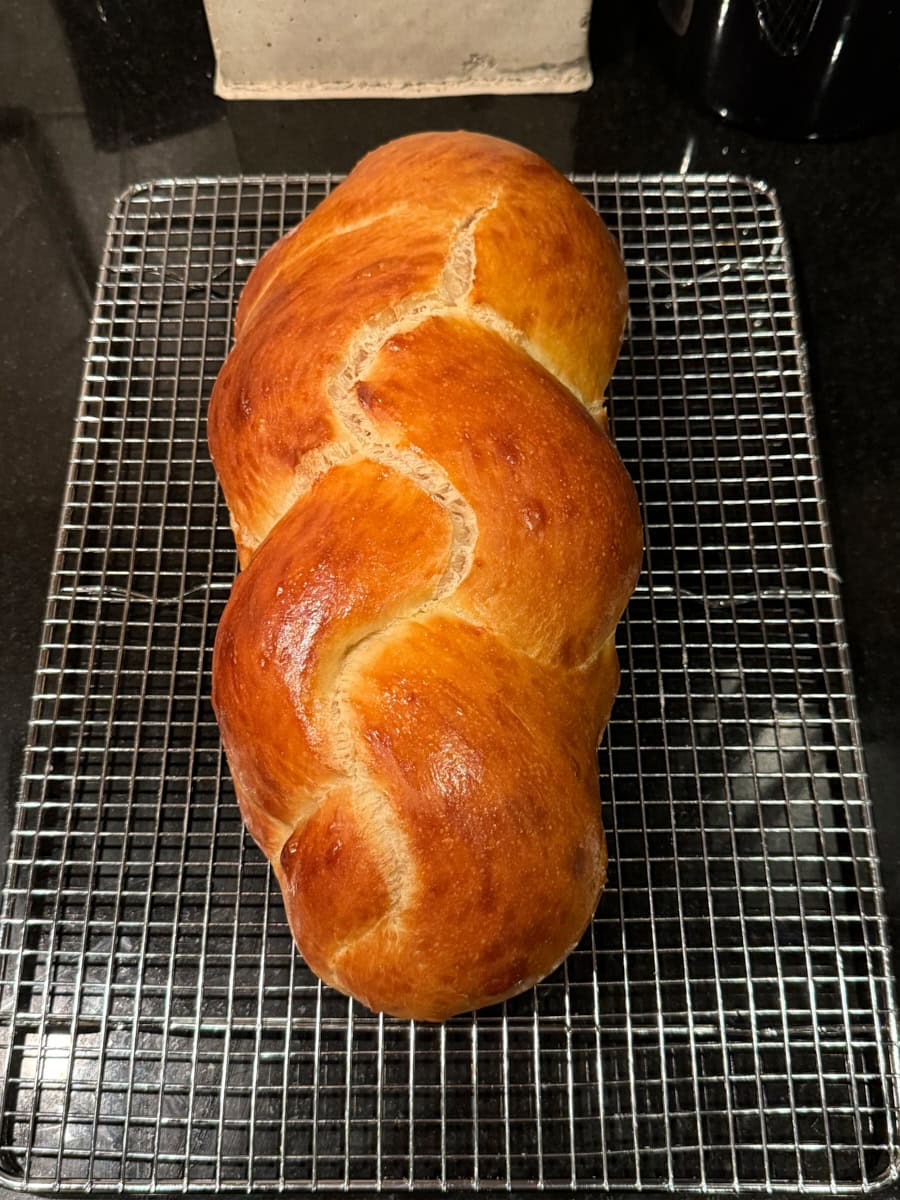
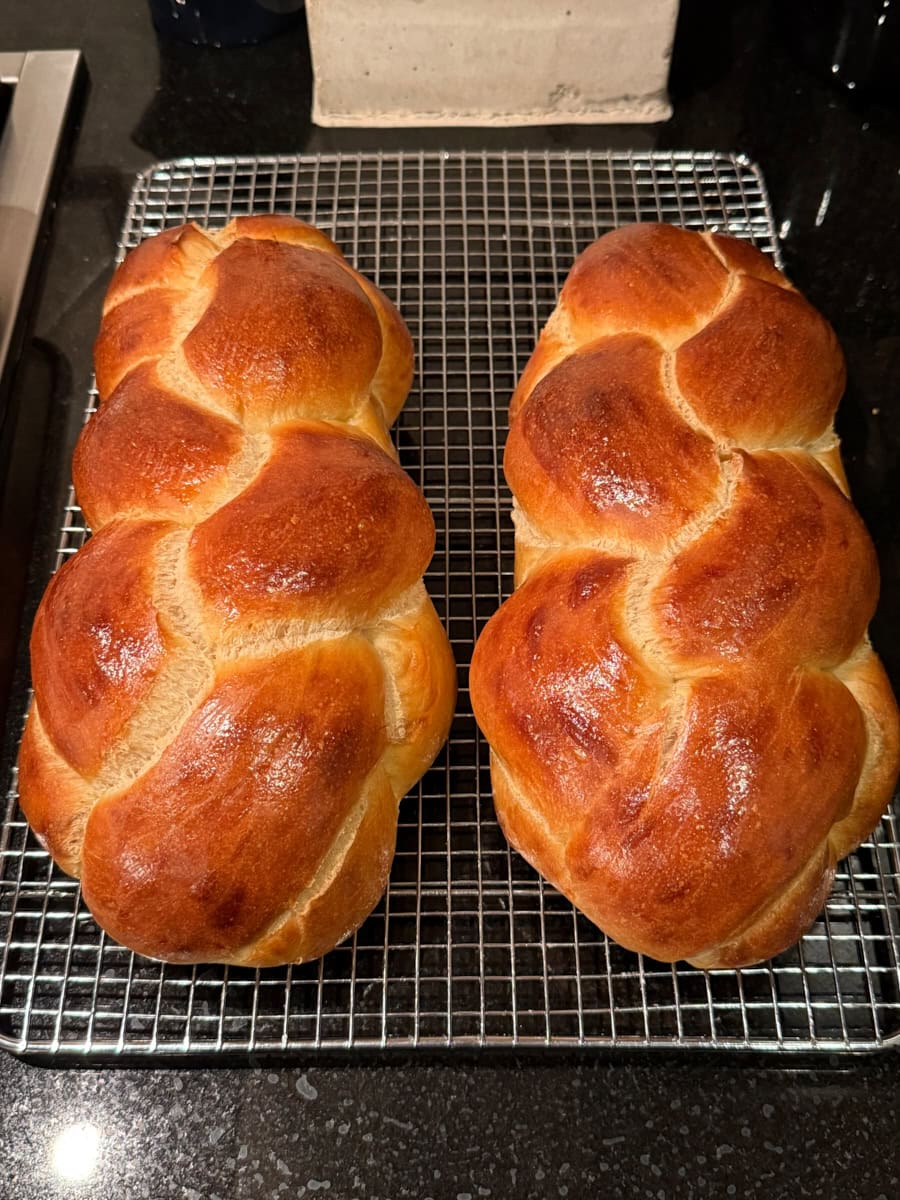
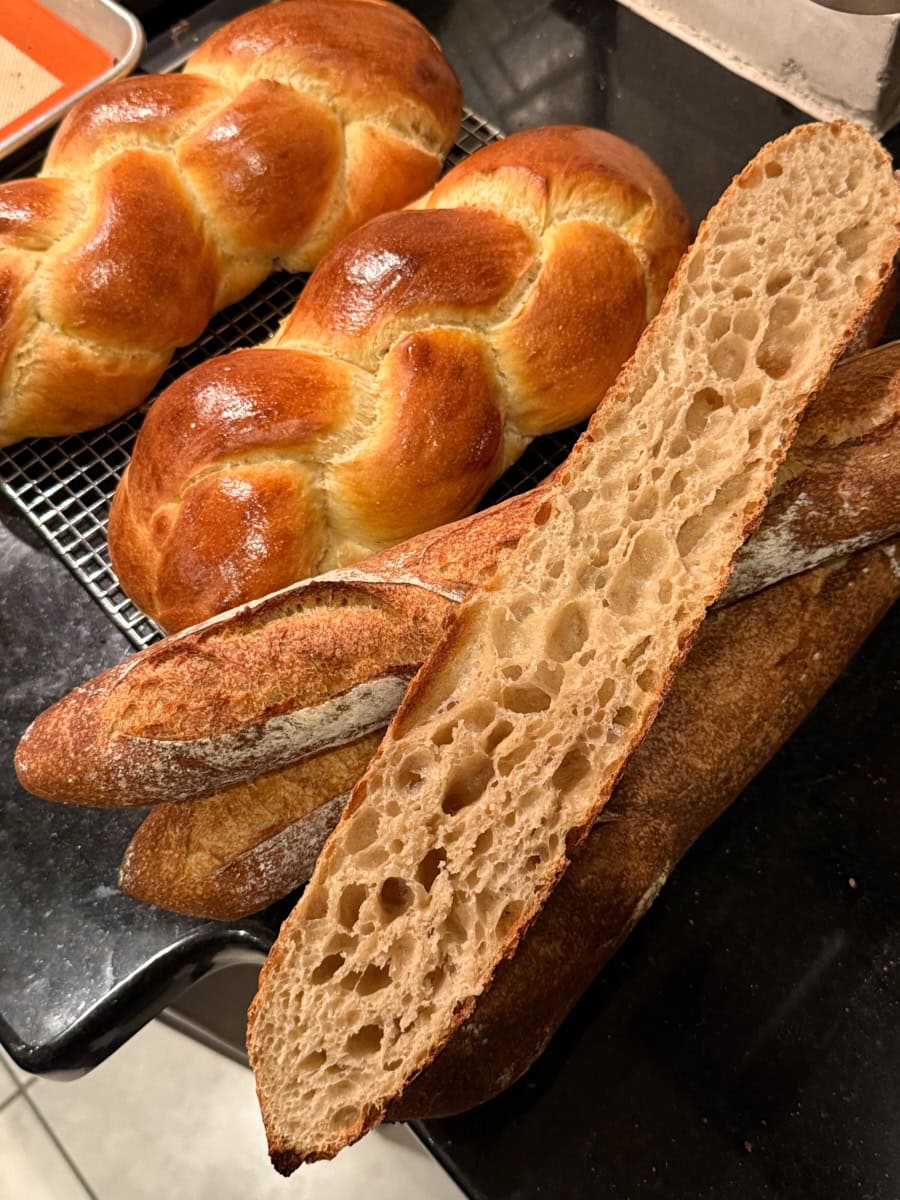
Below, you can see a few tests while developing this sourdough challah recipe. In the end, I did over 14 bakes with varying formulas.
Very evident is my struggle to increase dough softness while maintaining distinct braids (more on this below). In testing, I added softness with more eggs, more sugar, and more oil—but of course, there can be too much of a good thing. Increasing the sugar for added softness and flavor meant the dough needed longer to proof, and it wasn’t until I really started pushing the fermentation time that I arrived at the look and texture I was after (last image in the sequence).
After finding the right level of sweetness with sugar and honey, I dialed back the eggs. Finally, I settled on a ratio of each that brought maximum softness with lots of flavor without compromising the dough structure.
Minimizing Challah Sourness
Challah is traditionally a yeasted product leavened primarily by instant or commercial yeast. To make it sourdough, you must first consider the flavor profile change. Since sourdough fermentation involves lactic acid bacteria, I knew I had to manage fermentation properly, or my loaf could be overly sour and just wouldn’t taste good (trust me, I tested a version using a starter straight from the fridge—way too sour).
Don’t get me wrong, having slight sourness is a great thing—it awakens the palate at each bite, brings added depth of flavor, and I think balances out the overall sweet flavor profile. But fermentation must be kept in check to avoid an overly sour loaf.
To minimize sourness, I used a technique I talk about often in my cookbook: using a sweet levain as the preferment. This sweet levain has 40% sugar to flour, which helps deactivate most of the bacteria while allowing the yeasts to proliferate, thus setting the stage for dramatically reduced sourness in the final product while still achieving a fantastic rise.
Read more on how to control sourness in your sourdough bread.
Challah Dough Softness and Ensuring Distinct Braids
One of the most striking things about challah is that the dough is braided, creating a beautiful pattern as it weaves in and around itself, resulting in bumps of extra color interspersed with lighter areas.
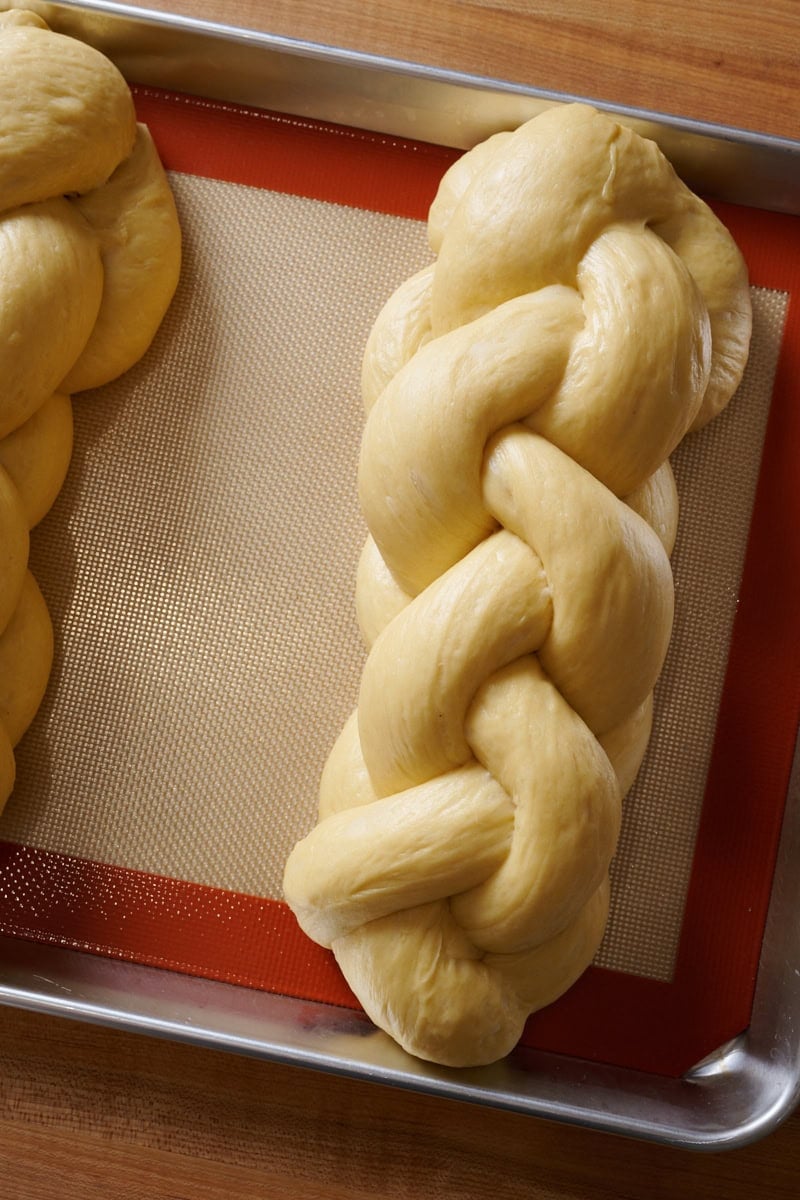
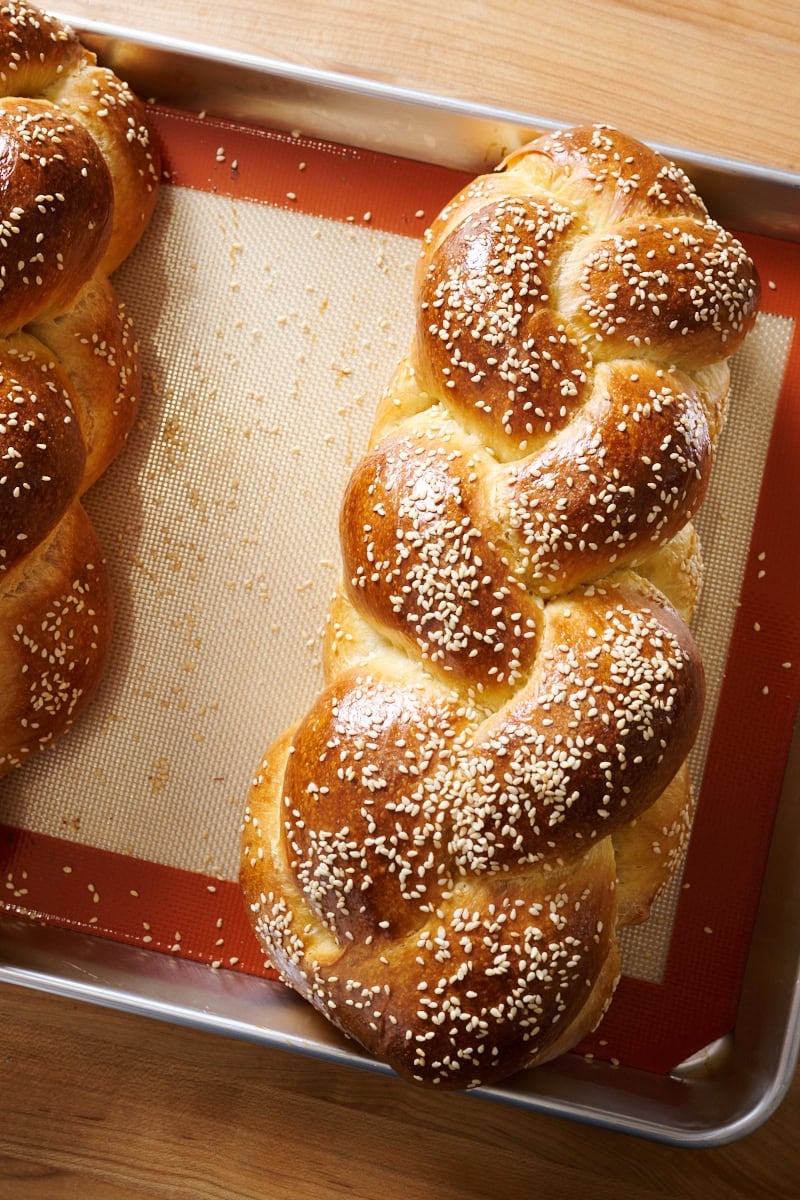
Now, you want each strand in the braid to be distinct in the final loaf. So, the dough can’t be too soft, otherwise it’s very difficult to handle when braiding and the braids merge together during proofing.
So, the dough and final loaf structure are at odds with each other. How can we get a soft challah without the dough being too soft to handle and braid?
The answer is to use a few techniques, ingredients, and processes all in balance. I:
- Used the tangzhong technique to pre-cook some of the flour and water, which holds on to significant amounts of moisture without making the dough harder to handle
- Used oil (fat) which coats flour proteins, thus preventing them from forming a strong gluten network
- Used sugar which holds moisture and also slightly interferes with gluten formation
- Incrementally increased the dough’s hydration just to the point where it started making the dough too soft and hard to handle
I feel like I had to pull every lever with this dough to make it aesthetically beautiful with distinct strands and for it to be soft and flavorful. It turns out, there’s a reason why dairy (particularly butter) is used so often in baked goods searching for softness!
How Many Eggs Go Into a Challah?
One of the big questions for me was deciding how many eggs to use in this recipe. Challah is known to be an egg-heavy bread, and the eggs give it richness and its characteristic yellow color. I started out way too high at 25% egg plus 10% yolks to total flour. The resulting bread was soft, very rich, and beautifully yellow, but the dough was really hard to handle.
Eggs make mixing very difficult because they turn the dough into a sticky mess, both when mixing and later in the process. You can make challah with zero eggs and all oil; I tasted such a loaf and while the flavor was actually okay, it wasn’t nearly as striking visually.
Through incremental testing I slowly decreased the amount of whole eggs and yolks until the dough was easier to handle, the final product was still rich-tasting, and it also had a beautiful yellow hue in the crust and crumb. I landed on 20% whole eggs and 4.25% egg yolks, which conveniently turns out to be 3 whole large eggs and 2 egg yolks for this recipe.
How To Properly Ferment Sourdough Challah Dough
A common theme in this recipe is an emphasis on keeping the dough warm, especially with the levain (keep it warm!) and meeting the final dough temperature of 78°F (26°C) at the end of mixing. Due to the high sugar percentage in this enriched dough, proofing takes longer than a leaner bread dough (a dough without eggs, sugar, or butter).
There are a few important things to help ensure your dough is adequately proofed:
- Use your sourdough starter when it’s ripe to make the levain
- Use the levain when it’s very ripe
- Keep the levain and dough warm at all stages of fermentation
Let’s take a look at two trial bakes I did, one where the challah is underproofed (below, left) and one where it’s properly proofed (below, right).
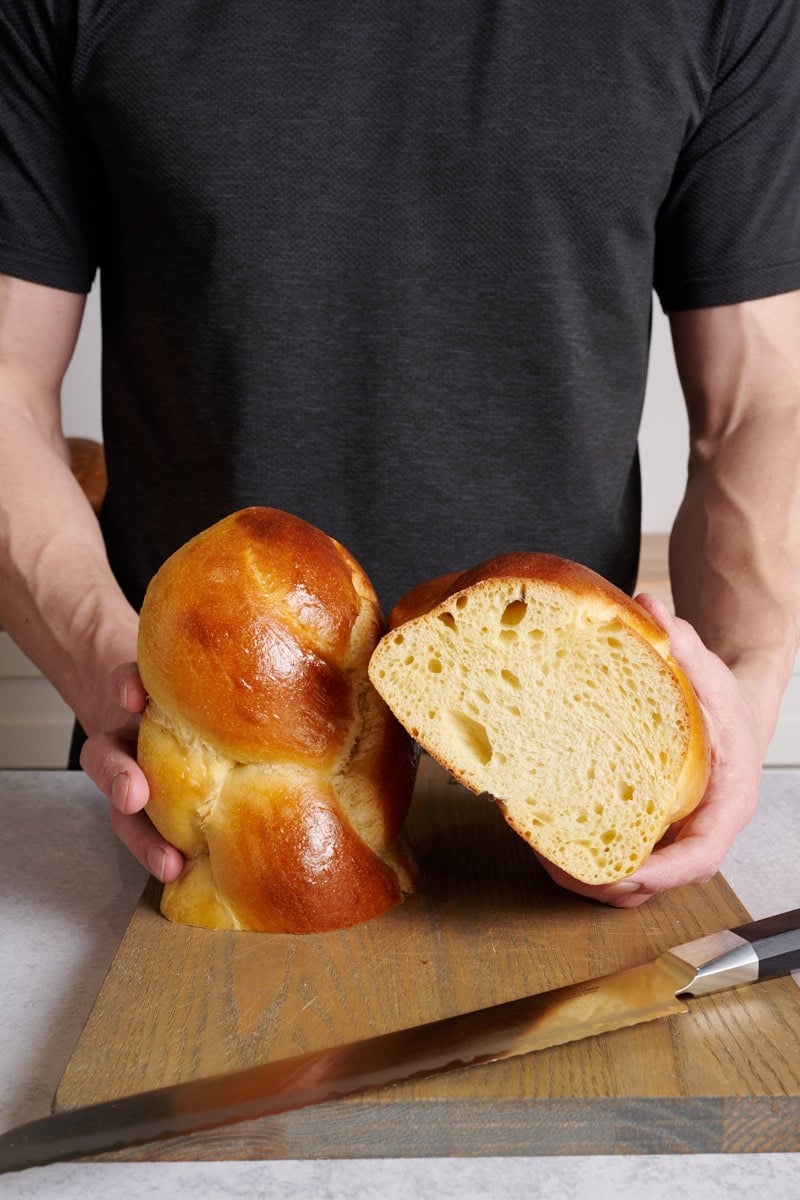
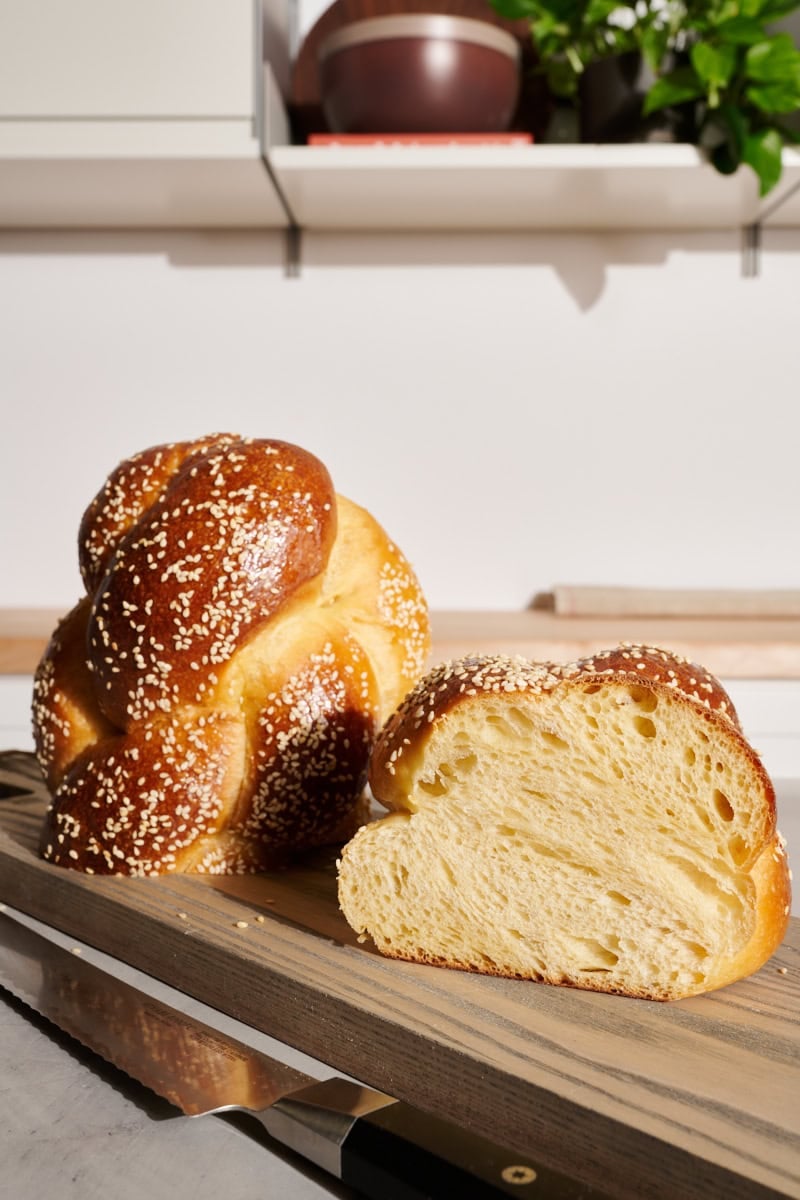
These doughs have the same weight and formula, but notice how tight the challah on the left is. It hasn’t expanded and generally looks denser (it eats that way, too). The one on the right has expanded much more, and if you could hold it, it feels like holding a puffy cloud.
The dough on the right was kept very warm during bulk fermentation (76°F/24°C on my proofer, which translates to about 78°F/25°C on the dough) and proofing (as described in the recipe to come). It wasn’t baked until a poke to the dough showed it to be very, very soft and airy (it passed the poke test and almost started to feel overproofed).
Flour Selection
For this sourdough challah, I initially tested using all high-protein white bread flour but found the resulting texture to be a little tough and dry (which is why I often minimize using high-protein flour). I then tried a blend of high-protein and medium-protein white flour to get the best of both worlds: a strong and manageable dough, but a final product that’s still tender. It worked well.
For medium-protein white flour, I have successfully used both King Arthur All-Purpose Flour and Central Milling Artisan Baker’s Craft+. Similarly, for the high-protein white flour, both King Arthur Bread Flour and Central Milling High Mountain worked very well (with slightly higher points for the Central Milling flour).
Baking Schedule
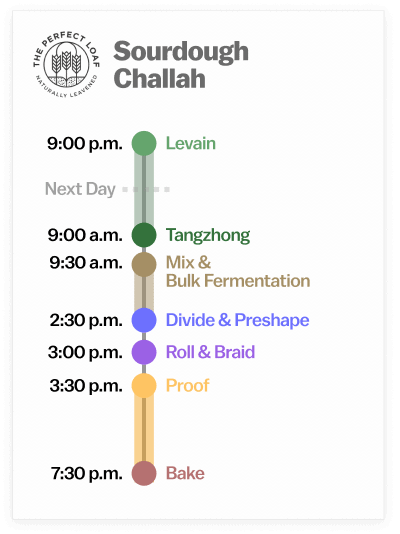
Since we’re using natural leavening, adversely affected by relatively high sugar concentrations, this recipe requires lengthy warm fermentation time. I typically start things at 8:00 or 9:00 am, and the challah should be ready to bake later that night.
I tested retarding this dough in the refrigerator in shape (that is, after braiding), but I found the resulting challah to be a bit too sour for my liking. I highly recommend baking this challah the same day it’s mixed.
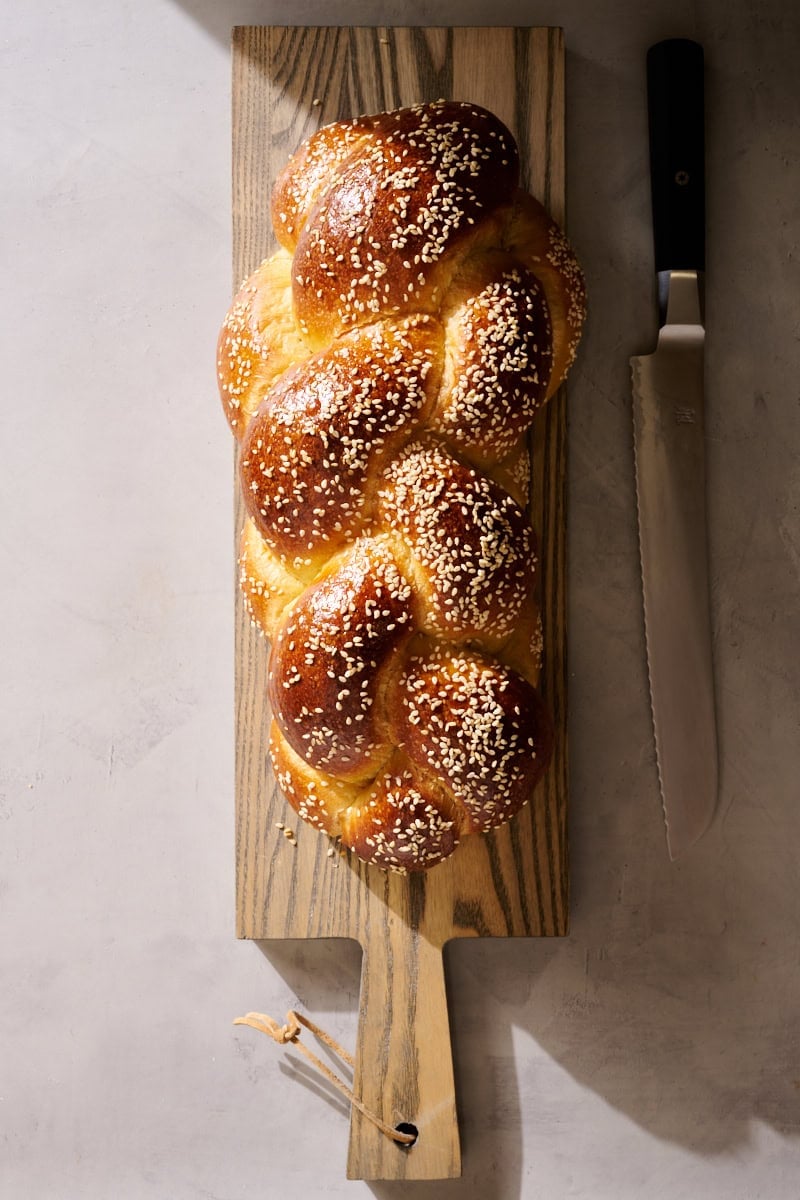
Sourdough Challah Recipe
See my guide to using baker’s percentages for tips on calculating baker’s percentages or modifying this formula (like doubling the recipe to make four sourdough challahs or two larger ones).
Vitals
| Total dough weight | 1,600 grams |
| Prefermented flour | 16.5% |
| Levain in final dough | 55.3% |
| Hydration | 43.5% (includes water in levain and tangzhong but does not include oil or egg) |
| Yield | Two 4-strand 760g sourdough challah |
Total Formula
Desired dough temperature: 78°F (26°C) (see my post on the importance of dough temperature).
As mentioned earlier, with this sourdough challah there’s a heavy my emphasis on ensuring dough, bulk fermentation, and proof temperatures are high. It’s very important with this enriched dough to achieve a soft, light, and flavorful loaf!
| Weight | Ingredient | Baker’s Percentage |
|---|---|---|
| 397g | Medium-protein white flour (King Arthur All-Purpose Flour or Central Milling Artisan Baker’s Craft) | 50.0% |
| 318g | High-protein white bread flour (Central Milling High Mountain, 13% protein, or King Arthur Bread Flour, 12.7% protein) | 40.0% |
| 79g | Tangzhong: High-protein white bread flour | 10.0% |
| 214g | Tangzhong: Water | 27.0% |
| 159g | Whole egg (About 3 large) | 20.0% |
| 34g | Egg yolk (About 2; save the egg whites in a covered container in the fridge to use for the egg wash when baking) | 4.3% |
| 36g | Oil 1: Vegetable oil or mild-flavored olive oil* | 4.5% |
| 36g | Oil 2: Vegetable oil or mild-flavored olive oil* | 4.5% |
| 79g | Superfine white sugar (or granulated sugar) | 10.0% |
| 48g | Honey | 6.0% |
| 131g | Water | 16.5% |
| 17g | Fine sea salt | 2.1% |
| 52g | Ripe sourdough starter, 100% hydration | 6.6% |
*The oil in this recipe is split into Oil 1 and Oil 2. The second is held back until the end of mixing.
Additional Ingredients
1 whole egg (or use the saved egg whites from above) and a pinch of salt for the egg wash
Raw sesame seeds, for topping (optional)
Sourdough Challah Method
1. Prepare the levain – 9:00 p.m. (the night before mixing)
| Weight | Ingredient | Baker’s percentage |
|---|---|---|
| 131g | High-protein white bread flour | 100.0% |
| 52g | Superfine white sugar (or granulated sugar) | 40.0% |
| 131g | Water | 100.0% |
| 52g | Ripe sourdough starter, 100% hydration | 40.0% |
Mix the ingredients in the chart above in your favorite jar and leave them covered at a warm temperature, 74-76°F (23-24°C), to ripen for 12 hours and 30 minutes. This is a sweet liquid levain and it will expand in volume significantly. Be sure to use a tall jar so it doesn’t overflow.
It is incredibly important that the levain is very ripe when you proceed with mixing the next day. It should be bubbly on top and very aerated with a sweet aroma.
2. Prepare the tangzhong – 9:00 a.m. (the day of mixing)
In a medium saucepan over medium-low heat, combine the 79 grams high-protein white bread flour and 214g grams water. Cook, whisking continuously, until the mixture thickens and becomes a paste (it should look like mashed potatoes), 4 to 5 minutes. Remove the pan from the heat and spread the tangzhong on a small plate to expedite cooling (or, if it’s cool in your kitchen, use when warm to help hit the high final dough temperature for this recipe).
Set aside.
3. Mix – 9:30 a.m.
| Weight | Ingredient |
|---|---|
| 397g | Medium-protein white flour |
| 187g | High-protein white bread flour |
| 293g (All*) | Tangzhong (from Step 2) |
| 159g | Egg |
| 34g | Egg yolk |
| 36g | Oil 1: Vegetable oil or mild-flavored olive oil |
| 36g | Oil 2: Vegetable oil or mild-flavored olive oil |
| 27g | Superfine sugar (or granulated sugar) |
| 48g | Honey |
| 17g | Fine sea salt |
| 367g (All*) | Ripe levain (from Step 1) |
*Note that it may be difficult to scrape every bit out of the pan or container; plus or minus 5g won’t make a massive difference.
Like other enriched bread, this sourdough challah requires intensive kneading to ensure a smooth and elastic dough. But with challah, it’s also very important the dough is strong at the end of mixing so braiding is more manageable, and for the best-looking challah with distinct braids.
I highly recommend using a stand mixer or spiral mixer to mix this sourdough challah.
For this bread, I use two longer mixing phases with a short rest of 10 minutes in between to ensure the dough passes the windowpane test at the end of mixing. Letting the dough rest lets the dough cool slightly to help avoid overshooting the final dough temperature (a hot dough is never a good thing). Additionally, it allows the gluten to relax. That way, the dough can be strengthened further during the second mixing phase (kneading) without tearing.
I tested using my KitchenAid stand mixer and the Ooni Halo Pro spiral mixer, and both mixed this dough very well (with the edge to the spiral mixer, for sure).
However, it’s also possible to mix this dough by hand using the slap and fold kneading technique or folds in-the-bowl technique, but know that mixing will likely take many minutes to reach a full windowpane. If mixing by hand, Be sure to hold back the oil until the dough is significantly strengthened.
To the bowl of a stand mixer fitted with the dough hook attachment, add the flour, tangzhong, egg, egg yolks, oil 1 (be sure to reserve oil 2 until later in mixing), sugar, honey, salt, and ripe levain. Mix on low speed (STIR on a KitchenAid) for 1 to 2 minutes until the ingredients come together, no dry bits remain, and the sides of the bowl are clean. Next, mix on medium speed (2 on a KitchenAid) for 7 minutes until the dough smooths and begins to cling slightly to the hook (it will still be sticky and shaggy).
Let the dough rest in the bowl for 10 minutes.
Return the mixer to medium speed and mix for 7 to 10 minutes until the dough gains more strength and clings again to the dough hook. The dough will still be sticky to the touch and might be attached to the bottom of the bowl, but the sides will be clean. It should be smooth, elastic, and pass the windowpane test.
With the mixer running on speed 1, stream in the oil 2 and continue mixing until all the oil is absorbed.
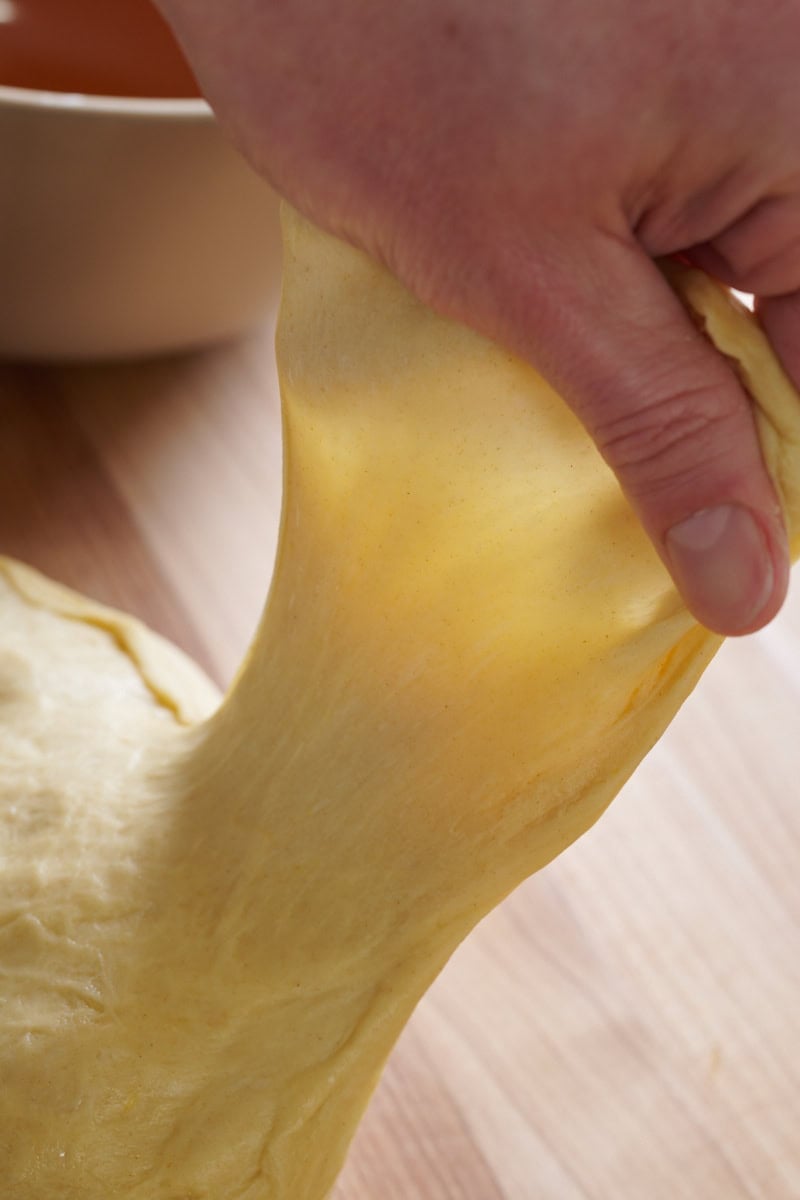
At this point, the dough will be very soft to the touch and a bit sticky but smooth, showing defined edges. Transfer the dough to a clean work surface. As you see above, it’s very important your dough shows full gluten development (it’s passing the windowpane test).
Next, use your hands to slap the dough on the counter and fold it over itself a few times, working it into a smooth, cohesive ball. Transfer it to a bulk fermentation container and cover.
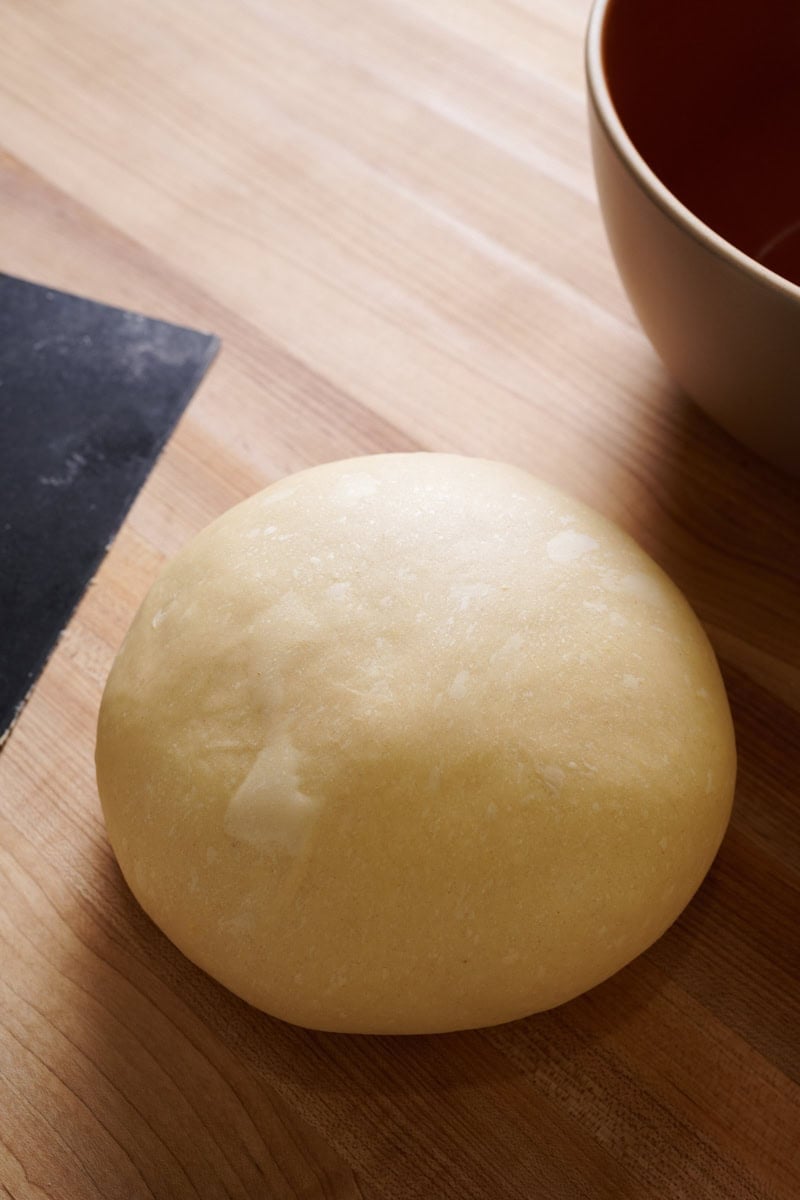
4. Bulk Fermentation – 10:00 a.m. to 2:30 p.m. (4 1/2 hours)
At a warm room temperature, 74-76°F (23-24°C), bulk fermentation should take about 4 ½ hours with no sets of stretches and folds (the dough has already been sufficiently strengthened during mixing).
It’s very important to keep the dough warm during bulk fermentation as it sets the timetable for this dough.
I’ll mention it again: It’s very important to keep the dough warm during bulk fermentation as it sets the timetable for this dough. I like to keep this dough in a proofer set to 76°F (25°C), but if you don’t have one, find a warm spot or use your oven with the inside light turned on and check in on it occasionally to ensure it’s staying warm.
Let the dough rest, covered, for the duration of bulk fermentation.
5. Divide and preshape – 2:30 p.m.
At the end of bulk fermentation, the dough should have risen significantly in the bulk container (about 40% volume increase) and be soft and puffy to the touch. It’s very important your dough aerate, show some bubbles, and rise significantly during bulk fermentation. If the dough has not risen or is tight, give it another 30 minutes to ferment at a warm temperature and check again.
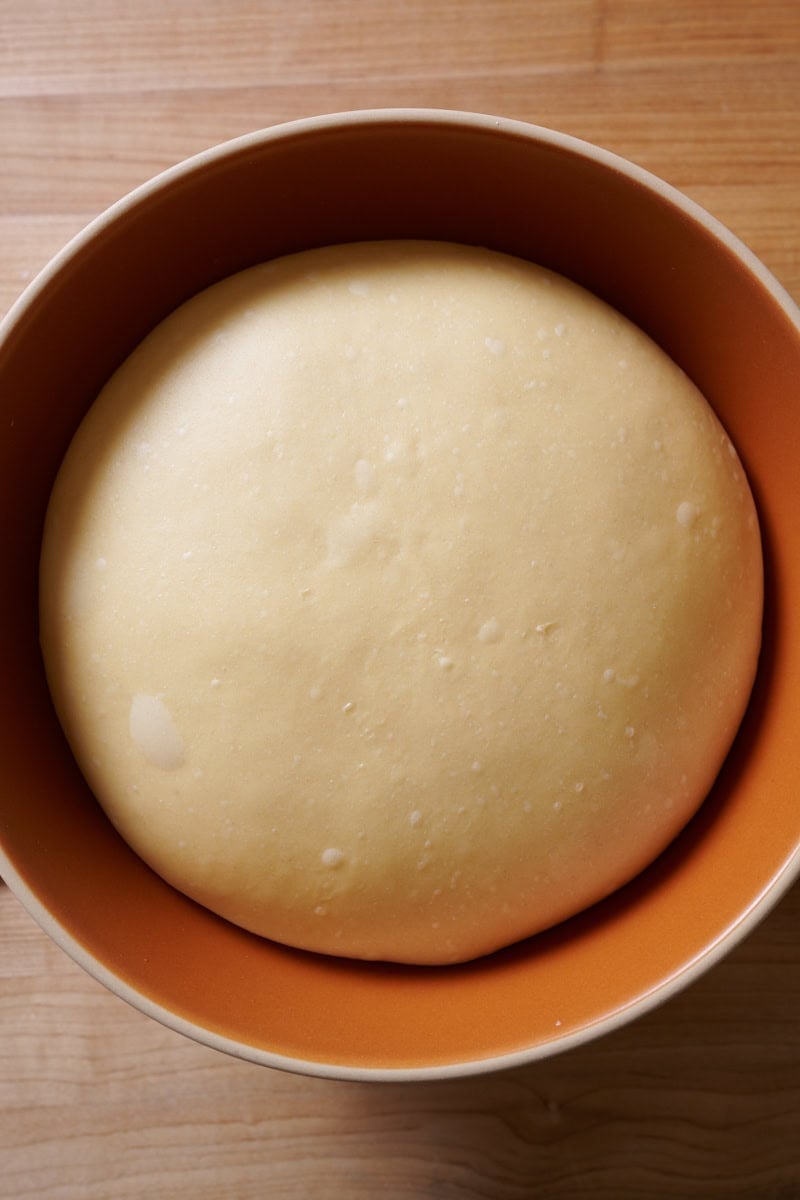
Line one baking sheet with parchment paper or a silicone mat.
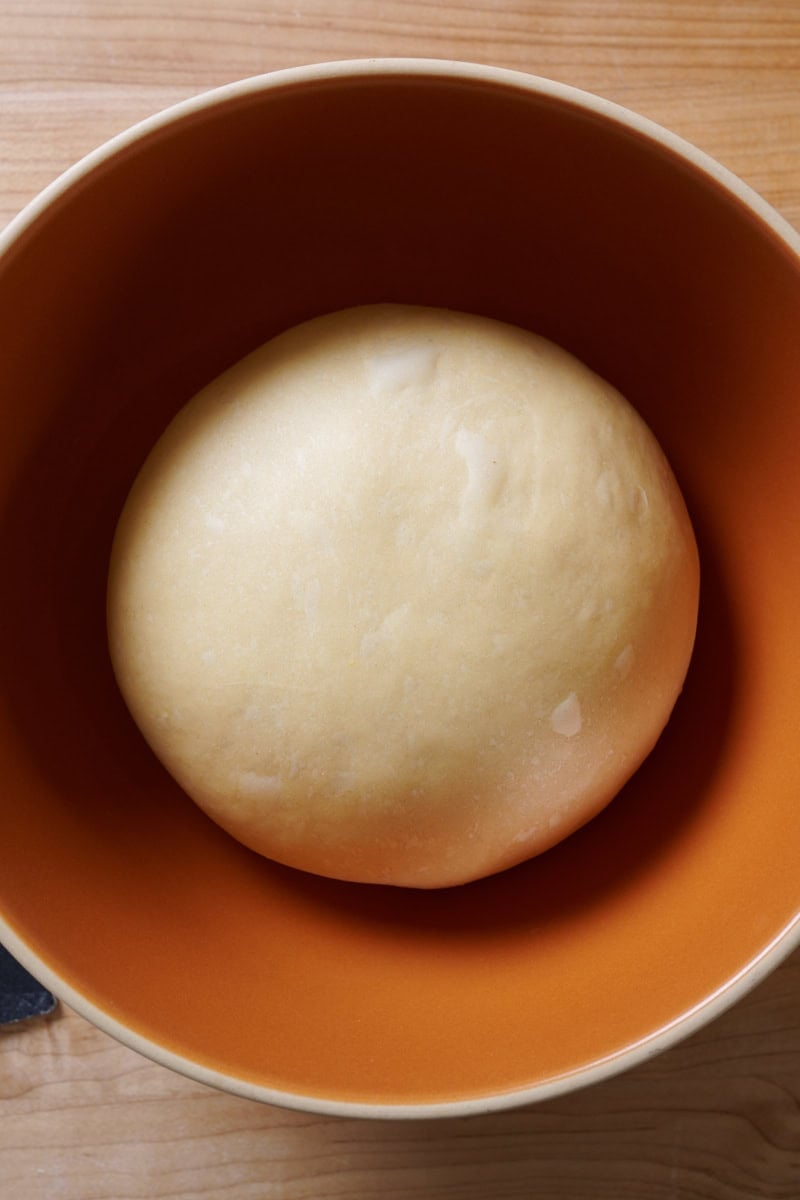
Using a bowl scraper, gently scrape the dough out of the bulk fermentation container onto a work surface. Divide the dough into 8 pieces weighing 190 grams each, trying to divide the dough so they’re mostly rectangular shapes. You might have a small bit of scrap dough left over.
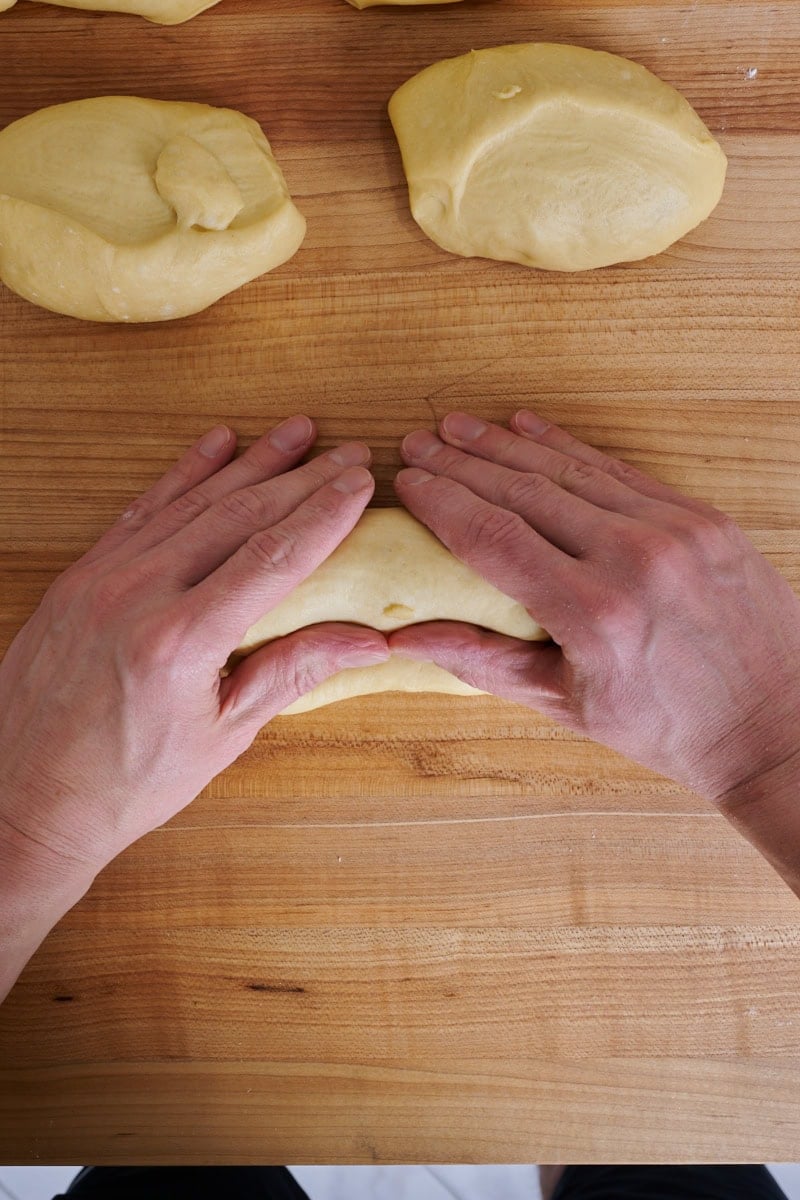
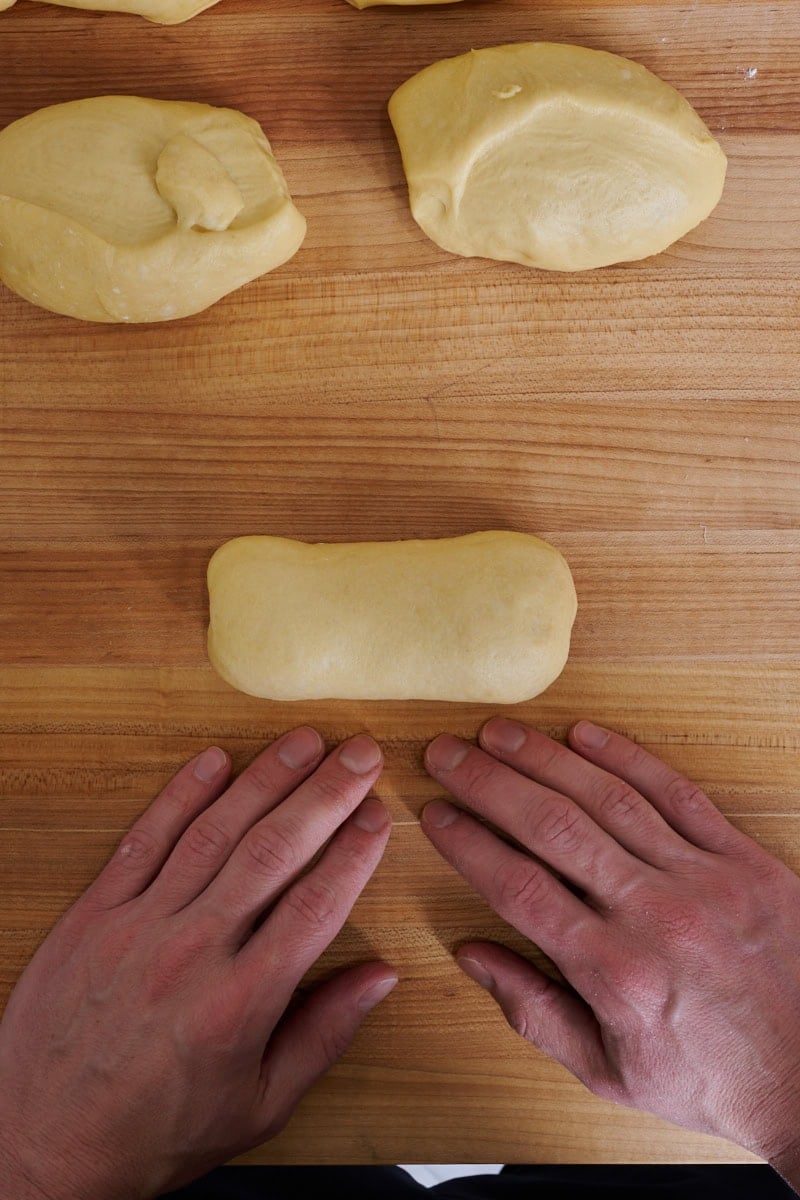
Preshape each piece of dough into a tube by rolling it down while cinching it up as you go (see above). Then, much like you’d roll out a baguette, gently and evenly roll the dough to about 4 to 5 inches long. This is not rolling out to its full length, but it will help get the dough in the right shape for more rolling after it has relaxed.
Cover the pieces with a large piece of plastic or moistened towel, and let rest for 30 minutes.
6. Roll and braid – 3:00 p.m.
Like you’d roll out a baguette, roll out four pieces of preshaped dough to 12 to 14 inches long with tapered ends (the tapered ends help braiding). Like baguettes, you want the dough to be as even as possible from end to end and with a smooth, taut surface.
Next, braid the 4 pieces into a 4-braid challah using the diagram and photos below.
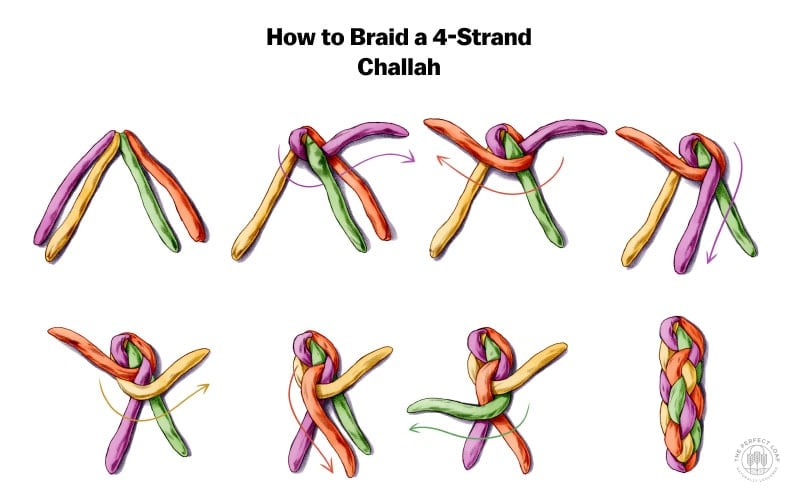
When finished braiding, turn the braided dough 90° and place your hands at the end of each side of the dough. Then, roll the dough slightly to seal the ends and tuck the points underneath the loaf.
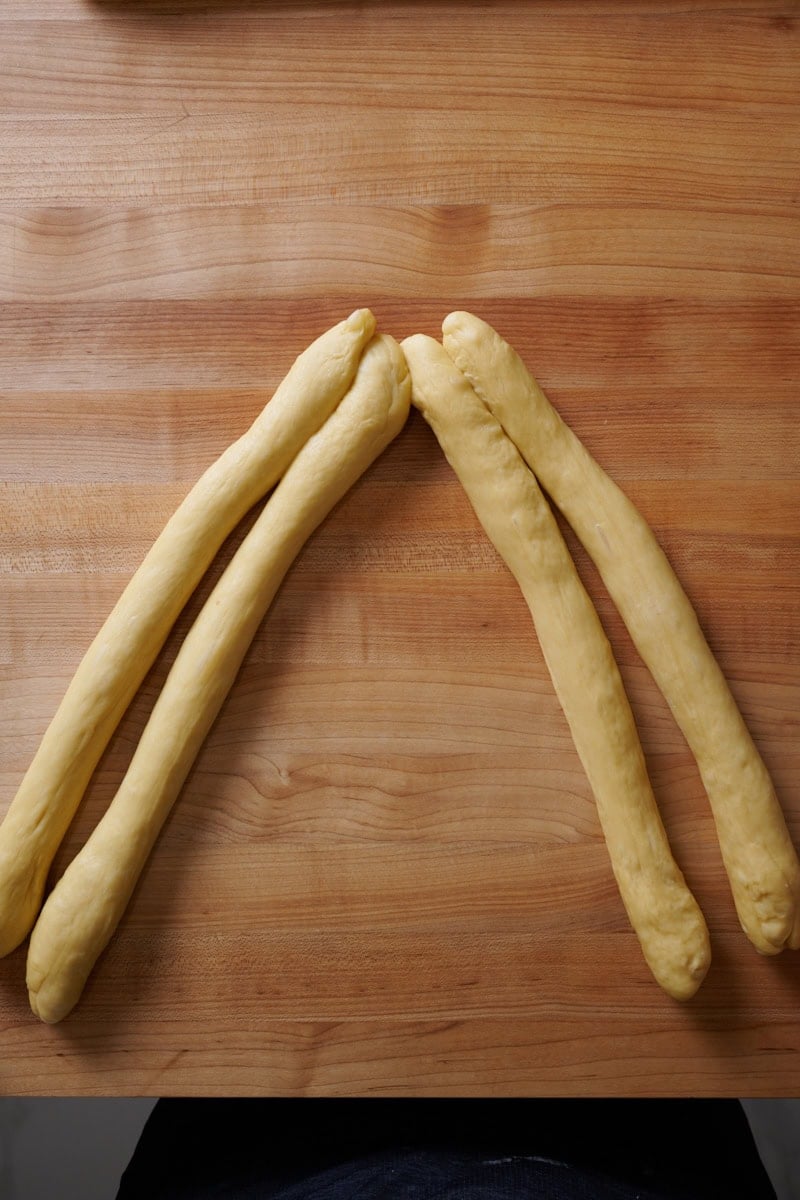
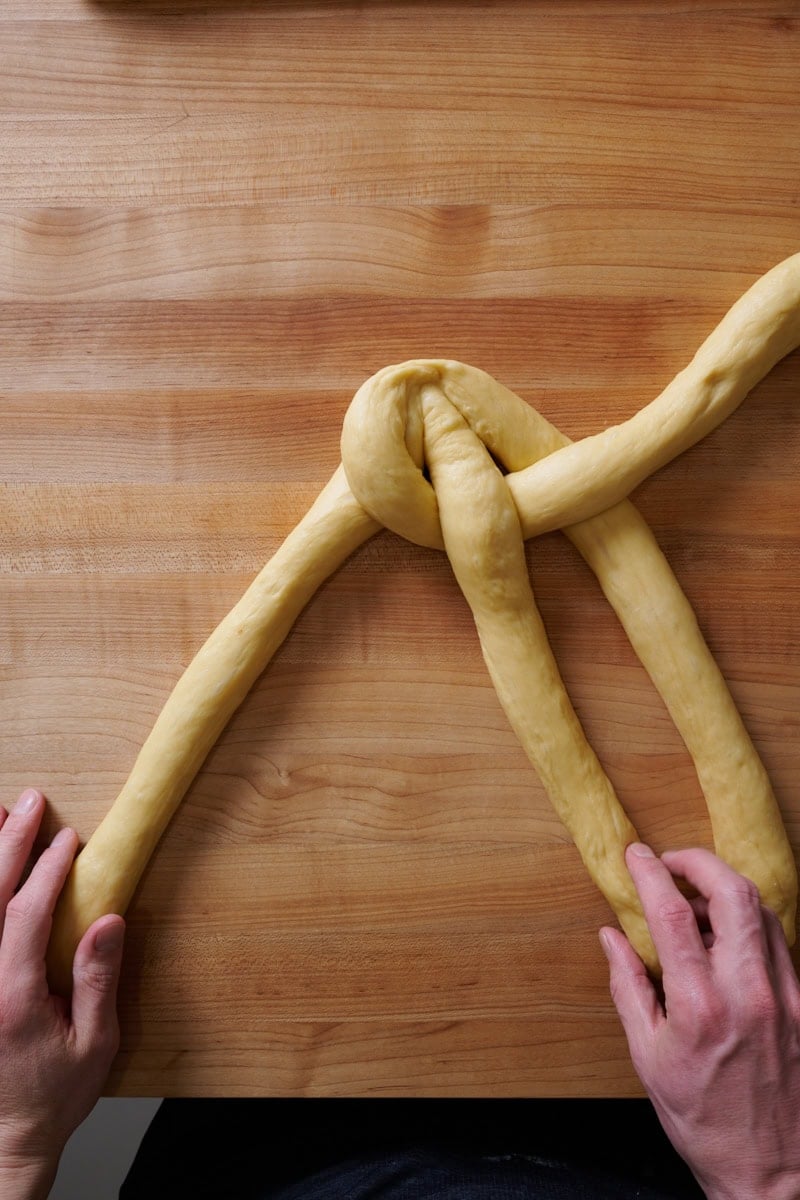
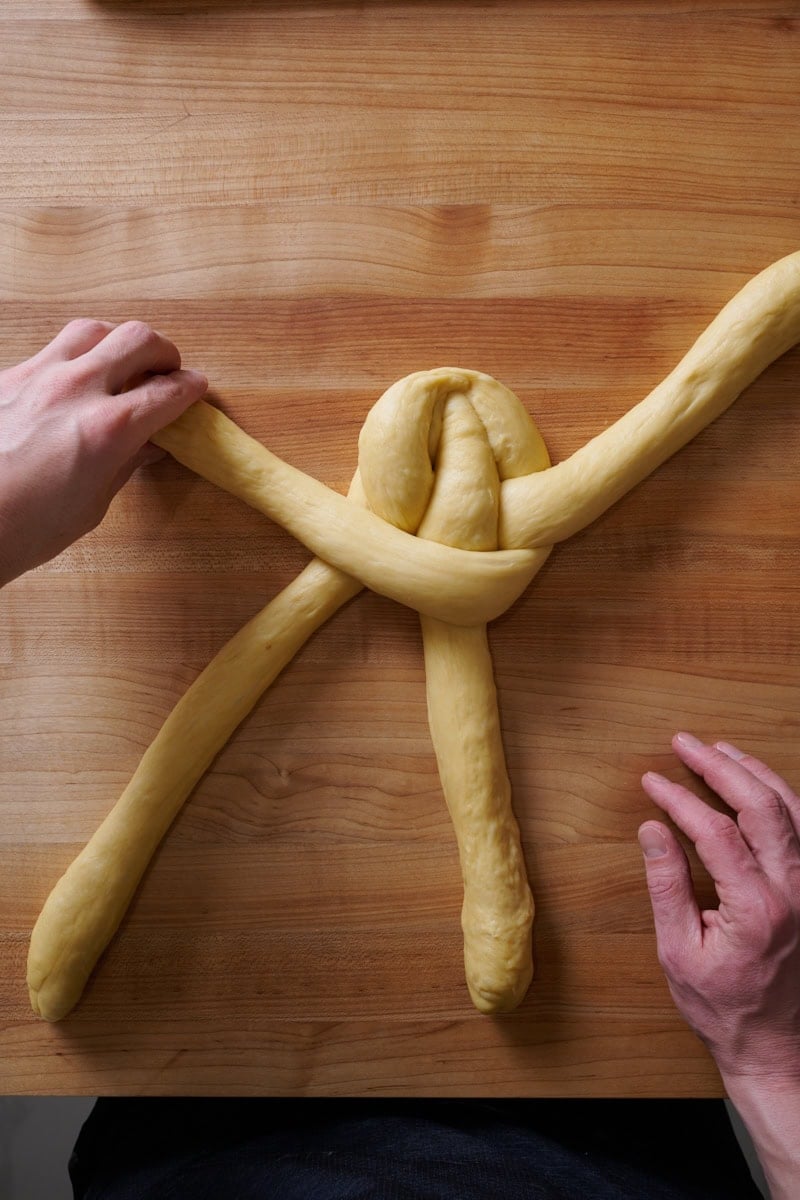
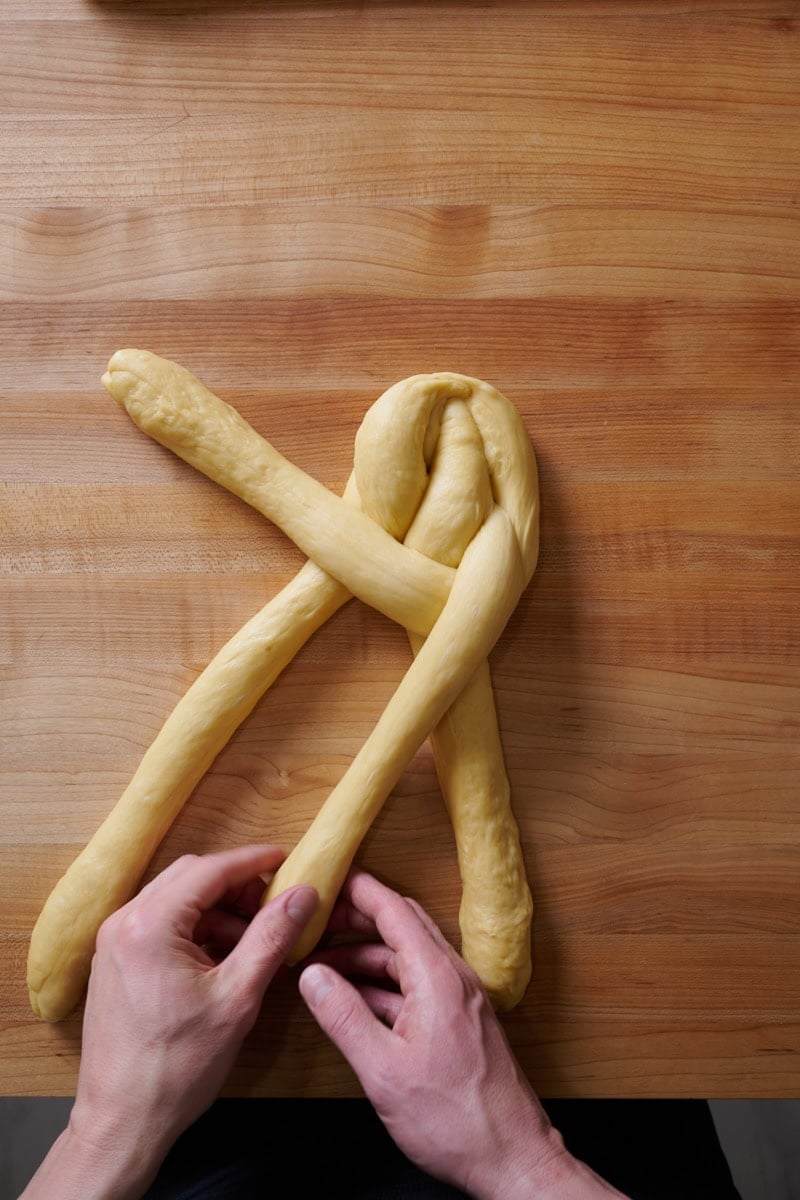
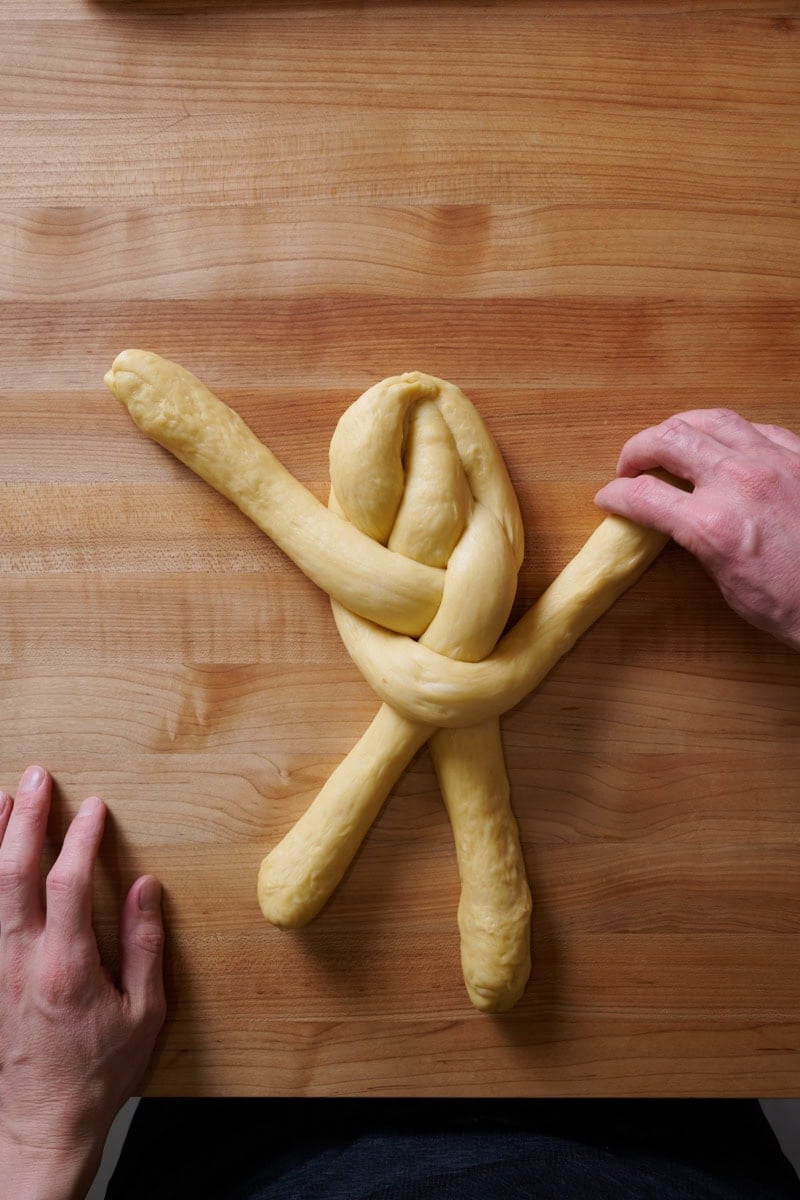
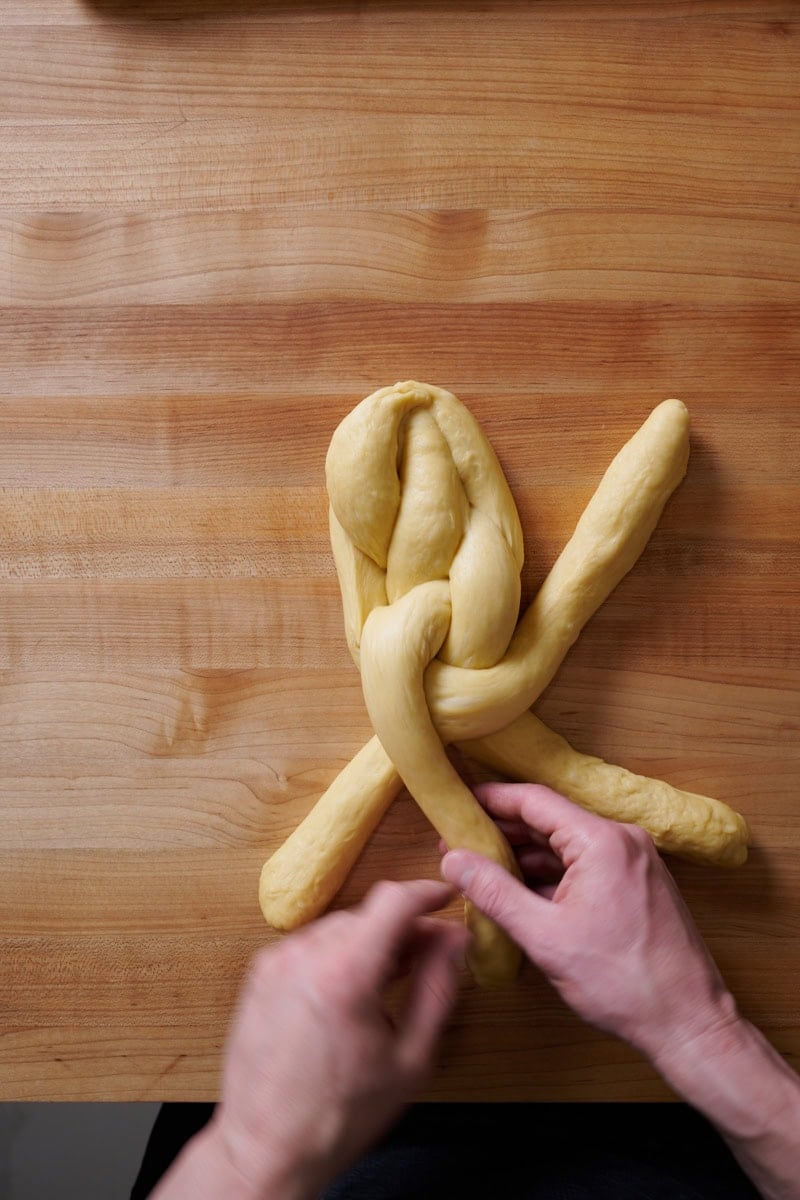
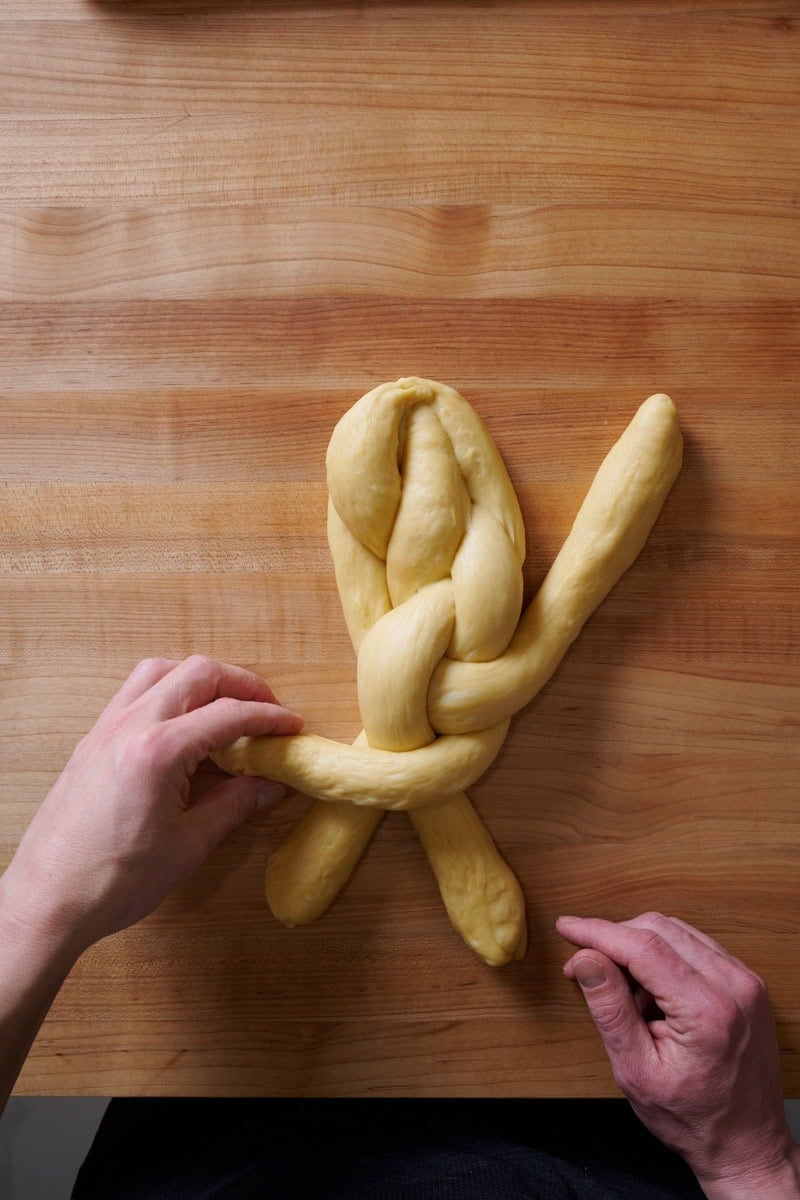

(Also, watch the video earlier in this post for step-by-step instructions on braiding a 4-strand challah.)
Transfer the braided dough to one side of the prepared baking sheet (it’s best to put it as far to one edge as possible) and repeat for the other four pieces of dough.
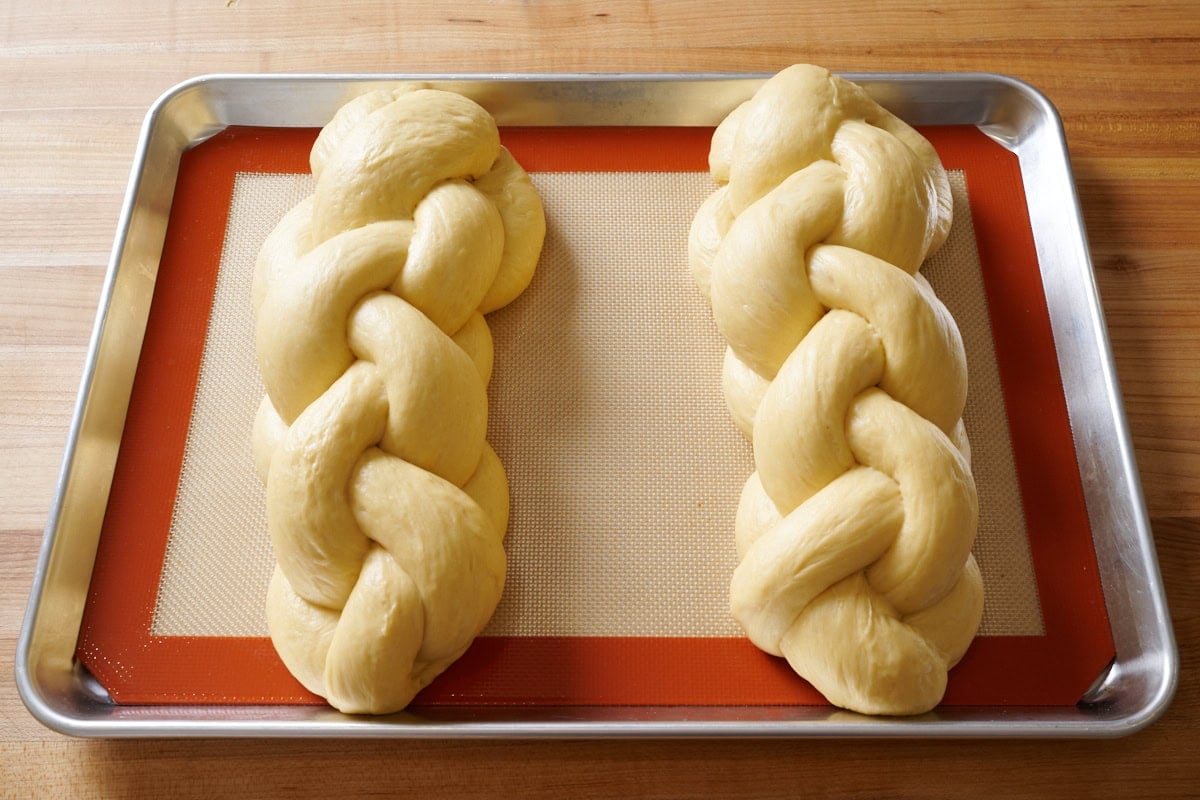
7. Proof – 3:30 p.m. to 7:30 p.m.
Cover the baking sheet with reusable plastic and let the dough proof for 4 hours at around 76°F (25°C). Again, since this dough is heavily enriched, keeping it warm is essential to stick to this schedule.
8. Bake – 7:30 p.m. (preheat oven at 7:00 p.m.)
After 4 hours, the dough should have puffed up and feel airy when poked. You can use the poke test to determine when the challah dough is ready for baking. A gentle poke to the dough should spring back slowly. The dough should feel very soft. If it feels tight or springs back quickly, give it another 30 minutes to proof at warm room temperature and check again.
(Be sure to read through the proofing section at the start of this post to look at the difference in proof levels with a dough like this sourdough challah.)
Preheat your oven to 425°F (220°C), with a rack in the middle.
Prepare the egg wash by whisking 1 whole egg (or the saved egg whites) and a small pinch of salt in a small bowl until smooth. (If using the saved egg white from earlier in mixing, your loaves will not have a crust as colorful as a whole egg.)
Uncover the baking sheet and, using a pastry brush, brush on an even, thin layer of the egg wash. Liberally sprinkle on sesame seeds, if using.
Place the baking sheet in the oven and bake for 15 minutes. After this time, if you want a deeply colored sourdough challah, apply a light second layer of egg wash to the dough, though this is optional. Rotate the pan back to front, then reduce the oven temperature to 375°F (190°C). Bake for 10 to 15 minutes until well-colored and the internal temperature is 200°F (93°C). Keep an eye on the dough in the last 10 minutes to avoid too much browning.
Transfer the baking sheet to a cooling rack for 5 minutes. Then, transfer the challah to a cooling rack and let them cool completely before slicing, about 30 minutes, or preferably overnight.
The sourdough challah keeps well for up to a week when covered completely to prevent drying out.
Print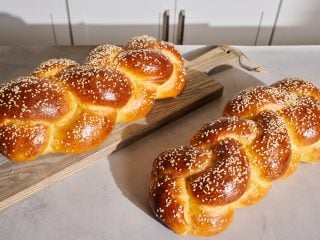
Sourdough Challah
- Prep Time: 23 hours
- Cook Time: 30 minutes
- Total Time: 23 hours 30 minutes
- Yield: 2 sourdough challah
- Category: Holiday, Sourdough, Bread
- Cuisine: Jewish
Description
This fluffy and dairy-free braided sourdough challah is incredibly flavorful—with a touch of sweetness—thanks to the long fermentation time. Perfect for Jewish holidays or for anyone looking for a delicate and flavorful bread!
Ingredients
Levain
- 131g High-protein white bread flour
- 52g Superfine white sugar (or granulated sugar)
- 131g Water
- 52g Ripe sourdough starter, 100% hydration
Tangzhong
- 79g High-protein white bread flour
- 214g Water
Main Dough
- 397g Medium-protein white flour
- 187g High-protein white bread flour
- 159g Egg
- 34g Egg yolk
- 36g Oil 1: Vegetable oil
- 36g Oil 2: Vegetable oil
- 27g Superfine sugar (or granulated sugar)
- 48g Honey
- 17g Fine sea salt
- All the ripe levain (about 367g)
- All the tangzhong (about 293g)
Instructions
- Prepare the levain — 9:00 p.m. (the night before mixing)
Mix the ingredients in the chart above in your favorite jar and leave them covered at a warm temperature, 74-76°F (23-24°C), to ripen for 14 hours. This is a sweet liquid levain and it will expand in volume significantly. Be sure to use a tall jar so it doesn’t overflow. Be sure to keep this warm. - Prepare the tangzhong – 9:00 a.m. (the day of mixing)
In a medium saucepan over medium-low heat, cook, whisking continuously, until the mixture thickens and becomes a paste (it should look like mashed potatoes), 4 to 5 minutes. Remove the pan from the heat and spread the tangzhong on a small plate to expedite cooling. Set aside. - Mix – 9:30 a.m.
Mix dough using a stand/spiral mixer with dough hook (hand mixing possible with slap-and-fold technique, but requires longer kneading; if mixing by hand, add oil later). Add Mix ingredients in mixer bowl. Mix on low (STIR) 1-2 minutes until combined. Mix on medium (speed 2) for 7 minutes until dough smooths and clings to hook. Rest 10 minutes. Mix again on medium 7-10 minutes until dough strengthens and passes windowpane test. Dough will be sticky but clean bowl sides. Stream in oil 2 on speed 1 until fully absorbed and dough is smooth and elastic. Transfer the dough to your work surface and slap and fold it a few times to get it into a taut ball. Transfer to a bulk fermentation container and cover.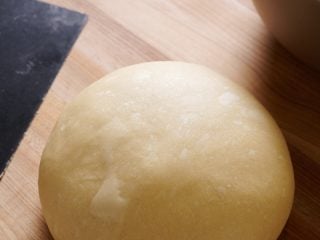
- Bulk Fermentation – 10:00 a.m. to 2:30 p.m. (4 1/2 hours)
At a warm room temperature, 74-76°F (23-24°C), bulk fermentation should take about 4 ½ hours with no sets of stretches and folds (the dough has already been sufficiently strengthened during mixing). - Divide and preshape – 2:30 p.m.
Line a half baking sheet with parchment/silicone mat. Scrape dough onto work surface and divide into 8 pieces (190g each), aiming for rectangular shapes. Preshape each piece into tubes by rolling and cinching. Roll like baguettes to 4-5 inches (partial length). Cover with reusable plastic and rest 30 minutes.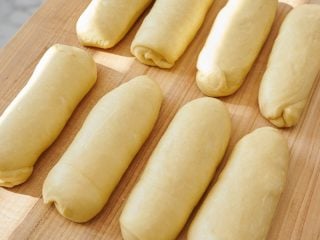
- Roll and braid – 3:00 p.m.
Roll out four pieces of preshaped dough evenly to 12 to 14 inches long with tapered ends. Next, braid the 4 pieces into a 4-braid challah. When finished braiding, turn the braided dough 90° and place your hands at the end of each side of the dough. Then, roll the dough slightly to seal the ends and tuck the points underneath the loaf. Transfer to one side of the prepared baking sheet and repeat for the other pieces of dough.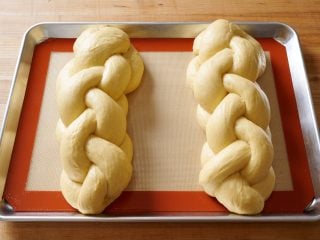
- Proof – 3:30 p.m. to 7:30 p.m.
Cover the baking sheet with reusable plastic and let the dough proof for 4 hours at around 76°F (25°C). - Bake – 7:30 p.m. (preheat oven at 7:00 p.m.)
After 4 hours, check the dough using the poke test—a gentle poke should spring back slowly and the dough should feel soft and airy. If it springs back quickly or feels tight, proof for another 30 minutes. Preheat oven to 425°F (220°C). Brush dough with egg wash (whole egg or saved egg whites + pinch of salt) and sprinkle with sesame seeds if desired. Bake for 15 minutes, then optionally apply a second egg wash for deeper color. Rotate pan, reduce temperature to 375°F (190°C), and bake 10-15 minutes more until internal temperature reaches 200°F (93°C). Keep an eye on the dough during the last 10 minutes of baking to avoid over-baking. Cool on baking sheet for 5 minutes, then transfer to cooling rack for at least 30 minutes.
Notes
If this is your first time making sourdough challah, I highly recommend you read the entire post before this recipe card. It’ll ensure you make the best-looking and tasting sourdough challah!
The vegetable oil can be substituted for a mild-flavored olive oil
Sourdough Challah FAQs
Can I proof this sourdough challah in the refrigerator?
I would not recommend this unless proofing is going very slowly and you must push it to the second day. Proofing this dough in the refrigerator for any period will increase the sour flavor.
Why does my challah tear or burst open?
This usually indicates the dough is underproofed. Give the challah dough another 30 minutes to 1 hour to proof before baking.
Why did the braids on my challah merge together?
This can happen for two reasons: 1) the dough was overproofed, or 2) the dough was over-hydrated and not strengthened enough. If you think the challah overproofed (when poking it, the dough was too soft and never sprang back), reduce the proofing time by 1 hour. If the dough was tough to braid because it was too sticky or slack, reduce the oil added to the dough or mix it longer in your stand mixer.
Can I freeze sourdough challah?
Yes, but it’s best to freeze after baking. Wrap the cooled bread several times in plastic wrap, then put it into a freezer bag. Defrost in the fridge overnight and toast slices the next day. Or, warm an entire loaf in a low oven for a few minutes until soft.
Can I use olive oil instead of vegetable oil in challah?
Yes, but be sure to use a mild flavored olive oil. If your oil is too fruity or peppery, this flavor can present itself in the final challah.
Can I make a 2, 3, or 5-strand challah with this dough?
Yes. In this case, I would make one 5-strand and one 3-strand challah out of the eight 190-gram pieces. Or, since the total dough weight is 1,600 grams, you can divide the dough into ten 160-gram pieces and make two smaller 5-strand challahs.
What’s Next?
Once you make this sourdough challah, slice it thick and use it for French toast. It’s incredible! If you’re in the mood for slightly sweet bread, my sourdough Pain de Mie makes the perfect toast.
Thank you, Baker’s Corner members (Simo, Karen, champgt1, and others) for helping me test this recipe and Ailine for our chats about all things challah!
Buon appetito!


82 Comments
HOLY MOLY! This is my first time making challah as an on-and-off sourdough home baker and it was absolutely PHENOMENAL. The loaves came out a little browner so I skipped the 2nd egg wash step but LET ME JUST SAY this was the FLUFFIEST bread I have ever made!! My family DEVOURED this (including my 10 month old nephew) and I am giving half of the bread tomorrow to my local grocery store. Thank you so much for the recipe and BEST BELIEVE I will be recreating your other recipes from now on! You have gained yourself a SUPERFAN! Keep baking and CHALLAH ON!!! 😝🤩🥖✌🏻
I make challah and using sourdough and a tangzhong (which I’ve never tried) is intriguing. I have to thank you so much for including the egg weight in grams. I have taken to doing this on my tried and true recipes as not all eggs in the carton will weigh the same thing (and I love consistency). My question is if I am say like ten grams under weight of the whole eggs, could I add water to make up the weight instead of wasting an egg just to get an extra ten grams. I guess I would have some white leftover from the egg yolks that I could use but would the water be okay to get it to weight without sacrifing anything?
Hi! This recipe looks amazing! I'm wondering if I'd be able to add raisins to the dough? We love raisin Challah and it would be fun to make our own! At what step would I add them? Thank you!
I was wondering this too.
Hello Leo,
I've been baking challah according to your recipe for almost a year now. I'd like to know how you mix this particular dough in a mixer Ooni. Thank you!
Our (Slovak) version is called Vianočka https://en.wikipedia.org/wiki/V%C3%A1no%C4%8Dka . I prefer the version with raising inside.
I like that idea, going to have to give this a try!
Went for middle of the night mix and just baked at 7:30am (made sweet starter at 11:00am day before). Skipped the Ooni mixer and used my Kenwood due to dough size. Took a bit longer to develop gluten and obtain windowpane but should have still kept going – very sticky. Tangzhong and sweet starter came up short, reduced Oil 2 to 15g. Very difficult to braid, wish I had seen the earlier comment about putting dough in fridge to make braiding easier. Braid definition got lost. Read another recipe can use a dust of rice flour to keep braids separate but I had just run out! Placed on two 1/4 sheet pans so I could stack in B & T proofer. Baked at same time, started at 400F for 10 minutes, reduced to 375F and after 10 minutes, got super dark, so reduced to 325F till I got internal temp to 205F. Used same Central Milling flours and will adjust hydration more next time and bake at lower temp. Loaves are monsters ~ happy with crumb and flavor. Will try again. https://uploads.disquscdn.com/images/d4ebd37b8fd7436a43c9346f1d45d4321c4a84f94ba18eb943f5a43c1145b206.jpg
They are quite big! Great work here Cheryl, the bake time and temp will definitely need some adjustment for your altitude and oven. You're on the right track here!
Hi Leo, I'm Heidi. I follow you on Instagram, You Tube, & I have your cookbook. If I cut this recipe in half, do you think the dough could be made in a sandwich bread loaf pan successfully?
Yes, I think it would work Heidi! It'll be a small amount of dough so you'll have to ensure the dough is mixed to proper development which might be hard given your mixer. But it will work.
This Challah bread just came out of the oven and my husband and kids already devoured a whole loaf. It is my second recipe I tried from your recipes and I find the measurements and details exact. It is also my first bread I ever baked.Thank you
So happy it worked out for you guys! Enjoy 🙂
I tried this recipe and just came out of the oven and my husband and the kids already devoured it. I find your recipes that I tried exact in terms of measurements and details. Thank you
Hi Maurizio,
Thank you for the effort and detailed description of your process. The results sound fantastic, I can't wait to try it! I am going to make some soon to practice before I make a few loaves for Hanukkah, but I have a question…
For several years I have been making challah using Melissa Clark's NYT recipe, and I love the orange flavor from using fresh-squeezed orange juice instead of water. There is also some orange zest added to the dough. It is a yeast bread that calls for 360-420g bread flour and 118ml orange juice plus a tbsp water, 1/3c olive oil and 2 eggs plus one yolk.
Would you recommend swapping out some or all of the water in your recipe with orange juice? How do you think would that impact fermentation? Would you adjust the sugar in the levain?
I would love to hear your thoughts on this before I start playing…
Best,
Carmine
I think you could do this with no problem Carmine. Definitely the zest will be okay, I've done this often in the past. I would say start with 20% of the water as OJ, and see how that goes!
Hi hi — I have a question:
I followed your recipe to the letter using the Ooni. That included the 6 minutes, then the rest, then 8–9 minutes, all at 30% speed. Kitchen temperature was about 78°F.
The result was a dough that turned into mush, with no gluten structure at all. At some point earlier in the process I think it was better (though I didn’t test it), but by the time I finished, it felt closer to cake batter than dough.
A couple of questions:
Why do you think this happened? It actually happens to me a lot with the Ooni, also when I’m making high-hydration breads. The dough seems to go from under-developed gluten (with some development), and then quickly collapses into mush.
Is there any way to save the dough once it reaches this stage? Whether for challah or for high-hydration breads?
To be honest, I’ve been pretty discouraged with my Ooni, and I’d really, really appreciate your advice. I’m a big fan of yours, and I actually bought the Ooni because of you.
Thanks so much!
Hey! It's very possible you've pushed the mix too far in the mixer, especially if there's not enough dough. But I often find the dough climbs up the hook and needs a little scrape down with the spatula. If you find it softens and slackens out, reduce the speed when mixing just a bit. Have you seen my guide to using the ooni?
do you happen to know the nutrition facts for the loaf? or what the carb count would be? I have two children with type 1 diabetes and they love challah!
I don't sorry Molly!
Can I simply make the tangzhong the night before so I get an earlier mix time? I could cover it and leave it on the counter or put it in the fridge. I am trying to get it baked in time for dinner.
Just made- need advice. When I added the second oil it never seemed to fully incorporate and then the dough became very sticky. It was too sticky to braid properly. Plus the levain came up 30g short and the tangzhong came up 20g short. Any advice? Thank you. I really want to get this right.
Dont worry about the tang coming up short, the levain, though, add 10g flour, water, and starter to make a slightly larger one. I would hold back that second addition of oil, or, reduce the water in the recipe, it sounds like your flour can't handle all the liquid—which is okay!
Hi is there a way to adjust the time for cooler temperatures? Can I mix the dough at 9pm, leave overnight to rise and then shape in the morning? The temperature would be around 70•. Thank you!
Hey there Rachel! Yes, you can certainly bulk (or even proof) the dough overnight at a cooler temp.
Can I make 4 smaller loaves? How long should I bake them?
Yes, absolutely. I'd probably knock off maybe 10m to the bake time (but definitely double check this, I haven't tried!).
I baked this recipe this week and got terrific results – despite an overly long batch rise and shorter rest at braiding and baking… I also agree with the thread that 425 degrees was too hot, and 1st challah started to brown too quickly. I would appreciate your recommendations on how to schedule this for a Shabbat dinner. Would you suggest following the recipe, baking on Thursday evening, and serving it on Friday? Or refrigerate the bulk dough overnight, and then braid and bake it on Friday morning?
Sounds like 400F is probably the sweet spot for most folks, I do tend to need to bake hotter here.
I would bake it Thursday then warm it in a low oven on Friday for the best flavor.
I baked this up and it was lovely but thought the dough was a wet. I double checked and there is a discrepancy in the recipe amounts for the bulk dough bread flour.
The bakers percentage table has 40% that equals 318g High-protein white bread flour.
The recipe cards have 187g High-protein white bread flour.
Hey there! They are correct over here, I don't see a difference between the two flours at the Mix step.
I see the same discrepancy. The Total Formula says 318g high protein flour (40%). The recipe card says 187g high protein flour. Which is it?
I’ve made this recipe many times and everyone loves the way it comes out but it’s very hard to work with at 187g.
The total formula is accounting for the flour that you used in the levain (131g) plus the additional bread flour that you used for the main dough (187g). 131 + 187 = 318g.
The tangzhong's flour is listed as a separate item.
I made this right away! I used to make so much of it in my shop but it has been years. Everything worked out great. Thanks for a great recipe and more… for all the research and development you do so we can be successful. My adult kids quickly called dibs on every loaf. Next time, I'm not telling them I made it!
Super glad to hear it worked well for you Rebecca!
https://uploads.disquscdn.com/images/6c5d3e2f5c641aad08b17b499a2852330724d2a4a0ed1109273363819716ac28.jpg Hi Maurizio, thank you so much for this recipe. I've been making it with 100% whole spelt flour, and surprisingly, it works really well without any modifications to the recipe. If you have any suggestions for how I can improve it even further, I would love to hear them. Thanks so much.
Looking really great Amy. I would reduce the total bake time, it's a little too colored and it'll probably help the texture be a little softer, too. Also, try reducing the hydration just a touch, spelt will make the dough slack and lose some of that tight braid look. You're on the right track here!
I’m really excited to try this! One question for you though. all Baking/cooking needs to be finished before Shabbat starts. While that time is getting later as we approach spring and summer, I still try to be finished by 530 ( earlier in the winter). Do you have any suggestions for adjusting the timeline other than getting up super early on Friday morning? I know you said fermenting in the fridge made it too sour. Could I proof at a warmer temperature perhaps? Thanks!
I just noted to another commenter that I'd bake this on Thursday. Then, reheat it in a low oven on Friday!
Thank you, Maurizio so much for your work! I have been baking challah for many years. I started with yeast but switched to a sourdough method. Your approach to challah really resonates with me.
I’ve already baked it several times using your recipe. The crumb and flavor are fantastic!
The only thing is that we prefer it less sweet, so starting from the second bake, I removed the sugar and kept only honey.
I have a question: the dough still turns out sticky. I suspect I need to reduce the amount of water, probably because my flour is different.
How would you recommend adjusting it?
Right on, Alona! I would say reduce the oil by 15g and see how that goes next time. Alternatively, you could reduce the water in the tangzhong by a little bit, though it's already quite low there.
I just made this today… Was googling for some sweet sourdough recipe and tour's came up so I wanted to try… OMG so good and amazing bread 😍
Happy it worked out for ya!
Thank you for your wonderful recipe and, especially, your development details and thoughtful explanations and options for adjustments. This bread is just as you have titled it, The Fluffiest Sourdough Challah! I live in the very warm, humid south and will adjust the oil on the next bake to minimize stickiness, even though the dough was well strengthened. The texture is pillowy soft with a sweetness that is perfectly challah. For me, the sourdough notes were extremely subtle, almost indiscernible on the palate. I used avocado oil and wonder, if dairy is not a concern, is ghee a suitable option for the oil? Thank you, again!
Right on, Karen. Yes, reducing the oil will definitely help here. Happy it worked out for you! Yes, you can absolutely swap out the oil for ghee, that'll work really well. Please report back if you do this!
I subbed ghee for the neutral oil. Loaves are beautiful and delicious! My next question is whether this recipe might work in a loaf pan or shaped into rolls? Challah is such a soft, flavorful bread. Thank you, again, for sharing your knowledge and recipes. The Perfect Loaf is one of the best bread baking books! https://uploads.disquscdn.com/images/df55f857a7180e9930d3c4b2de9c09ddae220527f8ac14dc0d275f778deb1c72.jpg
Gosh that came out just perfect Karen! Just lovely. I think it would work really well as a pan loaf. Appreciate the kind words!
This is a stunning recipe the Challah was outstanding! I did run out of time and had to toss the dough in the fridge overnight after the first proof. It still turned out beautifully to shape/proof/bake the next day only a very slight tang from the overnight cold proof.
Fantastic to hear that, Stacie! Yeah, that slightly longer proof will bring a touch more sourness, but even in testing, it wasn’t super pronounced for me.
I've been baking challah since 4 years old; it may be my earliest cooking memory. I frequently bake batches of 2 kg worth of flour and freeze or give away the extra loaves. Baking challah was my gateway into all other baking. I have made challahs with pumpkin, challah with streusel, challah with honeycomb, potato challah, seeded challah, challah with coconut and turmeric inspired by golden milk, eggless challah (aka German style "water challah"), and even other sourdough challahs. This recipe knocks many others out of the park. While the tangzhong is rather unconventional for challah, it only enhances the dough texture. The loaves I made last Friday, in honor of shabbat (of course), did brown a bit faster than I am used to; the high starting temp of 425 degrees nearly burned the crust but I caught it in time (I may try 400 next time). Maurizio, A+ from a life long challah baker 😉
Amazing, Miriam. Huge praise coming from someone who's made so many over the years, means a lot to hear you like my version! Now I'm curious about all these other varieties, I want to branch out 🙂
I'll put a note about the temp in the recipe for others!
Hi Maurizio scanning all of your enriched dough recipes to try to get more information on how to get better results from your cinnamon roll dough recipe. Unrelated to this, I had previously been making a sourdough sandwich bread that was 100% whole wheat with some oats added and the creator of that recipe had made a big point that if you want soft sandwich bread that you really need to knead very intensely to a good window pane and she gives some pretty good pictures and guidelines for the window pane. So I was trying to use her information and apply it to your cinnamon dough recipe, but I think I still was not kneading it quite enough, after watching the video for this challah and seeing how well the window pane was developed. I know in the cinnamon dough recipe you say that there will still be some stretch and folds at the end to strengthen the dough, but quite honestly for any enriched dough, I would much rather just knead it to full window pane before bulk ferment as you do for the challah. All of that leading to a couple of questions. Do you think there's any reason I shouldn't knead to full window pane for the cinnamon roll dough? And also do you see any benefit to using a sweet stiff levain for the cinnamon roll dough? Stiff levains are supposed to promote yeast over bacteria even without the addition of sugar, so it's something I was thinking about trying in order to get a better rise in the cinnamon roll dough.
Ginny, you're absolutely right about kneading enriched doughs like the cinnamon rolls to a full windowpane before bulk fermentation – it's a solid approach. If you do this, you won't need any stretches and folds during bulk fermentation.
As for the stiff levain – yes, this could help! A stiff levain (50-60% hydration) does tend to favor yeast activity over bacterial activity, which can help with rise and reduce sourness. But to take it a step further, this is why I use a sweet levain for this challah recipe: it suppresses bacterial activity even more dramatically.
For either modification, just keep an eye on your dough during bulk fermentation as timing may need slight adjustment based on the increased initial strength or changed yeast activity.
Let me know how these adjustments work for you!
So far I have gotten a ton of useful info to improve my sourdough baking skills. That said, I much prefer certain breads made with conventional yeast. Challah would be my recent example. I just finished the sourdough recipe for challah and, while good, I prefer a yeasted recipe. My sourdough version lacked the richness of eggs because it was overwhelmed by the firm starter's sourdough character. Just my opinion.
I totally get that, Ron! As I mentioned in the post, this is a classic yeasted bread, somewhat kind of like baguettes in that's how it's almost always prepared. I do find there's more flavor in my sourdough version, but I hear you on the texture and "cleaner" flavor of a yeasted challah. Many ways to make many things, we each have our preference. Appreciate the feedback and comments here!
Hello how do I add raisins?
Love this idea. I'd add them at the very end of mixing, right before you stream in the olive oil.
I am making this recipe today in advance of Rosh Hashanah, so I added 160g raisins (about 20% bakers' percentage). I added them at the end of mixing, as Maurizio suggested.
If I don't have a stand mixer how long should I knead the dough for?
I'd say at least 10 minutes for the first portion, then 10 for the second.
I made this recipe yesterday! There was not a suggested time for oil 2 and found it took quite a bit of time on my Kitchenaide at prescribed setting to incorporate. My dough was sticky. I had printed the instructions so did some slap & folds on my marble slab and set into B&T proofing box to BF. Then I watched your video. Your dough at slap and fold wasn't sticky! So an hour into BF I pulled out the dough and did a bunch of coil folds. It rose beautifully and passed windowpane, bubble on sides some air pockets on top but sticky to the touch still.
I proceeded with your instructions. Still sticky when braiding. I had to splash some flour lightly on the slap and on my hands to roll out and for braiding (which I loved doing).
My loaves appeared ready in 4 hours. Egg wash, sesame seeds and into the over.
Gorgeous and delicious!!!! If I could add a picture here you would be so proud! I can't stop eating it!
My Tangzhong wasn't as fluffy as yours. Advise?
Why so sticky when every weight was in perfect alliance with your recipe?
PS I always make more levain than your recipes call for as I'm always short when it's time to add to mix. In this recipe you say "about" 367gms. I have license to use what's in the jar and not weigh it when I use your recipes? Weights always followed exactly. Thank you for this amazing Challah! I will make again and again. I hope you are working up to another book. 🙂
Yes, that second oil takes a bit to get into the dough, but this is the safest approach. Really great adjustments and mods there, Pam, nice work!
Thank you! I’ve been waiting for your challah recipe! I’m making it right now, but I’m struggling a bit with braiding because the dough is very sticky. Does that mean it hasn’t been strengthened enough?
Yes, almost for sure. It could also be your flour needs less liquid. You could hold back a little of the water in the tangzhong, or leave out 1/4 of the oil. If it's sticky and hard to handle, pop it into the fridge (uncovered) for 10 mins to firm up a bit to make it easier to braid!
Thank you for the tips. I've just finished eating my first challah, and I definitely will bake it again – it is perfect. Thank you!
Hello, I am making this recipe today and am using my B&T proofer because it’s cold here in So. Cal. It looks like you are using a square sheet pan and silpat that might fit in the proofer. I looked in your tools but didn’t see one listed there. If so, it would be great to know the brand. Thanks!
Hey Debbie! Unfortunately, this sheet pan won't fit in the B&T proofer. It's your standard half size for the home oven. I cover the dough and sheet pan in reusable bags, and then proof in my oven. I toggle the light on and off to get it around 76-78F.
Let me know how the challah turns out!
A quarter sheet pan does fit in the B&T proofer. B&T also makes a suspended rack so you can stack two pans in at once.
Yes, that’s right!
I used a rectangular pizza stone with silpat on in to put challahs into the proofer.
If you haven't made it yet the sheet pan won't fit in your B&T but should rise nicely covered. It sits for so long in final shape! My last proof took 4 hours. Pretty cold here in Northern California as well. As always, BF is a dream in the proofer. Why do people moan about the temp of their home when they could have B&T equipment?!?
I just finished mixing with my Ankarsrum mixer. It comes together nicely. Although very difficult to get the second round of oil to mix in. I note that the recipe calls for adding the tangzhong in twice. I am looking forward to the bake later today. I have baked your other recipes that use pre-cooked flour and they always turn out great. Thanks for having the patience to put this one together.
Yes, that second oil add takes a bit with streaming it in. But it really helps to develop the dough first before adding it. If the dough is very dry feeling, you can just add it all in at the start (it all depends on your flour).
Thx regarding the tangzhong line, fixed!
Hope this turns out great, Mark!
It turned out great, thanks again. Although I think I could have worked it more and it was a bit over-proofed. If I account for the additional water, is there any reason not to use butter instead of oil? I make your brioche recipe often, a Challah seems adjacent.
Great to hear that, Mark. I don’t use butter because traditional challah is dairy-free! But you can definitely swap it out if you’d like.
In the main dough ingredients list you have 2 – 36grams of vegetable oil (oil 1 – oil 2). Do you add a total of 72 grams of vegetable oil to the dough or is this a typo? Great looking bread by the way.