

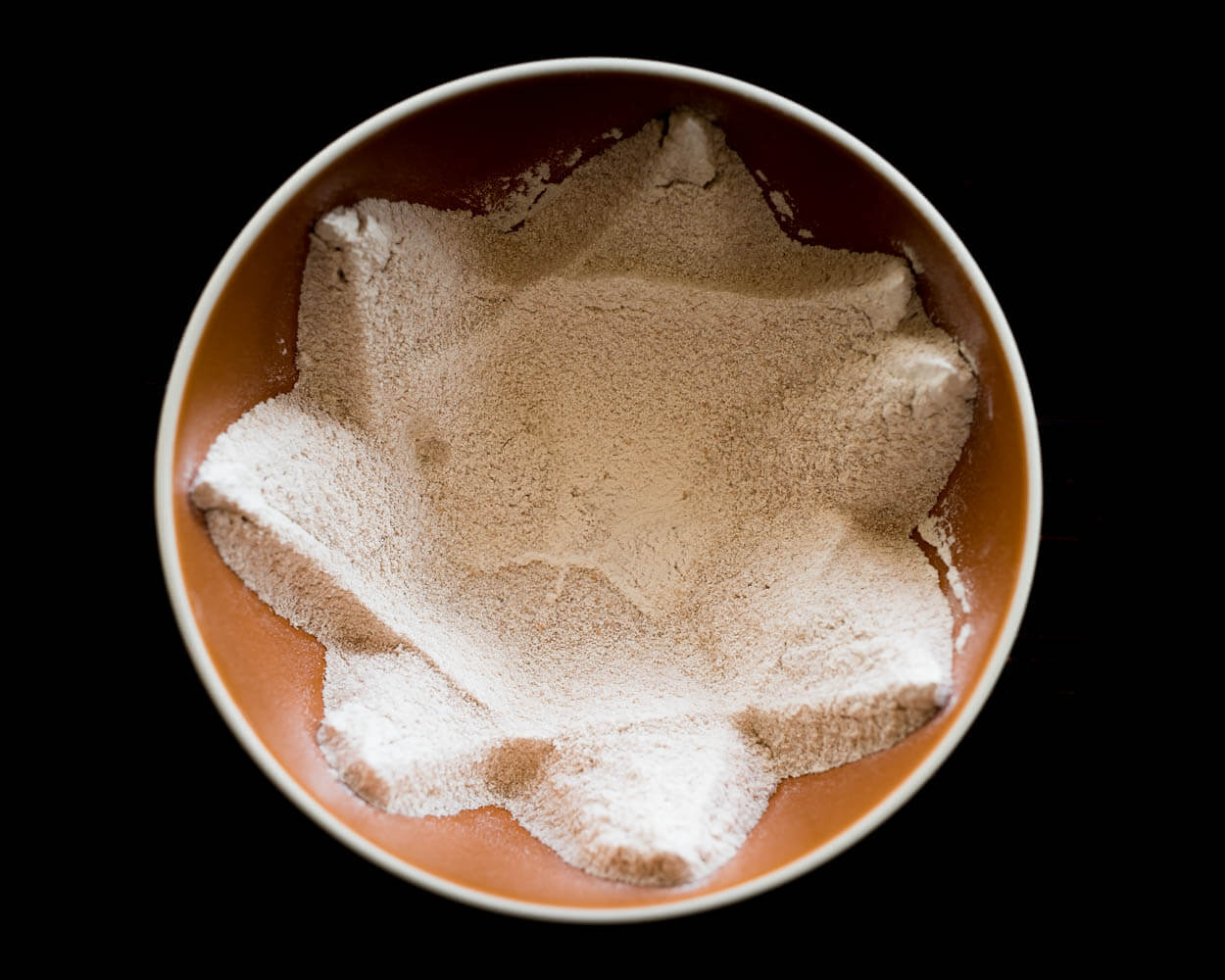
“You’re so crazy,” I heard my wife whisper in the background as I unearthed the great red beast from its box marked “Extremely Heavy.” The beast, a GrainMaker Model No. 116 hand-cranked mill, was carefully packaged and shipped across the country from a small place in the Midwest where everything was made and assembled by hand. It exuded quality and craftsmanship. As I placed the large, shiny apparatus on my kitchen counter, I tried to hold back my excitement and eagerness to start baking sourdough with freshly milled flour.
But is my wife right: am I crazy to have a flour mill in our kitchen? Throughout history, communities were centered on the flour mill. People would gather when the mill was finished grinding berries into wheat and pick up their fresh flour to bake with it straight away. These mills were life-giving to the community. Is it so different to have a mill in your own home and bake with fresh flour? While the importance of bread may or may not be the same today as it was back then, there’s certainly a list of things to be gained by baking with freshly milled flour, and for me, the taste is at the top.
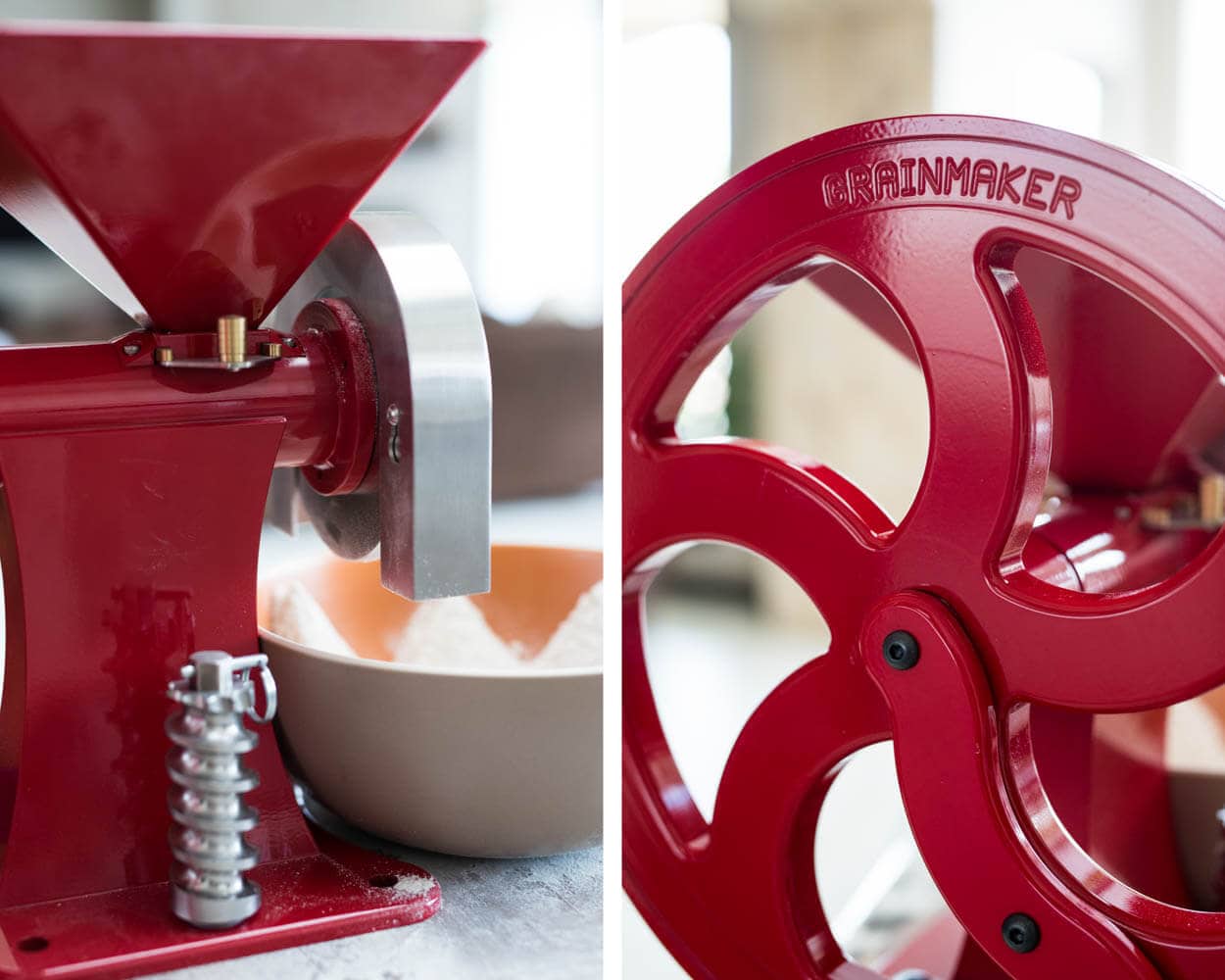
The GrainMaker allows me to produce some incredibly fine flour, but milling is not a speedy process: it takes me between 10 and 20 minutes to mill about 1 kilogram of flour (depending on how fine I decide to grind, and how strong I’m feeling that morning). While my proficiency improves each time I use the mill, the physical process of milling is part of the enjoyment for me. It’s that missing step in baking, the transformative part that takes each seed from field to bread. But perhaps most importantly, the resulting flour is spectacularly fine, light, and the aroma, it’s intoxicating. Milling that first batch of flour was a real awakening: who knew flour could smell like this?
What was my motivation for milling my flour? Several things captivated me after reading numerous articles and first-hand accounts of people milling at home: economics, the overall increase in freshness, health benefits, and king of them all, the taste.
Benefits of Freshly Milled Flour
The benefits of milling your wheat are numerous. First, buying whole, raw berries makes financial sense compared to milled sacks of wheat: not only are they cheaper but buying in bulk typically will save you even more. When stored properly (a cool, dry pantry devoid of light) the shelf life of raw wheat berries is incredibly long—years long, so ordering an excess is never a problem. For a home baker like me, this can be a real advantage as I can store 50 pounds of wheat berries almost indefinitely and not have to worry one bit about them spoiling. I typically bake two to three times per week, and I have no problem churning through a 50-pound sack of flour, but it’s nice to have fresh flour and mill only what I need for the next bake. But if you are a sporadic baker it might make even more sense, mill what you need and the rest will stay fresh long into the future.
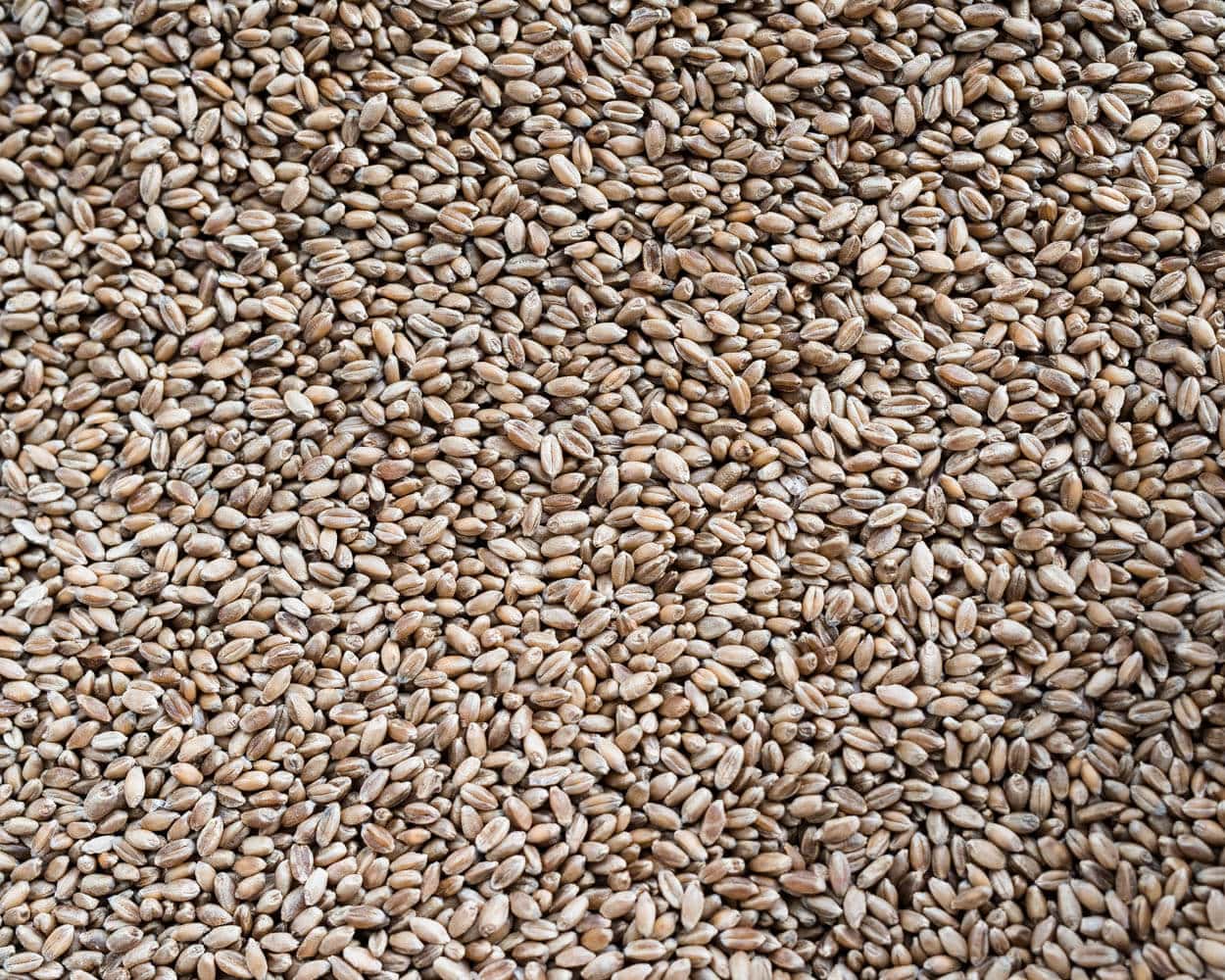
Milling your own flour, without sifting, means you will retain 100% of the same wheat berry in your end product. Many mills will indicate on their packaging that you’re buying whole wheat, but that doesn’t always mean whole grain. Additionally, they will sometimes perform several milling passes, especially on the germ and bran which are sifted out and then later added back in, reconstituting back to 100% of its original weight. I’ve read several accounts where bakers say there is something different about the taste, nutrition—and it simply does not perform the same as freshly milled flour milled in a single pass (see Peter Reinhart’s latest book, Bread Revolution).
Studies show that freshly milled flour provides added nutrients to your diet compared to aged flour. To start, bread baked with freshly milled flour has higher vitamin and fiber levels. Further, foods exposed to oxygen (oxidization) for prolonged periods will result in nutrient loss, and in this case beneficial minerals and oils.
Once the wheat berry is milled, breaking open that protective bran layer, oxidization begins which causes nutrients to degrade slowly. While we do not eat bread primarily for its vitamin content (compared to say, spinach), but rather more for proteins, fiber, and carbohydrates, it is great to know that bread baked with freshly milled flour retains more vitamins and nutrients than we might otherwise get.
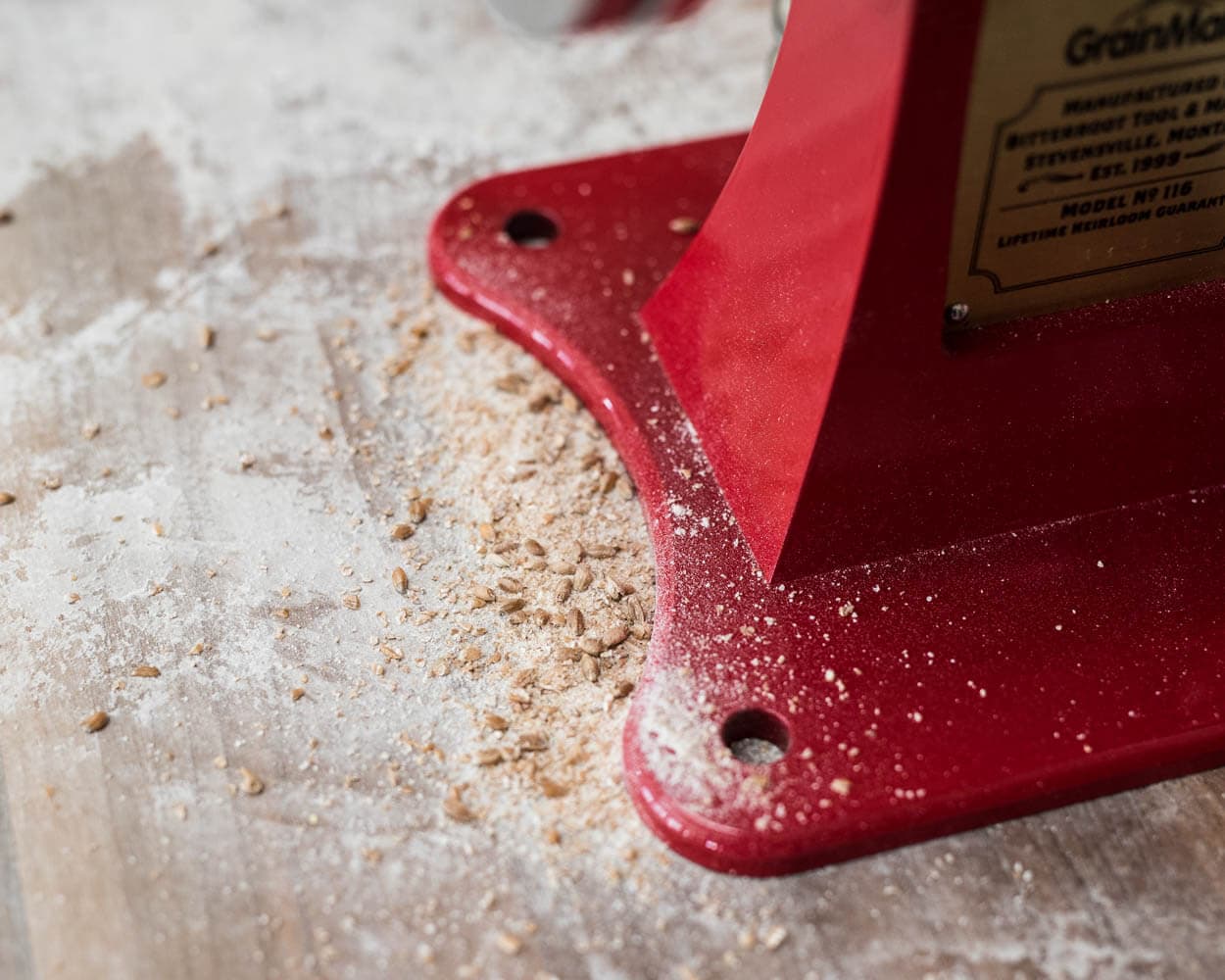
With all that said, it’s easy to get caught up in a debate on the exact percentage of vitamin and fiber retention, but to me, those are beneficial side effects of a more substantial motivating factor: taste. It’s much better to focus on the fact that this bread is just plain delicious (and, in some possibly unquantifiable way, healthier). Let’s talk about the taste.
The Taste of Freshly Milled Flour
Great taste is, of course, something we always strive for when baking, irrespective of what flour we are using, but the bread I’ve baked with freshly milled flour is a world apart from other bakes. It starts with the smell during milling—an aroma that reminds me of heavy cream or panna cotta. I never knew wheat could smell like this and it’s captivating. When you smell aged flour, it might have a particularly sweet smell, but there’s something more here, something I wasn’t expecting the first time I milled. You’re hit a second time with this beautiful aroma right when you get your hands in and mix with water, it wafts up from the cream-colored mixture and lingers with you through the mix.
I like to equate milling flour to grinding your own coffee beans. Once you taste the results there’s no alternative.
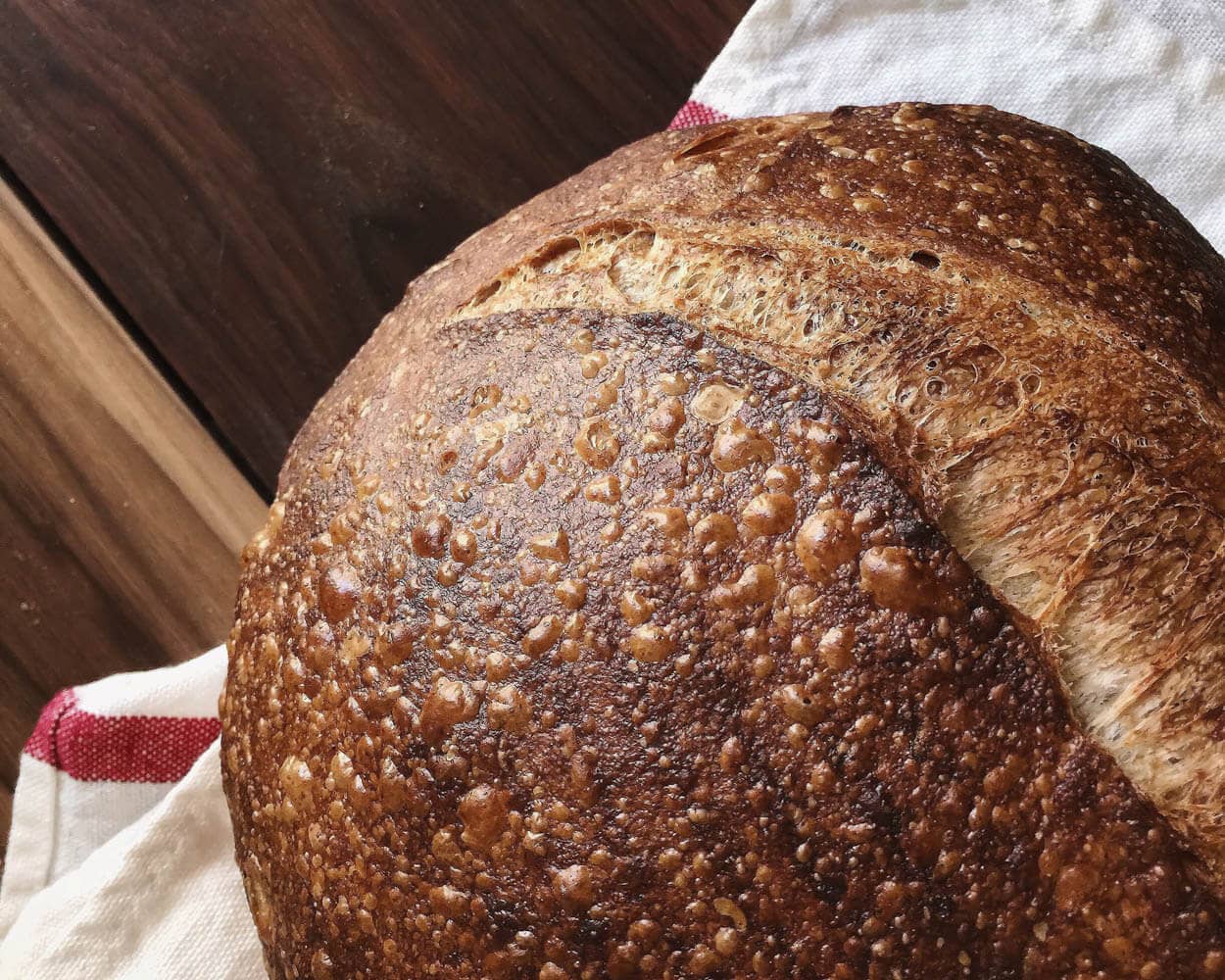
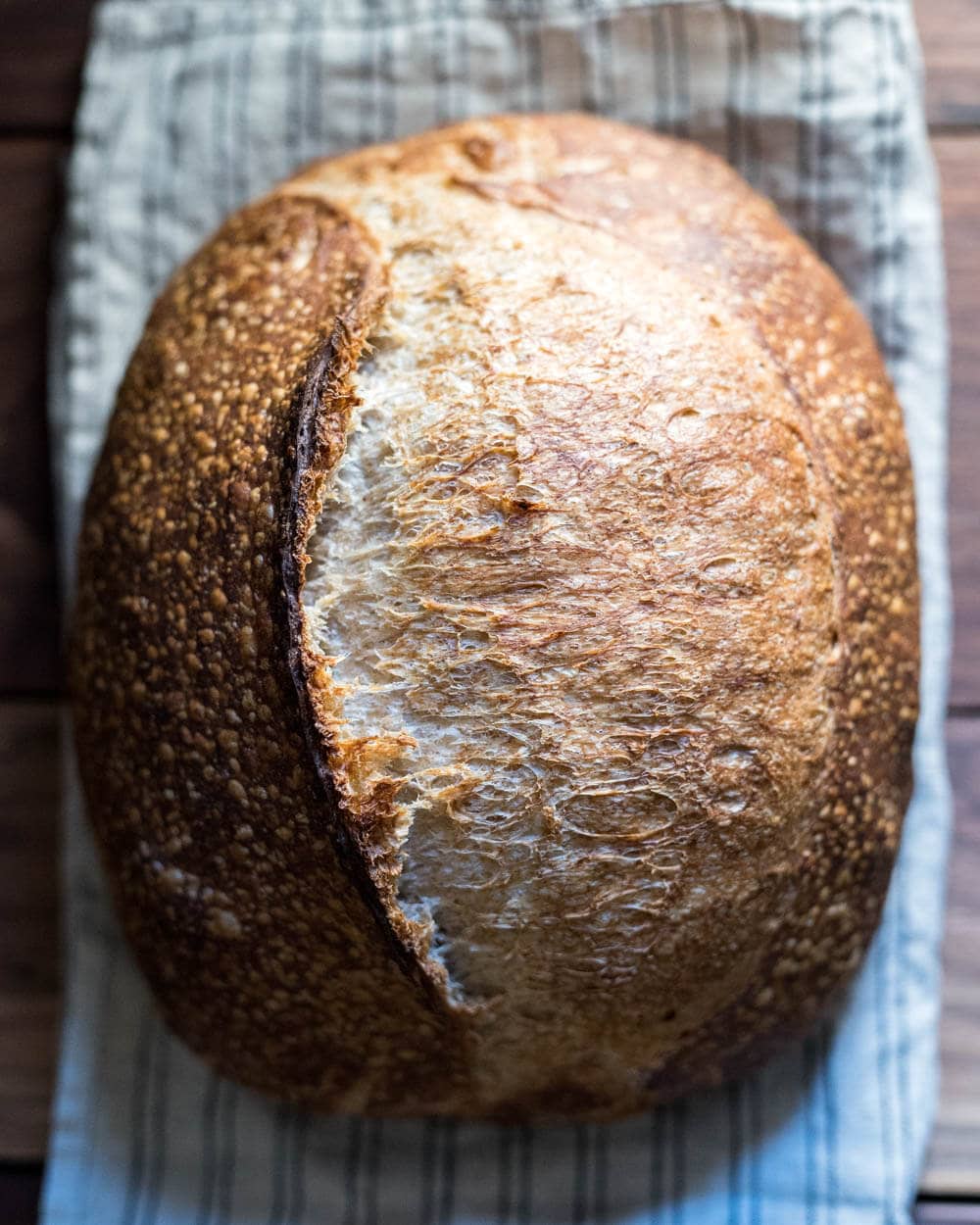
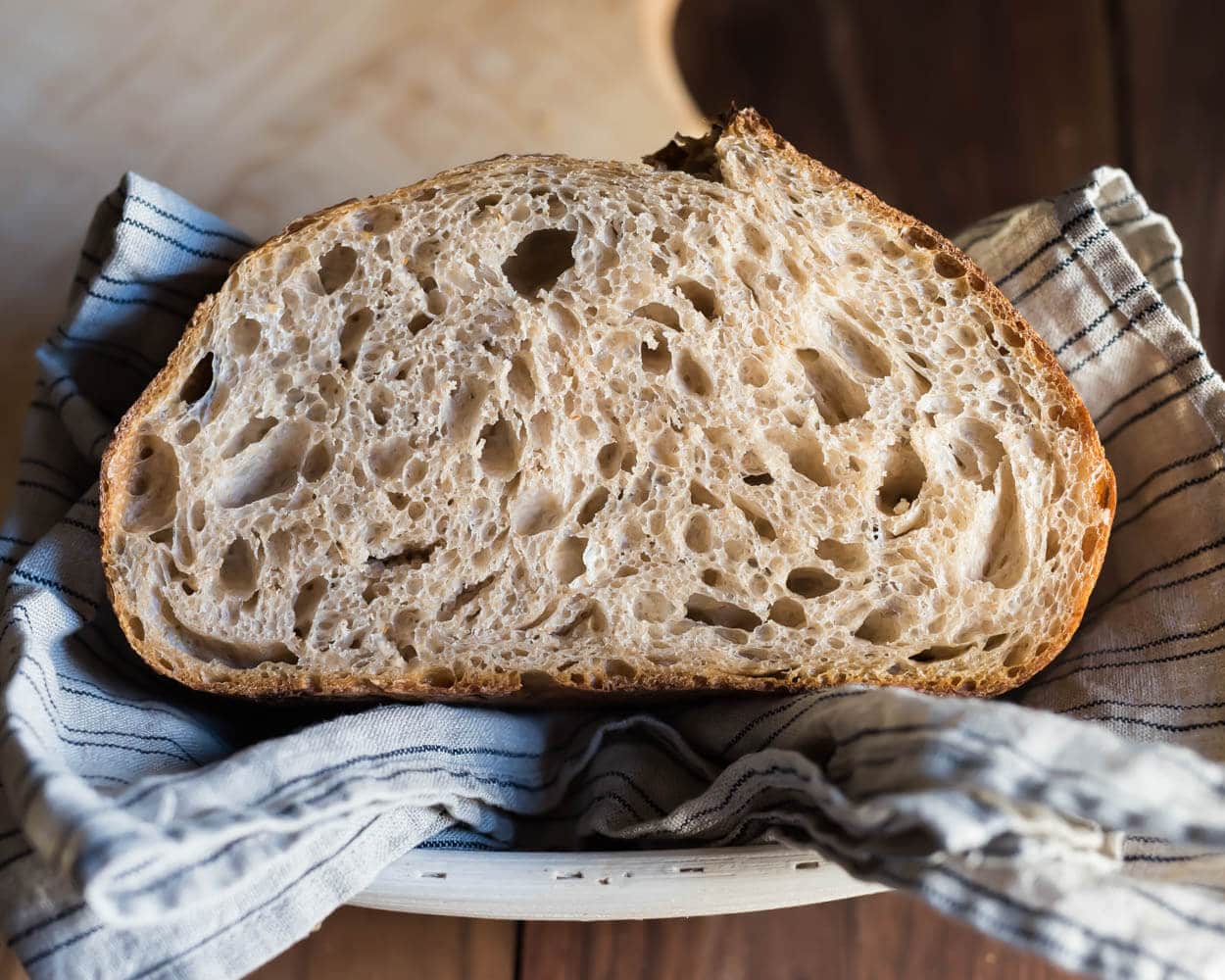
When I bake my typical sourdough bread with added freshly milled flour, it takes on added levels of flavor complexity, a taste that is hard to capture in words but brings a smile to my face. The crust becomes incredibly thin and crackly with a forward shine to it, a shine that almost looks as if I had smeared the bread with olive oil and then baked it. The interior of my loaves are tender, light, and with a vibrant flavor. I’ve read others describe this flavor as “nutty” or “grassy,” and I’d agree, it’s fresh and alive.
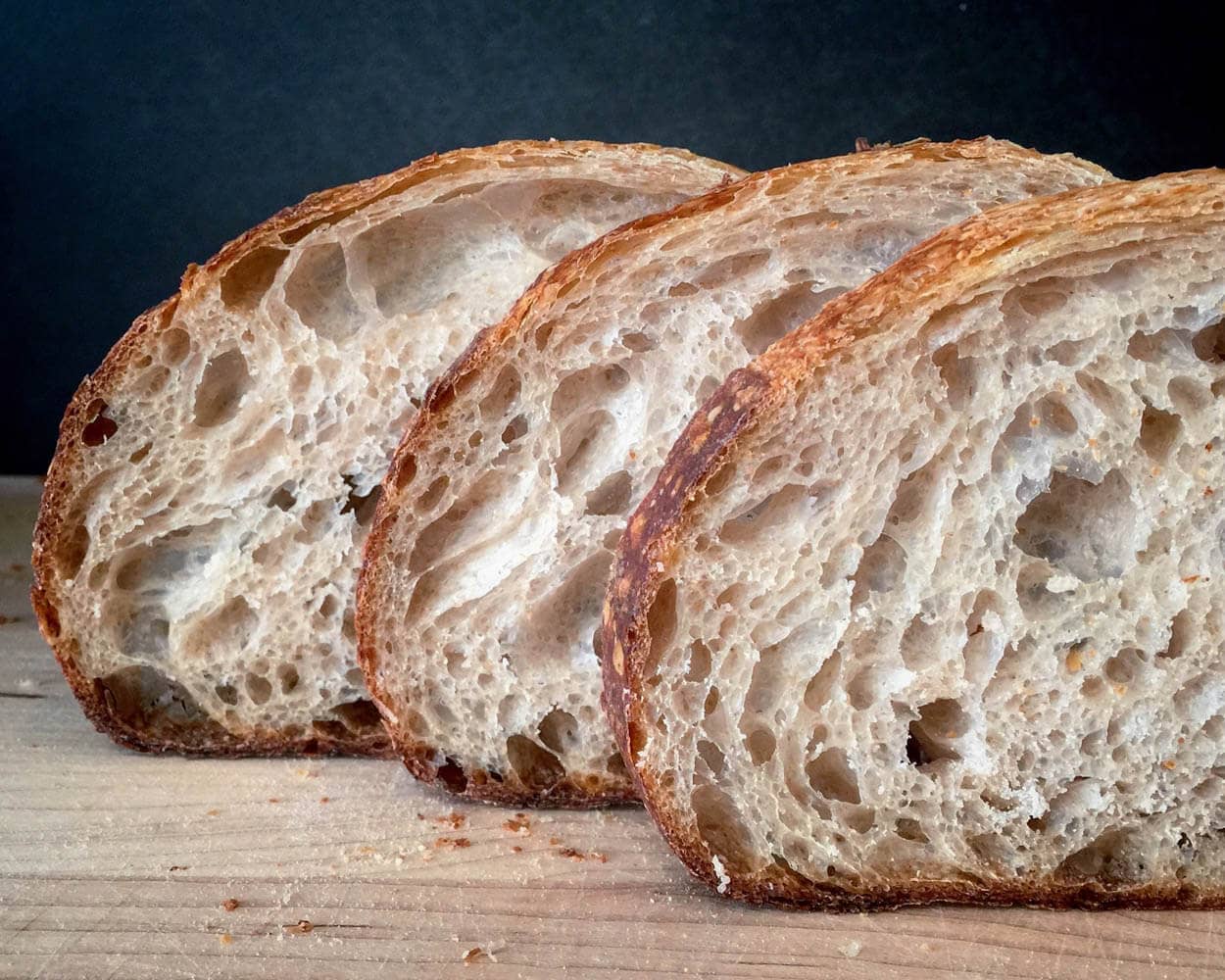
Surprisingly these loaves with fresh flour are almost better a few days after baking. That thin and crackly crust and open interior crisps up even further in the toaster, providing the perfect crunchy vessel for bruschetta, ricotta, and honey or even just a good slather of salted butter (you’ll see what I mean in just a bit). Incredibly simple but exquisitely delicious.
Freshly Milled flour vs. Store Bought
Using the whole grain berry and transforming it into freshly milled flour results in flour that’s free of bleaches, stabilizers, and other chemicals—just 100% of the wheat berry and nothing else. Freshly milled flour is reported to result in a “weaker” dough structure due to lack of oxidization, but I’ve found as long as the flour is used within a week of milling, it performs perfectly well in my baking.
Milled, store-bought flour is not always consistent either, of course. There are variations in each sack that every baker must account for and adjust for because flour is not a static input, it is an ever-changing component of baking. Each growing season for the farmer is different, and therefore each batch of flour will have different properties. One season might be full of rain, and the next might be very dry, the flour will then require different hydration and might even be stronger or weaker.
Since flour is such an essential part of baking (it is the most significant ingredient after all), it is incredibly important we look for the best flour we can reasonably afford.
Wheat Berry Selection
I like to source organic wheat when possible. There are many great resources out there for local wheat that is farmed sustainably, why not take advantage of these great products? For my first bulk order of raw wheat berries, I settled on a 25-pound sack of Great River Organic Hard Red Spring Wheat grown up north of me near the northern part of the Mississippi River.
Good food depends almost entirely on good ingredients.
Alice Waters
I had plans to use local wheat grown a few hours north of me but they sadly dropped their organic rating. I still plan on trying their wheat in the future with the hopes that they return to their original plans of farming wheat organically. Organic or not is a personal preference, I choose organic whenever possible to support farmers who are able and want to grow in an environmentally friendly and sustainable way.
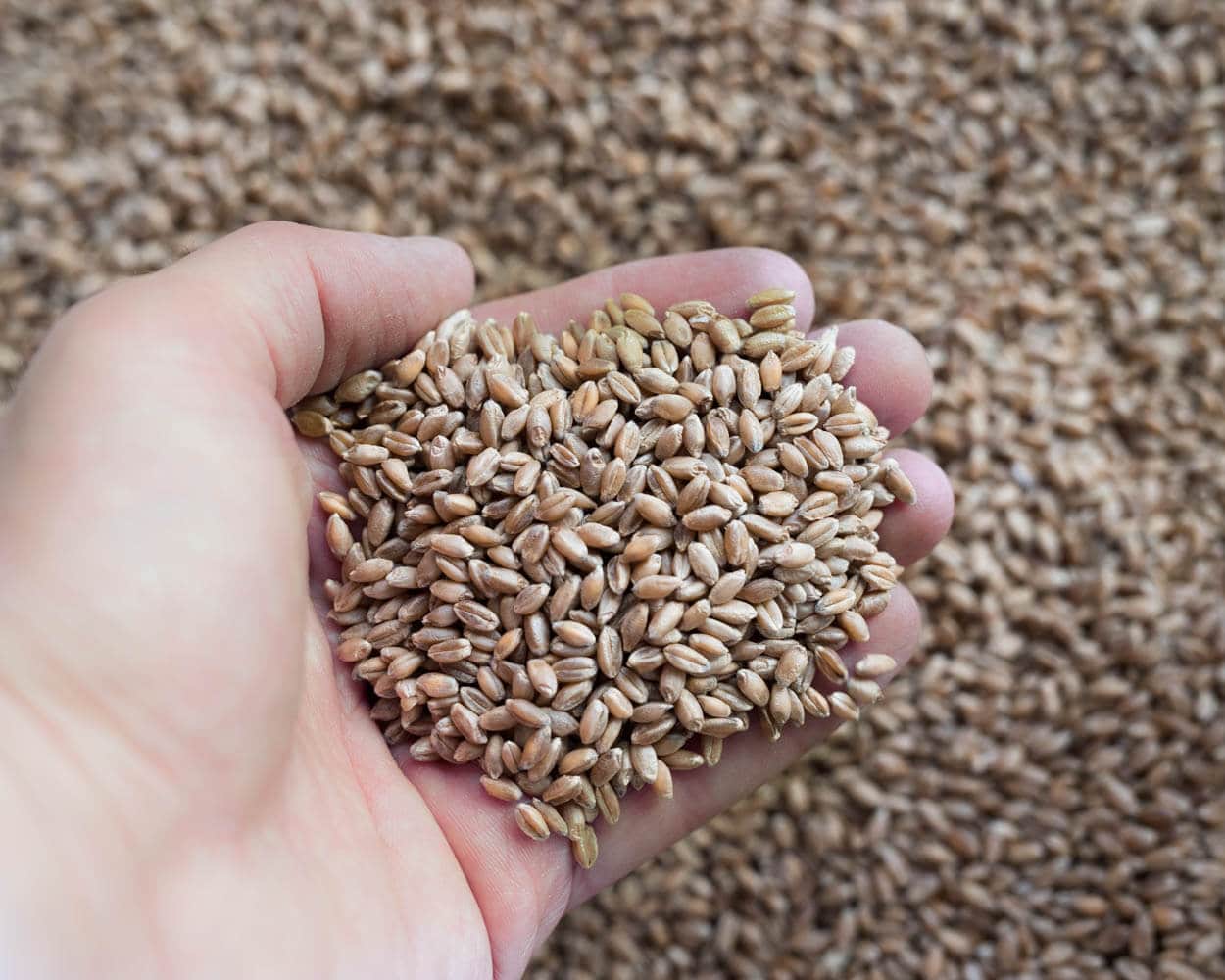
I selected hard red spring wheat with intention. Hard wheat is typically chosen for bread here in North America because it has a higher protein content than soft wheat, which is used primarily for cake and pastry flour. Red wheat gets its name from its reddish husk and is darker than other varieties. I’ve found red wheat to have a more assertive “wheaty” flavor that carries through beautifully to the finished loaf of bread.
For an even deeper look into using fresh flour, see my guide on how to freshly mill flour at home for baking.
Milling
For the home baker, there are several options for mills, hand-operated and motor-driven alike, and some with incredible build quality to boot. The GrainMaker is my go-to hand-operated mill when I have more time to spend in the kitchen, but a Mockmill is an excellent choice that mills fine flour at the flip of a switch.
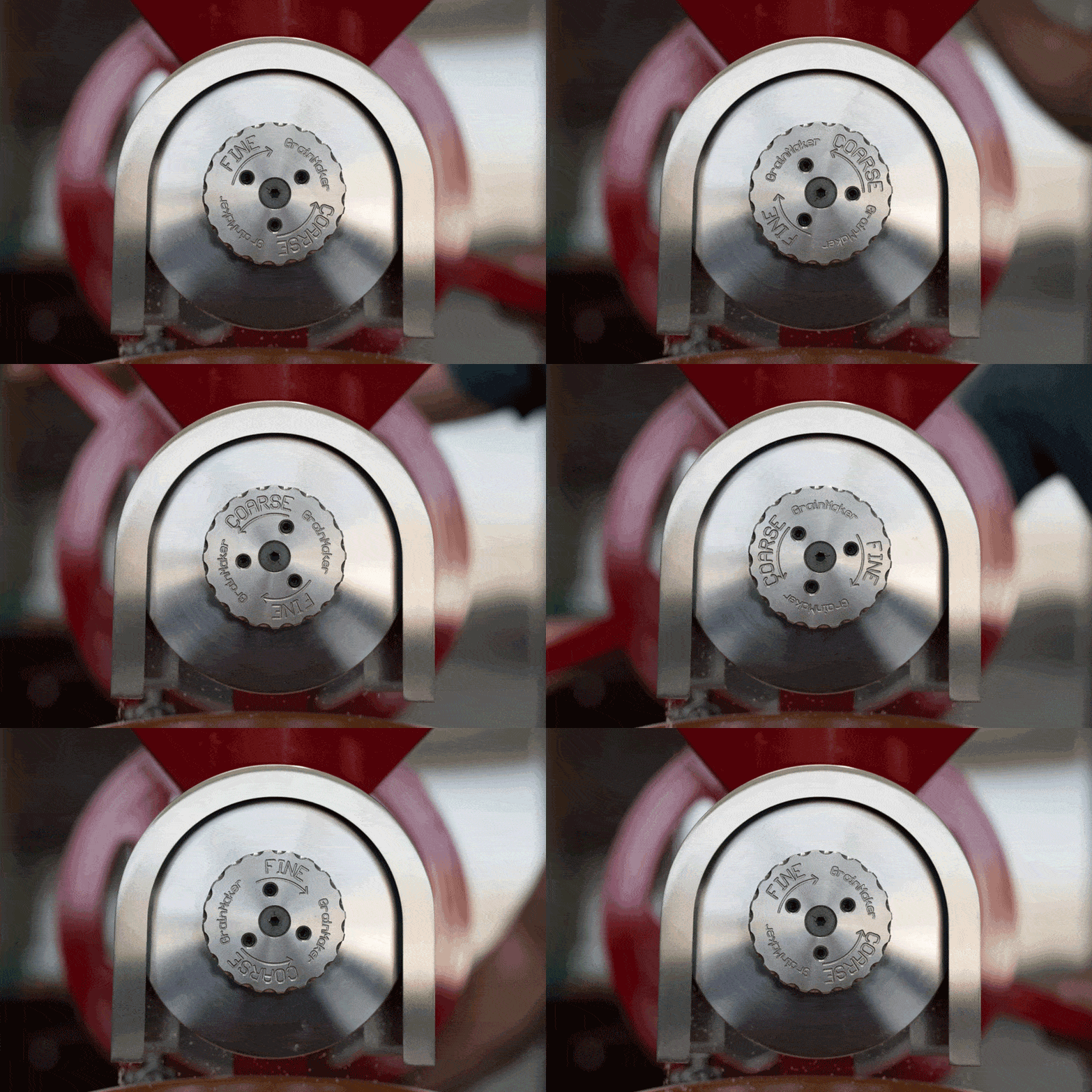
I always start milling early in the morning. The house is still asleep, and it’s just my mill and I in the kitchen as the sun comes up. I find it convenient to mill all the flour needed for the day’s bake first, then build my levain with 100% fresh milled flour. Finally, the rest of the day is baking as usual. I will typically bake two loaves, sometimes four, and I can comfortably mill enough flour in the morning to cover them.
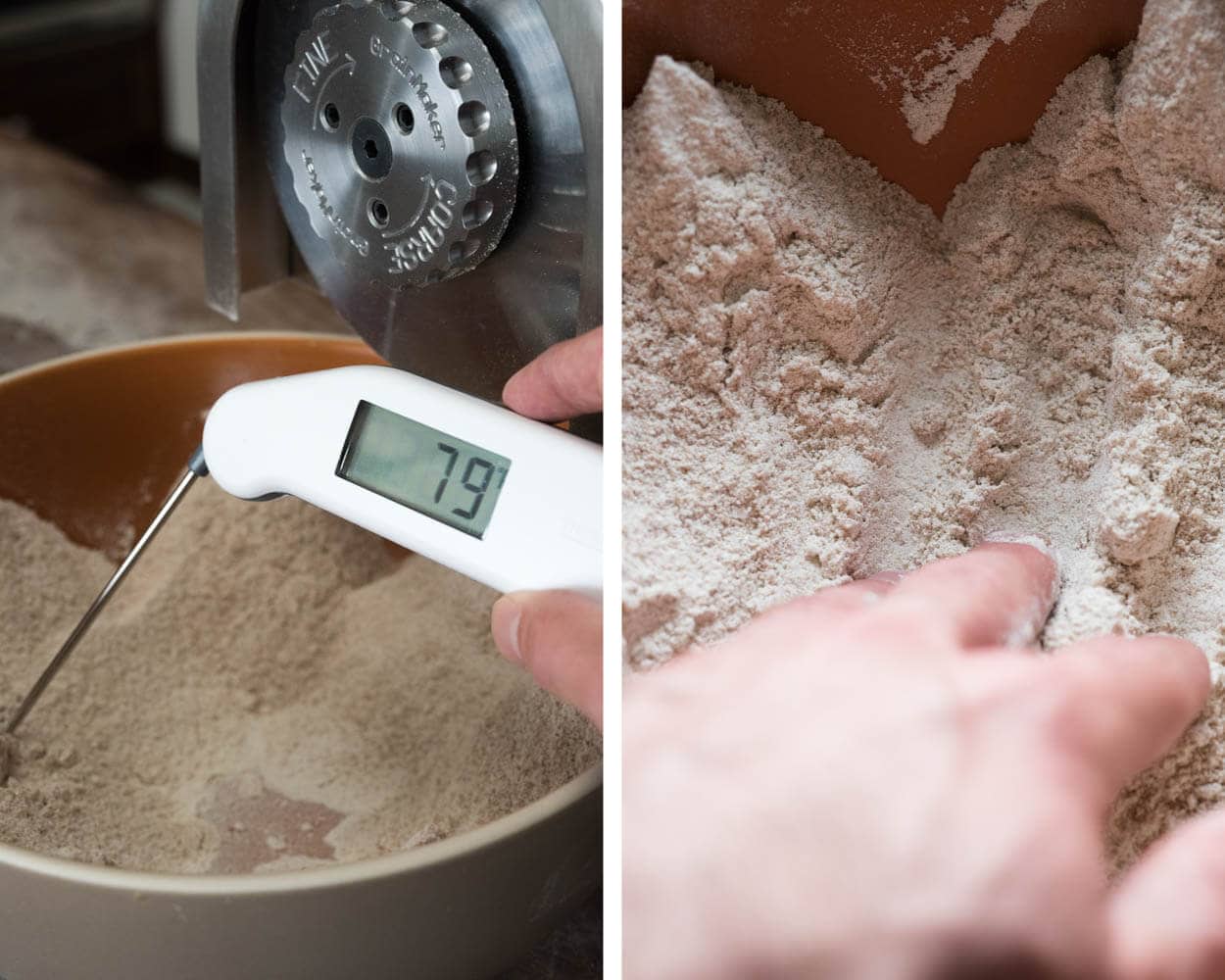
Before I start milling, I work out how fine I am going to mill the wheat berries on hand. I can turn the dial at the front of the mill clockwise to head more towards a finer flour, or counterclockwise to get a more coarse grind. This turning action moves the two stainless steel burrs closer or farther apart, respectively. I am still experimenting with varying levels of granularity, but currently, I start by turning the dial until it is at a medium level and then I begin milling grain slowly with a handful of grain to start. I turn the dial clockwise to go finer, inspecting the output at each turn. I’ve become attuned to the sound the mill makes and the vibration of the arm and handle when the grind is at just the right level to get the granularity I want.
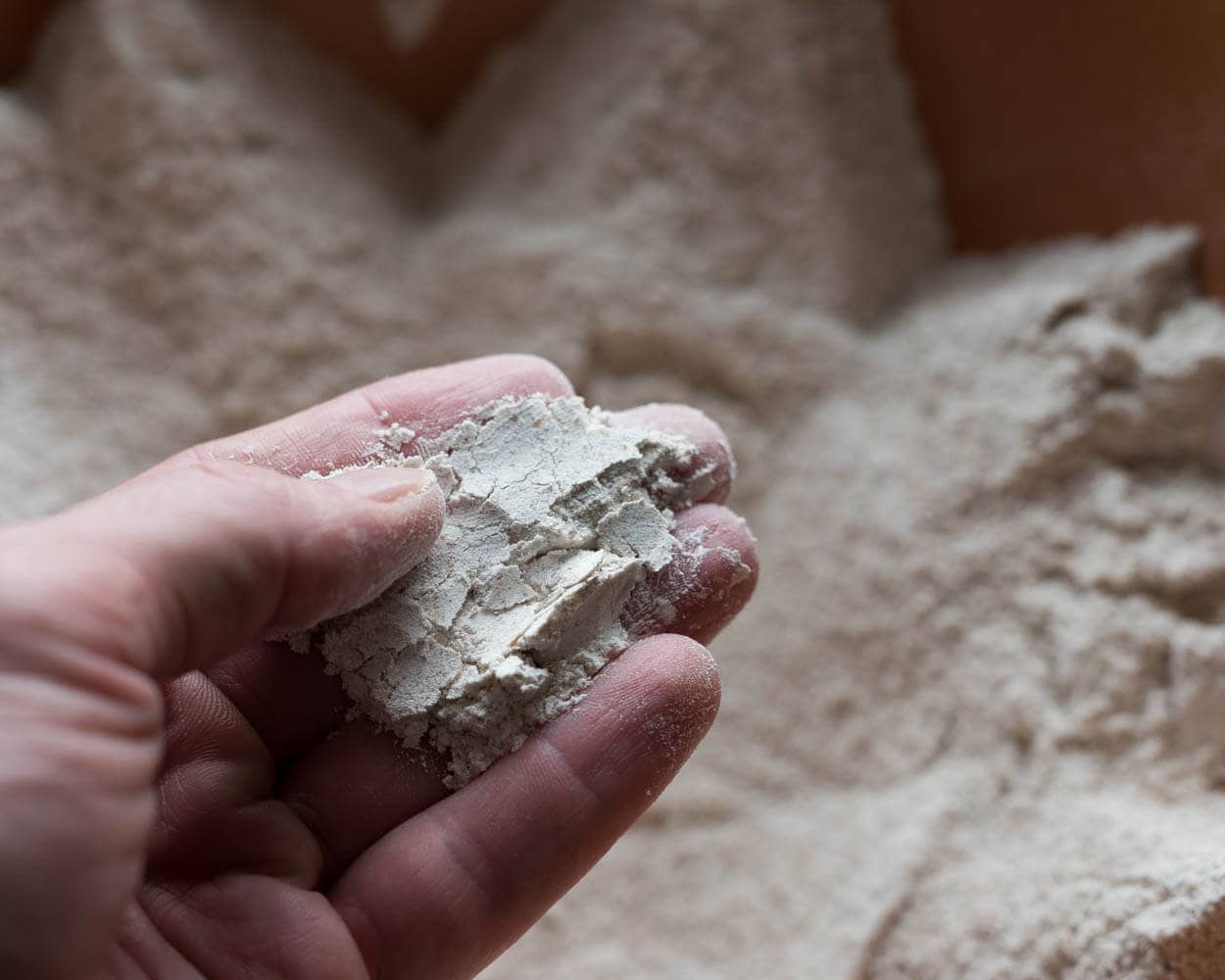
When I first experimented with the mill I used my whole wheat flour on hand as a guideline, I placed the two side-by-side and inspected the differences. I obtained my results empirically, but by merely taking flour and pressing it between my fingers I can garner a surprising amount of data: how large are the bran particles? Does the flour cake and stick when squished? How does the flour fall when it’s run through my fingers? All very tactile and visceral tests, but these types of tests are vital in baking after all.
Using a manual mill is not a fast process, but with the right music playing through my headphones, hand-milling becomes a very meditative process. As I turn the crank it gives me time to step back from the hustle of the day and think about the upcoming bake, what am I going to test? What do I seek to learn? And maybe most importantly, how can I work this bread into each meal of the day?
With my bowl of freshly milled flour, I’m then ready to build my levain and later in the day start mixing.
The Perfect Loaf Country Sour with Fresh Milled Flour
I’ve been working on a formula that has a balance between enough freshly milled flour to bring out the flavor and enough white flour to get a beautiful and lofty rise. The following produces some of the best-tasting bread I’ve ever made and it is now my go-to when I plan to mill flour. I’ve also baked a few 100% freshly milled loaves and those are equally incredible, if not more; you can see those recipes and results here.
Overview
| Total dough weight | 1900 g |
| Pre-fermented flour | 7% |
| Hydration | 84% |
| Yield | 2 x 950 g loaves |
Levain Build
| Weight | Ingredient | Baker’s Percentage |
|---|---|---|
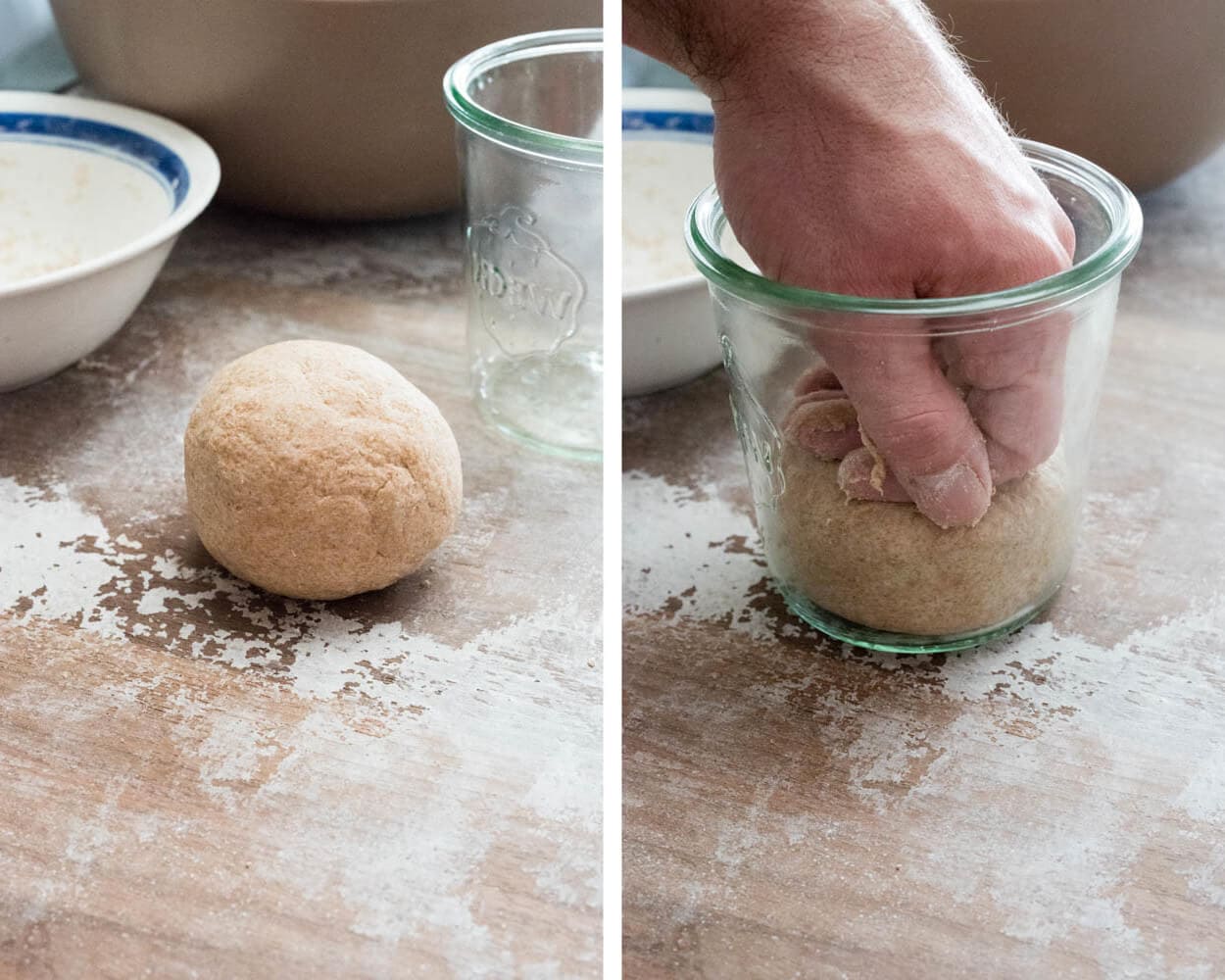
| 43g | Mature stiff starter (at 65% hydration) | 65% |
| 66g | Freshly Milled Organic Great River Hard Red Spring Whole Wheat | 100% |
| 43g | Water | 65% |
Formula
Note that the baker’s percentages listed below are with respect to the final dough ingredients and do not take into account the levain.
Target final dough temperature is 75°F (23°C). See my post on the importance of dough temperature in baking.
| Weight | Ingredient | Baker’s Percentage |
|---|---|---|
| 664g | Central Milling Organic Artisan Baker’s Craft, Malted (~11.5% protein) | 70% |
| 189g | Fresh Milled Organic Great River Hard Red Spring Whole Wheat | 20% |
| 102g | Central Milling Organic Type 70 | 10% |
| 815g | Water | 85% |
| 20g | Fine sea salt | 2% |
| 143g | Ripe, stiff levain | 15% |
Method
1. Levain – 8:00 a.m.
Build the levain in the morning after milling fresh flour. Store somewhere warm around 78°F (25°C) ambient.
2. Autolyse – 11:00 a.m.
Mix flour and water (reserve 50g water for the mix, later) very well in a bowl and cover. Ensure all dry flour is hydrated. Store near levain.
3. Mix – 2:00 p.m.
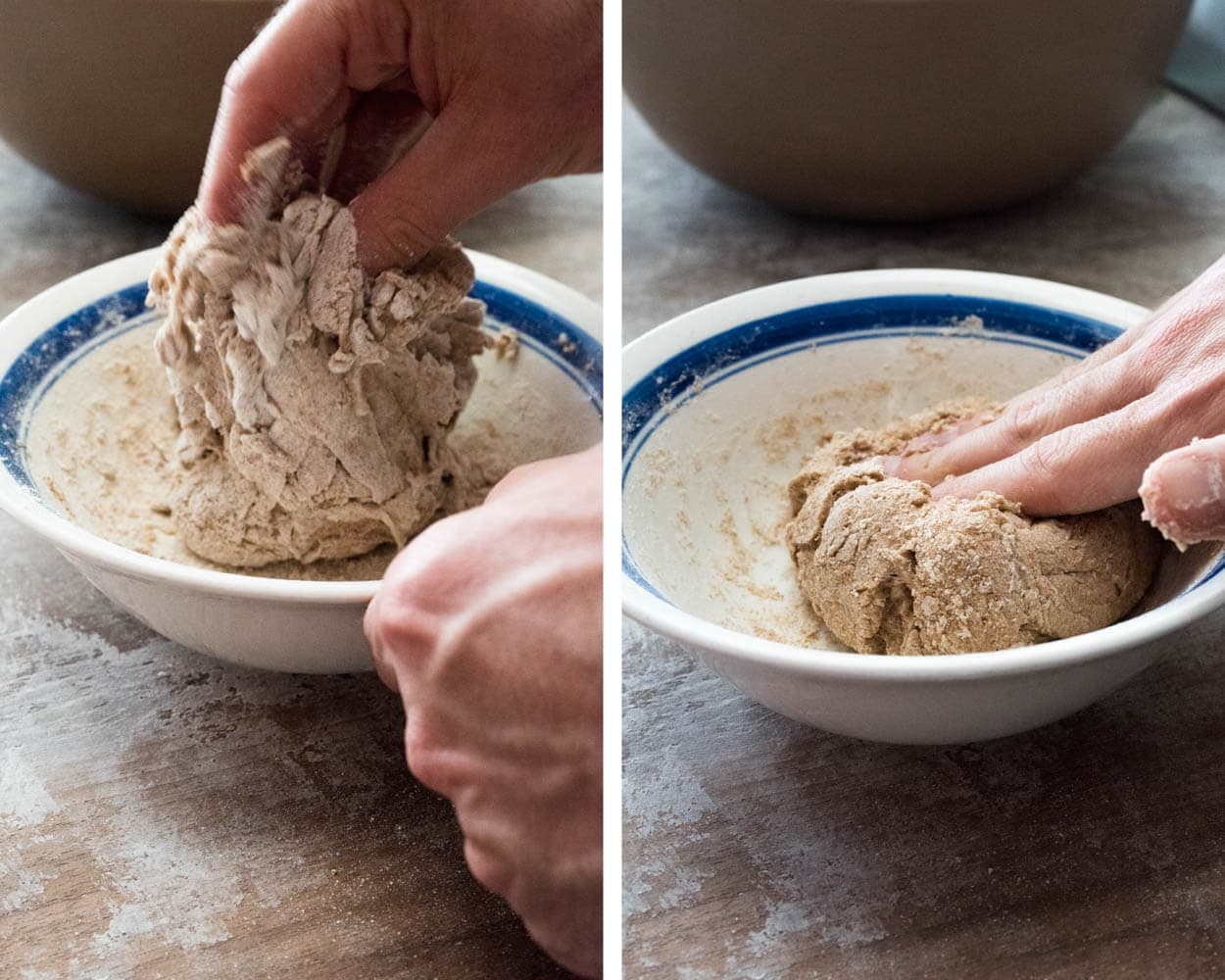
Using about 30g of the reserved water, incorporate levain build into autolyse and hand-mix thoroughly. Slap and fold for 6 to 8 minutes until dough holds shape well. Place dough back into the bowl and let rest for 5 minutes. Then, use remaining water, if necessary/desired, to incorporate salt into mixture. The dough will initially break apart and then come back together. Slap and fold an additional 3 to 6 minutes until the dough starts to catch air and strength is built enough to keep dough relatively in shape on the counter.
Transfer dough to a tub or thick-walled bowl for bulk fermentation.
4. Bulk Fermentation – 2:20 p.m.
At 80ºF bulk fermentation typically takes me somewhere between 3.5 and 4 hours. Watch the dough near the end–as I mentioned earlier, fermentation can quickly get out of control.
Perform four sets of stretch and folds (each set is a stretch and fold at North, South, East & West), one every 30 minutes.
5. Divide & Preshape – 6:20 p.m.
Divide the dough into two masses; each scaled at 950 grams. Lightly shape each mass into a round, cover with an inverted bowl or moist towel, and let rest for 25 minutes.
6. Shape – 6:45 p.m.
Shape each mass into a boule or batard, whatever your preference may be. For more instruction on how to shape this dough as an oblong loaf, see my post on how to shape a batard (with video!).
Once shaped, place the dough into a banneton lightly dusted with white rice flour, or into a basket with no flour but lined with a cotton tea towel (if you want a serious shine on the crust).
7. Proof – 6:50 p.m.
Retard immediately into the refrigerator at 39°F (3°C) for 12 hours.
8. Bake – Preheat oven at 6:00 a.m., bake at 7:30 a.m. (next day)
In the morning, preheat your oven to 450°F (232°C). You can bake these loaves in a Dutch oven or combo cooker or with my method for steaming your home oven.
Bake for 20 minutes at 450°F (232°C) with steam, and an additional 35 minutes without steam, until done to your liking.
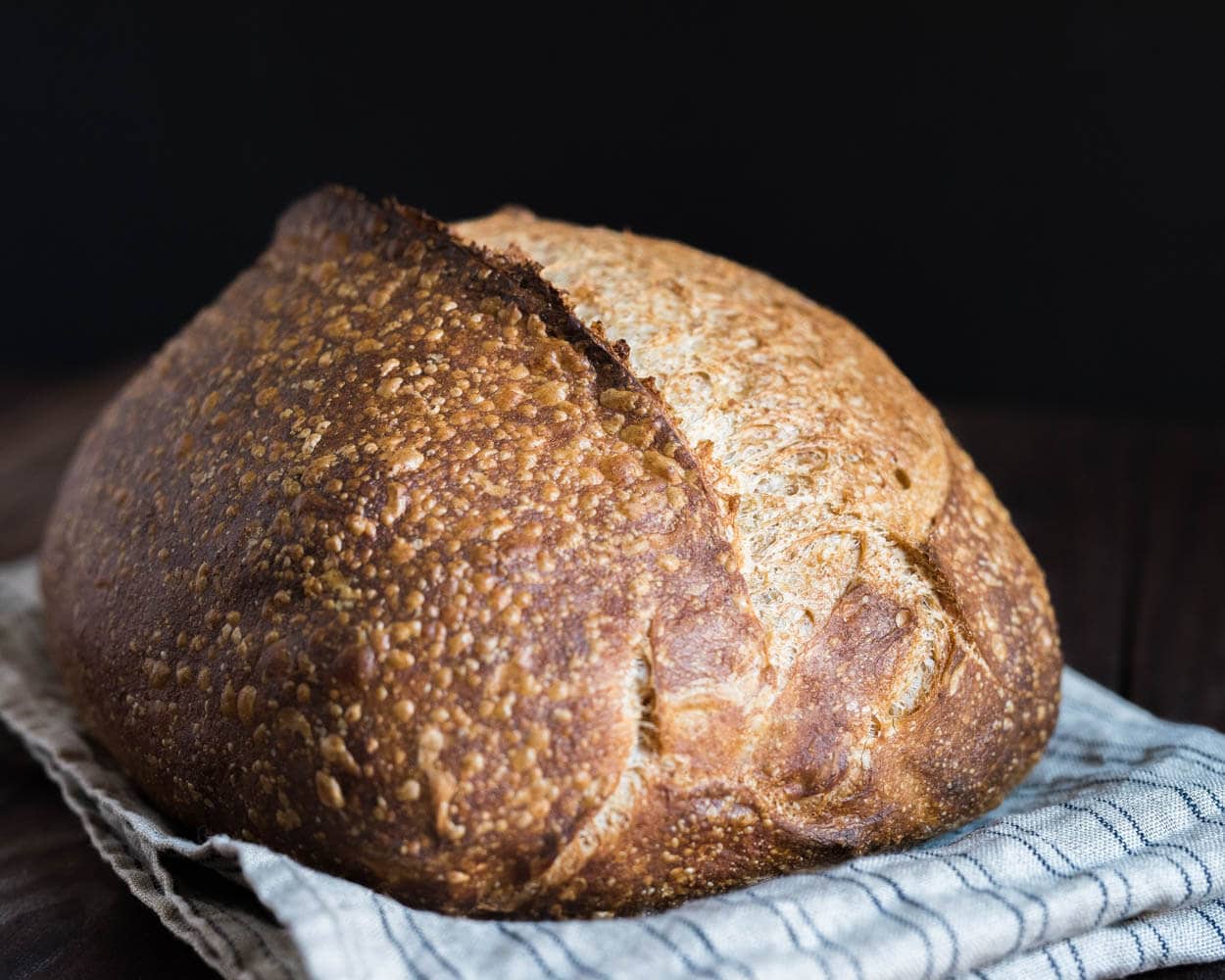
The resulting crust is incredibly thin, crunchy and wonderfully colored. You can see how much shine is brought forward by using freshly milled flour—just an immense amount of enzymatic activity. The crumb is soft and tender; it has a wonderfully complex flavor with a hint of sourness and a creamy hue throughout. The taste, well, I’ve already spoken at length on the flavor of this bread with freshly milled flour, it’s just delicious.
Parting Words
I’ve only just begun to scratch the surface of milling fresh flour at home, but thus far I’m incredibly excited about the results. I bake bread that genuinely tastes vibrant and fresh; it has levels of flavor that I’ve never experienced with my sourdough. The laborious act of hand-milling flour may not be possible, or desirable, for everyone but for me this part of the enjoyment: the transformation from berry to flour to bread—incredible.
After tasting the results I think my wife has finally accepted the sizeable red beast into our kitchen, and my “crazy” status has been downgraded to “normal”—well as normal as one can be when they wake before the sun rises to turn their kitchen into a flour mill.
In the same vein as my last post, and given the seasonality of these little gems, I toasted several slices of my sourdough using the recipe above and added organic figs, ricotta, and a light drizzle of local honey. Perfetto.



130 Comments
Yes, I figure it’s an expensive, laborious effort to get certification. Great suggestion, I’ll check in on this and see what information I can find out!
It’s an incredible feeling going from grain all the way to finished, baked loaf! The GrainMaker is also a fantastic machine, built to last generations — a rare thing these days! I cherish it every time I use it. Thanks for the commends, Rosie, and happy baking!
This method is becoming my go-to method for my last three bakes. The results are outstanding. You are correct about watching it at the end of bulk, I check the dough at 3-1/2 hours and I could see a significant change just 15 minutes later. Each time I start getting a little antsy and stop the bulk just about 15 minutes shy of the total 4 hours. I’ve tried mixing the whole grains with some Kamut and also with some spelt in place of some of the whole wheat. On the last bake, in addition to the hard red wheat, I subbed some of the white flour for 3% fresh milled rye,which I do for many of my bakes, to alter the flavor profile a bit. I’m thinking of using this method to make the Oat Porridge Sourdough, increasing the whole grain level for that recipe. Since I plan on using fresh milled flour in all my bakes,
I’ll keep referencing this method as I start experimenting with other grains.
Right on, Larry! Adding a bit of rye, at even just 3%, is one of my favorite practices as well. That small percentage seems to have a huge impact on subtle flavors later down the line, ramping up that acid production, bringing lots of flavor to the end result. Rye is a wonderful thing.
As with all of these whole grains, especially when fresh milled, the dough can quickly go too far, so yes, it’s a good idea to keep an eye near the end! Sounds like you’re making some amazing bread over there, too bad we’re not neighbors!
Hello! Aspiring bread baker. Could someone please explain to me why the mature stiff starter is 50% at 43 grams. That is more than 50% of the 66 grams of flour. Many thanks for any help!!
Alexandra — you’re totally correct, it’s a typo! The table should read the mature stiff starter is 65%. I’ve updated the post, thanks for pointing that out!
I am a total newcomer to milling my own grain. One of my favourite loaves of bread is a very simple loaf consisting of the following ingredients 165g of S W bread flour, 85g of wholemeal flour, 9g of easy bake yeast, 5g of kosher salt, and 165g of room temperature water. The dough was then bulk fermented for 1 hour at room temperature, shaped, placed in a Banneton then proofed for I hour. It was then baked in a Dutch oven for 50 minutes (30 minutes with lid on and 20 minutes with lid off). The problem started when I started to mill my own wholemeal flour. I followed the above recipe to the letter, but when the dough was placed in then Banneton it flattened out and hardly rose in the oven. And I am unable to work out why there was no oven spring. Is there a formula available that I could use so I can get a decent oven spring as before? Any help with this matter will be greatly appreciated. Just in case this is important the Mill that I use is a Komo Fidibus medium.
I’d say the first thing to look at would be the health of your sourdough starter — it needs to be rising and falling in its jar reliably each day. This is very important, it all begins with your starter. From there, I might suggest trying the above recipe but substitute out the fresh milled flour for another white flour you might be using. This way we can test the rest of the process first and ensure things are working well. Check in with your dough at each step of the process: does it need more time (and use my photos in the post and here at my website as guide posts)? Does it need another fold for strength during bulk fermentation? And so on.
Let me know how it goes and if you have any more questions!
lol i was like i hope that mill is under a hundred bucks… then i saw the price. I’m just going to see if i can find replacement grinder part and machine the rest of it in my spare time for a few months. that’s some retarded mark up for what it is.
Hi Maurizio, I’m interested in making a 100% (or near to it) sourdough using freshly milled whole grain wheat (my hand mill arrived this week) but I don’t know which recipe is best to follow. Do you have any suggestions for the best recipe? I thought maybe the 95% whole wheat recipe with a 4 hour autolyse?
Thanks, Brent.
Maurizio must also own a solar-heated oven there in N.M.! He advises pre-heating the oven to 500 degrees F for 1.5 hours, which may be practicable to do daily if two more things are true: one runs a bakery or has the bucks to burn (no worries re: climate change!)
Still, a beautiful sourdough blog, if you can stand the heat. 😉
LOL. Good day Maurizio!
I had to revisit this post. I just picked up a GrainMaker Model No. 99 on Craigslist for a smoking good deal.
Got off the phone with Bonnie and Janie at GrainMaker and was told that the guarantee goes with the mill, not the owner. Great folks. I insisted on paying for a missing piece (the previous owner lost) but they said no. They did finally agree to let me at least pay for shipping for it and the documentation for the mill. Great folks. If you’re looking at grain mills I can’t imaging going else where. Yeah they’re expensive but once you put your hands on it there is no comparison.
Great River is due north of me, I’ve gotten hooked up with them to supply my grain needs. I was going to buy flour but now it’s going to be grain. Fresh ground spelt is incredible! This is going to be such a good year.
Love this website, thank you Maurizio. My first batch of sourdough rolls made from 100% hand-milled flour came out of the oven this morning. I followed my recipe for commercial whole wheat flour and wound up with dough that was too wet when it came time to shape the rolls yesterday. I compensated by adding commercial whole wheat flour, but it hadn’t been autolyzed, plus that came with too much mixing at the end on top of adding unautolyzed flour. The extra moisture doesn’t make sense to me because wheat berries are supposed to have lower water content than flour, by a shave. Has anybody else experienced this?
-Kirsten
Wonder Mill Junior, stone burrs (my arms are going to get SO toned)
Green River Organic Hard Red Spring Wheat
sifted out the bran and soaked it separately/autolyzed the flour/made a stiff levain using stiff homemade starter
-milled the flour the morning I started the rolls
first batch of homemade sourdough came out of the oven on 2/15/2017 so I’m coming up on my 1-yr anniversary
Hi Maurizio,
I recently got the grainmaker and hooked it up to a motor: I’ts a beast!
Quick question: I notice that you and many others that bake with freshly milled flour typically cut it with another, non freshly milled flour. Typically the ratio of fresh to standard is 1:2 or so. What’s the reasoning behind this?
Is it that it’s too difficult to develop the gluten in the freshly milled stuff? I’v read that oxidation may be needed to activate the gluten proteins.
Thanks for all the help!
Congrats, that’s really awesome — especially the fact that you hooked it up to a motor! I dream of doing that one day, partly for fun, partly to save physical energy 🙂
There’s no need to mix with aged flour if you prefer a 100% whole grain bread — and this is super delicious! I sometimes do a blend if I want to try and achieve a certain height in the baked loaf (aged white flour will give you a higher rise) but of course this does compromise some of the potential nutrition compared to a 100% whole grain bread.
So the end answer is: it’s up to you and what type of bread you’re after! You can do any ratio of flours you’d like.
With regard to oxidization: the general consensus is if you use the flour relatively soon (within a few days) of milling it’ll bake up just fine. If you wait longer it goes through a stage where it does need some time to oxidize and become more stable for a better result. For me, I just use the flour right when I mill it.
Hope that helps!
Nice. Doing the same with the 99 I got off craigslist yesterday. Going to be awesome!
Have you been able to achieve this type of open crumb using 100% fresh milled whole grain flour? I’ve been trying to figure out how to get a better crumb on this type of sourdough – I’ve extended the autolyse and changed up the process with only little benefit. Wondering if it is possible with 100% whole grain?
It’s challenging to achieve a crumb like this on 100% fresh milled whole grain flour, for sure. I think it’s definitely possible to get a light loaf with that percentage of fresh flour but I also think we need to probably change our expectations when we’re working with that high of a percentage of whole grains. We’ll be very, very hard pressed to see anything like a white loaf, but the flavor and nutrition should be worth the tradeoff!
If 20% fresh milled is good, why not go on to 100% fresh milled? Differnt but excellent!
100% fresh milled sourdough is a truly exquisite bread, I highly recommend it as well!
Maurizio, quick question. When you make your stuff levain for this recipe, does it rise much and puff up? Mine puffed up a little in the 6 hours you have here, but it wasn’t as much as what I would have thought. Thanks in advance!
Eric
it’s not a huge rise, no. You’ll see the dome on top and there will be rise, but go by smell and if you can see the sides you’ll notice significant bubbles at the side and bottom!
Ummm, just subscribed & have slipped very far from my original search, which had to do with high levain inoculation percentage doughs. I couldn’t help noticing that you discuss only grain mills and never mention using the “grains” container on a Vitamix, for instance, to turn hard red wheat berries into flour. I have done this when unexpectedly out of flour, and the bread tasted fine.
If I freeze the berries first and maybe even the container, and then take care to grind as briefly as possible, would the result be even in the same universe as mill-ground flour???
Your breads look glorious. Your explanations & descriptions are clear and inspiring. Thank you, and I apologize for my ignoramus question, but would really like your opinion…
Sharron Sussman
Sharron — it’s easy to stray into the depths of bread making, believe me! There’s interest at every turn 🙂 I have a Vitamix but don’t have that container with the grain blade option, I’ll have to pick that up and do some testing!
While I’ve not seen the output from a Vitamix I would not believe it able to produce flour that’s quite as fine as what a burr mill could produce. That said, it doesnt mean the flour wouldn’t make for good bread at all! The results might be different, but it should still make healthy, delicious bread.
Another idea is you could use your Vitamix to coarsely crack the grain instead of milling it fine. This cracked grain could be soaked in boiling water and then mixed into a dough to add flavor and nutrition — trust me it tastes fantastic.
Thanks so much for the kind words and I hope this helps somehow!
Thank you! I’ve seen reports of that and perhaps they do have validity to them in regards to gluten development but all of the bread here at my site is milled the day it’s used for baking. I like to use it very fresh, as the flour ages and is exposed to air oxidization diminishes the natural oils present on the fresh milled grain. For me, I want to retain as much of that extra nutrition and taste as possible.
I do mean to do a side-by-side test of this in the future! You’ll certainly see a writeup here on that 🙂 Thanks again for the comments!
Good morning Maurizio. I have a follow up question for you if I may. I seem to remember reading somewhere that there is a narrow window of opportunity for using fresh milled flour. It came up, I think, in a discussion about bleaching flour. If memory serves, it went something like this:
In the bad old days millers would store their flour for a period of weeks or even moths, during which time the flour would bleach naturally from exposure to the atmosphere. Essentially it would oxidize. This allowed the proteins in the green flour to develop and strengthen. Then some bright spark discovered that if you treat the flour with an oxidizing agent you can achieve in minutes what nature takes weeks to do. That means getting the flour to market faster and since time is money, this seemed like a good plan for the miller. For the baker, not so much. It turns out the proteins in the bleached flours were too weak to support breads, not having been allowed the time to strnghthen. The solution to that was potassium bromate which artificially strengthens the proteins, the discussion contends. One of the conclusions drawn from the discussion was that freshly milled flour was good to use immediately after milling but shortly thereafter it has to be aged for optimum performance.
If all this is true, my question is, what is that window where green flour works before it must be aged? My research has not uncovered the answer to that and I wondered if you have any knowledge or experience. Like you, I only grind as much as I need for each bake (I have a Nutrigrain mill) so the question is somewhat academic but still, I am curious.
Thank you for your ever informative posts.
Very good comments and points there, Jock. I’ve talked to many bakers now at this point and have asked them these questions and it seems that as long as the fresh milled flour is used within a “few” days it’s suitable for use in baking bread, but if it’s been, say, a week then it’s best to wait “a while” (somewhere around a month?) before using it. It does seem like there’s a window there when the flour should be used.
While I’ve not tested this myself it is something I keep meaning to try to finally get to the bottom of it all — it is a difficult thing to test, though, and that’s probably why we’ve not seen much material published on the topic.
If I was to need much more flour than what I’m currently using for a single bake I’d probably try to mill all of it the day before using it, let it sit overnight, and then use it in total the next day in a dough mix. This way it’s used as fresh as possible but still allows it time to cool if necessary from the process of milling.
Thanks for the sharp comments, Jock!
Thank you for the thorough reply, Maurizio, and for the kind words. Your findings mirror my own; somewhat nebulous answers to queries. But it does give me a clue. Thanks
Hi Maurizio! You are amazing! I am learning so much from you. Thank you! I was wondering if you could explain the tea towel = shiny crust… Do you not flour the tea towel?
Thanks Toshi, really appreciate that! I find I get a nice shiny crust when I use very little dusting flour for my proofing baskets. I keep the dough as clean as possible this way. That, in combination with ample steam in the oven, almost always leads to a nice and shiny crust.
Happy baking!
Fantastic! Thanks Maurizio! You are the best!
Hey Maurizio!
I had a question about where you source your wheat berries and how one might assess wheat berry quality. I don’t have a mill near me, as of yet (Austin, TX will be opening up one soon!) but looking online at AzureStandard.com, Breadtopia, Pleasant Hill Grain, and even Amazon, I see quite a few options. Would you recommend a trial by fire sort of scenario in choosing berries? Are there any easy to access brands you’d have an opinion on?
My KoMo comes in soon and I can’t wait to start milling fresh flour!
Hey! I’ve purchased berries online at Amazon from Great River Organics which were of really good quality. Lately I’ve been purchasing wheat from Breadtopia which has also been really great (I think they get most from Montana Flour & Grain ultimately), the grain is very clean and packaged well. I’ve picked up some White Sonora (fantastic grain) from Hayden Mills online as well. I kind of just try various sources and stick with the ones I like. Those that I’ve mentioned have all be really great so far and I have many, many more to try. I hope to have something posted here in the future where I can show my results with each, just haven’t gotten there yet.
Have fun with your KoMo, it’s a fantastic mill and you’re going to love baking with fresh milled flour. I hope that helps let me know if you have any more questions!
Hey Maurizio, Great Post! I am deciding to purchase a mill but am looking at a lower price range than your amazing Grainmaker! I can’t decide between the KoMo Hand Grinder or the Kitchenaid Mill Grinder stand mixer attachment? I hear great things about KoMo, but not so sure about the Kitchenaid Mill. How do you think the Kitchenaid Mill would perform in comparison? I believe the KA has all metal and steel components where as the KoMo is using Ceramic Stones. I’m curious to know if you have a suggestion.
Hey! Unfortunately I haven’t used either mills so it’s hard for me to say. Like you, I’ve read really great things about KoMo mills and I’d surely pick one of those up if I did not have my GrainMaker. The KitchenAid might also be a really great mill I just don’t know much about it nor have I seen many using it.
Hope that helps!
Did you already test with different levels of milling from finest to coarse in order to check gluten development or other parameters, maybe like flavour, outcome temperature and so on ?
I have been playing with this quite a bit, but I don’t have any exhaustive tests/results to share just yet. Lately I’ve been trying to back off my milling so it’s not quite so fine and so I can see clear bran/germ particles — my mill does produce some nice separation. I have a long way to go with testing this but it’s an interesting area for me to explore.
One thing I’ve found lately with fresh milled spelt is when I mill the flour extremely fine (so fine it sort of cakes to my mill dust chute) the resulting bread has a more yellow hue to it and almost a creamier interior. Not sure the cause of this just yet, still experimenting!
Maybe , because the extremely fine milling , it’ oxidizing so its whiter…
Definitely something I need to research more!
I’m having a heck of a time with changing over to locally milled flour from commercial. The 100% hydration thing has me liking the manageability of the dough but not the finished product. Can I bend your ear offline?
Jen, shoot me over an email through the “Contact” link at the top of this page and we’ll figure out what’s going on!
I saw the grainmaker and would love to have one but the price is a little steep for me. I was wondering if you have recommendations of other mills that are a bit cheaper? I don’t mind putting in work via the hand mill, just looking for a good value with quality and price. I like the idea of keeping lower temperatures for nutritional value.
Yes it is definitely a high expense, something I plan on keeping forever (and probably hand down to my son!). I actually don’t know of any other hand operated mills but I am sure there are some more out there. If you’re looking for an electric mill check out KoMo and Hawos, two reputable brands. You’re going to love fresh flour!
Charcoal flour? Have seen charcoal powder…Natasa in Slovenia has this recipe.http://www.mydailysourdoughbread.com/charcoal-powder-sourdough-bread/. Not drawn to it but recommend her Rye sourdough with yoghurt. Maurizio, I continue to produce delicious loaves via your starter instructions; definitely a link for students in intro SD class am doing later this month.
Wow that bread looks very interesting, I definitely would love to get my hands on some of that flour. Will keep an eye out.
Really great to hear you’re doing so well with my starter instructions! I’d love to hear how your students like the post and how well they do. Good luck & happy baking!
I have never cursed myself for buying it, I use it all the time and for many other things besides bread! It’s a great tool to have in the kitchen. In fact this coming weekend I plan to mill some fresh flour for pancakes.
Glad you’re enjoying my site! That sounds like an awesome event, I would LOVE to have something like that nearby where I’m at, I haven’t heard of anything like that (perhaps I should start this!). Grist & Toll — I plan on picking up some flour from them here at some point! They have an awesome reputation and a great selection. Thanks for the tip! I just love that Walnut/Cranberry loaf, so tasty 🙂
That sounds so fun, very jealous! I’d love to get together with some other serious bakers and swap stories, experience, etc., sure would be fun. I’ve seen G&T’s charcoal flour before, it looks very, very interesting. I saw some bakers using it recently for sourdough, I can only imagine the taste! My pantry is full of kamut berries, spelt berries and rye flour for upcoming bakes… Can’t wait to get started! Happy holidays 🙂
Hey, could you point me to some loaves made with their charcoal flour? I saw the flour a couple weeks ago (sold out now 🙁 ) and to have black wheat berries, is crazy to me, so I’m very intrigued to see loaves baked with it. Thanks!
I really want to try some charcoal flour sometime soon. Unfortunately I don’t know of any recipes or loaves baked with it offhand. I found them on Instagram a while back. I’ll keep an eye out for them again and send you a link!
Interesting. . . I have been baking for 3 years now, starting with Lahey, onto Forkish and finally Robertson. I have only ever used convection (enameled iron pots and a pizza stone) with the thinking that it distributes the heat evenly. I like to bake to that chestnut color (or crimson with Robertson’s bread). The only thing I can report is that the baking time is somewhat reduced — I usually go the 30 minutes with the cover on the pot and then once removed it is usually done in 10—13 minutes after that. Only a couple of times have I had what I thought was not ‘baked through’. Might now try the conventional bake since you’re getting pretty impressive results with that.
Interestingly enough I’ve never used the convection option, even though many people have recommended it to me. Now that you’ve brought it up I’ll try it out on my next bake! I’ll keep an eye on the total time, I know that it is supposed to be reduced with the fan going. Let me know how a conventional bake goes for ya!
Hey Maurizio — great site and great looking bread. Very mundane question here. Do you use a conventional or convection oven for the bakes?
Manfred — thanks I appreciate that! I use a typical home oven that has convection, but I actually do not use the convection fan. I keep meaning to experiment with the fan but haven’t really had a chance (to risk the loaves) yet!
~Good article about milling your own flour for baking at home – look foreward to read more about the subject.
I sometimes like to dry-roast the grains before milling, – for enhancing taste and colour of the different grains used in baking my bread. During the time of milling some of my own flour at home I’ve learned a trick about keeping temperature low in the grains when milling, – and it’s as easy as to place the grains in the freezer for an hour or more before milling.
I’ve learned this trick when making my own nut flour at home, ex. almond flour for macrons, – if freezing the almonds before grinding them you avoid high temperature-rising during processing them into fine flour.
That’s the fun about baking, – it’s a life-time learning curve, and especially reading/learning from the good baking blogs, – as yours, is inspirational to jump outside of the comfort zone.
Thanks for the comments! That’s a great idea: freeze your grains and then mill. I could probably lower the temperature quite a bit more if I did this, although for me 79ºF on average is acceptable.
I haven’t yet ventured into milling other types of flour, e.g. almond, spelt, etc. So many possibilities! I also have never toasted my grains before milling them, interesting idea.
Thanks again for the comments, I’ll be posting more here very soon about baking with fresh milled flour!
Have you tried sprouting the wheat before milling? I’d be curious to know how that changes the performance in the bread
No I actually have not yet practiced with milled, sprouted grain. This is on the horizon though for sure. I just recently developed a recipe for a sprouted buckwheat loaf that I’ll be posting very, very soon. The taste of the sprouts mixed directly into the dough is incredibly good so I could imaging how it would taste with a percentage of milled sprouts!
More soon.
Great article – so interesting and such beautiful photos. Looking forward to more posts like this. I love the idea of all those oils making that shiny crust.
2 questions – 1. Why do you add white flour? 2. Why are the burrs steel as opposed to stone? Surely stone would stay cooler and thus allow you to mill faster?
@roybread
Rachel — thanks for the comments! I have quite a bit more entries to come regarding fresh milled flour, it’s an exciting thing to work with hours-old flour milled in my kitchen!
1. I added white flour (essentially sifted flour) because I wanted more of a white flour loaf this time around. I have a few loaves in the works that increase the amount of fresh milled flour — stay tuned!
2. I imagine GrainMaker chose steel burs because of their durability. Yes, stone would definitely stay cooler longer but I’ve milled quite a bit of flour in this without any significant increase in heat at all. If it were attached to a motor stone burrs might make more sense. I know larger mills that have stones (stoneground flour, for ex) produce some really exquisite flour.
I hope that answers your questions — thanks again for the comments!
This is just gorgeous through and through. The loaf, the flour, the writing, the photos. I am having my own fun experimenting with my Komo Classic mill, so your article and post come at just the right time for me. Well done, Maurizio, and congratulations on the beautiful Bread magazine feature. You deserve it.
– Altaf from @auntmaries on IG
Altaf, thanks so much, I appreciate the comments! I really respect the KoMo, I almost picked that up instead of the GrainMaker! It’s a really well built mill and I know lots of bakers truly enjoy it. I plan to post quite a bit more regarding fresh milled flour so I hope to hear your thoughts on how things work out for you!
Working on this post for Bread magazine was a really great experience, I hope to submit more here in the near future! Thanks again and happy baking Altaf!
Thanks, Sabrina! Electric mills really are great, nothing bad about them at all, and as you said you get flavors you never would from aged flour! Thanks for the comments & happy baking!
Great stuff and I love your photography. I am expecting my KOMO mill to be delivered tomorrow and looking forward to milling some unique heritage grains. Any reason you decided on the Grain Maker as opposed to the KOMO? Keep it up!
Thanks so much! I looked at the KoMo and almost bought it. Really well built machine and produces some excellent flour. I picked the GM because I wanted to be able to precisely control the mill rate and also mill at a lower temperature. There’s a tradeoff here, of course, in that it takes me quite a bit of time and energy to mill the flour required for my bakes, but this is actually something I enjoy. I also picked the GM because there are very, very few parts to it, making it easy to clean and maintain.
More fresh milled flour posts to come!
Your bread looks wonderful. Thank you for such a thorough explanation of the process, and for the photos to show the various steps. The GrainMaker looks like an extremely sturdy, well-made machine (unlike the attachment that a certain mixer company makes.) I can’t wait to read more of your adventures. Thank you.
You’re very welcome, thanks for the comments! The GrainMaker is indeed a solid, well built machine — I just love it. More posts to come 🙂
This is an amazing post. Can’t wait to see what else you do with fresh milled flour!
Thanks so much! Glad you’re following along 🙂 I have a few baking projects coming up using more fresh milled flour, stay tuned!
Such beautiful loaves and the pic of the fresh flour in that symmetric pattern is perfect! Wonderful post– I’m now getting obsessed with the notion of milling at home!
Thanks, Noah! It definitely is a time investment, especially with the hand cranked mill, but I am really, really enjoying the results. Incredible taste, fermentation is on supercharge, and to top it off it’s even healthier. Thanks for the comments!
This is an inspiring post. I have one question. You say you use white flour. Do you mill that? if so, how do you end up with white flour? And if you don’t where do you get it?
Thanks so much! The white flour used was not milled by me, it’s aged flour from Central Milling. However, I’ve been creating typical “white” flour by sifting the flour after I mill. I have a set of siting screens that allows me to create various levels of extraction. For example, if I wanted to mill 100% of the flour for this bread I would mill the entire required flour amount and then sift 80% of the flour to extract the bran/germ particles and arrive at white flour. The extraction would be around 80%, meaning, if I had 100g of fresh milled flour at 80% extraction I would keep 80g of the flour and discard (or save for another use) the larger bran and germ particles. Sifting out these larger particles, at various extraction percentages, allows me to get flour anywhere from extremely white pastry-type flour to 100% extraction whole wheat.
I hope that makes sense. I am working on another entry here for my site that goes into the details of sifting, which screens I use and the entire process I go through. It’s not hard at all, it just adds an additional step.