

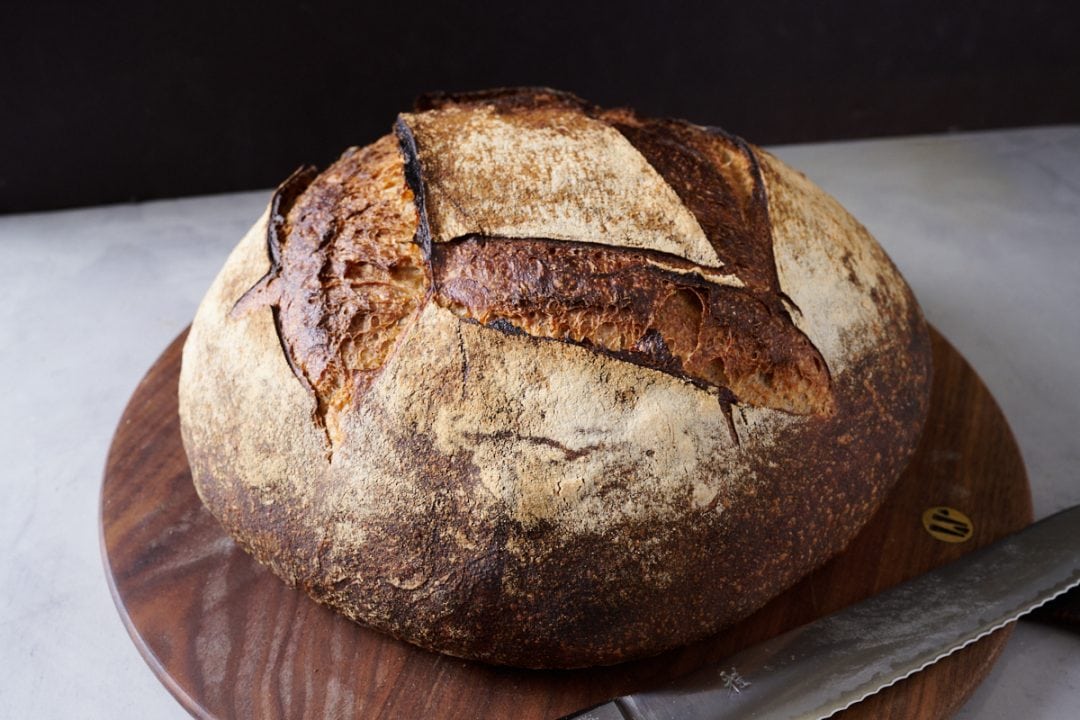
This is the kind of bread you want on your next family dinner (Thanksgiving! Christmas! Any meal!). With large loaves like this, it never ceases to amaze me how simply scaling up the size of a loaf transforms it so profoundly, but that’s precisely what happens, especially with this beer bread. For this hefty “hop miche,” I take it up a couple of notches past just increasing its weight by adding a dark stout beer to the mix for added flavor—but not by adding the thick, syrupy liquid directly. No, we’re doing something different than I’ve done in the past.
Instead of adding the malty beer alongside the water in the recipe, I use it in a tangzhong with whole rye flour. Essentially, I’m pre-cooking the flour with the beer, which amplifies the beer and grain flavor and aroma. It also brings softness to the crumb with a long-keeping quality (as tangzhong does). The crumb almost becomes iridescent and glossy, with dark overtones and a caramelized crust that’s a deep and brooding mahogany color.
To match its gorgeous outer appearance, this beer bread has an intense and rich flavor, thanks to the long fermentation time and the beer and whole grain flours. It’s malty, a little hoppy, and surprisingly, a little chocolatey. Now, this is what I call a miche.
Now, this is what I call a miche.
Real Quick: Why This Hop Miche Good For A Large Gathering
- Its large size and beautiful color make a statement on the dinner table
- It can feed a large gathering
- The flavor is deep, earthy, a little sweet, and just a hint sour, and it compliments most foods—especially when toasted
- It keeps fresh for over a week
- It’s fantastic for post-Thanksgiving turkey and ham sandwiches
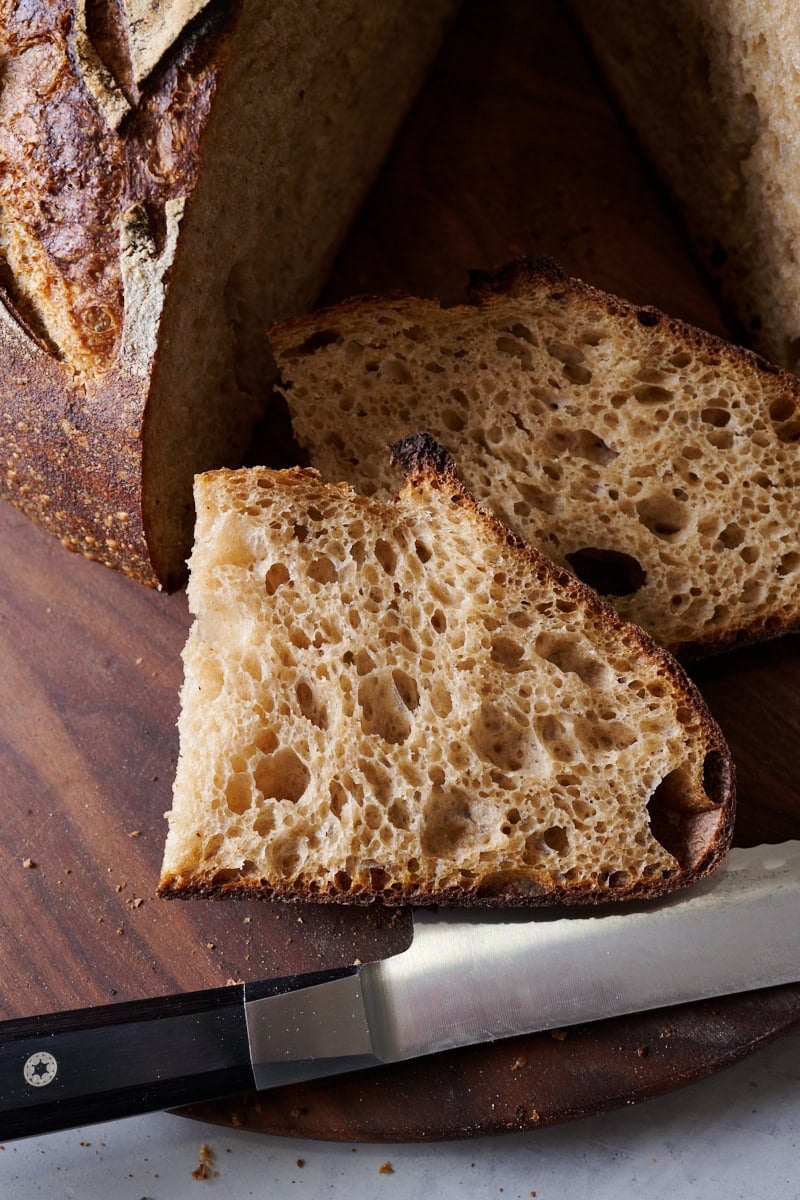
I’m no stranger to baking bread with beer. In the past, I’ve made a stout sourdough and even worked in spent beer grains into a loaf (talk about fiber!). There’s a reason why they call beer “liquid bread.” In the end, they’re essentially the same product.
Let’s look at the flour blend I used for this miche.
Video: Watch Me Make This Miche
Flour Selection
I love using specialty grains in large loaves like this beer bread miche because it’s a way to highlight an exceptionally flavorful flour in a large percentage. Plus, the high hydration of these miche and their large size mean the loaf lasts for a long time on the counter, letting me enjoy after slice after slice of the flavorful bread.
In this case, I used a hefty portion of hard red wheat from Camas Country Mill in the Pacific Northwest. Their freshly milled hard red is Yecora Rojo and makes for a strong dough that can take quite a bit of water. It’s also incredibly aromatic and stirs the senses right when mixing. In place of this flour, you can use any hard red wheat (typically any “whole wheat” you’d find at the market).
I paired this with stone-ground rye for the tangzhong, which added flavor and color to the crust. If you don’t have any rye on hand, swap this out for whole wheat.
If you’re making this for a large gathering, bake this bread the day before the meal.

Baking Schedule
I like to make this sourdough miche over two days for maximum flavor (and it makes for a slightly easier baking schedule, splitting the process over two days).
If you’re making this for a large gathering, bake this bread the day before the meal (this is what I do for Thanksgiving). This way, the bread has an entire night to set, allowing the complex flavor to develop fully.
Hop Miche Sourdough Beer Bread Recipe
Vitals
This recipe makes for a single large miche, but if you’d rather have two smaller loaves, divide the dough in half and make two round or oval loaves.
As always, the full (editable) spreadsheet is available for members of The Baker’s Corner to quickly scale up and down the recipe.
| Total dough weight | 2,000 grams |
| Prefermented flour | 7.3% |
| Levain in final dough | 19.5% |
| Hydration | 77.0% (not including beer in tangzhong) |
| Yield | One 2,000g loaf (or two 1,000g loaves) |
Total Formula
With this beer bread, I shoot for a typical final dough temperature of 78°F (26°C). See my post on the importance of dough temperature for a discussion on this and other temperature-related topics.
| Weight | Ingredient | Baker’s Percentage |
|---|---|---|
| 79g | Tangzhong: Whole rye flour | 8.0% |
| 197g | Tangzhong: Beer (Preferably stout, I used Old Rasputin Russian Imperial Stout) | 20.0% |
| 542g | Medium-protein white bread flour (Central Milling Artisan Baker’s Craft Plus or King Arthur All-Purpose) | 55.0% |
| 365g | Whole wheat flour (Camas Country Hard Red Wheat or Cairnspring Organic Whole Grain Expresso) | 37.0% |
| 641g | Water 1 (levain and autolyse) | 65.0% |
| 118g | Water 2 (mix) | 12.0% |
| 20g | Fine sea salt | 2.0% |
| 36g | Ripe sourdough starter, 100% hydration | 3.6% |

Hop Miche Sourdough Beer Bread Method
1. Prepare the levain – 9:00 a.m.
| Weight | Ingredient | Baker’s percentage |
|---|---|---|
| 71g | Whole wheat flour | 100.0% |
| 71g | Water 1 (levain) | 100.0% |
| 36g | Ripe sourdough starter, 100% hydration | 50.0% |
Mix the ingredients in the chart above in your favorite jar and leave them covered at a warm temperature, 74-76°F (23-24°C), to ripen for 5 hours.
2. Prepare the tangzhong – 9:10 a.m.
In a medium saucepan set over medium-low heat, add the 79g tangzhong rye flour and 197g tangzhong stout beer. Cook, whisking continuously, until the mixture thickens and becomes a paste, 5 to 8 minutes. The beer will initially begin to foam, so keep an eye out that it does not spill over the pan. Initially, whisk vigorously to break up any flour clumps, and continue to whisk well to avoid burning.
Remove the pan from the heat and spread the tangzhong on a small plate to cool. Set aside.
3. Autolyse – 1:00 p.m.
| Weight | Ingredient |
|---|---|
| 542g | Medium-protein white bread flour |
| 293g | Whole wheat flour |
| 569g | Water 1 (autolyse) |
| All | Tangzhong (from Step 2) |
Since this recipe is very high in hydration, I use the autolyse technique to help strengthen the dough before mixing. Additionally, I find that this extra “soaking” time helps the whole grains fully hydrate.
Warm or cool the autolyse water so that the temperature of the mixed dough meets the final dough temperature (FDT) of 78°F (25°C) for this recipe. Place the flour, water 1 (autolyse), and tangzhong mixture in a large bowl. Use wet hands to mix until no dry bits remain; the dough will be quite shaggy and loose. Use a bowl scraper to scrape down the sides of the bowl to keep all the dough in one area at the bottom. Cover the bowl and place it near your levain for 1 hour.
4. Mix – 2:00 p.m.
| Weight | Ingredient |
|---|---|
| 118g | Water 2 (mix) |
| 20g | Fine sea salt |
| 179g | Ripe levain (from Step 1) |
Note that this recipe has a very high hydration; hold back Water 2 and only add it if the dough feels like it can handle it. Using the bassinage technique like this helps ensure we don’t overhydrate the dough.
This beer bread miche dough benefits from extra strengthening during mixing. Below, I’ll discuss mixing this dough by hand, but it’s also possible to use a mechanical dough mixer (like a Famag). In this case, mix the dough until it smooths and holds itself together, about 5 to 6 minutes on speed 2 in total.
To mix by hand, add the salt and levain to the top of the dough in autolyse. Use a splash of water 2 to moisten. Mix thoroughly with wet hands or a dough whisk.
Next, knead the dough for a few minutes using either the slap and fold technique or folds in the bowl. For this dough, I kneaded for about 5 minutes until the dough smoothed and became less shaggy and a little smoother. Transfer the dough back into the bowl, cover, and let rest for 10 minutes.
Don’t add any remaining water if the dough feels very wet and soupy. If it seems cohesive but still shaggy, add the remaining water 2, mixing it in until absorbed. Once again, scrape the dough out to the counter and use wet hands to slap and fold it for 3-5 minutes, making it smoother and more cohesive. Or, to keep things cleaner, do a series of folds in the bowl.
Transfer the dough to a bulk fermentation container and cover.
5. Bulk Fermentation – 2:15 p.m. to 5:45 p.m. (3 hours 30 minutes)
At a warm room temperature, 74-76°F (23-24°C), bulk fermentation should take about 3 hours and 30 minutes and need 4 sets of stretches and folds at 30-minute intervals.
After the first 30 minutes of bulk fermentation have elapsed, give your dough its first set of stretches and folds. Grab one side of the dough and stretch it up and over the dough to the other side. Rotate the bowl 180° and perform another stretch and fold. Then rotate the bowl 90° and do another stretch and fold. Finally, turn the bowl 180° and do one last stretch and fold. Cover the dough.
Perform 3 more sets of stretches and folds at 30-minute intervals. After the fourth set, let the dough rest, covered, for the remainder of bulk fermentation.

6. Shape – 5:45 p.m.
After 3 hours and 30 minutes, the dough should have risen in the container and be puffy with some scattered bubbles around the edges, indicating it’s ready to be divided.
Since I’m making a single large loaf, I tend to skip the preshaping step for this dough. It also helps create a more open interior, but it is essential to shape the dough with sufficient tension.
If you want to make shaping easier or if you’d like to make two 1,000 g loaves instead, preshaping can help organize the two pieces of dough, but it’s optional. If you preshape, do so lightly and let the dough rest for 15 to 20 minutes before continuing.
If you’re making one single large loaf like I do, use one 10″ diameter proofing basket. If you split the dough into two, use 8″ diameter baskets. Regardless, heavily dust the proofing basket(s) with white flour to prevent sticking.
Flour your work surface and the top of the dough in the container. Gently scrape the dough onto the floured work surface. Using floured hands, shape the dough into a large boule. Transfer the shaped dough, seam-side up, to the proofing basket.

7. Proof – 6:00 p.m. to 9:00 a.m.
Cover the basket with a large, reusable plastic bag and seal it shut. Place the basket in the refrigerator to proof overnight. This long, cold-proof helps create a more aerated interior and continues to develop flavor as the yeasts and bacteria continue to function until the dough drops to refrigerator temperatures.
8. Bake – 9:00 a.m.
Due to the large size of this miche, it will not fit in a 3.2-quart Dutch oven. Instead, bake directly on a baking surface and steam the interior of the oven, or use a Brød and Taylor Baking Shell (the boule version).
Place an oven rack with a baking surface in the bottom third of the oven. Preheat the oven to 450°F (230°C) for 30 minutes.
Uncover the proofing basket from the fridge and put a piece of parchment paper over the top. Place a pizza peel or inverted baking sheet on top of the parchment, and using both hands, flip everything over. Gently remove the basket and score the dough.

Slide the parchment onto the preheated baking surface, cover the dough if using the Baking Shell or steam the oven if not, and bake for 20 minutes. Vent the oven of steam (uncover the dough or remove the steaming pans) and continue to bake for 45 minutes more. When done, the loaf should have an internal temperature of around 204°F (95°C), and the crust should be deeply colored and crusty. Tap a few times on the bottom of the loaf. It should feel sturdy and sound a bit hollow.
(If you decide to split this recipe into two loaves, reduce the baking time to about 10 minutes in total.)
Since this loaf has a prolonged bake time, expect it’ll have a thicker crust (as opposed to shorter bake times for a thinner crust). This thicker crust is precisely what we want with a large miche; it helps keep the bread fresh for even longer by locking in moisture naturally.
Due to the large size of this beer bread miche, it’s best to let it cool for at least 3 to 4 hours, preferably overnight, before slicing.
Print
Hop Miche (Sourdough Beer Bread)
- Prep Time: 24 hours
- Cook Time: 1 hour, 5 minutes
- Total Time: 25 hours 5 minutes
- Yield: 1 loaf
- Category: Sourdough, Bread, Holiday, Thanksgiving
- Cuisine: French, American
Description
A large French-style loaf with a deeply colored crust thanks to the bold bake and added dark stout beer and whole grain flours. The flavor is intense, rich, and with a hint of chocolate—this is one for the holidays!
Ingredients
Levain
- 71g whole wheat flour
- 71g water
- 36g ripe sourdough starter
Tangzhong
- 79g whole rye flour
- 197g stout beer
Autolyse
- 542g medium-protein white bread flour
- 293g whole wheat flour
- 569g water
- All of the tangzhong
Main dough
- 118g water
- 20g fine sea salt
- 179g ripe levain
Instructions
- Prepare the levain — 9:00 a.m.
Mix the levain in your favorite jar and leave them covered at a warm temperature, 74-76°F (23-24°C), to ripen for 5 hours. - Prepare the tangzhong — 9:10 a.m.
Add the tangzhong ingredients to a medium saucepan set over medium-low heat. Cook, whisking continuously, until the mixture thickens and becomes a paste, 5 to 8 minutes. The beer will initially begin to foam, so keep an eye out that it does not spill over the pan. Whisk vigorously to break up any flour clumps, and continue to whisk well to avoid burning. Remove the pan from the heat and spread the tangzhong on a small plate to cool. Set aside. - Autolyse — 1:00 p.m.
Warm or cool the autolyse water so that the temperature of the mixed dough meets the final dough temperature of 78°F (26°C) for this recipe. Place the autolyse ingredients and the tangzhong in a large bowl. Use wet hands to mix until no dry bits remain. Cover the bowl and place it near your levain for 1 hour. - Mix — 2:00 p.m.
Add salt and levain to the autolysed dough, moistening with a splash of water. Mix thoroughly with wet hands or dough whisk, then knead for about 5 minutes using slap and fold technique or bowl folds until dough becomes smoother. Rest covered for 10 minutes. If dough feels dry and shaggy, mix in remaining water – if very wet, skip this. Knead again for 3-5 minutes until cohesive, then transfer to bulk fermentation container and cover. - Bulk Fermentation — 2:15 p.m. to 5:45 p.m.
Bulk ferment for about 3.5 hours at 74-76°F (23-24°C), performing 4 sets of stretches and folds at 30-minute intervals. For each set, grab the dough from each of 4 sides, stretching and folding over the center, rotating the bowl 90° between each fold. Cover between sets. After the final set, let dough rest covered until bulk fermentation completes. - Shape — 5:45 p.m.
After 3.5 hours, when dough is puffy with bubbles at edges, gently turn it onto a floured surface. For a single large loaf, skip preshaping but ensure sufficient tension when shaping into a boule. Transfer seam-side up to a heavily floured 10″ proofing basket. - Proof — 6:00 p.m. to 9:00 a.m. (next day)
Cover the basket with a large, reusable plastic bag and seal it shut. Place the basket in the refrigerator to proof overnight. - Bake — 9:00 a.m.
For this large miche, bake on a baking surface with steam or use a Brød and Taylor Baking Shell. Preheat oven to 450°F (230°C) for 30 minutes with baking surface in bottom third. Turn dough onto parchment-lined peel, score, and slide onto hot surface. Bake covered/with steam for 20 minutes, then uncovered for 45 minutes more until internal temperature reaches 204°F (95°C) and crust is dark, crunchy, and sounds hollow. Cool at least 3-4 hours, preferably overnight, before slicing.
Notes
If you’re preparing this for Thanksgiving or other large gathering, plan to bake it the day before the big meal to give it time to fully cool before cutting (and one less thing to worry about!).
Instead of baking one single large loaf, you can divide the dough in half to make two smaller boules. In this case, reduce the baking time by 10 minutes.
If you don’t have whole rye flour, swap it out for more whole wheat.
Instead of stout, use another malty beer like a porter, or for a real hoppy kick, go for a hazy IPA.
If you don’t want to use beer, leave it out and replace it with equal-weight water and cook the rye in this instead.
Hop Miche Sourdough Bread FAQs
Why did the top of my miche burst open?
Bursting usually indicates the dough is slightly underproofed and needs more time in bulk fermentation and/or proof.
This miche dough feels very wet and is hard to handle. What did I do wrong?
As always, adjust the amount of water you add during mixing. The Water 2 (reserved water) is held back until mixing so you can “bassinage” the water if the flour can handle the addition. In other words, that reserved water helps you avoid overhydration, so you only add it if the dough feels cohesive and elastic (not soupy or falling apart).
What’s Next?
This beer bread miche is a great example of tangzhong being used for things other than super soft rolls (although these are wonderful, too) to bring out a soft crumb with incredible keeping quality.
If you’re looking for a larger miche for the dinner table with a more mellow, subdued flavor profile, check out my sourdough Einkorn Miche.
I hope this beer bread miche makes it to your next gathering—I guarantee it’s going to impress 🙂
Buon appetito!


44 Comments
What is the logic of excluding the stout from the hydration calculation? The stout is 99% water and once you mix all the the levain with the autolyse, the dough certainly feels wetter than the indicated 77%. By my calculation it is at 85%. It certainly feels like 85%. I am proceeding without adding the additional 118g of water (which by my calculation would put the hydration at 99%).
Correct. I came up with the same hydration calculations.
Hi, wonderful loaf, thank you! I want to make it again and still have a little of the beer left (albeit flat!) think I can still use it or do I need a fresh can? Thanks!
You can absolutely use it again, in fact, flat is even better.
Thank you! I realized of course I could just look it up on line, sorry, I really try to ask you questions that I can’t find easy answers to online but sometimes I ask before thinking.
this bread is a giant slice of yum. Great texture, I added a tablespoon or 2 of molasses to add to the deep “stout” taste. Nothing better as a grilled cheese sandwich. A side benefit: it’s beautiful to look at. I did add the cookie sheet under the cast iron too. Avoid a burnt bottom crust. You will be proud to be the baker. Thanks Maurizio
Love the idea of adding molasses to this… In fact I’m working on a new recipe in that direction right now 🙂
Hello Maurizio. Love your website and have made a lot of your recipes. I have had bad luck with steam baking in my oven. Could I get away with baking this as a single loaf in a 7.5qt dutch oven? I want to grab a B&T bread dome, but they’re currently sold out of the Boule version. Thanks!
Yes, it should fit in there, Bob!
Hi Maurizio – can I use the rest of the beer for part of the water in the recipe?
You can, yes. It might inhibit some of the rise… but it'll be delicious.
I think it is the alchohol that would inhibit the rise. I use Guiness 0 which is non-alchoholic.
Hi Maurizio, I'm making the bread now with a Mexican-Style Chocolate Stout. Can I just use the entire beer – use the beer leftover from the tahnzong to replace some of the water later? Thanks!
Hi Maurizio! I’m extremely allergic to rye and barley flour. Is there a way to make a beer bread without those flours ?
Sure, instead of the rye just use whole wheat in its place!
Do you think a porter will work? There is a local porter I'm really wanting to try with this, with hints of coffee and coconut!
Oh heck yes, that sounds awesome 🙂
Hello, if I divide the dough can I bake one loaf after overnight cold retard and bake the other the day after that?
Yes, you could definitely do this.
Can i bake it in sandwich pan or bread pan? I am not a fan of boules…
The dough as-is would be too large for a single loaf pan. But splitting it up would work! I would still steam the oven.
The absorbency of the flour is important there, it sometimes takes less time if it's particularly "thirsty" flour! How did it turn out?
I had a super sticky and wet dough despite adding only 5g of water (2) just to dissolve the salt a little. Any tips to improve on that? Will still bake it!
I would hold back more water from the recipe, it sounds like your flour isn't able to take on quite as much (which is okay!).
I had fun making this one until I added too much water (2). For some reason i had it in my head hold back half of water 2, so half was added first during mixing. I had to stretch and fold maybe 8 times and gave up. I put it in proofing basket and it barely fit! 🤣 Then in the morning it was almost overflowing and still too loose but I put it in my 6.5 Dutch oven and baked it 45 minutes with lid on and 20 lid removed until 204 F. It looks beautiful and I can’t wait to taste it.
Hope it tasted great, Debi!
Just pulled this out of the oven. It smells AMAZING. Waiting 4+ hours to slice is gonna be brutal. I just got back from vacation in NC where we hiked and drank a lot of local beer. I made this loaf with 7 Clans Brewing Chestnut Brown Ale that we brought home. My husband was a little annoyed that I used his craft beer to bake with, but I feel certain he will change his mind once he tastes this bread!
Oooh, a brown ale, great choice April! I would say it's 100% worth it for this bread 🙂 I hope you guys enjoyed it!
Wow, what a fun process and delicious loaf! This was my first time ever trying the tangzhong method. Very forgiving because I messed up my temperature (forgetting to put the dough back in the proofer after one set of folds during bulk fermentation). Thank you & happy Thanksgiving.
Woo hoo, glad you liked this one Nikki!
This is excellent bread!! I am adding it to my regular baking rotation. I send everyone who wants to learn to bake sourdough to your website!!
Thank you so much Robert, really appreciate that. Glad you liked this one. I had a lot of fun developing the recipe, it's so delicious (and a stunner!).
Thank you so much Robert, really appreciate that. Glad you liked this one. I had a lot of fun developing the recipe, it's so delicious (and a stunner!).
I have another dozen loaves in progress, adjusted the formula so I could use 3 bottles of Guinness extra stout. One of my people ate half a loaf the day he got it, it is outshining my Scarborough Faire bread…
Just made this and wow – really delicious loaf. First time that I've used a tangzhong in a regular bread (I make a lot of milk breads). The crumb is super soft and the exterior has a nice thin crunchiness. My starter wasn't very sour and the bread ended up with a slightly sweet flavor even though there's nothing sweet in it. I didn't have a dark beer and had to use Corona Extra – so that might account for the slight sweetness. Great recipe – thank you!
I get a little sweetness in this one, too! Happy you liked it. Thanks for coming back with the feedback!
Hi, started making the recipe this morning. Very excited to try it. But I just found out that I’ll have to go out tomorrow.
What’s the best for proofing?
1. I leave it on the counter and cook it tonight? Is so… how long on the counter?
2. Keep it in the fridge till tomorrow evening and adding a good 8h to the cold proof?
3. Making the cold proof 1-2 hours less and cook it earlier before I leave?
Thanks and I love your recipes!
I'd live it in the fridge until the evening!
Hi! I am very tempted to make this for Thanksgiving but work during the day and I wonder if I could make it on Sunday, and leave it in the fridge until Wednesday for baking. Would that be too long for cold proof? Thank you!
P.S. Love your book. Making your sesame and sunflower sourdough now!
I think that'll be just fine. This dough is great the longer it ferments (within reason) 🙂 Hope you love the sesame!
I don’t have rye but I have einkorn, emmer, or spelt available to mill. What would be closest? Thanks.
Honestly, any of those would be fantastic. Given my love of spelt, I'd probably go with that one first 🙂 Be sure to hold back Water 2 in the recipe when mixing, adding only as it can handle it.
This looks amazing. Is there a whole wheat flour equivalent from KA, that could be used?
Yes, their standard whole wheat will work well, Martin!