

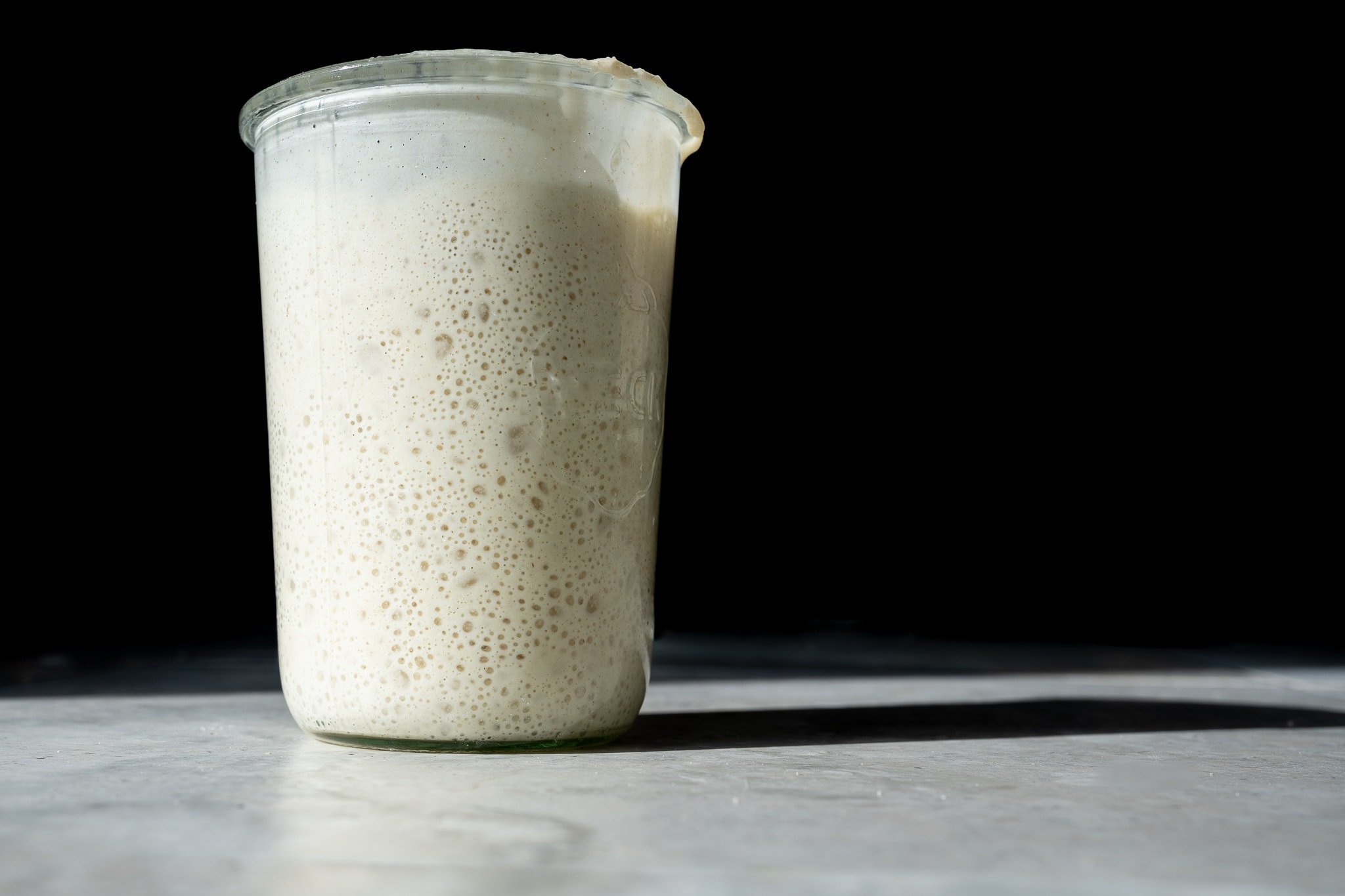
Feeding, also called refreshing, your sourdough starter ultimately becomes a series of personal choices. You have to adjust your starter feeding routine to match your baking frequency, the flour you plan to have on hand, the temperatures currently in your kitchen (which fluctuate naturally through the seasons), and also to time your sourdough starter ripening with your daily schedule. In this post, I plan to visit the question I get asked extremely often: how do I feed my sourdough starter?
This post will discuss what I’m feeding my sourdough starter (and will be updated should changes arise) and the schedule it follows. Since I often bake sourdough bread (just about every day!), keeping my starter in the strongest possible condition is beneficial. This means frequent feedings and keeping it at a warm temperature.
If you bake less often or want less commitment, there’s a place for that, too. Please have a look at my weekend bread-making schedule for a low-maintenance way to keep your starter with the possibility of still baking bread on the weekends.
For a quick rundown, check out my YouTube video of my feeding process:
First, Create a Sourdough Starter
If you don’t already have a sourdough starter, head to my easy sourdough starter creation guide to learn to make your own sourdough starter in around seven days. It’s an easy process of mixing flour and water, discarding, and letting the mixture rest until stable and predictable fermentation happens each day.
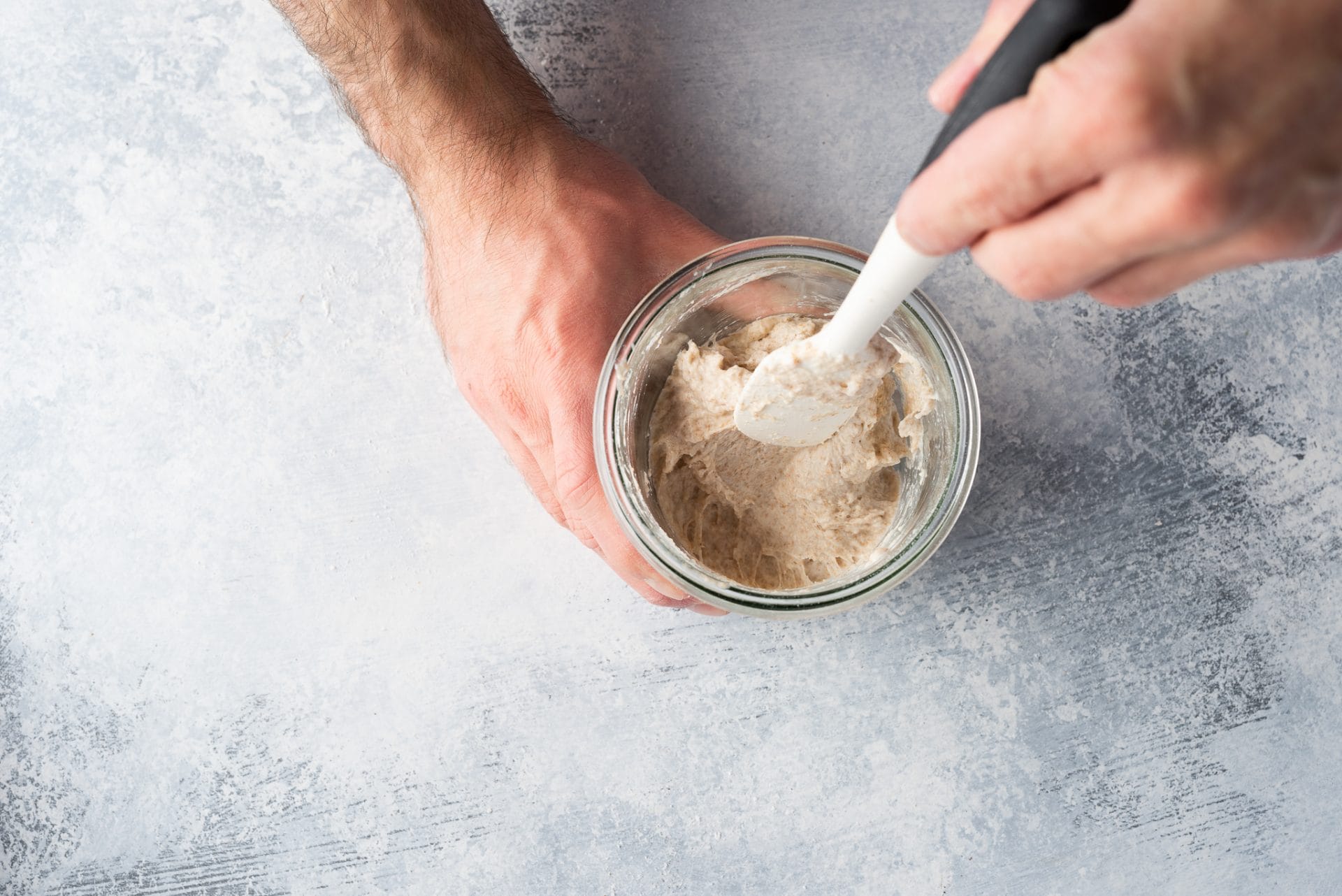
What is Feeding a Sourdough Starter?
A sourdough starter needs a regular feeding of fresh flour and water to provide it with “food” for its metabolic activities. The wild yeast and bacteria in a sourdough culture use the flour to continue to function, reproducing and eventually creating the byproducts of fermentation we’re after when baking bread: for the dough to rise (through carbon dioxide production) and for the flavor to be created (organic acids and other compounds).
Now that we know what it is let’s look at how I feed my sourdough starter.
How Do I Feed My Sourdough Starter?
I use baker’s percentages to communicate how I feed my starter in the same way I use them to convey bread formulas. All components of my sourdough starter are relative to the flour weight, which is always at 100%. This allows me to scale up or down my starter as needed—to, say, cover a large levain build for a big bake—while still maintaining the same ratio of ingredients.
Currently, I feed my sourdough starter the following ratio of carryover to flour to water:
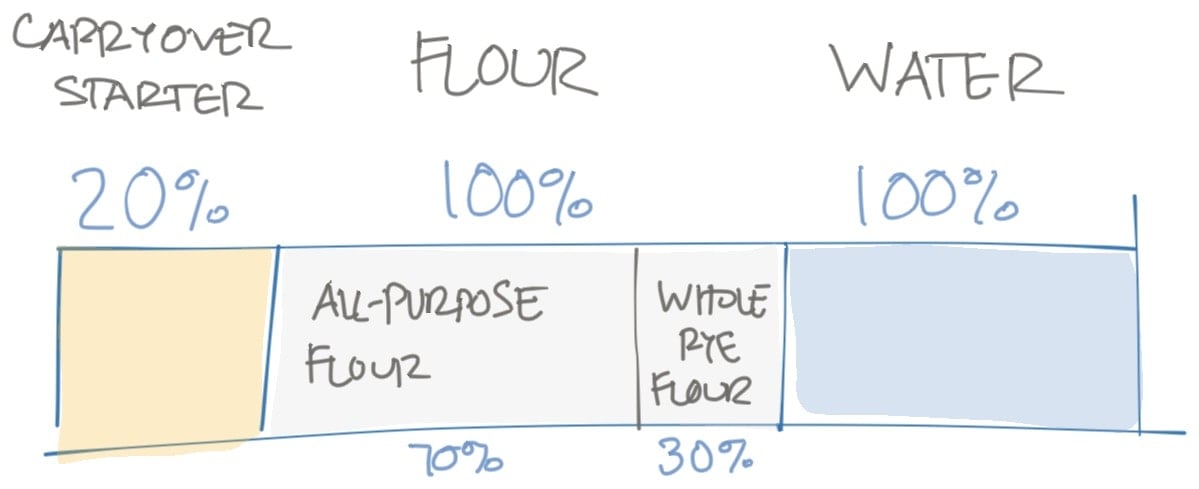
| Weight | Ingredient | Baker’s Percentage |
|---|---|---|
| 20g | Ripe sourdough starter carryover | 20% |
| 100g | Flour (70g all-purpose flour, 30g whole rye flour) | 100% |
| 100g | Water | 100% |
I maintain around 220g of starter each day, translating to 20g carryover ripe sourdough starter, 70g all-purpose flour, 30g whole rye flour, and 100g water. I keep my starter in a large 3/4 Liter Weck jar and the jar in my small dough proofer daily.
If kept around 76°F (24°C), this sourdough starter should ripen about every 12 hours.
To give it a feeding, I discard the ripe sourdough starter in the jar down to 20g, add 70g fresh all-purpose flour, 30g whole rye flour, and 100g water. Then, I give it a thorough mix until everything is homogenous. Finally, cover the jar (these are my favorite jars to hold my sourdough starter) with its glass lid—it’s not sealed shut, it just prevents air from getting inside—and leave it for 12 hours.
Adjusting Sourdough Starter Feedings Through the Seasons
Depending on the temperature in my kitchen, I might slightly adjust the amount of ripe sourdough starter I carry over during each feeding. For example, in the extreme heat of the summer, I might drop the amount of carryover starter down to 5 grams to ensure my starter doesn’t ripen too quickly (i.e., discard more starter and use it somewhere else!). More ripe sourdough carryover left in the jar means a faster ripening time. On the other hand, less left in the jar slows ripening.
More ripe sourdough carryover left in the jar means a faster ripening time. On the other hand, less left in the jar slows ripening.
Conversely, in the coldest parts of the winter, I might bump the ripe sourdough starter carryover to 25 grams, even with my dough proofer holding my starter jar and warming to 76°F (24°C).
Can I Save Sourdough Starter Discard?
With each sourdough starter feeding, you’ll be discarding some to avoid it from becoming overly acidic. Most will compost or trash this discard, but you can save it and use it in other recipes! When discarding, I’ll scoop out my ripe sourdough and add it to my sourdough starter discard cache, which is kept in the refrigerator.
Then, I can use this discard later in any delicious sourdough starter discard recipe.
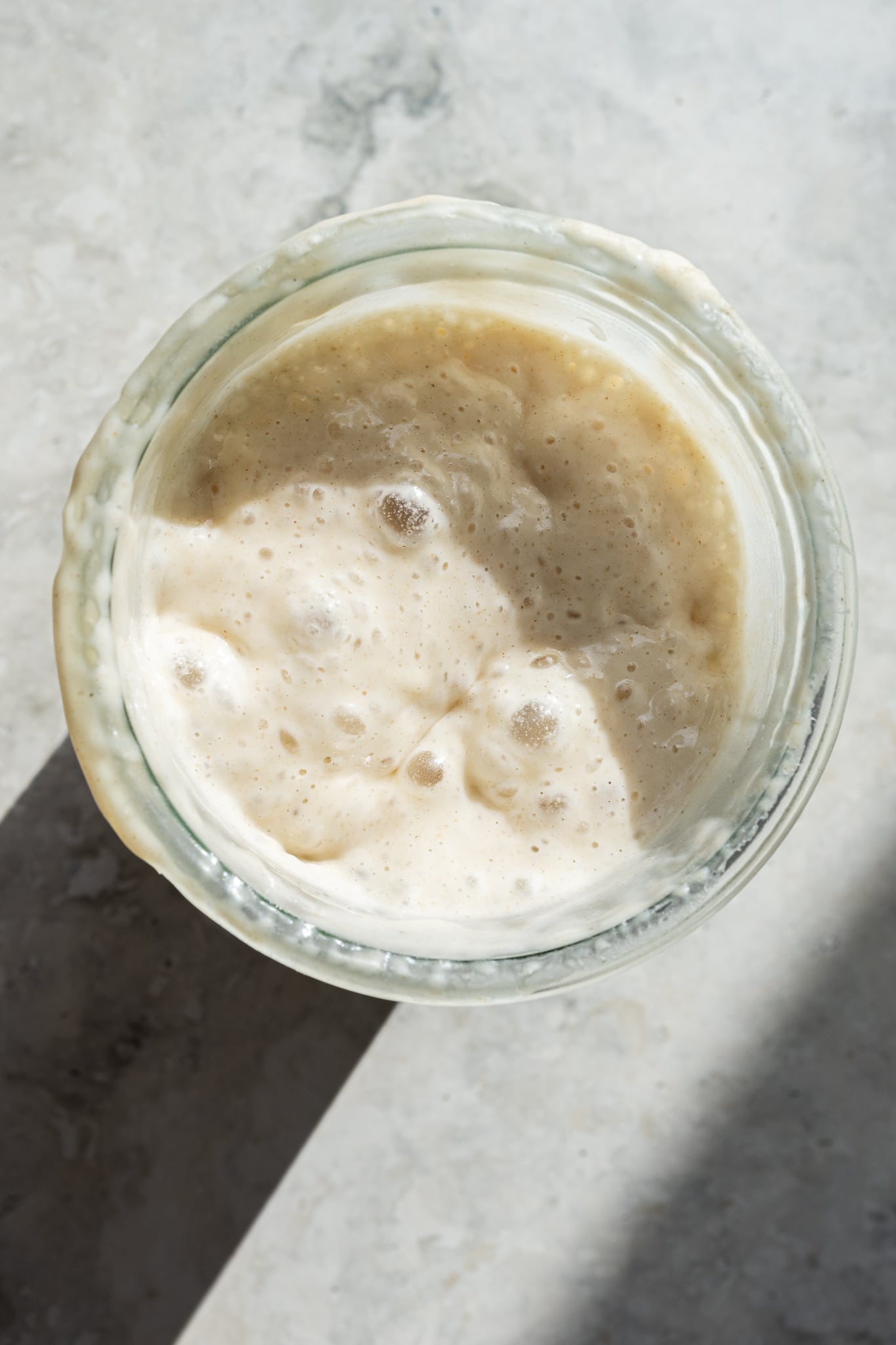
My Sourdough Starter Feeding Schedule
Now that you know what I feed my sourdough starter daily let’s look at its schedule.
With the above flour, water, and carryover ratios, I need to feed my sourdough starter twice a day if kept at a warm temperature. I like to feed once in the morning at around 9:00 a.m. and once at night at around 9:00 p.m. This isn’t a super strict schedule, sometimes I feed a little earlier and sometimes a little later, but generally, I like to keep to those times.
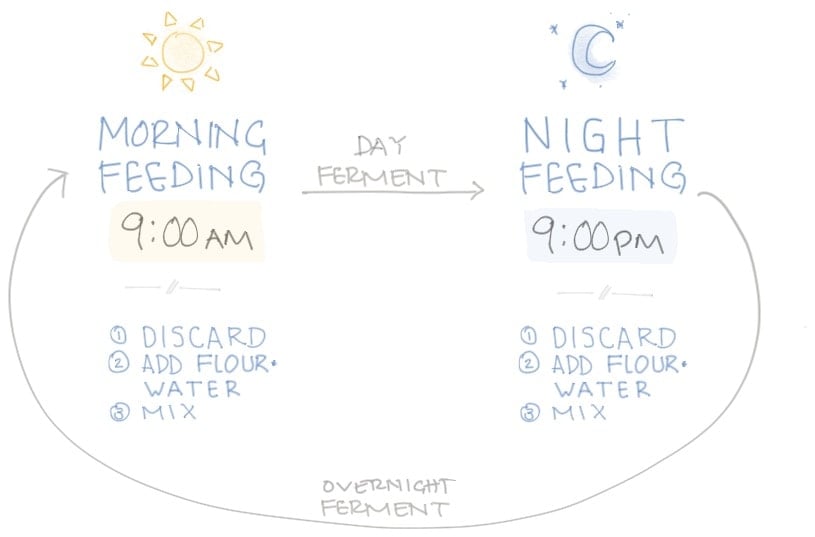
With this schedule, it means I can make the day’s levain early at 9:00 a.m., and in the case of something like my Sunflower & Sesame Sourdough, the levain will ripen and be ready for mixing around 2:00 p.m. In other cases, where I have an overnight levain, I’ll make the overnight preferment at night around 9:00 p.m., and it’s ready for mixing first thing in the morning.
The important thing is always to make a levain or mix a dough when your starter is ripe. This means making the levain with the ripe starter before feeding it.
In my case, I have two opportunities throughout the day to make a levain or mix a dough, at 9:00 a.m. and 9:00 p.m.
Recommended reading: Read on for more detail on my sourdough starter maintenance routine, including the signs I look for when my starter is ready for a feeding.
What’s Next?
How do I feed my sourdough starter? Well, that’s it! I’ll keep this post updated with any changes to my feeding regimen, but if you’re interested in reading more about starters, look at my sourdough starter collection, where I have a collection of maintenance routines, discard recipes, guides, and more.
If you’re having issues with your sourdough starter, check out my roundup of the most commonly asked starter questions I’ve compiled over the last decade: 21 common sourdough starter problems with solutions.
If you want to get baking straight away with your starter, check out these recipes to get a loaf of sourdough bread on your table in no time.
Sourdough Starter FAQs
I have an in-depth sourdough starter FAQ with many questions and answers, but below are a few related to how I feed my sourdough starter.
How long after feeding my starter can I use it?

It depends on how you’ve fed it! If you feed it by carrying over a large percentage of ripe sourdough starter, it will be ready earlier. On the other hand, less carryover means it will take longer to ripen, assuming it’s kept at the same temperature.
Why do you use rye flour in your sourdough starter?
I like using whole-grain rye flour to increase fermentation activity for a lively and strong starter. It’s not mandatory, but a preference of mine: it results in a starter with the performance and flavor characteristics I’m after. If you’re making a levain when baking, this will likely have a larger impact on a single bake (both in terms of flavor and fermentation performance).
Do I have to feed my sourdough starter twice a day?
No. You can scale back to once a day or even scale up to three times a day, whatever works for you and your schedule. I like to feed it at least once a day to keep it strong and ready for baking. If you aren’t baking for a while, you could store your starter.
Do I have to discard my sourdough starter?
It would be best to discard some portion of your starter each time you feed it unless you want to continue to let it grow. Eventually, you need to discard the used food (flour and water) that’s sustained your starter during the last fermentation period. This discard can be used to make man different sourdough discard recipes (like waffles, cookies, brownies, and more).


105 Comments
My question has nothing to do with my starter, but this is the only way I could find to communicate with you.
I think I make a pretty good loaf, but the bread coming from the Bread Shop in bSFe is better in one way and I’m hoping you can help. The Bread Shop loaf has a quite moist crumb. Mine is very good but ima crumb is comparatively dry. I’m assuming it’s a hydration issue, but would be grateful for your thoughts.
Thank you!
Don Emery
Hey Don! Bread Shop really is great! Yes, it’s likely a hydration issue—you need to increase yours. In doing so, though, make sure you’re mixing a little longer, and watch the dough during the summer, it can get a little loose if it’s verging on overproofing.
Check out my guide to dough hydration:
https://www.theperfectloaf.com/dough-hydration/
Also, you can always email me through the About page 🙂
The seasonal information is really helpful, thanks for adding that! When you drop the amount of starter that you carry over in the summer or increase it in the winter, do you drop/increase the flour and water to keep your ratio the same or do you just change the amount of starter and keep adding 100g of flour and 100g of water?
I always keep the flour the same, I'll adjust the water if I find the consistency needs adjusting (sometimes flour needs more or less depending on the bag). But the carryover, yes, I adjust based on the season!
I have been using your cookbook this year, trying to bring my baking to the next level. I am having mixed results due to the following: I moved to 3,000 ft in the NorCal Sierra Foothills, from the SF Bay Area. My starter is about 2.5 years old, and I have always fed it organic whole wheat. I am discovering mixed results depending on what the recipe is. this week, I created two levains: one for your focaccia which was all white flour and one for your "first loaf" that used mostly type 80 old world, all from central milling. The type 80 levain fermented in 12 hours well, but the one for the focaccia that was all white did not rise, and the bread did not ferment well either. So, now I think part of my problem is that my starter is all whole wheat and when it's introduced to an all white flour levain, the fermentation is very sluggish and inadequate. what is going on?
That won't be an issue. You can switch flours for your starter anytime you like!
Help! I've lost track of what day I've on but I've had no rise for about 4 days, there's no sign of visual mold but not a lovely smell. do I have to start all over again, it's thin with no bubble, I've accidently been continuing with 85g starter and 100g flour with 115 grams water way past day 5. hoe do I pull things back. do I have to start again?
Dont start again! Just pick up with any of the days, it'll be fine. I would say go with 1x a day until you see strong rise and fall, then switch to 2.
Hi there! I’ve been following you starter feeding schedule and maintenance for maybe 9ish months and it always yields great tasting loaves. Recently, I tried making a brioche bread with my starter and it came out SO SOUR, basically not edible. The internet (ChatGPT lol) said my starter is probably too acidic, and it does usually smell strongly of acetone before each feeding. Can you help me understand what I should do next time? Should I keep a separate starter with only AP flour for enriched breads? Thank you!!
I’ve been feeding my new starter for three weeks, but other than an occasional bubble on top it’s doing nothing. Feedings are twice daily: 30g rye flour, 70g all purpose flour, 100g water, and 20g from existing starter. What am I doing wrong?
If your kitchen is on the cold side try warming the water you’re using to feed your starter. If you have a thermometer, try to get the water around 80°F. Usually, it's temperature that's the cause.
I've also seen issues where people needed to use spring water from the market until it gets going, then switch over to tap water once it's rising and falling predictably.
Keep with it and it will eventually come around!
Thanks for the follow up. I’ll check the water temp to be sure it’s at 80 before adding. Once mixed, I keep the starter in a Brod & Taylor proofer set at 76. Anything else I should be doing?
I am a beginner, twice now after feeding starter and allowing it to ferment, it has been gummy, doesn’t float, doesn’t dissolve in water. What am I doing wrong? One time it had just risen to double, about 6 hours. The other time was overnight, it more like tripled in size, 11 hours. It looked beautiful and bubbly both times.
The float test can be tricky and isn't always the most reliable indicator of starter readiness. If your starter is doubling or tripling in size and looks bubbly, it's likely ready to use regardless of whether it floats.
The gummy texture you're noticing could be from a few different factors. First, make sure you're stirring your starter well before using it – sometimes the texture can be uneven throughout. Also, the flour you're using might impact the consistency – different flours absorb water differently and create varying textures.
When your starter has doubled or tripled and shows lots of bubbles on the surface and sides, these are much more reliable indicators that it's ready to use than the float test. Try building your levain or mixing your dough when the starter shows these signs, even if it doesn't float.
Keep at it – you're on the right track with your starter!
Hi Maurizio 😊 I feed my starter 1:4:4 every 12 hours and keep it in my Sourdough Home at 76 degrees and it never falls. Could it be too thick? So, what I’m wondering is, is it still ok to feed it even though it doesn’t fall? Thanks!
Julie, a starter that never falls isn't necessarily a problem! As long as your starter is showing consistent signs of activity with some visible rise and has a pleasant aroma, it's likely healthy despite not falling. Your 1:4:4 ratio creates a fairly thick starter, which tends to hold its structure longer than more liquid starters.
As long as it's producing successful bread with good fermentation and flavor, I wouldn't worry about the lack of falling. If you're curious though, you could try a slightly higher hydration ratio (like 1:4:5) to see if that changes its behavior.
Keep baking with it as long as it's performing well for you!
Do you feed your starter after it completely drops, while it’s the stages of dropping or when it at its peak?
Yes, sometimes that's happened here, Cory. It's okay if it drops, just give it a feeding when you can. I like to feed mine a little earlier before complete collapse like this.
Do you ever have to add more starter culture to the sourdough starter, as in along the line, or after a month? Or will it solely stay alive with only water and flour feedings?
You're continuing to keep some of the starter each time you feed (which is discarding and adding new flour and water).
Hi Maurizio. Can you share your thoughts about feeding a ripe starter once a week? Is that advisable while not actively baking? If so, what ratio should I follow?
In that case I would keep it in the refrigerator. I talk a bit about reduced feedings, here .
Hi Mauricio,
Do you keep a stiff starter as well? If you do, would you please share maintenance ratio, flour type and temperature?
Thank you,
Khushi
Apologies for they typo in your name… could not edit the comment 🙂
No worries 🙂 No, I don't keep a stiff starter anymore. I used to, but these days I keep a liquid one (as I talk about above), and then if I need a stiff levain, I make that for the day. For that, it would usually be 100% flour, 55-65% water, and 20% starter carryover, fed 2x a day.
Hi Maurizio. I purchased your book via kindle and I am enjoying it. It inspired me to start making my own starter following your method. I Had a flase rise after day1 to 3 then quiet phase started. Now on Day 10, bubbles on side sometimes on top but not significant rise. Doing 20g starter, 30g rye, 60g APF & 100g water. Placed it in proofing box with 78F temp, feeding twice. However, it turns a bit runny when I'm about to refresh. Any advice suggestion how to make it stronger? Thank you!!!
Hi quick question! Could I halve the starter maintenance to:
10g starter / 35g white flour / 15g rye / 50g water to yield same results?
Yes, absolutely. I talk about this in my guide to maintaining a smaller starter (to avoid too much waste).
Hi Maurizio! I read your book and am excited to try a little DOE with my starter to dial in my rye to AP percentages and feeding schedule. A few questions for you:
1. My starter seems to currently like a 1:2:2 at 78degF. Did you do anything to work up to the 1:5:5? Like slightly increase the feed until your starter could handle 1:5:5? Or just feed it the 1:5:5 and try to slowly reduce the time between feeds? I’m equating your feed schedule/ratios to a strong starter and would like to strengthen mine.
2. How would you adjust the levain in your recipes to account for weaker starters? Replace water and flour with extra starter? Or just go with the ratios and wait longer until peak? I suppose the same question could apply to colder and warmer temperatures. What adjustments would you make when conditions are not optimal?
Thank you in advanced for your advice!
Answers:
1. 1:5:5 is what works for me here and my starter. If you need a tighter ratio, that's fine! Neither is better or worse.
2. When conditions are not optimal, I would try to keep it at a warmer temp or use more or let it ferment longer.
Temperature really is the most important thing with this!