

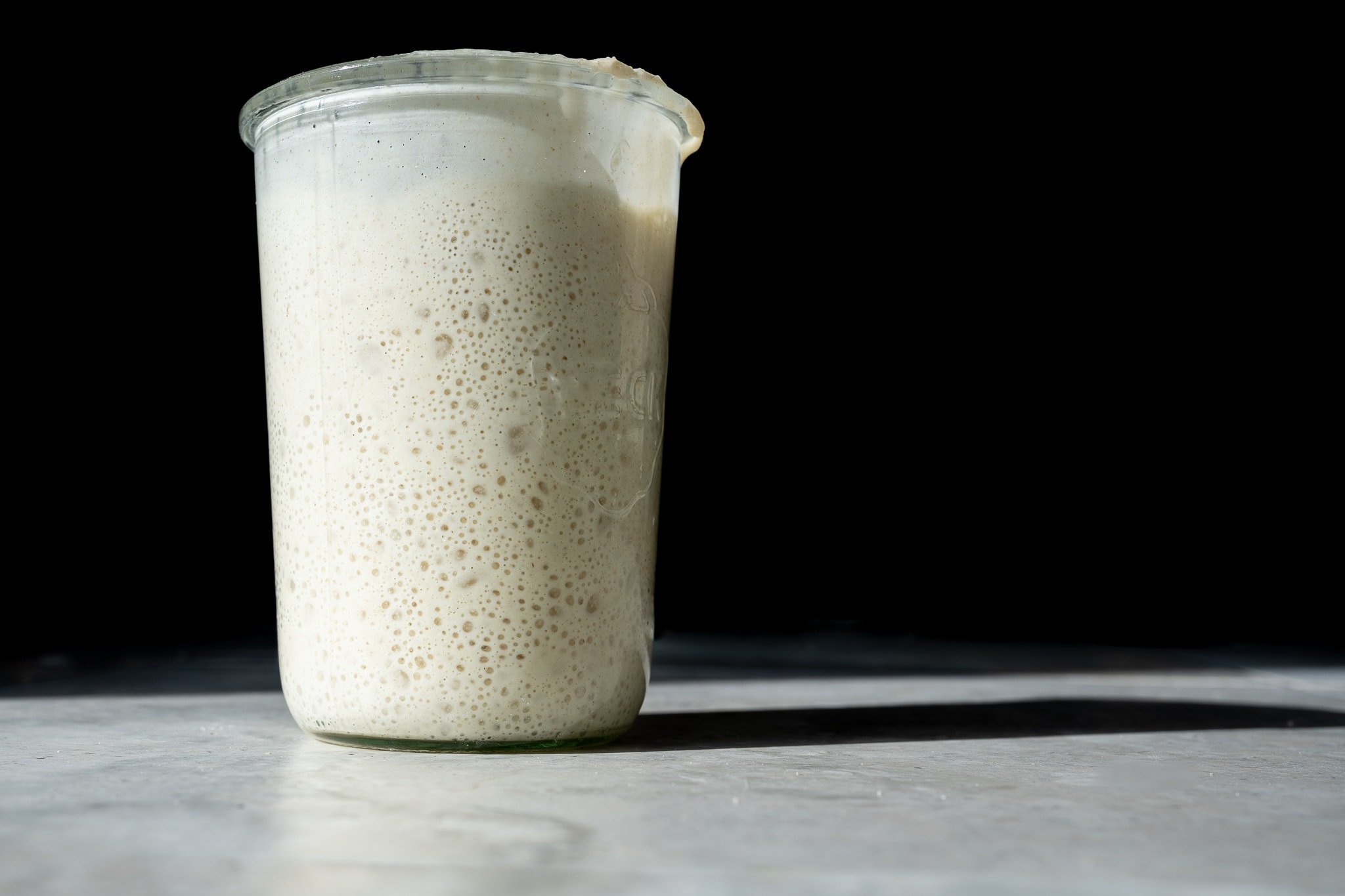
Feeding, also called refreshing, your sourdough starter ultimately becomes a series of personal choices. You have to adjust your starter feeding routine to match your baking frequency, the flour you plan to have on hand, the temperatures currently in your kitchen (which fluctuate naturally through the seasons), and also to time your sourdough starter ripening with your daily schedule. In this post, I plan to visit the question I get asked extremely often: how do I feed my sourdough starter?
This post will discuss what I’m feeding my sourdough starter (and will be updated should changes arise) and the schedule it follows. Since I often bake sourdough bread (just about every day!), keeping my starter in the strongest possible condition is beneficial. This means frequent feedings and keeping it at a warm temperature.
If you bake less often or want less commitment, there’s a place for that, too. Please have a look at my weekend bread-making schedule for a low-maintenance way to keep your starter with the possibility of still baking bread on the weekends.
For a quick rundown, check out my YouTube video of my feeding process:
First, Create a Sourdough Starter
If you don’t already have a sourdough starter, head to my easy sourdough starter creation guide to learn to make your own sourdough starter in around seven days. It’s an easy process of mixing flour and water, discarding, and letting the mixture rest until stable and predictable fermentation happens each day.
What is Feeding a Sourdough Starter?
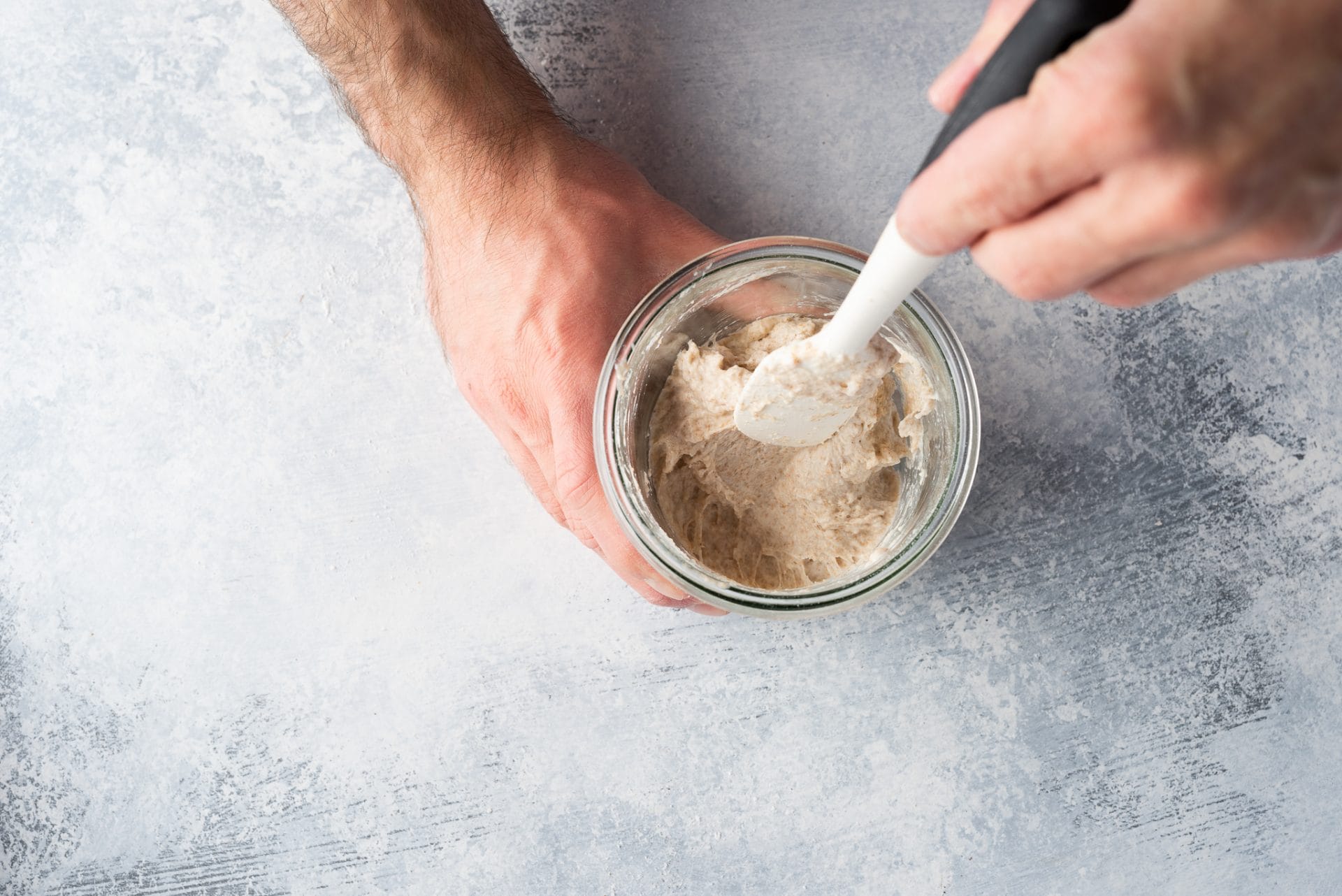
A sourdough starter needs a regular feeding of fresh flour and water to provide it with “food” for its metabolic activities. The wild yeast and bacteria in a sourdough culture use the flour to continue to function, reproducing and eventually creating the byproducts of fermentation we’re after when baking bread: for the dough to rise (through carbon dioxide production) and for the flavor to be created (organic acids and other compounds).
Now that we know what it is let’s look at how I feed my sourdough starter.
How Do I Feed My Sourdough Starter?
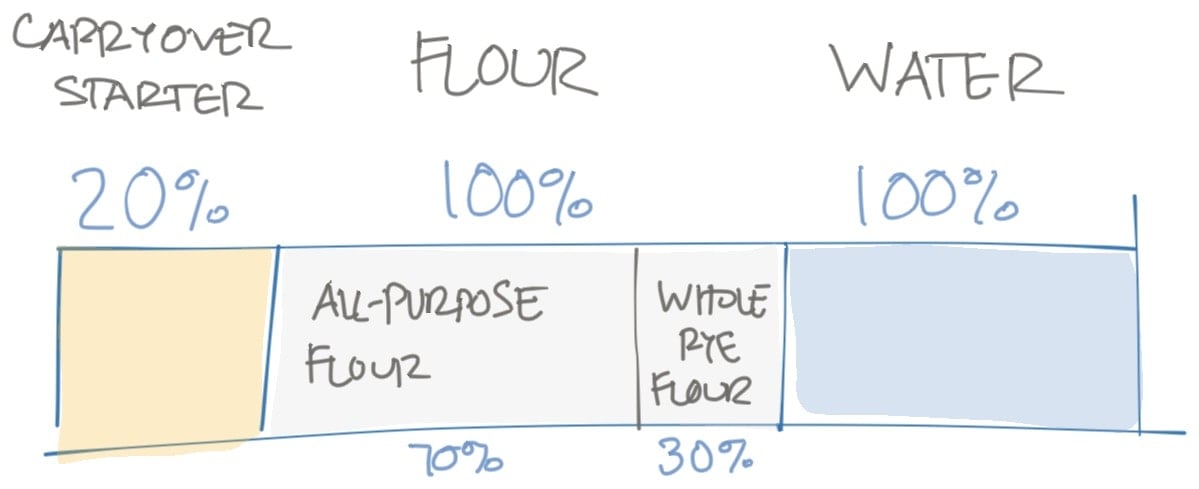
I use baker’s percentages to communicate how I feed my starter in the same way I use them to convey bread formulas. All components of my sourdough starter are relative to the flour weight, which is always at 100%. This allows me to scale up or down my starter as needed—to, say, cover a large levain build for a big bake—while still maintaining the same ratio of ingredients.
Currently, I feed my sourdough starter the following ratio of carryover to flour to water:
| Weight | Ingredient | Baker’s Percentage |
|---|---|---|
| 20g | Ripe sourdough starter carryover | 20% |
| 100g | Flour (70g all-purpose flour, 30g whole rye flour) | 100% |
| 100g | Water | 100% |
I maintain around 220g of starter each day, translating to 20g carryover ripe sourdough starter, 70g all-purpose flour, 30g whole rye flour, and 100g water. I keep my starter in a large 3/4 Liter Weck jar and the jar in my small dough proofer daily.
If kept around 76°F (24°C), this sourdough starter should ripen about every 12 hours.
To give it a feeding, I discard the ripe sourdough starter in the jar down to 20g, add 70g fresh all-purpose flour, 30g whole rye flour, and 100g water. Then, I give it a thorough mix until everything is homogenous. Finally, cover the jar (these are my favorite jars to hold my sourdough starter) with its glass lid—it’s not sealed shut, it just prevents air from getting inside—and leave it for 12 hours.
Adjusting Sourdough Starter Feedings Through the Seasons
Depending on the temperature in my kitchen, I might slightly adjust the amount of ripe sourdough starter I carry over during each feeding. For example, in the extreme heat of the summer, I might drop the amount of carryover starter down to 5 grams to ensure my starter doesn’t ripen too quickly (i.e., discard more starter and use it somewhere else!). More ripe sourdough carryover left in the jar means a faster ripening time. On the other hand, less left in the jar slows ripening.
More ripe sourdough carryover left in the jar means a faster ripening time. On the other hand, less left in the jar slows ripening.
Conversely, in the coldest parts of the winter, I might bump the ripe sourdough starter carryover to 25 grams, even with my dough proofer holding my starter jar and warming to 76°F (24°C).
Can I Save Sourdough Starter Discard?
With each sourdough starter feeding, you’ll be discarding some to avoid it from becoming overly acidic. Most will compost or trash this discard, but you can save it and use it in other recipes! When discarding, I’ll scoop out my ripe sourdough and add it to my sourdough starter discard cache, which is kept in the refrigerator.
Then, I can use this discard later in any delicious sourdough starter discard recipe.
My Sourdough Starter Feeding Schedule
Now that you know what I feed my sourdough starter daily let’s look at its schedule.
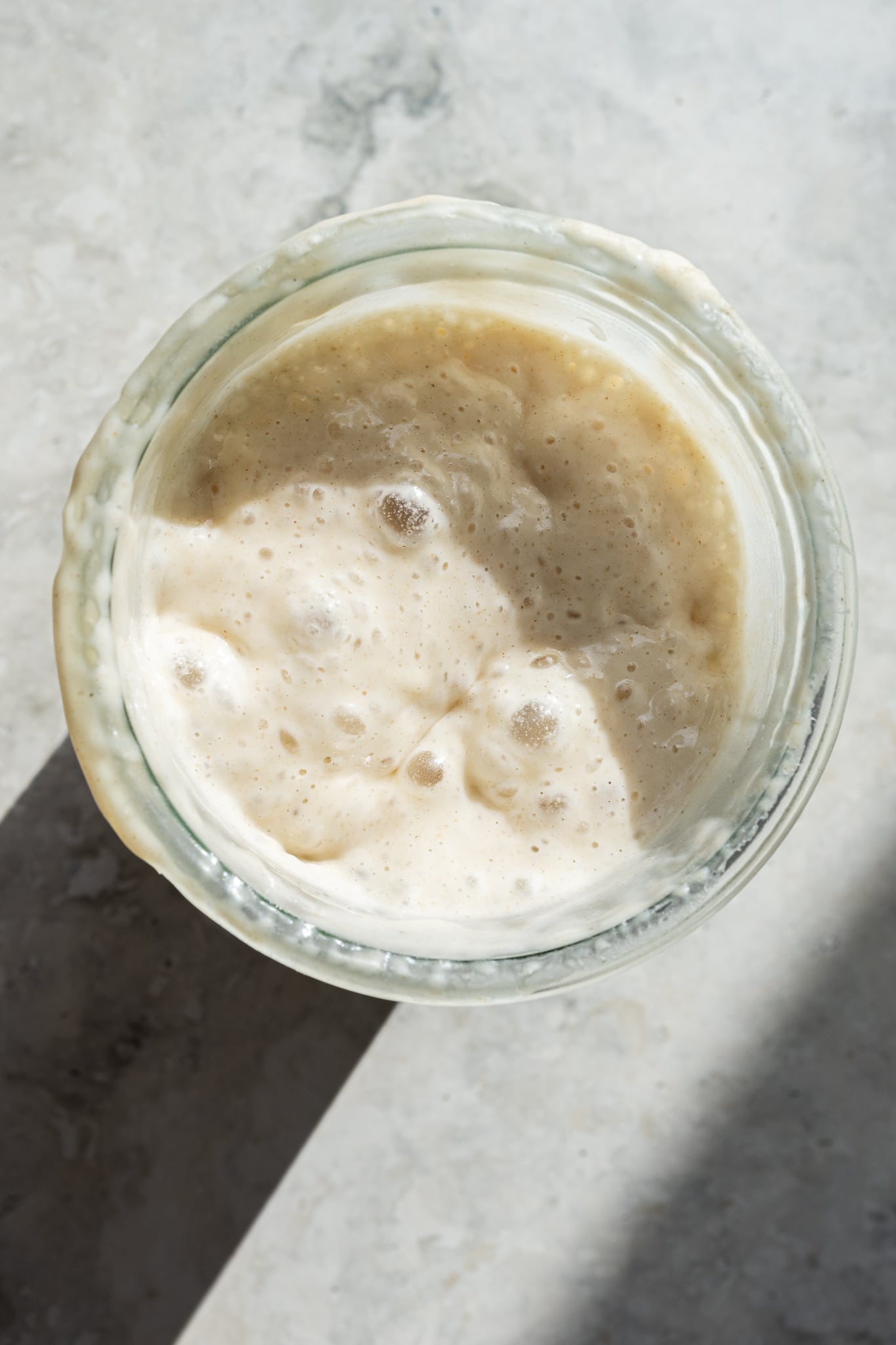
With the above flour, water, and carryover ratios, I need to feed my sourdough starter twice a day if kept at a warm temperature. I like to feed once in the morning at around 9:00 a.m. and once at night at around 9:00 p.m. This isn’t a super strict schedule, sometimes I feed a little earlier and sometimes a little later, but generally, I like to keep to those times.
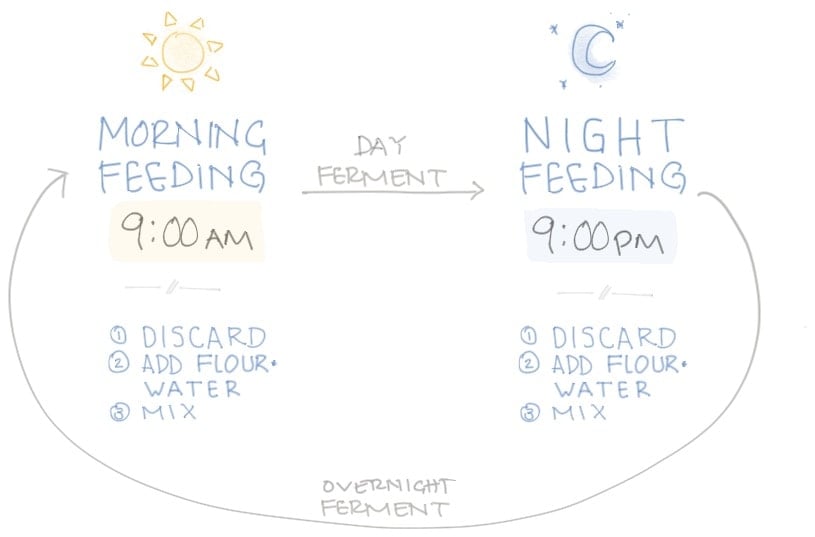
With this schedule, it means I can make the day’s levain early at 9:00 a.m., and in the case of something like my Sunflower & Sesame Sourdough, the levain will ripen and be ready for mixing around 2:00 p.m. In other cases, where I have an overnight levain, I’ll make the overnight preferment at night around 9:00 p.m., and it’s ready for mixing first thing in the morning.
The important thing is always to make a levain or mix a dough when your starter is ripe. This means making the levain with the ripe starter before feeding it.
In my case, I have two opportunities throughout the day to make a levain or mix a dough, at 9:00 a.m. and 9:00 p.m.
Recommended reading: Read on for more detail on my sourdough starter maintenance routine, including the signs I look for when my starter is ready for a feeding.
What’s Next?
How do I feed my sourdough starter? Well, that’s it! I’ll keep this post updated with any changes to my feeding regimen, but if you’re interested in reading more about starters, look at my sourdough starter collection, where I have a collection of maintenance routines, discard recipes, guides, and more.
If you’re having issues with your sourdough starter, check out my roundup of the most commonly asked starter questions I’ve compiled over the last decade: 21 common sourdough starter problems with solutions.
If you want to get baking straight away with your starter, check out these recipes to get a loaf of sourdough bread on your table in no time.
Sourdough Starter FAQs
I have an in-depth sourdough starter FAQ with many questions and answers, but below are a few related to how I feed my sourdough starter.
How long after feeding my starter can I use it?

It depends on how you’ve fed it! If you feed it by carrying over a large percentage of ripe sourdough starter, it will be ready earlier. On the other hand, less carryover means it will take longer to ripen, assuming it’s kept at the same temperature.
Why do you use rye flour in your sourdough starter?
I like using whole-grain rye flour to increase fermentation activity for a lively and strong starter. It’s not mandatory, but a preference of mine: it results in a starter with the performance and flavor characteristics I’m after. If you’re making a levain when baking, this will likely have a larger impact on a single bake (both in terms of flavor and fermentation performance).
Do I have to feed my sourdough starter twice a day?
No. You can scale back to once a day or even scale up to three times a day, whatever works for you and your schedule. I like to feed it at least once a day to keep it strong and ready for baking. If you aren’t baking for a while, you could store your starter.
Do I have to discard my sourdough starter?
It would be best to discard some portion of your starter each time you feed it unless you want to continue to let it grow. Eventually, you need to discard the used food (flour and water) that’s sustained your starter during the last fermentation period. This discard can be used to make man different sourdough discard recipes (like waffles, cookies, brownies, and more).


105 Comments
Hi there, I just bought your book and I see your recommendation is to feed the starter minimum once a week. I want to bake once a week or once every two weeks. Should I still feed my starter every day?
Thank you
Hey Paloma! Thanks for picking up my cookbook. So you can feed it 1x a day if you'd like, but if you're only baking once a week, or less, you can use the refrigerator to keep it cold and with less feedings. I talk about this, here:
https://www.theperfectloaf.com/weekend-baking-schedule/
What’s wrong with my sour dough starter if it has bubbles and I feed it again over the course of 12 hours it doesn’t bubble what am I doing wrong
Hey Rita. Maybe it needs longer to ferment than just 12 hours? Give it more time if you're not seeing the signs I talk about above.
What is the best way to achieve a sour flavor?
Hey Cindy! For a sourer flavor profile in your sourdough bread, try these ideas:
– Use more whole grains in your dough mix (whole wheat and whole rye)
– Use your starter when it’s very ripe (it should have a pungent sour aroma), perhaps let it ferment longer than you might otherwise
– Keep your dough warm, 78°F (25°C) or warmer
– Cold fermentation really helps, you can do a cold bulk fermentation (like I do here in this recipe), and then also do a cold proof (retard)
– Use less levain in your dough. It’s counterintuitive, but using less levain (which many of the recipes at my site actually do!) will allow for more total acidity to build up in the dough
– One or a combination of the above will help get you there! Let me know how it goes.
What's the best way to advertise the sour flavor?
Achieve
Hi Maurizio,
First of all thank you for shoring your knowledge and experience via this amazingly organizad organized website. I followed your book's starter guide but haven't found success even after restarting a couple times.
My assumption is that because I live in Hong Kong and average temperature is around between 25-33 degrees Celsius at home (depending if the A/C is on or not) in recent weeks. Every attemp saw great activity and rise furing the first 1-2 days, but eventually become quite inactive (i.e tiny bubbles and watery). I am using rye as well as a 12.2% protein white flour, cooled boiled tap water to avoid chorine).
I turned to your website for more help after my 3rd attempt, keeping to 25-26 degrees celcius as much as I possible could. However the starter just ended up the same (no streaks indicating rise after after 12 hours, watery, no trapped bubbles, and I believe a healthy sour smell).
Regardless, I went ahead and tried baking the first recipe in the book. The bulk formentation was done in room temperature of 26-27 degrees degres Celcius, shaped, and then went into cold proofing for 18 hours. The dough was very elastic and I saw 1-2 large bubbles near the skin when I was shaping them. Unfortunately, the loafs ended up being very dense despite having a beautiful crackling skin. There was 3-4 large pockets here and there, but the rest of the bread looked more like a sponge.
Before I start another week of restarting the starter and another 3 days of baking… I wanted to see if you have any advice for hotter climates and if there are anything I should be mindful of.
Thanks for your help in advance!
Regards,
Mike
It’s normal to see a burst of activity in the beginning (possibly with lots of bubbles) only to see a decline the day(s) after. Stick with the starter creation process of feeding and discarding and it will eventually take hold. That initial activity is most likely a bacteria we don’t want to stick around in the long run, it will eventually die off when the bacteria/yeast we do want acidifies the culture to the point where other bacteria cannot survive.
If your kitchen is super hot, which is sounds like it gets up there, definitely keep a jar of water in the fridge and use that to feed your mixture each time. I would say try not to go too much above 26-27C.
Keep with it and it will eventually come around!
Thank you!
Ok, lesson learned. Do not add the flour to the starter on the scale. At least for me anyway. I got some on the scale itself and went to brush it off and it accidentally reset my scale to 0 so I have no idea how much I added. I just started on this journey so no idea what to really compare it to on how it looked. I guess I'll see tomorrow morning if it grows at all before I feed it again. Any suggestions (besides don't feed into the starter) on how to know if I ruined it or not?
Yes, if you take some starter, feed it, and use it in a single bake, that's your levain (use it to bake with)! The rest of the starter, discard it down and feed it. Keep it in another jar and that's your starter you'll feed indefinitely.
I started day 1 today and 8 hours in and it has a few bubble but has not risen….it looks like it has a bit of liquid on top but just barely. And I live in Africa so it’s warm
Sounds fine to me Celine. Keep with the process!
Where do you purchase your RYE flour? I had a big problem sourcing it.
Hey, Liz! You can usually find rye at your supermarket, otherwise, order from a local mill in your area. Barton springs, Central Milling, Farmer Ground, and many others!
Hi hello 🙂
Maybe you can explain why my sourdough is finishing his rise and start to fall after only 8 hours with this ratio?
I feed it 50/50 ww and w.rye with 100% water..
1/5/5 and the temperature in my kitchen is 24/25 degrees.. so i do not understand why it doesn’t last 12 hours..
Thanks 🙂
You could try leaving less starter in the jar at each feeding to slow things down a bit!
Thank you for all of the great information, I love this website!
I have a question about trying to feed my starter only once a day. Should I use the same ratio you suggest? 20% / 100% / 100% or should I use a higher ratio?
I’m in San Diego so I probably have similar dry/hot climate as you, if that helps
Appreciate that, thank you Seth. If you want to feed once a day I'd go down to 10% carryover starter.
If I want to grow the starter I was given so I have a larger amount, can I just feed and then at the next feeding discard just a bit and continue until I have and amount I want? Trying to grow to dehydrate some in case I kill it
Yes, exactly, Sheila!
H Maurizio, thank your all the helpful information on this website. Sourdough can be confusing for a new baker. My starter, which I’ve had for about a year now) came from a friend who is also new to sourdough baking, so she hasn’t been knowledgeable herself in managing the starter. I have been reading through this starter page to better understand the directions I received with my sourdough starter. The directions I received call for feeding all of my starter at each feeding (no discard), adding 1 cup of flour and 1/2 cup of water. I use or discard enough after feeding to make sure I have about the same amount of starter I started with going back into the fridge, but this is just eyeballiing it. Given that, I’m kind of assuming my feeding rations are about 2:2:1 starter/flour/water. I’ve never seen that ratio referred to in my efforts to learn more about managing my starter. So far the things I am baking are turning our pretty well for beginner, I think. My questions for you are: assuming I start discarding before feeding and using more weights and accuracy in my weekly feeding ritual (I keep mine in the fridge), is a 2:2:1 feeding ratio OK for the long run? If not, can I just start using a different ratio? Thanks you so much
You're very welcome Kathy. Sorry for the delay. You can use that ratio, but it will ripen very fast, like 3-4 hours, depending on the temperature in your kitchen. I recommend leaving less starter in the jar at each feeding so it doesn't become overly acidic over the course of 12 hours.
I’m using an organic Dark Rye flour. Hope thats ok. I love a strong sourdough flavor. Also, do I cover my starter at any point of the fermentation process? An old recipe called for cheesecloth over the jar. I have Weck jars with a glass cover, rubber seal ring and 2 clamps for the lid.
Yes, dark rye is exactly what you want to use. I keep my starter covered always. With the weck jars, I just place the lid on top without the gasket or clamps.
Hi Syracuse. I’m new to sour dough, but I started to put my jar of starter in the microwave with the door open and the light works to get my starter ready to use after a few hours out of the frig. I don’t make bread every week because it’s just me. This works well.
Hi Maurizio!
How often do you change the starter jar? Currently I am using a new jar everytime when I refresh it, but can I leave the carryover in the jar and continue feeding in the same jar? 😊
I usually change it once every two weeks or so. You can use the same jar, yes, just change it out when it gets a little too dirty.
Hi Maurizio
I am on day 10 with my starter. For the 1st 6 days I used 50g rye and 50g 00 flour. On day 7 switched to 30 g rye and 70g 00. Then day 8 used 100 g 00 flour to 100 g water. The starter seems ok, but recently read 00 flour won’t perform that well. My goal was to make sourdough pizza dough for my Ooni oven. After looking over your site, I want to do much more. Should I switch off the 00 flour, or maybe add a little bit of Rye flour? Just not sure…
Thanks
I prefer using a bit of rye flour in my starter, but it’s not 100% necessary. You won’t see the same vigorous fermentation with only white flour, but it’s okay, you just have to adjust what to expect with it fed that way!
Hi Maurizio, thanks for all the great information, tips and recipes. I’ve been feeding my starter twice a day at the 7 day+ ratios, at 29C for a few days now. I worry that I’m throwing out so much of the starter each time to leave only 20g behind. It doesn’t smell particularly sour, like it did during days 1-7. Is that a sign I’m doing something wrong? It rises and falls predictably and shows bubbles etc. It rises to about half the Weck jar.
Thanks!
Hey, Matt! Sounds like things are just fine from here. If you wanted to, you could try leaving more in the jar to see if it’s more ripe when you go to feed it. Tweaking that last bit is going to come down to your starter a little, too, it might need more time (or more carryover) to ripen more, or vice versa.
Hey there! yes, you can absolutely use your fridge to keep it while you’re not baking. Just take it out and feed it at least 2 times (I like to do over 2 days) to ramp it back up before using it. If keeping in the fridge, I like to feed it at least once ever two weeks. Hope that helps!
I’m following the creation of starter to the letter. Day two was fabulous. (I have the book). Now at day 6 NOTHING. No sour taste, no bubbles. Just feels like I’ve wasted a week and a ton of flour trying to make this work. Using a different recipe I’ve been trying to make good sourdough for 18 months and my loaves are small, dense and hardly rise at all. I thought following your book would help as you are at over 5000 feet altitude. I’m just north of Albuquerque in the Jemez Mountains. I am using dark rye flour and good brand all purpose flour, keep the jar in a warm place. Measure to the gram exactly. I Follow every step to the letter. The starter is still quite stiff and almost no action. Not sure what I’m doing wrong but I’m about to throw in the towel on Sourdough and I don’t want to! What can be going wrong?
ADDING: I cranked up the heat in the house and now it’s 78 in here. Too hot for me but the Sourdough loves it. I’m back in action.
Glad to hear it’s working out for you now, Patty! Yes, it really does need to be warm… Instead of heating the house, warm the mixing water! Then, keep your container insulated the best you can (wrapping it in a thick towel helps). Hope you’re on track now!
I have doubts in some ratios that I found in some books, websites, etc. apart from the fermentation time and the amount of yeast generated, I can’t find the explanation of the ratios with the more or less sour taste..
1:2:2, 1:1:2, 1:2:3, 1:3:3 to 1:4:4 or higher.
There are so many ways to feed a starter! But ratios are only one part of the puzzle, too, you also have to consider temperature and flour. The more whole grains, the warmer the temp, the more starter leftover—all of these things will speed up fermentation.
I dont follow the daily feed with my starter , i only feed it once a week or every 2nd week when i decide to bake , i just keep a tablespoon of it in a small jar in the fridge and feed it on the day when i start working on the loaf…it works out for me.
Yes, that works very well, Hakan!
Thank you for this article. I was given a 25 g. sourdough starter. But after feeding it 50 g. of water and 50 g. of flour, I didn’t use it right away and ended up getting a new jar, one of discard and another of 25 g. of sourdough starter and 50g. of water and 50 g. of flour. (Eventually, ended up with 4 jars.) 3 of discard and 1 that was 125g. of starter. I left all the jars in the refrigerator for 1 month. I never took it out of the fridge to revive it. Can it still be revived? Would I find out the weight of all the contents in the 4 jars? But how much water and flour would i add to that amount? Thank you!
Yes, I’d try to revive it! Then, I’d feed it according to my starter maintenance guide.
Hi, Maurizio! First, let me say that I find your website to be a great resource and I really appreciate how its ‘evolved’ over the past few years. I read your guides, and then go back to re-read them when I’m encountering a problem.
I’ve made roughly 300 sourdough loaves since the start of 2020. I can produce some pretty good bread (crumb and taste) but have been having more difficulty with consistent spring. I’ve eliminated dough handling and hydration as the issue, and so I’ve been re-re-reading your guides on starter maintenance and using the starter. Sometimes you have to bake for awhile before you fully absorb the guides.
I get the general gist….get your starter on a regular feeding schedule, and only use a starter or a levain when they’re ripe. On this latter point I’m a little confused at an ‘apparent’ inconsistency in your guides, as explained below.
In ‘How Do I Feed My Sourdough Starter?’ you say refresh (or use to make a levain) your starter every 12 hours. And that you could use your starter to make a levain or mix a dough at 9:00 a.m. or 12 hours later at 9:00 p.m. In ‘Sourdough Starter Maintenance Routine’ you describe a schedule that starts later (10:00 a.m.) and which is ripe 10 hours later (ready to make a levain or mix a dough). You do also say you would still feel comfortable using it thus after 12 hours (past ripe)
1. I’m seeking clarification as follows: when you use a 1:5:5 starter maintenance ratio (as you do) is it ‘ripe’/do I refresh it (or use it) after 10 hours or 12? Or does it matter as long as it’s in that time range?
2. In ‘How Do I Feed My Sourdough Starter?’ you say: “With this schedule, it means I can make the day’s levain early at 9:00 a.m., and in the case of something like my Sunflower & Sesame sourdough, the levain will ripen and be ready for mixing around 2:00 p.m.” While implicit throughout your guides, it would have helped me (and perhaps other readers) if you had added “It’s ready in 5 hours (rather than 10 or 12) BECAUSE I change the ratio from 1:5:5 to 1:2:2.” Agree?
Thank you, I appreciate the kind words! And you’re absolutely right, I feel like with my baking my skills were “unlocked” through time, as I gained more experience and was ready to learn the lessons.
Answers:
1. Use it when it’s ripe, whether that’s 10 or 12 hrs for you. For me, it’s usually 12 hours because that’s what I stick to here most of the year. The key is to just use it when it shows the signs for ripeness.
2 Agreed. Changing the ratios (leaving more ripe starter in the jar or adding more ripe starter) will reduce the time needed to ripen.
Will try to go through and clarify all of this!
Hello Maurizio,
why do you prefer an all purpose flour instead of a strong bread flour?
Best
Riccardo
I find it has a less gummy texture!
I’m a little confused between the ratios on your maintenance and the sourdough starter guide. On this page you use 20g mature starter, 70g AP flour and 30g rye flour, 100g H2O. However, on the sourdough starter page you recommend 50g carryover, 50g AP and 50g rye…does this ratio matter much?
I’m also struggling to get my starter to rise and fall. I’ve been keeping it in my microwave with the underside light on (keeps the inside of the microwave around 78-80F. Should I continue with the 50g carryover, 50g AP, 50g rye and 100g water; or go back to the 75 carryover and 115g water?
Hey, Josh! Sorry for the delay. The ratios do matter quite a bit. I mention in the other post that once your starter is rising and falling predictably each day, you can switch to ratios that work better for you, your starter, and your climate (how warm/ cold it is, mostly). If you’re keeping your stater that warm (78F), you can go down to 20g ripe starter carryover and refresh it every 12 hours or so. That should work!
Is King Arthur all purpose flour okay? Or does it have too much protein content?
Hello! I have found some great tips reading your blog! My issue seems to be knowing when my starter is ripe? It is doubling in size and getting nice and bubbly, but my dough never seems to rise enough so the bread is always semi flat and dense! When I try the float test, it will sometimes float, then sink, or bits will float and bits will sink, or it just plain sinks. It seems like I’m missing optimal ripeness and the starter is starting to fall before I get to it. But from all my reading, I thought there were a couple of hours when it would be usable? I have started a new batch, feeding with your 20g carry over white/rye recipe, it’s been about 10 hours and the starter is double but not bubbly yet, so I am just waiting it out for another couple of hours. If/when it is bubbly is the right time to use it? How long will it be ripe? I would like to try the easy no knead recipe that uses the starter without making a levain first. Thank you so much for all your help, and being so detailed for us!
Yes, your starter should have a few hours on either side of “perfectly ripe” to use it, it’s pretty flexible! In my experience, it’s also better to use your starter when it’s over ripe, than under. You want to look for signs similar to what I show in this post: some bubbles, some rise, a loosening in consistency from when you first refreshed it (it should loosen the longer it ferments), and a mild sour aroma. If you go with 20g carryover and it’s kept around 76F or so, it should be ready to use in 12 hours!
Hope this helps and sorry for the late reply!
Hello, loved reading your post. Im new to all this and im having a hard time getting my mother starter to rise…I live in CO so the elevations are high so im thinking thats NOT helping…my mothers have great activity but it only rises about and 1or 2. if you know how to help please let me know or send me a link that could help me? Thank you!!!!
Hey, Morgan! Your altitude is likely not causing issue (I’m here in ABQ, about 5280 ft up), it’s likely just your flour and/or hydration of your starter. If your starter is very wet (a consistency like pancake batter) it may not rise as high. Also, depending on your flour choice for your stater, this might also cause issues with how much it rises.
BUT! That doesn’t matter, in my experience. As long as your seeing strong signs of fermentation consistently each day, your starter is likely just fine.
Maurizio,
I’m a new sourdough baker, and this site is AWESOME. Thanks.
I need some advice on one specific topic relating to starter. My starter has becpome very consistent — I’m feeding it about every 12 hours, at a 1:3:3. ratio and it’s more than doubling between feedings. However, both times I’ve baked bread with it, it didn’t seem active enough — the bread didn’t rise enough and was too dense.
So my question is — should I be doing something different with the feedings on the day that I want to bake?
Many thanks
You’re very welcome! Sorry for the delay. As long as you’re using your starter (or levain) when it’s ripe, you should be good to go. You could even wait a little longer if you’re unsure–I find it’s better to use a starter when over-ripe than under. Also, be aware of your starter and final dough temps! You want to keep that dough nice and warm to encourage strong fermentation activity. I hope I answered your Q 🙂
Hi, if i want to discard less could i keep the same ratio for a while but with less quantity, instead of 20/100/100 could i do 10/50/50 and have the same results?:)
Check out my guide to maintaining a (much) smaller starter 🙂
Hi Maurizio!!
I love all your guides and extra bits of info in everything, i’ve learnt so much about basically everything!
In regards to this post, i would like to ask a few more questions about the stiff starter maintenance!
– What ratios do you refresh it at when you kept the stiff starter at RT?
i’m currently trying to switch over to a stiff starter so that i don’t have to feed it as often/as much (i used to do 1:5:5, twice a day)
– and now i’m doing 1:2:4 for 12 hr feedings and worried i may be feeding a tad too much but also wondering if this can go for 24hrs?
– Should i reduce the ratio to 1:1:2 and will this last 24 hrs? (currently testing this!)
– My starter is kept really tiny (1-2g seed starter when feeding) — will this impact anything?
i’m sorry if the questions are a bit hectic, i just have so many questions and cannot find much information to use!
I hope you’ll see this soon and reply! Have a lovely day!
Isa
Hey, Isa! Happy to have helped. I used to keep a stiff starter, and when I did, it was something like 20% carryover at each feeding with 55% water and 100% flour. That worked well for me with a feeding twice a day, but I probably could have pushed it to 1x a day if not overly warm. Keep reducing the seed % as necessary so your starter isn’t super broken down when you go to feed it next—a stiff starter is pretty resilient and can be pushed pretty far!
It’s ok to keep a small starter, but if it’s too small, it’s hard to see the signs for when it needs a refreshment. I have a guide to keeping a small starter, but it’s geared toward a liquid variant. It still might be worthwhile to read through!
Hope that helps. It sounds like you’re on the right track doing what youre doing as long as your starter is strong and your bread coming out well!
Maurizio. I bake once a week for my wife and myself, and have for over a year. We are weight controllers and don’t eat a lot of carbs. I use a 1:1:1 ratio, and maybe 25% of my flour is dark rye. I’ll mix it up at night after the jar has been in the fridge for a week and has been discarded except for 60 grams. I then return it to the fridge and the next morning early (6:00 or 7:00), I remove from the fridge and place on a heated floor in the bathroom with a towel over it The floor is around 80℉. I mix my 500gm of flour (13.3% protein) which includes small bit of rye at 10:00 or later and 335gm of R.O. water at 115℉, using a wet butter knife. Autolyse for 2+ hours. By noon, my starter is really active and bubbly, and I mix in 60-80gm about 2 to 2.5 hours after I start the autolyse. The results are fine, but note that there was only the one feed the night before, then use the next day. After the loaf is made, I redo the 1:1:1 feed, and put it directly in the fridge for next week. Should I be feeding several times before using each week? It seems really active and strong the way I’m doing it, and the boules rise quite high, light and airy.
Hey, Jack! It sounds like you’re got a good rhythm going there. As long as your bread is to your liking, it’s all good! Whatever works for you, your schedule, and your starter.
For me, I like to do at least 2 refreshments coming out of the fridge, but it’s not necessary in every case. This would mean I have a day of refreshments before I mix up a levain on the second day. For my starter it seems to work the best.
I’ll give it a shot next week and see if I can find a difference. Thanks for the reply.
Hi Maurizio. Ever since the start of the pandemic, all kinds of flour have been in short supply here in Hongkong. To make my supplies last longer I cut my starter down to 25g flour, 25g water and 5-10g starter depending on the weather. Now in the summer (85F and up) I find that even 5g of starter is to much for me to go twelve hours between feedings. Just how low can I cut the starter quantity down to and still have a viable starter? Thanks for a entertaining and information blog.
Hey, Jay! You can cut it very, very low. If it’s really warm here sometimes I’ll just leave a super small dab in the bottom of the jar, and if my jar has a lot of starter smeared on the side, sometimes even that’s enough! You can always opt to cool the water for your feedings as well.
Hi Maurizio! Piggy backing on this question to clarify: when you say “cut the carryover starter very very low”, is this in the same feeding ratios still (i.e., 2g carryover start: 10g flour: 10g starter for a 1:5:5 ratio) OR would you be keeping the original weights and reducing the ratio (i.e., 2g carryover starter: 25g flour : 25g water for a 1:12.5:12.5 ratio)? Thank you!
I have much better luck with 1:1:1, as 1:5:5 usually takes forever and ever to double. I live in SF and my kitchen is pretty cold (usually around 60 degrees). Is it that my starter isn’t active enough?
What you’re doing sounds right for a cooler environment. It’s usually very warm here so I have to drop that carryover quite a bit (and even more in the summer)!
Hi: Haven’t visited in a while but very glad to see this blog/site is vibrant!
A couple of notes on sourdough cultures in general — meant to calm the minds of beginners. Wild cultures (which these are) are by nature pretty resilient. This means they can be ‘neglected’ and still bounce back in short order. You see this in some traditional baking cultures’ methods, for example I think there’s a Scandinavian tradition of having a stirring stick that starts the batch of bread. They were counting only on what yeasts remained on that stick from the previous day or whatever, so you can see how little is really needed. No doubt that stick just sat in the corner of the kitchen until it was needed again. So, relax and enjoy.
On the topic of feeding cadence, the natural cycle of these kinds of yeasts is closer to 6-8 hours (sometimes less, and depends also on environmental conditions), so if you really want to get a culture up and running, discarding/feeding at that schedule for a day or two will work wonders. It helps to be consistent, whatever you do, as the culture will naturally adjust to it. By that I mean the mix of yeasts and bacteria will reach an equilibrium that works well with the food and feeding cycle, so try not to confuse it.
Much of the understanding of yeasts comes from research into alcoholic fermentation, and while those strains are not baking strains they are very closely related. That process has been really carefully studied for more than a century. For some reason, brewers are much more sciency-engineering nerds than are bakers, so the accumulated research is massive.
Finally, for those who wonder what kind of ‘abuse’ a culture can put up with, here’s my method (I’ve had this culture going for more than 15 years, and I’ve been in wine/brewing going on 30 years):
I store it in a pint glass, in the refrigerator, uncovered.
I never have cleaned this glass (no fooling!).
After I use it in baking, I remove everything except about 1/2″ at the bottom. The sides generally have a caked on mess.
I take it out a couple of days before I bake, which is generally every other week.
By the time I take it out of the fridge, there is a hard puck at the bottom.
I add about a tablespoon or so of water (no measuring) and let it sit overnight to loosen the puck
I then break up and dissolve the puck, and add in as much flour as needed to make a not thick paste. No measuring involved, and if I’m feeling guilty about how I treated my starter, I’ll use rye exclusively, but generally I feel ok so it is just white or whole wheat (whichever is on hand).
Regardless of how it looks 12 hours later, I’ll remove at least half and add water/flour. This is usually in the evening before bed.
The next morning there is almost always an active fermentation that has risen and fallen over the night.
I will begin an 8 hour cycle of feeding, and generally mix up dough the next morning. If my baking plans don’t work out, I may revert to a 12 hour cycle. Or not.
That’s it! It’s a really robust flora, really. Be sure to use good flour, and clean un-chlorinated etc water, and you should be good. Don’t stress, either — other living beings pick up on that!
Wonderful advice there, David! I agree with you, our starters are incredibly resilient. When I first started baking sourdough (around 10 yrs ago) I treated my starter very poorly, and yet, it never failed me a single time. Sure, the bread needed improvement (as did my understanding of the process), but it was undoubtably delicious bread that satisfied all at the dinner table. Since then I’ve become more stringent about my process, but also very comfortable with everything knowing my starter can survive just about anything I throw at it and still help me make wonderful bread.
I have to say, your process is definitely more laid back than mine, but the “bones” of it are still there. The fridge works, I just like to (as you) wake it up a bit before baking with.
I’ve thought about going into brewing for a long time but have held back, I know my scientific side would probably get over engaged there and I’d probably end up with another all-consuming craft in my kitchen 🙂
Thanks again and happy baking (and brewing)!
On the topic of brewing (probably home brewing for most people) it’s great but has quite a few drawbacks compared to baking, so consider carefully…
The end result is alcoholic, and generally in quantities of 5gal+.
The process involves pretty extreme (for a home) heating and cooling, particularly the chill to fermentation temperature.
It is an ungodly mess, and results in significant by products.
If you set up a permanent brewery, in the garage, for example, it won’t be long before you start to eat away the concrete.
Cleanliness is vital for most beer types, so all this sourdough culture sensibility must be left at the door, or you’re in for many a spoiled batch.
Finally, the end results are always weeks away from all the work….
Speaking as a diplom-braumeister, baking is way more fun as something to do at home. Near instant pleasure, everyday, if you so choose!
Just my 2¢!
Well received, David, and your comments echo my friends who are into brewing. Lots of prep, lots of waiting… The upside for me is I leave the brewing to them, I bring the bread, and we end up meeting up once a month or so when their next batch is ready 🙂
Oh, and sometimes I get their spent grains, which I bake into bread!
Hello Maurizio! Sourdough titan! 🙂 When you refer to your starter as “ripe,” is there a certain metric of how much its risen? I always see 2-3x as the benchmark. However, could this be exaggerated by the shape of the container? Or perhaps just easier to gauge (a tall, smaller diameter jar vs a shorter, wider diameter vessel)?
I typically shoot for around 2x rise, but sometimes my starter will go 2.5-3x, and since I always feed it the same, I wonder what makes the difference. For instance, let’s say I store my starter in the fridge for a week, post-feeding. When I take it out, I let it sit overnight. When I check it in the morning, it’ll have risen like 3x, but the starter itself will have a much thinner consistency than, say, the consistency after 12h of normal feeding. However, with that normal 12h schedule, I get like a 2-2.5x rise. I typically feed mine 1:3 ratio, with the “3” being 1/3 dark rye and 2/3 AP.
Anyway, just curious what your benchmark is for ripeness. Is it sight, smell, height, a combination, etc. ?
Hey, Adam! I don’t like to go by rise height alone because it really can be affected by the flour used (variety and how much whole grains), the hydration, the jar… Many factors there. For me, a ripe starter has a distinct sour aroma, a loosening in consistency, many bubbles, some rise, and perhaps a little fall as well. There’s no single moment that’s perfect in my experience, but rather, it’s a window of ripeness where using it later in the window might speed up fermentation in the coming bake (due to increased populations of bacteria and yeast), and using it earlier might mean a reducing in speed—all things being equal.
I also take into account how much carryover I have, the temperature, and my experience with my stater.
All of this is to say, yes, it’s more of a wholistic determination rather than going with a single organoleptic metric.
Hope that helps!