Fall is coming. Actually, it already arrived at the doorstep and asked to come inside. It doesn’t quite feel like it yet, but I see the signs: long and brooding shadows, squash and apples at the market, trees changing from dark green to slightly orange and red, and of course that innate desire to make food with a hearty slant to it. Making food like whole wheat sourdough bread, butternut squash risotto, soup, whole-wheat pasta, and an apple pie or pear tart. I love my 100% whole wheat sourdough recipe, but given the transitory nature of fall, something in-between was calling, something not quite all of one, but a mix of several. Besides, there is plenty of room on the spectrum between a pure white and a pure whole wheat bread, and this 50% freshly milled whole wheat sourdough fits the bill.
Whole grains always bring an extra level of flavor and heartiness to food, and bread is no exception. Whole grain bread begs for more savory food, and it’s a perfect match for soup, minestrone being my all-time favorite. I still remember my grandma (nonna to us) cooking minestrone for my brother and me when we were young. Our kitchen may not have the “perfect” set of ingredients on hand, but she was an incredibly gifted cook, one of those cooks who can make pretty much anything from a pantry of scattered bits and pieces. She would always make minestrone when the weather started to turn cool, and in preparation, I remember her saving up all the “heels” (the crunchy ends) of the baguettes and batards we would get each week as accompaniment. The perfect crunchy part of a loaf to dip. Back then we didn’t have much whole wheat bread, but I know she would have picked that above all else.
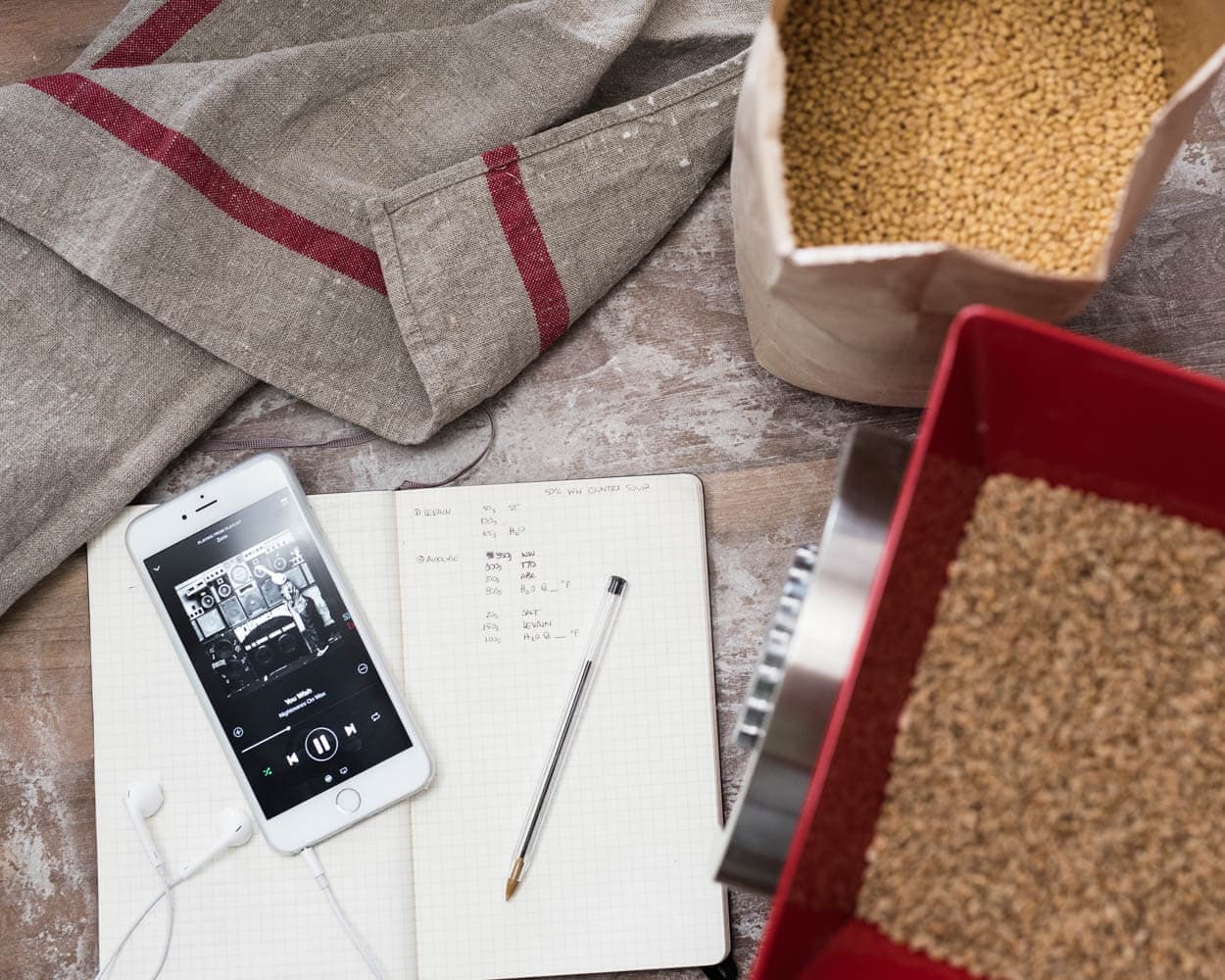
In my last entry, I dug deep into my new flour mill and my experience with freshly milled flour. For this bake, I decided to go at it with 50% fresh milled flour. I know many are not able to get hours-old fresh milled flour, and that’s ok, this recipe will work out smashingly with aged whole wheat.
Lately, I’ve been gobbling up every single book by Alice Waters. It started with a recommendation for her, The Art of Simple Food (which I wholeheartedly recommend for beginners and professional cooks alike), a gateway to her approach to simple yet delicious food.
When I switched to whole grains, the greatest revelation was a world of flavor I had been stubbornly resisting for years.
Alice Waters
These books have me completely transfixed. While reading another of her books, My Pantry, I stumbled on the quote at right just as I was working on what to bake next, and it fit perfectly. She hails the use of whole grains as a revelation and talks about how whole grain bread brings with it this connotation of a dense, dry, and heavy brick.
I tried to find that balance between flavor and loft. The whole grains in this recipe bring just the right amount of that gratifying hearty flavor without compromising loaf volume.
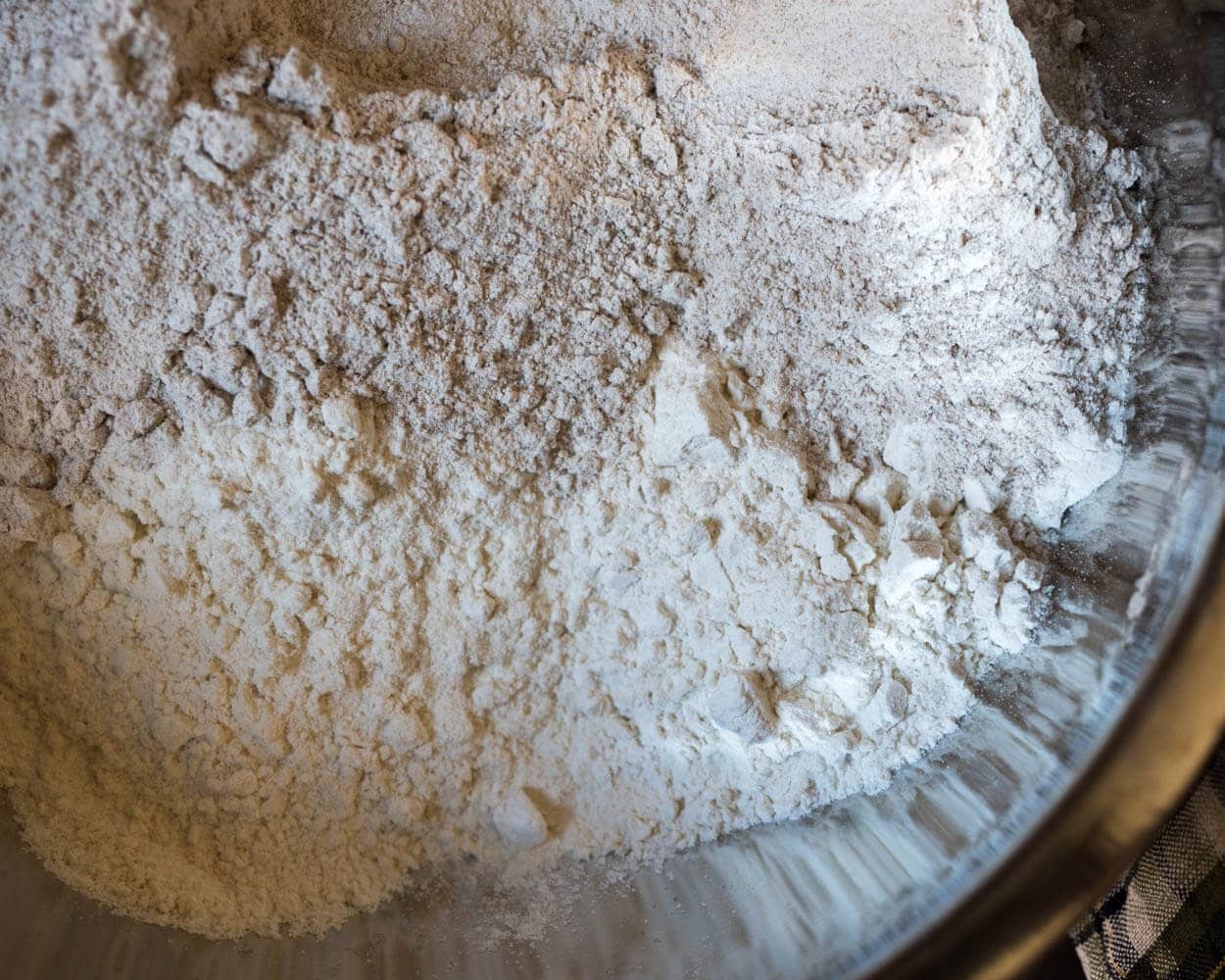
The flour selected for this entry was 50% fresh milled Great River Organic Whole Wheat and 50% Central Milling Organic Artisan Baker’s Craft (“ABC,” a medium-protein white flour). I’m still working my way through the two sacks of Great River raw wheat berries I purchased a while back, but I’ve found the wheat to have an excellent flavor regardless.
The choice to use Central Milling ABC was easy: I wanted an organic low-protein complement to the whole wheat flour with a delicate flavor that would ride backseat to the show’s real star.
After you mill your own flour, read my guide on storing flour to keep it fresh for longer.
50% Fresh Milled Whole Wheat Sourdough Formula
Vitals
Total Dough Weight
1,800 grams
Pre-fermented Flour
5.0%
Hydration
84.0%
Yield
2 x 900g loaves
Levain Build
Note that this bread has a low pre-fermented flour percentage and may require you to increase your bulk and or proof times to ensure the dough is fully proofed.
Fresh Milled Organic Great River Hard Red Spring Whole Wheat
100%
31g
Water
65%
Dough Formula
Note that the baker’s percentages listed below are with respect to the final dough ingredients and do not take into account the levain.
The target final dough temperature (FDT) is 75°F (23°C). I target this temperature to help slow the fermentation down just a little bit (my typical FDT is 78°F/25°C) so my bulk finishes in about 4 hours. See my post on the importance of dough temperature for more information.
Weight
Ingredient
Baker’s Percentage
484g
Central Milling Organic Artisan Baker’s Craft, Malted (~11.5% protein)
52.6%
435g
Fresh Milled Organic Great River Hard Red Spring Whole Wheat
47.4%
781g
Water
85.0%
19g
Fine sea salt
2.1%
104g
Ripe, stiff levain
11.3%
Method
1. Levain – 8:00 a.m.
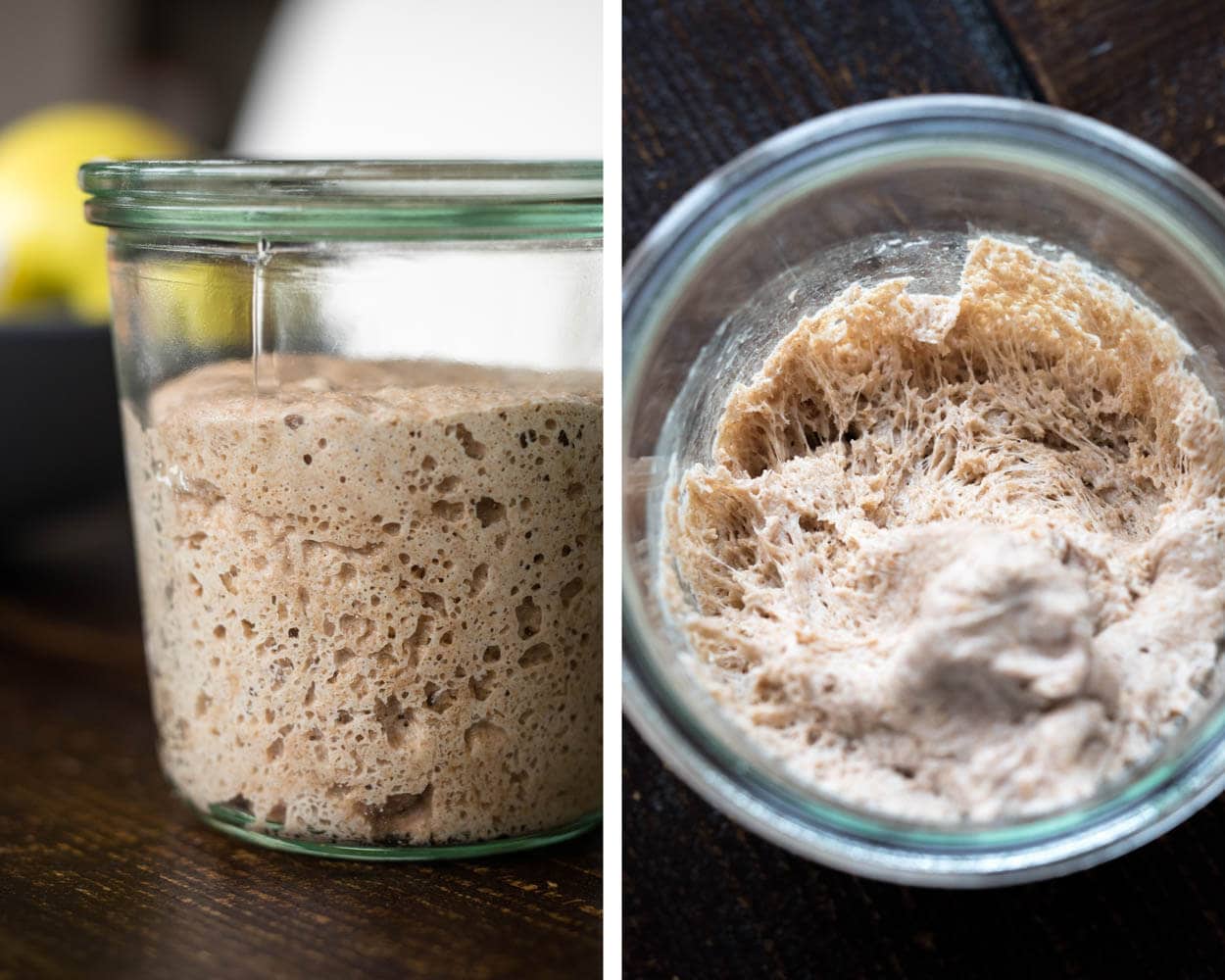
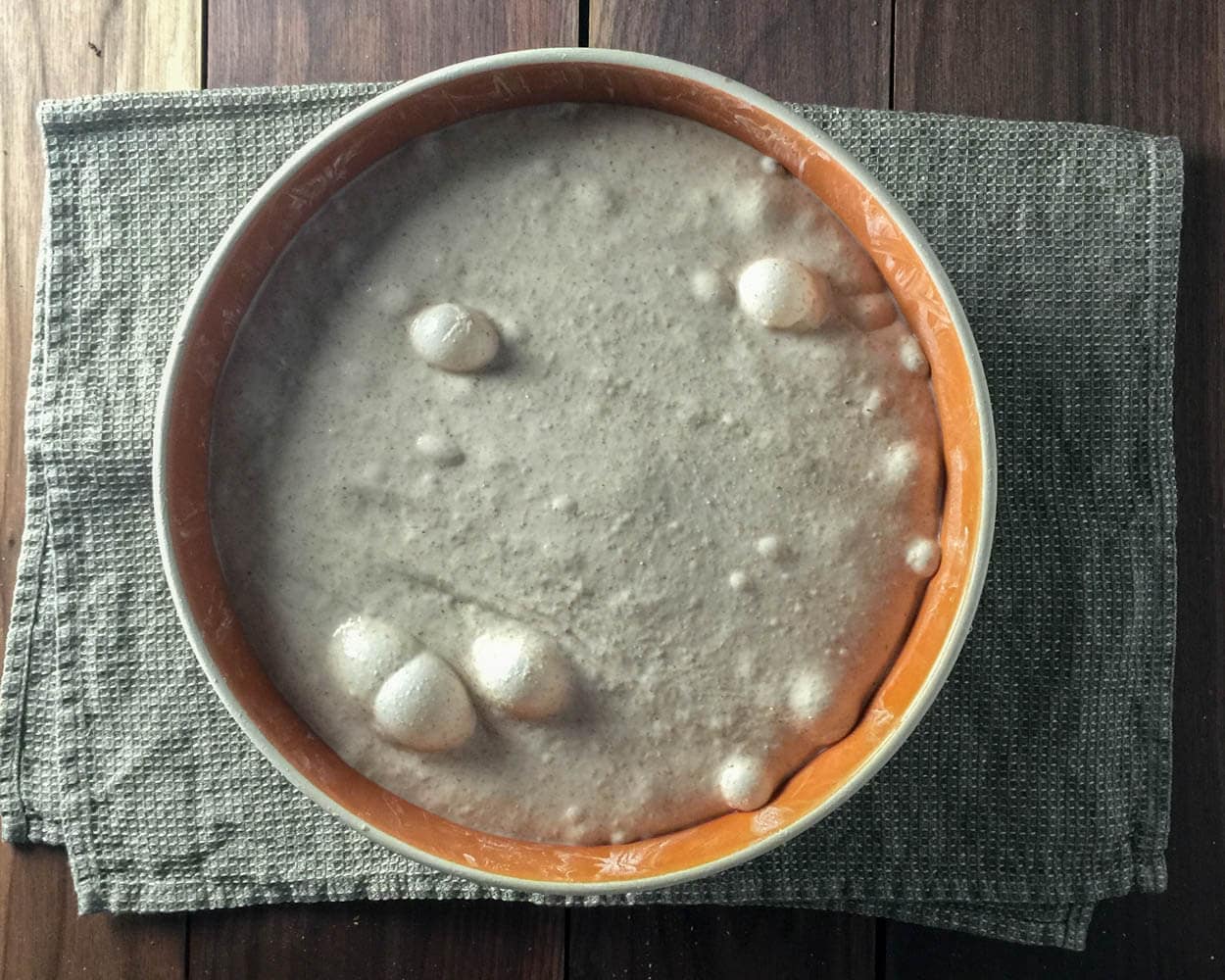
Use your ripe sourdough starter to create the stiff levain in the morning after milling fresh flour. Store somewhere warm around 78°F (25°C).
2. Autolyse – 1:30 p.m.
For the autolyse, mix the flour and water (reserve 50g water for the mix, later) very well in a bowl and cover. Ensure all dry flour is hydrated. Store near levain.
3. Mix – 3:00 p.m.
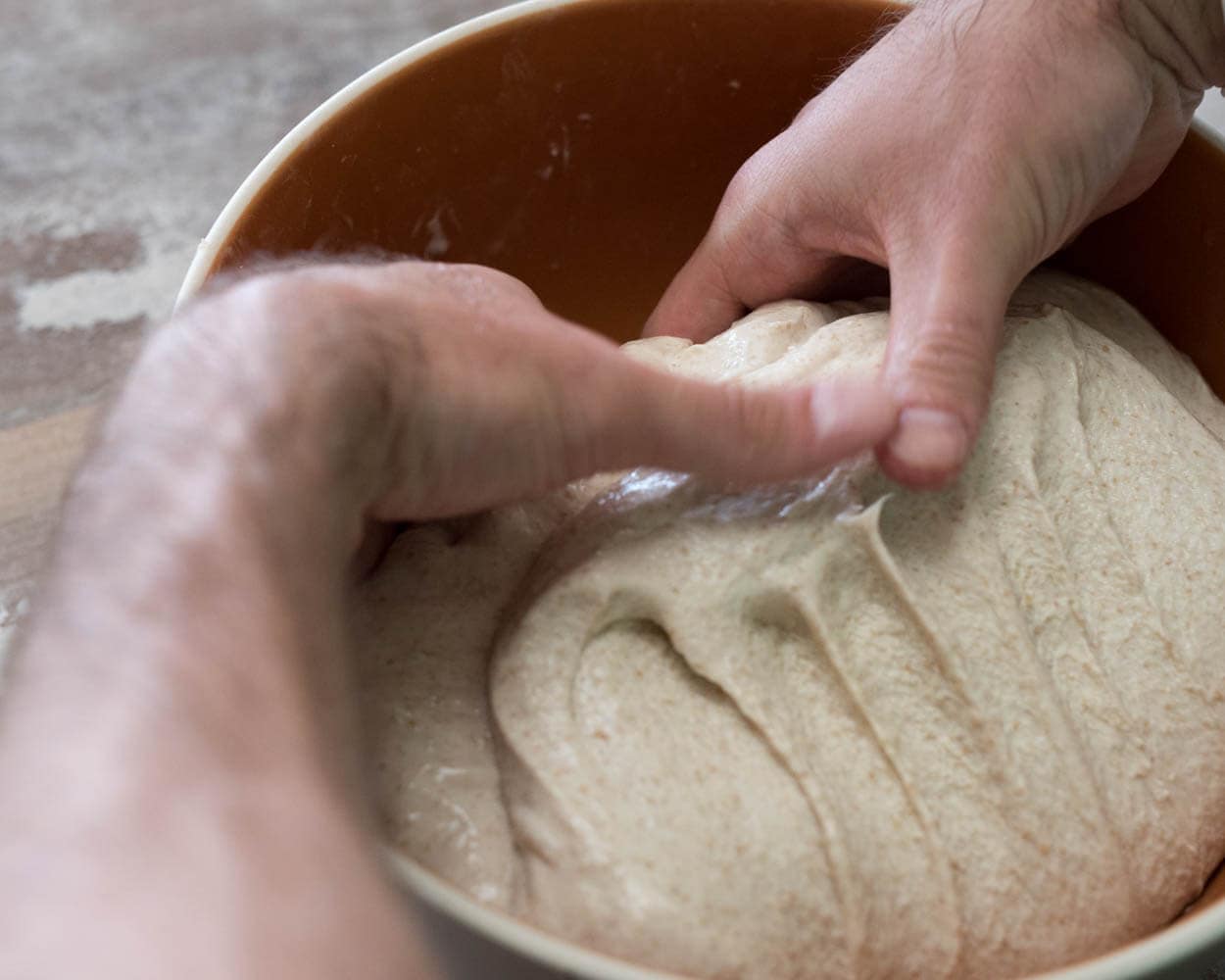
Using about 30g of the reserved water, incorporate levain build into autolyse and hand-mix thoroughly. Slap and fold for 5 minutes until dough holds shape well. Place the dough back into the bowl and let rest for about 4 minutes. Use remaining water, if necessary/desired, to incorporate salt into the mixture. The dough will initially break apart and then come back together. Slap and fold an additional 3 to 4 minutes until the dough starts to catch air and strength is built enough to keep dough relatively in shape on the counter. Transfer dough to a tub or thick-walled bowl for bulk fermentation.
At the FDT listed above and at 78°F (25°C) ambient temperature, bulk fermentation should go for about 4 hours. Perform 5 sets of stretch and folds (each set is a stretch and fold at North, South, East & West), one every 30 minutes.
5. Divide & Preshape – 7:15 p.m.
Divide the dough evenly in half. Lightly shape each mass into a round, cover with an inverted bowl or moist towel, and let rest for 25 minutes.
6. Shape – 7:40 p.m.
Shape each into a boule or batard, whatever your preference may be. Place into a banneton lightly dusted with white rice flour.
Retard immediately into the refrigerator 39°F (3°C) for 12 hours.
8. Bake – Next Morning: Preheat oven at 7:00 a.m., Bake at 7:30 a.m.
In the morning, preheat your oven at 450°F (232°C). I baked this recipe using my method for steaming a home oven. Bake for 20 minutes at 450°F (232°C) with steam, vent the oven of steam, and then an additional 25-30 minutes until done to your liking.
Conclusion
I love this bread. If I were to pick a “daily bread” to always have on hand, it would be this recipe. The fresh milled whole wheat adds so much flavor, and the whole grain, in general, brings a delightfully hearty bias. Not only does it taste delicious, but it is also a very versatile bread. You can pair this with just about anything, and it won’t overpower.
Crust
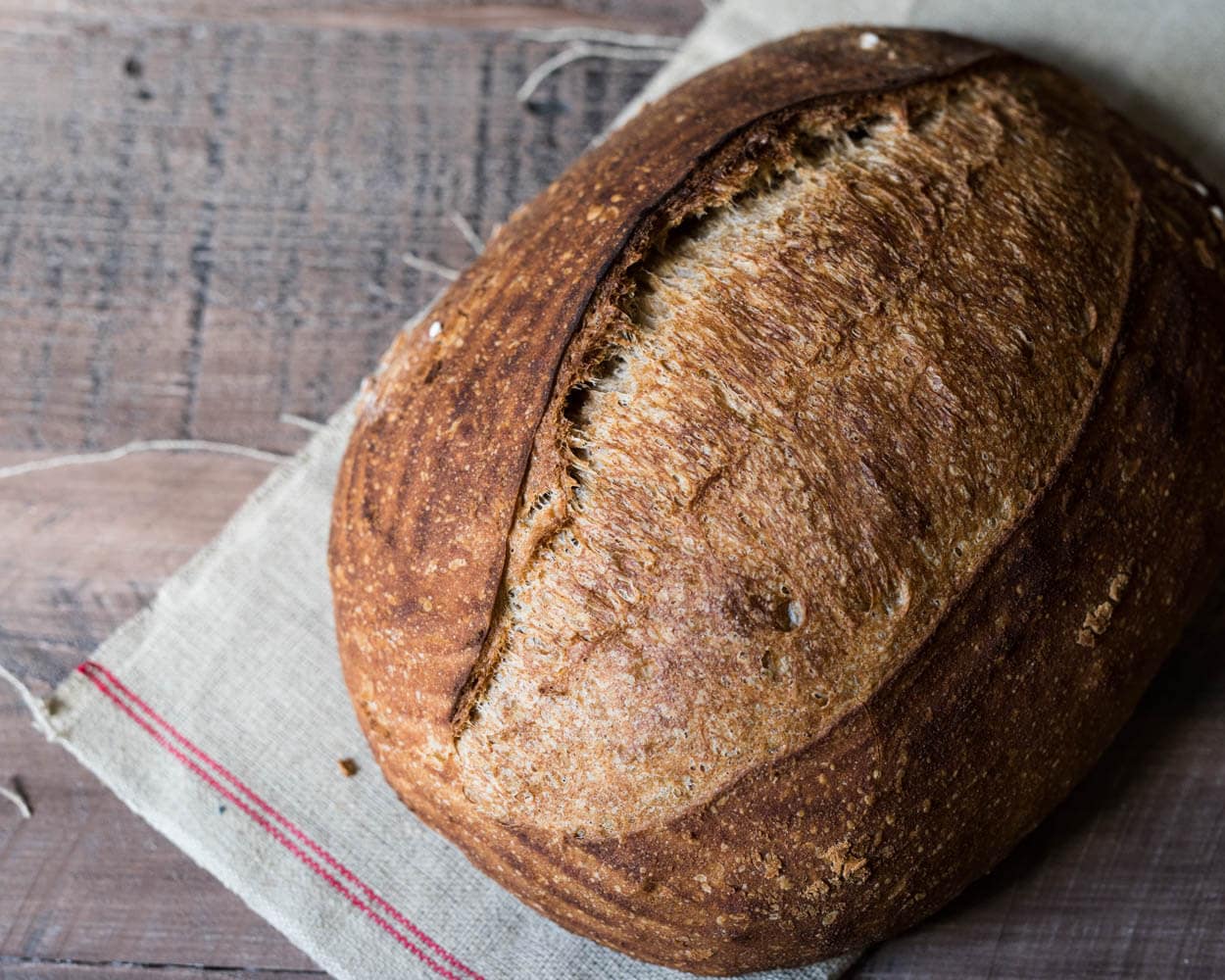
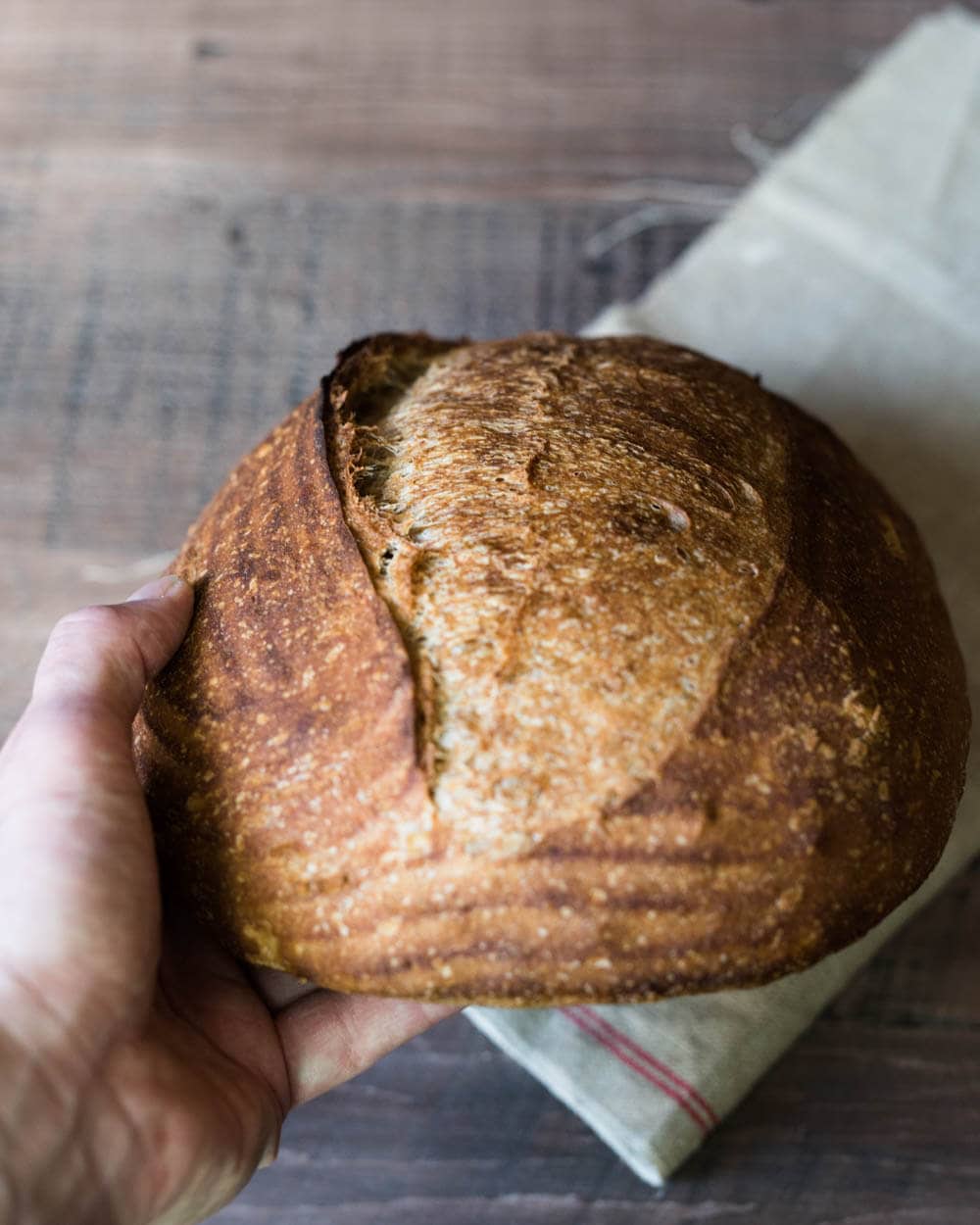
Notice the stunning golden hue to the crust, it sings in the sunlight. Freshly milled flour imparts softness to the crust that isn’t immediately apparent, but not so soft as to collapse in your hand. Aged whole wheat tends to be a bit more crunchy, but that is not a bad thing, just different.
After slicing into this loaf, I found the crust to be exceptionally thin, in part due to the high heat of the oven when baking but also further reinforcing the fact that my method for steaming my home oven works very well.
Crumb
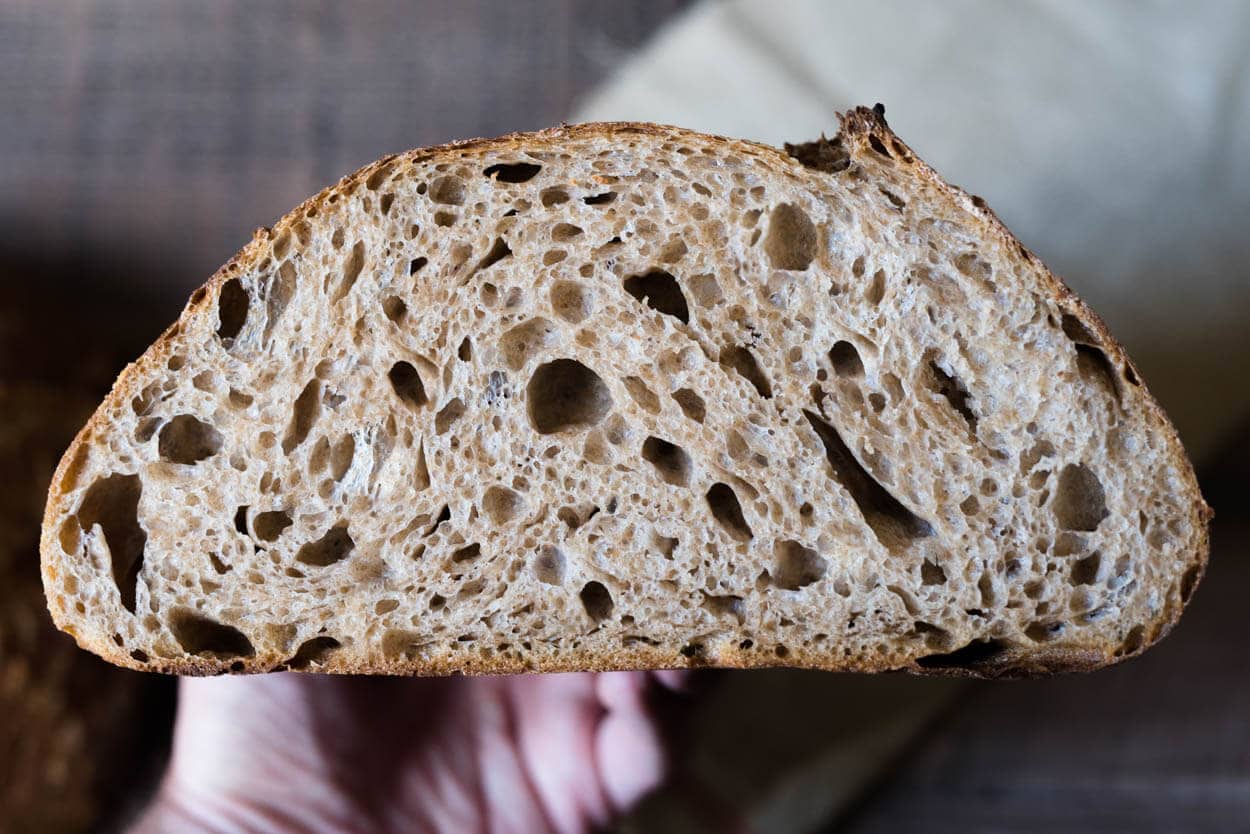
Quite open for so much whole wheat. It has a gloss and shines to it with translucent webbing throughout. The interior is incredibly soft and toothsome; you have to be very careful to eat one slice as it invariably leads to four or five. I love how light the loaf is in hand when you pick it up you know the interior is open and airy, it’s one of my favorite things about baking bread at home.
Taste
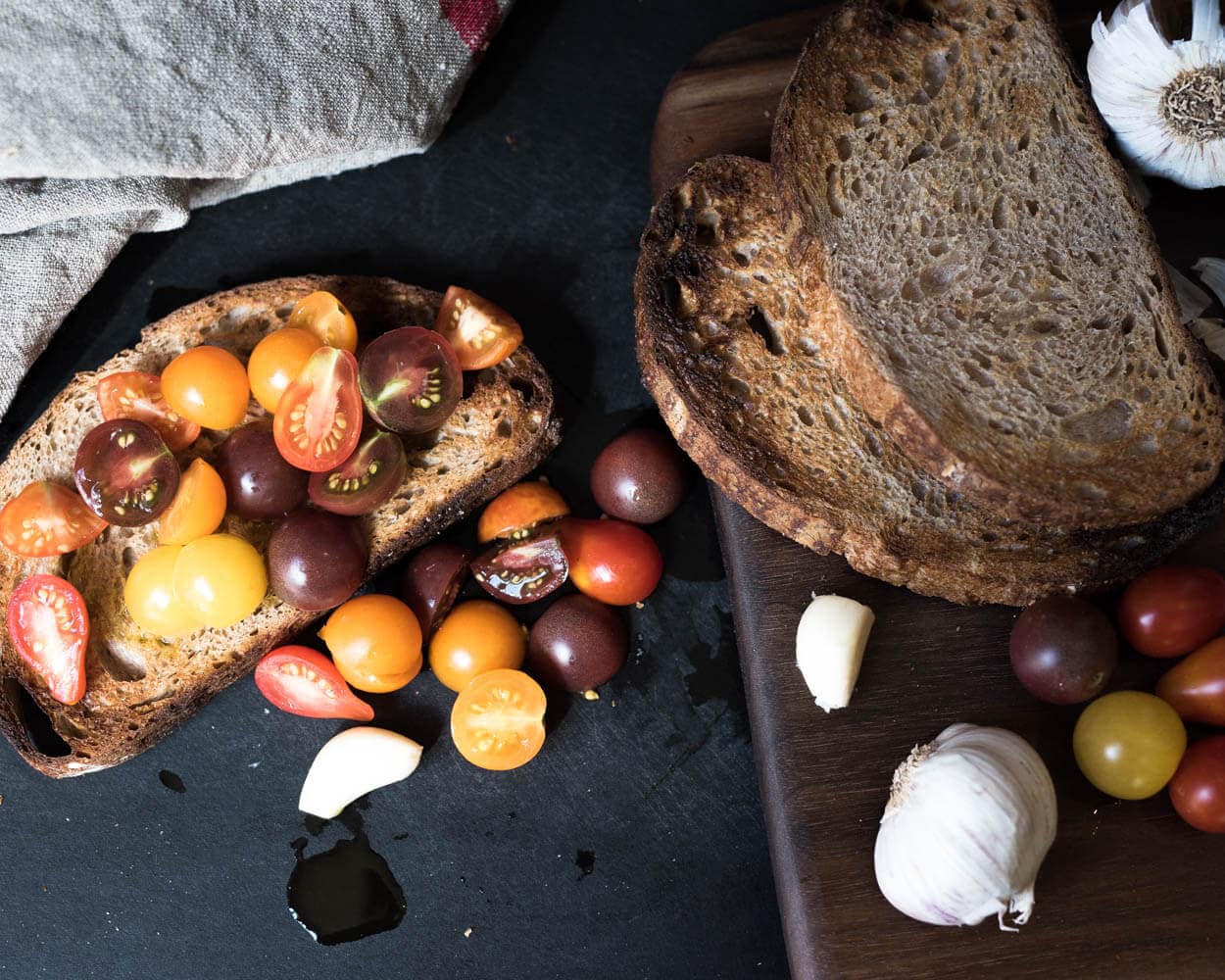
Interestingly enough, I almost prefer this bread a day or two after it’s been baked. The wheat flavor seems to come into its own and settle into a very mild and delicate flavor. When toasted heavily (as you can see above), the entire interior becomes a sort of soft crust that crackles away, and you chew. And when you have wonderfully crunchy sourdough, you can’t possibly deny yourself some bruschetta. I used some olive oil from my Dad’s restaurant, a mosto from Puglia that is just supernaturally good.
Mosto is derived from hand-picked “coratina” olives harvested whole and fresh at maturation. The olives are immediately transferred to the millstone, ground, and slowly cold-pressed. After settlement, maturation, and refinement, the extra virgin olive oil “Mosto” is born.
My favorite treat, especially when tomatoes are in season, of course.
With this bread, I think we can safely let Fall in the house and welcome its chilly attitude and strange colors. Plus, it motivates me to start planning my following market list: everything needed for my nonna’s minestrone, the perfect complement to go with the heels of these two whole wheat loaves.
Maurizio Leo is the creator of The Perfect Loaf, the leading independent resource for baking sourdough bread and pizza at home, and the James Beard Award-winning, New York Times bestselling author of The Perfect Loaf and The Perfect Pizza. He lives in Albuquerque, NM, with his wife and two sons, and he's been labeled "Bob Ross but for bread." Read his full story →
Do sourdough posts like this help you in your baking? Join The Baker’s Corner for only $60 a year, and get:
Come chat with me and other bakers and get baking help
Remove all ads on website
Get my bakers tools & discounts
Get the full recipe archive in editable spreadsheets
What do you recommend if one doesn't have Malted Artisan Baker’s Craft flour/berries? I have hard red, hard white, spelt, rye, and Kamut but I don't especially want to have 47 different kinds of flours and berries taking up all that space.
I recently baked with fresh home-milled flour for the first time and my loaves were predictably dense and small. They tasted amazing, but they didn't rise much. What should I change?
Could tell me how to feed my 100% hydration starter to make part of it 65% hydration? Your recipe calls for 28 g of ripe stiff starter 65% hydration. I just don't the the bakers that…
I maintain my starter @ 1:5:5 i.e. 6g starter, to 30g water/flour. When I feed to make the 65% starter in preparation for the stiff levain, what amount of starter to the 65% water/100% flour should I use? Do you typically change the starter to 1:1:1 when baking?
couldn’t preshape this . .. shouldn’t have added water with the salt I guess. Only the hint of an ear. . . . . waited in bulk till I got some bubbles and dough had that jiggle. Preshape was miserable. Dough flattened out during the rest. I wonder if I were to use all bread flour instead of the ABC?
If you did that it’ll help because Bread Flour usually can take more water and will still keep a lot of strength. Alternatively, hold back more of the mixing water and don’t add it in, Marcy!
so you don’t consider an hour and a half autolyse for this freshly milled flour to be a long period of time? Trying to wade through when and how long to autolyse. For a 50% fresh milled wheat, lower hydration (sandwhich loaf)? This recipe says hour and a half autolyse.
my preshapes won’t keep shape… I know my gluten was developed, my starter was perfectly strong, so did I add too much water? It didn’t seem like it . . . . guess even though it will be a really tight autolyse, I need to cut back on the water. Had about 20g of water left over.
Hi Maurizo, I’ve been making this recipe for many months and I really like it. I prefer having nutrients of the fresh ground wheat rather than all white flour. The crumb and rise I’m getting is really decent, especially when I was using sprouted hard red wheat. Lately I really wish my crusts would be crispier though! The one or two times I’ve made your beginner loaf of all white flour, the crust is WAY crispier, almost too hard for my children. But this one is quite soft. I’m using 2 Dutch ovens side by side as I don’t have all the gear to try your steam method yet. What could I do to get these crispier and darker? Mine turns into quite a bit lighter on the outside than your pictures.
There really isn’t any reason it needs to be so, only the fact that with freshly milled flour I’m using more whole grains. The fermentation activity should be appx the same.
I love your instructions, and I’ve learned so much from baking this recipe once. I baked in a combo cooker, removing the lid after 20 minutes, followed by another 20 uncovered. Best oven spring ever. The interior of the loaf, beautifully textured, was… gummy. There are a number of variables: the white flour was KA Sir Lancelot (too much protein?); the freshly milled wheat was hard red winter; I forgot the rest between dividing and shaping; I put a stone on the shelf below because my white sourdough gets almost caramelized on the bottom. (The white loaves are 750g each (total), 75% hydration; 40 minutes @450° F closed in the combo cooker). I’m guessing the 900g loaf at 85% needs either more heat or more time, or?
EDIT: I see I misread your recipe and robbed myself of the final 5-10 minutes in the oven.
I’ve baked this recipe several more times now, and the loaves are coming out beautifully. My oven temp runs low so I’m now running convection mode (which is accurate) until the lid comes off the combo cooker, then I switch to regular bake. Still working on shaping, but I’m really surprised at the difference it makes in oven spring. And the slap and folds today were the first time I haven’t hit the cabinets or backsplash with flying dough. I do think I’ve got too much protein between the whole wheat and the KA Sir Lancelot – the bread is a little tougher than I’d like. I’ve got a bag of ABC on the way and am looking forward to trying that.
I baked up a batard and boule this morning having meticulously followed this recipe, and they are the most successful sourdoughs I’ve ever baked! Beautiful open crumb, and the crust is thing and crisp. And the FLAVOR. I might just eat the entire loaf. Today. I don’t believe I’ll be able to stop myself. Thank you for this wonderful recipe and the detailed instructions and videos. Thanks to you, I’m finally getting the hang of sourdough, shaping, and oven spring!
I love fresh hard white wheat—I think it would do really well in this recipe. It usually is a little less strong in my experience, so watch the hydration of this dough, holding some back as necessary.
Thank you for this wonderful blog. Could you give general advice on when to take the loaves out of the fridge prior to baking? Does the answer depend on the recipe? I’ve been trying to figure a rule of thumb, wondering how variations factor into my overall results.
I almost always bake my dough straight from the fridge—it’s totally fine to do so. The only time I’d let them warm up is if I felt they were under proofed and needed additional fermentation time at room temperature. Hope that helps!
Hi Maurizio, a couple of questions on baking with ~100% fresh milled flour. I am using a Mockmill 100 on the setting where you can just here the grinding sound when you turn it on. Today I baked using the following: 940g –Central Milling Fresh Milled Organic Hard Red Spring Wheat Berries, 20g – Central Milling Organic Spelt Flour, 240g –Fresh Milled Breadtopia Organic Ethiopian Blue Tinge Emmer Wheat Berries, 12g – Diastatic Malt Powder, 200g of Levain made from my normal starter, and with the following: 75g – Mature Fred Starter, 70g – Fresh Milled Breadtopia Organic Ethiopian Blue Tinge Emmer Wheat Berries, 20g – Central Milling Organic Spelt Flour, 20g – Fresh Milled Vitamin Cottage Organic Medium Rye Flour, 110g – Water.
I made the levain at about 7:30 a.m., started Autolyse at 10:50 a.m. by mixing 820g of room temperature (approx. 70F) water, and then proofing in my Brod & Taylor proofer at 80F until 2:20 p.m. I then added 200g of the Levain and 21g room temperature water, let sit for 20 minutes in proofer at 80F covered with a linen towel, then added the salt and 25g more room temperature water, then put in Heath Ceramic Bowl, covered with the linen towel, put in proofer at 80F and did 4 stretch and folds at 30 minute intervals, then turned the proofer down to 78F and proofed until 6:50 p.m. During proofing I noticed a bit of initial peeling and “dryness” to the dough, but nothing bad, and after the first s&f it went away.
I then pre-shaped and left on the counter covered with stainless bowls for 25 minutes.
Next, I shaped and put in bannetons (batards) but left on the counter covered with the linen towel for 50 minutes (this is something I read about but haven’t tried before).
Finally, I put in the fridge like usual and proofed for 12 hours.
OK, finally I will get to the point here. When I took the dough out of the refrigerator to get ready for baking it felt sort of “soft” and “flexible”, definitely not firm. When I scored the top it felt a bit “jiggly” and collapsed a bit. In the end the loaves baked well but are fairly flat compared to normal.
A couple of things – This is the first time I used Emmer. Also, I usually add Hi-Mountain flour and bread flour in some percentage, but have been trying to move towards all fresh milled flour so as not to have to store processed flour. Plus, having the berries around is good in that they can also be cooked to eat like rice. One other thing, normally after proofing in the Brod & Taylor proofer the dough looks smooth and has some bubbles. Not this time. The dough had maybe one small bubble, and was more coarse or grainy looking.
I am thinking I messed up a few things. Maybe I over proofed? My starter shouldn’t have been an issue, but maybe the levain was as I didn’t use any bread flour or red whole wheat flour like I usually do.
Anyway, if you can think of anything that jumps out at you as to why this bread came out flat I would appreciate the suggestions. This is my first sourdough failure in a couple of years of baking. I have had great results in the past using Central Milling flours, and also with fresh milled Sonora flour when combined with Hi-Mountain and Bread Flour.
I found this online: “The gluten develops as the flour ages. If the flour is fresh ground you need to add 1 tablespoon of gluten per cup of flour to get it to rise properly.” If this makes sense can you translate how much vital wheat gluten I would add to the freshly milled flour based on weight rather than cups? Also, would it help the oven spring if I milled the flour the day before? Thanks!
Michael — sounds to me like the dough likely over proofed on you. Know that typically with freshly milled flour the dough will be more sensitive to long fermentation times, even in the fridge. I’d definitely cut back that final proof and/or bulk fermentation time to compensate.
I find it best to use the flour the day it’s milled, but milling the day before will be just fine as well! Unfortunately, I’ve never used vital wheat gluten so I’m not sure how much to use.
Ciao Maurizio! I’m gonna try this beautiful recipe in the next two days. I only have access to aged whole wheat flour in these days, should i double the levain percentage?
Hi- first post.
I got my mockmill mill the other day, and yesterday I milled some hard white to start making baguettes, following Patrick’s recipe.
I’m use to using KA flours for baking everything except pizza (lm in love with the Caputo 00). So, my milled dough mixture is extremely stiff. What, if anything, is wrong here? The dough seems to be telling me to add more hydration.(?)
Hey there. That’s to be expected, generally, when using freshly milled flour: it can usually take on more water than aged flour. Increase the hydration slowly through mixing as it feels right to you!
This is a great recipe and my first try using home milled flour. I used it as a guide substituting what I had on hand as I was determined to use 100% fresh milled (maybe not my best decision). For wheat berries I had hard white spring and hard red spring. I sifted the white spring to remove some of the hull. I pretty much followed the recipe with a few alterations:
I added about 50% more starter, held back about 20g of water and had to do 1 more stretch and fold- otherwise I followed the recipe (slap and folds weren’t working for me at all- the counter was a mess so I finished with traditional kneading).
In the morning, the loaves had proofed handsomely though not too much. Tipped them out and they held shape really well. Did my slashes and they did spread out a bit though not unusual in my experience.
Into the oven they went. After 20 minutes, off with the lids and they had some oven spring but not nearly what I expected although they looked great. Pulled them out after 15 more minutes and they were nicely browned and at 211 degrees.
Overall a good experience. I am desperately searching for a resource on using 100% fresh milled grains. I’d like to mimic my favorite Tartine loaves at some point if at all possible. Do you have any book suggestions?
Thank you for all you contribute to this craft. Couldn’t do it without you.
Glad to hear things worked well for you on this bake! Great job substituting to fit what you have on hand and how the dough was developing through the entire process.
I’ve been baking for a long while now on 100% freshly milled whole grain loaves and do plan to have an extensive recipe posted here sometime in the future (hopefully sooner than later). This kind of bread can be a challenge, but well worth the investment in time and energy. I don’t have any suggestions off hand for a book on 100% freshly milled bread, but there is a book coming out that might be of interest to you (as it is for me): Flour Lab. The book looks incredible and there will be lots of resources in there for baking with freshly milled flour!
This must be a fantastic recipe because the bread you are seeing was a failure. My usual method of bread making has me do the stretch and fold directly after mixing. Because the instructions for this bread had a long autolyse first, I forgot to do the folding. I just did the bulk fermentation and overnight retarding. This is the result of the recipe without kneading or folding the dough! And it tastes great.
IMG_1286.HEIC
How do you determine the amount of levain to use in formulas that includes fresh milled whole wheat?
I recently started milling my own whole wheat (using Central Mills Hard Red Spring Wheat berries). I have been baking variations of the Tartine country loaf over the past couple years, using the standard 200 grams of leaven, while increasing percentages of whole wheat from 100 to 300 grams per 1000 grams total flour weight (in addition to increasing the hydration to accommodate the increase in Whole wheat flour). With freshly milled whole wheat, however, I have noticed an accelerated fermentation, as you have indicated is common. Therefore, I would like to know exactly how much levain reduction you recommend when using say 20%, or 200 grams (for a 1000 grams total flour) of fresh milled wheat? Is there some standard ratio of reduction of levain you have found for using fresh milled wheat in any formula?
I appreciate your expertise, and writing.
It is truly remarkable how articulate you are about all things bread baking.
Roger, sorry for the late reply. Thanks for the kind words, I really appreciate that. So in short, no there’s no exact formula for determining how much levain to use given a percentage of fresh-milled flour in a recipe — at least for me. When I’m come up with a formula for a bread I sort of weigh all the inputs (fresh milled flour %, other flours, timeline, desired flavor, etc.) and make an instinctive call on what I feel the levain percentage should be. I’ll also consider other factors such as utilizing a liquid levain or a stiff levain (which I use to slow fermentation), and salt percentage (fermentation “inhibitor”). So there’s no real formula I’ve found, it’s an initial stab and then testing, refinement, adjustment.
Generally if I’m going to bake a recipe with a large portion of fresh milled flour I’ll drop the levain down to 10% or so, and adjust from there. The thing is, even if you use too little, or too much, levain you can always adapt with how the dough is progressing. Watch the dough like a hawk that first try and if it’s moving super fast, cut the bulk fermentation time down — and conversely, if things are moving super slow, lengthen it until the dough looks ready. Rarely does it happen where I misjudge the levain percentage so bad I have to take drastic action, like cutting bulk down to 2 hours or pushing it past 6.
I hope this helps. I know it can be frustrating with baking in that there’s usually no single answer for anything… But that’s part of the fun, I think! It requires us to hone our senses and learn to adapt with how the dough is moving that day.
No one answer is probably the most exact answer to so many questions in bread-making, and it does make it most interesting. Since I first posed my question, I have experimented with levain percentages in the standard Tartine formula, which typically calls for 20% (200g) levain. Because of the rapid fermentation I found when using fresh ground whole wheat, I tried cutting back. I first tried 16.5% (165g) of levain, then 14% (140g). I had success with both, each each resulting in respectively longer/shorter fermentation times. This is helping me better manage my time for baking and producing a more manageable dough and ultimately better bread. I may have not have even tried to experiment with levain percntages had it not been for you mentioning it in your blog post. I am glad I did, since it is helping me understand even more about the variable elements of bread-making.
That’s great to hear, Roger! Sometimes it just takes one little comment here or there to give us that idea on things to experiment with. Happy baking 🙂
Hi! I’m also fresh milling and trying for greater volume. I’ve been able to get decent volume on 30% while using King Arthur bread flour to boost the protein content to compensate for the lower volume you get from whole grain (the bran, I understand). So I’ve ordered some Lancelot high gluten flour to try to take that even higher… that’s about 14% protein. What do you think of that approach?
I’ve also been sitting my fresh milled flour (palouse white winter wheat and some others) to remove bran to try to increase volume, but that seems counter to the idea of whole grain… And I had another thought – William Ruble and Elizabeth David both talk about milling with the stones a bit further apart to get a finer flour — counter intuitive but they mean cracking the berry open and then sifting out the endosperm/starch, rather than finely milling the whole grain. ED says this is semolina. I asked on your wheat germ post about extracting bran but not germ and I wanted to possibly relate that here too — what setting do you use on your mill and do you go for very fine flour? Do you sift?
Sorry, this is a lot of info and questions, I’m just excited about bread 🙂
Thanks for your incredible documentation and experimentation – documentation isn’t easy and you do a fantastic job!
Higher protein flour will definitely give you more structure to your loaf, but I tend to like the result when only a small percentage of the overall flour in a formula is high protein (~13%+). I find using a lot of this flour sometimes leads to a tough crumb that can also sometimes be gummy. But this is very subjective and warrants experimentation on your part!
Correct — sifting your milled flour is essentially decreasing the extraction percentage of the resulting flour, making it more and more towards what we’d consider white flour. This will definitely allow your loaves to rise higher and become more and more open in the interior, but at the cost of losing nutrition (from the bran and germ sifted out), and likely flavor.
When I mill I usually go very, very fine. I don’t usually do any sifting — when I’m milling I want to use 100% whole grain! But if you want to sift that works too; in that case I would back off the stones/burrs a bit so you get large bran and germ particles that can easily be sifted out. If you mill too fine you might not be able to sift as the entire wheat berry would be pulverized to about the same granularity.
Maurizio, made this recipe a couple times now with great results. Thanks for the help. I have a question regarding the autolyse. Why do some recipes call for the leaven to be mixed in at the beginning of the autolyse and others like this one do it only after the flour and water have rested on their own for a while? What are the determining factors for choosing which method and what are the benefits to both? Thanks again for the vast resource.
Glad to hear that, Mike! When you add your levain to the rest of the flour and water in a recipe keep in mind that is when fermentation for the recipe begins. If you add it in, and then have a long autolyse, it’s possible your dough will over proof by the time bulk completes.
Typically if an autolyse time is really short, like less than 30 minutes, some bakers will just go ahead and add the levain in at the same time as they mix, then add salt later.
Really the most important thing to keep in mind there is that fermentation begins when the levain is added. Hope this helps!
Maurizio, two questions for ya. When calculating FDT is the room temp referring to the area you plan to mix the dough or where you’ll be bulk fermenting? I live in Toronto and it’s currently freezing so I must use my oven with a light on to maintain a warm environment. My kitchen is currently 72 and my oven is 81, which number am I using for the fdt calculation?
Also how long are each set of stretch and folds? I’m about to bake your 50/50 fresh milled and it says to do one every 30 minutes, five minutes of stretch and folds each time or reduce the time after each one? I think I saw something about that before? Can’t seem to find the answer but I’m sure you’ve covered it before.
The “room temp” you want to take is where you’ll be mixing the dough — this will be the temperature where everything is kept initially. If you then move the dough to another location you’ll have to adjust that location’s temperature (which is possible with the oven) to keep the dough warm, or cool, as necessary to maintain the FDT. Sometimes it’s ok if the dough’s temperature drops slightly through bulk, especially if it’s overly high or you over shoot the target dough temperature.
I typically do my stretch and folds every 30 minutes. You won’t want to reduce the time span between these sets as you progress through bulk because it will likely not be enough time for the dough to relax fully before the next set (the dough should strengthen through bulk). The key with that time period is to allow the dough to relax enough to stretch and fold. If the dough hasn’t relaxed enough time hasn’t passed or it’s been strengthened enough.
Hello there. Been making this bread close to ten times now and every time I just can’t seem to get the loaf tight enough during shaping to hold its snap, the bread ends up not rising much and spreading out a little to much and the cuts are not super good due to the fact that it seems to lack the tension.
With all that being said the crumb is still open and nice.
I guess it’s just a learning curve with getting wet dough tight during shaping
Thanks!
Love you’r blog
Andrew,
Sounds like you’re in the right track! Of course taste is most important but we all still want those nice tall loaves. Shaping is definitely something that takes quite a bit of practice to get just right. If your dough is lacking tension try to give it a few more “spins” on the counter if you’re making a boule or tuck the dough in tighter if making a batard. Either way it sounds like your bread is well in its way!
Thanks for the helpful words.
Yea shaping is an art. Iv been shaping by just folding then spin then folding and so on then flipping and rolling it to get it tight. How do you go about pre shaping? And do you degas at all during shaping?
So I had yet another idea why my bread is not shaping up well. I’m using winter red wheat from nc so I’m thinking the protien of the whole wheat is possibly 2% less protien. So I went down to at least 78% hydration to cominsate. and I me checked my fridge temp and its 58. So the bread was probaly over proofed for sure.
58ºF is definitely quite high! My fridge is typically around 38ºF so yes, my times listed above will be far too long — your dough probably overproofed!
When preshaping I do very light turns of the dough after it’s divided, just enough to build tension on the dough so it holds itself into a round for 20-30 minutes on the counter. I do not do any degassing.
Hi again Maurizio,
In Portugal, I never found malted flour. Can I use regular white flour instead? The same amount?
Another question. My starter is 100% hydration. Should I create one at 65%? Or is possible to adjust this recipe?
Thank you!
Malted flour means they add a small percentage of diastatic malt to the flour to increase enzymatic and fermentation activity. It’s totally optional, but I find it helps get a really nice color on the crust (due to increased caramelization). If you don’t have malted flour just use non-malted wheat it its place.
If your starter is at 100% hydration it’s not a problem at all, just reduce the final dough mix water percentage a little to compensate. The overall hydration of the dough is what matters 🙂 I’ll think about adding this in for future posts, showing percentages for lower hydration and higher hydration starter/levains!
Hi! This weekend I tried a kind of mix of flours: wheat, whole wheat and rye. In the end I got a bread that looked like a “dense cake”. I done all steps and it looks a good bread after baking but when I cut it… the truth appeared 😉 maybe it needed more retarding time in the fridge? I left for 8h and it wasn’t fresh milled flour.
There are a lot of things that could cause a more dense bread, so it’s hard to say! Know that the higher the percentage of rye and whole grains you use the less loft and open crumb you’ll see, for various reasons. If the crumb looked extremely dense with no smaller holes throughout but rather just dense flour, it usually indicates you didn’t proof long enough (there wasn’t enough activity for enough time). Hope that helps, hard to say exactly without more info and pictures!
I am trying to up my game with more whole wheat and wholegrain in SD baking, this is very encouraging results and post. As beginner I have found KAF very consistent and reliable. Will you share your insights about different types of flour, if I wish to venture in to local, fresh milled flour. Your recommendation for sources as well as how to find local sources here in DC,MD area. I will appreciate it.
Just discovered this beautiful site while looking to add more whole wheat to my recipes. Your passion comes through in your poetic descriptions and photos. That crumb looks incredible!
Thanks for the comments! Indeed, bread has totally take over — and I love it.
I didn’t know that about SF/Berkeley/Oakland, I fixed that footnote. Actually I think that’s how it was listed online (Wiki). Good to know, regardless. Cheers!
Hi Maurizio, Been at the home baking thing for about two years now. One suggestion if you haven’t yet tried it: After bulk ferment completes, I place the dough into the refrigerator for anywhere from 1-3 or 4 hours, whatever my schedule allows, and then do my divide, pre shape, 10 minute rest and shape. Then back into the refrigerator for the remainder of the retard on my couche. Same total retard time, but I have more freedom of time to schedule my divide and shape, and I’m working with a firmer dough at that stage. Makes for a really nice feel to the shaping.
Most of the steps that I see you doing pretty much mirrors mine. If you’d like to see a link to what I do on The Fresh Loaf, just look for “alfanso” in the blogs section. My batards have an awful lot in common with yours, as far as looks.
And I do love Ken’s breads too!
Alfanso, your bread looks great, yes very similar. Thanks for the suggestion on retarding at the end of bulk, I actually haven’t tried that. That may help me tame the incredible fermentation power of this fresh milled flour, or at least attempt to make it fit my busy schedule a bit. I believe Dave Miller (if you are familiar with him) does something similar — I keep meaning to try a mimic one of his methods. I’ll definitely give this a shot and perhaps do a “results” post here!
Not random at all, and yes it is a Heath Ceramics bowl! It’s one of their large serving bowls and I love the thing. I’ve had it for a long while now and use it pretty much only for bread 🙂 I’d probably buy all their stuff if I could swing it!
Ah, thought so! I have the same one, but never thought to use it for proofing. Now you’ve got me thinking of possibilities with it. Thanks for responding. Love the blog, am learning so much from it.
Thanks Maurizio – Awesome post yet again. I feel like I’m subscribed to my very own boutique baking magazine!
Looking forward to trying the recipe with fresh milled flour when I can get hold of some. Gotta have something to go with that cheese when its ready!
Jon — thanks so much! Hah, I like that, “boutique baking magazine”, not bad! Your cheese ventures have me very, very intrigued. That ricotta I made last week was so easy and so good I am afraid of opening that door into a dangerous new hobby 🙂 I am probably going to do a quick writeup on that process for this site, was very easy and something I think everyone making sourdough should try!
Thanks for the comments and I look forward to hearing your thoughts about this bread — and with your cheese!
Another wonderful post! I cannot believe the crust and crumb on that one– reminds me of the Country Brown I bought at Ken’s Artisan Bakery last week (that was my first time in Portland- what a great town!)
I am still deciding on which mill to buy. I was wondering why you choose the grainmaker 116 over the 99 and did you consider the KoMo?
-Noah (bartfeld1 on instagram)
Thanks, I appreciate that! Ken’s is an excellent place, great bread and his pizza joint is awesome as well. I just love Portland, such a great city.
I went with the 116 just because I wanted the larger burrs. Larger burs will usually keep the grain cooler as it’s being milled, but in this case I think the 99 would have performed just fine. I also wanted the larger hopper and I didn’t want to regret getting a smaller unit down the line, when I hope to bake even more than I am currently. There’s part of my personality in that decision as well, I figured I might as well go all out if I’m going to spring for it 🙂
I did in fact consider the KoMo — a great mill! In the end I wanted the hand operated mill to mill finer and cooler. Not to say there aren’t things you can do with the KoMo to reduce temperature but the quality, craftsmanship (to be fair the KoMo is also very well built) and small number of parts (less to clean and maintain) of the GM also called to me. It was a tough decision!




81 Comments
What do you recommend if one doesn't have Malted Artisan Baker’s Craft flour/berries? I have hard red, hard white, spelt, rye, and Kamut but I don't especially want to have 47 different kinds of flours and berries taking up all that space.
I recently baked with fresh home-milled flour for the first time and my loaves were predictably dense and small. They tasted amazing, but they didn't rise much. What should I change?
Could tell me how to feed my 100% hydration starter to make part of it 65% hydration? Your recipe calls for 28 g of ripe stiff starter 65% hydration. I just don't the the bakers that…
It's okay to use your normal high hydration starter if that's what you maintain!
Can this be made in loaf tins?
Yes, absolutely.
I maintain my starter @ 1:5:5 i.e. 6g starter, to 30g water/flour. When I feed to make the 65% starter in preparation for the stiff levain, what amount of starter to the 65% water/100% flour should I use? Do you typically change the starter to 1:1:1 when baking?
I usually make a levain: https://www.theperfectloaf.com/what-is-a-levain-and-how-is-it-different-from-a-starter/
can this dough be laminated?
Yes, if that's in your process!
couldn’t preshape this . .. shouldn’t have added water with the salt I guess. Only the hint of an ear. . . . . waited in bulk till I got some bubbles and dough had that jiggle. Preshape was miserable. Dough flattened out during the rest. I wonder if I were to use all bread flour instead of the ABC?
If you did that it’ll help because Bread Flour usually can take more water and will still keep a lot of strength. Alternatively, hold back more of the mixing water and don’t add it in, Marcy!
Can I use only fresh milled grain instead of addy all purpose?
Yes, but keep in mind you’ll be pushing a 100% whole grain loaf (delicious, but keep it in mind)!
so you don’t consider an hour and a half autolyse for this freshly milled flour to be a long period of time? Trying to wade through when and how long to autolyse. For a 50% fresh milled wheat, lower hydration (sandwhich loaf)? This recipe says hour and a half autolyse.
my preshapes won’t keep shape… I know my gluten was developed, my starter was perfectly strong, so did I add too much water? It didn’t seem like it . . . . guess even though it will be a really tight autolyse, I need to cut back on the water. Had about 20g of water left over.
if I don’t use malted grain should I add some diastatic malt powder? I’ve made this before without, but just wondering if that would be good.
I wouldn’t. It’s totally optional!
Hi Maurizo, I’ve been making this recipe for many months and I really like it. I prefer having nutrients of the fresh ground wheat rather than all white flour. The crumb and rise I’m getting is really decent, especially when I was using sprouted hard red wheat. Lately I really wish my crusts would be crispier though! The one or two times I’ve made your beginner loaf of all white flour, the crust is WAY crispier, almost too hard for my children. But this one is quite soft. I’m using 2 Dutch ovens side by side as I don’t have all the gear to try your steam method yet. What could I do to get these crispier and darker? Mine turns into quite a bit lighter on the outside than your pictures.
Maurizio, could you explain the rationale behind reducing the levain with the fresh milled flour vs aged flour?
There really isn’t any reason it needs to be so, only the fact that with freshly milled flour I’m using more whole grains. The fermentation activity should be appx the same.
I love your instructions, and I’ve learned so much from baking this recipe once. I baked in a combo cooker, removing the lid after 20 minutes, followed by another 20 uncovered. Best oven spring ever. The interior of the loaf, beautifully textured, was… gummy. There are a number of variables: the white flour was KA Sir Lancelot (too much protein?); the freshly milled wheat was hard red winter; I forgot the rest between dividing and shaping; I put a stone on the shelf below because my white sourdough gets almost caramelized on the bottom. (The white loaves are 750g each (total), 75% hydration; 40 minutes @450° F closed in the combo cooker). I’m guessing the 900g loaf at 85% needs either more heat or more time, or?
EDIT: I see I misread your recipe and robbed myself of the final 5-10 minutes in the oven.
Yes, I’d almost certainly say it needed to be baked out a little more! Let me know how the next one goes 🙂
I’ve baked this recipe several more times now, and the loaves are coming out beautifully. My oven temp runs low so I’m now running convection mode (which is accurate) until the lid comes off the combo cooker, then I switch to regular bake. Still working on shaping, but I’m really surprised at the difference it makes in oven spring. And the slap and folds today were the first time I haven’t hit the cabinets or backsplash with flying dough. I do think I’ve got too much protein between the whole wheat and the KA Sir Lancelot – the bread is a little tougher than I’d like. I’ve got a bag of ABC on the way and am looking forward to trying that.
I baked up a batard and boule this morning having meticulously followed this recipe, and they are the most successful sourdoughs I’ve ever baked! Beautiful open crumb, and the crust is thing and crisp. And the FLAVOR. I might just eat the entire loaf. Today. I don’t believe I’ll be able to stop myself. Thank you for this wonderful recipe and the detailed instructions and videos. Thanks to you, I’m finally getting the hang of sourdough, shaping, and oven spring!
So happy to hear this, Donna! Thanks for the kind words and here’s to many more awesome bakes 🙂
Planning to start recipe tomorrow. How do you think hard white wheat fresh milled would do. Any adjustments? Thanks in advance.
I love fresh hard white wheat—I think it would do really well in this recipe. It usually is a little less strong in my experience, so watch the hydration of this dough, holding some back as necessary.
Thank you for this wonderful blog. Could you give general advice on when to take the loaves out of the fridge prior to baking? Does the answer depend on the recipe? I’ve been trying to figure a rule of thumb, wondering how variations factor into my overall results.
I almost always bake my dough straight from the fridge—it’s totally fine to do so. The only time I’d let them warm up is if I felt they were under proofed and needed additional fermentation time at room temperature. Hope that helps!
Hi, I’m mixing the dough, is this baked in a dutch oven or direction a baking stone? Thank you! Tekla
Either way!
Hi Maurizio, a couple of questions on baking with ~100% fresh milled flour. I am using a Mockmill 100 on the setting where you can just here the grinding sound when you turn it on. Today I baked using the following: 940g –Central Milling Fresh Milled Organic Hard Red Spring Wheat Berries, 20g – Central Milling Organic Spelt Flour, 240g –Fresh Milled Breadtopia Organic Ethiopian Blue Tinge Emmer Wheat Berries, 12g – Diastatic Malt Powder, 200g of Levain made from my normal starter, and with the following: 75g – Mature Fred Starter, 70g – Fresh Milled Breadtopia Organic Ethiopian Blue Tinge Emmer Wheat Berries, 20g – Central Milling Organic Spelt Flour, 20g – Fresh Milled Vitamin Cottage Organic Medium Rye Flour, 110g – Water.
I made the levain at about 7:30 a.m., started Autolyse at 10:50 a.m. by mixing 820g of room temperature (approx. 70F) water, and then proofing in my Brod & Taylor proofer at 80F until 2:20 p.m. I then added 200g of the Levain and 21g room temperature water, let sit for 20 minutes in proofer at 80F covered with a linen towel, then added the salt and 25g more room temperature water, then put in Heath Ceramic Bowl, covered with the linen towel, put in proofer at 80F and did 4 stretch and folds at 30 minute intervals, then turned the proofer down to 78F and proofed until 6:50 p.m. During proofing I noticed a bit of initial peeling and “dryness” to the dough, but nothing bad, and after the first s&f it went away.
I then pre-shaped and left on the counter covered with stainless bowls for 25 minutes.
Next, I shaped and put in bannetons (batards) but left on the counter covered with the linen towel for 50 minutes (this is something I read about but haven’t tried before).
Finally, I put in the fridge like usual and proofed for 12 hours.
OK, finally I will get to the point here. When I took the dough out of the refrigerator to get ready for baking it felt sort of “soft” and “flexible”, definitely not firm. When I scored the top it felt a bit “jiggly” and collapsed a bit. In the end the loaves baked well but are fairly flat compared to normal.
A couple of things – This is the first time I used Emmer. Also, I usually add Hi-Mountain flour and bread flour in some percentage, but have been trying to move towards all fresh milled flour so as not to have to store processed flour. Plus, having the berries around is good in that they can also be cooked to eat like rice. One other thing, normally after proofing in the Brod & Taylor proofer the dough looks smooth and has some bubbles. Not this time. The dough had maybe one small bubble, and was more coarse or grainy looking.
I am thinking I messed up a few things. Maybe I over proofed? My starter shouldn’t have been an issue, but maybe the levain was as I didn’t use any bread flour or red whole wheat flour like I usually do.
Anyway, if you can think of anything that jumps out at you as to why this bread came out flat I would appreciate the suggestions. This is my first sourdough failure in a couple of years of baking. I have had great results in the past using Central Milling flours, and also with fresh milled Sonora flour when combined with Hi-Mountain and Bread Flour.
I found this online: “The gluten develops as the flour ages. If the flour is fresh ground you need to add 1 tablespoon of gluten per cup of flour to get it to rise properly.” If this makes sense can you translate how much vital wheat gluten I would add to the freshly milled flour based on weight rather than cups? Also, would it help the oven spring if I milled the flour the day before? Thanks!
Thanks, and stay healthy and safe.
Michael — sounds to me like the dough likely over proofed on you. Know that typically with freshly milled flour the dough will be more sensitive to long fermentation times, even in the fridge. I’d definitely cut back that final proof and/or bulk fermentation time to compensate.
I find it best to use the flour the day it’s milled, but milling the day before will be just fine as well! Unfortunately, I’ve never used vital wheat gluten so I’m not sure how much to use.
Hope this helps!
Ciao Maurizio! I’m gonna try this beautiful recipe in the next two days. I only have access to aged whole wheat flour in these days, should i double the levain percentage?
Awesome, Paolo! I would likely raise it up just a bit, yes. Perhaps to 7% pre-fermented flour…
Hi- first post.
I got my mockmill mill the other day, and yesterday I milled some hard white to start making baguettes, following Patrick’s recipe.
I’m use to using KA flours for baking everything except pizza (lm in love with the Caputo 00). So, my milled dough mixture is extremely stiff. What, if anything, is wrong here? The dough seems to be telling me to add more hydration.(?)
Hey there. That’s to be expected, generally, when using freshly milled flour: it can usually take on more water than aged flour. Increase the hydration slowly through mixing as it feels right to you!
Thanks, Maurizio! For a while there; I thought I had reinvented concrete.
It has happened to us all, believe me 🙂
Maurizio, good morning,
This is a great recipe and my first try using home milled flour. I used it as a guide substituting what I had on hand as I was determined to use 100% fresh milled (maybe not my best decision). For wheat berries I had hard white spring and hard red spring. I sifted the white spring to remove some of the hull. I pretty much followed the recipe with a few alterations:
I added about 50% more starter, held back about 20g of water and had to do 1 more stretch and fold- otherwise I followed the recipe (slap and folds weren’t working for me at all- the counter was a mess so I finished with traditional kneading).
In the morning, the loaves had proofed handsomely though not too much. Tipped them out and they held shape really well. Did my slashes and they did spread out a bit though not unusual in my experience.
Into the oven they went. After 20 minutes, off with the lids and they had some oven spring but not nearly what I expected although they looked great. Pulled them out after 15 more minutes and they were nicely browned and at 211 degrees.
Overall a good experience. I am desperately searching for a resource on using 100% fresh milled grains. I’d like to mimic my favorite Tartine loaves at some point if at all possible. Do you have any book suggestions?
Thank you for all you contribute to this craft. Couldn’t do it without you.
Glad to hear things worked well for you on this bake! Great job substituting to fit what you have on hand and how the dough was developing through the entire process.
I’ve been baking for a long while now on 100% freshly milled whole grain loaves and do plan to have an extensive recipe posted here sometime in the future (hopefully sooner than later). This kind of bread can be a challenge, but well worth the investment in time and energy. I don’t have any suggestions off hand for a book on 100% freshly milled bread, but there is a book coming out that might be of interest to you (as it is for me): Flour Lab. The book looks incredible and there will be lots of resources in there for baking with freshly milled flour!
Hope that helps and here’s to more awesome bakes!
This must be a fantastic recipe because the bread you are seeing was a failure. My usual method of bread making has me do the stretch and fold directly after mixing. Because the instructions for this bread had a long autolyse first, I forgot to do the folding. I just did the bulk fermentation and overnight retarding. This is the result of the recipe without kneading or folding the dough! And it tastes great.
IMG_1286.HEIC
Glad to hear things turned out well for you, Sara! Enjoy 🙂
Hi Maurizio,
How do you determine the amount of levain to use in formulas that includes fresh milled whole wheat?
I recently started milling my own whole wheat (using Central Mills Hard Red Spring Wheat berries). I have been baking variations of the Tartine country loaf over the past couple years, using the standard 200 grams of leaven, while increasing percentages of whole wheat from 100 to 300 grams per 1000 grams total flour weight (in addition to increasing the hydration to accommodate the increase in Whole wheat flour). With freshly milled whole wheat, however, I have noticed an accelerated fermentation, as you have indicated is common. Therefore, I would like to know exactly how much levain reduction you recommend when using say 20%, or 200 grams (for a 1000 grams total flour) of fresh milled wheat? Is there some standard ratio of reduction of levain you have found for using fresh milled wheat in any formula?
I appreciate your expertise, and writing.
It is truly remarkable how articulate you are about all things bread baking.
Thank you,
Roger
Roger, sorry for the late reply. Thanks for the kind words, I really appreciate that. So in short, no there’s no exact formula for determining how much levain to use given a percentage of fresh-milled flour in a recipe — at least for me. When I’m come up with a formula for a bread I sort of weigh all the inputs (fresh milled flour %, other flours, timeline, desired flavor, etc.) and make an instinctive call on what I feel the levain percentage should be. I’ll also consider other factors such as utilizing a liquid levain or a stiff levain (which I use to slow fermentation), and salt percentage (fermentation “inhibitor”). So there’s no real formula I’ve found, it’s an initial stab and then testing, refinement, adjustment.
Generally if I’m going to bake a recipe with a large portion of fresh milled flour I’ll drop the levain down to 10% or so, and adjust from there. The thing is, even if you use too little, or too much, levain you can always adapt with how the dough is progressing. Watch the dough like a hawk that first try and if it’s moving super fast, cut the bulk fermentation time down — and conversely, if things are moving super slow, lengthen it until the dough looks ready. Rarely does it happen where I misjudge the levain percentage so bad I have to take drastic action, like cutting bulk down to 2 hours or pushing it past 6.
I hope this helps. I know it can be frustrating with baking in that there’s usually no single answer for anything… But that’s part of the fun, I think! It requires us to hone our senses and learn to adapt with how the dough is moving that day.
Happy baking, Roger.
No one answer is probably the most exact answer to so many questions in bread-making, and it does make it most interesting. Since I first posed my question, I have experimented with levain percentages in the standard Tartine formula, which typically calls for 20% (200g) levain. Because of the rapid fermentation I found when using fresh ground whole wheat, I tried cutting back. I first tried 16.5% (165g) of levain, then 14% (140g). I had success with both, each each resulting in respectively longer/shorter fermentation times. This is helping me better manage my time for baking and producing a more manageable dough and ultimately better bread. I may have not have even tried to experiment with levain percntages had it not been for you mentioning it in your blog post. I am glad I did, since it is helping me understand even more about the variable elements of bread-making.
That’s great to hear, Roger! Sometimes it just takes one little comment here or there to give us that idea on things to experiment with. Happy baking 🙂
Hi! I’m also fresh milling and trying for greater volume. I’ve been able to get decent volume on 30% while using King Arthur bread flour to boost the protein content to compensate for the lower volume you get from whole grain (the bran, I understand). So I’ve ordered some Lancelot high gluten flour to try to take that even higher… that’s about 14% protein. What do you think of that approach?
I’ve also been sitting my fresh milled flour (palouse white winter wheat and some others) to remove bran to try to increase volume, but that seems counter to the idea of whole grain… And I had another thought – William Ruble and Elizabeth David both talk about milling with the stones a bit further apart to get a finer flour — counter intuitive but they mean cracking the berry open and then sifting out the endosperm/starch, rather than finely milling the whole grain. ED says this is semolina. I asked on your wheat germ post about extracting bran but not germ and I wanted to possibly relate that here too — what setting do you use on your mill and do you go for very fine flour? Do you sift?
Sorry, this is a lot of info and questions, I’m just excited about bread 🙂
Thanks for your incredible documentation and experimentation – documentation isn’t easy and you do a fantastic job!
Higher protein flour will definitely give you more structure to your loaf, but I tend to like the result when only a small percentage of the overall flour in a formula is high protein (~13%+). I find using a lot of this flour sometimes leads to a tough crumb that can also sometimes be gummy. But this is very subjective and warrants experimentation on your part!
Correct — sifting your milled flour is essentially decreasing the extraction percentage of the resulting flour, making it more and more towards what we’d consider white flour. This will definitely allow your loaves to rise higher and become more and more open in the interior, but at the cost of losing nutrition (from the bran and germ sifted out), and likely flavor.
When I mill I usually go very, very fine. I don’t usually do any sifting — when I’m milling I want to use 100% whole grain! But if you want to sift that works too; in that case I would back off the stones/burrs a bit so you get large bran and germ particles that can easily be sifted out. If you mill too fine you might not be able to sift as the entire wheat berry would be pulverized to about the same granularity.
Hope this helps!
Maurizio, made this recipe a couple times now with great results. Thanks for the help. I have a question regarding the autolyse. Why do some recipes call for the leaven to be mixed in at the beginning of the autolyse and others like this one do it only after the flour and water have rested on their own for a while? What are the determining factors for choosing which method and what are the benefits to both? Thanks again for the vast resource.
Mike
Glad to hear that, Mike! When you add your levain to the rest of the flour and water in a recipe keep in mind that is when fermentation for the recipe begins. If you add it in, and then have a long autolyse, it’s possible your dough will over proof by the time bulk completes.
Typically if an autolyse time is really short, like less than 30 minutes, some bakers will just go ahead and add the levain in at the same time as they mix, then add salt later.
Really the most important thing to keep in mind there is that fermentation begins when the levain is added. Hope this helps!
Maurizio, two questions for ya. When calculating FDT is the room temp referring to the area you plan to mix the dough or where you’ll be bulk fermenting? I live in Toronto and it’s currently freezing so I must use my oven with a light on to maintain a warm environment. My kitchen is currently 72 and my oven is 81, which number am I using for the fdt calculation?
Also how long are each set of stretch and folds? I’m about to bake your 50/50 fresh milled and it says to do one every 30 minutes, five minutes of stretch and folds each time or reduce the time after each one? I think I saw something about that before? Can’t seem to find the answer but I’m sure you’ve covered it before.
Cheers
The “room temp” you want to take is where you’ll be mixing the dough — this will be the temperature where everything is kept initially. If you then move the dough to another location you’ll have to adjust that location’s temperature (which is possible with the oven) to keep the dough warm, or cool, as necessary to maintain the FDT. Sometimes it’s ok if the dough’s temperature drops slightly through bulk, especially if it’s overly high or you over shoot the target dough temperature.
I typically do my stretch and folds every 30 minutes. You won’t want to reduce the time span between these sets as you progress through bulk because it will likely not be enough time for the dough to relax fully before the next set (the dough should strengthen through bulk). The key with that time period is to allow the dough to relax enough to stretch and fold. If the dough hasn’t relaxed enough time hasn’t passed or it’s been strengthened enough.
Hope that helps!
Hello there. Been making this bread close to ten times now and every time I just can’t seem to get the loaf tight enough during shaping to hold its snap, the bread ends up not rising much and spreading out a little to much and the cuts are not super good due to the fact that it seems to lack the tension.
With all that being said the crumb is still open and nice.
I guess it’s just a learning curve with getting wet dough tight during shaping
Thanks!
Love you’r blog
Andrew,
Sounds like you’re in the right track! Of course taste is most important but we all still want those nice tall loaves. Shaping is definitely something that takes quite a bit of practice to get just right. If your dough is lacking tension try to give it a few more “spins” on the counter if you’re making a boule or tuck the dough in tighter if making a batard. Either way it sounds like your bread is well in its way!
Thanks for the helpful words.
Yea shaping is an art. Iv been shaping by just folding then spin then folding and so on then flipping and rolling it to get it tight. How do you go about pre shaping? And do you degas at all during shaping?
So I had yet another idea why my bread is not shaping up well. I’m using winter red wheat from nc so I’m thinking the protien of the whole wheat is possibly 2% less protien. So I went down to at least 78% hydration to cominsate. and I me checked my fridge temp and its 58. So the bread was probaly over proofed for sure.
58ºF is definitely quite high! My fridge is typically around 38ºF so yes, my times listed above will be far too long — your dough probably overproofed!
When preshaping I do very light turns of the dough after it’s divided, just enough to build tension on the dough so it holds itself into a round for 20-30 minutes on the counter. I do not do any degassing.
Hi again Maurizio,
In Portugal, I never found malted flour. Can I use regular white flour instead? The same amount?
Another question. My starter is 100% hydration. Should I create one at 65%? Or is possible to adjust this recipe?
Thank you!
Malted flour means they add a small percentage of diastatic malt to the flour to increase enzymatic and fermentation activity. It’s totally optional, but I find it helps get a really nice color on the crust (due to increased caramelization). If you don’t have malted flour just use non-malted wheat it its place.
If your starter is at 100% hydration it’s not a problem at all, just reduce the final dough mix water percentage a little to compensate. The overall hydration of the dough is what matters 🙂 I’ll think about adding this in for future posts, showing percentages for lower hydration and higher hydration starter/levains!
Hi! This weekend I tried a kind of mix of flours: wheat, whole wheat and rye. In the end I got a bread that looked like a “dense cake”. I done all steps and it looks a good bread after baking but when I cut it… the truth appeared 😉 maybe it needed more retarding time in the fridge? I left for 8h and it wasn’t fresh milled flour.
There are a lot of things that could cause a more dense bread, so it’s hard to say! Know that the higher the percentage of rye and whole grains you use the less loft and open crumb you’ll see, for various reasons. If the crumb looked extremely dense with no smaller holes throughout but rather just dense flour, it usually indicates you didn’t proof long enough (there wasn’t enough activity for enough time). Hope that helps, hard to say exactly without more info and pictures!
How can I send you some pictures?
Shoot me over an email: maurizio (at) theperfectloaf (dot) com
I am trying to up my game with more whole wheat and wholegrain in SD baking, this is very encouraging results and post. As beginner I have found KAF very consistent and reliable. Will you share your insights about different types of flour, if I wish to venture in to local, fresh milled flour. Your recommendation for sources as well as how to find local sources here in DC,MD area. I will appreciate it.
Will reply to your email with these answers!
Just discovered this beautiful site while looking to add more whole wheat to my recipes. Your passion comes through in your poetic descriptions and photos. That crumb looks incredible!
Thanks for the comments! Indeed, bread has totally take over — and I love it.
I didn’t know that about SF/Berkeley/Oakland, I fixed that footnote. Actually I think that’s how it was listed online (Wiki). Good to know, regardless. Cheers!
Hi Maurizio, Been at the home baking thing for about two years now. One suggestion if you haven’t yet tried it: After bulk ferment completes, I place the dough into the refrigerator for anywhere from 1-3 or 4 hours, whatever my schedule allows, and then do my divide, pre shape, 10 minute rest and shape. Then back into the refrigerator for the remainder of the retard on my couche. Same total retard time, but I have more freedom of time to schedule my divide and shape, and I’m working with a firmer dough at that stage. Makes for a really nice feel to the shaping.
Most of the steps that I see you doing pretty much mirrors mine. If you’d like to see a link to what I do on The Fresh Loaf, just look for “alfanso” in the blogs section. My batards have an awful lot in common with yours, as far as looks.
And I do love Ken’s breads too!
Alfanso, your bread looks great, yes very similar. Thanks for the suggestion on retarding at the end of bulk, I actually haven’t tried that. That may help me tame the incredible fermentation power of this fresh milled flour, or at least attempt to make it fit my busy schedule a bit. I believe Dave Miller (if you are familiar with him) does something similar — I keep meaning to try a mimic one of his methods. I’ll definitely give this a shot and perhaps do a “results” post here!
Thanks again for the comments and suggestions!
Totally random question, but is that Heath salad bowl?!
Not random at all, and yes it is a Heath Ceramics bowl! It’s one of their large serving bowls and I love the thing. I’ve had it for a long while now and use it pretty much only for bread 🙂 I’d probably buy all their stuff if I could swing it!
Ah, thought so! I have the same one, but never thought to use it for proofing. Now you’ve got me thinking of possibilities with it. Thanks for responding. Love the blog, am learning so much from it.
You’re welcome, thanks!
Thanks Maurizio – Awesome post yet again. I feel like I’m subscribed to my very own boutique baking magazine!
Looking forward to trying the recipe with fresh milled flour when I can get hold of some. Gotta have something to go with that cheese when its ready!
Cheers mate. – Jon (jonno_r)
Jon — thanks so much! Hah, I like that, “boutique baking magazine”, not bad! Your cheese ventures have me very, very intrigued. That ricotta I made last week was so easy and so good I am afraid of opening that door into a dangerous new hobby 🙂 I am probably going to do a quick writeup on that process for this site, was very easy and something I think everyone making sourdough should try!
Thanks for the comments and I look forward to hearing your thoughts about this bread — and with your cheese!
Ciao!
Another wonderful post! I cannot believe the crust and crumb on that one– reminds me of the Country Brown I bought at Ken’s Artisan Bakery last week (that was my first time in Portland- what a great town!)
I am still deciding on which mill to buy. I was wondering why you choose the grainmaker 116 over the 99 and did you consider the KoMo?
-Noah (bartfeld1 on instagram)
Thanks, I appreciate that! Ken’s is an excellent place, great bread and his pizza joint is awesome as well. I just love Portland, such a great city.
I went with the 116 just because I wanted the larger burrs. Larger burs will usually keep the grain cooler as it’s being milled, but in this case I think the 99 would have performed just fine. I also wanted the larger hopper and I didn’t want to regret getting a smaller unit down the line, when I hope to bake even more than I am currently. There’s part of my personality in that decision as well, I figured I might as well go all out if I’m going to spring for it 🙂
I did in fact consider the KoMo — a great mill! In the end I wanted the hand operated mill to mill finer and cooler. Not to say there aren’t things you can do with the KoMo to reduce temperature but the quality, craftsmanship (to be fair the KoMo is also very well built) and small number of parts (less to clean and maintain) of the GM also called to me. It was a tough decision!