

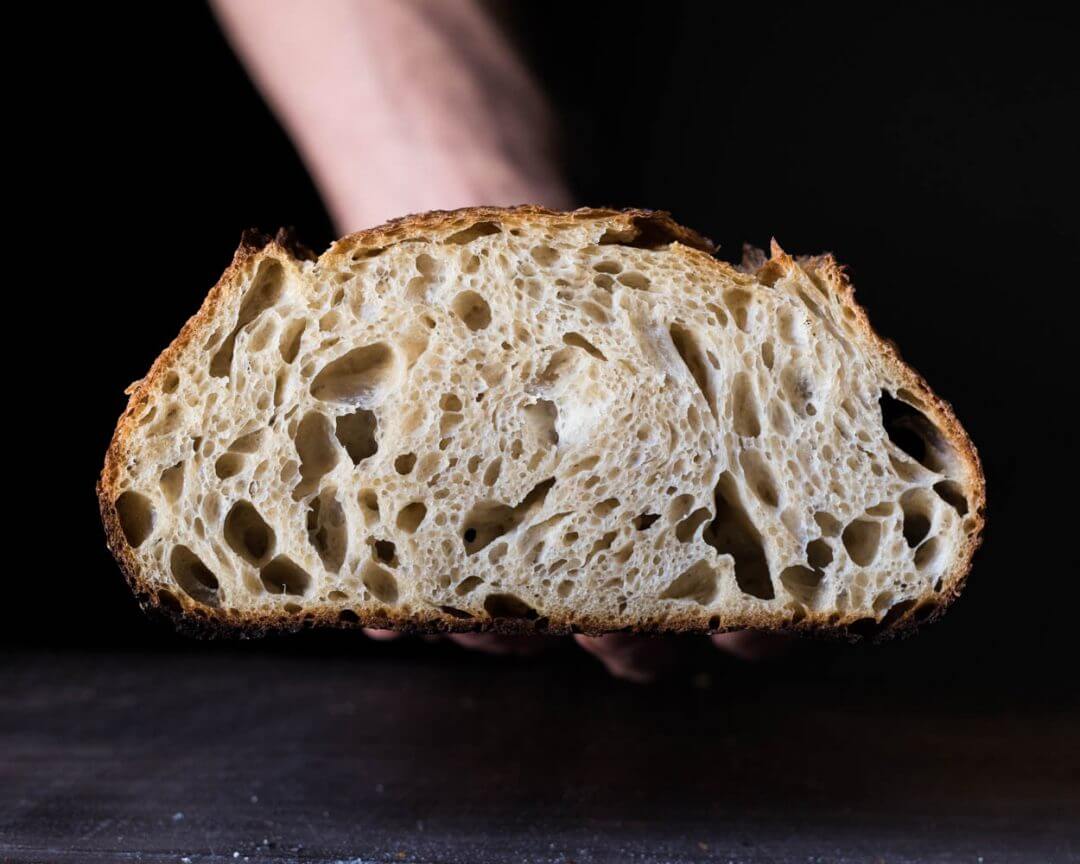
I ordered white Sonora wheat berries on a whim. I was already ordering some flour from Hayden Flour Mills in Arizona, and I decided to add a bag to my order. I’m so glad I did. This white Sonora sourdough recipe comprises a good chunk of whole-grain wheat flour and yet doesn’t taste anything like it.
White Sonora is soft white wheat that is not typically used for hearth loaves but used more frequently as a basis for food like tortillas. However, some bakers, namely Josey Baker, make some excellent bread from this wheat in California. Early in my trials with this flour, I made some unexpectedly fantastic loaves, and these early bakes tipped me off to what would ultimately be my focus for this bread: the crust.
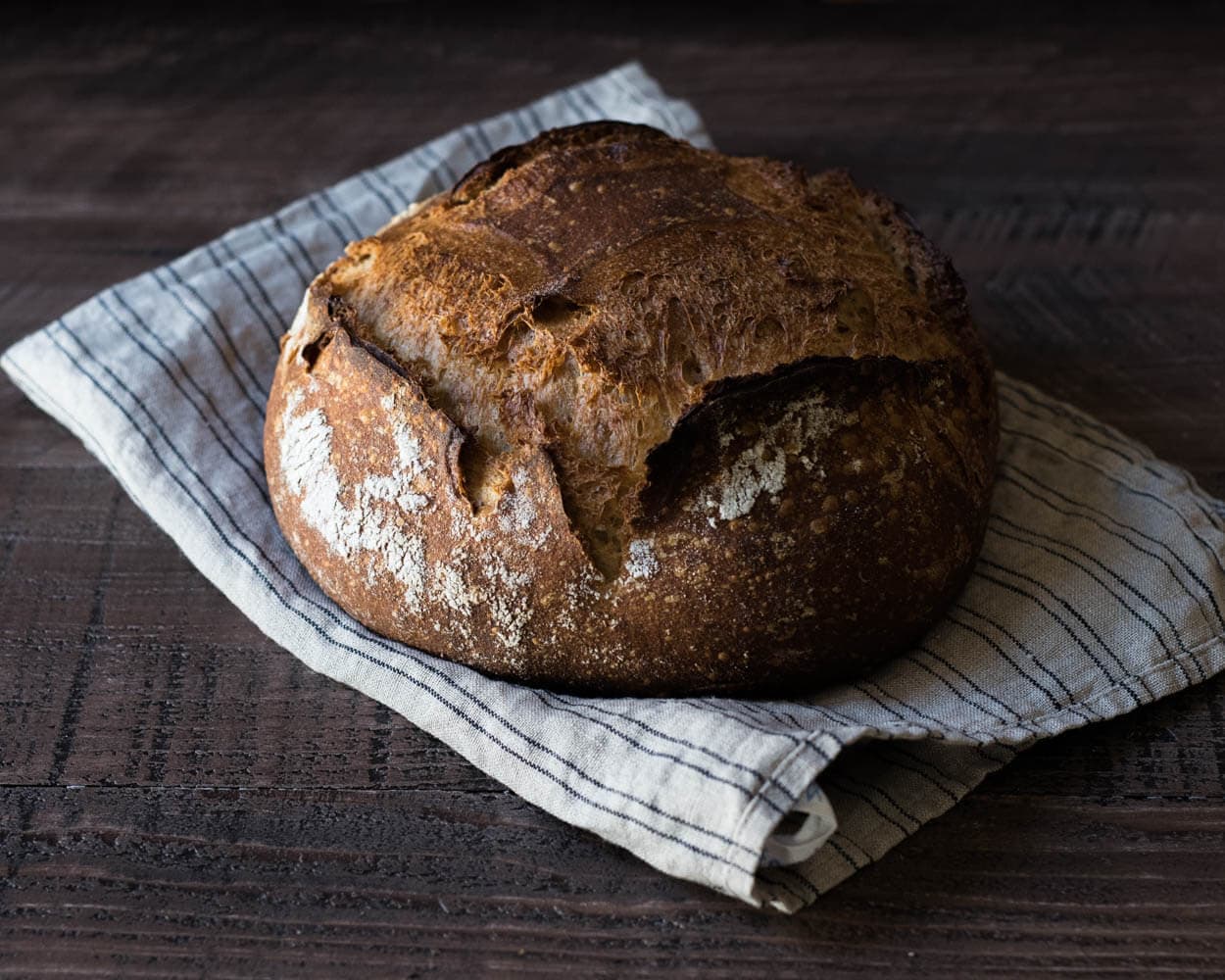
There’s something special about the way this flour bakes. The smell of the finished dark crust, which is amplified when toasted, is reminiscent of a freshly baked pizza pulled just from the oven. You know, one of those magnificent Neapolitan pizzas cooked in less than 2 minutes that’s still bubbling and slightly scarred from the searing oven. It has a creamy and sweet smell to it, and even though the resulting loaves look rustic and crunchy, it is surprisingly soft and supple. In my previous post on my favorite sourdough recipe, I mentioned how I love the crust above almost everything else, and this flour makes that statement true many times over.
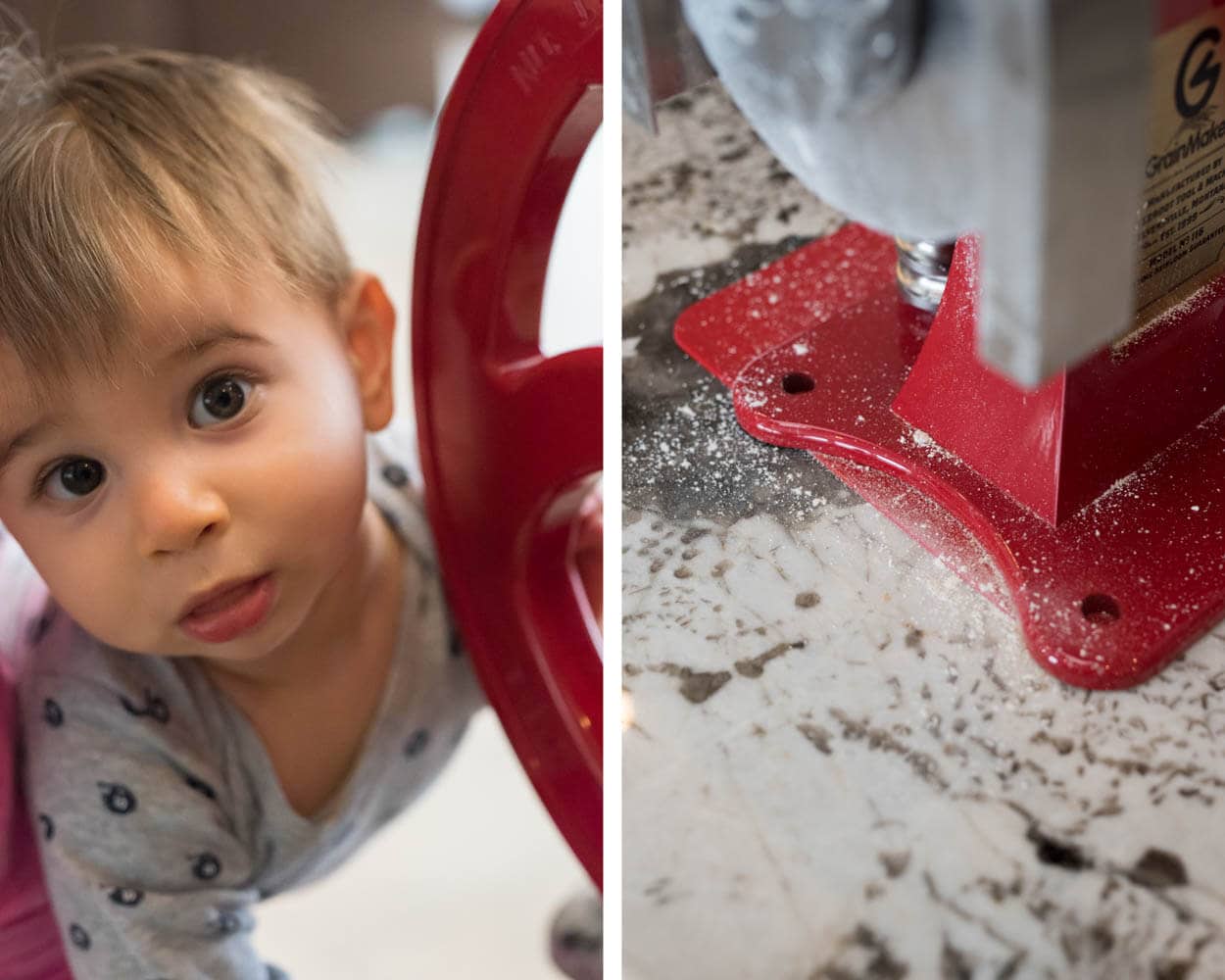
Besides fantastic bread, I’ve used this freshly milled flour in several things around my kitchen, most notably, pancakes (and I’d venture to say they’d be amazing in pumpkin pancakes). Talk about a light and fluffy pancake! This flour made the pancakes sweeter than traditional wheat (if you make these, I’d suggest holding back any added sugar) and incredibly light and airy (I make them by folding in whisked egg whites). I could see using this flour in other foods, like scones, flaky Southern-style biscuits, and cookies. I plan to tackle a few of these self-suggestions starting this weekend… But first, let’s talk about milling these beautiful little berries. I just had to share this photo. The big, shiny, red GrainMaker is an instant hit with the little one. They warn you about this in the manual (the mill is a heavy beast, so you want to keep an eye on it; the handle is very tempting for a kid to swing on). My son, Luca, gets a huge grin on his face when he sees me pull out the mill. To him, it must be the most tempting item ever placed on the counter. I always let him try and turn the crank a few times, a sort of Sword in the Stone test, but much to his sadness, his strength is still a few years out.
Flour Selection
White Sonora is an old wheat variety; it’s one of the oldest surviving wheat varieties in North America. It is remarkably drought-resistant and grows well in the USA’s Southwest region, where freezing temperatures are less common. It was once used heavily on the West coast before hybridized wheat varieties were developed and all but pushed it out. It seems like this grain is making somewhat of a comeback, and thankfully you can now find it at several places online.
White Sonora wheat is one of the oldest surviving wheat varieties anywhere in North America.
Slow Food USA
If you’re interested in trying to source some Sonora for yourself, see my Resources section at the end of this post for a few places that carry it—raw berries and fresh milled. I’m confident you will not regret ordering a sack or two, even if you don’t use it in bread (but I hope you do).
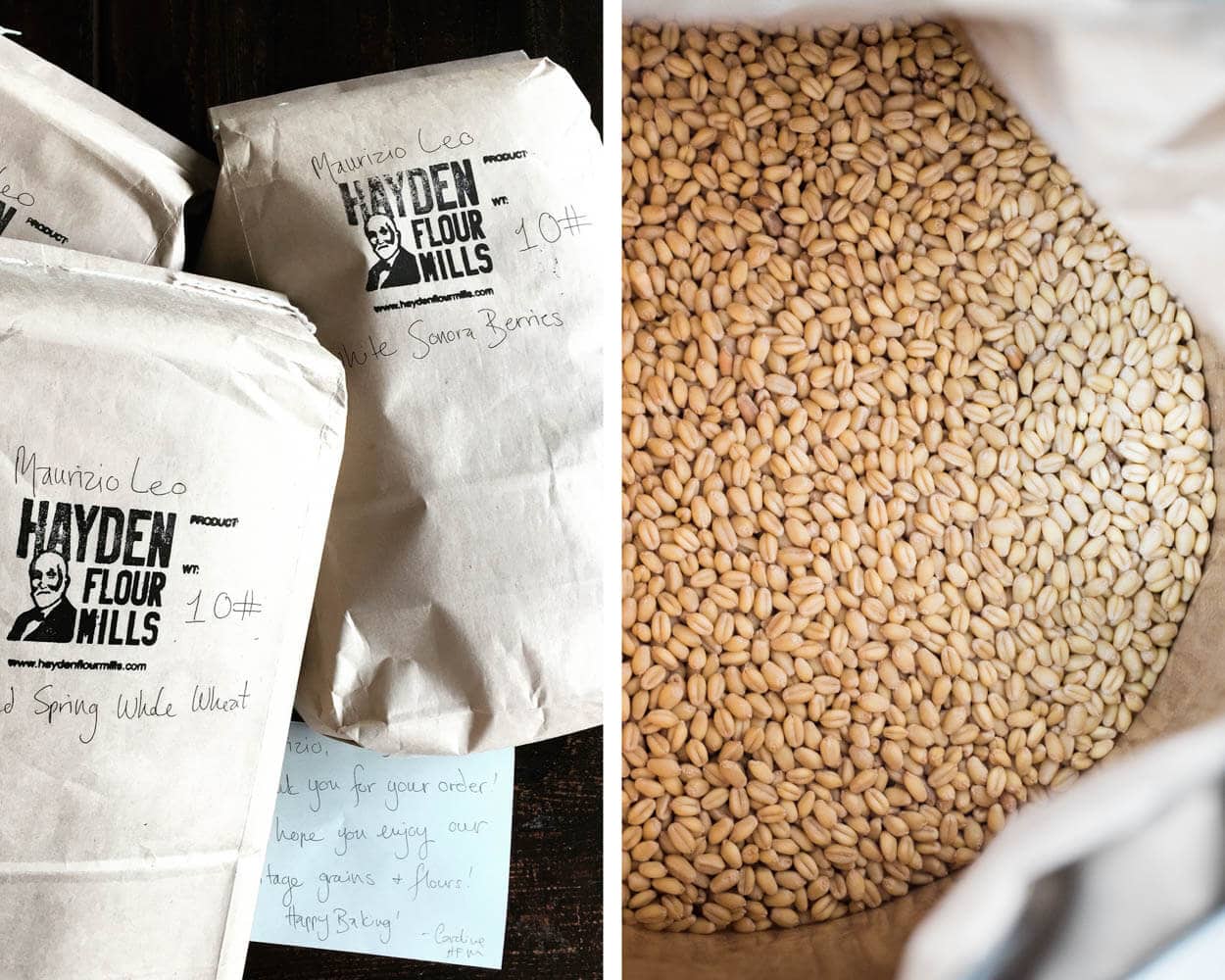
I know not everyone has access to this flour or raw berries, but you can, for the most part, equate this wheat with all-purpose flour — that is, flour with lower protein levels. The same process and formula below will work well with many all-purpose flour varieties out there. I have been working on a method that will produce a loaf that is open and light yet still contains a hefty percentage of the soft Sonora wheat. I ended up with a combination of Central Milling Organic High Mountain Hi-Gluten flour, Giusto’s Artisan Bread Flour, and of course, freshly milled Hayden Flour Mills white Sonora wheat. The thought here is to add a bit more strength to the weaker white Sonora with stronger flour, and you could do the same with something like King Arthur Bread Flour or another flour with higher protein levels (somewhere near 13%).
White Sonora Wheat & Milling
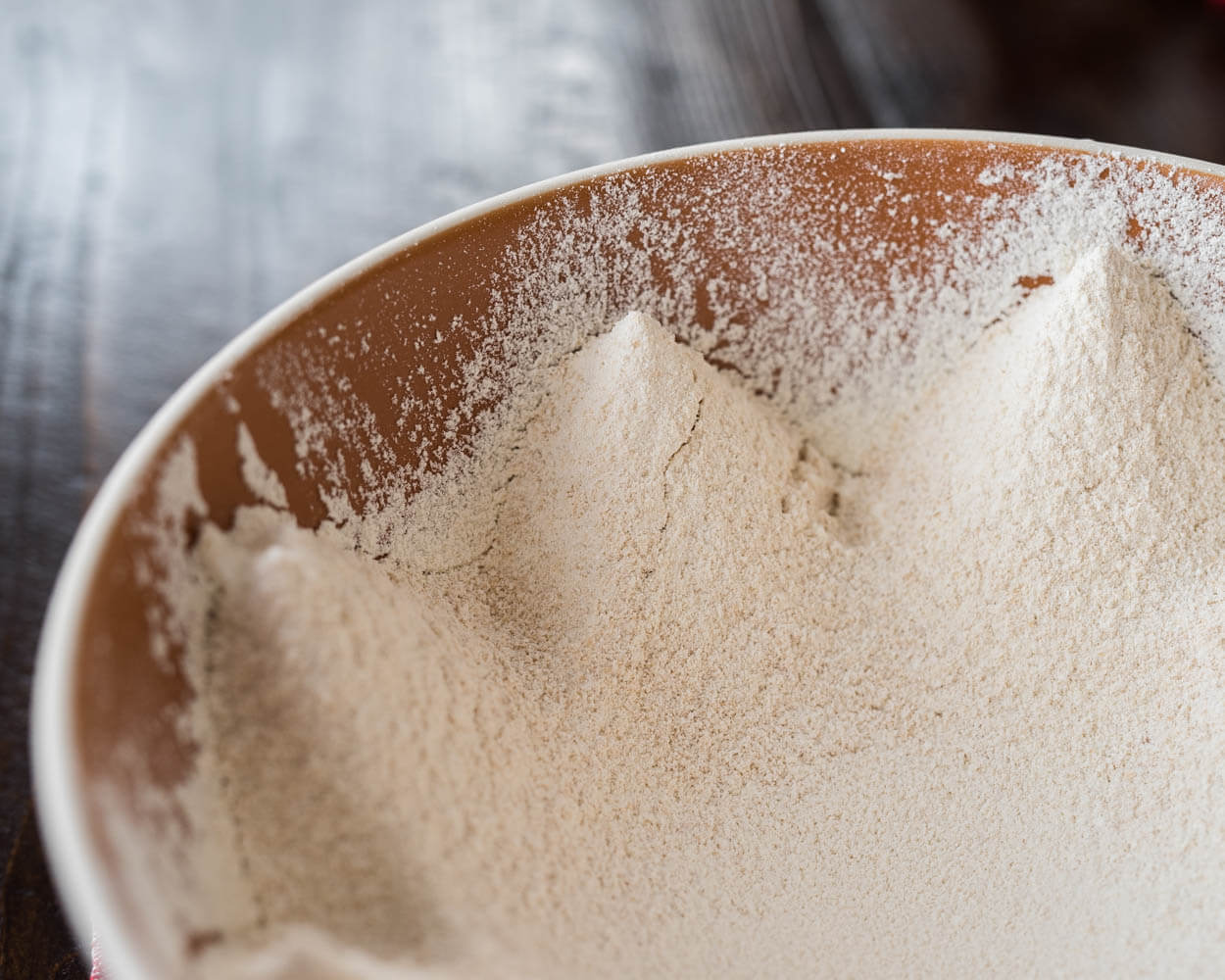
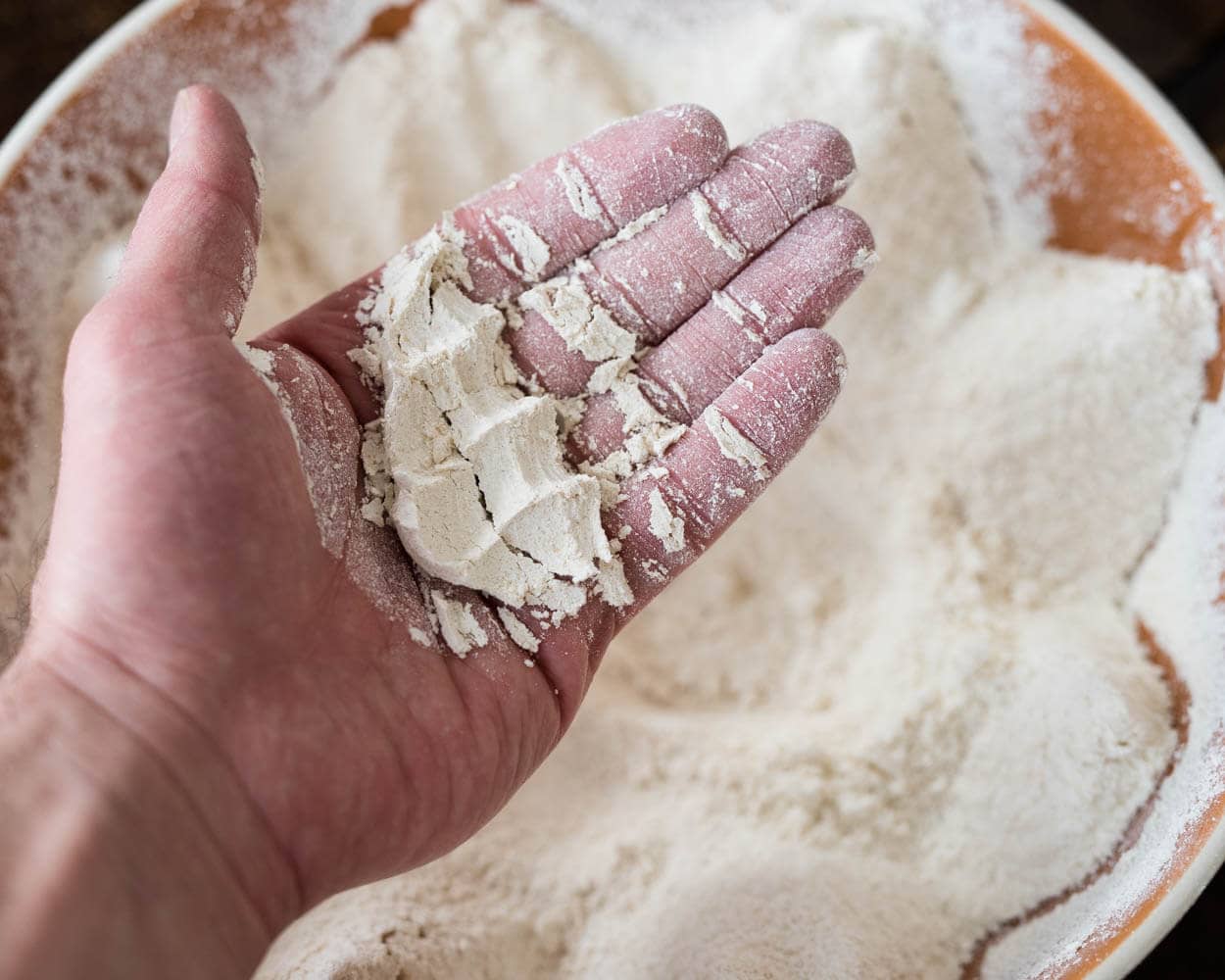
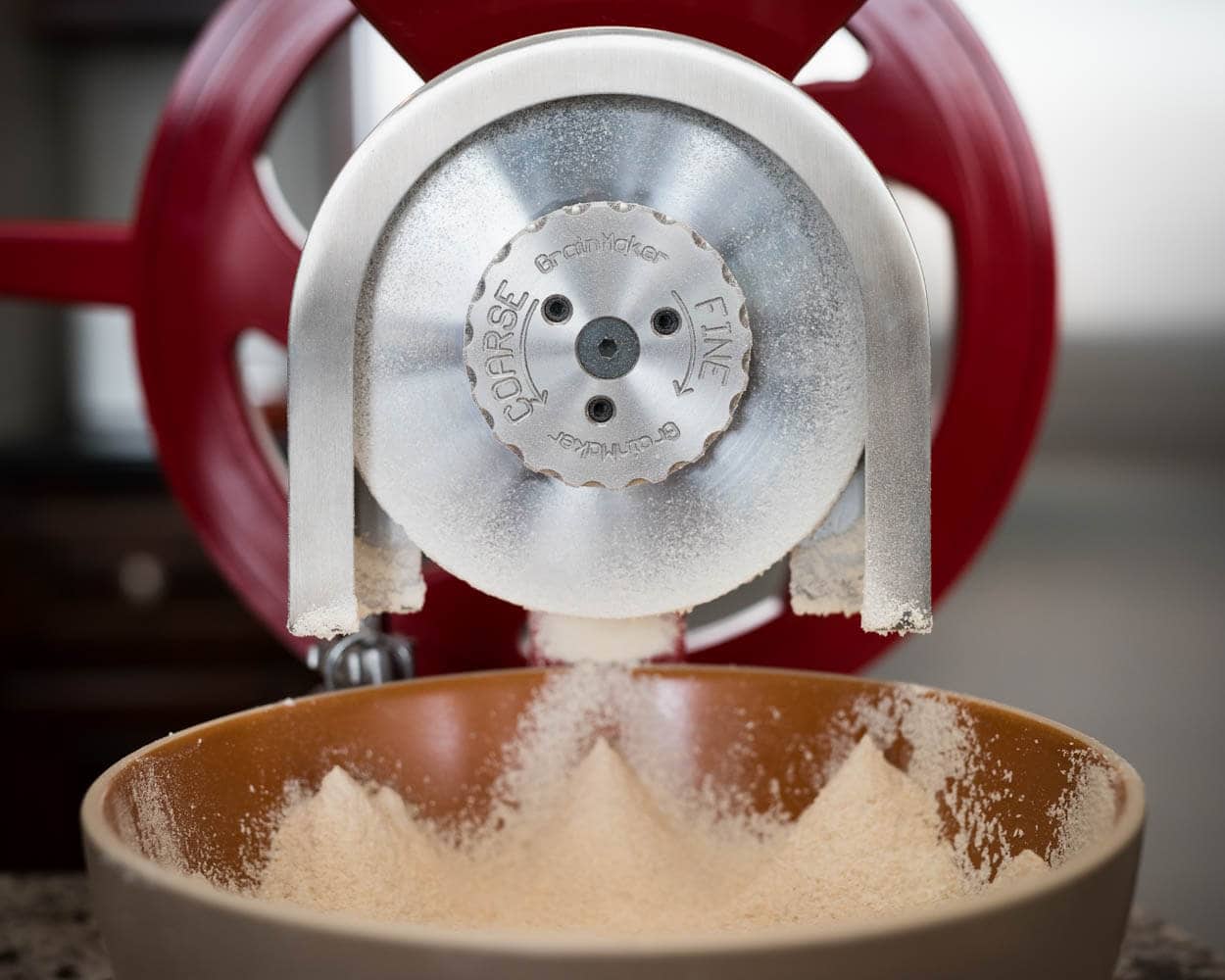
White Sonora berries are round and have a pale, creamy color. When milled, the flour turns a lovely yellowish hue reminiscent of very light zabaione. Beautifully elegant, fluffy, and light in of color and smell similar to fresh cream — intoxicating. With my GrainMaker, I’m able to mill the grain to an almost powdery texture, so light in fact that the grain floats up a bit and sticks to the burrs and dust guard. This creates a small mess, but the results are worth it: tiny bran/germ particles and the flour cakes in your hand when squeezed: a good sign that healthy oils from the grain are still present in the flour.
White Sonora Sourdough Recipe
Vitals
| Total Dough Weight | 1,800 grams |
| Pre-fermented Flour | 6.00% |
| Hydration | 85.00% |
| Yield | 2 x 900g loaves |
If you want to halve this recipe just take all ingredients (including the amount of levain used in the final mix) and divide by 2.
Levain Build
| Weight | Ingredient | Baker’s Percentage |
|---|---|---|
| 35g | Ripe liquid starter (100% hydration) | 50% |
| 35g | Giusto’s Stoneground Whole Wheat | 50% |
| 35g | Giusto’s Artisan Bread Flour | 50% |
| 70g | Water | 100% |
Dough Formula
Note that the baker’s percentages listed below are with respect to the final dough ingredients and do not take into account the levain.
The target final dough temperature (FDT) is 78°F (25°C).
| Weight | Ingredient | Baker’s Percentage |
|---|---|---|
| 353g | Fresh milled White Sonora | 39.42% |
| 306g | Giusto’s Artisan Bread Flour | 34.13% |
| 237g | Central Milling Hi Mountain Hi-Gluten Flour | 26.46% |
| 9g | Diastatic Malt (optional) | 1.06% |
| 753g | Water | 84.13% |
| 18g | Fine sea salt | 2.01% |
| 130g | Mature, liquid levain | 14.55% |
I added a small amount of diastatic malt to this formula to help color the crust even more and get that nice caramelization during the bake. The added malt is optional, and you’ll still get bread that is just as fantastic without it. I like to use this diastatic malt, made in the USA, but any will work just fine.
Read more about why diastatic malt powder can help your bread baking.
Method
1. Levain – 9:00 a.m.
Build the liquid levain in the morning and store somewhere warm around 78°F (25°C) ambient. Alternatively, you can build your levain in the evening the night before and leave out at cooler, room temperatures (around 72°F/22°C) and it should be ready in 10-12 hours.
2. Autolyse – 1:30 p.m.
Mix flour and water (reserve 50g water for the mix, later) very well in a bowl and cover. Ensure all dry flour is hydrated. Store near levain (we want the temperature of the dough to remain warm).
3. Mix, Step 1 – 2:30 p.m.
For the first step scoop out the required amount of levain on top of your autolysed dough and using about 30g of the reserved water hand mix the levain into the dough, so it’s incorporated.
Dump the dough out onto a dry, flourless counter and slap and fold for approximately 3 minutes. A rapid slap/fold session here at the beginning helps get the dough off to a strengthened start. As the flour is a bit weaker, I find it helps to develop the dough at the beginning, and then proceed through bulk per usual with stretch/folds.
If you prefer not to slap/fold on the counter, you can build strength in another way, such as stretch and folds in the mixing bowl. Perhaps somewhere close to 30-40 rotations. You want the dough to start to hold its shape and lose just a tad of that shaggy look.
Let the dough rest 30 minutes before proceeding to Mix Step 2 (where we add salt).
4. Mix, Step 2 – 3:00 p.m.
30 minutes later spread the salt on top of the dough and use the remaining water to help dissolve. Mix thoroughly with your hand to get the salt incorporated, but no need to mix too intensively as we’ve already strengthened the dough enough at Step 1.
Transfer dough to a tub or thick-walled bowl for bulk fermentation.
5. Bulk Fermentation – 3:00 p.m.
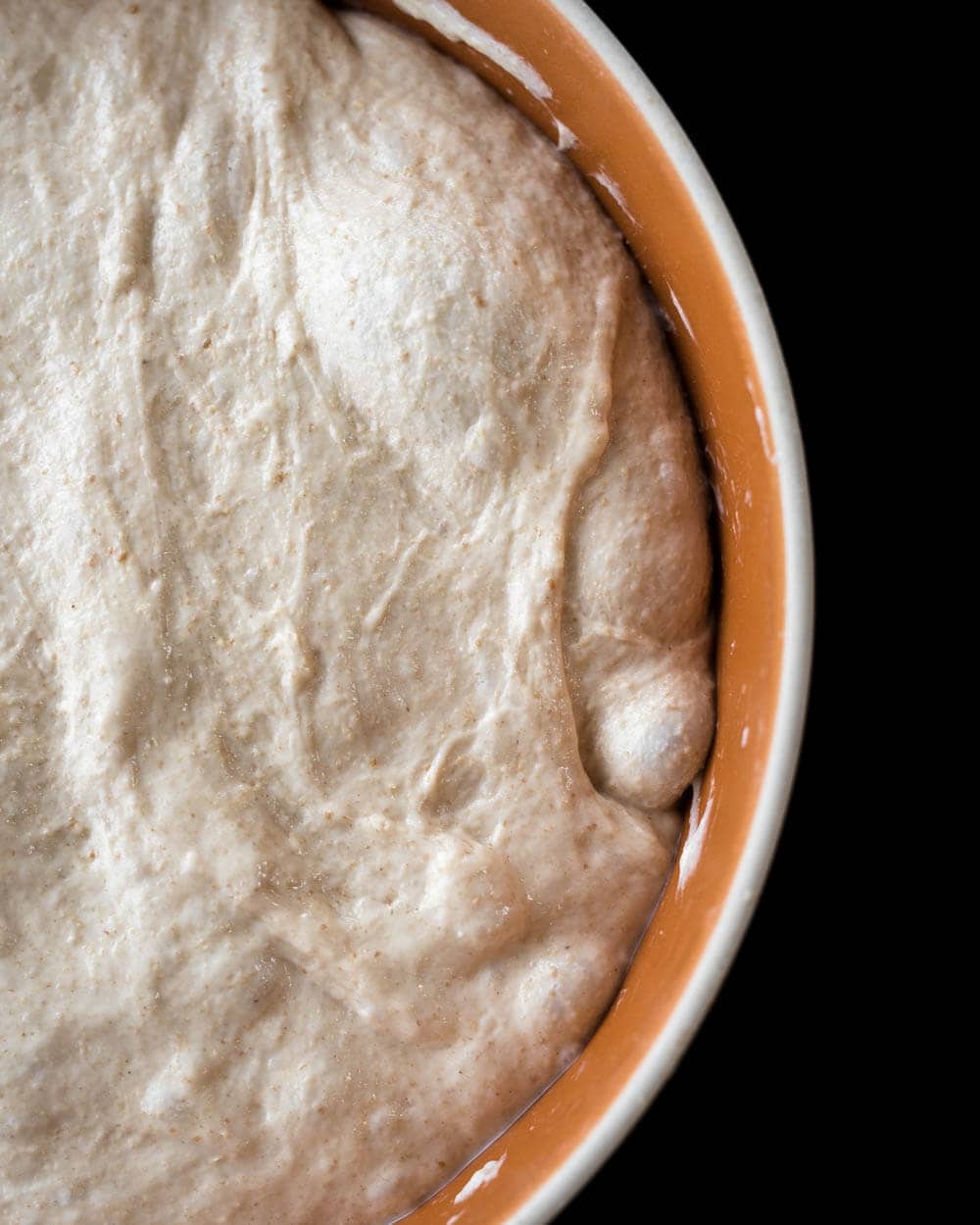
At 78°F (25°C) ambient temperature, bulk fermentation should go for about 4 hours. Perform six sets of stretch and folds during the bulk. The first three are at 15-minute intervals, and the last three are at 30-minute intervals. After the last set of stretch and folds let the dough rest, covered for the remainder of bulk fermentation.
6. Divide & Preshape – 7:05 p.m.
Divide the dough into two halves. Lightly shape each mass into a round, and let rest for 25 minutes uncovered.
7. Shape – 7:35 p.m.
Lightly flour the top of your dough rounds and flour the work surface. Use a little extra flour on the work surface and ensure your hands are nice and floured, shaping this white Sonora can be tricky as it wants to fall apart quickly and stick to just about everything.
Shape as a batard or boule and place seam side up in a proofing basket or banneton.
For instruction on how to shape this dough as an oblong loaf, see my post on how to shape a batard (with video!).
8. Rest & Proof – 7:45 p.m.
Cover your banneton with plastic and immediately retard in the refrigerator at 38°F (3°C) for 12-13 hours.
9. Bake – Next Morning: Preheat oven at 6:00 a.m., Bake at 7:30 a.m.
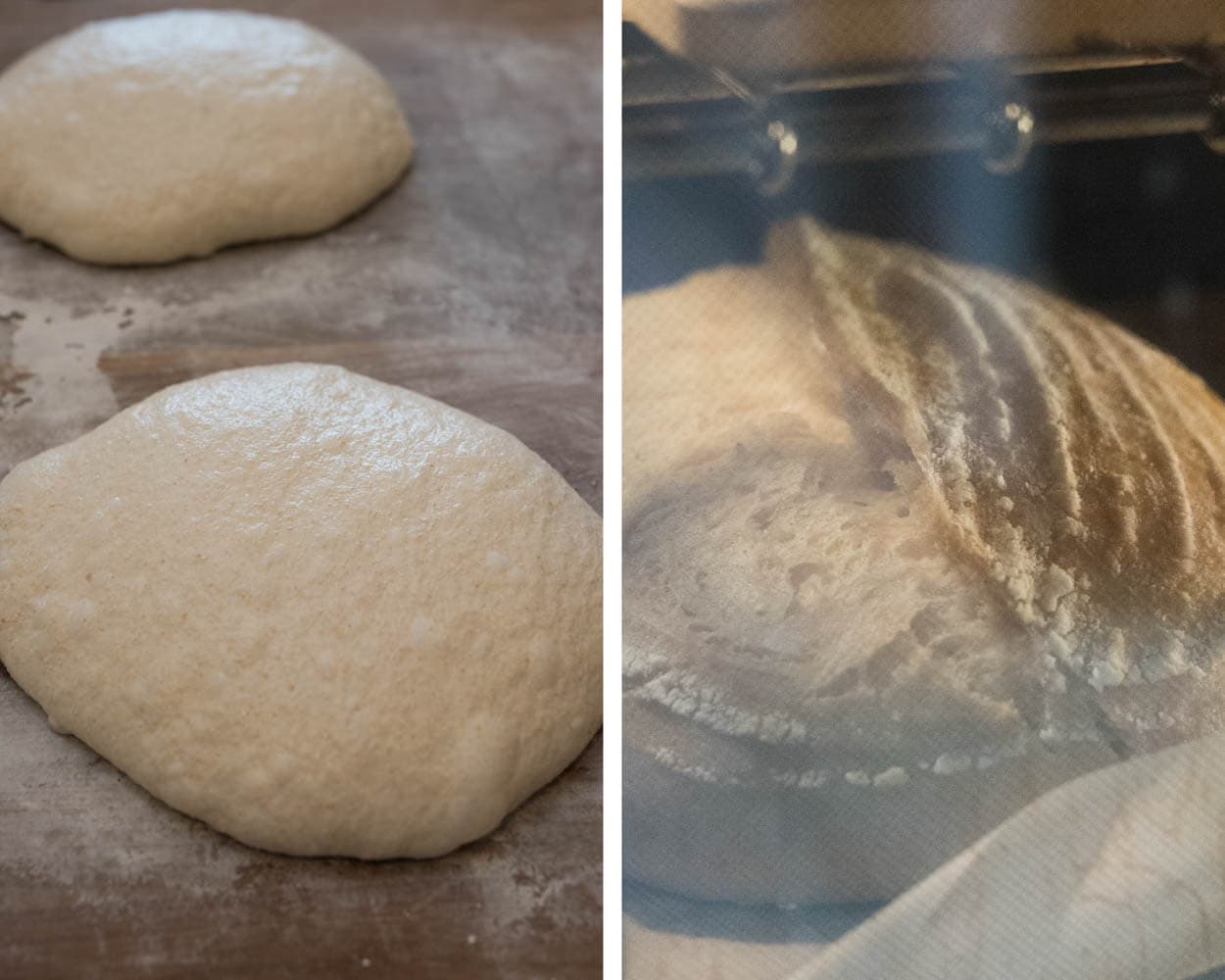
Preheat y our oven to 450°F (230°C). Bake for 20 minutes and then vent your oven (remove steaming pans or lid to Dutch oven). Then, bake for an additional 30 minutes until done. These loaves took extra time in my oven (about 10 minutes), keep an eye on them at the end, and go until they have a beautiful and dark crust. I steamed my oven in my usual way, described here in my post on how to steam your home oven for baking.
Conclusion
From my very first trials baking this white Sonora sourdough my focus for this has been all about the crust. That first taste gets you hooked so bad you can’t see anything else besides that next bite of crust, chomping down until you realize you’ve eaten half the loaf. It’s a dangerous thing, this golden bread.
It’s scary to think that this wheat variety was almost lost to us, and is just now starting to come back and become available. What was once a prominently used grain in North America, almost wholly abandoned for one reason or another — I’m glad the hard work of these local farmers helps to keep this beautiful grain available. It also makes me wonder, what other varieties have we lost to time?
Crust
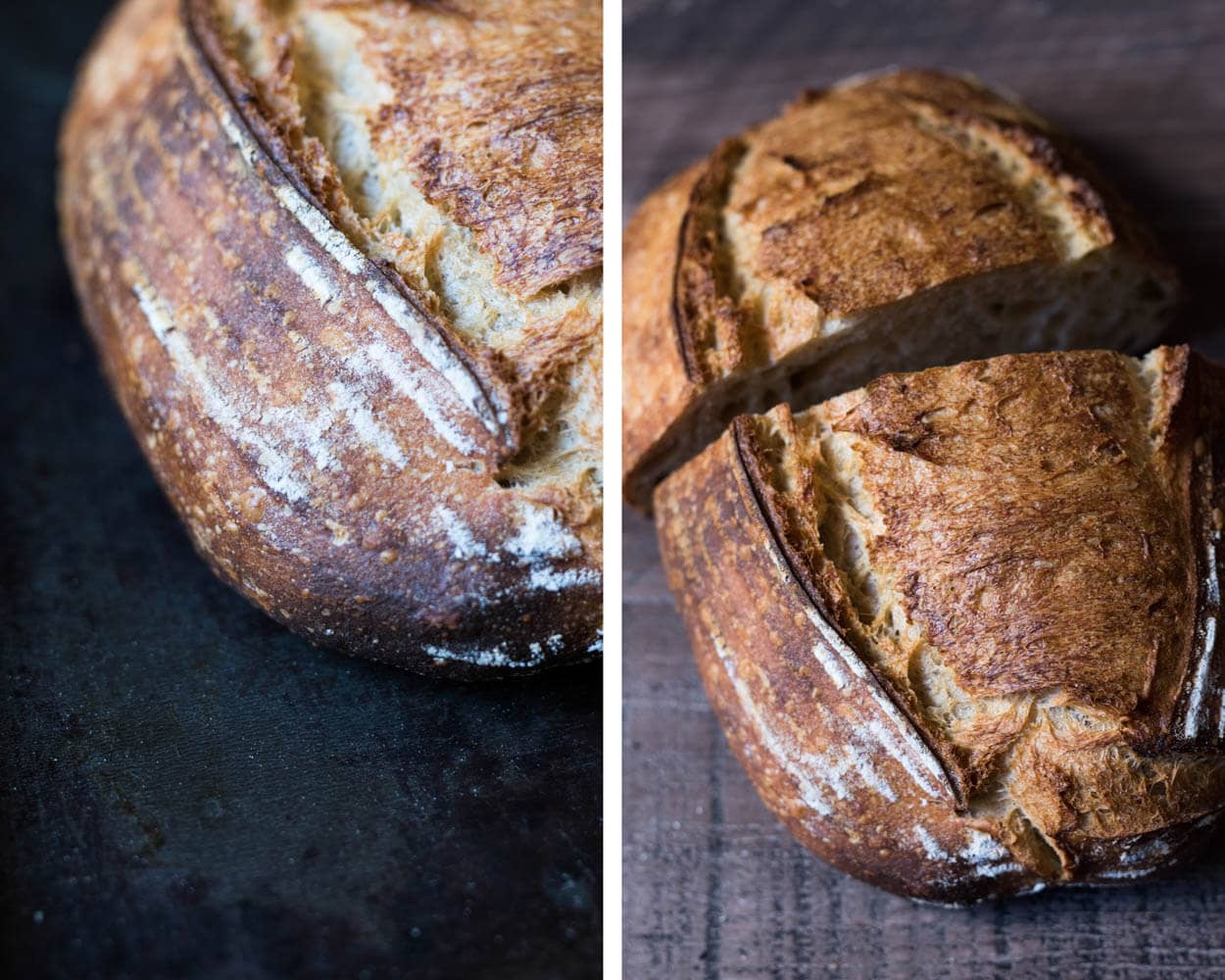
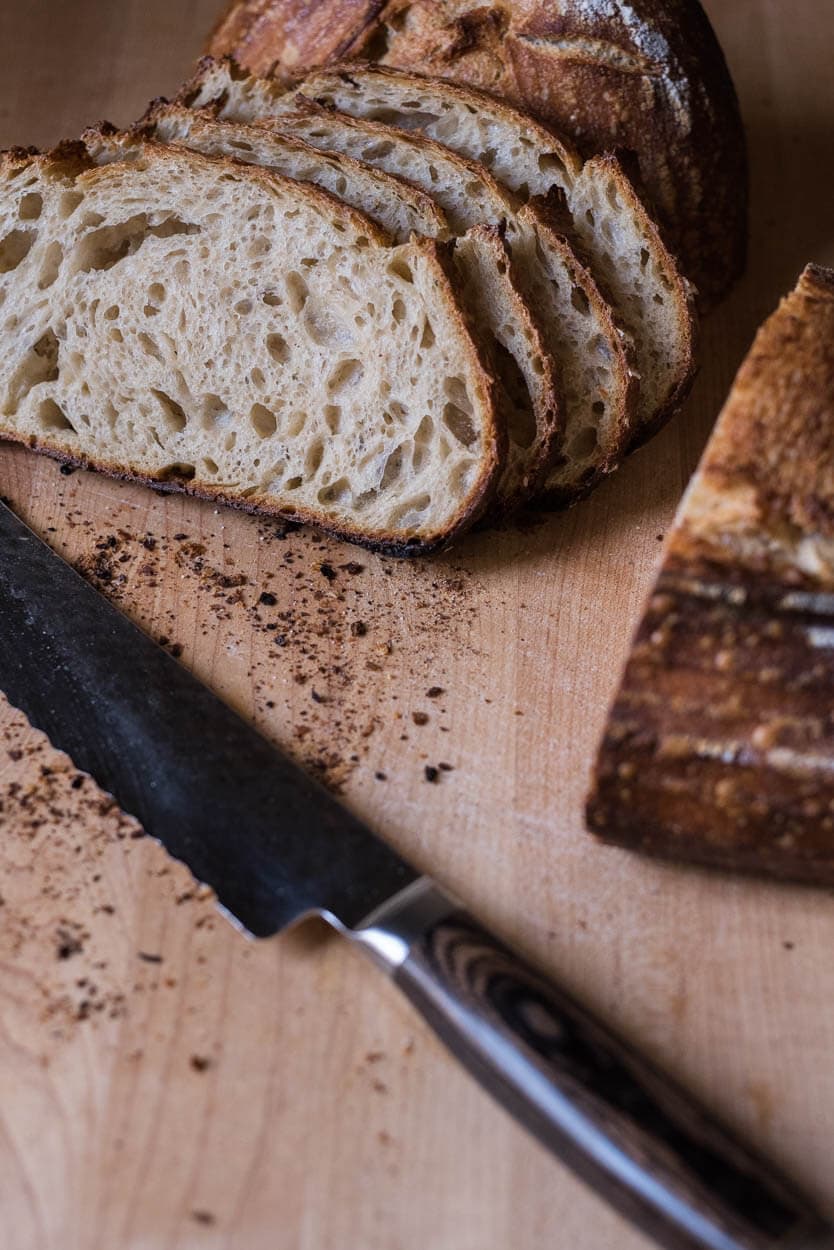
My foreshadowing at the beginning of this post is reiterated here: the crust is something very, very special with this bread. It bakes to a shiny, golden hue that crackles and crunches as you bite. In the batard above I slashed a bit differently to get that “double ear” you see there (there’s an edge on both the left and right side). To get this effect, you slash straight down the center with the blade at a 90º angle with the dough (perpendicular). I did this in some of my later bakes with this bread because I wanted even more of a dramatic opening in the middle. That open area is a little softer than the surrounding crust and is flaky & thin — it almost resembles pastry. If I could magically make the entire loaf open up this way I surely would.
Crumb
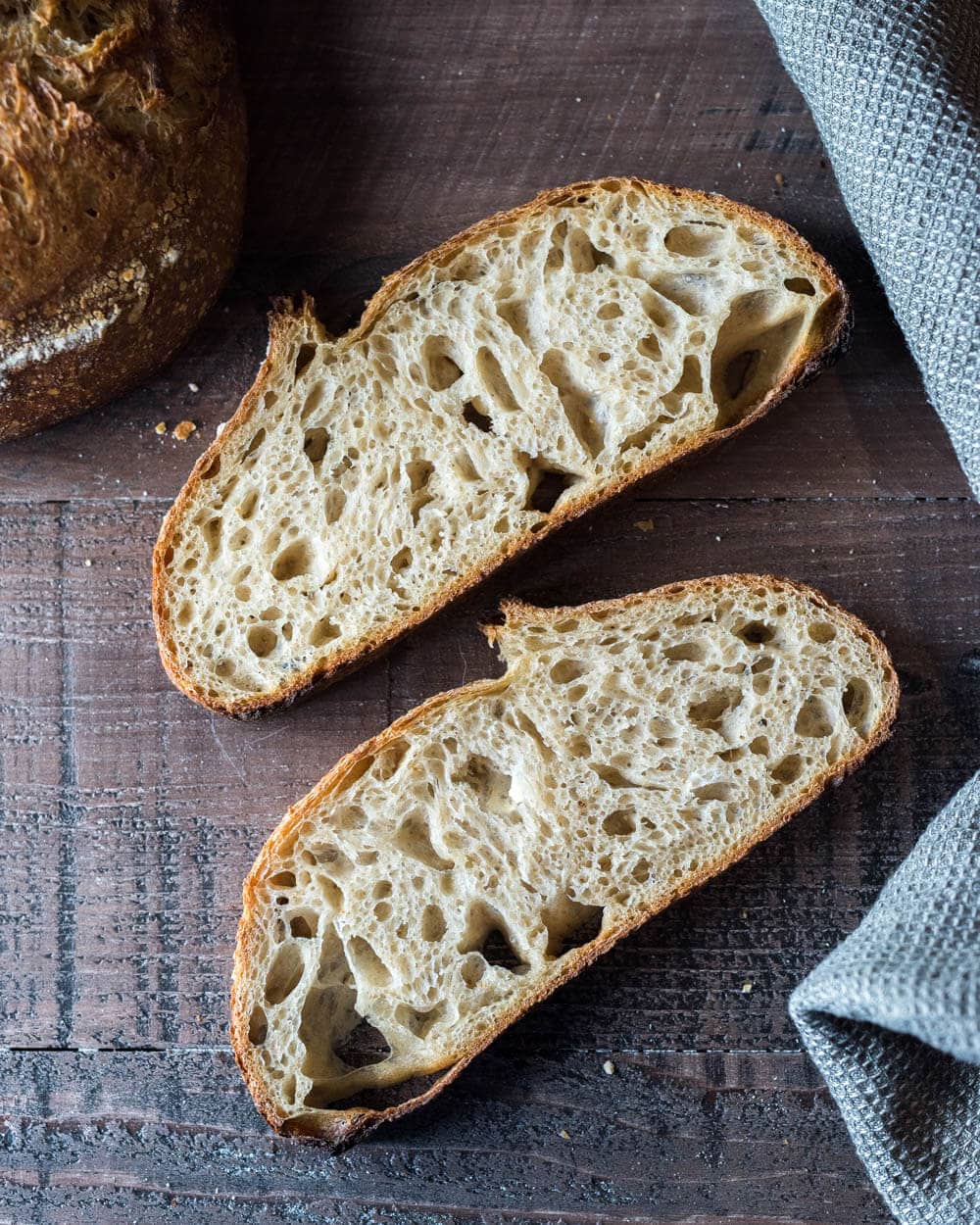
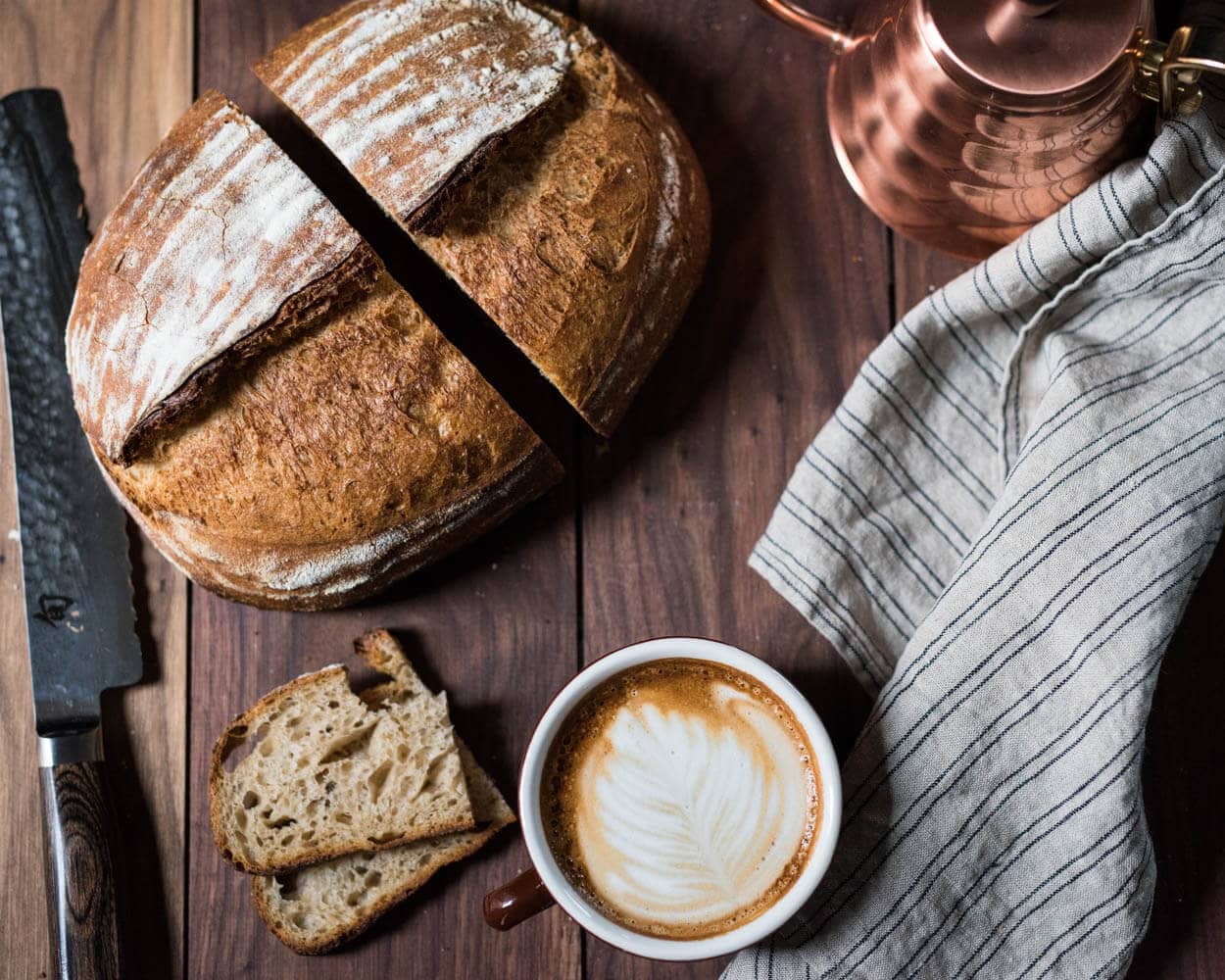
A cream-colored crumb cannot be a bad thing, and in this case, it surely is not. Very tender, light and no sour notes or bitterness.
I had to shape this bread rather gently to preserve the open structure of the crumb. The soft white wheat almost tears if you tug on it too intensely, your hands need to be gentle yet confident. I believe I could open things up even more through fewer shaping movements and more practice. Of course, we are always walking that fine line between sufficient tension and gentle handling.
Taste
Beautiful gelatinization and translucent webbing throughout. This bread with a good chunk of whole wheat flour in it yet tastes nothing even remotely close to whole wheat. It’s sweet and creamy, absolutely no bitterness present, and holds up surprisingly well to robustly flavored accompaniment like sharp cheddar or gorgonzola. However, I have found a particular fondness for toasted, slightly warm slices topped with thinly shaved manchego. Heaven.
Buon appetito and may the crust be with you! (…hey, I just watched Star Wars, a second time)
White Sonora Resources
Hayden Flour Mills
This is where I purchased my 10-pound sack of White Sonora berries for milling. A great resource for not only white Sonora but other grains, especially if you live in Arizona!
Grist & Toll
At the time of this writing fresh milled white Sonora flour is available here (no wheat berries, their offering is already milled). Grist & Toll has a fantastic reputation for high-quality grains.
Roan Mills
A family-owned farm based in California with a wide variety of hard-to-find grains and flour.
Delitaliana
I have not purchased from this supplier, but they indicate their white Sonora is grown organically in California, available through their Amazon store.


49 Comments
The levain build is 175g, but only 130g of it is used in the dough? Is this an error or am I misunderstanding something?
I’m trying this recipe with freshly milled soft white wheat flour to replace Sonora, and KA Bread flour for the rest. (I accidentally bought 25lbs of soft white wheat and am looking for a way to use it 😉 )
Would you recommend using all KA flour for the levain, or half/half with the soft white wheat? Do you think I could safely up the amount of soft white wheat?
Yes that's right. This is an older recipe and it made a larger levain than was needed!
Any of the flours will work fine for the levain!
Does this bread have a 4 hour autolyse?
Oof, that’s a typo. Should read 1:30pm for the beginning of the autolyse! I’ve updated.
Hi Maurizio,
I’ve been so happy with all of the rich information you have on your website. AND, I just received your book in the mail – yay! I found you when researching sourdough recipes with Einkorn. I’m now stretching my bread making to include other flours. For this White Sonora recipe, it calls for Giusto’s Artisan Bread Flour and Central Milling Hi Mountain Hi-Gluten Flour in the dough formula. I’m hoping to order flour from one source at this time. Would Central Milling Artisan Bakers Craft Plus be an adequate substitute for Giusto’s? I ordered flour from Hayden Mills, so I have the White Sonora Wheat and Heritage Bread Wheat in my pantry. Thanks for your consult – I find flour selection exciting and a bit overwhelming. 😉 Perhaps I read a thread comment that you are working on a flour selection .pdf. I’m excited about that! Thanks, again. Lauren
You’re very welcome, Lauren! I really hope you love my cookbook. Yes, CM ABC is a perfect sub for the Giusto’s flour. I love Hayden flour, in fact, I have a recipe coming out using my custom flour blend they’ve milled for me! Stay tuned 🙂
Was curious what adjustments I need to make baking this bread at 7,000 feet. I did not get the air bubbles and the bread was a little flat . I used 100% sonoran wheat.
Hey, Stephanie! Check out my guide to baking at high altitude for some tips 🙂
How do you think it would turn out using freshly milled soft white wheat? In place of the Sonora.
Would be really nice, Robin. Very similar performance I’d guess, and really nice flavor with the fresh flour.
I just started making this – I assume you add the malt in the autolyse? I don’t see a mention of that. Thanks.
I usually do add it, but either way. If you think about flour that has malt added (which many “bread” flours do), it gets added from the get-go 🙂 Happy baking!
I was thinking more of when it’s added but I guess it’s obvious that it’s with the flour! I’m going a bit rogue and making a 100% whole grain bread. 70% Sonora, 30% yecora rojo, with the same 84% hydration. Fingers crossed!
Just to report back – the bread was great – but next time I will make 100% Sonora as I think the yecora flour made it hard to tell what the Sonora really tastes like. I upped the hydration to 86%, which was about right.
Yes, the Sonora is very mellow and milk. Glad to hear it went well though, from here on it’s just little tweaks to get where you want to be. Thanks for reporting back, Cathy!
I made this recipe today. Came out great.
Used whole white sonora purchased from Breadtopia. It was milled about two months ago. Had to sub in some Central Milling ABC plus for the high mountain since I ran out of high mountain and KA bread flour while measuring.
The bread is pretty much as Maurizio describes it. Hard to tell it has so much whole wheat. Very tender and pillowy crumb. Thinner but crackly crust. Sweetish in flavor. Almost seemed like a really high class … white bread!
My dough was not crazy sticky. I used all but 15g of the water called for. Did 40 folds at the start, three S&Fs and two coil folds. Let the bread rest in the baskets for 60 minutes before putting in the fridge. Nice rise and open crumb.
I am going to use this as a base recipe to try red fife, red turkey and yecora.
So glad to hear that!
Like so many other folks in quarantine I started learning to bake sourdough a month ago in part using your guides but I quickly ran into trouble sourcing good flour after I used up the KA bread flour I had on hand. Hayden Mills is one of the few places I’ve found online selling artisan flour in semi-reasonable quantities (though it is expensive) that still has it in stock (I’m not quite ready to buy 50 lb bags just yet). I got 10lbs of their AP and 10 lbs of their Artisan Bread Flour and followed this recipe using a 50/50 mix of the two (no malt powder). I thought that ought to approximate the the blend you used since their AP is not all sonoran white. The result is the first loaf I’ve made that really competes with ones I’ve had from my favorite bakeries. Really soft and delicate with a papery crackly crust and great flavor, though I didn’t get quite the open crumb you did, probably because of my poor shaping skills. Anyway, thought I’d say thanks for the helpful website and share my experience in case anyone is in the same boat as me flour-wise.
Hi Maurizio,
Thank you for such an in depth site. Very excited that you can make real European bread at home. You inspired me to get a mill so I got a mill and a bunch of different grains coming. I would like to make a bread with only fresh milled. Is it possible to make a bread with an open crumb with one of these I ordered? Sonora, soft winter wheat, durum, heirlooom red fife, heirloom red turkey, or emmer wheat? I was thinking sonora and one of the red heirlooms? I also have KA bread flour but was trying to do an organic fresh milled bread. Thank you!!
You’re welcome, Leilani! Yes, you can certainly bake a light loaf with any of those flours, in the right combination. Sonora and red turkey would work super well, as would the others. It’ll take some experimentation (or some of the recipes here at my site 😀), but that’s part of the fun!
Hello! I’ve just started baking and have made 3 rounds of a beginner’s sourdough recipe, and I’m now addicted! I bought some local, organic White Sonora and am going to try this recipe. Before I do, can you help me confirm the dough recipe? I have at home the White Sonora, King Arthur Bread Flour, King Arthur All-Purpose Flour, and a local whole wheat variety. In the dough recipe, which would you use for the 237g “Central Milling Hi Mountain Hi-Gluten Flour” at 26.46% baker’s percentage? THANK YOU! Bake on! 🙂
Hey, Emily! Sorry for the delay. I would use your KA Bread Flour in place of the Hi Mountain — they both have similar protein levels and are both strong flours. I hope you enjoy this recipe — happy baking!
I’m happy you’ve had an opportunity to work with this wheat. I was living in tucson for a while and discovered it there. Never had anything like it. The root structure of this heirloom variety reaches 12 feet beneath the ground, as compared to the puny 1-2 foot roots of the modern common hybridized dwarf varieties. There’s a museum in tucson (called the desert museum iirc) that has a display showing the root structures of the sonoran white wheat vs modern. Super cool to see. Thats where the flavor (and nutrition) come from.
That’s incredibly interesting, I didn’t know that! Well, that’s why it must be possible to grow this variety in such a dry climate (which I am intimately accustom to!). Thanks for that and happy baking!
Hello Maurizio! If I was to buy the White Sonora all purpose flour from HFM, would any changes be made to the flour types you use in the recipe or would it stay the same? Thank you!
White sonora is my absolute favorite wheat—wondering if it would be possible to do a 100% Sonora loaf by adding some vital wheat gluten? Do you have any experience or tips for supplementing low-protein flours with pure gluten?
Such good grain, isn’t it?! Love the flavor and texture. As you know, it’s a pretty soft flour so some added structure is needed. I’ve not tried baking this with added gluten (I’ve never used it, actually) but theoretically it should work out just fine.
I’ve never used it either, but it seems like it could be such a great tool for flours that need a bit of help in the protein department. The idea of a 100% sonora loaf makes me weak in the knees, so that seems like a worthy place to start. I’ll give it a shot and report back!
Yeah, I could see it working well. I usually mix in a percentage of stronger “bread” flour when needed but going with the straight gluten route might be a good tool as well. Thanks, would love to hear how it works out!
Thanks for this. I’ve been on the fence about trying some White Sonora wheat from a local grower in SoCal. They only sell in 50# bags so I’ve been tempted to get it, but wary at the same time since I’ve never used it. Looks like I will have to give it a try.
That’s a large quantity but it’s a really awesome grain. You can use it for so many other things in the kitchen as well (pancakes, waffles, cakes, etc.), I think it’s a worthy investment!
Question! When you are milling fresh, do you use the flour right away or do you let it sit overnight? I’ve had some fresh milled flours used immediately into my bake, and the dough ferments aggressively fast, and they always end up over proofing.
When I let the flour sit out uncovered overnight and use it the next morning, it proofs much more predictably.
Was wondering what you do and if you do use flour straight after mill, how do you account for the unpredictable timeline?
Yes, fresh milled flour has incredible fermentation activity. I almost always use flour the same day I mill. I compensate for the activity by lowering my levain percentage to very low levels (usually single digits) and I use the fridge to proof the dough.
When using fresh milled flour I have to really watch the dough and adjust the timeline depending on how the dough looks and feels — it keeps you on your toes!
Thanks, Maurizio! Good to know. Do you think that the flavor deteriorates if you leave the flour out overnight to let it “calm down” a bit?
I might have to give 7-8% levain a try. Is there a % you usually start with as a ballpark?
Hard to say definitively whether there is a decrease in flavor waiting a few more hours or night. I know that essential oils and nutrients diminish as oxidation occurs but I have never seen any scientific data on durations for that process.
It depends on what other flours are involved with the recipe and the percentage of fresh milled flour in the recipe — if there is a significant amount I usually start right around there: 7-10% levain.
The taste of fresh milled flour is so incredible it’s worth the little bit of experimentation and guesswork 🙂 Happy baking!
Thanks, Maurizio! Always such a help!
Hi Maurizio,
I’ve been trying out some of your recipes lately and have been loving the results. My only issue is that I’m not getting great oven spring (although the crumb is lovely and open) and I’m trying to figure out why. My current guess is that I’m retarding for too long in the fridge overnight, and I was wondering if you think that could be it. If I made the recipe above, for example, starting relatively early on the first morning and getting the dough into the refrigerator by mid or late afternoon, baking the next morning around 7am, do you think it’s likely over-proofing? Curious to hear what you think, although of course it’s hard to diagnose these things at a distance.
Thanks!
Molly,
So glad to hear that your bakes are turning out well! Like you said it’s really hard to diagnose at a distance without more details. I find that about a 8-12 hour proof in the fridge (at 37-38ºF) is usually safe for most people, in general. Of course this depends on the dough and how it’s developing, the flour used, percentage of levain, etc.
If the interior of your loaf has lots of really small holes, tastes a little on the sour side, and doesn’t rise as high as you’d like it could be that you are overproofing. Try cutting back your proof time in the fridge 2 hours and see if you get more rise next time.
If the interior is very dense, gummy and you have stunted rise it could be that your dough is actually underproofed and needs more time in bulk, or at a warmer temperature. The telltale sign of this condition are dense areas in your dough with potentially some large holes here and there.
Finally, it could be simply your shaping is not tight enough and so your dough spreads out more than it rises up. Make sure you have a tight enough skin on the dough after shaping.
I would recommend trying to see where your dough fits in these cases and if you think you have an idea try to keep everything as consistent as possible each time you try to solve the problem. Use the same flour, temperatures, times, etc, while adjusting a single thing at a time so you know what moves you in the right direction and what doesn’t.
I hope that helps! Feel free to shoot me an email (Contact at top) if you’re still having issues!!
I don’t have a good resource for this because, as you said, it unfortunately comes down to trial and error. There are some key things to look for (as I mentioned above) but even those are not hard and fast rules. The comments I mentioned above are things I look for when troubleshooting my own bread and, for example, when I see my interior have dense spots (as in very dense with no holes at all) in it I know the dough could have used more fermentation time.
With baking, as you know, there are so many variables! I find trial and error the best way to fix problems and learn what to do and what not to do. If there’s something off in your baked product, try to isolate that problem and keep everything else consistent so you can see if your attempted changes move you in the right direction or the wrong direction.
Even after baking for a while now I still ask myself those same questions! Hope that helps in some way!
Hi Maurizio,
I am still stuck on the Sonora bread I made after reading your first blog on it. I’ve also tried the more recent Spelt experiment, but my first love is Sonora Wheat. I just wanted you to know, if you didn’t already, that BKW farms in AZ sells an organic Sonora Wheat at a really great price. I bought 30 lbs. of it for a little over a dollar a pound. Thanks again, as always for keeping us posted. It’s a service bakers crave!
Lindy
I’ll have to look into BKW, sounds like a great resource! I still have some Sonora berries I mill from time-to-time and I just fall in love with that flavor all over again. Thanks for the comments, I really appreciate that!
Hi maurizio
I would like to make just one loaf…….do I use the full amount or levain or half that too? I love your site by the way ?
Thanks, I appreciate that! If you are halving the recipe, also halve the amount of levain you would use in the final mix: instead of 130g use 65g.
Happy baking!
Thank you, Sue! I’m so glad to hear of the recent baking success, that makes me happy. Your questions:
1. A true “autolyse” is always just flour + water, no levain. I always have an autolyse step at the beginning, where I later add my levain to, and then later add salt. These are always the steps. Sometimes I add the levain and the salt together right away, and at other times I let the dough ferment a bit longer before adding the salt. Salt, among other things, slows fermentation so I sometimes let the levain get a foothold in before slowing things down. I’ve found this helps get the dough much more active, quicker. You can do whatever works for you, but I suggest giving the dough that 30 minutes before adding salt. So to clarify, there are three steps there really: 1) autolyse with just flour and water, typically for 1.5 hours but anywhere from 1 hour to overnight; 2) add levain to autolysed dough; 3) add salt.
2. I used the Tartine baking times and temperatures as my first guide, but then quickly changed things to suit my preferences. I now almost always bake 20 minutes @ 500F with steam, and then around 30 minutes @ 450F without steam. Each loaf is different, sadly, so at the end of the baking time I pull them out when I think they look “done”. To me “done” is when the loaf is baked nice and dark, almost too dark, but just before 🙂 It’s whatever you enjoy, really. Do you like that dark crust or do you prefer a more pale one? Up to you! Some books recommend an internal dough temp of 212F but I stopped taking the temperature probably 1 week after I started baking 🙂 I’m not sure if that all helps, but really I just use that starting guideline and adjust that remaining 30 minutes up/down depending on how the bread looks. If you want to try and prevent the bottom of the loaf from burning in the Dutch oven, when you uncover it turn the lid upside down and then quickly place the side that is containing the loaf inside the flipped lid — this helps create a temperature buffer of sorts.
I’d also like to mention that baking times can drastically change when you add certain ingredients in your bread. For example, if you add raisins, which are very sugary, you might have to reduce the temperature and/or time of your bake because the added sugar in the loaf will cause the crust to darken rather quickly. In this instance I’ll keep a close eye on the loaf at the beginning to see if it starts to color too quickly.
I hope that helps, it’s a lot of info to digest!
I really like that shirt idea! I’d wear that for sure. Thanks for the comments!
Yes, I went with a much longer autolyse here, and I think it helped pull out more sugars from the flour (to get an even nicer color on the crust) and it helped add a tad of extensibility to the dough. When working with the Sonora I knew I’d have to add a bit more strength in the dough so that was the reason I added that short slap/fold session at the beginning, and it really helped. I might have been able to go a few more minutes, but I didn’t want to risk overworking the dough so early, the surface started to slightly tear and that’s when I call it quits.
Yes, I am pretty sure the hydration was the same, if not a tad higher. I found that sack of T70 I had could really take on extra water. So yeah, very close hydration numbers!
Good luck, let me know how it goes, of course!
Beautiful! What a great right of passage, waiting patiently to be able to grind the grain. 🙂
Thank you!
I wasn’t in love with the flavor of this flour. After a couple experiments I found it tasted good mixed with sweet malt flavors. I ground malted barley from the beer store and used a fairly large quantity. Malt tends to make the dough gummy, but white Sonoran has such weak gluten it doesn’t really harm anything more than exists already.
Did you find just a lack of flavor overall or the specific taste? I find it to have a subtle sweet flavor to it, and the crust is light and crackly with no bitterness at all, pretty fantastic! I agree with malt, I try to steer clear from using too much as the interior will get gummy. It’s a balance for sure, to get a nice color on the crust without going overboard. Good point on that balance here with this bread, since Sonora is so soft it could take on more malt. I’ll have to give that shot. Thanks for the comments!