My childhood home had a craggy, sprawling cherry tree in our backyard where my brother and I would climb day after day. The heightened frequency of our climbing adventures and the arrival of the cherry season were not entirely unrelated. Each trip up, swinging and snaking through the litany of maroon branches, was punctuated with a delectable snack somewhere near the end. Of course, the acquisition of said snack didn’t come without its battle with a brash bird or two and even the occasional angry ant, but this was the price the tree demanded. Serendipitously stumbling upon that bunch of ripe cherries was reward enough for the surprising sting or feather in the face.
It’s during the cherry season that I remember my childhood backyard the most. Probably because of the endless cherries we snacked on, but also because the tree seemed to be an integral part of our yard, a friend almost, even if it was just one amongst many other fruit trees. During the hot summer days off school, we walked barefoot under its branches only to have the soles of our feet stained red from the fallen fruit discarded by the birds or scattered about by the rough winds.
While it’s not cherry season right now, I couldn’t quite shake a recent happy accident, which was the impetus for this entire recipe: a friend’s cherry preserves spread on my toasted sprouted buckwheat sourdough. The flavors instantly transported me back to childhood and my favorite tree. I knew I wanted to work with cherries right then, and a flavor profile for this formula began to take shape in my head: cherries, buckwheat, and roasted pecans for a slight buttery, rich note.
The next trip to the market resulted in my buying several packages of dried sour cherries (you can buy them online at a much better price) and some whole pecans. In addition to these two complementary flavors, I knew cherries and buckwheat would also work well together—the earthy buckwheat grounds the sweet and sour cherries, it mellows their strong flavor, and provides balance.
Flour Selection
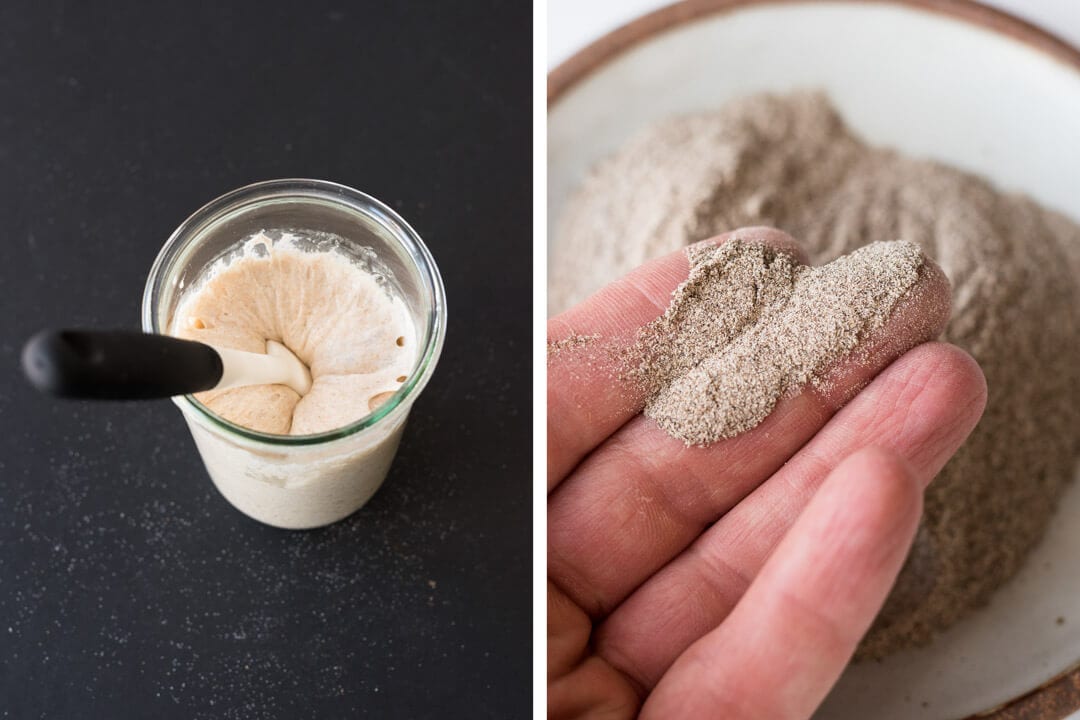
My (not so) secret love affair with buckwheat flour continues in this bread. I like to use buckwheat where I need a grounding flavor, something to balance out sweetness or add depth and complexity. I’ve found including more than 3-5% results in a tighter crumb as the percentage increases, but more than that, 3% seems to be the perfect percentage for me in terms of providing enough flavor without too many side effects (though, when using buckwheat in a flour scald, 5% is just fine). You can certainly work this percentage up if you want even more intense flavor from the buckwheat.
Aside from the buckwheat, the rest of the formula utilizes mostly medium-protein white flour and some strong white flour to help support the added pecans and cherries. Some straight 100% whole wheat would be a nice addition to this formula in place of some of the white flour if you prefer a heartier, more flavor-forward bread.
As always, if you don’t stock type-85 flour you can substitute the quantity called for with 30% whole wheat and 70% white flour. This is not an exact substitution, but it will get you close in terms of flavor and crumb color.
Sour Cherry, Toasted Pecan, and Buckwheat Levain
Vitals
Note that if you plan to bake this bread in a Dutch oven, you might want to reduce the total dough weight here to 1800g or so to ensure they’ll fit comfortably. Lately, I’ve been making slightly larger, and longer, batards at 1kg each.
Total Dough Weight
2000 grams
Pre-fermented Flour
5.30%
Hydration
83%
Yield
2 x 1000 gram loaves
Levain Build
Weight
Ingredient
Baker’s Percentage
47g
Mature liquid starter (100% hydration)
100%
47g
Type 85 flour (Central Milling T-85 Malted)
100%
47g
Water
100%
Dough Formula
Target final dough temperature (FDT) is 77°F (25°C).
Note that the baker’s percentages listed below are with respect to the final dough ingredients and do not take into account the levain.
Build the liquid levain (everything listed in the Levain Build section above) in the morning and store somewhere around 78°F (25°C) ambient. This is a very warm and fast levain and the high inoculation percentage, whole wheat flour, and warm temperature will ensure it’s ripe after 3 hours.
2. Autolyse – 11:00 a.m.
Mix all the flour (including buckwheat) and water (reserve 100g water for the mix, later) in a bowl until all dry bits are hydrated. Cover bowl and store somewhere warm for 1 hour.
At this time also toast the pecans in the next step.
3. Toast Pecans – 11:00 a.m.
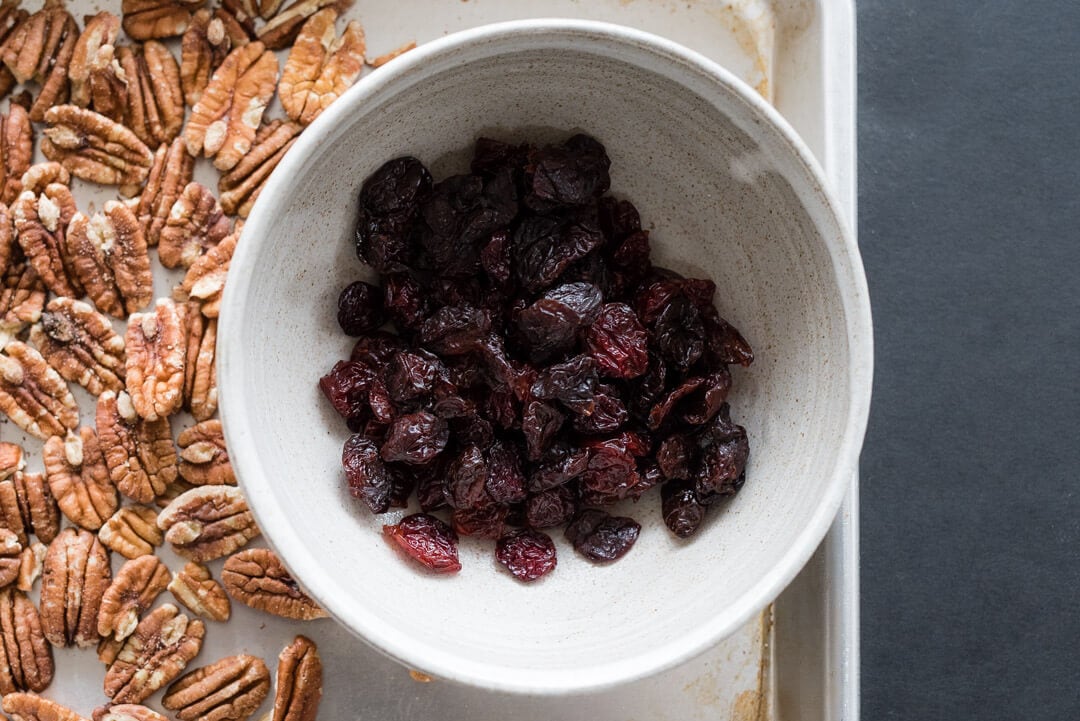
Preheat oven to 350°F (175°C). Spread whole pecans in a single layer on a baking sheet. Once the oven is preheated place the sheet into the oven and toast for about 10 minutes. Rotate the baking sheet after about 5 minutes and keep an eye on the nuts in the last few minutes as they can quickly burn.
The nuts are done when they are slightly browned and have a pleasantly pungent smell. Set aside to cool, then coarsely chop and reserve until needed during Bulk Fermentation.
4. Mix – 12:00 p.m.
Add the called for levain and about half of the reserved water to the mixing bowl. Mix until well combined.
Dump the dough onto the counter and slap and fold the dough (French fold) for about 5-6 minutes, just until the dough starts to show signs of a smooth surface. If you aren’t comfortable with slap/fold method or don’t like it, you can do stretch and folds in the bowl until the dough tightens up and becomes harder to stretch out and fold over.
Let the dough rest 15 minutes.
When finished with the initial strengthening, sprinkle the salt on top of the dough and use the remaining water to help dissolve. Pinch through a few times and fold the dough over itself to help incorporate. Perform a series of stretch and folds in the bowl until the dough absorbs all the added water and comes back together.
Transfer dough to a tub or thick-walled bowl for bulk fermentation.
5. Bulk Fermentation – 12:30 p.m. to 4:00 p.m.
At 78°F (25°C), bulk fermentation should go for about 3 hours and 30 minutes.
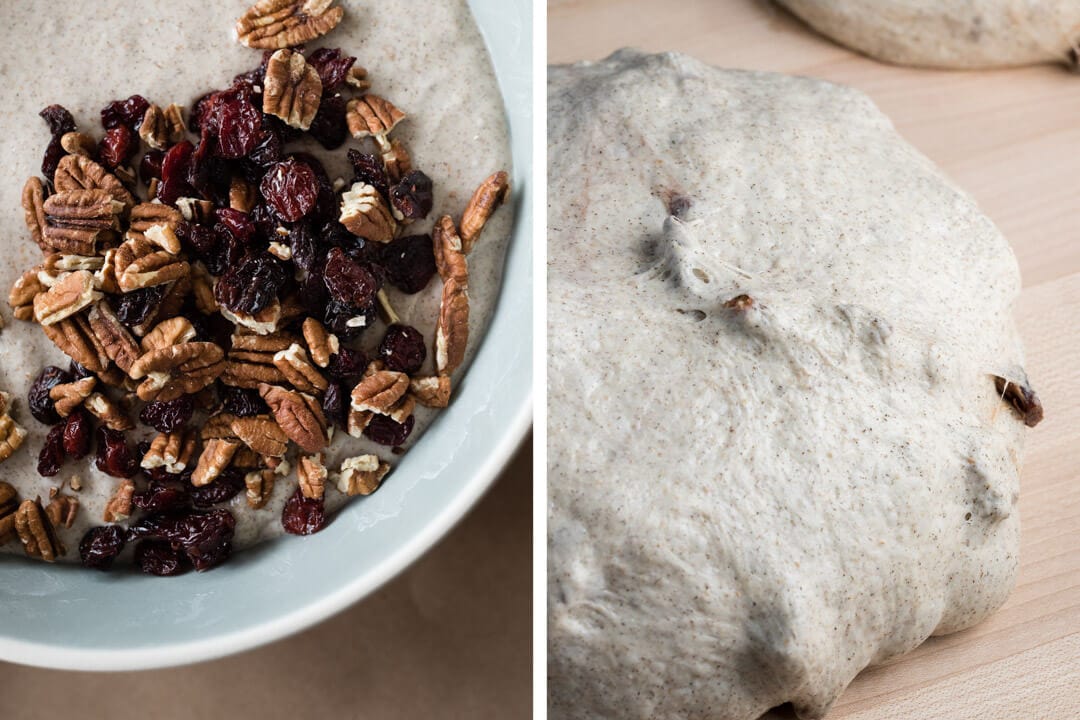
After the second set of stretch and folds add the toasted & chopped pecans and the sour cherries (these can be whole or coarsely chopped). Using a little water on the hands, mix gently into the dough until well incorporated.
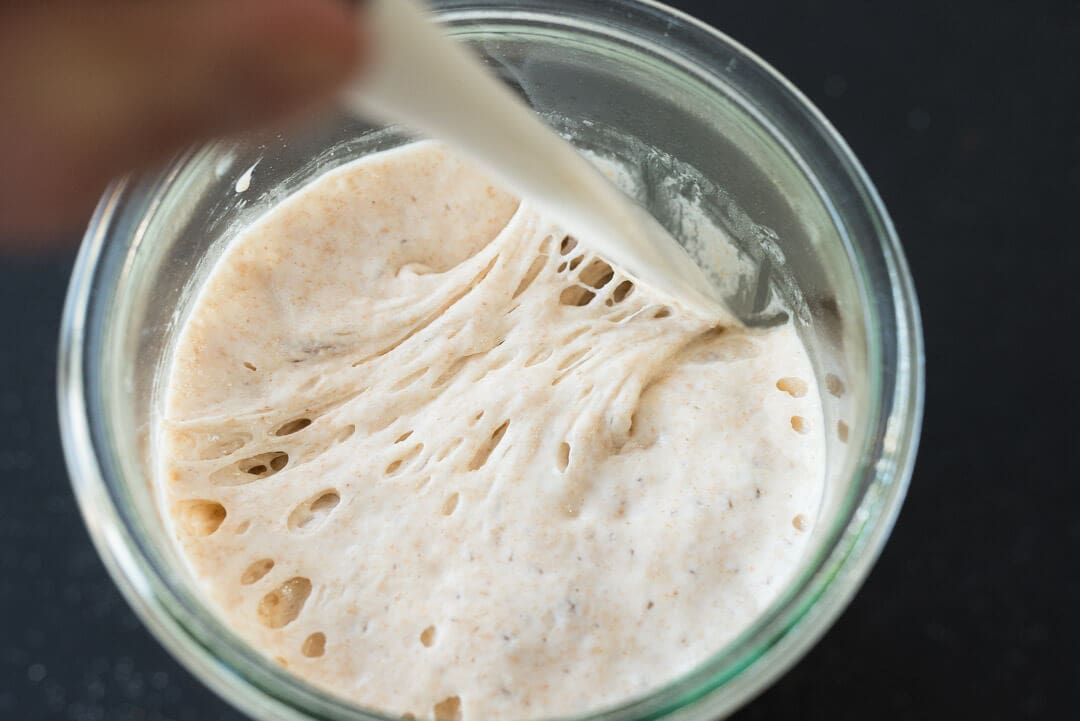
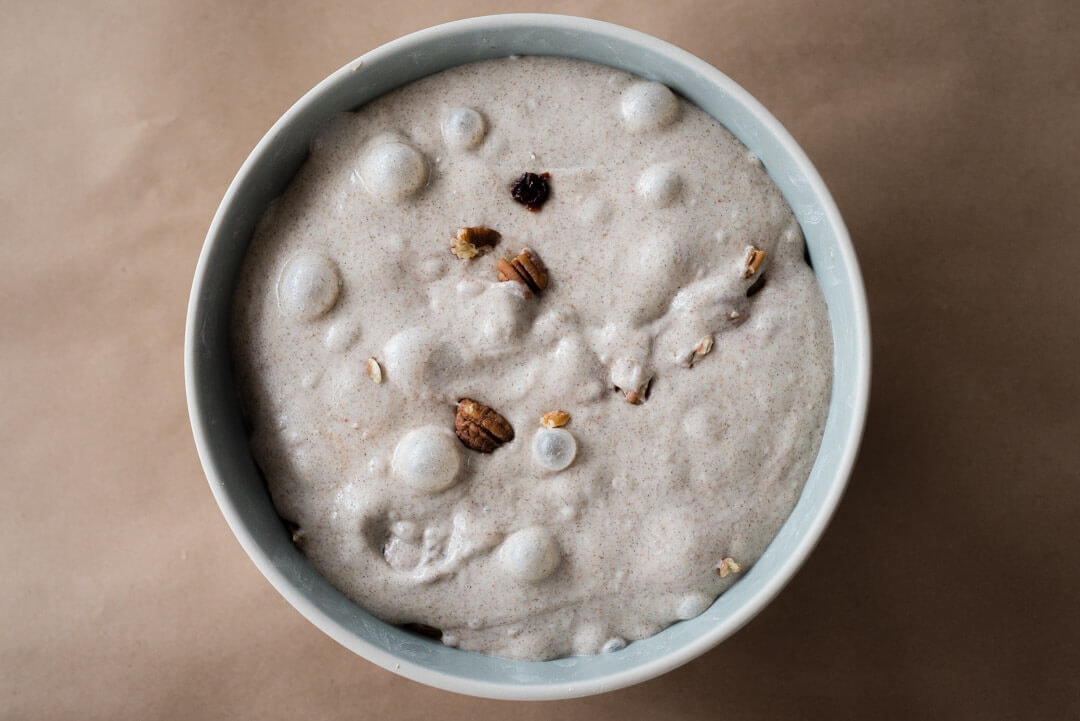
I decided to end bulk when I saw the dough in the picture below. You can see the dough is puffy and alive, there are plenty of bubbles on top and just below the surface, and most importantly: the edge where the dough meets the bowl is domed, convex. This is a good sign your dough is strong enough and ready to be divided.
6. Divide & Preshape – 4:00 p.m.
Dump the dough from the bulk container to an un-floured work surface. Divide the dough roughly in half and very gently preshape each piece of dough into a loose round.
Let the rounds rest 25 minutes uncovered.
7. Shape – 4:25 p.m.
Flour the work surface and the top of each rested round. Working with one at a time, flip a single round over onto the floured surface and fold the top half up and over to the middle and the bottom half up and over the recently folded top. You’ll have a long horizontal rectangle sitting in front of you. Turn the rectangle 90º and grab a small portion of the top, pull up and fold over a little bit, pressing down to seal. Take the rolled top and continue to gently roll it down toward your body with two hands working together. As you do each roll and work your way down the vertical rectangle, use your thumbs to gently press the dough into itself.
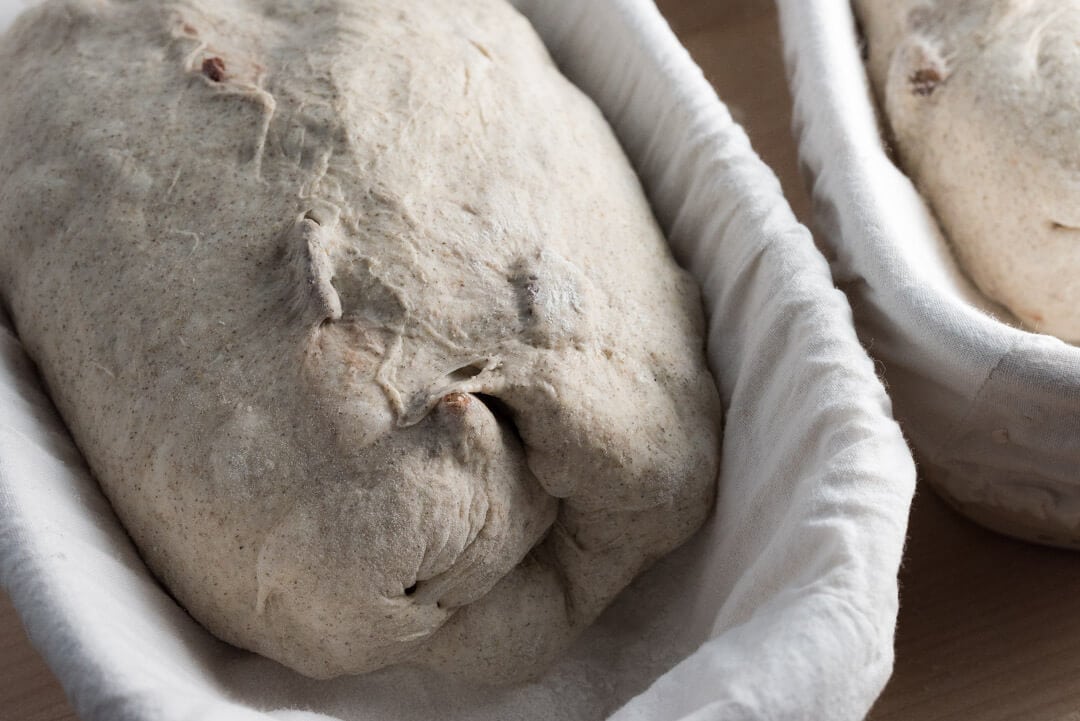
Once shaped, transfer each to a basket lined with a cotton towel (I like to use these towels when the dough has fruit added, much easier to clean) that has been lightly dusted with white rice flour, seam side up.
8. Rest & Proof – 4:50 p.m.
Cover each basket with plastic and then place it in the refrigerator at 38°F (3°C) for 14-15 hours.
9. Bake – Next Morning: Preheat oven at 6:30 a.m., Bake at 7:30 a.m.
Preheat oven for one hour at 450°F (230°C).
Take out both of the baskets from the fridge and cut a piece of parchment paper to fit over the top, quickly invert each basket onto each piece of parchment. Using a sharp razor blade fastened to a stick (or a lame) score the top of each at a shallow angle to the dough and just deep enough to cut below the top skin of the dough. Start at the top of the oblong loaf and with a single decisive stroke cut from top to bottom with a slight outward bend.
Bake the dough for 25 minutes with steam, then remove the steaming pans from inside the oven. Then, continue bake for an additional 30-35 minutes or until done.
I’ve worked with fruit and nut mix-ins countless bakes in the past but this one has a little something extra thanks to the buckwheat. Even at such a small percentage, it’s beautifully evident in each bite, and to those unfamiliar, it hints at something complex and earthy without giving away the answer too easily. I find that pecans and cherries have always been known to go well together, but the buckwheat is really what unites this bread, adding additional complexity and that haunting flavor I’ve come to really enjoy. This is just an all-around tasty bread, one that can be eaten by the slice all on its own — perhaps a little too easily.
Crust
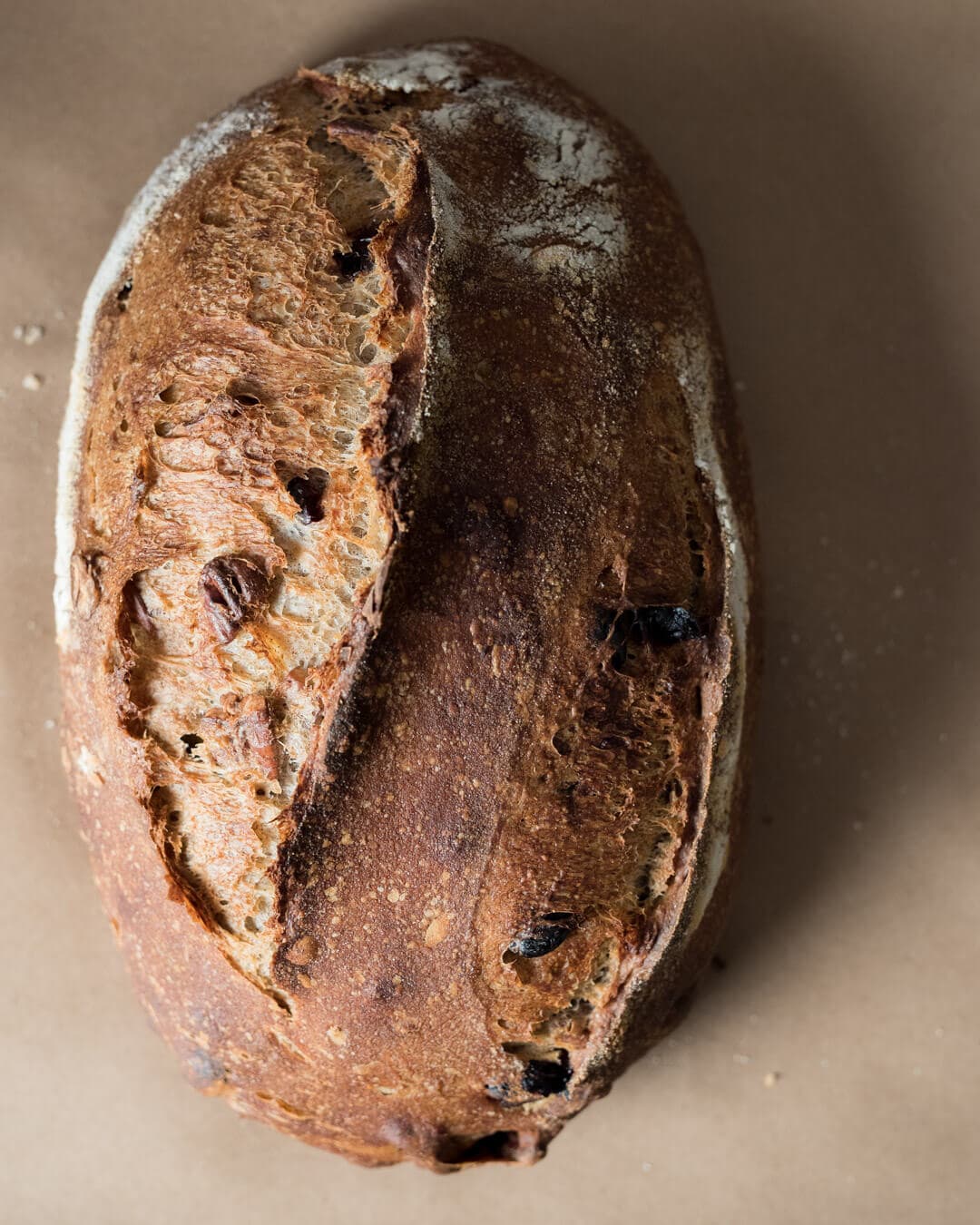
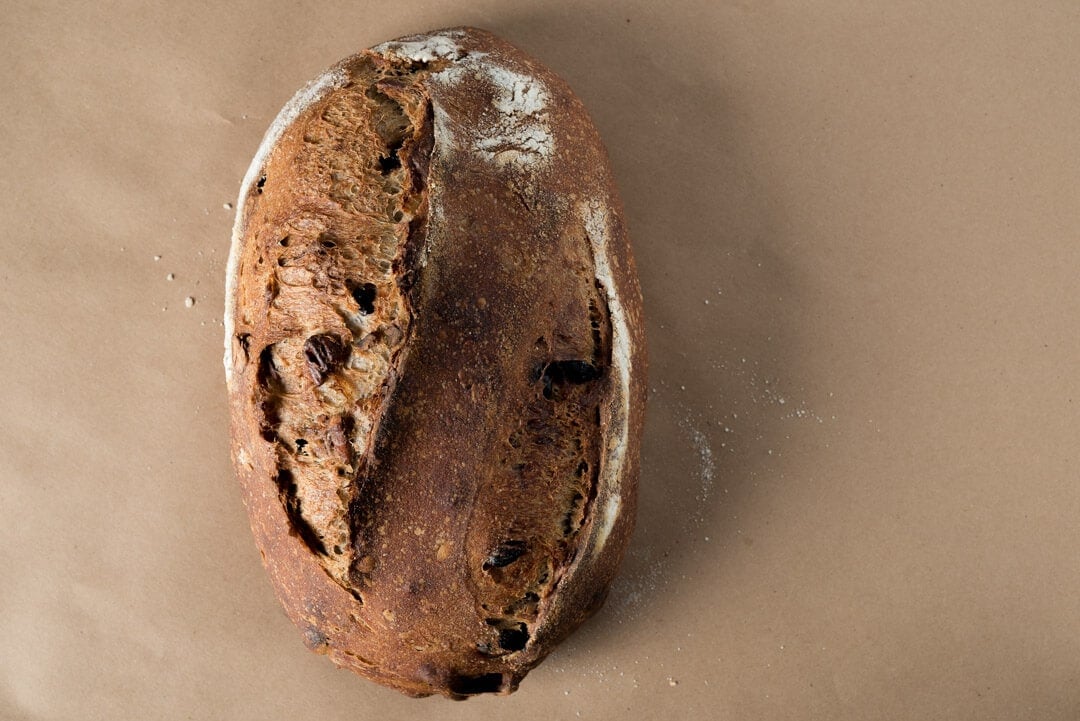
A wonderful crust to be sure and one that, while not as shiny as my other bakes (probably due to the buckwheat), is splendidly crunchy. I went with a double score for these bakes because I knew they wouldn’t spring open as much as my typical batard, partly because of the hefty ingredients but also because of the lengthy proof. Besides, that double score sure looks awesome.
Some bakers prefer to keep all the cherries and nuts poked into the dough when baked but I don’t bother — I like the outward appearance of these additions even if they get somewhat singed in the process. Poke the cherries and pecans into the dough before baking at your own discretion.
Crumb
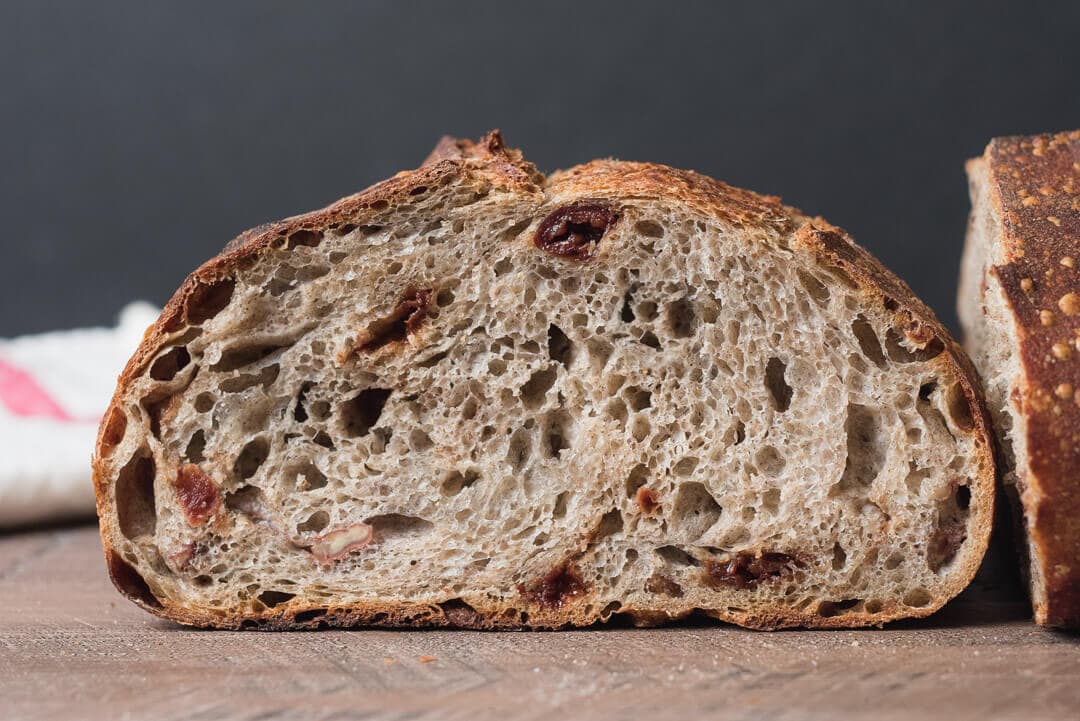
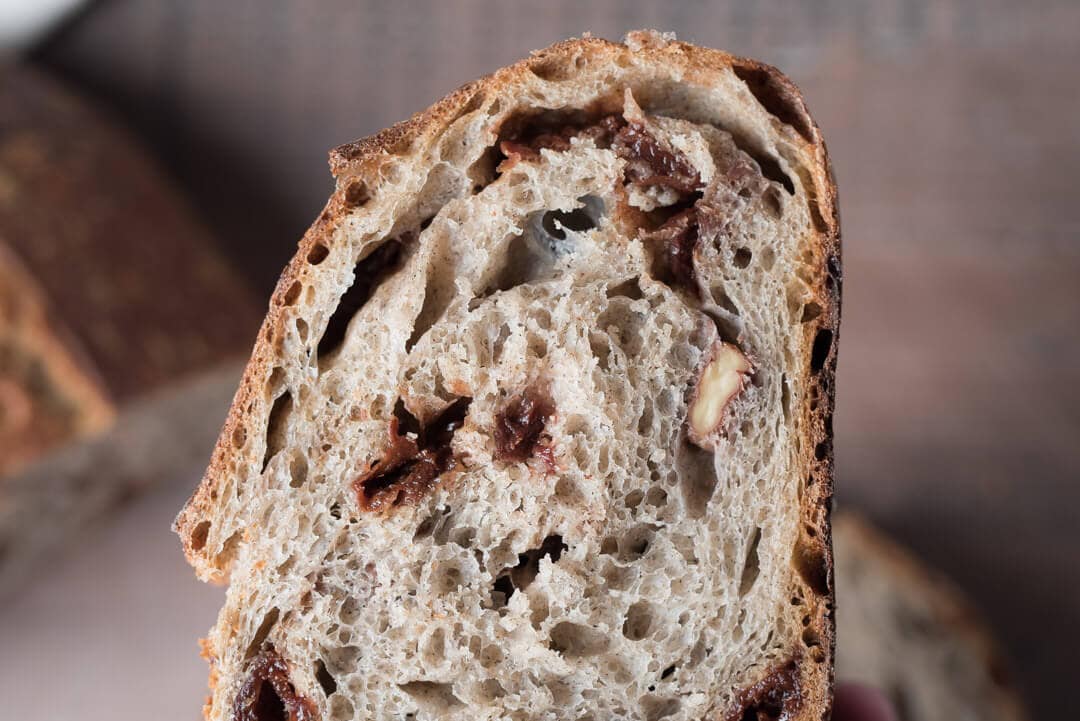
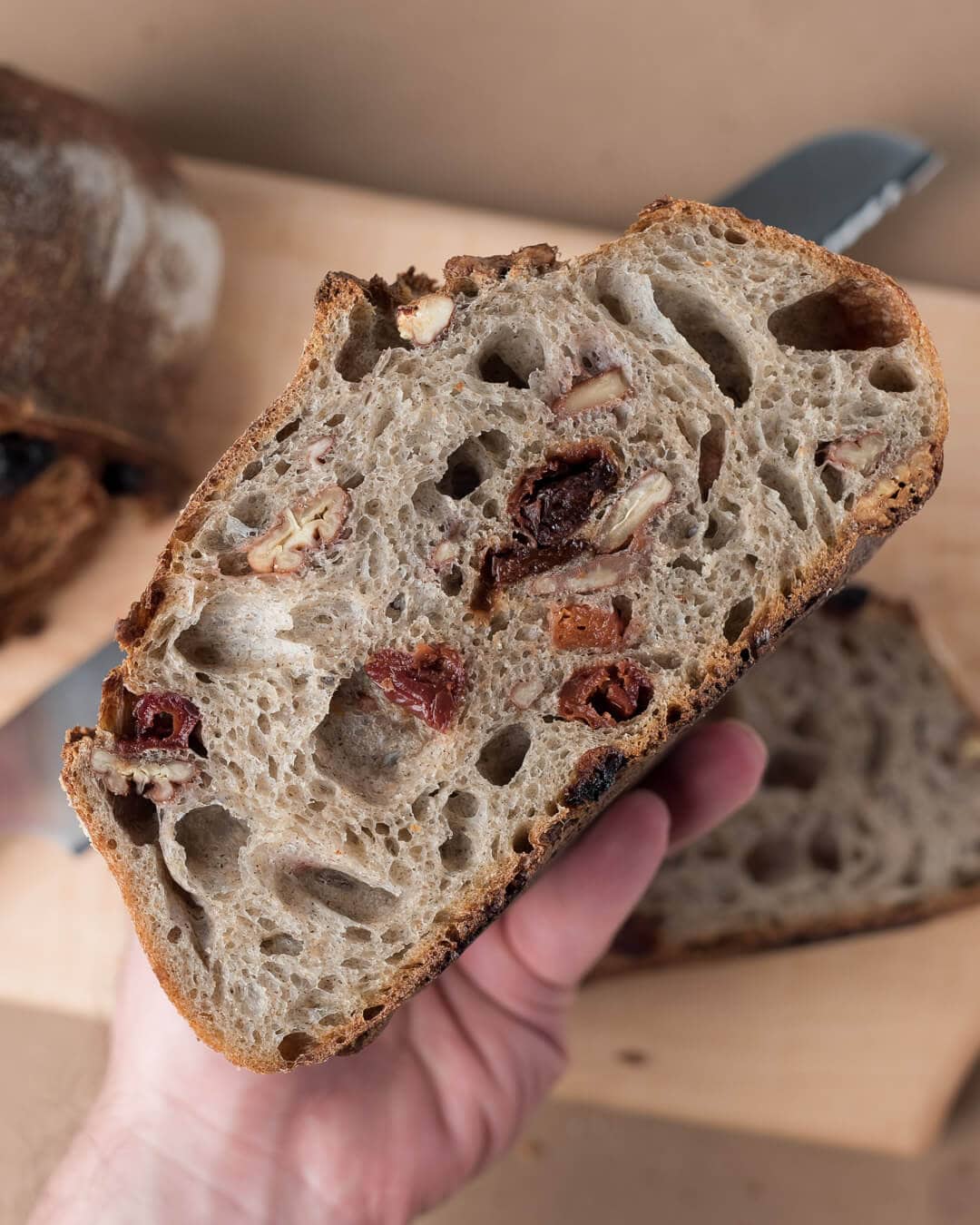
The crumb in this bread is so incredibly soft and tender, something almost akin to a porridge bread. Almost. The crust did bake up a bit thicker than usual, but by no means too thick, and that’s just fine as it complements the tender interior, providing structure and support. If you’ve read my posts for a while you know one thing for sure, you’ll rarely hear me complain about a crunchy crust.
Taste
As I mentioned earlier, the flavor pairing of buckwheat and cherry is fantastic. The dark red cherries stand up to the earthy buckwheat flavor and the two balance each other. Buckwheat has really become a secret weapon of mine–when I sneak a little in a formula people always comment that there’s “something different and totally delicious in this sourdough.” I like that!
When I add mix-ins to the dough I prefer to usually keep it pretty light. I think the percentages I’ve included in this recipe for the toasted pecans and sour cherries are just right: almost every bite results in the discovery of something extra. However, if you prefer more or less just adjust the quantity of each up or down to suit.
I’ve been enjoying this bread heavily toasted with a thick slather of the yellowest butter you can find — that’s all you need.
The crumb is speckled with black marks from the whole grain buckwheat, coarsely littered with sour cherries and toasted pecans, and the crust is nice and craggy just like the old cherry tree I used to climb each day in the summer. Having baked this bread several times now I feel satiated, I scratched that itch to return back to my childhood and, in some way, relived those moments with my favorite tree. Unfortunately, the bread will eventually run out but that’s just fine, I can always make this recipe any time I need to take a trip back and relive those red feet, scattered feathers, and antsy ants.
Maurizio Leo is the creator of the independent sourdough baking website The Perfect Loaf. His cookbook, The Perfect Loaf — The Craft and Science of Sourdough Breads, Sweets, and More, is a James Beard Award-winner and a New York Times bestseller. He lives in Albuquerque, NM, with his wife and two sons, where he's been baking sourdough for over a decade. He's been labeled "Bob Ross but for bread."
Do sourdough posts like this help you in your baking? Join The Baker’s Corner for only $60 a year, and get:
Come chat with me and other bakers and get baking help
Remove all ads on website
Get my bakers tools & discounts
Get the full recipe archive in editable spreadsheets
Hello Maurizio, I live in Europe and it seems so hard to get dried sour cherries and pecan in our stores. Can I substitute them with dried cranberries and walnuts instead, like your walnut cranberries sourdough bread recipe? Will it work well using this recipe? Thank you. Mery Christmas by the way.
Ingredient questions with regard to flours:
Is type 85 flour a whole wheat flour? Your levain instructions infer that.
I don’t have access to central milling flours, but use King Arthur flours routinely. Should I simply use all KA bread flour n place of the malted and the high gluten bread flours? And how will that affect the hydration?
Thank you! I’d really love to make this but need the flour advice! (I’m good with the buckwheat, by the way. I use Maine Grains.)
This is one of my favorite recipes! I’ve made it several times, and it always comes out nicely. The last time I made it, I mixed the levain the night before in anticipation of a busy day, and then included the levain in the autolyse step a la tartine country loaf. It worked better than I expected, and I think the final product was lighter and airier than my previous bakes.
Thank you! That’s great to hear about the outcome. Mixing the levain in early that way will give the dough additional fermentation time, sounds like it could use it! It’s totally fine to do that as long as you keep an eye on that dough during bulk, always be aware once the preferment hits the dough, fermentation begins. Thanks for that feedback and enjoy!
This is my first attempt at making the sour cherry, pecan and buckwheat loaf and it has turned out to be my most successful in terms of rise and crumb. It tastes delicious too!
First, thank you so much for your site. I’m a newbie and this site is excellent. I’ve been working my way up this more complex recipe. Can you please clarify the baker’s % for this recipe? I can’t seem to square your numbers. I am making this now and I don’t find the dough to be sticky. It feels like your basic recipe. I had tried a different cherry/walnut recipe where the dough was very sticky and splayed like a cookie. This is much better, but I’m confused about the math %’s.
Flour = 537 + 176 +134 + 27 = 874g Water = 696g The %’s don’t seem to work. Is it because you are not including the buckwheat? I think I may perhaps be misunderstanding the calculations. Thanks so much for your help!
Hello Maurizio! I, too, grew up with cherry trees and made myself sick eating too many climbing in the trees. I had to try this. I followed your formula exactly and I finally got a good oven spring with the closest thing to an ear that I’ve been able to achieve. This bread is melt in your mouth good with homemade butter. My loaves are dark, bordering on burned but the taste and texture are superb! This has become my new favorite. Thank you so much for your guidance!!
That’s great to hear! Yes, with a good pad of butter, this bread turns into something seriously special — can’t get enough. If you’re loaves are going to far in the oven, try reducing the temp 25F during the first part, this should help quite a bit. Glad I could help and happy baking!
Hello Maurizio, I accidentally threw away all my starter, ugh. Can I add a small portion of baked sourdough (reconstituted) to my new batch to speed things along? I’ll definitely dry some so I don’t do this again! Thank you!
Great recipe, love the buckwheat in there! I also added about the same amount of rye, somewhat inspired by the rye-raisin breads from my hometown (Antwerp, Belgium). Couldn’t find any cherries, so went with sweetened cranberries instead. I got great ovenspring, maybe the rye gave it a bit more activity? I also just started experimenting with yeast water, and added about 50g of this too, straight from the fridge. That could’ve helped the ovenspring as well I guess, although I’ll need to play around with that more to get a better feel of how much it actually contributes when added just as “water”, instead of building a levain first. The other difference: I used a long (4h) and warm autolysis, since winter is quickly approaching here in Montreal. In any case, the end result was amazing! Half a bread is gone with just some butter or no topping at all, that’s always a good sign! Thanks a lot!
Thanks, Michiel! Glad to hear that about your bread. Your result could be from so many things, really hard to say without lots more details. The extended autolyse might have helped increase the extensibility in your dough to allow it to stretch and bloom better in the oven, or it could have been the increased fermentation activity due to your additions, and so on… Either way, I find the best way to try and figure out what works and what doesn’t is to keep as many things consistent from bake-to-bake as possible. Then, change one thing at a time and see if it helps. Then you know for sure what helped and what didn’t.
Regardless, sounds like it turns out awesome and that’s what matters! Happy baking and thanks for that update 🙂
It’s been a few weeks but this is the second time I made this. https://imgur.com/AgDbabahttps://imgur.com/AgDbaba. This is a favorite of my at-work BFF, she requested this bake and I was happy to oblige. Aside from eating this as is, it also makes a great sandwich. I had some left over roast chicken that I made into a simple chicken salad and the flavor combination made our taste buds rejoice! This will always be in the mix…a little on the pricey side for the mix-ins but so worth it. The first time I made it I didn’t have buckwheat and it was good, but the buckwheat really adds a special touch to make it great. I made a three loaf batch, one for me, one for the office and one to share. The one for the office disappeared by lunch time!
I have a qn on increasing overall flour protein percentage . I have been experimenting with fillers for bread and i do know that it weighs down the dough and bread can be dense and develop less Crumb if the dough is not strong and extensible enough . Can I know the logic behind increasing the protein level and also how to improve on Crumb with fillers? Thanks!
“strong white flour to help support the added pecans and cherries”
Hey! I find that stronger flour helps the dough keep structure and forms a stronger gluten matrix that resists tearing. In my experience when I use a higher percentage of high protein flour I get a lighter, more airy interior even with added mix-ins. I contrast my thoughts there with a flour that’s weaker and of lower protein: it will readily break apart and requires much more gentle handling.
That’s my feeling and rational for using stronger flour at least!
Hi, thanks for the reply. I too have the same thoughts while perusing your blog and since high hydration results in a weaker dough strength, i find the final dough gets more slack and hard to shape. so when attempting the more challenging oat porridge bread, i used a wheat flour with higher protein flour 14% instead of my usual (10.5-11.5%) to increase strength and gluten to hold its shape since the dough will get more slack as it ferments . i laminated the cooked oats in after adding the salt then started the bulk. I have read that higher protein bread ie above 11.5% results in a tight crumb and tighter bread. what are your thoughts on this? Anyway also hoping the higher protein will help with shape and also the add ins, helping to create an airy crumb by being elastic since the dough is heavier with oats , the level of hydration and add ins. i dont get big holes but i do get even airy crumb small holes.
I haven’t found that higher protein flour necessarily results in a tighter crumb, as long as it’s compensated for. If the flour is too strong, or it’s mixed too long, then the dough becomes so firm that it’s not able to relax out enough and fill with gases during fermentation. If using a higher percentage of high protein flour I’ll usually extend the autolyse time to help create extensibility in the dough and/or increase the hydration to slacken it out.
Hope that helps!
Hi Maurizio! I’ve started experimenting with this recipe, as I intend to give boules of it away as Christmas presents this year–sour cherry and walnut (rather than pecans, mainly because I happen to have a large bag of walnuts already). Flour is all CM’s AP, because that’s what I have. The new starter is rocking it, the crumb is so open! The first loaf came out just in time to be served at a party we were having, as a kind of dessert, and it disappeared very quickly, which is quite the compliment, given that everyone had just stuffed their faces at dinner. 🙂 It didn’t even have any buckwheat in it yet because, well, because I’m impatient and wanted to try it right away, it sounded so good. Massive hit! I was telling everyone about your site. (Again.) Even the hole-hating boyfriend loved it and said that it’s good enough to become a signature bread. 🙂
The first loaf with buckwheat is cooling and the second is in the oven right now. I can hardly wait to try it!
So glad to hear all that! This bread has been one of my most popular, and for good reason — it’s just dang tasty! There’s a lot going on in each loaf but I find the ingredients really balance each other and produce a well-rounded loaf that’s sweet but not too sweet.
Glad to hear it has worked so well for ya and this will be perfect for Christmas presents. In fact, I might steal that idea ????
I wonder now…could you proof this dough ala Artisan Bread in 5 Minutes A Day, where you essentially throw it all into the fridge after a very short bulk and bake whenever? That sure would be handy for a big bake like Christmas presents…
Yes, a cold bulk is definitely possible. The key with this is to give the dough enough time when you take it out to warm up and proof fully. Check out my post on Kamut Demi-baguettes where I do something similar!
Really helpful, Maurizio–you are, as always, super generous with sharing your knowledge! I need to sit down and take some notes off the Kamut demi-baguettes post to experiment with this, and soon, because the levain is in the oven now. (We have officially hit “proof in the oven with the light on” season.) 🙂 I figure I’ll take the loaves to a big Halloween party tomorrow evening, nothing like a little pressure for oneself–hah!
We all perform best under pressure, I think at least 🙂 Good luck!
Do you use Organic Central Milling Type 85? I am torn between buying Type 70 and 85.
I wish shipping flour wouldn’t cost so much, makes me sad.
Yes, I currently use CM Type 85 malted — it’s one of my favorite flours from them. I used to use T70 but haven’t in a while, and switched to T85. Yes, shipping is quite expensive, unfortunately!
Just made this loaf, and it was marvelous! Added various toppings: jam, caramel, even goat cheese! Many thanks for sharing yet another great recipe.
P.S. – the spelt loaves I’d asked about last Wednesday also baked like a dream 🙂
Another great tasting loaf. I upped the buckwheat a bit (35 g instead of 14 g), therefore my crumb looks a little darker. The next one on my list is the Rosemary Potato Levain.
Thanks I appreciate that! Glad it turned out well. I played with varying levels of buckwheat in this loaf as well, adding more definitely brings a more earthy flavor and darker crumb. Have fun with the Potato Sourdough recipe, it’s a tasty loaf as well!
Hi Maurizo,
I love to try this receipe as I love the flavour of nut. I tried this last weekend, however the dough was still very sticky after the bulk fermentation and I could not able to do any fold and stretch. After proofing, the shape could not able to hold and finally it looks like a giant cookie. I am not sure what the reason is. I live Hong Kong with hot and humidity weather. I followed the water proportions from the receipe.Was that because I added too much water at this humid place? If so, can you recommend how much I should cut? Also, can you recommend if I should cut both bulk fermentation and proofing time? Many thanks,
Yan
Hi, Yan! Yes, it sounds like the dough was probably over hydrated. I’d reduce the water by 5-10% and give it another go — your environment is probably much, much more humid here (it’s usually about 30% humidity in my house). Sorry about the trouble! Adjusting for hydration is always a constant battle, the best way I’ve found to adjust is to hold back some of the water during your mix. Add this water in near the end in stages until the dough looks (and feels) like it’s had enough. Get in there and use your hands, take note of the feel each time — this way we can build up a feeling for the dough, how it should feel and react during mixing with various amounts of water added.
Hi Maurizio,
Thanks for your advice. My starter is ready for my second trial tomorrow . May I have few more questions?
1. After the second set of stretch and fold, if the dough is still very sticky, can I add some flour?
2. I really like the taste of wheat, I want to adjust the portion of wheat flour to 30%, do I need to adjust the portion of other ingredient?
3. I am going to make 1x1kg sourdough, should I cut half of levain?
4. My oven cannot create steam, it is a small oven. Should I shorten the baking time to keep it moisture?
Again. Thanks for your sharing. Look forward to seeing more new recipe from you.
1. I wouldn’t add any flour at that point. The rest of the dough has fermented for a while by that time in bulk, it’s possible that flour would continue to be raw through to the baked loaf.
2. Increasing the whole wheat wouldn’t be a problem. The overall feel of the dough might actually be better because increased whole wheat will absorb more water, which would help with your hydration problems.
3. Yes, cut the amount of levain you add to the dough in half as well. You could keep the levain build the same if you’d like, this way you aren’t working with a very small amount.
4. I’m not sure about the duration of the bake, you might have to experiment with this. I highly recommend trying to get some steam in your oven in the beginning, even if it’s just with a hand spray bottle. This will help your dough rise higher and form a nicer crust. If not, it’s totally ok, I just prefer it this way.
Hope that helps!
Hi Maurizo,
I always enjoy your recipes. So fantastic flavors of loaves! With this recipe, I am thinking to divide this dough in three. So they can fit in small my 8″ Banneton Basket. One dough should be around 670g instead of 1000g. Do you have any suggestion how to reduce the baking time? Also should I need to reduce the baking temperature as well? Thanks!
Thanks so much Anna, I really appreciate that! Sounds good — I’d probably keep the temperatures the same and just keep an eye on the dough nearing the end of the bake. You might actually end up with the same total bake time but likely just a few minutes less.
This recipe looks great (like all the recipes at your site) and I am going to try it this weekend.
Two quick questions- do you think that if I divide the dough before adding the pecans (so I can have one loaf without) it will hurt the proofing process?
And do you have suggestions for replacing the cherry with something else? another type of nut?
Thanks so much! There is something to be said for having a larger mass of dough: temperature regulation is much better as it takes longer for a big mass to cool or heat up and so the temperature will be more consistent. However, I’ve done this myself many times and it works out just fine!
It’s hard to do a direct substitute for cherries with a nut. Additional nuts will really add weight and heft to this bread whereas the cherries add sweetness and a nice chew.
Just want to say: Just made this recipe for a second time, and both times the bread has been excellent. And I want to pass on that I served it at our Easter celebration and one compliment was that it’s the best bread he’d ever eaten! I attribute this reaction to the brilliance of the recipe and that I didn’t foul it up too much! 🙂 My 2 cents: I use buckwheat groats and make the flour in my vitamix, which works great. I also substituted readily available Giusto for the Central Milling flour but just ordered mass quantities of it and look forward to comparisons between the malted flour and the Giusto flour. Thanks so much for dreaming up this and your other recipes!! I’m constitutionally an “recipe tweaker” but am averse to modifying yours because I trust your instincts/ homework! (Though that dark chocolate idea below sounds awesome!)
Right on, Rick! Glad to hear it — such high praise as well! You’re very welcome, I’m always happy to hear others love my recipe just as much as I do 🙂 Yes, I have to agree, the dark chocolate idea is a really good one and has me thinking about that for the future!
Hi there Maurizio! I adapted this recipe and made a sour cherry and dark chocolate loaf, and oh my is it ever good. I have never used buckwheat before and I had a feeling I was going to love it. I was right. Just that little bit adds so much flavour. I can’t wait to keep baking with it in the future.
I am a bit of a bread flour simpleton, in all of your recipes I just use organic all-purpose (Anita’s out of Chilliwack BC) instead of the variety of bread flours you list, and do the 50/50 mix with a whole wheat for the T85. It always turns out great. I have heard that Canadian flours are generally higher in protein content than American flours. Most Canadian mills that I have looked into don’t even carry specific bread or high-gluten flours. Actually my Canadian grandmother who winters in Arizona ships Canadian flour down there to bake bread with over the winter. I am coming to Arizona this year so I will bring back some American flour and see if I can tell any difference. Should be a fun experiment.
Really glad to hear that! Yes, in my experience the flour/wheat I’ve ordered from Canada has been on the stronger side and I usually blend it with something softer to find a middle ground. Interested to hear what your experience with American flour will be like!
Your dark chocolate idea really has me thinking… what a great idea!
Hi there! I live in a crazy hot and humid place (Singapore!! 86F and 70% humidity on a dry and sunny day) and I’m looking to try baking sourdough. I guess I can’t rely on time cues because of how fermentation is sped up in these kinds of conditions… how should I check when the dough has completed each stage of the process and is ready for the next step? (e.g. how do I tell when the autolyse is finished, or when the dough is rested and ready to retard, etc) Do you have any suggestions for tailoring sourdough recipes/techniques to hot and humid conditions? (I read somewhere that bulk fermentation can be done in the fridge. Or should I cram the suggested number of set of stretch-and-folds into a shorter time frame? Perhaps I should use cold water for the dough?) Thank you!
Hey, Meghan! All of those things you suggested will help in your environment. You can use the fridge for part of bulk fermentation to keep the dough cool, use cold water for your mix and you’ll likely have to shorten the timeline for most of the steps (I don’t usually like to go less than 3 hours for bulk fermentation, though). I know bakers who live in really warm climates will even use ice water to get that dough close to their target dough temp (78F in this case).
I also know that some bakers will use added salt in their levain/starter to help slow down and temper fermentation. If you find your levain/starter moves too aggressively you could use some of the sale in your dough mix in the levain to slow it down.
As far as cues for each step: have a look at each of the recipes here at my website! I try to explain when I transition to each step in just about every recipe (and have pictures to help). I also try to give the reasoning behind why I do the things I do, for example, why I might do a longer autolyse or a shorter one.
Thank you for the advice! A Singaporean baker advised me to put the dough in an ice box with an ice block inside to maintain the temperature… any thoughts?
Hey Maurizio! I don’t have access to Malted Flours like your recipe calls for. What do you think of adding diastatic malt powder to the mix? If so, what percentage? Thanks in advance!
Also…. I typically use KA Bread Flour (which I believe is around 14% protein). In this formula, you call for Malted Bread Flour and High Gluten Bread Flour, which you have listed as being about 13.5% protein. Should I be incorporating some AP flour into my mix (for this recipe as well as others) if I am primarily using KA Bread Flour?
I’ve been trying to get my hands on some other flours… looked into getting some Central Milling flours, but the shipping would cost more than the flour itself! And I haven’t had too much luck with locally milled flours, though I think once the weather warms up, I’ll be able to find some at a farmer’s market.
Not a problem, adding diastatic malt yourself is the way to go (I do this often as well, especially when using fresh milled flour). I would add no more than 2% of the recipe. You could start at 1% and see how it looks/tastes.
First, note that KA Bread Flour actually is malted flour (look at the ingredients on the package). You could use 100% KA Bread Flour if you’d like (for both parts of my formula) but I would do a mix. I’d use KA AP for the “Malted Bread Flour” I call for here and KA Bread Flour for the High Gluten I call for. KA AP actually has a pretty high protein percentage so it will work well.
Sorry, this is getting kind of confusing 🙂
Yes, Central Milling can be expensive to ship. KA flour is a really solid choice for sure, I’d stick with that and look for some local options to compliment!
Sure! Use a 50/50 mix of the KA Bread Flour and WW for the Type 85 I call for. For the rest of the flour I have listed (the malted bread flour and the high gluten flour) use 100% KA Bread Flour.
Your breads are always so amazing and I have been trying a lot of these recipes. My only issue that I seem to have is the open crumb. The bulk looks amazing, pre shape and shape work quite well which means the hydration is just right, however, I think it consistently gets overproofed. When I bring it out of the fridge about 12 hours later, it is quite jiggly and doesn’t really get the spring. I have measured my fridge with a temp and it doesn’t go below 45. Is that the problem? Should I cut the bulk time short or go with colder water? I can’t wake up any earlier 😉
Thanks so much, really appreciate that! 45ºF is pretty warm, yes, I’d cut your final proof time in the fridge by 2-4 hours and see if that helps. It sounds exactly like what you’re thinking: your dough is probably over proofing. Cut that proof and see if you eek out more spring and retain a little more structure in your dough!
Hey Maurizio, what size banneton are you using for your batards? Mine is 12″ long, 5 1/2″ wide and 3″ deep. When I’ve used it in the past, my loaves are too small, spread out too far and rise very little.
Spencer — These ones are 14″ long. I actually like a little extra space on the top and bottom to let the dough relax out. The caveat is you have to shape the dough just tight enough so it doesn’t relax out so much that you compromise rise. The dough doesn’t quite stretch to fit top and bottom, it just kind of relaxes some.
There’s really no direct substitute for buckwheat but hard wheat would at least give you some heartiness to the bread! I’d suggest going higher than 3%, though, it’s a bit small for you to notice that big of a flavor difference like you would with buckwheat (which is much stronger tasting). Perhaps 10-15% would be a good try!
I’ve made many of your recipes, and I’m looking forward to trying this one. For the “High Gluten Bread Flour”, does it make a big difference? I’m not sure I’ve seen it for sale at the shops around here, but I’ll check again.
Great to hear that! I like the additional strength the high gluten bread flour provides but it’s not 100% necessary. Use whatever white bread flour you typically use for baking, should be just fine. Happy baking!





83 Comments
Hello Maurizio, I live in Europe and it seems so hard to get dried sour cherries and pecan in our stores. Can I substitute them with dried cranberries and walnuts instead, like your walnut cranberries sourdough bread recipe? Will it work well using this recipe? Thank you. Mery Christmas by the way.
Ingredient questions with regard to flours:
Is type 85 flour a whole wheat flour? Your levain instructions infer that.
I don’t have access to central milling flours, but use King Arthur flours routinely. Should I simply use all KA bread flour n place of the malted and the high gluten bread flours? And how will that affect the hydration?
Thank you! I’d really love to make this but need the flour advice! (I’m good with the buckwheat, by the way. I use Maine Grains.)
Hi There! Any reason I shouldn’t use walnuts instead of pecans?
Walnuts will work well also!
This is one of my favorite recipes! I’ve made it several times, and it always comes out nicely. The last time I made it, I mixed the levain the night before in anticipation of a busy day, and then included the levain in the autolyse step a la tartine country loaf. It worked better than I expected, and I think the final product was lighter and airier than my previous bakes.
Thank you! That’s great to hear about the outcome. Mixing the levain in early that way will give the dough additional fermentation time, sounds like it could use it! It’s totally fine to do that as long as you keep an eye on that dough during bulk, always be aware once the preferment hits the dough, fermentation begins. Thanks for that feedback and enjoy!
Can we use regular flour if we don’t have access to malted, or will this impact more than the flavor?
That will work just fine!
This is my first attempt at making the sour cherry, pecan and buckwheat loaf and it has turned out to be my most successful in terms of rise and crumb. It tastes delicious too!
Glad to hear that, Linda! Enjoy 🙂
Is it possible to just add sour cherries and pecans into the beginner sourdough recipe?
That’s a great recipe for these additions as well!
First, thank you so much for your site. I’m a newbie and this site is excellent. I’ve been working my way up this more complex recipe. Can you please clarify the baker’s % for this recipe? I can’t seem to square your numbers. I am making this now and I don’t find the dough to be sticky. It feels like your basic recipe. I had tried a different cherry/walnut recipe where the dough was very sticky and splayed like a cookie. This is much better, but I’m confused about the math %’s.
Flour = 537 + 176 +134 + 27 = 874g Water = 696g The %’s don’t seem to work. Is it because you are not including the buckwheat? I think I may perhaps be misunderstanding the calculations. Thanks so much for your help!
Adding the levain adds 71 grams of flour and 71 grams of water. That gets you to 83%.
Hello Maurizio! I, too, grew up with cherry trees and made myself sick eating too many climbing in the trees. I had to try this. I followed your formula exactly and I finally got a good oven spring with the closest thing to an ear that I’ve been able to achieve. This bread is melt in your mouth good with homemade butter. My loaves are dark, bordering on burned but the taste and texture are superb! This has become my new favorite. Thank you so much for your guidance!!
That’s great to hear! Yes, with a good pad of butter, this bread turns into something seriously special — can’t get enough. If you’re loaves are going to far in the oven, try reducing the temp 25F during the first part, this should help quite a bit. Glad I could help and happy baking!
Hello Maurizio, I accidentally threw away all my starter, ugh. Can I add a small portion of baked sourdough (reconstituted) to my new batch to speed things along? I’ll definitely dry some so I don’t do this again! Thank you!
Great recipe, love the buckwheat in there! I also added about the same amount of rye, somewhat inspired by the rye-raisin breads from my hometown (Antwerp, Belgium). Couldn’t find any cherries, so went with sweetened cranberries instead. I got great ovenspring, maybe the rye gave it a bit more activity? I also just started experimenting with yeast water, and added about 50g of this too, straight from the fridge. That could’ve helped the ovenspring as well I guess, although I’ll need to play around with that more to get a better feel of how much it actually contributes when added just as “water”, instead of building a levain first. The other difference: I used a long (4h) and warm autolysis, since winter is quickly approaching here in Montreal. In any case, the end result was amazing! Half a bread is gone with just some butter or no topping at all, that’s always a good sign! Thanks a lot!
Thanks, Michiel! Glad to hear that about your bread. Your result could be from so many things, really hard to say without lots more details. The extended autolyse might have helped increase the extensibility in your dough to allow it to stretch and bloom better in the oven, or it could have been the increased fermentation activity due to your additions, and so on… Either way, I find the best way to try and figure out what works and what doesn’t is to keep as many things consistent from bake-to-bake as possible. Then, change one thing at a time and see if it helps. Then you know for sure what helped and what didn’t.
Regardless, sounds like it turns out awesome and that’s what matters! Happy baking and thanks for that update 🙂
It’s been a few weeks but this is the second time I made this. https://imgur.com/AgDbaba https://imgur.com/AgDbaba. This is a favorite of my at-work BFF, she requested this bake and I was happy to oblige. Aside from eating this as is, it also makes a great sandwich. I had some left over roast chicken that I made into a simple chicken salad and the flavor combination made our taste buds rejoice! This will always be in the mix…a little on the pricey side for the mix-ins but so worth it. The first time I made it I didn’t have buckwheat and it was good, but the buckwheat really adds a special touch to make it great. I made a three loaf batch, one for me, one for the office and one to share. The one for the office disappeared by lunch time!
Have you ever made this bread into french toast?
No, but that’s a brilliant idea!
Hey,
I have a qn on increasing overall flour protein percentage . I have been experimenting with fillers for bread and i do know that it weighs down the dough and bread can be dense and develop less Crumb if the dough is not strong and extensible enough . Can I know the logic behind increasing the protein level and also how to improve on Crumb with fillers? Thanks!
“strong white flour to help support the added pecans and cherries”
Hey! I find that stronger flour helps the dough keep structure and forms a stronger gluten matrix that resists tearing. In my experience when I use a higher percentage of high protein flour I get a lighter, more airy interior even with added mix-ins. I contrast my thoughts there with a flour that’s weaker and of lower protein: it will readily break apart and requires much more gentle handling.
That’s my feeling and rational for using stronger flour at least!
Hi, thanks for the reply. I too have the same thoughts while perusing your blog and since high hydration results in a weaker dough strength, i find the final dough gets more slack and hard to shape. so when attempting the more challenging oat porridge bread, i used a wheat flour with higher protein flour 14% instead of my usual (10.5-11.5%) to increase strength and gluten to hold its shape since the dough will get more slack as it ferments . i laminated the cooked oats in after adding the salt then started the bulk. I have read that higher protein bread ie above 11.5% results in a tight crumb and tighter bread. what are your thoughts on this? Anyway also hoping the higher protein will help with shape and also the add ins, helping to create an airy crumb by being elastic since the dough is heavier with oats , the level of hydration and add ins. i dont get big holes but i do get even airy crumb small holes.
I haven’t found that higher protein flour necessarily results in a tighter crumb, as long as it’s compensated for. If the flour is too strong, or it’s mixed too long, then the dough becomes so firm that it’s not able to relax out enough and fill with gases during fermentation. If using a higher percentage of high protein flour I’ll usually extend the autolyse time to help create extensibility in the dough and/or increase the hydration to slacken it out.
Hope that helps!
Hi Maurizio! I’ve started experimenting with this recipe, as I intend to give boules of it away as Christmas presents this year–sour cherry and walnut (rather than pecans, mainly because I happen to have a large bag of walnuts already). Flour is all CM’s AP, because that’s what I have. The new starter is rocking it, the crumb is so open! The first loaf came out just in time to be served at a party we were having, as a kind of dessert, and it disappeared very quickly, which is quite the compliment, given that everyone had just stuffed their faces at dinner. 🙂 It didn’t even have any buckwheat in it yet because, well, because I’m impatient and wanted to try it right away, it sounded so good. Massive hit! I was telling everyone about your site. (Again.) Even the hole-hating boyfriend loved it and said that it’s good enough to become a signature bread. 🙂
The first loaf with buckwheat is cooling and the second is in the oven right now. I can hardly wait to try it!
You rock, dude.
So glad to hear all that! This bread has been one of my most popular, and for good reason — it’s just dang tasty! There’s a lot going on in each loaf but I find the ingredients really balance each other and produce a well-rounded loaf that’s sweet but not too sweet.
Glad to hear it has worked so well for ya and this will be perfect for Christmas presents. In fact, I might steal that idea ????
Happy baking!
I wonder now…could you proof this dough ala Artisan Bread in 5 Minutes A Day, where you essentially throw it all into the fridge after a very short bulk and bake whenever? That sure would be handy for a big bake like Christmas presents…
Yes, a cold bulk is definitely possible. The key with this is to give the dough enough time when you take it out to warm up and proof fully. Check out my post on Kamut Demi-baguettes where I do something similar!
Really helpful, Maurizio–you are, as always, super generous with sharing your knowledge! I need to sit down and take some notes off the Kamut demi-baguettes post to experiment with this, and soon, because the levain is in the oven now. (We have officially hit “proof in the oven with the light on” season.) 🙂 I figure I’ll take the loaves to a big Halloween party tomorrow evening, nothing like a little pressure for oneself–hah!
We all perform best under pressure, I think at least 🙂 Good luck!
Do you use Organic Central Milling Type 85? I am torn between buying Type 70 and 85.
I wish shipping flour wouldn’t cost so much, makes me sad.
Yes, I currently use CM Type 85 malted — it’s one of my favorite flours from them. I used to use T70 but haven’t in a while, and switched to T85. Yes, shipping is quite expensive, unfortunately!
Just made this loaf, and it was marvelous! Added various toppings: jam, caramel, even goat cheese! Many thanks for sharing yet another great recipe.
P.S. – the spelt loaves I’d asked about last Wednesday also baked like a dream 🙂
That’s great — on both accounts! You’re making me hungry right now with that jam + caramel + goat cheese description. Thanks so much for the update!
Another great tasting loaf. I upped the buckwheat a bit (35 g instead of 14 g), therefore my crumb looks a little darker. The next one on my list is the Rosemary Potato Levain.
Thanks I appreciate that! Glad it turned out well. I played with varying levels of buckwheat in this loaf as well, adding more definitely brings a more earthy flavor and darker crumb. Have fun with the Potato Sourdough recipe, it’s a tasty loaf as well!
Hi Maurizo,
I love to try this receipe as I love the flavour of nut. I tried this last weekend, however the dough was still very sticky after the bulk fermentation and I could not able to do any fold and stretch. After proofing, the shape could not able to hold and finally it looks like a giant cookie. I am not sure what the reason is. I live Hong Kong with hot and humidity weather. I followed the water proportions from the receipe.Was that because I added too much water at this humid place? If so, can you recommend how much I should cut? Also, can you recommend if I should cut both bulk fermentation and proofing time? Many thanks,
Yan
Hi, Yan! Yes, it sounds like the dough was probably over hydrated. I’d reduce the water by 5-10% and give it another go — your environment is probably much, much more humid here (it’s usually about 30% humidity in my house). Sorry about the trouble! Adjusting for hydration is always a constant battle, the best way I’ve found to adjust is to hold back some of the water during your mix. Add this water in near the end in stages until the dough looks (and feels) like it’s had enough. Get in there and use your hands, take note of the feel each time — this way we can build up a feeling for the dough, how it should feel and react during mixing with various amounts of water added.
Hope that helps and good luck on the next go!
Hi Maurizio,
Thanks for your advice. My starter is ready for my second trial tomorrow . May I have few more questions?
1. After the second set of stretch and fold, if the dough is still very sticky, can I add some flour?
2. I really like the taste of wheat, I want to adjust the portion of wheat flour to 30%, do I need to adjust the portion of other ingredient?
3. I am going to make 1x1kg sourdough, should I cut half of levain?
4. My oven cannot create steam, it is a small oven. Should I shorten the baking time to keep it moisture?
Again. Thanks for your sharing. Look forward to seeing more new recipe from you.
Many thanks,
Yan
1. I wouldn’t add any flour at that point. The rest of the dough has fermented for a while by that time in bulk, it’s possible that flour would continue to be raw through to the baked loaf.
2. Increasing the whole wheat wouldn’t be a problem. The overall feel of the dough might actually be better because increased whole wheat will absorb more water, which would help with your hydration problems.
3. Yes, cut the amount of levain you add to the dough in half as well. You could keep the levain build the same if you’d like, this way you aren’t working with a very small amount.
4. I’m not sure about the duration of the bake, you might have to experiment with this. I highly recommend trying to get some steam in your oven in the beginning, even if it’s just with a hand spray bottle. This will help your dough rise higher and form a nicer crust. If not, it’s totally ok, I just prefer it this way.
Hope that helps!
Hi Maurizo,
I always enjoy your recipes. So fantastic flavors of loaves! With this recipe, I am thinking to divide this dough in three. So they can fit in small my 8″ Banneton Basket. One dough should be around 670g instead of 1000g. Do you have any suggestion how to reduce the baking time? Also should I need to reduce the baking temperature as well? Thanks!
Thanks so much Anna, I really appreciate that! Sounds good — I’d probably keep the temperatures the same and just keep an eye on the dough nearing the end of the bake. You might actually end up with the same total bake time but likely just a few minutes less.
Happy baking!
Hi Maurizio,
This recipe looks great (like all the recipes at your site) and I am going to try it this weekend.
Two quick questions- do you think that if I divide the dough before adding the pecans (so I can have one loaf without) it will hurt the proofing process?
And do you have suggestions for replacing the cherry with something else? another type of nut?
Thanks!
Thanks so much! There is something to be said for having a larger mass of dough: temperature regulation is much better as it takes longer for a big mass to cool or heat up and so the temperature will be more consistent. However, I’ve done this myself many times and it works out just fine!
It’s hard to do a direct substitute for cherries with a nut. Additional nuts will really add weight and heft to this bread whereas the cherries add sweetness and a nice chew.
Hope that helps and happy baking!
Just want to say: Just made this recipe for a second time, and both times the bread has been excellent. And I want to pass on that I served it at our Easter celebration and one compliment was that it’s the best bread he’d ever eaten! I attribute this reaction to the brilliance of the recipe and that I didn’t foul it up too much! 🙂 My 2 cents: I use buckwheat groats and make the flour in my vitamix, which works great. I also substituted readily available Giusto for the Central Milling flour but just ordered mass quantities of it and look forward to comparisons between the malted flour and the Giusto flour. Thanks so much for dreaming up this and your other recipes!! I’m constitutionally an “recipe tweaker” but am averse to modifying yours because I trust your instincts/ homework! (Though that dark chocolate idea below sounds awesome!)
Right on, Rick! Glad to hear it — such high praise as well! You’re very welcome, I’m always happy to hear others love my recipe just as much as I do 🙂 Yes, I have to agree, the dark chocolate idea is a really good one and has me thinking about that for the future!
Hope you had a great Easter and happy baking!
Hi there Maurizio! I adapted this recipe and made a sour cherry and dark chocolate loaf, and oh my is it ever good. I have never used buckwheat before and I had a feeling I was going to love it. I was right. Just that little bit adds so much flavour. I can’t wait to keep baking with it in the future.
I am a bit of a bread flour simpleton, in all of your recipes I just use organic all-purpose (Anita’s out of Chilliwack BC) instead of the variety of bread flours you list, and do the 50/50 mix with a whole wheat for the T85. It always turns out great. I have heard that Canadian flours are generally higher in protein content than American flours. Most Canadian mills that I have looked into don’t even carry specific bread or high-gluten flours. Actually my Canadian grandmother who winters in Arizona ships Canadian flour down there to bake bread with over the winter. I am coming to Arizona this year so I will bring back some American flour and see if I can tell any difference. Should be a fun experiment.
Happy Easter!
Really glad to hear that! Yes, in my experience the flour/wheat I’ve ordered from Canada has been on the stronger side and I usually blend it with something softer to find a middle ground. Interested to hear what your experience with American flour will be like!
Your dark chocolate idea really has me thinking… what a great idea!
Thanks so much and I hope you had a great Easter!
Hello maurizioleo, I can’t find the recipe for the fresh garganelli, can you please put the link on the message for me????
Oh and one more question, where can I get those large orange bowls that you use when you do your stretch and folds ..????
I get my large ceramic bowls from Heath Ceramics in San Francisco.
I made the two loaves and did it with the pan and towel clothes and it turn out absolutely wonderful…
P.S I also did the slap and fold???? ????????
Fantastic, thanks for the feedback Rosa! Really happy to hear these turned out so well for you 🙂
Hi there! I live in a crazy hot and humid place (Singapore!! 86F and 70% humidity on a dry and sunny day) and I’m looking to try baking sourdough. I guess I can’t rely on time cues because of how fermentation is sped up in these kinds of conditions… how should I check when the dough has completed each stage of the process and is ready for the next step? (e.g. how do I tell when the autolyse is finished, or when the dough is rested and ready to retard, etc) Do you have any suggestions for tailoring sourdough recipes/techniques to hot and humid conditions? (I read somewhere that bulk fermentation can be done in the fridge. Or should I cram the suggested number of set of stretch-and-folds into a shorter time frame? Perhaps I should use cold water for the dough?) Thank you!
Hey, Meghan! All of those things you suggested will help in your environment. You can use the fridge for part of bulk fermentation to keep the dough cool, use cold water for your mix and you’ll likely have to shorten the timeline for most of the steps (I don’t usually like to go less than 3 hours for bulk fermentation, though). I know bakers who live in really warm climates will even use ice water to get that dough close to their target dough temp (78F in this case).
I also know that some bakers will use added salt in their levain/starter to help slow down and temper fermentation. If you find your levain/starter moves too aggressively you could use some of the sale in your dough mix in the levain to slow it down.
As far as cues for each step: have a look at each of the recipes here at my website! I try to explain when I transition to each step in just about every recipe (and have pictures to help). I also try to give the reasoning behind why I do the things I do, for example, why I might do a longer autolyse or a shorter one.
I hope these suggestions help!
Thank you for the advice! A Singaporean baker advised me to put the dough in an ice box with an ice block inside to maintain the temperature… any thoughts?
Sure, that will work as well!
Hi, I found the light and dark Buckwheat,
So which one is it or does it matter please get back to me soon thank you.
Go with the dark buckwheat, that is most likely whole grain buckwheat which I am using here.
Thank you ????
Oh and one more question, where can I get those large orange bowls that you use when your dough is rising..????????
Hey Maurizio! I don’t have access to Malted Flours like your recipe calls for. What do you think of adding diastatic malt powder to the mix? If so, what percentage? Thanks in advance!
Also…. I typically use KA Bread Flour (which I believe is around 14% protein). In this formula, you call for Malted Bread Flour and High Gluten Bread Flour, which you have listed as being about 13.5% protein. Should I be incorporating some AP flour into my mix (for this recipe as well as others) if I am primarily using KA Bread Flour?
I’ve been trying to get my hands on some other flours… looked into getting some Central Milling flours, but the shipping would cost more than the flour itself! And I haven’t had too much luck with locally milled flours, though I think once the weather warms up, I’ll be able to find some at a farmer’s market.
Not a problem, adding diastatic malt yourself is the way to go (I do this often as well, especially when using fresh milled flour). I would add no more than 2% of the recipe. You could start at 1% and see how it looks/tastes.
First, note that KA Bread Flour actually is malted flour (look at the ingredients on the package). You could use 100% KA Bread Flour if you’d like (for both parts of my formula) but I would do a mix. I’d use KA AP for the “Malted Bread Flour” I call for here and KA Bread Flour for the High Gluten I call for. KA AP actually has a pretty high protein percentage so it will work well.
Sorry, this is getting kind of confusing 🙂
Yes, Central Milling can be expensive to ship. KA flour is a really solid choice for sure, I’d stick with that and look for some local options to compliment!
Hope that helps, enjoy!
I only have KA bread flour and 100 % whole wheat flour plus the buckwheat. Would this work? If so what measurements would I use?
Sure! Use a 50/50 mix of the KA Bread Flour and WW for the Type 85 I call for. For the rest of the flour I have listed (the malted bread flour and the high gluten flour) use 100% KA Bread Flour.
Happy baking!
Your breads are always so amazing and I have been trying a lot of these recipes. My only issue that I seem to have is the open crumb. The bulk looks amazing, pre shape and shape work quite well which means the hydration is just right, however, I think it consistently gets overproofed. When I bring it out of the fridge about 12 hours later, it is quite jiggly and doesn’t really get the spring. I have measured my fridge with a temp and it doesn’t go below 45. Is that the problem? Should I cut the bulk time short or go with colder water? I can’t wake up any earlier 😉
Thanks so much, really appreciate that! 45ºF is pretty warm, yes, I’d cut your final proof time in the fridge by 2-4 hours and see if that helps. It sounds exactly like what you’re thinking: your dough is probably over proofing. Cut that proof and see if you eek out more spring and retain a little more structure in your dough!
Hey Maurizio, what size banneton are you using for your batards? Mine is 12″ long, 5 1/2″ wide and 3″ deep. When I’ve used it in the past, my loaves are too small, spread out too far and rise very little.
batard baskets are about 14″ long. I like a little extra space on the top and bottom to let the dough relax out during the long, cold proof.
Spencer — These ones are 14″ long. I actually like a little extra space on the top and bottom to let the dough relax out. The caveat is you have to shape the dough just tight enough so it doesn’t relax out so much that you compromise rise. The dough doesn’t quite stretch to fit top and bottom, it just kind of relaxes some.
testing…..
Hi , what can use instead of buckwheat? I thought that maybe I can use red hard winter wheat. ????
There’s really no direct substitute for buckwheat but hard wheat would at least give you some heartiness to the bread! I’d suggest going higher than 3%, though, it’s a bit small for you to notice that big of a flavor difference like you would with buckwheat (which is much stronger tasting). Perhaps 10-15% would be a good try!
About 81 grams???
10% would be 87g whole wheat, 15% would be 127g.
Hi , what are the sizes of the baskets? ????
These batard baskets are about 14″ long. I like a little extra space on the top and bottom to let the dough relax out during the long, cold proof.
Thank you ????
It’s super delicious 🙂 Happy baking and have fun with the first bake!
Hi Maurizio,
I’ve made many of your recipes, and I’m looking forward to trying this one. For the “High Gluten Bread Flour”, does it make a big difference? I’m not sure I’ve seen it for sale at the shops around here, but I’ll check again.
thanks, Dan
Great to hear that! I like the additional strength the high gluten bread flour provides but it’s not 100% necessary. Use whatever white bread flour you typically use for baking, should be just fine. Happy baking!