

Understanding and working in baker’s percentages, also known as baker’s math, is a key skill for the home and professional baker alike.
If you’ve ever wanted to scale up or down a bread recipe, baker’s percentages and this page will help you. If you’ve ever wanted to understand all those percentages and prefermented flour labels in my posts and bread books, this post will help you do that, too. This introduction to baker’s percentages is a place to dig into that not-so-scary math behind baking formulas.
What Are Baker’s Percentages?
Baker’s percentages, also known as baker’s math or formula percentage, allow a baker to quickly scale up and down recipes, read formulas (recipes), and immediately understand the type of bread it represents and a way to add and remove ingredients without affecting the entire recipe.
Why Use Baker’s Percentages?
The cornerstone of using baker’s percentages is that we weigh each ingredient for accuracy (you are weighing, right?), and their weight is related to the total flour weight in a recipe. This means the water, salt, preferment, nuts—everything—is a percentage of the total flour weight.
And because we keep flour at the center of everything, it gives us a starting place from which to compare everything. Instead of ingredients as percentages with respect to everything else, they’re with respect to flour only. In this way, when we see a dough hydration of 80%, we instinctively know it will likely be a pretty wet dough[footnote]Ok, I know hydration is very respective of the flour you’re using. Still, generally, 80% hydration is considered moderately high by most standards.[/footnote].
With baker’s percentages, you can:
- quickly scale up and down a recipe
- assess a recipe immediately and determine what the end bread might be like when baked (further, it helps us spot gross errors at the formula-creation level)
- communicate with other bakers in a standard format to quickly share formulas
- add, remove, or change ingredient percentages without affecting the entire formula
First, let’s go through a simple calculation to set the stage. A nice stage. A gentle stage. A stage where math is our friend.
The First Thing To Know About Baker’s Percentages
Perhaps the most confusing part about baker’s percentages can be removed by understanding this single statement:
If you sum all the percentages for all the ingredients in a formula, it will be OVER 100%.
Typically, when dealing with percentages in other areas of life, all the items add up and neatly sum to 100%, or the percentages describe the portion of a whole (e.g., 50% of the pizza is cheese).
With baker’s percentages, however, percentages are used to serve as a reference point relative to the main ingredient: flour (which is always 100% of the recipe). This lets us quickly see how much of an ingredient is in the recipe relative to the flour.
Let’s look at how you can calculate the percentage of an ingredient now that we know flour is always pegged to 100%.
Calculating The Baker’s Percentage of a Single Ingredient
Here is how you calculate the baker’s percentage for any single ingredient in a bread formula:

And that’s it! If you want to know what the hydration of a recipe is (i.e., the baker’s percentage of the water), just take the total weight of the water, divide it by the total weight of the flour, and multiply it by 100. That’ll give you the hydration percentage. And you can do this with any ingredient in the recipe: mix-ins, butter, sugar, oil, etc.
Next, let’s work through an example.
My Spreadsheets Do All The Calculations For Me
While learning baker’s percentages and math is incredibly useful, I rely on my spreadsheets to do all the work. TPL Members have access to my baking spreadsheet suite, making creating and editing bread formulas much easier. In other words, the spreadsheets do all the heavy lifting.
A Baker’s Percentage Example
Now that we know how to calculate the baker’s percentage for a single ingredient, we apply this to all the ingredients in a recipe to fill out the total formula.
Let’s use my Simple Weekend Sourdough Bread as an example to work through. Below is a table you’ll typically see here called the Total Formula table; it shows the total weight for each ingredient and its corresponding baker’s percentage.
In the table below, you’ll see some typical percentages: the flour adds up to 100% (high protein bread flour at 80% and whole wheat flour at 20%), there’s water (usually 60% – 100%), some measure of salt (typically 1.8% – 2.3%), and some preferment percentage. For weights, I don’t often include sub-gram weights (I round everything up) since most home bakers do not have scales that measure to this precision, and it’s not necessary. I included those here, though, so the numbers work out precisely.
Total Formula
| Weight | Ingredient | Baker’s Percentage |
|---|---|---|
| 805.8g | High protein bread flour, malted | 80.00% |
| 201.5g | Whole wheat flour | 20.00% |
| 765.5g | Water | 76.00% |
| 19.1g | Salt | 1.90% |
| 8.1g | Sourdough starter | 0.80% |
A few important things to note:
- if you add all the flour percentages, you’ll get 100% (80% + 20%)—and this is always true with baker’s percentages: the total flour always adds up to 100%
- if you add all the percentages, you’ll get more than 100%[footnote]This is because all the ingredients are with respect to the flour weight—a single ingredient—rather than with respect to the weight of all the ingredients.[/footnote]
In addition to the total formula we also sometimes have a preferment such as a levain. Let’s look at that table.
Levain (Preferment)
Many bakes here rely on a dedicated preferment, or what’s typically called a levain (leaven) when working with sourdough. A levain is an off-shoot of your sourdough starter, and the difference is clear: the sourdough starter is the ongoing culture maintained indefinitely, whereas a levain ceases to exist once it’s mixed in with your dough (and eventually is baked in the oven).
| Weight | Ingredient | Baker’s Percentage |
|---|---|---|
| 40.3g | High protein bread flour, malted | 50% |
| 40.3g | Whole wheat flour | 50% |
| 80.6g | Water | 100% |
| 8.1g | Mature sourdough starter | 10% |
Just like the Total Formula table above, each ingredient is listed with its corresponding weight and baker’s percentage. In this case, the baker’s percentage of each ingredient is derived from the total flour in the preferment, 80.6g. For example, for the hydration (and baker’s percentage) of this levain, we have:

If you need to calculate how to make a specific sourdough starter or levain for a recipe, use my handy starter and levain calculator to do all this math for you!
How to Scale Up or Down a Sourdough Bread Recipe
Another handy reason to get comfortable with baker’s percentages is it becomes extremely easy to scale a recipe up or down (adjust the yield). I learned this method from Jeffrey Hamelman in his Professional Baker’s course (and this is also in his highly recommended book, BREAD). Note that this method works for any unit of weight in the formula: pounds, grams, or kilograms.
Steps to scale a formula:
- Sum all the percentages in the original formula
- Divide new desired total yield (the total weight you want) by the sum of percentages
- Round up the result and multiply it by each ingredient’s percentage to get the new weight of that ingredient
That’s it! Let’s work through an example. My Simple Weekday Sourdough recipe makes two 900g loaves, a total yield of 1,800g. Let’s say we wanted to make three loaves for a total yield of 2,700g.
| Weight | Ingredient | Baker’s Percentage |
|---|---|---|
| 805.8g | High protein bread flour, malted | 80.00% |
| 201.5g | Whole wheat flour | 20.00% |
| 765.5g | Water | 76.00% |
| 19.1g | Salt | 1.90% |
| 8.1g | Sourdough starter | 0.80% |
1. Sum all the percentages in the formula

2. Divide the new desired total yield by the sum of percentages

3. Round up the result and multiply it by percentages
| New Weight | Ingredient | Baker’s Percentage |
|---|---|---|
| 15.11 x 80 = 1208.8g | High protein bread flour, malted | 80.00% |
| 15.11 x 20 = 302.2g | Whole wheat flour | 20.00% |
| 15.11 x 76 = 1148.4g | Water | 76.00% |
| 15.11 x 1.9 = 28.7g | Salt | 1.90% |
| 15.11 x 0.8 = 12.1g | Sourdough starter | 0.80% |
There you have it, my Simple Weekday Sourdough recipe scaled up to make three 900g loaves for a total yield of 2,700g. Notice it adds up to a bit more than 2,700g. That’s because we rounded up the formula conversion factor—as Jeffrey says, it’s better to have a little more dough than not enough.
Also, notice the percentages of each ingredient remain the same. We’re scaling everything up proportionally to the new desired yield—thank you, baker’s percentages!
How To Bake Only a Single Loaf of Bread (Even if The Recipe Makes Two)
A bread formula (recipe) for a loaf of bread can be doubled to make four loaves or halved to only make a single loaf. To make only a single loaf, halve all the ingredients in the recipe, even the levain.
Let’s look at an example and continue with my Simple Weekday Sourdough and halve the recipe to make a single 900-gram loaf. All you do is take every ingredient and divide the weight of that ingredient by 2—including the levain build. The percentages will all stay the same, but the weights will be cut in half. So the total formula table will now be:
| Weight | Ingredient | Baker’s Percentage |
|---|---|---|
| 402.9g | High protein bread flour, malted | 80.00% |
| 100.7g | Whole wheat flour | 20.00% |
| 382.8g | Water | 76.00% |
| 9.6g | Salt | 1.90% |
| 4.0g | Sourdough starter | 0.80% |
To double a recipe, do the reverse: take the weight of each ingredient and multiply it by 2. Again, the percentages will remain the same but the total yield will now be 3,600g.
How to Modify a Bread Formula
Next, let’s say we wanted to add some walnuts to the Simple Weekday recipe. Where would we begin? We might instinctively say 15% would be a good amount: not too much, but just enough to get the flavor across[footnote]Your feeling for these percentages will develop with your ever-increased baking experience.[/footnote]. And the beautiful thing about baker’s percentages is we can add the 15% walnuts to the recipe, and all the other ingredient percentages will remain the same. If we kept our final yield at 1,800g, their weights would decrease, but their percentages will stay the same.
And this is important: because we’re keeping the percentages the same, their relative effect on the dough will remain the same.
Now let’s look at the result. This is the ingredient list before:
| Weight | Ingredient | Baker’s Percentage |
|---|---|---|
| 805.8g | High protein bread flour, malted | 80.00% |
| 201.5g | Whole wheat flour | 20.00% |
| 765.5g | Water | 76.00% |
| 19.1g | Salt | 1.90% |
| 8.1g | Sourdough starter | 0.80% |
| – | – | – |
And this is the ingredient list after adding in the walnuts (last row):
| Weight | Ingredient | Baker’s Percentage |
|---|---|---|
| 743.4g | High protein bread flour, malted | 80.00% |
| 185.9g | Whole wheat flour | 20.00% |
| 706.2g | Water | 76.00% |
| 17.7g | Salt | 1.90% |
| 7.4g | Sourdough starter | 0.80% |
| 139.4 | Walnuts, shelled and toasted | 15% |
After adding 15% walnuts to the formula at right, the weights of all the other ingredients went down proportionally, but their percentages remained the same. This means the ingredients’ weights went down by the same amount across the board, giving “room” to add the walnuts to the recipe and still maintain a yield of 1,800g.
Baker’s percentages let us focus on a single ingredient and not worry about how it affects others in the formula.
Imagine for a minute what would happen if we added some walnuts to the recipe but didn’t have baker’s percentages. We’d have to blindly guess their weight and add the walnuts, this would mean our total yield would increase and we’d have an increased dough weight in the end — perhaps our dough wouldn’t fit in our desired proofing baskets or we wouldn’t be able to fit it in our oven.
With baker’s percentages, we can add any percentage of walnuts we desire, and the ratio of other ingredients will remain constant. This lets us focus on just the ingredient we’re increasing (or decreasing) and let the rest of the ingredients still play their role.
Use Spreadsheets To Do All The Work
Understanding baker’s percentages and math is highly valuable, but I depend on my spreadsheets to handle the calculations. Join the baking community here—The Baker’s Corner—and access my baking spreadsheets, which simplify creating and adjusting bread formulas. Essentially, the spreadsheets take care of the hard work and let you focus on baking!
How To Calculate The Prefermented Flour Percentage
Another common term is the prefermented flour (PFF) percentage. This is the percentage of flour that’s fermented ahead of time before the main dough is mixed. This percentage can vary widely depending on the recipe (and whether you’re using only sourdough, instant yeast, a mixture), all the way down to 1%, and up to 50% — and even outside those extents.
Continuing with my Simple Weekday Sourdough example from above, that recipe has a prefermented flour percentage of 8.00% (listed in the Vitals table). This means that 8% of the total flour in the recipe is in the preferment (levain); let’s see how:
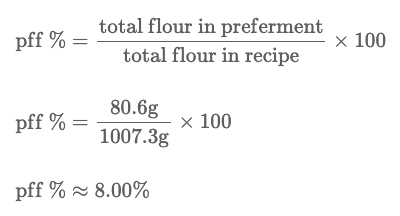
Over time, this percentage will begin to convey something instinctively to you, much like the hydration percentage. You’ll see 5% or 10% or 25% and think, ok, that’s a recipe’s low, medium, or high PFF percentage. Based on this intuitive assessment, you’ll need to pay attention and make a larger sourdough starter to build the levain (if high PFF), or perhaps start with the assumption that the dough will move very slowly for a long fermentation time (if low PFF).
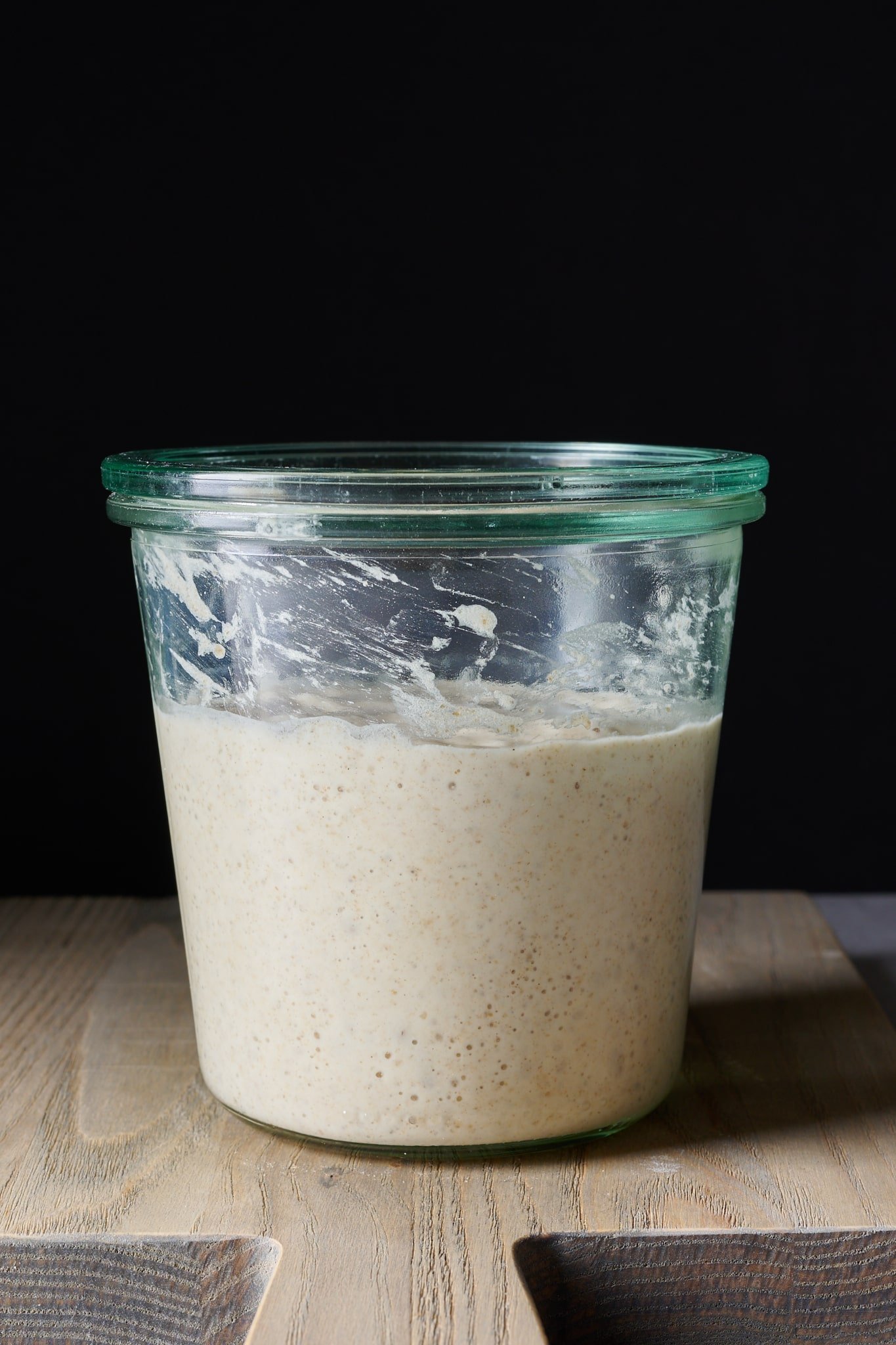
Why Don’t You Include the Sourdough Starter In The Calculations?
This is an important point and something I’ve struggled with here at The Perfect Loaf (and in my baking in general) for years: should I include the sourdough starter flour and water in my overall calculations? For a formula to be wholly correct and account for all flour and water, the flour and water in the starter should be included. However, I typically do not include them for clarity and ease of use. Instead, I treat the starter as a single, cohesive unit.
I see this as a tradeoff between complete correctness and clarity. For example, if I included my starter in my formulas here, you’d always see rye flour as an ingredient (because it’s in a tiny percentage of my sourdough starter feeds). Including that bit of flour would be the correct thing, but it means strange percentages for all the other ingredients, which will lead to questions and confusion.
In the end—and maybe just for now!—I’ve settled on not including the starter flour and water in my calculations. This is because, in many of my formulas, my starter is included in such a small percentage that the impact of that flour and water on the total formula is minimal.
If you’re a TPL Member, you’ll notice in my baking spreadsheets that I offer the option to include your sourdough starter in the calculations for a dough formula if you wish to be 100% correct.
Explaining The Perfect Loaf Bread Tables and Charts
I know there are many tables on this website, but I think it is the most concise and clear way to convey a bread formula. Here at The Perfect Loaf, I like to split up a bread formula into four tables: Vitals, Total Formula, Levain Build, and Dough Mix.
The Vitals table (see right) is a roll-up of all the important aspects of a recipe:
- the total dough weight (how much the recipe makes)
- the prefermented flour percentage (the amount of preferment in the recipe with respect to the total flour in the recipe, more on this below)
- the hydration percentage (the amount of water in the recipe with respect to the total flour in the recipe)
- the yield (how many loaves, buns, rolls, etc., the recipe makes).
Simple Weekday Sourdough Vitals
| Total Dough Weight | 1,800 grams |
| Pre-fermented Flour | 8.00% |
| Hydration | 76.00% |
| Yield | 2 x 900g loaves |
The Total Formula table (see earlier in this post) is a snapshot of the entire formula, taking the levain into account: the total flour required, the total liquid, total fats, total sugars, and so on. In addition, the TF table also shows the baker’s percentages for everything so you can get a sense of the recipe outright (as I discussed at the beginning of this post).
The Levain Build table (see earlier in this post) is what you need to mix to make the levain—the off-shoot of your sourdough starter (see my post here on the differences between a sourdough starter and levain) for a single bake—for the recipe. The levain is usually some percentage of sourdough starter, some flour, and some water that’s made some number of hours before the rest of the recipe begins.
Finally, the Dough Mix table is what you need when you get to your counter and start combining ingredients. This table doesn’t have baker’s percentages because, at this point, you just need the weights of everything to know what to add to your mixing bowl.
Why Are the Ingredient Weights Here Rarely Round Numbers?
You might have already figured out the answer to this by now, but it’s worth stating: almost every one of the recipes you see here will have strange ingredient weights that aren’t usually round numbers. For example, in the Simple Weekend recipe used above the high protein bread flour is 805.8g, not 800g. Why?
When making a formula, I work on the overall baker’s percentages. So, I might say to myself, “I want this recipe to have 80% bread flour, 20% whole wheat flour, 76% water, …” Forming an image of the end loaf in my mind through numbers. And this goes back to that instinctual feel for percentages and how they will eventually translate into bread dough.
In essence, I know for me a 76% hydration dough is low to moderate hydration, and it’s also a manageable dough for many. Finally, when I use those percentages and set the total dough yield to be 1,800g (to make two beautiful boules), the math spits out the actual weights I need for each ingredient to satisfy the percentage concerning the total yield. And because I’m focusing on working in percentages (usually round), the actual weights can be whatever the math says they should be—and generally not round.
What’s Next?
And there you have it, my (hopefully clear and not too scary) introduction to baker’s percentages. If things are still unclear, or I’ve missed something here, please comment below, and I’ll get back to you with an explanation. I’d also love to hear if you have any tricks or suggestions on how you work in baker’s percentages (besides just using a spreadsheet!)—there’s always more to learn and, dare I say, more fun!
If you’re looking for more technical aspects of baking, check out my post on dough temperature and its importance in baking.
Happy baking!

138 Comments
I have a TPL membership and I am signed in but I cannot download nor see your bakers percentage spreadsheet. When I click on the link for “Download My Baking Spreadsheets” it links me to the subscribe page. Also, the search feature does not work for me. When I click on the search icon, nothing happens. I have tried two different browsers and nothing works. For a paid membership I should have access to all the features. Please help/advise. Thank you.
Hey Christine, sorry about the confusion! You do have access to all features, but the navigation wasn’t immediately clear. That download button doesnt have the sheets there directly, that’s where the confusion is (I’ll work on a fix!).
You always have all the Perks for the membership available but clicking the drop down menu in the upper right at the very top of every page at the site (it’ll have your name, and then click Perks). Or, here’s a link:
https://www.theperfectloaf.com/membership/perks/
The sheets and everything else is there!
As for search. Try giving the site a hard refresh, it should clear the issue (everyone has the search functionality). Let me know if you’re still having trouble!
Hi Maurizio
I like the spreadsheet and it helped with the weight of the ingredient in the final dough. However, do you mind sharing how do you derive 0.8% baker's percentage for the sourdough starter in the total formula? I may have got almost everything on how it works in the spreadsheet, but from your recipe, i am just curious on the sourdough starter baker percentage. Thank you again Maurizio.
Hey Wendy! The 0.8% is the small bit of ripe starter I use to seed the levain build, measured against the total flour in the formula. It’s a tiny amount on purpose because that little inoculation seeds the levain, and over eight or so hours it wakes up into the mature preferment that actually leavens the dough. So the starter isn’t raising the loaf directly. It’s raising the levain, and the levain raises the loaf.
Hi Maurizio,
I just started my sourdough journey this year, i thought it was that sooo easy,but then after many attempts i failed. Little did i know it has lots of factors; temp,type of flour,weather,hydration etc. tbh after seeing your blog, i was quite overwhelmed because of the long details i was quite impatient and just jumped to the recipe but still my bread is still imperfect LOL but after many attempts, i went back to your blog and saw that everything was explained IN DETAIL. You know what, i just read everything! LOL and i was in awe because so many questions i want to ask and because of your blog i can mostly understand now and making me or us beginners to improve and make better sourdough. I really appreciate your time and hardwork to make blogs like this for us novice to understand the process of sourdough. From the bottom of my heart, thank you and i really appreciate the efforts that you write for us, not to mention this is a free website for those who couldn't afford membership fees and also your instagram (which i followed you eventually lol)
PS i want to ask if do you usually add 3% for oil? I saw some of your recipe calls for it when adding oils in your dough
Hope to hear from you soon!Thank you so much!!
Super happy to help, thank you. It's why I do what I do! Yes, 2-3% oil is where I start for most things calling for softness. Happy baking!
Hi Sir, I wish to add some sunflower seeds and walnut to the sourdough. My flour weight is 400gm. How much seeds + nuts that I can include in this recipe (since my flour weight only 400gm…the rest other ingredients not included yet). Any particular percentage nut vs flour weight without effecting the gluten and rising of the dough during oven spring. Thank you Sir.
I'd say if you do 10% to total flour, you're probably safe. That means, you can add 40g of seeds + nuts. Bake it off and see how it goes, then increase up to 15% if things go well and you want to!
Hi The site doesn't allow me to download or see your bakers percentage spreadsheet. It sends me back to the subscribe page though it shows me being logged in and a subscriber. Thanks
Hey Diane! Make sure you're signed in at the very top right of the website. There's a little member dropdown there to sign in. If you are signed in, your name should show up in the box! Email me if you're still having trouble, we'll get you squared away.
Yes, my spreadsheets can do enriched doughs as well. All my sheets are in the membership .
In the topical countries, room temperature can go as high as 33 degree Celsius (91.4 degree Fahrenheit) and the humidity can go to 80-90% and air-conditioned is not an option. Will these factors affect the bake mixing/fermentation/shaping/proof processes?
Much appreciate you can share some tips from your experience in dealing with such condition.
Yes, lots of tips in my guide to baking in the summer , Bruce!
How is the starter % calculated to find the weight needed in the vitals tab? Do you take the overall % of levain you want eg 20% and divide by 3 to find the Starter weight to then divide that number by the total flour in the vitals ?
The starter percentage is the amount of starter relative to the total flour in the recipe (the starter is then added to the levain).
I typically calculate and shoot for a levain that is 20% of my total flour. I aim to build my levain on the principle that the water and flour will be equal parts and they will be a multiple of the levain. To build a levain for any recipe I calculate based on a 1:8:8 ratio (because I know when it will reach maturity and it fits my baking schedule). So, on 1000g total flour weight a 20% levain would be 200g. If you divide that by 17 (the sum of all parts in a 1:8:8 ratio) you know how much starter to use, and then you divide the remainder in half to find how how much water and flour will be in the levain. 200/17=(12). 200-12=188. 188/2=94. These values are subtracted from the total flour and water in the formula so I know how much of each ingredient is in the mix.
So, the 20% levain in this example is comprised of:
12g starter
94g water
94g flour (which for me is usually a50/50 mix of the, usually, two flours in the recipe)
Do you have recommendations for a better or easier method of building a levain formula?
That's absolutely one way to do it, Morgan! I personally use my spreadsheets I have setup to do all the calculations based on the desired pre-fermented flour percentage and total flour. The calculation is baked into the spreadsheet so I just have to change a few numbers and I'm good to go.
Hi Maurizio,
This has been the clearest explanation of this subject ive come across, thanks!
I was doing fine until I got to the part where you talk about adding an extra ingredient to the basic recipe, in this case the 15% of walnuts. How did you come up with the changes to the base recipe in order to add the walnuts? I’ve tried decreasing the weight of flour by 15% and go from there but it doesn’t get me to your numbers. Id be so grateful if you can clarify this for me. Thanks!
From what I understand here, you don’t want to just decrease the flour by 15%. Instead, what he’s doing is recalculating the weights for every ingredient while maintaining a constant final dough weight of 1800 g.To do this, I think we need to use the conversion factor discussed in the previous section, where the 15% for the walnuts now gets added in to the total percentage in the formula:
80+20+76+1.9+0.8+15 = 193.7%
Then we take the desired yield and divide by the sum of percentages:
1800 g/193.7% = 9.3 g/%
That means that each percentage point in the formula means 9.3 g of the corresponding ingredient. To get the weights in the table, we multiply the percentage by the conversion factor:
80% × 9.3 g/% = 744 g
20% × 9.3 g/% = 186 g
… and so on. (My numbers don’t match exactly due to rounding.)
I hope that helps!
Thank you, Jaselyn!
Is there a difference in weight and volume of whole wheat vs flour? I often sub out some of the white flours for fresh milled whole wheat and have noticed that 1/4 c of whole wheat weighs more than 1/4 c of white flour. Seemed like paying attention to how much liquid is needed helps me adjust the texture.
I always measure by weight for this exact reason, Marcy!
Thanks for explaining this!
If you were to make a smaller bread. Lets say normally you bake a 1000g bread for 20/10/23 min (500/450/450F) in a dutch oven, but now you want to bake a 750g bread, how do you adjust the time in the oven?
I’d still do the 20m with steam, then reduce the second half as necessary. You need to keep an eye on it and test that first bake!
Thank you for the detailed explanation! In experimenting with enrichments like honey and olive oil, would those liquids need to be calculated together with water in figuring the hydration percentage?
You’re welcome, Sarah! So I don’t typically include other liquids when reporting the “hydration” percentage. Yes, they technically do have water content in them, but it’s so hard to measure!
Hello Maurizio, thanks the explanation above. Very helpful indeed.
I have been baking sourdough bread for 2 years now, and still learning)))) I sometimes come across the scenario when my dough is behaving great, its usually 75-76% hydration, after bulk fermentation i shape it and after resting some time it goes to fridge for cold fermentation for the night. What i notice is, before i go to bed the dough is already doubled in size in fridge. in the morning i turn it into the baking paper and see what i dont want to see: it starts changing its shape, going down in heigh…in this case the result it not same after i bake it. the consistency is still fine, the flavour is good, but the looks are not the same. Where is the mistake? Thanks
You’re welcome, Nika! It sounds to me like your dough is over proofing on you in the fridge. Reduce the amount of bulk fermentation time it it out on the counter before you put it in the fridge.
hello Maurizio, first of all thank you so much for all the detailed explanation. It is such a great help for sourdough newbie like me. I’m a bit confused on the levain percentage from the total flour in the recipe.
I’m aiming for a less acidic bread and I read some comments below where you said reducing the levain percentage of the total recipe will help reduce the sourness aside from using a not excessively ripe starter.
But I saw in the other comments also you mentioned that levain with higher seed will be faster to ripens and result in less bacterial activity and I assume less sour end product. I then thought bread with higher levain percentage means higher seed will need less fermentation time and resulted in less sour bread.
Maybe I got confused and understand it wrong, would you please help me clarify this? Thank you so much!
If you’re looking to reduce sourness, you can: reduce whole grains, keep the dough cooler, reduce total fermentation time (which would typically mean using more starter in the dough, within reason). All these will help you get there!
Curious how you determined 900g to be the perfect boule size. I will likely use that benchmark for my next loaf. Using a different recipe/different site, my total loaf weight was 650 (20% whole wheat, 80% AP, 20% levain, 2% salt). It seemed way too small for my 5.5 Qt / 10.5” Dutch oven and the dough spread a lot which may have contributed to a smaller (height wise) boule than I was expecting.
That was found simply through trial and error over the years. Even though I almost always bake at 900g (which conveniently fits my baskets nicely), a 600, 700, or 800g loaf is also fantastic!
The next time you update this web page could you have the developer address the current inability to print it out in a manner you can actually read.
There is no developer, just me 🙂 This page doesn’t have a print function, you’re correct. I’ll look at trying to get this in there! Just about all my other recipes do, though. Working on it!
I’ve read and re-read your article above, and can’t find the answer to my questions. I need to know if it really matters how much flour and water I add to my starter to make my levain, IF, without measuring but just eyeballing it, I add water and flour, my levain always doubles, is very bubbly, and floats? And, will measuring flour and water make a better loaf of bread in any way? Will it help the loaf rise better, have an ear, help the crust in any way? Thanks!
I like to keep things measured there with my starter, but it’s not 100% mandatory. I also do not take the water and flour that’s in my starter into account when doing calculations here at The Perfect Loaf (as I explain above). Why? Because typically my starter is a very small component to each bake, and it just makes the math more complicated. I do, however, take the levain water and flour into account, since this is much later (relative to other ingredients). Hope that helps!
Your answer makes great sense, and thanks for taking your time to answer it!!! I hope you have a super day!!
So, i am really struggling with these calculations and the need for “%” to guide your recipe weight
in your example above when you discuss adding 15% walnuts:
1) How did you come up with an add of 15″%”? why not for example 5% or an amount in grams?
2) Why did the total amount of other ingreients go down? is the calculation based on weight? will that weight calulation requirement cause the dough to become too wet beause because the nuts will just add volume and not necessarily dry out the dough?
does that make sense?
thank you !!
The 15% was just arbitrary, used as an example!
The rest of the ingredient weights were reduced when the walnuts added because everything is now recomputed to maintain the desired total dough weight (in other words, walnuts were now added, so flour and everything else has to be deceased otherwise the total amount of dough would increase as well).
Hope that makes sense!
I was using bakers percentage to also figure out final dough weight for my pizza dough.
Flour 500g 100%
Salt 16g 3%
Yeast 1g .02%
Water 350g 70%
And came up with a final dough of just shy of 1500g. When making the pizzas I wasn’t even able to make 3 x 300g pizzas. Not sure what I am doing wrong.
Ok just figured it out. I multiplied the totaled percentage by the total weight of everything and not just by the weight of the flour alone. That makes sense.
Yes, that’s correct, Andy! Sorry for the delay.
No need to apologize! Love your approach to baking.
I adore how meticulous and organized your formulas and directions are! Could you tell me more about the importance of preferment % in the Vitals? If I build my Levain differently than you, our PFF% will be different. How does that impact the final product?
Thank you, Elizabeth! Generally, the higher the pff % the faster your dough will ferment (the higher the inoculation into your dough, the more bacteria/yeast you’re moving over).
Your mathematical formula is unnecessarily complicated.
Simply divide the target yield by recipe yield, and multiply that value per ingredient.
Yield Adjustment: 2,700g / 1,800g = 1.5
Bread flour: 805.8g * 1.5 = 1208.7g
Whole wheat flour: 201.5g * 1.5 = 302.25g
Water: 765.5g * 1.5 = 1148.25g
Salt: 19.1g * 1.5 = 28.65g
Sourdough Starter: 8.1g * 1.5 = 12.15g
Hey, Lee! Yes, that’s another way to go about it. I need to update this post with a few more options and some easier ways to do these calculations!
It’s a great read Maurizio, thanks for it!
One area that is still not clear for me to understand is how to arrive at relative changes when adding/removing ingredients from a recipe.
I don’t have the formula for adding 15% walnuts while retaining 1,800g yield. It seems tricky because you need to calculate 15% of the walnuts based on the flour weight, but the flour weight needs to adjust to accommodate the addition of walnuts.
I have all these things plugged into a spreadsheet at this point since I do these calculations often, but yes, if you add in ingredients, the flour will have to go down to maintain the same dough yield.
I remember one other person asking this question, I’ll have to include an example like this in the post!
Hi Maurizio,
I am confused… what is the formula for adjusting the weights when adding the walnuts in your example? I can understand why they change but not the process of how.
thanks
Hi Alex,
Your knowns would be the weight of the walnuts relative to the flour (in this case 15% of the total flour weight) and the weight of the fully baked loaf of bread (in this case 1800 g).
If we let “x” represent the amount of total flour in grams, then the equation becomes:
x + 76%x + 1.9%x + 0.8%x + 15%x = 1800 g
(flour wt) + (water wt) + (salt wt) + (starter wt) + (walnut wt) = 1800 g
x = 929.27 g
which means the individual weights are the following:
flour wt (protein flour + wheat flour) = 929.27 g
water wt = 929.27 g x 76% = 706.2 g
salt wt = 929.27 g x 1.9% = 17.7g
starter wt = 929.27 g x 0.8% = 7.4 g
walnut wt = 929.27 g x 15% = 139.4 g
(The above may have some rounding discrepancies but they pretty much align with the author’s numbers).
Now we can further determine the weight of the two different flours used separately.
high protein bread flour, malted = 929.27 g x 80% = 743.4 g
whole wheat flour = 929.27 g x 20% = 185.9
(Note that the flour in the starter did not factor into the total flour equations for the reasons the author already spoke of in the article near the end).
You would use this equation if you wanted the same amount of bread (1800 g worth) despite the addition of walnuts (maybe the extra weight/volume would not be tolerated by your baking pans or your oven/bread-maker).
Hope that helps.
I enjoy your site so much, Maurizio. I have a question re a phenomenon I sporadically encounter, but more often with this bread, namely, that it gets stickier as I slap-and-fold. I sometimes wet my fingers but don’t think that the few drops are what cause this to happen. I presume it’s because the flour is absorbing more. But is that why? And what should I do about it? Does that mean that I started off with too high a hydration? Thank you!
Glad to hear that, Jessica! I would actually recommend you dampen your hands periodically when you do SF, which will help prevent sticking and tearing–that added water will not harm things. It’s ok if the dough breaks apart, this is actually normal. If the dough is too hard to SF, try starting out will less water and add the rest in after you’ve SF’ed for several minutes. Add the dough back to the bowl and squeeze the water into the dough, which will break apart–but that’s ok! This same thing happens if you mix in a mixer and is expected. Overall, though, the dough will strengthen over time, even if it looks like its breaking apart.