

As I was re-reading Tartine Bread the other week in preparation for my last post, I realized just how important managing your sourdough starter fermentation is after I stumbled on this quote:
A baker’s true skill lies in the way he or she manages fermentation. This is the soul of bread making.
Tartine Bread
I think sometimes it’s easy for me to fall into the routine of blindly feeding my sourdough starter at set times during the day and forget that it and it’s strength are the keys to good bread. Feedings shouldn’t happen on a strict schedule, they need to be adjusted based on cues obtained by sight and smell (perhaps this sounds peculiar but it is one sure-fire way to learn the habits of your starter) until the starter is predictable. Visual cues such as large air pockets and smells like ripe fruit or vinegar are indicators of good fermentation and tell you if a feeding should happen soon. In this post, I’ll go into managing your sourdough starter fermentation to increase fermentation activity.
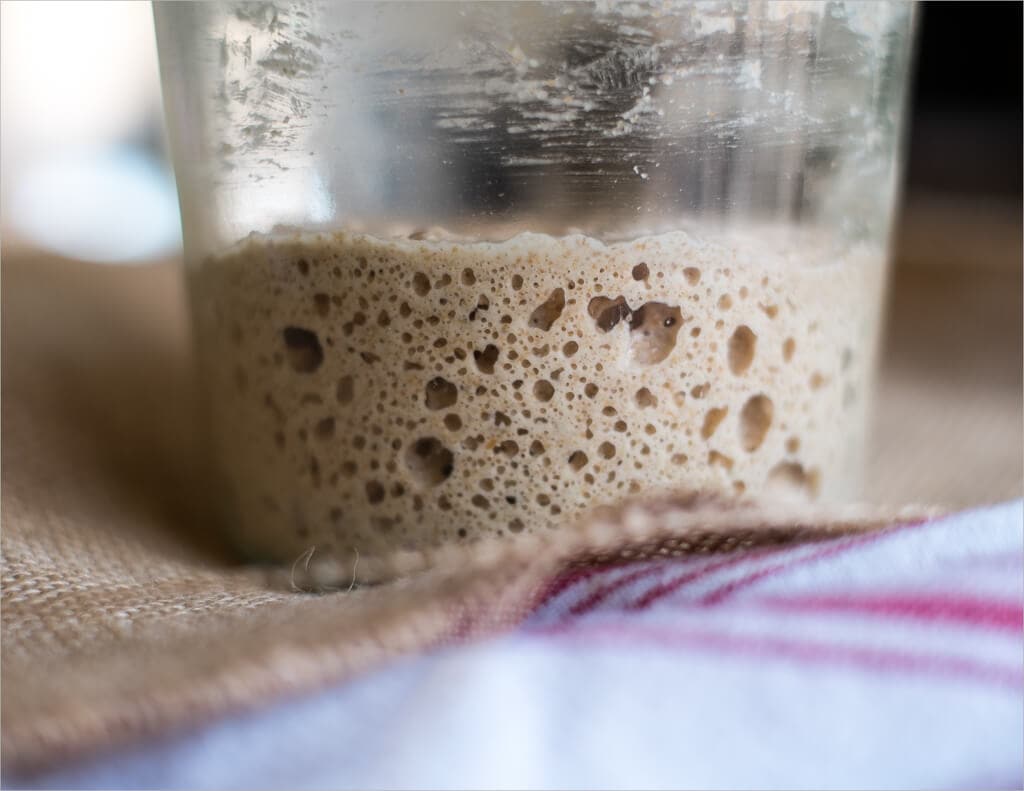
As an aside, I’ve always felt that my starter has “had a problem” and never displayed intense fermentation like I see in pictures online and images in Tartine Bread. It turns out, there are a few reasons my starter has been sluggish over the past almost 2 years, some of which I’ve only just discovered recently. I’ll go into a few of these later.
For this entry I decided to focus on my starter and to manage its fermentation until it became predictable and stable, feeding it not based on an arbitrary or convenient schedule but following its cues. Once my starter started showing signs of rising and falling consistency, I was going to use my previous bread formula and method and bake with it. Here are my results.
Flour Choices, Why Rye Flour?
One of the secrets to managing my starter is to refresh it with whole grain rye flour to keep its activity high. I’ve varied the amount of rye flour from 10% all the way up to 100% and have recently settled on 50% whole grain rye mixed with 50% unbleached all-purpose.
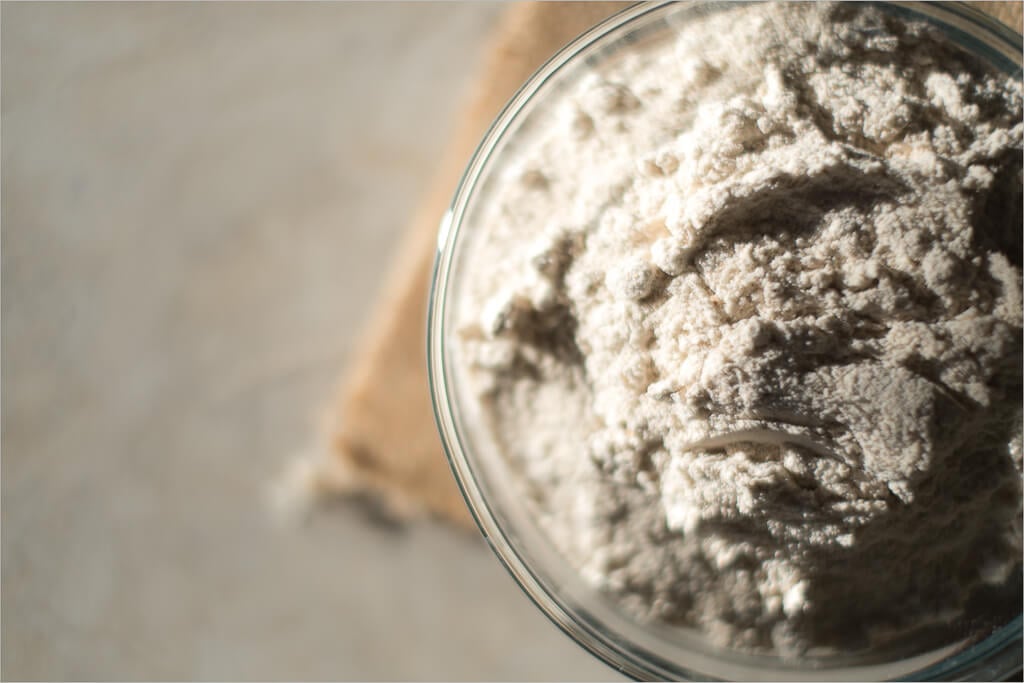
Whole wheat and rye flours provide more nutrients for your starter and ferment more actively, but working with rye flour makes starter maintenance easier than whole wheat. Rye provides increased fiber and nutrients similar to whole wheat flour, but because of its lower gluten amount it’s much easier to stir. I’ve noticed when I work with whole wheat if my feedings aren’t timed just right I will end up with a smelly soupy mess. Conversely, if I feed it too soon it will not build the required strength. Rye helps to alleviate some of these issues as it’s a bit more forgiving with its feeding times.
Managing Sourdough Starter Fermentation
The entire 2 weeks leading up to this bake I carefully fed my starter 3 times a day with 50% rye and 50% unbleached all-purpose. At the beginning of these two weeks, activity was slow and I could only manage 2 times a day (once in the morning and once before bed). After about half a week or so I was able to step it up to 3 times a day (morning, mid-afternoon, before bed). By the end of the first week, my starter began to expect these feedings and I noticed it started to strengthen. Again, I followed the cues. When I noticed it began to fall in mid-afternoon after consuming the sugars in the flour all morning and started to smell sour, I would feed it. It turns out my feeding times were 8:00 am, 4:00 pm, and 10:00 pm.
One important thing I noticed with these 3 times a day feedings: my starter no longer smelled like vinegar by the time its next feeding came around. I reduced the amount of acidity carried over at each feeding by frequently discarding 80% of my starter, removing that intense vinegar smell, and in the end, reduced the sourness of my bread enough that it only barely peeked through.
With a Strong Starter, Time to Bake My Tartine Sourdough
I followed the baking method listed in my previous post while only changing a few of the percentages in order to match Tartine Bread’s sourdough recipe more closely. The main difference is I prefer to use a 100% whole wheat leaven to spur even more fermentation.
Leaven:
- 55g ripe starter
- 200g whole wheat flour
- 200g water
Ingredients for bake:
- 250g (25%) leaven
- 900g (90%) King Arthur white bread flour
- 100g (10%) Great River whole wheat bread flour
- 20g (2%) salt
- 750g water (75%)
Thanks to my strong starter, by the end of the bulk fermentation step I noticed the dough was very aerated with lots of little air bubbles and correctly pulling from the sides of the container. The dough was definitely ready for shaping. I performed my usual shaping, one smaller chunk of dough as a boule and the other larger chunk as a batard. After shaping when the boule and batard were placed into their bannetons, they were jiggly and full of air. I knew I was on the right track with these two.
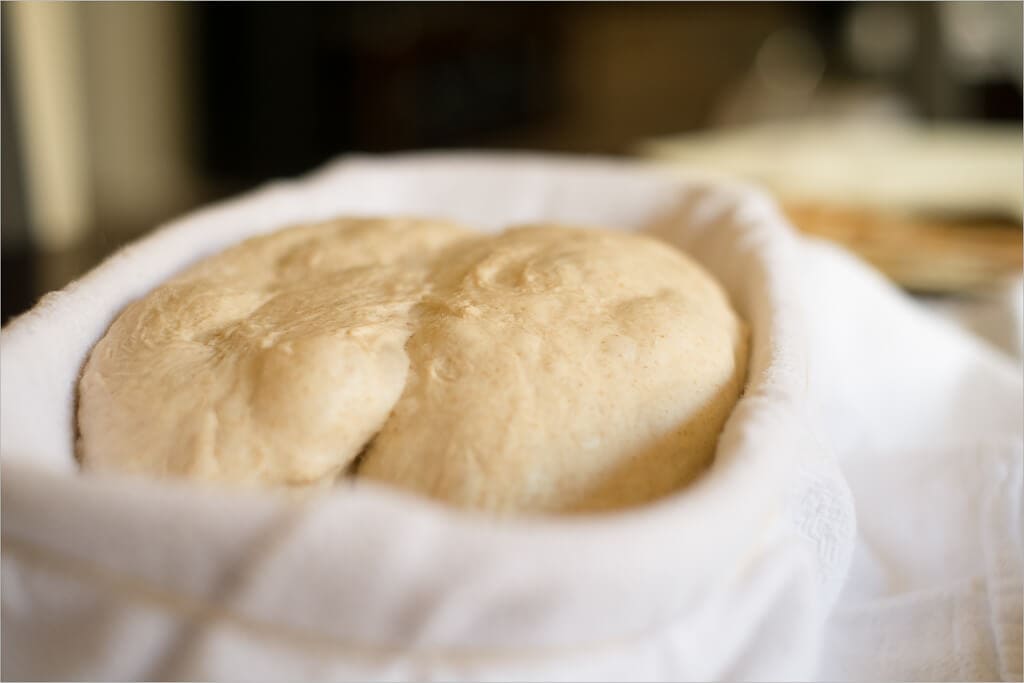
When I pulled out the bannetons from the fridge in the morning I could see the proof was moving along nicely. A quick “finger dent” test showed they were fully proofed and ready for baking.
Conclusion
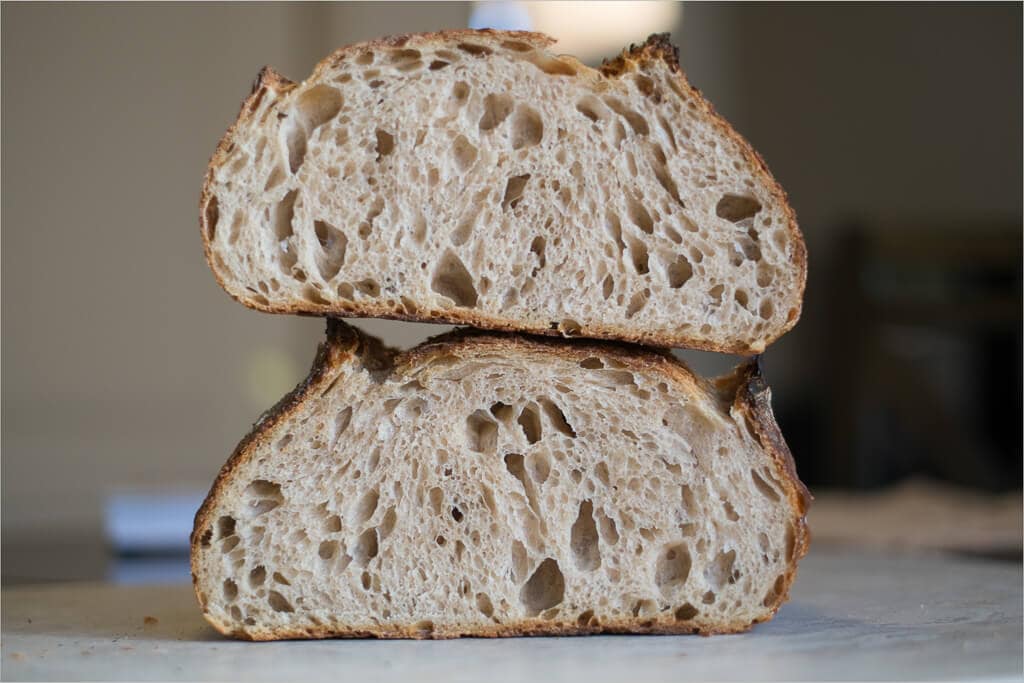
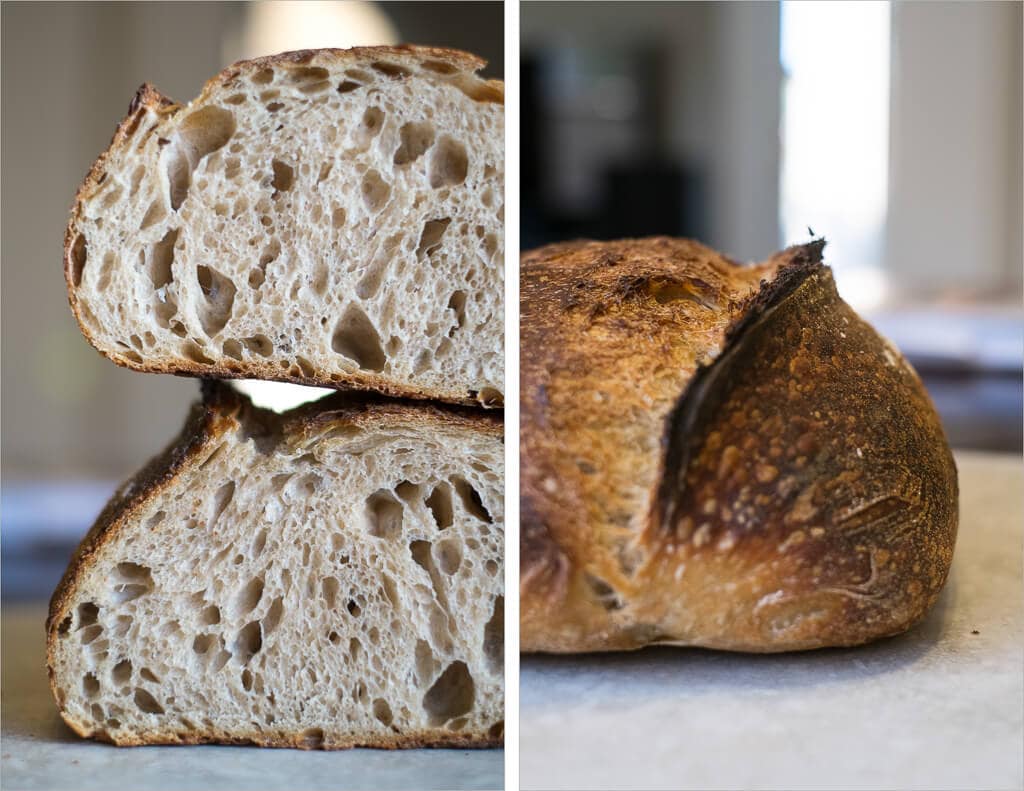
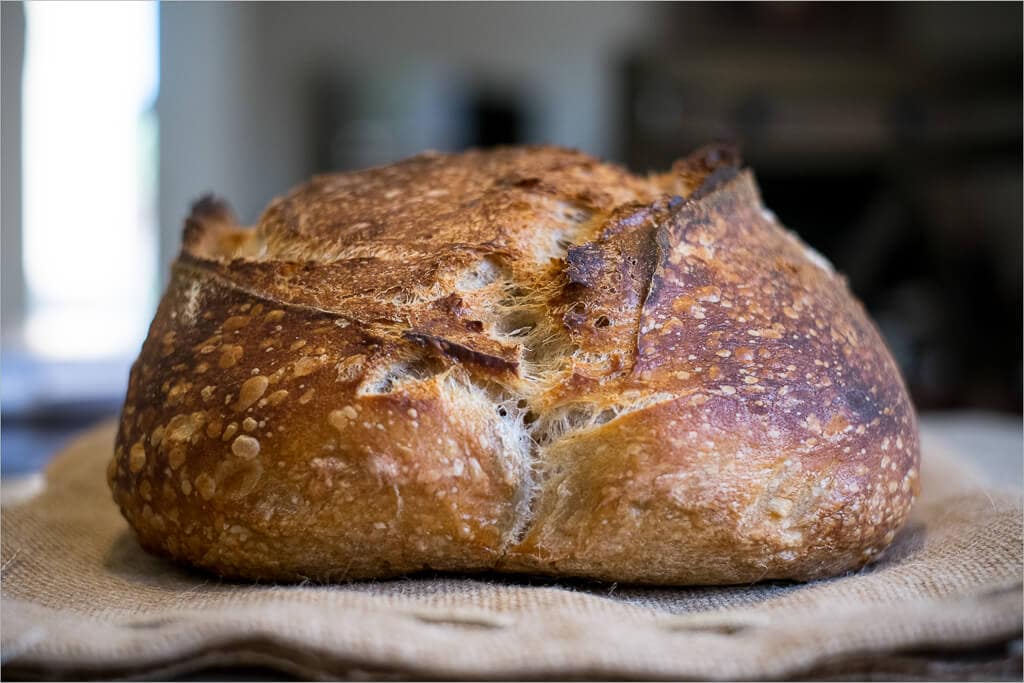
I think it’s safe to say, and you can just see in the pictures, this was hands down the best pair of sourdough loaves I’ve baked. There is just something so rewarding when these come out of your oven after spending more than a day coaxing them into existence. It turns out, managing your sourdough starter fermentation activity helps ensure is strong and lively when making your levain, which ultimately transfers to your end loaf of bread.
Crust
Shattered to the touch, brittle and flaky, this was the crust I have been after. The crust has beautifully dark colores where I scored in, and a lighter color in the fissure. With some more practice on shaping, I can improve here to create some more stretching and higher ears, but the blistery skin and thin crispy crust were very welcome.
Crumb
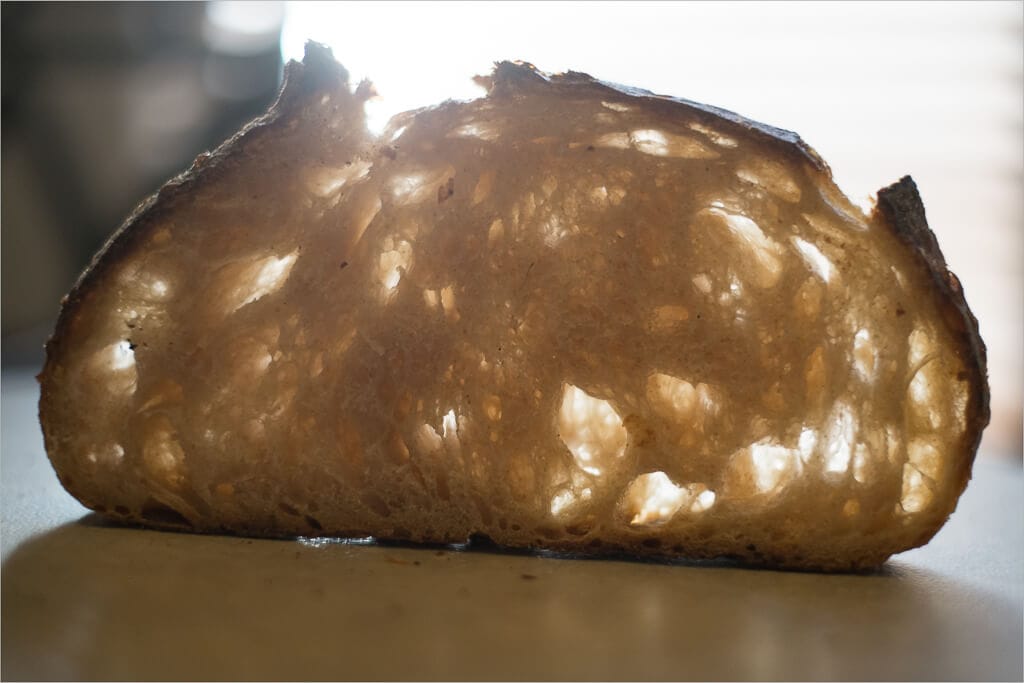
Beautiful and soft, the crumb was so light I was shocked when first biting into it. You can literally see the oven spring movement from the bottom of the loaf to where the score was done down the middle. The soft and perfectly cooked crumb came the closest thus far to my ideal loaf.
Taste
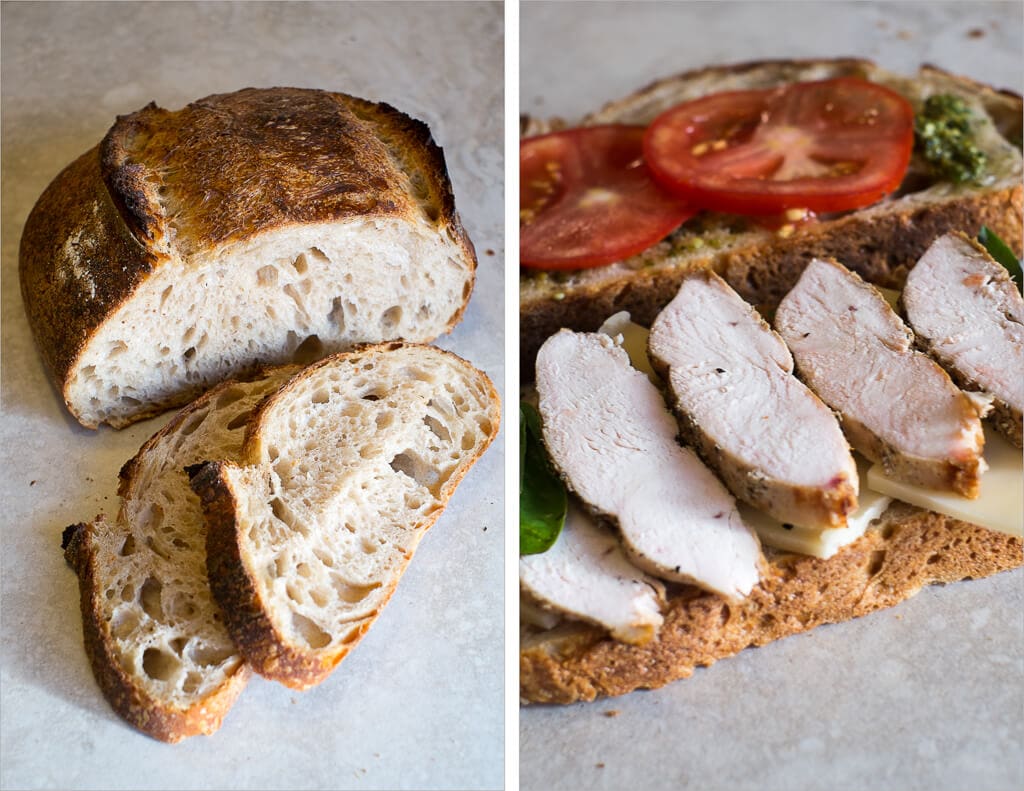
Light and soft with only the smallest hint of sour. This is the sourdough I love. Slicing up the bread to make a grilled chicken, pesto, swiss, and tomato sandwich for lunch was a real treat indeed. Later that evening I enjoyed a thick pan-grilled slice with chopped avocados, cherry tomatoes, and a dab of extra virgin olive oil.
Buon appetito!
If you use this recipe, tag @maurizio on Instagram so I can take a look!


133 Comments
I am trying a starter for the first time with 50% Rye 50% Whole Wheat – I wasn’t seeing much activity after 10 days at room temp 1 (it is winter) so I tried putting it in the oven with the light on and it’s been 7 days, still not much activity or change in odor – only feeding once a day bc visual and scent cues aren’t really there. I forgot about it overnight (so it’s been 36 hours instead of 24) and it has a ripe/slightly rotten fruit smell to it now and some internal bubbles. Should I keep the spacing longer and just go for visual and scent cues until it strengthens? Other ideas or suggestions? TIA!
Yes, definitely go by visual cues and smell — each mixture and environment will be different. Keep it as warm as you can, even up to 80F if that’s possible, it’ll help speed things up. Also, make sure your water is left out in an open container overnight, this should help alleviate any chlorine issues in the water. If you’re still having problems you might want to try a few bottles of purified water from the market, this might help!
Good day Maurizio, thank you for sharing all your insights. I admire your bakes and I look forward to putting many of your suggestions into practice. A few questions: Temperature during bulk fermentation? Temperature of your refrig when you retard the shaped breads? In his book Chad does as you do a series of S&F every 1/2 hour for the first 2 hours. Later he does additional S&F as necessary every hour, usually 1 or 2 as needed. In reading your recipes it appears that you vary from his method by skipping the hourly S&F. Is my understanding of your method correct?
Much appreciated,
Frank
Hey, Frank! My temp during bulk fermentation is typically between 78°F and 80°F. When retarding most of my dough (especially if it’s not explicitly stated otherwise) it’s done in a home fridge at about 39°F. No, I do actually do stretch and folds during bulk, typically every 30 minutes for the first hour or two — depending on how much strength the dough needs. In my more recent recipes here at my site I list out my bulk fermentation step more clearly, stating how many folds and at what interval.
I hope this helps and happy baking, Frank!
Thank you for your quick response! Sorry but I must not have explained my question well. I understand clearly that you and Chad are on the same page about the S&F during the first 2 hours, doing them after each half hour. My inquiry concerns itself with the 3rd to 4th hour of bulk fermentation. If I understand your process correctly, you do not do any S&F during the 3rd or 4th hour of the bulk fermentation, instead, the dough is left to rise without any further S&F’s. Is this correct?
Ah, sorry. Yes, that’s correct. After I do my last set of stretch and folds (the number depends on how the dough is developing; sometimes it’s just one set, sometimes many more) the dough rests in the bulk container until it’s ready to be divided.
The hourly S&F after the initial 2 hours has been an area I have had questions about. The method you use allows for better development.
So beautiful – at this point I can only hope. What do you do with the rest of your leaven after you put the 250g in your bake.
I came upon your wonderful site after I had started a whey/wheat/apf starter and a ww/ap starter, and a stiff ww/ap. Just experiments. I used ww because I had run out of Rye. I will start your beginners sdb soon – can’t wait.
Have fun and enjoy!
Thank you! These days I make much less levain, only what’s called for in the recipe. I used to make a little extra so I had a “buffer” if I wasn’t able to get to the levain in time, just so I wouldn’t go over. Feel free to reduce the levain build to be exactly what’s called for later. If you do have excess, make some waffles, banana bread, or pancakes!
Thanks again and happy baking!
Hi Maurizio,
I tried ti make SDS based on your guide this is the second times. I live in Phuket, Thailand and the weather here is hot and humid, average 85F can go up to 90F. After 19 hours on the first day, it rised almost double. So I fed it and now it continue to rise like crazy with lots of tiny bubbled. Can i start to feed it twice on my second day?
Hey there! Yes, I’d probably go to two feedings per day with those temperatures and that type of activity. Since your culture is kept so warm keep a close eye on it and give it a feeding when it needs one (when it gets close to its peak height). If you have a cooler spot in the kitchen this would help also, 90F is quite high! I like to keep mine in the low 80’s if possible. Hope this helps.
Hello Maurizio, my ww flour starter is 3 days old and, 12 hours after the morning feeding it already doubled in volume and fallen, with big bubbles on the suface and a little vinegary smell. Should I already start feeding it twice a day or wait till the 6th day like in your stater post? thanks, A
If it starts to fall before you get to a feeding you can increase the feedings to twice a day, give it the food it needs. If it’s taking longer to double then wait it out until you see it fall, then feed.
Have you ever experimented with a 50/50 whole wheat/rye starter? I have had good luck with ap/rye starters in the past but no longer keep ap flour around. I’ve taken to milling all of my own flours or buying freshly milled from local guys. I started my starter earlier this week and so far it’s looking strong, but I’m nervous about the whole wheat/rye blend for some reason. Any insight would be great! Thanks!
Hey there! No I haven’t kept one with that mixture but I have kept a 100% whole wheat one for a long while with no problems. I think you should be just fine, though. Keep an eye on the fermentation speed of that guy, though, it’s going to move pretty quick so you might only need a very small starting mature starter amount at each refreshment. Happy baking!
Thank you! Its been looking and smelling great; so much sweeter than my starters in the past. I haven’t baked with it yet, but really appreciate the feedback about his fermenting speed.
Hi Maurizio, my starter is about 6 days in and I’ve noticed, since yesterday, that it tends to rise and fall (as evident by the marks on the wall of the jar). Should I be feeding it more regularly if this is the case? I also noticed it smells heavily of alcohol.
Hi! Yes, if it rises and then falls before you get to the next feeding you can increase the number of feedings. The key is you want to do a feed right when it’s just about to fall down after it’s risen to its top height. The heavy smell of alcohol is also a sign that it’s probably sitting for a while after falling!
My beloved starter has been sluggish lately and smells more like yeasty feet than sour. Im concerned that it is sick. I feed it 100% fresh ground rye at the moment on a daily basis but not always at the same time of day. Should I increase feeding to 2x daily at regular time intervals? Do you think that using some AP flour would help it along as well? Also wondering if it’s best to store your starter in the fridge at all times or does it like to be at room temp?
100% rye flour will ferment quite quickly, depending on your ambient temperatures. Keep an eye on it when you’re able to be around, watch how it ferments and how it smells every couple hours. If it looks like it’s moving too fast and starts smelling overly sour bump it up to two feedings per day.
Adding some AP flour might help you visually inspect the fermentation process throughout a day but it’s not totally necessary. There are many bakers who maintain only a 100% rye starter and it works for them.
I don’t keep my starter in the fridge unless I’m planning on being away from it for some time and can’t get to it. You can use the fridge to slow the progress of your starter if necessary but I prefer to keep things at room temp (or higher) if possible.
Hope this helps!
Hi! My starter is in Day 3 and since literally 12 hours into day one I had a lot of activity. By day 2 it was doubling almost tripling in size and now Day 3 it smells nauseating. I’ve been feeding it straight wheat flour, not all purpose. I’m going to start feeding twice a day now. Why is it that way? The smell :/ is the whole wheat too operpowering?
It could be that your culture is fermenting much faster than you expect due to the extra whole wheat you’re using. Feeding twice a day will hopefully clear that up!
It’s not bad at all to use 100% whole wheat for feeds, in fact many bakers prefer this, just keep an eye on your culture and feed when it needs a refreshment. Have a look at my sourdough starter maintenance routine post for more info on this!
If one lives in a high altitude climate do you have any suggestions about the starter and baking? When I started preparing my starter it showed signs of activity the first couple of days but on the third day and onward it showed no life. I have been feeding it according to your instructions and discarding all but the 40 grams every day. I am using rye and bread flour 50/50 ratio.
Thanks for your outstanding blog.
That lull in activity can be a normal thing. Eventually, with consistent feedings, your starter will perk back up become reliable. Have a look at my Sourdough Starter FAQ for more topics (including a reason for this lull in activity)!
You’re welcome, Bess — happy baking!
Hi Maurizio, im loving your site, i have just done your seven day starter recipe but I have just kept going with it for about 5 more days trying to fix issues (such as too watery) but it has been looking great for a few days now but just smells quite vinegary? Would you recommend getting rid of more each day or shall I up the feeding to morning and night? I’m currently feeding every day at 5pm and I use filtered water and just plain unbleached white flour. Also a quick question in regards to baking, if i plan to bake only once a week should i just keep the daily feedings up and then 2 days before i plan to bake feed it twice? Thank you
Elise — if your culture smells overly acidic and very watery by the time you get to the next feeding it sounds like it needs a feeding earlier. You could try to keep it in a cooler spot in your kitchen or discard more of your starter so you have less carryover at each feeding (which will slow everything down, ultimately).
Yes, I recommend 2 feedings the day (or two days) before you plan to bake. This helps get your starter ramped up and more active before you build your leaven for baking.
Hope that helps, happy baking!
Hi Maurizio, thanks so much for getting back to me! I have followed your advice and I went ahead an baked my very first loaf today. It looked perfect and tasted ok (although a little like ordinary bread) but the inside was lacking holes.
Sure thing! It’s really important to ensure you do a full and complete bulk fermentation. Try to keep your dough around 78ºF if possible the entire time and it should look very active at the end. It will jiggle when you shake the bowl, show some bubbles perhaps, and just look alive. Usually when I see a dense interior it’s due to insufficient fermentation!
Maurizio … Hope you’re having a great time in NYC and with your two well deserved rewards!! I’ve been on a twice per day feeding schedule, and I was thinking about trying 3 times per day. My question to you is: do you use different amounts of ripe starter for each feeding due to the amount of time that lapses before the next feeding? I would assume that you want the starter to be at its peak at each feeding, right?
Jim — had a blast out there in NYC, such an amazing city! Thank you, so totally stoked to have won the Saveur awards for my category 🙂
Yes, you always want your starter to be around its peak at each feeding (a little above or below is ok). I do modify the amount of carryover at each feeding depending on when I know I’ll get to the next feeding. For example, if it’s nighttime and I know I won’t be able to feed when I normally do I’ll leave a little less mature starter in the jar so fermentation slows a bit. After feeding your starter for a while, and depending on the season (warmer temps increase fermentation and vice versa), you’ll develop a feel for how much starter to leave in the jar. So much so, actually, that I don’t even measure anymore.
Hope that helps and thanks again!
Thanks man. I figured that had to be the case. Congrats again!!
Maurizio – Just stumbled upon your website. Awesome!
I’m relatively new to the bread baking scene. Started with Ken Forkish’s book 4 months ago, and have just graduated to the Tartine book. Just made my third ‘sourdough’ loaf. While they were all good (except for the one that I tried to proof in the fridge for 4 days), I’m longing for that sour San Fransisco flavor. Living on the east coast, I know I can’t match the water or climate of CA, but I’d still like to get a more sour loaf.
A month ago I was gifted 50g of 120 year old starter from the Klondike. I’ve been feeding it, using it in levain and then refrigerating it for a week. I’m attempting to play with two jars of it; one that I feed with a 50/50 rye/AP mix and the other with a 50/50 wheat/AP mix. I’m thinking the rye would be more sour than the wheat? And with 2 different starters, i could bake 2 different flavors.I think I’ve read too many conflicting articles about starter care and use, so I have some questions, if you don’t mind. For a sour starter, do I stir in the hooch, or pour it off? What mix percent should I feed? I’ve been doing a 50g starter, 50g flour and 50g water. Should I wait until after it’s peak to feed again (it smells more sour at that point). A longer, refrigerated proof should yield a more sour final product, but how long is too long? Also, when the bread is fresh from the oven, the crust is nice and crusty. But as it cools, it gets kind of softer. I’m baking in a dutch oven at 475 for 30 minutes covered, 20 minutes uncovered.
Any words of wisdom would be most welcome. Thanks!
Thank you! Glad you’re enjoying my site.
Your bread will be more sour if you use more whole grains, rye especially. You could try upping the rye percentage in whatever recipe you use. Additionally, a longer cold proof will increase the acidity the longer you keep it in the fridge — within reason. You can’t leave the dough in there indefinitely as eventually the gluten in your dough will begin to breakdown and oven spring (rise in the oven) will be compromised. Some flour can take longer fermentation times and you’ll have to experiment with yours. I usually start with 12 hours and go up from there. It really depends on the flour mix you’re using!
Regarding your feeding times and what to look for, have a look at my sourdough starter maintenance routine post, it has quite a bit of information on all this!
The crust on your loaves will changed depending on your environment. If it’s humid where you are it will soften over time, here where I live it’s very dry so it gets more and more dry over time. Not sure what you can do to lengthen that period. I keep my bread in a bread box (listed in my Tools page up at the top), this might help.
Hope those tips help, let me know how it goes! Happy baking 🙂
I am finding this website very helpful, so thank you for your dedication to the art.
Readers less familiar with metric units (or without a metric scale) might be happy to know that the Chrome browser has an extension called autoConvert that will turn grams to ounces 🙂
Aaron thanks for the kind words, really appreciate it! This website is definitely the intersection of all things I’m passionate about, I’m happy to share 🙂
I haven’t heard of that Chrome extension but that’s super handy, thank you!
You don’t need an extension with Chrome. Just enter “50 g to oz” or whatever you need converted into the address bar. Sometimes the answer shows up below the bar on its own, sometimes you have to press return. You can do calculations this way too. I love Chrome for this; i use it all the time.
Hi Maurizio, after joining your fan club a few weeks ago I am now revising my routines and I would like to ask you
to answer a few questions of general interest.
1. Do I take it correctly that you are maintaining a unique rye/APB flour starter and convert it to the specific flour you are going to bake with? Is this a one step process occurring at time of building the levain or do you train your starter over a few feedings before? Well, You have been flexible of course, but what is your preference at this point in time?
2. Have you ever measured the pH of your starter? Your considerations correlating the acid load of your starter with the interval between feedings do definitely make sense. I have occasionally measured it in 130% hydrated starters and have consistently found it between 4 and 5 right before feeding. Though, I am now going to check it serially and will probably adopt your criteria instead of relying on time intervals.
3. There are additional factors contributing to the sour taste of loaves and I would like you to make an educated guess as to the relative weight of the amount of levain, its formula, its acidity and the practice of retarding fermentation (maybe you’ll need a brand new post for that). Quoting a Master and a reference for both of us, some Tartine Book No. 3 formulations differ from those of your practice but, please, don’t get me wrong, I am not impying you have gone the wrong way. I simply would like you to expand a little bit as to why you moved your way and how that impacted on your results.
Finally, the more I practice the better I appreciate how complex is the task of making good bread and why one easily becomes addicted. It is also more clear to me the value of your skill, the clarity of your narration and the gratitude you deserve for sharing your knowledge.
Bartolo
1. Yes I still keep my starter with 25% rye / 75% apw flour. When I make a levain from that I just take some of it, no conversion necessary.
2. I have not taken the pH of my starter, but I want to experiment with that some more in the future. It would be interesting to track that data over time and relate it to bread baked with it at various levels!
3. There are so many ways to make bread! Chad, in Tartine, created his formulas for a certain aesthetic outcome as well as a certain flavor profile. I’ve had his bread several times and do find it to be quite sour, much more than mine. While I like his sour flavor I like mine to be a little less so, mostly because I eat my bread every single day and I want it to pair well with any food I’m having. That doesn’t mean I don’t like a more sour loaf from time to time, but it’s all personal preference. I think you’re right though, I need a post on how to increase acidity in loaves, many people ask me for advice on that. I’ll work on it 🙂
Thanks again for the comments Bartolo, I’m really glad you’ve taken to making bread in earnest — it’s a fun and complicated adventure 🙂 Ciao!
Thank you Maurizio for your concise and exhaustive answer. Your point on sourness is well taken and, while I do not mind, most of my guests are quite sensitive about it and I’ll keep on trying to mitigate it. Ciao!
Flour Choices for starter?
Hello, first of all I also need to say your bakes are just pure art. I got here through your instagram where I have been active like a good starter recently 😉
I just wanted to ask about the types of flours to use for starter feeding. You suggest to use the 50/50 mix of rye and unbleached all purpose. My problem is that here in Poland we have different names for flours and I am a bit confused whats best to use. Below I have listed most popular tyeps of wheat and rye flours here.
WHEAT FLOUR
450: 0,50%
550: 0,51% do 0,58%
650: 0,59% do 0,69%
750: 0,70% do 0,78% (also called bread flour here in Poland)
1850: 1,61% do 2,00% (also called graham)
2000: >2,00% (whole wheat?)
RYE FLOUR
500: 0,58%
720: 0,59% do 0.78%
2000: >2,00%
450, 750 and so on is the TYPE. The lower the number the whiter the flour is. And the percentage relates to “the quantity of minerals” in each – whatever the hell that means. (there is this method here that a small portion of flour is burned for 60 minutes @950C so all organic substance is burned out and then they measure the amount of minerals leftover. That’s the percentage part above.
Someone told me to use rye flour TYPE 2000 as it has the most nutrients for the bacteria to grow and I have a nice starter now that is full of bubbles but it does not have this gluey like consistency like on your pictures. It rises well in the jar but it is so thick and sticky that it does not collapse after all the food is gone. It just stays up. When I do the test in the water it does not float tho, it goes submarine. When I stir it it gets really dense.
This is how it looks.
http://i1207.photobucket.com/albums/bb478/kisieloski/Mobile%20Uploads/image.jpeg
I wolud love to hear from you what you suggest is the best choice from the above.
Andrzej, thanks so much for the comments! For your wheat flour I’d suggest picking one around Type 550, that should be near what we have here in the US called “all purpose flour”. For your rye flour really any of those will be great, if you want increased fermentation of course go with the higher Type numbered flours.
I’d suggest using Type 550, and any of the rye types but change your ration to 75% Type 550 and 25% Type 720 or 2000. I think what’s happening is your starter is incredibly thick and dense do to the rye flour and thus it will not float when tested. It looks like you have good fermentation activity so that is a great sign. If we use a bit more white flour your consistency will probably be a little more in-line with what I have with mine.
That said, feel free to use any percentage you’d like — they will all work well. Just know that if your levain fails to float it can still produce wonderful bread! For example, imagine if you had a 100% rye flour levain, that would surely NOT float under any circumstance and yet you could make great bread with that. I find the float test works well when the percentage of white flour is rather high and the hydration isn’t too far over 100%.
Hope that helps!
Hi Maurizio,
I am really thankful for your reply and time! I am just not sure if I am reading your suggestions right. “I’d suggest using Type 550, and any of the rye types but change your ration to 75% Type 550 and 25% Type 720 or 2000.”
Would this mean: 75% of 550 ‘wheat’ + 25% of 720 or 2000 ‘rye’? I am not sure if I should mix wheat and rye for the starter?
So last Sunday I made another attempt to bake Tartine from the basic recipe with my 100% rye 2000 starter super thick and active. To produce 200g of my levain I used:
20g starter
25g of 1850 wheat
75g of 720 wheat
100g H2O
I mixed the levain at 12pm and went to bed. When I woke up at 6 am the levain was already collapsed quite a bit (just after 6 hours in room temp) but still floated in water.
For final dough I used:
700+50g H2O
200g levain
900g 720 wheat
100g of 1850 wheat
20g salt
I was using this recipe for quite a few bakes now and only once I was close to what you can call a nice bread J http://i1207.photobucket.com/albums/bb478/kisieloski/Mobile%20Uploads/image_1.jpeg
What keeps happening to me is that after autolyze and mixing (app 3,5 h) my dough is never strong enough to shape and its really sticky. What I just noticed in your best sourdoug recepie: https://www.theperfectloaf.com/best-sourdough-recipe/ is that you let the flour and water to autolise for 30 minutes and then add levain and in the recipe that I followed so far, levain goes in right at the start. Could this help build a stronger less sticky dough?
All the best form Poland!
Andrzej
Yes, I’d do a mix of wheat and rye, 75% wheat and 25% rye. Really the ratio is up to you! You can adjust this to whatever ratio you’d like, and what your starter performs well with. Each starter and each environment is different.
Your bread looks great! Really nice fermentation going on there.
I’d suggest you might want to try reducing hydration by 10% if you find the dough excessively sticky, or wet. Each flour and environment is different and will take on different amounts of water.
If your dough is extremely slack (weak, stretches out quite a bit), reduce your autolyse time to no more than 1 hour. You also need to make sure you build enough strength in your dough during bulk fermentation. At the end of bulk your dough should slightly resist you when you try to tug on it. Also, if it looks flat in the bowl and you don’t see any domed edges (where the dough meets the side of the bulk container) you should probably give it one or two more folds during bulk.
I hope that helps, Andrzej!
This is the first post I’ve read of yours (after googling concerns over my starter, which I use in everything from breads to waffles), and it was enough to make me want to subscribe! That loaf is beautiful and I’m so envious of your hard work and perfect results! Also, grateful for the new knowledge to better care for my starter. Thanks!
Thanks so much for the comments, Trista, I appreciate that! It takes practice, for sure, but SO worth it. Happy baking!
Hi Mauizio……I have been baking sourdough for about 10 months now and have had varying degrees of success and fails!!! I must admit tho I have neglected my starter on occasions so when I came across your article on starter maintenance I decided to change my “bad habits”. Two weeks later after following your advice, and baking your version of “Tartine” I think I may have baked my best loaf yet. I did change the type of flours (I’m in the UK) but all is good. I have one happy husband this fine sunny Sunday morning. Many many thanks 😍
Hello BakingNana, I’m in UK too, I just wanted to mention that I find UK flour, I use Waitrose will not accept as much water as do other flours, eg US flour. Now should I use an American recipe which has high hydration I don’t add the full amount of water until I see and feel that it needs it. I do autolyse, long fermentation etc.
Cynthia
Hi Cynthia….I started my sourdough journey, some 10 months ago, by following a US online course and have had some nightmares trying to translate US flours to UK flours. By trial and error though I think I’ve cracked this by finding a strong white (but not too strong) bread flour (11.7% – Lidl of all places) that seems to work with US recipes. Of course when I start adding in other flours, wholemeal, malt, semolina etc then that of course changes the dynamics. I agree with what you are saying…..you have to go by feel, look etc but of course that only comes with experience (something I didn’t have 10 months ago). I am now beginning to gain confidence and go by “gut feel” but it was good to go back to basics. By the way what flour do you use from waitrose
I use Essential Waitrose Strong White bread wheat flour which is 12.9 as my basic, but also use their Canadian, and wholewheat and the Duchy ones too, but I tend only to go to 50% wholewheat. I find I can also use a percentage of ordinary plain white flour too. What I cannot manage without with our cold weather is my Brod and Taylor proofer. I live in Swindon.
Interesting about the plain flour as someone else suggested that to me the other day. I too have the proofer. A god send
That’s awesome! Super glad to hear that, makes me happy when others are making great bread at home.
From the discussion below it sounds like you’re correctly adapting things to the flour in your area, it can be challenging at times! Definitely have to adjust based on experience, which takes time.
Glad things are now moving along nicely for you — I look forward to hearing from you again in the future. Happy baking!
Sue, thanks for the comments! Yes, timing is very key with a liquid starter and levain, it makes a big difference. I’m glad latest post on my sourdough maintenance routine has proved helpful! Sometimes a picture really is worth a thousand words 🙂
Good luck with your bread search, I have plans to do even more whole grain baking here very soon. Have a great holiday time!
Hi Maurizio. Great blog. Know what you mean by addiction. My starter seems nicely
active (8 hours 18c overnight satisfies float test Biodynamic wholewheat/white makers flour) and get a nice crumb but it
seems to collapse as soon as I turn it out onto Lodge Combo oven whereby I don’t
get heaps of oven spring. Prior to purchasing the Lodge from the US, I was using a smaller Le Creuset and it had no choice but to rise I feel. Tried proving in fridge to retard a bit as felt might
have been overprooving when done on bench at 22c. Still bloody tasty though. What are your thoughts?
James (near Melbourne Australia)
Thanks so much James, I appreciate that!
My first guess is overproof, as you suggested. Have you tried around 12 hours at 4-5ºC?
You definitely want to try and coax the dough easily into the dutch oven, just be careful not to burn yourself. When I do this I place the dough on a pizza peel with parchment paper (cut to fit the dutch oven), then I drag the dough off the peel into the dutch oven. This works very well for me.
I hope that helps — cheers!
Hi Maurizio,
It is me again. what a good idea to use parchment paper. Do you cut just the size of the base of the DO [i.e. the diameter of the base only] or do you include the sides (all round) as well. If you do include the side, it will be very bulky. How do you FOLD down the paper to fit the contour of the DO? A lot of overlapping of the paper. What size round DO is best?
Thanks,
Susan
Susan- I cut the paper so it’s not excessively hanging over the sides of the dutch oven but I don’t try to make the paper fit exactly inside. It’s ok if some of the paper hangs over into the oven, it will get brown and maybe a bit burned (not usually though) but it’s not a big deal. Just let it hang over some!
As for a Dutch oven, my favorite is this Lodge Combo Cooker, which is used quite a bit out there. I use this for tons of other things in my kitchen as well: french toast, searing meat, eggs, etc.
Hi Maurizio,
You are truly an amazing person. Thank you for your reply.
I have half-read, for the moment, and printed out all your articles on sourdough starters and am going to study them, like I study cases in law reports. But, of course, your articles are far more interesting and will not send me to sleep. Your photography is second to none. Your clarity and command of the subject is astounding. By now you head should be the size of a house. Thank you for being you and for all the help you have rendered me. I am now becoming obsessive about bread making because of your website.
I am going to make your SD starter, but you have two? one is 100% rye [stiff starter?] and the other is a mix of AP & whole wheat flour? Which will generate great big holes and which you would recommend for a novice? Every time I look at the holey texture of your bread, I turn green with envy! get frustrated, and am happy at the same time, that someone can make such beautiful bread. It is an Art.
Susan
PS is there an index to all your articles? and recipes?
Susan, thanks for the kind words! I know how it is to become obsessed & dedicated to baking bread, it isn’t a hard thing to fall into 🙂 An you get to eat the wonderful results, can’t beat that.
I sometimes have two going, a more stiff version and a liquid version. I’ve experimented with both for a long time, and probably will still continue to do so. There are theories about on which is better than the other for certain applications, but really, I’ve found either to work very well. Currently I’m using a liquid starter/levain and it’s working out very well for me. Either of your starters will work well. I like a mix of rye and all purpose, or a mix of whole wheat and all purpose.
There is an index for all my recipes, see my Recipe page. Happy baking, Susan!
Maurizio, thanks much for this description. Many good ideas. I was curious if there is a specific style of rye flour you suggest for starter? An article on the King Arthur’s site talks about a range of rye flours and mentions pumpernickel, “a.k.a. whole rye flour. It’s rye’s version of whole wheat flour, including bran, endosperm, and germ: the entire rye berry.”
Arthur, thanks! I typically use organic whole dark rye flour from Bob’s Red Mill but pumpernickel would be great option use as well. It might even be encourage more fermentation than what I use.
If you pick some up let me know how it works for you! I notice Bob’s Red Mill has some pumpernickel on Amazon as well.
Maurizio, thanks much for the info. I do have some of the Bob’s organic whole dark rye flour. So will use that for my first attempt.
Than you so much for getting back with me! Well I am going to give it a try. I have tried making a starter a few times but it always looks so bad I don’t trust it. This time I will let it ferment for 1 to 2 weeks. I was reading a reply from Sanna, that is what she has done. I will try that . I have had sourdough bread for our local bakery the ferment for 2 days. I can tolerate in small amounts, I think if is fermented long might be better. I will keep you posted.
Looking forward to hearing your results, good luck!
Love you site. I am Gluten intolerant (celiac) Is it true the longer you ferment your starter the less gluten?
Thanks! I don’t have any scientific articles on hand, but this is what I’ve read from various sources here and there. What I’ve read is that the fermentative action of a natural sourdough starter on wheat (so naturally gluten) helps break it down and make it more bioavailable for humans. There have been many fermented foods throughout our history that are reported to be easier to digest after undergoing several hours of fermentation.
Note that I have not done any personal research with the above comments and I do not have celiac so please use caution if you have a serious case!
Celiac aside, fermentation with a natural yeast starter definitely produces the best tasting bread out there 🙂
What a fantastic site, answering so many questions I had! I have a good rye starter and a sluggish wheat starter, and inspired by this post, I’m planning on feeding both 3 times a day for 2 weeks and then race them against each other (bake the same bread with both) 🙂 I started 3 days ago and the wheat starter seems to be majorly perking up already.
Have you ever had both pure rye and pure wheat starters at the same time? I started sourdough baking reading a book that instructed to make separate starters, so I was surprised to read that so many bakers just feed their starters a mix of both. There was some discussion on this already, but in your opinion, are there actually any benefits in having both or is a mixed starter better – is there a difference in the bread?
Thanks! I’ve tried maintaining a pure rye starter and a pure whole wheat/apw starter and have used both off and on. Honestly I can’t really tell a marketable difference between the two. Some rye “purists” will say a rye bread should only be made with a rye starter, but I’ve made rye with my whole wheat starter and it tasted great.
There is one reason I could see for keeping an all-rye starter for rye bread: the yeast and bacteria in your starter culture might get “used to” the rye grain it is fed, and over time become more efficient at metabolizing that grain.
In the end though I haven’t found a significant reason to keep one or the other exclusive. Thanks for the comments and I hope to hear how your baking progresses!
I am again trying to make sour dough starter. Reading your helpful posts.i have nice smelling soup, feed with different flour
Sounds like it’s going well, then. Good luck, let me know how it goes this go-around!
Maurizio, Your blog is just so good at explaining everything, I am learning a lot from it. Can I ask in the above recipe why do you make a Levain which weighs 455grs when you only need 250 grams when you make the dough. Why not for example, 20 grs starter, then 115 of water and flour mix?
I am fairly new to making sourdough but not bread making, my starter is working nicely, but I am also going to follow your instructions and make another using the rye mix.
I am very motivated to make a long retard sourdough as I have found after reading on the Internet that the long fermentation devalues the gluten proteins which cause problems for gluten intolerants/coeliacs. We find that my husband can eat the sourdough I make without any problem. This is a huge step forward for us both.
Thank you writing your blog.
Cynthia
Thanks so much! I’m glad my instructions are helping you out — this is my goal with this site 🙂 To answer your question about the levain, you really only need to make enough for your mix requirements per your recipe. I used to make extra here to keep a bit to continue my starter, but if you keep your starter fed separately you don’t have to mix so much.
The rye starter is a great thing, it’s almost bulletproof in starting and will give you some really great bread. I seem to always return to a rye mixture, even after venturing out to purely whole wheat, or a mix of white/whole wheat.
I’ve also had the same experience: people who have had gluten intolerances have been able to eat my sourdough with little issue. I’m not sure if the evidence is in to support this 100% but it’s exciting. Fermented foods have been around for a long, long time and have proven health benefits.
You’re very welcome, I hope to hear from you again — let me know how things are going!
Ciao,
Maurizio
It’s not particularly warm or humid here at the moment (Melbourne, Australia, spring) so i really don’t know what it is. Super clean jar and utensils etc…I might start again just to be safe, but I’m not sure it IS mould. It’s more like a paler skin on top. But if you say nothing should ever really form on top, I’ll take that as meaning I should discard it. Thanks for getting back to me!
Abby, you will usually get a kind of “crust” on top as the top gets more dry than the more liquidy areas below. That’s normal. But if it looks like mold (kinda hairy, perhaps green, etc.), you know the usual stuff you’ll see on your food if you leave out too long, then it’s not a good sign.
It’s a delicate thing trying to get your starter, and the beneficial bacterias/yeast, to take hold and ward off those unwanted bacterias. Starting over might not be a bad idea as it hasn’t been too long of an investment thus far, and if you see it again we might just proceed and see if it clears up 🙂
Sounds like a plan! I do have one more question for when I get past the starter hurdle – the Lodge cooker you recommend for baking is hard to come by here and fairly expensive to ship, so I was wondering if you had any suggestions on a good substitute baking method?
You could use any Le Cruset type pot that has good insulation and a seal (be careful when using certain types that have plastic as you’re baking at 500ºF and these will melt!).
If you prefer, though, you can bake directly on a baking stone in your oven. To do this you will need to generate steam when you first load your dough into the oven. Most will do this by having a pan on the bottom of their oven and they will throw either ice or hot water into the pan just as they load. Be very careful doing this as well as the steam can burn your arms, get some good quality oven mitts that go up to your elbow! It sounds scary but just mind what you’re doing and you won’t have any issues. You can do a google search for more details on this (some people put lava rocks or nuts/bolts in the pan to create more surface area to generate more steam, etc.).
Hi there! Thanks for such a detailed and thorough account of the starter fermentation process. I’m making one for the first time using a 50:50 organic rye + strong white bread flour mix, and I’m on day 4 of the feeding schedule. So far so good, getting some good bubbles and yeasty smells happening. Today though when I went to feed the starter I noticed a sort of powdery white skin on top of it – suspiciously mould-like. Do you think this could be mould, and if so a good or a bad kind? Should I discard it all and start again?
Thanks again and in advance 🙂
Sounds like you’re off to a good start — except for the mysterious white powdery stuff. I have never encountered this, actually. It could very well be mold as you should really never see any thing that looks like this on top. Is it very hot/humid in your area? Once your starter takes hold it will prevent any mold from growing (due to the high acidity level).
If it were me I’d probably start over again, sadly. 4 days isn’t that bad of an investment and if you got it going once you can easily do it again (especially with rye + white flour)! You might be able to scrape off the mold stuff on top and be just fine, but I’d play it safe and just restart.
Sorry about the bad news but I’m confident you’ll be up and running in no time!
Hi there! I’ve recently started baking my own bread using yeast. My boyfriend loves sourdough and I’ve been looking up different starter recipes and I must say yours is by far the easiest for me to understand! It’s simple and very well written, thank you!
I was curious though, since Rye is a little expensive where I’m from, can I do a ratio of 1:2:5 of rye, whole wheat and all purpose? I used the same total of 800g you mixed up, I just put 100g of rye, 200 of whole wheat and then 500g of all purpose. I’m not sure if that ratio will change the way I should take care of the starter or not. Thank you in advance!
Thanks for the feedback! Welcome to the world of bread, it’s going to be an awesome journey — one that is very worth it.
Once you have your starter active you can change to any combination of flour (white/whole wheat/rye/etc.) you’d like. Rye flour really helps get a working starter going, but after that you can use whatever you’d like. Many bakers use different ratios of flours to suit their environment, taste and behavior. Some choose to only use white flour and that works just fine. Keep in mind the more rye or whole wheat you use the more nutrients you are feeding to your yeast which means fermentation (i.e. the rate at which your starter consumes food and produces byproducts) increases.
Lately I’ve been using a 25% rye blend with 75% white flour. This helps reduce cost (rye flour is pricey here too) but I actually like the taste and behavior my starter takes on with this mix.
So in short, yes you can switch your ratio however you’d like. Just keep an eye on your starter throughout the day and see how it takes to the new flour mixture, you might need to continue to adjust until you find your preferred ratio and amount.
Have fun and let me know if you have any more questions, I’d be happy to help!
Oops, I actually thought I had posted on the thread where you actually made your starter! No wonder I was confused! Thank you for the reply. I mixed him up and stuck him in my bread proofer (a small, Brod&Taylor one). The house hardly ever gets above 62 degrees here in Michigan, even falling to the mid 50’s at night. I learned early that bread does NOT like that temperature! Trying to bake breads before my boyfriend bought me the proofer was a little difficult, I eventually resorted to using the microwave as a small heater. I decided to keep the starter in the box at a constant temperature of 76 for the next week, just to get a good start. I don’t have anyone that makes their own bread around me, so it’s difficult to ask questions and discuss the different aspects!
No worries, close enough 🙂
I’ve been eyeing one of those proofers. It gets cold here in Albuquerque but not quite as cold as where you are. Keeping your starter at 76ºF is a great idea, it will do really well there. I found out early, just like you, lower temps really slow things down. Yeast really thrives between 76-79ºF.
I started just like you, I didn’t have anyone around to ask questions and it’s hard to find reliable help online — that’s why I started this site!
Good luck and I’d love to hear how things are progressing from time-to-time!
You are very welcome, glad you’re enjoying the post. The traditional “sour” flavor of sourdough has part to do with the maintenance of your starter. If you keep more of the starter around between feedings it will hold on to a more acidic (sour) taste. Additionally, you can let your dough proof even longer in the fridge to take on a more sour taste. Try going for over 14 hours.
Of course all of this depends on the environment in which you are working, but those are two techniques I use!
That’s really great to hear! I’d love to hear how your bread turns out in the future, keep me posted 🙂
One more question 🙂 How much difference, in taste, or whatever, do you think the type of seed is used in a levain. ie: if you use 50g of white vs 50g 50/50 rye, or 50g wheat seed in your young 50/50, 100% wheat levain?
No problem! If you’re talking about the flour used to feed your starter normally then I don’t think it imparts that much of a taste since it’s a very small overall percentage.
If you’re talking about the flour used when building your levain (which is what I think you’re referring to), then there might be a slight taste difference but I don’t think it would be super detectable. However, it really depends on how much of that particular flour you’re using. I’d say if you were doing a 100% whole wheat levain that would add a larger percentage of whole wheat, this might adjust the taste enough to notice.
Those are my thoughts — good questions!
since you don’t bake more than once/wk, do you feed 3x every day, or just the days leading up to a bake? Also, if you feed 40/40/40, & discard 80%, you leave less than 40g. Or do you keep 40g out of each build?
I only ramp up feeding when I get close to bake day, otherwise it’s a lot of work! If I notice my starter is starting to go through what I feed it too quickly I’ll feed it more in the morning so it makes it through the day until the next feeding. This way there isn’t too much acid built up. As bake day comes closer, usually 2 days before, I’ll ramp up feeding.
You’re right, if you run the numbers there it isn’t exactly 80%, but the key is to discard most of your starter and keep enough so you have a 1:1:1 ratio for the next feeding. I keep 40g at each feeding.
I jumped down the rabbit’s hole of sourdough baking several weeks ago, courtesy of a friend’s own-made starter. I’ve gone from fearing it might be a delicate thing to realising that it’s pretty darn robust. But it could probably be stronger still, hence my appreciation for your post here…
I decided to keep it counter-top for a couple of weeks too, feeding it daily with a 50:50 rye-and-white blend. It now triples in volume in three hours, then gradually falls back. Isn’t that very fast? *Too* fast? Even on an eight-hour feed, that’s five hours dying down. I was about to go one part retained starter to two equal parts water and new flour with an idea that make a longer feast before fall-back, but you’re clearly keeping your starter optimal on 1:1:1. Any clues, please? It’s not even as if it’s warm yet in London. (Spring is avoiding us.) And a second question: since moving to the rye-white blend, the starter is noticeably less gooey when I stir it before feeding. The all-white version was freakishly sticky. Is that a predictable change following the rye, do you happen to know, please?
Aside from all of that, I’m really enjoying your blog – thanks for sharing your knowledge (and for making it stylish to boot).
If it’s tripling in volume then yes, you have yourself a superbly strong starter going on there! That’s definitely a good problem to have, in my opinion. You can definitely decrease the amount of starter when you do your feeding, that will help things to slow down (and as an added side effect reduce the acidity in your bread) so you’re not burning through flour that quickly. If it’s still cool in your area this “super-starter” will only get stronger when the temperatures increase. So yes, try reducing your inoculation percentage, say, by 50%.
That’s right, rye flour will change the consistency of your starter. You’ll no longer have that sticky soupiness you will see with straight APW or WW, it will hold air a little better and you’ll see more structure to your starter. This is one of the reasons I also like rye flour in my starter, it’s easier for me to discard during feeding time.
You’re very welcome I’m glad my entries are helping out! I’d love to hear how things are going with your baking and if you stumble on some great tips feel free to share!
Happy baking,
Maurizio
Thanks, Maurizio – that’s encouraging. I moved to 1:2:2 for the last feed, and still saw a tripling in volume before fall-back (judging from the overnight tidemarks). It’s in good form, then, and time to dry to some as my back-up plan.
The reason I thought I should commit to a counter-top fortnight is that the starter’s bubbles have always been on the small size. They are very well distributed through the batter, but are typically only 1-2mm. Obviously there must be lots of them for the mix to double so reliably, but I wanted to see some bigger bubbles (4-5mm) as they *look* so impressive! Now that the starter is tripling, at least some of the bubbles building up are bigger these days, if not yet of that size.
Last question for now: is it a significant aim to feed my starter very soon after it has peaked in volume? That might be every three or four hours at the moment. Or is the fall-back fine for several hours, even desirable? Does it make the flavour more complex?
If I ever find I’ve anything helpful to add from my experiences, I’ll be sure to do so. I’m enjoying finding all this good guidance and willingness to share in the online sourdough world.
I’ve found that trying to time it right after it starts falling is best, but not always practical. Once I noticed the starter start to fall I also notice a higher build up of acidity, making the overall flavor more sour and “complex”. It’s all about what you prefer: do you like more sourness in your bread? Or do you want it more subtle but still present?
As you continue to feed your starter and care for it, you’ll notice you develop almost a second sense for its feeding schedule — which changes each season and as the temperatures fluctuate each day. You’ll start to almost know when it will need food and you’ll slowly develop an intuition on when to feed to to achieve the flavor you enjoy.
So in the end, it’s up to you when you feed it! I prefer to feed often as I’m not really a fan of overly sour bread, but that’s just me.
Have fun!
Thanks so much!
I have not yet attempted Tartine No. 3 recipes yet, but those are definitely coming this year. I’m letting the new method soak in some while I still work the recipes from the first book!
Just found your blog and have enjoyed reading it. I started making sourdough bread about a year ago and the one thing I seem to be dissatisfied with is my stater. I have tried different ones, rye, whole wheat and a white, feed 75% white and 25% whole wheat! all with varying results. So your post was really interesting and I plan on trying your method of feeding my starter. My question is concerning the ratio of starter, water and flour. I’m currently doing 50% each water and flour to starter. Is this the same ratio you used?
Charlotte
Charlotte,
Thanks, I’m glad you’re finding my site helpful!
Yes, that is the same ratio I use. I feed 40g flour (a half/half mix of rye and all purpose white), 40g water, and 40g inoculation (left over starter from last feeding). That creates a 100% hydration starter.
Coincidentally I just put up a new post on my sight concerning starter creation and maintenance. Head over and check it out, be sure to note the section on starter consistency and how to keep it “stiff”. I think this is one of the greatest lessons I’ve learned over the past few years. A stiff starter helps you see just how much fermentation is happening (in addition to other benefits).
Let me know how it goes!
https://www.theperfectloaf.com/7-easy-steps-making-incredible-sourdough-starter-scratch/
I’m sorry Maurizio, I don’t understand the ratio. You are feeding your starting in 1:1:1 amounts, right? 40 g starter, 40g flour, 40g water, for a 100% hydration starter?
Elizabeth, yes that’s correct: 40g starter, 40g flour mixture, 40g water (1:1:1).
Congratulations for your interesting blog and very beautifuls bread you bake!. Just found it, and, beeing a fan of Tartine Bread, I’ve found some usufull informations here. Regarding the feeding. At what temperature do you keep your starter? In my place, the temperature is varying a lot now in the winter. Maybe now it’s ok a 1:1:1 ratio. In the summer, I’ll have to increase a little bit the ratio for sure. Thanks!
Thanks! The temperature of my starter varies with the seasons, of course. My house fluctuates between 66ºF and 73ºF. In the winter, I’ll usually keep my start on top my refrigerator where it’s usually a few degrees warmer than other parts of the kitchen. Yes, in the summer when temperatures increase you can adjust your feeding ratio to include less starter, or find a cooler place in your kitchen.
Happy baking!