

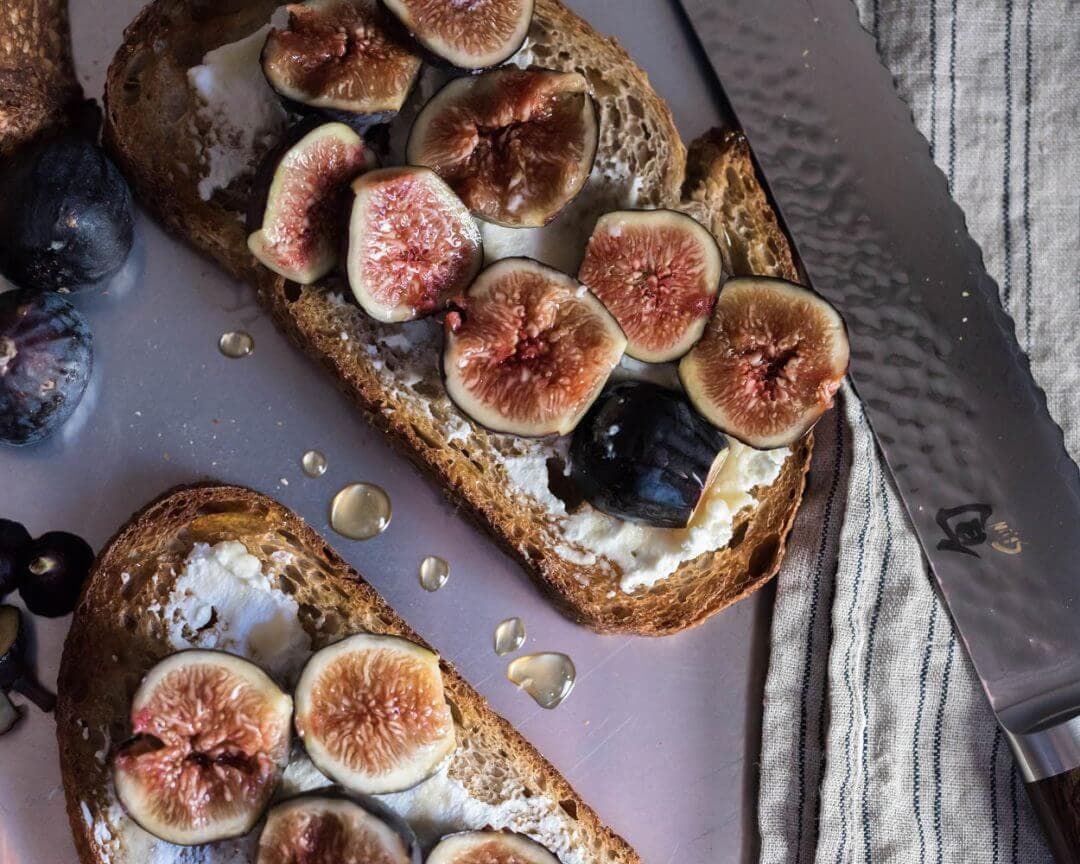
This entry is a short interlude that doesn’t contain a bread formula, but rather, an accompaniment to just about any of the loaves baked here. I’ve experimented with how to make ricotta cheese at home, and once I did, I ate it on just about everything: my whole wheat sourdough, my sourdough waffles, and my go-to white sourdough formula. Ricotta is incredibly versatile. You can find recipes abound, but as I’ve recently discovered, it tastes far superior to store-bought options when freshly made at home with high-quality milk.
It was the Albuquerque International Balloon Fiesta here a couple of weeks ago, and it was the perfect weekend for me to make this recipe. I used to attend the fiesta each year, but as it is when you grow up somewhere, you rarely visit the sights around, opting for places far and wide—anywhere but home. The fiesta is a pretty big deal here in Albuquerque; the unique terrain of the city makes for the perfect conditions to launch and fly balloons. The vast Sandia Mountains and low valley create a sort of “box” that keeps balloons in the area for longer, before finally drifting away. Couple that with cold, crisp mornings around this time of the year, and you have ideal flying conditions. The shot below was taken from my backyard one chilly morning as the balloons ascended and drifted away.

I have no excuse for why I haven’t made ricotta at home until now, and it just might become a weekend ritual. The recipe is so easy, and it requires only a few things in your pantry, it makes me wonder why you’d ever had to repurchase this at the market. If you decide to make pancakes or waffles one morning out of the blue, it only takes about 15-20 minutes to whip up a batch of ricotta and be ready to serve it warm.
The following recipe is based on Alice Waters’ ricotta recipe found in her excellent book, My Pantry. I reduced the amount of salt by about 1/4 TSP (originally 3/4 TSP) as it was a bit on the salty side for my taste. Her recipe takes up only three-quarters of a page in her book– that’s how easy this is. I think the key to making good ricotta is, naturally, using good quality milk (if you have access, fresh local milk is best).
Milk Selection
Alice Waters recommends using milk that is not ultra-pasteurized (UHT) as a result just won’t come out correctly. It should be easy to find whole milk (even organic) at your local market that is not UHT, and I’ve tried this recipe now with a few different types. The latest attempt was using Kalona organic “batch pasteurized” whole milk, and the result was the best so far. Next to finding locally produced milk I’ve enjoyed this brand the most out of the options at my market (you can find this milk at Whole Foods). This milk is not the only batch pasteurized, but it’s also non-homogenized, meaning it will have the label “cream on top.” Essentially this means the fat in the milk is not distributed evenly throughout the liquid.
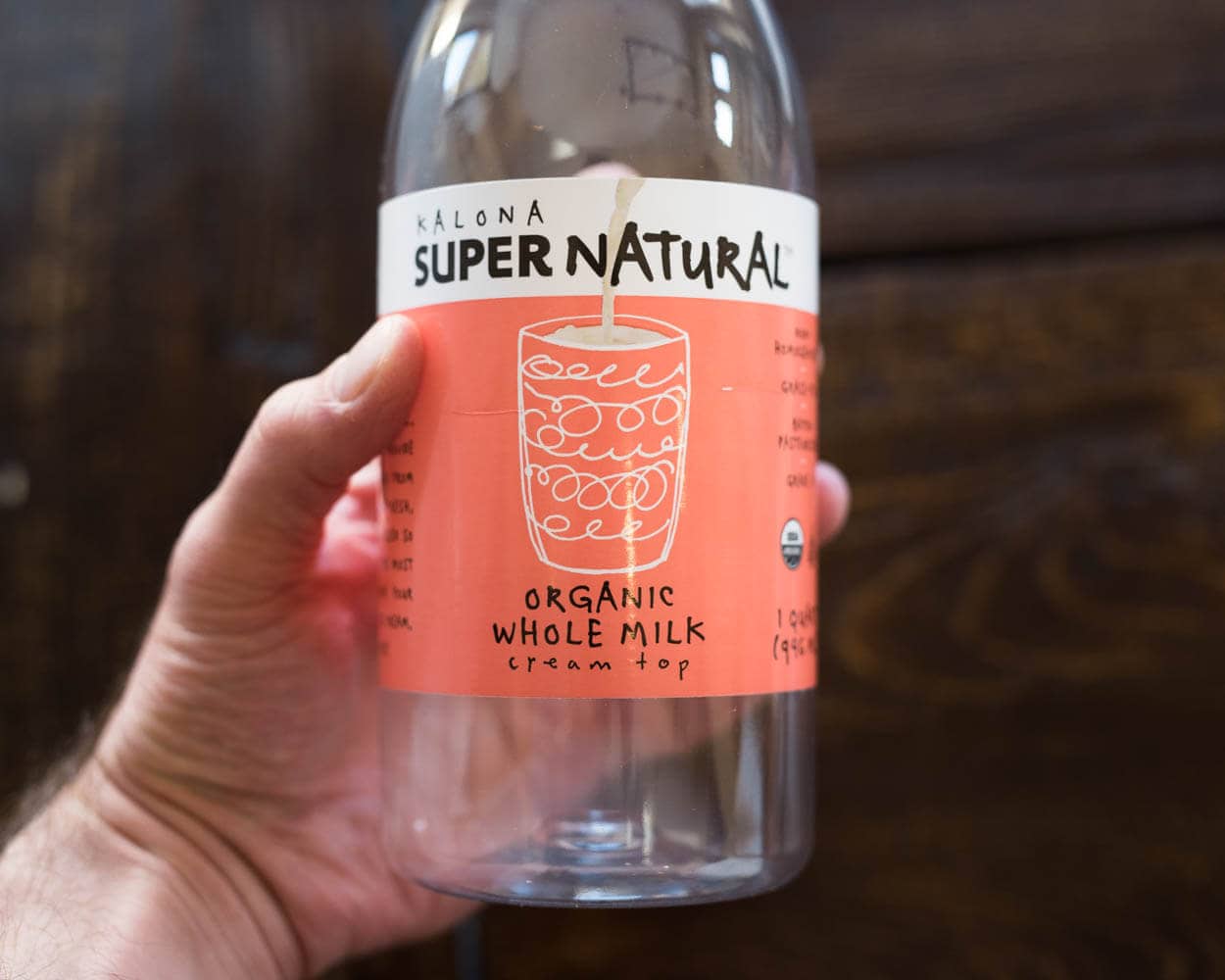
So what’s the difference between UHT and batch pasteurized? UHT milk is heated to a high temperature, about 280°F (135°C), and then rapidly cooled. Through this process enzymes, vitamins, and some proteins are destroyed, rendering it unusable for making cheese. Batch pasteurized, also called vat pasteurized, is heated to a lower temperature, but heated for longer, preserving more enzymes, vitamins, and proteins and thereby making it more suitable for making ricotta. Chances are if you are buying batch pasteurized milk it will be fresh and organic, which is excellent.
Low-temperature pasteurization, also called vat or batch pasteurization, is one of several acceptable ways to pasteurize milk, a process used to kill harmful pathogens.
Berkeley Wellness
I haven’t tried making ricotta with UHT milk just yet, but I’d be interested to see if it works. Has anyone tried this? If you’ve attempted this, I’d love to hear about it below in the comments section!
How To Make Ricotta Cheese
- Prep Time: 5 minutes
- Cook Time: 15 minutes
- Total Time: 20 minutes
- Yield: 1 1/5 cups
Description
Ricotta is something I’ve had my entire life and is a staple in an Italian household. It’s a cheese usually made from high-quality cow milk and goes well with bread and can be used in sweets as well.
It’s incredibly easy to make at home with just a few minutes at the stove!
Ingredients
- 4 cups whole milk, batch pasteurized, cream on top (avoid ultra-pasteurized)
- 1 1/2 tablespoons distilled white vinegar
- 1/2 teaspoon sea salt
Instructions
- Heat the milk in a saucepan until it reaches 190ºF (stir occasionally to prevent scorching)
- Pour in vinegar and lightly stir, until the temperature rises back up to 190°F (87°C). If you do not see any white curd chunks forming add in more vinegar, 1/2 TSP at a time until you do

- Turn off heat & leave for 10 minutes untouched
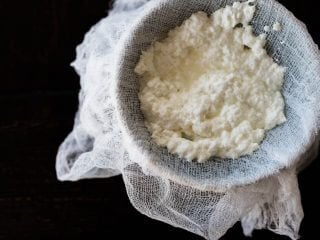
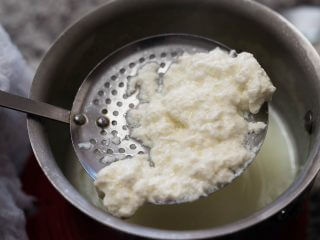
- Place some cheesecloth over a bowl and gently ladle in the chunky curds from a saucepan
- Slowly stir salt into chunks resting on cheesecloth

Notes
A one-quart bottle of milk will make approximately 1.5 cups of ricotta. The liquid that’s leftover from this, whey, can be used in many other ways including baking sourdough. See my polenta and rosemary sourdough which uses the whey to make polenta!
If you’re making this for a large group of people, go with 2 quarts of milk and use a larger saucepan, doubling the other ingredients. One and a half cups of ricotta will disappear faster than you think.
If you want your ricotta more firm, leave it to drain thoroughly in the cheesecloth, and further, you can use a cheese mold or as I’ve done here, a tofu press with a weight on top. Place the mold on a dish and let sit in the fridge for a day or so.
My iconic fish, an incredibly heavy cast iron bottle opener I’ve had for just about ever, stepped in to help gravity do its job.
The tofu press I have is a nice one, made entirely from wood and if you ever find yourself eating tofu, this is the one to get. I think I’ve used it to make ricotta more often than tofu, but hey, I am Italian after all.

This ricotta will last about four days in the fridge. We ate the entire batch warm, right from the stove, on top of my freshly made sourdough waffles. We placed a dollop or two of the ricotta on top of the waffles after a good slathering of butter and then topped it all off with some light maple syrup. The warm cheese went exceptionally well with the slightly-sour crisp waffles, and I would say perhaps a few blueberries would have taken it even further.
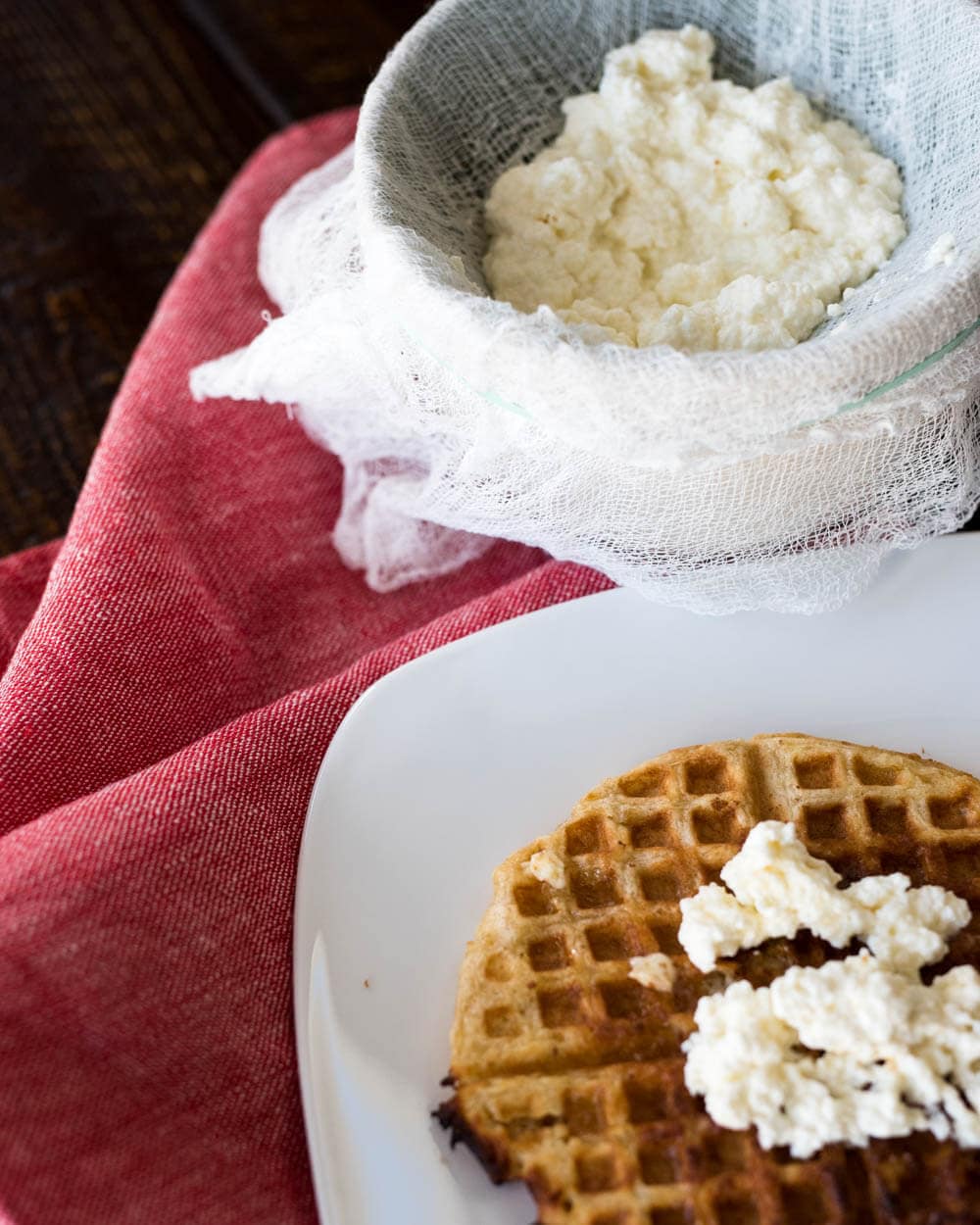
But this cheese doesn’t just stop at waffles. Use it to top any sourdough bread right after it’s been toasted, then add some fresh figs, and finish with a drizzle of honey.
How to Make Ricotta Cheese Wrap-up
I’ve eaten ricotta my entire life, and some of the best while traveling out in Italy, but when you learn how to make ricotta cheese you find just how remarkably easy it is to make. It tastes so staggeringly good it’s a mystery to me I’ve not tried making this at home before. This homemade ricotta cheese goes well with almost every bread recipe found here, especially with hearty whole wheat loaves and those with walnuts or other seeds added.
At this point, I’ve been inspired by so many of Alice Waters’ recipes and writings I need to buy her a spritz and have a nice long chat over some fresh cheese and sourdough. Until that date, I’ll have to settle with reading her excellent books on cooking and her methodologies for applying seasonal and fresh food to our cooking lineup — perhaps more importantly, though, is my attempt to use as many of her recipes on or with fresh sourdough bread as possible.

Cin cin!
If you use this recipe, tag @maurizio on Instagram so I can take a look!


37 Comments
what can be done with the leftover liquid? I did a full qt but only got about a cup of cheese. I also as a little heavy on the salt 😞 tasty for sure but the quantity is a little disappointing.
Use the liquid to make this loaf of bread, it's amazing:
https://www.theperfectloaf.com/polenta-rosemary-sourdough/
I’ve made yesterday for pizza !
Great with pink pepercorn and chives.
I can’t wait to find rennet to try mozza…
Thank you once more. I’m a big fan of your recipes !
Awesome, Joanne! This ricotta is so versatile, I find myself putting it on just about everything after I make it 🙂 Enjoy!
Vat pasteurization is just as destructive to nutrients as UHT processing – the milk may be heated to a lower temperature, however the hold time is so, so, sooo much longer than higher temperature processing methods (30 mins vs. 2-15 seconds), and in practice the batch temp is harder to control and often exceeds that lower temp to be in compliance with milk processing regulations (better over than under when dealing with pathogens). You are correct in associating it with local, organic producers, but this is typically because they are smaller and don’t have the volume or capital to process their milk on large-scale HTST (high temperature short time) equipment. We have a local dairy in CA that touts vat past as being closest in flavor to raw milk, which is wildly incorrect – vat past has become synonymous with small producers, which ARE generally more sustainable, organic, higher quality, etc., but the association doesn’t mean the *process* is all of those things. For example, vat past uses significantly more energy and water than HTST. It’s really just turned into a tool for marketing. Most milk you buy at the store that is labeled “pasteurized” is HTST processed, while anything labeled as “ultra-pasteurized” is UHT milk. HTST milk actually retains nearly all of its inherent nutrients. I don’t know enough about cheesemaking to comment on whether HTST is better for that purpose, but I would suspect it has an advantage over vat past since the product is exposed to a much smaller heat load (imagine the area under a curve where x axis is time and y axis is temp – a very long but low curve vs. a high but very sharp spike).
Fantastic information, thank you for sharing that, Claire! This whole area is brand new to me and most of my exposure is likely subject to many of the marketing gimmicks like other food areas, unfortunately 🙂 However, finding local dairy is a challenging thing where I live at least, and I’m mostly subject to what’s at the market (I think raw milk is not legal here, sadly). Thanks for sharing all that, it’s given me some things to look for when I source dairy!
Hi. I’ve made this ricotta several times. I substituted the vinegar for freshly squeezed lemon juice. It seems to enhance the taste of the cheese. Juice from 1 1/2 medium sized lemons is about right.
Right on — yes that’s another way to get the milk to curdle. I use lemons sometimes and love the change in flavor!
Iowa girl here! I’m truly enjoying your website and thrilled to see a wonderful Iowa product featured! 🙂 I’m just noticing you were a software engineer! As a science teacher who has been married over 10 years to a software engineer, I am starting to understand why I seem to absorb your information effortlessly. 😛 Thank you for this beautiful and always evolving resource!
Ah yes, truly some awesome dairy out there! Hah, yes us engineer types tend to have a certain view on things 😀 Thanks so much for the kind words and to continued happy bakes in the future, Maria!
You can also dry the ricotta and press it together to make ricotta salata cheese which is delicious shredded on top of pasta or even eaten with bread, though it is a very dry cheese.
“Real” ricotta is made with fresh whey from rennet made cheese. There’s really not much of a difference besides that, they taste about the same to me. Also, UHT milk, from what I’ve researched will not curdle. I’ve never tried though, I don’t want to waste milk!
Well this could be TRUE, but then again what about Great Reno Balloon Races out at San Rafael Regional Park, Rancho, Rancho Connector, Reno, NV 89503, United States The Great Reno Balloon Race is the largest free hot-air ballooning event in the world. During three days in early September, you can look up into the Reno skies and see a rainbow of hot air balloons soaring about. From its humble beginnings in 1982 with just 20 balloons, The Great Reno Balloon Race has taken flight with up to 100 balloons each year. So he could have been from Reno as well, BUT YES he is from Albuquerque, Lucky Guy ! !
They basically define the Albuquerque skyline that time of year — instantly recognizable! Thanks and happy baking 🙂
I just made this ricotta in less than ten minutes! I had about 3 cups of standard, grocery brand whole milk in the fridge that was about to expire. I threw it in my instant pot pressure cooker on the yogurt -> boil function. Added 1 Tbs vinegar when it beeped (The milk was at 184 degrees F). Gave it a good stir, strained it in a flour sack towel, sprinkled with sea salt and just like that… done! I plan on using it for some lasagna later tonight. I will use the whey to cook the noodles and thin the sauce. I can’t wait for dinner.
Oh how I want one of those Instant Pots! I’ve had one in my to-buy cart for a long while now — you may have just finally pulled the trigger for me. You really knocked it out with the use of that whey and the ricotta, well done! Heading to Amazon right now… 🙂
This is amazing!!
Thanks! I hope you try it out, super easy and dang good 🙂
made the ricotta with great results! I’ve made your beginner’s sourdough a bunch and am wondering if you think I could use the whey with that recipe in place of (some of) the water? and if so, how much whey would you use? thanks!
Excellent! It’s so handy to have some around in the fridge, and when you have fresh bread it’s a perfect pairing. Yes you could definitely use some of the whey to supplant the water. Actually you probably could do that with most of the recipes here without any issue. Have you seen my Polenta & Rosemary recipe? I cooked the polenta in the leftover whey as well, it turned out fantastic!
Happy baking, Jake.
What about if you want to bake once a week? I need to hear this more than once, sorry to have you keep going over this with me!
Not a problem! If you plan to bake only once per week you have a few options.
1) You can feed your starter just once per day (2x a day starting a day or two before you plan to make levain).
2) You can keep your starter in the fridge the other days of the week, take it out 2 days before you plan to bake and refresh it twice a day (e.g. if you are baking Sunday, take it out Friday AM, discard a portion, feed, and repeat in the evening. Do the same Saturday. Sunday in the AM build your levain and mix later in the day). Once you build your levain feed your starter per usual and put back into the fridge after you let it sit for 30 minutes to get up and running.
I hope that helps!
Thanks! You don’t have to use exactly the same flour, just find something similar! I typically go for more “all purpose” flour varieties (around 11% protein) for my white and whole wheat is the best stoneground 100% whole grain you can find.
Thanks Jarkko! I’ve been meaning to try making cheese and after seeing how easy this was I had to give it a try. Can’t wait to hear what you think!
Jon, thanks! I was hoping you’d comment given your venture into cheese on IG. Also thanks for that quote. I don’t typically buy UHT milk but I was curious to see if it would work, I’ll definitely avoid it when making ricotta, no reason to try it.
I’m definitely going to use the leftover whey in sourdough next time I make this cheese (probably next week). I’ve never added anything like that to bread so I’m very curious.
Thanks for the comments!
I am so glad that you gave the homemade ricotta a try, it is simple incredible isn’t it?! We have tired it with UHT with varied success ranging for no seperation at all to performing as well as unpasteurized milk. The taste was better than store bought but not as consistent as with batch pasteurized milk or even fresh local milk. Do you make your own pasta? We sometimes use the fresh whey in the pasta. I can give you no reason other than my grandmother did it on occasion. Have a wonderful week and thank you for sharing this version. (we use freshly squeezed lemon juice so I will be trying the vinegar as a comparison.)
Peggy — agreed, super easy but so good! As Jon commented below I’ll probably steer clear of UHT, no reason to risk it. My next attempt ill try to score some local milk.
I’ve made my own pasta many times, I absolutely love the flavor. I’ve never heard of using whey in pasta but why not? I’ll have to add this to my list of things to try 🙂
By the way, I’ve seen other recipes use lemon juice or other acidic liquids and I have yet to try them, Alice Waters claims distilled white vinegar leaves the least flavor impression but I’d like to try others as well. I almost always have a lemon on hand for cooking.
Thanks for the comments and you have a great week also!
The lemon juice actually leaves a nice light bright flavor. This is how I make my paneer (basically pressing out as much whey as possible and forming in a mold). Great stuff!
I agree, it does brighten things up a bit. I’ve still been making it this way!
That looks delicious! I think I’ll make my own batch of ricotta this week. Thanks for the inspiration.
It really is so good, I wish I could force everyone into making at least one batch so they will be convinced 🙂 You’re welcome and thanks for the comments!
Not related to ricotta, but when do you know when to feed your starter/use your starter for leaven? I’ve been struggling with making sourdough; my loaves end up very flat 🙁 Do you feed the starter when it’s at it’s peak, or after it has fallen? Thanks so much for your help…I’ve been reading all your posts for tips!
I’m working on a post that shows more detail on how I do this, hopefully it’ll be out next. There are many preferences and theories out there on this subject but I can tell you how I’ve been doing it lately and I think my bread has turned out best so far.
I’m assuming you’re using a liquid starter. You want to feed your starter right when it’s at its peak and just about to start falling. Currently I’m feeding 30 starter, 100g flour, 100g water every 12 hours in my 73ºF kitchen (I bake a lot, though). But that will most likely be different for you as your temps and flour will be different. Try to observe your starter and see how long it takes to get to its peak and then fall. Once you take notice of its peak you can count on it getting to that level at that time each day, as long as everything else is kept the same.
I hope that helps, feel free to ask more questions if anything is unclear! Just remember your starter is kind of another person in your household 🙂
Yes, I’m using a liquid starter. I’ll try the 30/100/100 ratio. Right now I’m doing 50/100/100 and it peaks in about 5 hours or so, but then again, it’s been hot out here in CA.
My starter feels like a pet, his name is Yukon and I talk to him when no one is looking 🙂
Looking forward to the next post as always.
Hah! Ok, yes reduce the amount of mature starter by 20g and that should let it go a few more hours before you need to feed it. I bake pretty often so 2x feedings per day is good since I need my starter to be quite active. If you’re baking less then you can adjust so you only need to feed it once a day (and you can always refrigerate it if you’re not going to use it for a week or two).
Wow! Yet again 🙂
Thanks, Maree! 🙂