Description
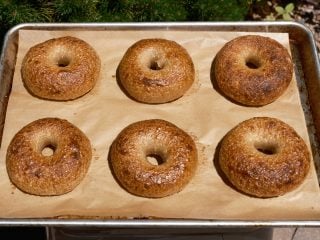
Crispy and chewy new wave sourdough bagels with a glossy, blistered crust and tender crumb. Built on a multi-grain flour blend, sweetened levain, and an overnight cold retard. Shaped with the poke method and boiled in barley malt water before baking on a steel.
Ingredients
Levain
- 90g medium-protein white flour
- 81g water
- 18g superfine (caster) sugar
- 36g ripe sourdough starter, 100% hydration
Main Dough
- 406g high-protein white flour (12–14% protein)
- 271g medium-protein white flour (or all purpose flour)
- 90g whole wheat flour
- 45g whole rye flour
- 23g barley malt syrup (or honey)
- 9g diastatic malt powder
- 460g water 1
- 72g water 2
- 18g fine sea salt
- 226g ripe levain (from above)
Boil Water
- 1 gallon water
- 1 teaspoon baking soda
- 5 tablespoons barley malt syrup
Toppings (optional)
- Sesame seeds, poppy seeds, everything seasoning, flaky salt, or plain
Instructions
- Prepare the levain (Day One, 9:00 p.m.)
Mix the levain ingredients in a clean, tall jar (this levain rises quite high). Stir until the sugar is dissolved and the starter is fully incorporated. Cover and leave at 74–76°F (23–24°C) to ripen overnight, about 12 to 14 hours. The levain is ready when it’s risen significantly, super bubbly on top, and smells sweet. - Mix (Day Two, 9:00 a.m.)
With a mechanical mixer: Add the flour, levain, barley malt syrup, diastatic malt powder, salt, and Water 1 to the bowl. Mix at low speed for 1 to 2 minutes until combined into a shaggy mass. Increase to medium speed (120–130 RPMs) and mix for 5 minutes. Rest 5 minutes. Resume at medium speed, slowly adding Water 2 over 5 minutes. Mix until smooth, strong, and pulling cleanly from the bowl. Target a final dough temperature of 76–78°F (24–26°C). - Bulk fermentation (Day Two, 9:30 a.m. to 12:30 p.m., 3 hours)
At 74–76°F (23–24°C), let the dough rest undisturbed for the full 3 hours. This dough was mixed heavily and is quite stiff, so no stretches and folds are needed. - Divide and shape (Day Two, 12:30 p.m.)
Sprinkle medium cornmeal on two half sheet pans (cornmeal won’t absorb water from the dough, making removal easier; use white flour if you don’t have cornmeal). Scrape the dough onto your work surface and divide into twelve 130g pieces. Shape in two phases: *Ball the dough:* Fold the sides of each piece into the middle, roll it down, then push against the surface with the side of your hand to smooth the top. Flip and pinch the seam closed. You want a perfectly round, smooth, closed-seam ball. *Poke and make the ring:* Starting with the first piece you balled, gently pat to flatten slightly. Press your index finger through the center to create a hole. Pick up the dough and gently stretch it with both hands, rotating to form a ring with a center hole about 2 to 2.5 inches in diameter (the hole shrinks during proofing and baking). Place on the prepared sheet pans, six per pan, with an inch or two between them. - Overnight retard (Day Two, 1:00 p.m.)
Cover the sheet pans with lids and refrigerate. This step is flexible—a few hours earlier or later the next morning, or even into the afternoon, the dough is forgiving. - Proof (Day Three, 9:00 a.m., 2 hours)
Remove the trays from the refrigerator and proof at warm room temperature for 2 hours. About halfway through, place a baking steel on the middle rack and preheat to 500°F (260°C) convection (525°F/270°C without convection). Give the oven at least 1 hour to preheat. - Boil (Day Three, 11:00 a.m.)
Add 1 gallon of water and 1 teaspoon of baking soda to a large, wide pot and bring to a rolling boil. Stir in 5 tablespoons of barley malt syrup until dissolved. Working in batches of 2 to 3, gently lower bagels into the boiling water smooth side down. They should float; if one sinks and doesn’t come back up, it may be underproofed. Boil 20 to 25 seconds per side, flipping with a slotted spoon or spider. Lift out, let excess water drip off, and place on a wire rack. Dip tops in toppings while still wet, if desired. Transfer topping-side up to a parchment-lined sheet pan or peel. - Bake (Day Three, 11:15 a.m.)
Transfer one pan of 6 bagels to the preheated steel. Bake for 10 minutes, then rotate the pan and reduce the temperature to 450°F (230°C) for 5 more minutes. The bagels are done when the crust is deep golden brown. Don’t pull them too early—a pale bagel is an underbaked bagel. Cool on a wire rack for at least 15 to 20 minutes before slicing. Repeat with the second batch.
Notes
Storage: Keep in a sealed bag on the counter for 3 to 4 days. Slice and freeze for longer storage; toast directly from frozen.
Same-day option: Skip the overnight retard. After shaping, proof at room temperature for 45 minutes to 1 hour until a bagel floats in water within a few seconds.