

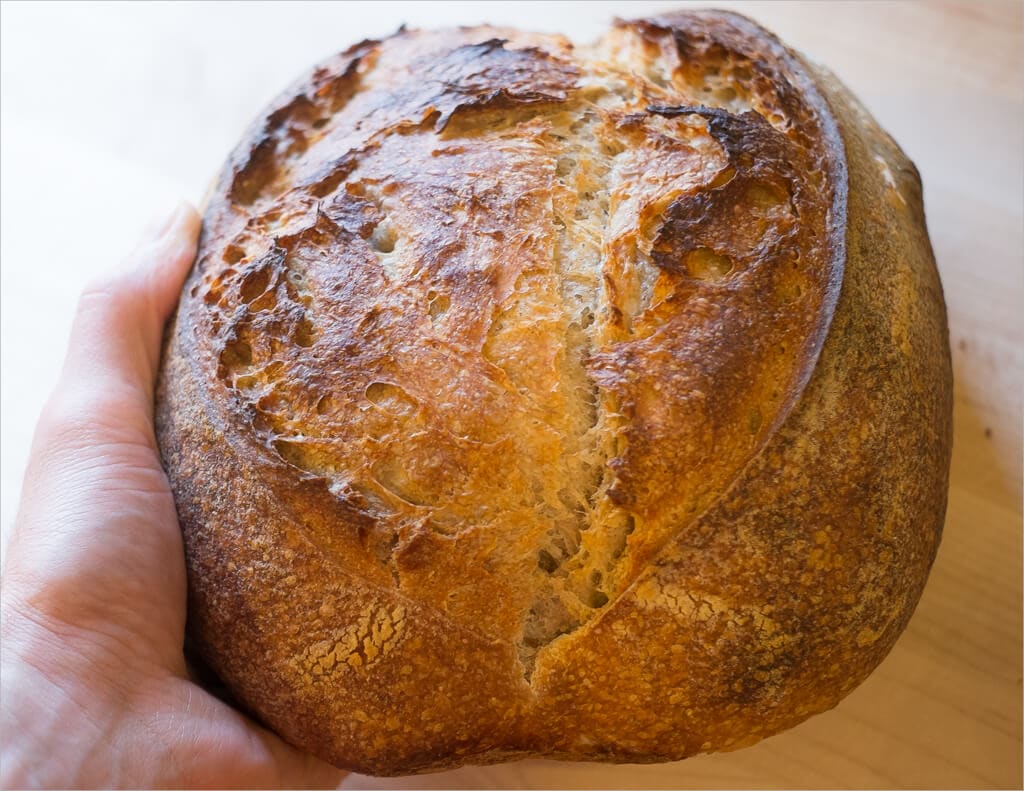
One of the reasons I started this journal was to experiment with my bread baking, and this entry has me dabbling with a bit of wheat germ. What the heck is wheat germ and why would we want to use it?
More fiber and nutrition with wheat germ? Yes, I think that sounds like two good additions to my family’s bread. After doing some research on The Fresh Loaf, and through some interactions on Instagram, I quickly ordered a package of wheat germ.
The germ is retained as an integral part of whole-grain foods. Non-whole grain methods of milling are intended to isolate the endosperm, which is ground into flour, with removal of both the husk (bran) and the germ. Removal of bran is aimed at producing a flour with a white rather than a brown color, and eliminating fiber: neither of these objectives is necessarily desirable from the nutritional viewpoint. 1
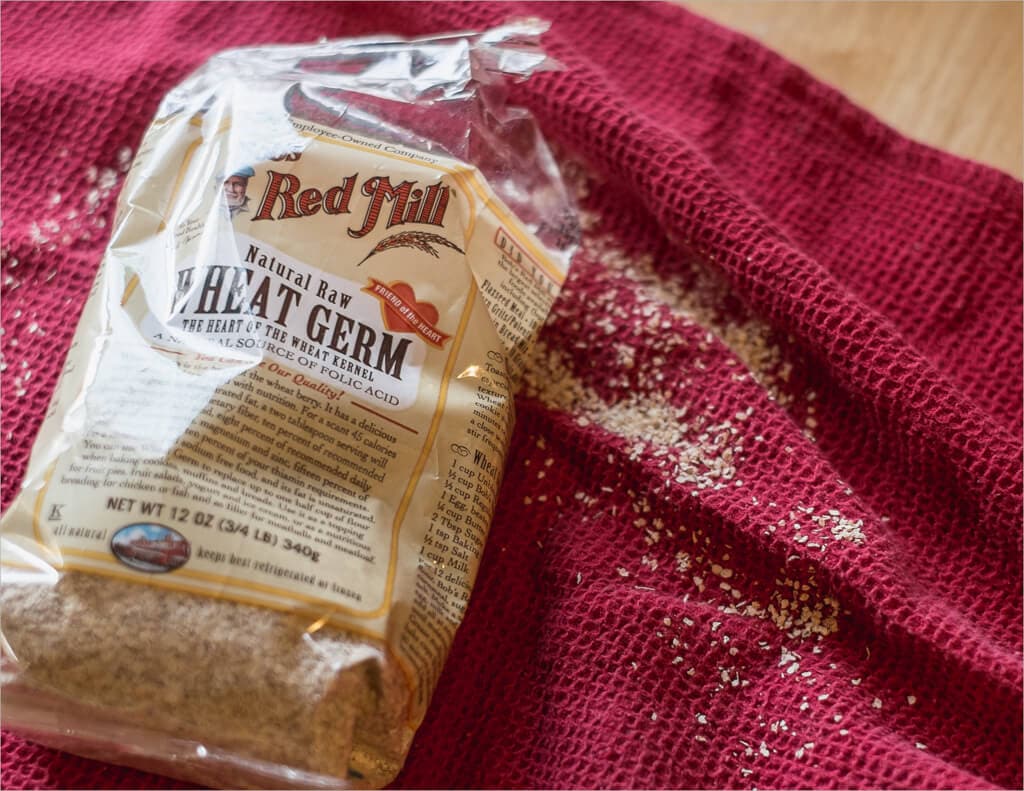
The “research” suggested that adding about 10% of wheat germ would stimulate the fermentation during the bulk fermentation phase, much the same way as adding extra whole wheat flour would, but requiring much less whole wheat. One reason I wanted to give this a try is that my starter can sometimes get a bit “sluggish” when using only white flour and this go around I really wanted to push the white flour.
Without further ado, on to The Wheat Germ Experiment!
Prepare the leaven – 10:00pm
The night before you plan to prepare your dough, mix the following, lightly cover, and set out on the counter overnight:
- 55g ripe starter
- 200g whole wheat flour
- 200g water
Mix the flour + water, autolyse – 8:00am
In the morning, once your starter is ready (see here for some shots on what a “ready” starter should look like), gather your ingredients.
Ingredients:
- 250g (25%) of your new leaven
- 100g (10%) raw wheat germ
- 100g (10%) whole-wheat flour
- 800g (80%) all-purpose white flour
- 20g (2%) fine sea salt
- 720g water and 50g (77%) in reserve for the next step
Method:
- Add 250g leaven to your large mixing bowl
- Pour in 720g water and mix with your hands until the leaven is completely dissolved
- Add 100g wheat germ, 800g white flour, and 100g whole wheat flour and mix with your hand until all the dry bits of flour are gone
- Cover your bowl with a towel and let autolyse for 40 minutes
- After 40 minutes, add 20g salt on the dough and slowly pour your reserved water on top. Squeeze the dough with your hand to incorporate the salt throughout
- Now reach your hand under the dough and pull the side up and over onto itself. Continue to do this as you spin the bowl; grab, pull, and push. Do this until the dough comes together and becomes super sticky and comes together
- Transfer your dough to your plastic or glass container, set a timer for 30 minutes
Bulk Fermentation – 8:50am
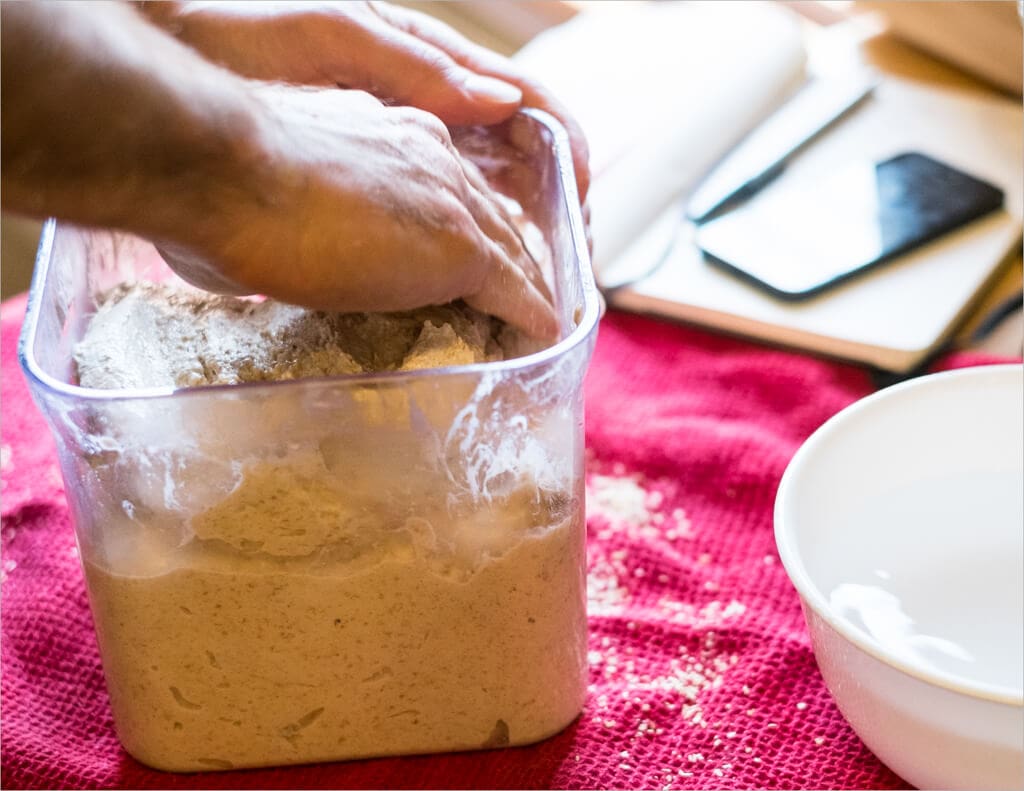
At this stage we want to do 4 sets of turns, plus 1 – 2 hours of bulk fermentation. This is one of the most important phases of the whole process, and one that I continue to struggle with. You really need to feel the dough and adjust your fermentation time based on the strength of the dough, not the clock.
After I had started this phase and the first 4 turns sped by, per usual (don’t weekends always do this?), I realized the dough needed more turns as it just didn’t feel strong enough.
- 9:20am – Turn 1
- 9:50am – Turn 2
- 10:20am – Turn 3
- 10:50am – Turn 4
- 11:20am – Turn 5
- 11:20am – 12:50pm rest on counter
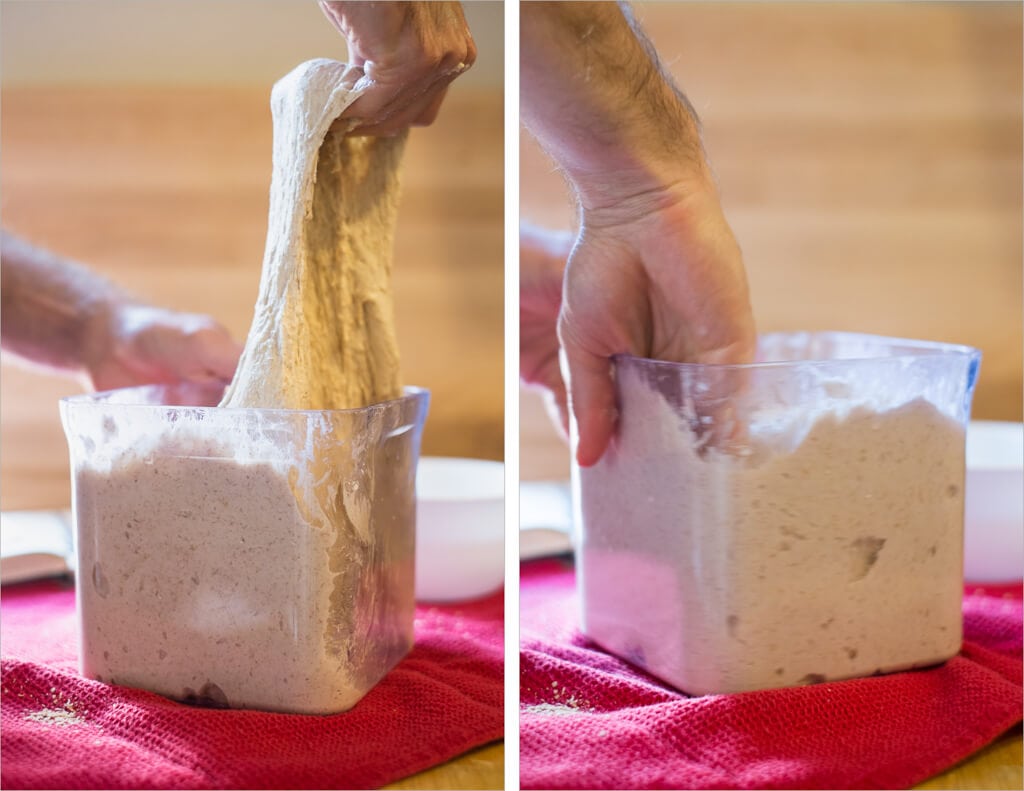
As you can see, that’s a pretty lengthy bulk step but I felt it was necessary. At the end of this the dough rose about 30% almost to the top of my container. The dough felt much stronger and would hold its shape after turning.
Pre-shape – 12:55pm
Take the dough out of the container onto your unfloured work surface and sprinkler some flour on top before dividing. Divide the mass into two equal halves and flour the top of each half. Flip one half over using your dough knife and your hand, then gently bend the 4 sides of the dough from under to the top (imagine closing a cardboard box you’re preparing for shipment). Using the knife flip the mass so the new seam is on the counter and spin it a few times to create a bit of tension. Set a timer for 35 minutes and let it bench rest.
Shape – 1:30pm
The resting dough should have spread out, but not quite into a thin pancake shape. If it has formed a pancake you can strengthen it by pre-shaping one more time and waiting another 35 minutes.
Flour the top of one of the boules and flip it over with your lightly floured hand and dough knife. Take the part of the dough that’s closest to you and fold it up and over in half. Take the part that’s to the right, stretch it out as far as it will stretch, and fold it up and to the left. Repeat with the left side and the side of the dough farthest from you. Then take the edge that’s closest to you, pull it up and over again towards the back. When doing this last move you will lift the entire dough up and over until the seam side is now down on your work surface.
Spin the dough using your two hands to shape into a boule. As you slightly pick up the dough and spin it, the bottom snags the unfloured work surface and creates tension. I do this several times to create a very taught surface on the top of the boule sometimes small air bubbles will be visible. This tension is what creates that nice blistery look on your loaf once you bake it.
Proof – Approx 2:00pm
Place towels into small mixing bowls, or bannetons, and dust with white rice flour. These baskets will hold the dough as they proof in the fridge overnight.
For one of these boules I decided to try out a rectangular banneton I’ve had sitting in my cupboard for some time. I essentially placed the boule in the banneton like usual, but because of the shape, it ended up forming more of an elongated shape (a batard) than a pure round boule. Place both of the baskets into the fridge for an overnight proof, a chance to strengthen and build taste complexity.
Score + Bake – 7:00am
Gather your tools:
- Lame (blade) for scoring bread dough prior to baking
- Parchment paper
- Pizza peel
- Pizza stone
- Oven mitts
- Lodge Combo Cooker
See my post on baking in a Dutch oven (or combo cooker) for more information on the following process.
In the morning get your oven ready: place your pizza stone in your oven at the middle position and turn it on to 450°F (230°C) to preheat.
Take one of your loaves out of the fridge, cut a piece of parchment paper, and place it on top of the basket. I then place the pizza peel on top of the parchment paper (and basket) and invert the whole thing quickly to get the dough out of the bowl and onto the paper and peel.
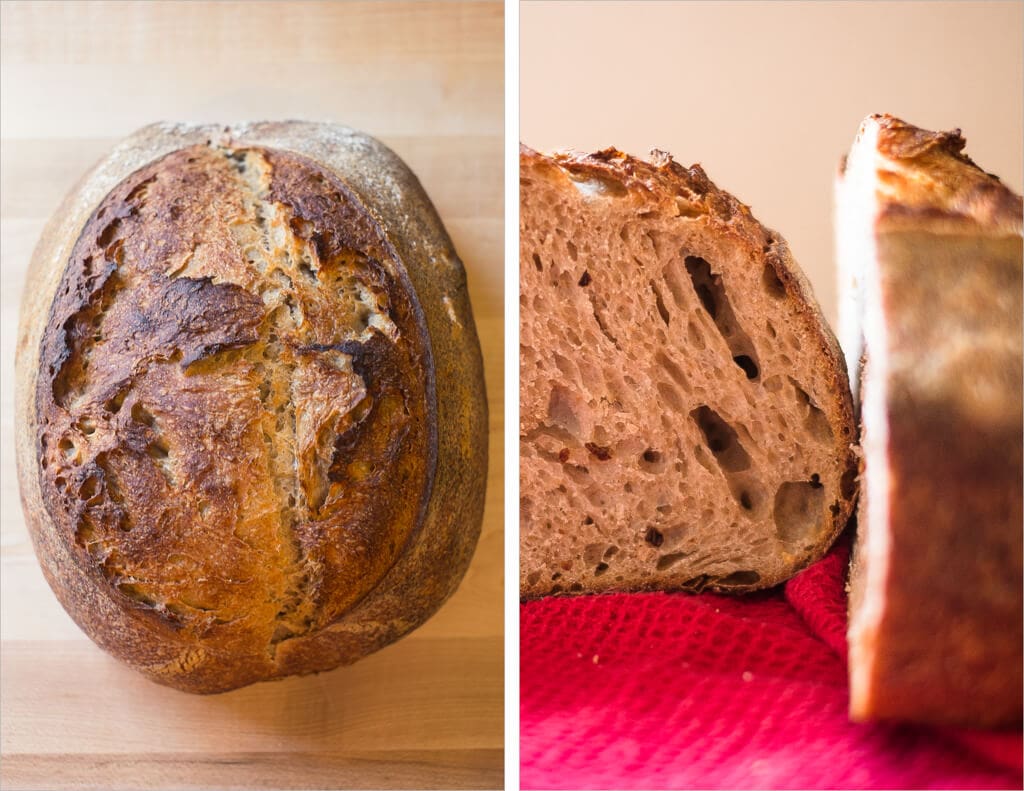
Get your razor blade out and score the top of the loaf to allow the bread to expand while rising in the oven. For the rectangular loaf I did a single slash down the middle starting from the very top to the bottom. I attempted this scoring pattern to coax the loaf into opening up forcefully through the middle.
Place the dough into the combo cooker, cover with the lid, and bake for 25 minutes. After this time, open the oven, remove the lid of the combo cooker, and bake for an additional 35. After pulling the loaves from the oven I cool them on a wire rack for at least one hour before cutting into them. Cutting too soon can cause the crust to harden drastically and the inside to become quite dense. See my post on storing bread for more information on this.
Conclusion
Crust
Nice coloring, but not quite enough spring to form the “ears” I so desire. One reason for this, I believe, is my shaping might not have imparted sufficient tension on the outside of the loaf.
Crumb
Nice rise and great interior movement, but not quite open enough. It’s a bit dense, as you can see— where are the irregular open holes for these loaves? Something to work on.
Taste
Well, they taste excellent! The wheat germ seems to add a touch of “nuttiness” to the bread and a bit of texture to the crumb as well. In the future I’d like to experiment with toasting the wheat germ before incorporating it into the main dough.
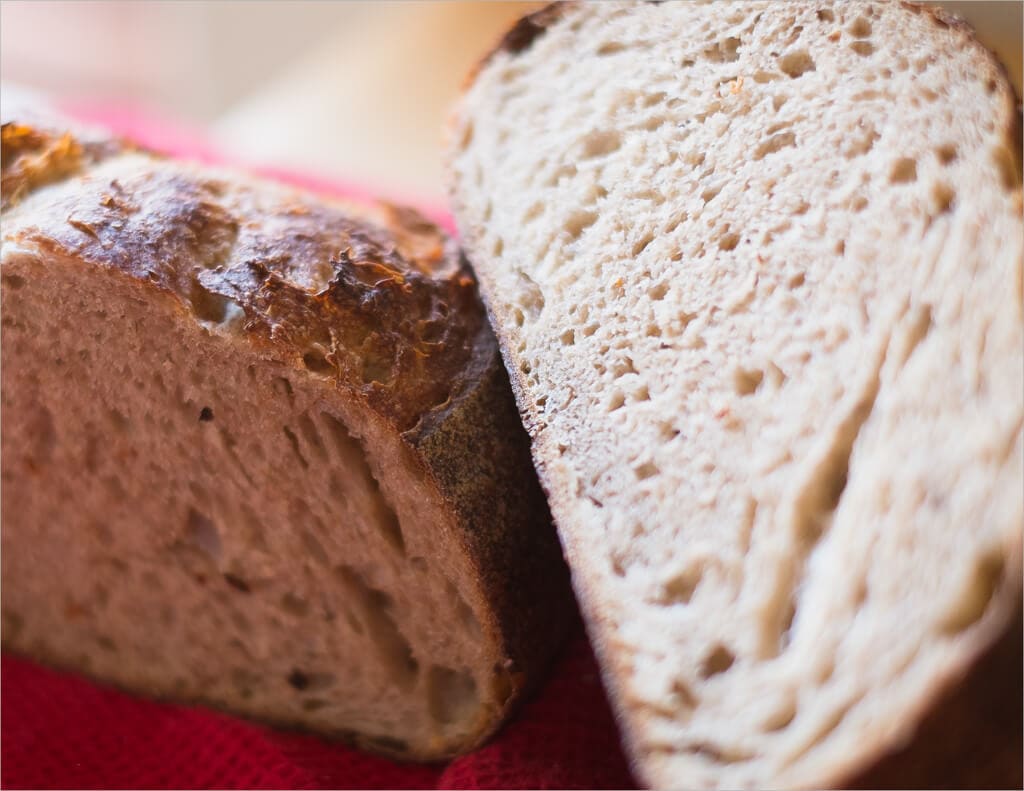
All-in-all the experiment was well attempted, but will need some tweaks for the next go around. I do believe, based on these findings, that the wheat germ does in fact spur fermentation further than what I would normally see with 100% white flour. My starter must really like that wheat germ, and you know, I think I like the taste and texture enough to give this a second shot in the near future.
Buon appetito!
If you use this recipe, tag @maurizio on Instagram so I can take a look!


12 Comments
Could I make this with milk?
Confused here. I bake Tartine bread every week, and have been interested in adding wheat germ or bran, so I greatly appreciate you sharing your experiment. But I don’t understand what you are doing with the pizza stone, as the bread seems to cook only in the “combo cooker” (which is what I use, although I call it a “Dutch oven.” And when you say to “open the oven” and keep baking, do you mean taking off the top of the combo cooker (which is what I do), or actually opening the oven door?
Hey there! This is an older post where I used to place the combo cooker on top of the pizza stone and bake it that way. However, it ends up getting a bit too hot this way and nowadays I prefer just baking in the combo cooker on a wire rack in the oven. At the end of the bake I like to keep the oven on bake and open the door for a few minutes to crisp up the crust a bit more.
Hi Maurizio, I’ve been diligently perfecting my relationship with bread over the last year, and this site of yours has been my primary “bible” so-to-speak. Really wonderfully created and written. So, thanks! I realize this entry is an older one of yours, but it’s the only time I’ve seen you mention the relevance of the blisters on the final crust as evidence of a properly tensioned/shaped loaf.
I’ve seen the blisters mentioned on numerous other sites, videos, etc., and most people seem to think that the blisters are a sign of moisture in the air of the oven, which is generally a good thing. One video I watched some time ago even went so far as to say that the French see the blisters as imperfections, while in the US they’re a sign of a well-steamed oven.
I have no idea who’s correct with regard to the cultural preferences, but could you elaborate on how and why, in your mind, a blistered crust indicates a properly shaped/tensioned loaf? It’s piqued my curiosity because thinking back, the more pancake-like loaves that I’ve baked have had smoother crusts, while the higher-rising loaves have the blisters. I’ve just never thought there might be a connection between the two phenomena.
I’ve only ever achieved a really solid (like, instagram-worthy, ha) oven spring maybe a handful of times in the last 12 months of baking (almost every weekend!), and I’d be lying if I said I had identified a pattern. I think I can probably chalk it up (mostly) to my starter’s activity, but shaping the loaves seems to happen differently with every batch of dough. Don’t get me wrong, all my loaves rise, but some actually have that final kick that makes them really stick out. I’ve tried numerous shaping methods, and I understand the concept pretty thoroughly, but your loaves look better than anyone else’s out there so that’s why I’m finally reaching out after lurking for so long.
Also, I live about an hour away from Central Milling’s mill up in Logan, UT, and they sure do make some of the best tasting flour!
Cheers for the inspiration and experimentation! Apologies for the block of text!
May the yeast be with you,
Rob
Super glad to hear that Robert, and thanks! Super envious of your proximity to Central Milling, I love their flour! I order it in bulk but it’s still quite expensive for me out here.
I’ve heard the same thing about blistering with regard to cultural differences. Personally, I like them to a degree, too much of a good thing can be, well, too much. But I think they provide a nice additional crunch to each bite. They add someone to visual appeal but also texturally. The number one thing I look for in the crust, though, is nice coloring and that slight sheen you get from proper fermentation. We want the dough to have enough residual sugars to color up nicely in the oven.
I think the number one factor to achieving blisters on the crust is most likely the steam in the oven. Particularly the amount of water directly on the dough’s surface. I find that if I steam my oven super heavily I’ll end up with quite a bit more blistering than if I lightly steam. Aside from that, I do believe the dough needs a sufficiently tight “skin” on it to blister up — if the dough spreads like a pancake then I’ve noticed, with my doughs at least, it doesn’t matter how much moisture is in the oven, the skin on the dough just isn’t tight enough to blister outward.
Also, I do believe fermentation plays a role here as well. If there isn’t the right amount of activity in the dough you won’t get those bubbles even forming in the first place!
I hope that helps. I think in the end if you nail a good steaming technique you’ll likely get them more often than not, assuming all the other pieces are in place. Happy baking, Robert!
The ears are probably due to your scoring technique. A well developed bread will not have “blisters” as a result of development, but rather the improper scoring does not allow the pressure to release on top. Try a smaller score lengthwise, and at an increased angle to the top of the bread.
Agreed — scoring was likely the issue with this loaf. In retrospect it looks like I didn’t score in deeply enough and at a sufficiently shallow angle.
Hi, reading Elizabeth David’s English Bread and Yeast Cookery (amazing) one p80 she talks about germs effect on bread, and says it’s good for volume and open crumb… She used 2-3oz per 18oz flour.
She did say too much could have an adverse effect but you seem to have used just about what she did unless my math is wrong.
I’m interested because I’m home milling with a Komo and want to figure out how to separate bran from germ and see if I can reproduce her “volume” with it. She also says 85% extraction flours are proportionally higher in germ and are good for baking as a result and that germ is a major source of flavor (oils and fats I guess?). All this sounds amazing so if you do more germ experiments I’d love to know!
Thanks, love your site!
Hi Maurizio,
During bulk fermentation, do you keep the dough covered?
Elie,
Yes, I keep my dough covered at all times. During bulk fermentation I keep the bowl/container covered with plastic wrap. After it’s been pre-shaped I invert large bowls over the resting dough on the counter.
I’m not sure if this is necessary if you live in a humid climate but here in the desert it is very, very dry.
Hi Maurizio,
What size is the plastic proofing container in the photos in this post (the one you make the turns in)? Can I just use a ceramic or stainless steel bowl if I don’t have a plastic container? Also, what are the dimensions of your bannetons (round and rectangular)?
Elie,
I’d recommend either a plastic or ceramic bowl to do your turns. You could use stainless but some people advise against this (honestly I’m not too sure why).
Plastic container:
Oxo Good Grips Pop 2.4 quart container
Banneton Round:
Frieling USA Brotforms 8″ or 10″
Rectangular banneton:
12″ oblong from Lucky Clover (I bought these a while ago and I’m pretty sure they are these ones…