

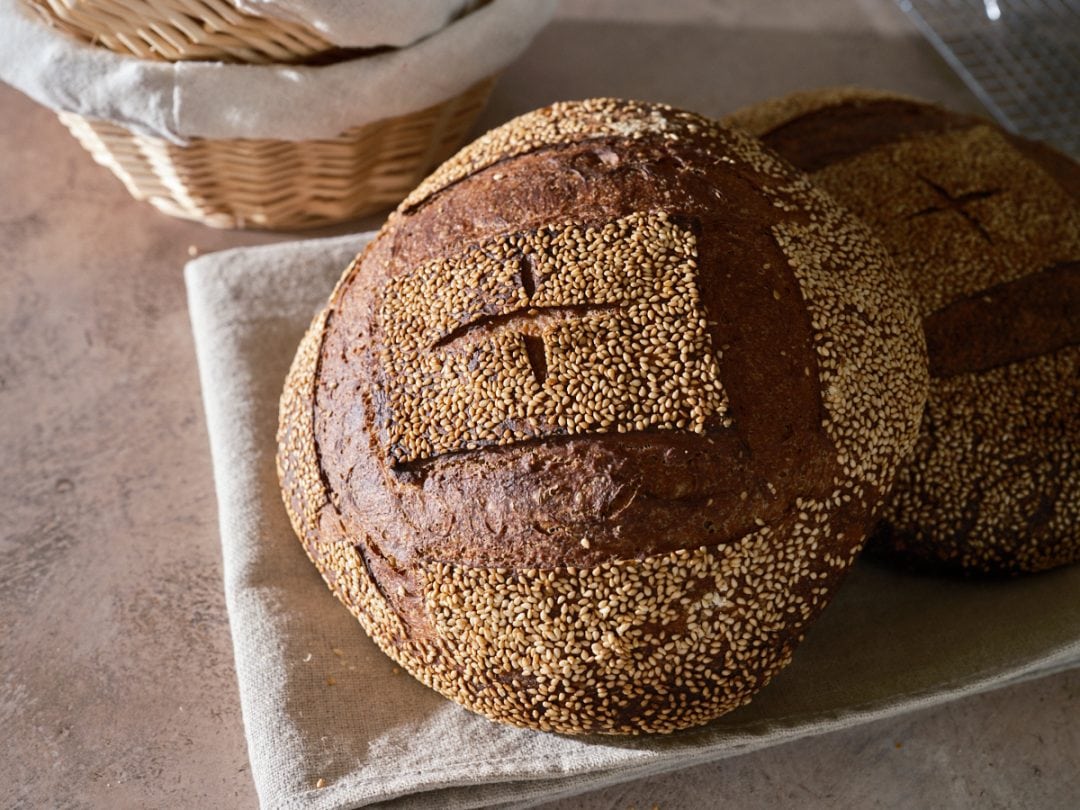

This spice-forward, hearty sourdough is exactly the kind of bread I needed to drag me through the cold that’s clung to this month far longer than it had any right to. The frigid weather is a fine motivator to get that oven roaring and a well-proofed dough inside, I’ll give it that, but the early dark and the dry chill don’t make any of it easier. The good news, if I dare to say it, is that at every step of making this bread—the pungent anise aroma when the spice is ground, the sweet and rich malt, the beautiful buckwheat-speckled dough, that silky texture from the flour scald—you’ll find yourself not minding the cold quite so much.
Anise doesn’t politely wait for you to smell it. It arrives.
Heady, licorice-sweet anise is one of my favorite spices to use in baking. Whether it’s left whole, as I do often in my sourdough discard biscotti in my cookbook, or ground and used in so many other cookies, I realized recently that I’ve never actually used it in a large loaf of bread. Anise doesn’t politely wait for you to smell it. It arrives. Pair this warm spice with buckwheat—nutty, mineral, tannic—and you get a loaf of sourdough bread that’s quite balanced and quite irresistible.
To finish this bread off, I love topping it with striking white sesame seeds. The flavor complements the spice and sweetness in this bread, and they look stunning on a loaf with this much whole grain.
Why Use a Flour Scald?
When I set out to develop this recipe, I was inspired to include buckwheat in some form, and scalding flour is a great way not only to enhance the flavor but also to add texture to the final bread.
Scalding flour—simply covering it with boiling water—gels it, turning it into a thick paste that’s then mixed into the final dough. It’s very similar to the yudane technique, and very related to tangzhong as well. This paste is highly aromatic and flavorful, and it helps keep the final loaf softer for longer by trapping moisture and delaying staling.
It’s an easy thing to do, really, and one I find myself turning to just to add a little something extra to each loaf.
Flour Selection
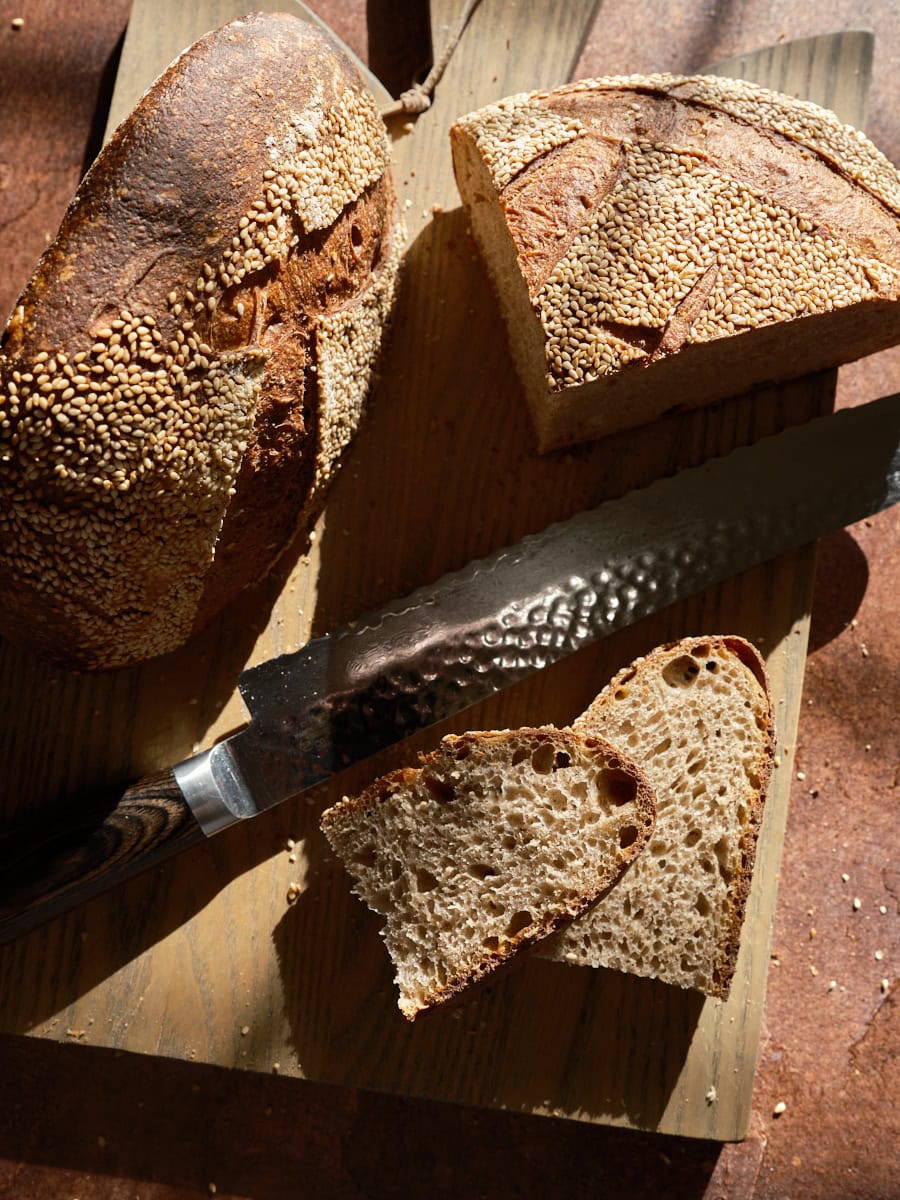
Aligning with my intention for this loaf to be hearty, spicy, and perfect for sandwiches, I reached for high-extraction (type 85) flour as the base. I turned to Cairnspring’s Trailblazer, which is a workhorse in my kitchen. Often, I swap this type 85 in for many of the white flour options I might otherwise use. It brings a little more bran and germ to the final bread for more flavor and nutrition.
When it comes to buckwheat, based on my experience, even in small percentages, I find it tends to close up the crumb since it doesn’t have the same gluten structure as wheat. The tradeoff is that you get intense earthiness and a gorgeous color that shines in the final loaf.
Baking Schedule
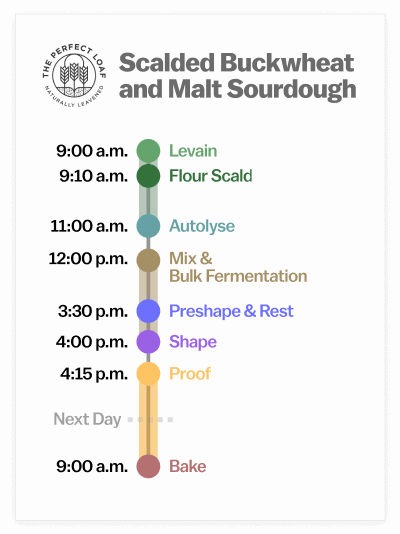
This sourdough bread recipe is made over two days, with little interaction required from the baker. Just check in with it from time to time during bulk fermentation, and then after shaping, retard the dough for a cold proof overnight. The next day, bake the loaves in the morning, or let them rest in the fridge until the evening for fresh bread before dinner.
Scalded Buckwheat and Malt Bread Recipe
Vitals
This dough recipe makes two loaves, but you can divide all the ingredients in half to make a single loaf. The full (editable) spreadsheet is available for members of The Baker’s Corner to quickly scale up and down the recipe.
| Total dough weight | 1,800 grams |
| Prefermented flour | 5.8% |
| Levain in final dough | 18.5% |
| Hydration | 75.0% (83% including the water in the flour scald) |
| Yield | Two 900g loaves |
Total Formula
With his beer bread, I shoot for a typical final dough temperature of 78°F (26°C). See my post on the importance of dough temperature for a discussion on this and other temperature-related topics.
| Weight | Ingredient | Baker’s Percentage |
|---|---|---|
| 46g | Scald: Buckwheat flour (Anthony’s Organic Buckwheat Flour) | 5.0% |
| 73g | Scald: Water | 8.0% |
| 687g | High-extraction wheat flour (Type 85; Cairnspring Trailblazer) | 55.0% |
| 183g | Whole wheat flour (Camas Country Hard Red Wheat) | 37.0% |
| 46g | Barley malt syrup | 5.0% |
| 6g | Aniseed, ground | 0.6% |
| 596g | Water 1 (levain and autolyse) | 65.0% |
| 92g | Water 2 (mix) | 10.0% |
| 18g | Fine sea salt | 2.0% |
| 53g | Ripe sourdough starter, 100% hydration | 5.8% |
Scalded Buckwheat and Malt Bread Method
1. Prepare the levain – 9:00 a.m.
| Weight | Ingredient | Baker’s percentage |
|---|---|---|
| 53g | High-extraction wheat flour | 100.0% |
| 53g | Water 1 (levain) | 100.0% |
| 53g | Ripe sourdough starter, 100% hydration | 100.0% |
Mix the ingredients listed in the chart above in your favorite jar and leave it covered at 74-76°F (23-24°C) to ripen for 5 hours.
To scale up or down the levain (if you wanted to make another recipe at the same time or modify this one), use my sourdough starter and levain calculator.
2. Prepare the flour scald – 9:10 a.m.
| Weight | Ingredient |
|---|---|
| 46g | Scald: Buckwheat flour |
| 73g | Scald: Water, boiling |
In a small bowl containing the flour, pour the boiling water over the top. Stir until a paste forms. If the mixture is very dry, add an additional small splash of boiling water.
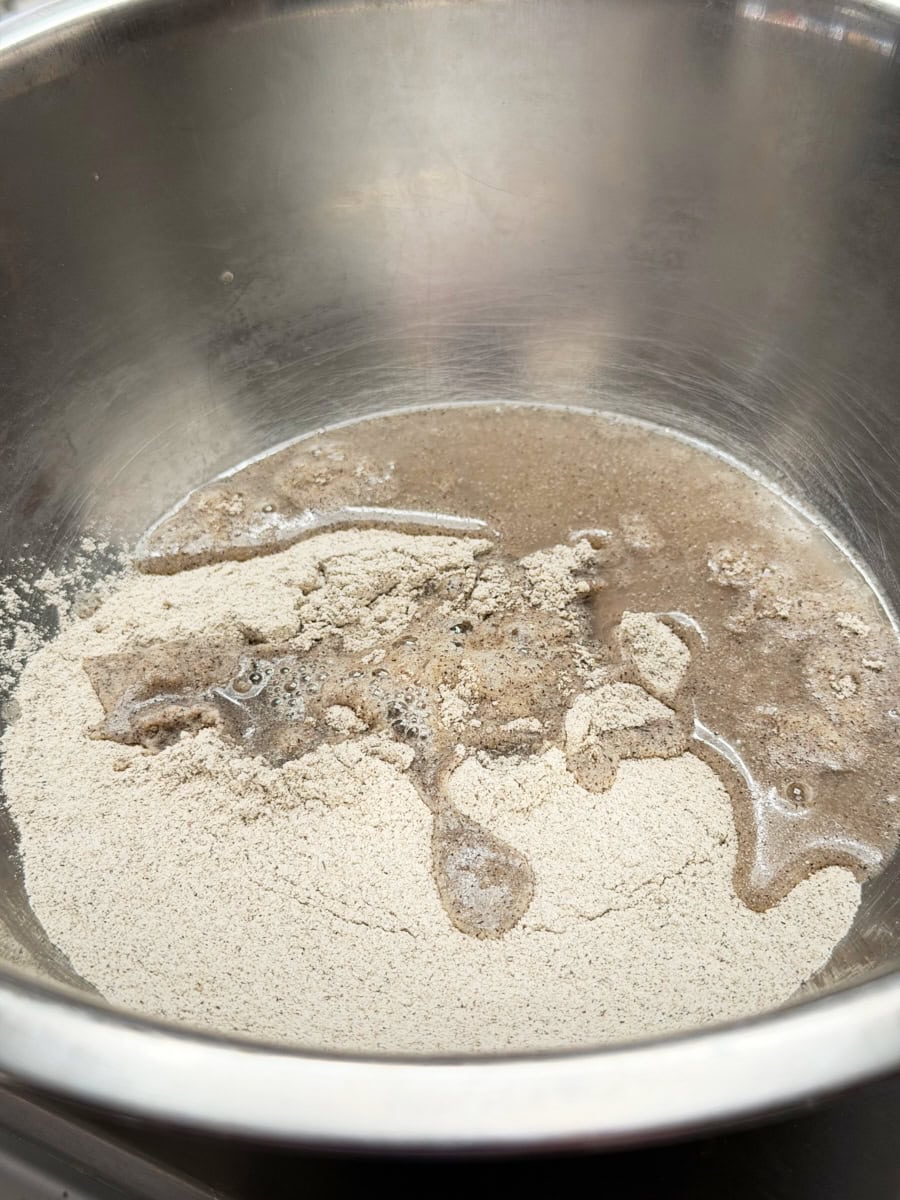

Cover and set aside until mixing.
3. Autolyse – 11:00 a.m.
| Weight | Ingredient |
|---|---|
| 634g | High-extraction wheat flour |
| 183g | Whole wheat flour |
| 543g | Water 1 (autolyse) |
| All | Flour scald (from Step 2) |
Use my water temperature calculator to warm or cool the autolyse water until the mixed dough reaches the final dough temperature (FDT) of 78°F (25°C) for this recipe.
Place the flour, water 1 (autolyse), and flour scald in a large bowl. Use wet hands to mix until no dry bits remain (or if using a mixer, mix on low to the same state). At the end of this initial incorporation, the dough will be quite shaggy and loose. Use a bowl scraper to scrape down the sides of the bowl, keeping all the dough in one area at the bottom.
Cover the bowl and place it near your levain for 1 hour. At the end of this autolyse, you’ll notice that the dough will be stronger and well-hydrated.
4. Mix – 12:00 p.m.
| Weight | Ingredient |
|---|---|
| 92g | Water 2 (mix) |
| 18g | Fine sea salt |
| 159g | Ripe levain (from Step 1) |
Note that this recipe has a very high hydration level, and the dough will feel slack and sticky. Be sure to hold back Water 2 and add it only if the dough feels able to handle it. Using the bassinage technique like this helps ensure we don’t overhydrate the dough.
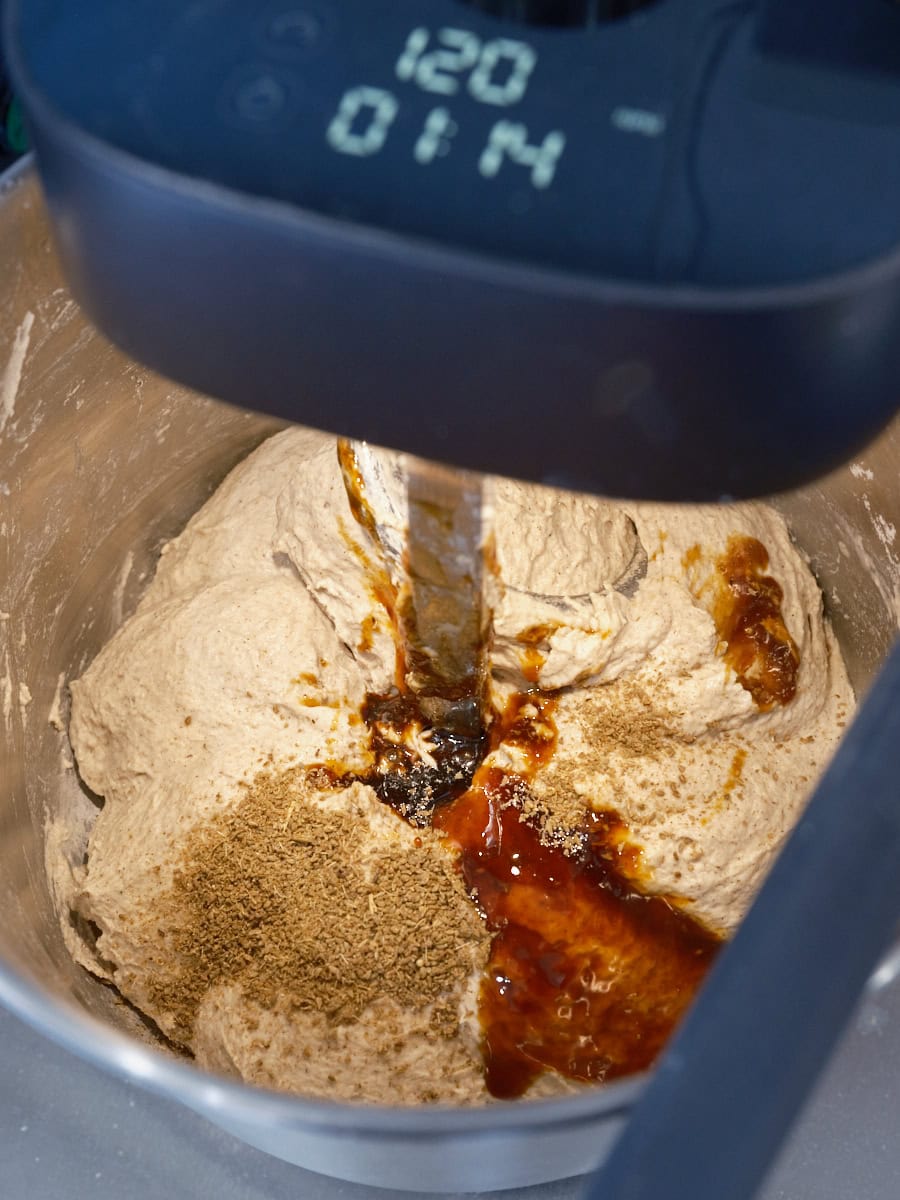
Mixing with a mechanical mixer
I mixed this scalded buckwheat dough in my Ooni Halo Pro spiral mixer in several phases after the autolyse:
- Add the levain, salt, and a splash of Water 2; mix at 90 RPM for 1 to 2 minutes until absorbed
- Increase to 120 RPM and mix for 3 minutes
- Rest 5 minutes
- Mix at 120 RPM for 3 minutes, adding the remaining Water 2 slowly
- Once smooth and gripping the breaker bar, add the malt and aniseed; mix at 90 RPM for 1 minute until distributed
Mixing by hand
To mix by hand, add the salt and levain to the top of the dough in autolyse. Use a splash of water 2 to moisten. Mix thoroughly with wet hands or a dough whisk.
Next, knead the dough for a few minutes using either the slap-and-fold technique or the folds-in-the-bowl method. For this dough, I kneaded for about 5 minutes until it was smooth and less shaggy. Transfer the dough back into the bowl, cover, and let rest for 10 minutes.
Don’t add any remaining water if the dough feels very wet and soupy. If it seems cohesive but still shaggy, add the remaining water 2 and mix it in until absorbed. Once again, scrape the dough out to the counter and use wet hands to slap and fold it for 3-5 minutes, making it smoother and more cohesive. Or, to keep things cleaner, do a series of folds in the bowl.
Transfer the dough to a bulk fermentation container and cover.
5. Bulk Fermentation – 12:30 p.m. to 3:30 p.m. (3 hours)
At a warm room temperature of 74-76°F (23-24°C), bulk fermentation should take about 3 hours and require 2 sets of stretches and folds at 30-minute intervals.
After the first 30 minutes of bulk fermentation have elapsed, give your dough its first set of stretches and folds. Grab one side of the dough and stretch it up and over the dough to the other side. Rotate the bowl 180° and perform another stretch and fold. Then rotate the bowl 90° and perform another stretch-and-fold. Finally, turn the bowl 180° and do one last stretch and fold. Cover the dough.
Perform one more set of stretches and folds after 30 minutes. After the second set, let the dough rest, covered, for the remainder of bulk fermentation.
6. Pre-shape – 3:30 p.m.
After 3 hours, the dough should be smooth, puffy, and have risen in the container. I’d aim for about 30% increase in volume.
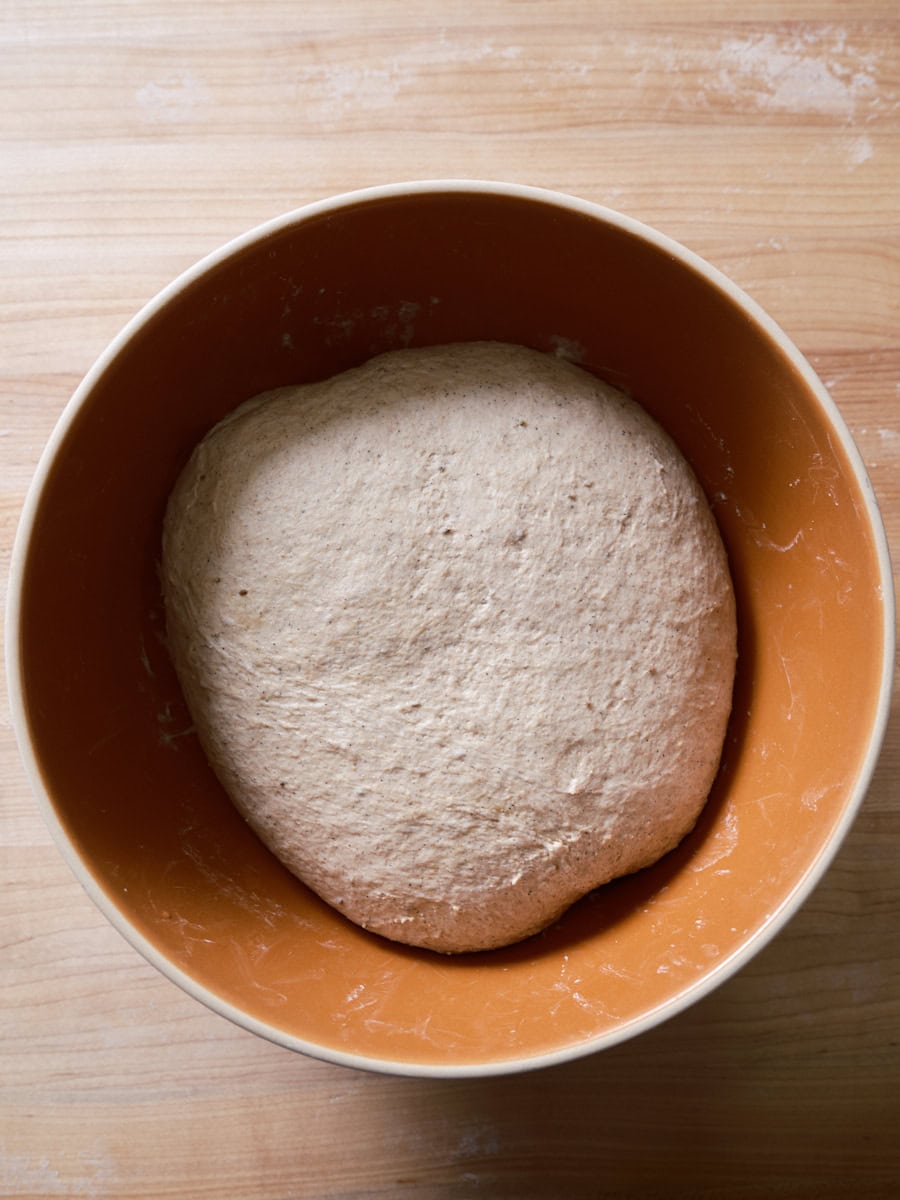
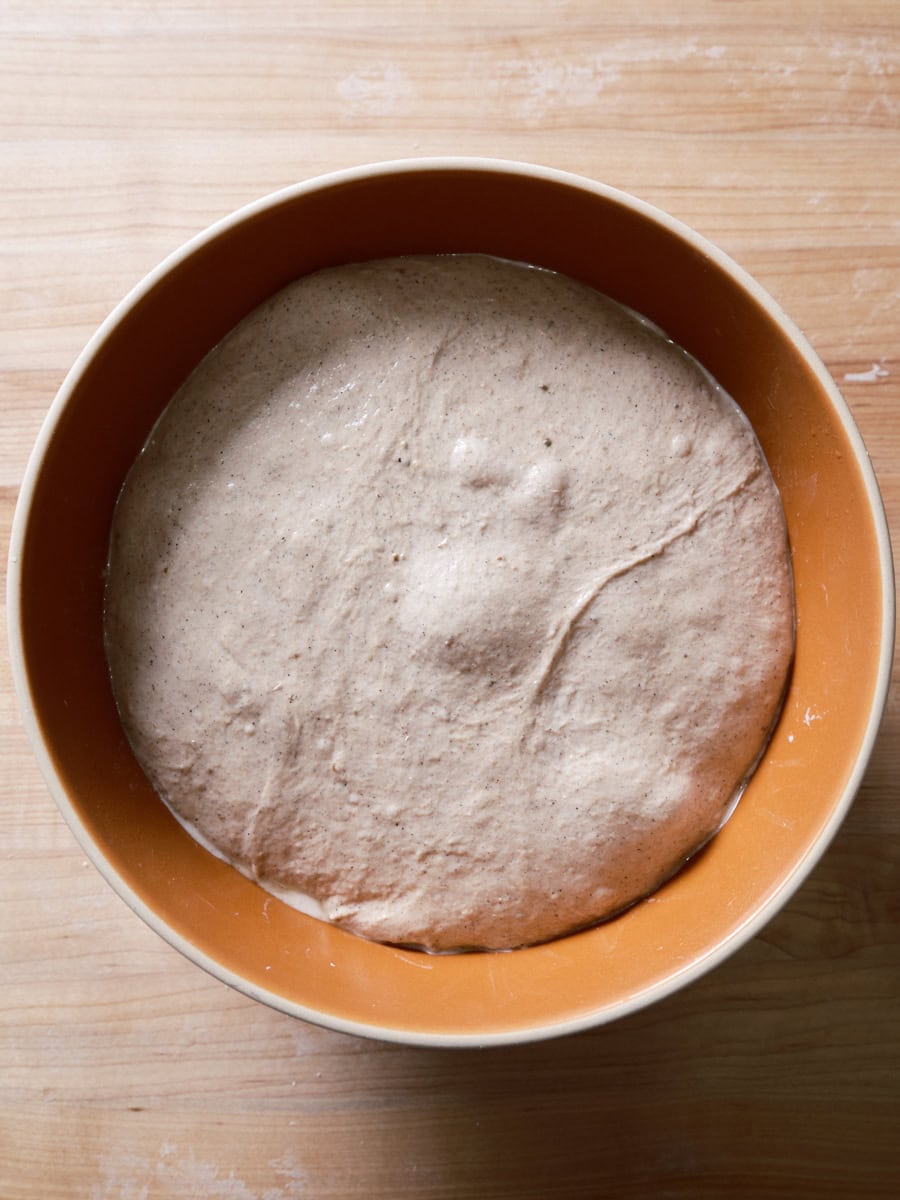
Gently scrape the dough out to a clean work surface. Then, divide the dough in half and preshape each piece into a loose round.
Let the rounds rest for 30 minutes, uncovered.
7. Shape – 4:00 p.m.
Spread an even layer of raw white sesame seeds (these are my favorite for baking) on a kitchen towel or a quarter-sheet pan.
I like to shape this dough using my “gather up” method:
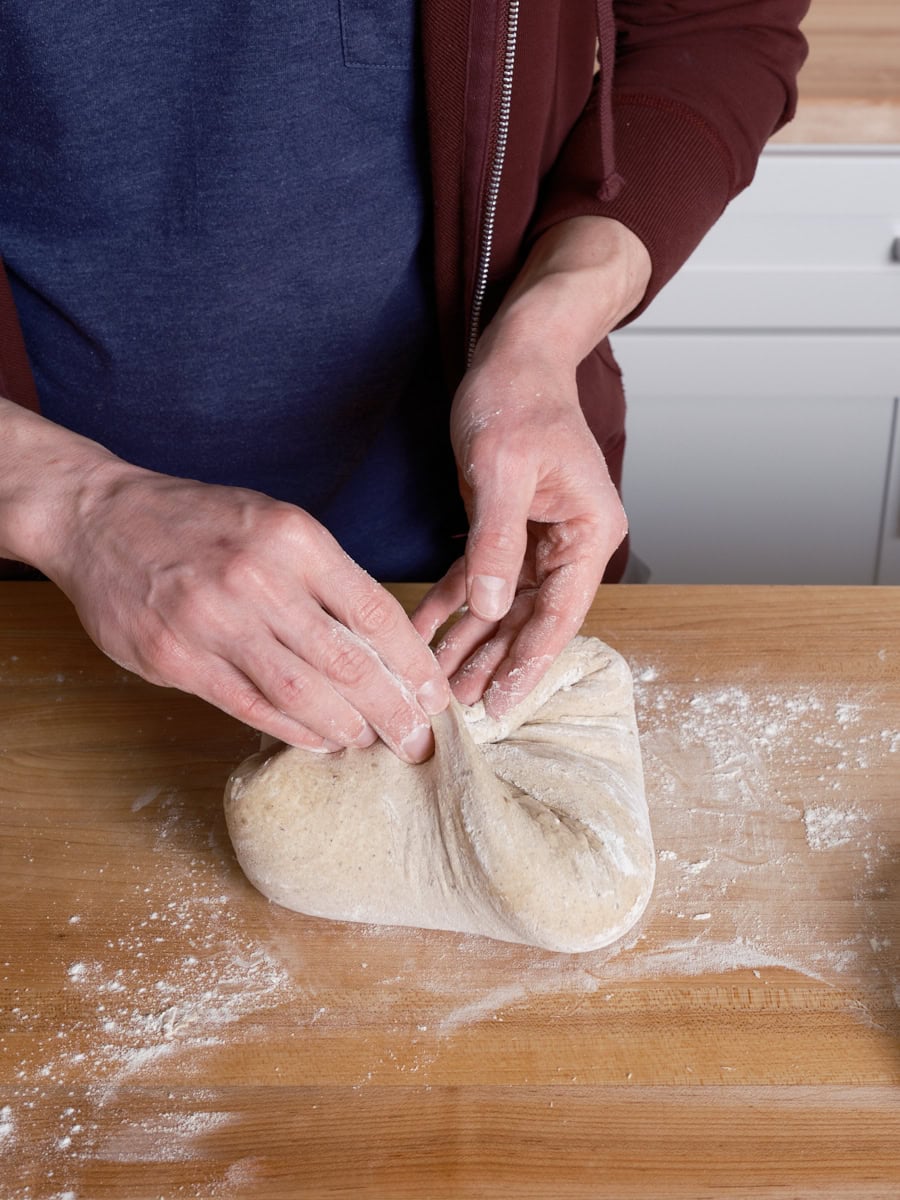


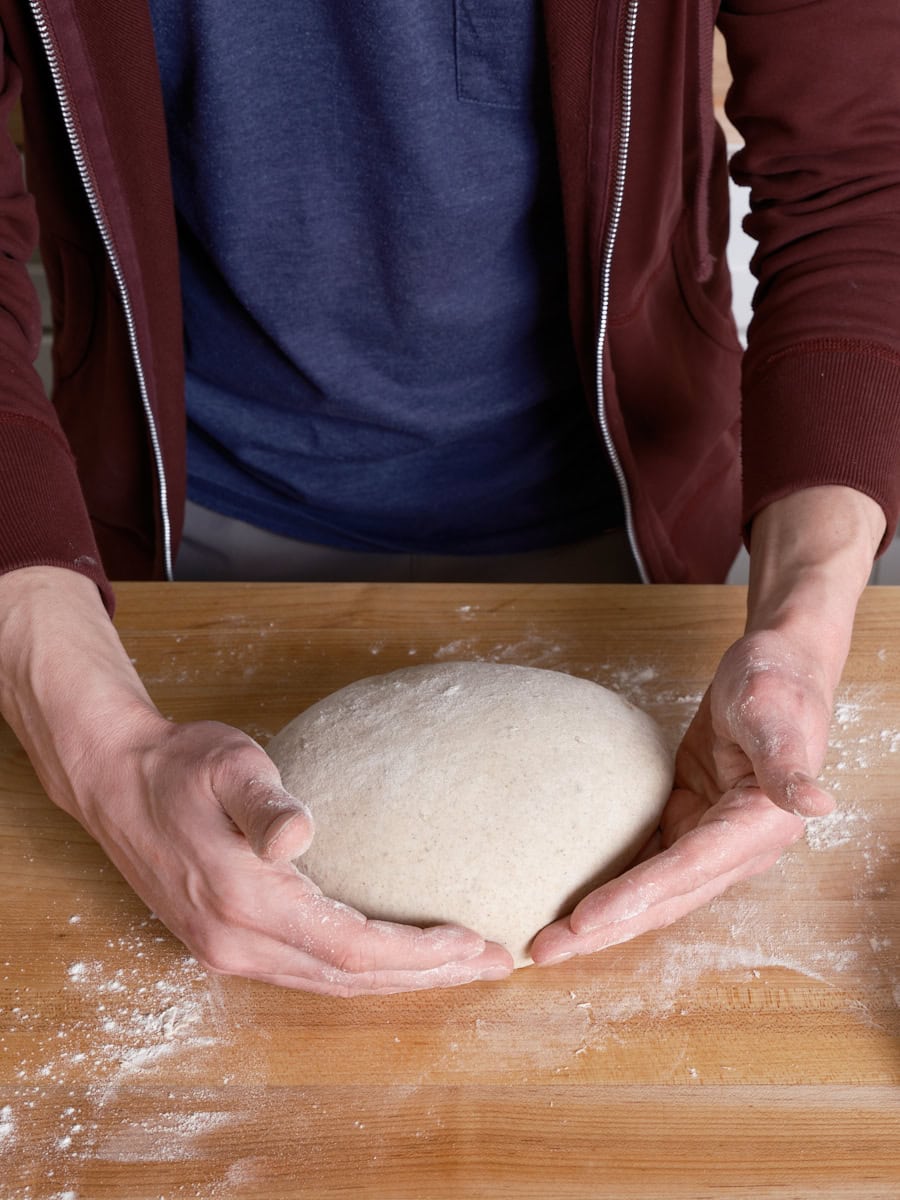
Flour the tops of the rested rounds. Using your bench scraper, flip one over onto a lightly floured work surface. Grab two opposing points on the outside of the dough and fold them into the middle, slightly overlapping. Grab two more points and repeat. Flip the dough over and use your hands to drag the dough down toward your body, creating tension on top of the dough. You should have a smooth, unformed, round shape.

Gently scoop the dough with both hands and invert it onto the sesame seeds. Then transfer it, seam-side up, to a round 10-inch proofing basket. Repeat for the other piece of dough.
8. Proof – 4:15 p.m. to 9:00 a.m.
Cover the baskets with reusable plastic bags and seal them shut. Place them into the refrigerator to proof overnight.
9. Bake – 9:00 a.m.
Place an oven rack in the bottom third of the oven. Put a Dutch oven, combo cooker, Challenger bread pan, or baking stone/steel on the rack with an empty pan at the bottom for ice. Or, use a bread steel and a round Baking Shell. Preheat the oven to 450°F (230°C).
Take one of the proofing baskets out of the fridge, uncover it, and put a piece of parchment paper over the basket. Place a pizza peel or inverted baking sheet on top of the parchment and, using both hands, flip everything over. Gently remove the basket and score the dough.
Slide the dough into the oven. Steam the oven: either cover the Baking Shell, Dutch oven, or pour ice into the preheated pan at the bottom of the oven. Bake for 20 minutes. Then, vent the oven of steam: either uncover the Dutch oven and remove the lid or remove the steaming pans. Continue baking for 30 more minutes. When done, the loaf should have an internal temperature of around 204°F (95°C), and the crust should be deeply colored. Repeat for the second piece of dough.
Let the loaves cool on a wire rack for 1 to 2 hours before slicing.
Print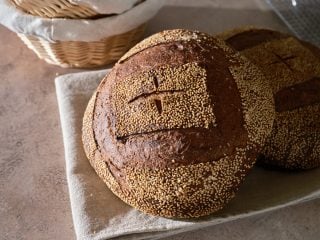
Scalded Buckwheat and Malt Sourdough Bread
- Prep Time: 24 hours
- Cook Time: 50 minutes
- Total Time: 24 hours 50 minutes
- Yield: 2 loaves 1x
- Category: Sourdough, Bread
- Cuisine: American
Description
A hearty, spice-forward sourdough with ground aniseed, barley malt syrup, and a silky buckwheat flour scald. The anise brings a warm, licorice-sweet aroma while the buckwheat’s nutty, mineral qualities keep everything balanced.
Ingredients
Levain
- 53g high-extraction wheat flour
- 53g water
- 53g ripe sourdough starter
Flour Scald
- 46g buckwheat flour
- 73g boiling water
Autolyse
- 634g high-extraction wheat flour
- 183g whole wheat flour
- 543g water
- All of the flour scald
Main Dough
- 92g water
- 18g fine sea salt
- 159g ripe levain
- 46g barley malt syrup
- 6g ground aniseed
Instructions
- Prepare the levain — 9:00 a.m.
Mix the levain ingredients in your favorite jar and leave covered at 74-76°F (23-24°C) to ripen for 5 hours. - Prepare the flour scald — 9:10 a.m.
In a small bowl, pour the boiling water over the buckwheat flour. Stir until a paste forms, adding a small splash more boiling water if very dry. Cover and set aside. - Autolyse — 11:00 a.m.
Warm or cool the water so the mixed dough reaches 78°F (26°C). Combine the flour, water, and scald in a large bowl. Mix with wet hands until no dry bits remain. Cover and rest for 1 hour. - Mix — 12:00 p.m.
Add the levain, salt, and a splash of water to the dough. Mix thoroughly, then knead using slap and fold or bowl folds for about 5 minutes until smoother. Rest 10 minutes. If the dough can handle it, add remaining water and knead another 3-5 minutes. Add the malt syrup and aniseed; mix until distributed. Transfer to a bulk fermentation container. If using a spiral mixer, mix at low speed until combined, increase to medium for 3 minutes, rest 5 minutes, then mix at medium for 3 more minutes while slowly adding the remaining water. Add the malt and aniseed at low speed for 1 minute. (See the expanded mixing directions above, if needed.) - Bulk fermentation — 12:30 p.m. to 3:30 p.m.
Bulk ferment for 3 hours at 74-76°F (23-24°C), performing 2 sets of stretches and folds at 30-minute intervals. After the second set, let the dough rest covered until bulk completes. Aim for about 30% rise. - Preshape — 3:30 p.m.
Turn the dough onto a clean surface. Divide in half and preshape each piece into a loose round. Rest uncovered for 30 minutes. - Shape — 4:00 p.m.
Spread white sesame seeds on a towel or sheet pan. Flour the tops of the rounds, flip onto a lightly floured surface, and shape into boules using your preferred method. Invert onto the sesame seeds, then transfer seam-side up to 10-inch proofing baskets. - Proof — 4:15 p.m. to 9:00 a.m. (next day)
Cover baskets with reusable plastic bags and seal. Refrigerate overnight. - Bake — 9:00 a.m.
Preheat oven to 450°F (230°C) with your Dutch oven, combo cooker, or baking surface in the bottom third. Turn dough onto parchment, score, and transfer to the hot vessel. Bake covered (or with steam) for 20 minutes, then uncovered for 30 minutes more until internal temperature reaches 204°F (95°C) and crust is deeply colored. Cool 1-2 hours before slicing.
Notes
To make one loaf, halve all ingredients.
This dough is high hydration (75%, or 83% including the scald). Hold back Water 2 and add only if the dough can handle it.
If you don’t have high-extraction flour, substitute bread flour or a blend of 90% bread flour and 10% whole wheat.
Instead of barley malt syrup, use blackstrap molasses for increased bitter/rich notes, or honey for more sweetness.
FAQs
What can I use instead of aniseed?
Caraway would work quite well and would bring similar spice notes.
What can I use instead of barley malt syrup?
For a more bitter-and-sweet flavor profile, try blackstrap molasses. Or, use honey for more floral sweetness that pairs very well with anise.
What’s Next?
If you’re looking for more sourdough recipes with buckwheat, try my Soft Honey Buckwheat Sandwich Bread for a rich yet sweet loaf.
Happy baking!