

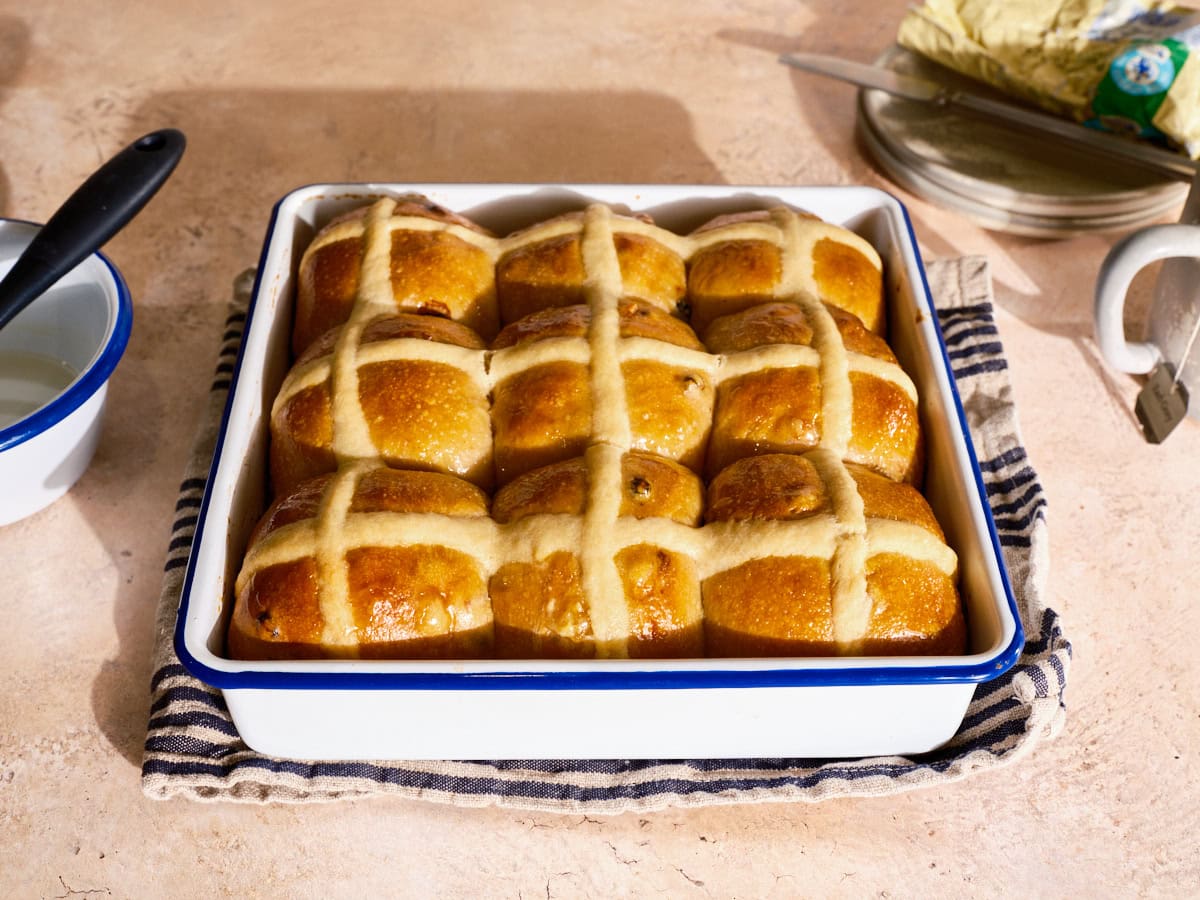
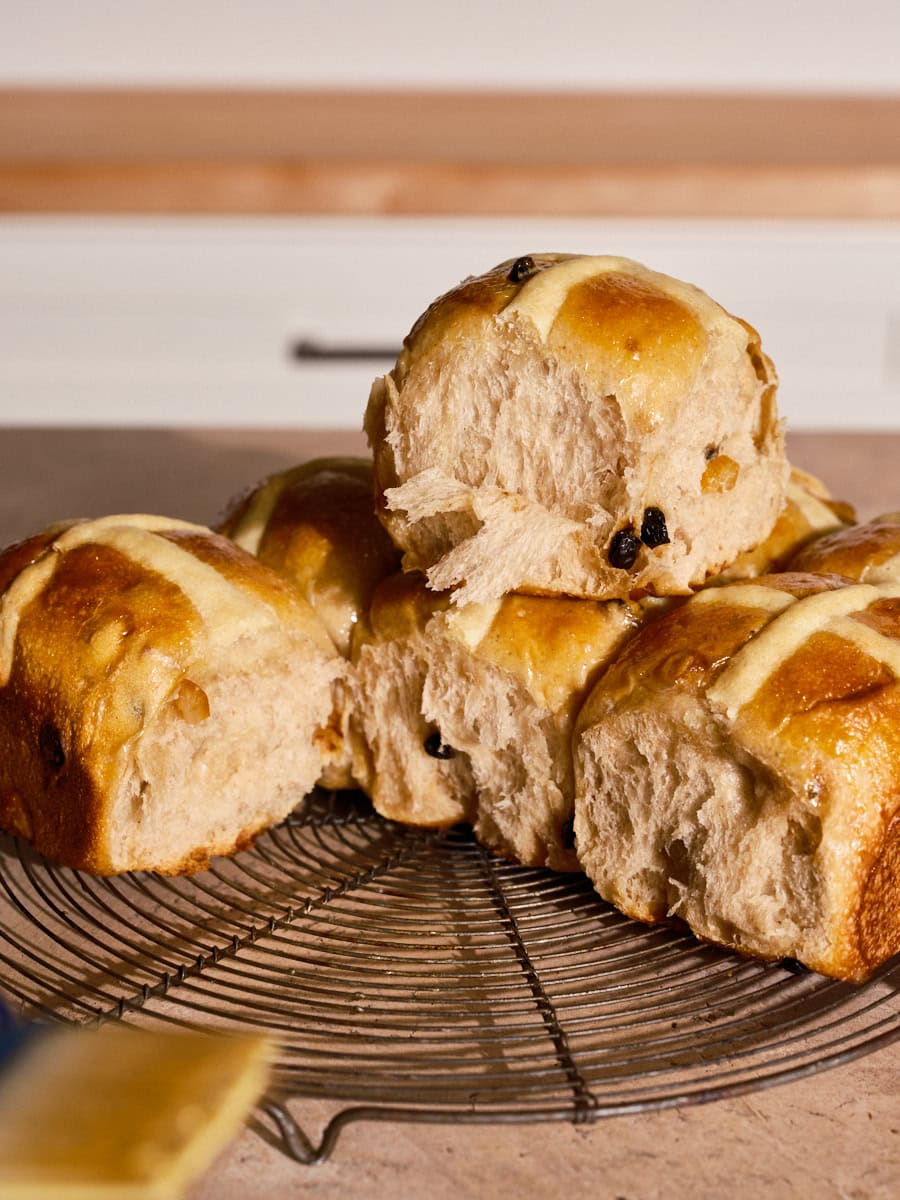
The moment the weather starts warming up and Easter is on the horizon (though, these are traditionally eaten on Good Friday), I start thinking about sourdough hot cross buns. The combination of warm spices, citrus zest/oil, and plump dried fruit (and candied peel!) folded into a soft, enriched dough that feels like the perfect bridge between winter baking and spring.
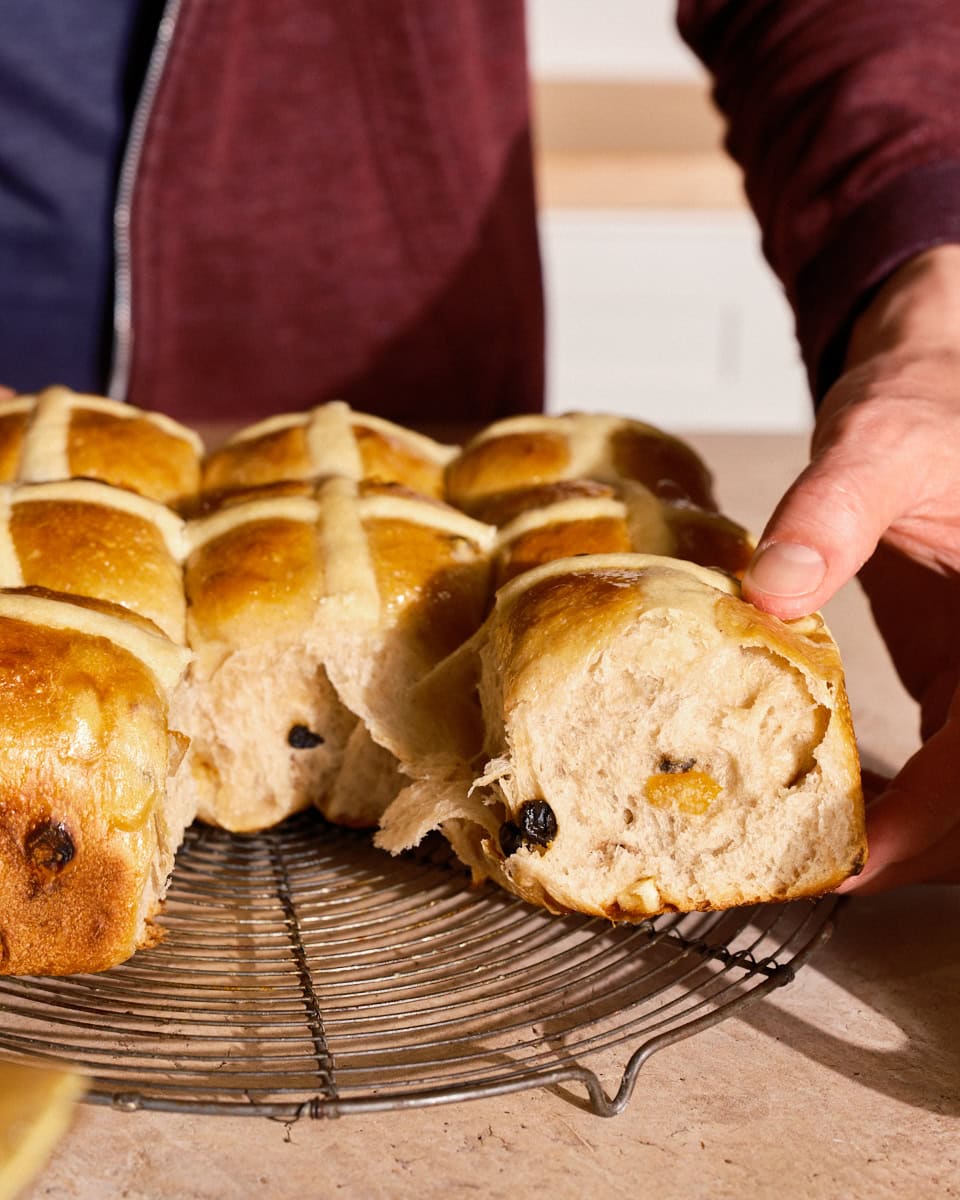
This recipe is adapted from my cookbook, The Perfect Loaf, but I’ve updated the formula here to include a tangzhong (a cooked flour paste) that makes these buns even softer and more tender. The tangzhong traps extra moisture in the dough, giving you that pillowy, pull-apart texture and keeping it softer longer than a traditional enriched bun.
These buns have milk, egg, butter, cinnamon, and sugar, which means the dough is a bit slower to ferment and takes a bit of patience. But the result is a deeply flavorful bun with a subtle sourdough tang that plays beautifully against the warm spices and sweet glaze.
What Makes These Hot Cross Buns Different
Most hot cross bun recipes rely on commercial yeast, which gets the job done fast but leaves flavor on the table. Using a sourdough gives these buns a more complex, rounded flavor with a very gentle acidity thanks to the sweet levain that balances the sweetness of the sugar, fruit, and glaze.
A few things that set my sourdough hot cross buns apart:
- Sweet levain: The levain for this recipe includes a small amount of sugar, which helps the wild yeast work more efficiently in such a rich dough.
- Tangzhong: By pre-cooking a small portion of the flour with milk, the result is a softer crumb that stays moist for days. I discuss this technique in detail in my guide to making tangzhong.
- Warm spices and citrus: Cinnamon, allspice, freshly ground nutmeg, and the zest of both a lemon and an orange. The combination is warm without being heavy.
- Two dried fruits: I use Thompson raisins (or candied orange peel) and currants (or regular raisins, or even chocolate chips, if you want to go that route). The optional soaker step plumps them so they don’t steal moisture from the dough during fermentation.
Baking Schedule
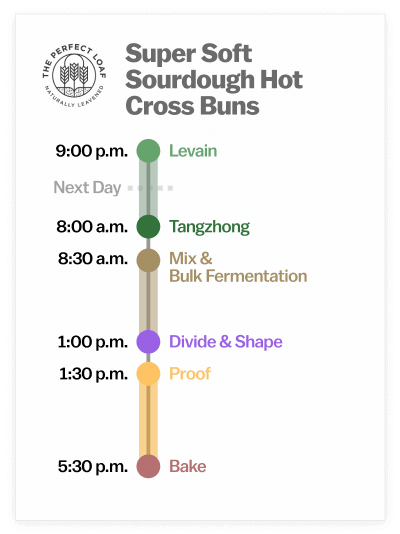
This is a same day, direct bake (except for the overnight levain). The levain and optional fruit soaker go overnight, and everything else happens the next day.
If you’re making these for Easter morning, prepare the levain Friday night, take the dough all the way until it’s halfway through proofing, then place it in the fridge overnight. Easter morning, take out to finish proofing for about an hour or two, and bake.
Baking Equipment
- Stand mixer or spiral mixer (highly recommended for this enriched dough)
- 9-inch square baking pan
- Medium saucepan (for tangzhong and glaze)
- Bench knife
- Bowl scraper
- Pastry bag, zip-top bag, or my favorite, disposable pastry bags (for piping the crosses)
- Digital scale
- Instant-read thermometer
Sourdough Hot Cross Buns Formula
For tips on how to calculate baker’s percentages or how to modify this formula, see my post on baker’s percentages (baker’s math).
| Total Dough Weight | 1,150 grams |
| Pre-fermented Flour | 15.5% |
| Levain in final dough | 48.6% |
| Hydration | 31.0% (not including milk) |
| Yield | 9 × 115g hot cross buns |
Total formula
Desired dough temperature: 78°F (25°C). See my post on the importance of dough temperature for more information on dough temperatures.
| Weight | Ingredient | Baker’s Percentage |
|---|---|---|
| 454g | High-protein white flour (~12–14% protein) | 92.0% |
| 39g | Tangzhong: High-protein white flour | 8.0% |
| 178g | Tangzhong: Whole milk | 36.0% |
| 49g | Egg, beaten (1 medium) | 10.0% |
| 69g | Unsalted butter | 14.0% |
| 39g | Superfine sugar | 8.0% |
| 74g | Thompson raisins or candied orange peel | 15.0% |
| 49g | Dried currants or chocolate chips | 10.0% |
| 3g (1 teaspoon) | Ground cinnamon | 0.6% |
| 1g (1/2 teaspoon) | Ground allspice | 0.2% |
| 1g (1/2 teaspoon) | Freshly ground nutmeg | 0.2% |
| — | Zest of 1 lemon | — |
| — | Zest of 1 orange | — |
| 153g | Water | 31.0% |
| 9g | Fine sea salt | 1.9% |
| 31g | Ripe sourdough starter (100% hydration) | 6.2% |
Additional ingredients: 1 egg and 1 tablespoon milk for the egg wash.
Cross mixture
| Weight | Ingredient |
|---|---|
| 50g | White flour |
| 35g | Water |
| 15g | Orange juice (or more water) |
| 15g | Vegetable oil |
| Pinch | Salt |
Simple syrup glaze
| Weight | Ingredient |
|---|---|
| 50g | Water |
| 50g | Sugar |
Sourdough Hot Cross Buns Method
1. Prepare the Sweet Levain and Fruit Soaker – 9:00 p.m.
| Weight | Ingredient | Baker’s Percentage |
|---|---|---|
| 77g | High-protein white flour | 100.0% |
| 19g | Superfine sugar | 25.0% |
| 77g | Water | 100.0% |
| 31g | Ripe sourdough starter (100% hydration) | 40.0% |
Mix the levain: Warm or cool the water to about 78°F (25°C). In a large bowl, mix the levain ingredients until well incorporated. This is a sweet levain where the sugar helps yeast work more efficiently in such an enriched dough and it helps reduce the overall sourness in the final buns. Use a container that has plenty of room because it will rise considerably. Loosely cover and store in a warm place for 12 hours.
Prepare the optional fruit soaker: If your dried fruit and peel are very dry, soaking them can help soften them in the final buns. My fruit and peel are not dry, but rather, they’re incredibly moist. So I skipped this step.
Put the 74g raisins (or candied peel as you see in this post) and 49g dried currants (these are my favorite) in a medium bowl. Pour in enough water to just cover the dried fruit (the excess will be drained before the fruit is added to the dough). Cover the bowl and let soak until bulk fermentation.
2. Make the Tangzhong and Prepare Butter – 8:00 a.m. (next day)
Prepare the butter: Cut the butter into 1/2-inch-thick pats. Place in a bowl on the counter to warm to room temperature until mixing.
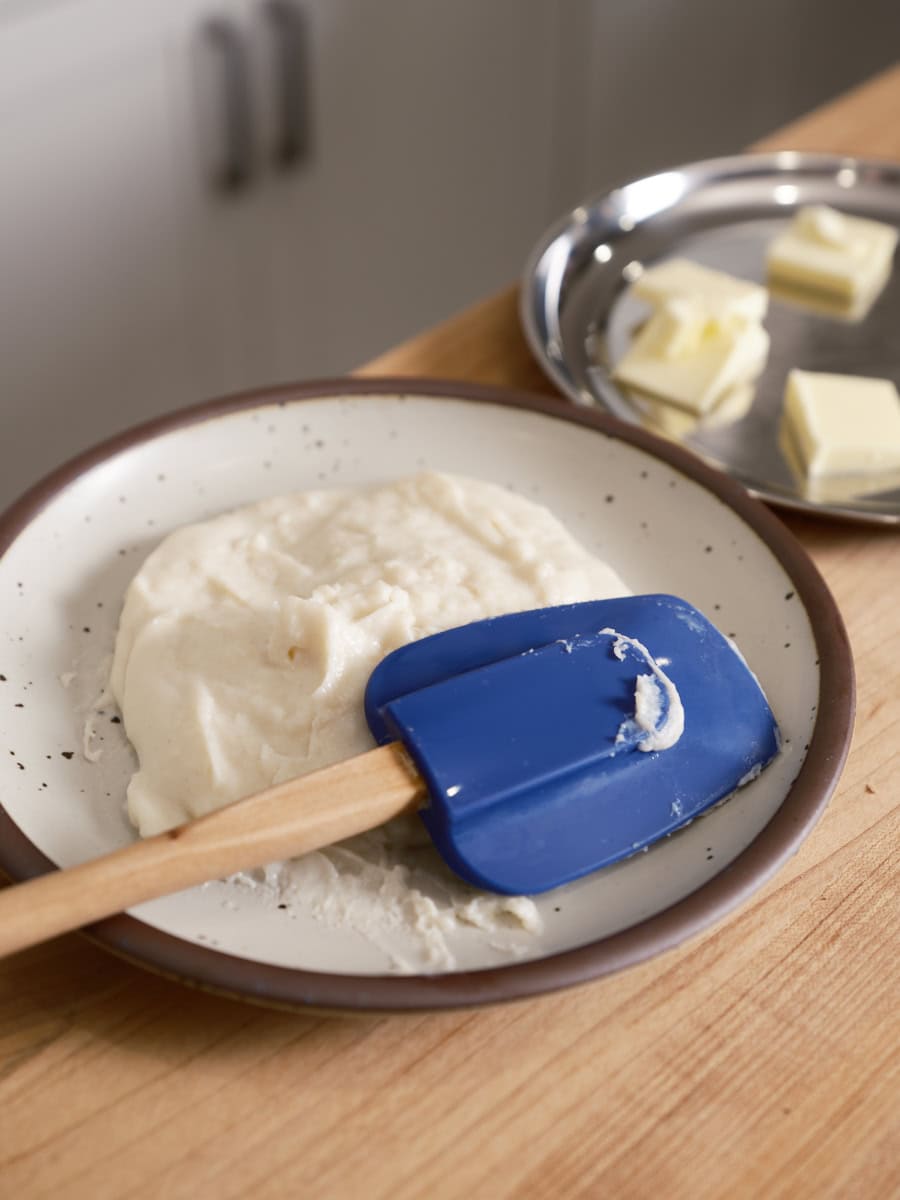
In a medium saucepan set over medium-low heat, add the 39g tangzhong flour and 178g tangzhong milk. Cook, whisking continuously, until the mixture thickens into a paste, 5 to 8 minutes. In the beginning, whisk vigorously to break up any flour clumps, and continue whisking to avoid burning. The mixture won’t seem to do anything for a while, but it will thicken.
Remove the pan from the heat and spread the tangzhong on a small plate to expedite cooling. Set aside.
3. Mix – 8:30 a.m.
Desired dough temperature (DDT): 78°F (25°C)
| Weight | Ingredient |
|---|---|
| All | Tangzhong (from Step 2) |
| 378g | High-protein white flour |
| 49g | Egg, beaten (about 1 medium) |
| 69g | Unsalted butter |
| 20g | Superfine sugar |
| 74g | Thompson raisins or orange peel |
| 49g | Currants or chocolate chips |
| 3g (1 teaspoon) | Ground cinnamon |
| 1g (1/2 teaspoon) | Ground allspice |
| 1g (1/2 teaspoon) | Freshly ground nutmeg |
| — | Zest of 1 lemon |
| — | Zest of 1 orange |
| 77g | Water |
| 9g | Fine sea salt |
| 202g | Levain (from above) |
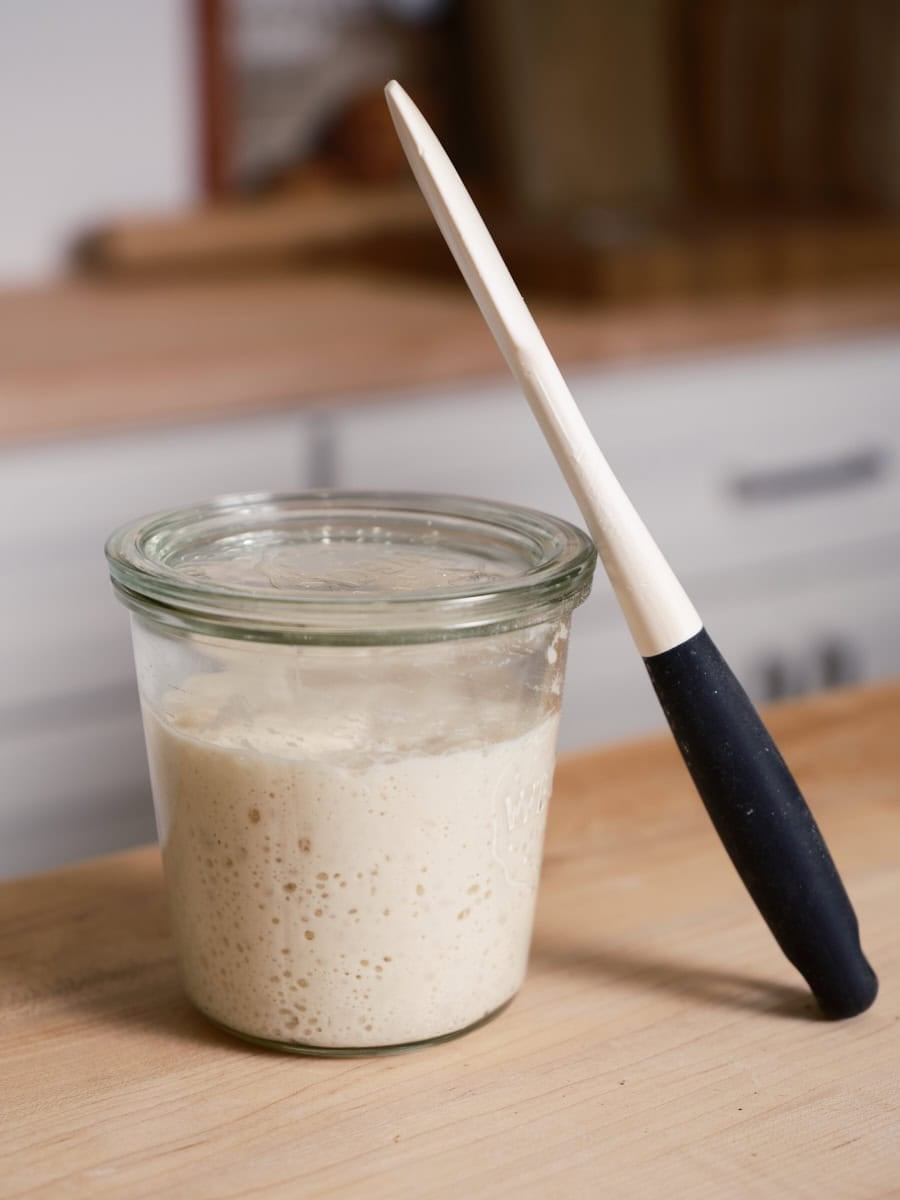
Check the levain: It should show signs of readiness: well aerated, risen very high, very bubbly, and frothy (see image below). If the levain is not showing these signs, let it ferment for 1 more hour and check again.
Mix the dough: With this enriched dough I highly recommend using a stand mixer (or a spiral mixer like the Halo Pro—see below). To the bowl of a stand mixer fitted with the dough hook, add the flour, beaten egg, the sugar (it’s okay to add it all at once, whereas in the cookbook I do half at a time), spices and zest, water, salt, and ripe levain. Mix on low speed for 1 to 2 minutes until combined. Increase the speed to medium and mix for 5 minutes, until the dough begins to tighten, cling to the dough hook, and pull from the sides. Let the dough rest for 5 minutes in the bowl.
Continue mixing: Increase the speed to medium and mix for 3 to 6 minutes, until the dough is smooth and strong; it should cling to the dough hook but may not completely lift off the sides of the bowl. Use the windowpane test (stretch a small piece of the dough to see if it forms a translucent membrane) to check whether the dough is intensively developed. If the dough does not spread evenly or tear cleanly, mix on medium speed for 2 more minutes and test again.
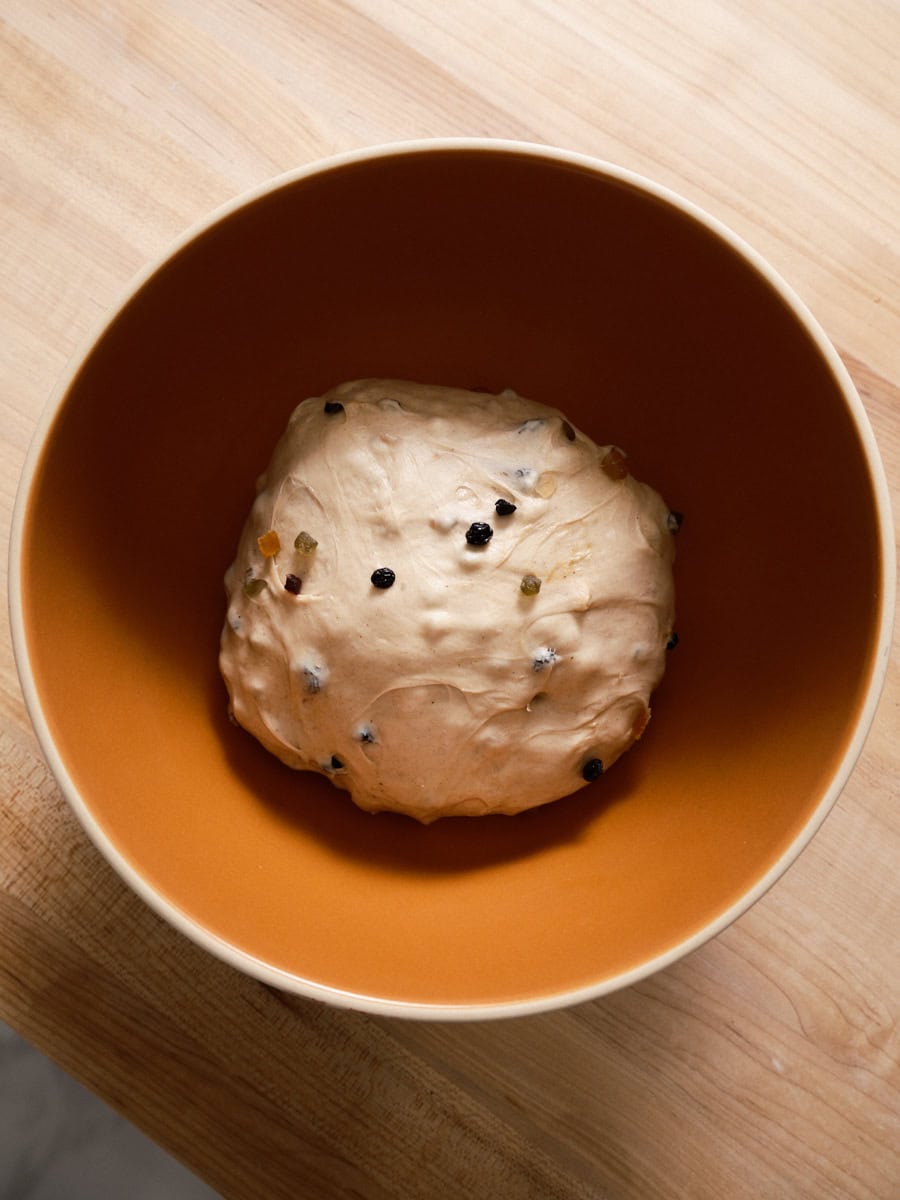
Add the butter: With the mixer running on low speed, add the room temperature butter, one pat at a time. Wait until each pat is mostly absorbed before adding the next pat. Scrape down the sides of the bowl and the dough hook as needed. Continue mixing on medium speed for 1 to 2 minutes more until the dough smooths out and clings to the dough hook. The dough will be silky smooth, elastic, and shiny. Transfer to a container for bulk fermentation.
Add the inclusions: When using a mixer, I prefer to add the inclusions at the very end of mixing. Spread them over the dough in the mixing bowl and mix on the slowest speed until they’re evenly distributed throughout the dough.
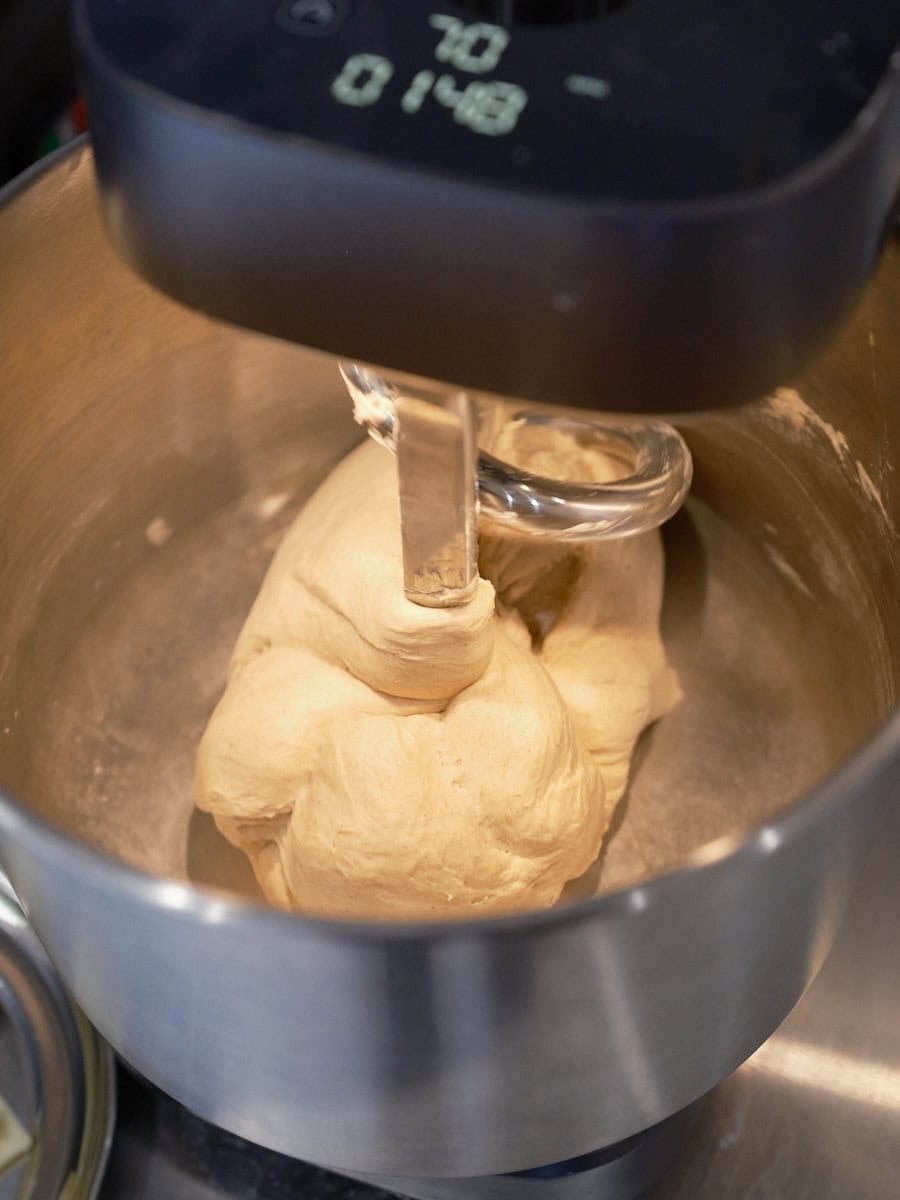
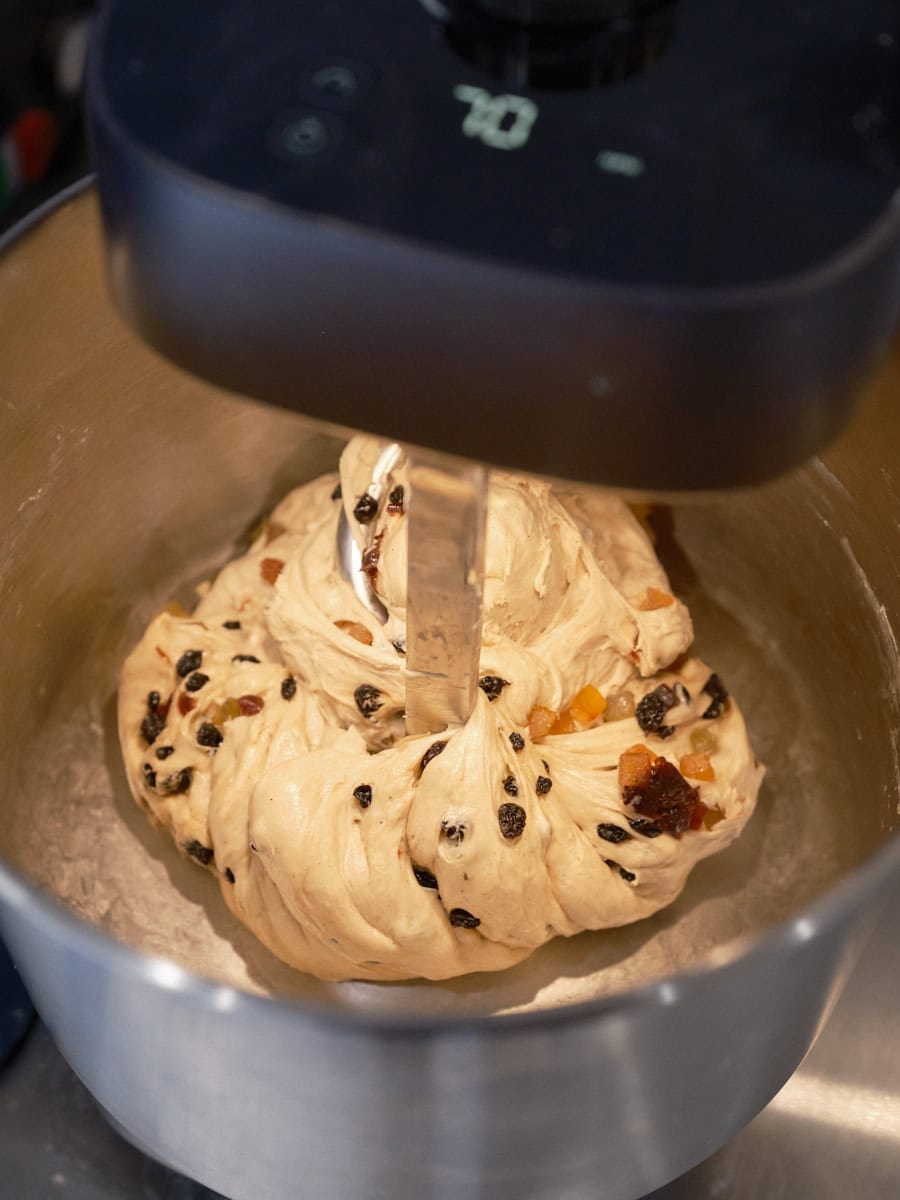
Mixing hot cross buns with the Halo Pro spiral mixer: Since many of you might have this mixer, here’s how I mix this dough:
- Add all the ingredients except the butter to the mixing bowl. Turn the mixer to 90 RPM and mix for 2 minutes.
- Mix for 4 minutes at 120 RPM.
- Let the dough rest for 5 minutes.
- Mix for 4 minutes at 120 RPM.
- Once the dough is smooth and strong, turn the mixer down to 90 RPM and add the butter one pat at a time.
- Turn the mixer to 70 RPM and add the fruit mixture a little at a time and mix until fully incorporated, 1-2 minutes.
Regardless of whether you’re mixing the dough with a stand mixer, spiral mixer, or by hand, it should look smooth and strong at the end of mixing, as seen below.
4. Bulk Fermentation – 9:00 a.m. to 1:00 p.m. (about 4 hours)
Duration: About 4 hours at warm room temperature, 74–76°F (23–24°C)
Folds: 2 sets of stretches and folds at 30-minute intervals
Set a timer and make a note: Write down the current time as the start of bulk fermentation, set a timer for 30 minutes, and let the dough rest in a warm place.
Stretch and fold: If you’re fully strengthening the dough during mixing with a mechanical mixer, one or more of these steps may not be necessary (see my guide to stretching and folding to learn how to determine this). When your timer goes off, drain the fruit soaker of any excess water. Spread about one-quarter of the soaker evenly over the dough. Using wet hands, pick up one side of the dough, stretch it up, and fold it over. Rotate the bowl 180 degrees and perform another stretch and fold. Rotate the bowl a quarter turn and perform another stretch and fold. Rotate the bowl 180 degrees and perform the last stretch and fold. The dough should be folded up neatly. Cover the bowl and repeat once more after 30 minutes.
Let the dough rest: After the last set, cover the bowl and let the dough rest for the remainder of bulk fermentation, about 3 hours.
5. Divide and Shape – 1:00 p.m.
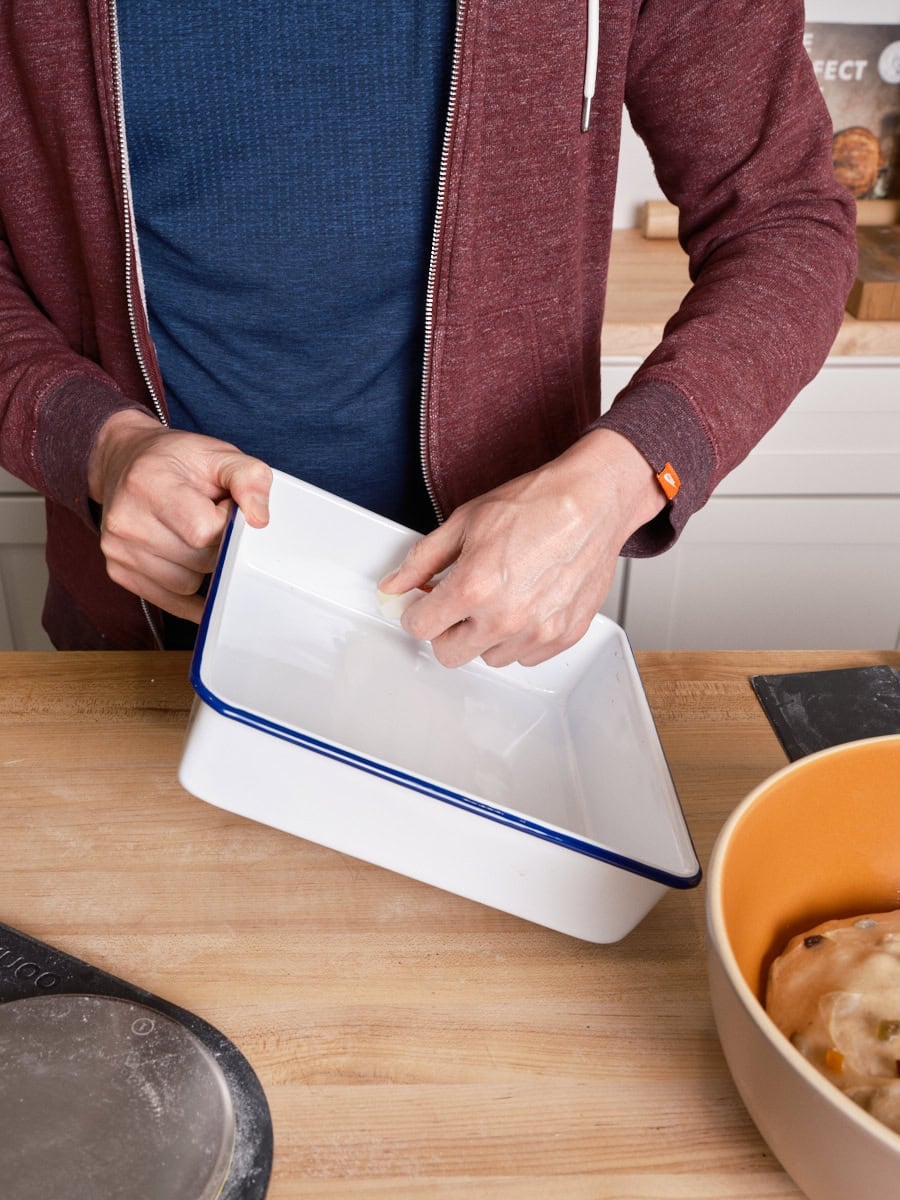
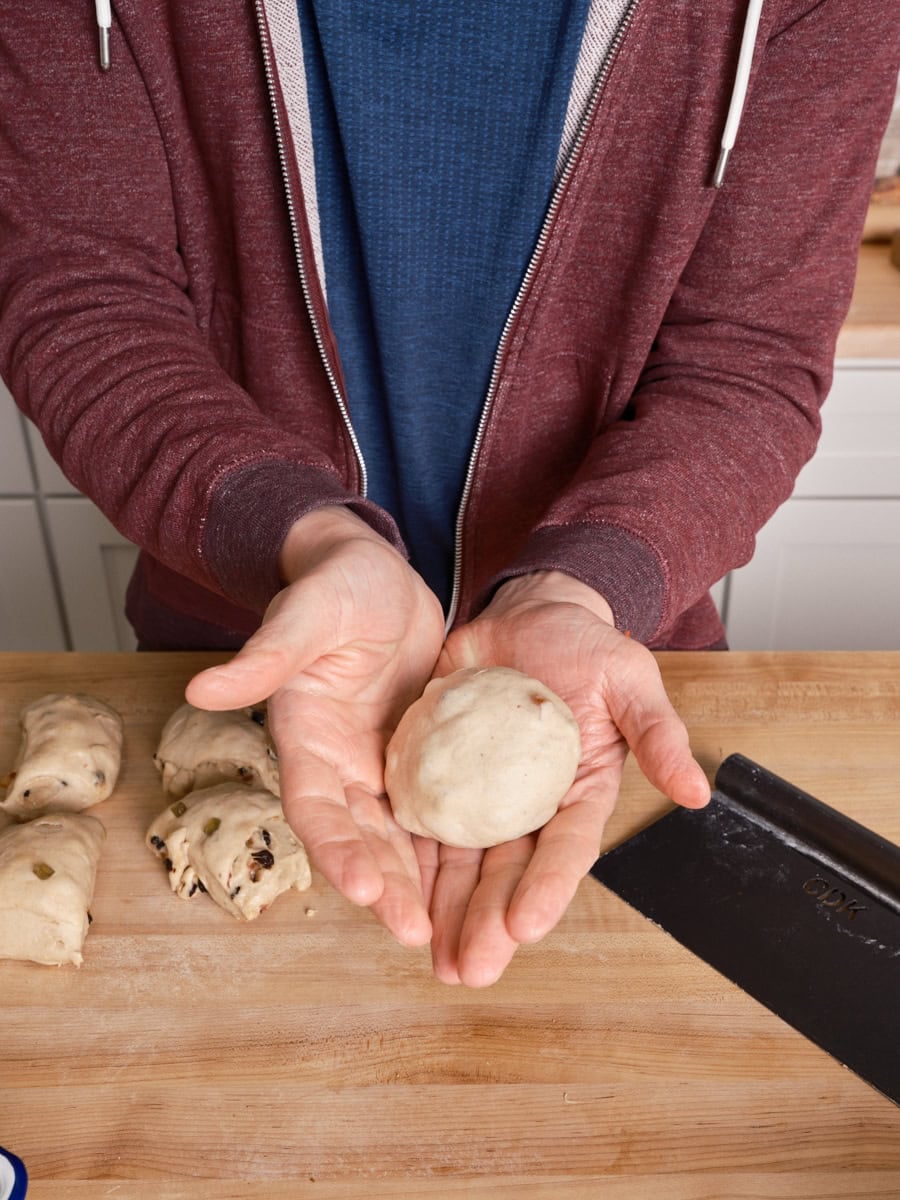
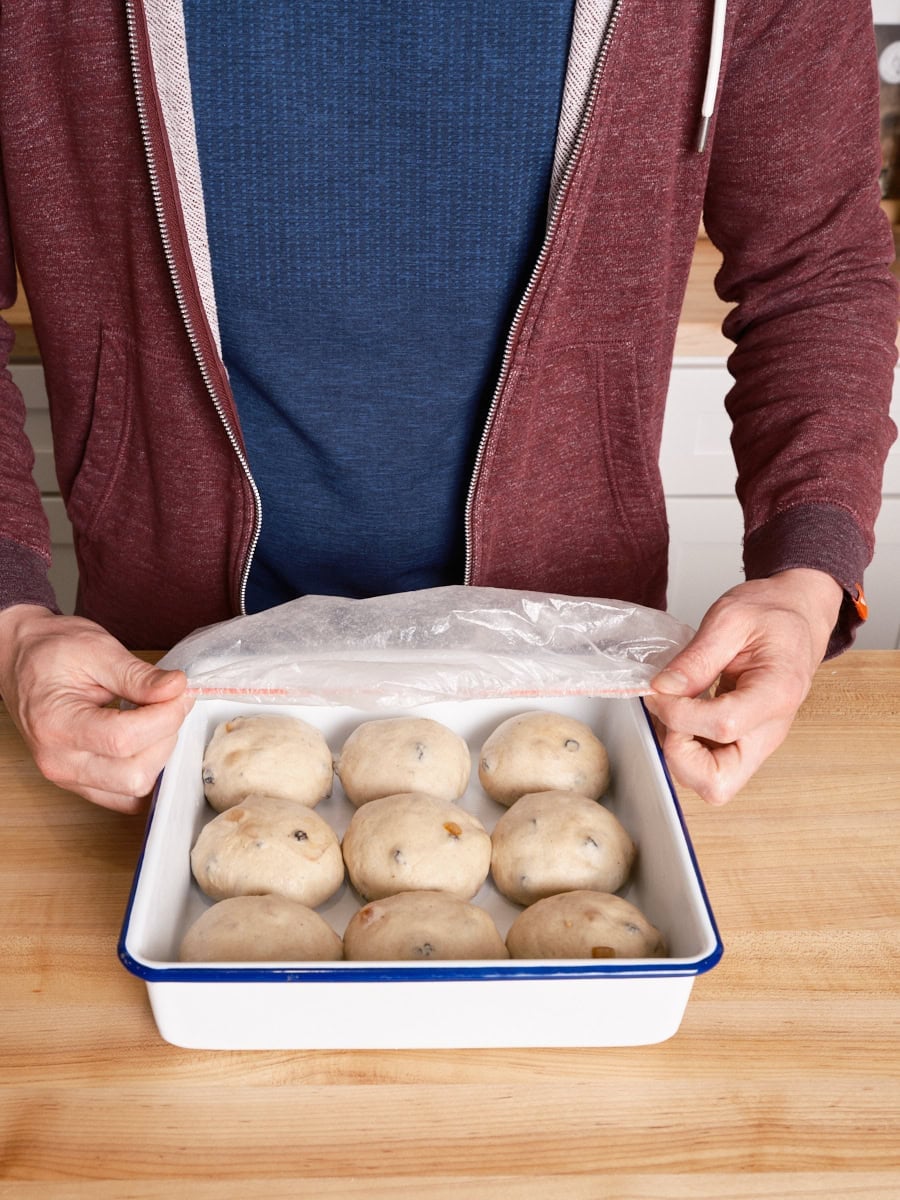
Prepare the baking pan: Liberally butter a 9-inch square baking pan.
Check the dough: At the end of bulk fermentation, the dough will have risen and feel puffy when poked. If you wet a hand and gently tug on the surface of the dough, it will feel elastic and cohesive, resisting your pull. If you don’t see dough that’s airy, leave it for another 30 minutes in bulk fermentation and check again.
It’s important your dough rises and becomes puffed and soft at this point; don’t rush it.
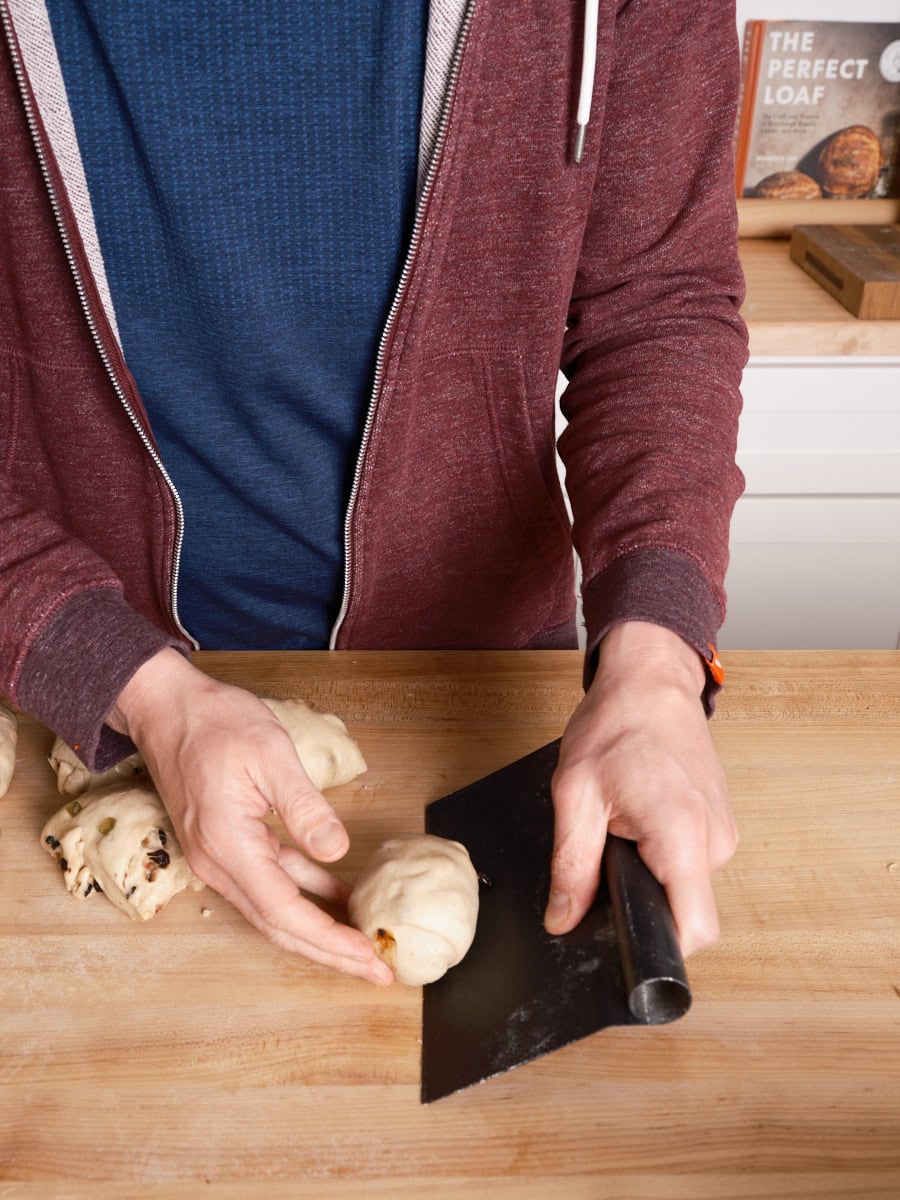
Divide and shape the dough: Using a bowl scraper, gently scrape the dough onto a clean work surface, then use your bench knife to divide it into 9 pieces, each 115g. Using your bench knife in your dominant hand and with your other hand wet to reduce sticking, shape each piece of dough into a tight round (see above). Place the rounds in the prepared baking pan in 3 rows of 3. Place the pan inside a reusable plastic bag and seal.
Alternate pan option: I bake these in my 9-inch square nonstick baking pan for buns that are super soft, but you could also bake them on a 13 x 18-inch sheet pan with a little space in between if you want buns that have a well-colored and firmer crust all around.
Overnight option: At this point, the shaped buns can be covered and placed into the fridge overnight (or let proof for a few hours, then pop into the fridge to make the next day even shorter). Take out the next day and proceed with the remaining steps.
6. Proof – 1:30 p.m. to 5:30 p.m. (about 4 to 5 hours)
Duration: About 4 hours, or longer, if needed, at warm room temperature, 74–76°F (23–24°C)
Let the dough proof: Put the pan in a warm place to proof for about 4 hours. This is a slow-moving dough due to all the enrichments; it might take longer if your kitchen is cooler. The bun dough is ready when it is very soft to the touch with no dense spots and well risen. If using the 9-inch pan, the dough should have risen to just below the rim.
If the dough isn’t puffy and soft to the touch, proof 30 minutes more and check again—don’t rush the dough!
7. Prepare the Glaze, Cross Mixture, and Bake – 5:30 p.m.
Duration: 25 to 30 minutes in the oven
Prepare the oven: Place an oven rack in the middle position and preheat the oven to 400°F (200°C).
Prepare the simple syrup glaze: Combine the 50g water and 50g sugar in a small saucepan over medium heat and bring to a boil. Let it simmer, stirring occasionally, until the mixture turns clear, 2 to 4 minutes. Let cool to room temperature. The simple syrup can be stored in an airtight container in the refrigerator indefinitely.
Prepare the cross mixture: In a small bowl, combine the 50g white flour, 35g water, 15g orange juice(or more water), 15g oil, and a pinch of salt until a thick paste forms. It’s important that the paste not be too thick or too thin; it should just barely flow off the edge of a spoon (similar to a thick cream). If the mixture is too dry or thick, add a small splash of water as needed to loosen. Transfer to a pastry bag or a plastic bag with a small cut made at the corner to pipe out the mixture. Set aside.
Before baking, apply the egg wash and pipe the crosses: Make the egg wash by whisking together the egg and 1 tablespoon milk. Uncover the pan and brush a light layer of the egg wash on the buns. Pipe a thin, vertical line of the cross mixture down the center of each column of buns. Rotate the pan a quarter turn and pipe another line down the center of each column, forming a cross on each bun.
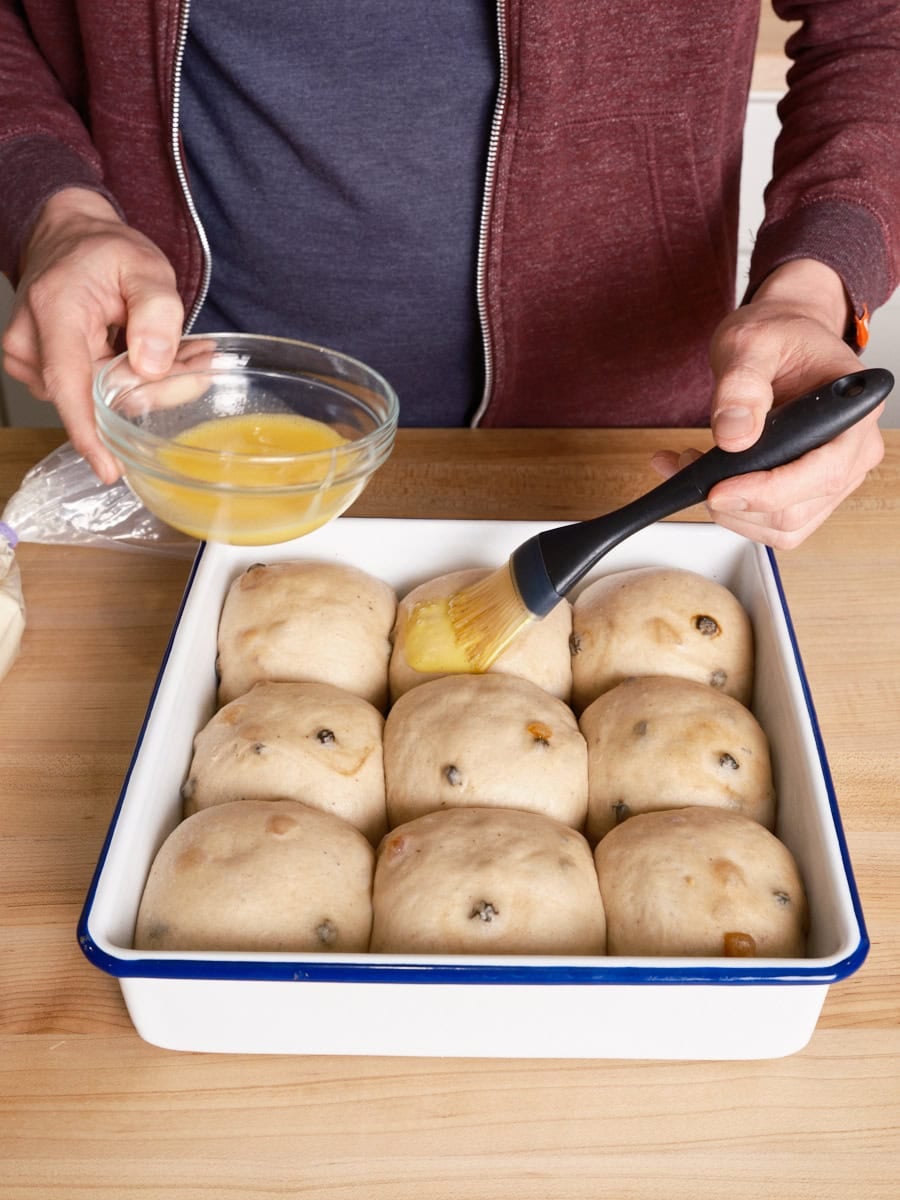
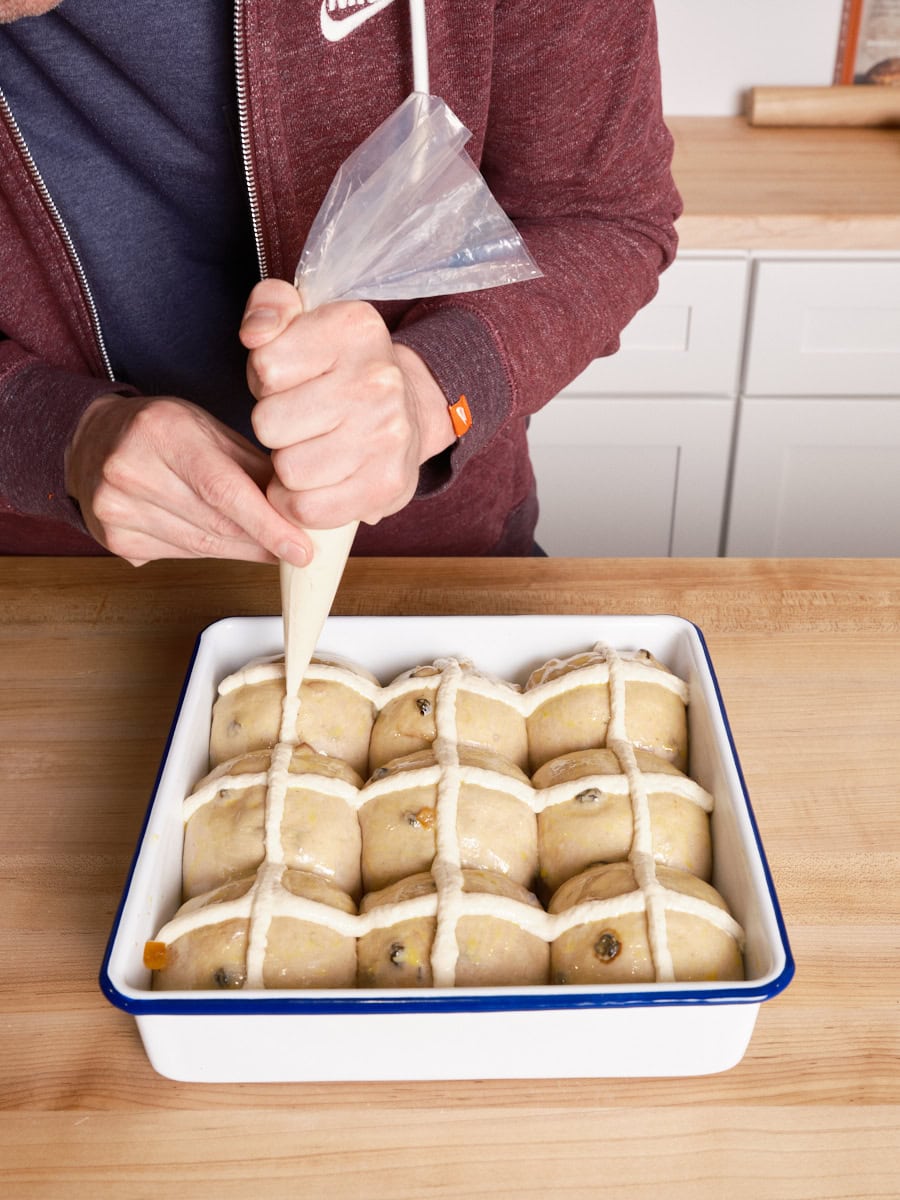
Bake: Bake for 15 minutes. Rotate the pan back to front, reduce the oven temperature to 350°F (175°C), and bake for 10 to 15 minutes more, or until the internal temperature reaches 195°F (90°C) and the buns are golden brown on top.
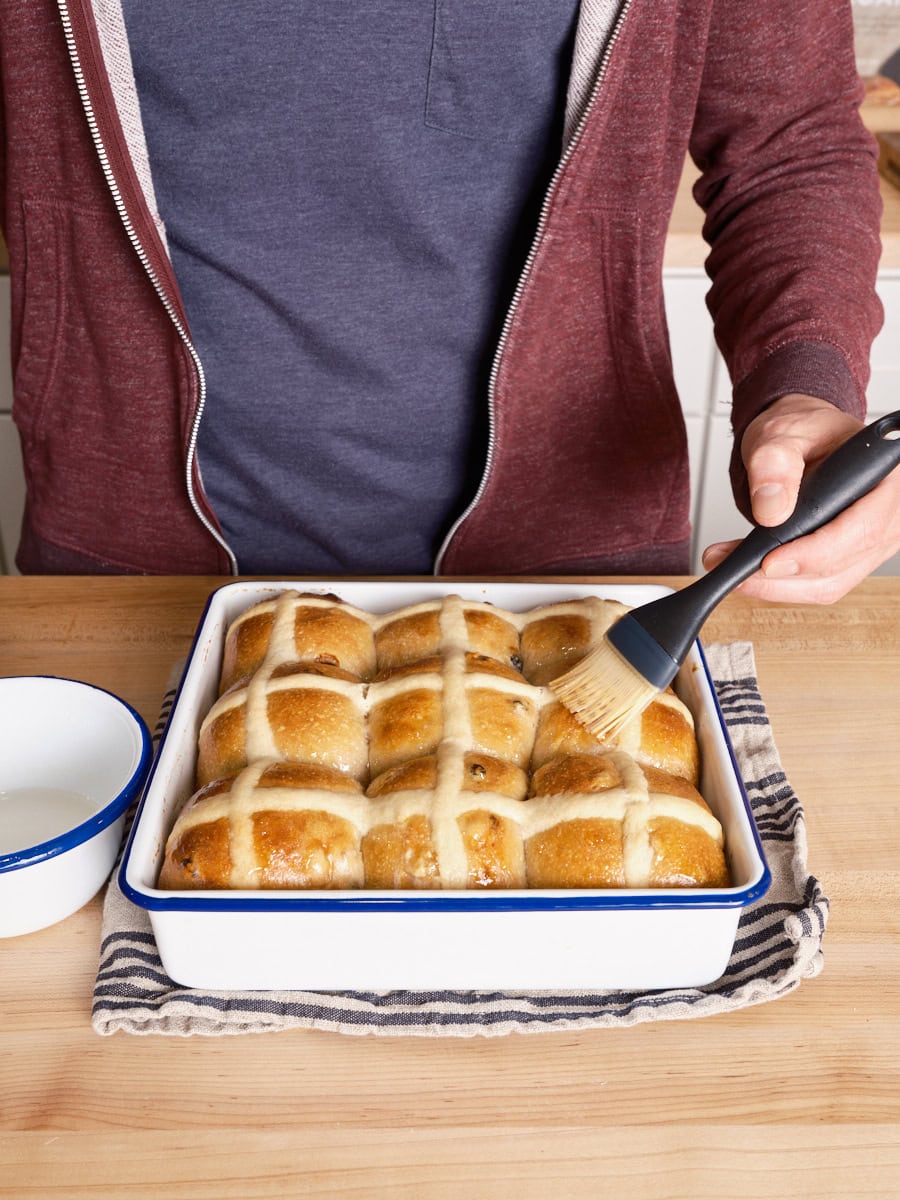
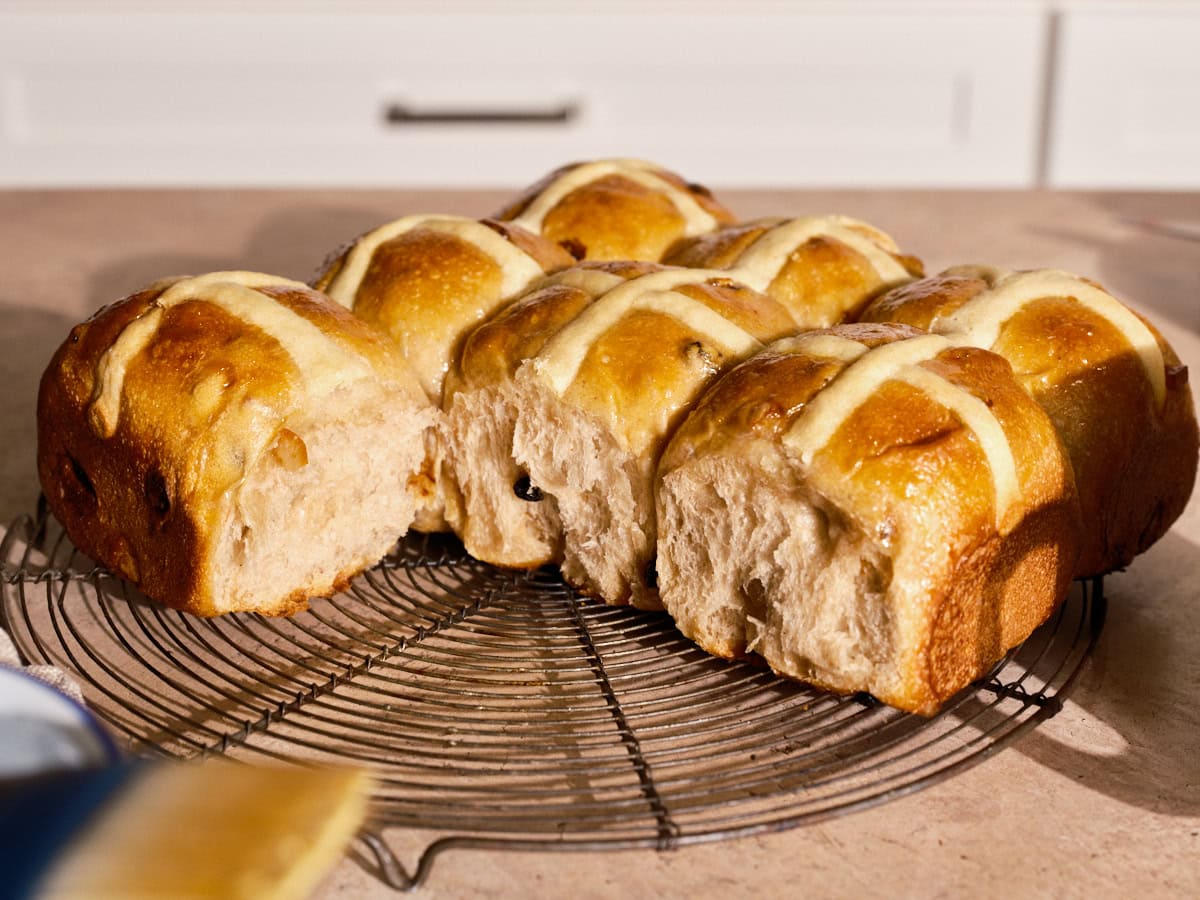
Finish and cool: Remove the pan from the oven, then brush a layer of the simple syrup onto the buns. Let cool for 5 minutes. Either serve warm straight from the pan or let them cool on a wire rack.
These are fantastic served with a high-quality salted butter (I like to slice them in half and spread them in the middle). They’re best the day they are baked, but can be stored in an airtight container for 1 day (reheat in a low oven).
Print
Sourdough Hot Cross Buns
- Prep Time: 12 hours
- Cook Time: 30 minutes
- Total Time: 12 hours 30 minutes
- Yield: 9 buns
- Category: Buns, Sweets
- Cuisine: British
Description
Soft, spiced sourdough hot cross buns with warm cinnamon, allspice, nutmeg, citrus zest, and plump dried fruit. A sweet levain and tangzhong make these buns exceptionally tender and flavorful.
Ingredients
Levain
- 77g high-protein white flour (~12–14% protein)
- 19g superfine sugar
- 77g water
- 31g ripe sourdough starter, 100% hydration
Tangzhong
- 39g high-protein white flour
- 178g whole milk
Main Dough
- All the tangzhong
- All the levain
- 378g high-protein white flour (~12–14% protein)
- 49g egg, beaten (about 1 medium)
- 77g water
- 20g superfine sugar
- 9g fine sea salt
- 74g Thompson raisins or candied orange peel
- 49g dried currants or chocolate chips
- 3g ground cinnamon (about 1 teaspoon)
- 1g ground allspice (about ½ teaspoon)
- 1g freshly ground nutmeg (about ½ teaspoon)
- Zest of 1 lemon
- Zest of 1 orange
- 69g unsalted butter, room temperature, cut into ½-inch pats
Cross Mixture
- 50g white flour
- 35g water
- 15g orange juice (or more water)
- 15g vegetable oil
- Pinch of salt
Simple Syrup Glaze
- 50 water
- 50g sugar
Egg Wash
- 1 egg
- 1 tablespoon milk
Instructions
- Prepare the levain and fruit soaker (Day One, 9:00 p.m.)
Mix the levain ingredients in a container and leave covered to ripen at about 78°F (25°C) for 12 hours overnight. In a separate bowl, cover the raisins and currants with water and let soak overnight. - Make the tangzhong (Day Two, 8:00 a.m.)
Cook flour and milk portion in a saucepan over medium heat, whisking continuously, until the mixture thickens into a paste, about 5–8 minutes. Set aside to cool. - Mix (8:30 a.m.)
Cut the butter into ½-inch pats and set on a plate to come to room temperature. To the bowl of a stand mixer fitted with the dough hook, add the flour, beaten egg, sugar, spices and zests, water, salt, tangzhong, and ripe levain. Mix on low speed for 1 to 2 minutes until combined. Increase to medium and mix for 5 minutes until the dough tightens and clings to the hook. Rest 10 minutes. Then mix on medium for 3 to 6 minutes, until smooth and strong. Add the butter one pat at a time on low speed, waiting for each to absorb. Add the inclusions (raisins and peel) and mix on low speed for 1 to 2 more minutes until silky and elastic. Transfer to a bulk fermentation container. - Bulk fermentation (9:00 a.m. to 1:00 p.m.)
Give the dough 2 sets of stretch and folds at 30-minute intervals. After the last fold, let the dough rest undisturbed for the remainder of bulk fermentation, about 3 hours. - Divide and shape (1:00 p.m.)
Liberally butter a 9-inch square baking pan. Divide the dough into 9 pieces of 115g each and shape each into a tight round. Place in the pan in 3 rows of 3. Cover with a reusable plastic bag. - Proof (1:30 p.m. to 5:30 p.m.)
Let the buns proof in a warm place for about 3 hours, or until very soft to the touch, well risen, and the dough has risen to the rim of the pan. Don’t rush the dough, keep it warm and proof until the dough is very soft. - Prepare the glaze, crosses, and bake (5:30 p.m.)
Preheat the oven to 400°F (200°C). Make the simple syrup by simmering 50g water and 50g sugar until clear, 2 to 4 minutes; set aside. Mix the cross ingredients into a thick paste and transfer to a piping bag. Whisk the egg wash and brush lightly on the buns. Pipe crosses on each bun. Bake for 15 minutes, rotate the pan, reduce the oven to 350°F (175°C), and bake for 10 to 15 minutes more until the internal temperature reaches 195°F (90°C). Brush with simple syrup and let cool for 5 minutes before serving with salted butter.
Notes
Scheduling: If you’re making these for Easter morning, prepare the levain Friday night, take the dough all the way until it’s halfway through proofing, then place it in the fridge overnight. Easter morning, take out to finish proofing for about an hour or two, and bake.
Do ahead (tangzhong): You can prepare the tangzhong the night before. Cook the flour and milk as instructed, let cool to room temperature, cover, and refrigerate overnight. The next morning, take it out to let it warm some (to room temperature would be ideal) and proceed to add it during the mix as instructed.
Do ahead (overnight proof): You can prepare the dough and proof the buns overnight to bake the next day at any time. After shaping, cover the pan and place it in the fridge overnight. The next day, take the buns out and let them warm for 30 minutes, then continue with the Proof and Bake steps.
Fruit options: Thompson raisins are traditional, but dried orange peel works beautifully. For the currants, chocolate chips make a great nontraditional swap.
Pan options: A 9-inch square pan gives you super-soft, pull-apart buns. A sheet pan with spacing gives buns with a firmer, more well-colored crust all around.
What’s Next?
Since I wrote my cookbook over four years ago and developed the bones of this recipe, these sourdough hot cross buns have become a spring tradition in my kitchen. This new version of the recipe yields an even softer bread, and the combination of warm spices, citrus, and plump fruit in a soft, naturally leavened dough makes this transitional time even better.
If you’d like to explore similar enriched dough recipes, check out my super soft sourdough rolls (which also uses tangzhong) or my sourdough pumpkin dinner rolls for a different take on pull-apart rolls.
Happy baking!


32 Comments
The original of this recipe made me a baking star in my family (they say Bread is my middle name). I tweaked it, of course – I scaled it to 750g, making 15 buns on a rectangle pan. I subbed orange and lemon food grade oil for the zest (same flavour, infinitely more convenient, carries better in the dough), and vanilla, and dark choc bits at 22% (a convenient 200g package). Then I put a special blend in the simple syrup glaze of vanilla, rosewater, citrus oils, a dash of citric acid and a drop of almond essence, for a complex floral, fruity and citrus mix. No, it's not too much! All in all, it was the best hot cross buns I have ever eaten. I love the tart sourdough tang with the citrus and chocolate, and the way the sweet levain balances the acidity.
My one drawback was that they were on the dry side, comparatively, the next day. And now you fixed that with the tangzhong method. I updated my formula with your adjustments and mine, and they are so, so good.
Also, it might be my flour, but I find the mix slightly too wet as written. Rather than holding back water, I add the fruit without soaking (I increase it to 40% as per my preference) and it balances beautifully by the end of bulk ferment. Thanks for an amazing recipe. I already have your first book and I'm looking forward to your second.
Amazing feedback here Cassie! So glad this updated version is hitting all the right notes with you. I love the version in the book, it's a little different, but yes, these are definitely a touch softer 🙂 Thanks so much for getting both my books!
I accidentally used wholemeal flour in the leavin, so I was worried they would not come out right. They were amazing! I have used other recipes, sourdough and yeast ones, but this one is the best. So soft and pillowy. Thank you.
Glad it turned out okay for ya. It might have meant a little more sourness, but honestly it wouldn't be a bad thing with these!
This was a simple recipe to follow, and the result was incredibly delicious. I don’t know what Thompson raisins are, but I had golden raisins on hand, so used them. I also substituted milk chocolate chips for the currants and it turned out great. They had a superb citrus scent and flavor and paired beautifully with Easter dinner, including the Riesling wine. Definitely a keeper.
Right on, Tom! Glad you enjoyed these. I love the citrus in them as well, I think they really make the bun. Thanks for the comments!
These are next level – so good! I made the Hot Cross Buns from your book last year, but the updated version with the addition of the tangzhong is brilliant. They are so soft and I feel the spice level was even more flavorful. I used a combination of candied orange peel and golden raisins soaked in orange juice for my inclusions. This will now become my annual Hot Cross Bun recipe! Thank you!
Great combo there, Julia. So glad you liked this adapted version! And the book is always there when you travel to bake with others, too 🙂
Maurizio, I made 100+ of these for my bread club yesterday and they were such a big hit. Folks bought them by the dozen and I was so happy bc I don't think they are that easy to get locally. I used Cairnspring Trailblazer and they were nice with that whole-grain hint. Had to use more liquid bc of the flour. I used the formula in your book. I had never made HXB before and I was wondering about adding some orange juice to the cross mix so this adjustment makes a lot of sense. I overnighted them and they just did beautifully in the Rackmaster!! https://uploads.disquscdn.com/images/3aa9e92bb7ffca33a60a908683157532054ad1089d87fda1a9d1ebf3e3eeb542.jpg
Amazing bake, Tam! I originally started this recipe out with some whole grain flour, and scaled it back to make it more versatile. But I agree, some whole flour takes even these to the next level… Thanks for your comments!
Just made these – absolutely fab! Used our own candied orange peel with raisins, and soaked them with vanilla as well as water, and used oat milk for the milk part – turned out really lovely, thank you!
Dang, good call on the soaking liquid, Katy! I need to play with that next…
Only a teaspoon of vanilla mind you 🙂
The only criticism of the recipe I have is that I did find I had way too much paste for the cross and too much simple syrup for glazing, but better too much than too little!
Oh wow! Made these for Easter and was pleasantly surprised by the flavour and pillowy-ness. Reminiscent of the Hot Cross Buns of my childhood. Thank you, Maurizio, for this perfectly timed recipe!
So glad you enjoyed them Janita!!
Lovely soft buns but too salty for me
That's really strange, these should not be salty at all. Is it possible there was an error in measuring
FYI: The raisins and current don’t show up in the printed version of the recipe.
The printed version also still says to add both milk and water in step three.
Give the page a refresh and it's fixed!
I see instructions to add milk to the mixer, but don't see a milk amount in list of ingredients, only water. I've looked over recipe several times, can't find the milk. Help! With thanks!
PS, love your recipes!!
Sorry about that, refresh the page ive fixed it. There's no additional milk besides the milk in the tangzhong. Sorry about that. LMK how you like these, Maria!
Thanks for quick response!
Well, in a moment of panic, I ended up putting in 77g water, 77g milk, which will be too much liquid. I’ll see what happens. Will probably remake tomorrow!! 🙂
I made a batch last year, with your previous recipe, no tangzhong, and they were amazing. I’ll keep at it! Thanks so much.
It might be just fine. If the dough is very sticky and hard to handle, pop it into the fridge for 30m to firm up a bit before dividing. Let me know how it goes!
I’m very excited to try this! Thank you as always for your detailed recipes. I think on the main recipe portion bit you are missing the fruit measurements though they are elsewhere on this page!
Thanks Jesse! I've fixed the fruit inclusions to be in the bottom recipe card. Sorry for missing that. I hope you love these!
This was perfect timing! I’m making the book version (with cranberries & chocolate chips) for the first time today. I was planning to put them in the fridge overnight after shaping so thank you so much for including that option here. I can’t wait to try these with tangzhong next time!
Perfect, Joy. Let me know how you like this variation!
Hi Maurizio,
I just made your hot cross buns from the book today and was planning to make another batch when I saw the notification for this recipe pop up! I’m keen to try this recipe tomorrow with choc chips and cranberries. I’m curious to add cocoa powder in for a chocolate flavoured dough, would you recommend this and if so what measurements would I need? Thanks!
Awesome, Toni! This is a different take on that recipe, and makes a really nice bun. You could definitely add cocoa powder. I'd probably start around 2-3% of the total flour, which will yield a dark bun, but really tasty. That's similar to the approach I take with my chocolate and cherry sourdough .
If you're a member , I have the HxB sheets on the Perks page, just go in there and add a cocoa powder line at 2% and it'll calculate all the ingredients for you (it should be around 10g of cocoa powder).
Thank you! I ended up baking original recipe with dark chocolate chips and hydrated cranberries just to compare with the book version- was slightly less tangier, crumb was a little tighter but more tender, both were delicious in their own way but personally prefer this recipe! Also like the addition of orange juice in cross mixture. Changes I made: divided into 12 buns and ended up with perfect serving size and used warm marmalade as glaze. accidentally added the butter during the step where I was supposed to mix for 3-6 minutes before incorporation, wonder if that affected crumb texture? Will try the cocoa addition for next time though! https://uploads.disquscdn.com/images/2812bf2c83802f2a5f7385824e929f77c620111eaee4c8c6101e535eff28f9ad.jpg
Right on, they look great Toni! Yes, try to hold back that butter next time, you will get a better texture (more open, lighter). But these look really great!