Description
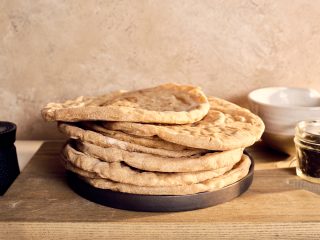
A fully whole-grain sourdough pita with a soft texture, reliable puff, and the depth of flavor you only get when sourdough fermentation meets high-quality whole wheat flour.
Ingredients
Levain
- 66g whole wheat flour
- 66g water
- 7g ripe sourdough starter, 100% hydration
Main Dough
- 632g whole wheat flour
- 437g water 1
- 84g water 2
- 14g fine sea salt
- 139g ripe levain (from above)
- 14g extra-virgin olive oil
Instructions
- Prepare the levain (Day One, 9:00 p.m.) Mix the levain ingredients in a jar and leave covered at 74–76°F (23–24°C) to ripen overnight. Alternatively, use your ripe sourdough starter first thing in the morning — just keep in mind that if your starter contains any white flour, the final pita won’t be 100% whole grain.
- Mix (Day Two, 9:00 a.m.) With a mechanical mixer: Add the levain, salt, and water 1 to the flour; mix at low speed for 1 to 2 minutes until absorbed. Increase to medium and mix for 5 minutes. Rest 5 minutes. Mix at medium for 5 more minutes, slowly adding water 2. Once smooth, add olive oil and mix at low speed for 1 minute until absorbed. By hand: Add the flour, levain, salt, and water 1 to a mixing bowl. Mix thoroughly with wet hands or a dough whisk. Knead for 6 to 8 minutes using either the slap-and-fold technique or folds in the bowl until smooth and less shaggy. Cover and rest 5 minutes. Add a splash of water 2 and knead for 6 to 7 more minutes, adding a little more water 2 as it gets absorbed — be cautious not to add too much at once, or the dough will break apart. Once smooth and cohesive, transfer to a bulk fermentation container and cover.
- Bulk fermentation (9:30 a.m. to 12:30 p.m., 3 hours) At 74–76°F (23–24°C), give the dough 2 sets of stretch and folds at 30-minute intervals. After the second set, let the dough rest undisturbed for the remainder of bulk fermentation.
- Divide and shape (12:30 p.m.) Flour a half sheet pan with white flour. Lightly flour your work surface and the top of the dough, then scrape it out. Divide into ten 120g pieces. Shape each into a tight ball: pat down, fold in the sides, flip, and drag against the surface to build tension. Flip and pinch the seam closed. Place on the prepared pan with a few inches between each ball.
- Proof (1:00 p.m. to 2:00 p.m., 1 hour) Cover the baking sheet and set aside to proof. Meanwhile, preheat the oven to 550°F (290°C), or as hot as it will go, with a rack in the middle and a baking steel or stone on top.
- Bake (2:00 p.m.) The dough is ready when it has increased about 30% in volume, feels soft to the touch, and just barely passes the poke test. Prepare a large lidded container lined with a kitchen towel, a small bowl of flour, and a lightly floured pizza peel. For each pita: drop a dough ball into the flour bowl, flip, transfer to your work surface, pat down, flip, and pat again. Roll to 7 inches in diameter and about ⅛ inch thick — use light pressure to avoid compressing the dough. Transfer to the peel and slide into the oven. Bake 1 to 2 minutes until it puffs, flip with a fish spatula, and bake 1 more minute. Transfer to the towel-lined container and cover. Repeat with remaining pieces.
Notes
- Storage: These pitas keep for up to a week in a sealed bag on the counter. Warm in a low oven or toaster oven for a few minutes before serving.
- Starter substitution: You can skip the overnight levain and use your ripe starter directly. If your starter includes white flour, the amount in the final dough is negligible but technically not 100% whole grain.
- Baking surface: A preheated baking steel or stone is essential for the high heat transfer that drives the puff.
- Rolling tip: Don’t press hard when rolling — light pressure prevents the dough from compressing and sticking.